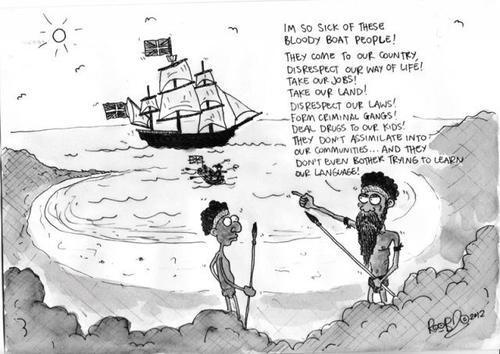
Mark Brett on why Christians should be championing the cause of asylum seekers

Boat people

So why should Christians be championing the cause of asylum seekers today? In short, this issue goes to the heart of our identity and calling as the people of God.

The Gospel of Matthew tells us that Jesus started life as a refugee child, fleeing with his family to Egypt.  Even his father’s name, Joseph, reminds us that Jesus was not the first Jew to be a refugee in Egypt. All the tribal ancestors of Israel took refuge there. We read that scripture was fulfilled when Jesus went there as a child, because “Out of Egypt I called my son” (Matthew 2.15). The quote is from Hosea 11.1:  “When Israel was a child I loved him, and out of Egypt I called my son”. That is, Matthew sees a spiritual analogy between the life of Jesus and the life of Israel: both are marked by the refugee experience.

And this experience is also embodied in the laws of Israel. So, for example, Leviticus 19.34 says:

The immigrant who resides with you shall be to you as the citizen among you; you shall love the immigrant as yourself, for you were immigrants in the land of Egypt: I am the LORD your God.  (cf. Exodus 22.21)

Similarly, the later prophets came to recognize the treatment of asylum seekers as a litmus test of faith (e.g., Jeremiah 7.5-7).

In the Old Testament, the ‘immigrant’, ‘alien’, ‘refugee’ or ‘sojourner’ (all possible translations of ger) is a foreigner who has left his or her country to settle elsewhere. Perhaps the most common reasons for movement are famine and war.

Some things never change: the United Nations Convention Relating to the Status of Refugees (1951), for example, arose as a response to international displacements following World War II, and since Australia is a signatory to this Convention, we recognize the legal right to seek asylum.

When people arrive in a host country, there are always complex questions about the extent of their assimilation. Not surprisingly, then, Old Testament laws sometimes set assimilating strangers apart from ‘the foreigner’ (thenokri or ben nekar) who is not given full rights of participation (e.g., Exodus 12.43 excludes such people from the Passover). This distinction is surprisingly overturned, however, in Isaiah 56.3,6 where the ‘foreigner’ (ben nekar) can offer acceptable sacrifices to God and is welcomed into the covenant community.

References to strangers in the New Testament are few but significant. Being ‘strangers’ (paroikoi) becomes a central metaphor for Christian identity in some books, building on the theological idea in Leviticus that all Israelites were in some sense ‘sojourners’ (Leviticus 25.23, cf. 1 Peter 1.1 and Ephesians 2.19).

Perhaps against our expectations, we may even find Christ present in the stranger. This is precisely the point that is made in the parable of the sheep and the goats in Matthew 25: the hungry and thirsty stranger (xenos in vs. 38 and 44) may actually be the Lord, and not even the people in the parable called ‘the righteous’ have been able to discern this. In other words, no-one has the power to tell whether the needy stranger may in fact be Christ.

Ezekiel 47 is also a challenge to our political imagination: it takes us beyond random acts of kindness and demands that refugees be given a ‘fair go’ in the provision of land, that is, basic resources that provide the foundation of economic security:

So you shall divide this land among you according to the tribes of Israel. You shall allot it as an inheritance for yourselves and for the aliens who reside among you and have begotten children among you. They shall be to you as citizens of Israel; with you they shall be allotted an inheritance among the tribes of Israel. In whatever tribe aliens reside, there you shall assign them their inheritance, says the LORD God. (Ezekiel 47.21-23)

In international comparisons (taking account of national wealth and population sizes), the welcome that Australia offers to asylum seekers is not very impressive.

– Mark Brett, ‘Hospitality: A Biblical Perspective’.

Ed. This piece, written in 2011, and which cites sources which are almost prehistoric, is, of course, completely irrelevant and dated now and I only draw attention to it for the benefit of those historians who may one day be interested in researching such obscure things. It’s almost impossible today to believe that once upon a time some Christians who happen to be living in Australia thought it an act of compassion and of mature political judgement to demonise some of the most vulnerable and yet extraordinarily courageous people on the planet, and an act of freedom to disregard not only the rule of law but, more importantly, the command of God.
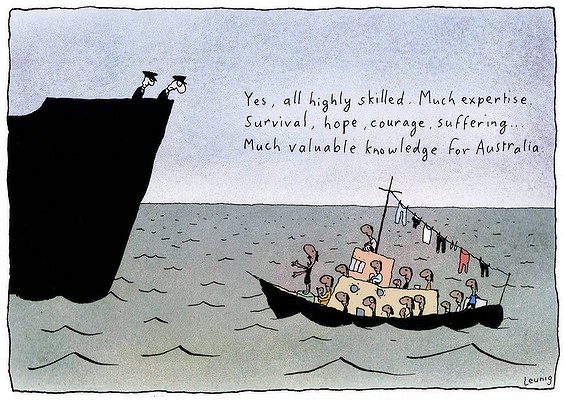
Leunig - Refugees

PARK(ing) Day Eucharist

Parking day

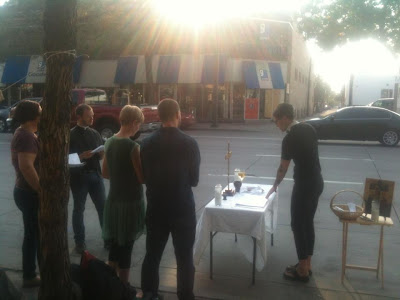
Now here’s a little invitation that I would love to see a few churches take up: PARK(ing) Day, which takes place this year on Friday 20 September, is ‘an annual worldwide event where artists, designers and citizens transform metered parking spots into temporary public parks’. And it occurred to me (and clearly to others too) that this just might be a great place, way and opportunity for Jesus’ friends – and his friends-to-be – to celebrate the Lord’s Supper; i.e., to proclaim the weird and inconvenient and public activity of God’s reign in the world.

And while it’s true that every now and then, reality protrudes ‘into the protective armor of illusion and the result is psychological havoc’, what’s not to welcome – and to like – about that!

A wee update on Descending on Humanity and Intervening in History

Forsyth - 1892A number of folk have written to ask me where things are at with my forthcoming bookDescending on Humanity and Intervening in History: Notes from the Pulpit Ministry of P.T. Forsyth. I’m pleased to report that things are progressing well. The proofs are looking great, and the cover designer is just working on producing something agreeable. In the meantime, the book has received the following kind endorsements:

‘Far from being a collection of cozy meditations, here are challenging, biblically rooted, theologically powerful, pastorally concerned essays and sermon notes by Britain’s most stimulating theologian of the twentieth century. Church members will be energized; preachers will be prompted towards relevant exposition. This book is the product of much persistent burrowing by Jason Goroncy, whose substantial introduction is an exemplary piece of scholarship in its own right. We are greatly indebted to him’. – Professor Alan P. F. Sell, University of Wales Trinity Saint David

‘Few modern theologians have displayed the combination of intellectual energy, rhetorical power, and pastoral commitment of P. T. Forsyth. In this valuable collection of Forsyth’s sermons, many of them hitherto unpublished, we encounter a conviction too often absent in church and academy alike – that theology and preaching belong vitally together. In these striking examples of that vision, contemporary readers will find much to learn, challenge, and inspire’. – Ivor J. Davidson, University of St Andrews

Chasing essays [updated]

I can't find itFor some weeks now, I’ve been wracking my brains, various search engines, and a plethora of library catalogues trying to get my hands on the following two essays:

  • Brian G. Armstrong, ‘Semper Reformanda: The Case of the French Reformed Church, 1559–1620’, in Later Calvinism: International Perspectives (ed. W. Fred Graham; Kirksville: Sixteenth Century Journal Publishers, 1994), 119–140.
  • Richard Muller, ‘Diversity in the Reformed Tradition: A Historiographical Introduction’, in Drawn into Controversie: Reformed Theological Diversity and Debates Within Seventeenth-Century British Puritanism (Oakville: Vandenhoeck & Ruprecht, 2011), 1–30. (I only need the last 5 pages of this one!)

Even where I have (finally) been able locate the relevant items listed in a library catalogue, the librarian has been unable to unearth the book! Sigh! So, basically, I need some help here and am really keen to hear from anyone who may have copies, or access to copies, of one or both of the aforementioned essays. I can be contacted via here.

Note: I’m both delighted and relieved to declare that this hunting trip is now over. Many, many thanks, indeed to all those who have so kindly offered to assist me in my hunt for these two essays. I have been humbled by the response … and I now have copies. Thank you.

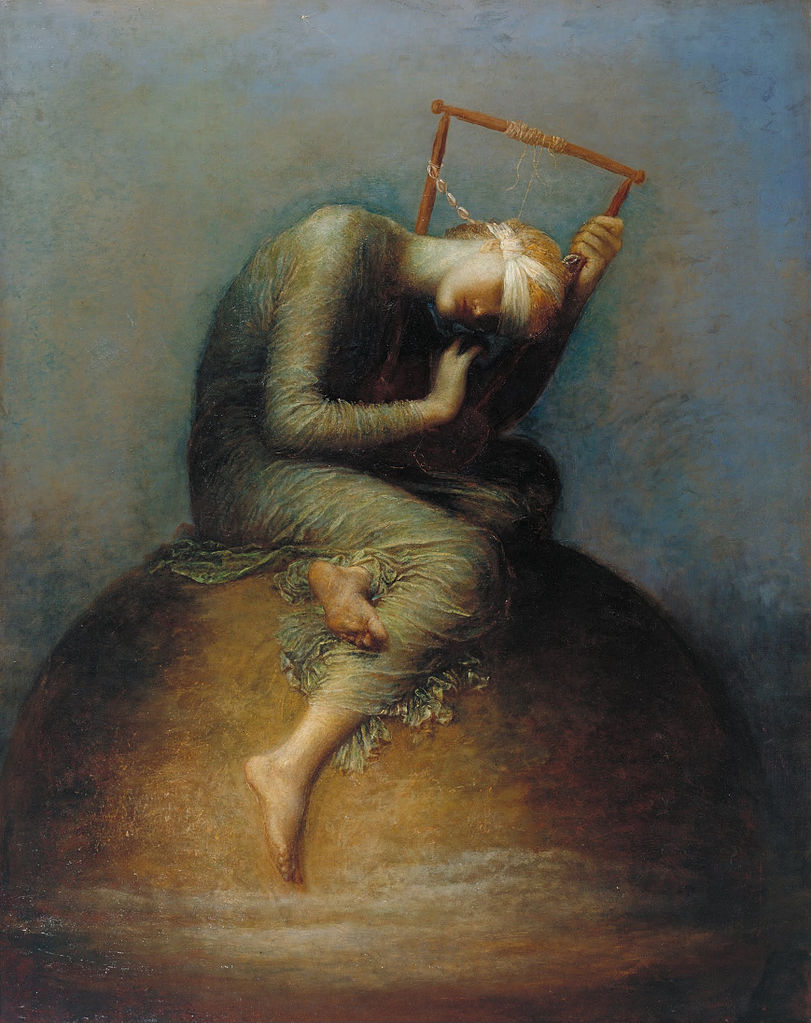
Hope: a late-winter reflection

Watts - Hope 2The thought of my affliction and my homelessness is wormwood and gall! My soul continually thinks of it and is bowed down within me. But this I call to mind, and therefore I have hope: The steadfast love of the Lord never ceases, his mercies never come to an end; they are new every morning; great is your faithfulness. “The Lord is my portion,” says my soul, “therefore I will hope in him.” – Lamentations 3.19–24

To be human is to be a creature of hope, to be orientated towards something which or someone who transcends the boundaries of our own history and experience, and to see our life as anchored somewhere beyond view. I was reminded of this again recently when I was reading Václav Havel’s wonderful book Disturbing the Peace wherein he writes:

… the kind of hope I often think about (especially in situations that are particularly hopeless, such as prison) I understand above all as a state of mind, not a state of the world. Either we have hope within us or we don’t; it is a dimension of the soul, and it’s not essentially dependent on some particular observation of the world or estimate of the situation. Hope is not prognostication. It is an orientation of the spirit, an orientation of the heart; it transcends the world that is immediately experienced, and is anchored somewhere beyond its horizons …

Hope, in this deep and powerful sense, is not the same as joy that things are going well, or willingness to invest in enterprises that are obviously headed for early success, but, rather, an ability to work for something because it is good, not just because it stands a chance to succeed. The more unpropitious the situation in which we demonstrate hope, the deeper that hope is. Hope is definitely not the same thing as optimism. It is not the conviction that something will turn out well, but the certainty that something makes sense, regardless of how it turns out. In short, I think that the deepest and most important form of hope, the only one that can keep us above water and urge us to good works, and the only true source of the breathtaking dimension of the human spirit and its efforts, is something we get, as it were, from “elsewhere.” It is also this hope, above all, which gives us the strength to live and continually to try new things, even in conditions that seem as hopeless as ours do, here and now. (pp. 181–82)

Christians, and people of other faiths too, will want to give a particular name to this ‘elsewhere’ of which Havel (who was an agnostic) speaks, and the ‘love’ and ‘mercies’ and ‘faithfulness’ of the Lord of which the writer of Lamentations (possibly Jeremiah) speaks, but the basic conviction here will be shared by all. For Christians, this ‘elsewhere’ has a name – Jesus Christ – and it has a particular shape – the cross and resurrection. And St Paul reminds us that to call upon this name, and to embody this cross-resurrection shape, and to participate in this hope – in this ‘elsewhere’ orientation – is something that we do not do alone, for the patient Spirit of God hopes along with us too, perhaps especially when things feel the most hopeless, and waits with us for all things to become new.

And this hoping also takes a particular kind of shape in our world. And it is important that it does, for as Edward Schillebeeckx reminds us, ‘Who could believe in a God who will make everything new later if it is in no way apparent from the activity of those who hope in the One who is to come that he is already beginning to make everything new now?’

Hope, in other words, does not allow us to remain unmoved, but the Spirit of hope ‘leads us into life, into the whole of life’, and encourages faith so that it does not degenerate into faintheartedness, and strengthens love so that it does not remain enclosed within itself and with those who are like it.

Hope leads everything.
For faith only sees what is.
But hope sees what will be.
Charity only loves what is.
But hope loves what will be –
In time and for all eternity. (Charles Péguy, as cited in Jürgen Moltmann, The Experiment Hope, 189)

♦♦♦

Prayer (modified from Terry Falla, Be Our Freedom, Lord, and Rowland Croucher, ed., Still Waters, Deep Waters, 127–28)

O Lord our elsewhere, be for us the truth on which our life and death are built, the hope that cannot be destroyed, the freedom from which love and justice flow, and the joy that has eternity within it.

God of hope, we confess that we have fallen prey to false hopes; hopes of success, prestige, influence; we have invested ourselves emotionally in them only to be disappointed.

We pray for those we see deceived by the illusions of false hope; led by false shepherds, political and psychological messiahs who promise much, but deliver little.

We praise and thank you for our true hope, a sure and certain hope in your Son, and pray that even today we might live in the light of the last day. Help us not to be nostalgic for the past nor possessive of the present, but, with the Spirit’s help, to hold today and each day open to the future heritage of your Kingdom. Amen.

god in the art gallery

God in the art galleryTomorrow night, I will be speaking about (and showing some slides of) artist’s images of Jesus. Here are the details:

Where: The Seminar Room at Salmond College, 19 Knox Street, Dunedin
Time: 7.30 pm

If you’re in Dunedin, you are very welcome to come along. There’s even supper.

Forsyth’s plea for an All Creatures’ Day

cow‘Now what day should we have for All Creatures’ Day? You will not find that in the almanack either. But what better day could we have than this selfsame Christmas Day? For was Jesus born among other children? Was He born into a nursery? Was there a crowd of other children all eager to see the new baby, and all clapping their hands when they did? Nothing of the kind. You know He was born in a stable, with a horse-trough for a cradle, with straw for a bed, and the cattle for company. There was the ass on which His mother rode, there were the asses of the other travellers who had got rooms in the inn; there were the cows belonging to the farm, and the fowls pecking in the straw; and there were the sheep—well, the sheep, of course, were in the fields, where the angels’ message came to the men who were taking care of them. The animals were nearer to the infant Jesus than any children were. And how often He spoke of the animals when He grew up; and He never spoke as if he despised them, but always as if He watched and loved them. And how very much the animals owe to Jesus! How much better the religion of Jesus has made people treat animals! The animals owe Jesus a great deal, if they but had a tongue to tell it. Yet they have tongues. I once saw a very old carving of the Nativity over a great church door. Now, I have seen several old pictures of the Nativity with the animals standing by or looking in with great interest at the stable window. But in this case they were still more interested; they were very affectionate to the baby, and their tongues expressed it. For it was two cows, and they had come up to the manger. You may know, perhaps, how curious cows are about clothes. They eat the cottage wash sometimes when it is hung out on the hedge. Well, among the swaddling clothes they found the baby; and they were so far from being disappointed that they felt quite loving, and they were licking it with their great rough tongues. I often think cows very kindly animals, but I never thought so more than then. Very likely the artist, with a kindly humour, wished to represent the homage of the creatures for the little Jesus. And he knew that they could not speak and praise with their tongues like men. So he made them worship in the only way their tongues could’.

– P. T. Forsyth, ‘Dumb Creatures and Christmas: A Little Sermon to Little Folk, 1903’ in Descending on Humanity and Intervening in History: Notes from the Pulpit Ministry of P.T. Forsyth (ed. Jason A. Goroncy; Eugene, OR: Pickwick Publications, 2013).

On reading P. T. Forsyth

River bankRecently, I posted a snippet from one of my forthcoming books, another on P.T. Forsyth, titled Descending on Humanity and Intervening in History: Notes from the Pulpit Ministry of P.T. Forsyth. As the typesetter and myself put the final touches on the manuscript, I have been struck again by the gift that discovering Forsyth has meant for me. I share a little of that in the book’s Introduction. Here’s a taste:

There can be little doubt that one of the real gifts that this great Congregationalist and Edwardian theologian bequeathed to the Church is the encouragement of her ministers to forego the “affable bustle” that would see them running errands for the culture motivated in no small part by an attempt to convince the world—and the Church!—of the use, value and worthiness of their vocation, and to instead give themselves wholly to echo and bear witness to divinely-ordained foolishness—what Forsyth calls “the Folly of the Cross”—and to trust the outcome to God. Those who carry the burden—a joyous burden to be sure, but a burden nonetheless—of preaching week after week will no doubt be familiar with that anxiety that attends the sweat marks staining the manuscript, the fruit of one’s wrestling with the very impossible possibility of the preacher’s task—which is nothing less than witness to and confession of God’s self-disclosure—of addressing those not only desperate to hear the Word of life but also those long deafened by the drums of seemingly endless counter-words, that feeling that despite all one’s best efforts the fire that burns so freshly in the heart of the biblical witness has all but been snuffed out by the time the sermon is made public. Such an experience is not uncommon among ministers; nor is the quest for some trustworthy guides. The pulpit is a demanding mistress!

A generation after Douglas Horton discovered Karl Barth’s Das Wort Gottes und die Theologie in the library of the Harvard Divinity School and in Barth’s “strange new world” a potent alternative to the dehydrated humanism in which he had been trained, Browne Barr, who later taught homiletics at Yale, made a similar discovery in 1944 when, as a green minister in a recently-vacated parsonage he found himself among old-looking and left behind books which lined the study walls where the “practice pulpit set up by his predecessor . . . faced the street.” He reasoned:

The church was in such poor shape—no worship center, no 16mm projector, no personality games in the youth society or new signs on the front lawn—because the old minister, the stricken one, was a Britisher who simply was not up-to-date, modern. It was obvious he did not understand American needs nor use contemporary methods. There wasn’t a single flannel cloth board in the whole church or parsonage, but he certainly had a lot of books! The young man glanced at the titles and his eye fell on one about “preaching” and the “modern mind.” He picked it up and flipped a few pages into it . . . He remained there transfixed for a long time . . . He read until darkness and cold woke him to the hours’ passing. He tucked that single volume under his arm and went down out of the attic and through the cold house and into the street. He had found the place where he was to study and practice to be a preacher for the next years of his life. He had also found the man, then dead 23 years, who was to be his instructor.

The cause of the hypnosis was Forsyth’s Positive Preaching and [the] Modern Mind. In many ways the origin of the book in your hands lies in a similar experience (or, more accurately, in a series of such experiences) in myself half a century and more since Barr’s encounter with “the homiletician’s theologian.” While sitting at a Melbourne bus stop some years before I entered pastoral ministry, the last bus for the evening had long departed before I looked up from my first reading of Forsyth’s The Justification of God. During those late hours, I was given to see myself as one having been carried into the very crisis where God and the world meet. There was something arresting, too, about Forsyth’s style. It seemed to simultaneously bear witness to the elusive nature of divine truth and to open up that space which had been cleared and invite—nay, command—me to enter, or, better still, to find myself already in, the new landscape created by the crisis, the view of and from which was entirely unexpected. Moreover, as I came to learn, this landscape, satiated as it is with the occupation of holy love, rendered hollow and disenchanting much of what my reading of theology had taught me, and what my own arrogance had assured me, and underlined the impotence of all creaturely aspirations, including and perhaps especially religion, to speak to the real issues facing human persons, their consciences and their communities. Here, I was confronted with a Word that one could live by with the honesty and integrity that being human demands, a Word which faced the world and not only a select minority within it living, as it were, in an ark, a Word destined to be made public to those living in the cynicism and despondency of the time, and of all times.

Words from Czesław Miłosz come readily to mind: “I have read many books but I don’t believe them/When it hurts we return to the banks of certain rivers.” One of those banks is called “reading P. T. Forsyth.” On that bank, I experienced not only a dying but also a resurrection, a resurrection into a new and still largely-unsurveyed world wherein everything and every one—including God—is viewed sub specie crucis; that is, under the vista or form of the cross. Forsyth’s thought, drenched as it is in the cruciality of God, came as a lifeline, even as something like a sacrament or as medicine which charged life itself with the Spirit who makes life life, with the Son who is the living content of God’s own good news and who experienced in a divine life our death “unsustained by any sense of the grandeur and sublimity of the situation,” and with the Father who in all the jealousy and joy of holy love transforms “bold and bitter” mutineers into the delighted and forgiven children of God who “in their living centre and chronic movement of the soul experience sonship as the very tune of their heart, the fashion and livery of their will,” and which cleared for me a way which bespoke of realities I can do little more than point to regarding the task of Christian ministry into which I was being called. Reading Forsyth, I also came to believe in preaching, and to keep on preaching when the content of my speech finds so little echo in the shape of my own living, or when my spirit is as dry as the Simpson Desert, or when it is soaking wet but off course and perilously close to the rocks, or when in darkness so overwhelming that escape seems impossible, and when, like Maurice Gee’s Reverend George Plumb, I make “loud noises to persuade back my memories.”

To be sure, to believe in preaching is to believe in miracles; or, more properly, it is to believe in One who not only already longs to speak but who also “gives life to the dead and calls into existence things that do not exist” (Romans 4:17). Moreover, to believe in preaching is to believe that such calling into existence occurs via the irresponsible method of liberally sowing seeds whether in places where there is no soil, or on rocky ground, or among thorns, or in fertile and productive soil. Of course, to believe in preaching is not the same thing as to believe in preachers. Forsyth too taught me that, and enabled me to hear what I later learnt and heard again in Barth and in others—that “the Church does not live by its preachers, but by its Word.”

– Jason A. Goroncy, ‘Preaching sub specie crucis: An Introduction to the Preaching Ministry of P.T. Forsyth’ in Descending on Humanity and Intervening in History: Notes from the Pulpit Ministry of P.T. Forsyth (ed. Jason A. Goroncy; Eugene, OR: Pickwick Publications, 2013).

Cornel West and Julian Assange in conversation

West and Assange

Here’s a remastered version of Cornel West’s interesting conversation with Julian Assange, recorded last May at the Ecuadorian Embassy in London. The ‘blues man’ wants to talk about W. B. Du Bois, R. H. Tawney, Margaret Fuller, Martin Luther King, Jr., Hannah Arendt, Abraham Heschel and Plato, and Assange wants to talks about Google, the rule of law, Bradley Manning and Wikileaks. They both like talking about courage, and appropriately so. The pastor-theologian in me wishes that they had also spent some time talking about ego.

[An earlier version of the talk was posted here.]

On reading Moby Dick

Moby Dick

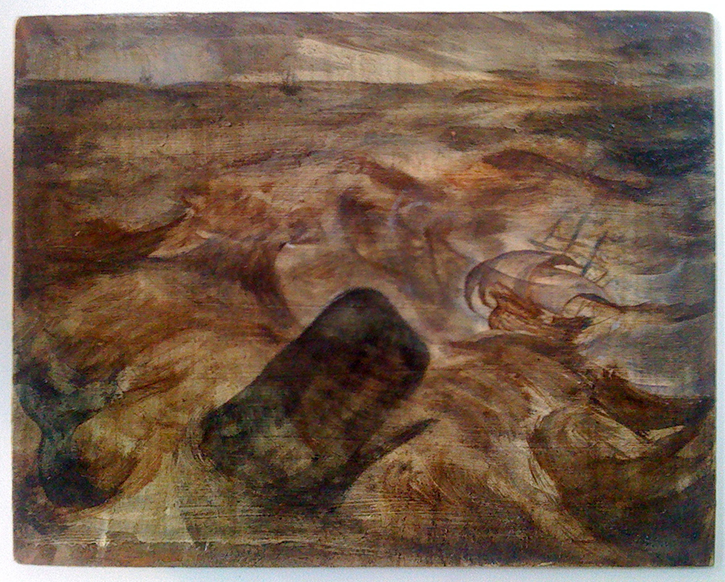
‘It is generally recognized that the canons of the ordinary novel do not apply to Moby-Dick. If we applied them we should be forced to put it down as an inept, occasionally powerful, but on the whole puzzling affair. This was the opinion up to two decades ago. During those decades we have discovered Moby-Dick to be a masterpiece. What caused this shift in perspective? To put it simply, we discovered how Moby-Dick should be read. We must read it not as if it were a novel but as if it were a myth. A novel is a tale. A myth is a disguised method of expressing mankind’s deepest terrors and longings. The myth uses the narrative form, and is often mistaken for true narrative. Once we feel the truth of this distinction, the greatness of Moby-Dick becomes manifest: we have learned how to read it’. – Clifton Faldman, in The Atlantic Monthly 172 (July, 1944), 90. [HT]

[Image: Clara Drummond, ‘Cape-Horner in a great Hurricane’. Oil on board, January 2012]

The Reformation as a triumph of the sacraments

WineIn a wee reflection on Herbert McCabe’s The New Creation, Peter Leithart offers a good word on why the magisterial reformers were not about the triumph of word over sacraments:

[T]he mainstream Reformers were more sacramental than the Catholic church. For the Reformers, no one was to participate in the life of Christ’s body non-sacramentally. That was simply a contradiction in terms, for the sacraments were the means of participations. Sacramental participation and membership in Christ are completely co-extensive; there’s no spillage or overlap, such that someone (an infant, say!) might be seen as a member of Christ without being marked with Christ’s sacramental sign. The Reformation was not a triumph of word over sacrament; it was a triumph of sacraments.

You can read the rest of the article here. [HT to David Entwistle for drawing my attention to it]

And some of my own thoughts on the Supper can be read here.

Symposium on Theology, Spirituality and Cancer

Theology, Spirituality and CancerThe School of Theology at The University of Auckland, and Laidlaw College, are organising a Theology, Spirituality and Cancer symposium, an ‘interdisciplinary meeting exploring dialogue between theological (including biblical), religious, philosophical, spiritual, healthcare and pastoral arenas’. The symposium, which will be held on 20-21 February 2014 at the University of Auckland (City Campus), is aimed at academics and practitioners, including religious ministers, chaplains, counsellors and healthcare practitioners in related areas, and will ‘address issues such as theodicy, cancer therapies, end of life care, pastoral issues, and insights a theological, religious or spiritual perspective can bring to an understanding of all aspects of cancer’. More information, including the Call for Papers, is available here.

John Milne’s ‘The Jesus Prayer’

A few weeks ago, I drew attention (here on PCaL) to the work of American composer John Milne and to his piece  ‘Per Crucem ad Lucem‘. Since then, John has kindly sent me a number of additional recordings of his work, so I thought I would share another one. Here’s his rendition of ‘The Jesus Prayer’:

Lord Jesus Christ, Son of the Living God, have mercy on me, a sinner
In death, I will stand before the Son of Man – Behold I tell you a mystery.

July stations …

Jayber CrowReading:

Listening:

Watching:

Ageing and Spirituality conference

Aging-5The Selwyn Centre for Ageing and Spirituality is organising a one-day conference to ‘hear New Zealand researchers and others with an academic interest in the area speak about ageing and spirituality’.

Dates:  6 September 2013, 9.30 am – 4 pm

Place:   Tamaki Campus – University of Auckland, 261 Morrin Rd, St Johns, Auckland

The conference is concerned with the following topics:

• Spirituality and ageing: a discussion from a principle-based, evidence-informed and zeitgeist-based approach
• Spirituality teaching in NZ medical schools
• Spirituality in a Dunedin rest home
• The church and older people after the Christchurch earthquakes
• Older people and euthanasia
• Religious and spiritual data from the LILAC study
• The role of religion/spirituality in mental health and mental health care – general findings and data and literature relevant to the older adult participants
• Caregiving across cultures
• Grief and loss in caregivers of people with dementia
• The role of caregivers and their interaction with rest home residents, particularly noting their preparedness to respond to needs of a spiritual nature
•  Spirituality in residential dementia care

More information here.

Seeking asylum in Australia

Refugee Rights Protest at Broadmeadows, MelbourneRecent weeks have witnessed no shortage of ink spilt on the matter of the Australian government’s disgraceful – and illegal – policies vis-à-vis asylum seekers. And appropriately so! A number of people have asked me to comment on this question, and at some stage, when I have more moments to spare than I do this week, I may spill some ink of my own on it. In the meantime, however, I wish to draw attention to, and to commend, one editorial (among the many dozens that I have read) that I found particularly helpful. It’s Robert Manne’s piece (published in March this year and so before developments in recent days), ‘Tragedy of Errors: Australia’s shipwrecked refugee policy’.

[There is also an edited transcript of a speech by Barry Jones: ‘Asylum is the greatest moral challenge of our time’. The latter is significantly less satisfying than Manne’s piece, but worth a read all the same, not least given Jones’ long and high profile relationship with the ALP.]

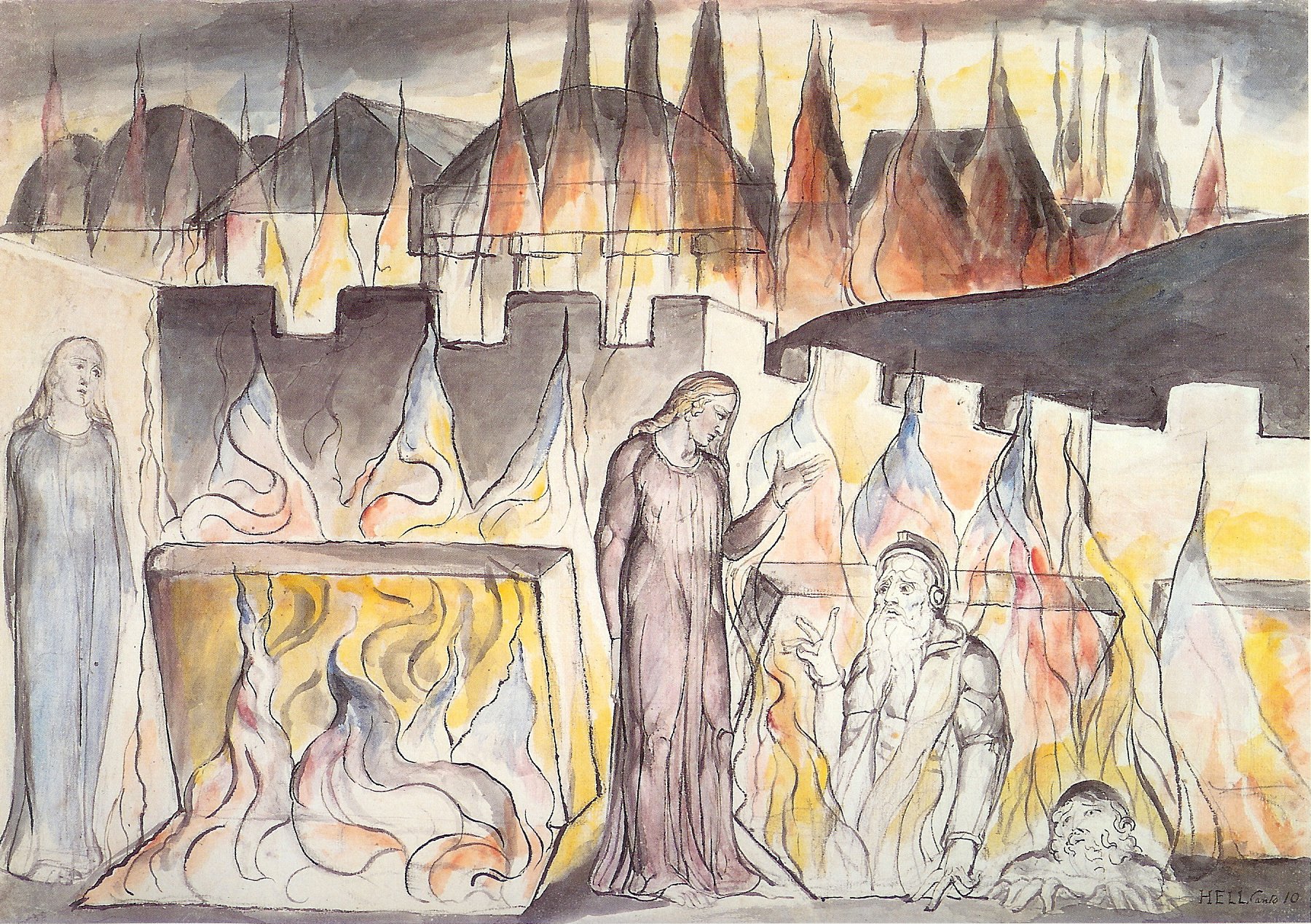
‘The Good Man in Hell’, by Edwin Muir

Blake Dante Hell X Farinata

If a good man were ever housed in Hell
By needful error of the qualities,
Perhaps to prove the rule or shame the devil,
Or speak the truth only a stranger sees,

Would he, surrendering to obvious hate,
Fill half eternity with cries and tears,
Or watch beside Hell’s little wicket gate
In patience for the first ten thousand years,

Feeling the curse climb slowly to his throat
That, uttered, dooms him to rescindless ill,
Forcing his praying tongue to run by rote,
Eternity entire before him still?

Would he at last, grown faithful in his station,
Kindle a little hope in hopeless Hell,
And sow among the damned doubts of damnation,
Since here someone could live and could live well

One doubt of evil would bring down such a grace,
Open such a gate, all Eden would enter in,
Hell be a place like any other place,
And love and hate and life and death begin.

– Edwin Muir, ‘The Good Man in Hell’ in Collected Poems (London: Faber and Faber, 1960), 104.