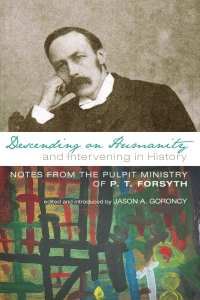
‘Descending on Humanity and Intervening in History’ is now available

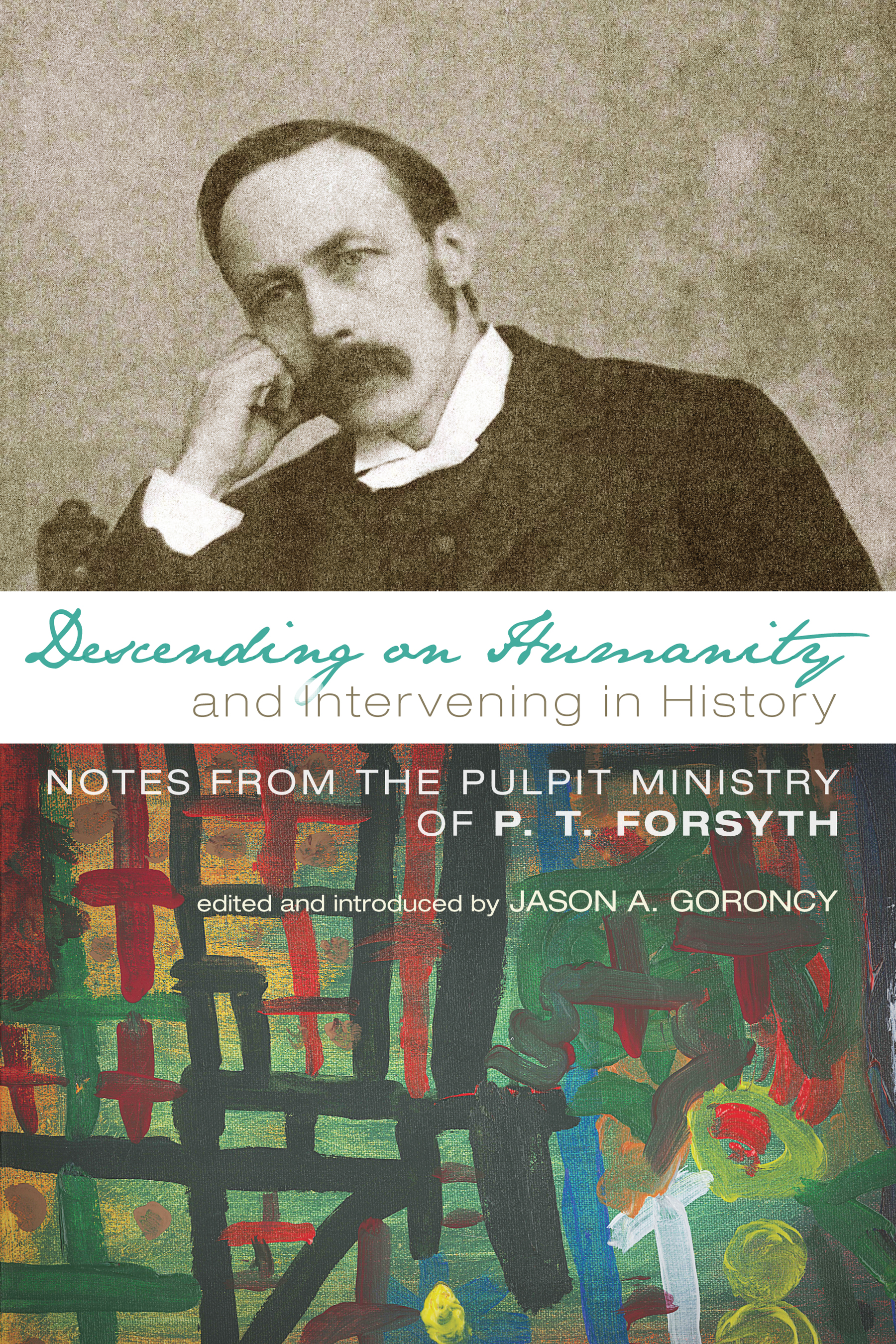
Forsyth.DescendingonHumanity.90702After a very long gestation period, I’m truly delighted to finally announce the birth of Descending on Humanity and Intervening in History: Notes from the Pulpit Ministry of P. T. Forsyth. As I mentioned in a previous post, it has been a pregnancy marked by great joy and hope, and, I might add, by very few bouts of morning sickness.

The book includes a marvelous foreword by Professor David Fergusson, a lengthy (and, I hope, helpful) introduction to Forsyth’s preaching ministry written by myself, and, from Forsyth’s pen, forty-eight sermons, over half of which are previously unpublished. It seeks to introduce Forsyth, his thought, his ministry, and the Word he served, to a new generation of readers, to provide those already familiar with his writings some new material to digest, and to encourage preachers – and those who hear the Word of the Lord through them, or in spite of them – to not abandon the ‘earth’s foremost part’ (as Herman Melville described the pulpit), especially at a time when the storms are so inexorable and the spoils of exile are so scrumptious.

It will, of course, be up to others to judge, but I think that the book would make a judicious gift for any minister, theology student, historian, or general reader. You can order copies here or via here or by contacting me directly.

If you are interested in reviewing the volume, then please contact Amanda Vanderhoof at Wipf and Stock.

Mother and baby are feeling great, and the siblings proud.

‘Missional God, Missional Church’: a review

Ross Hastings, Missional God, Missional Church: Hope for Re-evangelizing the West (Downers Grove: IVP Academic, 2012). ISBN: 978-0-8308-3955-1; 321pp.

A guest post by Kevin Ward.

The words ‘missional’ in general and ‘missional church’ in particular are real buzz words in the church at the moment, and nowhere more so than within the PCANZ. Put ‘missional’ in front of anything and it legitimates it. The missional movement has much to offer in thinking about our current situation and its challenges going forward, and is something I have engaged with ever since the book Missional Church (edited by Darrell Guder) was published in 1998 – yes that’s how long it has been around for. My great concern is that it has rapidly become a fad, and like so many of those that have come and gone in the forty-plus years I have been involved in church leadership, it too will go. Ross Hastings’ book is, I believe, one of the most important and helpful of all the books that have been published with the word ‘missional’ in the title. This is largely because it is called ‘Missional God, Missional Church’. The order is important. A missional church flows out of a missional God, and so the first task we face as a church is not developing new forms of ‘missional’ churches or new programmes that will make our existing churches missional, but actually coming anew to a proper understanding of who the God whom we know and experience through the Father’s sending of Jesus and the Father and Son’s sending of the Spirit truly is.

Hastings takes us back to these key foundational understandings, before moving us on to envision what this means for our understanding of the church and how we engage with the world in God’s mission in it. In the missional movement the key text is John 20:21, ‘As the Father has sent me so I am sending you’, which is followed by Jesus breathing the Spirit onto the disciples. Sadly, in the life of the church this has played second fiddle to Matthew 28:19–20. Hastings frames the whole book around a wonderful exposition of John 20:19–23, which he calls ‘the greatest commission’, arguing that in this picture of the frightened disciples huddled in the upper room with Jesus in their midst, all of the elements needed for the church to fulfil its calling as the community of the God of mission are present.

Based on a sound Trinitarian theology, the book moves on to develop a solid ecclesiology and missiology, both of which reflect the character of the God whose life they flow from. One of the great values of the book is that it corrects many of the false dichotomies that can be found in so much other work. The missional God is both a sending God and a gathering God, and so the church needs to both send and gather. Flowing from this, therefore, the church needs to be both deep and wide, grounded in the traditions of the faith as an alternative community but taking God’s shalom far and wide into the world. Both worship and mission are intrinsic to the life of the church. To do the latter it needs to inculturate the gospel without becoming enculturated itself. In other words, incarnate the gospel into the culture of the context it finds itself in without accommodating itself to it. Indeed, the theology of culture and personhood in the book is one of its great treasures. When it comes to the practice of mission, Hastings has a broad and holistic understanding of mission – what Renee Padilla calls integrated mission, which is much more true to a biblical understanding than the rather limited concept found in much of the missional church material. There are two final things I am pleased to find in this book. Missing in much of the other literature is a great love of and passion for the church, which while not being the goal of God’s mission, is certainly critical in it. Much of the missional church material takes a critical and almost dismissive stance toward the church. ‘The essential sociality of salvation, implies the essential institutionality of the church. The question is not whether the church is an institution, but rather what kind of institution is it’ (p. 133). Finally, Hastings gives adequate attention to the role of the Spirit in both the life of the church and God’s mission, something that is missing in much of the other material.

Ross Hastings parents were missionaries for 60 years in Africa, he has PhDs in both science and theology, has served as minister in two urban churches, and now teaches theology at Regent College in Vancouver. All of these factors help to make this a book which combines solid biblical and theological understanding, clear social and cultural analysis, pastoral empathy for people and the church, and a deep concern for mission in western societies – a wonderful holistic treatment. I cannot recommend it enough for those who are concerned to work in the deep and integrated way that is necessary if our churches are to truly live out the life that our missional God is calling us to.

Position: Director, Presbyterian Church Schools’ Resource Office

Applications are now invited for the position of Director of the Presbyterian Church Schools’ Resource Office. In 2011, an office was established to strengthen and support the Christian character of the thirteen schools and colleges around the country that are affiliated to, or associated with, the Presbyterian Church of Aotearoa New Zealand. This role consists largely of supporting chaplains and religious education teachers in their work, and the compilation and development of curriculum resources.

The office is run by the Knox Centre for Ministry and Leadership on behalf of the church schools. It is currently located in Auckland, but can be relocated if necessary.

This is a half-to-two-thirds-time position.

The successful candidate will have a theological qualification, a teaching Diploma, and proven experience in chaplaincy and/or teaching. Knowledge of, and/or ministry within, the Presbyterian Church and the Reformed tradition will be an advantage.

Enquiries about the position (including requests for a job description) should be directed to the Principal of the Knox Centre for Ministry and Leadership, the Very Rev Dr Graham Redding (phone: 03 473 0784; email).

Applications should be submitted to the Principal of the Knox Centre for Ministry and Leadership, either in hard copy (address: Knox College, Arden St., Opoho, Dunedin 9010) or electronically (email) by 15 November 2013.

Leunig on Cirque Canberra

Michael Leunig‘s latest three cartoons are a fitting commentary on Cirque* Canberra:

Leunig-Wedding--Oct-9

MPs

Travel Expenses

Plus, one from a few weeks earlier:

Politics-21-Sept

* There is, of course, another  and equally truthful  way of thinking about the image of the circus. I think, for example, of William Stringfellow‘s reflections on the circus as an event of the eschaton. Picking up the image in the wake of Ingmar Berman and Georges Rouault, Stringfellow propose that we recognise circuses as parables of the kingdom and, as such, as parodies of the world as it is. I suspect that Leunig would like that image too.

A wee note on ‘hypothetical universalism’ in the Reformed tradition

John_Owen by John_Greenhill

One of the recurring themes that crops up in conversations with my students is over the various articulations of and arguments for and against soteriological universalism. And, from time to time, some of my students are even interested in knowing what the Reformed tradition (my students are, after all, trying to be Presbyterians!) has to say on the subject. And so I was delighted to find (among some less salutary material, to be sure) a helpful wee discussion on non-Amyraldian hypothetical universalism in English Reformed orthodoxy in Richard’s Muller’s essay ‘Diversity in the Reformed Tradition: A Historiographical Introduction’ wherein Muller writes:

‘Given that there was a significant hypothetical universalist trajectory in the Reformed tradition from its beginnings, it is arguably less than useful to describe its continuance as a softening of the tradition [as Jonathan Moore does]. More importantly, the presence of various forms of hypothetical universalism as well as various approaches to a more particularistic definition renders it rather problematic to describe the tradition as “on the whole” particularistic and thereby to identify hypothetical universalism as a dissident, subordinate stream of the tradition, rather than as one significant stream (or, perhaps two!) among others, having equal claim to confessional orthodoxy’.

Moltmann on the interactions between science and theology

Is the world unfinished? This is the title of Jürgen Moltmann’s 2011 Boyle Lecture, given on 8 February 2011 at St Lawrence Jewry, London, and subsequently published in Theology. Herein, Moltmann explores interactions between theology and the sciences, the ‘readabilty of the world’, and the non-contradiction that exists between the empirical concept of nature and the theological concept of creation. Moltmann also reflects on some themes more traversed in his thinking; namely, the nature of time and history and their openness to the future. The lecture’s gracious respondent was Alan Torrance, who takes on naturalism, temporalist accounts of time (‘the past is not ontologically annihilated by the so-called “passage of time”‘, Torrance argues), and, albeit too briefly, Moltmann’s presentation and use of the doctrine(s) of kenosis (a doctrine which I believe was/is too easily dismissed by some theologians who share Alan’s surname and which I would love to see Alan engage with more seriously at some stage).

Jonathan Mane-Wheoki on Christianity and Māori Art and Architecture

The Crucified Tekoteko by Darcy NicholasIn July this year, the Department of Theology and Religion at the University of Otago hosted the first of what promises to be a biannual lecture series in honour of Professor Albert Moore. This year’s lectures were delivered by Professor Jonathan Mane-Wheoki, Professor of Fine Arts at Elam School of Fine Arts at the University of Auckland, and addressed the theme Toi Karaitiana: Christianity and Māori Art and Architecture’.

For those who missed these lectures, or would like to experience them post festum, these are now available:

  • Lecture 1: From Samuel Marsden to Frederick Bennett: Te Hahi Mihinare (23 July) [Video; Audio]
  • Lecture 2: From Patoru Tamatea to Ralph Hotere: The impact of Catholic spirituality and iconography (24 July) [Video; Audio]
  • Lecture 3: Regret and resistance – The Crucified Tekoteko (25 July) [Video; Audio]

My friend Andrew has also provided a wee summary of the lectures here.

Some interviews with Moltmann

Moltmann 2Undoubtedly, one of the most stimulating minds among Reformed theologians today remains that of Jürgen Moltmann. I hope to post a lecture by Moltmann soon, but here I simply wish to draw attention to three interviews that I discovered and enjoyed this morning. The first two happen to be pre-conference interviews.

The first is from the 37th National Theological Conference held at Trinity Wall Street on the theme of ‘God’s Unfinished Future’ and can be seen here. (A snippet from the interview can be read here, and Moltmann’s lecture from the conference can be viewed here and here.)

And in the lead up to BMS’s one-day Catalyst Live event, the organisers have shared a wee interview with Moltmann in which he comments on atheism, anti-intellectualism, fundamentalism, and the necessity for involvement in politics.

Finally, there’s this interview on Bibel TV  Parts I and II.

September stations …

Tilda SwintonReading:

Listening:

Watching:

  • Babel
  • The Pillars of the Earth
  • We Need to Talk About Kevin. This is one of the most extraordinary films I’ve seen in many years, with an absolutely astonishing performance by Tilda Swinton. (On a less enthusiastic note, Australia’s ‘MA 15+’ rating is severely misjudged.)

An update on “Tikkun Olam”—To Mend the World: A Confluence of Theology and the Arts

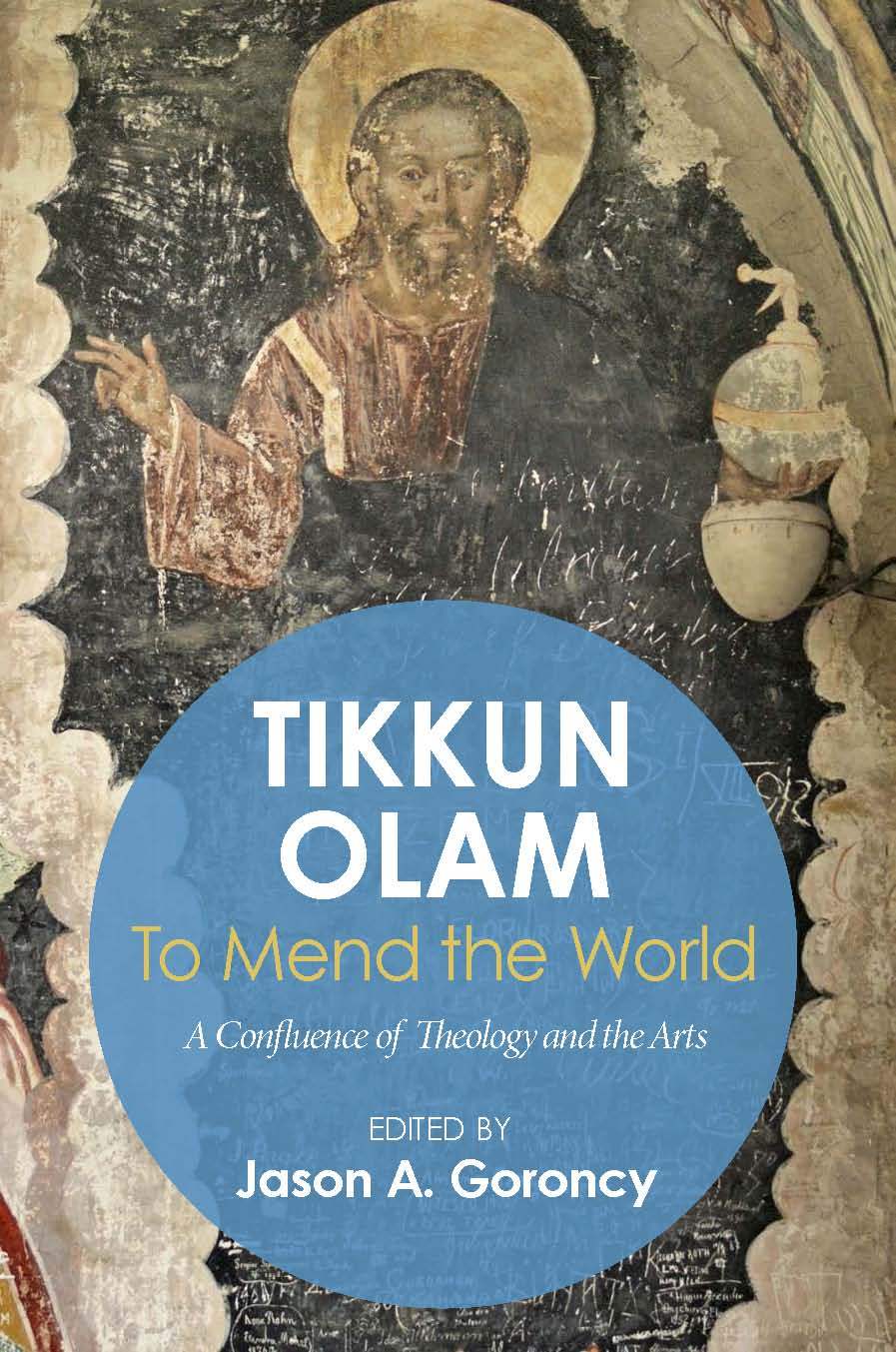
Tikkun Olam CoverRecently, the publishers, essayists and myself have picked up a gear or two with the final edits on the forthcoming book “Tikkun Olam”—To Mend the World: A Confluence of Theology and the Arts (Pickwick Publications). The book is a collection of essays premised on a very basic conviction that artists, theologians and others have things to learn from one another, things about the complex interrelationality of life, and about a coherence of things given and sustained by God. The essays therein attend to the lives and burdens and hopes that characterize human life in a world broken but unforgotten, in travail but moving towards the freedom promised by a faithful Creator. More specifically, they reflect on whether the world – wounded as it is by war, by hatred, by exploitation, by neglect, by reason, and by human imagination itself – can be healed. Can there be repair? And can art and theology tell the truth of the world’s woundedness and still speak of its hope?

The Foreword was written by New York-based artist Alfonse Borysewicz, and the Table of Contents reads thus:

  1. Introduction—Jason Goroncy
  2. “Prophesy to these Dry Bones”: The Artist’s Role in Healing the Earth—William Dyrness
  3. Cosmos, Kenosis and Creativity—Trevor Hart
  4. Re-forming Beauty: Can Theological Sense Accommodate Aesthetic Sensibility?—Carolyn Kelly
  5. Questioning the Extravagance of Beauty in a World of Poverty—Jono Ryan
  6. Living Close to the Wound—Libby Byrne
  7. The Sudden Imperative and Not the Male Gaze: Reconciliatory Relocations in the Art Practice of Allie Eagle—Jo Osborne and Allie Eagle
  8. Building from the Rubble: Architecture, Memory and Hope—Murray Rae 
  9. The Interesting Case of Heaney, the Critic, and the Incarnation—John Dennison
  10. New Media Art Practice: A Challenge and Resource for Multimedia Worship—Julanne Clarke-Morris
  11. Silence, Song, and the Sounding-Together of Creation—Steven Guthrie

Also, Jeremy Begbie and Paul Fiddes were kind enough to read the manuscript and to provide the following endorsements for the book:

‘Artistically sensitive, theologically rich, and eminently readable – this is a rare combination, but it is amply demonstrated in this fascinating set of essays’.

– Jeremy Begbie, Duke Divinity School, Duke University

‘Emerging from a theological symposium and an art exhibition, the essays in this book show in glorious profusion and profundity the marks of this double origin. Theologians, artists, literary scholars, and musicians combine to bear witness to a world that is broken and yet is also the stage for a decisive event of divine love and healing. These are essays full of insights about order and disorder, beauty and tragedy. Their achievement is to make the reader think and, above all, imagine’.

– Paul S. Fiddes, University of Oxford

When the book becomes available, I’ll be sure to let readers here at Per Crucem ad Lucem know.

Daniel Bell on ‘Just War and Christian Discipleship’

By way of a wee follow up to a recent post on ‘just war’ theory, I wish to draw attention to a talk, which I have only just gotten around to listen to, by Daniel Bell on ‘Just War and Christian Discipleship’, the subject of a book and of this pamphlet also by Bell. It’s a paper presented at Wheaton’s Theology Conference earlier this year on Christian Political Witness, and is available for download in both MP3 and MP4 formats.

Remembering 11 September

cfd398c0-51c1-4083-87d9-744786ca8804A confession: I can be a bit of a geek when it comes to following those ‘On this day’ sites. And, in an effort to demonstrate that geeks can be good lovers, I thought I’d share some of my geek-love about important events on this day in recent history:

1226: The Roman church’s practice of the public adoration of the Blessed Sacrament outside of Mass spreads from monasteries to parishes. The Catholics are starting to go all soft.

1297: Scottish patriot William Wallace defeated Edward I’s pommie army at Stirling Bridge. Apparently, it happened just like in the movie, except that it was in black and white because it was the olden days.

1814: The poms take another beating, this time at the hand of an American fleet in the Battle of Lake Champlain. ‘Those bloody colonies are simply not towing the line’, it was reported.

1863: Bushranger Captain Thunderbolt escapes from the supposedly escape-proof Cockatoo Island gaol. Three cheers for Captain Thunderbolt!

1885: D. H. Lawrence was born in Eastwood, England. Thank you Eastwood in England.

1893: The inaugural meeting of the Parliament of the World’s Religions. Seems like a whacko concept to me.

1900–2099: New Year’s Day in the Coptic and Ethiopian calendars. Happy new year to brothers and sisters, many of whom do life in massive travail.

1916: The first time that ‘Star Spangled Banner’ was sung at the beginning of a baseball game. Nationalism and sport – who would have thought? ‘And where is that band who so vauntingly swore/That the havoc of war and the battle’s confusion/A home and a country, should leave us no more?’ Go the Red Sox!

1928: The first trans-Tasman flight, and it only took them 14 hours 25 minutes. Virgin Australia Airlines could learn a lot from Charles Kingsford Smith and Charles Ulm.

1962: The Beatles recorded their first singles, ‘Love Me Do’ and ‘P.S. I Love You’, at EMI studios in London.

1970: The final episode of ‘Get Smart’ aired on CBS-TV. So grateful for re-runs. I spent the first 8 years of my life talking to my shoes.

1973: Chilean President Salvador Allende, who was the world’s first democratically-elected Marxist head of state, died in a violent CIA-backed military coup.

1974: ‘Little House On The Prairie’ made its television debut. Tragic but true.

1977: Steven Biko died in police custody. Tragic but true.

1977: David Bowie and Bing Crosby recorded a duet version of ‘The Little Drummer Boy’. This is not looking good for music, folks. The next decade could be a real disaster on the pop music front.

1997: The Scots, the Lord’s beloved, voted to create their own Parliament after 290 years of union with the poms. Now finish the job boys!

2000: The beginning of the S11 protests against the World Economic Forum’s meetings in Melbourne.

2013: Jason had a bowl of dahl and a very large mug of coffee for breakfast. Ambrie had a bowl of muesli and a big cup of milk. Father and daughter are both doing well.

Leunig, Hunsinger and Hauerwas on ‘just war’ theory

As the US continues to beat its war drums in the Middle East, it’s a good time to think again about the so-called ‘just war’ theory. So, I draw attention to three pieces – from Michael Leunig, from George Hunsinger and from Stanley Hauerwas.

So, Leunig:

Just war

And in a recent piece published in Commonweal Magazine, Hunsinger argues that ‘a defensible case for the attack on Syria would have to satisfy traditional “just war” standards. In its modern form the just-war tradition (jus ad bellum) involves at least four primary elements: just cause, legitimate authority, last resort, and reasonable chance of success. If these criteria remain unmet, the recourse to war is unjustified’. In Hunsinger’s view, the proposed attack on Syria meets none of these standards.

And here, Hauerwas argues that the real realists are not the just-war advocates anyway, but the pacifists. Moreover, he contends that ‘the lack of realism about realism by American just war advocates has everything to do with their being American’. ‘In particular’, he suggests, ‘American advocates of just war seem to presume that democratic societies place an inherent limit on war that more authoritarian societies are unable to do. While such a view is quite understandable, I would argue that democratic society – at least, the American version – is unable to set limits on war because it is democratic. Put even more strongly, for Americans war is a necessity to sustain our belief that we are worthy to be recipients of the sacrifices made on our behalf in past wars. Americans are a people born of and in war, and only war can sustain our belief that we are a people set apart’. Such democracies, Hauerwas believes, ‘by their very nature seem to require that wars be fought in the name of ideals that make war self-justifying’. And, characteristically, Hauerwas concludes his piece with a reflection on the relationship between war, christology and ecclesiology:

Pacifists are realists. Indeed, we have no reason to deny that the “realism” associated with Augustine, Luther and Niebuhr has much to teach us about how the world works. But that is why we do not trust those who would have us make sacrifices in the name of preserving a world at war. We believe a sacrifice has been made that has brought an end to the sacrifice of war.

Augustine and Luther thought Christians might go to war because they assumed a church existed that provided an alternative to the sacrificial system war always threatens to become. When Christians no longer believe that Christ’s sacrifice is sufficient for the salvation of the world, we will find other forms of sacrificial behaviours that are as compelling as they are idolatrous. In the process, Christians confuse the sacrifice of war with the sacrifice of Christ.

If a people does not exist that continually makes Christ present in the world, war will always threaten to become a sacrificial system. War is a counter church. War is the most determinative moral experience many people have.

That is why Christian realism requires the disavowal of war. Christians do not disavow war because it is often so horrible, but because war, in spite of its horror – or perhaps because it is so horrible – can be so morally compelling. That is why the church does not have an alternative to war. The church is the alternative to war. When Christians lose that reality – that is, the reality of the church as an alternative to the world’s reality – we abandon the world to the unreality of war.

For what it’s worth, whenever I happen across Christians defending just-war theory to justify their participation in the state’s various machineries of cross-border violence (which, for the record, is not what I think Hunsinger is doing), I’m reminded of another George – George Bernard Shaw – and his challenge to (hypocritical) church leaders:

They have turned their churches into recruiting stations and their vestries into munitions workshops. But it has never occurred to them to take off their black coats and say quite simply, ‘I find in the hour of trial that the Sermon on the Mount is tosh, and that I am not a Christian. I apologise for all the unpatriotic nonsense I have been preaching all the years. Have the goodness to give me a revolver and a commission in a regiment which has for its chaplain a priest of the god Mars: my God.’ Not a bit of it. They have stuck to their livings and served Mars in the name of Christ, to the scandal of all religious mankind.

A chair in Theology and Public Issues

Centre for Theology and Public IssuesWith the recent departure of Professor Andrew Bradstock from these picturesque and stimulating shores, the Council of the University of Otago is now advertising the following position:

The Council of the University of Otago invites applications for the Howard Paterson Chair in Theology and Public Issues and Director of the Centre for Theology and Public Issues.

The University is seeking a scholar with a distinguished record of international research publications and teaching experience in the area of Theology and Public Issues, Public Theology, Christian Ethics or Applied Theology.

The Howard Paterson Professor will be expected to engage in ongoing research, teaching and postgraduate supervision and will be the Director of the Centre for Theology and Public Issues within the Department of Theology and Religion. The aims of the Centre are to facilitate research at the interface of Christian theology and society in a New Zealand context, and to encourage in the public realm theologically and ethically informed discussion on matters of public interest, including important issues of public policy. The Centre’s activities will include research and research publication, hosting conferences, public symposia and other educational events, and media commentary. The Centre has a national focus, and is also a foundation member of the Global Network for Public Theology. It attracts high-quality research students, and is expected to seek external funding to support some of its activities.

Salary will be at an appropriate point in the University’s professorial range, depending on qualifications and experience. Less experienced candidates with appropriate expertise are not precluded from applying but may be appointed at an Associate Professorial level.

For confidential enquiries about this role, please contact the search partner, Academic Search International:

Sonia Pechner, Executive Director
Email: Sonia.pechner@academic-search.net
T: +64 9 379 6900 M: +64 21 338 879

Closing Date 4th October 2013.

The position will be available from 1 February, 2014, or as soon as possible thereafter.

August stations …

Reading:

  • Hannah Arendt: For Love of the World by Elisabeth Young-Bruehl. An impressive and well-researched biography on one of the most untwitter-like characters of the twentieth century.
  • Wild Red Horses by Alan Marshall. This one’s worth reading just for the great story ‘Singing to God’.
  • The Word of God and Theology by Karl Barth. An energetic and fresh translation, with excellent critical notes, of some of Uncle Karl’s most important essays. An absolute ‘must-read’ for preachers!
  • Complicity in the Holocaust: Churches and Universities in Nazi Germany by Robert P. Ericksen. A very helpful study and, if Ericksen’s right, an important corrective to many widely-held misconceptions.
  • Tradition and Dissent by Davis McCaughey. A fascinating collection of addresses from one of the great Antipodean minds of the twentieth century. Thank you Belfast!

Listening:

Watching:

An(other) update on Descending on Humanity and Intervening in History

Forsyth.DescendingonHumanity.90702I’m delighted to inform readers of Per Crucem ad Lucem that it is looking increasingly likely that my forthcoming book Descending on Humanity and Intervening in History: Notes from the Pulpit Ministry of P.T. Forsyth will be available sometime around October (and so in good time for Christmas). The project has taken considerably longer – and considerably more energy – than I had imagined when I first embarked on it many moons ago. That said, it has been a project marked by great joy, and with hope that the final product may be a blessing to all who take up and read and, beyond such persons, to others.

The folk at Wipf and Stock, and especially Charlie Collier, Matthew Wimer (the typesetter) and Amelia Reising (the cover designer), have again been great to work with.