An update on my forthcoming book ‘Descending on Humanity and Intervening in History’

Forsyth 16A week or so ago, I received  finally  the first proofs for my forthcoming book Descending on Humanity and Intervening in History: Notes from the Pulpit Ministry of P.T. Forsyth (Pickwick Publications). I’m really delighted with the typesetter’s efforts, and genuinely excited to see this 350+ page baby  which consists of forty-eight sermons (most of which are previously unpublished), a Foreword by David Fergusson, and an Introduction by yours truly – finally near full term. All going to plan, she should be ready to pop in the next few months. Of course, I’ll announce the birth soon after I know about it. In the meantime, here is a wee taster, an ultrasound (to keep the running metaphor alive), from the Preface wherein I attend to the matter and logic of the book’s title:

A note about the title of this volume is in order too. The phrase “descending on men and intervening in history” appears in Forsyth’s Yale lectures. In the section wherein the phrase appears, Forsyth was concerned about religious liberalism’s tendency towards vagueness and detachment from a more intellectually and morally rigorous or “positive” religion that speaks to the deep crises of human history and experience. The former understands Christ to be the product rather than the creator of the Church, reduces the history of redemption to “the ascending history of the race developed with God’s aid,” and begins from ideas and ends in the theological suicide of positive belief and distinctive experience. The so-called “positive” theology of the New Testament, however, is chiefly concerned with God’s moral action of overcoming human sin and the hallowing of God’s own name in the creation in order that God might hear an echo of himself therefrom. Whereas the former merely proposes prerequisites for and conditions of reconciliation, the latter bears witness to the reconciliation that has already taken place in Jesus Christ, trumpeting that we are already in a healed situation and “not merely in a world in process of empirical reconciliation.” Also, the gospel descends on, rather than arises from, us:

It is not a projection of [our] innate spirituality. It is revealed, not discovered, not invented. It is of grace, not works. It is conferred, not attained. It is a gift to our poverty, not a triumph of our resource. It is something which holds us, it is not something that we hold. It is something that saves us, and nothing that we have to save. Its Christ is a Christ sent to us and not developed from us, bestowed on our need and not produced from our strength, and He is given for our sin more than for our weakness.

So Forsyth could describe the experience of faith as that which rests on God’s finished work and then “takes a line,” appealing to “our moral mettle” and calling us not to mere consideration and pondering but to “moral verve and vigilance,” to stake the entirety of our being and eternity on selection, decision, and committal. This choice, Forsyth averred, depicts the gulf faced by preachers, a gulf that Forsyth believed is as wide and as irreconcilable as that between being a herald of the gospel and an advocate of culture. The former, Forsyth said, “will make you strangers and sojourners in the world, the other citizens of the world . . . One will make you apostles of Christ, and one will make you champions of humanity. One will make you severe with yourself, one will make you tender with yourself. One will commend you to the naughty people, and one will commend you to the nice.” He continues:

Now of these two tendencies one means the destruction of preaching. If it cease to be God’s word, descending on men and intervening in history, then it will cease as an institution in due time. It may become lecturing, or it may become oratory, but as preaching it must die out with a positive Gospel. People cannot be expected to treat a message of insight from man to man as they do a message of revelation from God to man. An age cannot be expected to treat a message from another age as they treat a message from Eternal God to every age. Men with the passion of the present cannot be expected to listen even to a message from humanity as they would to one from God. And if humanity redeem itself you will not be able to prevent each member of it from feeling that he is his own redeemer.

In other words, Forsyth sees at stake here nothing less than the nature of the gospel as grace, as that foreign word that descends and intrudes and makes alive, rather than that which arises from our own situation and in the end merely coddles a frondeur race in its blindness and recalcitrance. The latter promises to raise the dead while having nothing but death’s machinery with which to do so—machinery reluctant, moreover, either to name the corpse as corpse or even to attend to the right grave. But not so the preacher of grace, the preacher who, with words given, names a thing for what it is and by such naming participates in grace’s continuing event by which all things are being made new. To so recall Forsyth’s plea here is to recall that he was, of course, ministering at a time when the theology of the day was radically out of joint with the situation confronting the human community in Europe, when the easy optimism heralded as the new orthodoxy was about to be crushed under the press of catastrophic historical events. In response, Forsyth attacked the amorality of established theology and raised a too-lonely voice in plea for a staurocentric theology of redemption.

Orthodox and Reformed in dialogue

Centre Orthodoxe du Patriarcat OEcumeniqueA guest post by Joseph D. Small

Followers of Per Crucem ad Lucem may have seen the video of Orthodox theologian George Dragas’ wonderful reminiscence of T.F. Torrance. In his remarks, Dragas mentioned the Orthodox-Reformed Dialogue, which he and Torrance co-chaired. The Dialogue resulted in a remarkable ecumenical achievement, the ‘Agreed Statement on the Holy Trinity’.

Ecumenical dialogues (a number of reports from which can be accessed here) often assume agreement on fundamental theological matters, focusing instead on neuralgic issues or comparative ecclesiology. But Torrance believed that mutual understanding of Trinity was the essential prerequisite for the viability of future dialogues on other themes. Only from acknowledgment of shared Trinitarian faith, Torrance believed, could the two church bodies proceed to discuss issues about which there might be less commonality, such as the nature of the church, ministry, and sacraments.

The ‘Agreed Statement on the Holy Trinity’ is precisely that, a statement that speaks with one voice. Unlike many reports that emerge from ecumenical dialogues, the Agreed Statement does not set out differing emphases or divergent positions. It begins by stating, ‘We confess together the evangelical and ancient Faith of the Catholic Church …’, and it is common confession that is articulated throughout. The Agreed Statement is divided into eight brief, densely packed sections, each one of which contains affirmations that are of enduring importance. The Agreed Statement on the Holy Trinity is a singular theological and ecumenical achievement. It is worth attention for its succinct articulation of the doctrine of the Trinity, and also for its demonstration of the very best in ecumenical engagement. The text is readily available here, as well as in Growth in Agreement II: Reports and Agreed Statements of Ecumenical Conversations on a World Level, 1982–1998 edited by Jeffrey Gros, Harding Meyer and William Rusch.

The parable of the Good Samaritan: a sermon by Marilynne Robinson

Rudd - Faith in Politics

Let the words of my mouth and the meditations of my heart be acceptable in Thy sight, O Lord, my strength and my Redeemer.

The parable of the Good Samaritan is more complex than it might seem at a first or a hundredth reading. Its central point is precious and also clear, that we are to help where help is needed, putting aside every distinction and consideration that might give us an excuse to pass by on the other side. If we are more like the scribe and the priest on too many occasions, sometimes we encounter, and sometimes we are, good Samaritans, people who do the kind and necessary thing, even the difficult and costly thing, when occasion arises, hoping nothing in return but to secure the well being of a stranger. This nameless, and fictional, Samaritan has left innumerable descendants, and they have been a blessing to us all.

Luke gives the parable an interesting context. A lawyer rises to “test” Jesus. He asks Jesus what he must do to inherit eternal life. Jesus asks him what is written in the law. He answers, “You shall love the Lord your God with all your heart, and with all your soul, and with all your strength, and with all your mind, and your neighbor as yourself.” Jesus replies, “Do this and you will live.” Good brothers and sisters in Christ, let us ponder the fact that, if Jesus is to be believed, the law of Moses is fully sufficient to the securing of eternal life.

The lawyer is offering an established first-century Jewish understanding of the essence of the law of Moses. Notice that here the lawyer cites the law. In the Gospel of Matthew it is Jesus who quotes it. He does so repeatedly, a fact which might explain, though it cannot excuse, the belief widely held among Christians that the commandment originated with Jesus. I have even seen it argued that this commandment to love, which is found in Leviticus, a Book of Moses, epitomizes the difference between the law of Moses and the law of Christ, between Judaism and Christianity. It’s hard to know sometimes whether to laugh or to weep or to tear one’s hair. Be that as it may. Here Luke gives us two first-century Jews discussing the correct interpretation of a particularly venerated law of Moses.

What is called a “law” here is in fact a phrase taken from a law, Leviticus 19:18, which forbids grudgeholding and revenge. In the New Testament the phrase is consistently understood to have a much broader meaning than its original context would give it. Indeed, it seems to be in its nature somehow to have and to acquire always broader reference. The phrase occurs three times in the Gospel of Matthew. In the first, Jesus enlarges the circle of those to be loved to include one’s enemy, since God “makes his sun to rise on the evil and the good, and sendeth rain on the just and the unjust.” Again, when a young man asks what he must do to be saved, Jesus cites the Ten Commandments, and then, “Thou shalt love thy neighbor as thyself.” It is remarkable to find this phrase, stripped of its context, given equal standing with the Decalogue. Its great importance is made clear again when Jesus responds to a question put to him by another lawyer – “Teacher, which is the great commandment in the law?” Jesus replies, “Thou shalt love the Lord thy God with all they heart, and with all the soul, and with all thy mind. This is the great and first Commandment. And a second like unto it is this, Thou shalt love thy neighbor as thyself. On these two commandments the whole law hangeth, and the prophets.” In the Gospel of Mark Jesus quotes the great commandment, to love the Lord, as the first in importance. Then he says, “The second is this, Thou shalt love thy neighbor as thyself, There is none other commandment greater than these.” Paul quotes the phrase in Romans, saying that the law is summed up “in this word, namely, Thou shalt love thy neighbor as thyself.” He says, “Love worketh no ill to his neighbor; therefore love is the fulfillment of the law.”

In the exchange in Matthew that prompts the famous parable of compassion in today’s text, the lawyer who is testing Jesus grants the authority of this commandment, but, being a lawyer, he wants a clarification. “Who is my neighbor?” Luke says he is seeking to justify himself when he asks this question, which might be understood to mean that he is asking “Whom am I obliged to love? and, conversely, who falls outside the range of those to whom love is owed?” Presumably the lawyer in his attempt to be obedient to this law has been proceeding on a definition of his own that allows him to be a little bit selective. The Hebrew word translated “neighbor” can mean kinsman, friend, companion, or neighbor as we understand the word. The Greek word suggests less in terms of personal relationship and more in terms of nearness, physical proximity. In both cases, the concept “neighbor” is potentially somewhat narrow, as it is for us. The lawyer, intent on his own salvation, clearly does not want on one hand to risk loving where he would realize no eternal benefit from it, or, on the other. to allow himself indifference or hostility toward anyone on whom his eternal happiness might depend. In the way of pious people in all times and places, he wants to get it right.

Now, as it happens, there is another law, another commandment to love, in the same chapter of Leviticus, fifteen verses on, which is far too little known, though we must assume Jesus knew it, and probably the lawyer did, too. It says: When an alien resides with you in your land, you shall not oppress the alien. The alien who resides with you shall be to you as the citizen among you; you shall love the alien as yourself, for you were aliens in the land of Egypt. I am the Lord your God. A phrase very like the one with which we are familiar could have floated free of this context – Thou shalt love the alien as thyself. Here the law specifically draws the stranger, as stranger, into the great defining narrative of the people Israel. Aliens are in effect naturalized, made, in the same language, properly the objects of love just as neighbors are, and on precisely the grounds that they are outsiders. Without reference to origins or any other quality, their circumstance is all the identity that matters. Put these laws side by side, and together they make neighbor and stranger equivalent terms. In the language of the Hebrew Bible there is a structure called a merism. The naming of two extremes – heaven and earth, good and evil – implies everything that falls between them. This is to say that, taken together, the commandments to love in Leviticus are very broad indeed. Whence, perhaps, the energy that makes this fragment of a law, thou shalt love thy neighbor as thyself, rank among the greatest laws.

Boat peopleStill, the lawyer seems to feel that he can love where the law requires, that the requirement of the law can be limited and defined – and that self-interest can inspire a good enough approximation to that exalted emotion to satisfy the commandment, and to serve his eternal purposes. Looking at context again, this characteristic pairing of the laws to love God and neighbor makes them both dependent on the one word “love.” Thou shalt love the Lord thy God, and thy neighbor as thyself. To perform actions that only signify love of God is not sufficient – is in fact reprehensible, offensive to God, as all the prophets tell us. The very emphatic language of the first of the laws – love is to engross heart, soul, strength and mind – makes this point. It is in effect a definition of love, that it is engrossed by its object, and is in that sense selfless. The lawyer is using his own interests, piously defined, to determine the limits of his love as well as its proper focus. Insofar as his thinking influences his feeling, he is preventing himself from really loving anyone. The self-forgetfulness love requires is impossible for him.

I propose that the parable turns on this point. The kindness of the Samaritan has no self-interest behind it, no motive of friendship or kinship. In fact, there was inveterate hostility between Samaritans and Jews. In a broad, cultural sense, the Jew was the Samaritan’s enemy. Freud might have referred this hostility to what he called the narcissism of minor difference, the tendency of friction and conflict to occur most frequently between populations that are most similar to each other. Our own United States has engaged in three wars in which its national survival was at stake – the Revolution and the War of 1812, fought against England, and the Civil War, between our own North and South. Over the centuries Europeans have found differences among themselves that were intolerable to them and trivial or invisible to outsiders. And so with the world at large.

The kingdom of Israel became divided after the reign of Solomon. After the separation, the northern kingdom was called Israel, then Samaria, and the southern kingdom was called Judah, then Judea. This distinction is reflected in the word “Jew,” which means Judean. Both peoples centered their faith and worship around the five books of Moses. The Samaritans did not accept the prophets or worship at the temple in Jerusalem but at a temple of their own in Bethel. These distinctions are reflected in the Old Testament text from the writing of the prophet Amos. Christianity, of course, has its origins in the religious culture of Judea, which might lead to further, sadder reflection on the narcissism of minor differences. In any case, the antipathy felt on both sides, Samaritan and Judean, was very real and is certainly a factor in this parable. The compassion of the Samaritan expresses an utter freedom, on this occasion, at least, from the mean distinctions culture and history seem always to generate and to impose. In making the good man of the parable a Samaritan, another inheritor of the traditions of Moses, and specifically of the commandments to love in Leviticus, Jesus suggests that this “heretic’s” understanding of them and obedience to them were of a higher order than the lawyer’s, a man who had devoted himself to mastering the law, and probably prided himself on his command of it. Jesus is inviting his hearers to put aside these same mean distinctions, to emulate a Samaritan. In putting aside the strictures of religion, they will enable themselves to be truly obedient to the law. We are all painfully aware that the most telling indictment of Christianity is our persistent failure to distinguish identity and adherence from actual, lived faithfulness.

But Jesus broadens the question much further. A commandment to love is mysterious in itself. Thou shalt love the Lord thy God. How is this done? If one’s heart does not incline to love, or to this kind of love, what then? How does one love God, of Whom reverence itself requires us to acknowledge that we can know so little? Jesus says; the commandment “Thou shalt love thy neighbor as thyself” is like unto the first great law. How is this to be understood? For Christians, the answer lies in Jesus Himself, in the Incarnation. In another famous parable, this one in the 25th chapter of Matthew, the Son of Man, appearing enthroned as apocalyptic judge of all the nations of the earth, says to the blessed, “I was hungry, and you fed me. I was naked and you clothed me.” To the Samaritan he would say, “I was beaten and robbed and left lying by the road, and you bound my wounds and cared for me, bearing every expense of time and effort and money, expecting nothing in return.” This parable in Matthew is also addressed to the question put by the lawyer in the text we have read today, what one must do to inherit eternal life, and there is absolutely nothing sectarian in the answer it gives. Humanity’s remotest ancestors could come under its blessing. The impulse to be kind manifest in the parable of the Good Samaritan is a human impulse, rarer than it ought to be and beautiful wherever it finds expression. Christians can know that they honor God Himself whenever they honor another human being, showing that they understand the value of his or her dignity, life, peace and safety. Jesus, man of sorrows, Son of Man, gives us most explicit instruction on this point. If we fail in our reverence toward others, it is not because we don’t know better.

Still there is a question. Can we oblige God to think well of us by showing mercy and generosity? As children of the Reformation we must answer, no, we cannot. The revelation we are given in Matthew’s parable of the Great Judgment is not simply that heaven blesses acts of mercy, but something vastly more astounding, that Christ is present in those who are vulnerable to our oppression or neglect, and that Christ feels and remembers in his own person every kindness that is done to them. It is not the pathos of the world but its profound sacredness that is shown to us. At issue in our parable is not how the word neighbor is to be understood, but what is meant by the word love.

That one verb expresses the right relation of ourselves to God and of ourselves to whomever circumstance puts in our way. Notice how Jesus’s parable shifts our perspective. The neighbor is definitely not a relative, not the member of the community, not a co-religionist. Jesus’s having made his protagonist a Samaritan suggests that he takes the lawyer to expect the definition of the word “neighbor” to fall within one of these categories, if not more than one. The letter of the law could be used, as it so often is, to deny the spirit of the law. Jesus does not even allow the word to mean “whoever needs our kindness or our help,” though this would be a very broad definition, since everyone does need kindness very often. Instead he defines the neighbor not as the proper object of love – but as the one who acts lovingly. More precisely, his story moves the lawyer to this recognition. If love of neighbor were a commandment honored generally, then its effects would be reciprocal. As neighbors we would receive the benefits of this love, and also extend them to others. We create ourselves as neighbors – and fulfill the law – when we honor our side of this shared bond, whether the bond is acknowledged on the other side or not. The word has as broad a definition as we have insight, engagement and compassion to give it.

And there is always another, much larger, context. The Gospel gives us a scene in which a legal scholar is disputing with a self-taught carpenter about a point of law. A bright fellow, he must have thought, interesting enough to spar with a little. He’s attracting crowds, and that can be dangerous. If I give him a question we specialists have struggled with, I might take him down a peg. No harm in that.

The writers of the Gospels take this carpenter to have been, in fact, the epitome of holiness, the Word made flesh, the universal judge. The lawyer is debating the law with God Himself, whose own commandments are at issue. This makes the scene most remarkable. But it is remarkable for nothing more than for the fact that Jesus, the Christ of Luke’s Gospel, is an ordinary man. On a landscape where prophets have appeared he is taken by some people to be one more prophet. Others have no opinion, or take no notice. But, in light of the utterly singular Presence the writer we call Luke understood him to be, there is the greatest significance in the fact that he really is one of us. He might have been the man lying injured by the side of the road, and he might have been the Samaritan who took him up. His wounds would have bled, his voice and his hands would have comforted, just as theirs did, just as ours do. The deep holiness with which human life is invested, which is so great that the Christ could take on true humanity without the least diminishment of his holiness, should tell us who we are and whom we are among, and why it is that the love of neighbor is “like unto” the love of God.

Let us be truly faithful to the last commandment of Jesus, that we love one another. Amen.

Marilynne Robinson preached this sermon at the Congregational United Church of Christ of Iowa City, 14 July 2013.

[A note on the first image: The first image, of Kevin Rudd, is accompanied with words from Rudd’s essay ‘Faith in Politics’, published in The Monthly, October 2006. It seemed a fitting image to use given the subject of the sermon, and the shameful political context in Australia during recent days from where I first read it.]

Good samaritans

John Milne’s ‘Per Crucem ad Lucem’

FugueOne of the amazing readers of this blog, the aspiring Chicago choral composer John Milne, was kind enough to email me a copy of a wonderful piece of music that he had recently written and recorded. It is titled ‘Per Crucem ad Lucem‘, about which he writes:

I had originally conceived a very modern arrangement, a slow evolution of minor and sometimes dissonant chords rising up and eventually resolving into a triumphant major chord, but once the phrase took on a melodic form I knew it had to be something more of a Bach-like fugue.

You can listen to the piece here. As you might imagine, I was absolutely delighted that John sent it to me, and then gave me permission to post it here. The music is both deeply moving and a faithful witness to the truth articulated in its title. What do you think?

A few days later, John sent me another piece, this time one set to the poem ‘Soft and safe to thee, be this earthly bed’. I may post it sometime.

Orders of Service for a Tangihanga and an Unveiling: A resource manual for worship leaders

Te Paepae Tapu o Te Maungarongo ki Ohope

The Rev Wayne Te Kaawa, the Moderator of Te Aka Puaho (the Māori Synod of the Presbyterian Church of Aotearoa New Zealand) has helpfully produced a bilingual Māori and English resource for ministers and worship leaders who may need resources to aid them with a tangi, funeral and unveiling. It can be downloaded here.

A wee rant on the unwelcoming church

‘The feeling of being unwanted is the most terrible poverty’. – Mother Theresa 

Everything is a sign, literally. No-thing points to nothing. And over the past few weeks, I’ve been noticing some very literal  and very disturbing  signs around some churches that I’ve visited; signs which indicate, at the very least, some serious confusion about the nature and raison d’être of the community that gathers together in the name of Hospitable Love. Film isn’t able to capture the mustiness and temperature (or lack thereof) of some of the depressing solitary confinement cells (sometimes these are called ‘play area’, or ‘cry room, or ‘creche’) that I’ve seen recently, but here are just a few shots (including one that I pulled from somewhere else on the web) of some other signs that I’ve happened across:

This slideshow requires JavaScript.

For those who may be interested, I’ve uploaded a copy of Peter Corney’s wee and somewhat dated booklet, The Welcoming Church. It has some good practical ideas in it. But seriously, folks; hospitality is not rocket science. If someone takes the trouble to visit your home, the least you can do is to let them in, say hello, brew them a coffee, feed them, let them change their kid’s nappy (and use your rubbish bin), find something to talk about, make sure they know where the loo is, remember their name, enjoy them, participate in the movement of ek-stasis which characterises the good cheer of the universe itself, and bless them with a bag of vegetables, a curry, or a bottle of homemade lemonade to take away when they leave. It takes a little bit of thought and effort but, like I said, it’s not rocket science.

So why is it that there are some faith communities, including those made up of some of the nicest individuals you will ever meet, that are just so unwelcoming, or whose public environment, at least, is such? To be sure, there’s a job here for some theology of architecture and of interior design. And at the risk of doing a René Girard, I guess that there’s something too to be said about the DNA of those attracted to serve as community gate keepers. But wherever there is a shortage of the former, that ball needs to be picked up. And where the latter prevails, where such inhospitable demons exist, such need to be exorcised, along with their footprints, if the Body of Christ is to look, feel and smell less decapitated than it often appears. Surely love demands  and seeks  no less.

Sometimes it’s the little things, eh …

Rant over.

By the way, I’m happy to receive by email any photos that I can add to this collection.

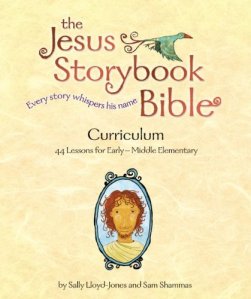
Sally Lloyd-Jones and Sam Shammas, The Jesus Storybook Bible Curriculum Kit – a review

JSBBSally Lloyd-Jones and Sam Shammas, The Jesus Storybook Bible Curriculum Kit (Grand Rapids: Zondervan; 2012) – a review

A guest post by Judy Goroncy (the great)

Over the past two terms, our church’s Sunday School has been using The Jesus Storybook Bible Curriculum, the focus of which is to teach ‘the Story beneath all the stories in the bible’. As the product description has it:

There are lots of stories in the Bible, but all the stories together tell one Big Story: The Story of how God loves his children and comes to rescue them. It takes the whole Bible to tell this Story. And at the centre of the Story, there is a baby.

The Jesus Storybook Bible (JSBB) includes 21 stories from the Old Testament, and 23 from the New Testament. Each week’s accompanying lesson is based on one of the stories and follows a similar structure ­– a time to recap previous stories, a relevant activity, the story time (which can be presented by either the teacher, or with the use of the accompanying DVD/CD), unpacking the story (technically called exegesis), reflection on Jesus’s location in the story, prayer, learning the memory verse, and completion of a hand-out. One of the real strengths and blessings of the programme is that it is concerned at every point to teach the great Story of the Bible rather than focus attention on presenting a series of seemingly unrelated ancient religious stories that remain largely unconnected to their principle purpose. Every part of the JSBB, in other words, is concerned to bear witness to the One who is God’s principal revelation; namely, Jesus. ‘Every story in the Bible whispers his name’.

We have found the programme to be geared more towards children aged 4–7. However, those aged 2–10 seemed to all benefit from and enjoy it too. Accounting for holidays and other ‘interruptions’, the curriculum takes about a year-and-a-half to work through. The lessons are easy to prepare, are clearly set out, and come with various helpful media aids. Because the lessons are presented chronologically, connections can be made between the stories and so enable children – and their teachers too – to build on what they have learnt in previous weeks. Hand-outs provide not only an opportunity for children to revisit the teaching and memory verses, but also assist and encourage parents/caregivers to be aware of what the kids are learning at Sunday School, and so encourage further discussions about the Story beyond the Sunday morning.

Despite there being so much focus on the Bible, learning memory verses, learning books of the Bible, etc., we have felt it imperative that the children look up the verses in their own Bible (a real one and not the JSBB). While this component is not specified in the curriculum, we believe that it is vital that the children have an understanding that all the stories come from the ‘actual’ Bible and that they become familiar with and are able to look up books, chapters and verses in their own Bible.

As we draw near to the end of the Old Testament section, the children are enjoying opportunities to present what they have learnt to the rest of the congregation, typically through the Sunday morning service. They present an overview of the key events and people in the Old Testament in the form of drama, bible readings, memory verses and song, using all to bear witness to God’s Great Rescue Plan in Jesus.

I cannot recommend this curriculum highly enough. Too often, our children’s programmes are so geared at entertainment, or are so diluted of content, that the true message of what Christ has done is lost. This programme takes seriously God’s love, our sin, and that we need Jesus, our Saviour, to redeem us and our lost world.

Sunday Hymn: ‘We sing a love that sets all people free’

wind man

We sing a love that sets all people free,
that blows like wind, that burns like scorching flame,
enfolds the earth, springs up like water clear:
come, living love, live in our hearts today.

We sing a love that seeks another’s good,
that longs to serve and not to count the cost,
a love that, yielding, finds itself made new:
come, caring love, live in our hearts today.

We sing a love, unflinching, unafraid
to be itself, despite another’s wrath,
a love that stands alone and undismayed:
come, strengthening love, live in our hearts today.

We sing a love that, wandering, will not rest
until it finds its way, its home, its source,
through joy and sadness pressing on refreshed:
come, pilgrim love, live in our hearts today.

We sing the Holy Spirit, full of love,
who seeks out scars of ancient bitterness,
brings to our wounds the healing grace of Christ:
come, radiant love, live in our hearts today.

– June Boyce-Tillman

[Image: Svetlana Lazarova]

Some forthcoming conferences

conference

Our Only Comfort: The Heidelberg Catechism at 450 Years

18-21 July, 2013. Heidelberg, Germany. The Heidelberg Conference on Reformed Theology seeks to bring together Reformed believers from Germany, the Netherlands, Austria, Switzerland, Italy, France, the United Kingdom, the United States of America and elsewhere. Details.

Holy Trinity – Holy People

26-27 July, 2013. Sydney, Australia. We encourage scholars from a broad range of disciplines to submit paper proposals on aspects of the Wesleyan doctrine of Christian Perfection, especially in relationship to the doctrine of the Trinity. Details.

Addressing the Sacred through Literature and the Arts

2-3 August, 2013. Strathfield, Australia. The conference will address acts of creation and co-creation and encourage a dialogue between artists, scholars and audiences in a mutual exploration of the sacred. Details.

Virtues, Vices, and Teaching

3-5 October, 2013. Grand Rapids, USA. The purpose of this conference is to explore the implications of a focus on virtues and vices for the way Christian teaching and learning are approached. Discussions of virtues and vices direct our attention away from rules and consequences and toward the role of character. Details.

International Conference on the Council of Trent

4-6 December, 2013. Leuven, Belgium. This conference will first shed light on the Tridentine theology and perspective on pastoral care, as the consequence of both the internal struggle to bring about reform within the Catholic Church and the controversy with Protestant Reformation. Along the same lines, attention will be paid to initiatives subsequently taken by Rome in order to interpret and implement the Council, while at the same time giving shape to the Catholic identity, in confrontation with the Protestant confessions. Further, the conference focuses on three key questions: What kind of changes in the local religious life may be considered as the outcome of the Council? To what degree has the Council contributed, on a European level, to political polarization and confessionalisation? And finally, how were the Tridentine reforms implemented on a more global level, through mission and evangelization? In each of the above mentioned questions, special attention is given to the contribution of the religious orders, in addition to the interplay between the Catholic and the Protestant Reformation. It is the explicit aim of the conference to bring together junior and senior researchers from different disciplines and confessional backgrounds. Details.

Arts, Portraits and Representation in the Reformation Era

15-17 May, 2014. Bologna, Italy. This conference will attend to the theme of how the arts were used to represent power, theological and political standpoints and cultural changes during the Reformation. Details.

International Congress on Calvin Research

August 24-28, 2014. Zürich, Switzerland. The 11th international Congress on Calvin Research will take place hosted by the Institute for Swiss Reformation Studies at the Theological Faculty of the University of Zürich. Details.

Encounters between Jesuits and Protestants in Africa

28 June – 1 July 2016. Nairobi, Kenya. For better or worse, much ink has been used to write about their animosity, especially in the European context. While this important historical chapter will be explored in other venues, the international conference in Nairobi aims to re-examine the encounters between the Jesuits and the Protestants and their respective traditions in the context of Africa. The conference is organized by the Committee for the Study of Religion at the CUNY Graduate Center and the Jesuit Historical Institute in Africa, Nairobi, Kenya. Details.

Encounters between Jesuits and Protestants in Asia

9-11 November, 2016. Macau, China. This conference aims to re-examine the encounters between the Jesuits and the Protestants and their respective traditions in the context of Asia. Details.

John Pilger and ‘The War You Don’t See’

John Pilger‘s film The War You Don’t See is, above all else, a call to responsible journalism, especially by those ‘journalists’ who have en masse lost their nerve, or who have temporarily (one hopes) mislaid the purpose of their craft. (Of course, Pilger himself has attracted no shortage of detractors over the years who would accuse him of irresponsible journalism. The onus on proof is clearly on the side of the detractors. And then there are those who find themselves in broad agreement with Pilger’s interpretation of things but struggle with a style that is perceived to be arrogant or hyped. I have some sympathy with these critics, although I’ve tried to never let his style get in the way of the content. This interview with the queen of ego herself, Kim Hill, is a case in point.)

There’s challenge here too, it seems to me, for those of us charged with the responsibility of rightly dividing the word of truth, especially for those who have lost our nerve to boldly address the powers or to do the demanding work it takes to simply tell the truth rather than spout the party line.

Anyway, for those who are yet to see the film, I thought I’d commend and post it for viewing here:

Pilger’s latest film (currently in production) is called Utopia and is due out at the end of the year. I look forward to seeing it.

Two notes from Ed.

editorNote 1: Some readers may have noticed that in addition to a new layout, this blog now has a new URL  jasongoroncy.com. But, in the immortal words of Douglas Adams, ‘Don’t panic!’ Those who visit the old ‘cruciality’ address(es) will be automatically directed to their new equivalent, and those who subscribe to posts via the RSS feed or via email will continue to receive that service uninterrupted (or so I am led to believe). Please let me know if you encounter any problems accessing a page.

Note 2a: I’m wondering about replacing the ‘Some Current Reading’ section (in the sidebar) with ‘Good Recent Reads’, highlighting what have been my favourite reads during the previous month. This is because it seems to be more helpful to draw readers’ attention to books that one has most appreciated than to inform (or to show off) about what one is currently reading, although I accept that there may be some uses for the latter too. Might add film and music as well; in which case it may have to be under the title ‘Good Reads, Sounds and Films’. If anyone has any strong opinions to share on this subject, I’m all ears.

Note 2b: Please return now to what you were doing before you were rudely interrupted by this broadcast.

– Ed.

Some scribbles on the elderly as gift

632614403133_0_BGOn a recent Sunday past, I had the joy of preaching on hope and memory to a wonderful group who were, on average, and at a guess, about twice my age. Not surprisingly, I loved being among them, and felt greatly privileged to share time together with them. And being with them made me do something I used to do a lot more of than I have in recent years – pause. More specifically, pause and reflect on why I really love being among the aged. That afternoon, I returned to my reading of Rowan Williams’ recently published book Faith in the Public Square (and therein to his address to the Friends of the Elderly, also available here) wherein he writes:

[A]geing brings much that is bound to be threatening; of course it entails the likelihood of sickness and disability and that most frightening of all prospects, the loss of mental coherence. But if this is combined with an unspoken assumption that the elderly are socially insignificant because they are not prime consumers or producers, the public image of ageing is bound to be extra bleak; and that is the message that can so easily be given these days. In contrast to a setting where age means freedom from having to justify your existence, age in our context is often implicitly presented as a stage of life when you exist ‘on sufferance’. You’re not actually pulling your weight; you’re not an important enough bit of the market to be targeted in most advertising, except of a rather specialised and often rather patronising kind. In an obsessively sexualised world of advertising and other images, age is often made to look pathetic and marginal. And in the minds of most people there will be the picture of the geriatric ward or certain kinds of residential institution.

To borrow the powerful expression used of our prisons by Baroness Kennedy, this is ‘warehousing’ – stacking people in containers because we can think of nothing else to do with them. From time to time, we face those deeply uncomfortable reports about abuse or even violence towards the vulnerable. Terrible as this is, we need to see it as an understandable consequence of a warehousing mentality.

As the Friends of the Elderly make plain in their literature, even if not precisely in these terms, the question of how we perceive age is essentially a spiritual one. If you have a picture of human life as a story that needs pondering, retelling, organising, a story that is open to the judgement and mercy of God, it will be natural to hope for time to do this work, the making of the soul. It will be natural to ask how the life of older people can be relieved of anxiety, and how the essentially creative work of reflection can be helped. It is not an exaggeration to say that, in such a perspective, growing old will make the greatest creative demands of your life. Furthermore, if we are all going to have the opportunity of undertaking reflection like this, it will be important that older people have the chance to share the task with the rest of us. The idea that age necessarily means isolation will be challenged. There is a sense that what matters for our own future thinking through of our life stories doesn’t depend on the sort of things that go in and out of fashion. That is why, in most traditional societies, the term ‘elder’ is a title of honour – as it is, of course, in the Christian Church, where the English word ‘priest’ is an adaptation of the Greek for ‘elder’. A person who has been released from the obligation to justify their existence is one who can give a perspective on life for those of us who are still in the middle of the struggle; their presence ought to be seen as a gift.

Incidentally, one of the most worrying problems in the impact of Western modernity on traditional culture is that it quite rapidly communicates its own indifference or anxiety or even hostility about age and ageing. Generation gaps open and it is no longer clear what there is to be learned. On our own doorsteps, we now have to confront a situation in, for example, the British Muslim community, where the status of older family members has been eroded by the prevailing culture around, creating a vacuum: of course it is natural and in many ways healthy for the young to examine and explore the received wisdom of their elders as they move towards maturity but when younger members of a community are left without signposts, they are more easily shifted towards extreme behaviour of one sort or another. It is as if, in the crises of these communities and the challenge they pose to the rest of our society, we see an intensified image of the tensions and unfinished business in our whole attitude to age and ageing.

We must not be sentimental. Age doesn’t automatically confer wisdom, and the authority of ‘elders’ of one sort or another can be oppressive, unrealistic and selfish. But when we completely lose sight of any idea that older people have a crucial role in pointing us to the way we might work to make better sense of our lives, we lose something vital. We lose the assumption that there is a perspective on our human experience that is bigger than the world of production and consumption. Work, sex, the struggle to secure our position or status, the world in which we constantly negotiate our demands and prove ourselves fit to take part in public life – what is there outside all this that might restore some sense of a value that is just given, a place that doesn’t have to be earned? A healthy attitude to the elderly, I believe, is one of the things that can liberate us from the slavery of what we take for granted as the ‘real’ world. Giving dignity to the elderly … is inseparable from recognising the dignity of human beings as such. Contempt for older citizens, the unthinking pushing of them to the edges of our common life, is a sure sign of a shrivelled view of what it is to be human. (pp. 244–46)

Here, Williams does a characteristically stellar job celebrating the invaluable gift that the elderly are to human community, and that while avoiding any sense of either reducing old people to commodities or apotheosizing them with a romanticism that seeks to shroud some of the ugliness that characterizes all human being.

From time to time I get asked how I feel about being part of an ‘ageing’ (which seems to be code for ‘dying’) institution like the Presbyterian Church here in New Zealand. One thing that immediately comes to mind is the incredible depth of memory that characterizes such a community, storied memory that helps us to understand who we are, why certain things matter, and why ‘realities’ like consumerism represent such an empty lie. Of course, I am grieved too that such an ageing community has fewer and fewer people each year to share its memory with – memory shaped by, among other things, decades of mistakes that need not be repeated, but will be.

This is part of the obligation laid upon the elderly; an obligation which, in my experience, too few rejoice to take up, and that for a great number of reasons that we need not go into here. But some do, of course, and in many such instances provide beautiful illustration of the claim that one really can teach an old dog new tricks; and, what’s more, many have learnt by now that there’s a joyous freedom in so learning some such tricks, and that not because by such one might progress anywhere but simply because learning new tricks can be surprisingly hilarious – the boisterous merriment of the Spirit. More importantly, such learnings-in-community – and the stories that accompany such – celebrate the relationality that lies at the deepest recesses of the universe’s grain.

Another great thing about being part of an institution filled with old people is that one is surrounded by so many more people who can teach me how to die – who have been given the time to teach me how to die and, hopefully, how to die well – and thereby be liberated from the horrible burden of having to always act as if one were younger, or older, or more indispensable, than one actually is. Exactly how this happens remains a mystery to me, although there seem to be conditions that surround the life of the aged that make such virtues real and not merely abstract possibilities. These include friendship, a humble assessment of human vocation, hope that rests in the all-embracing love of God, and a manifestly genuine aversion to twaddle.

But, to repeat, it’s not like this for all. Some old people live with consciences and hearts which have become so calloused over many years – through, among other things, the skill of self-justification – that it seems that it will take as long in the time beyond this time to soften such sisters and brothers enough that healing might take place and growth begin again. To employ a different metaphor, it is no slack knot that grace must undo; and for the elderly this knot has had longer to tighten. For the elderly, as for all – Peccator in re, iustus in spe! Of course, one need not squint too hard to see how industrialisation has contributed too to the very environments in which such knots are formed and then made to be what seems permanent. Consider, for example, words penned by Helmut Thielicke as he reflected on his first visit to the United States in the Spring of 1956, and in which he diagnosed a dire picture:

Elderly Americans constantly made a depressing impression upon me. I can still see the large hall of a hotel on the coast before me. Old ladies were sitting there with wrinkled faces that were not just made up but, frankly, plastered with cosmetics. To me they seemed like masks, consumed with boredom. They stared straight ahead, or looked with unseeing eyes through the gaps in the sun-blinds onto a street where nothing ever happened, or sat for hours in front of the television. A few of them played patience. The same was true of the old people with whom I lived in a house together for a few days. None of them ever read a book, at the most they might occasionally read a magazine. And always that unseeing stare and always television as a desperate protection against drowning in boredom. Some friends confirmed the correctness of this impression to me.

What is the origin of this despairing attitude to old age? One of the reasons is certainly not least the fact that people’s exclusive dependence upon the car kills any real attachment to the countryside. One can indeed wander all over nature and get to know it inside out, but despite this never actually experience it. When Moltke retired he was asked what there was now left for him to do, since he had always been such an active man. He replied: I shall watch a tree grow. How many elderly Americans could give a similar answer? (This question could, of course, also be directed at many elderly Europeans.)

The life that is determined exclusively by external influences prompts a sham vitality on the part of the individual. However, when contact with the outside world becomes weaker as the individual’s receptivity for impressions decreases and he is forced to have a life of his own, the pseudocharacter of his vitality inevitably becomes apparent. The friendly manners in America only inadequately disguise the fact that elderly people are often regarded as a burden. ‘But we don’t have elderly people like in Europe’, a clever woman once said to me with whom I had been discussing this problem and whose memory had perhaps caused her to idealize the Old World too much. ‘Such a thing as the serenity of old age is here rather the exception’, she said. Alongside this, there is also a sociological side to the problem of aging. This takes the form of an idolization of youth. After the loss of youth, life is regarded as a decline and people live in fear of this. That is why people basically do not have a positive attitude towards aging and do their utmost to conserve their youth. (Notes from a Wayfarer, pp. 311–312).

Once upon a time, in the time when we (in the West, at least) were less eager to shove our aged into holding pens, or what Williams refers to as ‘warehousing’, to await their death (these pens are sometimes called ‘nursing homes’), we were more likely to grow up alongside those living in the winter of their lives; that is, alongside those who are moving to die, alongside those who appear to be beginning even now to undergo a translation of life from time (i.e., time as we know it) to eternity (i.e., time as we will know it). Insofar as this is true, the elderly, or at least those elderly who have ceased engaging in the kinds of groping for justification and celebration of independence so characteristic of other adults, are among us as a kind of ‘sacrament’ of true being before God, as icons of God’s presence in frail flesh, as parables of the truth of human being-in-dependence-upon-the-other, and as signs that ‘the glory of human beings is not power, the power to control someone else … [but] the ability to let what is deepest within us grow’ (Jean Vanier, Befriending the Stranger).

In his final book to be published during his lifetime, P. T. Forsyth testified to the ways that ageing can also occasion immortal things becoming more real to us, of eternity being more deeply set in our heart. ‘We become’, he says, ‘more alert in a certain direction. We become more sensitive to what is deep than to what is lively, to a searchlight than to the flares, to what is the sure, permanent, and timeless thing in all movement’ (This Life and the Next, 54). This description does not tell the whole story, of course, but it does tell the story of some, perhaps even of many; and I consider myself blessed to be doing life among those who are alert in this way.

To be continued …

Sri Lankan Beef Curry

PeppercornsCooking Sri Lankan is enormously fun, just as cooking Indian is. And anyone who tells you otherwise is of dubious character.

This delicious pot roast recipe, modified slightly, comes from Madhur Jaffrey’s At Home with Madhur Jaffrey: Simple, Delectable Dishes from India, Pakistan, Bangladesh, and Sri Lanka. A specialty from Sri Lanka’s Burgher community, this dish owes its origins to a happy union between European colonialists (mostly Dutch but also some Portuguese and English) and the so-called indigenous population. Here, a simple pot roast has been made wonderfully Sri Lankan with the addition of roasted coriander, cumin and fennel seeds – the main ingredients in Sri Lankan curry – and, of course, coconut milk.

Serves 4

Ingredients

1kg beef
Freshly ground black pepper
Sea salt
4 teaspoons whole coriander seeds
1 teaspoon whole cumin seeds
1 teaspoon whole fennel seeds
¼ teaspoon whole fenugreek seeds
4 tablespoons olive or coconut oil
One 2-inch cinnamon stick
1 large onion, finely chopped
One 2-inch piece fresh ginger, peeled and finely grated
4 cloves garlic, finely chopped
2 tablespoons red wine vinegar
1½ cups beef (or chicken) stock
½–1 teaspoon cayenne pepper
1 cup coconut milk, well-stirred

Method

Set a small cast-iron (or other heavy) frying pan over medium heat. When hot, sprinkle in the coriander, cumin, fennel, and fenugreek seeds. Stir for 30 seconds or so until the spices just start to emit a roasted aroma. Empty onto a piece of paper towel, and, when cooled off a bit, grind the spices or crush in a mortar.

Preheat the oven to 160°C, and pour yourself a drink.

Cut the beef into large chunks and sprinkle lightly with crushed salt and lots of freshly ground black pepper.

In an ovenproof casserole-type pan with a lid (I use a large cast iron French oven made by Le Creuset, which I love as much as it is possible to love any non-‘person’), heat the oil over medium-high heat. When hot, add the meat and brown on all sides. Then, remove the meat to a plate. Add the cinnamon, onions, ginger and garlic to the pot, stir and cook for 4–5 minutes. Then add the vinegar, stock, cayenne pepper, 1½ teaspoons salt, the ground seeds and the beef (with its accumulated juices). Stir and bring slowly to a boil. Then cover and place in the oven for an hour at 160°C, and then lower it to 125°C, basting and turning every 30 minutes or so, for a further 2–3 hours, or until meat is tender. If things begin to look a little dry, then add a little boiled water or stock, and stir in well. You don’t want the meat to dry out. When the meat has reached the desired tenderness, or when you can just no longer handle smelling and not eating, then remove the pan from oven. Stir in the coconut milk, and bring it all to a slow simmer on a stove top before serving.

Serve with rice, noodles (Sri Lanka has exquisite rice noodles, so thin rice noodles would work) or mashed potatoes. Enjoy it with a beer.

And while we’re thinking Sri Lanka, here’s one of my all-time favourite fishing pics from that amazing part of the world:

sri lanka fishing

June stations …

The Collected Poems of George Mackay BrownReading:

Listening:

Watching:


Bruce McCormack on ‘God’s Gracious Election in the Theology of Karl Barth’

Whether on the subject of beer or theology, Bruce McCormack is always worth listening to (he’s considerably less reliable on the subject of sports), and that not least when it comes to the subject of Karl Barth and the doctrines of election. Here is Bruce’s lecture titled ‘God’s Gracious Election in the Theology of Karl Barth: Musings on a Possible Way to Move Beyond the Calvinist/Arminian Divide’ given last year at the Rethinking Arminius Conference held at Point Loma Nazarene University.

George Dion Dragas and an appreciation of T.F. Torrance

As one who sometimes finds himself bemoaning the fact that he has not yet been able to attend a gathering of the T.F. Torrance Theological Fellowship, I was delighted to discover tonight, via Alvin Kimel, a talk given at last year’s meeting by the Orthodox theologian George Dion Dragas. Reverend Dragas was a student of Tom Torrance, and many of the themes that characterised TF’s own work are evident here in this warm hearted presentation.

Plus the Q&A:

A wee note to those who read this blog via the RSS feed

RSS feedTo those who read this blog’s content via the RSS feed,

Thank you for being a regular reader of Per Crucem ad Lucem via the feed. You will all almost certainly know by now that Google Reader will be retiring on 1 July. If Google Reader has been your preferred feed reader, and you’re an RSS junkie like me, then you will need to choose a new reader. If you’re yet to choose a replacement reader, it’s really time to do a bit of homework. Certainly there is no shortage of sites listing the pros and cons of the various readers, but the mainline options seem to be The Old Reader, NewsBlurFeedlyBloglines, Digg, FeedreaderNewsvibePulseTiny Tiny RSS, FeedDemon and Yahoo Pipes. For what it’s worth, and these decisions are highly subjective, my first choice of reader – by far – is Feedly.

Of course, dear readers of this blog can also subscribe to posts here at PCaL via email. There are even some of you who get the email in addition to the feed; double points! If you fill out the form on the right hand side (on the desktop version), each new post will magically appear in your inbox. How cool is that!

Thanks again for your interest, interaction and encouragement.

Pax christi,

Jason

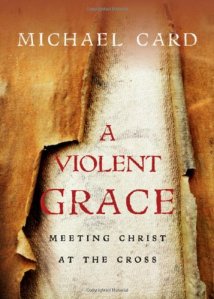
Michael Card, A Violent Grace: Meeting Christ at the Cross – a review

A Violent GraceMichael Card,  A Violent Grace: Meeting Christ at the Cross (Downers Grove: IVP, 2000).  ISBN 978-0-8308-3772-4.

A guest review by Graeme Ferguson

I hope that Mr Card is a much better gospel singer than he is a writer. This book is intended to be a spiritual guide to bring people back to reflect on the cost of Jesus’ sacrifice on the Cross and to call them once more to a renewed and more costly discipleship. It fails badly.

At heart, Mr Card is a foiled romantic who wants the scandal of the Cross and its violence to be seen as ‘beautiful’ but he has neither the verbal skills nor the spiritual insight to be helpful or to draw people on into deeper faith.

He has a very cavalier way with Scripture and abuses the integrity of the text in order to press his points. He has an alarming inadequate understanding of prophetic discourse and tries to ‘apply’ prophetic imagery directly to the event of the crucifixion. The result is that texts are twisted in ways that are not helpful. One gains the impression that he has become entangled in a clutch of half digested proof texts but has not waited to discover how they might enrich his meditation.

The heart of the problem is that he rushed to write but did not wait to be renewed by the texts he is attempting to meditate on. As a result there is no authentic insight and no sense that here is a humble and wise guide who has struggled and wept and written slowly and with restrained care.

It has not occurred to Mr Card that sacrifice as his preferred image for the Cross needs to be placed in a very demanding context before it can begin to sing. Genocide, holocaust and nuclear bombing, torture and abuse are all images of suffering to be addressed and lived through before anyone can dare speak of the Cross as once and for all sufficient for the sin of the world. We all speak far more hesitantly than Mr Card realises.

The production of the book is regrettable and gives Christian publishing a bad name. The print faces attempt to reinforce the sad romanticism of the writing. The steel engraving, in the style of nineteenth century devout religious pictures, are sad pastiches, and they are unacknowledged.

I hope that this severe critique is not simply a clash of cultural expectations. I approached the book looking for guidance from a spiritual master. I gained little.

Learning from Australia’s Political Meltdown

Ben Chifley

A few days before the recent leadership spill in the Australian Labor Party, former Cabinet Minister and (in my view, quite exceptional) Foreign Minister Gareth Evans offered some thoughts, or some evidence of ‘relevance deprivation syndrome’, on the ALP and what we all might be able to learn from Australia’s political meltdown. I thought them worth reposting:

Australian politics should, on the face of it, hold as much interest for the rest of the world as Mongolian throat singing or Bantu funerary rites. But I have found otherwise in my recent travels in North America, Europe, and Asia. Much more than one might expect, there is an eerie fascination in political and media circles with the death throes of the current Australian Labor Party (ALP) government.

How is it, policymakers and analysts ask, that a government that steered Australia comfortably through the global financial crisis, and that has presided for the last six years over a period of almost unprecedented prosperity, could be facing electoral extinction in September, as every opinion poll is now predicting?

How did a diverse, socially tolerant country with living standards that are the envy of much of the world, become roiled by so much political divisiveness and bitterness? Is there a message for democratic governments generally, or center-left governments elsewhere, or just for the ALP?

It may be that certain peculiarities of the Australian situation are creating more tensions than would be likely elsewhere. A ludicrously short three-year electoral cycle makes it almost impossible to govern in a campaign-free atmosphere. Party rules allow for leaders – including serving prime ministers – to be politically executed overnight by their parliamentary colleagues. Our media’s preoccupation with trivia – and collective lack of conscience – is impressive even by British tabloid standards.

But none of these factors is new. They might have compounded the tensions, but they don’t explain how, in 2010, a party less than three years into its term dispatched a leader, Kevin Rudd, who had brought it to power after 11 years in the political wilderness and still commanded a majority of the public’s support. Nor do they explain why now, three years after she replaced Rudd, Julia Gillard enjoys practically no public support at all and seems destined to lead the ALP back into exile for another generation, if not for good.

Even if Gillard is dropped by her panicking colleagues – and that could happen at any time in the Grand Guignol theater that Australian politics has become – the situation for the world’s oldest labor party is dire indeed.

Those like me who have been out of public office for a long time need to be wary about offering gratuitous commentary – or, worse, advice. It is unlikely to be gratefully received by one’s successors, and it suggests a severe case of what I call “relevance deprivation syndrome.”

But there do seem to be some fundamental rules of political survival that have been ignored in Australia in recent years. Perhaps spelling them out will help others to remember them, not least those parties in Europe, Canada, and elsewhere that share some of the ALP’s social-democratic and center-left ideological traditions and are also struggling to win or retain electoral support.

The first rule is to have a philosophy – and to stick to it. The hugely successful Labor governments led by Bob Hawke and Paul Keating two decades ago did just that, essentially inventing the “third way” model that later became associated with Tony Blair and Gordon Brown in Britain. Its elements were clear: dry, free-market economics (but in our case with low-paid workers benefiting enormously from “social wage” increases in medical care and retirement pensions); compassionate social policy; and a liberal internationalist foreign policy.

Australia’s current government, by contrast, has struggled to re-create anything as compelling. It seems torn between old industrial labor preoccupations, the new environmentalism, and capitulating to populist anxiety on issues like asylum-seeking “boat people.”

The second rule is to have a narrative – and to stick to it. Confused and ever-changing messages don’t win votes. The most wounding criticism of the ALP government is that no one really knows what it stands for. It has initiated visionary national policies in areas like broadband access, disability support, and education, but it has struggled to maintain a coherent and consistent overall story line.

The third rule is to have a decent governing process – and to stick to it. The Rudd administration successfully navigated the global financial crisis largely because the prime minister, with a small inner group, bypassed traditional Cabinet processes. But, with the crisis over, the bypassing continued – increasingly by the prime minister alone. Genuinely collective decision-making can be a painfully difficult process, but, in government as elsewhere, there is wisdom in crowds.

The fourth rule is that leaders should surround themselves with well-weathered colleagues and advisers who will remind them, as often as necessary, of their mortality. Self-confidence, bordering on hubris, gets most leaders to the top. If that is not occasionally punctured, things are bound to end in tears.

The last rule is that one should never trash the brand. Those who mounted the coup against Rudd three years ago felt it necessary to explain that it was because his government was, beneath the surface, a dysfunctional mess. The public hadn’t actually noticed that at the time, but has been prepared to believe it ever since. The tragedy is that both Rudd and Gillard are superbly capable and have complementary skill sets; working together effectively, they were as good as it gets in Australian politics.

Adherence to these rules will not ensure that a governing party stays in office forever. Many other factors, domestic and international, are always in play. Over time, electorates will tire of even the best-run governments, and look for reasons to vote for change.

But following all of these rules should ensure that a party maintains credibility and respect, and that, in defeat, it at least remains competitive for the next election. Observing none of them guarantees catastrophe.

The cruel and godless practice of live animal exports

live-export-australian-steer-slaughtered-indonesiaRecently, I posted a video of David Clough’s lecture ‘Rethinking Animality: Towards a New Animal Ethics’. One of the reasons that I drew attention to that lecture was because I consider the work that David (and others too) is engaged in around this issue to be incontrovertibly ‘vital’ [from the late fourteenth century Latin vitalis, meaning ‘of or belonging to life’]. Any society that takes lightly the killing of animals (those creatures whom Dietrich Bonhoeffer refers to as the brothers whom Adam loves), as do those societies with which I am most familiar, has grossly misjudged the sheer giftedness of life itself and is, it seems to me, already well on the way to responding lightly to and of justifying various forms of homicide and deathliness in its midst, blinded by the lie that the life of any creature belongs to something or someone other than God. This is why Karl Barth, for example, argued with due passion that ‘the slaying of animals is really possible only as an appeal to God’s reconciling grace’, and that we ought to have very good reasons for why we might claim the life of another creature for ours. Human beings can only kill an animal, Barth avers, knowing that it does not belong to us but to God alone, and that in killing it – an act which itself is incredibly traumatic, as I can testify – one surrenders it to God in order to receive it back from God as something one needs and desires. ‘The killing of animals in obedience is possible’, Barth contends, ‘only as a deeply reverential act of repentance, gratitude and praise on the part of the forgiven sinner in face of the One who is the Creator and Lord of humanity and beast’. Here Barth’s words compliment the Jewish tradition which champions the need to avoid tzar baalei chayim – causing pain to any living creature – and insists that where animals are killed that they are done so ‘with respect and compassion’, most properly by way of shechita.

With that, I come to the subject of this post; namely, live animal exports. Animals Australia reports that

every year millions of Australian animals are exported live for slaughter. Those who survive the journey often endure brutal treatment and conscious slaughter. Cattle, sheep and goats are sent throughout the Middle East and South East Asia — to countries with no laws to protect them from cruelty. Tens of thousands of animals don’t survive the sea journey and those that do disembark into countries where they are transported, handled and then slaughtered in appalling ways. Most animals slaughtered overseas have their throats cut while they are fully conscious, leading to an incredibly painful and prolonged death. Since 2003, Animals Australia has conducted numerous investigations into the treatment of animals exported from Australia. The evidence from investigations in the Middle East and South East Asia has consistently revealed the willingness of Australia’s live export industry, and consecutive Federal Governments, to export live animals despite appalling cruelty in importing markets.

While Australia remains by far the world’s largest exporter of sheep and cattle, this is not, of course, only an Australian issue. Earlier this year, the New Zealand Herald, for example, reported a ‘Boom in live cattle exports to China’, although thanks to the Customs Exports Prohibition (Livestock for Slaughter) Order these are mostly for breeding purposes, and recent protests at the Port of Dover in the UK are evidence that exporting of live cattle remains a practice in the UK and the EU, with exports going mainly to Italy and France.

This video, produced by Animals Australia, testifies to the cruel and godless practices that attend the live export of animals:

Clearly, this is a political as well as a moral issue (not that the two can ever be separated); and as the Australian Federal election draws near, I wish to publicise my support for the campaign by Animals Australia and Ban Live Export against the sickening and anti-vital practice of live animal exports. I learned recently that one of the Coalition’s priorities, should it win the election, is to ‘apologise’ to Indonesia (a country that receives some 45% of Australia’s live animals) for the Labour Government’s five week trade suspension in 2011, a suspension put in place in direct response to an ABC Four Corner’s program, ‘A Bloody Business’, which exposed the practices that attend live animal exports. In Australia, with the exception of Independent Senator Nick Xenophon, it has been The Greens who have consistently spoken out against this practice and who have sort to (re)introduce the Live Animal Export (Slaughter) Prohibition Bill (2012) into the Senate. And in New Zealand, from which there has been no live animal exports for slaughter since 2003, it is again The Green Party who have tried to maintain pressure to restrict the export of live animals. (I don’t mention this in order to propagandise for The Greens, but simply to report a fact.)

Here is the campaign video produced by Animals Australia:

Opposition Leader Tony Abbott, and the other Coalition party leaders, seem to have forgotten – or, just couldn’t give a rats about – the outrage that Australians felt after that program aired, the facts therein being also corroborated by the live export industry’s own reports. Certainly, it is difficult to see how any formal apology to the Indonesian government or business groups could do anything other than serve to send a message that animal abuse is condoned. To my mind, this ought to be an important election issue. It is certainly an important theological issue. So if you are a fellow Australian citizen, or have your name on the electoral role, then please consider joining me in supporting this campaign.