Sunday Hymn: ‘On the turning away’

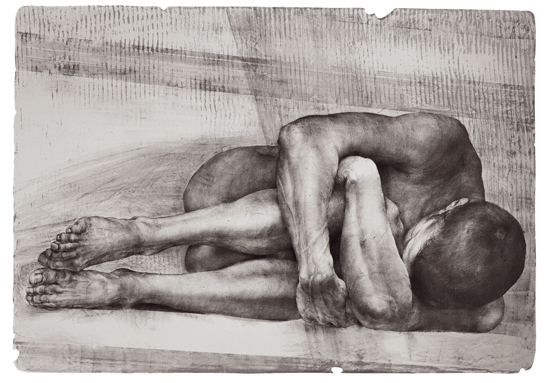
Ice people

On the turning away
From the pale and downtrodden,
And the words they say
Which we won’t understand.
‘Don’t accept that what’s happening
is just a case of others’ suffering
Or you’ll find that you’re joining in
The turning away’.

It’s a sin that somehow
Light is changing to shadow,
And casting its shroud
Over all we have known.
Unaware how the ranks have grown,
Driven on by a heart of stone,
We could find that we’re all alone
In the dream of the proud.

On the wings of the night
As the daytime is stirring,
Where the speechless unite
in a silent accord.
Using words you will find are strange,
Mesmerised as they light the flame,
Feel the new wind of change
On the wings of the night.

No more turning away
From the weak and the weary.
No more turning away
From the coldness inside.
Just a world that we all must share,
It’s not enough just to stand and stare.
Is it only a dream that there’ll be
No more turning away?

– David Gilmour & Anthony Moore

Jobs for historians? – yeah right!

Scott, Great moments in New Zealand history

… that’s what I thought, but it seems that the Waitangi Tribunal, a permanent commission of inquiry that researches and reports on claims submitted by Māori under the Treaty of Waitangi Act 1975, is serious about seeking to appoint two historians and one senior historian.

  • Information on the historian positions, including the job description and application form and process, is available here.  Applications close 19 July.
  • Information on the senior historian position, including the job description and application form and process, is available here.  Applications close 10 July.

Should you require any further information, please email Jonathan West.

‘Outspoken: Coming Out in the Anglican Church of Aotearoa New Zealand’ – a review

OutspokenLiz Lightfoot (ed.), Outspoken: Coming Out in the Anglican Church of Aotearoa New Zealand (Dunedin: Otago University Press, 2011). ISBN: 9781877578083; 218pp.

A guest review by André Muller

In mid-2009, Liz Lightfoot, an independent researcher working under the supervision of Dr John Paterson of the University of Waikato, interviewed eleven subjects as part of a project aimed at documenting the stories of gay and lesbian people within the Anglican Church of Aotearoa New Zealand. Whatever the merits of the ‘Listening Process’ upon which the Anglican Communion embarked in the wake of the 1998 Lambeth Conference, it has become clear that many gay and lesbian Anglicans feel that their stories have not in fact been heard. In publishing the edited versions of her interviews, Lightfoot hopes, in a modest way, to redress this situation, if only by showing that at least some gay and lesbian people have been so hurt by the Church as to have abandoned all hope that the ‘Listening Process’ is anything other than a charade concealing a profound lack of courage on the part of those charged with leading the Church. If this reveals an irony at the heart of a project commended as a contribution to that process, it is perhaps one that brings a measure of clarity to the situation in which Anglicans (and, by analogy, members of other Churches), find themselves, by drawing attention to the limits of an official process that has, by its inability to bring about effective change, done a great deal to foster cynicism on the part of the very people it is claiming to serve. Such a process is yet to prove itself a means by which the complexity and depth of the often painful experiences of gays and lesbians within the Church is rendered audible to clergy and laity alike. To talk of the need for honest dialogue while in practice allowing a ‘don’t ask, don’t tell’ policy to flourish at both official and unofficial levels, is simply to have failed to hear the voices of gays and lesbians.

It may seem rather strange to press the logic of Lightfoot’s book in this way, since it is presented as a piece of qualitative research that aims to conform to academic standards (indeed, it is published by a university press). But Lightfoot is aware that the role she is playing is more than that of the neutral observer. She believes her research to be ‘primarily about justice and about what is done, how people are treated in the name of God’ (p. 15), and this as a way of outworking a ‘gospel bias … to the oppressed and towards justice … to the suffering and towards healing … to the captives and towards liberation’. Given such commitment, it is curious then that Lightfoot hedges at the very moment when most is at stake, claiming that when it comes to the issue of homosexuality, ‘the definitions of justice, healing and liberty are up for debate’. This is fine in so far as empirical descriptions of the way in which that issue, or rather, set of issues, is being played out within the Anglican Communion go, but it is clear that the justice with which her research is concerned is incommensurate with policies that would exclude gays and lesbians from full participation in the Church. To appeal here, as Lightfoot does, to the supposed ability of the Anglican Church to accommodate a range of views on the subject, or worse, to theological clichés that insist that ‘God is beyond theology’ and ‘sexuality is no barrier to God’s love’ (p. 16) is to beg the very question at stake. It is hard, particularly when reading the introduction, not to feel that Lightfoot wants to answer that question while, at the same time, pretending that she isn’t.

The bulk of Lightfoot’s book is, of course, taken up with the edited versions of the interviews she conducted between May and July 2009. The experiences of the eleven interviewees are, as one might expect, enormously diverse, and it would be perilous to attempt any generalisations were it not for the fact that Lightfoot herself encourages us to do so by offering at the end of each interview some reflections that ‘might help the reader’s understanding of the participant’s experience’, and by summing up the key themes that emerge from her interviews in a concluding ‘postscript’. There is a quite proper sophistication to the analysis Lightfoot offers in the concluding pages of her book, recognising that the process of ‘coming out’ is an enormously complicated one for gay and lesbian people within the Church. ‘The cost of integrity in the church is devastatingly high’, one of the interviewees remarks, and Lightfoot sees in this comment a way of approaching one of the key problems that gay and lesbian Christians face. Indeed, notions of personal integrity, and therefore, notions of the self, play a profoundly important role in many of the experiences of Lightfoot’s interviewees. To cite but one example, after coming out to his wife (of more than thirty years) and children, ‘Rob’ (all the names are pseudonyms) tells Lightfoot that he decided to write them a letter, saying ‘I love you and all the rest of those nice, humane and truthful things but I have to be true to myself too. There’s not much point living a lie and having you people happy and me not. I’ve got another thirty years perhaps, if I play it right’. If many of the other interviewees come off sounding less childish than this, the imperative to be ‘true to myself’ is one that continually resurfaces throughout the book as an explanation, even justification, for often painful, and sometimes tragic, decisions.

At this point we begin to see the sort of work that is being done by Lightfoot’s insistence that ‘people’s lives are sacred ground’. Although it is not immediately clear what she means by this claim, it effectively functions as a way of forestalling any attempt to question the Emersonian framework that supplies the moral imperative to be ‘true to myself’. It was the American novelist and host of A Prairie Home Companion, Garrison Keillor, who once remarked that Ralph Waldo Emerson had a great deal to answer for, not least because his writings encouraged men and women who would have made fine accountants and bus drivers and lawyers, to become very bad writers and musicians and artists, and to find in their supposedly artistic temperaments the warrant for jettisoning ordinary virtues like kindness and patience. They were told to throw caution to the wind, to escape from the ordinary obligations and responsibilities that constrained their lives, and to be true to themselves. Only the selves they were being true to were selves in the process of becoming monstrous precisely to the degree that they were being extricated from concrete and unspectacular obligations to others. Monstrous and, we might add, incoherent (which may be the same thing), since the attempt to orientate myself, to find my bearings within the world, by appealing to myself is necessarily self-defeating. Not only does it trade upon an essentialism that is profoundly problematic – a stable self, at one remove from our interactions with others (a self, therefore, behind the public, historical self), that is simply there to be known; it also presumes that knowledge of that self is a rather straightforward affair. It was the early church theologian Augustine of Hippo who pointed out that we are not, in fact, perspicuous to ourselves; that we cannot simply lay ourselves out like a map. There is no vantage point from which we can obtain a clear enough vision of ourselves for us to be able to say, at any one point in our lives, ‘now, at last, I am truly being myself’.

The question here is whether the Emersonian logic to which many of the interviewees in Lightfoot’s book appeal as in some sense offering justification for actions they have committed can actually do the work it is claiming to do. When ‘Rob’ tells his family that he has to ‘be true’ to himself, or ‘Edward’ says that one of the best things about his new homosexual life is ‘just being open … just being myself’ (p. 33), or ‘Janet’ suggests that the root cause of the sense of emptiness she felt while married was that she was ‘unfulfilled in terms of who I am’ (p. 41), or ‘Gareth’ says that it is out of ‘my spiritual journey that I’ve discovered and come to terms with who I am’ (p. 151), even when ‘Naomi’ says that ‘the Church is my home, where I am myself’ (p. 118), one has to ask whether the sort of clarity that is being presumed here is the sort of clarity that human beings can have with respect to themselves. And if it is not, we have to admit that if we are to try to come to terms with the experiences of those interviewed in Lightfoot’s book, we must press them to provide deeper, more adequate, accounts of those experiences. ‘What precisely do you mean when you say you are just being yourself?’ is the sort of a question a good interviewer ought to ask. At the very least, we might expect Lightfoot’s postscript to contain some analysis of the Emersonian framework that plays such an important role in many of the interviewee’s account of their experiences. Instead, Lightfoot offers her readers an exemplarist Christology that has itself been thoroughly domesticated by that framework. ‘What I see in the life of Jesus’, Lightfoot writes, ‘is someone integrated. Not someone living, as we all do to some extent, on conflicting, disparate planes. He was what he seemed; he was what he claimed to be’ (p. 214). To point out that such a picture of Jesus bears little resemblance to those offered in the Gospels would be to misunderstand what it is that Lightfoot is doing here. She is not commenting on the historical, flesh-and-blood Jesus, but rather seeking to legitimate one particular – and highly modern – account of what it means to be human. ‘My understanding is that our Christian journey is one towards integration of the parts of us that we might prefer not to face’ (p. 214). Only an Emersonian could write of the Christian life in such terms, freeing it from any real connection to the life and death of Jesus of Nazareth, indeed, reinventing that life so that it conforms to pictures of what it means to be human that would have been sheerly unintelligible to pre-moderns.

Lightfoot’s book is marked by a curious naivety. She wants to make a number of substantive claims without engaging in the sort of critical analysis that those claims demand if, that is, they are to be convincing. She asserts, and then pulls back at the very points when most is at stake. In so doing, she is not serving the subjects of her interviews, but abandoning them. Neither is she serving her readers, who find that they are unable to gain real purchase on the experiences of those they are reading about precisely to the extent that the notion of ‘being myself’ remains unexamined. In the end, what we are left with are stories that in themselves are rather unremarkable: a man leaves his wife for his gay lover, only to find that some people in his local church are not sympathetic; a devout woman discovers that she is a lesbian, and has to rethink certain aspects of the conservative theology with which she was brought up; and so on. Such stories are valuable in their way, but not very interesting. And this because Lightfoot does not allow us to get into the inside of them, in the way, for example, that Conrad enables us to gain some purchase on the experiences of Tuan Jim, or Stryon on those of Peyton Loftis. If Lightfoot is right to say that selves are ‘sacred’, then this must be an invitation not to call a halt to our enquiry, but to probe further, knowing that in the end, as Augustine understood, it not we who confer meaning on our lives, but one who is closer to us than we are to ourselves.

Hope and Memory (Job 14.1–14): a sermon

Oldřich Kulhánek - Job 2

There’s a scene in Terrence Malick’s film Thin Red Line where a young soldier gives voice to a series of imponderable and ancient questions about meaning, about the ‘thin red line’ between life and suffering and death. In what is essentially a prayer, he asks:

This great evil. Where does it come from? How’d it steal into the world? What seed, what root did it grow from? Who’s doing this? Who’s killing us? Robbing us of life and light. Mocking us with the sight of what we might have known. Does our ruin benefit the earth? Does it help the grass to grow or the sun to shine? Is this darkness in you, too? Have you passed through this night?

These questions haunt human history and seem to give lie to the claim that the earth is good, that behind and before history, that behind and before our life, that behind and before our agonising questions, stands one whom the NT calls ‘love’. It is little wonder then that we ask ‘why’ – why, if the Creator is good and powerful and loving, are there tsunamis and earthquakes? Why, if the Creator is on the side of life, will 29% of New Zealanders die of cancer? Why, if the Creator is the one who brings shalom, do 20% of us suffer from anxiety and mood disorders on a daily basis?  Why, if the Creator is a father who knows how to give good gifts to his children, are there 925 million people who share life with us on this planet hungry? Why, if Jesus is the bringer of a new thing, is the world so unchanged? If this is how a good God governs the world, and because our cry for answers seems to illicit no response, it is little wonder that we lose hope and we begin to wonder not only do I have a future, but also does creation itself have a future, and even does God have a future.

The philosopher Bertrand Russell spoke for not a few when he wrote:

I can imagine a sardonic demon producing us for his amusement, but I cannot attribute to a Being who is wise, beneficent, and omnipotent the terrible weight of cruelty, suffering, and ironic degradation of what is best, that has marred the history of Man in increasing measure as he has become more master of his fate.[1]

And so we come to the ancient Book of Job, a book which begins with these words:

There was once a man in the land of Uz whose name was Job. That man was blameless and upright, one who feared God and turned away from evil. There were born to him seven sons and three daughters. He had seven thousand sheep, three thousand camels, five hundred yoke of oxen, five hundred donkeys, and very many servants … (Job 1.1–3)

Such fertility represents signs, in the Semitic world, of a family under the blessing of God. But not for long. Soon Job is robbed of every iota of financial prosperity and security that was his familiar lot, his children all die in a tragic accident, his livestock are stolen from him, he himself falls victim to a painful and disfiguring chronic disease, and then even his wife turns against him with the words, ‘Curse God and die’. And, perhaps most terrible of all, the book suggests that all of these things happen by God’s permission.

And then for the next 36 or so chapters, Job’s so-called friends – the would-be theologians – instead of waiting with Job for God to speak, they rush in to defend God with their moronic and ignorant theological speculations and they try to convince Job that he must have done something wrong to bring about this state of affairs. On the other hand, Job, for his part, rather than engage in philosophical speculation about the meaning of suffering – as if there might even be such meaning – turns to address God; first by cursing the day of his birth, and then later by challenging God to a day in court where the injustices of his life might be evaluated before someone or something manifestly less prejudicial than God. And what strikes me about this litany of complaints is that rather than jump onto some ancient equivalent of an online social networking site and whinge to others about his loss, Job turns to prayer. He is completely in the dark as to the reason for his suffering, but again and again and again he commits his cause to God. Consider these words from chapter 13:

See, he will kill me; I have no hope; but I will defend my ways to his face … Why do you hide your face, and count me as your enemy? Will you frighten a windblown leaf and pursue dry chaff? For you write bitter things against me, and make me reap the iniquities of my youth. You put my feet in the stocks, and watch all my paths; you set a bound to the soles of my feet. One wastes away like a rotten thing, like a garment that is moth-eaten. (13.15, 24–28)

This theme is further developed in chapter 14 where we are invited to ask, ‘In the midst of such tragedy, in the midst of our agonies, in the midst of living with our demons and black dogs, in the midst of so many unanswered questions, “Can we hope?” And, if so, what might possibly be the basis of such hope?’

The chapter begins with a sober description of the experience of human life:

A mortal, born of woman, few of days and full of trouble, comes up like a flower and withers, flees like a shadow and does not last. Do you fix your eyes on such a one? Do you bring me into judgment with you? Who can bring a clean thing out of an unclean? No one can. (vv. 1–4)

And then we hear something of Job’s bitterness towards God as if he is addressing the schoolyard bully:

Since their days are determined, and the number of their months is known to you, and you have appointed the bounds that they cannot pass, look away from them, and desist, that they may enjoy, like laborers, their days. (vv. 5–6)

In other words, ‘God, since you have already planned all our days, and even our deaths, why can’t you just leave us alone to live out whatever life we have been given, because it seems like every time you come near, my life just falls apart’.

According to Job, our fate is hopeless. We all die, and when we breathe our last, we lie down and never get up. In fact, Job says that even the trees have more hope than we do:

For there is hope for a tree, if it is cut down, that it will sprout again, and that its shoots will not cease. Though its root grows old in the earth, and its stump dies in the ground, yet at the scent of water it will bud and put forth branches like a young plant. But mortals die, and are laid low; humans expire, and where are they? As waters fail from a lake, and a river wastes away and dries up, so mortals lie down and do not rise again; until the heavens are no more, they will not awake or be roused out of their sleep. (vv. 7–12)

Now most scholars argue that the real turning point of this chapter is in v. 14 when Job asks the question: ‘If mortals die, will they live again?’ (v. 14). And many commentators highlight how Job’s question here whispers that something else might be possible; that despite all evidence to the contrary, some crack might appear in an otherwise closed door and let in some fresh air, some crack which suggests that despite every appearance we are creatures not of chance but of One who has orientated us towards a hopeful future. It’s a fine way to read the passage, though I wonder if it too quickly closes our ears to something else that is important here.

For it may be that the real turning point in this passage actually lies on either side of these words – in v. 13 and in the second half of v. 14 – where Job speaks of both remembering and of waiting:

O that you would hide me in Sheol (i.e., in the underworld, the hiding place from God’s scrutiny and anger), that you would conceal me until your wrath is past, that you would appoint me a set time, and remember me! … All the days of my service I would wait until my release should come.

The language of remembrance and of waiting is, of course, familiar language around the church. It’s the language that we hear not only around Advent, but also during Lent and during Easter, and during so-called Ordinary Time. But if there’s one day in the church’s calendar when the language of remembrance and of waiting is most intense it is on the quietest day of the Christian year – Holy Saturday. And the story of Job is the story of one faithful person’s experience of Holy Saturday, just as the book of Lamentations recalls on a corporate level the whole community’s journey through its own experience of God abandonment. And Holy Saturday reminds us that there’s waiting and then there’s waiting. For whereas the quality of Advent waiting brims with expectation and preparation for hope to ring and joy to arrive like having warm bread in the oven, the air of Holy Saturday reeks of stale smoke, as though something was burned the day before. The silence of this day is not like the silence of restoration and anticipation and peace. The silence of Holy Saturday sounds more like the buzz of a lonely streetlight on a dark deserted road in the middle of nowhere. It’s the silence of paralysing shock. It’s the silence of shattered hopes. It’s the kind of silence when nothing feels safe or dependable anymore.

The waiting of Job and the waiting of Holy Saturday are like waiting for a teenage son or daughter who has missed a midnight curfew to come home, or like waiting for the surgeon to emerge from the hospital operating room, or like waiting for the phone to ring with a report of biopsy results. Like Job’s questions, Holy Saturday is a day of suspense. It is the boundary marker between the undeniable and the inconceivable. It is, in the words of one theologian, what ‘appears to be a no-man’s land, an anonymous, counterfeit moment in the gospel story, which can boast no identity for itself, claim no meaning, and reflect only what light it can borrow from its predecessor and its sequel’.[2] And it is the space all too familiar to those of us who grieve the loss of one whom death has claimed prematurely. It is the space all too familiar to those of us who live with the burden of unreconciled relationships. It is the space all too familiar to those of us who live with the anxiety of not knowing whether or not we will always be recognisable to our loved ones.

And I want to suggest that what holds that space together – what fills the boundary between death and life, between despair and hope, between love experienced and love unimaginable – is the divine memory. It is God’s memory of us which makes it possible for us to neither abandon our sorrow nor to surrender the horizon of hope. It is God’s memory which places a boundary to our hopelessness and our dislocation. It is the memory of the God who remembered Rachel and filled her barren womb (Gen 30.22). It is the memory of the God who heard Israel groaning under the burden of cruel slavery and remembered an ancient promise to Abraham, Isaac, and Jacob. It is the memory of the God who heard the desperate cry of a frightened thief and made a promise to accompany him even beyond death. And it strikes me that the dead Jesus is resurrected too precisely because he is not forgotten by the Father and the Spirit.

Job knows that one day all who know him will pass away and that his achievements will be long abandoned. He knows the futility of trusting in what will only return to dust. He knows the futility of trusting in those shrines of remembrance that we erect in our lives and in our churches and in our communities. But as fragile as he is, he is not finally without hope, and his hope is not that he will be faithful enough to remember God but that God is faithful to remember him, that he will be kept alive only by God’s memory of him. Job’s hope is that despite all appearances, God’s memory outlasts this creation which is passing away. This is great news for those of us who have ‘lost’ their memory, and for those of us who live with those who have ‘lost’ their memory – for it announces that our dignity and hope and humanity are not to be found finally in our ability to remember and to love but rather in the promise of one who both remembers and loves and who does so beyond the boundaries that death itself would seek to erect.[3]

When pain torments our body; when unwelcome fantasies invade our sleep; when friends unite to condemn or to abandon us; when death hovers on our doorstep – then, it is not finally a kind word or a new resolve that we need but rather an encounter with the God who remembers us, who remembers that we are dust; who is, in the words of Psalm 8, ‘mindful’ of us; who remembers that our history is not something that can be discarded willy-nilly, and who, in Jesus Christ, enters into the boundary of our dislocation and into the emptiness of our long-abandoned memories and who publicises to and for us that we are not forgotten. The reason for our hope is that we are remembered in life; we are remembered when disaster engulfs robbing life of joy and peace; and we are remembered in our graves. The reason for our hope is that we are remembered by God when all other memories have dried up, when all has passed away and the creation itself undone, when (as in v. 19) the waters wear away the stones and the torrents wash away the soil of the earth and all human hopes are extinguished.

And, finally, in the crucified God, we hope together with those who do not share our hopes, and with those whose hopes for this life remain unfulfilled, and with those who are disappointed and indifferent, and with those who despair of life itself, and with those who have been the enemies of life, and with those who for whatever reason have abandoned all hope. In and with Christ, we hope and we remember them before God. In the crucified God, we hope together with the God who remembers us and who, in remembering us, is our hopeful end. Amen.


[1] Bertrand Russell, Last Philosophical Testament: 1943–68 (ed. John G. Slater and Peter Köllner; The Collected Papers of Bertrand Russell, Volume 2; London: Routledge, 1997), 87.

[2] Alan E. Lewis, Between Cross and Resurrection: A Theology of Holy Saturday (Grand Rapids: Wm. B. Eerdmans, 2001), 2–3.

[3] No wonder that John Calvin once said that ‘there is nothing [human beings] ought fear more than to be forgotten by God’. John Calvin, Sermons from Job (trans. Leroy Nixon; Grand Rapids: Wm. B. Eerdmans, 1952), 78.

Ray Anderson and The Gospel according to Judas

Was chatting to an old friend tonight about Ray Anderson‘s work on Judas (my favourite saint). I indicated that Anderson’s popular-level book The Gospel According to Judas: Is There a Limit to God’s Forgiveness?, and his later book Judas and Jesus: Amazing Grace for the Wounded Soul, remain two of the most profound treatments on Judas that I have encountered. There’s also Anderson’s very powerful sermon on Judas (given, I understand, at Fuller Theological Seminary in 1998), a copy of which seems to only be available these days to iTunes users. I can’t remember where I got this copy from but I hope that I haven’t broken some ridiculous copyright law uploading it here. It begins proper 4.45 minutes into the video. The sound is not great. The theology is.

For the benefit of my dear readers, I’ve also uploaded a copy of Anderson’s chapter ‘Will Judas Be in Heaven?’ (which was freely available some years ago from Anderson’s own webpage) from his book Dancing with Wolves While Feeding the Sheep: The Musings of a Maverick Theologian (Wipf & Stock, 2001).

The Bible and the State: towards a response to James Skillen

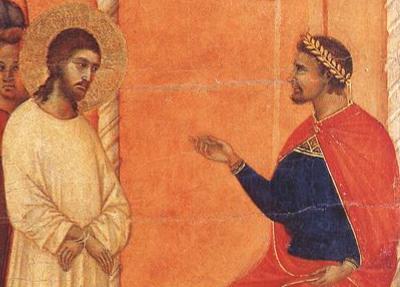
pontius-pilateIn October last year, I participated in a very stimulating three-day symposium on ‘Churches and the Rule of Law’, held at the lovely John Knox International Reformed Centre in Geneva. I was there invited to be a respondent to a paper by James Skillen (the former executive director and president of the Center for Public Justice), the subject of which was the Bible and the State. I am pleased to report that the main papers from the symposium have now been published as part of the John Knox Series of books, and are available by contacting the secretariat of the Centre via email, or by snail mail at

Centre international réformé John Knox, Secrétariat
27, chemin des Crêts de Pregny
1218 Grand-Saconnex / Ge – Suisse

For those who may be interested, you can download a copy of my (somewhat undercooked) response to Dr Skillen’s paper here.

‘Rethinking Animality: Towards a New Animal Ethics’

David Clough is a very fine Christian theologian who for many years now has been doing some great work to help us rethink our attitude to animals. Recently, he delivered a wonderful inaugural professorial lecture at The University of Chester (a university, to be sure, with some aesthetically-challenged lecture rooms) on the subject ‘Rethinking Animality: Towards a New Animal Ethics’, or Why Christians (& others) should stop eating animals from intensive farming. I thought it was worth sharing, so here it is:

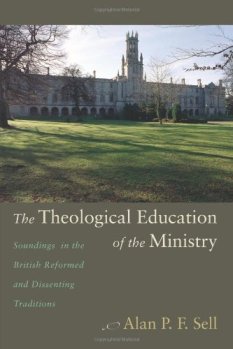
Alan Sell’s The Theological Education of the Ministry: Soundings in the British Reformed and Dissenting Traditions: a review

The Theological Education of the MinistryAlan P. F. Sell, The Theological Education of the Ministry: Soundings in the British Reformed and Dissenting Traditions (Eugene, OR.: Pickwick Publications, 2013). ISBN 13: 978-1-62032-593-3; 328pp.

A guest review by Graeme Ferguson

Alan Sell, who served for a time as Theological Secretary of the WARC and who taught in Manchester and Wales, has indulged himself in retirement, writing a very readable account of the thinking of several theologians who helped form ministry in the reformed tradition in Great Britain and whose contribution should not be forgotten.

It may come as a surprise that the English dissenting tradition is as angular and stubborn today as it has been through the years in shaping the Church. Sell, as an unrepentant Congregationalist, knows the ins and outs of this history well. He has worked with the theologians who shaped ministry in the last fifty years. He has the patience to track through some of the more tortuous paths of dissent both in England and Scotland and celebrates several churchmen who are not widely remembered.

He begins with Caleb Ashworth and the dissenting academy he set up in Daventry. This sets the tone for remembering the costs involved in bearing witness to the faith outside the mainstream of English church life.

His chapter on Scottish religious philosophy in the later nineteenth century is a sharp reminder of how effectively and fully Scottish theologians engaged in the intellectual debates of the day.  Theological professors such as A.C. Fraser, Robert Flint, A.B. Bruce, James Iverach, and others, came out of the realist tradition of the Scottish Enlightenment. They were committed apologists for the faith, formulating forms of knowing that gave an assured intellectual basis for strong faith. Their books were found on the shelves of many New Zealand ministers who followed these debates closely.

His chapter on John Oman of Cambridge not only traces his formidable philosophical contribution to personalist modes of knowing God but also has a fascinating segment on Oman’s church background in the secessionist groups of the islands of northern Scotland. Oman is an Orcadian who for all his life retained that mystical spirituality of the northern lights. I was glad to see that Sell added the story about Oman’s portrait which hangs in the dining hall at Westminister College. One person asked the artist if the sitter’s face was that of a fisherman; another suggested a philosopher, and a third that he had the face of a saint. The artist was content that he had captured Oman’s heart.

In writing about N.H.G. Robinson and Geoffrey Nuttall, Sell speaks about people he knew and valued. Robinson was an ethicist in St Andrews, a careful scholar committed to clarity and precision in developing his ideas. Sell develops a set of theses to encapsulate Robinson’s thinking. Nuttall was an angular and difficult church historian of English dissent who taught in London and with whom Sell had a long friendship. Not only did Nuttall not suffer fools, but he was also an authority on Puritanism and dissent. Both men influenced a generation of students to value sound scholarship and appreciate the richness and depth of lively faith.

This book needed some strong editing. In trying to ensure that each scholar could speak for himself, Sell quotes extensively. There are some personal interjections which may be endearing but which read as self-justifying. A good editor would have picked up infelicities of language and dates that wobbled into the wrong century. Also, the bibliographies are far too long. But the book was well worth persevering with as a fascinating study of people, with their foibles, personal loves and hates, and passion for sound scholarship, who influenced generations of people serving in ministry.

The United Stasi of America – championing a new level of efficiency

Stasi

‘No one shall be subjected to arbitrary interference with his privacy, family, home or correspondence, nor to attacks upon his honour and reputation. Everyone has the right to the protection of the law against such interference or attacks’. – The Universal Declaration of Human Rights, Article 12.

‘After the Wall fell the German media called East Germany “the most perfected surveillance state of all time”. At the end, the Stasi had 97,000 employees – more than enough to oversee a country of seventeen million people. But it also had over 173,000 informers among the population. In Hitler’s Third Reich it is estimated that there was one Gestapo agent for every 2,000 citizens, and in Stalin’s USSR there was one KGB agent for every 5,830 people. In the GDR, there was one Stasi officer or informant for every sixty-three people. If part-time informers [many of whom were ‘pastors’] are included, some estimates have the ratio as high as one informer for every 6.5 citizens’. – Anna Funder, Stasiland: Stories from Behind the Berlin Wall, p. 57.

Having recently finished reading Funder’s wonderful book, it has been near impossible to not observe some very disturbing parallels with what is unfolding about PRISM. Today, we face a situation where something towards 39% of the world’s population (or something in the order of 2.5 billion people) – which is the number of the world’s internet users – can be spied on by a single person/agency. Just as terrifying is the fact that he who has informed ‘the people’ about this situation is labeled a ‘traitor’, though to what exactly is not too clear.

The shareholders will, no doubt, rejoice at news of such unprecedented levels of efficiency and technological sophistication, and in the assurances that their ‘interests’ are being maintained at all costs. Most important, though, is that Edward Snowden’s girlfriend is doing ok. Ah, all’s well with the world Empire!

Tonight, I will go to bed with Václav Havel and Dietrich Bonhoeffer; they help me at such times. And in the morning, I will (God willing) awake into a world that belongs to One upon whose word I will meditate, and to whom I shall direct my gaze and the burdens of the world and of things closer to my own soul. Ah, He is risen. All is indeed well with the world! Optimism? No. An opiate? No one who has ever really prayed has ever thought so, and I trust them. Patience and hope? Yes. And so joy.

The Tendering of New Zealand’s Restorative Justice Services: Robbing Peter to Pay Paul

Restorative Justice New Zealand

A guest post by Janet Sim Elder

The recent announcement that government tendering of Restorative Justice (RJ) services throughout Aotearoa New Zealand to a smaller number of providers based here in NZ or from offshore is imminent. Judith Collins, Minister of Justice, has also announced there an increase of funding of $4.42 million in the May budget. Clearly this National Government wants to expand services.

A good thing you might say. Yes it is, but … and there is a large ‘but’. Ministry staff numbers entrusted with servicing the Restorative Justice groups around the country have gradually diminished over the last thirteen years since we in Dunedin and three other jurisdictions trained and were part of the world-first pilot of RJ as an alternative way of doing justice within the Justice system.

From a vibrant, forward-thinking, large group of public servants, the staff in this unit now number about five. The logic is, I suspect, that it is much easier and more cost efficient for a small group of Ministry staff to work with a handful of providers; the fewer the better.

Restorative Justice Aotearoa, the national grouping of all RJ services in NZ, is not in a position to put in a tender for all those services and is clearly not interested in doing so.

Nicola Taylor, the feisty Director of Anglican Family Care in Dunedin under whose umbrella we work as Restorative Justice Otago, providing long-term, highly professional and skilled work in bringing victims and offenders together to hear each other’s stories and to begin repair of the harms caused by offending, has decided we have no other option than to submit a tender ourselves. It’s risky because we have no certainty we will be successful, and because there is no contingency plan if we fail. Our story will be replicated throughout the country for the other RJ providers.

justice is what love looks like in publicSo we are committed to going all out for a strong bid to provide services in our Otago region. We have a depth and breadth of experience and are known and trusted by victims and offenders alike, as well as by local professionals working within and around the court system. This all has to be done in a few short weeks rather than months. Anglican Family Care is committing resources including in governance and making tenders to ensure we put in the best tender we can.

If you can help with brief letters of support for our bid, or for the RJ group near you elsewhere in the country in the same boat as we are, then, who knows, Peter does not have to be robbed in order to pay Paul and both might have a chance to live life in all its fullness!

To help out, please contact:

Restorative Justice Otago
c/- Anglican Family Care
PO Box 5219
Dunedin, Otago, NZ
email
p: +64 3 477 0801

Interfaith Engagement for Peace: a Muslim Perspective

dringridmattsonI’m delighted to learn (and publicise) that Ingrid Mattson (who holds the Chair in Islamic Studies at Huron University College at the University of Western Ontario in London, Canada) will deliver this year’s Open Peace Lecture at the University of Otago.

The title of Dr Mattson’s lecture is ‘Interfaith Engagement for Peace: a Muslim Perspective’.

When: Monday 19 August, 1730–1900, followed by supper.

Where: Burns 1 Lecture Theatre, Dunedin.

All are welcome. The event is being sponsored by the Dunedin Abrahamic Interfaith Group and Otago Tertiary Chaplaincy.

A review of ‘Barth’s Interpretation of the Virgin Birth’

Barth's Interpretation of the Virgin BirthBarth’s Interpretation of the Virgin Birth: A Sign of Mystery, by Dustin Resch. Farnham/Burlington: Ashgate, 2012. ix + 218pp; ISBN 978 1 4094 4117.

In Barth’s Interpretation of the Virgin Birth, Dustin Resch (Assistant Professor of Theology and Dean of the Seminary at Briercrest College and Seminary) offers us a clearly written introductory survey to Barth’s presentation of the doctrine of the virgin birth, unencumbered with detail and critical interaction.

With a view to setting Barth’s contribution in its theological context, the study begins, appropriately, with a brief overview of the doctrine in the Western tradition. Here, particular attention is given to treatments by Irenaeus, Augustine, Aquinas, Luther, Calvin, Schleiermacher, Strauss and Brunner, and to the ways that the pre-Reformation articulations of the tradition tended to evaluate the doctrine in terms of its ‘fittingness’ with the broader themes of christology, pneumatology and original sin. This emphasis, Resch argues, ‘slipped into the background during the Reformation, which aimed to chasten what the Reformers took to be undue speculation, particularly about Mary’ (p. 36), only to emerge again during the modern period, albeit in ways that argued for its fundamental un-fitness in the courtroom of critical biblical scholarship and modern biology, and therefore without any significant theological value. Resch proceeds to argue that Barth takes up the Augustinian heritage of the virgin birth, but revises it such that Barth believes he escapes the criticisms of its modern despisers. The success or otherwise of Barth’s efforts here are left largely untested by Resch.

In the second chapter, Resch offers an exposition of the methodological and exegetical features of Barth’s development of the doctrine from his early work at Göttingen and Münster up to the introductory volume of Die Kirkliche Dogmatik. Locating Barth’s unembarrassed claims on the virgin conception vis-à-vis the Augustinian, Schleiermacherian, Harnackian and modern Roman Catholic traditions, and as a dogmatic bookend to Jesus’ miraculous resurrection, Resch convincingly rehearses throughout the ways in which, for Barth (post-Münster), the virgin birth functions as a fitting theological ‘sign’ (Zeichen) of the mystery of the incarnation – rather than making any claims about the constitutive significance of Jesus’ person as the Logos incarnate or about biology and the wonders of parthenogenesis – which directs the church to a number of its basic dogmatic claims. As P.T. Forsyth – the so-called ‘Barthian before Barth’ (a great compliment to Barth!) – had earlier shown, the virgin birth is really a theological rather than a critical question. It is not a necessity created by the integrity and authority of Scripture per se but a necessity created (if at all) by the solidarity of the gospel, and by the requirements of grace. In terms of epistemology, for example, it recalls that ‘the beginning of our knowledge of God … is not a beginning which we can make with God. It can be only the beginning which God has made with us’ (CD II/1, 190). For Barth, the Bible’s presentation of the miracle of the virgin birth has ‘no ontic but [only] noetic significance’ (Credo, p. 69), its concern being the mystery of God’s free grace. Hence the Bible evidences a complete lack of concern with scientific explanation and is wholly concerned with the question of the sheer mystery and grace of revelation, a mystery and grace which announce, among other things, the foundationless nature of all our presuppositions about, and our semi-Pelagian gropings for, God. It is, literally, to begin again at the beginning; i.e., with God’s self-giving in Jesus Christ. Ontology, in other words, for Barth, must always precede epistemology.

Notwithstanding the comments made above vis-à-vis Scripture, Resch suitably notes, however, that Barth’s treatment of the virgin birth as a sign relating to the mystery of the incarnation rather than as a constitutive element of Christ’s person was one that was ‘derived exegetically and was not a theological decision made simply to avoid the criticism of modern theology’ (p. 62). So Resch:

For Barth, the criteria by which the church should make its decision to adopt the biblical attestation of the virgin birth into its understanding of the biblical message should be the same as the criteria by which the New Testament authors themselves decided to incorporate the virgin birth into their witness. In both cases, questions of the age and source value of the tradition were not conclusive. Instead, the doctrine was accepted because of its ‘fit’ with the central elements of Christian faith. (pp. 73–74)

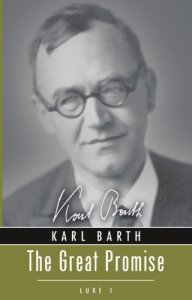
The Great PromiseThis theological reading of the Gospel texts, as Resch notes in a number of places, enabled Barth to avoid many of the charges often laid at Augustinian interpretations of the doctrine, and that while guarding the mystery of Christ’s person from being collapsed into a general truth or principal. That said, Resch is also concerned to map how, for Barth, the virgin birth functions as a ‘paradigm’ through which to understand not only the shape of God’s work upon human beings but also something about the corresponding posture of faith’s being-before-God, features borne out well by Resch not only in terms of Barth’s treatment of Mary but also, and perhaps especially, through his attendance to the largely ignored figure of Joseph who ‘clearly has no capacity for God, but rather is elected to serve Christ in the world as his guardian. Understood this way’, Resch notes in a later chapter, ‘Joseph becomes an excellent metaphor for Barth’s view of the church’ (p. 175). In Barth’s own words:

Though I am very averse to the development of ‘Mariology’, I am very inclined to ‘Josephology’, because in my eyes Joseph has played a role with respect to Christ which the church should adopt. I know that the Roman Church prefers to compare its role with the glorious role of Mary. It brings the Christian message to the world in the same way in which Mary has given us Christ. But the comparison deceives. The church cannot give birth to the Redeemer; but it can and must serve him with humble and discrete enthusiasm. And that was exactly the role that Joseph played, who always held himself in the background and left all fame to Jesus. Exactly that should be the role of the church, if we want the world to rediscover the glory of the Word of God. (‘Über die Annäherung der Kirchen: Ein Gesprach zwischen Karl Barth und Tanneguy de Quénétain’, Junge Kirche: protestantische Monatshefte 24 (1963): 309)

Chapter Three is concerned to examine Barth’s doctrine of the virgin birth in relation to his presentation of Christ’s sinless humanity and original sin in the Church Dogmatics. In particular, Resch maps the ways that, for Barth, Christ’s birth through the virgin Mary attests to both the ‘Yes’ of God’s grace to humanity and, because of the absence of a human father, to God’s ‘No’ of judgment against sinful human beings: ‘The natus ex Maria virgine unambiguously negates the possibility of viewing revelation and reconciliation as a possibility latent within human beings by describing the mystery of the sovereign act of God in the incarnation. It does this “by an express and extremely concrete negative”. This negative – symbolized by the removal of the man – indicates the limitation of human participation in the incarnation’ (p. 85).

In Chapter Four, Resch brings Jesus’ conception into conversation with Barth’s pneumatology, noting how the former, which remains sui generis, functions, for Barth, as a pattern for, and a heuristic tool – ‘a distinctive mark’ – to interpret, the work of the Spirit in the lives of those who ‘perceive and accept and receive [Jesus Christ] as the Reconciler of the world and therefore as their Reconciler’ (CD IV/1, 148). It is argued that, just as Mary was enabled by the Spirit to conceive Christ within her womb, so too are Christians enabled by the same Spirit to receive the revelation and reconciliation of God.

Mary’s role in Barth’s theology is given fuller attention in the final chapter where Resch helpfully outlines how Barth’s treatment of Mary’s ‘readiness’ (Bereitschaft) before God informs both his understanding of the relationship between divine grace and human agency, and his evaluation of Roman Catholic Mariology, noting the ways that Barth’s acceptance of the virgin birth happens by the same criteria by which he rejects Mariology; namely, with its fit with the mystery of the incarnation. ‘Barth’s main problem with Mariology’, Resch avers, ‘is simply that in it Mary is treated in relative independence from Christ. While never completely severed from Christ, Mary has come to have her own special dignity, merit and ministry. In contrast with the Councils of Ephesus and Chalcedon, and particularly the New Testament, according to Barth, Roman Catholic Mariology fails to use the term Theotokos as an exclusively Christological title … The Catholic Mary is, for Barth, the symbolic portrayal of the philosophical concept of the analogia entis’ (pp. 168–69, 177). Conversely, Barth will insist that human readiness for God – and God’s readiness for humanity – is found in, and is synonymous with, Christ alone.

Throughout the essay, Resch successfully illustrates ways that Barth’s thinking on the virgin birth remains both broadly Augustinian insofar as the doctrine relates to that of original sin, and radically revisionist insofar as Barth departs from Augustine’s interpretation of the virgin birth as that which mysteriously preserves Christ from the tainting effects of concupiscence and original sin and conceives it instead as a symbol of the dialectic that the incarnation itself announces – the futility of all human willing, acting and striving for the grace of God, and the divine determination and gracious freedom to call into existence things that do not exist (Rom 4.17).

Readers (and I suspect Resch himself too) may well be left asking, however, whether Resch has bought too uncritically into Barth’s Protestant critique of Mariology, and whether his heavy reliance on a somewhat limited scope of Barth’s work (mainly The Great Promise and CD I/2) leaves his presentation less satisfying than it might be. More frustrating, however, is the exhausting repetition throughout the book. Where the reader may be hoping to find a new vista around the next corner, or an idea further developed in conversation with other themes pertaining to the subject (e.g., the doctrines of election and creation, the relationship between ‘sign’ and ‘ontology’ and between this particular ‘sign’ and other ‘signs’, the relationship between the objective basis and subjective experience of faith’s participation in the faithfulness of Christ as the vicarious human given by God, discipleship and prayer, how Mary’s and Joseph’s fittingness relates to that of other characters throughout the Bible, etc. are all left too uncooked) or with at least some significant secondary literature, the reader discovers instead that he is simply back where he has been numerous times before, and little the wiser for the effort. I suspect, nonetheless, that we are not here dealing with a case of an author who does not know where the real questions lie – indeed, he identifies some very worthwhile trajectories for further thought in his conclusion; Barth’s rather one-dimensional presentation of Mary divorced from her existential situation, for example – but perhaps with a matter of confidence and/or energy to traverse there within the bounds of this project. One hopes that in future work, he builds on the reliable foundation laid here.

[In due course, a version of this review will appear in The Journal of Theological Studies]


Two conferences to note

AquinasThe department of theology at Durham University is hosting a one-day colloquium (13 June) on Ecumenical Readings of Aquinas. It will include presentations by Andrew Davison, Christopher Insole, Marcus Plested and Lewis Ayres. Details here.

The Australian Catholic University is organising a conference titled ‘Addressing the Sacred through Literature and the Arts’ (2-3 August). The conference will aim to ‘address acts of creation and co-creation and encourage a dialogue between artists, scholars and audiences in a mutual exploration of the sacred’. Keynote speakers are Amanda Lohrey, Kevin Hart and Rosemary Crumlin. Details here.

For details about other theology conferences, visit here.

On the anniversary of our baptisms

Baptism

Religious rituals are important because by them truths (and not only truths) are inscribed in us, because by them we have opportunity to rehearse those things that matter deeply to us and to do so with others, and because it is among such rituals that the loose and sometimes deeply painful and paradoxical strands of our life are held, and that in ways that take our location seriously and which are, one hopes, intentionally faithful to a broader and deeper narrative into which our lives have been taken up, the old old story by which we live and move and are measured. So understood, it’s little wonder that C.S. Lewis, in A Preface to Paradise Lost, spoke of ‘the proper pleasure of ritual’. Of course, not all rituals could properly be defined as ‘acts of pleasure’. Nor are all handmaidens of an overtly religious imagination. Monday afternoon netball, or pre-bed activities of endless calls for ‘toilet, teeth, and pajamas’, or story time, or a wee dram of aqua vitae, for example, readily come to mind. And while these latter types of activity seem to be no less important for our formation, and while they are common enough, they are not what we might call ‘catholic’ in nature.

I mention this because one of the most important things one can do as a public citizen is to remind catholic bodies that the local situation is where the real action is. It is equally important that the correspondent reality is manifest; namely, to remind the local clan that its raisons d’être are most faithfully conceived in light of a – or the – catholic story. And we need rituals that perform both tasks, that celebrate both realities.

To return to the matter of more overtly ‘religious’ rituals, my most local tribe – which consists of my partner and I and our three begats (1, 2 and 7) – practices a number of such and that with, it must be said, modulating degrees of regularity and intentionality. However, one of the ‘rituals’ that we celebrate with particular enthusiasm and without fail is the various anniversaries of our baptisms (this week it was mine). So, five times a year, usually after dinner – or between main course and dessert, depending on where clan members are on the sanity-ometer at that particular moment – we clear the table, light a candle, put out a small bowl of water and recite the following liturgy together (drawn, with some modification, from the excellent Uniting in Worship 2, a liturgical resource produced by the Uniting Church in Australia. I intend, at some stage, to write an entirely new liturgy but at the moment this is what we use), rotating the leader from occasion to occasion. The words in bold are said by all.

1. INTRODUCTION

Brothers and sisters,
in our baptism, we died and were buried with Christ,
so that we might rise with him to new life.
We were initiated into Christ’s holy Church
and brought to life through water and the Spirit.
God’s mighty acts of salvation for us and all people
are gracious gifts, freely given.
Today we come to reaffirm our baptism,
declaring our allegiance to the risen Christ
and seeking to be obedient to his will.

2. REAFFIRMATION OF BAPTISM

Do you repent of your sins?
I repent of my sins.

Do you turn to Jesus Christ
who has defeated the power of sin and death
and brought us new life?
I turn to Christ.

Do you commit yourself to God,
trusting in Jesus Christ as Saviour
and in the Holy Spirit as God’s power and presence along the way?
I commit myself to God.

THE APOSTLES’ CREED

And now I ask you to confess the faith
into which you were baptised,
and in which you continue to live and grow.

Do you believe in God?

I believe in God, the Father almighty,
creator of heaven and earth.

Do you believe in Jesus Christ?

I believe in Jesus Christ, God’s only Son, our Lord,
who was conceived by the Holy Spirit,
born of the Virgin Mary,
suffered under Pontius Pilate,
was crucified, died, and was buried;
he descended to the dead.
On the third day he rose again;
he ascended into heaven,
he is seated at the right hand of the Father,
and he will come to judge the living and the dead.

Do you believe in the Holy Spirit?

I believe in the Holy Spirit,
the holy catholic Church,
the communion of saints,
the forgiveness of sins,
the resurrection of the body,
and the life everlasting. Amen.

This is the faith of God’s baptised people.

We are not ashamed to confess it
in Christ our Lord.

COMMITMENT TO MISSION

I ask you now to pledge yourselves
to Christ’s ministry in the world.

Will you continue in the community of faith,
the apostles’ teaching,
the breaking of bread and the prayers?

With God’s help, we will.

Will you proclaim by word and example
the good news of God in Christ?

With God’s help, we will.

Will you seek Christ in all people,
and love your neighbour as yourself?

With God’s help, we will.

Will you strive for justice and peace,
and respect the dignity of every human being?

With God’s help, we will.

May almighty God,
who has given us new birth by water and the Holy Spirit,
keep us steadfast in the faith,
and bring us to eternal life;
through Jesus Christ our Lord.

Amen.

3. RECOLLECTION OF BAPTISM

The leader pours water into the bowl, saying:

Come, Lord Jesus,
refresh the lives of all your faithful people.

The leader places her/his hand into the bowl and then sprinkles the rest of the family three times saying:

Sisters and brothers:

Always remember you are baptised,
and praise the Holy Spirit.

THE SIGN OF THE CROSS

Today we remember that, from the time of our baptism,
the sign of the cross has been upon us.
I invite you now to join me
in tracing the sign of the cross upon your forehead,
saying: I belong to Christ. Amen.

Everyone places their fingers into the bowl and then marks themselves with the sign of the cross, saying:

I belong to Christ. Amen.

You are now invited to trace the sign of the cross
on those around you,
saying: You belong to Christ. Amen.

Everyone places their fingers into the bowl and then marks each other person at the table with the sign of the cross, saying:

You belong to Christ. Amen.

4. PRAYERS

Let us pray for all the baptised everywhere
and for ourselves in this congregation of God’s people.

That our redemption from evil
and our rescue from the way of sin and death
may be evident in our daily living.
Lord, in your mercy,
hear our prayer.

That the Holy Spirit may continue
to open our hearts and lives
to the grace and truth we find in Jesus our Lord.
Lord, in your mercy,
hear our prayer.

That we may be kept in the faith and communion
of the holy, catholic and apostolic Church.
Lord, in your mercy,
hear our prayer.

That we may be sent into the world
to witness to the love of Christ.
Lord, in your mercy,
hear our prayer.

That we may be brought to the fulness
of God’s peace and glory.
Lord, in your mercy,
hear our prayer.

Other prayers are offered here for other people/situations that lay heavy on our hearts.

Then to conclude the prayers, we say together:

Praise be to you, our Lord Jesus Christ,
for all the benefits
you have won for us,
for all the pains and insults
you have borne for us.
O most merciful Redeemer,
friend and brother,
may we know you more clearly,
love you more dearly,
and follow you more nearly,
day by day. Amen.

5. THE PEACE

We are the body of Christ.
In the one Spirit we were all baptised into one body.
Let us then pursue all that makes for peace
and builds up our common life.

May stations …

Reading:

Listening:

Watching:

‘Ministry As Difficult As It Ought to Be’, by Will Willimon

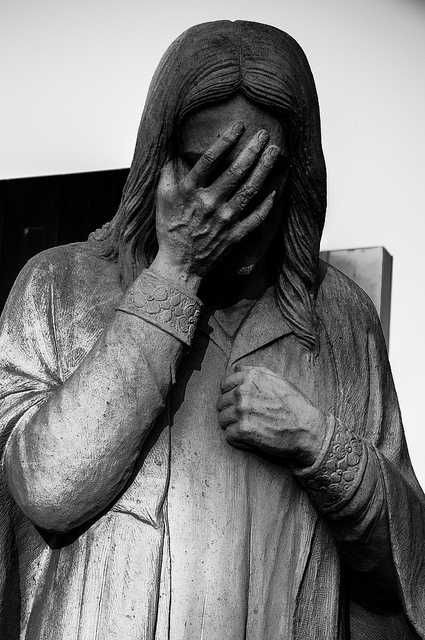
weeping jesusWill Willimon’s latest piece, a version of an article previously-published in The Christian Century, is well worth the read. It’s entitled ‘Ministry As Difficult As It Ought to Be’, and I thought it worth reproducing here. Willimon’s words speak powerfully to pastors, to theological educators, to church committees set up to discern/assess calls about future pastors, and more:

“See our big buildings?” asked the Medical School Dean as he swept his hand across the panorama of the Duke Medical Center.  “Their purpose is production of a handful of doctors who can be trusted to be alone with a naked patient.  Takes us four years.”

I repositioned the Dean so that he faced the less impressive neogothic Divinity School.  “That’s where we teach our seminarians to be in awkward situations with naked, vulnerable parishioners.  It only takes us three years.”

After two quadrennia as a church bureaucrat, slogging in the muck and mire of ecclesiastical trenches — sending pastors to remote, unappealing locations where Jesus insists on working — I’m again teaching in that amazing countercultural phenomenon called a seminary.

I was honored to serve with eight hundred fellow clergy who risked United Methodism in Alabama, though I leave behind a subpoena and three law suits; don’t tell Governor Bentley that I’ve now fled the state.

Being bishop gave me a front row seat to observe ministry in the Protestant mainline that is being rapidly sidelined.  Pastoral leadership of a mainline congregation is no picnic.  My admiration is unbounded for clergy who persist in proclaiming the gospel in the face of the resistance that the world throws at them.  Now, as a seminary professor, I’m eager to do my bit in the classroom to prepare new clergy for the most demanding of vocations.

Consumer Corrupted Clergy

From what I saw, too many contemporary clergy limit themselves to ministries of congregational care-giving – soothing the fears of the anxiously affluent.  One of my pastors led a self-study of her congregation.  Eighty percent responded that their chief expectation of their pastor was, “Care for me and my family.”

I left seminary in the heady Sixties, eager to be on the front line in the struggle for a renaissance of the church as countercultural work of God.  By a happy confluence of events, the church was again being given the opportunity to be salt and light to the world rather than sweet syrup to enable the world’s solutions to go down easier.

Four decades later as bishop I saw too many of my fellow clergy allow congregational-caregiving and maintenance to trump other more important acts of ministry like truth-telling and mission leadership.  Lacking the theological resources to resist the relentless cloying of self-centered congregations, these tired pastors breathlessly dashed about offering their parishioners undisciplined compassion rather than sharp biblical truth.

North American parishes are in a bad neighborhood for care-giving.  Most of our people (at least those we are willing to include in mainline churches) solve biblically legitimate need (food, clothing, housing) with their check books.  Now, in the little free time they have for religion, they seek a purpose-driven life, deeper spirituality, reason to get out of bed in the morning, or inner well-being – matters of unconcern to Jesus.  In this narcissistic environment, the gospel is presented as a technique, a vaguely spiritual response to free-floating, ill-defined omnivorous human desire.

A consumptive society perverts the church’s ministry into another commodity which the clergy dole out to self-centered consumers who enlist us in their attempt to cure their emptiness.  Exclusively therapeutic ministry is the result.  I saw fatigue and depression among many clergy whom I served as bishop.  Debilitation is predictable for a cleros with no higher purpose for ministry than servitude to the voracious personal needs of the laos. 

The 12 million dollar Duke Clergy Health study implies that our biggest challenge is to drop a few pounds and take a day off.  If you can’t be faithful, be healthy and happy.  I believe that our toughest task is to love the Truth who is Jesus Christ more than we love our people who are so skillful in conning us into their idolatries.

Seminaries, Wake Up

Yet I must say that by comparison, the poor old demoralized mainline church, for all its faults, is a good deal more self-critical and boldly innovative than the seminary.  Our most effective clergy are finding creative ways to critique the practice of ministry, to start new communities of faith, to reach out to underserved and unwelcomed constituencies, and to engage the laity in something more important than themselves.  Alas, seminaries have changed less in the past one hundred years than the worship, preaching, and life of vibrant congregations have changed in the last two decades.

As bishop I served as chair of our denomination’s Theological Schools Commission. Most of our seminaries are clueless, or at least unresponsive, to the huge transformation that is sweeping through mainline Protestantism.  We have so many seminaries for one reason: the church has given seminaries a monopoly on training our clergy with no accountability for the clergy they produce.  Increasing numbers of our most vital congregations say that seminary fails to give them the leadership they now require.  Oblivious to our current crisis, seminaries continue to produce pastors for congregational care-giving and institutional preservation.   The result is another generation of pastors who know only how to be chaplains for the status quo and managers of decline rather than leaders of a movement in transformational faith.  As a fellow bishop said, “Seminaries are still cranking out pastors to serve healthy congregations, giving us new pastors who are ill equipped to serve two-thirds of my churches.”

In just a decade, United Methodists, various Presbyterians, Lutherans, and Episcopalians will have half of our strength and resources – judgment upon our unfaithful limitation of ministry to a demographic (mine) that is rapidly exiting.  After decades of study, finger-pointing and blaming, we now know that a major factor in our rapid decline is our unwillingness to go where the people are and to plant new churches.  Yet few traditionalist mainline seminaries teach future pastors how to start new communities of faith.

My new pastors repeatedly told me: “We got out of seminary with lots of good ideas but without the ability to lead people from here to there.”  “I’ve learned enough to know that something is bad wrong with the current church but I don’t know where to begin to fix it.”  Seminaries produce clergy rich in ideas but impoverished in agency, well-intentioned in care giving but deficient in leadership.

After interviewing a dozen seminarians at one of our prestigious seminaries, I asked my District Superintendents, “How many interviewees could be helpful in the work that we believe God has assigned us in Alabama?”

They identified two of the twelve.  “Seminaries are run by professors whose life goal is acquisition of academic tenure,” said one DS.  “Why ask the seminary to give us innovators who take risks and hold people accountable for their discipleship?”

We found that too many of our pastors want to be John on Patmos, dreaming dreams and seeing visions, when what we badly need is Paul in Corinth, doing the tough, persistent, measureable work required to initiate new communities of faith.  If that much touted moniker “servant leader” means anything, it means someone who is willing to submit to what the institution now needs doing for the common good in this time and place.  Mainline churches who want to be part of God’s future need leadership by impatient instigators rather than patient caretakers for the ecclesial status quo.

Our Board of Ordained ministry habitually asked candidates unrevealing questions like, “What are your gifts and graces for ministry?”

Surprise, the would-be pastors were incredibly gifted.

I got the Board to ask behavioral questions like, “When is the last time you started a ministry?”  “Tell us about your most recent failure in the church.  What did you learn?”  No ventures, no leadership; no failures, no initiatives.

Don’t dismiss my criticism of seminaries as due to anxiety about a dying institution.  Though anxiety is an appropriate response to death, my impetus for concern is Christological.  Scripture renders a living agent on the move. “God never rests!” thunders Barth.  The Lord of the church means to reign over a far more expansive realm than the church.  Nothing in the message or work of Christ justifies a settled, parochial, sedate, care-giving style of ministry that comforts one generation (the average Methodist is 59), cares for aging real estate, and ceases all efforts to get the news to a violent, despairing world that, in Jesus Christ, God is decisively doing something about what’s wrong with the world.

So in this semester’s The Local Church in Mission class rather than have students write a paper on their theology of mission, I’m having them attempt to start up some mission in a church context.  Then they are to tell me what they have learned about the leadership skills they need to obtain if they are to be a pastor in a North American church that finds itself in a missionary situation.

One of my pastors succeeded in planting a congregation in a marginalized, primarily Spanish-speaking community (where we have closed three churches in the past ten years).  I spent a day with her, primarily to urge her to go back to school and finish her seminary education.  During the course of the day she told me that in her previous life she had started three restaurants.  Two failed, one finally succeeded.  I not only understood why God had used her so effectively in this church start but also why I ought to put her in charge of our new church development rather than send her to seminary.

Seminaries have got to find ways to listen to the church’s cry for bold, transformative clergy leaders to serve the church in the present hour or seminaries face a bleak prospectus.

Theological Refurbishment

Seminaries must remember that the most interesting thing about clergy is not that we have acquired savvy management skills or have been given esoteric knowledge that is unavailable to the lowly baptized.  The One who calls and makes clergy, the One who is in ministry and mission rocking the world (whether we are or not) is ultimately the only good reason to be a pastor.  Leadership in the name of Jesus is inherently energetic, transformative leadership that challenges and enables Christians to participate in the ever-expanding Realm of God.  Pastors have the privilege of expending our lives for someone more important than ourselves or our congregations.  We get to serve a people on the move because they are in the grip of a God who refuses to be God alone and leave us to our own devices.

After my prattling about how the sixth century prophets inform our work as pastors, a surly seminarian piped up, “So Jesus explains how you got to be pastor of a large church and a bishop?”  Being a seminary professor is more difficult than it looks.

As I look out upon the students in my Intro to Christian Ministry class, I hear Jesus say, “Hey, I’m doing my part to give your church a future.  I’m giving you all the resources you need to be faithful.”

Then I hear Jesus sneer, “Would you people at Duke try not to bore to death those whom I’ve summoned to give your church a future?”

I agonized with a pastor about what he could do to stop his congregation from self-destruction.  Had he tried a consultant? Yes.  Had he secured a crisis counselor?  Yes.

“I keep thinking that maybe our disintegration is not something I did or didn’t do,” the pastor said, “or even due to our bad history.  I wonder if our demise is caused by Jesus.”

What?

“Maybe Jesus has used our way of being church as much as he intends. Perhaps the Holy Spirit is moving somewhere else?  Only Jesus can birth a church; maybe he’s the only one who’s got a right to kill it.”

How willing are we clergy to risk service to such a demanding Savior?
Seminary’s grand goal?  Theological education makes ministry in the name of Jesus Christ as difficult as it ought to be.  In sending each new wave of pastors, seminaries have the opportunity to theologically regenerate the church, giving the church and its pastoral leaders some canon of measurement greater than institutional health or cultural relevance.  Seminarians come to us more adept at construal of their world through a-theistic categories, most of them purloined from the reigning social sciences, than theological canons.  Our job is to train the church’s leaders in a rigorously theological refurbishment of the church.

Training people to minister in the name of Jesus is a huge challenge — because of Jesus.  His vision of a new, reborn humanity, the extravagant reach of his realm, the constant outward, Trinitarian momentum, the command not only to belief the faith but also to enact and embody the faith, Christ’s revelation of the God whom we did not expect, Christ’s determination to save sinners, only sinners, all make leadership in Jesus’ name a daunting task.

I received a heated email from a long-time member of one of my churches complaining that during the Sunday service the pastor had prayed for the salvation of Osama bin Laden.  “We don’t pay a preacher to pull a stunt like that,” whined the lay leader.

I called the pastor, explaining to him that his behavior was difficult for the laity to handle, asking him if he had used good judgment to pray such a thing during our national crisis.

With distinct annoyance the pastor replied, “Just for your information bishop, I happen to believe that the Jew who said, ‘Pray for your enemies and bless those who persecute you,’ is the Son of God.”

In my courses I face a two-fold challenge: responsibility to hand over what we’ve learned in two thousand years of leading in the name of Jesus, indoctrinating a new generation of pastors into the God-given wisdom of the church and taunting would-be pastoral leaders to step up and help the church think, pray, and act our way out of our present malaise.

“Here kid, watch me now,” I say in my classes, “here’s the way my generation tried to serve the church and its mission.  Now, here’s my list of failures and disappointments.  God has sent you to overcome my generation’s limitations in doing church.  Go for it!”

In spite of my best intentions, my classes in ministry sometimes degenerate into techniques for success, managerial tips and tricks, and irresistible, knock down arguments for effective ministry; atheism that ministers as if God doesn’t matter.

Still, my students keep calling me back to the theological wonders that convene us, another benefit of working almost exclusively among those who outrageously believe that they have been summoned, commandeered, called by God to leadership in the Body of Christ.  Whatever God wants to do with the world, God has decided to do it with them.

The paradigmatic story of their enlistment is Exodus 3, the call of Moses.  (We made our entering students read Gregory’s Life of Moses to prepare them for Duke Divinity.)  When summoned to leadership, Moses asks, “Who are you that you should send me?”

Moses cannot represent a deity without knowing the peculiar identity of the God who sends him against the empire.  Nor can we.  The best work we do in the seminary classroom is investigation and reiteration of the identity of the Triune God who, in every time and place, summons the people required to help the church to be faithful, giving them the grace needed to keep ministry as difficult as God needs it to be.

I begin my class by asking students to describe, in less than five pages, how they got to seminary, “My Call to Christian Leadership.”  Reading those papers is a faith-engendering experience.  People jerked out of secure positions in perfectly good professions, bright young things commandeered and shoved into a very different life trajectory, a nurse to whom Jesus personally appeared on a patio.  All I could say, when I finished reading those papers was, “Wow. Jesus is more interesting (and dangerous) than even I knew.”


Waiting for ‘Hannah Arendt’

Hannah ArendtIt’s been a while since I really looked forward to a film’s release, but I’m on the edge of my seat awaiting Margarethe von Trotta’s award-winning Hannah Arendt. The film’s focus is Arendt’s controversial reporting for the The New Yorker on the 1961 Adolf Eichmann trial, what Arendt named the ‘show trial’. Of course, one of the reasons for why this and other similar trials were so named by Arendt was because of her deep-seated conviction, expressed in a letter to her Doktorvater Karl Jaspers and published in Correspondence 1926-1969, that ‘the Nazi crimes … explode the limits of the law’. Indeed, ‘that is precisely what constitutes their monstrousness. For these crimes’, she continues, ‘no punishment is severe enough. It may well be essential to hang Göring, but it is totally inadequate. That is, this guilt, in contrast to all criminal guilt, oversteps and shatters any and all legal systems. That is the reason why the Nazis in Nuremberg are so smug … We are simply not equipped to deal, on a human, political level, with a guilt that is beyond crime’. As she would write in Eichmann in Jerusalem: ‘The purpose of a trial is to render justice, and nothing else; even the noblest of ulterior purposes — “the making of a record of the Hitler regime which would withstand the test of history” … — can only detract from the law’s main business: to weigh the charges brought against the accused, to render judgment, and to mete out due punishment’.

I’m really interested to see how von Trotta deals with these difficult themes in the film. By the way, for those interested in reading an outstanding and critical (here meant in both senses of the word) engagement with these ideas may I commend to you Lawrence Douglas’ The Memory of Judgment: Making Law and History in the Trials of the Holocaust, a book that I shall probably re-read in preparation for seeing the film.

The film’s synopsis reads:

HANNAH ARENDT is a portrait of the genius that shook the world with her discovery of “the banality of evil.” After she attends the Nazi Adolf Eichmann’s trial in Jerusalem, Arendt dares to write about the Holocaust in terms no one had ever heard before. Her work instantly provokes a scandal, and Arendt stands strong as she is attacked by friends and foes alike. But as the German-Jewish émigré struggles to suppress her own painful asso- ciations with the past, the film exposes her beguiling blend of arrogance and vulnerability – revealing a soul defined and derailed by exile.

The film portrays Hannah Arendt (Barbara Sukowa) during the four years, (1961 to 1964), that she observes, writes, and endures the reception of her work on the trial of the Nazi war criminal, Adolf Eichmann. Watching Arendt as she attends the trial, staying by her side as she is both barraged by her critics and supported by a tight band of loyal friends, we experience the intensity of this powerful Jewish woman who fled Nazi Germany in 1933. The fierce, chainsmoking Arendt is happy and flourishing in America, but her penetrating vision makes her an outsider wherever she goes.

When Arendt hears that the Israeli Secret Service has kidnapped Adolf Eichmann in Buenos Aires and brought him to Jerusalem, she is determined to report on the trial. William Shawn (Nicholas Woodeson), the editor of “The New Yorker” magazine, is thrilled to have such an esteemed intellectual cover the historic process, but Arendt’s husband, Heinrich Blücher (Axel Milberg), is not so sure. He worries that this encounter will put his beloved Hannah back into what they both call the “dark times.”

Arendt enters the tense Jerusalem courtroom expecting to see a monster and instead she finds a nobody. The shallow mediocrity of the man cannot be easily reconciled with the profound evil of his actions, but Arendt quickly realizes that this contrast is the puzzle that must be solved. Arendt returns to New York and as she begins to discuss her groundbreaking interpretation of Adolf Eichmann, fear ripples through her best friend, Hans Jonas (Ulrich Noethen). Her philosophical approach will only cause confusion, he warns. But Arendt defends her courageous and original perspective and Heinrich supports her all the way. After two years of intense thought,

additional reading, and further debate with her best American friend, Mary McCarthy (Janet McTeer) her German researcher and friend, Lotte Köhler (Julia Jentsch) and of course, constant consultation with Heinrich, she finally delivers her manuscript. The publication of the article in “The New Yorker” provokes an immediate scandal in the U.S., Israel, and soon in the rest of the world.

HANNAH ARENDT provides an insight into to the profound importance of her ideas. But even more moving is the chance to understand the warm heart and icy brilliance of this complex and deeply compelling woman.

So far, I’ve been unable to find out any details about when the film opens here in New Zealand (only that it seems that Curious is bringing it out here) and have had to try and satisfy myself with watching the promos and reading a few reviews, including this one published in Der Spiegel. If anyone has any details about when and where I can see it south of the Waitaki, then please let me know.


Susan Sontag on writing in our time

‘The culture-heroes of our liberal bourgeois civilization are anti-liberal and anti-bourgeois; they are writers who are repetitive, obsessive, and impolite, who impress by force—not simply by their tone of personal authority and by their intellectual ardor, but by the sense of acute personal and intellectual extremity. The bigots, the hysterics, the destroyers of the self—these are the writers who bear witness to the fearful polite time in which we live. It is mostly a matter of tone: it is hardly possible to give credence to ideas uttered in the impersonal tones of sanity. There are certain eras which are too complex, too deafened by contradictory historical and intellectual experiences, to hear the voice of sanity. Sanity becomes compromise, evasion, a lie. Ours is an age which consciously pursues health, and yet only believes in the reality of sickness. The truths we respect are those born of affliction. We measure truth in terms of the cost to the writer in suffering—rather than by the standard of an objective truth to which a writer’s words correspond. Each of our truths must have a martyr’. From Susan Sontag’s wonderful review of Simone Weil’s Selected Essays 1934–43.

An aid for teaching

‘No matter how often it happens in my courses, I never cease to be infuriated with plagiarism’. So tweeted a friend of mine earlier this week. And every teacher worth his or her salt knows the feeling. His comment coincided nicely with a very practical gift that my thoughtful partner purchased for me just a day or two earlier – a ‘GOOD JOB’ stamp that I’m really looking forward to using the next time I engage in that wonderful form of lovemaking called ‘grading papers’:

SAMSUNG

Of course, when I think about my current crop of students, I anticipate that mainly only one box will be required. However, the Augustinian in me can certainly imagine occasions when all three boxes will need to be ticked, and sometimes all at once.