Author: Jason Goroncy

Michael Jinkins on ‘Myths and urban legends about John Calvin’

4Firstly, don’t forget to enter the Who said it? competition. It closes on Friday. Suggestions so far have been fascinating.

Now, enjoy this post by Michael Jinkins on ‘Myths and urban legends about John Calvin’:

Recently I asked Serene Jones, president of Union Theological Seminary in New York, what resources she finds particularly helpful in her vocation as a theological educator and church leader. She said, “This may sound corny, but John Calvin.” I don’t think she sounds corny at all, but, then, I’m a Calvinist. Or a Neo-Calvinist. Or maybe a Crypto-Neo-Calvinist. Anyway I agree with Serene – and with David Steinmetz writing for “Faith & Leadership” here.

This year we Calvinists have been busy baking birthday cakes with 500 candles on them in honor of John Calvin whose influence has been noted, lamented or celebrated by figures as divergent as the sociologist and economist Max Weber, the journalist G. K. Chesterton and the novelist Marilynne Robinson. As a public service to all non-Calvinists, I have assembled a myth-busting primer on the Protestant Reformer.

Myth No.1: John Calvin was a sour puss.

Martin Luther is usually cast as the fun-loving, beer-swigging, warm-hearted Reformer while Calvin is caricatured as dour, the sort of person who (as one Episcopal bishop once notoriously described him) “sucked sour persimmons for fun.” In fact, Calvin was the Reformation’s chief apologist for fun. For example, he reminds us that God created food and drink “for delight and good cheer,” not simply for nourishment. Quoting the Psalms he tells us that wine is given to us to gladden the heart, and olive oil was made for dipping bread. Here’s a person who knew his way around a Michelin Star restaurant (never forget that Calvin was French!). According to Calvin, God did not create the world merely for utilitarian purposes, but for beauty and pleasure.

Myth No.2: Calvin was a tyrant.

Recently this myth got some highly visible air time in “The New York Times Magazine” in an article titled: “Who Would Jesus Smack Down?” The article profiled a preacher who justifies his refusal to listen to the criticism of lay leaders by citing Calvin. When a member of his congregation complained, for example, the pastor suspended the complainer’s membership, explaining, “They were sinning through questioning.” The author of the article commented, “John Calvin couldn’t have said it better himself.” In fact, Calvin could and often did say it much better than that. Calvin distrusted the vesting of power in any individual (himself included), and abided with decisions made by the ordered bodies of his church and city even when he did not agree with them. Calvin believed that God makes God’s will known through groups more reliably than through the will of individuals, and there’s no better guarantee against the abuse of a leader’s power than a vigilant group in which authority is shared.

Myth No.3: Calvin and Calvinism are identical.

This one’s tricky! There’s an assumption that everything we call “Calvinism” actually came from Calvin. A colleague recently mentioned that he was sitting on a plane reading a book about Calvin. The flight attendant saw what he was reading and said, “I know about Calvin. He’s the TULIP guy.” In fact, the well-known “five points of Calvinism,” memorialized in the acronym TULIP (Total depravity; Unconditional election; Limited atonement; Irresistible grace; Perseverance of the saints) dates from the century after Calvin (the Synod of Dort, 1618-1619), and represents the high water mark of “Calvinist Scholasticism” in which the warm personal evangelical movement that Calvin led was distorted by a calcified reactionism. Calvin scholars like James Torrance and T.F. Torrance, R. T. Kendall and Holmes Rolston, III, have helped us differentiate between Calvin and his latter-day disciples.

Myth No. 4: Calvin was a religious fanatic.

There certainly is a popular perception of Calvin as a sort of religious fanatic or zealot. After all, there are some Christian Fundamentalists to this day who claim him as their spiritual father, and let’s not forget the various heresy prosecutions that have followed in the wake of “Calvinism” especially in Scotland and the United States. In fact, Calvin himself deserves to be remembered both as a “Renaissance Man” and a “Humanist.” Calvin was part of that remarkable Renaissance movement that included Thomas More (the brilliant Catholic “Man for all Seasons”) and Desiderius Erasmus (the Dutch scholar known for his critical studies and satire). The humanist movement swept away the cobwebs of superstition and obscurantism and placed the Bible, freshly translated, in the hands of ordinary Christians. Calvin, like other humanists, was also a critical scholar of the Bible who believed that knowledge and wisdom, scholarship and science are not enemies of the faith.

Myth No. 5: Calvin was sadistic.

Obviously this myth is supported by the burning of Michael Servetus (a person who had the distinction of being considered a heretic by both the Protestants and the Roman Catholics and of being a physician who discovered how blood circulates in the human body). Calvin opposed Servetus’s teachings. Calvin denounced him to the Roman Catholic Inquisition. Calvin believed that Servetus’s heresies were dangerous to the future of the Church, and he wanted him silenced. In fact, however, what is less well known is that Calvin argued that Servetus not be burned at the stake. The conventional picture of Calvin cruelly twirling his moustache like Snidely Whiplash while Servetus burned is baseless. Calvin urged the courts to spare Servetus from burning, which Calvin considered a barbarous method of execution – and to behead Servetus instead. Okay, this one sounds like cold comfort even to me, and even if Calvin thought Servetus “had it coming” (to quote Clint Eastwood). The fact that Calvin believed the church was locked in a life and death struggle with Servetus, and that the magistrates had no other responsible alternative than to execute him, does not necessarily mean that Calvin was sadistic, though he does appear to have been a pretty typical product of a cruel age on this score. The burning of Servetus ignited a firestorm of controversy among Protestants as to whether such measures are ever justified. Incidentally, Servetus was opposed to the use of force to promote religion long before he was sentenced to death.

[Source: Faith and Leadership]

Church History in Four Minutes

[HT: Rick Floyd].

Looking for something a little longer? Then check out the brilliant new study, Christianity: The First Three Thousand Years, by Diarmaid MacCulloch. It’s set to become the text in its field, and at 1184 pages (!) it will be keeping me busy for some weeks/months.

BTW: Don’t forget to enter the Who said it? competition.

UpdateJanet, the producer of the aforementioned video, has recently posted the words to her flick:

Pentecost, Palestine, barbarians, Paul gets a sign
Neglected widows, martyred Stephen, Gentile vs. Jew
New Testament, getting tribal, Gnostic gospels, Holy Bible
Jamnia, Revelation, word of God is true
Martyrs, Diocletian, Polycarp, Domitian
Church learns, Nero burns, Christians underground
Chi-Rho, basilica, Vita Evangelica
Nicea, Who was Jesus, Christians start to rebound

CHORUS: We didn’t start the fire
It’s been always burning
Since the world’s been turning
We didn’t start the fire
Though we didn’t light it
And we cannot fight it

St. Patrick, Monastery, Visigoths are pretty scary
Pope Leo, St. Jerome, forgetting how to read
Mohammed writes the Koran, Convert or die to Islam
Hard to cope, Where’s the Pope, the Venerable Bede
Dark ages, knights and pages, east and west will split in stages
Monks’ skulls, cathedrals, Charlemagne starts to reign,
Methodias, Constantinople, Peasants, clergy, serfs and nobles
Augustine, Irene, everything goes Byzantine

CHORUS: We didn’t start the fire …

Cluny, bubonic plague, Vikings, Saracens invade
William conquers, priests and monks, and Jerusalem gets sacked
Flying buttress, St. Clare, celibacy, worship Mary
Knights Templar, stained glass, Sultan Saladin gets whacked
Mendicants, Avignon, Albertus Magnus, Genghis Khan
Aquinas, Maimonides, Gentle Francis of Assisi
Summa bono , Faith and reason, say God bless you when you’re sneezin’
Just War, Crusades galore, but who are we fighting for?

CHORUS: We didn’t start the fire …

Competing popes, not much hope, Joan of Arc makes her mark
John Wycliff, Thomas Kempis, Canterbury Tales
Michelangelo, Siena, Leonardo and Vienna
Reformation, printing press, Guttenberg prevails
John Calvin, Ulrich Zwingli, indulgences for the kingly
Martin Luther pounds the door, Here I stand, I’ll do no more

CHORUS: We didn’t start the fire …

King James Bible, John Locke, Galileo, J.S. Bachj
Anabaptists, Guy Fawkes, Blaise Pascal, John Knox
Puritans preach denial, Salem witches go on trial
Enlightenment or transcendence, we declare our independence
Whitfield makes us all Awaken, Pentecostals get us shakin’
Darwin teaches evolution, Marx preaches revolution
Jesus freaks, immigration, nuclear annihilation
Overwhelmed by information, Who will save this generation?

CHORUS: We didn’t start the fire
It’s been always burning
Since the world’s been turning
We didn’t start the fire
But when we are gone
It will still go on and on and on and on and on and on and on and on …

Online Activism & Human Rights in China

Online activismThose within cooee of Dunedin might like to diary that Amnesty International’s Human Rights Book Club (which is not really a book club at all) is meeting again on Monday 12th October, 5:30pm, at the Dunedin Public Library, 1st Floor, LearnIT Left room. The topic of this month’s meeting is ‘Online Activism & Human Rights in China’ and our guest speaker will be Paola Voci, Senior Lecturer in Chinese in the Department of Languages & Culture at Otago University.

For more information, contact the very approachable Betty Mason-Parker.

This discussion is timely with the recent crackdown on human rights defenders, including media in China and Rebiya Kadeer’s just-announced visit to New Zealand.

Who said it?

SpeakerTime for a wee competition. From whose mouth/pen did the following words come:

‘For not only has the darkness of foolishness and ignorance so blinded our mind that it can neither sense nor utter anything divine, but also conscience has convicted it of all sins, so that even if our mind may have some light, still it conceals it’.

Closing on Friday. No cheating.

Living in the Celtic twilight

celtic-crossRecent days (and nights) have seen me delving into the fascinating world of research on Celtic Christianity, helped along by a bottle of Laphroaig, the able Ian Bradley, James Mackey, Noel Dermot O’Donoghue, Oliver Davies, John MacLeod, Donald Meek, and the delectably fun Adomnán of Iona. All the while, the assessment offered by J.R.R. Tolkien in his famous lecture on ‘English and Welsh’ (reprinted in The Monsters and the Critics and Other Essays) has been ringing true in my ears:

“To many, perhaps to most people outside the small company of the great scholars, past and present, ‘Celtic’ of any sort is, nonetheless, a magic bag, into which anything may be put, and out of which almost anything may come. Thus I read recently a review of a book by Sir Gavin de Beer, and, in what appeared to be a citation from the original, I noted the following opinion on the river-name Arar (Livy) and Araros (Polybius): ‘Now Arar derives from the Celtic root meaning running water which occurs also in many English river-names like Avon’. It is a strange world in which Avon and Araros can have the same ‘root’ (a vegetable analogy still much loved by the non-philological when being wise about words). Catching the lunatic infection, one’s mind runs on to the River Arrow, and even to arrowroot, to Ararat, and the descent into Avernus. Anything is possible in the fabulous Celtic twilight, which is not so much a twilight of the gods as of the reason”. (pp. 185–6).

Iran and Samoa

propagandaJohn Pilger spotlights that Obama’s propaganda machine is in full swing:

Iran’s crime is its independence. Having thrown out America’s favourite tyrant, Shah Reza Pahlavi, Iran remains the only resource-rich Muslim state beyond US control. As only Israel has a “right to exist” in the Middle East, the US goal is to cripple the Islamic Republic. This will allow Israel to divide and dominate the Middle East on Washington’s behalf, undeterred by a confident neighbour. If any country in the world has been handed urgent cause to develop a nuclear “deterrence”, it is Iran.

As one of the original signatories of the Nuclear Non-Proliferation Treaty, Iran has been a consistent advocate of a nuclear-free zone in the Middle East. In contrast, Israel has never agreed to an IAEA inspection, and its nuclear weapons plant at Dimona remains an open secret. Armed with as many as 200 active nuclear warheads, Israel “deplores” UN resolutions calling on it to sign the NPT, just as it deplored the recent UN report charging it with crimes against humanity in Gaza, just as it maintains a world record for violations of international law. It gets away with this because great power grants it immunity.

Obama’s “showdown” with Iran has another agenda. On both sides of the Atlantic the media have been tasked with preparing the public for endless war. The US/Nato commander General Stanley McChrystal says 500,000 troops will be required in Afghanistan over five years, according to America’s NBC. The goal is control of the “strategic prize” of the gas and oilfields of the Caspian Sea, central Asia, the Gulf and Iran – in other words, Eurasia. But the war is opposed by 69 per cent of the British public, 57 per cent of the US public and almost every other human being. Convincing “us” that Iran is the new demon will not be easy. McChrystal’s spurious claim that Iran “is reportedly training fighters for certain Taliban groups” is as desperate as Brown’s pathetic echo of “a line in the sand”. – John Pilger, Iran’s nuclear threat is a lie

On another – and more immediate – note, the Global Mission Office of the Presbyterian Church of Aotearoa New Zealand is coordinating a relief effort for the people of Samoa hit by the tsunami of 30 September, donations to be passed on to partner churches and agencies working in Samoa. Appeals are also being run by Oxfam and the New Zealand Red Cross.

Baptism, ordination and God’s calling forth of faith

ServantBen’s recent post on Baptism and ordination reminded me of some stuff that Ray Anderson once prepared on the relationship between the two. Anderson cautioned that we understand ‘ordination’ not only in relation to baptism, but also in relation to God’s work of calling forth faith, God’s work of guiding and enabling the whole community of faith, God’s care for all people. Ordination must be seen in the light of this broader movement of the divine will – that is, in the context of God’s good purposes for creation. So, the ministry to which a pastor is ordained is deeply and inherently about a life in God, and it means participation in that life. This means that ordination makes no sense not merely apart from baptism but – and more fundamentally – apart from Jesus Christ, and apart from his service to the Father on behalf of the world. So T.F. Torrance (who is not a particularly great friend of Ben’s):

Christ was Himself the diakonos par excellence whose office it was not only to prompt the people of God in their response to the divine mercy and to be merciful themselves, not only to stand out as the perfect model or example of compassionate service to the needy and distressed, but to provide in Himself and in His own deeds of mercy the creative ground and source of all such diakonia. He was able to do that because in Him God Himself condescended to share with men their misery and distress, absorbed the sharpness of their hurt and suffering into Himself, and poured Himself out in infinite love to relieve their need, and He remains able to do that because He is Himself the outgoing of the innermost Being of God toward men in active sympathy and compassion, the boundless mercy of God at work in human existence, unlimited in His capacity to deliver them out of all their troubles. – Thomas F. Torrance, ‘Service in Jesus Christ’ in Theological Foundations for Ministry: Selected Readings for a Theology of the Church in Ministry (ed. Ray S. Anderson; Edinburgh/Grand Rapids: T&T Clark/Wm. B. Eerdmans, 1979), 718.

Ben’s post, and the comments that follow (particularly those from the Revd Bruce Hamill who laments ordination ‘to a kind of generic “leadership” which covers all the bases of being a “professional Christian”), reminded me of a powerful essay that I read just last week by Dietrich Bonhoeffer wherein he warns against leadership becoming vested in the concept of the Leader (der Führer), where the humanity of the leader becomes concealed in a role:

Where there is community there is leadership … The group is the womb of the Leader. It gives him everything, even his authority. It is his person to which all the authority, all the honour and all the glory of the group is transferred. The Leader holds no office independent of the group. The group expects the Leader who derives from the group in this way to be the bodily incorporation of its ideal. This task, impossible in itself, is made easier for the Leader by the fact that the group which produced him now sees him already bathed completely in the light of its ideals. It sees him, not in his reality but in his vocation. It is essential for the image of the Leader that the group does not see the face of the one who goes before, but sees him only from behind as the figure stepping out ahead. His humanity is veiled in his Leader’s form … The Leader is what no other person can be, an individual, a personality. The relationship between those led and their leader is that the former transfer their own rights to him. It is this one form of collectivism which turns into intensified individualism. For that reason, the true concept of community, which rests on responsibility, on the recognition that individuals belong responsibly one to another, finds no fulfillment here. – Dietrich Bonhoeffer, ‘The Nazi Rise to Power’ in No Rusty Swords: Letters, Lectures and Notes from the Collected Works (ed. John Bowden; London: Collins, 1970), 191, 192, 195.

Now I really need to get back to my reading on Celtic Christianity … some of us have lectures to prepare.

Michel Foucault’s Madness and Civilisation

Michel FoucaultWhile slowly working through a growing backlog of podcasts on my iPod, I happened upon this fascinating conversation (available as transcript and audio) with Justin Clemens about Michel Foucault and his Madness and Civilization: A History of Insanity in the Age of Reason.

Here’s just two snippets:

One of the things that Foucault argues specifically about what happens to madness in the 17th century is that it suffers a ‘great confinement’ as he calls it, an exclusion and incarceration whereby people who we would now denominate mad are locked up higgeldy-piggeldy with an enormous number of other sorts of types, like beggars, petty criminals, layabouts, prostitutes, and so on. And he wants to ask us to the provenance or historical anticipations of this great confinement. He finds this in the great leprosaria of the mediaeval period, and he draws that connection first of all in order to show yes there have been these techniques before in the history of the West, certainly, but then that the great confinement that he’s talking about vis-à-vis madness in these other forms, it’s not quite the repetition, something different is going on, and it’s kind of a bravura Foucault performance again …

I think that Foucault was actually desperately trying to de-philosophise. One of his critiques of Derrida is that Derrida is just a kind of part of a well-determined little pedagoguery of a very exclusive, prestigious, small, small-minded, philosophical discourse that actually in its obsession with the great texts of the masters, fails to recognise its links to society and actually what happens in society is registered in philosophy, in its dissimulating way. And so much of Foucalt’s life it seems to me, is desperately trying to not be a philosopher in a classical model, but to try and be (to use a word he didn’t mind himself) a real intellectual, to question philosophy, history, psychiatry, medicine, prisons and so on, sexuality, in a way that returns them a kind of deranging and alienated force and makes you think about them again in ways that either historians wouldn’t have made you think about again, and/or philosophers wouldn’t have made you think again. So Foucault’s I think tries to make you think again.

September bests …

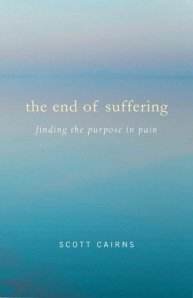
BackspacerFrom the reading chair: Biography as Theology: How Life Stories Can Remake Today’s Theology by James Wm. McClendon; The Concentration Camp and Other Stories by Geoffrey C. Bingham; The End of Suffering: Finding Purpose in Pain by Scott Cairns [reviewed here]; Pastoral Theology in the Classical Tradition by Andrew Purves; Poems for Gardeners edited by Germaine Greer; No Rusty Swords: Letters, Lectures, and Notes from the Collected Works by Dietrich Bonhoeffer.

Through the iPod: Come Up Full and The Crossing by Meg Hutchinson; Backspacer by Pearl Jam; Beautiful World and The Road Between by Khristian Mizzi; My Holiday by Mindy Smith; Our Bright Future by Tracy Chapman; Death Magnetic by Metallica; Symphony No. 4 in E minor, Op. 98 – Carlos Kleiber/Vienna Philharmonic Orchestra by Johannes Brahms.

On the screen: Shooting Dogs [2007], reviewed here;  Wallace and Gromit: A Matter of Loaf or Death [2009]; Shaun the Sheep: Sheep on the Loose [2009]; Shaun the Sheep: Off the Baa! [2008]; Sometimes in April [2005].

By the bottle: Seppeltsfield Cellar No 9 Muscat Rutherford (tasting notes).

The Service of Intercession

Moses MosaicKarl Barth once noted that ‘Even within the world to which it belongs, it [the Church] does not exist ecstatically or eccentrically with reference to itself, but wholly with reference to them, to the world around. It saves and maintains its own life as it interposes and gives itself for all other human creatures’ (CD IV.3.2, 762). There can be no doubt that this ministry of intercession certainly involves prayer, but prayer without diakonia is not true prayer, even as diakonia without prayer is not true diakonia. Authentic intercession also involves a struggle against evil, identification with those who are estranged and alienated, and an ‘argument’ with God on behalf of those who have become disenfranchised from God, from human community and from creation. We might recall here Moses’ intercession for those who have worshipped the golden calf:

On the following day Moses said to the people, ‘You have committed a great sin. But now I shall go up to Yahweh: perhaps I can secure expiation for your sin.’ Moses then went back to Yahweh and said, ‘Oh, this people has committed a great sin by making themselves a god of gold. And yet, if it pleased you to forgive their sin …! If not, please blot me out of the book you have written!’ (Exodus 32:30–32)

Inherent in this intercession of responsible action is a sharing of guilt. This recalled something that I read recently in Bonhoeffer’s Ethics, (the implications of which we might also profitably tease out with a copy of TF Torrance’s The Mediation of Christ in hand). I cite Bonhoeffer:

[The] structure of responsible action includes both readiness to accept guilt and freedom.

When we once more turn our attention to the origin of all responsibility it becomes clear to us what we are to understand by acceptance of guilt. Jesus is not concerned with the proclamation and realization of new ethical ideals; He is not concerned with Himself being good (Matt. 19.17); He is concerned solely with love for the real man, and for that reason He is able to enter into the fellowship of the guilt of men and to take the burden of their guilt upon Himself. Jesus does not desire to be regarded as the only perfect one at the expense of men; He does not desire to look down on mankind as the only guiltless one while mankind goes to its ruin under the weight of its guilt; He does not wish that some idea of a new man should triumph amid the wreckage of a humanity whose guilt has destroyed it. He does not wish to acquit Himself of the guilt under which men die. A love which left man alone in his guilt would not be love for the real man. As one who acts responsibly in the historical existence of men Jesus becomes guilty. It must be emphasized that it is solely His love which makes Him incur guilt. From His selfless love, from His freedom from sin, Jesus enters into the guilt of men and takes this guilt upon Himself. Freedom from sin and the question of guilt are inseparable in Him. It is as the one who is without sin that Jesus takes upon Himself the guilt of His brothers, and it is under the burden of this guilt that He shows Himself to be without sin. In this Jesus Christ, who is guilty without sin, lies the origin of every action of responsible deputyship. If it is responsible action, if it is action which is concerned solely and entirely with the other man, if it arises from selfless love for the real man who is our brother, then, precisely because this is so, it cannot wish to shun the fellowship of human guilt. Jesus took upon Himself the guilt of all men, and for that reason every man who acts responsibly becomes guilty. If any man tries to escape guilt in responsibility he detaches himself from the ultimate reality of human existence, and what is more he cuts himself off from the redeeming mystery of Christ’s bearing guilt without sin and he has no share in the divine justification which lies upon this event. He sets his own personal innocence above his responsibility for men, and he is blind to the more irredeemable guilt which he incurs precisely in this; he is blind also to the fact that real innocence shows itself precisely in a man’s entering into the fellowship of guilt for the sake of other men. Through Jesus Christ it becomes an essential part of responsible action that the man who is without sin loves selflessly and for that reason incurs guilt. – Dietrich Bonhoeffer, Ethics (ed. Eberhard Bethge; trans. N.H. Smith; London: SCM, 1955), 209–10.

BonhoefferBonhoeffer (who my wife often confuses with Jason Alexander, a.k.a. George Costanza) then turns to consider the implications of this theology of Christ’s vicarious humanity for the human conscience and its relationship with law:

When Christ, true God and true man, has become the point of unity of my existence, conscience will indeed still formally be the call of my actual being to unity with myself, but this unity cannot now be realized by means of a return to the autonomy which I derive from the law; it must be realized in fellowship with Jesus Christ. Natural conscience, no matter how strict and rigorous it may be, is now seen to be the most ungodly self-justification, and it is overcome by the conscience which is set free in Jesus Christ and which summons me to unity with myself in Jesus Christ. Jesus Christ has become my conscience. This means that I can now find unity with myself only in the surrender of my ego to God and to men. The origin and the goal of my conscience is not a law but it is the living God and the living man as he confronts me in Jesus Christ. For the sake of God and of men Jesus became a breaker of the law. He broke the law of the Sabbath in order to keep it holy in love for God and for men. He forsook His parents in order to dwell in the house of His Father and thereby to purify His obedience towards His parents. He sat at table with sinners and outcasts; and for the love of men He came to be forsaken by God in His last hour. As the one who loved without sin, He became guilty; He wished to share in the fellowship of human guilt; He rejected the devil’s accusation which was intended to divert Him from this course. Thus it is Jesus Christ who sets conscience free for the service of God and of our neighbour; He sets conscience free even and especially when man enters into the fellowship of human guilt. The conscience which has been set free from the law will not be afraid to enter into the guilt of another man for the other man’s sake, and indeed precisely in doing this it will show itself in its purity. The conscience which has been set free is not timid like the conscience which is bound by the law, but it stands wide open for our neighbour and for his concrete distress. And so conscience joins with the responsibility which has its foundation in Christ in bearing guilt for the sake of our neighbour. (pp. 212–3)

This got me thinking: What might be some implications of Moses’ prayer, and Bonhoeffer’s words, for pastoral ministry? And for that of the people of God as a whole?

I’m still thinking …

James Will on the practice and praxis of peace

Christology of peace‘If incomplete and ideologically distorted persons nevertheless have the dignity of participation with their Creator in the preservation and completion of the creation, then praxis is a necessary dimension of theology. But praxis must not be misunderstood as practice. Practice has come to mean the use of external means to attain a theoretically defined end. It suggests that finite and sinful persons may so understand the meaning of God’s peace as to be able to devise economic, political, diplomatic, and even military means to attain it. The end of peace is thought to be a transcendent value that appropriate external means may effect. Praxis, on the other hand, is a dialectical process of internally related events from which a result dynamically emerges. Given the finite and ideological character of our preconceptions of peace, they cannot be treated as sufficient definitions of an eternal value to guide our practice. Rather, we need a praxis; that is, peace must be allowed to emerge from a dialogical and dialectical process that may continuously correct our ideological tendencies. Praxis is thus a process of struggle, negotiation, and dialogue toward a genuinely voluntary consensus’. – James E. Will, A Christology of Peace (Louisville: Westminster/John Knox Press, 1989), 24–5.

Collingwood on things ‘perfectly serviceable’

Wireless‘It is a weakness of printed literature that this reciprocity between writer and reader is difficult to maintain. The printing-press separates the writer from his audience and fosters cross-purposes between them. The organization of the literary profession and the “technique” of good writing, as that is understood among ourselves, consist to a great extent of methods for mitigating this evil; but the evil is only mitigated and not removed. It is intensified by every new mechanization of art. The reason why gramophone music is so unsatisfactory to any one accustomed to real music is not because the mechanical reproduction is bad – that would be easily compensated by the hearer’s imagination – but because the performers and the audience are out of touch. The audience is not collaborating, it is only overhearing. The same thing happens in the cinema, where collaboration as between author and producer is intense, but as between this unit and the audience non-existent. Performances on the wireless have the same defect. The consequence is that the gramophone, the cinema, and the wireless are perfectly serviceable as vehicles of amusement or of propaganda, for here the audience’s function is merely receptive and not concreative; but as vehicles of art they are subject to all the defects of the printing-press in an aggravated form. “Why”, one hears it asked, “should not the modern popular entertainment of the theatre, produce a new form of great art?” The answer is simple. In the Renaissance theatre collaboration between author and actors on the one hand, and audience on the other, was a lively reality. In the cinema it is impossible’. – Robin George Collingwood, The Principles of Art (Oxford: Oxford University Press, 1958), 323.

Tragically, the same critique may be laid against many churches. In fact, Collingwood’s words reminded me of Ben’s reflections on ‘a famous Sydney megachurch’ posted earlier this year.

Gregory of Nazianzus on pastoral ministry and healing

Gregory of NazianzusLately, I have been making my way through the work of Gregory of Nazianzus, and I was particularly struck by his ‘Oration II: In Defence of his Flight to Pontus, and his Return, after his Ordination to the Priesthood, with an Exposition of the Character of the Priestly Office’ where he not only outlines the gravity of the pastoral call and charge, but also identifies that the nature of pastoral ministry concerns healing, and that that healing is unreservedly grounded in the incarnation:

‘… the scope of our art [i.e. pastoral ministry, which he elsewhere calls the ‘the art of arts and science of sciences’] is to provide the soul with wings, to rescue it from the world and give it to God, and to watch over that which is in His image, if it abides, to take it by the hand, if it is in danger, or restore it, if ruined, to make Christ to dwell in the heart by the Spirit: and, in short, to deify, and bestow heavenly bliss upon, one who belongs to the heavenly host.

This is the wish of our schoolmaster the law, of the prophets who intervened between Christ and the law, of Christ who is the fulfiller and end of the spiritual law; of the emptied Godhead, of the assumed flesh, of the novel union between God and man, one consisting of two, and both in one. This is why God was united to the flesh by means of the soul, and natures so separate were knit together by the affinity to each of the element which mediated between them: so all became one for the sake of all, and for the sake of one, our progenitor, the soul because of the soul which was disobedient, the flesh because of the flesh which co-operated with it and shared in its condemnation, Christ, Who was superior to, and beyond the reach of, sin, because of Adam, who became subject to sin.

This is why the new was substituted for the old, why He Who suffered was for suffering recalled to life, why each property of His, Who was above us, was interchanged with each of ours, why the new mystery took place of the dispensation, due to loving kindness which deals with him who fell through disobedience. This is the reason for the generation and the virgin, for the manger and Bethlehem; the generation on behalf of the creation, the virgin on behalf of the woman, Bethlehem because of Eden, the manger because of the garden, small and visible things on behalf of great and hidden things. This is why the angels glorified first the heavenly, then the earthly, why the shepherds saw the glory over the Lamb and the Shepherd, why the star led the Magi to worship and offer gifts, in order that idolatry might be destroyed. This is why Jesus was baptized, and received testimony from above, and fasted, and was tempted, and overcame him who had overcome. This is why devils were cast out, and diseases healed, and the mighty preaching was entrusted to, and successfully proclaimed by men of low estate.

This is why the heathen rage and the peoples imagine vain things; why tree is set over against tree, hands against hand, the one stretched out in self indulgence, the others in generosity; the one unrestrained, the others fixed by nails, the one expelling Adam, the other reconciling the ends of the earth. This is the reason of the lifting up to atone for the fall, and of the gall for the tasting, and of the thorny crown for the dominion of evil, and of death for death, and of darkness for the sake of light, and of burial for the return to the ground, and of resurrection for the sake of resurrection. All these are a training from God for us, and a healing for our weakness, restoring the old Adam to the place whence he fell, and conducting us to the tree of life, from which the tree of knowledge estranged us, when partaken of unseasonably, and improperly.

Of this healing we, who are set over others, are the ministers and fellow-laborers; for whom it is a great thing to recognize and heal their own passions and sicknesses: or rather, not really a great thing, only the viciousness of most of those who belong to this order has made me say so: but a much greater thing is the power to heal and skillfully cleanse those of others, to the advantage both of those who are in want of healing and of those whose charge it is to heal’.

– Gregory of Nazianzus, ‘Oration II: In Defence of his Flight to Pontus, and his Return, after his Ordination to the Priesthood, with an Exposition of the Character of the Priestly Office’ in A Select Library of Nicene and Post-Nicene Fathers of the Christian Church, Second Series (ed. Philip Schaff and Henry Wace; Edinburgh/Grand Rapids: T&T Clark/Wm. B. Eerdmans, 1989), 7:209–10.

Among other things, Gregory reminds us that the ministry of pastoral care needs to be set within a theological understanding of ministry that is at once apostolic, trinitarian, catholic and evangelical. The primary ministry is the ministry of God, incarnate in the person of Jesus Christ in the world; the mission and ministry of the Church is to participate, in the Spirit, in that ministry of Jesus Christ in the world.

Andrew Purves, in his Reconstructing Pastoral Theology, argues that a huge space seems to have opened up between the faith of the church, understood biblically and historically (the consensus fidelium), and what is often identified as pastoral theology and pastoral care. He contends that it is reasonable to expect that pastoral theology and care would in its own way express what Christians believe about God and the gospel of Jesus Christ and do so in a clear, simple and coherent manner. If this is so the focus of pastoral care will be on God’s grace in Jesus Christ, on the gospel that is a Word from beyond us, and to which pastoral theology and practice must submit to be faithful to the gospel. In other words, it must be Trinitarian, Christological and soteriological:

To insist that God, or, more accurately the ministry of the Father through the Son and in the Holy Spirit, is the subject matter of pastoral theology means then that there is no faithful content to speaking forth and living out the gospel pastorally apart from knowledge of and sharing in the mission of the God who acts savingly in, through, and as Jesus Christ and in the Spirit precisely as a man for all people. It is important to emphasize the reality of our union with Christ, for without that all pastoral work is cast adrift from the actuality of God’s ministry. If it gets God wrong, or more specifically fails to appreciate that knowledge of God is always and only a knowledge of a God who acts, and who acts in, through, and as Jesus Christ, and into whose action and life we, by the Holy Spirit, participate through our union with Christ, the church gets its saying and doing wrong. Knowledge of God and God’s mission is the only critical perspective from which we can judge our own pastoral actions. (Andrew Purves, Reconstructing Pastoral Theology, xxi)

In other words, pastoral care becomes the task of maintaining the connection between the particularity of human stories and the grounding story of the Christian tradition and its community.

Convictions, Principles, Opinions and the proper task of Christian theology

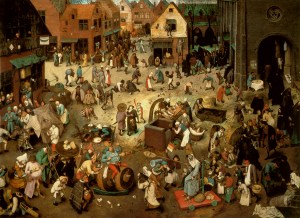
Bruegel - The Fight Between Carnival and LentSaturday morning is always about coffee. Not only about coffee, to be sure, but never anything apart from coffee. In fact, my vision of hell is being locked in a house devoid of beans for an eternal Saturday morning. Sometimes, Saturday morning is also about reading. But if that’s going to happen, then Saturday-morning reading really needs to be something decent. Well, James McClendon’s Biography as Theology: How Life Stories Can Remake Today’s Theology is a worthy contender for the much-coveted Saturday morning slot. Here he is on the distinction between convictions, principles and opinions:

Convictions may be distinguished from principles, in that the latter are the product of reflective thinking, have often a rather academic flavor, and are perhaps more often weapons for attacking others than guides for ourselves (most of us have at some time served on committees with ‘men of principle’); while convictions are very often particular and immediate in form, and may not be consciously formulated by their holders at all, yet when we do find our convictions, we find the best clue to ourselves. Convictions may be distinguished from opinions: people stake money on opinions, whether of lawyers or of handicappers, but they have been known to stake their lives on their convictions; opinions are argued, but convictions are the hidden agenda in every argument, the unseen weight on even the most honest set of moral scales. Now it must be that an ethics of character will be concerned with convictions, for to have convictions is to have at least that much character; moreover, convictions, unlike traits of character such as justice or mercy, may, if known, be expressed in propositional form, so they may evince the particularity of character as the more general ‘traits’ cannot … For as men or women are convinced so will they live. And similarly with convinced communities. What is noteworthy, however, is that the realm of convictions is just the realm with which theology, too, is concerned. The best way to understand theology is to see it, not as the study about God (for there are godless theologies as well as godly ones), but as the investigation of the convictions of a convictional community, discovering its convictions, interpreting them, criticizing them in the light of all that we know, and creatively transforming them into better ones if possible … Theologians, then, are concerned with convictions, not merely in themselves, but in relation to the persons and communities that embrace these convictions, and they are interested in what those convictions are about. The Christian theologian cares not only to know that there is a belief in God, not only to know that that belief is the conviction of the Christian community, but also to know whether there be such a God and what difference God’s being (as well as the belief in it) makes to the women and men who believe or disbelieve. – James Wm. McClendon Jr., Biography as Theology: How Life Stories Can Remake Today’s Theology (Philadelphia: Trinity Press International, 1990), 19–21.

McClendon proceeds to name the relationship between ‘adequate ethic’ and what he calls theology’s ‘proper work’:

Ethics may have to acknowledge that the only truly universal ethical judgments are purely formal, providing little guidance for the formation of moral character, and may have to learn to attend afresh to the way of life of particular communities and individuals, though without sacrificing its yearning for universalizability. Theology may have to acknowledge that a theology of revelation or of reason, or a theology of secularity or of religiosity, if it does not enter into the actual shape of the lives of the people in its community of concern, is after all irrelevant to these lives. (p. 21)

The reconciliation of this relationship, he argues, is found is biography where the tension between ‘what is and what ought to be believed and lived by all’ is enfleshed, and that in community. To engage in such reflection, he argues, is ‘the proper task of Christian theology’.

By recognizing that Christian beliefs are not so many ‘propositions’ to be catalogued or juggled like truth-functions in a computer, but are living convictions which give shape to actual lives and actual communities, we open ourselves to the possibility that the only relevant critical examination of Christian beliefs may be one that begins by attending to lived lives. Theology must be at least biography. If by attending to those lives, we find ways of reforming our own theologies, making them more true, more faithful to our ancient vision, more adequate to the age now being born, then we will be justified in that arduous inquiry. Biography at its best will be theology. (p. 22)

This relates to another important thesis of McClendon’s essay; namely, that the locale for the formation of one’s character is community. As Edmund Pincoffs reminds, ‘Aristotle did not give open lectures; St. Paul did not write open letters. When they used the word “we”, they spoke from within a community of expectations and ideals: a community within which character was cultivated’. This, of course, is one of the weaknesses of so-called ‘situation ethics’, or what James McClendon refers to as ‘decisionism’. McClendon argues that decisionism is ‘ill equipped to understand and shed light upon those dark struggles of our selves in which, confronted with imponderables, we do flounder about, sometimes conscientiously, sometimes self-deceived, sometimes locked in the struggle that classical Christian theology calls temptation’. He contrasts this with what he calls the ‘classic view’, the notion that a person’s life is ‘a journey, a pilgrimage, in which one’s self is not mere datum, nor an electronic calculator reading “decisions” off new “situations”, but a soul in the making, a self which can become itself only as the weight of sin is fully recognized and the self recognizes a center of meaning and source of power beyond itself, forgiving and remaking that self’ (p. 9). Such recognition, I concur, requires being-in-community. There is no stand-alone ‘I’. The journey inwards cannot be made apart from the journey outwards. Learning, maturation and character are perichoretically-determined activities.

Anyway, time to grind …

Scott Cairns: ‘The End of Suffering: Finding Purpose in Pain’

End of SufferingScott Cairns’ most recent publication – The End of Suffering: Finding Purpose in Pain (Brewster: Paraclete Press, 2009) – invites a play on the word end. Cairns recalls that while we can believe that a day will come when suffering will be no more, we live now in ‘our puzzling meantime’, aware both that suffering is no end in itself but also that we sense something of ‘suffering’s purpose’, that ‘our own descents into suffering may turn out to be the occasions in which we – imitating [Christ’s] unique and appalling descent – come to know Him all the more intimately’ (p. 99). Here’s a further snippert:

Saint Isaac counsels, “Blessed is the person who knows his own weakness, because awareness of this becomes for him the foundation and the beginning of all that is good and beautiful.” Affliction appears to be our only reliable access to this kind of knowledge, this necessary confrontation with our own weaknesses, and this advantageous mitigation of our pride. And it seems to be the only way we come against self-esteem to glimpse and thereafter to know our condition, to appreciate our vulnerability, and to live according to this new and chastening light. (pp. 18–19)

Throughout this book, Cairns draws not only upon Saint Isaac, but also upon work by George Steiner, W.H. Auden, G.K. Chesterton, Dostoevsky (mainly his The Brothers Karamazov), Dietrich Bonhoeffer, Archimandrite Sophrony, Saint Theophan the Recluse, Kallistos Ware, Alexander Schmemann, Simone Weil, and others. This essay serves as not only an accessible reflection on suffering (it would be a good book to work through in small groups), but also as a nuanced entrée into the Christian tradition (particularly into its Orthodox branch), and into a way of doing theology that invites us to embrace – or, rather, to be embraced by – a new vision of life via the ‘puzzlement’ of our afflictions. Those already familiar with Cairns’ poetry (and if you’re not, shame on you!) will want to go back and re-read it. Those unfamiliar with Cairns the poet, will (hopefully) get enough of a taste of it in this essay that they will want to ‘take up and read’ [it].

The book concludes – appropriately – by recalling Alexander Schmemann’s reflection on Lent:

For many, if not for the majority of Orthodox Christians, Lent consists of a limited number of formal, predominantly negative, rules and prescriptions: abstention from certain food, dancing, perhaps movies. Such is the degree of our alienation from the real spirit of the Church that it is almost impossible for us to understand that there is “something else” in Lent – something without which all these prescriptions lose much of their meaning. This “something else” can best be described as an “atmosphere,” a “climate” into which one enters, as first of all a state of mind, soul, and spirit, which for seven weeks permeates our entire life. Let us stress once more that the what is lacking purpose of Lent is not to force on us a few formal obligations, but to “soften” our heart so that it may open itself to the realities of the spirit, to experience the hidden “thirst and hunger” for communion with God.

Cairns recalls how that for Schmemann, ‘a “quiet sadness” permeates the Lenten services themselves; “vestments are dark, the services are longer than usual and more monotonous, there is almost no movement.” He observes that despite the alternating readings and chants, “nothing seems to happen.” And so, he acknowledges, we stand for a very long time in this quiet, this sadness, this monotony. “But then we begin to realize that this very length and monotony are needed if we are to experience the secret and at first unnoticeable ‘action’ of the service in us. Little by little, we begin to understand, or rather to feel, that this sadness is indeed ‘bright,’ that a mysterious transformation is about to take place in us.” Moving through the sadness’, Cairns writes, ‘we glimpse the joy. We feel its effects on us and feel how it changes us. We are thereby led to a place where noises, distractions, and false importance of the street – of our dissipated lives – finally “have no access – a place where they have no power.” Similarly, then, in those seasons of our afflictions – those trials in our lives that we do not choose but press through – a stillness, a calm, and a hope become available to us; they are a stillness, a calm, and a hope that must be acquired slowly, because – as Father Schmemann says of our joy in Lent – “our fallen nature has lost the ability to accede there naturally.”’ We are obliged, Cairns insists, to ‘recover this wisdom slowly, bit by bit’. (pp. 112–14)

‘To believe means …’

Van Gogh - The Raising of Lazarus 1890I wish to follow up on my previous post on A Liturgy for a Miscarried Child with some words from the ‘Introduction’ to Moltmann’s groundbreaking thesis, Theology of Hope:

To believe means to cross in hope and anticipation the bounds that have been penetrated by the raising of the crucified. If we bear that in mind, then this faith can have nothing to do with fleeing the world, with resignation and with escapism. In this hope the soul does not soar above our vale of tears to some imagined heavenly bliss, nor does it sever itself from the earth. For, in the words of Ludwig Feuerbach, it puts ‘in place of the beyond that lies above our grave in heaven the beyond that lies above our grave on earth, the historic future, the future of mankind’. It sees in the resurrection of Christ not the eternity of heaven, but the future of the very earth on which his cross stands. It sees in him the future of the very humanity for which he died. That is why it finds the cross the hope of the earth. This hope struggles for the obedience of the body, because it awaits the quickening of the body. It espouses in all meekness the cause of the devastated earth and of harassed humanity, because it is promised possession of the earth. Ave crux – unica spes!

But on the other hand, all this must inevitably mean that the man who thus hopes will never be able to reconcile himself with the laws and constraints of this earth, neither with the inevitability of death nor with the evil that constantly bears further evil. The raising of Christ is not merely a consolation to him in a life that is full of distress and doomed to die, but it is also God’s contradiction of suffering and death, of humiliation and offence, and of the wickedness of evil. Hope finds in Christ not only a consolation in suffering, but also the protest of the divine promise against suffering. If Paul calls death the ‘last enemy’ (I Cor. 15.26), then the opposite is also true: that the risen Christ, and with him the resurrection hope, must be declared to be the enemy of death and of a world that puts up with death. Faith takes up this contradiction and thus becomes itself a contradiction to the world of death. That is why faith, wherever it develops into hope, causes not rest but unrest, not patience but impatience. It does not calm the unquiet heart, but is itself this unquiet heart in man. Those who hope in Christ can no longer put up with reality as it is, but begin to suffer under it, to contradict it. Peace with God means conflict with the world, for the goad of the promised future stabs inexorably into the flesh of every unfulfilled present. If we had before our eyes only what we see, then we should cheerfully or reluctantly reconcile ourselves with things as they happen to be. That we do not reconcile ourselves, that there is no pleasant harmony between us and reality, is due to our unquenchable hope. This hope keeps man unreconciled, until the great day of the fulfilment of all the promises of God. It keeps him in statu viatoris, in that unresolved openness to world questions which has its origin in the promise of God in the resurrection of Christ and can therefore be resolved only when the same God fulfils his promise. This hope makes the Christian Church a constant disturbance in human society, seeking as the latter does to stabilize itself into a ‘continuing city’. It makes the Church the source of continual new impulses towards the realization of righteousness, freedom and humanity here in the light of the promised future that is to come. This Church is committed to ‘answer for the hope’ that is in it (I Peter 3.15). It is called in question ‘on account of the hope and resurrection of the dead’ (Acts 23.6). Wherever that happens, Christianity embraces its true nature and becomes a witness of the future of Christ’. – Jürgen Moltmann, Theology of Hope: On the Ground and the Implications of a Christian Eschatology (New York/Evanston: Harper & Row, 1967), 20–22.

A Liturgy for a Miscarried Child

William_Turner_-_Shade_and_Darkness_-_the_Evening_of_the_DelugeWe are made for life. Everything in our humanity cries out against death. Strangely, and shockingly, we’ve come to accept the ‘fact’ of death (and even, in some cases, to benefit from it), especially when it concerns those who have ‘had a good innings’. But one of the toughest gigs is to bury a child. Only one who has lost a child can know the journey from enrapture at the news that ‘we’re pregnant’, to the birth of dreams and laughter, to losing the grip on hope, and … well, to the great emptiness.

Many of those who ‘lose’ a child – including a child in utero – feel that they want to remember rightly, to honour life, and to thank God for the life given – and taken – from them. For some, this means intentional time together with God, to give thanks, to listen, to rage, to see if God might listen, to bury the ‘body’, to protest.

About a year ago, it fell to me to conduct a ‘private’ funeral service for a child which had died in utero (at 11 weeks). Disappointingly, among all the many resources that I had at hand for preparing a funeral liturgy, I had absolutely nothing for funerals in the case of a miscarriage. I was shocked, and deeply bothered, that while I could find prepared liturgies for children who had died in infancy, or as stillborns, I looked in vain for words that might gather up the feelings surrounding the 10-20% of pregnancies that end in miscarriage. So in the end, I scrambled together my own.

The liturgy I pulled together in haste remains a work-in-progress, but rather than wait I wanted to make it available for others for whom it might be a helpful resource. Note that the couple in question had ‘named’ their child with an in utero ‘name’. It was this ‘name’ that was used in the service.

A Liturgy for a Miscarried Child

Gathering

We are here together to worship God, to thank God for God’s love, and to remember [name] short life with us on earth; to share our grief and to commend [name] to God’s eternal care. We meet in the hope that while death is the great enemy, death is not the end, but the new beginning, and so may be faced without fear, bitterness, or guilt, but in faith, hope, and love.

Readings

‘God bent his bow and aimed it squarely at me. He shot his arrows deep into my heart … He has filled me with bitterness. He has given me a cup of deep sorrow to drink. He has made me grind my teeth on gravel. He has rolled me in the dust.Peace has been stripped away, and I have forgotten what prosperity is. I cry out, “My splendor is gone! Everything I had hoped for from the LORD is lost!” The thought of my suffering and homelessness is bitter beyond words. I will never forget this awful time, as I grieve over my loss. Yet I still dare to hope when I remember this: The unfailing love of the LORD never ends! By his mercies we have been kept from complete destruction. Great is his faithfulness; his mercies begin afresh each day. I say to myself, “The LORD is my inheritance; therefore, I will hope in him!” The LORD is wonderfully good to those who wait for him and seek him’. (Lamentations 3.12–25)

‘Where shall I go to escape your spirit? Where shall I flee from your presence? If I scale the heavens you are there, if I lie flat in Sheol, there you are. If I speed away on the wings of the dawn, if I dwell beyond the ocean, even there your hand will be guiding me, your right hand holding me fast. I will say, ‘Let the darkness cover me, and the night wrap itself around me,’ even darkness to you is not dark, and night is as clear as the day. You created my inmost self, knit me together in my mother’s womb. For so many marvels I thank you; a wonder am I, and all your works are wonders. You knew me through and through, my being held no secrets from you, when I was being formed in secret, textured in the depths of the earth. Your eyes could see my embryo. In your book all my days were inscribed, every one that was fixed is there’. (Psalm 139.7–16)

Silence

Prayer

Merciful Father, before you formed us in the womb you knew us as a mother. You make nothing in vain and you love all that you have made. You are the God of unfailing compassion, and you too know what it is like to lose a child. In your creative love and tenderness you gave us [name], so full of hope for the future. You are the source of all our lives, the strength of all our days. You did not make us for darkness and death but to see you face to face and to enjoy abundant life. We praise you for with you nothing is wasted or incomplete, and all things are upheld and made whole with your love. Help us to comfort one another with the comfort we receive from you through your two hands – Word and Spirit.

We pray for [name]. We ask that any trauma that [name] may have felt in those last days, hours, or moments, may be met with your healing. We pray that [name] may continue to grow physically and to mature emotionally, unfrightened and secure in your love, and thrilled about knowing you as the Ground of their being. We thank you for the promise that [name] is in your care where there is no more dying, or tears or pain. And we thank you for giving us every reason to hope that one day we might meet [name] face to face, and in that long-awaited embrace, know afresh that you are the promise-keeping Lord of life.

Readings

‘Let the children come to me; do not hinder them, for to such belongs the kingdom of God’. (Mark 10.14)

‘I am convinced that nothing can ever separate us from God’s love. Death can’t, and life can’t. The angels can’t, and the demons can’t. Our fears for today, our worries about tomorrow, and even the powers of hell can’t keep God’s love away. Whether we are high above the sky or in the deepest ocean, nothing in all creation will ever be able to separate us from the love of God that is revealed in Christ Jesus our Lord’. (Romans 8.38–39)

Silence

Apostles’ Creed

We believe in God, the Father Almighty,
the Creator of heaven and earth,
and in Jesus Christ, His only Son, our Lord:
Who was conceived of the Holy Spirit,
born of the Virgin Mary,
suffered under Pontius Pilate,
was crucified, died, and was buried.
He descended into hell.
The third day He arose again from the dead.
He ascended into heaven
and sits at the right hand of God the Father Almighty,
whence He shall come to judge the living and the dead.
We believe in the Holy Spirit, the holy catholic church,
the communion of saints,
the forgiveness of sins,
the resurrection of the body,
and life everlasting.

Prayer of Committal

Gracious God, we commit [name] into your ever-caring and gentle love; [name] brought the promise of joy to our lives, and to those closest to us, for such a short time; enfold [name] now in your mighty and eternal life of love, in the name of the risen One who was born and died and who lives and reigns with you and the Holy Spirit for ever.

Blessing

‘God bless you and keep you, God smile on you and gift you, God look you full in the face and make you prosper’. (Numbers 6.24–26)

Reading

‘Then I saw a new heaven and a new earth, for the old heaven and the old earth had disappeared. And the sea was also gone. And I saw the holy city, the new Jerusalem, coming down from God out of heaven like a beautiful bride prepared for her husband. I heard a loud shout from the throne, saying, “Look, the home of God is now among his people! He will live with them, and they will be his people. God himself will be with them.He will remove all of their sorrows, and there will be no more death or sorrow or crying or pain. For the old world and its evils are gone forever.” And the one sitting on the throne said, “Look, I am making all things new!” … And he also said, “It is finished! I am the Alpha and the Omega – the Beginning and the End. To all who are thirsty I will give the springs of the water of life without charge! All who are victorious will inherit all these blessings, and I will be their God, and they will be my children’. (Revelation 21.1–7)

Thinking baptism … and formation

underwater-sculpture-parkToday, Halden (pbuh) had me thinking about baptism. I had this – or at least something like it – to contribute:

Baptism is both God’s sign to humanity that we have been redeemed by Christ, and humanity’s sign to God that we are willing partners in God’s work of reconciliation. Baptism, in other words, finds its basis in the hypostatic union through which God draws near to humanity and humanity draws near to God. Jesus Christ is the one mediator between God and humanity. It is the prius of the divine ecomony in the incarnation that baptism testifies chiefly to, and not to any subjective attainment of our confession, which might change. To put it another way, baptism is nothing less than our participation in the full and vicarious humanity of the Son of God.

This then got me thinking about the relationship between baptism and formation, at which point I recalled Bonhoeffer’s words:

Formation comes only by being drawn into the life of Jesus Christ. It comes only as formation in His likeness, as conformation with the unique form of Him who was made man, was crucified and rose again. This is not achieved by dint of efforts ‘to become like Jesus’ … It is achieved only when the form of Jesus Christ himself works upon us in such a manner that moulds our form in its own likeness (Gal 4.19). It is not Christian men who shape the world with their ideas, but it is Christ who shapes men in conformity with Himself. – Dietrich Bonhoeffer, Ethics (ed. Eberhard Bethge; trans. N.H. Smith; London: SCM, 1955), 18.

[Image: Jason deCaires Taylor]

Dietrich Ritschl on sermons

‘The Word of the sermon is indeed a new Word and not a repetition of last Sunday’s sermon, but this does not mean that each sermon devaluates or extinguishes the previous sermons. If this were so, the New Testament could never speak about a “Church” and Paul could never refer to the message he had brought before … This is true because Jesus Christ’s presence among His people does not consist of appearances discontinuous in time, i.e., which occur’. – Dietrich Ritschl, A Theology of Proclamation (Richmond: John Knox Press, 1960), 72, 73.

Why Men Shouldn’t be Ordained

Poussin OrdinationEarlier this year, the Knox Centre for Ministry and Leadership hosted Robert Jenson in an informal but riveting round table conversation about the eucharist and mission. In the midst of the discussion, Professor Jenson made the comment that the ecumenical movement (at least at ‘official’ levels) has reached a standstill, and he named as the reason the ordination of women. [Seems like a good time to recall Balthasar’s words: ‘But the most important requirement for [the ecumenical] venture is that both partners in the dialogue have God before them and not behind them. All movement must be towards God, the depth of whose wisdom and mystery appears always to increase’. Who Is a Christian? (London: Burns & Oates, 1968), 39.]

Anyway, now Halden has reposted an absolute ripper from Linda on why men shouldn’t be ordained. In fact, it’s so good that I’m reposting it here as well:

10. A man’s place is in the army.

9. For men who have children, their duties might distract them from the responsibilities of being a parent.

8. Their physical build indicates that men are more suited to tasks such as chopping down trees and wrestling mountain lions. It would be “unnatural” for them to do other forms of work.

7. Man was created before woman. It is therefore obvious that man was a prototype. Thus, they represent an experiment, rather than the crowning achievement of creation.

6. Men are too emotional to be priests or pastors. This is easily demonstrated by their conduct at football games and watching basketball tournaments.

5. Some men are handsome; they will distract women worshipers.

4. To be ordained pastor is to nurture the congregation. But this is not a traditional male role. Rather, throughout history, women have been considered to be not only more skilled than men at nurturing, but also more frequently attracted to it. This makes them the obvious choice for ordination.

3. Men are overly prone to violence. No really manly man wants to settle disputes by any means other than by fighting about it. Thus, they would be poor role models, as well as being dangerously unstable in positions of leadership.

2. Men can still be involved in church activities, even without being ordained. They can sweep paths, repair the church roof, change the oil in the church vans, and maybe even lead the singing on Father’s Day. By confining themselves to such traditional male roles, they can still be vitally important in the life of the Church.

1. In the New Testament account, the person who betrayed Jesus was a man. Thus, his lack of faith and ensuing punishment stands as a symbol of the subordinated position that all men should take.

And, in the comments, Kim Fabricius has added an eleventh reason: ’11. Jesus did not ordain men. He did not ordain women either, of course – but two wrongs don’t make a right’.