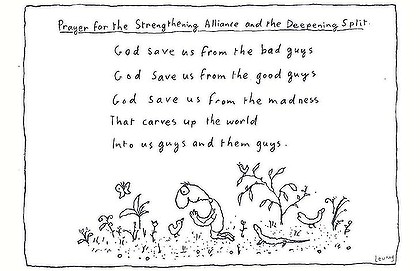
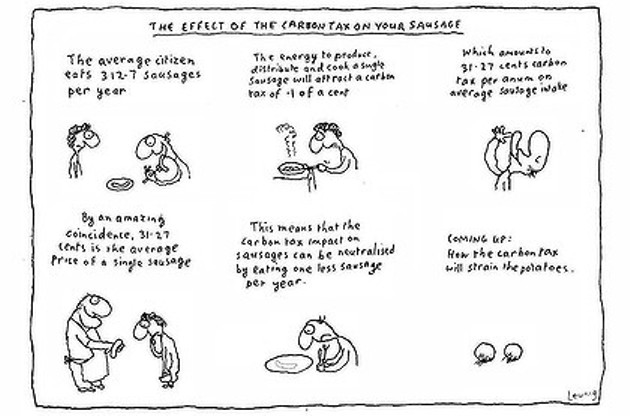
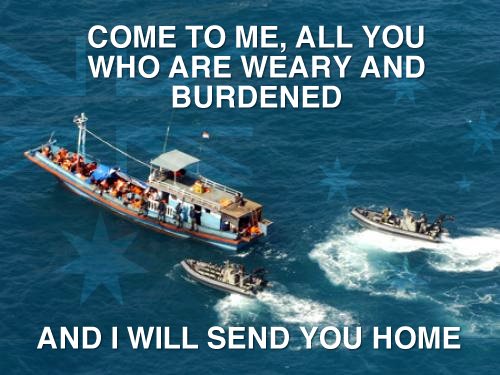
While Aussies discuss the new carbon tax, Michael Leunig provides his own take:
Australia
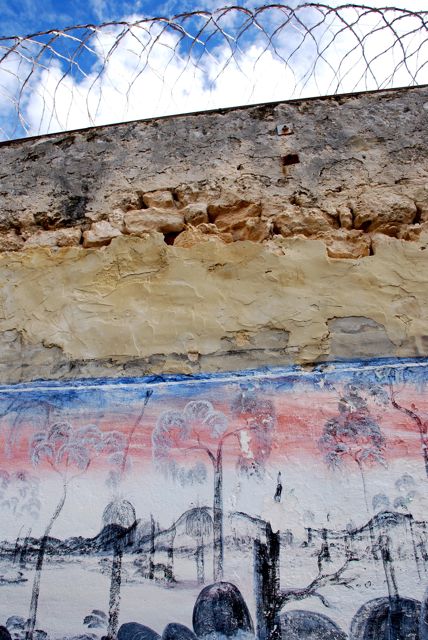
Fred Williams: Intimate Horizons
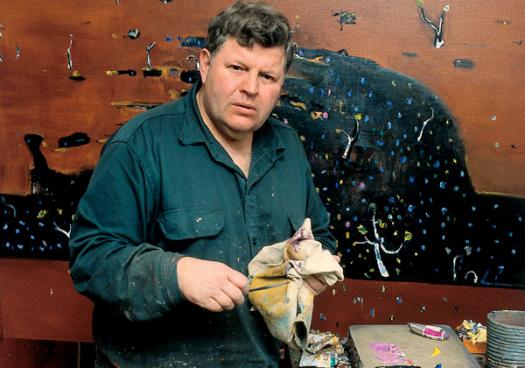
The day has been filled with a number of highlights, not least of which was the discovery of a piece about Fred Williams by Peter Conrad in the latest issue of The Monthly. Williams is certainly among my favourite painters, from Australia or elsewhere. I well remember his show at the National Gallery of Victoria back in the 80s – it was absolutely mind-blowing. Anyway, here’s a wee snippet from Conrad’s piece:
In 1947 the art historian Kenneth Clark sympathised with Sidney Nolan’s early efforts to paint “the Australian countryside (if one can call that inhospitable fringe between sea and desert by such a reassuring name)”. Clark suspected that art, with its play of bright but not blinding light and soft shadow, was disabled because Australia contained “no dark woods … no thick, sappy substances”, no excuse for pictorial impasto.
A decade later, Fred Williams returned to Melbourne after spending six years as a student in London and began to prove Clark wrong. The work Williams had done in England – mostly figurative, with wistful urban vignettes of buskers and beggars, or souvenirs of the desperately jaunty acrobats and comedians in the last remaining music halls – proved to be a false start. In Australia the land was starkly depopulated bush, with no workers tidily pruning the trees, as seen in one of his English etchings, and no church steeples to organise and sanctify the view. The affectionately downtrodden rural scenery of Constable seemed irrelevant, as did Turner’s frothy sublimity. On a trip to Kosciuszko National Park, Williams discovered something quite unlike the Alps that had excited the European Romantics. Storm clouds pummelled the Australian mountains in an aerial bombardment and snow, as it settled onto rock, sketched grotesque, leering faces.
The geometrical boulders painted by Cézanne were of some help, because they reminded Williams to consider what the land was made of, but his visual education did little to prepare him for his first expeditions to Mittagong in the Southern Highlands, New South Wales, and Upwey in the Dandenongs, Victoria. He was bewildered by the lack of a skyline, and by the eye’s inability to find a track through the mess of scrub: perspective is an urban convenience, allowing us to travel to the horizon in a straight line, and Australian space refused to be regulated.
You can read the whole piece here.
I was especially pleased, too, to read that the National Gallery of Australia in Canberra will be hosting an exhibition of Williams’ work entitled ‘Infinite Horizons’, from 12 August to 6 November 2011. It’s enough to make one want to jump onto a plane, very soon.
John Pilger on Anzac Day
‘Anzac Day has been appropriated by those who manipulate the cult of state violence – militarism – in order to satisfy a psychopathic deference to foreign power and pursue its aims. And the “legend” has no room for the only war fought on Australian soil: that of the Aboriginal people against the European invaders. In a land of cenotaphs, not one stands for them. The modern war-lovers have known no street of screams and despair. Their abuse of our memory of the fallen, and why they fell, is common among all servitors of rapacious power …’. – John Pilger, ‘Julia Gillard leads the march for Anzac in the 51st state’.
Blurring visions
‘While (the Christian) vision is no longer the dominant one (in Australia), and may never have been, neither is any other at the moment. There is as yet no other vision abroad in our society which commands the same authority as ours does, the same sense of being the bottom line, the great reserve to be called on in times of real need. Many of the themes of the rallies are necessary problem solving and little more, and much in the spiritual supermarket is fair weather stuff, adjuncts to a prosperity which may now be vanishing. Unbelief, once a daring and rather aristocratic gesture, must now have exhausted most of its glamour; it is certainly no longer exclusive, or particularly rebellious. Much the same could be said of sexual indulgence, pornography and the like. Having by now surely lost most of its flavour of forbidden fruit, sexual licence has to justify itself in terms of whatever real satisfaction it can give; its utility as a bait to draw people out of traditional ways and beliefs, and if possible into new allegiances, must by now also be wearing thin. And it will be difficult at the very least, for the cult of unremitting youthfulness and physical beauty to survive in the era of aging populations which it has helped to produce. By now liberal humanism is as badly fragmented by dissension as our witness ever was, and its fiercest adherents are often covertly uneasy at its lack of gentleness, its readiness to force the facts and its desolate this-worldliness. Its unrelenting adulthood forces people onto the thorns of tragic complexity and the strange intractability of the world, and often when people who subscribe to it relax for a moment, their eyes are seen to contain an almost desperate appeal: please prove us wrong, make us believe there is more to it than this, show us your God and that Grace you talk about. We are more widely judged on our own best terms than we think, and more insistently expected to be the keepers of the dimension of depth than we find comfortable’. – Les A. Murray, ‘Some Religious Stuff I Know About Australia’ in The Shape of Belief: Christianity in Australia Today (ed. Dorothy Harris, et al.; Homebush West: Lancer, 1982), 25–6.
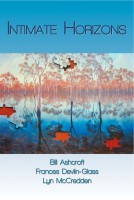
Intimate Horizons: The Post-Colonial Sacred in Australian Literature – A Review
Intimate Horizons: The Post-Colonial Sacred in Australian Literature, by Bill Ashcroft, Frances Devlin-Glass, and Lyn McCredden. (Adelaide: ATF Press, 2009), vi + 364 pp. IBSN 9781921511790
Intimate Horizons is an erudite and intriguing overture to post-colonial Australian literature and, via such, into the psyche of a nation. Its enquiry proceeds on the assumption that the twentieth-century’s final defeat of the gods is injudicious and that Australian authors working after the savageries of two world wars – and as indigenous peoples began to speak back to their colonisers, and in so doing open up new vistas of understanding about the land and about human relationships – began to “encounter the sacred as a region of difference, transformation and empowerment” (2).
The clear movement of Australian literature at the middle of the century is away from time – and its correlates such as history and rationality – to space which overwhelms it, and to the bodies and the proximate material world, and their stories, around which space is constituted. The conclusion to be made from this is that the literary engagement with place during this period, veering away from the horizontal sublime towards the sense of the sacred in the proximate, ordinary and material world, undertakes an unconscious movement towards Aboriginal experience, towards place as an embodied presence – characteristic of Aboriginal culture. (22–3)
The works of Francis Webb, Roland Robinson, David Malouf, and others, echo a fugue of common themes replayed across genres and decades, and which relate to the sacredness of place and embodiment, and the production of aesthetic “presence,” both of which are demotic and proximate, which stand in tension with those inherited forms from Europe, and “in which the sacred is glimpsed outside structure of interpretation” (18). Indeed, the authors of this volume (Bill Ashcroft, Frances Devlin-Glass and Lyn McCredden) believe that art and literature have been the “cultural discourses most successful in shedding the European yoke” (4) and have created, in Joseph Addison’s words, a “spacious horizon” as liberating as it is terrifying and which intimates distance and “placelessness” (8) that overwhelms the colonial imagination, disrupting the Romantic notion of the sublime and opening up the way to an acuity of the sacred in the broad spaces that characterise the horizontal experience of place. The authors are particularly critical of that literature which “seeks refuge in a melancholic and privileged mythologising of Australian history and white settler responses to it” (258).
Perceptive chapters on Patrick White (who “seemed to promise a new imagining of what is meant to be Australian” (33)), James McAuley (whose poetry speaks in a “haunted, homeless and displaced register” (105)), and Judith Wright (whose “‘parabolic’ vision … ‘runs beside or beyond the world of everyday’” (143)), are complemented with follow-up chapters exploring the “creative collision/encounter of paradigms of bush nationalism … and earthed sacredness” (165), and, drawing upon the work of Xavier Herbert, Kim Scott and Alexis Wright, “versions of the Indigenous sacred” (206) which find voice from the ecological depths of indigenous epistemology.
Chapter Seven, perhaps the most engaging of the chapters, surveys some contemporary Australian poetry which invites us to embrace questions of sacredness – a “theology of the earth” (285) – through “an immersion in the material world of place and time, and the material processes of poetic language” (244). Here we are introduced to poems by Kevin Hart, Robert Adamson, Gwen Harwood, Les Murray, Robert Gray, Lionel Fogarty and Sam Wagan Watson, whose poetry “triggers possibilities for change, even as it keeps the horrors of the colonial past in sight (283). Heirs to Webb and Wright, each of these poets, it is argued, when read within the context of the sacred, can be seen “grappling in new, demotic forms of language with the thisness of place, … with the intricate, lived realities of history in Australia” (245), and that partly by a refusal to be “pale reflections of European forms and ideas” (250). Such particularities, it is suggested, “are never merely backdrops to the poetry; nor does some abstracted ‘other’ seem to be the desired goal. Rather, in different but related ways, the poets confront this palpable, earthed, proximate place, Australia, through processes that do not cede any simplistic or monolithic access to the sacred” (245). This is evident, our authors observe, in “the drive to find new words” – “earthed, demotic languages of the sacred” – in order to respond to the “tangible realities of this place” (248). One place where this drive is evidenced is when Murray (a Roman Catholic) and Gray (one deeply influenced by Buddhist and Dharmic thought) are brought into conversation: “Gray’s Australia is permeated by the moral and spiritual meditativeness of a solitary poet, a cosmopolitan intellectual and sensualist, given to the detailed ‘thinginess’ of this place, but facing finally towards universalising formulations garnered across the centuries, into his reading and writing. Murray’s is a much more embattled, idiosyncratic and restless imagination” (277).
The final chapter considers the ways in which contemporary Australian fiction operates in a continual and heteroglossic dialogue with “earlier voices, a dialogue between different perceptions of the sacred sublime, and increasingly a dialogue between white and Aboriginal, between meaning cultures and presence cultures … [and which] constantly avoids closure” (288). It is one thing to suggest that the apotheosis of language adheres to an “intimation of the horizon of meaning at the edge of language” (321), to treat language as in some sense “sacramental” (232), to avoid monologism and to embrace a “multiplicity of voices” (288); it is another entirely to avoid clarifying the basis upon which such a discourse might take place. It is of little help to the reader to confess (after wading through over 300 pages!) that this book “avoids defining the term [‘the sacred’] because the very ground of our discussion – the concept of Presence, of meaning which exceeds final interpretation – makes definitions useless” (325). To be sure, I am not calling here for a kind of “doctrinal statement,” what I take the authors to mean by “orthodoxy” (288). Rather, as a Christian theologian, I wish to suggest that the dialogue and quest for new languages that a “metaphorically displaced society” (318) is groping after are literally given to us not in silence (as the authors suggest) but in the noise of divine incarnation, in the enfleshment of the divine in a particular location and story – in the ordinary – which is indeed “realised in the creative imagination” (300). As it stands, the pseudo-mysticism assumed throughout the book is as destructive of discursive knowledge as it is of birthing ethical action, concerns which are, I suspect, not far from some of the writers herein considered.
Those with deep allergies to natural theology – of the grammar of “place that remains the path to the sacred” (32) – will find much herein to baulk at: in its starkness, a borrowed fight which reminds the reader that while escape into cosmic emotions contemplating the grandeurs of antipodean place and space has some draw, any enlargement of the intelligence and calm of the mind is offset by the starvation of the soul groping for what Murray calls “unpurchased lifelong plenishment.”
The authors of Intimate Horizons assume much of their readers. They assume knowledge of Australian history, of post-colonial literature, of aboriginal spirituality, of the basic contours of theological grammar, of current discourse around race-relations, of the sense and sacramentality of place, and of antipodean attitudes to sentimentalism and religion. Some grasp of Heidegger’s notion of “Being” would be of help too.
The book highlighted again for me the legitimacy of Ian Anderson’s claim (in his Introduction to Blacklines: Contemporary Critical Writing by Indigenous Australians, edited by Michele Grossman), that “in the context of settler colonial states, such as Australia, colonial structures have never been dismantled. Colonial ways of knowing are not historical artefacts that simply linger in contemporary discourse. They are actively reproduced within contemporary dynamics of colonial power. Yet this fundamental observation does not really seem to have penetrated mainstream postcolonial theory” (24). Still, this stimulating book invites, and deserves, close reading. It helps one read Australian fiction and poetry – and, indeed, a national mythology – with more informed and sharpened eyes.
[An edited version of this review is to appear in Colloquium in due course]
Around: ‘Love seeketh not itself to please’
- Stanley Hauerwas and the university
- Richard Hays on the word of reconciliation
- Byron Smith shares a great quote from Karl Rahner on ‘Christian pessimism’
- John Pilger on ‘Julia Gillard, the new warlord of Oz’
- Walter Kasper on the regret of no shared communion
- Elliott Prasse-Freeman on Retaking power in Burma (Part I)
- Carol Howard Merritt on What Causes Pastors to Burnout?
- J.R. Daniel Kirk shares a parents prayer
- Kim Fabricius shares a wonderful sermon on baptism
- Sung-Sup Kim reviews David Gibson’s Reading the Decree: Exegesis, Election and Christology in Calvin and Barth
- Ben Myers is completely uninterested in ‘being a real man’
- ‘Speaking Christian: A Commencement Address for Eastern Mennonite Seminary’ by Stanley Hauerwas
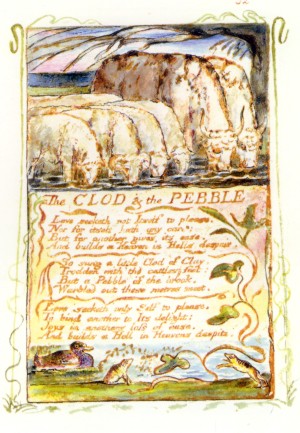
- Finally, here’s some William Blake that I’m enjoying today:
‘The Clod and the Pebble’
‘Love seeketh not itself to please,
Nor for itself hath any care,
But for another gives its ease,
And builds a heaven in hell’s despair.’
So sung a little clod of clay,
Trodden with the cattle’s feet,
But a pebble of the brook
Warbled out these metres meet:
‘Love seeketh only Self to please,
To bind another to its delight,
Joys in another’s loss of ease,
And builds a hell in heaven’s despite.’
‘Piping songs of peasant glee’: Around the aether
- Some protest against St Andrews’ appointment of NT Wright.
- NT Wright’s speech, on women bishops, at General Synod.
- Charles Marsh reflects on Bonhoeffer’s time in America.
- Slavoj Žižek’s lecture on Apocalyptic Times.
- Jean-Luc Nancy on Communism.
- The ABC launch an exciting-looking new sight – Religion and Ethics – with pieces by Rowan Williams on resident aliens, Stanley Hauerwas on greed, Paul Griffiths on death, Abdullahi Ahmed An-Na’im on Islam and human rights, David Novak on Judaism, punishment and torture, and others.
- Emma Wild-Wood on the journal of CMS Evangelist, Apolo Kivebulaya.
- Maria Nugent on the meaning of texts in Aboriginal people’s oral traditions.
- Tarkovsky films now free online.
- Sarah Coakley rethinks the sex crises in Catholicism and Anglicanism, Part 1.
- Archbishop Rowan Williams’ closing sermon at General Synod.
Australia’s Apartheid
‘Since Rudd‘s apology, Aboriginal poverty indicators have gone backwards. His “Closing the Gap” programme is a grim joke, having produced not a single new housing project.
An undeclared agenda comes straight from Australia’s colonial past: a land-grab combined with an almost prurient need to control, harass and blame a people who have refused to die off, whose genius is their understanding of an ancient land that still perplexes and threatens white authority. Whenever Canberra’s politicians want to look “tough”, they give the Aborigines a good kicking: it is a ritual as sacred as Don Bradman worship or Anzac Day.
The indigenous affairs minister, Jenny Macklin, has decreed that unless certain communities hand over their precious freehold leases, they will be denied basic services. The Northern Territory contains abundant mineral wealth, such as uranium, and has long been eyed by multinationals as a lucrative radioactive waste dump. The blacks are in the way, yet again: so it is time for the usual feigned innocence. Rudd has said his government “doesn’t have a clear idea of what’s happening on the ground” in Aboriginal Australia. What? The learned studies pour forth as if the sorcerer’s apprentice is loose.
One example: the rate of incarceration of black Australians is five times that of black South Africans during apartheid. Western Australia imprisons Aboriginal men at eight times the apartheid figure, an Aussie world record.
On 16 November, a 12-year-old Aboriginal boy appeared in court charged with receiving a Freddo Frog chocolate bar from a friend who had allegedly taken it from a supermarket. Only the international headlines forced the police to drop the case. Two-thirds of Aboriginal children who have contact with the police are jailed; two-thirds of white children are cautioned. A young Aboriginal man was jailed for a year for stealing £12 worth of biscuits and soft drink’.
– John Pilger, ‘Return to a secret country’. New Statesman 26 November 2009.
It seems that I can’t put away my sackcloth and ashes just yet …
Australia, the Aborigines, and restitution
Yesterday I posted Barney Zwartz’s piece on Peter Adams’ weighing in on a national discussion on the relationship between indigenous and non-indigenous Australians. [The full text of Peter’s talk is available here]. Adams’ word to non-indigenous Aussies is essentially, ‘Get out or pay up’. Zwartz (who blogs here) has now followed this up with another piece titled ‘Australia, the Aborigines, and restitution’:
Anglican theologian Peter Adam thinks that unless Australia’s indigenous people give us belated permission, everybody whose forebears came after 1788 should decamp and return the land to its first inhabitants.
In a public lecture on Monday, he said that if the non-indigenous stayed they should have to provide whatever recompense the indigenous thought appropriate for the genocide and theft they have suffered.
Impossible! Absurd! Surely this is mere posturing? Neil Mitchell on radio station 3AW certainly thought so. He gave a 60-second tirade against Adam, apparently based on just the short Age report, saying it was the reason why no one should ever step inside a church again. And he thought Adam was melodramatic.
But there’s method in Adam’s madness. First, the Reverend Dr Peter Adam, principal of Ridley College, is a sober and sensible man, a conservative evangelical Christian, who thinks carefully about what he says. He knows very well how impractical and impossible it is for 21 million people to uproot themselves.
Probably Aborigines would not want us to – it’s hardly realistic for them to revert to a pre-colonial hunter-gatherer life. And how far back do you go? For the English would it be ”go home Normans”? Or Vikings? Or Saxons?
And who qualifies as an Aborigine? A Maori leader in New Zealand once said being Maori was a state of mind. ”Beethoven was a Maori,” she said. If being Aboriginal was a state of mind that brought instant reward, large numbers of Australians might self-identify.
But Adam wants to make two points. First is the gravity of what the indigenous people suffered. However impractical, mass emigration would be the moral response because ”what was done was so vile, so immense, so universal, so pervasive, so destructive, so devastating and so irreparable”.
The Christian concepts of repentance and restitution or recompense are profoundly radical. Adam’s idea is in keeping with the biblical concepts, even if these are honoured more in the breach than the observance now that Christianity is so institutionalised.
So it’s not merely rhetorical, however impractical. After all, the colonial powers returned India, Africa and Indonesia to their inhabitants.
The second point, the one that should gain traction, is that Australians need to grapple seriously with the idea of recompense – real recompense – perhaps for the first time. He wants to dispel the convenient fancy articulated by a former prime minister that we are not responsible for our forebears’ actions and owe no apology. Adam said: ”It is right to say ‘sorry’. For they were serious crimes and sins. They included the theft of land, which was not only the theft of livelihood but also the theft of home, identity and religion. They included murder and manslaughter, the destruction of social structures and culture, the breaking up of families, the desecration of the dead and genocide, with no legitimate justification.”
Nor are the churches exempt: their prosperity, he charged, ”has come from the proceeds of crime”.
He wants to rekindle the debate, move it beyond the relatively restricted arguments about apologies and native title. Of course, the broader Australian community has a vested interest in averting our eyes and wringing our hands over Aboriginal suffering. After all, we mean well but it’s so intractable. Adam’s point is, that won’t do – we must go much deeper and it starts with the indigenous telling us what they need. We need fresh eyes and an honest appreciation before we can grasp the gravity and really make amends.
And if Adam’s words are confrontational, that is thoroughly consonant with the ancient Hebrew device of hyperbole, found throughout the Bible. For example, when Jesus said ”And if thy right eye offend thee, pluck it out, and cast it from thee”, what he meant was take the notion of sin seriously; it matters what you do.
And that, surely, is Adam’s point: it matters what we do. It matters to indigenous Australians, it matters to the rest of us, and – for the religious among us – it matters to God.
All non-Aboriginal Australians should be prepared to leave the country
On Tuesday, The Age ran a piece which picked up on some comments made in a recent lecture by Aussie theologian Peter Adam. [The full text of Peter’s talk is available here]. I’ve learnt much from Peter over many years, particularly about pastoral ministry (see his Speaking God’s Words: A Practical Theology of Preaching and Hearing God’s Words: Exploring Biblical Spirituality), and believe that he is always worth listening to, and no less in this case so germane to what it means to be human community (I have posted on issues relating to indigenous Australians elsewhere). Here’s the report from Barney Zwartz:
All non-Aboriginal Australians should be prepared to leave the country if the indigenous people want that, making restitution for the vile sin of genocide, an Anglican leader suggested last night.
If they stayed, they would have to provide whatever recompense indigenous peoples thought appropriate, the Reverend Peter Adam told a Sydney audience.
”It would in fact be possible, even if very difficult and complicated, for Europeans and others to leave Australia. I am not sure where we would go, but that would be our problem,” he said.
Dr Adam, principal of Ridley College – the main Anglican theological college in Victoria – was giving the NSW Baptist Union’s annual John Saunders Lecture.
Dr Adam said Christian teaching required either restitution – returning what was stolen, the land – or recompense. If those who arrived after 1788 did not leave, they would need to ask each of the indigenous peoples what kind of recompense would be appropriate. This would be complicated and extensive but must be done or the genocide would be trivialised.
”No recompense could ever be satisfactory because what was done was so vile, so immense, so universal, so pervasive, so destructive, so devastating and so irreparable.”
Dr Adam acknowledged that some people had done their best to remedy wrongs, including some government actions, but something ”more drastic” was required.
Dr Adam said churches shared responsibility because the land and wealth of churches came from land stolen from indigenous people. ”The prosperity of our churches has come from the proceeds of crime. Our houses, our churches, our colleges, our shops, our sport grounds, our parks, our courts, our parliaments, our prisons, our hospitals, our roads, our reservoirs are stolen property.”
He called for a co-ordinated recompense by churches that included supporting indigenous Christian ministry and training.
”We European Australians often claim that one of the strengths of the Australian character is ‘caring for the underdog’. That claim is hypocrisy – we do not act with justice, let alone care.”
He said his proposal would be difficult, complicated and costly. ”The alternative is to fail in our moral duty, to admit that for Australia, in Martin Luther King jnr’s words, ‘the bank of justice is bankrupt’.”
Kevin Rudd and the problem of evil
Andrew Hamilton has this good piece in Eureka Street:
After both the bushfires and the recent explosion on the asylum seekers’ boat, Mr Rudd expressed himself with uncharacteristic vehemence. In the first case he spoke of the evil of arson, and in the second he said that people smugglers could rot in hell.
This kind of language echoes the tabloid characterisation of people who have done particularly foul deeds as monsters. Such strong language serves many purposes. It insists that there is a clear difference between right and wrong, and that moral standards are objective, not subjective. It cuts through moral complexities and through arguments that would diffuse or minimise the moral culpability of the perpetrators of monstrous deeds.
It also separates evil-doers from ‘people like us’, and effectively excommunicates them from society. Arsonists and people smugglers have abandoned themselves to an evil that is alien to the rest of us. By denouncing and excluding them we keep ourselves untainted by their evil.
This view, for all its uses, contrasts with the Christian view of moral evil. The Christian view is more complex and holds together under tension three different insights.
First, it sees sin as pervasive, present in every human heart, and as distorting every relationship and institution of society. Because sin is so pervasive, the crucial line of separation does not lie between monsters and ordinary human beings. It lies between movements of the human heart that are open to God and others, and those that are selfish and possessive. The difference between Hitler and ourselves is one of degree, not of kind.
Of course, simply to insist that sin is ordinary and universal risks domesticating it. If there is a little Hitler in every human being, then what Hitler did could also seem to be of little significance. The second strand of the Christian view of sin is to recognise its destructiveness. When we choose our individual interests over our relationship to God and to others, we incalculably harm both our world and ourselves.
The BrisConnections business illustrates this. The greed of the parties who structured the deal, lured investors into it and served their own interests in resolving its conflicts is ordinary enough. But its drabness may cause us to neglect the potential damage done to society when it leads observers sensibly to decide that neither the parties to the dispute nor similar financial organisations are trustworthy. Such withdrawal of trust led to the Recession and its diminishment of human lives.
To recognise simultaneously the havoc that sin wreaks in individuals and society, and its pervasiveness in all human lives and relationships is challenging. It seems to encourage a grim view of the world. Indeed it is no wonder that people associate negativity and repression with Christianity and with any emphasis on sin. So the third strand of the Christian view of sin is also central. It is that God has overcome evil. So we can look honestly at our own lives and realistically at our world, confident that the Good News has outrun the bad.
The Christian attitude to people who have done monstrous deeds is complex. It encourages us to begin by seeing them as people like ourselves who are held in play by God’s love. We recognise the twisted knots of motivation in them and the factors that lessen moral culpability. We also give weight to the harm they have done. That does not deprive them of the respect to which they are entitled by their shared humanity.
Seen in this light, the incident involving people smugglers and asylum seekers requires a more complex view than that taken by the Prime Minister. We should look carefully at all the people involved. They are human beings like us, and the line of sinfulness runs through them as for us.
But they are also caught up in the sin of others — embodied in the Russian occupation, the initial encouragement of the Taliban for geopolitical ends, the current military action, and the ethnic hostility between different tribal groups in Afghanistan.
We should also give full weight to the selfishness that has led Australians to evade the claims that asyulum seekers make on us by virtue of their shared humanity. This is embodied in the artificial devices used to exclude asylum seekers, the pressure previously put on asylum seekers to return to their death in Afghanistan, the forced separation of refugees from their families through Temporary Protection Visas and so on.
But our focus throughout ought to be on the people caught in this story who are like us. They include the asylum seekers, the people smugglers, the officials administering an unjust policy, and Mr Rudd himself. Each makes claims on us that should be heard and judged. All are entitled to receive a hearing and a just judgment.
[Source: Eureka Street]
Mike Grimshaw on Aussie and Kiwi secularism
This week, Radio NZ aired an informative interview with Mike Grimshaw (Senior Lecturer in Religious Studies at the University of Canterbury) on the subject of Australian and New Zealand secularism. Among his claims is that ‘Religion in Australia is much stronger, and much more public, and much more of a political force than it is in New Zealand’.
And on cultural diversity: ‘Australia is struggling with a different type of diversity than New Zealand, and I think the residual Christianity in Australia (that is sitting there) and the rise of conservative Christianity in both the Catholic church and the Anglican church in Australia, and then the rising Pentecostal churches in Australia, makes it quite different, makes it more similar in many ways to America, than to New Zealand’.
And on rugby as New Zealand’s religion: ‘… [New Zealanders] get the sense that rugby is all consuming but it actually hasn’t been. What we lack is the balance of culture and tradition – other forms of celebration and identity; … [rugby] is more for Pākehā than anyone else; Maori have a whole culture that balances the role of rugby … But for secular Pākehā in New Zealand there seems to be this sort of thing that rugby is sitting there as an alternative institution; and often the claims of rugby being New Zealand’s religion are often [made] by those who are either celebrating the fact, or those who are opposed to the fact because they feel it is all-consumming. But the trouble is that it is only all-consumming in that there seems to be nothing to balance it …’.
Australian Government Apologises to the Stolen Generations
How good was this!
Unfortunately – and shamefully – not all get it; and some remain skeptical about the whole affair. But what was said – and done in the saying – was and is momentously important and ought not be either trivialised or mocked. As Phillip Adams recently reminded us, ‘Sorry and reconciliation aren’t dirty words’. Indeed, they are the stuff of the reign of grace, of holy love, of God. Sure, there’s lots still to say, and to do, but this was a really great day. Thank you Mr Rudd.
Here’s a full transcript of what the Prime Minister said:
‘I move that today we honour the Indigenous peoples of this land, the oldest continuing cultures in human history.
We reflect on their past mistreatment. We reflect in particular on the mistreatment of those who were Stolen Generations—this blemished chapter in our nation’s history.
The time has now come for the nation to turn a new page in Australia’s history by righting the wrongs of the past and so moving forward with confidence to the future.
We apologise for the laws and policies of successive Parliaments and governments that have inflicted profound grief, suffering and loss on these our fellow Australians. We apologise especially for the removal of Aboriginal and Torres Strait Islander children from their families, their communities and their country.
For the pain, suffering and hurt of these Stolen Generations, their descendants and for their families left behind, we say sorry.
To the mothers and the fathers, the brothers and the sisters, for the breaking up of families and communities, we say sorry.
And for the indignity and degradation thus inflicted on a proud people and a proud culture, we say sorry.
We the Parliament of Australia respectfully request that this apology be received in the spirit in which it is offered as part of the healing of the nation.
For the future we take heart; resolving that this new page in the history of our great continent can now be written.
We today take this first step by acknowledging the past and laying claim to a future that embraces all Australians.
A future where this Parliament resolves that the injustices of the past must never, never happen again. A future where we harness the determination of all Australians, Indigenous and non-Indigenous, to close the gap that lies between us in life expectancy, educational achievement and economic opportunity.
A future where we embrace the possibility of new solutions to enduring problems where old approaches have failed. A future based on mutual respect, mutual resolve and mutual responsibility. A future where all Australians, whatever their origins, are truly equal partners, with equal opportunities and with an equal stake in shaping the next chapter in the history of this great country, Australia.
There comes a time in the history of nations when their peoples must become fully reconciled to their past if they are to go forward with confidence to embrace their future. Our nation, Australia, has reached such a time. That is why the parliament is today here assembled: to deal with this unfinished business of the nation, to remove a great stain from the nation’s soul and, in a true spirit of reconciliation, to open a new chapter in the history of this great land, Australia.
Last year I made a commitment to the Australian people that if we formed the next government of the Commonwealth we would in parliament say sorry to the stolen generations. Today I honour that commitment. I said we would do so early in the life of the new parliament.
Again, today I honour that commitment by doing so at the commencement of this the 42nd parliament of the Commonwealth. Because the time has come, well and truly come, for all peoples of our great country, for all citizens of our great Commonwealth, for all Australians—those who are Indigenous and those who are not—to come together to reconcile and together build a new future for our nation.
Some have asked, “Why apologise?” Let me begin to answer by telling the parliament just a little of one person’s story—an elegant, eloquent and wonderful woman in her 80s, full of life, full of funny stories, despite what has happened in her life’s journey, a woman who has travelled a long way to be with us today, a member of the stolen generation who shared some of her story with me when I called around to see her just a few days ago.
Nanna Nungala Fejo, as she prefers to be called, was born in the late 1920s. She remembers her earliest childhood days living with her family and her community in a bush camp just outside Tennant Creek. She remembers the love and the warmth and the kinship of those days long ago, including traditional dancing around the camp fire at night. She loved the dancing.
She remembers once getting into strife when, as a four-year-old girl, she insisted on dancing with the male tribal elders rather than just sitting and watching the men, as the girls were supposed to do.
But then, sometime around 1932, when she was about four, she remembers the coming of the welfare men. Her family had feared that day and had dug holes in the creek bank where the children could run and hide. What they had not expected was that the white welfare men did not come alone.
They brought a truck, two white men and an Aboriginal stockman on horseback cracking his stockwhip. The kids were found; they ran for their mothers, screaming, but they could not get away. They were herded and piled onto the back of the truck. Tears flowing, her mum tried clinging to the sides of the truck as her children were taken away to the Bungalow in Alice, all in the name of protection.
A few years later, government policy changed. Now the children would be handed over to the missions to be cared for by the churches. But which church would care for them? The kids were simply told to line up in three lines. Nanna Fejo and her sister stood in the middle line, her older brother and cousin on her left.
Those on the left were told that they had become Catholics, those in the middle Methodists and those on the right Church of England. That is how the complex questions of post-reformation theology were resolved in the Australian outback in the 1930s. It was as crude as that.
She and her sister were sent to a Methodist mission on Goulburn Island and then Croker Island. Her Catholic brother was sent to work at a cattle station and her cousin to a Catholic mission. Nanna Fejo’s family had been broken up for a second time.
She stayed at the mission until after the war, when she was allowed to leave for a prearranged job as a domestic in Darwin. She was 16. Nanna Fejo never saw her mum again. After she left the mission, her brother let her know that her mum had died years before, a broken woman fretting for the children that had literally been ripped away from her.
I asked Nanna Fejo what she would have me say today about her story. She thought for a few moments then said that what I should say today was that all mothers are important. And she added: ‘Families—keeping them together is very important. It’s a good thing that you are surrounded by love and that love is passed down the generations.
That’s what gives you happiness.’ As I left, later on, Nanna Fejo took one of my staff aside, wanting to make sure that I was not too hard on the Aboriginal stockman who had hunted those kids down all those years ago. The stockman had found her again decades later, this time himself to say, ‘Sorry.’ And remarkably, extraordinarily, she had forgiven him.
Nanna Fejo’s is just one story. There are thousands, tens of thousands of them: stories of forced separation of Aboriginal and Torres Strait Islander children from their mums and dads over the better part of a century. Some of these stories are graphically told in Bringing them home, the report commissioned in 1995 by Prime Minister Keating and received in 1997 by Prime Minister Howard.
There is something terribly primal about these firsthand accounts. The pain is searing; it screams from the pages. The hurt, the humiliation, the degradation and the sheer brutality of the act of physically separating a mother from her children is a deep assault on our senses and on our most elemental humanity.
These stories cry out to be heard; they cry out for an apology. Instead, from the nation’s parliament there has been a stony, stubborn and deafening silence for more than a decade; a view that somehow we, the parliament, should suspend our most basic instincts of what is right and what is wrong; a view that, instead, we should look for any pretext to push this great wrong to one side, to leave it languishing with the historians, the academics and the cultural warriors, as if the stolen generations are little more than an interesting sociological phenomenon.
But the stolen generations are not intellectual curiosities. They are human beings, human beings who have been damaged deeply by the decisions of parliaments and governments. But, as of today, the time for denial, the time for delay, has at last come to an end.
The nation is demanding of its political leadership to take us forward. Decency, human decency, universal human decency, demands that the nation now step forward to right an historical wrong. That is what we are doing in this place today.
But should there still be doubts as to why we must now act, let the parliament reflect for a moment on the following facts: that, between 1910 and 1970, between 10 and 30 per cent of Indigenous children were forcibly taken from their mothers and fathers; that, as a result, up to 50,000 children were forcibly taken from their families; that this was the product of the deliberate, calculated policies of the state as reflected in the explicit powers given to them under statute; that this policy was taken to such extremes by some in administrative authority that the forced extractions of children of so-called ‘mixed lineage’ were seen as part of a broader policy of dealing with ‘the problem of the Aboriginal population’.
One of the most notorious examples of this approach was from the Northern Territory Protector of Natives, who stated: “Generally by the fifth and invariably by the sixth generation, all native characteristics of the Australian aborigine are eradicated.
“The problem of our half-castes— to quote the protector— will quickly be eliminated by the complete disappearance of the black race, and the swift submergence of their progeny in the white … ”
The Western Australian Protector of Natives expressed not dissimilar views, expounding them at length in Canberra in 1937 at the first national conference on Indigenous affairs that brought together the Commonwealth and state protectors of natives.
These are uncomfortable things to be brought out into the light. They are not pleasant. They are profoundly disturbing. But we must acknowledge these facts if we are to deal once and for all with the argument that the policy of generic forced separation was somehow well motivated, justified by its historical context and, as a result, unworthy of any apology today.
Then we come to the argument of intergenerational responsibility, also used by some to argue against giving an apology today. But let us remember the fact that the forced removal of Aboriginal children was happening as late as the early 1970s.
The 1970s is not exactly a point in remote antiquity. There are still serving members of this parliament who were first elected to this place in the early 1970s. It is well within the adult memory span of many of us. The uncomfortable truth for us all is that the parliaments of the nation, individually and collectively, enacted statutes and delegated authority under those statutes that made the forced removal of children on racial grounds fully lawful.
There is a further reason for an apology as well: it is that reconciliation is in fact an expression of a core value of our nation—and that value is a fair go for all. There is a deep and abiding belief in the Australian community that, for the stolen generations, there was no fair go at all. There is a pretty basic Aussie belief that says that it is time to put right this most outrageous of wrongs.
It is for these reasons, quite apart from concerns of fundamental human decency, that the governments and parliaments of this nation must make this apology—because, put simply, the laws that our parliaments enacted made the stolen generations possible.
We, the parliaments of the nation, are ultimately responsible, not those who gave effect to our laws. And the problem lay with the laws themselves. As has been said of settler societies elsewhere, we are the bearers of many blessings from our ancestors; therefore we must also be the bearer of their burdens as well. Therefore, for our nation, the course of action is clear: that is, to deal now with what has become one of the darkest chapters in Australia’s history.
In doing so, we are doing more than contending with the facts, the evidence and the often rancorous public debate. In doing so, we are also wrestling with our own soul. This is not, as some would argue, a black-armband view of history; it is just the truth: the cold, confronting, uncomfortable truth—facing it, dealing with it, moving on from it. Until we fully confront that truth, there will always be a shadow hanging over us and our future as a fully united and fully reconciled people. It is time to reconcile. It is time to recognise the injustices of the past. It is time to say sorry. It is time to move forward together.
To the stolen generations, I say the following: as Prime Minister of Australia, I am sorry. On behalf of the government of Australia, I am sorry. On behalf of the parliament of Australia, I am sorry. I offer you this apology without qualification.
We apologise for the hurt, the pain and suffering that we, the parliament, have caused you by the laws that previous parliaments have enacted. We apologise for the indignity, the degradation and the humiliation these laws embodied.
We offer this apology to the mothers, the fathers, the brothers, the sisters, the families and the communities whose lives were ripped apart by the actions of successive governments under successive parliaments. In making this apology, I would also like to speak personally to the members of the stolen generations and their families: to those here today, so many of you; to those listening across the nation—from Yuendumu, in the central west of the Northern Territory, to Yabara, in North Queensland, and to Pitjantjatjara in South Australia.
I know that, in offering this apology on behalf of the government and the parliament, there is nothing I can say today that can take away the pain you have suffered personally. Whatever words I speak today, I cannot undo that. Words alone are not that powerful; grief is a very personal thing. I ask those non-indigenous Australians listening today who may not fully understand why what we are doing is so important to imagine for a moment that this had happened to you.
I say to honourable members here present: imagine if this had happened to us. Imagine the crippling effect. Imagine how hard it would be to forgive. My proposal is this: if the apology we extend today is accepted in the spirit of reconciliation, in which it is offered, we can today resolve together that there be a new beginning for Australia. And it is to such a new beginning that I believe the nation is now calling us.
Australians are a passionate lot. We are also a very practical lot. For us, symbolism is important but, unless the great symbolism of reconciliation is accompanied by an even greater substance, it is little more than a clanging gong. It is not sentiment that makes history; it is our actions that make history. Today’s apology, however inadequate, is aimed at righting past wrongs. It is also aimed at building a bridge between Indigenous and non-Indigenous Australians—a bridge based on a real respect rather than a thinly veiled contempt.
Our challenge for the future is to cross that bridge and, in so doing, to embrace a new partnership between Indigenous and non-Indigenous Australians—to embrace, as part of that partnership, expanded Link-up and other critical services to help the stolen generations to trace their families if at all possible and to provide dignity to their lives.
But the core of this partnership for the future is to close the gap between Indigenous and non-Indigenous Australians on life expectancy, educational achievement and employment opportunities.
This new partnership on closing the gap will set concrete targets for the future: within a decade to halve the widening gap in literacy, numeracy and employment outcomes and opportunities for Indigenous Australians, within a decade to halve the appalling gap in infant mortality rates between Indigenous and non-Indigenous children and, within a generation, to close the equally appalling 17-year life gap between Indigenous and non-Indigenous in overall life expectancy.
The truth is: a business as usual approach towards Indigenous Australians is not working. Most old approaches are not working. We need a new beginning—a new beginning which contains real measures of policy success or policy failure; a new beginning, a new partnership, on closing the gap with sufficient flexibility not to insist on a one-size-fits-all approach for each of the hundreds of remote and regional Indigenous communities across the country but instead allowing flexible, tailored, local approaches to achieve commonly-agreed national objectives that lie at the core of our proposed new partnership; a new beginning that draws intelligently on the experiences of new policy settings across the nation. However, unless we as a parliament set a destination for the nation, we have no clear point to guide our policy, our programs or our purpose; we have no centralised organising principle.
Let us resolve today to begin with the little children—a fitting place to start on this day of apology for the stolen generations. Let us resolve over the next five years to have every Indigenous four-year-old in a remote Aboriginal community enrolled in and attending a proper early childhood education centre or opportunity and engaged in proper preliteracy and prenumeracy programs.
Let us resolve to build new educational opportunities for these little ones, year by year, step by step, following the completion of their crucial preschool year. Let us resolve to use this systematic approach to build future educational opportunities for Indigenous children to provide proper primary and preventive health care for the same children, to begin the task of rolling back the obscenity that we find today in infant mortality rates in remote Indigenous communities—up to four times higher than in other communities.
None of this will be easy. Most of it will be hard—very hard. But none of it is impossible, and all of it is achievable with clear goals, clear thinking, and by placing an absolute premium on respect, cooperation and mutual responsibility as the guiding principles of this new partnership on closing the gap.
The mood of the nation is for reconciliation now, between Indigenous and non-Indigenous Australians. The mood of the nation on Indigenous policy and politics is now very simple. The nation is calling on us, the politicians, to move beyond our infantile bickering, our point-scoring and our mindlessly partisan politics and to elevate this one core area of national responsibility to a rare position beyond the partisan divide. Surely this is the unfulfilled spirit of the 1967 referendum. Surely, at least from this day forward, we should give it a go.
Let me take this one step further and take what some may see as a piece of political posturing and make a practical proposal to the opposition on this day, the first full sitting day of the new parliament. I said before the election that the nation needed a kind of war cabinet on parts of Indigenous policy, because the challenges are too great and the consequences are too great to allow it all to become a political football, as it has been so often in the past.
I therefore propose a joint policy commission, to be led by the Leader of the Opposition and me, with a mandate to develop and implement—to begin with—an effective housing strategy for remote communities over the next five years. It will be consistent with the government’s policy framework, a new partnership for closing the gap.
If this commission operates well, I then propose that it work on the further task of constitutional recognition of the first Australians, consistent with the longstanding platform commitments of my party and the pre-election position of the opposition.
This would probably be desirable in any event because, unless such a proposition were absolutely bipartisan, it would fail at a referendum. As I have said before, the time has come for new approaches to enduring problems. Working constructively together on such defined projects would, I believe, meet with the support of the nation. It is time for fresh ideas to fashion the nation’s future.
Mr Speaker, today the parliament has come together to right a great wrong. We have come together to deal with the past so that we might fully embrace the future. We have had sufficient audacity of faith to advance a pathway to that future, with arms extended rather than with fists still clenched. So let us seize the day.
Let it not become a moment of mere sentimental reflection. Let us take it with both hands and allow this day, this day of national reconciliation, to become one of those rare moments in which we might just be able to transform the way in which the nation thinks about itself, whereby the injustice administered to the stolen generations in the name of these, our parliaments, causes all of us to reappraise, at the deepest level of our beliefs, the real possibility of reconciliation writ large: reconciliation across all Indigenous Australia; reconciliation across the entire history of the often bloody encounter between those who emerged from the Dreamtime a thousand generations ago and those who, like me, came across the seas only yesterday; reconciliation which opens up whole new possibilities for the future.
It is for the nation to bring the first two centuries of our settled history to a close, as we begin a new chapter. We embrace with pride, admiration and awe these great and ancient cultures we are truly blessed to have among us—cultures that provide a unique, uninterrupted human thread linking our Australian continent to the most ancient prehistory of our planet.
Growing from this new respect, we see our Indigenous brothers and sisters with fresh eyes, with new eyes, and we have our minds wide open as to how we might tackle, together, the great practical challenges that Indigenous Australia faces in the future.
Let us turn this page together: Indigenous and non-Indigenous Australians, government and opposition, Commonwealth and state, and write this new chapter in our nation’s story together. First Australians, First Fleeters, and those who first took the oath of allegiance just a few weeks ago. Let’s grasp this opportunity to craft a new future for this great land: Australia. I commend the motion to the House’.
For more information, ABC News has dedicated this site to it.
Australian Parliament Finally Says ‘Sorry’
Australia‘s Prime Minister Kevin Rudd has finally revealed the wording that he will use tomorrow as he delivers Federal Parliament’s apology to the Stolen Generations:
Today we honour the Indigenous peoples of this land, the oldest continuing cultures in human history.
We reflect on their past mistreatment.
We reflect in particular on the mistreatment of those who were Stolen Generations – this blemished chapter in our nation’s history.
The time has now come for the nation to turn a new page in Australia’s history by righting the wrongs of the past and so moving forward with confidence to the future.
We apologise for the laws and policies of successive Parliaments and governments that have inflicted profound grief, suffering and loss on these our fellow Australians.
We apologise especially for the removal of Aboriginal and Torres Strait Islander children from their families, their communities and their country.
For the pain, suffering and hurt of these Stolen Generations, their descendants and for their families left behind, we say sorry.
To the mothers and the fathers, the brothers and the sisters, for the breaking up of families and communities,
we say sorry.
And for the indignity and degradation thus inflicted on a proud people and a proud culture, we say sorry.
We the Parliament of Australia respectfully request that this apology be received in the spirit in which it is offered as part of the healing of the nation.
For the future we take heart; resolving that this new page in the history of our great continent can now be written.
We today take this first step by acknowledging the past and laying claim to a future that embraces all Australians.
A future where this Parliament resolves that the injustices of the past must never, never happen again.
A future where we harness the determination of all Australians, Indigenous and non-Indigenous, to close the gap that lies between us in life expectancy, educational achievement and economic opportunity.
A future where we embrace the possibility of new solutions to enduring problems where old approaches have failed.
A future based on mutual respect, mutual resolve and mutual responsibility.
A future where all Australians, whatever their origins, are truly equal partners, with equal opportunities and with an equal stake in shaping the next chapter in the history of this great country, Australia.
For some reactions to the wording from the National Aboriginal Alliance, see here.
Also, ABC News Online will stream Kevin Rudd’s apology from 8:55am AEDT on Wednesday. The apology will also be broadcast on ABC TV and ABC Local Radio.
I have posted more on this issue here.
You were in this place … but we never knew

About 15 years ago now, I was introduced to a wonderful book by Vincent J. Donovan entitled Christianity Rediscovered. I have posted on this book before, and have never really gotten over reading it. I can’t remember how many copies I’ve given away. I only mention it here because I was reminded of it twice again today.
First, after following some of the (mostly) ignorant commentary on Rowan Williams’ recent lecture on Civil and Religious Law in England: a Religious Perspective. (As well as the copious newspaper and blog articles, there’s also this frustrating discussion on BBC Wales with Kim Fabricius and Peter Hitchens). For a clarification of what Rowan did and did not propose see this post on What did the Archbishop actually say?
Second, I had reason today to revisit a paper given at a Faith & Unity Commission Meeting in 2003. As the report from that commission states, ‘the paper represents the thoughts and discussions of the National Aboriginal and Torres Strait Islander Ecumenical Commission. It comes out of a couple of workshops held at their Commission meetings in late 2002 and early 2003’. The result is a powerful restatement of the grace of God at work in the world and in particular human communities, the God who is determined to make himself known because he does not want to be God without us. Here is a rich testimony, akin to that which Donovan was offered by the Masai elders. The paper reads:
We are what we are – Spirit People
We Aboriginal and Torres Strait Islander peoples believe that the Creator has always been with our people since the beginning of time. Our connection to this land Australia and the stories from long ago emphasise this and reveals to us our ongoing relationship to the Creator. We know that the Spirit is always close to us and within us. The Spirits of our ancestors are always around us looking out for us and showing us the path we should travel. We are surrounded by a cloud of witnesses.
We have been given a gift to offer the rest of humanity; the importance of relationships. The Creator still has a strong relationship with us and helps us build stronger relationships with one another. These relationships also cover everything around us, for it is through the land, water and air that we are continually reminded of this. It is not just the symbol of the rainbow that reminds us about the covenant between the Creator and humanity. There are signs all around us that continually reminds us of the Covenant.
Our peoples are generous, caring and compassionate towards each other and other Australians. We have survived many negative things yet we still reach out our hand in reconciliation. This is the message of long ago from our roots and also the message through the Christian Bible. It has been the message passed down from generation to generation from parent to children since time began.
The Spirit lives on through us and we must continually foster this relationship through acts that remind us of this great truth. These acts are ceremonies, which help us to draw closer to our creator who has left the Spirit with us. Through them we retell and relive the great stories of our past.
Since the coming of the Western Culture, there has been a breakdown in our relationship with the Creator. Our ways have been under threat and this has led us to move away from our roots and into a foreign way of thinking. This has caused hardships within our communities as we struggle to find our way. Sometimes we have failed to recognise the Spirit present with us. We looked to the new culture to show us the way forward and it has led to more confusion and loss of direction. This culture has failed our people. It has shown it cannot satisfy our deepest yearnings.
This culture wanted us to look for the Creator through their eyes. They have failed to see that the Creator exists within our culture. While Abraham was wandering in the desert our peoples had been for many generations living in close relationship with our Creator. We have an Old Testament, which we can now accept as part of our salvation history.
How short sighted Western Culture was to think they had the monopoly on the Creator and how blinded were we to believe this was true. It is up to us to reclaim our beliefs. Our Creator yearns for us to come back. Our relationship has been tested and made stronger because of the many mistakes along the journey because we have learnt so much from the experience. We now know about Christ. This story from the Western Culture has touched and had an impact on our lives.
We did not have Jesus amongst us as the Apostles did but he left us the Spirit of the Creator with us. We know this Spirit to be the same Spirit who is with us now because of what it has done and continues to do. This Spirit of relationships reminds us about our responsibilities to one another and creation and that we all come from the
same source of life. This Spirit is also the Spirit of the Rainbow Serpent, the Brolga, the Emu, the Stars, the Fish, the Plants, the mountains and much more. We must hold on to and strengthen our Spiritual heritage.
As a Minority we stand as the strength of this Land. We affirm our belief in the Creator Spirit who created us. It is in our connection to this deep sense of belonging that our Identity lives. Our Culture can never be broken. We embrace our past. We are alive in the present and have hope in the future. The Creator Spirit calls us into a search for a deeper relationship with himself and each other. The Creator Spirit calls us to renewal.
Back in 1996, Wadjularbinna Doomadgee, a Gungalidda Leader on the Gulf of Carpentaria too bore witness to what Donovan had also ‘discovered’:
So the sad thing about it all was the missionaries didn’t realise that we already had something that tied in with what they’d brought to us. They saw different as inferior, and they didn’t ask us what it was that we had. And it’s very sad because if they had asked … things may have been different today.
Our people, before the white man came were very spiritual people. They were connected to land and creation through the great spirit, there was a good great and a great evil spirit … And Satan was the great evil one. So there wasn’t much difference in what the missionaries brought and what we already had …
One of the songs we used to sing regularly at our weekly college chapel services, and which bears witness to this reality, is Robin Mann’s You were in this place. I offer it here as a prayer:
1. At the dawn of the ages
You pulled land from the sea
With your Word You invented
All we know, all we see
Creek and desert and forest,
Red and grey Kangaroo
You were in this place
But we never knew.
2. Do we take after Jacob –
Blind to what lies at hand,
Needing dreams to inform us
God is here in this land?
See him suffering and dying,
Bread and wine tell the news
You were in this place
But we never knew.
3. Paintings seen on the rock face
Footprints left in the sand.
Campfire next to the river,
Songs that rise from the land
Signs that seem so elusive,
Shadows just out of view.
You were in this place
But we never knew.
4. Jesus, open our senses
Help us to see you today
In the person beside us,
As we work, as we play.
While we love you and serve you
May it never be true:
You were in this place
But we never knew.
On Bastard Philosophies, Stolen Generations, and the Forgiveness of Sins
Writing of Bacon, Locke and Scottish common sense philosophy (uncritically lumped together), Nevin writes: ‘The general character of this bastard philosophy is, that it affects to measure all things, both on earth and in heaven, by the categories of the common abstract understanding, as it stands related to simply to the world of time and sense’. – John W. Nevin, Human Freedom and a Plea for Philosophy: Two Essays (Mercersburg: P. A. Rice, 1850), 42. Cited in Alan P. F. Sell, Testimony and Tradition: Studies in Reformed and Dissenting Thought (Aldershot: Ashgate, 2005), 173.
This leads me to draw attention to a recent reflection by Aussie theologian, Frank Rees, on what it means for the new democratically-elected Australian government to say sorry for past and not-so-past sins, and why ‘sorry is not the hardest word: indeed, it will be a word of life’. Frank’s post is a timely reminder of how ‘bastard philosophies’ don’t bring life, but only death; in this case that death bred of fear, misunderstanding (of the issues, of people, and of the gospel itself) and mistrust, the wounds of which will probably take decades, if not centuries, to heal.
In a related post, Rory suggests that the apology to Australia’s stolen generation should be made on our behalf by the Governor General rather than by the Prime Minister. He writes: ‘He is the head of government in Australia, and he holds a position that is above party politics. Whatever you think about the virtues or otherwise of the current government, surely addressing this part of our history is bigger than who won the last election. I can only think that an apology coming from the GG would better speak for the nation, and it would allow the apology to loose itself from any particular party’.
I think I like this (Are there any good reasons – constitutional or otherwise – for why this cannot, or should not, happen?). But regardless of from whose vicarious lips the apology comes, one hopes that it may also model and encourage the way of life and a softening of heart (and a less bastardly-informed philosophy) for other people, governments and organisations. One hopes … [I confess to having no such confidence in human nature of itself to bring about such a change of heart. This too must be a work of the Spirit].
Frank’s and Rory’s posts reminded me of Stevan Weine’s book, When History Is a Nightmare: Lives and Memories of Ethnic Cleansing in Bosnia-Herzegovina, a volume which includes some powerful documentary of those closely affected by the tragedies attending the recent conflict in the Balkans. One such testimony witnesses:
I remember Bosnia as a beautiful and peaceful country. We all lived together. Before the war, it was unnecessary to know if your neighbor was Serb, Croat, Muslim or Jew. We looked only at what kind of person you were. We were all friends. But now I think it is like a kind of earthquake. A huge catastrophe. After this war nothing will be the same. People will live, but I think they will not live together. they will not share the same bread like before. Maybe they will be neighbors, but I think the close relationship will not exist any more. Because the Bosnian people, especially the Muslim people, had a bad experience, partly as a result of our attitude. (p. 13)
In his brilliant treatment on forgiveness, The Cleansing of the Memories, Geoffrey Bingham reminds us that ‘memory has always been a problem with mankind. It may seem a curious thing that man can be troubled by his past, as also delighted by it. Some memories bring a renewal of shock and trauma when they come unbidden’. Bingham proceeds to speak of ‘God’s holy amnesia’, of ‘the Divine forgetfulness’ or ‘the Divine non–remembering’. ‘God refuses to remember our sins! If then God refuses to remember our sins, why should we choose remember them?’ While our consciences never let anyone off the hook, Bingham writes, ‘God–through Christ–has so purged our sins, that they have been worked out to exhaustion and extinction, and all their power of guilt, penalty and pollution has been erased. In other words there are–effectively –no sins to remember! God has not simply ignored our sins. He has destroyed them, forever! … Of course–from time to time–we will remember the sins we once did, but we must not make them back into substantial things. God has denuded them of substance, of guilt, power and pollution. If they come to us in memory, then in faith in the Cross we should say, ‘Whilst you represent the sins I committed, you have no substance. God has emptied you, purified you, and taken away the guilt which accompanied you. You are wraiths, ghosts of the past come back to haunt me via the accusations of Satan and his hosts, but you have no substance’. [See The End of Memory: Remembering Rightly in a Violent World by Miroslav Volf, and my post here on Redeeming Bitterness – An Interview with Miroslav Volf].
I have just finished reading Wilhelm Herrmann’s Systematic Theology (Dogmatik), which I recommend. At one point, he notes that ‘It is the realization of the impossibility of friendship with God that creates in us the religious consciousness of guilt. Obviously we cannot be quit of this burden of guilt by any effort for our own betterment; for the sense of guilt before God will paralyse our courage to start a new life’. To all who have tried to be quit of the burden of guilt by their own efforts, Herrmann’s words sound out as a prophetic rebuke and caution against the futility and arrogance of such resolve. This is one of the reasons why in the final chapter of his The Wondrous Cross (reviewed here), Steve Holmes suggests that the message of penal substitution remains an important one to teach us about God’s love, about forgiveness and about justice – for both victims and perpetrators. He writes:
Penal substitution will, of course, teach us something about justice and guilt. It will teach us first that justice cannot and will not ever be set aside. Not that there can never be forgiveness – of course not – the point of the story is precisely that there can be, and is: while crimes cannot be forgotten, yet at the same time they must also be forgiven. Cases of child abuse, where the abuser has used shaming mechanisms so successfully that none of his victims ever speak; cases of corruption, where the politician has cynically sold favours and hidden her misdeeds well enough never to be discovered; cases of war crimes, where the military officer has callously committed certain deeds, feeling secure in the knowledge that they will not come to light: these are the types of cases and situations where penal substitution becomes an important story to tell.
For the victims in such situations, the story of penal substitution holds the promise that there is justice in this world, even for the worst crimes, or the best-hidden atrocities …
For the perpetrators in these situations, the story of penal substitution holds out the invitation to stop trying to escape their crimes by their own efforts, and to find, if they dare to face up with honesty and repentance to what they have done, full and free forgiveness in Christ.
In a recent paper I heard, Alan Torrance bore witness to the truth that it is only by virtue of Christ’s vicarious humanity that we discover the two forms of liberation that are intrinsic to atonement: first, liberation as victimisers for our
sin of victimisation; and second, liberation as victims from the bitterness and hatred that attend the sense of irreversible injustice, the hurt of damaged lives, irretrievably lost opportunities, and all the other evils that result from sin. There is liberation here, he said, because precisely at the point where we cannot forgive our enemies the Gospel suggests that our sole representative, the sole priest of our confession, does what we cannot do – he stands in and forgives our victimisers for us and in our place as the One on behalf of the many – and then invites us to participate in the very forgiveness he has realised vicariously on our behalf. On these grounds we are not only permitted to forgive but obliged and indeed commanded to forgive others. Alan said, ‘Where we are not entitled to forgive, the crucified Rabbi is. And where we are unable to forgive, we are given to participate in his once-and-for-all forgiveness and to live our lives in that light and from that centre – not least in the political realm’. He cited his dad (JB Torrance), who defined worship as ‘the gift of participating by the Spirit in the Son’s communion with the Father’. The consequence of any ethic, therefore, that warrants the name ‘Christian’ must be conceived in parallel terms, namely as the gift of participating by the Spirit in the incarnate Son’s communion with the Father. ‘Forgiveness’, Alan stressed, ‘is the gift of participating in a triune event of forgiveness. In an act of forgiveness, the Father sends the Son, who, by the Spirit, forgives as God but also, by the Spirit, as the eschatos Adam on behalf of humanity. The mandate to forgive must be understood in this light.’
The ‘apology’ that will be made when the federal government next sits is ultimately possible because in Christ, God has already confessed humanity’s sins and forgiven all parties. To say ‘sorry’ is to take up Christ’s invitation to us to ‘participate in that forgiveness that he has realised vicariously on our behalf’. It is, as Alan presses, to participate in a triune event of forgiveness in which the Father sends the Son, who, by the Spirit, forgives. And, it is to participate by the Spirit, in the action of the last Adam on behalf of humanity, to the joy of the Father. Whether or not the Australian Government (or Governor-General), those of the Stolen Generation (and their families/nations), and all Aussies (even Faris QC) know that this is what it means to say ‘Sorry’ and ‘Receive the forgiveness of sins’ does not undermine the reality that the very human actions of confession and forgiveness are at the heart of what it means to be imago dei, and to participate in the ministry of the Triune God in our maimed and besmirched world.
‘For he himself is our peace, who has made us both one and has broken down in his flesh the dividing wall of hostility’ (Eph 2:14).
‘See to it’, therefore, ‘that no one takes you captive by philosophy and empty deceit, according to human tradition, according to the elemental spirits of the world, and not according to Christ. For in him the whole fullness of deity dwells bodily, and you have been filled in him, who is the head of all rule and authority. In him also you were circumcised with a circumcision made without hands, by putting off the body of the flesh, by the circumcision of Christ, having been buried with him in baptism, in which you were also raised with him through faith in the powerful working of God, who raised him from the dead. And you, who were dead in your trespasses and the uncircumcision of your flesh, God made alive together with him, having forgiven us all our trespasses, by canceling the record of debt that stood against us with its legal demands. This he set aside, nailing it to the cross. He disarmed the rulers and authorities and put them to open shame, by triumphing over them in him’. (Col 2:8-15)
Weekly Meanderings
‘Hundreds of demonstrators have defied the military junta in Burma to stage a rare protest march, despite the arrests of 13 leading pro-democracy activists.
Witnesses said 300 people staged an hour-long march then were dispersed by gangs of unidentified men, believed to be members of the regime-created Union Solidarity and Development Association (Usda).
There has been a series of midnight raids aimed at confronting the growing protests over rising fuel prices. Among those arrested were some of the country’s most important dissidents.’ Read on here.
Also, there’s a wee interview with Pat Dodson, Pete Postlethwaite, Michael Long and Bishop John Selby Spong here and, more interestingly, Clive James here. Also, there’s an interview here with an Iraq veteran speaking out against the war and media coverage of Iraq.
More MP3’s of interest include this one on Religious Toleration in an Age of Terrorism (at about 18 mins) and this one on Minority Religious Groups in Iraq, and The War For Children’s Minds.
I really enjoyed this wee piece by Brendon O’Connor entitled Just something about George or is an anti-American century likely? and this piece by George Williams on ‘Does Australia need a Charter of Rights?’
And finally there’s Robert Fisk, who is always worth reading, on The Iraqis don’t deserve us. So we betray them… and this shocker on Abu Ghraib abuse.
And after all that heavy reading and listening …


We today take this first step by acknowledging the past and laying claim to a future that embraces all Australians.
same source of life. This Spirit is also the Spirit of the Rainbow Serpent, the Brolga, the Emu, the Stars, the Fish, the Plants, the mountains and much more. We must hold on to and strengthen our Spiritual heritage.