Darby Ross Tjampitjinpa, Ngapa Manu Yankirri Jukurrpa (Water and Emu Dreaming), 1989.
I was delighted today to happen across this rendition of Psalm 23, by the Rev Ron Williams:
My big fella boss up in the sky is like the father emu.
He will always look after me and take me to green grass,
And lead me to where the water holes are full and fresh all the time.
He leads me away from the thick scrub
and helps me keep safe from the hunters, dingoes and eagles.
At night time when I’m very lonely and sad,
I will not be afraid, for my Father covers me with His feathers like a father emu.
His spear and shield will always protect me.
My big fella boss always gives me a good feed in the middle of my enemies.
In hot times he makes me sit down in a cool shade and rest.
He gives me plenty of love and care all of my life through.
Then I will live with my big fella boss like a father emu,
that cares for his chickens in good country full of peace and safety,
Forevermore and evermore.
(It reminded me a bit of the African Creed in Donovan’s Christianity Rediscovered.)
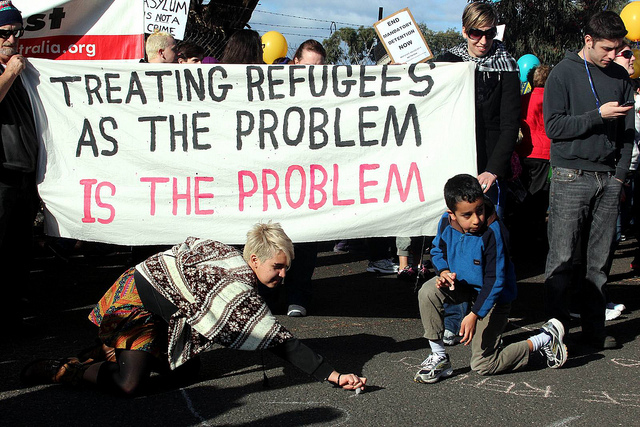
Last Sunday, my daughter and I marched, together with a reported 15,000, in Melbourne’s Palm Sunday Walk for Justice4Refugees. Many thousands of others across the country were doing likewise. For a number of reasons I won’t name here, it was at once emboldening and disheartening.
And over in Perth, Tim Winton offered a great speech. It bears reposting, both in its written and spoken forms:
Palm Sunday commemorates the day an itinerant prophet spoke truth to power. Jesus of Nazareth arrived at the gates of Jerusalem in a parody of imperial pomp. But he was a nobody. Instead of a stallion, he rode up on a borrowed donkey. In place of an army, he had a bunch of lily-livered misfits throwing down their cloaks and palm branches as if he was a big shot. Street theatre, if you like. And a week later he was dead. He was there to challenge the commonsense of the day. Armed with only an idea.
Jesus used to say things like this. If a child asks you for bread, will you give him a stone? Awkward things like that.
His followers called his idea The Way. Many of us are here today because the idea has stuck. We try to follow the Way of Peace and Love. Just another bunch of lily-livered misfits.
For generations, in communities all over the globe, Palm Sunday has been a day when people walk for peace and reconciliation. And not just Christians. People of every faith and of no faith at all come together as we have today in solidarity. To express our communal values and yearnings, the things that bind us rather than those that separate us.
We belong to a prosperous country, a place where prosperity and good fortune have made us powerful. Yes, whether we feel it or not, we are exceptionally powerful as individuals and as a community. We have the power of safety. We’re richer, more mobile, with more choices than most of our fellow citizens worldwide. Not because we’re virtuous, but because we’re lucky. But we don’t come here to gloat. We’re here to reflect. To hold ourselves to account. We didn’t come here today to celebrate power or to hide in its privileged shadow. We’re here to speak for the powerless. We’re not here to praise the conventions of the day, but to examine them and expose them to the truth. We’re not here to reinforce the status quo. We gather to dissent from it. To register our dismay at it. We’re here to call a spade a spade, to declare that what has become political common sense in Australia over the past 15 years is actually nonsense. And not just harmless nonsense; it’s vicious, despicable nonsense. For something foul is festering in the heart of our community, something shameful and rotten.
It’s a secret we don’t want to acknowledge. We hide it from ourselves. At times, it seems we’re content to have others hide it from us and for us. But we hide this dark secret at great cost. To faceless strangers. To innocent people. To powerless children. We hide this dirty secret at a terrible cost to ourselves as individuals and as a community.
What secret are we hiding? Well, it’s awkward, and kind of embarrassing. You see, we’re afraid. Terrified. This big, brash wealthy country. We have an irrational phobia. We’re afraid of strangers. Not rich strangers. No. The ones who frighten us out of our wits are the poor strangers. People displaced by war and persecution. We’re even scared of their traumatised children. And if they flee their war-torn countries in boats, well, then, they’re twice as threatening. They send us into wild-eyed conniptions. As if they’re armed invaders. But these people arrive with nothing but the sweat on their backs and a crying need for safe refuge. Yet, they terrify us. So great and so wild is our fear, we can no longer see them as people, as fellow humans. First, we criminalised them. Then, we turned them into faceless objects. Cattle. Well, maybe that’s not quite right. You see we’re sentimental about cattle. Especially cattle on boats. We have values, you see, standards of decency. We hate to see suffering. We’re moved to pity.
But for someone seeking asylum, someone arriving by boat, this special species of creature called a “boat person”, the pity isn’t there. Pity is forbidden. All the usual standards are overturned. Their legal right to seek asylum is denied. They’re vilified as “illegals”. And their suffering is denied. As if they’re not our brothers and sisters. Yes, we hate suffering. But apparently their kind of suffering is no longer legitimate. And therefore, it’s no longer our problem. Our moral and legal obligations to help them are null and void.
Since August 2001, Australians have gradually let themselves be convinced that asylum seekers have brought their suffering and persecution and homelessness and poverty on themselves. Our leaders have taught us we need to harden our hearts against them. And how obedient we’ve been, how compliant we are, this free-thinking, high-minded egalitarian people.
We’re afraid. But the government has made them go away. They have stopped the boats. And spirited the victims away. Now, we don’t have to see their suffering. In fact, we’re not allowed to see it. They’re out of sight, and out of mind. And here at home, all is well, all is calm again. For the past few years, as traumatised people have fled towards safety, towards what they believed was a civilised and compassionate haven, our national peace of mind has been built upon the hidden, silent suffering of others.
And that, my friends, is what our elected representatives have done. Using the military, using warships. Using spin and deception in Parliament. Shielding its deeds from media scrutiny. With the collusion of our poorer neighbours, the client states of Nauru and PNG. The political slogans have ground their way into our hearts and minds. The mantras of fear have been internalised. We can sleep at night because these creatures are gone. It wasn’t enough to turn these people away. We had to make them disappear.
So. All is well. Nothing to be afraid of any more. Until we find other poor people to be afraid of. Folks who are here already. Australians who are poor and powerless and, therefore, somehow troublesome, embarrassing, even dangerous. Because that’s the thing. Once you start the cycle of fear, there’s always someone new and different to be afraid of, some new group to crack down on.
But will we ever sleep easy? I wonder. Because there’ll always be the creeping suspicion that some poor person could be white-anting our prosperity, our privilege, our Australian specialness. Or maybe we won’t sleep because, deep in the back of our heads, somewhere in our spirit, we’ll feel a flicker of shame, a twinge of conscience. Maybe I caught a glimpse of a child’s face behind the wire. For a second, I saw a resemblance. Could have been my kid, my grandkid, the little girl next door. Just a kid. A face behind the wire.
My friends, we weren’t always this scared. We used to be better than this. I remember because I was a young man when we opened our arms and hearts to tens of thousands of Vietnamese. Australians were poorer then, more awkward, less well travelled as a people. And yet, we took pity on suffering humans. No cages, no secret gulags. We had these people in our homes and hostels and halls and community centres. They became our neighbours, our schoolmates, our colleagues at work. I was proud of my country, then, proud of the man who made it happen, Malcolm Fraser, whose greatness shames those who’ve followed him in the job. Those were the days when a leader drew the people up and asked the best of them and despite their misgivings, Australians rose to the challenge. And I want to honour his memory today.
It breaks my heart to say it, but fear has turned us. In the past 15 years, it’s eaten into our public spirit and made a travesty of our most sacred values, the very things we thought we stood for as a society: our sense of decency, fairness, justice, compassion, openness. In our own time, we have seen what is plainly wrong, what is demonstrably immoral, celebrated as not simply pragmatic but right and fair. It’s no accident that both mainstream political parties have pursued asylum seeker policies based on cruelty and secrecy. First, pandering to irrational public fear and then at the mercy of it. Because these policies are popular. I don’t deny it. It hurts me to acknowledge it. But it’s a fact. A hard-hearted response to the suffering of others has calcified and become the common sense of our day.
We used to be better than this. I still believe we’re better than this.
So what’s happened to this country? I’m confused. I read the news. But as events unfold, I don’t always recognise my own people. This still looks like the country I was brought up in but it doesn’t always feel like it. You think mining royalties have had a dip? Well, spare a thought for the Fair Go. Because that currency has taken a flogging. There’s a punitive spirit abroad, something closer to Victorian England than the modern, secular, egalitarian country I love.
In the days of Charles Dickens, child labour was acceptable, respectable. It was common sense. So was the routine degradation of impoverished women. Charity was punitive. Until Victorian reformers like Dickens exposed the common sense of his era as brutal nonsense, the suffering of children was inconsequential. The poor were human garbage. They were fuel. Victorian England extracted energy and sexual pleasure from the faceless bodies of the poor. When they became a nuisance, they were exported, “offshored”. In chains. Some of these faceless, degraded people were our ancestors. Mine was an unaccompanied minor, a little boy. A boy consigned to oblivion. A boy without a face. I’ve been thinking of him lately. Public events have made it unavoidable.
And yet from this brutish convention, this hellish common sense, we made something new here in this country, something better. Where Jack was as good as his master. We turned away from the callous feudalism of the Old World and made this place a haven for decency. We granted everyone a face. Some, to our shame, later than others.
The face is the window of the soul. It’s the means by which we make ourselves known. To those of us of religious faith, it’s the means by which we recognise the Divine spark in each other, the presence of God. To those who aren’t religious, it’s the way we apprehend the sacred dignity of the individual. We present ourselves to one another face-to-face, as equals. When you rob someone of their face, of their humanity, you render them an object.
In this country, a nation built upon people fleeing brutes and brutality for 200 years, we have a tradition of fairness and decency and openness of which we’re rightly proud. Whether we’re inspired by the Christian parable of the Good Samaritan, the universal dignity of humankind, or the sanctity of the individual, we’ve always thought it low and cowardly to avert our gaze from someone in trouble or need, to turn our face from them as though they did not exist. When I was a kid, there were a few salty names for people like that. You didn’t want to be called out as one of those. That’s where our tradition of mateship comes from. Not from closing ranks against the outsider, but from lifting someone else up, helping them out, resisting the cowardly urge to walk by. It distinguished this country from the feudalism and patronage of the Old World. When the first boat people arrived in the late ’70s, we looked into their traumatised faces on the TV and took pity despite our misgivings.
Now, of course, we don’t see faces. And that’s no accident. The government hides them from us. In case we feel the pity that’s only natural. Asylum seekers are rendered as objects, creatures, cargo, contraband, and criminals. And so, quite deliberately, the old common sense of human decency is supplanted by a new consensus. Built on hidden suffering, maintained by secrecy. Cordoned at every turn by institutional deception. This, my friends, is the new common sense. According to this new dispensation, Australia does not belong to the wider world. We’re nobody’s fool. We have no obligations to our fellow suffering humans. Unless it suits us. Because we are exceptional. And beyond reproach. It seems we are set to distinguish ourselves by our callousness, by our unwavering hardness of heart. We will not be lectured to by outsiders. Or, come to think of it, by insiders, either. Not about human rights, not about torture, not about the incarceration of children. We will bully critics and whistleblowers into silence. We will smear them. We will shirtfront them.
Which is to say that we live now as hostages to our lowest fears. But to assent to this newly manufactured common sense is to surrender things that are sacred: our human decency, our moral right, our self-respect, our inner peace. To passively assent to this is to set out together on a road that leads to horrors, a path from which we must turn back before we lose our way entirely.
To those in power who say they’re exiling and caging children for their own good, I say we’ve heard that nonsense before. So, don’t do it in my name.
To those who say they’re prolonging misery to save life, I say I’ve heard that nonsense before. You don’t speak for me; I don’t recognise your perverse accountancy.
To those in power who say the means will justify the end, I say I’ve heard that nonsense before. It’s the tyrant’s lie. Don’t you dare utter it in my name.
To those who say this matter is resolved, I say no. For pity’s sake, no. For the love of God, no. A settlement built on suffering will never be settled. An economy built on cruelty is a swindle. A sense of comfort built upon the crushed spirits of children is but a delusion that feeds ghosts and unleashes fresh terrors.
If current refugee policy is common sense, then I refuse to accept it. I dissent. And many of my countrymen and women dissent alongside me. I don’t pretend to have a geopolitical answer to the worldwide problem of asylum seekers. Fifty million people are currently displaced by war and famine and persecution. I don’t envy those who make the decisions in these matters, those who’ve sought and gained the power to make decisions in this matter. I’m no expert, no politician. But I know when something’s wrong. And what my country is doing is wrong.
Prime Minister, forget the boats for a moment. Turn back your heart. Turn back from this path to brutality. Turn back from piling trauma upon the traumatised. Because it shames us. It grinds innocent people to despair and self-harm and suicide. It ruins the lives of children. Give these people back their faces, their humanity. Don’t avert your gaze and don’t hide them from us.
Because the secret won’t hold. It’s out already. There are witnesses. There will be testimony. We will remember. In another time, and very soon, I think, our common sense will be nonsense. And you’ll have to ask yourself, was it worth it? This false piece of mind, this stopping of the boats. Was it worth the price paid in human suffering? You’re not alone; the rest of us will have to face it, too.
Jesus said: “What shall it profit a man to gain the whole world only to lose his soul?” And I wonder: What does it profit a people to do likewise, to shun the weak and punish the oppressed, to cage children, and make criminals out of refugees? What about our soul as a people?
We’re losing our way. We have hardened our hearts. I fear we have devalued the currency of mercy. Children have asked for bread and we gave them stones. So turn back. I beg you. For the children’s sake. For the sake of this nation’s spirit. Raise us back up to our best selves. Turn back while there’s still time.
New Zealand songwriter Malcolm Gordon, no stranger to this blog, has been at it again. This time, as he tells it, he has been
churned up by what is happening in Australia with the asylum seekers. Some of the friends we met and made in Adelaide last year have been protesting in MP’s offices and been arrested as a result. It’s a justifiably upsetting situation.
This song is one result of that churning:
In these wide open spaces
This land needs tilling
But there’s rumours of war
There’s whispering of killing
Over mountain and flood and over the plain
This dark cloud reigns.
Put my hand to the plough
There’s no turning home
For this stirring within
Won’t leave me alone
And alone is one thing that you’ll never be
There is no ‘them’, there is only ‘we’.
Surely there is room for one more Love make a way How many saviours, unseen and displaced here Will we leave out in the rain?
The weight of these times
Is measured in tears
The risk of this love
Is death to our fears
Give our voice for the groaning
Of children in chains
Forever there’s hope wherever there’s pain.
Surely there is room for one more Love make a way How many saviours, unseen and displaced here Will we leave out in the rain?
Surely there is room for one more Love make a way Picture what we could be A generous family Where welcoming arms hold open the door.
In these wide open spaces
The wind blows alone
And the streets are just valleys that wander and roam
There is room for the pilgrim to lay down their load
And build a home.
My local Amnesty International group in Dunedin will be screening Mary Meets Mohammed at the Pioneer Hall in Port Chalmers on Friday 28 November at 7pm. This is a heart-warming movie made by AI Australia about the friendship that develops between an asylum seeker from the Middle East and a Tasmanian woman who initially thinks that such people should be ‘sent back to where they came from’. A gold coin donation for entry will go to AI Australia to support our own Mary Morwood who has committed herself to a sponsored walk in Australia, raising money to support asylum seekers in detention, and the rights of Australian Aboriginal people. There will be refreshments available after the film. All welcome.
‘No war can be called just; they all use the same machinery’. So argued Professor Henry Reynolds (University of Tasmania) at tonight’s Inaugural Archibald Baxter Memorial Peace Lecture, sponsored by the National Centre for Peace and Conflict Studies at the University of Otago. Reynolds opened his public lecture by making the case that pacifism need not necessarily be anti-patriotic. On the contrary, the best thing one can do for a nation, he argued – in the spirit of him whose name and witness were being honoured, the great Archibald Baxter – is to keep it from going to war. He also argued that wars beget war, and that a victory to any side only further perpetuates the violence in one form or another.
Unsurprisingly, Reynolds spent most of his time in what for him is familiar territory – Australia. He rehearsed his oft-played themes about Australia’s hidden wars (see his Black Pioneers: How Aboriginal and Islander People Helped Build Australia, Why Weren’t We Told?, The Other Side of the Frontier: Aboriginal Resistance to the European Invasion of Australia, and Forgotten War – all which are well worth reading), noting how between 1788 and 1928 (or, according to some other historians, 1934) Australia was home to large-scale wars between European settlers and indigenous Australians, and that the frontier conflicts (most of the wars took place in isolated regions) in Queensland saw the deaths of tens of thousands (Reynolds argues for a figure of over fifty thousand people – significantly more Australians than were killed in WWII, and on par with those who died in the war to end them all). And yet, as Reynolds and many others have noted, and John Pilger has recently made most public in his film Utopia, these hidden wars remain uncommemorated at the Australian War Memorial in Canberra, that ‘great emporium of white nationalism’ (Pilger) and pantheon of Australia’s most enduring and important cult – war. (On this, see What’s Wrong with ANZAC?: The Militarisation of Australian History edited by Reynolds and Marilyn Lake.) It is difficult to see how Australians will even begin to think honestly about its wars until this scandal is rectified.
Reynolds suggested that the calendar for military commemorations in Australia is fuller than the religious calendars ever were during the Middle Ages. He might be right, although there’s little at stake if he’s not. But drawing attention to the Edwardian conviction (surely it’s much older than that?) that nations are made in war, and that there can be no true nationhood without war, Reynolds is certainly right to call out the propaganda machines which publish ad infinitum the narrative that Australian involvement in overseas conflicts are the nation’s most important defining events, a fact which begs the question about what nationhood might have meant prior to 1914, and which does wonders for tourist operators arranging parties at ANZAC Cove.
Reynolds concluded with some discussion about the Boer War, noting that there were only four members of the Australian Parliament who voted against involvement, and that there was scarcely any discussion at all – either in Parliament or elsewhere – on either the legality or morality of the war. The new egalitarian democracies of Australia and New Zealand were keener to join Britain’s war than were the Brits, and the colonisers were desperate to secure the allegiance of her loyal subjects (including India), frightfully concerned that they might go the way of Canada or, God forbid, of the United States. The second half of the Boer War in particular saw numerous and widespread atrocities and human rights violations, violations which Australia felt no responsibility for – just as contemporary white Australia, ‘Team Australia’, feels no responsibility for its most costly wars, the one’s which took place upon her own soil – because this was, after all, Mother Britain’s war and not ours.
I left feeling grateful for the work of places like the National Centre for Peace and Conflict Studies, emboldened in my own commitment to the ways of non-violence in the ‘broken middle’ (Gillian Rose), and thinking about the ongoing relevance of Desmond Tutu’s words (published in God Is Not a Christian): ‘There can be no future without forgiveness. There will be no future unless there is peace. There can be no peace unless there is reconciliation. But there can be no reconciliation before there is forgiveness. And there can be no forgiveness unless people repent’.
While the Australian Human Rights Commission conducts its own inquiry into children in detention, and while Scott Morrison (and Tony’s ‘gift to our nation’) stays on his own delusional course, The Guardian has published this piece based on an interview with the courageous Dr Peter Young:
United Theological College and the Centre for Public and Contextual Theology (PaCT) are hosting a symposium on the patient and provocative work of Craig Keen. Keen’s work is described by Bruce McCormack as “animated by a deep personal desire for an authentically kenotic existence, and a longing for the coming of a community of women and men who understand that they cannot live until they die.” Keen’s sensitivity to issues of embodiment, existence, and faith marry with the constellation of thinkers that he has lived with since his youth to produce his subtle, surprising, and prayerful writings. This symposium will focus on his latest book, After Crucifixion: The Promise of Theology, and the questions about faith and life that it impels the reader to consider.
The University of Divinity, Whitley College, the Centre for Theology and Ministry, and the Commission for Mission of the UCA are organising what sounds like a wonderful conference ‘to reflect on discourses of sovereignty in the Australian context’:
In a context where Indigenous claims remain unresolved, the rights of asylum seekers are contested, and global economic forces are making new demands on nation states, the theme of sovereignty demands closer examination. Beginning with discussion of settler colonialism, this conference brings together people from a range of disciplines to reflect on discourses of sovereignty in the Australian context.
Last night’s edition of the ABC program Sunday Nights, hosted by John Cleary, included an interview with the Rev Dr Kerry Enright, the outgoing National Director of UnitingWorld, and a friend of mine. During the interview, Kerry reflects upon two of his favorite topics – the catholic nature of the church as gift from God and as sign to the world, and on the role of the church in civil society (here the discussion is focused particularly on Fiji, Australia and New Zealand). He also talks a bit about his forthcoming appointment as minister of Knox Church (Presbyterian) in Dunedin. I’m looking forward to welcoming Kerry back to Dunedin, and back to the PCANZ, soon. You can listen to the interview here.
And while I’m mentioning Kerry, there’s also an older interview in which he talks about God’s mission and about the significance of partnerships that UnitingWorld enjoys:
After over four years in the wings, it is indeed a delight to see that Calvin: The Man and the Legacy has finally hit the press. (One recalls Walter Benjamin’s words in Aesthetics and Politics―‘I came into the world under the sign of Saturn―the star of the slowest revolution, the planet of detours and delays’).
The book, which is edited by Murray Rae, Peter Matheson and Brett Knowles, consists mostly of papers delivered at a conference held at the Knox Centre for Ministry and Leadership in 2009, one of a plethora of conferences organised to mark the 500th anniversary of Calvin’s birth. It really was a great two days—marked by intelligent papers on a diverse range of themes, good humour, abundant attendance, a generosity of spirit, real coffee, and low testosterone, a combination of features relatively rare at these kinds of gigs.
The book’s description reads:
Alongside essays on aspects of Calvin’s theology, Calvin: The Man and the Legacy includes studies of Calvin as pastor, preacher and liturgist and traces the influence of Calvin as it was conveyed through Scottish migration to Australia and New Zealand. Fascinating stories are told of the ways in which the Calvinist tradition has contributed much to the building of colonial societies, but also of the ways it has attracted ridicule and derision and has been subject to caricature that is sometimes deserved, sometimes humorous, but often grossly misleading.
And the TOC reads:
Part 1: The Man and His Thought
1. Graham Redding—Medicine for Poor Sick Souls?: Calvin’s Communion Service in Profile
2. Jason Goroncy—John Calvin: Servant of the Word
3. Randall Zachman—The Grateful Humility of the Children of God: Knowledge of Ourselves in Calvin’s Theology
4. Elise McKee—A Week in the Life of John Calvin
5. Murray Rae—Calvin on the Authority of Scripture
6. Randall Zachman—Calvin’s Interpretation of Scripture
Part II: The Legacy and the Caricature
7. John Roxborogh—Thomas Chalmers and Scottish Calvinism in the Nineteenth Century
8. John Stenhouse—Calvin’s Own Country? Calvinists, anti-Calvinists and the Making of New Zealand Culture
9. Peter Matheson—The Reception of Calvin and Calvinism in New Zealand: a Preliminary Trawl
10. Alison Clarke—Popular Piety, the Sacraments and Calvinism in Colonial New Zealand
11. Kirstine Moffat—‘Mr Calvin and Mr Knox’: The Calvinist Legacy in the Fiction and Poetry of New Zealand Scots
12. Ian Breward—Calvin in Australia and New Zealand
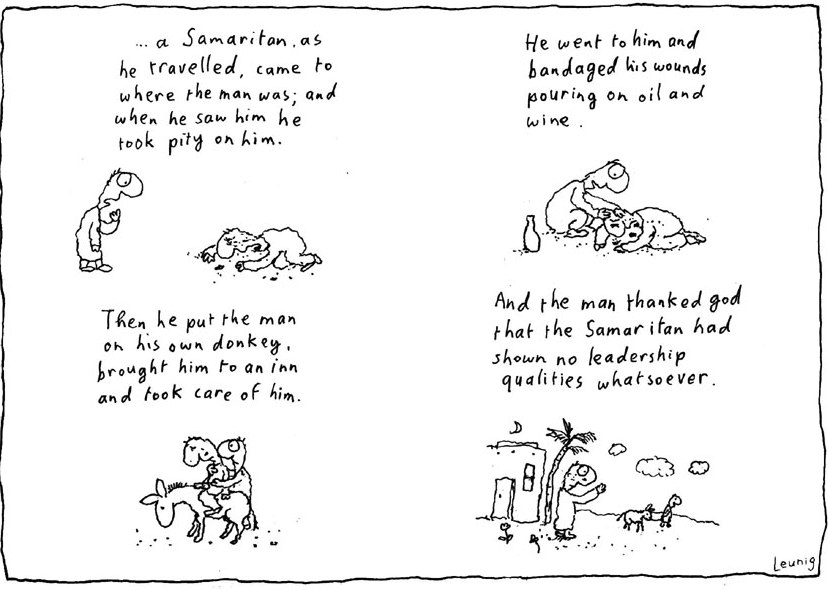
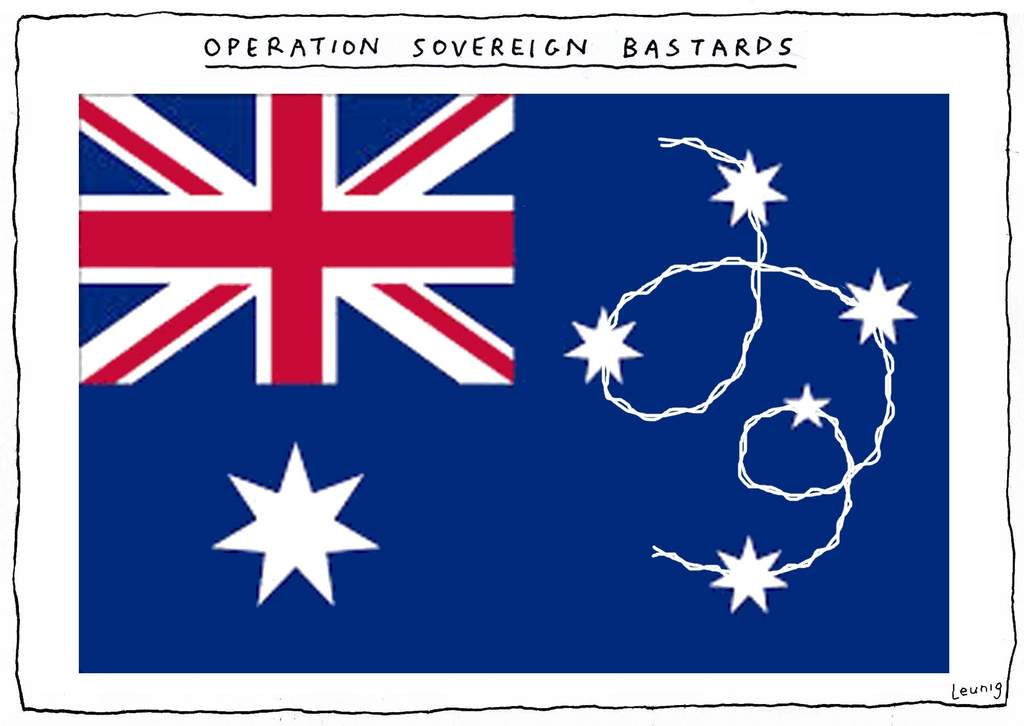
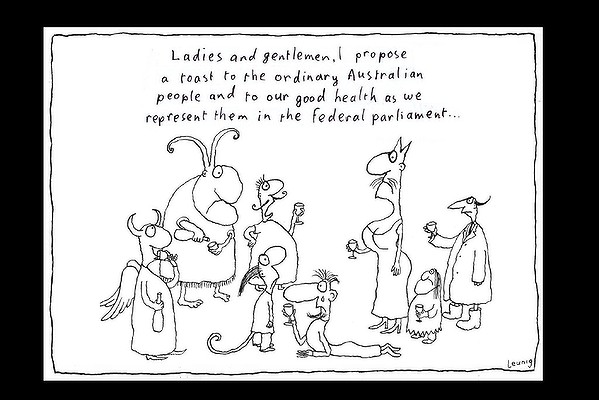
Sad times. They are sad times when a people’s highest interests are decided by methods characterised by the crude arbitrament of numbers, by methods which seek to silence those who would speak unwelcome words, and by methods which seek to render martyrdom inexplicable. In such times, I am exceedingly grateful for all those who shy not away from the madness. One such all-too-rare character is Michael Leunig, whose moral compass, hopeful outlook, ability to laugh at turkeys, and critical courage is exemplified in his recent cartoons published in The Age and the Sydney Morning Herald, newspapers to which Leunig is a regular contributor:
Michael Leunig‘s latest three cartoons are a fitting commentary on Cirque* Canberra:
Plus, one from a few weeks earlier:
* There is, of course, another – and equally truthful – way of thinking about the image of the circus. I think, for example, of William Stringfellow‘s reflections on the circus as an event of the eschaton. Picking up the image in the wake of Ingmar Berman and Georges Rouault, Stringfellow propose that we recognise circuses as parables of the kingdom and, as such, as parodies of the world as it is. I suspect that Leunig would like that image too.
So why should Christians be championing the cause of asylum seekers today? In short, this issue goes to the heart of our identity and calling as the people of God.
The Gospel of Matthew tells us that Jesus started life as a refugee child, fleeing with his family to Egypt. Even his father’s name, Joseph, reminds us that Jesus was not the first Jew to be a refugee in Egypt. All the tribal ancestors of Israel took refuge there. We read that scripture was fulfilled when Jesus went there as a child, because “Out of Egypt I called my son” (Matthew 2.15). The quote is from Hosea 11.1: “When Israel was a child I loved him, and out of Egypt I called my son”. That is, Matthew sees a spiritual analogy between the life of Jesus and the life of Israel: both are marked by the refugee experience.
And this experience is also embodied in the laws of Israel. So, for example, Leviticus 19.34 says:
The immigrant who resides with you shall be to you as the citizen among you; you shall love the immigrant as yourself, for you were immigrants in the land of Egypt: I am the LORD your God. (cf. Exodus 22.21)
Similarly, the later prophets came to recognize the treatment of asylum seekers as a litmus test of faith (e.g., Jeremiah 7.5-7).
In the Old Testament, the ‘immigrant’, ‘alien’, ‘refugee’ or ‘sojourner’ (all possible translations of ger) is a foreigner who has left his or her country to settle elsewhere. Perhaps the most common reasons for movement are famine and war.
Some things never change: the United Nations Convention Relating to the Status of Refugees (1951), for example, arose as a response to international displacements following World War II, and since Australia is a signatory to this Convention, we recognize the legal right to seek asylum.
When people arrive in a host country, there are always complex questions about the extent of their assimilation. Not surprisingly, then, Old Testament laws sometimes set assimilating strangers apart from ‘the foreigner’ (thenokri or ben nekar) who is not given full rights of participation (e.g., Exodus 12.43 excludes such people from the Passover). This distinction is surprisingly overturned, however, in Isaiah 56.3,6 where the ‘foreigner’ (ben nekar) can offer acceptable sacrifices to God and is welcomed into the covenant community.
References to strangers in the New Testament are few but significant. Being ‘strangers’ (paroikoi) becomes a central metaphor for Christian identity in some books, building on the theological idea in Leviticus that all Israelites were in some sense ‘sojourners’ (Leviticus 25.23, cf. 1 Peter 1.1 and Ephesians 2.19).
Perhaps against our expectations, we may even find Christ present in the stranger. This is precisely the point that is made in the parable of the sheep and the goats in Matthew 25: the hungry and thirsty stranger (xenos in vs. 38 and 44) may actually be the Lord, and not even the people in the parable called ‘the righteous’ have been able to discern this. In other words, no-one has the power to tell whether the needy stranger may in fact be Christ.
Ezekiel 47 is also a challenge to our political imagination: it takes us beyond random acts of kindness and demands that refugees be given a ‘fair go’ in the provision of land, that is, basic resources that provide the foundation of economic security:
So you shall divide this land among you according to the tribes of Israel. You shall allot it as an inheritance for yourselves and for the aliens who reside among you and have begotten children among you. They shall be to you as citizens of Israel; with you they shall be allotted an inheritance among the tribes of Israel. In whatever tribe aliens reside, there you shall assign them their inheritance, says the LORD God. (Ezekiel 47.21-23)
In international comparisons (taking account of national wealth and population sizes), the welcome that Australia offers to asylum seekers is not very impressive.
Ed. This piece, written in 2011, and which cites sources which are almost prehistoric, is, of course, completely irrelevant and dated now and I only draw attention to it for the benefit of those historians who may one day be interested in researching such obscure things. It’s almost impossible today to believe that once upon a time some Christians who happen to be living in Australia thought it an act of compassion and of mature political judgement to demonise some of the most vulnerable and yet extraordinarily courageous people on the planet, and an act of freedom to disregard not only the rule of law but, more importantly, the command of God.
Recent weeks have witnessed no shortage of ink spilt on the matter of the Australian government’s disgraceful – and illegal – policies vis-à-vis asylum seekers. And appropriately so! A number of people have asked me to comment on this question, and at some stage, when I have more moments to spare than I do this week, I may spill some ink of my own on it. In the meantime, however, I wish to draw attention to, and to commend, one editorial (among the many dozens that I have read) that I found particularly helpful. It’s Robert Manne’s piece (published in March this year and so before developments in recent days), ‘Tragedy of Errors: Australia’s shipwrecked refugee policy’.
[There is also an edited transcript of a speech by Barry Jones: ‘Asylum is the greatest moral challenge of our time’. The latter is significantly less satisfying than Manne’s piece, but worth a read all the same, not least given Jones’ long and high profile relationship with the ALP.]
John Pilger‘s film The War You Don’t See is, above all else, a call to responsible journalism, especially by those ‘journalists’ who have en masse lost their nerve, or who have temporarily (one hopes) mislaid the purpose of their craft. (Of course, Pilger himself has attracted no shortage of detractors over the years who would accuse him of irresponsible journalism. The onus on proof is clearly on the side of the detractors. And then there are those who find themselves in broad agreement with Pilger’s interpretation of things but struggle with a style that is perceived to be arrogant or hyped. I have some sympathy with these critics, although I’ve tried to never let his style get in the way of the content. This interview with the queen of ego herself, Kim Hill, is a case in point.)
There’s challenge here too, it seems to me, for those of us charged with the responsibility of rightly dividing the word of truth, especially for those who have lost our nerve to boldly address the powers or to do the demanding work it takes to simply tell the truth rather than spout the party line.
Anyway, for those who are yet to see the film, I thought I’d commend and post it for viewing here:
Pilger’s latest film (currently in production) is called Utopia and is due out at the end of the year. I look forward to seeing it.