Month: December 2013

December stations …

Reading:

Listening

Leunig love

Real Men

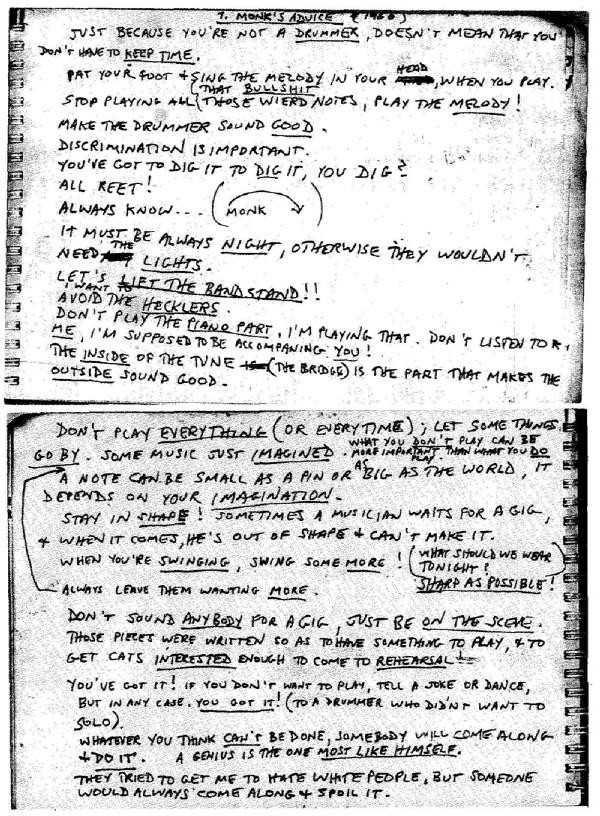
And finally, to end the year and all – a gift especially for those likely to be sucked in to making New Year’s resolutions – some advice from Thelonious Monk:

Advice from Thelonious Monk

… and some great sounds to see the new year in with:

2013: some favourites, some thanks

Amidst all that I have read, re-read, listened to and watched during this past year, I am especially grateful for having read, re-read, listened to, and watched the following:

Books

Biblical Studies

Biography

Cooking

Fiction

History

Philosophy

Poetry

Theology

Music

Films

I am equally grateful to those readers of this blog, and to those fellow wayfarers in blogdom, who have recommended some of these gems.

I am grateful too that this year has seen the birth of three books that I have either written or edited – Hallowed Be Thy Name: The Sanctification of All in the Soteriology of P. T. ForsythDescending on Humanity and Intervening in History: Notes from the Pulpit Ministry of P. T. Forsyth, and, most recently, ‘Tikkun Olam’ To Mend the World: A Confluence of Theology and the Arts. I hope that each of these prove beneficial – and rollicking good fun – for those who take up and read them.

As 2013 approaches expiration, I wish to sincerely thank readers of Per Crucem ad Lucem for stopping by, for reading my periphrastic prose, for offering comment (both online and via email), and for subscribing to and linking to posts. I hope that you have been blessed by what and by who you have encountered here, and I look forward to continuing a further leg or two of the pilgrimage with you. Ngā mihi o te Tau Hou ki a koutou katoa.

‘Animal Nativity’, by Les Murray

starving_dogThe Iliad of peace began
when this girl agreed.
Now goats in trees, fish in the valley
suddenly feel vivid.

Swallows flit in the stable as if
a hatching of their kind,
turned human, cried in the manger
showing the hunger-diamond.

Cattle are content that this calf
must come in human form.
Spiders discern a water-walker.
Even humans will sense the lamb,

He who frees from the old poem
turtle-dove and snake,
who gets death forgiven
who puts the apple back.

Dogs, less enslaved but as starving
as the poorest human there,
crouch, agog at a crux of presence
remembered as a star.

Les Murray, ‘Animal Nativity’, in Collected Poems (Melbourne: Black Inc., 2006), 374–75.

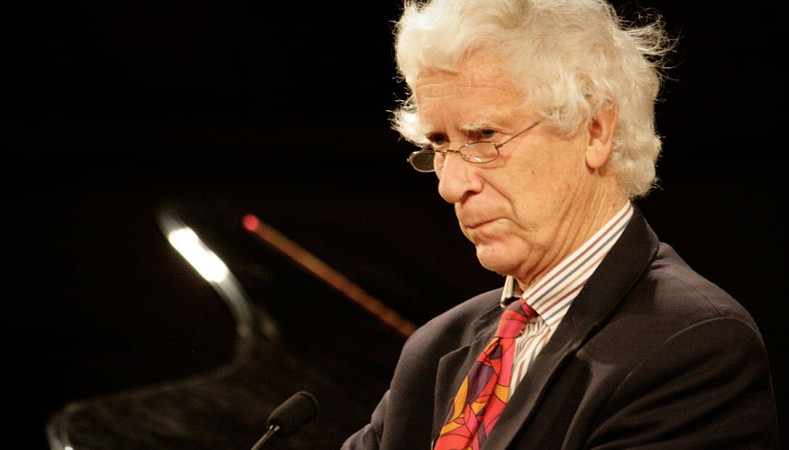
Nicholas Wolterstorff’s 2013 Kantzer Lectures

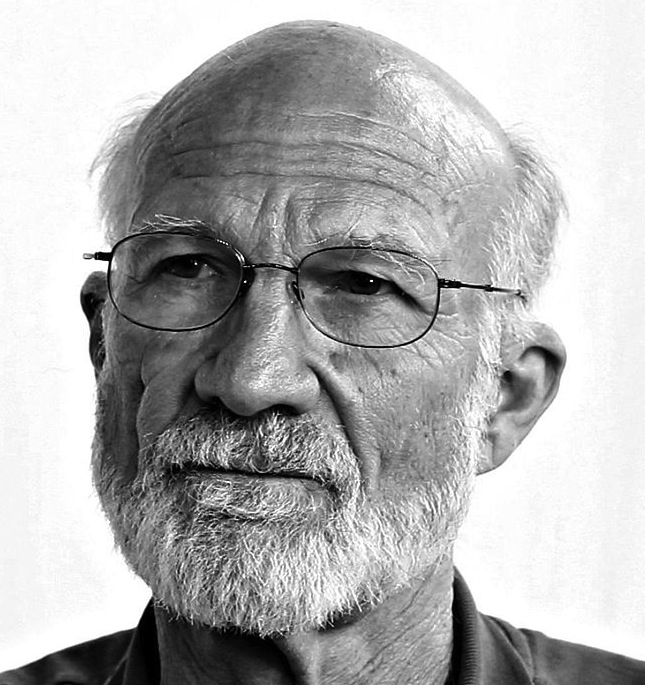
Wolterstorff

Nick Wolterstorff’s Kantzer Lectures are now available for viewing:

I. The God We Worship: A Liturgical Theology

In this first Kantzer lecture, Nicholas Wolterstorff provides the overarching structure to his liturgical project. Using as his main interlocutors liturgical theologians Schmemann and von Allmen, and working at the convergence of Orthodox, Episcopal, Catholic, Lutheran, and Reformed traditions, Wolterstorff expounds his ontology of liturgy as dependent on the enactment of a “script,” the complete set of rules that determine what is a correct liturgy. He argues that the nature and purpose of the church become manifest in the correct enactment of the liturgy. Anticipating future lectures, Wolterstorff suggests that the God implicit in the liturgy is discernible at three levels: the understanding of God implicit in (1) the entire liturgy, (2) the various types of liturgical actions, and (3) the particular content of individual liturgical acts. Thus, Wolterstorff will lend his analytic tools to decode and thereby reveal the theological logos of Christian liturgy.

II. God as Worthy of Worship

In the second lecture, Wolterstorff explicates what he calls the implicit understanding of God within the Christian liturgy as a whole (or as it accords with the convergence of the five traditions he is considering), the third and highest level of implicitness (see lecture 1).  The highest level of implicitness is the assumption that God is worthy of worship. This understanding of God, says Wolterstorff, leads us in Christian worship to acknowledge the unsurpassable excellence of God. There is a definitive orientation taken on in worship, which he calls an attitudinal stance. This way of orienting ourselves toward God in Christian worship evokes (at least) awe, reverence and adoration of God. Awe is the proper response to God’s creative and redemptive glory; reverence to God’s holiness as untainted perfection; and adoration to God’s love for humanity. Thus, the implicit understanding of God as unsurpassably excellent and thereby worthy of worship is manifest in our attitudinal stance, or orientation towards God in worship.

III. God as One Who Listens and Speaks

Wolterstorff now considers the understanding of God implicit in some of the fundamental types of Christian liturgy. He submits that the address of God is the most common type of action that occurs in the enactment of Christian liturgy. In addressing someone. In the act of (strongly) addressing God the participants of Christian worship hope, Wolterstorff contends, that God can and will attend to, grasp, and respond appropriately to their address. By addressing God directly, the participants and God enter into a “we-Thou” relationship. God as listener is implicitly understood, therefore, as one who is reciprocally oriented to those who have addressed him. He is free to respond favorably, but not bound. The community hopes and prays that he will respond favorably. The other most common type of action in Christian liturgy is being addressed by God through (1) the reading Scripture, (2) prophetic proclamation, (3) and the clerical mode (e.g., pronouncing absolution). That the enactment of liturgy is the place and sight of people speaking and listening to God provides an understanding of God as One who listens and speaks.

[Image courtesy of Daniel Rodrigues-Martin Photography]

Saturday with Leunig (plus, as a bonus, a theology of deodorant)

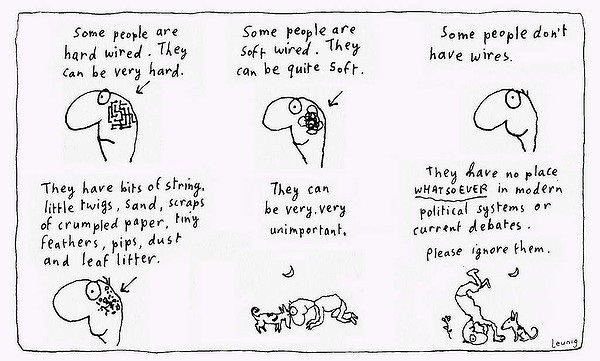
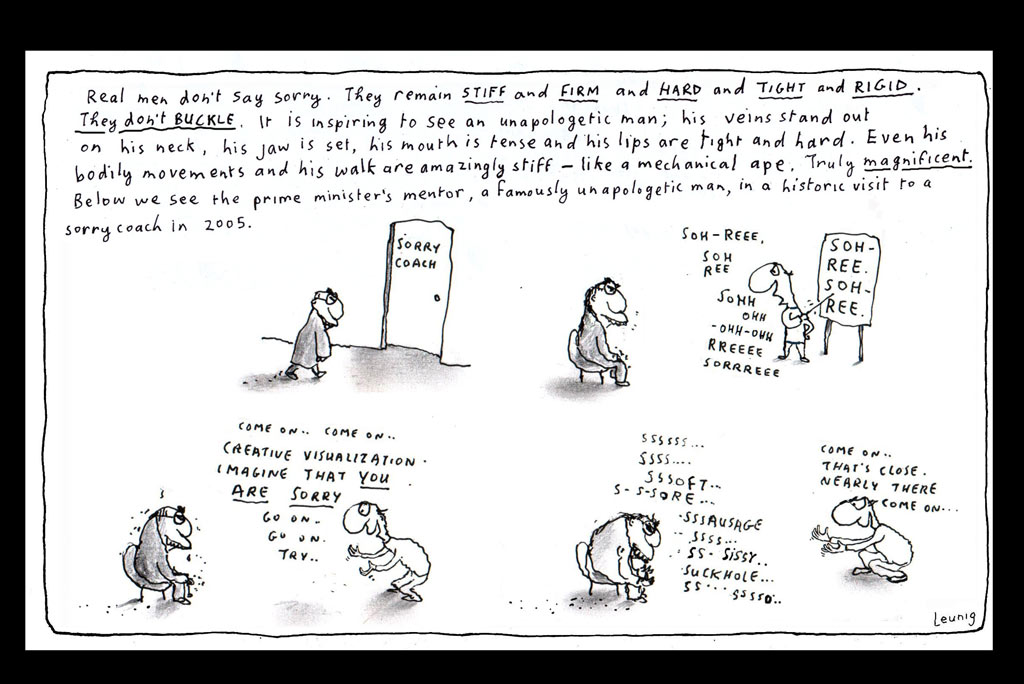
Anyway, amid the stories in The Age today about how Scott Morrison has done the seemingly impossible and discovered a new level of low, about why we should consider covering up the cameras on our smartphones and other devices, about how much charities spend on fund-raising, about Grumpy Cat, about Harry Kewell’s ankle, and about how today is the day for me to create the ideal future I’ve envisioned, through sheer force of will!, because the universe supports that kind of intensity right now, there was this gem from Michael Leunig:

Some people

And while I’m drawing attention to things worthwhile (and otherwise), one other serious gem worth checking out is Scott Stephens’ fantastic piece (over at the ABC’s Religion and Ethics site) on Hirschhorn, human bodies, icons and the body of Christ; or, to put it otherwise, What would a theology of deodorant look like?

[Image source: The Age]

Simeon’s Song

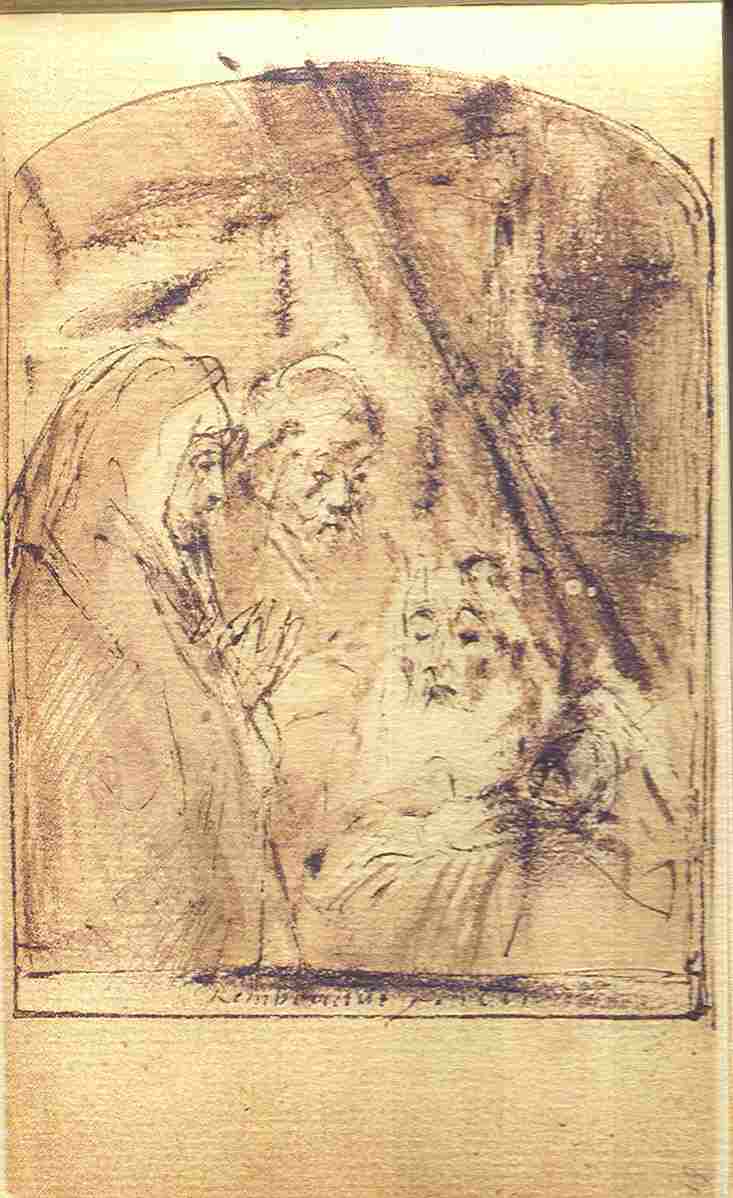
Rembrandt - Simeon With Christ ChildMalcolm Gordon, a dear friend of mine and the engine behind the very exciting One Voice Project, wrote and recorded a new song last night based on Luke 2.25–31. It’s called ‘Simeon’s Song’, and about which he writes:

‘I wrote it for the youth group who are having a worship night tonight and wanted to reflect on this story as a turning point between anticipation and celebration. I’ll probably play it at the midnight Christmas Eve service at St Peters too, hence the night/darkness themes’.

I thought it was worth sharing here too; so, with Malcs’ permission, here ‘tis:

Rembrandt - Simeon's Song Of Praise 1661I’m just an old man
With an ancient conviction
That God is troubled by our pain

I have no wisdom
Just a fool’s expectation
That God will come to our aid

Through prayer and through pain
My hope has not strayed
Keep watch with me
My soul aches for dawn
My heart stretched and worn
Keep watch with me
O my Lord
O my friend

I’m just a lone voice
Frail in the darkness
But the night can only last so long

I’m just a watchmen
Eyes to the distance
Waiting for heaven’s light to show

Through prayer and through pain
My hope has not strayed
Keep watch with me
My soul aches for dawn
My heart stretched and worn
Keep watch with me
O my Lord
O my friend

He’s just a small child
From nowhere special
But something tells me, this is it

My heart’s desire
My world’s salvation
A candle in this darkness has been lit

Through prayer and through pain
My hope has not changed
Keep watch with me
My soul aches for dawn
My heart stretched and worn
Keep watch with me
O my Lord
O my friend

God can I go to sleep now
I’ve stayed awake to the sunrise
With my failing eyes
I see through Love’s disguise
In my arms I hold the world.

Note: Malcolm has made the link to the song downloadable so if folk want to use it (or one of the other songs available here) for a church service, or for personal reflection, it’s there to be had. Share the love!

Two wee notices about the global theology scene

GlobeTheoLibFirst, there’s the Global Digital Library on Theology and Ecumenism (GlobeTheoLib), a joint project of the WCC and Globethics.net which ‘aims to redress a global imbalance of access to research materials in theology and related disciplines’. It contains more than 750,000 articles, documents and other academic resources that can be accessed freely, in six languages (English, French, German, Spanish, Indonesian and Chinese), by registered participants.

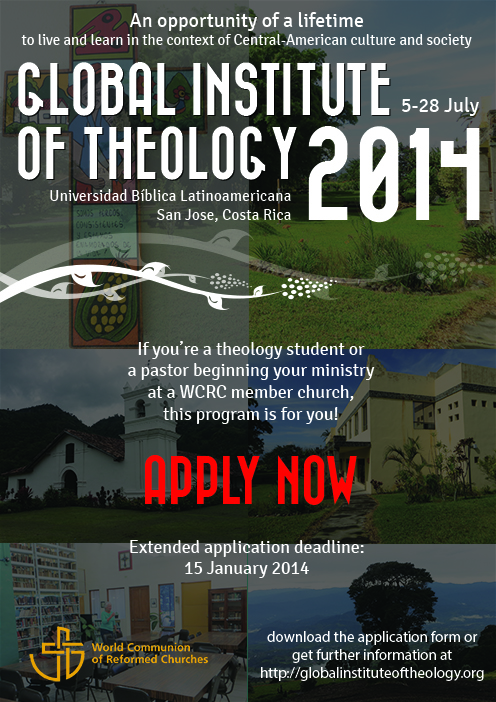
Second, the application deadline for next year’s Global Institute of Theology (something that I’ve posted about before) has been extended until 15 January. Applications forms can be accessed here.

git-poster-small

On the demonic and introverted nature of worldly power

Christopher Henry Dawson‘[T]he new mass dictatorships associate the highest and lowest qualities of human nature—self-sacrifice and boundless devotion, as well as unlimited violence and vindictiveness—in the assertion of their will to power … As soon as men decide that all means are permitted to fight an evil, then their good becomes indistinguishable from the evil that they set out to destroy. The subordination of morals to politics, the reign of terror and the technique of propaganda and psychological aggression can be used by any Power or Party that is bold enough to abandon moral scruples and plunge into the abyss. This is the greatest difficulty that faces us at the present time. For it is an evil that thrives by war, and the necessity of opposing the spirit of unlimited aggression by force of arms, creates the atmosphere which is most favourable to its growth’.

– Christopher Dawson, ‘The Hour of Darkness’, The Tablet, 2 December 1939, 626.

Now available: Tikkun Olam—To Mend the World

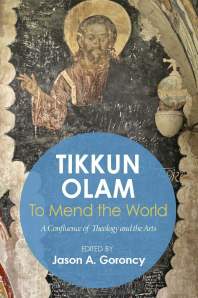
Tikkun Olam CoverI am delighted to announce that my latest edited volume – Tikkun Olam—To Mend the World: A Confluence of Theology and the Arts – is now available. It has received kind endorsements from Jeremy Begbie and Paul Fiddes, and the Table of Contents reads:

Foreword: Alfonse Borysewicz
Introduction: Jason Goroncy

1. “Prophesy to these Dry Bones”: The Artist’s Role in Healing the Earth — William Dyrness
2. Cosmos, Kenosis, and Creativity — Trevor Hart
3. Re-forming Beauty: Can Theological Sense Accommodate Aesthetic Sensibility? — Carolyn Kelly
4. Questioning the Extravagance of Beauty in a World of Poverty — Jonathan Ryan
5. Living Close to the Wound — Libby Byrne
6. The Sudden Imperative and Not the Male Gaze: Reconciliatory Relocations in the Art Practice of Allie Eagle — Joanna Osborne and Allie Eagle
7. Building from the Rubble: Architecture, Memory, and Hope — Murray Rae
8. The Interesting Case of Heaney, the Critic, and the Incarnation — John Dennison
9. New Media Art Practice: A Challenge and Resource for Multimedia Worship — Julanne Clarke-Morris
10. Silence, Song, and the Sounding-Together of Creation — Steven Guthrie

A brief section from the Introduction provides a summary of each chapter:

The essays compiled in this volume, each in their own way, seek to attend to the lives and burdens and hopes that characterize human life in a world broken but unforgotten, in travail but moving toward the freedom promised by a faithful Creator. Bill Dyrness’s essay focuses on the way that the medieval preference for fiction over history has been exactly reversed in the modern period so that we moderns struggle to make a story out of the multitude of facts. Employing Augustine’s notion of signs as those which move the affections, the chapter develops the notion of poetics as the spaces in peoples’ lives that allow them to keep living and hoping, suggesting one critical role that art can play in imagining another world, a better world. For art offers to carry us to another place, one that doesn’t yet exist, and in this way offers hope and sustenance to carry people through the darkest times. This is illustrated by the outpouring of Haiku after the recent tsunami in Japan, or in the spaces made available for poetry in Iraq. Most importantly, it is underwritten by the centrality of lament in the biblical materials wherein we are reminded that lament and prophecy provide aesthetic forms that carry believers toward the future that God has planned for the world.

The essay by Trevor Hart considers the place of human “creativity” (artistic and other sorts) and seeks to situate it in relation to God’s unique role as the Creator of the cosmos. It draws on literary texts by Dorothy Sayers and J. R. R. Tolkien, as well as theological currents from Jewish writers and Christian theologians, to offer a vision of human artistry as (in Tolkien’s preferred phrase) “sub-creation,” a responsible participation in a creative project divinely initiated, ordered, and underwritten, but left deliberately unfinished in order to solicit our active involvement and ownership of the outcomes.

Beauty, Hans Urs von Balthasar has suggested, is “a word from which religion, and theology in particular, have taken their leave and distanced themselves in modern times by a vigorous drawing of boundaries.” More recently, a number of theologians have addressed this distance and attempted to dismantle the boundaries widely assumed between certain Protestant theologies and the realm of the arts or aesthetics. In her essay, Carolyn Kelly seeks to contribute to that communal exploration by addressing the particularly imposing boundary line demarcating, on the one hand, Reformed affirmations of the beauty of Truth and, on the other, a Romantic commitment to the truth of Beauty. Kelly reflects on what Romantic and aesthetic “sensibility” might gain from its modern counterpart and, in turn, what Reformed theological “sense” might have to gain from a re-cognition of Beauty.

But what place is there for extravagant works of beauty in a world tarnished with the ugliness of poverty and injustice? This is a question taken up by Jonathan Ryan in his essay. Beginning with the recollection of the disciples’ objection to an extravagant act of beauty retold in Mark 14:4, Ryan allows the “anointing at Bethany” narrative in Mark 14 to frame this question and to suggest the legitimacy—and necessity—of works of beauty and creativity for bearing witness to God’s extravagant love for the world.

Libby Byrne’s essay explores the premise that the artist’s calling is to “live close to the wound.” Locating this contention within the nexus that seems to exist between art, theology and philosophy, she argues that we are able to consider the prevailing conditions required for the artist to work toward the task of mending that which is broken, and, drawing on theory from Matthew Del Nevo and Rowan Williams, Byrne helps us understand the importance of melancholy and vulnerability in the sacramental work of human making. She provides examples of how this theory may work in practice with particular reference to the work of Anselm Kiefer and finally with her own studio practice, reminding us that it takes courage to choose to live and work close to our wounds, and also that by so doing the artist not only opens themselves to the possibility of transformation but also offers to others gifts that reverberate within the world and that call us to healing and wholeness.

New Zealand artists Allie Eagle and Joanna Osborne discuss the Sudden Imperative, Eagle’s art project that reframes much of the ideology she held as a feminist separatist during the 1970s. They also outline a reappraisal of direction and motivation in Eagle’s thinking and highlight the theological and reconciliatory center of her current art practice.

Murray Rae takes up the question posed by Theodor Adorno following the Jewish Holocaust and considers whether art can have anything at all to say in the face of evil or whether some evils might, in fact, be unspeakable. Through a consideration of architecture and, in particular, the work of Daniel Libeskind at Ground Zero and in the Jewish Museum in Berlin, Rae contends that while architecture, along with the arts more generally, has no power to redeem us, much less to make amends, it can nevertheless give expression to our memories, our sorrow, and our penitence. He concludes that art may also reveal the extent to which the Spirit is at work within us, prompting us toward forgiveness and reconciliation and a true mending of the world.

In his essay on the Irish poet Seamus Heaney, John Dennison argues that one of the most notable—and least understood—aspects of Heaney’s trust in the good of poetry and the arts in general is the way in which his account approximates religious faith. Some critics have been encouraged toward the conclusion that Heaney’s poetics constitutes an active (if heterodox and often apophatic) extension of Christian theology through the arts. Most importantly here, John Desmond in his book Gravity and Grace argues that Heaney’s writings assume certain fundamentals that mark his transcendental cultural poetics as Christian. Central to Heaney’s thought, Desmond insists, is the doctrine of the Incarnation. Christian doctrine, and in particular the doctrine of the Incarnation, is indeed central to understanding the character of Heaney’s public commitment to the restorative function of art. But, Dennison argues, if we attend to the development and structures of Heaney’s thought, we can see how this influential account of the arts’ world-mending powers is not so much extensive with Christian soteriology as finally delimited by the biblical and theological descriptions it knowingly appropriates. It allows us to see, also, the degree to which Heaney’s trust in the adequacy of poetry turns on a refracted after-image of Christian doctrine, particularly that of the Incarnation.

Julanne Clarke-Morris’s offering proposes that multimedia worship and worship installations would benefit from a more consistent approach to aesthetics and context than is often the norm. She suggests that new media art forms offer communities of faith a range of ready-made critical practices that could amiably be brought to bear in the case of liturgical installation art. Seeking to draw attention to the coherence and communicative power of multimedia liturgical installations in order to improve both their accessibility and artistic credibility, she investigates some significant insights from virtual reality art, immersion art, multimedia installation art, and site-specific art as resources for preparing worship installations and assessing their effectiveness.

The closing essay, penned by Steven Guthrie, bears witness to ways in which Christian scripture and the Christian theological tradition both testify to a natural world that has a voice; one that not only speaks, but sings. The Hebrew prophet Isaiah speaks of mountains and hills “bursting forth in song” (Isaiah 55), and St John exiled on the island of Patmos listens with astonishment to “every creature in heaven and on earth and under the earth” singing (Revelation 5). This idea is taken up in turn by Augustine, Boethius and many others in the tradition, where it is often joined to the Pythagorean idea of “the music of the spheres.” According to this tradition, all of creation comprises a finely tuned symphony, the combined voices of which articulate the Creator’s praise. This tradition of thought—conceiving of the world as a singing creation—is a valuable resource for all who hope to faithfully care for God’s world. The musical creation described by Augustine and other theologians is a beautiful and profoundly interconnected cosmos, filled with an astonishing harmony of human and non-human voices. In this universal song, humans have a vital but circumscribed role. Silence, song and harmony have the capacity to make us more—or less—fully aware of, and more—or less—responsive to the world we inhabit. Music may act as a kind of aural armor by which we shut out the voices of the creation and others who inhabit it. It may also be a weapon by which we dominate the surrounding space. Or music may be a schoolmaster from whom we learn attentiveness and responsiveness, and with which we might join with all creation to participate in God’s symphonic work of healing the creation.

More information about the book is available here.

On the twelve days of curry

Tonight, when I was supposed to be reading William Stringfellow’s Conscience and Obedience, I found myself somewhat distracted by the thought of two other great passions of mine – Indian cuisine and my wonderful partner Judy. The result was this little song:

Now, with that out of my system, I can return to Stringfellow, and to ‘the impending devastation of political authority’.

On Handles Messiah

Mr Richard Starnes’ intelligent and delightful piece, which appeared in the Friday Morning edition of The Spartanburg Herald on 13 December 1963, is without doubt the very best article that I’ve ever ever ever ever read, or am likely to read, on Handles Messiah. And it was too good not to share, particularly at this time of year:

Handles Messiah

Living Amid the Principalities: Pro Ecclesia Annual Conference for Clergy and Laity

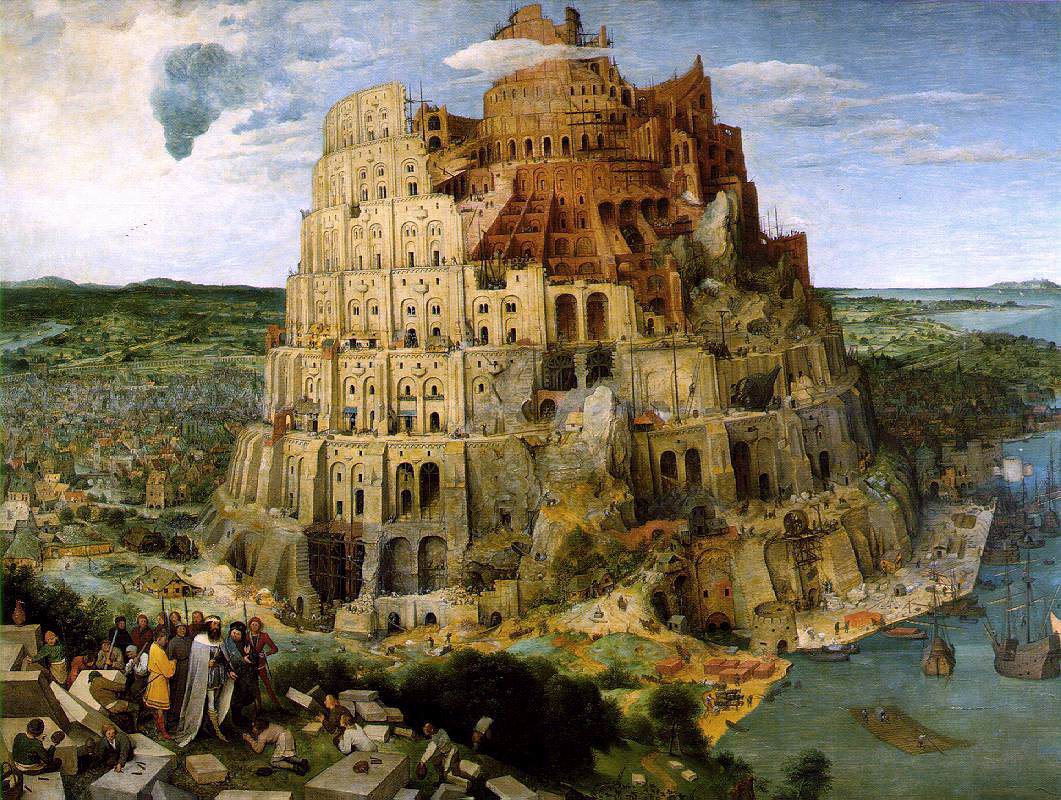
Brueghel-tower-of-babelThe Center for Catholic and Evangelical Theology are sponsoring the 2014 Pro Ecclesia Annual Conference for Clergy and Laity. It will be held at Loyola University, Baltimore, Maryland between 9–14 June.

The promo reads:

“We are not contending against flesh and blood, but against the principalities, against the powers, against the world rulers of this present darkness.” So Paul warns his Ephesian readers to put on the “whole armor of God” and be ready for struggle with the world. And yet Paul also says that these principalities and powers were created in and for Christ (Col. 1:16), have now been disarmed (Col 2:15), and cannot separate us from the love of God (Rom 8:38). What are the principalities and powers of our time in politics, technology, culture, economy, and religion? How do we understand them as created, fallen, and disarmed? How does the Christian today engage these powers? The 2014 conference of the Center for Catholic and Evangelical Theology will take up this theme. Presentations will represent a variety of traditions: Catholic, Orthodox, and Protestant.

Further details are promised in due course here. In the meantime, queries can be directed towards Michael Root.

It sounds like a great conference, and a great opportunity too to do some work with dear Uncle Stringfellow, among others.

Parents. Children.

Yesterday, with all the grief that attends just completing reading a great book, and with all the joy-in-anticipation of beginning a new one, I began reading Andrew Solomon’s Far From the Tree: Parents, Children and the Search for Identity. This deeply personal and somewhat cathartic book is about the forming and reforming of identities, those attributes and values which are passed down from parent to child across generations not only through strands of DNA but also through shared cultural norms (vertical identities), and those traits that are foreign to one’s parents ‘and must therefore acquire identity from a peer group’ (horizontal identities), identities which ‘may reflect recessive genes, random mutations, prenatal influences, or values and preferences that a child does not share with his progenitors’.

Through a series of reflections on deafness, dwarfism, autism, Down syndrome, disability, prodigies, schizophrenia, rape, crime, and transgender sexuality, Solomon is concerned to challenge notions of ‘ordinary’ and ‘extraordinary’, to examine the value judgements we carry, create, project and/or dismiss about such, and to ward off temptations to play down the ambiguities and ambivalences that surround notions of extra/ordinary.

In lieu of the likely event that I do not get around to writing a review of the book, and because I wanted to share something of my interest so far in reading this book – and for the consideration of fellow parents – here’s the (scene-setting) opening two paragraphs:

‘There is no such thing as reproduction. When two people decide to have a baby, they engage in an act of production, and the widespread use of the word reproduction for this activity, with its implication that two people are but braiding themselves together, is at best a euphemism to comfort prospective parents before they get in over their heads. In the subconscious fantasies that make conception look so alluring, it is often ourselves that we would like to see live forever, not someone with a personality of his own. Having anticipated the onward march of our selfish genes, many of us are unprepared for children who present unfamiliar needs. Parenthood abruptly catapults us into a permanent relationship with a stranger, and the more alien the stranger, the stronger the whiff of negativity. We depend on the guarantee in our children’s faces that we will not die. Children whose defining quality annihilates that fantasy of immortality are a particular insult; we must love them for themselves, and not for the best of ourselves in them, and that is a great deal harder to do. Loving our own children is an exercise for the imagination.

Yet blood, in modern as in ancient societies, is thicker than water. Little is more gratifying than successful and devoted children, and few situations are worse than filial failure or rejection. Our children are not us: they carry throwback genes and recessive traits and are subject right from the start to environmental stimuli beyond our control. And yet we are our children; the reality of being a parent never leaves those who have braved the metamorphosis. The psychoanalyst D. W. Winnicott once said, “There is no such thing as a baby—meaning that if you set out to describe a baby, you will find you are describing a baby and someone. A baby cannot exist alone but is essentially part of a relationship.” Insofar as our children resemble us, they are our most precious admirers, and insofar as they differ, they can be our most vehement detractors. From the beginning, we tempt them into imitation of us and long for what may be life’s most profound compliment: their choosing to live according to our own system of values. Though many of us take pride in how different we are from our parents, we are endlessly sad at how different our children are from us’.

‘The Second Coming’, by W. B. Yeats

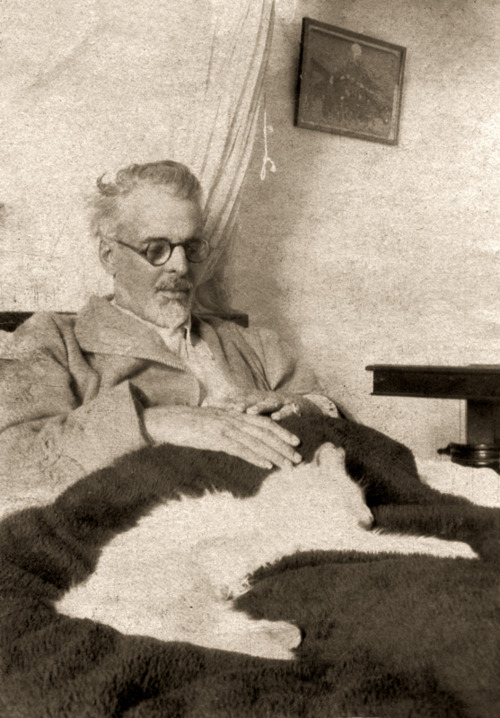
W.B. Yeats on his deathbed, 1939 by Georgie Hyde-LeesTurning and turning in the widening gyre
The falcon cannot hear the falconer;
Things fall apart; the centre cannot hold;
Mere anarchy is loosed upon the world,
The blood-dimmed tide is loosed, and everywhere
The ceremony of innocence is drowned;
The best lack all conviction, while the worst
Are full of passionate intensity.

Surely some revelation is at hand;
Surely the Second Coming is at hand.
The Second Coming! Hardly are those words out
When a vast image out of Spiritus Mundi
Troubles my sight: somewhere in sands of the desert
A shape with lion body and the head of a man,
A gaze blank and pitiless as the sun,
Is moving its slow thighs, while all about it
Reel shadows of the indignant desert birds.
The darkness drops again; but now I know
That twenty centuries of stony sleep
Were vexed to nightmare by a rocking cradle,
And what rough beast, its hour come round at last,
Slouches towards Bethlehem to be born?

– W. B. Yeats, ‘The Second Coming’, in The Collected Works of W. B. Yeats, Vol. 1: The Poems (New York: Simon & Schuster, 1996), 187.

[Notes: Penned 1919, in the aftermath of WWI, ‘The Second Coming’ was originally titled ‘The Second Birth’. The image, taken by Yeats’s wife Georgie Hyde-Lees, depicts Yeats on his deathbed in 1939.]

November stations …

Reading:

Listening

Leunig

Real Men