Year: 2009

Karl Barth on doing theology in the university

Karl Barth - SketchI’ve been re-reading some early lectures by Karl Barth from the period 1916–1923, published as The Word of God and the Word of Man. It really is an inspiring collection, the reading of which is of great encouragement to pastors and theological educators alike, recalling that our unique task is none other than to bear witness to the Word of God unveiled for us in Jesus Christ. When the demands of church and academy pull and prod us in all directions – directions determined, Barth insists, by the very question of being human – Barth graciously recalls our calling as witnesses to the given answer – the one Word of God. This witness alone is the love that we owe to God and to God’s people. And this is no less true for those called to serve in the academy, to which Barth offers the following reminder:

Theology is an omen, a sign that all is not well, even in the universitas literarum. There is an academic need which in the last analysis, as might be inferred, is the same as the general human need we have already described. Genuine science is confessedly uncertain of itself – uncertain not simply of this point or that, but of its fundamental and ultimate presupposition. Every science knows well that there is a minus sign in front of its parenthesis; and the hushed voice with which that sign is ordinarily spoken of betrays the secret that it is the nail from which the whole science hangs; it is the question mark that must be added to the otherwise structurally perfect logic. If this question mark is really the ultimate fact of each of the sciences, it is evident that the so-called academic cosmos is an eddy of scattered leaves whirling over a bottomless pit. And a question mark is actually the ultimate fact of each of the sciences.

So the university has a bad conscience, or an anxious one, and tolerates theology within its walls; and though it may be somewhat vexed at the want of reserve shown by the theologians when they deliberately ask about a matter that cannot with propriety be mentioned, yet, if I am not mistaken, it is secretly glad that some one is willing to be so unscientific as to talk aloud and distinctly about the undemonstrable central Fact upon which all other facts depend – and so to suggest that the whole academic system may have a meaning. Whatever the individual opinion of this or that non-theological doctrinaire may be, there is a general expectation that the religious teacher will give an answer to what for the others takes the shape of a question mark in the background of their secret thought. He is believed to be doing his duty (let him beware of doing it too well!) when he represents as a possibility what the others have known only as an impossibility or a concept of limitation. He is expected not to whisper and mumble about God, but to speak of him: not merely to hint of him, but to know him and witness to him; not to leave him somewhere in the background, but to disregard the universal method of science and place him in the foreground. (pp. 192–3)

Barth then proceeds to recall theology’s ‘position’ within the university’s program, and to draw out some implications for, so-called, ‘religious studies’ departments:

It is obvious that theology does not owe its position at the university to any arbitrary cause. It is there in response to a need and is therefore justified in being there. The other faculties may be there for a similar reason, but theology is forever different from them, in that its need is apparently never to be met. This marks its similarity to the church. It is the paradoxical but undeniable truth that as a science like other sciences theology has no right to its place; for it becomes then a wholly unnecessary duplication of disciplines belonging to the other faculties. Only when a theological faculty undertakes to say, or at least points out the need for saying, what the others rebus sic stantibus [things thus standing] dare not say, or dare not say out loud, only when it keeps reminding them that a chaos, though wonderful, is not therefore a cosmos, only when it is a question mark and an exclamation point on the farthest rim of scientific possibility – or rather, in contradistinction to the philosophical faculty, beyond the farthest rim – only then is there a reason for it.

A faculty in the science of religion has no reason for existence whatsoever; for though it is true that knowledge of religious phenomena is indispensable to the historian, the psychologist, and the philosopher, it is also true that these scholars are all capable of acquiring and applying this knowledge themselves, without theological assistance. Or is the so-called ‘religious insight’ the property only of that rare historian or psychologist who is also a theologian? Is the secular scientist incapable of studying the documents of religion with the same love and the same wisdom? Palpably not.

If then we say that theology is the science of religion, we deprive it of its right to a place at the university. Religion may be taught as well as anything else – but then it must be called into question as well as anything else. To be sure, it is both necessary and possible to know something about religion, but when I study it as something that may be learned, I confess thereby to having the same need above and beyond it as I have above and beyond any science – above and beyond the study of beetles, for instance. New and remarkable and highly intriguing questions about it may keep me busy, but they are questions like all other questions, questions which point on to an ultimate and unanswered question. They are not the question which is also the ultimate answer. They are not the question by virtue of which theology, once the mother of the whole university, still stands unique and first among the faculties, though with her head perhaps a little bowed. (pp. 193–5)


(what) would Barth tweet?

st-barth-twitterDrawing on recent posts by Halden Doerge, Ben Myers and Carol Howard Merritt, Graham Ford (a pastoral resident at Bryn Mawr Presbyterian Church (USA) in Bryn Mawr, Pennsylvania), asks ‘What would Barth tweet?’ He begins:

If Karl Barth rightly claimed that all theological discourse is repetition, then I’d suggest that his Twitter page would be a beautiful, rehashed failure. As the vanguard of the social networking world, Twitter thrives on novelty. As one of the twentieth century’s few great theologians, Barth strove for depth. “The Church Dogmatics” simply would not work in 140 character bites. And yet the rapidly changing nature of communication, virtual and otherwise, requires church and institutional leaders to know what words to speak and how.

Here’s the rest.

Dietrich by the path …

Last Light

[Image: Colin Webb,  ‘Last Light’]

Calvin’s Candour

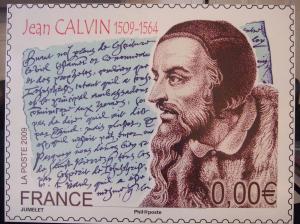
Calvin 15Candour is a ‘monthly magazine about ministry and leadership’ produced by the Presbyterian Church of Aotearoa New Zealand. Recent issues have been dedicated to ‘Ecumenism and collaboration’, ‘Interaction with Contemporary Culture’ and ‘Ministry paradigms and hats’. The latest issue is dedicated to John Calvin, and includes (heavily) edited versions of conference papers by Graham Redding, Murray Rae and yours truly. Enjoy.

Michael Mullins on ‘Black Faces’ and the Chaser

ChasersMichael Mullins posts an insightful commentary on the recent ‘Black Faces’ performance on Hey Hey It’s Saturday. Towards the end of the piece, Mullins draws a comparison with The Chasers Make a Wish Foundation’ routine:

The ABC’s own review processes approved the segment before it went to air, though management and the Chaser failed to anticipate the public response. The Chaser team maintains to this day that it was misunderstood by the public. It was intended as a parody against unthinking charity. The withdrawal of the segment, and the ABC’s apology for it, was a capitulation to the public outcry. The socially constructive statement was lost, and unthinking charity won the day.

Want to read more? Ben posted a good piece on this back in June.

Robert Fisk: Obama, man of peace? No, just a Nobel prize of a mistake

FiskFisk offers the most interesting reflection I’ve read this weekend on the Nobel sham:

His Middle East policy is collapsing. The Israelis have taunted him by ignoring his demand for an end to settlement-building and by continuing to build their colonies on Arab land. His special envoy is bluntly told by the Israelis that an Arab-Israel peace will take “many years”. Now he wants the Palestinians to talk peace to Israel without conditions. He put pressure on the Palestinian leader to throw away the opportunity of international scrutiny of UN Judge Goldstone’s damning indictment of Israeli war crimes in Gaza while his Assistant Secretary of State said that the Goldstone report was “seriously flawed”. After breaking his pre-election promise to call the 1915 Armenian massacres by Ottoman Turkey a genocide, he has urged the Armenians to sign a treaty with Turkey, again “without pre-conditions”. His army is still facing an insurgency in Iraq. He cannot decide how to win “his” war in Afghanistan. I shall not mention Iran.

And now President Barack Obama has just won the Nobel Peace Prize. After only eight months in office. Not bad. No wonder he said he was “humbled” when told the news. He should have felt humiliated. But perhaps weakness becomes a Nobel Peace Prize winner. Shimon Peres won it, too, and he never won an Israeli election. Yasser Arafat won it. And look what happened to him. For the first time in history, the Norwegian Nobel committee awarded its peace prize to a man who has achieved nothing – in the faint hope that he will do something good in the future. That’s how bad things are. That’s how explosive the Middle East has become.

Isn’t there anyone in the White House to remind Mr Obama that the Israelis have never obliged a US president who asked for an end to the building of colonies for Jews – and Jews only – on Arab land? Bill Clinton demanded this – it was written into the Oslo accords – and the Israelis ignored him. George W Bush demanded an end to the fighting in Jenin nine years ago. The Israelis ignored him. Mr Obama demands a total end to all settlement construction. “They just don’t get it, do they?” an Israeli minister – apparently Prime Minister Benjamin Netanyahu – was reported to have said when the US Secretary of State, Hillary Clinton, reiterated her president’s words. That’s what Avigdor Lieberman, Israel’s crackpot foreign minister – he’s not as much a crackpot as Mahmoud Ahmadinejad, but he’s getting close – said again on Thursday. “Whoever says it’s possible to reach in the coming years a comprehensive agreement,” he announced before meeting Mr Obama’s benighted and elderly envoy George Mitchell, “… simply doesn’t understand the reality.”

Across Arabia, needless to say, the Arab potentates continue to shake with fear in their golden minarets. That great Lebanese journalist Samir Kassir – murdered in 2005, quite possibly by Mr Obama’s new-found Syrian chums – put it well in one of his last essays. “Undeterred by Egypt since Sadat’s peace,” he wrote, “convinced of America’s unfailing support, guaranteed moral impunity by Europe’s bad conscience, and backed by a nuclear arsenal that was acquired with the help of Western powers, and that keeps growing without exciting any comment from the international community, Israel can literally do anything it wants, or is prompted to do by its leaders’ fantasies of domination.”

So Israel is getting away with it as usual, abusing the distinguished (and Jewish) head of the UN inquiry into Gaza war crimes – which also blamed Hamas – while joining the Americans in further disgracing the craven Palestinian Authority “President” Mahmoud Abbas, who is more interested in maintaining his relations with Washington than with his own Palestinian people. He’s even gone back on his word to refuse peace talks until Israel’s colonial expansion comes to an end. In a single devastating sentence, that usually mild Jordanian commentator Rami Khouri noted last week that Mr Abbas is “a tragic shell of a man, hollow, politically impotent, backed and respected by nobody”. I put “President” Abbas into quotation marks since he now has Mr Ahmadinejad’s status in the eyes of his people. Hamas is delighted. Thanks to President Obama.

Oddly, Mr Obama is also humiliating the Armenian president, Serg Sarkisian, by insisting that he talks to his Turkish adversaries without conditions. In the West Bank, you have to forget the Jewish colonies. In Armenia, you have to forget the Turkish murder of one and a half million Armenians in 1915. Mr Obama refused to honour his pre-election promise to recognise the 20th century’s first holocaust as a genocide. But if he can’t handle the First World War, how can he handle World War Three?

Mr Obama advertised the Afghanistan conflict as the war America had to fight – not that anarchic land of Mesopotamia which Mr Bush rashly invaded. He’d forgotten that Afghanistan was another Bush war; and he even announced that Pakistan was now America’s war, too. The White House produced its “Afpak” soundbite. And the drones came in droves over the old Durand Line, to kill the Taliban and a host of innocent civilians. Should Mr Obama concentrate on al-Qa’ida? Or yield to General Stanley McChrystal’s Vietnam-style demand for 40,000 more troops? The White House shows the two of them sitting opposite each other, Mr Obama in the smoothie suite, McChrystal in his battledress. The rabbit and the hare.

No way are they going to win. The neocons say that “the graveyard of empire” is a cliché. It is. But it’s also true. The Afghan government is totally corrupted; its paid warlords – paid by Karzai and the Americans – ramp up the drugs trade and the fear of Afghan civilians. But it’s much bigger than this.

The Indian embassy was bombed again last week. Has Mr Obama any idea why? Does he realise that Washington’s decision to support India against Pakistan over Kashmir – symbolised by his appointment of Richard Holbrooke as envoy to Afghanistan and Pakistan but with no remit to discuss divided Kashmir – enraged Pakistan. He may want India to balance the power of China (some hope!) but Pakistan’s military intelligence realises that the only way of persuading Mr Obama to act fairly over Kashmir – recognising Pakistan’s claims as well as India’s – is to increase their support for the Taliban. No justice in Kashmir, no security for US troops – or the Indian embassy – in Afghanistan.

Then, after stroking the Iranian pussycat at the Geneva nuclear talks, the US president discovered that the feline was showing its claws again at the end of last week. A Revolutionary Guard commander, an adviser to Supreme Leader Khamenei, warned that Iran would “blow up the heart” of Israel if Israel or the US attacked the Islamic Republic. I doubt it. Blow up Israel and you blow up “Palestine”. Iranians – who understand the West much better than we understand them – have another policy in the case of the apocalypse. If the Israelis attack, they may leave Israel alone. They have a plan, I’m told, to target instead only US troops in Iraq and Afghanistan, and their bases in the Gulf and their warships cruising through Hormuz. They would leave Israel alone. Americans would then learn the price of kneeling before their Israeli masters.

For the Iranians know that the US has no stomach for a third war in the Middle East. Which is why Mr Obama has been sending his generals thick and fast to the defence ministry in Tel Aviv to tell the Israelis not to strike at Iran. And why Israel’s leaders – including Mr Netanyahu – were blowing the peace pipe all week about the need for international negotiations with Iran. But it raises an interesting question. Is Mr Obama more frightened of Iran’s retaliation? Or of its nuclear capabilities? Or more terrified of Israel’s possible aggression against Iran?

But, please, no attacks on 10 December. That’s when Barack Obama turns up in Oslo to pocket his peace prize – for achievements he has not yet achieved and for dreams that will turn into nightmares.

[Source: The Independent]

And the answer is … Pelagius!

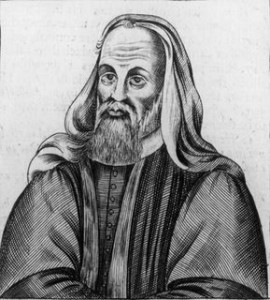
Pelagius 2There is a time for everything under heaven … and it is time to reveal the answer to our Who said it? competition. It was Pelagius! What this might say about the suggestions of Jonathan Edwards, Calvin and Augustine (!), to say nothing of Joel Osteen, is absolutely fascinating, and recalls (at least) the polemical point-scoring nature of the theological enterprise, and the distortive fruit of such. Ah depravity! (Speaking of which, check out Halden’s recent posts)

There are few things more blatantly satanic for a Reformed theologian than Pelagianism. Remembering Pelagius, however, recalls that history is written by the winners; in this case by those who sat on the winning team at the Council of Carthage in 418 and honked their Augustinian kazoos.

But what do we know about Pelagius himself? Sadly little. We do, however, have the following brief account by J. Stevenson:

Pelagius, b. c. 355, a lay monk (?) from Great Britain or Ireland, was in Rome for a long period up to 410. Later he was in Sicily and Africa (410), and in Palestine (411ff). He was the author of a Commentary on the Epistles of Paul (still extant). From c. 410 he was involved in the controversy about grace and free will, to which his name is attached. His views were attacked by Augustine (q.v.), Jerome and Orosius, and were finally condemned by the Council of Ephesus in 431.

Donald Meek notes that Pelagius’s views met with a strong following in Britain (a following which has been abiding; so Barth’s description of British Christianity as ‘incurably Pelagian’), but his teaching met with severe disapproval beyond Britain in the years around 431. In 429 Germanus, bishop of Auxerre, was dispatched to Britain by Pope Celestine in an attempt to root out the heresy. Like most bishops, he was unsuccessful, but tried again around 436–7. The ‘official’ story is that Pelagianism was suppressed during the fifth century. Clearly this applies to Pelagianism as a mass movement, since it certainly does not mean that the thoughts and influence of Pelagius were banned or destroyed; commentaries by Pelagius, often under more respectable names (e.g. Jerone) or expurgated, were read by ecclesiastics in the churches of Britain and Ireland many centuries later. And Barth’s description of anglo-Christianity still rings true – perhaps more than ever.

Still, it must be questioned just how far Pelagius’ own views relate to that of the movement which would bear his name. In a helpful review of Diarmaid MacCulloch’s brilliant new study, Christianity: The First Three Thousand Years, Rowan Williams properly cautions that ‘Pelagius’s opposition to Augustine on original sin was not a sunny and optimistic vision but part of a fiercely rigorous morality that left little room for the lights and shadows of human experience and the uneven quality of what we call freedom’. Feel cautioned.

Thanks to those who threw their hat in the ring with this. It was fun, and so we might do it again sometime soon.

**UPDATE**

For those wishing to read further on these issues, Dr Mark Elliott (who really isn’t as grumpy as he looks in this photo) has been kind enough to offer a few suggestions:

… time’s running on

Astronomical Clock PragueThere’s now less than 24 hours remaining in our Who said it? competition. Some fascinating suggestions thus far; and most people (though not naughty Martin Fey!) have resisted the temptation to cheat. While there have so far been no seconder’s for Dan’s ‘Joel Osteen’, a number are running with Calvin, and some people have even cast a second (split) vote.

So, in the haunting tone of Dr Lecter, ‘Tick tock. Tick tock …’

VOTE NOW!

BTW: The image is of the famous Prague Orloj, a medieval astronomical clock located in Prague’s beautiful city centre. This may be a hint to an answer, but then again …

Michael Jinkins on ‘Myths and urban legends about John Calvin’

4Firstly, don’t forget to enter the Who said it? competition. It closes on Friday. Suggestions so far have been fascinating.

Now, enjoy this post by Michael Jinkins on ‘Myths and urban legends about John Calvin’:

Recently I asked Serene Jones, president of Union Theological Seminary in New York, what resources she finds particularly helpful in her vocation as a theological educator and church leader. She said, “This may sound corny, but John Calvin.” I don’t think she sounds corny at all, but, then, I’m a Calvinist. Or a Neo-Calvinist. Or maybe a Crypto-Neo-Calvinist. Anyway I agree with Serene – and with David Steinmetz writing for “Faith & Leadership” here.

This year we Calvinists have been busy baking birthday cakes with 500 candles on them in honor of John Calvin whose influence has been noted, lamented or celebrated by figures as divergent as the sociologist and economist Max Weber, the journalist G. K. Chesterton and the novelist Marilynne Robinson. As a public service to all non-Calvinists, I have assembled a myth-busting primer on the Protestant Reformer.

Myth No.1: John Calvin was a sour puss.

Martin Luther is usually cast as the fun-loving, beer-swigging, warm-hearted Reformer while Calvin is caricatured as dour, the sort of person who (as one Episcopal bishop once notoriously described him) “sucked sour persimmons for fun.” In fact, Calvin was the Reformation’s chief apologist for fun. For example, he reminds us that God created food and drink “for delight and good cheer,” not simply for nourishment. Quoting the Psalms he tells us that wine is given to us to gladden the heart, and olive oil was made for dipping bread. Here’s a person who knew his way around a Michelin Star restaurant (never forget that Calvin was French!). According to Calvin, God did not create the world merely for utilitarian purposes, but for beauty and pleasure.

Myth No.2: Calvin was a tyrant.

Recently this myth got some highly visible air time in “The New York Times Magazine” in an article titled: “Who Would Jesus Smack Down?” The article profiled a preacher who justifies his refusal to listen to the criticism of lay leaders by citing Calvin. When a member of his congregation complained, for example, the pastor suspended the complainer’s membership, explaining, “They were sinning through questioning.” The author of the article commented, “John Calvin couldn’t have said it better himself.” In fact, Calvin could and often did say it much better than that. Calvin distrusted the vesting of power in any individual (himself included), and abided with decisions made by the ordered bodies of his church and city even when he did not agree with them. Calvin believed that God makes God’s will known through groups more reliably than through the will of individuals, and there’s no better guarantee against the abuse of a leader’s power than a vigilant group in which authority is shared.

Myth No.3: Calvin and Calvinism are identical.

This one’s tricky! There’s an assumption that everything we call “Calvinism” actually came from Calvin. A colleague recently mentioned that he was sitting on a plane reading a book about Calvin. The flight attendant saw what he was reading and said, “I know about Calvin. He’s the TULIP guy.” In fact, the well-known “five points of Calvinism,” memorialized in the acronym TULIP (Total depravity; Unconditional election; Limited atonement; Irresistible grace; Perseverance of the saints) dates from the century after Calvin (the Synod of Dort, 1618-1619), and represents the high water mark of “Calvinist Scholasticism” in which the warm personal evangelical movement that Calvin led was distorted by a calcified reactionism. Calvin scholars like James Torrance and T.F. Torrance, R. T. Kendall and Holmes Rolston, III, have helped us differentiate between Calvin and his latter-day disciples.

Myth No. 4: Calvin was a religious fanatic.

There certainly is a popular perception of Calvin as a sort of religious fanatic or zealot. After all, there are some Christian Fundamentalists to this day who claim him as their spiritual father, and let’s not forget the various heresy prosecutions that have followed in the wake of “Calvinism” especially in Scotland and the United States. In fact, Calvin himself deserves to be remembered both as a “Renaissance Man” and a “Humanist.” Calvin was part of that remarkable Renaissance movement that included Thomas More (the brilliant Catholic “Man for all Seasons”) and Desiderius Erasmus (the Dutch scholar known for his critical studies and satire). The humanist movement swept away the cobwebs of superstition and obscurantism and placed the Bible, freshly translated, in the hands of ordinary Christians. Calvin, like other humanists, was also a critical scholar of the Bible who believed that knowledge and wisdom, scholarship and science are not enemies of the faith.

Myth No. 5: Calvin was sadistic.

Obviously this myth is supported by the burning of Michael Servetus (a person who had the distinction of being considered a heretic by both the Protestants and the Roman Catholics and of being a physician who discovered how blood circulates in the human body). Calvin opposed Servetus’s teachings. Calvin denounced him to the Roman Catholic Inquisition. Calvin believed that Servetus’s heresies were dangerous to the future of the Church, and he wanted him silenced. In fact, however, what is less well known is that Calvin argued that Servetus not be burned at the stake. The conventional picture of Calvin cruelly twirling his moustache like Snidely Whiplash while Servetus burned is baseless. Calvin urged the courts to spare Servetus from burning, which Calvin considered a barbarous method of execution – and to behead Servetus instead. Okay, this one sounds like cold comfort even to me, and even if Calvin thought Servetus “had it coming” (to quote Clint Eastwood). The fact that Calvin believed the church was locked in a life and death struggle with Servetus, and that the magistrates had no other responsible alternative than to execute him, does not necessarily mean that Calvin was sadistic, though he does appear to have been a pretty typical product of a cruel age on this score. The burning of Servetus ignited a firestorm of controversy among Protestants as to whether such measures are ever justified. Incidentally, Servetus was opposed to the use of force to promote religion long before he was sentenced to death.

[Source: Faith and Leadership]

Church History in Four Minutes

[HT: Rick Floyd].

Looking for something a little longer? Then check out the brilliant new study, Christianity: The First Three Thousand Years, by Diarmaid MacCulloch. It’s set to become the text in its field, and at 1184 pages (!) it will be keeping me busy for some weeks/months.

BTW: Don’t forget to enter the Who said it? competition.

UpdateJanet, the producer of the aforementioned video, has recently posted the words to her flick:

Pentecost, Palestine, barbarians, Paul gets a sign
Neglected widows, martyred Stephen, Gentile vs. Jew
New Testament, getting tribal, Gnostic gospels, Holy Bible
Jamnia, Revelation, word of God is true
Martyrs, Diocletian, Polycarp, Domitian
Church learns, Nero burns, Christians underground
Chi-Rho, basilica, Vita Evangelica
Nicea, Who was Jesus, Christians start to rebound

CHORUS: We didn’t start the fire
It’s been always burning
Since the world’s been turning
We didn’t start the fire
Though we didn’t light it
And we cannot fight it

St. Patrick, Monastery, Visigoths are pretty scary
Pope Leo, St. Jerome, forgetting how to read
Mohammed writes the Koran, Convert or die to Islam
Hard to cope, Where’s the Pope, the Venerable Bede
Dark ages, knights and pages, east and west will split in stages
Monks’ skulls, cathedrals, Charlemagne starts to reign,
Methodias, Constantinople, Peasants, clergy, serfs and nobles
Augustine, Irene, everything goes Byzantine

CHORUS: We didn’t start the fire …

Cluny, bubonic plague, Vikings, Saracens invade
William conquers, priests and monks, and Jerusalem gets sacked
Flying buttress, St. Clare, celibacy, worship Mary
Knights Templar, stained glass, Sultan Saladin gets whacked
Mendicants, Avignon, Albertus Magnus, Genghis Khan
Aquinas, Maimonides, Gentle Francis of Assisi
Summa bono , Faith and reason, say God bless you when you’re sneezin’
Just War, Crusades galore, but who are we fighting for?

CHORUS: We didn’t start the fire …

Competing popes, not much hope, Joan of Arc makes her mark
John Wycliff, Thomas Kempis, Canterbury Tales
Michelangelo, Siena, Leonardo and Vienna
Reformation, printing press, Guttenberg prevails
John Calvin, Ulrich Zwingli, indulgences for the kingly
Martin Luther pounds the door, Here I stand, I’ll do no more

CHORUS: We didn’t start the fire …

King James Bible, John Locke, Galileo, J.S. Bachj
Anabaptists, Guy Fawkes, Blaise Pascal, John Knox
Puritans preach denial, Salem witches go on trial
Enlightenment or transcendence, we declare our independence
Whitfield makes us all Awaken, Pentecostals get us shakin’
Darwin teaches evolution, Marx preaches revolution
Jesus freaks, immigration, nuclear annihilation
Overwhelmed by information, Who will save this generation?

CHORUS: We didn’t start the fire
It’s been always burning
Since the world’s been turning
We didn’t start the fire
But when we are gone
It will still go on and on and on and on and on and on and on and on …

Online Activism & Human Rights in China

Online activismThose within cooee of Dunedin might like to diary that Amnesty International’s Human Rights Book Club (which is not really a book club at all) is meeting again on Monday 12th October, 5:30pm, at the Dunedin Public Library, 1st Floor, LearnIT Left room. The topic of this month’s meeting is ‘Online Activism & Human Rights in China’ and our guest speaker will be Paola Voci, Senior Lecturer in Chinese in the Department of Languages & Culture at Otago University.

For more information, contact the very approachable Betty Mason-Parker.

This discussion is timely with the recent crackdown on human rights defenders, including media in China and Rebiya Kadeer’s just-announced visit to New Zealand.

Who said it?

SpeakerTime for a wee competition. From whose mouth/pen did the following words come:

‘For not only has the darkness of foolishness and ignorance so blinded our mind that it can neither sense nor utter anything divine, but also conscience has convicted it of all sins, so that even if our mind may have some light, still it conceals it’.

Closing on Friday. No cheating.

Living in the Celtic twilight

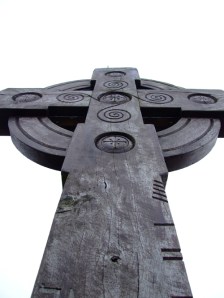
celtic-crossRecent days (and nights) have seen me delving into the fascinating world of research on Celtic Christianity, helped along by a bottle of Laphroaig, the able Ian Bradley, James Mackey, Noel Dermot O’Donoghue, Oliver Davies, John MacLeod, Donald Meek, and the delectably fun Adomnán of Iona. All the while, the assessment offered by J.R.R. Tolkien in his famous lecture on ‘English and Welsh’ (reprinted in The Monsters and the Critics and Other Essays) has been ringing true in my ears:

“To many, perhaps to most people outside the small company of the great scholars, past and present, ‘Celtic’ of any sort is, nonetheless, a magic bag, into which anything may be put, and out of which almost anything may come. Thus I read recently a review of a book by Sir Gavin de Beer, and, in what appeared to be a citation from the original, I noted the following opinion on the river-name Arar (Livy) and Araros (Polybius): ‘Now Arar derives from the Celtic root meaning running water which occurs also in many English river-names like Avon’. It is a strange world in which Avon and Araros can have the same ‘root’ (a vegetable analogy still much loved by the non-philological when being wise about words). Catching the lunatic infection, one’s mind runs on to the River Arrow, and even to arrowroot, to Ararat, and the descent into Avernus. Anything is possible in the fabulous Celtic twilight, which is not so much a twilight of the gods as of the reason”. (pp. 185–6).

Iran and Samoa

propagandaJohn Pilger spotlights that Obama’s propaganda machine is in full swing:

Iran’s crime is its independence. Having thrown out America’s favourite tyrant, Shah Reza Pahlavi, Iran remains the only resource-rich Muslim state beyond US control. As only Israel has a “right to exist” in the Middle East, the US goal is to cripple the Islamic Republic. This will allow Israel to divide and dominate the Middle East on Washington’s behalf, undeterred by a confident neighbour. If any country in the world has been handed urgent cause to develop a nuclear “deterrence”, it is Iran.

As one of the original signatories of the Nuclear Non-Proliferation Treaty, Iran has been a consistent advocate of a nuclear-free zone in the Middle East. In contrast, Israel has never agreed to an IAEA inspection, and its nuclear weapons plant at Dimona remains an open secret. Armed with as many as 200 active nuclear warheads, Israel “deplores” UN resolutions calling on it to sign the NPT, just as it deplored the recent UN report charging it with crimes against humanity in Gaza, just as it maintains a world record for violations of international law. It gets away with this because great power grants it immunity.

Obama’s “showdown” with Iran has another agenda. On both sides of the Atlantic the media have been tasked with preparing the public for endless war. The US/Nato commander General Stanley McChrystal says 500,000 troops will be required in Afghanistan over five years, according to America’s NBC. The goal is control of the “strategic prize” of the gas and oilfields of the Caspian Sea, central Asia, the Gulf and Iran – in other words, Eurasia. But the war is opposed by 69 per cent of the British public, 57 per cent of the US public and almost every other human being. Convincing “us” that Iran is the new demon will not be easy. McChrystal’s spurious claim that Iran “is reportedly training fighters for certain Taliban groups” is as desperate as Brown’s pathetic echo of “a line in the sand”. – John Pilger, Iran’s nuclear threat is a lie

On another – and more immediate – note, the Global Mission Office of the Presbyterian Church of Aotearoa New Zealand is coordinating a relief effort for the people of Samoa hit by the tsunami of 30 September, donations to be passed on to partner churches and agencies working in Samoa. Appeals are also being run by Oxfam and the New Zealand Red Cross.

Baptism, ordination and God’s calling forth of faith

ServantBen’s recent post on Baptism and ordination reminded me of some stuff that Ray Anderson once prepared on the relationship between the two. Anderson cautioned that we understand ‘ordination’ not only in relation to baptism, but also in relation to God’s work of calling forth faith, God’s work of guiding and enabling the whole community of faith, God’s care for all people. Ordination must be seen in the light of this broader movement of the divine will – that is, in the context of God’s good purposes for creation. So, the ministry to which a pastor is ordained is deeply and inherently about a life in God, and it means participation in that life. This means that ordination makes no sense not merely apart from baptism but – and more fundamentally – apart from Jesus Christ, and apart from his service to the Father on behalf of the world. So T.F. Torrance (who is not a particularly great friend of Ben’s):

Christ was Himself the diakonos par excellence whose office it was not only to prompt the people of God in their response to the divine mercy and to be merciful themselves, not only to stand out as the perfect model or example of compassionate service to the needy and distressed, but to provide in Himself and in His own deeds of mercy the creative ground and source of all such diakonia. He was able to do that because in Him God Himself condescended to share with men their misery and distress, absorbed the sharpness of their hurt and suffering into Himself, and poured Himself out in infinite love to relieve their need, and He remains able to do that because He is Himself the outgoing of the innermost Being of God toward men in active sympathy and compassion, the boundless mercy of God at work in human existence, unlimited in His capacity to deliver them out of all their troubles. – Thomas F. Torrance, ‘Service in Jesus Christ’ in Theological Foundations for Ministry: Selected Readings for a Theology of the Church in Ministry (ed. Ray S. Anderson; Edinburgh/Grand Rapids: T&T Clark/Wm. B. Eerdmans, 1979), 718.

Ben’s post, and the comments that follow (particularly those from the Revd Bruce Hamill who laments ordination ‘to a kind of generic “leadership” which covers all the bases of being a “professional Christian”), reminded me of a powerful essay that I read just last week by Dietrich Bonhoeffer wherein he warns against leadership becoming vested in the concept of the Leader (der Führer), where the humanity of the leader becomes concealed in a role:

Where there is community there is leadership … The group is the womb of the Leader. It gives him everything, even his authority. It is his person to which all the authority, all the honour and all the glory of the group is transferred. The Leader holds no office independent of the group. The group expects the Leader who derives from the group in this way to be the bodily incorporation of its ideal. This task, impossible in itself, is made easier for the Leader by the fact that the group which produced him now sees him already bathed completely in the light of its ideals. It sees him, not in his reality but in his vocation. It is essential for the image of the Leader that the group does not see the face of the one who goes before, but sees him only from behind as the figure stepping out ahead. His humanity is veiled in his Leader’s form … The Leader is what no other person can be, an individual, a personality. The relationship between those led and their leader is that the former transfer their own rights to him. It is this one form of collectivism which turns into intensified individualism. For that reason, the true concept of community, which rests on responsibility, on the recognition that individuals belong responsibly one to another, finds no fulfillment here. – Dietrich Bonhoeffer, ‘The Nazi Rise to Power’ in No Rusty Swords: Letters, Lectures and Notes from the Collected Works (ed. John Bowden; London: Collins, 1970), 191, 192, 195.

Now I really need to get back to my reading on Celtic Christianity … some of us have lectures to prepare.

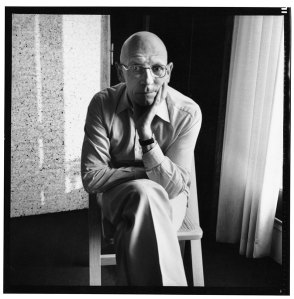
Michel Foucault’s Madness and Civilisation

Michel FoucaultWhile slowly working through a growing backlog of podcasts on my iPod, I happened upon this fascinating conversation (available as transcript and audio) with Justin Clemens about Michel Foucault and his Madness and Civilization: A History of Insanity in the Age of Reason.

Here’s just two snippets:

One of the things that Foucault argues specifically about what happens to madness in the 17th century is that it suffers a ‘great confinement’ as he calls it, an exclusion and incarceration whereby people who we would now denominate mad are locked up higgeldy-piggeldy with an enormous number of other sorts of types, like beggars, petty criminals, layabouts, prostitutes, and so on. And he wants to ask us to the provenance or historical anticipations of this great confinement. He finds this in the great leprosaria of the mediaeval period, and he draws that connection first of all in order to show yes there have been these techniques before in the history of the West, certainly, but then that the great confinement that he’s talking about vis-à-vis madness in these other forms, it’s not quite the repetition, something different is going on, and it’s kind of a bravura Foucault performance again …

I think that Foucault was actually desperately trying to de-philosophise. One of his critiques of Derrida is that Derrida is just a kind of part of a well-determined little pedagoguery of a very exclusive, prestigious, small, small-minded, philosophical discourse that actually in its obsession with the great texts of the masters, fails to recognise its links to society and actually what happens in society is registered in philosophy, in its dissimulating way. And so much of Foucalt’s life it seems to me, is desperately trying to not be a philosopher in a classical model, but to try and be (to use a word he didn’t mind himself) a real intellectual, to question philosophy, history, psychiatry, medicine, prisons and so on, sexuality, in a way that returns them a kind of deranging and alienated force and makes you think about them again in ways that either historians wouldn’t have made you think about again, and/or philosophers wouldn’t have made you think again. So Foucault’s I think tries to make you think again.

September bests …

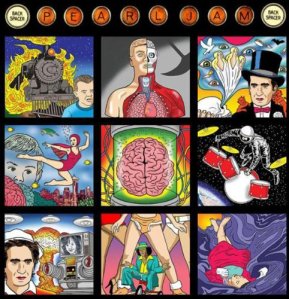
BackspacerFrom the reading chair: Biography as Theology: How Life Stories Can Remake Today’s Theology by James Wm. McClendon; The Concentration Camp and Other Stories by Geoffrey C. Bingham; The End of Suffering: Finding Purpose in Pain by Scott Cairns [reviewed here]; Pastoral Theology in the Classical Tradition by Andrew Purves; Poems for Gardeners edited by Germaine Greer; No Rusty Swords: Letters, Lectures, and Notes from the Collected Works by Dietrich Bonhoeffer.

Through the iPod: Come Up Full and The Crossing by Meg Hutchinson; Backspacer by Pearl Jam; Beautiful World and The Road Between by Khristian Mizzi; My Holiday by Mindy Smith; Our Bright Future by Tracy Chapman; Death Magnetic by Metallica; Symphony No. 4 in E minor, Op. 98 – Carlos Kleiber/Vienna Philharmonic Orchestra by Johannes Brahms.

On the screen: Shooting Dogs [2007], reviewed here;  Wallace and Gromit: A Matter of Loaf or Death [2009]; Shaun the Sheep: Sheep on the Loose [2009]; Shaun the Sheep: Off the Baa! [2008]; Sometimes in April [2005].

By the bottle: Seppeltsfield Cellar No 9 Muscat Rutherford (tasting notes).

The Service of Intercession

Moses MosaicKarl Barth once noted that ‘Even within the world to which it belongs, it [the Church] does not exist ecstatically or eccentrically with reference to itself, but wholly with reference to them, to the world around. It saves and maintains its own life as it interposes and gives itself for all other human creatures’ (CD IV.3.2, 762). There can be no doubt that this ministry of intercession certainly involves prayer, but prayer without diakonia is not true prayer, even as diakonia without prayer is not true diakonia. Authentic intercession also involves a struggle against evil, identification with those who are estranged and alienated, and an ‘argument’ with God on behalf of those who have become disenfranchised from God, from human community and from creation. We might recall here Moses’ intercession for those who have worshipped the golden calf:

On the following day Moses said to the people, ‘You have committed a great sin. But now I shall go up to Yahweh: perhaps I can secure expiation for your sin.’ Moses then went back to Yahweh and said, ‘Oh, this people has committed a great sin by making themselves a god of gold. And yet, if it pleased you to forgive their sin …! If not, please blot me out of the book you have written!’ (Exodus 32:30–32)

Inherent in this intercession of responsible action is a sharing of guilt. This recalled something that I read recently in Bonhoeffer’s Ethics, (the implications of which we might also profitably tease out with a copy of TF Torrance’s The Mediation of Christ in hand). I cite Bonhoeffer:

[The] structure of responsible action includes both readiness to accept guilt and freedom.

When we once more turn our attention to the origin of all responsibility it becomes clear to us what we are to understand by acceptance of guilt. Jesus is not concerned with the proclamation and realization of new ethical ideals; He is not concerned with Himself being good (Matt. 19.17); He is concerned solely with love for the real man, and for that reason He is able to enter into the fellowship of the guilt of men and to take the burden of their guilt upon Himself. Jesus does not desire to be regarded as the only perfect one at the expense of men; He does not desire to look down on mankind as the only guiltless one while mankind goes to its ruin under the weight of its guilt; He does not wish that some idea of a new man should triumph amid the wreckage of a humanity whose guilt has destroyed it. He does not wish to acquit Himself of the guilt under which men die. A love which left man alone in his guilt would not be love for the real man. As one who acts responsibly in the historical existence of men Jesus becomes guilty. It must be emphasized that it is solely His love which makes Him incur guilt. From His selfless love, from His freedom from sin, Jesus enters into the guilt of men and takes this guilt upon Himself. Freedom from sin and the question of guilt are inseparable in Him. It is as the one who is without sin that Jesus takes upon Himself the guilt of His brothers, and it is under the burden of this guilt that He shows Himself to be without sin. In this Jesus Christ, who is guilty without sin, lies the origin of every action of responsible deputyship. If it is responsible action, if it is action which is concerned solely and entirely with the other man, if it arises from selfless love for the real man who is our brother, then, precisely because this is so, it cannot wish to shun the fellowship of human guilt. Jesus took upon Himself the guilt of all men, and for that reason every man who acts responsibly becomes guilty. If any man tries to escape guilt in responsibility he detaches himself from the ultimate reality of human existence, and what is more he cuts himself off from the redeeming mystery of Christ’s bearing guilt without sin and he has no share in the divine justification which lies upon this event. He sets his own personal innocence above his responsibility for men, and he is blind to the more irredeemable guilt which he incurs precisely in this; he is blind also to the fact that real innocence shows itself precisely in a man’s entering into the fellowship of guilt for the sake of other men. Through Jesus Christ it becomes an essential part of responsible action that the man who is without sin loves selflessly and for that reason incurs guilt. – Dietrich Bonhoeffer, Ethics (ed. Eberhard Bethge; trans. N.H. Smith; London: SCM, 1955), 209–10.

BonhoefferBonhoeffer (who my wife often confuses with Jason Alexander, a.k.a. George Costanza) then turns to consider the implications of this theology of Christ’s vicarious humanity for the human conscience and its relationship with law:

When Christ, true God and true man, has become the point of unity of my existence, conscience will indeed still formally be the call of my actual being to unity with myself, but this unity cannot now be realized by means of a return to the autonomy which I derive from the law; it must be realized in fellowship with Jesus Christ. Natural conscience, no matter how strict and rigorous it may be, is now seen to be the most ungodly self-justification, and it is overcome by the conscience which is set free in Jesus Christ and which summons me to unity with myself in Jesus Christ. Jesus Christ has become my conscience. This means that I can now find unity with myself only in the surrender of my ego to God and to men. The origin and the goal of my conscience is not a law but it is the living God and the living man as he confronts me in Jesus Christ. For the sake of God and of men Jesus became a breaker of the law. He broke the law of the Sabbath in order to keep it holy in love for God and for men. He forsook His parents in order to dwell in the house of His Father and thereby to purify His obedience towards His parents. He sat at table with sinners and outcasts; and for the love of men He came to be forsaken by God in His last hour. As the one who loved without sin, He became guilty; He wished to share in the fellowship of human guilt; He rejected the devil’s accusation which was intended to divert Him from this course. Thus it is Jesus Christ who sets conscience free for the service of God and of our neighbour; He sets conscience free even and especially when man enters into the fellowship of human guilt. The conscience which has been set free from the law will not be afraid to enter into the guilt of another man for the other man’s sake, and indeed precisely in doing this it will show itself in its purity. The conscience which has been set free is not timid like the conscience which is bound by the law, but it stands wide open for our neighbour and for his concrete distress. And so conscience joins with the responsibility which has its foundation in Christ in bearing guilt for the sake of our neighbour. (pp. 212–3)

This got me thinking: What might be some implications of Moses’ prayer, and Bonhoeffer’s words, for pastoral ministry? And for that of the people of God as a whole?

I’m still thinking …

James Will on the practice and praxis of peace

Christology of peace‘If incomplete and ideologically distorted persons nevertheless have the dignity of participation with their Creator in the preservation and completion of the creation, then praxis is a necessary dimension of theology. But praxis must not be misunderstood as practice. Practice has come to mean the use of external means to attain a theoretically defined end. It suggests that finite and sinful persons may so understand the meaning of God’s peace as to be able to devise economic, political, diplomatic, and even military means to attain it. The end of peace is thought to be a transcendent value that appropriate external means may effect. Praxis, on the other hand, is a dialectical process of internally related events from which a result dynamically emerges. Given the finite and ideological character of our preconceptions of peace, they cannot be treated as sufficient definitions of an eternal value to guide our practice. Rather, we need a praxis; that is, peace must be allowed to emerge from a dialogical and dialectical process that may continuously correct our ideological tendencies. Praxis is thus a process of struggle, negotiation, and dialogue toward a genuinely voluntary consensus’. – James E. Will, A Christology of Peace (Louisville: Westminster/John Knox Press, 1989), 24–5.

Collingwood on things ‘perfectly serviceable’

Wireless‘It is a weakness of printed literature that this reciprocity between writer and reader is difficult to maintain. The printing-press separates the writer from his audience and fosters cross-purposes between them. The organization of the literary profession and the “technique” of good writing, as that is understood among ourselves, consist to a great extent of methods for mitigating this evil; but the evil is only mitigated and not removed. It is intensified by every new mechanization of art. The reason why gramophone music is so unsatisfactory to any one accustomed to real music is not because the mechanical reproduction is bad – that would be easily compensated by the hearer’s imagination – but because the performers and the audience are out of touch. The audience is not collaborating, it is only overhearing. The same thing happens in the cinema, where collaboration as between author and producer is intense, but as between this unit and the audience non-existent. Performances on the wireless have the same defect. The consequence is that the gramophone, the cinema, and the wireless are perfectly serviceable as vehicles of amusement or of propaganda, for here the audience’s function is merely receptive and not concreative; but as vehicles of art they are subject to all the defects of the printing-press in an aggravated form. “Why”, one hears it asked, “should not the modern popular entertainment of the theatre, produce a new form of great art?” The answer is simple. In the Renaissance theatre collaboration between author and actors on the one hand, and audience on the other, was a lively reality. In the cinema it is impossible’. – Robin George Collingwood, The Principles of Art (Oxford: Oxford University Press, 1958), 323.

Tragically, the same critique may be laid against many churches. In fact, Collingwood’s words reminded me of Ben’s reflections on ‘a famous Sydney megachurch’ posted earlier this year.