A note on the Formula, Liberty of Conscience and the Declaratory Act

A guest post by Andrew Smith.

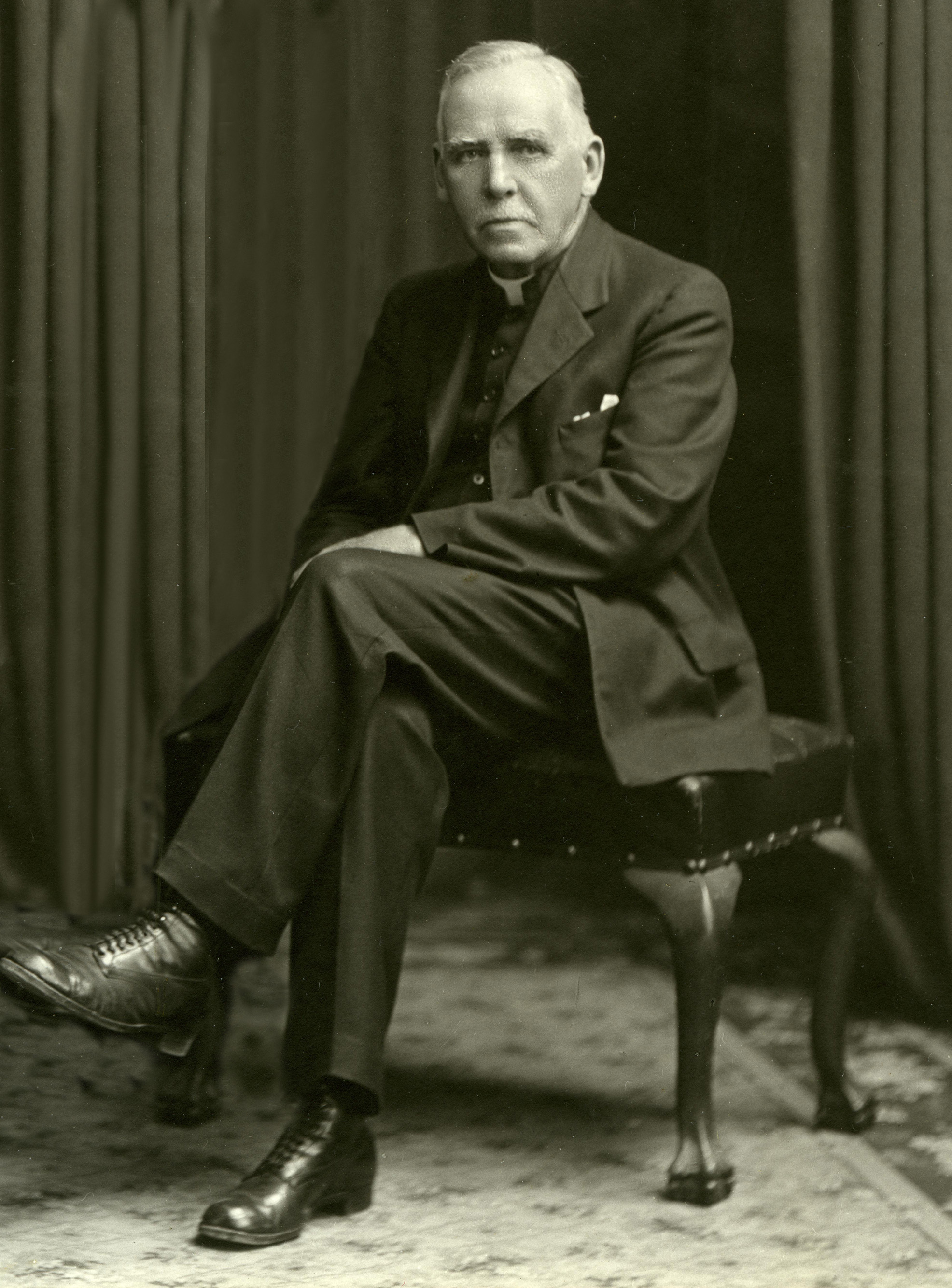
In 1930, the minister J.A. Asher and the elder J.S. Butler of the Presbytery of Hawke’s Bay supported an overture from the Presbytery to the General Assembly of the Presbyterian Church of New Zealand. It read:

Whereas this Presbytery of Hawke’s Bay, being of the opinion that Question 2, appointed to be asked of elders on the occasion of their ordination to the office, having reference to the Westminster Confession of Faith, has given rise to considerable difficulty; has resulted in men declining to accept the office of eldership, who have been in every way qualified for such office, to the detriment of the interests of our Church; hereby overtures the General Assembly that Question 2 be omitted from the questions in connection with the ordination of elders.

An examination of the Year Book of the period shows that Question 2, asked of all office-bearers of the Presbyterian Church of the time reads: ‘Do you sincerely own and believe the system contained in the Westminster Confession of Faith; and do you acknowledge the said doctrine as expressing the sense in which you understand the Holy Scriptures; and will you constantly maintain and defend the same, and the purity of worship in accordance therewith?’

Perhaps some laymen being ordained to office found this question too much to ask. Even in the early parts of the twentieth century, the Westminster Confession, a document written in dense legal language several centuries old, was too impenetrable for them to answer Question 2 in good conscience. Unlike the Bible it had no ‘revised standard version’. Rather than omitting Question 2, the General Assembly moved to revise the questions for the ordination of elders. At the same time the Church of Scotland was proceeding in the same direction and the Presbyterian Church of New Zealand chose to wait on the parent church to create a new formula and adopted a similar one with questions replacing the Formula of Subscription in 1936. The new form of the formula read:

I believe the fundamental doctrines of the Christian Faith contained in the Westminster Confession of Faith and other subordinate standards of the Church. I acknowledge the Presbyterian government of this Church to be agreeable to the Word of God, and promise that I will submit thereto and concur therewith. I promise to observe the order of worship and the administration of all public ordinances as the same are or may be allowed in this Church.

The formula was not amended again until the General Assembly of the Presbyterian Church of Aotearoa New Zealand in 2010 to read:

I believe in the Word of God in Scriptures of the Old and New Testaments and the fundamental doctrines of the Christian Faith contained in the Kupu Whakapono and Commentary, the Westminster Confession of Faith and other subordinate standards of this Church. I accept that liberty of conviction is recognised in this Church but only on such points as do not enter into the fundamental doctrines of Christian Faith contained in the Scriptures and subordinate standards. I acknowledge the Presbyterian government of this Church to be agreeable to the Word of God and promise to submit to it. I promise to observe the order and administration of public worship as allowed in this Church.

The General Assembly carried the motion that the Formula be reworded as above. While it was sent to the presbyteries and church councils, consideration to report back at the 2012 General Assembly it was adopted ad interim. There was some debate in the Assembly. My feeling is that the General Assembly did not compare the old and new versions of the Formula and that the new version has some innovations on which there could be improvements.

Firstly if the phrase in the Word of God in Scriptures of the Old and New Testaments needs to be added to the Formula then I think it should come after the subordinate standards. As it reads it conflates the authority of the Scriptures with that of the subordinate standards. While placing the Scriptures as pre-eminent is appealing, placing it as our ultimate authority is much clearer. Without further research, which probably goes back to the Church of Scotland’s version of the Formula, I suspect that the earlier generation decided that not placing the Scriptures here avoided controversy. Their intention is not without merit.

Secondly I suggest that the word conviction should be amended to read conscience. Liberty of Conscience has a long history in the Presbyterian Church going back to the Declaratory Act. It was first passed by the Church of Scotland in 1892, then by the then independent Synod of Otago and Southland in 1893, and by the united Presbyterian Church of New Zealand in 1901. Reading the Declaratory Act it seems evident that the church of this period had problems accepting that God elected some for salvation and some for damnation, especially those who died before the age of decision-making. This is an age when literature suggested that children came from heaven and if they died before a certain age that they could join the angels. Conscience has precedence in the Church’s terminology, conviction does not. To me conviction suggests belief or opinion while conscience is the prompting of the Holy Spirit. That is a significant difference.

Finally, I would strike out the words but only. To paraphrase the Gospels, what comes out of a butt goes into the sewer! But is a conjunction, a balancing word that contrasts a negative clause with a positive one, the negative clause coming first and the positive clause after the conjunction. Liberty of conviction is in the negative clause of the sentence, and the fundamental doctrines of Christian faith in the positive. The sentence reads like a big stick to police ordained ministers and elders. Agreement with this sentence suggests that too much liberty of conviction or conscience cannot be trusted. Conform or else we will have you thrown out of office! Removing it would encourage more faith in our leadership.

I believe that Asher and Butler’s overture in 1930 remains a challenge for the modern church and we still don’t know the answer. We have the Subordinate Standards of the Church. Our shared knowledge of them remains shallow. They are beyond our grasp of understanding: the words are too clever, too pretty. We might give more consideration to the Terms and Conditions taking out membership on Facebook than we do to the Formula of Ordination and to our Confessions. It lies in the too hard basket.
‘Emmaus’, by Bruce Prewer

We walked into the sunset
brooding our deep loss,
sure that the best days of our lives
lay dead behind us.

We talked around the rumours
spread by our small group,
but feared to embrace the good news
lest it be false hope.

A stranger then overtook us,
travelling our road,
he unfolded the truths and loves
our grief had betrayed.

Our hearts trembled within us
for the faith we’d lost,
we reached an inn at sundown
wanting to break fast.

We sat at table together
to share cheese and bread,
he took up the loaf and broke it
and out danced the dead!

– Bruce Prewer, ‘Emmaus’ in Beyond Words: Reflections on the Gospel of Luke (Melbourne: The Joint Board of Christian Education, 1995), 62.

Why should we love our enemies?

Why should we love our enemies? The first reason is pretty obvious. Returning hate for hate multiplies hate, adding deeper darkness to a night already devoid of stars. Darkness cannot drive out darkness; only light can do that. Hate cannot drive out hate; only love can do that. Hate multiplies hate, violence multiplies violence, and toughness multiplies toughness in a descending spiral of destruction. So when Jesus says “Love your enemies” [Matt. 5:44], he is setting forth a profound and ultimately inescapable admonition. Have we not come to such an impasse in the modern world that we must love our enemies – or else? The chain reaction of evil – hate begetting hate, wars producing more wars – must be broken, or we shall be plunged into the dark abyss of annihilation’. – Martin Luther King Jnr, Strength to Love (Philadelphia: Fortress Press, 1977), 53.

Revenge (‘keeping faith with the dead’) or Reconciliation (keeping Easter faith)?

In light of events dominating the news, there’s an interesting reflection by Michael Ignatieff in a book written in response to the Balkan crisis of the 1990s. In The Warrior’s Honour: Ethnic War and the Modern Conscience, Ignatieff argues that the virtue which underlies and motivates revenge is simply the matter of ‘keeping faith with the dead’. This is something known to us all, whether givers or objects of terror. He writes:

‘The chief moral obstacle in the path of reconciliation is the desire for revenge. Now, revenge is commonly regarded as a low and unworthy emotion, and because it is regarded as such, its deep moral hold on people is rarely understood. But revenge – morally considered – is a desire to keep faith with the dead, to honour their memory by taking up their cause where they left off. Revenge keeps faith between generations; the violence it engenders is a ritual form of respect for the community’s dead – therein lies its legitimacy. Reconciliation is difficult precisely because it must compete with the powerful alternative morality of violence. Political terror is tenacious because it is an ethical practice. It is a cult of the dead, a dire and absolute expression of respect’. – Michael Ignatieff, The Warrior’s Honour: Ethnic War and the Modern Conscience (London: Chatto & Windus, 1988), 188.

The Church, of course, is the child of the narrative at the heart of which is reconciliation, a narrative which is ‘difficult’, to be sure, but whose Author makes it possible to ‘from now on … regard no one from a worldly point of view’ (2 Cor 5.16), to live hopefully by the word that ‘in Christ God was reconciling the world to himself, not counting their trespasses against them, and entrusting the message of reconciliation to us’ (2 Cor 5.19), and to rejoice in the vocation of being ‘Christ’s ambassadors, as though God were making his appeal through us’ (2 Cor 5.20). Such is a narrative is difficult to live by because, as Ignatieff notes, it exists in relentless competition with ‘the powerful alternative morality of violence’.

Jürgen Moltmann, in The Power of the Powerless, bears witness to this ‘difficult’ way, a way which lives not from that narrative that is passing away but from what Moltmann calls ‘the superabundance of God’s future’:

‘The Easter faith recognizes that the raising of the crucified Christ from the dead provides the great alternative to this world of death. This faith sees the raising of Christ as God’s protest against death, and against all the people who work for death; for the Easter faith recognizes God’s passion for the life of the person who is threatened by death and with death. And faith participates in this process of love by getting up out of the apathy of misery and out of the cynicism of prosperity, and fighting against death’s accomplices, here and now, in this life. Weary Christians have often enough deleted this critical and liberating power from Easter. Their faith has then degenerated into the confident belief in certain facts, and a poverty-stricken hope for the next world, as if death were nothing but a fate we meet with at the end of life. But death is an evil power now, in life’s very midst. It is the economic death of the person we allow to starve; the political death of the people who are oppressed; the social death of the handicapped; the noisy death that strikes through napalm bombs and torture; and the soundless death of the apathetic soul. The resurrection faith is not proved true by means of historical evidence, or only in the next world. It is proved here and now, through the courage for revolt, the protest against deadly powers, and the self-giving of men and women for the victory of life. It is impossible to talk convincingly about Christ’s resurrection without participating in the movement of the Spirit “who descends on all flesh” to quicken it. This movement of the Spirit is the divine “liberation movement,” for it is the process whereby the world is recreated. So resurrection means rebirth out of impotence and indolence to “the living hope.” And today “living hope” means a passion for life, and a lived protest against death … Christ’s resurrection is the beginning of God’s rebellion. That rebellion is still going on in the Spirit of hope, and will be complete when, together with death, “every rule and every authority and power” is at last abolished (1 Cor. 15:24). The resurrection hope finds living expression in men and women when they protest against death and the slaves of death. But it lives from something different – from the superabundance of God’s future. Its freedom lives in resistance against all the outward and inward denials of life. But it does not live from this protest. It lives from joy in the coming victory of life. Protest and resistance are founded on this hope. Otherwise they degenerate into mere accusation and campaigns of revenge. But the greater hope has to take living form in this protest and resistance; otherwise it turns into religious seduction … Easter is a feast, and it is as the feast of freedom that it is celebrated. For with Easter begins the  laughter of the redeemed, the dance of the liberated and the creative play of fantasy. From time immemorial Easter hymns have celebrated the victory of life by laughing at death, mocking at hell, and ridiculing the mighty ones who spread fear and terror around them. Easter is the feast of freedom. It makes the life which it touches a festal life. “The risen Christ makes life a perpetual feast,” said Athanasius. But can the whole of life really be a feast? Even life’s dark side – death , guilt, senseless suffering? I think it can. Once we realize that the giver of this feast is the outcast, suffering, crucified Son of Man from Nazareth, then every “no” is absorbed into this profound “yes,” and is swallowed up in its victory. Easter is at one and the same time God’s protest against death, and the feast of freedom from death. Anyone who fails to hold these two things together has failed to understand the resurrection of the Christ who was crucified. Resistance is the protest of those who hope, and hope is the feast of the people who resist’. (pp. 123–26).

Robert Frost was right; we have a choice. That choice, in this case just as in others more domestic, is between Revenge (‘keeping faith with the dead’) and Reconciliation (keeping Easter faith):

Two roads diverged in a wood, and I –
I took the one less travelled by,
and that has made all the difference.

Revenge, justice and pleasure

While watching President Obama’s re-election speech this afternoon on the death on Osama bin Laden – and particularly while seeing the video footage of celebrating crowds – I was reminded of a few paragraphs from Don Carson’s Love in Hard Places:

‘Not that long ago on television we heard a soldier protest, “You must understand . . . it was our revenge!” The soldier was a Serb captured by the Kosovo Liberation Army. His words were broadcast in a television interview, nicely translated for the benefit of English-speaking peoples. He admitted that his unit had been involved in brutal acts of ethnic cleansing. Certainly he was frightened to be in the hands of his enemies, but he did not appear to be ashamed: “You must understand . . . it was our revenge!”

That is the trouble with revenge, of course: it does not feel like a sin. It feels like justice. Many of us have become inured to the distinction because we have watched so many movies or read so many books in which revenge, especially revenge that is adamantly pursued when the proper authorities either cannot or will not pursue justice, is itself just. It matters little if the hero is Clint Eastwood in a spaghetti western or a Dirty Harry film, or Bruce Lee in a martial arts flick, or Rambo getting even in Vietnam. In every case, we enjoy a cathartic release because we are made to feel the violence is just and therefore that the revenge is justified. When the right is on your side, revenge, no matter how violent, is a pleasure. It is just‘.

– Don A. Carson, Love in Hard Places (Wheaton: Crossway Books, 2002), 72–3.

Levinas on searching and dying

‘Time and death: these themes are subordinated to the search for the signification of the being of beings, a search that itself does not come from the curiosity of the explorer, but is a search essential to man, characteristic of his essence, his esse. Being qua being is already to-be-in-question. This essence in question is equivalent to being-there as the humanity of man, who is a being whose being is equivalent to the essence in question. This placing in question is also a pre-comprehension of being; it is effectuated in the form of a taking charge: a taking charge within Dasein and a charge imposed in the most incontestable way—to the point of becoming properly my own. This superlative thus takes the meaning of mineness, in such a way that being qua being-in-question is the affair of ipseity. This taking charge is the mode of the human beings to-be, which unfolds as being-there, as being-the-there, and this unfolds as being-in-the-world, which itself unfolds as care, where care is broken into a triple structure: being-out-ahead-of-oneself (ec-sistence) as already-in-the-world (facticity), alongside of things (dispersion or dereliction among things) … Death is a possibility that is absolutely certain. It is the possibility that makes all possibility possible’.

– Emmanuel Levinas, God, Death, and Time (trans. Bettina Bergo; California: Stanford University Press, 2000), 46, 49.

April stations

Reading:

Listening:

Watching:

‘How To Kill’, by Keith Douglas

Under the parabola of a ball,
a child turning into a man,
I looked into the air too long.
The ball fell in my hand, it sang
in the closed fist: Open Open
Behold a gift designed to kill.

Now in my dial of glass appears
the soldier who is going to die.
He smiles, and moves about in ways
his mother knows, habits of his.
The wires touch his face: I cry
NOW. Death, like a familiar, hears

And look, has made a man of dust
of a man of flesh. This sorcery
I do. Being damned, I am amused
to see the centre of love diffused
and the wave of love travel into vacancy.
How easy it is to make a ghost.

The weightless mosquito touches
her tiny shadow on the stone,
and with how like, how infinite
a lightness, man and shadow meet.
They fuse. A shadow is a man
when the mosquito death approaches.

– Keith Douglas, ‘How To Kill’ in Keith Douglas: The Complete Poems (ed. Desmond Graham; London: Faber & Faber, 2000), 119.

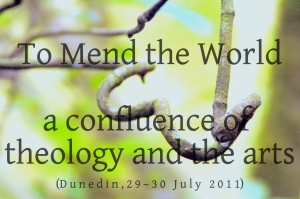
To Mend the World: a confluence of theology and the arts

The sixteenth-century Jewish mystic, Isaac Luria, made much of the notion of tikkun olam, a phrase which we might translate as ‘to mend the world’. Luria believed that the Creator of all things, in deciding to create a world, drew in – contracted – the divine breath in order to make room for the creation coming into being. In this enlarged space, the Creator then set vessels and poured into them the radiance of the divine light. But the light was too brilliant for the vessels, causing them to shatter and scatter widely. Since then, the vocation given to human person has consisted of picking up and to trying to mend or refashion the shards of creation.

Tikkun olam is also the theme of a conference and exhibition that I’m involved in organising, and which will take place in Dunedin this July. It is shaping up to be a very exciting twin-project, with an impressive line-up of speakers and artists. Registration for the conference has exceeded expectation for this stage so far out from the date, is still open, and there’s still some time to get in on the ‘early-bird’ rate.

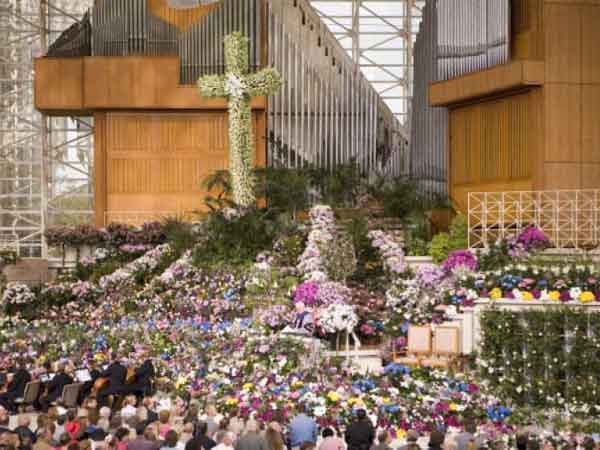
‘Not the empty tomb’, by R.S. Thomas

Not the empty tomb
but the uninhabited
cross. Look long enough
and you will see the arms
put on leaves. Not a crown
of thorns, but a crown of flowers
haloing it, with a bird singing
as though perched on paradise’s threshold.

We have over-furnished
our faith. Our churches
are as limousines in the procession
towards heaven. But the verities
remain: a de-nuclearised
cross, uncontaminated
by our coinage; the chalice’s
ichor; and one crumb of bread
on the tongue for the bird-like
intelligence to be made tame by.

– R.S. Thomas, Counterpoint (Newcastle upon Tyne: Bloodaxe Books, 1990), 37.

Community of the Transfiguration: a commendation

Paul Dekar’s book, Community of the Transfiguration: The Journey of a New Monastic Community (Cascade Books, 2008), maps the historical, theological, liturgical, and missiological life of Holy Transfiguration Monastery [HTM], or what many of us know better as The Breakwater Community – a Baptist monastic community in Geelong, near Melbourne. HTM was birthed in the early 1970s and bound together by ‘a common calling to contemplative prayer, simplicity, a Eucharistic focus, and the nurture of monastic spiri­tuality’ (p. 33). How this birth happened, and the shape that the life birthed has taken, and is taking, is a focus of this book; it is, however, by no means the only focus.

Dekar, who is Professor Emeritus of Evangelism and Mission at Memphis Theological Seminary and (as I understand it) a ‘Companion in identifica­tion with HTM as a spiritual home’, locates the story of the Breakwater Community among the wider stories and history of Christian monasticism in both its ancient and contemporary forms: ‘HTM exhibits many generic traits of its monastic forebears and of the new monastic communities. These include the centrality of Jesus Christ, communal life under a rule of life, vital worship, use of the visual arts, care for youth, care for the natural world; and ministries among marginalized persons. In this sense, the life of Community mem­bers is neither unique, nor original, perhaps only “newly born … a spirit and an endless trying, changing and beginning again”’ (p. 57). That the members of the Community have sought to explore and live out of traditional monastic spiri­tuality for over thirty-five years has, in Dekar’s words, ‘made the Community somewhat of a working model, or bridge, between past and contemporary forms of monastic religious life’ (pp. 61–62).

Dekar believes that ‘the radical love Community members have extended to lay people, pastors, denomi­national leaders, critics, and even enemies is perhaps its greatest gift’ (p. xvi). That I can count myself as one among many who has been, on more than one occasion, the recipient of the hospitable love of this extraordinary and permission-giving community (once in the form of home-made lemonade and a pumpkin – food for the journey, so to speak), is but one the reasons that I was so keen to read this book. From my brief experience and observation as a pastor in the Baptist Union of Victoria, among the greatest gifts bestowed by the Breakwater Community to the wider Church is the centrality, rhythm, and theological maturity afforded to gathered worship, and the attendant invitation to live all of life as an expression of and participation in the One who gives himself in the eucharist. It is, I believe, appropriate, then, that Dekar devotes a significant portion of the book to introducing readers to some of the liturgical resources and prayers authored by the Community, and to outlining the theology and practice of HTM’s worship, the shape that a community in which ‘the nurture of warm, personal intimacy with the Holy Trinity’ (p. 89) lies at the heart of common life.

On occasion, Dekar gets sidetracked from the main story and expends ink on some of his additional interests which, although loosely related to the book’s subject, disrupt its flow. Still, this moving and challenging book records a fascinating and important – albeit small – chapter of the story of Victorian Baptists, and locates that story in both a wider and more grassroots ecumenical and catholic context. Those already familiar with the inspirational life and witness of the Breakwater Community and its relationship with the Baptist family in Victoria, and those interested in hearing a more detailed account of one community that religion sociologists might locate in a movement known as ‘New Monasticism’, will find much of interest here.

John Pilger on Anzac Day

Anzac Day has been appropriated by those who manipulate the cult of state violence – militarism – in order to satisfy a psychopathic deference to foreign power and pursue its aims. And the “legend” has no room for the only war fought on Australian soil: that of the Aboriginal people against the European invaders. In a land of cenotaphs, not one stands for them. The modern war-lovers have known no street of screams and despair. Their abuse of our memory of the fallen, and why they fell, is common among all servitors of rapacious power …’. – John Pilger, ‘Julia Gillard leads the march for Anzac in the 51st state’.

Easter Eucharist, a conversation with a five-year old

Here’s a snippet of a wee conversation that took place this morning between my daughter and myself – in church:

‘So why do we eat bread and drink wine today?’, I asked.

‘The wine is God’s life, and the bread is God’s skin’, she said. ‘We eat and drink so that we won’t die. When we eat and drink, God’s life and our life is joined together’.

Impressed by this young anti-Zwinglian (a description she embraces with some enthusiasm), I enquired: ‘Since when have you been reading Ignatius of Antioch?’ (Ignatius once referred to the Eucharist as ‘the medicine of immortality’).

And she said, ‘Ha? Can we have our chocolates soon?’

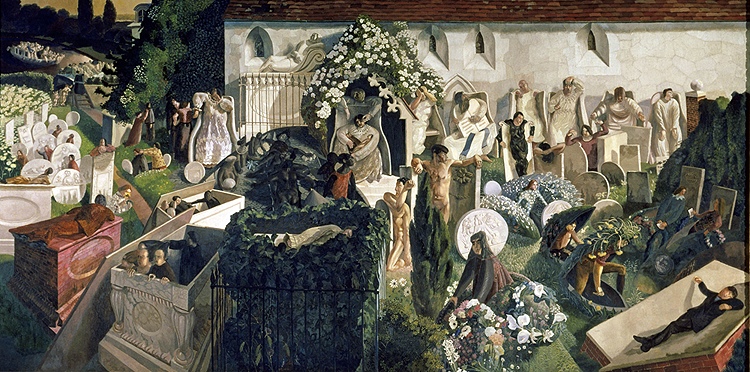
The Risen Truth

‘The resurrection of Jesus, then, is not simply the raising and the restoration to the world of his past identity (though that is a vital component in the situation … ). Equally importantly, it is the ‘raising’ of the past identity of those who have been with him. The risen truth shows us the self-deceptions which have drawn us into the vortex of destructiveness. “Look”, says the risen Christ, “and see that, whatever your hopes and your longings, you were still trapped in fantasy, in blindness to yourselves and to the reality confronting you. Look how you trapped me and handed me over to death. Learn the depth of your resistance to the truth.” And yet the whole of that past that is shared with Jesus is now to be transformed: as we learn the truth of its tragic character, we learn also that the tragedy is interwoven with hope. The truth incarnate, present in the human world, is instantly, inevitably, entangled with the luxuriant tendrils of human fantasy and self-deceit. Throughout the ministry of Jesus, we are reminded of the longing of disciples and “multitude” alike for a saviour congruent with their projections and aspirations. There is no breaking-free from this web, because entanglement in it is inseparable from human being – the conditions of imperfect knowledge and imperfect communication, combined with the urge to structure and subdue the world and tame its contingency. And thus truth in this world is a stranger, essentially and profoundly vulnerable (so the Fourth Gospel reiterates again and again): its connection with or participation in the world involves rejection, crucifixion outside the city gates. Yet it has entered the world, it has allowed itself to be linked with the sphere of destructive untruth; and even if rejected, it cannot be annihilated. If Calvary shows the links between truth and untruth pulling the former down towards extinction, Easter shows us those same links, the same interconnectedness of the human world, reversed, so that truth draws untruth up towards the light. Our connection with truth, with Jesus, has led to the cross; his connection with us remains, indestructibly, to assure us that our betrayal is not the ultimate fact in the world. We may betray, but the world characterized by betrayal is now interwoven with a reality incapable of betrayal. God’s faithfulness has worn a human face, through Calvary and beyond. The incarnate truth, “risen from the dead”, establishes that faithfulness as the ground of inexhaustible hope in the world, even in the midst of our self-deceits’.

– Rowan Williams, Resurrection: Interpreting the Easter Gospel (London: Darton, Longman and Todd, 1982), 41–2.

Holy Saturday, the Son who is held in oneness with the Father

‘If it is hard to understand how the Father-Son relationship is maintained when Jesus is among the god-forsaken, it is even harder to understand how it could be maintained when at the end of his passion he is among the dead. What can it possibly mean to say that the eternal Son of God has died? … The Nicene creed within its second christological answer affirms that he of whom it speaks is “of one Being (homoöusios) with the Father” and also that as part of his work “for us men and our salvation”, “he suffered death and was buried”, but it does not tell us how we are to understand these statements in their relationship to each other.

Hans Urs von Balthasar warns against failing to face up to the stark fact of Holy Saturday, the fact of a dead Christ. We can rush on too quickly to the joys of the third day; we can, with the Greek iconographers, picture a living and active and glorious Christ invading the world of the dead, raising Adam and Eve from their coffins in a pre-resurrection triumph. All that has its place, but it must not be allowed to displace or distract attention from the fact that from Good Friday to Holy Saturday the Son of God lies dead. His identification with us will be incomplete and his saving act insufficient if he does not share with us the ultimate consequence of our subservience to evil, either as its victims or its servants. Hebrews is quite clear that it belongs to the redeeming act of God’s grace that Jesus should experience the death that all of us have to experience and that this is the way he must go in order to reach his glorious destination: “… we see Jesus, who was made a little lower than the angels, now crowned with glory and honour because he suffered death, so that by the grace of God he might taste death for everyone” (Heb. 2.9).

Death, whatever function it might be designed to fulfil in the purpose of the Creator, becomes for those who are the sinful victims of evil the dreaded ultimate moment in which the destructiveness that is endemic to the sinful situation finally has its way. When we die all our relationships with God and with people are severed and we are carried from being to non-being: “The wages of sin is death.” Jesus dies, to quote Hebrews again, to “free those who all their lives were held in slavery by their fear of death” (Heb. 2:15).

The illusion of death as the automatic transition from an imperfect to a perfect heavenly state, deceptively propagated at many semi-Christian funerals, is untrue both to scripture and experience. Death can be more biblically and realistically described as the “ultimate enemy” (1 Cor. 15:26) and our reluctance to contemplate the reality of our own death only goes to prove the point.

There must therefore be no mitigation of the awfulness of death either in Jesus’ case or our own. As von Balthasar puts it:

It [death] is a happening which affects the whole person, though not necessarily to the point of obliterating the human subject altogether. It is a situation which signifies in the first place the abandonment of all spontaneous activity and so a passivity, a state in which, perhaps, the vital activity now brought to an end is mysteriously summed up.

Death is the collapse of all relationships into unresponsiveness. Those who are dead can neither speak nor be spoken to, they can neither receive love nor return it, they can neither initiate nor participate in all the activities and concerns in which our relationships are expressed and by which they are nourished. “I have lost my husband”, says the widow, and exactly that is the source of her grief. All that makes up life is lost to the dead and they are lost to it.

And so it is with Jesus, as his body is lowered from the cross and carried to Joseph of Arimathea’s dark garden tomb. No more parables, no more healing, no more praying to his Father; he has offered everything and he has nothing more. It looks as if all the hopes he roused are now reduced to mocking illusions, his promises become retreating echoes fading into nothingness: The Son of God is dead.

As Alan Lewis puts it, we are “compelled to confront the possibility that God’s own Son is dead and buried among the transgressors, and that God himself has failed in his fatherhood and deity” and as a consequence “the world is delivered up to godlessness and negativity”. That is the reality of Holy Saturday and we must give it its own space and its own meaning before we hurry on to Easter Sunday, not least because Holy Saturday is a day that both individuals and the Church have to live through again and again. We shall all have to confront the day of our dying when resurrection may seem a distant hope rather than an imminent reality.

The Son of God is dead; his death is our death. It is an evil undoing of the work of the Creator which looks like the final triumph of all the powers of darkness that have brought him to the cross. He is dead and unresponsive to his friends and he is dead and unresponsive to his Father. This is the ultimate disruptive attack on the unity of Father and Son, this is the permitted intrusion of death into the Trinitarian life of God.

Nevertheless … in his furthest absence from the Father, the dead Son is still in profound unity with the Father. His passivity and unresponsiveness are still the expressions of his obedience that hold him in oneness with the Father in his execution of the Father’s redeeming purpose. That fact alone makes his death different from ours and, even before the resurrection, full of hope for ours. This dead man is indeed bearing the death of the victims and perpetrators of evil, but he is bearing it as the loved and obedient Son of the Father’.

– Thomas A. Smail, Once and For All: A Confession of the Cross (Eugene: Wipf and Stock, 2005), 137–40.

Around the traps: under grey skies repatriated

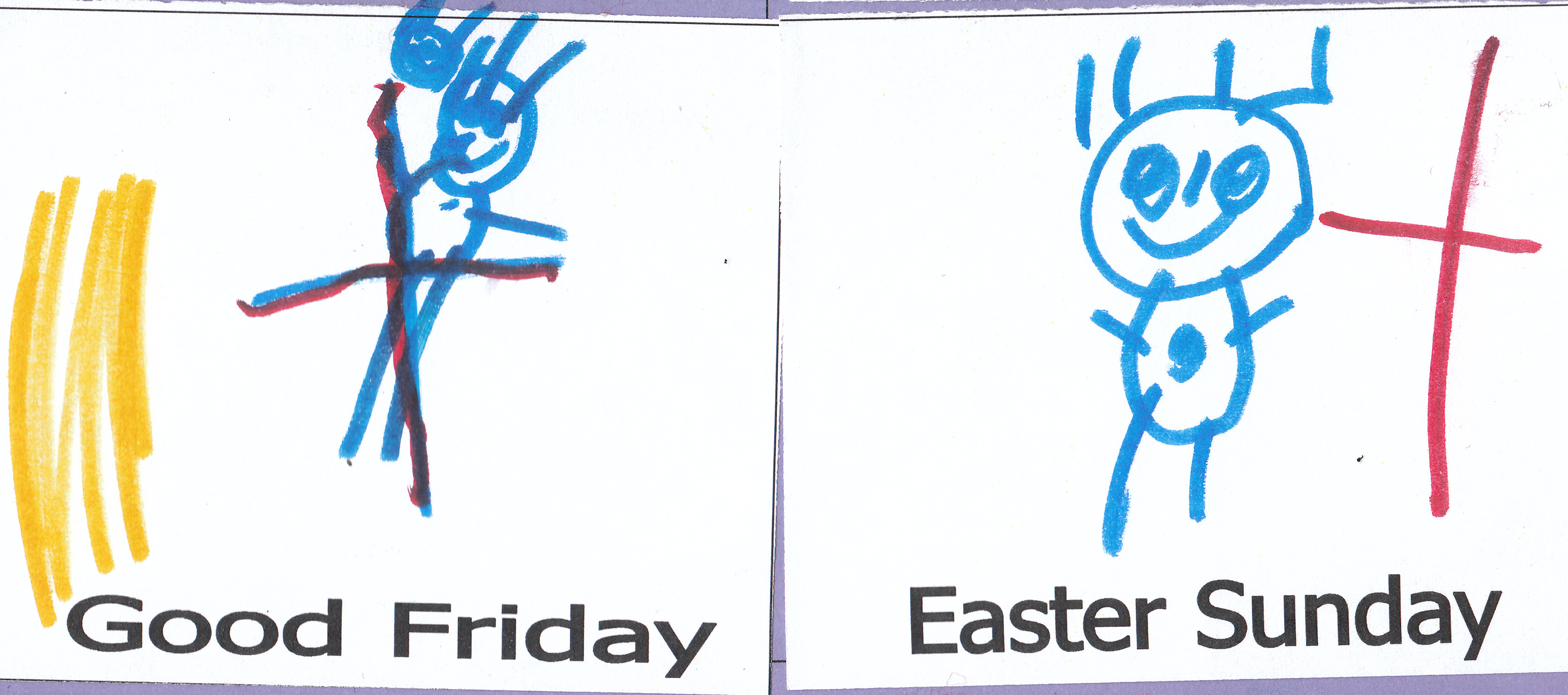
Friday, and Sunday: Easter according to a five-year-old

‘Anyway’, she said, ‘it’s all about Jesus’.

‘But what about the empty tomb?’, asked her theologian father.

‘We don’t worship the tomb, daddy’, she said. ‘Jesus is the bit that matters’.

‘So why is there a cross?’

‘Because people always seem to forget about that bit, and because that’s how Jesus remembers himself to us’.

‘But what about the yellow bit?’

‘Ah. That bit is just to make it pretty, silly’.

The Wisdom of Stability: A Review

In The Wisdom of Stability: Rooting Faith in a Mobile Culture (Brewster: Paraclete Press, 2010), Jonathan Wilson-Hartgrove seeks to write a book about ‘staying put and paying attention’. In a culture characterised by unprecedented mobility, he believes that ‘the most important thing most of us can do to grow spiritually is to stay in the place where we are’ (p. 1). The author insists that the life of Spirit is, in Rowan Williams’ words, impossible ‘in abstraction from the actual business of living in the body of Christ, living in concrete community. The life of intimacy with God in contemplation is both the fruit and the course of a renewed style of living together’. Or, in Wilson-Hartgrove’s words, ‘Apart from stability in the life of a community, the songs of Zion quickly begin to sound like wishful thinking’ (p. 63).

Drawing from the experiences of the monastic fathers and mothers, and from his own journey now as a minister of St. Johns Baptist Church and member of Rutba House, Wilson-Hartgrove properly argues that the practices of stability cannot be ‘reduced to a quick fix for the spiritual anxiety of a placeless people’, and that ‘if our feelings of rootlessness are what drive us to the practice, we’ll need something more than an immediate sense of relief to help us stay’ (pp. 110–11). He turns then to consider three ‘midday demons’ which require resistance if we are to be serious about not being perpetual pot plants but being planted in soil where our roots have room to reach deeper. These are ambition, boredom and vanity.

He writes of ambition: ‘ambition tempts us to forsake the mundane for the sake of unlimited growth – or, at least, new opportunities. We are so easily unimpressed by the ordinary, longing for the feeling of excitement that comes with a new task to take up, new people to engage, new challenges to face (p. 114). And of boredom: ‘Whereas ambition pushes us toward perpetual motion, boredom paralyzes, leaving us unable to love our neighbors or even take care of our own basic needs. Though different in character, these midday twins tempt us to the same lack of care. In their grip, it is impossible for us to find joy in community’ (p. 118). And of vanity: ‘Vainglory comes midway along our journey to suggest that all our care is best directed toward self-preservation … Vainglory will try to persuade us that there is nothing more important in the world than our own stability, encouraging us to defend it at all costs against any potential threat’ (pp. 122, 123).

There is wisdom in these words, and there’s much to like about the book. Still, I have two reservations about commending it: First, it’s nauseatingly repetitive, yet another example of a standard article-length piece being padded out to make a book. Second, and more substantially, there is, surprisingly, a drift towards an unearthed nostalgia here which works to undermine the author’s basic thesis. (It may be, of course, that my cultural eyeglasses are simply the child of a different prescription to those of Wilson-Hartgrove’s.) Walter Brueggemann once observed of memory that it is that which ‘may be enmeshed in a nostalgic longing for normalcy and “the good old days,” when life was simple and agrarian, settled, and well-ordered. That nostalgia is all intertwined with evangelical memory, so that the nostalgia has a vague religious feeling about it. There is a need to sort out the normative memory from this other vague yearning’. I’m unconvinced that Wilson-Hartgrove (in this volume) succeeds fully in doing the kind of sort out that Brueggemann, rightly to my mind, calls for.

For me, the highlight of the book was this poem (on p. 106):

The house was built in ’98,
prior to my arrival.
And a big maple tree at the corner of the porch
was run over and buried lots of times by wagons
moving in materials to build the house.
And the other maples what Daddy had planted,
they had no trouble at all.
But they all died and this one lived that had such rough treatment.
And there’s a saying
“Rough weather makes good timber.”
It may be
that the trouble with folks today
is that they’re raised like hothouse flowers,
and they don’t have much to go on
at the end.

‘Scottish Seeds in Antipodean Soil: the development of Presbyterian worship in Aotearoa New Zealand’

Recently, I drew attention to a public lecture that Graham Redding would be giving on the development of Presbyterian worship in Aotearoa New Zealand. Last night, to a crowded room, Graham delivered what was a fascinating lecture in which he traced the contours and patterns of worship trends in NZ Presbyterianism from its Reformation and Scottish roots, through its early colonial characteristics, to the modern era.

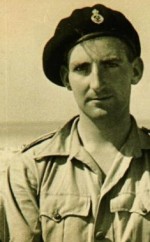
Drawing upon a host of indigenous examples and personalities, notably Harold Turner, Helmut Rex, John Henderson and John Dickie (pictured left), Redding concluded that ‘there is a desperate need for a revitalisation of worship in the Presbyterian Church. In my view, if such a revitalisation is to be of enduring significance, it is unlikely to take place independently of a recovery of core liturgical principles that undergird and inform the practice of Christian worship. Our church needs ministers and liturgists committed to this fundamental task’.

A copy of the full lecture, ‘Scottish Seeds in Antipodean Soil: the development of Presbyterian worship in Aotearoa New Zealand’, is available here. I’ve also uploaded a copy of the audio which can be downloaded from here.

And while I’m drawing attention to lectures, here are the links to three lectures by Walter Kaufmann on existentialism: