Author: Jason Goroncy

‘What Language Shall I Borrow?’: Reading for ministry

Picasso - The ReaderThere is a lot in the observation that pastors who read (and there are too few of those) not to be drawn into a deeper place of grappling with realities human and otherwise but who engage in page turning primarily with a view to ‘finding illustrations’, or sponsoring homiletical self-aggrandisement that can be employed for doing something ‘really significant’, only betray themselves as soon as they take up the invitation to speak, whether in a public setting or in a more private one. I recall the words of Michael Dirda, the editor of the Washington Post Book World, who once opined:

A true literary work is one that makes us see the world or ourselves in a new way. Most writers accomplish this through an imaginative and original use of language, which is why literature has been defined as writing that needs to be read (at least) twice. Great books tend to feel strange. They leave us uncomfortable. They make us turn their pages slowly. We are left shaken and stirred. But who now is willing to put in the time or effort to read a real book? Most people expect printed matter to be easy. Too often, we expect the pages to aspire to the condition of television, and to just wash over us. But those who really care about literature nearly always sit down with a pencil in their hands, to underline, mark favorite passages, argue in the margins. The relationship between a book and reader may occasionally be likened to a love affair, but it’s just as often a wrestling match. No pain, no gain. This is why the NEA report shows that poetry is suffering most of all. Poets keep their language charged, they make severe demands on our attention, they cut us no slack. While most prose works the room like a smiling politician at a fundraiser, poetry stands quietly in the dusty street, as cool and self-contained as a lone gunfighter with his serape flapping in the wind. It’s not glad-handing anybody. (Washington Post, July 2004)

Moreover, good writing leaves us humbled and grateful for the privilege of learning from adroit diagnosers and physicians of the soul, the accumulation of whose experiences serve to assist those of us charged with ministering to those who labour with diseases and distempers of spirit beyond our own experience.

Therefore, in order to sponsor such happenings, I’m wanting to compile a list of suggested novels, plays and collections of poetry as assigned reading for theology students and pastors. And to this end I am soliciting the help of readers of Per Crucem ad Lucem. I’m thinking of work by Geraldine Brooks, John Updike, John Steinbeck, J.M. Coetzee, David Malouf, F. Scott Fitzgerald, Flannery O’Connor, Jim Crace, Thomas Carlyle, Francine Prose, Kenzaburō Ōe, Thomas Lynch, George MacDonald, A.S. Byatt, and Nathaniel Hawthorne; and poets like William Blake, John Donne, E.E. Cummings, T.S. Eliot, George Herbert, Philip Levine, Sylvia Plath, Anna Akhmatova and John Ciardi.

Here’s some additional suggestions to kick us off:

Novels


Poetry/Plays


What might you add?

Scott Cairns: ‘Adventures in New Testament Greek: Nous’

breathe

You could almost think the word synonymous
with mind, given our so far narrow
history, and the excessive esteem

in which we have been led to hold what is,
in this case, our rightly designated
nervous systems. Little wonder then

that some presume the mind itself both part
and parcel of the person, the very seat
of soul and, lately, crucible for a host

of chemical incentives—combinations
of which can pretty much answer for most
of our habits and for our affections.

When even the handy lexicon cannot
quite place the nous as anything beyond
one rustic ancestor of reason, you might

be satisfied to trouble the odd term
no further—and so would fail to find
your way to it, most fruitful faculty

untried. Dormant in its roaring cave,
the heart’s intellective aptitude grows dim,
unless you find a way to wake it. So,

let’s try something, even now. Even as
you tend these lines, attend for a moment
to your breath as you draw it in: regard

the breath’s cool descent, a stream from mouth
to throat to the furnace of the heart.
Observe that queer, cool confluence of breath

and blood, and do your thinking there.

– Scott Cairns, Philokalia: new and selected poems (Lincoln: Zoo Press, 2002), 26–7.

Christ is our Peace: A reflection on Ephesians 2:11–22

Chagall - The White Crucifixion, 1938

Marc Chagall, 'The White Crucifixion', 1938

What does it mean to share Christ’s peace with each other?

Chapter 2 of Paul’s letter to the saints in Ephesus opens with an exposition of the lavish mercy and love of God by which we who were ‘dead in sin’ are made ‘alive with Christ’. Paul makes it clear that this divine action has been concerned to create a new entity in the world by which God brings blessing to the nations and through which God displays the glory of his grace to the principalities and powers in the heavenly realms. And Paul is concerned that we understand that this new reality to which the church bears witness is inseparably identified with Jesus Christ – that is, all we have and all we are and all we will ever be is now in Christ.

And then, from verses 11–22, Paul unpacks something of what it means to be in Christ. He talks about circumcision and uncircumcision. He talks about the commonwealth of Israel and about a new kind of citizenship. And he talks about the household of God and of a new temple in which God dwells by the Spirit. Now all of these things had deep connotations in the First Century, but this does not mean that they are confined to the First Century!

Like our own land, that of the regions around the Mediterranean during the First Century were made up of a vast number of culturally- and ethnically-diverse groups. But in all of that, there existed no greater cultural or religious divide as that between Jews and non-Jews (Gentiles) – a divide most obvious when it came to issues pertaining to the temple. Both groups had a different understanding of history and of where history is heading, a different understanding of who God is, a different understanding of revelation, a different understanding of worship, a different understanding of why we are here, a different understanding of how to live together as human community. And along with these different understandings was a deep hatred for one another that went both ways.

The Jew had an immense contempt for the Gentiles. The Gentiles, said the Jews, were created by God to be fuel for the fires of hell. God, they said, loves only Israel of all the nations he had made … It was not even lawful to render help to a Gentile mother in her hour of sorest need, for that would simply bring another Gentile into the world. Until Christ came, the Gentiles were an object of contempt to the Jews. The barrier between them was absolute. If a Jewish boy married a Gentile girl, or if a Jewish girl married a Gentile boy, the funeral of that Jewish boy or girl was carried out. Such contact with a Gentile was the equivalent of death. [William Barclay, cited in John R.W. Stott, God’s New Society: The Message of Ephesians (Leicester: Inter-Varsity Press, 1979), 91].

And for their part, the Gentiles viewed the Jews with attitudes that ranged from curiosity to perplexity to fierce persecution. Judea was not an easy place for Herod to rule. We don’t have time to go into all the background of this but what we do need to see is that the barriers between these two groups – like that between Serbs and Croats – were long-standing and, to human eyes, insurmountable.

We have, to our shame I think, gotten used to using adjectives to describe different Christians. So we talk about ‘Chinese’ Christians, or ‘Palangi’ Christians, or ‘born-again’ Christians, or ‘Catholic’ Christians, or ‘gay and lesbian’ Christians, as if what really unites us is not the fact that we are in Christ so much as it is our ethnicity, or our difference from others. And we’re not wanting to suggest that these adjectives aren’t true, or that they’re completely erased by the transformation that comes in Christ. But we do want to confess that in Christ, we are no longer defined, and still less separated, by them. So Paul to the Galatians:

… for in Christ Jesus you are all children of God through faith. As many of you as were baptised into Christ have clothed yourselves with Christ. There is no longer Jew or Greek, there is no longer slave or free, there is no longer male and female; for all of you are one in Christ Jesus. (Gal 3:26–28)

Here too the issue pertains to our identity: Who are we? What is our relationship with – and obligation to – others? What might it mean when Paul says that ‘now in Christ Jesus you who once were far off have been brought near by the blood of Christ. For he is our peace; in his flesh he has made the two one and has broken down the dividing wall of hostility between us’? What does it mean that Jesus has taken our place of alienation? That in his cross, he became the prodigal? That he left the security of the Father’s house and went off into the far country? And in that far country, in the desert of his alienation, he gathered all of humanity to himself and reconciled us together and to God. He brought us home! He created one new ‘man’. What does it mean that he has taken responsibility for all that would compromise our relationship with God and with each other? And what might it mean that in his wounds he has healed all that separates man from man, and woman from woman, and tribe from tribe, and Jew from Gentile, and husband from wife, and child from parent, and you and I from God? What might it mean when Paul writes in Colossians 1 that …

God was pleased to have all his fullness dwell in him, and through him to reconcile to himself all things, whether things on earth or things in heaven, by making peace through his blood, shed on the cross. (Col 1:19–20)

The peace created in Christ is more than just that which transcends ethnic divides. We also have to think about political and cosmic, moral and righteous, intellectual and psychological, physical and metaphysical walls as well. As one commentator has written:

Jesus Christ has to do with whatever divisions exist between races and nations, between science and morals, natural and legislated laws, primitive and progressive peoples, outsiders and insiders. The witness of Ephesians to Christ is that Christ has broken down every division and frontier between [human beings]. And even more, Ephesians adds that Christ has reconciled [humanity] with God!

To confess Jesus Christ is to affirm the abolition and end of division and hostility, the end of separation and segregation, the end of enmity and contempt, and the end of every sort of ghetto! Jesus Christ does not bring victory to the [person] who is on either this or that side of the fence. Neither rich nor poor, Jew nor Greek, man nor woman, black nor white, can claim Christ solely for [themselves]. [Markus Barth, The Broken Wall: A Study of the Epistle to the Ephesians (London: Collins, 1960), 37.]

So Bruce Hamill reminded the folk at Coastal Unity parish recently:

We belong to [Christ] … because he has made peace … not because he merely teaches us about peace, or preaches peace, or encourages peace, but because in his own body he has made peace and broken down the enmity … And the purpose of his life and death is to create a single new humanity in Christ – a humanity of peace … but a humanity which is peace in Christ.

And … the biggest barrier to this humanity of peace … is the thought that enmity must be killed by Christ … it is the thought that we need to have peace made for us first before we can make it ourselves. Most of us believe we can kill the enmity ourselves, if we think it exists at all. We are confident that we can make peace our self, even if it is only purifying our own attitude. In general we struggle to admit our need to have our old humanity killed, so that Christ can create us into a single new humanity. We find that demeaning! However, it is the beginning of the Christian life. Christianity begins with a death, (our death) or it doesn’t begin at all.

So to return to the question with which we began: What does it mean to share Christ’s peace with each other? And from here I draw upon Timothy Radcliffe’s superb book, Why God to Church?: The Drama of the Eucharist (pp. 161–74.) For many, the exchanging of the sign of peace can be embarrassing and awkward. We might offer a peck on the cheek to members of our family or to friends, but strangers are more likely to receive a distant nod or a polite handshake. But it was not always so.

During the Middle Ages the kiss of peace was a solemn moment of reconciliation in which social conflicts were resolved. The community was restored to charity before Holy Communion could be received. One of the earliest preaching missions entrusted to the Dominicans and Franciscans was what was called ‘The Great Devotion’ of 1233. Northern Italian cities were torn apart by division which in some cases amounted to civil war. And the climax of the preaching was the ritual exchange of the kiss of peace between enemies. Here at the table – in the eating of one loaf and the drinking of one cup – was enacted the reconciliation made real in Christ.

And here at the table, we confess that we Christians have often been unimpressive witnesses to Christ’s peace. Our history is marked by aggression, intolerance, rivalry and persecution. These days we usually avoid the extremes of some early Christians, rarely poisoning each other’s chalices or arranging ambushes of our opponents. But we still tend to succumb to the dominant ethos of our competitive and aggressive society, though rarely with the clarity of a First World War general who instructed his chaplain that he wanted a bloodthirsty sermon next Sunday ‘and would not have any texts from the New Testament’.

I want to suggest that when we offer each other a sign of peace we are not so much making peace as we are accepting and confessing the Christ who is our peace. To be a member of the Church is to share Christ’s peace, however nervous or awkward we may feel. I recall the challenging words of Thomas Merton: ‘We are already one. But we imagine that we are not. And what we have to recover is our original unity. What we have to be is what we are’. [Thomas Merton, The Asian Journal of Thomas Merton (ed. Patrick Hart, et al.; New York: New Directions Publishing, 1975), 308]

When we offer each other Christ’s peace we are doing no less than accepting the basis upon which we are gathered together. We recognise that we are here together not because we are friends or because we enjoy the chummy atmosphere, or because we have the same theological opinions, but because – and only because – we are one in Christ’s indestructible peace. That’s why we gather as church: to exchange the kiss of peace with strangers, to exchange the sign of our Lord’s victory in the face of all that assaults human community.

John records that on the evening of the resurrection, ‘the first day of the week, … the doors of the house where the disciples had met were locked for fear of the Jews, [and] Jesus came and stood among them and said, “Peace be with you”’ (John 20:19). The disciples are locked in the upper room for fear of the Jews, and Jesus passes through the walls and doors erected by their fear and by doing so reveals the way in which the limitations of our present bodily communion are overthrown. If Jesus is shown as walking through locked doors then it is because he is the one in whom all barriers are transcended. God is love, and love does not love walls.

When a French Dominican celebrated a family funeral after WWII he saw that the congregation was deeply divided. On one side of the aisle were those who had belonged to the Resistance and on the other those who had collaborated with the Nazis. He announced that the funeral Mass would not even begin until the kiss of peace had been exchanged. This was a wall that had to fall before it would have made any sense to pray together for the resurrection of their dead brother. Hanging onto alienation is mortal. It is, in the words of Ann Lamott, like drinking rat poison and then waiting for the rat to die.

Jesus’ invitation to this table means his embrace of all the ways in which our communion is faulty, subverted or betrayed. Here, in bread and wine, he takes into his hands all our fear, betrayal, lies, cowardice, shame, pain, isolation, distances, silences, misunderstandings and disloyalties, saying, ‘This is my body, given for you’.

Together we sing for joy that Christ comes, that he returns to our midst in the Eucharist, to strengthen us in our struggles, to share with us the burden of each day, to speak to us of peace when our minds are troubled, and to put the hope of eternal life in our hearts in that hour when our way seems to be entering the shadow of death. Here again we see that in spite of the barriers we have erected, the Eucharist is a sacrament of unity, joining us all in the same triumphant joy that the presence of the risen Lord gives to his Church. [Jean-Daniel Benoît, Liturgical Renewal: Studies in Catholic and Protestant Developments on the Continent (ed. Geoffrey W. H. Lampe; trans. Edwin Hudson; Studies in Ministry and Worship; London: SCM Press, 1958), 16]

And so in this bread and wine, Christ is really present to us, even more present than we are to each other, more bodily. He is truly the embodied Word of God who pulls down every barrier. That’s what it means for him to say to us, ‘Peace be with you’. For him to be risen is, then, not just to be alive once more: it is to be the place of peace in whom we meet and are healed.

Did John Calvin write ‘I greet thee who my sure Redeemer art’?

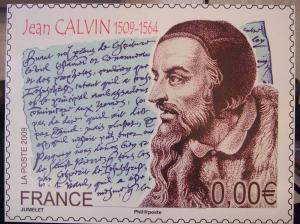
CalvinA friend of mine, John Roxborogh, has been doing some fascinating detective work in recent days around the claim that Calvin authored the hymn ‘I greet thee who my sure Redeemer art’. It’s a wonderful hymn, but did Calvin write it?

Here’s where John has gotten to:

That the hymn is merely attributed to Calvin in most English sources is a hint that the authorship may be uncertain. Calvin is associated with the versification of Psalms (though he gave it up in favour of the poet Clément Marot) but not with the writing of hymns. The first line in French which appears in a number of sources (Je te salue, mon certain rédempteur) is not on any French website, but only in English hymn books or on English websites. It seems agreed that the French text originates from the Strassburgh Psalter La Forme des Prières et Chants Ecclésiastiques of 1545, where the hymn is referred to as Salutation à Jesus-Christ. This edition appears to have been lost. It is item 22 in the ‘Genealogical Bibliography’ in W D Maxwell, The Liturgical Portions of the Genevan Service Book used by John Knox while a minister of the English Congregation of Marian Exiles at Geneva, 1556-1559, Westminster, Faith Press, 1931, 1965, p.70.

Andrew Myers in his blog Virginia is for Hugenots on 13 July 2009 also raised the same question, and quotes extensively from sources I have not been able to access fully. His preference for Jean Garnier as the likely author of the text and his confidence that Calvin is not seems well argued. It is a conclusion I am happy to go with.

The English attribution to Calvin appears to be wishful thinking dating especially from the translation in 1869. The mistaken attribution is a fine example of Calvinism and Calvin not being the same thing, but it nevertheless does serve as a powerful connection with the middle period of the Reformation, and to a time when making congregational singing possible was somehow achieved in the midst of the turmoil. It’s a reminder that many people and places helped sort out what a Reformed church should look like. If it would be fair to say that the hymn belongs more to Strasbourg than to Geneva, that too is a reminder we need to know about Strasbourg too as a laboratory of Reformed faith, worship and society.

Perhaps in our times the more accurate story of the origins of this particular hymn will help us connect with God and with those known and unknown in our history who put faith to music and remind us that renewal in the church is never the work of just one person.

John proceeds to draw attention to a number of other sources:

Andrew Myers: Credit where credit is due – is the author Jean Garnier?

Emmanuel Orentin Douen, Clement Marot et le Psautier Huguenot, Vol. 1, p. 452, on the hymn in question:
Ce morceau n’est point, on le voit, une traduction de la Bible, mais une composition libre qui ne rentre dans la maniere de Calvin, et dont Garnier est peut-etre l’auteur.

Erik Routley and Peter Cutts (ed.), An English-Speaking Hymnal Guide (2005), p. 83: 386. I GREET THEE, WHO MY SURE REDEEMER ART

French: JE TE SALUE, MON CERTAIN REDEMPTEUR, which according to Douen appears in the Strasbourg Psalter (1545), and according to E. [Pierre] Pidox is certainly in the edition of 1553 but not that of 1548. It has been attributed to John Calvin, but Pidoux judges this ascription very unlikely; also attr. to J. Garnier, which Pidoux says is mere “guesswork” (Le Psautier Huguenot, 1962). It must be regarded as anonymous.

The ‘Liturgy of Calvin’ in Philip Schaff’s History of the Christian Church, Volume VIII: Modern Christianity. The Swiss Reformation

A copy of an enlarged Strassburg ed. of 1545, entitled La forme des prieres et chantzs ecclesiastiques, was preserved in the Public Library at Strassburg till Aug. 24, 1870, when it was burnt at the siege of the city in the Franco-German War (Douen, I. 451 sq.)

Note 552: They were printed at Strassburg, 1539, and republished, together with an original hymn (Salutation à Jesus-Christ), from an edition of 1545, in Opera, VI. 212-224.

Douglas Bond on a Calvin 500 Tour visits Strasbourg and blogs on 9 July 2009

We discussed what Calvin wrote in his commentary on Genesis about music and its role in Christian worship. Here in the Strasbourg Psalter published 1544, was included “I Greet Thee Who My Sure Redeemer Art,” clearly not a strict Psalm versification (though it has hints of Psalm 67 in it, “shine on us with the light of thy pure day”). Calvin commended Psalm singing, versified poetry from the Psalms himself, commissioned Clement Marot, the work carried on by Beza after him, but nowhere during or after his time in Strasbourg, where German Lutheran hymns were widely sung, did he condemn the writing or singing of hymns of human poetic composition. In the Geneva Psalter published 1551, Calvin included “I greet thee.” Some hymnologists believe Calvin wrote this hymn; it is very Calvin and may have been so; the fact that we don’t know who wrote it is actually a vote in favor of humble, un-self-serving Calvin.

Presbyterian Hymnal

The hymn is 457 in the Presbyterian Hymnal. It is also found in the Australian Hymnbook and With One Voice as number 128:

Author (attr.): John Calvin
Tune name: TOULON
Translator: Elizabeth Lee Smith (1868)
Meter: 10.10.10.10
Scripture: John 14:6; Acts 4:12; Colossians 1:27
Key: F Major
Source: French Psalter, Strassburg, 1545
Source: Genevan Psalter 1551, adapt. from Genevan 124

Cyber hymnal

Words: Attributed to John Calvin, 1545 (Je te salue mon certain rédempteur); translated from French to English by Elizabeth L. Smith in Schaff’s Christ in Song, 1869. Music: Toulon, Genevan Psalter, 1551

Rejoice and Sing, 1991.

When the 1991 United Reformed Church Hymnal Rejoice and Sing was being compiled a web-site of sources, the Enchiridion was developed, which includes Notes on Source Books (French & Genevan Psalters). The cross reference is to Rejoice and Sing, 501.

La Forme des Prières et Chants Ecclésiastiques, 1545 &c.

Various editions of the Psalter were published at Paris, Lyons, Strasbourg and Geneva in the years following the death of Clement Marot (1544); these included a Strasbourg edition of 1545 with psalms &c. from various sources and a hymn attributed to Calvin. (The Strasbourg Town Library copy was lost when the library was destroyed in the bobardment of the town during the Franco-German war (Julian, p.579a). )

Xrefs: RS-501 I greet thee, who my sure Redeemer art.

The Westminster Directory of Public Worship (1645) article by Alan Clifford, 1989, fn 70

See the hymn ‘I greet Thee who my sure Redeemer art’ in Christian Hymns, Evangelical Movement of Wales, Bridgend, 1977, hymn 124; also Hymns and Psalms, Methodist Publishing House, London, 1983, hymn 391.

The hymn first appeared in the 1545 Strasbourg Psalter, the very same year Calvin produced the new liturgy for his old congregation. Is it not possible that he wrote the hymn for them too? According to Philip Schaff, it was also discovered in ‘an old Genevese prayer-book.’ (Christ in Song, Anson Randolph, New York, 1869, 678). While external evidence might not be conclusive (see Bushell, op.cit., [Michael Bushell, The Songs of Zion, Crown and Covenant Publications, Pittsburgh, Pa., 1980.”] p.199, n. 56), strong internal evidence of style and piety comparing the hymn with Calvin’s recorded prayers arguably strengthens Schaff’s case for Calvin’s authorship of the hymn.

John Pilger: Mourn on the fourth of July

barack-obamaThe monsoon had woven thick skeins of mist over the central highlands of Vietnam. I was a young war correspondent, bivouacked in the village of Tuylon with a unit of US marines whose orders were to win hearts and minds. “We are here not to kill,” said the sergeant, “we are here to impart the American Way of Liberty as stated in the Pacification Handbook. This is designed to win the hearts and minds of folks, as stated on page 86.”

Page 86 was headed WHAM. The sergeant’s unit was called a combined action company, which meant, he explained, “we attack these folks on Mondays and we win their hearts and minds on Tuesdays”. He was joking, though not quite. Standing in a jeep on the edge of a paddy, he had announced through a loudhailer: “Come on out, everybody. We got rice and candy and toothbrushes to give you.”

Silence. Not a shadow moved.

“Now listen, either you gooks come on out from wherever you are, or we’re going to come right in there and get you!”

The people of Tuylon finally came out and stood in line to receive packets of Uncle Ben’s Long Grain Rice, Hershey bars, party balloons and several thousand toothbrushes. Three portable, battery-operated, yellow flush lavatories were kept for the colonel’s arrival. And when the colonel arrived that evening, the district chief was summoned and the yellow flush lavatories were unveiled.

“Mr District Chief and all you folks out there,” said the colonel, “what these gifts represent is more than the sum of their parts. They carry the spirit of America. Ladies and gentlemen, there’s no place on earth like America. It’s a guiding light for me, and for you. You see, back home, we count ourselves as real lucky having the greatest democracy the world has ever known, and we want you good folks to share in our good fortune.”

Thomas Jefferson, George Washington and Davy Crockett got a mention. “Beacon” was a favourite, and as he evoked John Winthrop’s “city upon a hill”, the marines clapped, and the children clapped, understanding not a word.

It was a lesson in what historians call “exceptionalism”, the notion that the United States has the divine right to bring what it describes as liberty and democracy to the rest of humanity. That this merely disguised a system of domination, which Martin Luther King described, shortly before his assassination, as “the greatest purveyor of violence in the world”, was unspeakable.

As the great people’s historian Howard Zinn has pointed out, Winthrop’s much-quoted description of the 17th-century Massachusetts Bay Colony as a “city upon a hill”, a place of unlimited goodness and nobility, was rarely set against the violence of the first settlers, for whom burning alive some 400 Pequot Indians was a “triumphant joy”. The countless massacres that followed, wrote Zinn, were justified by “the idea that American expansion is divinely ordained”.

Not long ago, I visited the American Museum of History, part of the celebrated Smithsonian Institution in Washington, DC. One of the popular exhibitions was “The Price of Freedom: Americans at War”. It was holiday time and lines of people, including many children, shuffled reverentially through a Santa’s grotto of war and conquest where messages about their nation’s “great mission” were dispensed. These ­included tributes to the “exceptional Americans [who] saved a million lives” in Vietnam, where they were “determined to stop communist expansion”. In Iraq, other true hearts ­“employed air strikes of unprecedented precision”. What was shocking was not so much the revisionist description of two of the epic crimes of modern times as the sheer scale of omission.

“History without memory,” declared Time magazine at the end of the 20th century, “confines Americans to a sort of eternal present.. They are especially weak in remembering what they did to other people, as opposed to what they did for them.” Ironically, it was Henry Luce, founder of Time, who in 1941 divined the “American century” as an American social, political and cultural “victory” over humanity and the right “to exert upon the world the full impact of our influence, for such purposes as we see fit and by such means as we see fit”.

None of this is to suggest that vainglory is exclusive to the United States. The British presented their often violent domination of much of the world as the natural progress of Christian gentlemen selflessly civilising the natives, and present-day TV historians perpetuate the myths. The French still celebrate their bloody “civilising mission”. Prior to the Second World War, “imperialist” was an honoured political badge in Europe, while in the US an “age of innocence” was preferred. America was different from the Old World, said its mythologists. America was the Land of Liberty, uninterested in conquest. But what of George Washington’s call for a “rising empire” and James Madison’s “laying the foundation of a great empire”? What of slavery, the theft of Texas from Mexico, the bloody subjugation of central America, Cuba and the Philippines?

An ordained national memory consigned these to the historical margins and “imperialism” was all but discredited in the United States, especially after Adolf Hitler and the fascists, with their ideas of racial and cultural superiority, had left a legacy of guilt by association. The Nazis, after all, had been proud imperialists, too, and Germany was also “exceptional”. The idea of imperialism, the word itself, was all but expunged from the American lexicon, “on the grounds that it falsely attributed immoral motives to western foreign policy”, argued one historian. Those who persisted in using it were “disreputable purveyors of agitprop” and were “inspired by the communist doctrine”, or they were “Negro intellectuals who had grievances of their own against white capitalism”.

Meanwhile, the “city on the hill” remained a beacon of rapaciousness as US capital set about realising Luce’s dream and recolonising the European empires in the postwar years. This was “the march of free enterprise”. In truth, it was driven by a subsidised production boom in a country unravaged by war: a sort of socialism for the great corporations, or state capitalism, which left half the world’s wealth in American hands. The cornerstone of this new imperialism was laid in 1944 at a conference of the western allies at Bretton Woods in New Hampshire. Described as “negotiations about economic stability”, the conference marked America’s conquest of most of the world.

What the American elite demanded, wrote Frederic F Clairmont in The Rise and Fall of Economic Liberalism, “was not allies but unctuous client states. What Bretton Woods bequeathed to the world was a lethal totalitarian blueprint for the carve-up of world markets.” The World Bank, the International Monetary Fund, the Asian Development Bank, the Inter-American Development Bank and the African Development Bank were established in effect as arms of the US Treasury and would design and police the new order. The US military and its clients would guard the doors of these “international” institutions, and an “invisible government” of media would secure the myths, said Edward Bernays.

Bernays, described as the father of the media age, was the nephew of Sigmund Freud. “Propaganda,” he wrote, “got to be a bad word because of the Germans… so what I did was to try and find other words [such as] Public Relations.” Bernays used Freud’s theories about control of the subconscious to promote a “mass culture” designed to promote fear of official enemies and servility to consumerism. It was Bernays who, on behalf of the tobacco industry, campaigned for American women to take up smoking as an act of feminist liberation, calling cigarettes “torches of freedom”; and it was his notion of disinformation that was deployed in overthrowing governments, such as Guatemala’s democracy in 1954.

Above all, the goal was to distract and deter the social democratic impulses of working people. Big business was elevated from its public reputation as a kind of mafia to that of a patriotic force. “Free enterprise” became a divinity. “By the early 1950s,” wrote Noam Chomsky, “20 million people a week were watching business-sponsored films. The entertainment industry was enlisted to the cause, portraying unions as the enemy, the outsider disrupting the ‘harmony’ of the ‘American way of life’… Every aspect of social life was targeted and permeated schools and universities, churches, even recreational programmes. By 1954, business propaganda in public schools reached half the amount spent on textbooks.”

The new “ism” was Americanism, an ideology whose distinction is its denial that it is an ideology. Recently, I saw the 1957 musical Silk Stockings, starring Fred Astaire and Cyd Charisse. Between the scenes of wonderful dancing to a score by Cole Porter was a series of loyalty statements that the colonel in Vietnam might well have written. I had forgotten how crude and pervasive the propaganda was; the Soviets could never compete. An oath of loyalty to all things American became an ideological commitment to the leviathan of business: from the business of armaments and war (which consumes 42 cents in every tax dollar today) to the business of food, known as “agripower” (which receives $157bn a year in government subsidies).

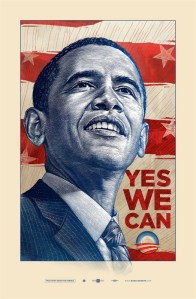
Barack Obama is the embodiment of this “ism”. From his early political days, Obama’s unerring theme has been not “change”, the slogan of his presidential campaign, but America’s right to rule and order the world. Of the United States, he says, “we lead the world in battling immediate evils and promoting the ultimate good… We must lead by building a 21st-century military to ensure the security of our people and advance the security of all people.” And: “At moments of great peril in the past century our leaders ensured that America, by deed and by example, led and lifted the world, that we stood and fought for the freedoms sought by billions of people beyond their borders.”

Since 1945, by deed and by example, the US has overthrown 50 governments, including democracies, crushed some 30 liberation movements and supported tyrannies from Egypt to Guatemala (see William Blum’s histories). Bombing is apple pie. Having stacked his government with warmongers, Wall Street cronies and polluters from the Bush and Clinton eras, the 45th president is merely upholding tradition. The hearts and minds farce I witnessed in Vietnam is today repeated in villages in Afghanistan and, by proxy, Pakistan, which are Obama’s wars.

In his acceptance speech for the 2005 Nobel Prize for Literature, Harold Pinter noted that “everyone knew that terrible crimes had been committed by the Soviet Union in the postwar period, but “US crimes in the same period have been only superficially recorded, let alone documented, let alone acknowledged, let alone recognised as crimes at all”. It is as if “It never happened. Nothing ever happened. Even while it was happening, it wasn’t happening… You have to hand it to America… masquerading as a force for universal good. It’s a brilliant, even witty, highly successful act of hypnosis.”

As Obama has sent drones to kill (since January) some 700 civilians, distinguished liberals have rejoiced that America is once again a “nation of moral ideals”, as Paul Krugman wrote in the New York Times. In Britain, the elite has long seen in exceptional America an enduring place for British “influence”, albeit as servitor or puppet. The pop historian Tristram Hunt says America under Obama is a land “where miracles happen”. Justin Webb, until recently the BBC’s man in Washington, refers adoringly, rather like the colonel in Vietnam, to the “city on the hill”.

Behind this façade of “intensification of feeling and degradation of significance” (Walter Lippmann), ordinary Americans are stirring perhaps as never before, as if abandoning the deity of the “American Dream” that prosperity is a guarantee with hard work and thrift.. Millions of angry emails from ordinary people have flooded Washington, expressing an outrage that the novelty of Obama has not calmed. On the contrary, those whose jobs have vanished and whose homes are repossessed see the new president rewarding crooked banks and an obese military, essentially protecting George W Bush’s turf.

My guess is that a populism will emerge in the next few years, igniting a powerful force that lies beneath America’s surface and which has a proud past. It cannot be predicted which way it will go. However, from such an authentic grass-roots Americanism came women’s suffrage, the eight-hour day, graduated income tax and public ownership. In the late 19th century, the populists were betrayed by leaders who urged them to compromise and merge with the Democratic Party. In the Obama era, the familiarity of this resonates.

What is most extraordinary about the United States today is the rejection and defiance, in so many attitudes, of the all-pervasive historical and contemporary propaganda of the “invisible government”. Credible polls have long confirmed that more than two-thirds of Americans hold progressive views. A majority want the government to care for those who cannot care for themselves. They would pay higher taxes to guarantee health care for everyone. They want complete nuclear disarmament; 72 per cent want the US to end its colonial wars; and so on. They are informed, subversive, even “anti-American”.

I once asked a friend, the great American war correspondent and humanitarian Martha Gellhorn, to explain the term to me. “I’ll tell you what ‘anti-American’ is,” she said. “It’s what governments and their vested interests call those who honour America by objecting to war and the theft of resources and believing in all of humanity. There are millions of these anti-Americans in the United States. They are ordinary people who belong to no elite and who judge their government in moral terms, though they would call it common decency. They are not vain. They are the people with a wakeful conscience, the best of America’s citizens. They can be counted on. They were in the South with the civil rights movement, ending slavery. They were in the streets, demanding an end to the wars in Asia. Sure, they disappear from view now and then, but they are like seeds beneath the snow. I would say they are truly exceptional.”

Adapted from an address, Empire, Obama and the Last Taboo, given by John Pilger at Socialism 2009 in San Francisco on 4th July.

[Source: johnpilger.com]

Thinking Calvin

CalvinIn recent days, my attention has turned to John Calvin, and to a paper that I’m trying to pen for an upcoming conference on Calvin. It has been great to meet books that have remained unopened on my shelves – and the library’s – for well over a decade (I knew I’d read them eventually!), to revisit some great studies, and to familiarise myself with some of the more recent and hard to get scholarship, including Bruce Gordon’s very readable Calvin, and Jean-Daniel Benoît’s enthralling study, Calvin in His Letters: A Study of Calvin’s Pastoral Counselling, Mainly from his Letters (trans. Richard Haig; Courtenay Studies in Reformation Theology; Appleford: Sutton Courtenay Press, 1986); thanks Jim for putting me on to Benoît. I’m also appreciating some re-digging into Barth’s reading of Calvin, such as this observation:

We must not view Calvin’s church of holiness as a catholicizing confusion of divine and human commands, at least not as far as Calvin himself was concerned, no matter what misunderstandings might have arisen among his successors. Calvin himself clearly saw the possibility of such a confusion. Under the pressure of the order and holiness that he found in God, he realized that order and holiness are incommensurable. They cannot be imitated on this side of the human sphere that is not to be confused with the other world, in the little city of Geneva that even at the pinnacle of his success he never truly regarded as a Jerusalem. With a certain resigned wisdom and grim humor, if we might put it thus, he spoke only of honoring God by bonds of humanity so far as this is possible seeing that we live on earth. Calvin did not fall victim to the illusion that gripped the Middle Ages and that has gained force again in the modern age, the illusion that there is a continuous path that leads step by step from an earthly city of God to the kingdom of heaven. For him the divine was always divine and the human always human. – Karl Barth, The Theology of John Calvin (trans. Geoffrey Bromiley; Grand Rapids: Wm. B. Eerdmans, 1995), 201.

If you’re interested, my own paper, (tentatively) titled ‘John Calvin: Servant of the Word’, proposes to attend to the notion of Calvin as minister of the Word, and to consider the attention that preaching occupied in Calvin’s ministry, his understanding of preaching as divine accommodation, as public, as event, as the Word of God, and its relationship to the proclamation activities of font and table.

Markus Barth on Ephesians 2:15

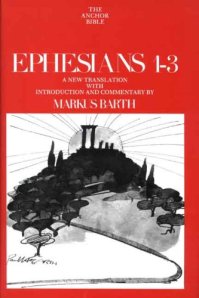
Barth Ephesians 1-3‘The pacification carried out by Jesus Christ is an act of creation. This distinguishes it from sheer transformation or improvement, or from the unification of diverse elements by revealing a common feature … The beginning and first fruit of the new creation is called “a single new man” (lit. one new man”). Translations such as “new humanity,” “new nature,” “new personality” are not to be recommended because they create the impression that out of two (old) things, a new thing was made. But the text does not describe the creation of a combination of things, e.g. heaven and earth, or the production of a new concept or type of humanity or personality. It speaks only of the creation of a new person, “a single new man”. – Markus Barth, Ephesians 1–3 (The Anchor Bible; vol. 34; Garden City: Doubleday, 1974), 308, 309.

Things to read while eating your Saturday toast …

Philip Larkin, ‘Church Going’

St Andrews CathedralOnce I am sure there’s nothing going on
I step inside, letting the door thud shut.
Another church: matting, seats, and stone,
And little books; sprawlings of flowers, cut
For Sunday, brownish now; some brass and stuff
Up at the holy end; the small neat organ;
And a tense, musty, unignorable silence,
Brewed God knows how long. Hatless, I take off
My cycle-clips in awkward reverence.

Move forward, run my hand around the font.
From where I stand, the roof looks almost new –
Cleaned, or restored? Someone would know: I don’t.
Mounting the lectern, I peruse a few
Hectoring large-scale verses, and pronounce
‘Here endeth’ much more loudly than I’d meant.
The echoes snigger briefly. Back at the door
I sign the book, donate an Irish sixpence,
Reflect the place was not worth stopping for.

Yet stop I did: in fact I often do,
And always end much at a loss like this,
Wondering what to look for; wondering, too,
When churches will fall completely out of use
What we shall turn them into, if we shall keep
A few cathedrals chronically on show,
Their parchment, plate and pyx in locked cases,
And let the rest rent-free to rain and sheep.
Shall we avoid them as unlucky places?

Or, after dark, will dubious women come
To make their children touch a particular stone;
Pick simples for a cancer; or on some
Advised night see walking a dead one?
Power of some sort will go on
In games, in riddles, seemingly at random;
But superstition, like belief, must die,
And what remains when disbelief has gone?
Grass, weedy pavement, brambles, buttress, sky,

A shape less recognisable each week,
A purpose more obscure. I wonder who
Will be the last, the very last, to seek
This place for what it was; one of the crew
That tap and jot and know what rood-lofts were?
Some ruin-bibber, randy for antique,
Or Christmas-addict, counting on a whiff
Of gown-and-bands and organ-pipes and myrrh?
Or will he be my representative,

Bored, uninformed, knowing the ghostly silt
Dispersed, yet tending to this cross of ground
Through suburb scrub because it held unspilt
So long and equably what since is found
Only in separation – marriage, and birth,
And death, and thoughts of these – for which was built
This special shell? For, though I’ve no idea
What this accoutred frowsty barn is worth,
It pleases me to stand in silence here;

A serious house on serious earth it is,
In whose blent air all our compulsions meet,
Are recognized, and robed as destinies.
And that much never can be obsolete,
Since someone will forever be surprising
A hunger in himself to be more serious,
And gravitating with it to this ground,
Which, he once heard, was proper to grow wise in,
If only that so many dead lie round.

– Philip Larkin, ‘Church Going’, in Englische und amerikanische Dichtung 3: Von R. Browningbis Heaney (ed. Horst Meller and Klaus Reichert; München: C.H. Beck, 2000), 343–346.

Leunig on a great lie

Loser

‘I suppose it dates back to an early childhood feeling that people weren’t really saying what they were thinking. I think a lot of children grow up thinking, “Hang on, more is going on here, but people aren’t saying it.” I wanted to know what they really thought, what they were saying to themselves that they couldn’t say out loud. People lie constantly, we all do. I think we suffer from the absence of the personal. When society lapses into the personal it gets all maudlin and inept and clumsy. Because we are not used to incorporating spontaneous, natural, truthful response’. – Michael Leunig

‘Poems for the Pastor’

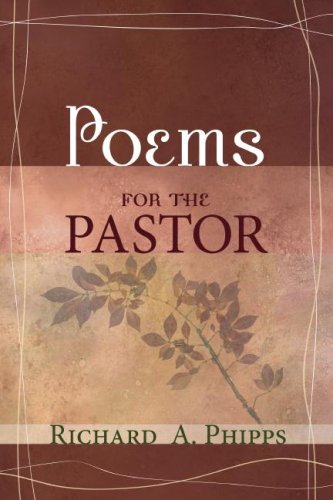
Poems for the PastorSøren Kierkegaard, in Either/Or, once stated that a poet is ‘an unhappy person who conceals profound anguish in his heart but whose lips are so formed that as sighs and cries pass over them they sound like beautiful music’. He may well be right, and that not only of poets; I think too of pastors, for the years have taught me to be less surprised that poetry is one of God’s greatest gifts to pastors. Because happy or otherwise, there remains something about pastoral realities which well echoes Kierkegaard’s description.

I’ve just finished reading Poems for the Pastor: The Reflections and Poetry of Richard A. Phipps (2008), another book from our friends at Wipf and Stock. Phipps is certainly no Les Murray or Jack Kerouac or James K. Baxter – nor does he claim to be – but one is hard-pressed to know why many of these poems deserve to be in print (especially under a publishing label which is deservedly earning a stellar reputation). I love the idea of a collection of poems penned by a pastor for pastors, for those who ‘struggle for the words to express our deepest desires, hurts, expectations, counsel, and prayers for our beloved flock of sinners saved by grace’ (p. ix), but very few lines in this wee volume (74 pages!) quite cut it for me.

If you’re into sentimental, this volume might be your thing. But in my experience, sentimental never gets near to cutting it in pastoral ministry. Am I missing something here?

‘Without’, by C.K. Stead

A View of Cape Stephens in Cook's Straits (New Zealand) with Waterspout, 1776Without

Crossing Cook Strait
going home to be
ordained in the

parish of his
father, while seas wished
by and the wind

had its say in the
wires, it came to
him there was no

God. Not that
God was sulking or had
turned His back—that

had happened
often. It was that God
wasn’t there, was

nowhere, a Word
without reference or
object. Who was

God? He was the
Lord. What Lord was
that? The Lord God. Back

and forth it went while
stern lifted, screw
shuddered, stars glowed

and faded. The
universe was losing
weight. It was

then he threw his
Bible into the
sea. He was a

poet and would
write his own. Happiness
was nothing

but not being
sad. It was your
self in this one and

only moment
without grief or
remorse, without God

or a future—sea,
sky, the decks
rolling underfoot.

– Christian Karlson Stead, ‘Without’ in The Red Tram (Auckland: Auckland University Press, 2004), 52–3.

[Image: William Hodges, ‘A View of Cape Stephens in Cook’s Straits (New Zealand) with Waterspout, 1776’, 1776.]

‘God will Transform’, by Jürgen Moltmann

Moltmann 2‘God will Transform: Destructive Judgement is a Godless Picture’

By Jürgen Moltmann

Since the Middle Ages, a conception of death and resurrection became fixed in Christian thinking that is deeply unchristian: the pictorial world of heaven and hell, the conception of a Last Judgement that rewards good works and punishes bad deeds to order the transition to the world to come. According to this notion, God’s judgement only knows two sentences: either eternal life or eternal death, either heaven or hell. If one asks what will come of the good visible creation, the earth and God’s other earthly creatures, the answer is everything will be burnt to ashes. This world will not be needed any more when the blessed will see directly in heaven without mediation by other creatures.

This idea of judgement is incomprehensible and hostile to creation. Are God the Judge and God the Creator different gods? Does the judging God destroy the faithfulness of the Creator to his creatures? This would be God’s self-contradiction or different gods. The Biblical trust in God is destroyed as well as trust in Jesus. The judging Christ with the two-edged sword has nothing to do with the preacher of the Sermon on the Mount Jesus of Nazareth healing the sick and forgiving sins. The idea of destructive punishment is an extremely godless picture.

However, there is another conception of world judgement. Injustice is a scandal. Victims do not die away. All the murderers do not find any rest. The hunger for justice remains as a torment in a world of violent crying. The powerless and oppressed hope for a world judge “who creates justice for those suffering injustice.” Israel’s psalms of lamentation are an eloquent example of true creative justice. God’s righteousness will “create” justice for victims, raising them from the dust and healing wounded life.

Later and under foreign influences, a universal criminal judge was made out of this saving Liberator in the biblical scriptures who judges good and evil and does not ask about the victims any more. A deed-oriented moral judgement according to the standard of retributive justice came out of a victim-oriented expectation of saving justice. Correcting this aberration means christianizing the idea of judgement so it is oriented in Israel’s original experience of God’s creative, saving and healing justice.

The New Testament offers staring-points. The New Testament understands Judgement Day as the “day of the Son of man” on which the crucified and resurrected Christ will be revealed and all the world before him. Both will appear out of their concealment in the light of truth, the Christ now hidden in God and the person hidden from him/herself. The eternal light will be revealed to them. What is now hidden in nature will be transparent because persons are physical and natural beings connected with the nature of the earth. We cannot be separated from the nature of the earth, neither in the resurrection nor in the end-time judgement.

Christ will be revealed as the crucified and resurrected victor over sin, death and hell, not as the avenger or retaliator. Christ will be revealed as the Everlasting One and leader of life. He will judge according to the justice he proclaimed and practiced through his community with sinners and tax collectors. Otherwise no one could recognize him.

God’s justice is a creative justice. The victims of sin and violence are supported, healed and brought to life by God’s righteousness. The perpetrators of sin and violence will experience a rectifying transformative justice. They will change by being redeemed together with their victims. The crucified Christ who encounters them together with their victims will save them. They will “die off” in their atrocities to be “reborn” to a new life.

Helping and supporting the victims and straightening the perpetrators as the victory of God’s creative justice over everything godless, not the great reckoning with rewards and punishments. This victory of divine justice leads to God’s great day of reconciliation on this earth, not to the division into blessed and damned.

Seen this way, the Last Judgement is not the end of God’s works. It is only the first step of a transformation out of transitoriness into intransitoriness. The new eternal creation will be created on the foundation of justice. Because the judgement serves this new creation of all things, its future-oriented justice is creative and not only a requiting justice referring to the past. It was the mistake of Christian tradition in picture and concept, piety and teaching to only see the judgement over the past of this world and not God’s new world through the judgement.

If a social judging occurs in the Last Judgement, it is in truth a cosmic judgement because the coming Christ is also the cosmic Christ. Already in the psalms, YHWH is called “to judge the earth.” All shattered relations in creation must be straightened out so the new creation can stand on the solid ground of justice and abide in eternity. All creatures should share in eternal being and in God’s eternal vitality. That will be a fundamental change of the cosmos and life. “God will indwell all things and be present in all things.” Then the nothingness will be destroyed and death annihilated. The power of evil will be broken and separated from all creatures. The misery of separation from the living God – sin – will end. Hell will be destroyed. Then the reign of glory will begin.

[Source: Publik-Forum; HT: Marc Batko, via Jürgen Moltmann group]

Conference: ‘Reversed Thunder: The Art of the Psalms’

Reversed Thunder

George Herbert once penned:

Engine against th’ Almightie, sinner’s towre,
Reversed thunder, Christ-side-piercing spear,
The six daies world-transposing in an houre,
A kinde of tune, which all things heare and fear

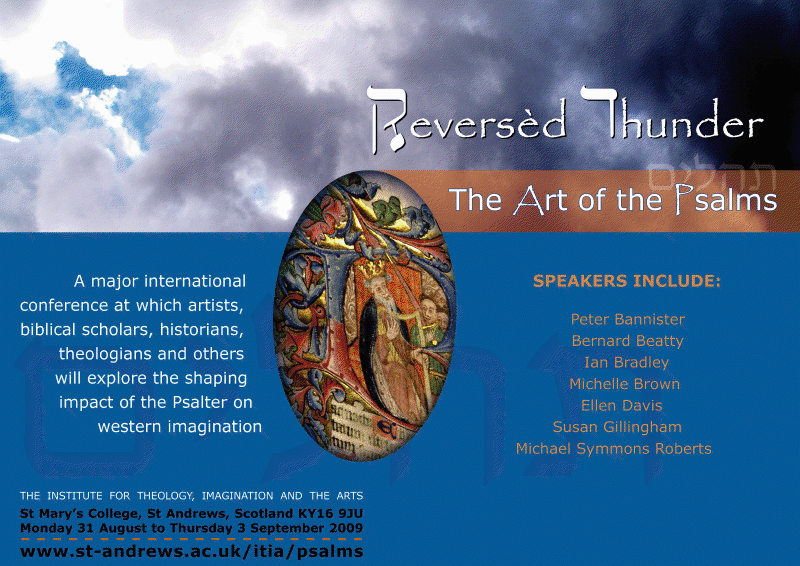
The tune of which all things hear and fear, the drama of Christ.  The Psalms, whilst not explicitly portraying Christ’s performance, pierce the core of our being. Few texts can have had a more decisive impact on Western culture across the centuries than the Psalter. Central to the scriptures that have shaped both Jewish and Christian faith, the Psalms have always enjoyed a prominent place in Western religious life. Their importance is reflected in a wide variety of modes of reception reaching beyond the specifically religious domain and maintaining a strong public presence even in the milieux of modernity. The Psalms have been widely appropriated and ‘sampled’ in the plastic arts, music, literature, and various other cultural forms, and their depths will be replumbed this August in a conference at St Andrews University titled ‘Reversed Thunder: The Art of the Psalms’.

The Institute for Theology, Imagination & the Arts at St Mary’s College, University of St Andrews invites you to participate in ‘The Art of Psalms’.  This major international conference will bring together artists, biblical scholars, historians, literary critics, theologians, and others to explore ways in which the ‘reversed thunder’ of the Psalter has shaped the identity not just of the Jewish and Christian traditions, but of Western culture more widely.

For more information please visit here or email Matt Farlow.

‘The Gospel of the Judgement and New Creation of All Things’, by Jürgen Moltmann

jurgen-moltmann

The Gospel of the Judgement and New Creation of All Things

By Jürgen Moltmann

What is the Goal of Christ’s Judgement?

The goal of helping victims and rectifying culprits is the triumph of God’s creative justice over everything godless in heaven, earth and below the earth, not the great reckoning with wages and punishments. This victory of divine justice leads to God’s great day of reconciliation on this earth, not to division of humankind into blessed and damned and the end of the world. On Judgement Day, “all tears will be wiped away from their eyes,” the tears of suffering and the tears of repentance. “There will be no mourning, crying or pain” (Rev 21,4). Thus the Last Judgement is penultimate, not ultimate and is not the end of God’s works. It is only a first step in a transition or transformation from transitoriness to intransitoriness. The new eternal creation created on the foundation of justice is definitive. Because the judgement serves this new creation of all things, its justice is a healing, creative justice re-establishing life according to this future, not a retaliatory justice referring to the past. The judgement serves the new creation, not sin and death as the great reckoning. It was the error of the Christian tradition in picture and idea, piety and teaching to see only judgement on the past and not God’s new world beyond the judgement and thus not believing the new beginning in the end.

The practice and endurance of evil are not always apportioned to different persons and groups of persons. Victims can also be perpetrators. In many persons, the perpetrator side and the victim side of evil are inseparably connected. The knowledge that the coming judge will judge us as perpetrators and as victims, reject the Pharisee in us and accept the sinner in us and reconcile us with ourselves. Judging victims and perpetrators is always a social judging. We do not stand isolated and dependent on ourselves before the judge as in human criminal courts or in nightly pangs of conscience. The perpetrators stand together with their victims, Cain with Abel, the powerful with the powerless, the murderers with the murdered. Humanity’s story of woe is inseparably joined with the collective history of culpability.

There are always unsolved and unsolvable social, political and personal conflicts where some become perpetrators and others victims of sin. As in the Auschwitz trials and the South African truth commission, victims have a long tormented memory while perpetrators have only a short memory if they have a memory at all. Therefore the perpetrators depend on the memories of their victims, must hear their reports and learn to see themselves with the eyes of their victims, even if this is frightening and destructive.

Dialectical Universalism

In conclusion, what practice follows from this future expectation? How do we visualize Christ’s coming justice?

An American friend asked his Baptist grandmother about the end of the world and she replied with the mysterious spine-chilling name “Armageddon.” According to Revelation 16,16, this is God’s end-time battle with the devil. Today the struggle of good against evil is generalized with the final victory of the good at the end. From this idea of the end, American fundamentalism developed a fantastic modern end-time struggle scenario. George W. Bush Jr. invented such a scenario, justifying “friend-enemy thinking” as a basic political category. To this end, he conjured the “axis of evil” reaching from Iraq to Iran and North Korea. “America is at war,” he announced after “September 11” and “whoever is not for us is against us.” America remains “at war” since no state had attacked the US but the criminal Islamic unit Al-Qaeda. In what war? The apocalyptic war called Armageddon has already started!

The judgement expectation common to Christianity and Islam has a very similar effect on the present. If the end of the world is God’s judgement over believers and unbelievers with the twofold end: believers in heaven and unbelievers in hell, the present will inevitably be ruled by religious friend-enemy thinking: here the believers in “God’s house” and there the unbelievers in the “house of war.” Since there is no hope for unbelievers, they can be punished here with contempt or terror. Unbelievers are enemies of believers since they are God’s enemies. Anticipation of the Last Judgement by separating people into believers and unbelievers and possibly persecuting unbelievers as God’s enemies is wrong because it is godless. God is not the enemy of unbelievers or the executioner of the godless. “For God has consigned all men to disobedience, that he may have mercy upon all” (Rom 11,32). Thus all people of whatever faith or unbelief must be seen as befriended by God’s mercy. God loves them whoever they are. Christ died for them and God’s spirit works in their lives. Thus we cannot be against them.

The all-embracing hope in God’s future explains this boundlessness of love. Why should we take seriously the faith, superstition or unbelief of others as God’s mercy? That was a theme for Christendom in the atheistic East Germany (DDR) state. This cannot be otherwise in our dealings with people of other religions that must be marked by God’s unconditional love. The difference between believers, persons of other faiths and unbelievers are real but are annulled in God’s mercy with everyone.

Christian universalism does not hinder but promotes taking sides for victims of injustice and violence. In a divided and hostile world, the universalism of God’s mercy with everyone is reflected in the well-known “preferential option for the poor.” God acts unilaterally in history in favour of victims and also saves perpetrators through them. Jesus calls the burdened and heavy-laden to himself, accepts sinners and sends the Pharisees away empty. For Paul, the community itself is a testimony for God’s unilateral action in favour of all people. “Consider your call, brethren: not many of you were wise according to worldly standards, not many were powerful, not many were of noble birth, but God chose what is foolish in the world to shame the wise. God chose what is weak in the world to shame the strong. God chose what is low and despised in the world, even things that are not, to bring to nothing things that are, so that no human being might boast in the presence of God.” (1 Cor 1,26-29). Therefore we sing “Sun of Righteousness, Arise in our Time.”

Ecumenical Church Hymn

Sun of righteousness,
arise in our time.
Dawn in your church
so the world can see.
Have mercy, O Lord.

Wake up, dead Christendom
from the sleep of security
so it hears your voice.
Have mercy, O Lord.

Behold the divisions
that no one can resist.
Great Shepherd, gather
everything that has lost its way or gone astray.
Have mercy, O Lord.

Open the gates to the nations.
Let no cunning or power
hamper your heavenly race.
Create light in the dark night!
Have mercy, O Lord.

Let us see your glory
in this time
And seek what creates peace
with our little strength.
Have mercy, O Lord.

Let us be one, Jesus Christ,
as you are one with the Father,
remaining in you always,
today and in eternity.
Have mercy, O Lord.

Power, praise, honour and glory
Are yours Most High always
As Most High is three in one,
Let us be one in him.
Have mercy, O Lord

[Source: Christ im dialog; HT: Marc Batko, via Jürgen Moltmann group]

June bests …

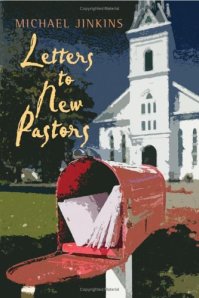
Letters to New PastorsBest books: Voicing Creation’s Praise, by Jeremy S. Begbie; Calvin: A Biography, by Bernard Cottret; Letters to New Pastors, by Michael Jinkins. (On Jinkins’ book: It’s been many moons since I read an entire book in a day, particularly in a day already replete with so many other commitments, but this one was impossible to put down. I think it’ll not be long before parts of it, at least, are revisited).

Best music: Dave Matthews Band, Big Whiskey And The GrooGrux King [2009]; Krzysztof Penderecki, St Luke Passion (Warsaw National Philharmonic Orchestra); Guy Clark, Keepers.

Best films: In Search of a Midnight Kiss [2007]; Så som i himmelen [2004]

Best drink: Glenmorangie, 18 Years Old

Blogging famine?

AucklandBlogging here at Per Crucem ad Lucem may be a little light on for the next few weeks. I’m off to Auckland tomorrow to do some teaching on theology and the arts, and on pastoral theology on issues pertaining to marriage. When I return, I’ll be thinking (and so probably blogging) about Calvin for a few weeks as I prepare a paper for the upcoming Calvin Rediscovered conference. At this stage, I’m thinking of a paper on Calvin as servant of the Word. But, on that, more to come.

Michael Jackson and the cult[ure] of dead celebrities

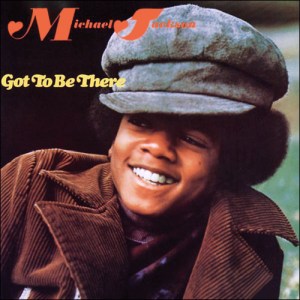
Michael JacksonRick Floyd, in his recent post on the death of Michael Jackson and the culture of celebrity, includes this insightful claim:

‘The church’s notion of the faithful dead as the communion of saints (see my Mystic Sweet Communion) has been replaced in popular culture by the cult of dead celebrities whose lives for the most part serve more as cautionary tales than good examples’.

Too true. This reminded me of Camus’ definition of culture as ‘the cry of men in face of their destiny’. Still, Jackson’s death is both a tragedy (even in Camus’ sense of that word) and a reminder that in the most unCamus-like economy of grace, hope hopes in the redemption who comes on the other side. For it is the triune God – and not Michael Jackson, and still less that army of fans and critics that he left behind – who has, in Jesus Christ, made the final call on this man’s life, and fate.

Yes, Jackson’s chapter is included in that growing book of ‘cautionary tales’, but that book is not the last in the series.