Author: Jason Goroncy

‘The Word’

A pen appeared, and the god said:
‘Write what it is to be
man.’ And my hand hovered
long over the bare page,

until there, like footprints
of the lost traveller, letters
took shape on the page’s
blankness, and I spelled out

the word ‘lonely’. And my hand moved
to erase it; but the voices
of all those waiting at life’s
window cried out loud: ‘It is true.’

– RS Thomas, ‘The Word’, in Collected Poems, 1945–1990 (London: Dent, 1993), 265.

‘Thy works, not mine, O Christ’

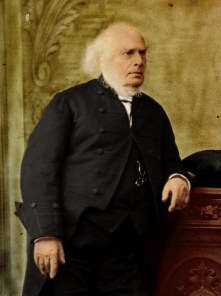
Today marks the anniversary of the first General Assembly of the Church of Scotland convened in Edinburgh in 1560. And yesterday marked the birthday of one of my favourite hymn writers – Horatius Bonar (1808–89) – who also, incidentally, wins the prize among Kirkmen for the Bilbo Baggins-likeness award. Anyway, it only seemed proper to post one of his greatest hymns:

1. Thy works, not mine, O Christ,
Speak gladness to this heart;
They tell me all is done;
They bid my fear depart.
To whom save Thee,
Who canst alone for sin atone,
Lord, shall I flee?

2. Thy wounds, not mine, O Christ,
Can heal my bruisèd soul;
Thy stripes, not mine, contain
The balm that makes me whole.
To whom save Thee,
Who canst alone for sin atone,
Lord, shall I flee?

3. Thy Cross, not mine, O Christ,
Has borne the awful load
Of sins that none could bear
But the incarnate God.
To whom save Thee,
Who canst alone for sin atone,
Lord, shall I flee?

4. Thy death, not mine, O Christ,
Has paid the ransom due;
Ten thousand deaths like mine
Would have been all too few.
To whom save Thee,
Who canst alone for sin atone,
Lord, shall I flee?

5. Thy righteousness, O Christ,
Alone can cover me;
No righteousness avails
Save that which is of Thee.
To whom save Thee,
Who canst alone for sin atone,
Lord, shall I flee?

Seeking doctoral supervisors

Every now and then, someone who is considering undertaking a PhD by thesis will seek my thoughts about doctoral supervisors. And while there are lots of things I might draw the enquirer’s attention to, my standard reply is that I reckon that you want to look for 3 things in a supervisor:

  1. Someone who makes time for you, including responding to your calls/emails in a timely manner. There’s an element here too of the ‘pastoral’ reality in the supervisory relationship. A good supervisor knows, or at least acts as if they know, that they are working with a person and not just with ideas, and that most often that person experiences ‘the thesis’ as a mixed ride, and often with not a little stress, both internal and external. Some confidence that the supervisor is an aid – which includes some basic reliability on the communication front – and not a thorn in this journey is pretty important. (Side note: The 3-year thesis has some affinities with pregnancy, or so I’m led to believe. The first trimester is often about excitement and adjustment, and some weird conviction that this baby is going to be the best thing ever. Sometimes vomiting is involved too. The second trimester is like being in cruise control, and the baby sort of just hangs around while one starts to be a little more lax about the ‘no-alcohol’ rules and stuff. And the third trimester is something akin to ‘Let’s just get this baby out of here – enough is enough’.)
  2. Someone who knows what a doctoral thesis looks like. Just because a person has one doesn’t guarantee that they know what one looks like, or how to go about authoring a decent one, or helping someone else to do so.
  3. Someone – and this is perhaps the most important of the three – who asks the right kinds of questions. In other words, you’re not necessarily looking for someone who knows everything, or even a lot, about your subject of interest. But you are looking for someone who has a good nose for the general area and who can help you articulate the right kinds of questions. In PhDs – as in life – the right questions are always much more important, and much more interesting, than the answers.

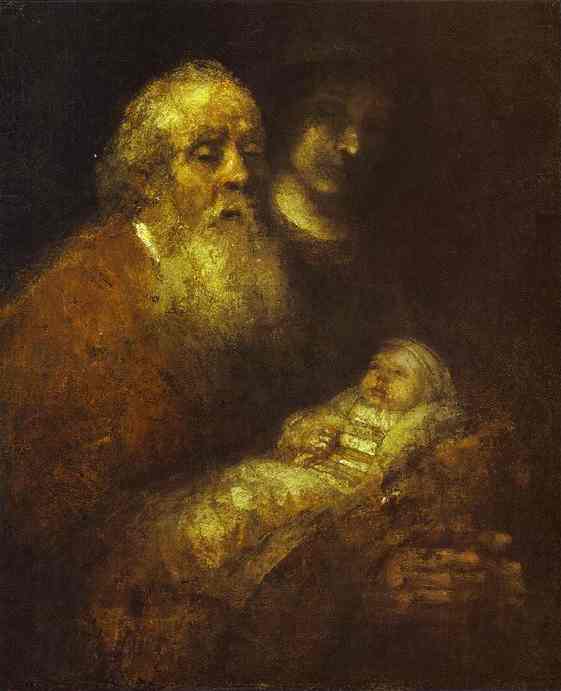
Marilyn Chandler McEntyre, ‘Simeon with the Christ Child in the Temple’

Rembrandt, 'Simeon with the Christ Child in the Temple', c. 1666-69.

How light he lies
in these ancient arms.
The infant’s eyes open
to meet the old man’s
as they close.

I have seen his eyesight fade.
I have wept some days to watch
his long waiting, sonorous mumbling
prayer trailing into sleep. For many
months he has wished to be
dismissed in peace.

Now, holding this child,
he can let go.

Glad for his good release, I mourn
the mother’s pain, the child’s plight,
the loss that comes
for me in this: no longer to see him
on the temple steps, old eyes glittering
with hope, always ready to retell
the ancient tales while doves coo
in the courtyard and chattering housewives
pass in the street and within
the drone of prayer turns story into song.

What darkness comes with this light
burden he bears now, gurgling
his brief contentment. Glory of Israel,
Revelation to the Gentiles, this little gift
of God will cost us all we know. I see
the sword in his mother’s heart,
and in his own – and mine, too,
as the old man, his log watch ended,
speaks his fateful benediction.

– Marilyn Chandler McEntyre, ‘Simeon with the Christ Child in the Temple’, in Drawn to the Light: Poems on Rembrandt’s Religious Paintings (Grand Rapids: Wm. B. Eerdmans, 2003), 37–8.

Words to sink your ears into

Missing your lectures? Eyes need a break? Need to kill some time over the Christmas period? Want to impress your friends (and enemies) with your learnedness? Check out some of the following links (which are mostly from our friends at Holden Village):

H. George Anderson

Karl Barth

  • “Was ist für Sie Mozart?”. Gespräch mit R. Schmalenbach (Text Schweizerdeutsch Text Standarddeutsch). Aus “Musik für einen Gast” (Radio Interview vom 17.9.1968, geführt von R. Schmalenbach). [mp3]
  • Weihnachtsgruss 1960 (siehe auch Letter Nr. 12) [mp3]
  • Institutio-Jubiläum 1959 (siehe Neue Zürcher Zeitung, Nr. 158, vom 11./12. Juli 2009, S. B 3) [mp3]
  • Aus dem Gespräch mit den Tübinger Stiftlern vom 2. März 1964 über die Entstehung der Barmer Theologischen Erklärung (siehe K. Barth, Gespräche 19641968, hrsg. von E. Busch [Gesamtausgabe, Abt. IV], Zürich 1997, S. 111–114; auch in: K. Barth, Texte zur Barmer Theologischen Erklärung, hrsg. von M. Rohkrämer, Zürich 20042, S. 221–223) [mp3]
  • Aus dem Gespräch mit der Kirchlichen Bruderschaft Württemberg vom 15. Juli 1963 über die Bedeutung von Barmen (siehe K. Barth, Gespräche 1963, hrsg. von E. Busch [Gesamtausgabe, Abt. IV], Zürich 2005, S. 54; auch in: K. Barth, Texte zur Barmer Theologischen Erklärung, hrsg. von M. Rohkrämer, Zürich 20042, S. 191) [mp3]
  • Aus “Die Liebe”, Abschiedsvorlesung Karl Barths vom 1. März 1962 an der Universität Basel (siehe K. Barth, Einführung in die evangelische Theologie, Zürich 20045, S. 220) [mp3]
  • Aus “The Community”, Vorlesung Karl Barths vom 26. April 1962 in Chicago und 2. Mai 1962 in Princeton (siehe K. Barth, Evangelical Theology. An Introduction, Grand Rapids, MI 1979, S. 41) [mp3]
  • Aus “Commentary”, Vorlesung Karl Barths vom 23. April 1962 in Chicago und 29. April 1962 in Princeton (siehe K. Barth, Evangelical Theology. An Introduction, Grand Rapids, MI 1979, S. 9–12) [mp3]
  • Tondokumente aus Letter Nr. 6.
  • Gespräch mit R. Schmalenbach. Aus “Musik für einen Gast” (Radio Interview vom 17.9.1968, geführt von R. Schmalenbach). [mp3]
  • Gespräch mit der Kirchlichen Bruderschaft in Württemberg. Aus dem Gespräch am 15.7.1963 im Restaurant Bruderholz in Basel. [mp3]
  • Gespräch in Bièvres. Aus der Diskusion am 20.10.1963 über Fragen im Zusammenhang seines Buches «Einführung in die evangelische Theologie». [mp3]
  • Podiumsdiskussion in Chicago. Aus dem Schlusswort bei der Podiumsdiskusion in Chicago 26.4.1962. [mp3]

Carl Braaten

Walter Brueggemann

Nancy Eiesland

Terry Fretheim

Martin Marty

Bonnie Miller-McLemore

Jürgen Moltmann

Ched Myers

Lesslie Newbigin

John Polkinghorne

Dorothee Sölle

William Stringfellow

  • Civil rights movement – an interview with Robert Penn Warren: Part I, Part II (1964)

Helmut Thielicke

Vitor Westhelle

Rowan Williams

Umhau Wolf

John Howard Yoder

some monday morning link love

New noises

Within the past fortnight, I discovered NoiseTrade, and some great new (and some already-familiar) sounds. These include:

There are others too, but which no longer seem to be available – like albums by Tyrone Wells, JD Eicher & the Goodnights and Andrew Osenga. If you discover some new noises that you like, why don’t you let me know in the comments. I have hungry ears …

‘Virgin’

As if until that moment
nothing real
had happened since Creation

As if outside the world were empty
so that she and he were all
there was — he mover, she moved upon

As if her submission were the most
dynamic of all works: as if
no one had ever said Yes like that

As if that day the sun had no place
in all the universe to pour its gold
but her small room

– Luci Shaw, ‘Virgin’ in Accompanied By Angels: Poems of the Incarnation (Grand Rapids: Wm. B. Eerdmans, 2006), 15.

Advent poem: ‘Eleven’


Her growing stomach struck me as grotesque.
Some other seed than mine engendered this:
Some stolen love, some alien, wretched bliss
Raped all integrity, all trust suppressed.
To consummate my pledge, by honor pressed,
Would violate that honor, transform kiss
To custom, love to duty, prove remiss
In truth, and make of joy a jest.

Exhausted by despair’s fatigue, I slept
The torment of the God-forsaken dead.
I tossed and turned, or when I woke, I wept,
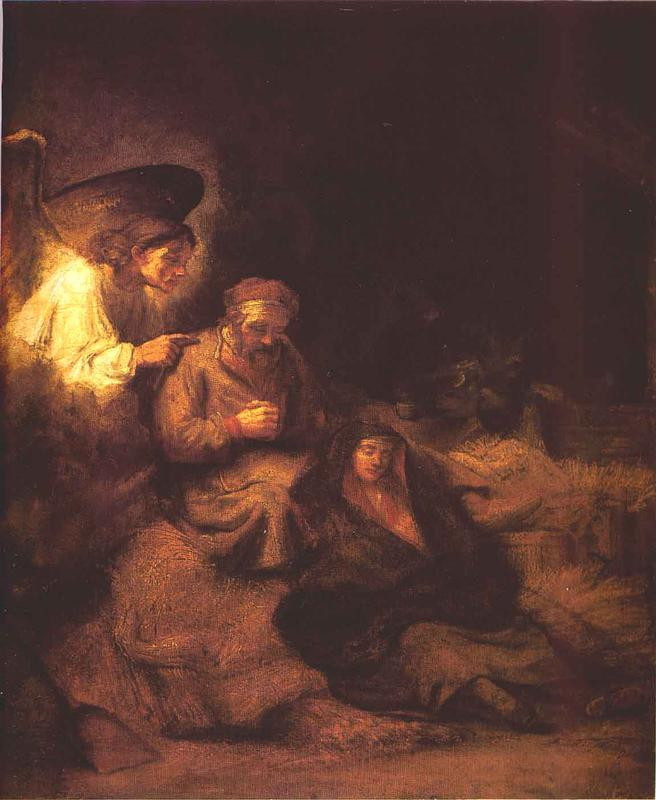
Until an angel stilled my fears, and said:

“Abandon doubt, and take this quiet boast:
The child she bears is by the Holy Ghost.”

– D.A. Carson, ‘Eleven’ in Holy Sonnets of the Twentieth Century (Grand Rapids/Nottingham: Baker/Crossway, 1994), 27.

Athanasius: a book competition

It’s time for another competition here at Per Crucem ad Lucem.

When C.S. Lewis first opened a copy of Athanasius’ De Incarnatione he quickly discovered that he was ‘reading a masterpiece’. ‘The whole book’, he said, ‘is a picture of the Tree of Life – a sappy and golden book, full of buoyancy and confidence. We cannot, I admit, appropriate all its confidence today. We cannot point to the high virtue of Christian living and the gay, almost mocking courage of Christian martyrdom, as a proof of our doctrines with quite that assurance which Athanasius takes as a matter of course. But whoever may be to blame for that it is not Athanasius’. (Lewis’ essay was published in God in The Dock as ‘On the Reading of Old Books’, and again as the ‘Introduction’ to the St Vladimir’s Seminary Press edition of Athanasius’ On the Incarnation.)

I draw attention to Athanasius for a reason. I’ve posted before about the importance of the Church’s production and encouragement of the kind of literature that assists us to know and celebrate our story. And I’ve already commended Simonetta Carr’s delightful little book on John Calvin, a book published by Reformation Heritage Books and targeted at children from 6–12 years of age. In addition to the book on Calvin, Carr has also written books on Augustine of Hippo and John Owen for that same series of ‘Christian Biographies for Young Readers. And now she has turned her attention to a fourth book, this time on Athanasius, and she has kindly sent me a copy as a giveaway here at Per Crucem ad Lucem. In order to determine the recipient of the book, I thought we could have a wee competition. The rules are simple – answer the following question:

Why should we bother teaching our kids (and ourselves for that matter!) about this particular fourth century bishop?

I’ll leave the competition open until next Wednesday, after which time I will announce the winner who, in the best of possible worlds with the best of possible postal services, should receive the book before Christmas.

(BTW: I notice that Peter Leithart’s recent book on Athanasius is now out. And, for those keen to read a little deeper, there’s also great titles by Thomas G. Weinandy, Khaled Anatolios, and Alvyn Pettersen.

Why did Rowan Williams defend Shari’a Law?

It’s because, Ben Myers argues, Williams was seeking to ‘promote [an] Hegelian style of public engagement, where what is good for any single community becomes part of the vision of what is good for all’. It also, as Ben notes, has everything to do with the fact that Williams seeks to take Philippians 2 seriously, where the church’s ‘vocation’ is to ‘reach out across all those boundaries that fragment the human community into self-protective ghettos’ and ‘to dismantle the whole logic of side-taking’. Read Ben’s piece here.

November stations …

Reading:

Listening:

Watching:

A new study on theodicy in the work of PT Forsyth

The arrival of a baby into our world is always an event that calls for thanksgiving and gratitude. This is no less the case around the arrival of that all-too-rare book on some aspect of the theology of P.T. Forsyth. So I am very excited to announce that the midwifery department at Wipf and Stock have just assisted in the birth of a new study on the all-too-neglected Aberdonian. The Theodicy of Peter Taylor Forsyth: A “Crucial” Justification of the Ways of God to Man is a revised version of a very thoughtful and carefully-argued doctoral dissertation by my dear friend Theng Huat Leow. The book’s description reads:

The theodicy of the remarkable Scottish Congregationalist theologian Peter Taylor Forsyth has long been recognized as a vital and significant contribution to twentieth-century theology. Up until now, however, there has not been a substantial full-length treatment of Forsyth’s work on the problem of evil. The Theodicy of Peter Taylor Forsyth fills this lacuna by setting out, in a fairly systematic and comprehensive manner, Forsyth’s justification of God in the face of evil. In so doing, it also illuminates several other related areas of his thought, such as his epistemology and Christology, as well as his understanding of sin, the atonement, providence, divine passibility, human origins, and the God-world relationship.

Bringing Forsyth’s approach to the subject into conversation with other prominent thinkers like Leibniz, Dostoyevsky, Camus, Moltmann, Hick, Bauckham, and Fiddes, this book also suggests ways in which Forsyth’s justification of God contributes to the current state of Christian theodicy. It highlights Forsyth’s ability to integrate insights from different approaches, even those that have hitherto generally been considered diametrically opposed notions. Forsyth’s theodicy therefore presents an integrative approach to the topic, with every theme flowing from and returning to a clear center: the cross of Christ. As the book also makes clear, Forsyth considers theodicy to be an immensely practical discipline, with significant implications for human life. In every sense, therefore, it constitutes a “crucial” justification of the ways of God to humanity.

PT Forsyth in Japan: フォーサイス神学概論―十字架の神学

It’s very exciting to see Hiroshi Ōmiya’s edition and translation of Justice the True and Only Mercy: Essays on the Life and Theology of Peter Taylor Forsyth (originally edited by Trevor Hart), which includes an additional essay by Jim Gordon. The presence of this volume recalls a small but unabated interest among Japanese theologians in Forsyth’s work. This interest stretches back to at least the time of the Great War and is represented, for example, in the work of people like Hiromichi Kozaki and Takakura Tokutaro, and in the Forsyth Society (Tokyo) who published 35 volumes of studies on Forsyth’s theology between 1932 and 1935, and in Ōmiya Hiroshi’s biography on Forsyth published as Fōsaisu Shohan (Hito to shisō shirīzu; Tōkyō: Nihon Kirisuto Kyōdan Shuppanbu, 1965), and in published essays by Masaichi Takemori (‘Scottish Theology and the Church and Theology in Japan’, Theological Studies in Japan 14 (1975), pp. 16–17, 161–77) and Yutaka Morishima (‘God’s Holiness in P.T. Forsyth: through influence [sic] of R.W. Dale’, Theological Studies in Japan 46 (2007), pp. 101–18). Also, I understand that Kaneko Keiichi, of Rikkyo University (Tokyo), is currently supervising a doctoral dissertation on Forsyth. (BTW. If any readers of Per Crucem ad Lucem know anything about this latter project, or the contact details of the student and/or supervisor, I’d really appreciate knowing more about this.)

I hope at some stage to post more about the reception of Forsyth’s theology in Japan; it’s a fascinating story. But for now, I simply wanted to draw attention to this new volume – Hiroshi Ōmiya, ed., Fōsaisu shingaku gairon: jūjika no shingaku (Tōkyō: Kyōbunkan, 2011); ISBN: 9784764273283 – and to congratulate Hiroshi, Jim and Trevor on its appearance.