Author: Jason Goroncy

On the twelve days of curry

Tonight, when I was supposed to be reading William Stringfellow’s Conscience and Obedience, I found myself somewhat distracted by the thought of two other great passions of mine – Indian cuisine and my wonderful partner Judy. The result was this little song:

Now, with that out of my system, I can return to Stringfellow, and to ‘the impending devastation of political authority’.

On Handles Messiah

Mr Richard Starnes’ intelligent and delightful piece, which appeared in the Friday Morning edition of The Spartanburg Herald on 13 December 1963, is without doubt the very best article that I’ve ever ever ever ever read, or am likely to read, on Handles Messiah. And it was too good not to share, particularly at this time of year:

Handles Messiah

Living Amid the Principalities: Pro Ecclesia Annual Conference for Clergy and Laity

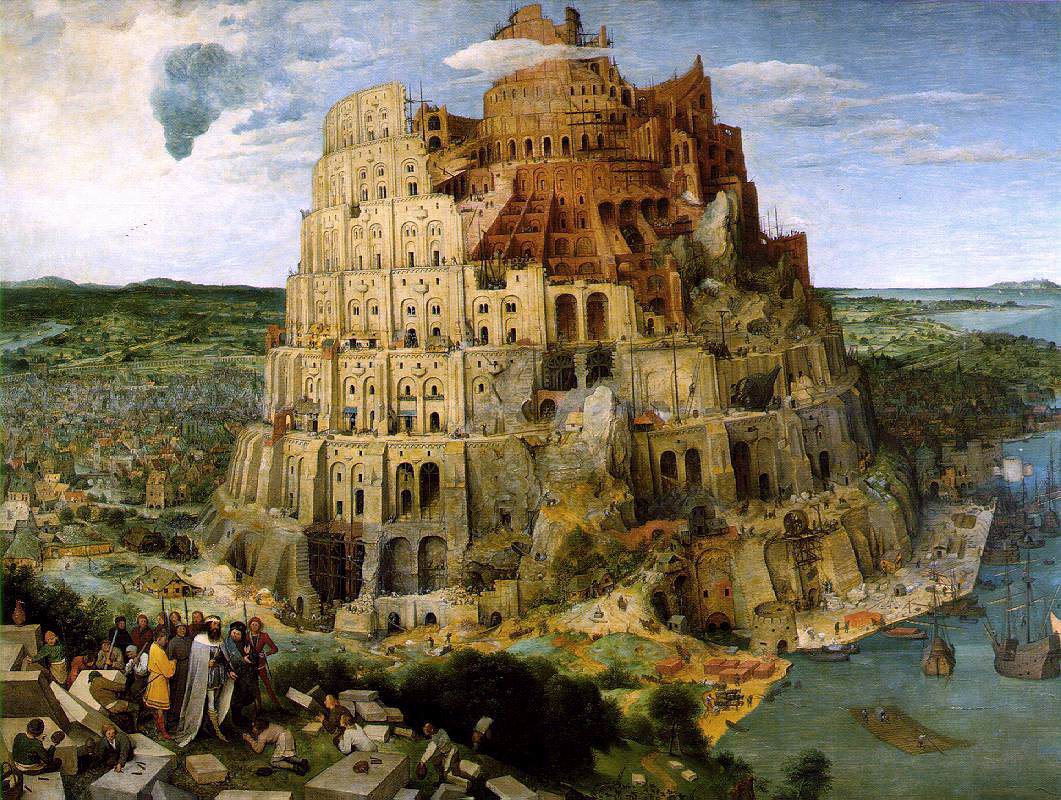
Brueghel-tower-of-babelThe Center for Catholic and Evangelical Theology are sponsoring the 2014 Pro Ecclesia Annual Conference for Clergy and Laity. It will be held at Loyola University, Baltimore, Maryland between 9–14 June.

The promo reads:

“We are not contending against flesh and blood, but against the principalities, against the powers, against the world rulers of this present darkness.” So Paul warns his Ephesian readers to put on the “whole armor of God” and be ready for struggle with the world. And yet Paul also says that these principalities and powers were created in and for Christ (Col. 1:16), have now been disarmed (Col 2:15), and cannot separate us from the love of God (Rom 8:38). What are the principalities and powers of our time in politics, technology, culture, economy, and religion? How do we understand them as created, fallen, and disarmed? How does the Christian today engage these powers? The 2014 conference of the Center for Catholic and Evangelical Theology will take up this theme. Presentations will represent a variety of traditions: Catholic, Orthodox, and Protestant.

Further details are promised in due course here. In the meantime, queries can be directed towards Michael Root.

It sounds like a great conference, and a great opportunity too to do some work with dear Uncle Stringfellow, among others.

Parents. Children.

Yesterday, with all the grief that attends just completing reading a great book, and with all the joy-in-anticipation of beginning a new one, I began reading Andrew Solomon’s Far From the Tree: Parents, Children and the Search for Identity. This deeply personal and somewhat cathartic book is about the forming and reforming of identities, those attributes and values which are passed down from parent to child across generations not only through strands of DNA but also through shared cultural norms (vertical identities), and those traits that are foreign to one’s parents ‘and must therefore acquire identity from a peer group’ (horizontal identities), identities which ‘may reflect recessive genes, random mutations, prenatal influences, or values and preferences that a child does not share with his progenitors’.

Through a series of reflections on deafness, dwarfism, autism, Down syndrome, disability, prodigies, schizophrenia, rape, crime, and transgender sexuality, Solomon is concerned to challenge notions of ‘ordinary’ and ‘extraordinary’, to examine the value judgements we carry, create, project and/or dismiss about such, and to ward off temptations to play down the ambiguities and ambivalences that surround notions of extra/ordinary.

In lieu of the likely event that I do not get around to writing a review of the book, and because I wanted to share something of my interest so far in reading this book – and for the consideration of fellow parents – here’s the (scene-setting) opening two paragraphs:

‘There is no such thing as reproduction. When two people decide to have a baby, they engage in an act of production, and the widespread use of the word reproduction for this activity, with its implication that two people are but braiding themselves together, is at best a euphemism to comfort prospective parents before they get in over their heads. In the subconscious fantasies that make conception look so alluring, it is often ourselves that we would like to see live forever, not someone with a personality of his own. Having anticipated the onward march of our selfish genes, many of us are unprepared for children who present unfamiliar needs. Parenthood abruptly catapults us into a permanent relationship with a stranger, and the more alien the stranger, the stronger the whiff of negativity. We depend on the guarantee in our children’s faces that we will not die. Children whose defining quality annihilates that fantasy of immortality are a particular insult; we must love them for themselves, and not for the best of ourselves in them, and that is a great deal harder to do. Loving our own children is an exercise for the imagination.

Yet blood, in modern as in ancient societies, is thicker than water. Little is more gratifying than successful and devoted children, and few situations are worse than filial failure or rejection. Our children are not us: they carry throwback genes and recessive traits and are subject right from the start to environmental stimuli beyond our control. And yet we are our children; the reality of being a parent never leaves those who have braved the metamorphosis. The psychoanalyst D. W. Winnicott once said, “There is no such thing as a baby—meaning that if you set out to describe a baby, you will find you are describing a baby and someone. A baby cannot exist alone but is essentially part of a relationship.” Insofar as our children resemble us, they are our most precious admirers, and insofar as they differ, they can be our most vehement detractors. From the beginning, we tempt them into imitation of us and long for what may be life’s most profound compliment: their choosing to live according to our own system of values. Though many of us take pride in how different we are from our parents, we are endlessly sad at how different our children are from us’.

‘The Second Coming’, by W. B. Yeats

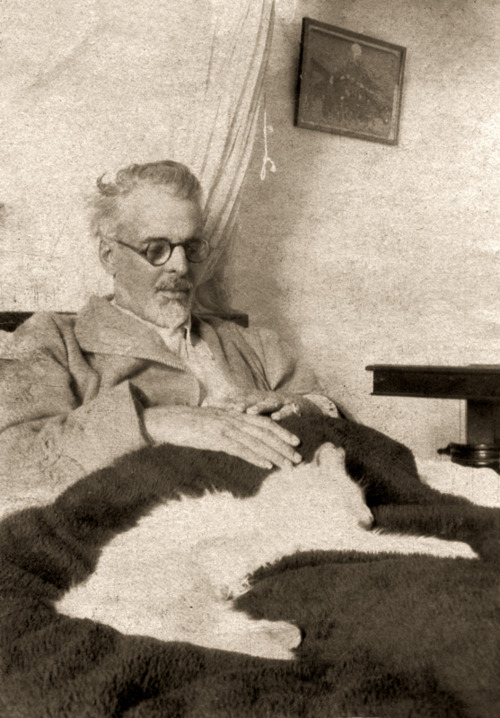
W.B. Yeats on his deathbed, 1939 by Georgie Hyde-LeesTurning and turning in the widening gyre
The falcon cannot hear the falconer;
Things fall apart; the centre cannot hold;
Mere anarchy is loosed upon the world,
The blood-dimmed tide is loosed, and everywhere
The ceremony of innocence is drowned;
The best lack all conviction, while the worst
Are full of passionate intensity.

Surely some revelation is at hand;
Surely the Second Coming is at hand.
The Second Coming! Hardly are those words out
When a vast image out of Spiritus Mundi
Troubles my sight: somewhere in sands of the desert
A shape with lion body and the head of a man,
A gaze blank and pitiless as the sun,
Is moving its slow thighs, while all about it
Reel shadows of the indignant desert birds.
The darkness drops again; but now I know
That twenty centuries of stony sleep
Were vexed to nightmare by a rocking cradle,
And what rough beast, its hour come round at last,
Slouches towards Bethlehem to be born?

– W. B. Yeats, ‘The Second Coming’, in The Collected Works of W. B. Yeats, Vol. 1: The Poems (New York: Simon & Schuster, 1996), 187.

[Notes: Penned 1919, in the aftermath of WWI, ‘The Second Coming’ was originally titled ‘The Second Birth’. The image, taken by Yeats’s wife Georgie Hyde-Lees, depicts Yeats on his deathbed in 1939.]

November stations …

Reading:

Listening

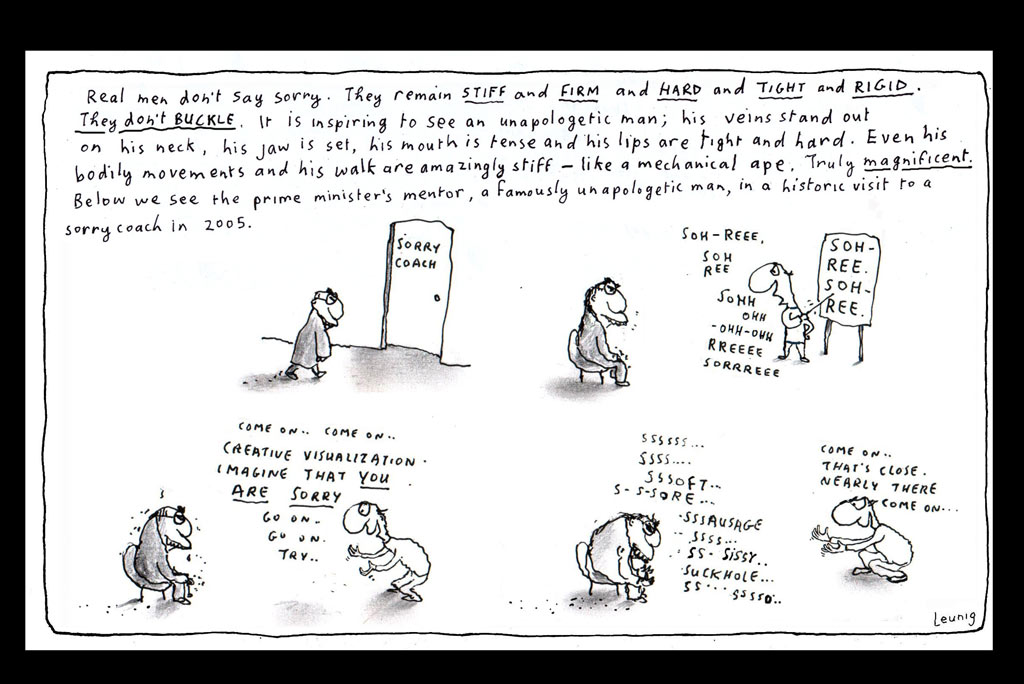
Leunig

Real Men

advent: two poems

‘Advent’, by Donald Hall

When I see the cradle rocking
What is it that I see?
I see a rood on the hilltop
     Of Calvary.

When I hear the cattle lowing
What is it that they say?
They say that shadows feasted
     At Tenebrae.

When I know that the grave is empty,
Absence eviscerates me,
And I dwell in a cavernous, constant
     Horror vacui.

– Donald Hall, ‘Advent’, in The Back Chamber: Poems (New York: Houghton Mifflin Harcourt, 2011), 22.

‘A Praise in Advent’, by Arnold Kenseth

See, as we stumble in the Advent snows,
God comes to fathom us. He sends his Son,
A gentleness by whom our fear’s undone,
A jubilance who overcomes our woes.

At first, we hold him in the ancient picture:
Skoaled by great angels, crooned by watching beasts,
Thick-footed shepherds by his side, deep frosts;
Love’s history: for you and me hope’s texture.

Now he is with us, at our village stones,
Fingering the mortar, testing. His mirth
Assaults our streets, and daily he goes forth
Troubling our elegant houses with unknowns

That were and are before whatever is
Began to be. By him was made the air,
Sparrows, eagles, Asias, the sweet despair
Of the free mind. All honest things are his.

He is the holy one we waited for, the Word
Who speaks to us who stammer back, the plot
Against the rich and poor, the Gordian knot
Our wit cannot untie. He is time’s Lord.

Thus, shall we sing him well these Christmas days
And at his birth-feast practice with him praise.

– Arnold Kenseth, ‘A Praise in Advent’, in The Ritual Year: Christmas, Winter, and Other Seasons: Poems (Amherst: Amherst Writers and Artists Press, 1993), 90.

More Advent Resources

AdventThis year, the Centre for Theology and Ministry has produced a resource to ‘assist individuals, households and small groups in their journey through Advent’. The booklet, which combines ‘individual daily reflections comprising a suggested Scripture reading, some words of reflection and a short prayer’, plus ‘ideas that can be used in the household or multi-age contexts’, can be downloaded here.

Also, a few years back, I posted some advent reflections. These can be accessed via hereherehere and here.

Advent Reflections: 2011–12

Waiting-by-Ramon-Mariano

You can also access previous year’s reflections here: 20072009 and 2010.

On dangerous ideas to change the world

A recent episode of Q&A, filmed during the Festival of Dangerous Ideas, dispensed with the most-usual band of dull politicians and instead hosted Peter Hitchens and Germaine Greer (a regular guest on the show), as well as two lesser minds – Hanna Rosin and Dan Savage. (Incidentally, I’ve never seen Tony Jones, who normally does a stellar job, moderate the discussion as poorly as he did. An off night for Tony.) As each guest responded to questions on subjects as diverse as the collapse of Western civilization, internet hook ups, women’s liberation, conservative politics and the permanence (or otherwise) of marriage in the ‘modern’ world, it became startlingly obvious that not only was Hitchens by far the best student of history on the panel but that he was also the only one who seems to hae a scoobie about the moral realities that give shape to such.

The final question, which came from Lisa Malouf, in more ways than one elicited the most revealing responses. The question was: ‘Which so-called dangerous idea do you each think would have the greatest potential to change the world for the better if were implemented?’

Here are the responses:

The entire episode, which is worth watching, can be downloaded here.

Poems of Devotion. A Review

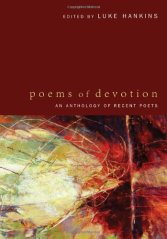
Poems of DevotionLuke Hankins (ed.). Poems of Devotion: An Anthology of Recent Poets (Eugene, OR.: Wipf and Stock, 2012). 236pp; ISBN: 978-1-61097-712-8

A guest-review by Mike Crowl.

Luke Hankins is not quite thirty. He’s already published a highly regarded book of poems, Weak Devotions, in which he ‘wrestles with the issues Donne, Herbert, Hopkins … also found worthy of their most impassioned work’ (John Wood), and a chapbook of translations from the French poems of Stella Vinitchi Radulescu (three of her poems are included in this book). He is also senior editor of the Asheville Poetry Review.

In Poems of Devotion, Hankins is aiming to present to the modern reader a substantial collection of poems on the theme of devotion, from a wide range of poets – American, English, and other nationalities, including some translations. If the word ‘devotion’ arouses thoughts of prissy, sappy pseudo poems that barely scratch the surface, you will find Hankins’ collection eschews such works; much of what is here is tough, painful, meditative, worshipful, and certainly deep enough to call you back again and again.

Hankins presents poets who are willing to wrestle with God. Many of them come from angles that are anything but devotional in the generally accepted sense. Some know from the outset where they’re going, but Hankins has looked more for poets who appear to work out their experience as they go along. As he writes in his introduction: ‘Great poems are – if not invariably, at least most often – an unfolding, not only for the reader, but for the poet in the process of composing’. And he quotes fellow poet, Charles Wright: ‘Writing is listening. Religious experience is silent listening and waiting. I have always been able to tell whether something I am writing is genuinely an expression of revelation or if it’s just me exercising my intellect. I can feel the difference, see it and taste it, but I don’t know how I can do that’. In the poems collected here, poetry is for the most part a means of meditating rather than an experience recounted.

That is not to say that these are floppy works without poetic structures: subtle rhymes and rhythms abound, the last lines are often a revelation; sharp metaphors of atmosphere and the spirit and creation are evident on every hand. The poets have taken their original searchings and crafted them well.

Many of these poets are not ‘saints’ in any ordinary sense, though they bring themselves to understand the need to submit to God’s will, even when it seems at odds with their very being, or when they haven’t found the answer they set out to look for. Old poets still look for answers in their old age. (Leonard Cohen has a couple of very good prose poems, for instance). There is also great joy and wonder (for example, in Luci Shaw’s Mary’s Delight; Shaw isn’t a poet I’ve greatly admired in the past, but this is a beauty) and praise (several poems are modern psalms) and worship (Thomas Merton’s Evening: Zero Weather, for instance).

Then there are the strange poems: Amit Majmudar’s extraordinary long piece about the angel we generally know as Satan; Michael Schiavo’s odd ‘dub versions of Shakespeare’s sonnets’, Bruce Beasley’s long, collage-like ‘Damaged Self-Portrait’.

Hankins offers seventy-seven poets in all. Some have only one poem, some have several, some provide several parts of a larger poem. But there’s no sense of stinting on the poets here; each one has room to breathe. There are some familiar names – T.S. Eliot, Theodore Roetke, E.E. Cummings, R.S. Thomas, Denise Levertov, Richard Wilbur – but the majority are unfamiliar – to me, anyway, and I suspect to many readers of the book.

The poems are book-ended by the substantial introduction, and a reprint of an interview between Hankins and Justin Bigos, which gives some background to Hankins and his poetic stance.
Launching

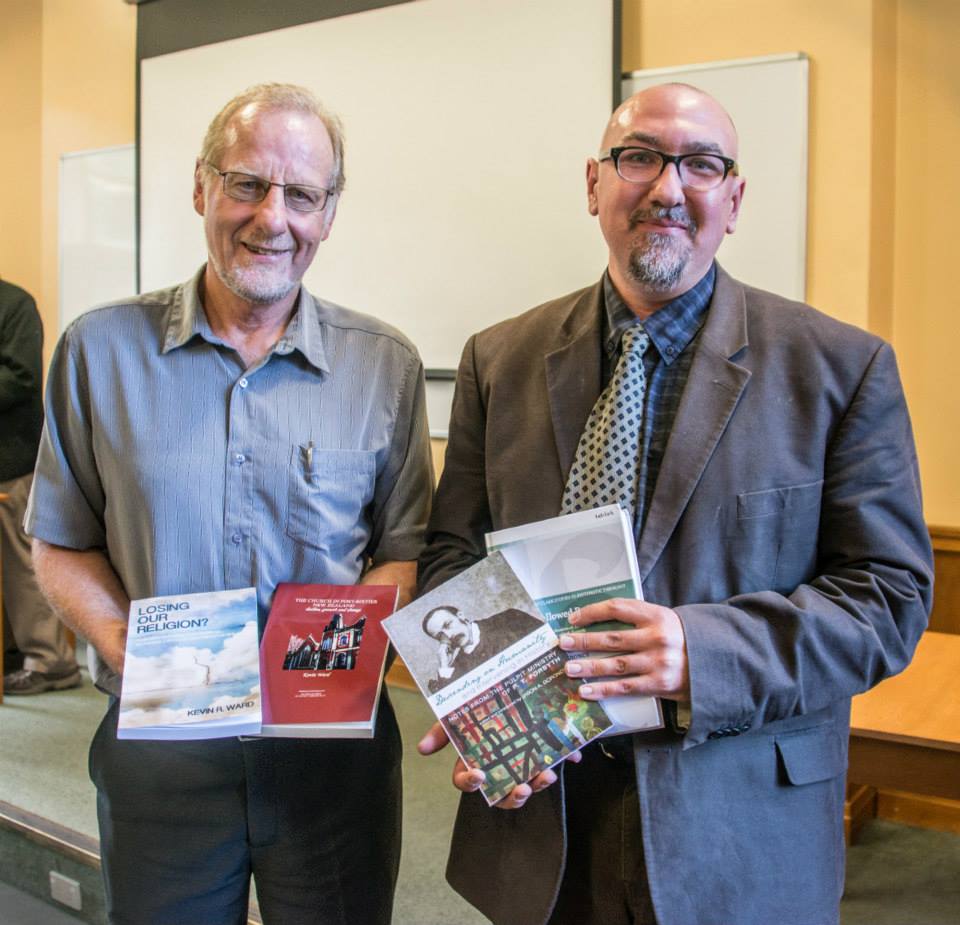
Book LaunchLast night, the Knox Centre hosted the launch of four books:

John Stenhouse and John Roxborogh spoke to Kevin’s books, and Mike Crowl and Murray Rae spoke to mine. All did a super job. It was a great night. Post-launch, the two authors (and a few others) then partied on with Chinese food and whiskey. The gastronomical combo seemed to work well.

Mike has since posted what he really would have liked to have said, some reflections on his experience of reading P T Forsyth.

Those unable to make it along to the launch can still pick up a copy of the books at the special book launch price. If you’re interested, please contact either Kevin or myself.

‘Our Great High Priest’, a song by Glen Soderholm

Glen SoderholmGlen Soderholm is an accomplished musician and songwriter, an ordained minister (with the Presbyterian Church in Canada), and a teacher in the area of the theology and curating of worship. He tells me that he is also ‘currently part of a group of friends giving birth to a missional community in his living room and neighbourhood, and that he has a deep and abiding interest in the relationship of trinitarian/incarnational/onto-relational theology to worship, arts, and culture’. 

Following my recent post on James Torrance’s hymn, ‘I know not how to pray, O Lord’, Glen contacted me and shared with me his own song on that theme, ‘Our Great High Priest’. This song, he tells me, was ‘inspired by a life-changing encounter with James Torrance’s book Worship, Community, and the Triune God of Grace. I read it and felt like I’d come home’. Glen gave me permission to share his wonderful song.

Our great high priest now at the throne
You ever live to pray for your own
And to the Father, you make us known
Our great high priest now at the throne

We long to pray, but we don’t know how
We yearn to stay, but lack the power
Our wills are weak, our tongues are tied
Oh lift us now, right to your side

For us you came to this low plane
For us you lived with joy and pain
For us you died to set us free
And rose on high to bear our plea

Glen’s music is available here or through iTunes.

‘Iolaire’, by Donald S. Murray

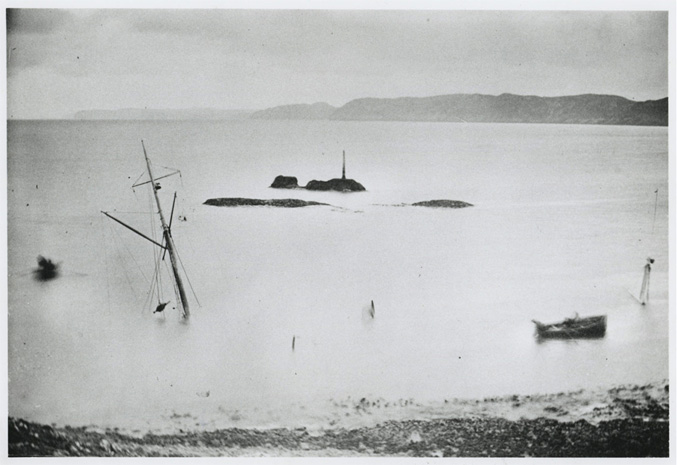
Iolaire Disaster

Donald Murray, who is originally from Lewis but now lives in Shetland, has shared a very moving (and very Calvinist!) poem about the Iolaire Disaster in 1919 for Remembrance Day 2013:

Sometimes we still sit upon that ledge
and consider the dark fervour of the waves,
wondering why some of us went under
while others clung with every fibre and were saved.
There are no answers to that question. Fortune
(whatever scholars tell us) does not favour the brave
or the virtuous. It rescued some
who could be wicked, hard and wretched ones enslaved
to drink or women, and swept aside
the good, the kind, those who each day forgave
others. We only know a rope was hurled
and we possessed both grip and faith
strong enough to hold it. Nothing else is known to us,
all as dark, intangible as the fervour of these waves.

Ministry and theology for a ‘Post-Fukushima world’

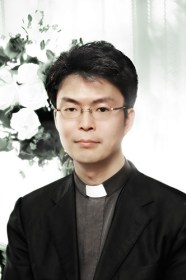
The Rev. Dr. Naoya Kawakami is the Secretary General of Touhoku HELP, a highly commendable ministry birthed in the wake of the Tōhoku earthquake and tsunami and the Fukushima Daiichi nuclear disaster in 2011. Touhoku HELP produced a video for a presentation at the recent WCC General Assembly in Busan. With Korean narration and English subtitles, it illustrates not only the recent (note: some of the footage was filmed last August) situation in Fukushima but also something of the inspiring ministry that is emerging from the rubble.

Naoya and I maintain a steady and prayerful correspondence. In a recent exchange, he wrote of the overwhelming number – over a half of million! – who live with the effects of radiation. He also wrote of his own need, amidst the crushing wave of need around him, to ‘keep time to think and read’, and of the urgency for what he calls a ‘new theology for this “Post-Fukushima” world’.

Naoya KawakamiHe mentioned too about a recent meeting of Japanese and Korean theologians who conversed about the situation birthed by the Fukushima tragedy. Among the topics discussed was the possibility of post-mortem salvation for the many victims of the tsunami and of radiation poisoning. He said,
In the tradition of the major protestant churches, there is no way of salvation for the dead who have not believed in Jesus Christ as Lord during their living time. But many Japanese theologians who have read PT Forsyth have spoken out against this tradition since the triple disaster. Yesterday, we talked about this issue. I shared the logic of Forsyth for this issue from his book This Life and the Next.

Inspired by Forsyth’s lively challenge (via his Protestant reappraisal of the doctrine of purgatory) that God alone – and not death – determines the time when creation reaches its maturity, these theologians found themselves, in faith and together, straining to hear – but hearing indeed – the promise of the Lord of hope in a land crushed under the burden of fear and despair.

Please join me in praying for Naoya (he carries a great burden for the people who live in the Fukushima area, and for the gospel), and please consider supporting the work of Touhoku HELP.

[Naoya’s dissertation was on Japanese receptions of Forsyth’s theology, and the subject of post-mortem conversion receives attention in the final chapter of my own study, Hallowed be Thy Name: The Sanctification of All Things in the Soteriology of P.T. Forsyth. Naoya kindly described my latest offering on Forsyth, Descending on Humanity and Intervening in History, as a ‘big present for Fukushima’.]

In defence of Clive James’ translation of Dante’s The Divine Comedy

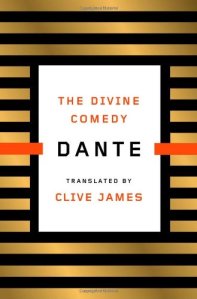
The Divine ComedyI’ve started reading Clive James’ translation of Dante’s The Divine Comedy, a volume which has been met with mixed reception. Colin Burrow (LRB) and Ian Thomson (FT), among others, have signalled their being largely unimpressed with James’ efforts. A common charge is that the translation lacks fidelity to the original in which ‘accuracy, precision and concision were sovereign virtues’. It’s not only ‘short on precision’, however. It also has too many ‘slangy phrases’ which betray the voice of the antipodean translator as much as they do the original author.

I’m still in ‘Hell’, so I ought to reserve my comments – and reserve the right to change my mind – but apparent already to me is that while James has taken certain liberties, made certain ‘additions’ (his is almost a paraphrase in parts), the wood is certainly not lost for the trees, and the result is something fresh, energetic, poetically sophisticated. James ‘lets Dante’s poetry shine in all its brilliance’. Moreover, the reader is carried along (a point not lost on Jane Goodall), and with a poem of this size the reader needs all the carrying they can get!

To be sure, it would be a great loss indeed if James’ rendering was the only one we had. But it’s not! And this means that fibre deficient highbrow ilk can take a chill pill, pour a wee dram and enjoy the astonishing offering on hand here. And for goodness sake, show some gratitude – the bloke’s been ploughing away on this work for decades!

Fiona Sampson correctly points out that the Comedy is best appreciated with a host of translations (Singleton’s pretty-flat-but-at-least-annotated version, or Ciardi’s pseudo-paraphrase, or Sinclair’s old English version, or Nichols’ excellent translation) alongside a copy of the magnificent lingua toscana itself – could there be a more perfect language for poetry? – and, I would add, at least one decent introduction (I like Sayers’) and a translation (like Musa’s) that includes some helpful critical apparatus. For, as one reviewer pointed out, not everyone is ‘au fait with 13th-century politics and religious struggle in Europe and the Italian peninsula’. And as another noted, ‘Dante requires at least some exegesis’. James, with genius, includes the footnotes and the exegesis in the text itself, and that without robbing the poem of its music.

Anyway, this grateful reader’s now heading back to his reading, and onwards to purgatory …

James Torrance on ‘Prayer and the Triune God of Grace’

James Torrance 4In 1997, Professor James Torrance gave four lectures on the theme ‘Prayer and the Triune God of Grace’, a theme beautifully articulated in his essay ‘The Place of Jesus Christ in Worship’ (published in Theological Foundations for Ministry, edited by Ray Anderson) and in his 1994 Didsbury Lectures (published as Worship, Community, and the Triune God of Grace), among other places.

The titles of the lectures were:

1. Prayer as Communion: Participating by Grace in the Triune Life of God
2. Prayer and the Priesthood of Christ
3. Different Models of Prayer: Stages in the Life of Prayer
4. Covenant God or Contract God: Is Prayer a Joy or a Burden?

Part 1 [MP3]

Part 2 [MP3]

Part 3 [MP3]

Part 4 [MP3]

Part 5 [MP3]

Part 6 [MP3]


The substance of the lectures – indeed, the substance of JB’s public ministry – is articulated in his hymn, ‘I know not how to pray, O Lord’:


1. I know not how to pray, O Lord,
So weak and frail am I.
Lord Jesus to Your outstretched arms
In love I daily fly,
For You have prayed for me.

2. I know not how to pray, O Lord,
O’erwhelmed by grief am I,
Lord Jesus in Your wondrous love
You hear my anxious cry
And ever pray for me.

3. I know not how to pray, O Lord,
For full of tears and pain
I groan, yet in my soul, I know
My cry is not in vain.
O teach me how to pray!

4. Although I know not how to pray,
Your Spirit intercedes,
Convincing me of pardoned sin;
For me in love He pleads
And teaches me to pray.

5. O take my wordless sighs and fears
And make my prayers Your own.
O put Your prayer within my lips
And lead me to God’s throne
That I may love like You.

6. O draw me to Your Father’s heart,
Lord Jesus, when I pray,
And whisper in my troubled ear,
‘Your sins are washed away.
Come home with Me today!’

7. At home within our Father’s house,
Your Father, Lord, and mine,
I’m lifted up by Your embrace
To share in love divine
Which floods my heart with joy.

8. Transfigured by Your glory, Lord,
Renewed in heart and mind,
I’ll sing angelic songs of praise
With joy which all can find
In You alone, O Lord.

9. I’ll love You, O my Father God,
Through Jesus Christ, Your Son.
I’ll love You in the Spirit, Lord,
In whom we all are one,
Made holy by Your love.

[For those who may be interested, I have included this hymn in my essay “‘Tha mi a’ toirt fainear dur gearan’: J. McLeod Campbell and P. T. Forsyth on the Extent of Christ’s Vicarious Ministry,” published in Evangelical Calvinism: Essays Resourcing the Continuing Reformation of the Church, edited by Myk Habets and Robert Grow (Pickwick, 2012).]