On the cost and grace of parish ministry – Part XI

I made the claim earlier that the crisis in ministerial and churchly identity is a crisis that finds it genesis in a defunct christology. This ought to be no surprise, for the Church is the body of Christ. And I drew attention to T.F. Torrance’s claim that everything for the Church depends on Christ’s humanity and substitutionary work. I have spoken a little of the implications of Christ’s humanity. Now let me press a little more on the church’s dependence upon Christ’s substitutionary work, and that by way of offering an essential clarification.

History leaves us with little question about the fact that when the substitutionary elements in Christ’s work are emphasised at the expense of the participatory elements – when, for example, salvation is reduced to an application of Christ’s merits as some sort of external transaction and the grace of union with Christ (of which Calvin was so fond) all but abandoned – then this inevitably sponsors the notion of the Church as a mere institution. [For an antidote, see Mike Gorman’s Inhabiting the Cruciform God: Kenosis, Justification, and Theosis in Paul’s Narrative Soteriology, and Todd Billings’ Calvin, Participation, and the Gift: The Activity of Believers in Union with Christ, and Braaten’s & Jenson’s Union with Christ: The New Finnish Interpretation of Luther]. It is this element of participation that I have been trying to emphasise here precisely because the implications of such a doctrine for pastoral practice and identity are so radically fruitful and liberating.

But lest we distort or impose limits upon the richness of Christ’s person and undermine his call to discipleship, we might also highlight the sense in which service is also a response to the love of God in Christ. But here again, the reality and form of this service is grounded in the vicarious humanity of Jesus Christ (see T.F. Torrance’s article on ‘Service in Jesus Christ’ published in Theological Foundations for Ministry). In other words, the response of the creature is constituted in and made possible by participation with Christ. To confess that service is the response to the love of God, therefore, is to confess that service is determined by the relationship established with and maintained by God, and not by any outcomes. Put differently, Christian service is, from first to last, about grace. Service, therefore, cannot stand on its own outside of the God-human relation (which itself in constituted in the hypostatic union). Little wonder then that service for service’s sake finally results in boredom and despair, and that preachers that seek to ‘whip-up’ the faithful by throwing them back upon their own resources participate in murder rather than resurrection. This reminds us too that service is not about servitude, but about freedom and the movement of love. It also recalls God’s provision of powers for service, and that Christ’s servants ought not assume authority for the service they undertake nor are they responsible for any results that arise. They must look for no reward beyond the joy of the relation itself.

This is only possible because in the incarnation of the Word God has undertaken to wear our humanity, to heal our brokenness and to put to death the idolatry that reigns from within the depths of human existence. Only in the humanity of God, therefore, lies the creative ground and source of true diakonia. And it is at this point that we finally come to where we might have begun: with baptism, and to the stunning truth that baptism is ordination to ministry. Indeed, baptism reminds us – among other things – of the fact that ministry is what the whole people of God is called to. The ‘Book of Order’ of the Presbyterian Church of Aotearoa New Zealand puts it thus: ‘Baptism invites us to share in God’s mission through our own vocation and commitment to God’s new and coming world. This vocation and commitment take shape in a range of occupations and activities in society’

Eugene Peterson once wrote:

‘The biblical fact is there are no successful churches. There are, instead, communities of sinners, gathered before God week after week in towns and villages all over the world. The Holy Spirit gathers them and does his work in them. In these communities of sinners, one of the sinners is called pastor and given a designated responsibility in the community. The pastor’s responsibility is to keep the community attentive to God. It is this responsibility that is being abandoned in spades’. – Eugene Peterson, Working the Angles: The Shape of Pastoral Integrity (Grand Rapids: Wm. B. Eerdmans, 1987), 2.

So the need to keep recalling the truth proclaimed in baptism, including the truth that the tools for Christian ministry are to be found underwater. Learning to breathe underwater, then, is the challenge of being Church.

◊◊◊

Other posts in this series:

[Image: Time]

Systematic Theology Association of Aotearoa New Zealand Annual Conference

The Annual conference of STAANZ will be held at the Knox Centre for Ministry and Leadership, Knox College, Arden Street, Dunedin, from November 11–12, 2010.

The Conference will include the following papers:

  • Bruce Hamill, Why Practical Theology Amounts to Ecclesiology: clarifying issues in the current ecclesiology debate
  • Hugh Bowron, Walter Kasper on the Church and the Churches
  • Merv Duffy, The True Vine: The Ecclesiology of the First Catholic Missionaries in Aotearoa
  • Harold Hill, The Salvation Army as a case study of the clericalisation process
  • Nicola Hoggard Creegan, On the Church and Moral Character (Title to be confirmed)
  • Kevin Ward, Selling out the house of God?
  • Andrew Nicol, The Church As Detour: Reflections in the Theology of Robert W. Jenson
  • Andrew Torrance, Søren Kierkegaard on the Relationship between Human Agency and Divine Agency in the Process of Reconciliation
  • Don Fergus, Taking up Space on Earth: Dietrich Bonhoeffer on the Visbility of the Church
  • Mark Gingerich, Kierkegaard’s Understanding of Original Sin and its Implications for his Understanding of the Self.
  • Christopher Holmes, The Ecclesia and the Presence of Christ.
  • Myk Habets and Greg Liston, Propositions Toward a Third Article Ecclesiology: Methodological Criteria and Constitutive Features.
  • Graham Redding, Perspectives on Church and Ministry: Reflections on a Moderatorial Term
  • Adam Dodds, The Necessity of an Ecclesial Missiology
  • Alan Thomson, Ecclesiology Between Purpose and Place: Negotiating the Gap

More information is available here.

[Image: bobtravis @ Photography Blogger]

On the cost and grace of parish ministry – Part X

In an earlier post, I drew attention to some words from Michael Jinkins’ (in Called to Be Human: Letters to My Children on Living a Christian Life) about the relationship that exists between friendship and a thoroughly-human life. I suggested there that ‘effective pastoral ministry is impossible apart from friendship precisely because human flourishing is impossible apart from friendship. Only non-human pastors can go it alone, those particularly uninterested in being associated with the imago dei in creation’. In this post, I wish to return to this topic, and that again by way of Jinkins. In his book, Letters to New Pastors, which is a collection of letters from a mature pastor to fictional recipients, Professor Jinkins notes that while friendship is no harder for pastors than it is for others, ‘what is more difficult for pastors is finding safe places to share their struggles and frustrations’ (p. 167). He continues:

‘Ministers often tell me they just don’t feel comfortable being vulnerable with certain colleagues. Sometimes they feel least safe with colleagues in their own denomination, especially if these colleagues might play a role in their future calls. Ministers also tell me they cannot be completely vulnerable with members of their congregations. I think what they’re basically saying here is that they don’t want to confuse their role as pastor or transgress a boundary that might undermine their calling’. (p. 168)

And this raises the question of whether pastors can be friends with members of their own congregations. Jinkins again:

‘On the face of it, this is one of those questions you want to answer unequivocally: “Yes, of course. If you can’t be friends with members of your congregation, who can you be friends with?” One retired pastor told me that several of his oldest, closest friends come from the congregations he has served over the years. He’s gone on vacations with them, named his children after them, and so forth. He said it is simply foolish and arrogant for pastors to pretend that they can’t be friends with members of their congregations.

Other pastors tell me something different. While they maintain deep and affectionate relationships with members of their congregations, relationships they refer to as friendships, they try never to lose sight of the larger obligation they have to serve as pastor to and to lead the whole congregation. They work hard to remind themselves of their role as pastors, which means there may be times when the congregation’s claim on them has priority over the claims of a particular friend’. (p. 168)

Most pastors with whom I have discussed this topic at any length will inevitably describe the tension that exists here between these two realties. Jinkins warns of the dangers associated with both minimising and over-maximising this tension, before recalling that such tension is not unique to pastors, that many friendships require negotiating just such straits: ‘I do think we have to be particularly careful about doing anything that might invite the charge of favoritism that can emerge in a congregation around friendships with the pastor. We need to take this very seriously. We need to keep a healthy measure of self-criticism in play to make sure our friendships do not lead us to compromise our pastoral responsibilities for the whole congregation. The congregation needs us to be its pastor, and we simply must not compromise that calling. But I cannot imagine life as a pastor without real friendships among the people with whom I serve Christ’ (p. 169).

◊◊◊

Other posts in this series:

[Image: Jankel Adler, ‘Two Rabbis’. 1942. Oil on canvas, (86 x 112.1 cm). Museum of Modern Art]

September exploits …

Reading: Desiring the Kingdom: Worship, Worldview, and Cultural Formation by James K.A. Smith; A Long Obedience in the Same Direction: Discipleship in an Instant Society by Eugene H. Peterson; Home by Marilynne Robinson; Absence of Mind: The Dispelling of Inwardness from the Modern Myth of the Self (The Terry Lectures Series) by Marilynne Robinson; On My Country and the World by Mikhail Gorbachev; The Theology of Food: Eating and the Eucharist by Angel F. Mendez Montoya; Theology of the Reformed Confessions by Karl Barth; Practicing Our Faith: A Way of Life for a Searching People edited by Dorothy C. Bass; Confessions of a Reformission Rev.: Hard Lessons from an Emerging Missional Church by Mark Driscoll (I confess that some skim reading was required here, but this is proof that I read widely!); The Challenge of Jesus’ Parables edited by Richard N. Longenecker; Counterpoint by R.S. Thomas; The Parables of Grace by Robert Farrar Capon; Between Two Worlds: Understanding And Managing Clergy Stress by Andrew R. Irvine; Theological Controversies in the Presbyterian Church of New South Wales, 1865–1915: The Rise of Liberal Evangelicalism by Peter Barnes.

Listening: Songs of Love & Hate by Leonard Cohen; Beneath Southland Skies by Mike Brosnan; Mass in G Minor by Vaughan Williams; In Buenos Aires Volume 1: 1973 Concert by Bill Evans Trio; Symphonies Nos. 7 ‘Sinfonia Antartica’ & 8 by Vaughan Williams; God Willin’ & The Creek Don’t Rise by Ray Lamontagne & The Pariah Dogs; Trouble and Gossip In The Grain by Ray LaMontagne; August & Everything After, Recovering the Satellites, This Desert Life, Across A Wire: Live In New York City, Films About Ghosts, Saturday Nights & Sunday Mornings, New Amsterdam: Live at Heineken Music Hall and Hard Candy by Counting Crows; So Much More, Hope for the Hopeless and Brett Dennen by Brett Dennen; Supply And Demand and Last Days At the Lodge by Amos Lee; Stop All The World Now, Sound The Alarm, Australia by Howie Day; You Can Tell Georgia, Take My Blanket and Go, Stompin Grounds, Sessions From Motor Ave., Paris In The Morning, Only Four Seasons, Last Clock On The Wall, Julie Blue, Joe Purdy and Canyon Joe by Joe Purdy.

Watching: U2: Go Home – Live from Slane Castle; Abandoned; Law Abiding Citizen; Salt; Saw VI; Alice in Wonderland; The Matrix; When Did You Last See Your Father?; Pink Floyd: Pulse; Robin Hood; Love Happens.

Brewing: Sumatra Mandaling.

Drinking: Felton Road Pinot Noir Cornish Point 2009; Waipara Hills Pinot Noir 2008.

[Image: Elizabeth Kaeton]

On the cost and grace of parish ministry – Part IX

In my most recent post in this series, I made the claim that to engage in Christian ministry is to take up an invitation to participate in the life of God. Indeed, it is to enter into God’s rest. To enter such rest is to be, in Irenaeus’ words, ‘fully alive’. More wonderfully, it is to be ‘the Glory of God’. In this post I wish to ruminate on the Decalogue’s fourth word; namely, that which concerns the grace of Sabbath, the rest which renews and restores:

‘Remember the sabbath day, and keep it holy. Six days you shall labor and do all your work. 10 But the seventh day is a sabbath to the Lord your God; you shall not do any work – you, your son or your daughter, your male or female slave, your livestock, or the alien resident in your towns. For in six days the Lord made heaven and earth, the sea, and all that is in them, but rested the seventh day; therefore the Lord blessed the sabbath day and consecrated it’. (Exod 20.8–11)

Whereas the First Word is about how we honour God with our loyalty, the Second about how we honour God with our thought life, the Third about how we honour God with our words, this Fourth Word concerns how we honour God with our time. This word has nothing at all to do with legalistic notions associated with various brands of Sabbatarianism. It does have everything to do with rest and with God’s invitation that we enter his rest. This word is all about the use of our time in a rhythm of toil and rest, work and worship. It reminds us that the goal of God’s creation is not humanity, but Sabbath. And unlike the other six days, the seventh day has no end. In other words, we live in the Sabbath now. The Sabbath of God is the whole history of the world from the sixth day until the end (of time).

Few commandments in holy writ so cut across the grain of Western society as this one. In his book, The Soul of Ministry: Forming Leaders for God’s People, Ray Anderson devotes an entire chapter to the matter of Sabbath. He speaks of the ‘slave master self’ that lurks at the edges of the human psyche. Whether it be a demanding parent or boss or job, like Israel we too carry this virus with us – a ‘hidden virus with an insatiable appetite for healthy flesh’ (p. 60). While Israel had just been redeemed from a dehumanising bondage in Egypt, they were yet to be redeemed from the bondage that existed in their very being. And so not only would they need to learn ‘the discipline of the Sabbath’ for their own well-being, but they would also need to learn ‘the theology of the Sabbath’ in order to strengthen their faith and to give perspective to their hope.

Anderson writes:

‘Without a theology of the Sabbath, the discipline of the Sabbath would itself become a slave master as, in fact, quickly happened. By the time of Jesus, the Sabbath discipline had become a law more severe and sacred than any moral imperative. Paradoxically, liberation from the taskmaster of the sabbath law was a primary occasion for the condemnation and execution of Jesus. That which was to be a sacrament of liberation, of renewal and restoration, had become a rigid and inhumane rule from which liberation was effected by the ministry of Jesus!’

Sabbath is not about taking a ‘day-off’ – what Eugene Peterson calls ‘a bastard Sabbath’ (in Working the Angles: The Shape of Pastoral Integrity, p. 66); rather it is a conscious effort of entering into, and responding to, the rhythms and actions of Spirit at work in creation. It is realising that God is not waiting for us to wake up to begin working each day, but that God is working already and inviting us, when we awake, firstly to listen, and only then to join in.

Sabbath time is not a time that proves its worth or justifies itself. It is not a time to ‘get things done’. It is a time of rest, of ‘not-doing’. No Patmos visions. No Sinai’s. No Mounts of Transfiguration. It is, put simply, the sanctification of time.

Thinking about Sabbath recalls that the Sabbath was God’s way of operating before it became ours. (Geoffrey Bingham’s The Law of Eternal Delight is helpful here). So Genesis 1.31–2.3:

‘God saw everything that he had made, and indeed, it was very good. And there was evening and there was morning, the sixth day. Thus the heavens and the earth were finished, and all their multitude. And on the seventh day God finished the work that he had done, and he rested on the seventh day from all the work that he had done. So God blessed the seventh day and hallowed it, because on it God rested from all the work that he had done in creation’.

There is no commandment here for us concerning what we should do with this day. What there is is a sense of completeness. On the seventh day – not at the end of the sixth day – God stopped creating. But that does not mean that God is finished working. Rather, God keeps on sustaining and providing for his creation. God is, in every sense, ‘the faithful Creator’ (1 Pet 4.19).

The other thing that Genesis 1 and 2 highlight is that the goal of God’s creation is not humanity but Sabbath. Creation was not finished until God made the Sabbath. The seventh day was not God’s day off. It was the day God finished creating and rested. Also, unlike the other six days, the seventh day has no end. When we read through Genesis 1 we notice a rhythm: ‘And God said … and there was evening and there was morning, the first day. And God said, … and there was evening and there was morning, the second day … the third day … the fourth day … the fifth day … the sixth day’. But when we get to the seventh day there is no end because the seventh day is all the history of the world from the end of the sixth day until the end of time itself. In other words, we are living in the seventh day now. This is what we were made for – to enter into God’s rest.

And what was creation’s seventh day was, for the primal couple, only their second. Might it not be significant that immediately after creating them God thrust them into his rest? Might it not be that the reason that there remains a Sabbath-rest for the people of God (Heb 4.9) is precisely because we are those who live in God’s own rest; i.e., in God’s finished work in creation and redemption. The people of God are those who take seriously Jesus’ cry ‘It is finished’ and live in the truth that we have no rest apart from that in the crucified and risen Lamb! Jesus Christ is our Sabbath rest!

Sabbath makes no sense apart from its relationship to the creation, and to the covenant that God has made with creation. It is little surprise then that it is the only one of the Ten Words that finds its voice in the creation narratives, completing both the creation itself, and marking the beginning of creation’s growth and renewal by God. We might also note here that the Sabbath command was revealed to Israel in hard-copy form at Sinai before they set down to write the creation account. In other words, Genesis makes most sense (and matters most) because Exodus has happened. Only in this order – redemption then creation – is the theo-logic of the Fourth Word preserved. This recalls not only that redemption and creation are interwoven, but also that Israel already had a theology of redemption and creation before they had a theology of the Fall, sin and death.

The second creation account reads: ‘Thus the heavens and the earth were finished, and all their multitude. And on the seventh day God finished the work that he had done, and he rested on the seventh day from all the work that he had done’ (Gen 2.1–2). On these verses, Anderson notes: ‘The sixth day represents the culmination of creaturely possibility, while the seventh day represents the possibility and creative conclusion that God provides. A theology of the Sabbath, therefore, is a theology of God’s Sabbath ministry of completion of his work. This is the ministry of renewal and restoration’ (pp. 62–3).

In the Book of Hebrews, the author understands the Sabbath rest as synonymous with the Israelites journey from slavery to liberation, from a land of mud and whips to that ‘flowing with milk and honey’ (Exod 3.8, 17; 13.5; 33.3). The author describes entry into this land of promise as ‘entering into God’s rest’ (Heb 3.11, 18; 4.3), identifying this entering by citing the second creation account in Genesis (Heb 4.4; Gen 2.2). The author of Hebrews suggests that the redeemed Israelites failed to enter into this rest because of their disobedience. Thus the invitation to enter into the rest remains: ‘So then, a sabbath rest still remains for the people of God; for those who enter God’s rest also cease from their labors as God did from his’ (Heb 4.9–10).

Anderson notes that ‘the Sabbath rest of God can be understood as the continuing ministry of God “completing his work” on the seventh day. The seventh day is the end of the sixth day. This end goal represents the last or final work of God. The seventh day, therefore, provides an end-goal orientation for the sixth day. As the ‘last day’, the seventh day now casts its light back into the sixth day, the next to the last day’ (p. 63). Recalling Dietrich Bonhoeffer, Anderson reminds us that while the last day is the ultimate, the next to the last is the penultimate. It is the ultimate (the seventh day) that gives meaning to the penultimate (the sixth day). In other words, today makes sense because of tomorrow. Furthermore, tomorrow does not eliminate the significance of today so much as provide a proper context, dignity and perspective for the environment in with earthly existence is lived out and apart from which the six days would seem pointless and endless. ‘Anticipation of the seventh day, even from the first day of the week, makes what would otherwise be unbearable something that can be accepted as having only limited power and duration’ (p. 63).

The Sabbath requirement also reminds us that there is more to life than work. This is not because work is a bad thing indeed, work is just as ‘holy’ as rest from it – but the Sabbath was given to (in)form the usage of all our time. In Deuteronomy 5, the reason given for Sabbath-keeping is that our ancestors in Egypt went for something like 400 years without rest. Under Egyptian slavery they were compelled to work – they never had a day off. They were considered slaves, not people. Hands, work units for building bricks for shrines of death. And so when they were redeemed they were released into a rest that had eluded them for hundreds of years. Their Sabbath was identified with their salvation. That is why, it seems to me, that as part of the Sabbath they were not only to rest but to celebrate their redemption. And not only them but also their servants and their livestock and the sojourners among them. This was a gift to the whole covenant community because when God brings us out of bondage he frees us so we are no longer slaves to our work. So Jesus’ words: ‘Come to me, all you that are weary and are carrying heavy burdens, and I will give you rest. Take my yoke upon you, and learn from me; for I am gentle and humble in heart, and you will find rest for your souls. For my yoke is easy, and my burden is light’ (Matt 11.28–30). Jesus comes into our sixth day with the invitation, ‘come with me into my own Sabbath rest’.

So we given a glimpse here into the truth that the Sabbath is God’s grace gift for all round renewal. We were not created to be at it all the time, to be slaves to our work, or to our egos, or to a day. Remembering the Sabbath day, therefore, has to do with trusting in Christ whether or not we make or break the day. It has to do with trusting that Christ is working on the Sabbath in our place. It has to do with the liberating  reality that this world does not revolve around us and what we are doing. It has to do with saying ‘Yes’ to Jesus’ invitation to come and enter into his rest. It has to do with making a conscious effort of entering into and responding to the rhythms and actions of the God who is always at work. It has to do with God’s work of bringing humanity into his rest. It has to do with God ‘finishing’ his ancient work of renewal and restoration and healing and liberation from oppression and sin and abuse and injustice and all else that restricts human flourishing. That is where the Pharisees got it so wrong and Jesus got it so right (see Matthew 12.1–13 and John 5.1–18). Jesus was accused of ‘working’ on the Sabbath. Of course he was working on the Sabbath! What else would God be doing on the Sabbath but healing and liberating a groaning creation from the bondage of the sixth day and bringing it into the very rest that it was all created for!

The fourth commandment is not given to bind us up in legalistic knots. It is given so that we might not be slaves anymore to anything, but rather we might enjoy our won-freedom and rest in God. It is given that we might not try to live as though God does not exist. It is given that we might participate in the ministry and rest of Jesus. In other words, it is an invitation to trust in One who watches over us, who neither slumbers nor sleeps, and who works for us. So Matthew 6.25–34:

‘Therefore I tell you, do not worry about your life, what you will eat or what you will drink, or about your body, what you will wear. Is not life more than food, and the body more than clothing? Look at the birds of the air; they neither sow nor reap nor gather into barns, and yet your heavenly Father feeds them. Are you not of more value than they? And can any of you by worrying add a single hour to your span of life? 28 And why do you worry about clothing? Consider the lilies of the field, how they grow; they neither toil nor spin, yet I tell you, even Solomon in all his glory was not clothed like one of these. But if God so clothes the grass of the field, which is alive today and tomorrow is thrown into the oven, will he not much more clothe you – you of little faith? Therefore do not worry, saying, “What will we eat?’ or “What will we drink?’ or “What will we wear?’ For it is the Gentiles who strive for all these things; and indeed your heavenly Father knows that you need all these things. But strive first for the kingdom of God and his righteousness, and all these things will be given to you as well. “So do not worry about tomorrow, for tomorrow will bring worries of its own. Today’s trouble is enough for today’.

Jesus’ work as the Incarnate Son takes place during the sixth day and is done with a view of bringing to completion the creation which he began as the Word of God. Thus he taught that ‘the Sabbath was made for humankind, not humankind for the Sabbath’, and that ‘the Son of Man is lord even of the Sabbath’ (Mark 2.27–28). Through the Spirit, the Son of Man continues the Father’s work of healing, restoring, liberating, comforting, forgiving not only on the sixth day, but also on the Sabbath. By doing this, the ‘lord of the Sabbath’ is setting a precedent that ought to find expression in every day of the week. (See, for e.g., Rom 14.5–6; cf. Col 2.16).

Anderson writes:

‘The original consecration of the seventh day as the Sabbath left the other six days unconsecrated, as it were. Only on the evening of the sixth day could the Israelite stand with his or her back to these days and step into the day consecrated by the renewal and restoration of the Lord. On this day they were to celebrate life as a gift of Yahweh, with no efforts of their own needed beyond the necessary chores. The point was that they were to leave behind the struggle to live by their own efforts and live out of the gracious provision of God. Those who attempted to carry over into this consecrated day some tasks related to their own purpose were severely judged. Some were even put to death for this violation. Even so small a matter as gathering sticks for the fire on the Sabbath caused the death of one man (Num 15:32–36). The enormity of the violation was not determined by the scale of the incident, but because it served to undermine the entire fabric of the covenant grounded in grace alone. The ‘slave driver’ within must be exposed and removed before we can experience the full deliverance of our humanity from bondage. Grace does not stop with the removal of external conditions of oppression and pain, but seeks deep inner healing and recovery’. (pp. 64–5)

Through their disobedience, the primal couple fell out of the rest that was given to them to enjoy. As a consequence, their death became sealed with that of the sixth day. The Sabbath, therefore, served as a ‘sacramental bridging of this abyss’ (p. 65) which offered immediate relief from nature’s powers and the threat of death. While the six days would always be lived under these powers, the seventh day provided relief, renewal, and restoration that pointed towards a final jubilee and the hope of the reconciliation of all things to God. Saint Paul also witnesses to something of this:

‘For the creation waits with eager longing for the revealing of the children of God; for the creation was subjected to futility, not of its own will but by the will of the one who subjected it, in hope that the creation itself will be set free from its bondage to decay and will obtain the freedom of the glory of the children of God’ (Rom 8.19–21).

This setting free happens in and through Jesus Christ who in his incarnation entered into the nothingness and dread of human depravity in order to bring creation into the saving rest of God. The Bible’s word for this action is ‘grace’. Grace is never a soft thing. Grace is a man groaning on a cross, dying on a bitter tree, not only for his friends but also for those who would wish him and his Father dead. Grace is God redeeming in holy love. Grace is God in his eucatastrophic action in the face of Nature’s catastrophe. Grace is God taking seriously the scandalous nature of sin’s offence, and himself going down into the experience of nothingness and dread, into hell, into death, into the furnace of his own wrath, into the radical depths of its wound, in order to save. There can be no higher gift. This grace alone, the grace of the initiating Father, lived in the obedient Son, and made alive through the Spirit, carries humanity home and brings creation into the Sabbath rest of God. Only then can Paul sing: ‘For I am convinced that neither death, nor life, nor angels, nor rulers, nor things present, nor things to come, nor powers, nor height, nor depth, nor anything else in all creation, will be able to separate us from the love of God in Christ Jesus our Lord’ (Rom 8.38–39).

Now the ‘Lord who is the Sabbath’ calls us into his rest in order that we might join him in doing the things that he is doing ‘on the Sabbath’ every day of the week. There can be no place here for that Sabbatarianism that consecrates one day out of all the others. In Christ, every day is about Sabbath rest, renewal and healing, that our entire ministry may be performed under the grace-aegis of God. To keep the Sabbath is never about conformity to rules and regulations (Col 2.22), but is about conformity to Christ who is the Lord of the Sabbath.

I conclude this post with a wee poem that I penned recently. It is titled ‘Sabbath’:

Sabbath means
living with limits –
with the limits of time: of millennia, of centuries, of minutes and of seconds,
with the limits of creatureliness,
with the limits of creation itself,
with the limits of knowing.

Sabbath means
living with faith –
faith in the muscle of ancient and unbroken promises,
faith in the magic of rest,
faith in the remorselessness of Love’s ongoing endeavour;
Wendell Barry is right: ‘Great work is done while we’re asleep’.

Sabbath means
living with hope –
hope that the deepest reality and creation’s flourishing do not revolve around me,
hope in the renewing power of stillness,
hope that both pools and rapids (in)form the life of the one river,
hope that a community – whose roots are long and deep, and whose shoots recur fresh and green – has heard rightly.

Sabbath means
living with love –
love of one’s self and of one’s other,
love of election to vocation,
love of the law of eternal delight,
love of what is,
and love of the other days, for ‘the Sabbath cannot survive in exile, a lonely stranger among days of profanity’ (Abraham Heschel).

© Jason Goroncy,
2 September 2010
Bannockburn

◊◊◊

Other posts in this series:

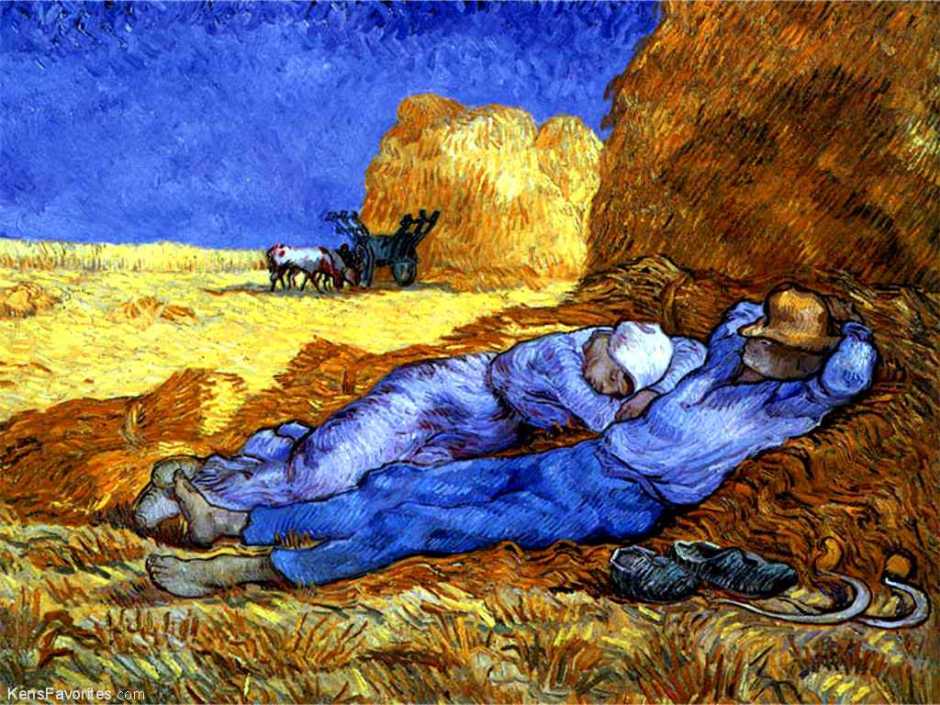
[Image: Vincent van Gogh, ‘Noon: Rest From Work (After Millet)’. 1889–90; Musée d’Orsay, Paris]

We celebrate Spring’s returning …

Dear God,

We celebrate spring’s returning and the rejuvenation of the natural world. Let us be moved by this vast and gentle insistence that goodness shall return, that warmth and life shall succeed. Help us to understand our place in this miracle. Let us see that as a bird now builds its nest, bravely, with bits and piece, so we must build human faith. It is our simple duty; it is the highest art; it is our natural and vital role within the miracle of spring; the creation of faith.

Amen

– Michael Leunig, When I Talk to You: A Cartoonist Talks to God (Riverside: Andrews McMeel, 2006), np.

‘One Heart’, ‘Baptism’, and ‘Old Story’ by Franz Wright

There are two poets whose work I’ve been devouring of late: RS Thomas and Franz Wright. I will write more about the former at some other stage, of why the Welshman’s words haunt me in the hours I ought to be sleeping and of why he may in fact be one of the poets that I’ve been listening for for all my life. This wee post, however, is about Wright, an American poet writing with a different energy to Thomas’, and whose words, which are no less honest, move at a pace which betrays that he inhabits not only a different time, but a younger nation as well.

Published about a year ago, in a NYT article titled ‘Dark Glamour’, Daisy Fried writes about Franz Wright’s poems:

‘Wright’s poems sometimes feel insufficient, but also, in that insufficiency, authentic. Is there really any such thing as reconciliation? the poet seems to ask, even as he yearns for reconciliation. Anyone else might have come to terms with this quandary years ago. But poetry, like quandaries, should be unsolvable. What’s bothersome about Franz Wright is what keeps his poetry alive, and makes him worth coming back and back to’.

While these may not be the most striking examples, there is, I think, in this Pulitzer Prize-winning poet’s poems ‘One Heart’, ‘Baptism’ and ‘Old Story’ (all published in Walking to Martha’s Vineyard), instances of what Fried is eluding to:

◊◊◊

One Heart

It is late afternoon and I have just returned from
the longer version of my walk nobody knows
about. For the first time in nearly a month, and
everything changed. It is the end of March, once
more I have lived. This morning a young woman
described what it’s like shooting coke with a baby
in your arms. The astonishing windy and altering light
and clouds and water were, at certain moment,
You.

There is only one heart in my body, have mercy
on me.

The brown leaves buried all winter creatureless feet
running over dead grass beginning to green, the first scent-
less violet here and there, returned, the first star noticed all
at once as one stands staring into the black water.

Thank You for letting me live for a little as one of the
sane; thank You for letting me know what this is
like. Thank You for letting me look at your frightening
blue sky without fear, and your terrible world without
terror, and your loveless psychotic and hopelessly
lost
with this love.

◊◊◊


Baptism

That insane asshole is dead
I drowned him
and he’s not coming back. Look
he has a new life
a new name
now
which no one knows except
the one who gave it.

If he tastes
the wine now
as he is allowed to
it won’t, I’m not saying it
will
turn to water

however, since You
can do anything, he
will be safe

his first breath as an infant
past the waters of birth
and his soul’s, past the death water, married–

Your words are spirit
and life.
Only say one
and he will be healed.

◊◊◊

Old Story

First the telephone went,
then
the electricity.

It was cold,
and they both went to sleep
as though dressed for a journey.

Like addictions condoned
from above evening
fell, lost

leaves waiting
to come back as leaves–
the long snowy divorce. . .

That narrow bed, a cross
between an altar
and an operating table. Voice

saying, While I was alive
I loved you.
And I love you now.


Naming God

Long-time readers of Per Crucem ad Lucem will know of my abiding interest in discussions about naming God; which reminds me, my friend Rick Floyd has two fantastic posts here and here on this topic. Anyway, inspired by Robert Jenson, Stanley Hauerwas has written a stimulating piece on this same topic. Here’s a few snippets:

‘… it should not be surprising that in a culture which inscribes its money with “In God We Trust,” atheists might be led to think it is interesting – and perhaps even useful – to deny god exists. It does not seem to occur to atheists, however, that the vague god which some seem to confuse with trust in our money cannot be the same God who raised Jesus from the dead, having before raised Israel from Egypt’.

‘… We, like the people of Israel, would like to think we get to name God. By naming God we hope to get the kind of God we need, that is, a god after our own likeness. We can make the “more” that must have started it all after our own image. But God refuses to let the people of Israel – or us – assume that we can name the One who will raise Israel from Egypt. Only God can name God. That, moreover, is what God does’.

‘… The God we worship is not a vague “more” that exists to make our lives meaningful. The God we worship is not “the biggest thing around.” The God we worship is not “something had to start it all.” The God we worship is not a God that insures that we will somehow get out of life alive. The God we worship is not a God whose ways correspond to our presumptions about how God should be God.

That God has come near to us in Christ does not mean that God is less than God. God is God and we are not.

Yet we believe that the God we worship has made his name known. We believe we have been given the happy task of making his name known. We believe we can make his name known because the God we worship is nearer to us than we are to ourselves – a frightening reality that gives us life. We believe that in the Eucharist, in the meal of bread and wine, just as Jesus is fully God and fully man, this bread and this wine will, through the work of the Spirit, become for us the body and blood of Christ.

To come to this meal in which bread and wine become for us the body and blood of Christ is to stand before the burning bush. But we are not told to come no closer. Rather we are invited to eat this body and drink this blood and by so doing we are consumed by what we consume becoming for the world God’s burning bush.

By being consumed by the Divine Life we are made God’s witnesses so that the world may know the fire, the name, Jesus Christ’.

[Image: bLaugh]

‘It is one of those faces’, by R.S. Thomas

It is one of those faces
beginning to disappear
as though life were at work
with its eraser. It drizzles
at the window through which
I regard it. As one realising
its peril, it accosts me
in silence at every corner
of my indifference, appealing
to me to save it gratuitously
from extinction. There was a moment
it became dear to me, a skull
brushed by a smile as the sun
brushes a stone through ravelled
passages in the hill mist.
Must I single it with a name?
I am coming to believe,
as I age, so faithful its attendance
upon the eye’s business, it is myself
I court; that this face, vague
but compelling, is a replica
of my own face hungry for meaning
at life’s pane, but blearing it
over as much with my shortness
of faith as of breath.

– R.S. Thomas, Counterpoint (Newcastle upon Tyne: Bloodaxe Books, 1990), 46.

A prayer for the meeting of the General Assembly

As the Presbyterian Church of Aotearoa New Zealand prepares to gather for its General Assembly next week, it’s a time not only for reading through hundreds of pages of reports and recommendations, but also to be praying. So …

Almighty God,
in Jesus Christ you called disciples
and, by the Holy Spirit, made them one church to serve you.
Be with members of our General Assembly.
Help them to welcome new things you are doing in the world,
and to respect old things you keep and use.
Save them from empty slogans or senseless controversy.
In their deciding,
determine what is good for us and for all people.
As this General Assembly meets,
let your Spirit rule,
so that our church may be joined in love and service to Jesus Christ,
who, having gone before us,
is coming to meet us in the promise of your kingdom. Amen.

– Presbyterian Church (U.S.A.), Book of Common Worship, prepared by the Theology and Worship Ministry Unit for the Presbyterian Church (U.S.A.) and the Cumberland Presbyterian Church (Louisville: Westminster/John Knox Press, 1993), 805.

Jim Wallis on Faith, Ethics and Public Life

A guest post by Andrew Bradstock.

With his rare ability to challenge people to think afresh about the issues of the day, and consider how religious faith can transform hope-less situations into hope-ful ones, Jim Wallis is always worth hearing.

But with so many news items at present involving ‘faith’ in different ways – from the threats to burn the Koran and proposal for a Muslim community centre near Ground Zero in the US, to the Pope’s visit to the UK, to the debates here and elsewhere about what it means to be ‘secular’, to the ongoing conflicts in Iraq, Afghanistan and Israel/Palestine – this is a particularly apposite time to get the insider’s perspective that a global commentator and White House adviser like Wallis is able to give.

There is a rare opportunity to hear Jim Wallis in person in Dunedin next week, and I hope you are planning to seize it!

Next Tuesday, 28 September, from 2.00 – 6.00 pm at First Church in Moray Place, Wallis will speak at a Conference on Faith, Ethics and Public Life. The main event of the afternoon will be the Howard Paterson Memorial Lecture in Public Theology, to be introduced by the Vice Chancellor, Prof David Skegg, and delivered by Jim Wallis at 4.30 pm, and also included in the programme are a ‘public conversation’ with Mr Wallis and the launch of his new book, Rediscovering Values.

Full information about the programme is available here, where you can also book your ticket (tickets are just $20 ($15 concession) including refreshments). Admission to just the Memorial Lecture at 4.30 pm is of course, as with all University open lectures, free, though in the event of the venue being full priority will be given to full ticket-holders.

As anticipated, this being Jim Wallis’s only South Island event tickets are going quickly, so do make sure you get yours now to avoid disappointment.  I look forward to seeing you!

Andrew Bradstock

Howard Paterson Professor of Theology and Public Issues
Department of Theology and Religion
University of Otago
PO Box 56 Dunedin 9054

Preaching Luke 16.19–31

Thinking ahead to this Sunday’s lectionary readings, those preparing sermons on Luke 16.19–31 (not an easy text to tackle, or to be tackled by) may find some help in the following places:

‘God’s fool, God’s jester’, by R.S. Thomas

God’s fool, God’s jester
capering at his right hand
in torment, proving the fallacy
of the impassible, reminding
him of omnipotence’s limits.

I have seen the figure
on our human tree, burned
into it by thought’s lightning
and it writhed as I looked.

A god has no alternative
but himself. With what crown
plurality but with thorns?
Whose is the mirthless laughter
at the beloved irony
at his side? The universe over,
omniscience warns, the crosses
are being erected from such
material as is available
to remorse. What are the stars
but time’s fires going out
before ever the crucified
can be taken down?
Today
there is only this one option
before me. Remembering,
as one goes out into space,
on the way to the sun,
how dark it will grow,
I stare up into the darkness
of his countenance, knowing it
a reflection of the three days and nights
at the back of love’s looking –
glass even a god must spend.

– R.S. Thomas, Counterpoint (Newcastle upon Tyne: Bloodaxe Books, 1990), 36–7.

Leonard Cohen, Happy Birthday

I really wasn’t going to post today, but it’s Leonard Cohen‘s 76th birthday, and as I count down the weeks until the Christchurch concert, I’ve just discovered (to my rapturous joy and my wife’s inconsolability) his latest album released last week – Songs From The Road – a cd/dvd package of 12 live tracks performed across the globe during Cohen’s 2008–2010 tour.

And also this poem, ‘I have not lingered in European monasteries’:

I have not lingered in European monasteries
and discovered among the tall grasses tombs of knights
who fell as beautifully as their ballads tell;
I have not parted the grasses
or purposefully left them thatched.

I have not held my breath
so that I might hear the breathing of God
or tamed my heartbeat with an exercise,
or starved for visions.
Although I have watched him often
I have not become the heron,
leaving my body on the shore,
and I have not become the luminous trout,
leaving my body in the air.

I have not worshipped wounds and relics,
or combs of iron,
or bodies wrapped and burnt in scrolls.

I have not been unhappy for ten thousands years.
During the day I laugh and during the night I sleep.
My favourite cooks prepare my meals,
my body cleans and repairs itself,
and all my work goes well.

– Leonard Cohen, ‘I Have Not Lingered In European Monasteries’, in Stranger Music: Selected Poems and Songs (New York: Vintage Books, 1994), 18.

So happy birthday Mr Cohen, a man who ‘has a way to betray the revolution’.

On the cost and grace of parish ministry – Part VIII

If there is a crisis in ministerial and churchly identity, it is, I propose, a crisis that finds it genesis in a defunct christology. One of the critical questions for every Christian – pastors too! – concerns the confidence we have in the gospel itself, which is really confidence in God and his Christ and should not in any way be confused with self-confidence. Much of the ‘leadership’ literature that lands on a pastor’s desk or in a pastor’s inbox – and which finds its voice in sermons and pastoral counsel – constitutes a wave of temptation to employ the powers of this present age for ministry. Much of this is hard to resist. With the enormous stress birthed by dwindling congregations, the temptation to turn inward and/or to ‘manage the institution’ rather than ‘serve the gospel’ is potent. And with the command to stones to become loaves of bread comes a loss of the memory that the Church is a creature of the Word (creatura verbum Dei), is an entity formed by the gospel alone, and for the gospel alone. This means that its capacity for being a community in the world lies wholly in the gracious God, whose work creates a radical dependence on the gospel which itself is the act and Word of God judging our false allegiance to idols, defeating evil powers and calling us to know and witness to God. In every sense, therefore, the Church is the Church insofar as it glories in the weakness and foolishness of the cross and repents of its theologies of glory.

So there exists a radical connection between the doctrine of justification and pastoral ministry. Put differently, we might say that everything for the Church depends on Christ’s humanity and substitutionary work. If this is not clear, the Church will become dependent on the pastor’s humanity, on her or his personality and action, and/or on its own programmatic existence which is destined for death. All around us is what TF Torrance describes as the Protestant psychological Sacerdotalism which displaces the humanity of Christ as leader of the community and sole substitute for our life, and leaves the Church with mere human alternatives to the one saving work of God secured in Christ’s humanity. So often in ministry we seek justification in terms of what is seen. We seek an outcome in order to justify our ministry. (This helps to keep the ecclesiastical sociologists in business, and those who draft endless ‘reviews’). But all ministry is God’s ministry. And we are called to participate in that ministry. When we fail to realise or fulfill our calling, it is often because we have neglected or abandoned or rejected the actuality that our calling is a participation, and not a proprietorship. Put otherwise, there is no such thing in and of itself as ‘the Church’ or as ‘ministry’. There is only God, and a people created and called out by God to witness to God and to God’s creation of God’s marvellous grace by which reality is (re-)constituted and by which all things live and breathe and worship and die and live again.

Some years ago, Ray Anderson penned a wonderful paper on ‘A Theology of Ministry’ (published in Theological Foundations for Ministry) in which he argued that ‘ministry precedes and produces theology’. By ‘ministry’, he meant that which ‘is determined and set forth by God’s own ministry of revelation and reconciliation in the world’. The task of the Church is to reflect on, to bear witness to, and to participate in, this ministry as set forth by God. Neither the Church nor her doctors and pastors and sessions stand on their own and determine the shape and content and ground of ministry. And so Anderson continues, ‘To say that all ministry is God’s ministry is to suggest that ministry precedes and determines the Church’. Clearly what Anderson was contending for was that the way we see ministry is essential to how we understand the Church. So when we call the pastor ‘the minister’ we are confessing that her ministry expresses something about the way the Church understands its own existence. The nature of ministry is the nature of the Church, and the minister par excellence, the leitourgos, is Jesus Christ himself (Heb 8.1).

In that same collection, James Torrance shows us how Jesus Christ is the minister in the true sanctuary that the Lord has set up. Jesus ministers to the Father on our behalf. All ministry is, first and foremost, the ministry of the Father who demonstrates his love to us in sending the Son (who himself does not act on his own accord, but carries out the will of the Father) that we might have life in him (John 5.17, 19, 30; 6.38; 1 John 4.9). The Son’s ministry is about, among other things, revelation (John 1.18) and reconciliation (2 Cor 5.17–19) in response to the will of the Father. And the Spirit, as the other paraclete, continues the ministry of the Son of bearing witness to the Father’s holy love (John 14.26; 15.26; 16.7, 13–15; Rom 8.9–15). To think about Christian ministry, and to engage in such, therefore, is to take up an invitation to participate in the very life of God – Father, Son and Spirit in their mutual witness to each other, and to the world. It is also, to borrow language from the Book of Hebrews, to ‘enter God’s rest’ (4.10), on which I will say more in the next post in this series.

Anderson also argued that ‘Christ’s primary ministry is to the Father for the sake of the world, not to the world for the sake of the Father’. This means that it is the purpose and joy of the Father, and not human needs, which determines the prime nature of Christ’s ministry (John 6.38). And in the Holy Spirit the Church is given to participate in Christ’s ministry to the Father for the sake of the world. Again, only in the context of this vision of the ministry of the Triune God does it make any sense to talk about the Church – the called-out people of God, the ekklesia – and its ministry. Ecclesiology, as Colin Gunton noted in On Being the Church: Essays on the Christian Community, is controlled by the tri-personed community of God. This means that the Church – if it truly is to be the Church – has no business in running its own agenda – indeed, it has no agenda! To press on as if it did, or to be concerned with one’s own preservation, is to uproot oneself from the very soil of what constitutes it. That is, it is to be ‘made a waste; it shall not be pruned or hoed, and it shall be overgrown with briers and thorns’ (Isa 5.6).

◊◊◊

Other posts in this series:

The ‘calm, gentle, reasonable Calvin’

In his In the Beauty of the Lilies, John Updike wrote of the ‘calm, gentle, reasonable Calvin’, an image reinforced by THL Parker:

The reader [of Calvin’s sermons] will have noted the low key in which he speaks. There is no threshing himself into a fever of impatience or frustration, no holier-than-thou rebuking of the people, no begging them in terms of hyperbole to give some physical sign that the message has been accepted. It is simply one man, conscious of his sins, aware how little progress he makes and how hard it is to be a doer of the Word, sympathetically passing on to his people (whom he knows to have the same sort of problems as himself) what God has said to them and to him. We even notice that … there is not one direct imperative in the second person. He is content to pass on the message, to declare how unwilling ‘we’ are to accept it and how weak ‘we’ are in general, how slack and rebellious, and then to use the firm but gentle first person plural imperative, ‘let us …’. Yet he is never weak. Sin is never condoned, never treated lightly. Its gravity in the sight of God, the eternal curse that lies upon every departure from the Law, every falling short of God’s standard, are continually and relentlessly driven home. But because he is always aware of his solidarity in sin with all his hearers, there is no moral brutality of the strong Christian bullying the weak. Nevertheless, we must certainly not give the impression that butter would not melt in his mouth. There are some things that rouse his anger. One is injustice, and especially injustice under the cloak of legality. Another is deliberate and flagrant opposition to the Gospel by those who had sworn to uphold it’ – THL Parker, Calvin’s Preaching (Edinburgh: T&T Clark, 1992), 118–9.

Saturday Link Love

Thinking about the (living) nature of tradition

Igor Stravinsky once wrote that ‘Real tradition is not the relic of a past that is irretrievably gone. It is a living force that anticipates and informs the present’. I got thinking about this recently when sparked by a comment over at James Hoffmann’s blog, a blog mainly about coffee. Rejecting ‘the idea that tradition is something immutable, something to be preserved and studied’, he proposes that that we think about tradition as ‘little more than persistent ideas, roughly copied using the human mind’. He continues:

‘Their memetic nature means that a tradition will adapt and change in order to be valuable and be passed on. What distinguishes tradition from historical cultural artifact is relevance to the current culture. What is traditional is not correct, nor perfect, it is merely useful enough to keep alive as an idea’.

He then asks what this has to do with coffee. His answer: ‘Espresso is Italy in 1950 would be further away from espresso in Italy in 2010 than espresso in the USA in 2010. I hope, and strongly suspect, that espresso in Italy today will be abhorrent to an Italian in 2060. Tradition must evolve’.

I love this way of thinking about tradition (and coffee) as dynamic. Indeed, one nature of tradition is that the retelling of traditions typically births stories which themselves become part of the tradition itself. In other words, traditions are living things, birthing realities. So, for example, in his book, Celtic Christianity: Making Myths and Chasing Dreams, Ian Bradley helpfully recalls how (through 6 epochs or distinct movements of what he calls ‘Celtic Christian revivalism’) the tradition has co-opted and even bastardised Celtic faith and created a mythology with serves its current interests, whether political, ecclesiological or missional.

Or we might prefer to think along lines drawn by Jürgen Moltmann in The Church in the Power of the Spirit:

The tradition to which the church appeals, and which it proclaims whenever it calls itself Christ’s church and speaks in Christ’s name, is the tradition of the messianic liberation and eschatological renewal of the world. It is impossible to rest on this tradition. It is a tradition that changes men and from which they are born again. It is like the following wind that drives us to new shores. Anyone who enters into this messianic tradition accepts the adventure of the Spirit, the experience of liberation, the call to repentance, and common work for the coming kingdom. Tradition and reformation, what abides and what changes, faithfulness and the fresh start are not antitheses in the history of the Spirit. For the Spirit leads to the fellowship of Christ and consummates the messianic kingdom. (p. 3)

Two further thoughts on tradition, the first from Steve Holmes, the latter from Katherine Sonderegger:

‘When we learn to listen to the tradition faithfully, not assuming that we already know what we shall hear, but instead allowing earlier voices their own integrity, we will inevitably be surprised by the strangeness of much what is said. At that point we will be faced with a choice: we might take the modern way of patronising earlier voices by assigning them to their ‘place in history’, and so pretending that they have nothing to say to us; or we might believe that to listen to these voices in all their strangeness, and to regard their positions as serious, and live, options is actually a theological imperative. Perhaps the most two obvious areas where this will be true are sexual ethics and biblical interpretation …’. – Steve Holmes, Listening to the Past, 86.

‘It is to be admitted on all sides, I believe, that religions are deeply traditional in character-to their glory or shame-and do not find transformation over and out of their past an easy act, or a welcome one. Indeed, it is this very traditionalism that has made observers of religion-sociologists or anthropologists-keen to compare or conflate religions with the social ideals and structures that they mirror and guide. It is not simply the reductionism of Ludwig Feuerbach, or rather only a caricature of him, that stands behind the association of religion with social practice and ideal. Instead, Emile Durkheim and Max Weber see in religion what historians have long recorded: the antiquarian nature of religious dress and language; the preservation of older, sometimes ancient custom in ritual and rite; the fondness for the old and customary in guilds and furnishings; the retention of laws, texts, and titles from an earlier age that slowly become the cultural and technical terms of the religious world; and finally, the backwardlooking posture of religious teaching that loves its own past and sees in those ancient teachings wisdom that shapes and instructs the new … Tradition is not simply the church’s past. It is not even its living or continuous past. Tradition is both a body of teaching, practice, and lore, and an attitude toward that body. Tradition – to echo a favorite phrase of the Protestant scholastics – is both the piety by which we honor the past and the piety that we honor. It is a communion with the saints and their witness to God that makes them our contemporaries in the life of faith. “The past,” William Faulkner wrote in a haunting phrase, “is not dead; it is not even past.” So we might say of tradition. It possesses a quality of the present that resides in our midst, not in fact because of our recollection or use of it, but rather because as a cloud of witnesses, it participates in the eternal history of God made present in the Spirit to us now. Tradition is itself, in this way, a part of the trinitarian and christological dogmas of the church, and draws its power from the divine reality on which it depends and is given grace to echo’. – Katherine Sonderegger, ‘On the Holy Name of God’, Theology Today 58:3 (October 2001): 387, 389.

On the cost and grace of parish ministry – Part VII

In his book, Called to Be Human: Letters to My Children on Living a Christian Life, Michael Jinkins tells of a letter that he received from a young minister. [BTW: I highly recommend Jinkins’ wonderful wee book, Letters to New Pastors]. This young minister recalls how he loves being a pastor, but is struggling to find his way through a long and bitter church conflict. Meanwhile, a variety of routine pastoral crises keep nipping like Chihuahuas at his heels. And, in the midst of all of this, he and his young wife are coping with the wondrous and life-changing event of the arrival of their first baby. The letter went on to highlight that his life had become so off kilter that he had almost completely lost the joy he knew when he entered the ministry. Jinkins’ response was to recall that ‘learning to live a balanced life is never easy, and even joyful events can sometimes contribute to life’s crises. But finding balance in the life of ministry – and this includes the preparation for ministry – is one of the greatest challenges of this vocation’. Jinkins cites Calvin’s view that ultimately it is our calling that sustains us in ministry. ‘But sometimes it is hard to sort through the accumulation of life’s debris, the flotsam and jetsam that move with every new tide’.

Jinkins then turns to Seneca’s Letters from a Stoic, impressed as he is with the wisdom, sensitivity and humanity evidenced in the Roman Stoic philosopher’s Epistulae morales ad Lucilium. Reflecting on Seneca’s Letters, Jinkins writes:

‘Too often, it seems to me, Christians fail to treasure the fact that we are human … Maybe the reason we lose our balance in the first place is related to the fact that we under-appreciate our humanity, that we as Christians forget that we are human. We treat our bodies with contempt. We ignore our limitations. We indulge in the self-destructive myth of our own indispensability. And we violate the sacred principle of Sabbath. Then we go to our physicians or our therapists or our pharmacists asking them to calm the symptoms of the illnesses we have induced, without any intention of dealing with the underlying causes’. (p. 119)

One of the things that Jinkins proceeds to reflect on concerns the deep relationship between friendship and a thoroughly-human life. And here he again cites Seneca:

‘There are certain people who tell any person they meet things that should only be confided to friends, unburdening themselves of whatever is on their minds into any ear they please. Others again are shy of confiding in their closest friends, and would not even let themselves, if they could help it, into the secrets they keep hidden deep down inside themselves. We should do neither. Trusting everyone is as much a fault as trusting no one … Similarly, people who never relax and people who are invariably in a relaxed state merit your disapproval – the former as much as the latter. For a delight in bustling about is not industry – it is only the restless energy of a hunted mind. And the state of mind that looks on all activity as tiresome is not true repose, but a spineless inertia’.

Jinkins appreciates Seneca’s warning us to be ‘attentive to the hidden compulsions that drive us’, and he recounts how the experience of CPE (which I wish was compulsory for all our interns in the PCANZ) was so helpful here. It was in CPE – where he experienced being peeled like an onion – that Jinkins learned that ‘the success of my theological education depended on the success of an even more basic human education, the education which Kierkegaard describes as the curriculum a person “goes through in order to catch up with himself.” Anyone, Kierkegaard writes, “who will not go through this course [of study] is not much helped by being born in the most enlightened age”’. Jinkins continues:

‘The compulsions that lead us to talk when we should be silent and to be silent when we should speak, the compulsions that drive us to inappropriate actions and inappropriate inaction can only be dealt with when we find the courage to name them. Iwas unable to find the courage to name these compulsions and to deal with them until I knew (really knew!) that there is nothing in the world that can separate us from the love of God. The balanced life is a life liberated (or at least on the road to being liberated) from the unseen, unexamined compulsions and hidden forces that toss and turn us. Seneca understood the dangers of those inner forces and compulsions, although we have a real advantage over him in that we know something about God’s grace that can liberate us from them. Seneca also understood the importance of friendship for living a balanced life. C.S. Lewis in a letter to his friend Arthur Greeves called friendship “the greatest of worldly goods.” Lewis told his friend, “Certainly to me [friendship] is the chief happiness of life. If I had to give a piece of advice to a young [person] about a place to live, I think I should say, ‘sacrifice almost everything to live where you can be near your friends”’.

The calling to pastoral ministry can and often does separate us geographically – and sometimes in other ways too – from those we love. But we need friends. I remember Geoffrey Bingham once commenting that pastors are expected to be friends to all, but few have any friends of their own. Might it be that one of the main contributors to clergy burnout is a paucity of friends? Effective pastoral ministry is impossible apart from friendship precisely because human flourishing is impossible apart from friendship. Only non-human pastors can go it alone, those particularly uninterested in being associated with the imago dei in creation.

While doing some study recently on 2 Timothy, I was struck by the depth of affection in Paul (or the author) for Timothy, who he remembers ‘constantly in [his] prayers night and day’ (1.3). Recalling Timothy’s tears, Paul writes of longing to see Timothy in order to be ‘filled with joy’ (1.4). Paul is concerned that Timothy may be embarrassed by his current state in prison and invites Timothy to join with him in ‘suffering for the gospel’ (1.8). Paul also notes with pain the abandonment of those in Asia who turned away from him (naming Phygelus and Hermogenes), and with thanksgiving the ‘household of Onesiphorus, because he often refreshed me and was not ashamed of my chain’, recalling that ‘when Onesiphorus arrived in Rome, he eagerly searched’ for Paul and found him (1.15–17). Throughout the letter, Paul proceeds to encourage Timothy to stay steadfast to the truth of the gospel, to ‘proclaim the message with persistence whether the time is favourable or unfavourable’ (4.2), and to resist the temptation to abandon the ministry of the word, reminding him that such a determination will come at cost, and that ‘all who want to live a godly life in Christ Jesus will be persecuted’ (3.12). It strikes me that this is the tone of a true friend and fellow worker. The letter closes with Paul’s personal appeal to Timothy to ‘do your best to come to me soon’ (4.9), ‘do your best to come before winter’ (4.21), and not only come yourself but also bring Mark along as well (4.11). Moreover, ‘when you come’, Paul writes, ‘bring the cloak that I left with Carpus at Troas, also the books, and above all the parchments’ (4.13). I repeat: Effective pastoral ministry is impossible apart from friendship (and possibly parchments!).

While reading 2 Timothy, I remembered Barth’s comments in the Preface to Church Dogmatics III/4 where he expresses gratitude for ‘so much understanding and confidence, comfort and encouragement, friendship and co-operation, from so many people … both near and in many distant places (even in Germany, with a fidelity which I find very moving) … [who] in writing, in print, by telegraph and over the air .. moved, shamed and delighted’ him (pp. xiii–xiv). And later on in the same volume, he writes of the real honour of friendship, the koinonia in the ministry entrusted by God, reminding us that friendship is a gift of our union in the one Mediator Jesus Christ:

‘It is in service that two men learn to know and respect one another, not by simply observing or thinking about one other, or even by living with one another, however great their concord or even friendship, in indolence or caprice, self-will or arrogance. So long as it depends on these factors, they can only underestimate or overestimate one another and miss the real honour which they both have, since each can only miss his own honour. Mere companions and comrades cannot appreciate either their own honour or that of the other. The honour of two men is disclosed and will be apparent to both when they meet each other in the knowledge that they are both claimed, not by and for something of their own and therefore incidental and non-essential, but for and by the service which God has laid upon them. This alone is the school of true self-estimation and mutual respect. But it really is this’. (CD III/4, 659)

But Barth also warns of the danger of making an idol out of friendship. Only in Christ is friendship free from the tyrannies of idolatry, and the consequent pain birthed when the idols topple, as is inevitable. In the anxieties that attend the condition called ‘being human’, Barth suggests, in CD IV/2, that such anxiety relates firstly to our ‘ignorance of God’, our ‘unwillingness to honour and love [God] as God’ (p. 475), to be, as he writes elsewhere, ‘friends of God’ (‘Our truth is our being in the Son of God, in whom we are not enemies but friends of God …’. CD II/2, 158; cf. CD II/2, 344, 745; CD III/3, 285–87; CD III/4, 40, 503, 576; CD IV/1, 251, 432). He continues:

‘In his anxious care man has secured and bolted himself against God from the very outset. He thinks that he can and should deal with God as if He were not God but a schema or shadow which he has projected on the wall. Is it not inevitable, then, that he should not have hearing ears or seeing eyes for His self-revelation? How can he believe in Him and love Him and hope in Him and pray to Him, however earnestly he may be told, or tell himself, that it is good and right to do this, and however sincerely he may wish to do so? In his care he blocks up what is for him too open access to the fountain which flows for him. Care makes a man stupid.

But when we turn to the horizontal plane care also destroys human fellowship. It does this in virtue of the unreality of its object. The ghost of the threat of a death without hope has no power to unite and gather. It is not for nothing that it is the product of the man who isolates himself from God. As such it necessarily isolates him from his fellow-men. It not only does not gather us but disperses and scatters us. It represents itself to each one in an individual character corresponding to the burrow from which he looks to the future and seeks to grasp its opportunities and ward off its dangers. Care does not unite us. It tears us apart with centrifugal force. We can and will make constant appeals to the solidarity of care, and constant attempts to organise anxious men, reducing their fears and desires to common denominators and co-ordinating their effects. But two or three or even millions of grains of sand, however tightly they may be momentarily compressed, can never make a rock. Anxious man is a mere grain of sand. Each individual has his own cares which others cannot share with him and which do not yield to any companionship or friendship or fellowship or union or brotherhood, however soundly established. By his very nature he is isolated and lonely at heart and therefore in all that he does or does not do. Even in society with others he secretly cherishes his own fears and desires. His decisive expectation from others is that they will help him against the threat under which he thinks he stands. And it is just the same with them too. Cares can never be organised and co-ordinated in such a way as to avoid mutual disappointment and distrust and final dissolution. And behind disappointment and distrust there lurks, ready to spring, the hostility and enmity and conflict of those who are anxious. It is a rare accident if different cares, although not really uniting, do at least run parallel and thus do not lead to strife. For the most part, however, they do not run parallel for long, but soon intersect. And, unfortunately, they do not do so in infinity, but in the very concrete encounters of those who are anxious. What is thought to be the greater anxiety of the one demands precedence over what is supposed to be the lesser anxiety of the other. The desires of the one can be fulfilled only at the expense of the desires of the other. Or the intersection is because they fear very different things, or – even worse – because the one desires what the other fears, or the one fears most of all what the other desires most of all. It is only a short step from a fatal neutrality to the even more fatal rivalry of different cares and those who are afflicted by them. If care itself remains – and it always does, constantly renewing itself from the source of the false opinion of human temporality – we find ourselves willy-nilly on this way in our mutual relationships, and we have no option but to tread it. There can be no genuine fellowship of man with man. There can only be friction and quarrelling and conflict and war. Care dissolves and destroys and atomises human society. In its shadow there can never arise a calm and stable and positive relationship to our fellow and neighbour and brother. It awakens the inhuman element within us’. (pp. 476–77)

So one is a friend when they have ‘the freedom, the ability, to be spontaneously good to another – a voluntary friend of God and therefore of [others]. As such [a person] does not do anything alien or accidental. [One] is not “friendly” amongst other things – casually – when [one] gives [themselves] to God and [to their brother or sister. One] does that which is most proper to him [or her. One] loves in doing it’ (CD IV/2, 833).

To return to Jinkins: Jinkins rightly notes that ‘friends keep us in balance. Friends keep us from taking ourselves too seriously. Often a friend’s laughter is a signpost pointing to our own absurdity, turning the light of grace on a fault so we can correct it. A friend may be the only person who loves you enough to read your sermon manuscript for the next week and tell you: “I know how you feel; but you shouldn’t say that in your sermon.” Or, “I agree with you and I’d be angry too; but don’t mail that letter.” Or, “I understand why you feel the way you do; but for God’s sake don’t do this.” On the high wire of life and Christian ministry, there are times when the net below us is unsure and the wire on which we balance has become frayed. Sometimes the only thing that we have to steady ourselves is a friend’s voice. The words may be spoken in reproof or in comfort. But if you know they are spoken in friendship, they may just save you from yourself’.

In a follow up letter to his son Jeremy, Jinkins again picks up on Seneca and the so-called ‘balanced life’, noting that ‘the life to which we are called in Jesus Christ is not necessarily a balanced life. The Christian life (and this extends to the life of Christian ministry) is, in a way, a profoundly unbalanced life. The Christian life is not simply the life of moderation described by Seneca the Stoic. The Christian life is a life of holy excess – not fanaticism, but excess nonetheless’. To illustrate, he cites from a diary that Reinhold Niebuhr kept as a young pastor (published as Leaves from the Notebook of a Tamed Cynic) wherein Niebuhr wrote of himself:

‘I am not really a Christian … I am too cautious to be a Christian. I can justify my caution, but so can the other fellow who is more cautious than I am. The whole Christian adventure is frustrated continually not so much by malice as by cowardice and reasonableness … A reasonable person adjusts his moral goal somewhere between Christ and Aristotle, between an ethic of love and an ethic of moderation. I hope there is more of Christ than of Aristotle in my position. But I would not be too sure of it’.

And later in this same diary, Niebuhr says: ‘It is almost impossible to be sane and Christian at the same time, and on the whole I have been more sane than Christian. I have said what I believe, but in my creed the divine madness of a gospel of love is qualified by considerations of moderation which I have called Aristotelian, but which an unfriendly critic might call opportunistic’.

Most of us, I suspect, operate how Jinkins describes himself: as benefiting greatly from our reading of the Stoics, but preferring to dine with the Epicureans. Or what is probably more accurate is that we live in a tension between ‘the good life’ as defined by the ancient Greek philosophers and ‘the call of Jesus Christ’ to take up our cross and follow him. ‘There is indeed something of a “divine madness” about the gospel of Jesus Christ. There is an outlandish, outrageous, insane extravagance about God’s mercy that acts without reservation and without the expectation of getting anything in return. But it is precisely in this holy madness that God reveals his own humanity, and shares it with us’ (p. 125).

I plan to return to this question of friendships in a latter post. But for now, it’s time to re-read 2 Corinthians, … and Dostoevsky, … and MacKinnon …

◊◊◊

Other posts in this series: