Advent VII: ‘The Man Who Was a Lamp’, by John Shea

Legend says,
the cave of Christmas
where the child of light
burns in the darkness
is hidden
in the center of the earth.

Access is not easy.
You cannot just amble to a mantle,
note the craft of the crib child,
and return to the party for more eggnog.
You may see a figurine in this way,
but you will not find the child of light.
The center of the earth is not the surface.
You must journey
and, wayfarer,
you need a guide.

Even the Wise Men had to risk
the treacherous courts of Herod
to consult the map of Scripture.
They knew that a star, no matter how bright,
could not take them all the way
It is true
that sometimes angels hover in the sky
and sing directions,
but they cannot be counted on
to appear.
Besides, you are not one
to keep watch over a flock by night.

There is another pointer of the way,
a map of a man,
who when you try to read him,
reads you.
Unexpected angels are pussycats
next to this lion,
a roar that once overrode Judea.
You may not heed
but you will hear
his insistent,
intruding,
unsoothing voice.
Some say this thunder is because his father
stumbled mute from the Holy of Holies,
tongue tied by an angel who was peeved
by the old man’s stubborn allegiance to biological laws.
The priest was silenced in the temple
because he thought flesh could stop God.
The son of the priest shouted in the wilderness
because he feared God would stop flesh.
His open mouth was an open warning.

His name is John,
a man who was a lamp,
at least that is what Jesus said,
“a burning and shining lamp.”
The implication is clear:
The lamp is a torch through the darkness
to find the Light of the World.
As the lamp comes closer to the Light,
its radiance is overwhelmed.
It is in the presence of a stronger shining.
It decreases as the Light increases.
Yet there is no comparison.

The child cannot be found by competition.
The lamp and the Light meet
in the mystery of communion.
The two become one
while remaining two.
Follow John and find Jesus.
Find Jesus and find the Illness of John.

But John is not so easy to follow.
He is no toady
He lacks senility
and does not work for pay
In truth,
he is more guardian than guide,
more dragon at the gate than porter at the door,
more fire on the earth than lamp on a stand.
Opposite of the sought-after child in every way
The child is round,
this one has edges;
the child nurses on virgin’s milk,
this one crunches locusts;
the child is wrapped in swaddling clothes,
this one is rubbed raw by camel hair.
Yet they know one another
even exchange smiles.
They share a mystery,
this hairy man and smooth child.

Jesus came out of John
as surely as he came out of Mary.
John was the desert soil
in which the flower of Jesus grew.
John was the voice in the wilderness
who taught Jesus to hear the voice from the sky.
John would push sinners beneath the water
and Jesus would resurrect them on the waves.
John was the fast
who prepared for Jesus the feast.

No man ever less a shepherd than John,
yet loved by one.
If you are surprised that Jesus came from John,
imagine John’s prophetic puzzle
when the predicted “wrath to come” came
and he said, “Let’s eat!”
John expected an ax to the root of the tree
and instead he found a gardener hoeing around it.
He dreamt of a man with a winnowing fan and a fire
and along came a singing seed scatterer.
He welcomed wrathful verdicts,
then found a bridegroom on the bench.
When John said, “There is one among you
Whom you do not know,”
he spoke from experience.

So from prison
John sent his disciples to Jesus.
He will send you too.
Despite his reputation,
he is best at introductions.
It is simply who he is,
preparer, primer, pointer,
a tongue always on the verge of exclaiming,
“Behold!”

His question was, “Are you the One Who Is to Come
or should we look for another)”

This arrow of a question was sent from prison
but the bow was bent in the desert
by “none greater born of woman”
who was awake before the sun,
waiting,
watching the vipers flee before the morning
his eyes welcomed.

“Are you the One Who Is to Come”
is the question of John highway,
his road under construction,
hammer and pick and hardhat song,
“I have leveled a mountain
and raised a valley
to make even the path of the Lord!”

You
are the mountain
his sunburnt muscles
are slamming to cracked rock.
You
are the valley
his tattooed arms
are filling with broken earth.
He will trowel you to smooth,
and when there is no impediment,
when there is nothing in you
which would cause a child to trip,
you will yearn for someone to arrive
and ask the question
that guards the cave of Christmas,
“Are you the One Who Is to Come?”
So do not go fearfully
into John’s wilderness,
beaten from civilization by others
or driven by your own self-loathing.
Go simply because it is the abode
of wild beasts and demons
and, given all you are,
you will most certainly feel at home.
Wrestle with the rages of the soul,
talk to the twistedness.

Try no tricks on him.
Parade no pedigree.
Who you know will not help you.
If the children of Abraham and stones
have equal standing in his eyes,
you will not impress him
with anything you pull from your wallet.

Also do not ready your brain for debate.
He is not much for talk.
He has washed his mind with sand.
Injunctions are his game.
If you have two coats or two loaves of bread,
share them.
Do not bully,
do not exploit,
do not falsely accuse.
Do not object that these actions are
economically naive,
culturally inappropriate,
insufficiently religious.
Just do them.
Afterwards,
you will be unencumbered,
yet lacking nothing,
freer to move, to bend.
The entrance to the cave is low.

John’s desert is the place between slavery and promise,
out of Egypt but not yet in the waters of the Jordan,
Your sojourn there will burn away
the last marks of the shackles
and you will stand unfettered.
You will be between the castle and the crowd,
between fine garments and reeds shaken by the wind.
You will not lord it over others
and you will not be pushed around.
Prophet?
Yes, and more.
But in the thrill of freedom
it will take you a moment to notice
what that more is.
In the emptiness of John’s desert
you will find yourself waiting,
like a bowl that waits for wine,
like a flute that waits for breath,
like a sentinel that waits for the dawn.
You are a highway ready for traffic,
and here comes One
who seems also to have been waiting,
waiting for the construction to be complete.
The more is arriving,
and there is only one question,
“Are you the One Who Is to Come?”

Jesus answered,
“Go and tell John
what you see and hear.”

So they did.
The disciples of John returned on the night of Herod’s birthday
The music and laughter of the celebration
twisted down the stairs to the dungeon
beneath the earth.
They talked to John through the bars.
They could barely make him out
in the shadows.

“We saw a blind woman staring at her hand,
first the palm, then the back,
over and over again,
twisting it like a diamond in the sun,
weeping all the time and saying,
“I can see through tears! I can see through tears!”

We saw a lame man
bounce his granddaughter
on his knee.

We saw a leper
kiss her husband.

We saw a deaf boy
snap his fingers
next to his ear
and jump.

We saw a dead girl
wake and stretch
and eat breakfast.

The poor we saw
were not poor.

They paused.
Although there was no light in the dungeon,
there was a glow around John.
It softened the fierceness of his face
yet took no strength away
When he had preached on the banks of the Jordan,
they could not take their eyes off his fire.
Now this new light made them look down.
“Jesus said
we would be blest
if these sights did not scandalize us.

John was silent.
When he spoke,
the words had no urgency.
There was no strain in his voice.
It was no longer
the voice in the wilderness.
“The guards tell me that Herod,
panting,
has promised Salome
half a kingdom
if she will dance for him.
Surely she will ask for me
for I am half a kingdom.
I can denounce a king
but I cannot enthrone one.
I can strip an idol of its power
but I cannot reveal the true God.
I can wash the soul in sand
but I cannot dress it in white.
I devour the Word of the Lord like wild honey
but I cannot lace his sandal.
I can condemn the sin
but I cannot bear it away
Behold, the lamb of God
who takes away the sin of the world!

Yet he came to me
to go beyond me.
He entered the water
to rise out of it.
He knew I would know him when he came
even though I did not know him before he came.
The fulfillment is always more than the promise,
but if you hunger and thirst in the promise,
you will welcome the One Who Is Not You
as All You Are,
and more.
Go back
and tell Jesus
what you see and hear –
John,
not scandalized but fulfilled,
witness to his coming.

When you told me
what you saw and heard,
I knew who I was:
the cleanser of eyes but not the sight that fills them,
the opener of ears but not the word that thrills them.
A prophet?
Yes, and more.
Friend of the Bridegroom.
And more.
It was love in the desert and I did not know it.
It was love by the river and I did not know it.
It is love in this cave and now I know it.
Bridegroom myself!”

The guards clattered down the stairs,
their impotent swords drawn.
They pushed aside the disciples
and unlocked a dungeon of light
to find John dancing,
his feet moving to the long-ago memory
of womb kicks.
Who was about to lose his head to Herod
had lost his mind to God.

The cave of Christmas
is hidden
in the center of the earth.
You will need a lamp for the journey
A man named John
is a step ahead of you.
His torch sweeps the ground
so that you do not stumble.
He brings you,
at your own pace,
to the entrance of the cave.
His smile is complete,
perfect,
whole,
lacking nothing.

Inside
there is a sudden light,
but it does not hurt your eyes.
The darkness has been pushed back by radiance.
You feel like an underwater swimmer
who has just broken the surface of the Jordan
and is breathing in the sky
John is gone.
Notice
from whom the light is shining,
beloved child.

– John Shea, Starlight: Beholding the Christmas Miracle All Year Long (New York: Crossroad, 1993), 174–83.

2010 in film

One never tires of seeing just how insanely clever some people are, and of seeing evidence of the incredible amount of time some people seem to have at their disposal. Gen I, of G-Whiz Productions, is one such dude. She has taken 270 of this year’s movies and remixed them into one video. Amazing.

One also never tires of seeing just how insane some people are, period. Consider this, for example:

To intinct, or not to intinct?

Mike Crowl’s comment on the previous post led me to Richard Giles’ somewhat controversial book Creating Uncommon Worship: Transforming the Liturgy of the Eucharist wherein Giles had this to say:

In every method of sharing communion there lurks a gremlin that needs to be named, and the name of the gremlin is intinction. This is an antisocial habit, which smacks of fear, arrogance and lack of faith, symptomatic of our not thinking what we are doing. It is a problem that needs to be addressed by the community, led by the pastor and his/her leadership team.

Although of ancient provenance (first springing out of the woodwork in the seventh century) it has been repeatedly condemned and outlawed by the Church. Fear of spilling the Precious Blood of Christ, or of catching the plague, may have made sense in the Middle Ages, but surely not today. It is a particularly grave misdemeanour for Anglicans and Lutherans, whose spiritual ancestors fought so hard in the Reformation period for the restoration to the people of communion in both kinds. How ironic if today we were to turn up our noses at the chalice!

Intinction poses two problems, theological and practical:

1.     The common cup has always been a potent symbol of the bond between disciple and Lord. The passing of the cup is a dramatic feature of the gospel accounts of the Last Supper, and those who would be close to him are challenged, as were James and John, with the question, ‘Are you able to drink the cup that I drink?’ (Mark 10.38)

2.     It leaves such a mess for those who come after, especially so in the era of real bread, when those who intinct reduce the contents of the chalice to a soup.

The remedy lies in a renewed education of congregations about the history of the sacrament, the privilege of the common cup, and its safety on health grounds. We also need a few more pastors who will slap wrists. (pp. 200–1)

An undercooked theology? An over-reaction? Or both?

Aquinas, Luther and Calvin on the role of the priest in the eucharist

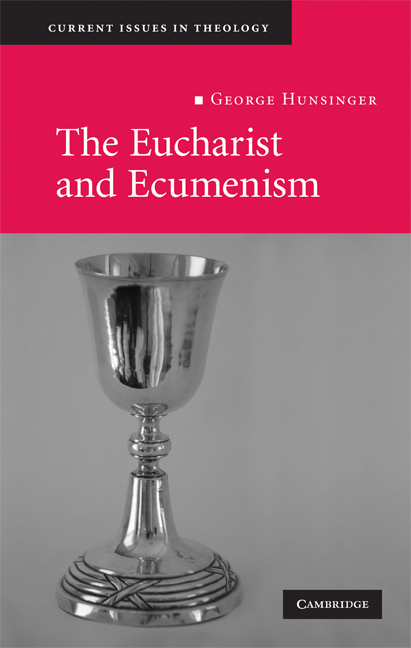
While in the current of writing a lecture on the Eucharist, I have been enjoying intincting – and, in some cases, re-intincting – into some great books: William T. Cavanaugh’s Torture and Eucharist: Theology, Politics, and the Body of Christ, Angel F. Mendez Montoya’s The Theology of Food: Eating and the Eucharist, Stephen Sykes’ Power and Christian Theology, among them. William Stringfellow’s essay ‘Liturgy as Political Event’ is also wonderful. I’m also enjoying George Hunsinger’s The Eucharist and Ecumenism: Let Us Keep the Feast, a book that deserves a very close read and is certainly among the boldest and most important studies available on the subject.

Hunsinger notes that Thomas Aquinas, who was among the most impressive of the pre-Reformation theologians, understood the role of the priest in the eucharist as in some sense mediating between Christ and the faithful. In other words, for Thomas, the priest was the central figure in the eucharistic sacrifice. So Hunsinger writes: ‘‘He [i.e., the priest] acted both “in the person of Christ” (in persona Christi) as well as “in the person of the church” (in persona ecclesiae) (ST 3.82.8). In the person of Christ, he consecrated the sacrament. In the person of the church, he offered Christ in prayer to God (ST 3.82.8). Whatever the priest did when acting in the person of Christ was taken up in turn by the people (ST 3.83.4). The priest’s union with Christ, however, was different than it was for the laity. “Devout layfolk are one with Christ by spiritual union through faith and charity,” explained Aquinas, but the priest was one with Christ “by sacramental power” (ST, 3.82.1). At his ordination the priest had received a special status, “the power of offering sacrifice in the church for the living and the dead” (ST 3.82.1). The priest was set apart from the people, and above them, by virtue of this sacramental power’ (pp. 114–5).

Luther, of course, would radically qualify – or extend – this notion in his argument that the priest symbolised the priesthood of all believers, while possessing no special powers of consecration and sacrifice in and of himself. Luther stated:

‘Thus it becomes clear that it is not the priest alone who offers the sacrifice of the mass; it is the faith which each one has for himself. This is the true priestly office, through which Christ is offered as a sacrifice to God, an office which the priest, with the outward ceremonies of the mass, simply represents. Each and all are, therefore, equally priests before God . . . For faith must do everything. Faith alone is the true priestly office. It permits no one to take its place. Therefore all Christian men are priests, all women are priestesses, be they young or old, master or servant, mistress or maid, learned or unlearned. Here there is no difference unless faith be unequal’. Martin Luther, Luther’s Works, Vol. 35: Word and Sacrament 1 (ed. J.J. Pelikan, et al.; vol. 35; Philadelphia: Fortress Press, 1999), 100–1.

Hunsinger, in Eucharist and Ecumenism, properly notes that Luther upheld the idea of grace alone by combining christological mediation with communal participation:

‘The believer and the community can be said to offer Christ by participating in Christ’s own self-offering, which in turn mediates them into eternal life with God. Inclusion in Christ’s priestly self-offering is at once the promise and the consequence of grace. At the same time, the place of the priest in the mass has been radically redefined. Christ the eternal priest does not operate in and through the visible priest, nor does the priest offer Christ as the invisible victim through the bread and the cup. The bread and the cup, for Luther, are the sacramental but not the sacrificial body and blood of Christ. That is, they are not the means of reciprocal self-offering to God by Christ, priest, and people. They are not the eucharistic means by which Christ is offered up. The bread and cup are simply a pledge of Christ’s faithfulness to his promises. It is not the priest but the faith of each believer that offers Christ to God. The role of the priest is simply to symbolize by outward ceremonies the one true priestly office, which is faith’. (p. 135)

The Reformed, following Calvin and the best of those who spoke in his wake, sought to witness to how the cross and the eucharist are held in a unity that does not violate but reinforces their distinction via two forms: The constitutive form is the cross while the mediating form is the eucharist. ‘The cross is always central, constitutive, and definitive, while the eucharist is always secondary, relative, and derivative. The eucharistic form of the one sacrifice does not repeat the unrepeatable, but it does attest what it mediates and mediate what it attests. What it mediates and attests is the one whole Jesus Christ, who in his body and blood is both the sacrifice and the sacrament in one. As the sacrifice, he is the Offerer and the Offering. As the sacrament, he is the Giver and the Gift. The Son’s sacrificial offering of himself to the Father for us on the cross is the ground of the Father’s sacramental gift of his Son to the faithful in the eucharist’ (Ibid. 151). As TF Torrance has shown in Theology in Reconciliation, the cross is the ‘dimension of depth’ in the eucharist. The eucharist has no significance in and of itself. Its significance is both derived and grounded in the cross. The cross alone is, as TF Torrance notes, the saving ‘content, reality and power’ of the eucharist. It is to this that the Reformed minister and church directs our gaze.

It was precisely such a position which led PT Forsyth, the theologian of the cross, in his lectures on The Church and the Sacraments, to offer the following statement:

The Lord’s Supper is the most complete and plenary of all the cultic ways of confessing the work of reconciliation, where the sin of humanity is conquered by the grace of God in a holy Kingdom. It is therefore the real centre of the Church’s common and social life. This should not be sought in social reunions, or ecclesiastical monarchy, or philanthropic cohesion, but in the spiritual region, in the worship, and the theology moulding it. For here we are summoned to what is our vital centre deep within all the individual wills that wish to unite, to what is the centre of the faith that makes the new Humanity, and to the goal which rounds all’. (p. 260)


Advent VI: ‘Gift’ by Marion Armstrong

Not then; and never since
Have we quite reached the stable, King and Prince,

Nor clearly seen the manger
As shepherd saw it, and as money-changer,

Nor worshiped with our hearts the small
Body which bore the weight of miracle;

But stand, have stood forever in our night
While the beloved Baby made of light

Sleeps in the stillness that his Father sent
Where animals’ eyes are eloquent.

And if (O God) I move from my self and come
And call the stable suddenly heaven and home

And bend my scarred unvirgin knee:

Receive, O Word, dumbstricken me.

– Marion Armstrong. ‘Gift’, The Christian Century, 22 December 1965, 1575.

A dog is not just for Christmas …

Since being accused of promoting ‘sick’ and ‘just plain wrong’ culinary suggestions, of championing a dodgy theology, of not understanding much about life, of demonstrating ‘the reality of total depravity’ and of promoting ‘that knotty variety of Hard Knox Calvinism that flourishes in the chilly sub-Antarctic climes of Dunedin’, I am delighted to advertise my equilibrious nature via the promotion of this video on ‘After The Rapture Pet Care’:

[H/T: Robin Parry]

Calvin the preacher

‘[Calvin] the preacher does not so much move forward from point to point as be borne onwards by the movement of his author’s thought. Even so, this is not a simple, uncomplicated stepping from clause to clause; for within each clause there is movement and counter-movement of one sort or another. The sermons are like rivers, moving strongly in one direction, alive with eddies and crosscurrents, now thundering in cataracts, now a calm mirror of the banks and the sky; but never still, never stagnant. Calvin’s intention (like that of the medieval theology lecturers) was to expound each passage. Usually this entailed the continuous exposition of sentence by sentence, sometimes of clause by clause. After a brief preface to remind the congregation of what the previous passage had said, and thus to set the present verses within their context, he would embark on the exposition of the sentences, usually rendering them in a slightly different (sometimes very different) form from the head text; this partly because he was translating direct as he went along, partly for the sake of clarification by paraphrasing. The exposition will consist where necessary of simple exegesis and the unravelling of any difficulties (perhaps discrepancies with other passages of Scripture, which, again like medieval lecturing, had always to be reconciled); after this he will apply the place to “our” use so that “we” may profit from it and be “edified”’.

– Thomas Henry Louis Parker, Calvin’s Preaching (Edinburgh: T&T Clark, 1992), 132–3.

Main Course: felis domesticus

There is surprisingly little online advice about how to prepare a cat for human consumption. But here’s an edit of what I could pull together by way of some basic preparation and simple recipes.

Preparation

1. Get a large cutting board and lay out your cat. Lop off the head, the tail and the feet with a sharp butcher’s knife. These parts of the cat contain little usable meat, so give them to the dog.

2. Make a longitudinal incision on the cat’s abdomen. Reach your hand into the body cavity, and remove all of the internal organs. Discard them – especially the liver. It may look tasty, but the liver of a felis domesticus is frequently too toxic for human consumption.

3. Time to skin. As the saying goes, there’s more than one way to do it, but the basic advice is to use a sharp knife to trim off the skin, and pull it back, snipping away at the muscle tissue. Alternatively, grab some loose skin near the head stump and, using a pair of pliers, peel it back off the carcass like a banana or like how you’d skin an eel, rolling it off the body.

4. Wash the meat of stray gristle and hairs.

5. Pour yourself a drink.

Recipes

Here too you have some options:

Microwaved Cat

Place your prepared a cat in a high powered magnetron microwave for 10 minutes. This will denature the proteins and caramelise the sugars. Unfortunately, it will taste like a microwaved burger. Just as well there are other options.

Beer Roasted Cat

Ingredients

  • 1 cat cut into roast
  • 1 can of Campbell’s Cream of Mushroom soup
  • 1 cube of beef bouillon
  • 1 clove of garlic
  • 1 Fine Irish Stout

Directions

Cover and soak cat roast in salt water for 24 hours. Drain water and then cover and soak in beer for 6 hours. Drain and place in crock pot with your cans of soup. Add a clove of garlic, and a cube of beef bouillon. If you start to slow cook your cat in the morning with your George Foreman Cooker (or it’s ilk), you’ll have finely cooked feline in time for supper.

If a slow cooker is not available, a cat can be baked at 170 degrees for 2–3 hours in a conventional oven and still come out pretty good. Beer Roasted Cat is fantastic served with mashed potatoes, collard greens, and fresh, homemade egg rolls. When planning a full meal just remember – cat is a course best served hot!

Cat may not be the most glamorous, or tastiest of game meats, but with a little thought and preparation, Baked Cat can make the belly of the persnicketiest diner glow with home baked goodness.

You could also try a modified version of this: Instead of using Campbell’s Cream of Mushroom soup, try using 1 chili and 2 tablespoons of grated ginger.

Cat Braisé

Ingredients

  • 1 cat cut in serving-sized pieces dusted in flour with salt and pepper
  • 1/4 cup extra virgin olive oil
  • 6 artichokes
  • thick slices of slab bacon, diced
  • 1 small sweet onion, diced
  • 4 cloves garlic, minced
  • 1 carrot, diced
  • 1 lemon
  • 3 small tomatoes, peeled, seeded, and diced
  • 1/2 cup dry white wine
  • 2–4 cup homemade chicken broth
  • 4 flat parsley stems, 6 leafy thyme branches, 1 bay leaf tied up with kitchen twine
  • Salt and pepper
  • 1/4 cup chopped flat-leaf parsley (optional)

Directions

1. Snap the leaves off the artichokes until only the tender inner leaves remain. Snap off the stem. Trim the remaining green bits from the bottom of the artichoke, and cut off the inner leaves in a bunch at the point where they are very tender. Pare the tough green outer layer off the remaining stem, pairing the stem into a point. Now cut the artichoke bottom into quarters and remove the choke with a sharp knife from each quarter. Rinse to remove any traces of foin and drop them into a bowl of water acidulated with the juice of half a lemon.

2. Heat 2 tablesoons of olive oil in a large heavy casserole or Dutch oven. Dredge the cat pieces in seasoned flour, shaking off excess. Brown over medium heat, turning regularly, until golden on all sides. Remove cat pieces to a plate and dump any oil remaining in the pan. Add 1 tablespoon of the remaining oil and the bacon dice. Sauté until cooked but not crisp. Add the remaining tablespoon of oil and the onion and carrot. Saute for 5 minutes, then add the artichoke quarters and the garlic, stir one minute, and add the tomatoes and the white wine. Turn up the heat and reduce until syrupy, stirring constantly, for about 5 minutes. Lay the parsely, thyme and bayleaf garnish on top of the vegetables. Arrange the cat pieces on top, together with any juice accumulated in the plate.

3. Pour in enough broth to come halfway up the sides of the cat pieces. Cover and bring to a simmer. Continue to simmer over very low heat about 1 hour or cook in the oven at 170 degrees for the same amount of time. The cat should be just tender and part readily from the bone. Don’t overcook or it will become dry. Check the liquid level frequently and add more broth if necessary. Turn the cat pieces once.

4. When done, remove the cat pieces to a warm platter and arrange the vegetables, removed with a slotted spoon, around them. Cover and keep warm. Strain the remaining pan juices into a smaller saucepan and reduce over high heat, skimming frequently, until reduced by 1/3. Pour over the platter and serve immediately. Sprinkle with finely chopped flat-leaf parsley if you like.

5. Serve with the best bottle of Sauvignon Blanc that you can source.

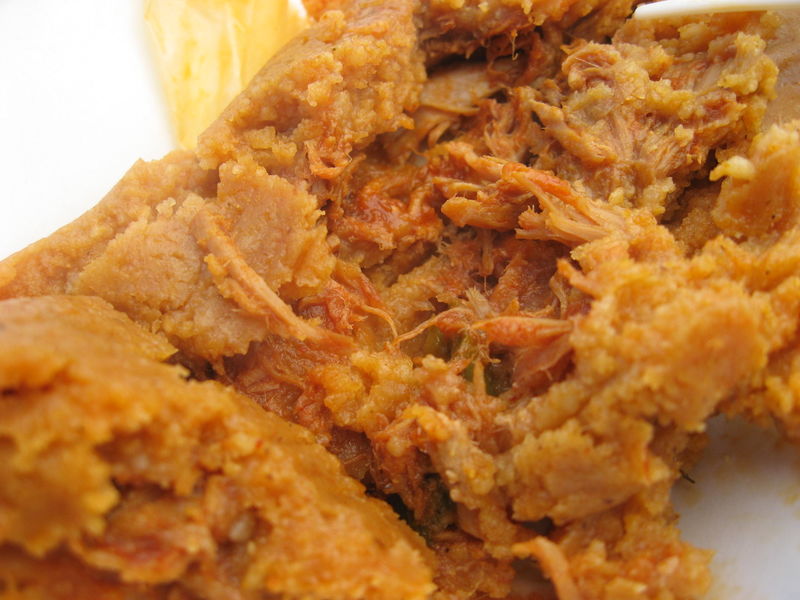
Cat Tamales

1. Toss one pot of bone-free cat strips right into the frying pan.

2. Add 1 cup of Mexican-style chili sauce, 2 cloves of garlic, and 1 tablespoon of crushed cumin seeds. Add chili powder, and salt and pepper, to taste.

3. Fry at a medium-high temperature in a little cooking oil, stirring occasionally. After ten or fifteen minutes, add 1 cup of water, reduce heat, and simmer.

4. Meanwhile, place 3 cups of cornmeal in a mixing bowl. Add 1/4 cup of butter, 1/4 cup of lard, 1 teaspoon of baking powder, and 1/2 a teaspoon of salt. Mix well. To this, add one and a half cups of chicken or cat broth. Beat until you have a light, soft dough.

5. Now take a small ball of your dough mixture, and spread it out on a corn husk. Remember to pre-soak your corn husks for an hour or two, so they will be soft and easy to roll. If you don’t have any corn husks, you can use aluminum foil, in 4×4 inch squares.

6. Spread at least a tablespoon full of your filling down the center of your dough. Then roll the whole thing up, tucking in the ends of the corn husk, so it stays together.

7. When you have 12 to 18 tamales ready to cook, steam them over boiling water, for about two hours.

8. Garnish with a little lettuce, spread a little salsa over the top, and they’re ready to serve!

9. Enjoy with a pilsner.

Cat Au Gratin

Ingredients

  • 1 cat – skinned and diced
  • 1 medium onion – chopped
  • 1/4 cup butter
  • 1 tablespoon flour
  • 1 teaspoon salt
  • 1/4 teaspoon pepper
  • 2 cups milk
  • 2 cups cheddar cheese – shredded
  • 1/4 cup dry breadcrumbs
  • paprika

Directions

1. Cut skinned cat pieces into dices.

2. Cook and stir onion in butter in a large saucepan until onion is tender. Stir in flour, salt and pepper.

3. Cook over low heat, stirring constantly, until mixture is bubbly; remove from heat.

4. Stir in milk and 1–1/2 cups of the cheese. Heat to boiling, stirring constantly. Boil and stir 1 minute.

5. Place cat in ungreased casserole dish and pour on the cheese sauce.

6. Cook uncovered in 165 C degree oven 1 hour 20 minutes.

7. Mix remaining cheese and the bread crumbs; sprinkle over cat. Sprinkle with paprika. Cook uncovered until top is brown and bubbly, 15 to 20 minutes longer.

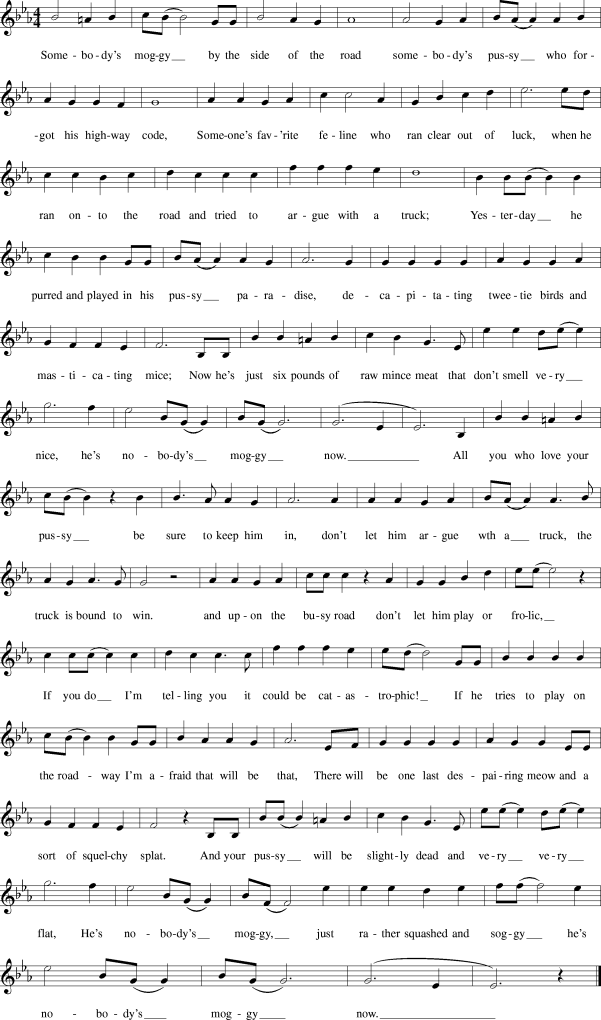
Dinner Music: ‘Nobody’s Moggy Now’, by Eric Bogle

Somebody’s moggy by the side of the road
Somebody’s moggy who forgot his highway code
Someone’s favourite feline who ran clean out of luck
When he ran onto the road and tried to argue with a truck

Yesterday he burled and played in his pussy paradise
Decapitating tweety birds and masticating mice
Now he’s just six pounds of raw minced meat
That don’t smell very nice

He’s nobody’s moggy now.

You who love your pussy, be sure to keep him in
Don’t let him argue with a truck, the truck is bound to win
And upon a busy road, don’t let him play or frolic
If you do, I’m warning you, it could be cat-astrophic
If he tries to play on the roadway I’m afraid that will be that
There will be one last despairing meouw and a sort of squelchy splat
And your pussy will be slightly dead and very very flat
He’s nobody’s moggy, just red and squashed and soggy,

He’s nobody’s moggy nooow, hoummmmm…

Video

‘A Small Ode on Mixed Flatting’, by James K. Baxter

Elicited by the decision of the Otago University authorities to forbid this practice among students

Dunedin nights are often cold
(I notice it as I grow old);
The south wind scourging from the Pole
Drives every rat to his own hole,
Lashing the drunks who wear thin shirts
And little girls in mini-skirts.
Leander, that Greek lad, was bold
To swim the Hellespont raging cold
To visit Hero in her tower
Just for an amorous half-hour.
And lay his wet brine-tangled head
Upon her pillow – Hush! The dead
Can get good housing – Thomas Bracken,
Smellie, McLeod, McColl, McCracken,
A thousand founding fathers lie
Well roofed against the howling sky
In mixed accommodation – Hush!
It is the living make us blush
Because the young have wicked hearts
And blood to swell their private parts.
To think of corpses pleases me;
They keep such perfect chastity.
O Dr Williams, you were right
To shove the lovers out of sight;
Now they can wander half the night
Through coffee house and street and park
And fidget in the dripping dark,
While we play Mozart and applaud
The angel with the flaming sword!
King Calvin in his grave will smile
To know we know that man is vile;
But Robert Burns, that sad old rip
From whom I got my Fellowship
Will grunt upon his rain-washed stone
Above the empty Octagon,
And say – ‘O that I had the strength
To slip yon lassie half a length!
Apollo! Venus! Bless my ballocks!
Where are the games, the hugs, the frolics?
Are all you bastards melancholics?
Have you forgotten that your city
Was founded well in bastardry
And half your elders (God be thankit)
Were born the wrong side of the blanket?
You scholars, throw away your books
And learn your songs from lasse’s looks
As I did once – ‘Ah, well; it’s grim;
But I will have to censor him.
He liked to call a spade a spade
And toss among the glum and staid
A poem like a hand grenade –
And I remember clearly how
(Truth is the only poet’s vow)
When my spare tyre was half this size,
With drumming veins and bloodshot eyes
I blundered through the rain and sleet
To dip my wick in Castle street.
Not on the footpath – no, in a flat,
With a sofa where I often sat,
Smoked, drank, cursed, in the company
Of a female student who unwisely
Did not mind but would pull the curtain
Over the window – And did a certain
Act occur? It did. It did.
As Byron wrote of Sennacherib –
‘The Assyrian came down like a wolf on the fold
And his cohorts were gleaming in purple and gold’ –
But now, at nearly forty-two,
An inmate of the social zoo,
Married, baptized, well heeled, well shod,
Almost on speaking terms with God,
I intend to save my moral bacon
By fencing the young from fornication!
Ah, Dr Williams, I agree
We need more walls at the Varsity;
The students who go double-flatting
With their she-catting and tom-catting
Won’t ever get a pass in Latin;
The moral mainstay of the nation
Is careful, private masturbation;
A vaseline jar or a candle
Will drive away the stink of scandal!
The Golden Age will come again –
Those tall asthenic bird-like men
With spectacles and lecture notes,
Those girls with wool around their throats
Studying till their eyes are yellow
A new corrupt text of Othello,
Vaguely agnostic, rationalist,
A green banana in each fist
To signify the purity
Of educational ecstasy –
And, if they marry, they will live
By the Cardinal Imperative:
A car, a fridge, a radiogram,
A clean well-fitted diaphragm,
Two-and-a-half children per
Family; to keep out thunder
Insurance policies for each;
A sad glad fortnight at the beach
Each year, when Mum and Dad will bitch
From some half-forgotten itch –
Turn on the lights! – or else the gas!
If I kneel down like a stone at Mass
And wake my good wife with bad dreams,
And scribble verse on sordid themes,
At least I know man was not made
On the style of a slot-machine arcade –
Almost, it seems, the other day,
When Francis threw his coat away
And stood under the palace light
Naked in the Bishop’s sight
To marry Lady Poverty
In folly and virginity,
The angels laughed – do they then weep
Tears of blood if two should sleep
Together and keep the cradle warm?
Each night of earth , though the wind storm
Black land behind, white sea in front,
Leander swims the Hellespont;
To Hero’s bed he enters cold;
And he will drown; and she grow old –
But what they tell each other there
You’ll not find in a book anywhere.

1967


– James K. Baxter, ‘A Small Ode on Mixed Flatting’ in Collected Poems (ed. John Edward Weir; Wellington: Oxford University Press, 1979), 396–99.

Blogging Presbyterian Ministers

I guess that it is encouraging to see blogging catching on among Presbyterian ministers (and their partners) here in Aotearoa New Zealand. Here’s a list (repeated in the sidebar) of those that I know of:

Am I missing anyone?

And while I’m in ‘give ’em a plug’ mode, there’s a few other Pressie-tribe sites that are worth noting:


Advent V: ‘The sign of God is powerlessness in the world’

‘And to us who come, in the midst of the wicked world torn by malice, to venerate the Infant lying in the manger, what law and wisdom of life are given by this miraculous sign? To what do the angels now call those who come to venerate Christ? They call them to receive into their hearts His humiliation, His persecution, His Crucifixion, as the sole sign of the Christian life, as its power and triumph.

For the best self-attestation of the Good is its defenselessness in the face of the power of evil. The best attestation of Truth is silence in the face of much-talkative falsehood. The supreme manifestation of Beauty consists in the unadornment by vain adornment. The power of God triumphs by means of itself, not by means of the power of this world. For the world, there is no power of God. The world does not see and does not know the power of God: it laughs at the power of God. But Christians know that the sign of God is powerlessness in the world – the Infant in the manger.

And there is no need to gild the manger, for a gilded manger is no longer Christ’s manger. There is no need for earthly defense, for such defense is superfluous for the Infant Christ. There is no need for earthly magnificence, for it is rejected by the King of Glory, the Infant in the manger. But there is a need for the authentic revelation of the God of Love. There is a need for the image of all-forgiving meekness, praying for His enemies and tormentors. There is a need for the image of the way of the cross to Christ’s Kingdom, to defeat evil by the triumphant self-evidence of good. There is a need for the image of freedom from the world. And powerless, we are powerful. In the kingdom of this world we desire to serve the Kingdom of God; we believe in, call, and await this Kingdom. For we have come to know the sign of the Infant in the manger. Power in powerlessness, Triumph in humiliation. And let our heart be our manger, in which we bear the divine sign, the sign of the cross.

By this sign reigns the King of kings, the Infant in the manger. In Him and with Him we are united forever by the fact He was made man. We call him Emmanuel – God with us’.

– Sergeĭ Nikolaevich Bulgakov, Churchly Joy: Orthodox Devotions for the Church Year (trans. Boris Jakim; Grand Rapids: Wm. B. Eerdmans Publishing, 2008), 39–40.

Advent IV: ‘The process of Your coming’, by Karl Rahner

‘Every year we celebrate the holy season of Advent, O God. Every year we pray those beautiful prayers of longing and waiting, and sing those lovely songs of hope and promise. Every year we roll up all our needs and yearnings and faithful expectation into one word: “Come!”

And yet, what a strange prayer this is! After all, You have already come and pitched Your tent among us. You have already shared our life with its little joys, its long days of tedious routine, its bitter end. Could we invite You to anything more than this with our “Come”? Could You approach any nearer to us than You did when You became the “Son of Man,” when You adopted our ordinary little ways so thoroughly that it’s almost hard for us to distinguish You from the rest of our fellow men?

In spite of all this we still pray: “Come.” And this word issues as much from the depth of our hearts as it did long ago from the hearts of our forefathers, the kings and prophets who saw Your day still far off in the distance, and fervently blessed its coming. Is it true, then, that we only “celebrate” this season, or is it still really Advent?

Are You the eternal Advent? Are You He who is always still to come, but never arrives in such a way as to fulfill our expectations? Are You the infinitely distant One, who can never be reached?

Are You only the distant horizon surrounding the world of our deeds and sufferings, the horizon which, no matter where we roam, is always just as far away? Are You only the eternal Today, containing within itself all time and all change, equally near to everything, and thus also equally distant?

When our bleeding feet have apparently covered a part of the distance toY our eternity, don’t You always retreat twice as far away from us, into the immense reaches filled only by your infinite being? Has humanity drawn the least bit closer to You in the thousands and thousands of years that have elapsed since it boldly began its most exciting and fearsome adventure, the search for You?

Have I come any nearer to You in the course of my life, or doesn’t all the ground I have won only make my cup all the more bitter because the distance to You is still infinite? Must we remain ever far from You, O God of immensity, because You are ever near to us, and therefore have no need of “coming” to us? Is it because there is no place in our world to which You must first “find your way”?

You tell me that you have really already come, that Your name is Jesus, Son of Mary, and that I know in what place and at what time I can find You. That’s all true, of course, Lord – but forgive me if I say that this coming of Yours seems to me more like a going, more like a departure than an arrival.

You have clothed Yourself in the form of a slave. You, the hidden God, have been found as one of us. You have quietly and inconspicuously taken Your place in our ranks and marched along with us. You have walked with us, even though we are beings who are never coming, but rather always going, since any goal we reach has only one purpose: to point beyond itself and lead us to the last goal, our end.

And thus we still cry: “Come! Come to us, You who never pass away, You whose day has no evening, whose reality knows no end! Come to us, because our march is only a procession to the grave.” Despairing of ourselves, we call upon You – then most of all, when, in composure and quiet resignation, we bring ourselves to accept our finiteness.

You promised that You would come, and actually made good Your promise. But how, O Lord, how did You come? You did it by taking a human life as Your own. You became like us in everything: born of a woman, You suffered under Pontius Pilate, were crucified, died, and were buried. And thus You took up again the very thing we wanted to discard. You began what we thought would end with your coming: our poor human kind of life, which is sheer frailty, finiteness, and death.

Contrary to all our fond hopes, You seized upon precisely this kind of human life and made it Your own. And You did this not in order to change or abolish it, not so that You could visibly and tangibly transform it, not to divinize it. You didn’t even fill it to overflowing with the kind of goods that men are able to wrest from the small, rocky acre of their temporal life, and which they laboriously store away as their meager provision for eternity.

No,You took upon Yourself our kind of life, just as it is. You let it slip away from You, just as ours vanishes from us. You held on to it carefully, so that not a single drop of its torments would be spilled. You hoarded its every fleeting moment, so You could suffer through it all, right to the bitter end.

You too felt the inexorable wheel of blind, brute nature rolling over Your life, while the clear-seeing eye of human malice looked on in cruel satisfaction. And when Your humanity glanced upwards to the One who, in purest truth and deepest love, is called “Father,” it too caught sight of the God whose ways are unfathomable and whose judgments are incomprehensible, who hands us the chalice or lets it pass, all according to His own holy will. You too learned in the hard school of suffering that no “why” will ever ferret out the secret of that will, which could have done otherwise, and yet chose to do something we would never understand.

You were supposed to come to redeem us from ourselves, and yet You, who alone are absolutely free and unbounded, were “made,” even as we are. Of course, I know that You remained what You always were, but still, didn’t our mortality make You shudder, You the Immortal God? Didn’t You, the broad and limitless Being, shrink back in horror from our narrowness? Weren’t You, absolute Truth, revolted at our pretense?

Didn’t You nail yourself to the cross of creation, when You took as Your own life something which You had drawn out of nothing, when You assumed as Your very own the darkness that You had previously spread out in the eternal distance as the background to Your own inaccessible light? Isn’t the Cross of Golgotha only the visible form of the cross You have prepared for Yourself, which towers throughout the spaces of eternity?

Is that Your real coming? Is that what humanity has been waiting for? Is that why men have made the whole of human history a single great Advent-choir, in which even the blasphemers take part – a single chant crying out for You and Your coming? Is Your humble human existence from Bethlehem to Calvary really the coming that was to redeem wretched humanity from its misery?

Is our grief taken from us, simply because you wept too? Is our surrender to finiteness no longer a terrible act of despair, simply because You also capitulated? Does our road, which doesn’t want to end, have a happy ending despite itself, just because You are traveling it with us?

But how can this be? And why should it be? How can our life be the redemption of itself, simply because it has also become Your life? How can You buy us back from the law, simply by having fallen under the law Yourself (Gal. 4:5)?

Or is it this way: is my surrender to the crushing narrowness of earthly existence the beginning of my liberation from it, precisely because this surrender is my “Amen” to Your human life, my way of saying yes to Your human coming, which happens in a manner so contrary to my expectations?

But of what value is it to me that my destiny is now a participation in Yours, if You have merely made what is mine Your own? Or have You made my life only the beginning of Your coming, only the starting point of Your life?

Slowly a light is beginning to dawn. I’ve begun to understand something I have known for a long time: You are still in the process of Your coming. Your appearance in the form of a slave was only the beginning of Your coming, a beginning in which You chose to redeem men by embracing the very slavery from which You were freeing them. And You can really achieve Your purpose in this paradoxical way, because the paths that You tread have a real ending, the narrow passes which You enter soon open out into broad liberty, the cross that You carry inevitably becomes a brilliant banner of triumph.

It is said that You will come again, and this is true. But the word again is misleading. It won’t really be “another” coming, because You have never really gone away. In the human existence that You made Your own for all eternity, You have never left us.

But still You will come again, because the fact that You have already come must continue to be revealed ever more clearly. It will become progressively more manifest to the world that the heart of all things is already transformed, because You have taken them all to Your heart.

Behold, You come. And Your coming is neither past nor future, but the present, which has only to reach its fulfillment. Now it is still the one single hour of Your Advent, at the end of which we too shall have found out that You have really come.

O God who is to come, grant me the grace to live now, in the hour of Your Advent, in such a way that I may merit to live in You forever, in the blissful hour of Your eternity’.

– Karl Rahner, Encounters with Silence (Westminster: Newman Press, 1965), 80–87

‘Change of Address’

Recently, I participated in a group reading of Luke’s account of Jesus’ death. I was struck by the change in tone and of heart of the second criminal crucified with Jesus. One moment, he was with the crowds in their hurls of abuse; the next he was questioning the justice associated with his own death and asking Jesus to remember him when Jesus came into his kingdom.

What brought about this incredible change in the criminal? I wondered if it might be simply the first word that Jesus spoke in the interim – the word ‘Father’, and the fact that in that simple address this man was given a glimpse into the deepest truth of all reality.

Perhaps like many prisoners, this man too had a lousy relationship with his earthly father. Perhaps like all of us, to hear (i.e., to really hear, and so to be overcome by the crisis that comes in that hearing) that we are forgiven even though we don’t know what we are doing cuts right through all our defenses. (So PT Forsyth: ‘The greatest, last, humanest, passion is the passion to be forgiven’). Perhaps we will never know. And perhaps that doesn’t matter. What does matter, though, is the transformation experienced in this briefest of exchanges. A wee poem attempts to capture something of this transformation:

Change of Address

The mob, by this time, was blood-crazed,
choler coupled with the shame of betraying ‘innocent blood’,
tempestuous with fury against a God way too human.

And two brigands – one on his right and one on his left –
were also there, their antisocial terror
flaring into blasphemous howls.

They joined the rest – sibilating the fruit of irrational rage:
‘If you are the Son of God, come down from the cross’. But a night in
the garden had closed that possibility.

And now, lifted up on the mob’s violent altar,
amid swells of vengeance fueled by power’s lusts
a prayer: ‘Father, forgive them …’.

Abruptly, and with all the violence of a different nature
one neighbour fell silent. His ire ended;
his soft confession birthed.

Could it be that something in that cry – ‘Father’ –
untwisted his tangled self,
broke open the truth of all things?

Father?
Father?
Father?

Where am I?

© Jason A. Goroncy
17 November 2010

Advent III: ‘Advent Calendar’, by Rowan Williams

He will come like last leaf’s fall.
One night when the November wind
has flayed the trees to bone, and earth
wakes choking on the mould,
the soft shroud’s folding.

He will come like frost.
One morning when the shrinking earth
opens on mist, to find itself
arrested in the net
of alien, sword-set beauty.

He will come like dark.
One evening when the bursting red
December sun draws up the sheet
and penny-masks its eye to yield
the star-snowed fields of sky.

He will come, will come,
will come like crying in the night,
like blood, like breaking,
as the earth writhes to toss him free.
He will come like child.

– Rowan Williams, The Poems of Rowan Williams (Grand Rapids: Wm. B. Eerdmans, 2004), 31.

November exploits …

Reading:

Listening:

Watching:

Drinking:

Advent II: ‘The Waiting’, by RS Thomas

Are there angels or only
the Furies? We sleep
on a stone pillow
and the troubles of Europe
are the molecules that
compound it. Where is
the ladder or that heavenly
traffic that electrified Jacob?

We wrestle with somebody,
something which withholds its name.
How is the anonymous
disposed? The enemy is without
number; is there an infiltration
of its forces by one not
indifferent to the human?
Though genes have their war,

yet the smiling goes on
from cradle to cradle.
Our experiments are repeatable,
but what is love the precipitate
of? We have eaten of a tree
whose foliage is radioactive
and the autumn of
its fall-out is upon our children.

Why, then, of all possible
turnings do we take
this one rather than that,
when the only signs discernible
are what no one has erected?
Is it because, at the road’s
ending, the one who is as a power
in hiding is waiting to be christened?

– RS Thomas, Collected Later Poems (Highgreen: Bloodaxe, 2004), 268.

Advent I: On Matthew 11.25–27

In keeping with my practice in recent years, I propose to again post a series of short Advent reflections. Here’s the first:

‘I praise you, Father, Lord of heaven and earth, because you have hidden these things from the wise and learned, and revealed them to little children. Yes, Father, for this was your good pleasure. All things have been committed to me by my Father. No one knows the Son except the Father, and no one knows the Father except the Son and those to whom the Son chooses to reveal him. (Mt 11:25–27)

It is God’s way—it keeps being so—to hide Himself from those whom Jesus ironically calls “wise and learned.” It is God’s way—it keeps being so!—to reveal Himself to the humble. The relevance of this text to understanding the mission of Jesus is decisive. His God can only be known through the revelation made to the “little children.” There is no other place where Jesus has wanted to reveal his Father to us. This is how God has wanted it. He does not want human beings to identify Him with the Law, with the cult, with power, with ritual purity, with judgment, and with punishment. He does not want to be identified with the encyclicals, the canonical code, liturgical rubrics, or other fanciful things. Only in the revelation to those who do not count—the marginalized and those who remain excluded from everything—can the true face of God be known. For this reason, Jesus perceives himself as a relief for the afflicted and the oppressed. (see Mt 11:28-30). Jesus frees God from His own yoke. And he frees the poor from the God that had condemned them to their fate by showing them that God is with them, that He has decided to undergo the same fate as the poor. For this reason, he calls them “blessed.” The new times they have hoped for have come’.

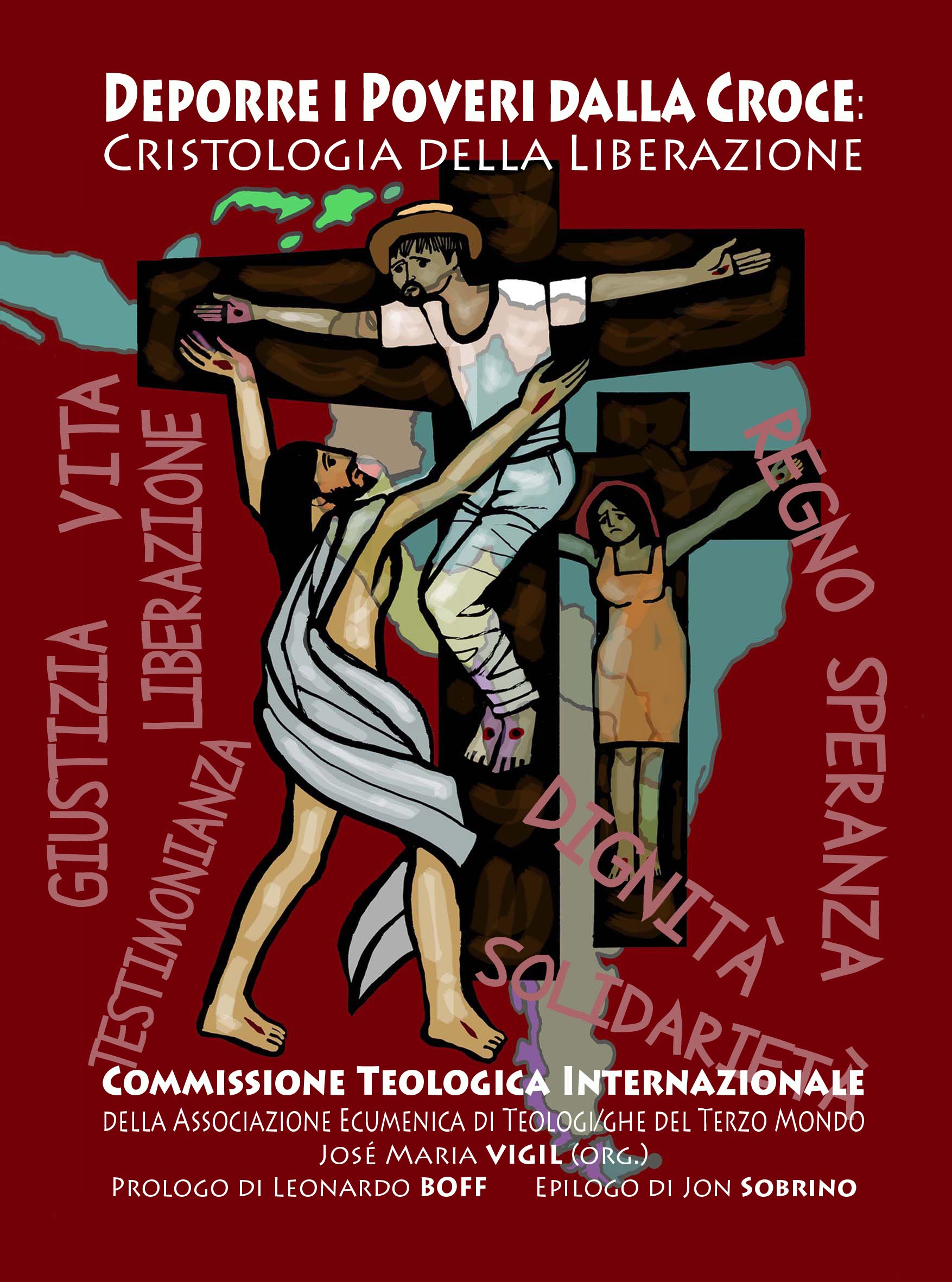
– Oscar Campana, ‘Jesus, the Poor, and Theology’ in Getting the Poor Down From the Cross: Christology of Liberation (ed. José María Vigil; np: International Teological Commission of the Ecumenical Association of Third World Theologians, 2007), 58.

BTW: It’s always worth heading over to Hopeful Imagination this time of year to read the Advent reflections.