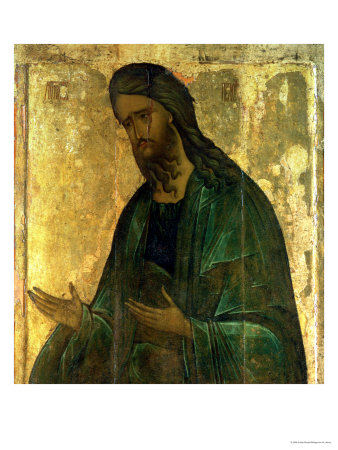
Author: Jason Goroncy

December exploits …

Not sure why (although holidays and extended daylight may have something to do with it), but December seemed to be a month in which I knocked over a bucket-load of reading, listened to a tonne of music, and enjoyed more flicks than usual. Here’s my exploits:

Reading:

Listening:

Watching:

Brewing: Sumatra Mandaling

Drinking:


Les Murray on the Kingdom and limits of prose

‘… the Kingdom of God, which is not solely of this world, is slowly coming closer to being more clearly figured in this world … we who are not saints are caught up, not by God but by the logic of our choosing to delay sainthood, in a combat we keep thinking is new (or even Modern) because of the novel shapes and pressures it keeps presenting, a physiognomic struggle between those who somehow accept grace and those who bear the distorting strain of trying to block it off, to act without it or against it. This, I think, rather than the usual superficial divisions between Right and Left, Black and White, religious and irreligious etc, is where the real lines are drawn … But when I come to meditate on topics such as grace, I don’t finally trust myself to talk about them in prose. For the important stuff, I need the help of my own medium of poetry, which can say more things’. – Les A. Murray, A Working Forest: Selected Prose (Sydney: Duffy & Snellgrove, 1997), 146–7.

Advent Reflections: 2010

Advent I: On Matthew 11.25–27

Advent II: ‘The Waiting’, by RS Thomas

Advent III: ‘Advent Calendar’, by Rowan Williams

Advent IV: ‘The process of Your coming’, by Karl Rahner

Advent V: ‘The sign of God is powerlessness in the world’

Advent VI: ‘Gift’ by Marion Armstrong

Advent VII: ‘The Man Who Was a Lamp’, by John Shea

Advent VIII: ‘Advent’, by Trygve David Johnson

Advent IX: Somebody’s out to get me

Writing off Yoder

The latest edition of One the Road, the journal of the Anabaptist Association of Australia and New Zealand, includes a helpful piece by Michael Buttrey titled ‘12 ways to prematurely write off Yoder: Some common misconceptions about Yoder’s ‘Neo-Anabaptist’ vision’. Buttrey identifies the twelve ‘misconceptions’ as:

1. Yoder believes Constantine corrupted the church.

2. Yoder thinks that there was no salt or light in the medieval church.

3. Yoder hates Luther, Calvin and the other magisterial Reformers.

4. Yoder has a low view of God’s sovereignty over history. Or:

5. He idolizes the early church.

6. Yoder inappropriately sees Jesus’ earthly life as normative.

7. Yoder fails to deal with the Old Testament, especially the wars of Joshua.

8. Yoder’s pacifism inhibits any effective witness to the state, especially regarding war.

9. Even for Christians, Yoder’s pacifism is impossible, or at least irresponsible.

10. Yoder advocates separation from the world that ‘God so loved.’ And:

11. Isn’t Yoder a ‘fideistic sectarian tribalist’ like Stanley Hauerwas?

Here, Buttrey writes:

These common accusations seriously misunderstand Yoder.

First, Yoder’s context was one where he was urging traditionally quietist Anabaptists to realize they had a social ethic and witness to society, while simultaneously calling activist Christians to realize they need not abandon the gospel and take up the methods of the world in their impatience to get things done. Ironically, Yoder has often been taken more seriously by theologians and political philosophers outside his tradition – such as Stanley Hauerwas and Romand Coles – than those on the ‘inside.’

Second, Yoder has no desire to divide the church further. Indeed, in “The Kingdom As Social Ethic” he deeply objects to the labelling of radically obedient groups as sectarian, for they had no intentions of separating themselves:

[Such groups] have called upon all Christians to return to the ethic to which they themselves were called. They did not agree that their position was only for heroes, or only possible for those who would withdraw from wider society. They did not agree to separate themselves as more righteous from the church at large. (85)

Third, Yoder is fundamentally not interested in withdrawal or separation from society. In “The Paradigmatic Public Role of God’s People,” Yoder agrees with Karl Barth that ‘what believers are called to is no different from what all humanity is called to. … To confess that Jesus Christ is Lord makes it inconceivable that there should be any realm where his writ would not run.’ (25) Of course, those who seriously see Christ’s commands as normative for all tend to be called fideists or theocrats. Yoder is neither.

Yoder is not a fideist because, unlike most realists, he sees the gospel as having a truly universal appeal. Christian realists typically assume that the gospel is inaccessible and incomprehensible to all other groups, and so it is necessary to use a neutral, ‘public’ language to oblige non-Christians ‘to assent to our views on other grounds than that they are our views.’ (16–7) Indeed, it is not Yoder but his critics who tend to think that their faith is fundamentally irrational and its public demands must be set aside for that reason. This reverse fideism is not surprising, however, given how modern liberal democracies understand religious groups and language.

Further, Yoder is not a theocrat, because he does not call for the violent imposition of the gospel, which would be an oxymoron. Rather, the challenge for the church is to purify its witness so ‘the world can perceive it to be good news without having to learn a foreign language.’ (24) Christ’s universal lordship obliges the church to make great demands of the world, but by definition, the gospel witness is a process of public dialogue, not coercion.

In short, the best word for Yoder’s understanding of the church’s witness to society is that of model. Consider some of these potential imperatives for civil society Yoder derives theologically in that same essay:

  • egalitarianism, not because it is self-evident (history suggests that it is clearly not!) but because baptism into one body breaks down ethnic and cultural barriers;
  • forgiveness as commanded by Christ (he agrees with Hannah Arendt that a religious origin and articulation for forgiveness is no reason to discount it in secular contexts);
  • radical sharing and hospitality, even voluntary socialism, as implied in the Eucharist; and
  • open public meetings and dialogue, as Paul instructed the Corinthians.

This sketch is almost a political “platform,” and hardly separatist. But for Christians with typical approaches to politics, Yoder’s call for the church to be where God’s vision for society is first implemented and practiced is an enormous stumbling block. It is yet another irony that realists are so often closet quietists: they see the only choice as being between transforming society and letting it go its own way. Yoder, however, asks us to obey Christ even if no one else is interested – although he trusts that the Kingdom will advance if the word of God is faithfully witnessed and embodied amid the powers and principalities of the world.

12. Yoder and Stanley Hauerwas are the same.

You can read the full piece here.

‘Hill Christmas’, by RS Thomas

They came over the snow to the bread’s
purer snow, fumbled it in their huge
hands, put their lips to it
like beasts, stared into the dark chalice
where the wine shone, felt it sharp
on their tongue, shivered as at a sin
remembered, and heard love cry
momentarily in their hearts’ manger.

They rose and went back to their poor
holdings, naked in the bleak light
of December. Their horizon contracted
to the one small, stone-riddled field
with its tree, where the weather was nailing
the appalled body that had asked to be born.

– RS Thomas, ‘Hill Christmas’, in Collected Poems, 1945–1990 (London: Dent, 1993), 290.

Pathetic Christmases

Happy Christmas to all readers of Per Crucem ad Lucem. Here’s PT Forsyth singing his constant song, and reminding us again of why today the Church might sing Joy to the World, and of the ‘wonders of [God’s] love’ :

‘Without [the] cross and its Atonement we come to a religion of much point but no atmosphere, much sympathy and no imagination, much kindness and no greatness, much charm and no force—a religion for the well-disposed and not for the rebel, in which we love our neighbour, but not our enemy, and not our Judge; a religion for the sensitive, but not for the world. When the world-cross goes out of the centre of religion, religion in due time goes out of the centre of man’s moral and public energy. The public then goes past the preacher because he is not strong enough to arrest and compel them. He has too much to say and too little to tell. He hangs to his age by its weakness, and not by its strength. He does not reach its soul with such gospel as he has. The pathos of Christ takes the place of his power. We canonise the weak things of our Christian world in our haste for rapid success with the many. Religion becomes too aesthetic, too exclusively sympathetic, too bland, too naturalistic. Our very Christmas becomes the festival of babyhood, Good Friday the worship of grief, and Easter of spring and renewal instead of regeneration. To use the old theological language, under an obsession of culture and its pensive delicacies we become dominated by the passive obedience of Christ instead of His active. We treat the cross as a passion only, instead of a principle, or as a moral principle instead of a decisive deed. Christ becomes a pathetic, tender, helpful and gracious figure rather than a mighty … But the great dividing issue for the soul is neither the Bethlehem cradle nor the empty grave, nor the Bible, nor the social question. For the Church at least (however it be with individuals) it is the question of a redeeming atonement. It is here that the evangelical issue lies. It is here, and not upon the nativity, that we part company with the Unitarians. It is here that the unsure may test their crypto-unitarianism. I would unchurch none. I would but clear the issue for the honest conscience. It is this that determines whether a man is Unitarian or Evangelical, and it is this that should guide his conscience as to his ecclesiastical associations. Only if he hold that in the atoning cross of Christ the world was redeemed by holy God once for all, that there, and only there, sin was judged and broken, that there and only there the race was reconciled and has its access to the face and grace of God—only then has he the genius and the plerophory of the Gospel. If he hold to Christ as this head, then, whatever views he may hold on other heads, he is of the Gospel company and the Evangelical pale. Only thus has he a real final message for the age. Only thus is he more than one that has a lovely voice and can play well on an instrument for the ages’ pleasure and its final neglect’.

– PT Forsyth, The Cruciality of the Cross (London: Hodder & Stoughton, 1910), 27, 73–4.


The liturgical year: training for life in this world and the next

Halden Doerge’s latest post, The impotence of the liturgical year, is well worth reading. And why I have neither the time nor the inclination to give a full response, I did want to post just a few of my initial reactions. To publish one’s thoughts on-the-run, as it were, is always a somewhat dangerous thing to do in blogdom, but what the salami; it’s close to Christmas, and my responsibility-guard is down.

What Halden wishes to affirm needs to be affirmed: that Advent and the Church’s liturgical calendar as a whole is, properly conceived, about God and not about a fascination with or idolatry about liturgical time per se; that God in his freedom may meet us like he did Zechariah, i.e., while ‘going about the usual liturgical practices of [the] calendar’; we ought not presume that God in his freedom will meet us like he did Zechariah, i.e., while ‘going about the usual liturgical practices of [the] calendar’; that the liturgical calendar functions as something like an icon insofar as we are invited to look through rather than at it, etc., etc., … So three or more cheers for Halden. Halden may also be right when he suggests that some of the claims made by ‘liturgical enthusiasts’ for the efficacy of calendar observance are exaggerated and often appear to lack any empirical testing (I think that the Bible calls this ‘fruit’; the Bible also encourages us to look for such). While I confess that I’ve never actually met such enthusiasts (I haven’t met most people), it is probable that in a world where people can get excited about watching synchronised swimming that some such people do exist.

But I want to defend the claim, made by Hauerwas and others (there is some irony here for it was Halden, among others, who inspired me to read Hauerwas again after some years of neglect), that living in a deeper awareness of the story of Jesus and of the Church does, in the freedom and grace of God, ‘do’ something. Specifically, it trains us. It immerses us into a gospel-forming rhythm. And that is precisely something that the Church’s calendar encourages (rather than ‘does’) too. Like praying the Lord’s Prayer, or fasting, the Church’s calendar calls us into the river with others and watches to see if we are learning to swim in it yet, or otherwise. It does not turn us into liturgical automatons. Again, it trains us. It trains us in the way of ordinary gospel-posture. (It seems significant to me that the bulk of the Church’s time is ‘ordinary’). To claim that keeping Church time ‘does’ something is different to claiming that such time-keeping has some kind of magical power, something akin to a superstitious understanding of baptism articulated by some (in less enlightened times than our own ;-)). The former is to say something about the way that faith understands God’s way with us; the latter is simply atheistic.

I understand that every time we come to the Lord’s Table, for example, which is where the entire Church story is enacted in concentrated form, we are offered training in how to live sacramentally in the world, to unearth its idolatries and to expose what William Stringfellow (in Free in Obedience) calls the ‘transience of death’s power in the world’. I agree that the training itself doesn’t, in Halden’s words, ‘just do it’, i.e., do the work in and of itself of making us more like the discipling community intended by the training ‘event’, but I’m not sure that the fault (if we are looking for such) here lies with either the teacher nor with the training manual. I think that Jamie Smith’s thesis, in Desiring the Kingdom, is basically right. To be baptised into the liturgical life of the community is to be immersed into its habit-forming practices, practices which are invitational, which are undertaken with a view to fostering transformation of both mind and performance, and have something like what we might call eschatological reserve or groan. In other words, they are the gift of the Spirit, and so bear the print of the Spirit’s hand. As one of my students put it to me recently, the Church is called to be ‘a foretaste of a community of right relationships’, not the kingdom arrived! This begs the question of how the Church’s observance of ‘real’ time prepares and directs one for life as it shall be: ‘For now we see in a mirror, dimly, but then we will see face to face. Now I know only in part; then I will know fully, even as I have been fully known’ (1 Cor 13.12).

Or think of the Supper, the central act of the Christian community. As the community gathers around the Table, we are offered, among other things, training in how to forgive others. God creates koinonia around the Table in which, as Hauerwas and Willimon argue in Resident Aliens (sorry Dan but I think that Hauerwas has a point here, even if his response to you was less than satisfying), ‘even small, ordinary occurrences every Sunday, like eating together in Eucharist, become opportunities to have our eyes opened to what God is up to in the world and to be part of what God is doing. If we get good enough at forgiving the strangers who gather around the Lord’s Table, we hope that we shall be good at forgiving the strangers who gather with us around the breakfast table. Our everyday experience of life in the congregation is training in the arts of forgiveness; it is everyday, practical confirmation of the truthfulness of the Christian vision’ (p. 91), and it is an invitation to live as if the one who first appeared as a stranger at the Emmaus breakfast was serious when he preached the so-called Sermon on the Mount.

As a side note, Jaroslav Pelikan (in The Christian Tradition: A History of the Development of Doctrine, Vol. 4: Reformation of Church and Dogma (1300–1700), p. 124) recalls an interesting point argued by Nicholas de Cusa. While de Cusa supported communion in only one species (bread), he linked Eucharistic practice with the health of the church. Pelikan summarises de Cusa’s position thus: ‘When the love of the church was at its peak, believers communicated often and under both species; when it was only warm, they received more rarely and by means of intinction; and now that it was merely tepid, they received even less often and under one species. Thus, “the usage was commensurate with the love of the church”’.

Perhaps it is no coincidence, afterall, that St Paul comes back to the Supper as he deals with the Corinthians and their train-wreck of a church. We either feast on Christ, or we feast on each other!

Advent IX: Somebody’s out to get me

Few books have left their mark on me as deeply as Vincent Donovan’s Christianity Rediscovered: An Epistle to the Masai. One of the oft-recounted ‘episodes’ in the book concerns Donovan’s ‘conversion’ by a Masai elder who unmasked Donovan’s very Western (enlightenment) notion of faith as predominantly intellectual assent, ‘to agree to’. ‘“To believe” like that’, the elder said, ‘was similar to a white hunter shooting an animal with his gun from a great distance. Only his eyes and his fingers took part in the act. We should find another word’. He continued: ‘for a man really to believe is like a lion going after its prey. His nose and eyes and ears pick up on the prey. His legs give him the speed to catch it. All the power of his body is involved in the terrible death leap and single blow to the neck with the front paw, the blow that actually kills. And as the animal goes down the lion envelops it in his arms (Africans refer to the front legs of an animal as its arms) pulls it to itself, and makes it part of himself. This is the way a lion kills. This is the way a man believes. This is what faith is’.

Donovan’s response? Silence, and amazement: ‘Faith understood like that would explain why, when my own was gone, I ached in every fiber of my being’. But the Masai elder had not finished speaking to Donovan:

‘We did not search you out, Padri … We did not even want you to come to us. You searched us out. You followed us away from your house into the bush, into the plains, into the steppes where our cattle are, into the hills where we take our cattle for water, into our villages, into our homes. You told us of the High God, how we must search for him, even leave our land and our people to find him. But we have not done this. We have not left our land. We have not searched for him. He has searched for us. He has searched us out and found us. All the time we think we are the lion. In the end, the lion is God’. (p. 51)

Does this not go to the heart – and challenge some of our misconceptions – of Advent wherein we celebrate the coming of God, the lion – or, if you prefer Francis Thompson’s image, ‘the hound’ – of heaven among us? For all the time that we are focussed on our waiting, the lion is on the prowl, awaiting his own time to enact the ‘terrible death leap and single blow’ upon us, love’s victim. Clearly, Advent is his waiting too.

It was this lion, of course – this lion from whose generous bounty we live, gift after gift after gift; this lion who is the glory of the Father – who pounced on Mary, pulled her to himself, and made her part of himself. And it is Mary, perhaps more than any other biblical figure, who gifts us with how one lives under and inside a lion; i.e., who gifts us with how one lives the other side of our death. So her Magnificat, as recorded in the Book of Common Prayer:

My soul doth magnify the Lord: and my spirit hath rejoiced in God my Saviour.
For he hath regarded the lowliness of his handmaiden.
For behold, from henceforth: all generations shall call me blessed.
For he that is mighty hath magnified me: and holy is his Name.
And his mercy is on them that fear him: throughout all generations.
He hath shewed strength with his arm: he hath scattered the proud in the imagination of their hearts.
He hath put down the mighty from their seat: and hath exalted the humble and meek.
He hath filled the hungry with good things: and the rich he hath sent empty away.
He remembering his mercy hath holpen his servant Israel: as he promised to our forefathers, Abraham and his seed for ever.

Time to reflect: Here’s the ‘Magnificat’ by Arvo Pärt, set to Cal Jones’ (Director and Producer) and Ralph Lopatin’s (Cinematographer) ‘Miracle on the Delaware’:

[Image: Gary Cutri]


Herbert McCabe: ‘Human words become God’s Word’

Back in 2001, for the Feast of Corpus Christi, Herbert McCabe O.P., delivered a fascinating sermon on the Eucharist. It was titled ‘Human words become God’s Word’. It reads:

‘The eucharist is about the way we are with each other, about our unity. This is obvious from its shape, a ritual meal, an eating and drinking together, to say we share one life.

Now it is not just an ordinary ritual meal, but a sacramental ritual meal, because it expresses the mystery of our unity. It is plain that the eucharist is not a meal any more than baptism is taking a shower. It ought not to look like an occasion when hungry people come to eat and drink. It is a token meal, when something is said. The bread and wine are there for symbolism, not nourishment, though of course they wouldn’t have their symbolism if they weren’t food and drink.

A purely ritual meal in which all share a token portion of bread and wine is purely symbolic, a piece of language, a word. It is not because the eucharist is a sacrament that bread and wine become signs: they are already signs in a perfectly ordinary way. To see the eucharist as a sacrament is to see it as symbolic not just of our human friendship or of the human mystery within it, but of the unfathomable mystery within and beyond it, of community in the Spirit of God.

We cannot express this unity in the Spirit in the same signs with which we symbolise human friendship; they have to be transformed into a new language. We can attempt to express the depth of human relationships in human words, but they cannot adequately express our relationship in the Spirit. Only God can speak of God: to express this unity we need not just human speech but God’s speech. That is what it is for the eucharist to be a sacrament: what on the face of it are human words deepen into God’s Word, which speaks the unfathomable mystery of his love in which we share.

The eucharist is also the sacrament of the human body of Christ. The Word by which God’s love is made present amongst us is not in the first place words, but a human being of flesh and blood, not an idea about God, but the enacted life-story of Jesus of Nazareth. When we say God’s Word expresses our unity in the Spirit in the eucharist, we mean that language used for our love for each other is no longer just human words of bread and wine, but the divine Word-made-flesh, the real body and blood of Christ.

This is the difference between Catholic teaching and the idea that bread and wine are human symbols expressing what Christ does for us. Catholics say that this cannot be expressed except in God’s language; it can only be spoken by God’s speaking his Word, the bodily reality of Jesus. It is not just that our language is now used to speak of Christ, but Christ himself, the Word, is now our language: our words, symbolic bread and wine, have become Christ, the flesh and blood of God’s Word.

So while to one without faith we seem to be dealing simply in human symbols, we know that that is only to look at appearances. In reality it is the body and blood of God’s Word, his whole humanity, that is the sign of our unity in the Spirit. When we eat his body and drink his blood, we speak and hear God’s Word telling of our divine friendship, just as when we share human food we speak a human word of human friendship.

Finally, the eucharist is the sacrament of a body broken and blood shed. Jesus’ life-story was completed in his execution. His obedience to his mission to be truly human meant that we, the world, killed him. Because of the disunited world we have made, the Word takes flesh that is tortured and killed. The divine language and sacrament of our unity is Christ’s body broken and blood shed.

This feast of friendship celebrates the cross. This friendship the world will hate and it belongs to those in solidarity with the victims of the world, and expects only suffering and death. The sacrament of love is also sacrament of death – Christ’s death through which we come to a new life in the love which is the Holy Spirit, in which we shall live for eternity’.

Advent VIII: ‘Advent’, by Trygve David Johnson

I am told that just before dawn,
there is a moment
when it is neither dawn nor night.
It is a blink after the dark
and a flash before the light.

It is promise of life held in an instant;
moving but not yet ours to see;
suspended between what was,
and what is yet to be.

We exist in this holy interregnum,
for the old is past, and behold a new day,
but not yet. Not yet.
In this moment between movements,
we strain and ache for the promised
joy that comes with the morning.

This is time between time,
a breath between days;
the rupture of epochs:
marking a border between the inauguration
and the consummation of all things.

Here, the Word whispers softly,
disturbing our sleep,
so that we might awaken
in the embrace of the son,
whose life is the light
that illuminates the world.

This is the moment when all is quiet
before creations sings.
A stillness heard so deeply
it is barely heard at all.

It is advent,
the silence
between notes.

Behold!

Trygve David Johnson, ‘Advent’. A Poem written for Hope College Vespers 2010, Dimnent Chapel.

[Image: Flandrum Hill]

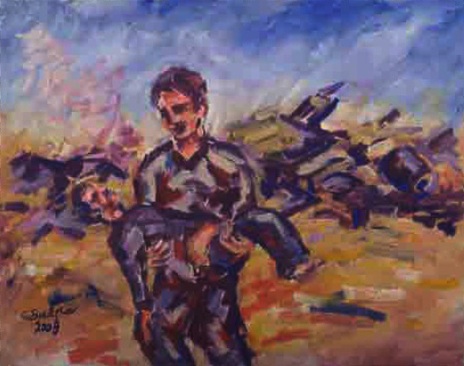
‘Life in Gaza Today’: an exhibition

Christian World Service are sponsoring an exhibition of paintings by Christian and Muslim children and adult artists who live in Gaza.

WhereKnox Church, 449 George St, Dunedin, in the Gathering Area.

When: 20–22 December 2010, 3–5 January 2011. 10.00 am – 4.00 pm.

The exhibition will be launched on Monday 20 December @ 5.15pm with a talk by Mai Tamimi.

Enquiries: email or phone (03) 477 0229.

Blurring visions

‘While (the Christian) vision is no longer the dominant one (in Australia), and may never have been, neither is any other at the moment. There is as yet no other vision abroad in our society which commands the same authority as ours does, the same sense of being the bottom line, the great reserve to be called on in times of real need. Many of the themes of the rallies are necessary problem solving and little more, and much in the spiritual supermarket is fair weather stuff, adjuncts to a prosperity which may now be vanishing. Unbelief, once a daring and rather aristocratic gesture, must now have exhausted most of its glamour; it is certainly no longer exclusive, or particularly rebellious. Much the same could be said of sexual indulgence, pornography and the like. Having by now surely lost most of its flavour of forbidden fruit, sexual licence has to justify itself in terms of whatever real satisfaction it can give; its utility as a bait to draw people out of traditional ways and beliefs, and if possible into new allegiances, must by now also be wearing thin. And it will be difficult at the very least, for the cult of unremitting youthfulness and physical beauty to survive in the era of aging populations which it has helped to produce. By now liberal humanism is as badly fragmented by dissension as our witness ever was, and its fiercest adherents are often covertly uneasy at its lack of gentleness, its readiness to force the facts and its desolate this-worldliness. Its unrelenting adulthood forces people onto the thorns of tragic complexity and the strange intractability of the world, and often when people who subscribe to it relax for a moment, their eyes are seen to contain an almost desperate appeal: please prove us wrong, make us believe there is more to it than this, show us your God and that Grace you talk about. We are more widely judged on our own best terms than we think, and more insistently expected to be the keepers of the dimension of depth than we find comfortable’. – Les A. Murray, ‘Some Religious Stuff I Know About Australia’ in The Shape of Belief: Christianity in Australia Today (ed. Dorothy Harris, et al.; Homebush West: Lancer, 1982), 25–6.

The (two) Stories of (two) Gulfs: on logs and splinters

Copious media outlets this morning report that the U.S. Department of Justice recently filed a lawsuit against the oil giant BP and eight other companies over the oil spill in the Gulf of Mexico. U.S. Environmental Protection Agency Administrator Lisa Jackson said the government is seeking compensation for restoring the Gulf Coast region. She says,

This is about getting a fair deal for the region that suffered enormous consequences from this disaster. And it’s also about securing the future of the Gulf Coast. Ensuring accountability strengthens our ongoing efforts to help Gulf Coast communities get their lives and livelihoods back on track. The government’s complaint seeks civil penalties against those responsible for the spill and will lay the foundation for securing what is needed to restore the Gulf’.

Anyone else see the irony here? If one was to write a book, perhaps an appropriate working title might be The (two) Stories of (two) Gulfs: on logs and splinters.

[Images from here, here, here and here]


Advent VII: ‘The Man Who Was a Lamp’, by John Shea

Legend says,
the cave of Christmas
where the child of light
burns in the darkness
is hidden
in the center of the earth.

Access is not easy.
You cannot just amble to a mantle,
note the craft of the crib child,
and return to the party for more eggnog.
You may see a figurine in this way,
but you will not find the child of light.
The center of the earth is not the surface.
You must journey
and, wayfarer,
you need a guide.

Even the Wise Men had to risk
the treacherous courts of Herod
to consult the map of Scripture.
They knew that a star, no matter how bright,
could not take them all the way
It is true
that sometimes angels hover in the sky
and sing directions,
but they cannot be counted on
to appear.
Besides, you are not one
to keep watch over a flock by night.

There is another pointer of the way,
a map of a man,
who when you try to read him,
reads you.
Unexpected angels are pussycats
next to this lion,
a roar that once overrode Judea.
You may not heed
but you will hear
his insistent,
intruding,
unsoothing voice.
Some say this thunder is because his father
stumbled mute from the Holy of Holies,
tongue tied by an angel who was peeved
by the old man’s stubborn allegiance to biological laws.
The priest was silenced in the temple
because he thought flesh could stop God.
The son of the priest shouted in the wilderness
because he feared God would stop flesh.
His open mouth was an open warning.

His name is John,
a man who was a lamp,
at least that is what Jesus said,
“a burning and shining lamp.”
The implication is clear:
The lamp is a torch through the darkness
to find the Light of the World.
As the lamp comes closer to the Light,
its radiance is overwhelmed.
It is in the presence of a stronger shining.
It decreases as the Light increases.
Yet there is no comparison.

The child cannot be found by competition.
The lamp and the Light meet
in the mystery of communion.
The two become one
while remaining two.
Follow John and find Jesus.
Find Jesus and find the Illness of John.

But John is not so easy to follow.
He is no toady
He lacks senility
and does not work for pay
In truth,
he is more guardian than guide,
more dragon at the gate than porter at the door,
more fire on the earth than lamp on a stand.
Opposite of the sought-after child in every way
The child is round,
this one has edges;
the child nurses on virgin’s milk,
this one crunches locusts;
the child is wrapped in swaddling clothes,
this one is rubbed raw by camel hair.
Yet they know one another
even exchange smiles.
They share a mystery,
this hairy man and smooth child.

Jesus came out of John
as surely as he came out of Mary.
John was the desert soil
in which the flower of Jesus grew.
John was the voice in the wilderness
who taught Jesus to hear the voice from the sky.
John would push sinners beneath the water
and Jesus would resurrect them on the waves.
John was the fast
who prepared for Jesus the feast.

No man ever less a shepherd than John,
yet loved by one.
If you are surprised that Jesus came from John,
imagine John’s prophetic puzzle
when the predicted “wrath to come” came
and he said, “Let’s eat!”
John expected an ax to the root of the tree
and instead he found a gardener hoeing around it.
He dreamt of a man with a winnowing fan and a fire
and along came a singing seed scatterer.
He welcomed wrathful verdicts,
then found a bridegroom on the bench.
When John said, “There is one among you
Whom you do not know,”
he spoke from experience.

So from prison
John sent his disciples to Jesus.
He will send you too.
Despite his reputation,
he is best at introductions.
It is simply who he is,
preparer, primer, pointer,
a tongue always on the verge of exclaiming,
“Behold!”

His question was, “Are you the One Who Is to Come
or should we look for another)”

This arrow of a question was sent from prison
but the bow was bent in the desert
by “none greater born of woman”
who was awake before the sun,
waiting,
watching the vipers flee before the morning
his eyes welcomed.

“Are you the One Who Is to Come”
is the question of John highway,
his road under construction,
hammer and pick and hardhat song,
“I have leveled a mountain
and raised a valley
to make even the path of the Lord!”

You
are the mountain
his sunburnt muscles
are slamming to cracked rock.
You
are the valley
his tattooed arms
are filling with broken earth.
He will trowel you to smooth,
and when there is no impediment,
when there is nothing in you
which would cause a child to trip,
you will yearn for someone to arrive
and ask the question
that guards the cave of Christmas,
“Are you the One Who Is to Come?”
So do not go fearfully
into John’s wilderness,
beaten from civilization by others
or driven by your own self-loathing.
Go simply because it is the abode
of wild beasts and demons
and, given all you are,
you will most certainly feel at home.
Wrestle with the rages of the soul,
talk to the twistedness.

Try no tricks on him.
Parade no pedigree.
Who you know will not help you.
If the children of Abraham and stones
have equal standing in his eyes,
you will not impress him
with anything you pull from your wallet.

Also do not ready your brain for debate.
He is not much for talk.
He has washed his mind with sand.
Injunctions are his game.
If you have two coats or two loaves of bread,
share them.
Do not bully,
do not exploit,
do not falsely accuse.
Do not object that these actions are
economically naive,
culturally inappropriate,
insufficiently religious.
Just do them.
Afterwards,
you will be unencumbered,
yet lacking nothing,
freer to move, to bend.
The entrance to the cave is low.

John’s desert is the place between slavery and promise,
out of Egypt but not yet in the waters of the Jordan,
Your sojourn there will burn away
the last marks of the shackles
and you will stand unfettered.
You will be between the castle and the crowd,
between fine garments and reeds shaken by the wind.
You will not lord it over others
and you will not be pushed around.
Prophet?
Yes, and more.
But in the thrill of freedom
it will take you a moment to notice
what that more is.
In the emptiness of John’s desert
you will find yourself waiting,
like a bowl that waits for wine,
like a flute that waits for breath,
like a sentinel that waits for the dawn.
You are a highway ready for traffic,
and here comes One
who seems also to have been waiting,
waiting for the construction to be complete.
The more is arriving,
and there is only one question,
“Are you the One Who Is to Come?”

Jesus answered,
“Go and tell John
what you see and hear.”

So they did.
The disciples of John returned on the night of Herod’s birthday
The music and laughter of the celebration
twisted down the stairs to the dungeon
beneath the earth.
They talked to John through the bars.
They could barely make him out
in the shadows.

“We saw a blind woman staring at her hand,
first the palm, then the back,
over and over again,
twisting it like a diamond in the sun,
weeping all the time and saying,
“I can see through tears! I can see through tears!”

We saw a lame man
bounce his granddaughter
on his knee.

We saw a leper
kiss her husband.

We saw a deaf boy
snap his fingers
next to his ear
and jump.

We saw a dead girl
wake and stretch
and eat breakfast.

The poor we saw
were not poor.

They paused.
Although there was no light in the dungeon,
there was a glow around John.
It softened the fierceness of his face
yet took no strength away
When he had preached on the banks of the Jordan,
they could not take their eyes off his fire.
Now this new light made them look down.
“Jesus said
we would be blest
if these sights did not scandalize us.

John was silent.
When he spoke,
the words had no urgency.
There was no strain in his voice.
It was no longer
the voice in the wilderness.
“The guards tell me that Herod,
panting,
has promised Salome
half a kingdom
if she will dance for him.
Surely she will ask for me
for I am half a kingdom.
I can denounce a king
but I cannot enthrone one.
I can strip an idol of its power
but I cannot reveal the true God.
I can wash the soul in sand
but I cannot dress it in white.
I devour the Word of the Lord like wild honey
but I cannot lace his sandal.
I can condemn the sin
but I cannot bear it away
Behold, the lamb of God
who takes away the sin of the world!

Yet he came to me
to go beyond me.
He entered the water
to rise out of it.
He knew I would know him when he came
even though I did not know him before he came.
The fulfillment is always more than the promise,
but if you hunger and thirst in the promise,
you will welcome the One Who Is Not You
as All You Are,
and more.
Go back
and tell Jesus
what you see and hear –
John,
not scandalized but fulfilled,
witness to his coming.

When you told me
what you saw and heard,
I knew who I was:
the cleanser of eyes but not the sight that fills them,
the opener of ears but not the word that thrills them.
A prophet?
Yes, and more.
Friend of the Bridegroom.
And more.
It was love in the desert and I did not know it.
It was love by the river and I did not know it.
It is love in this cave and now I know it.
Bridegroom myself!”

The guards clattered down the stairs,
their impotent swords drawn.
They pushed aside the disciples
and unlocked a dungeon of light
to find John dancing,
his feet moving to the long-ago memory
of womb kicks.
Who was about to lose his head to Herod
had lost his mind to God.

The cave of Christmas
is hidden
in the center of the earth.
You will need a lamp for the journey
A man named John
is a step ahead of you.
His torch sweeps the ground
so that you do not stumble.
He brings you,
at your own pace,
to the entrance of the cave.
His smile is complete,
perfect,
whole,
lacking nothing.

Inside
there is a sudden light,
but it does not hurt your eyes.
The darkness has been pushed back by radiance.
You feel like an underwater swimmer
who has just broken the surface of the Jordan
and is breathing in the sky
John is gone.
Notice
from whom the light is shining,
beloved child.

– John Shea, Starlight: Beholding the Christmas Miracle All Year Long (New York: Crossroad, 1993), 174–83.

2010 in film

One never tires of seeing just how insanely clever some people are, and of seeing evidence of the incredible amount of time some people seem to have at their disposal. Gen I, of G-Whiz Productions, is one such dude. She has taken 270 of this year’s movies and remixed them into one video. Amazing.

One also never tires of seeing just how insane some people are, period. Consider this, for example:

To intinct, or not to intinct?

Mike Crowl’s comment on the previous post led me to Richard Giles’ somewhat controversial book Creating Uncommon Worship: Transforming the Liturgy of the Eucharist wherein Giles had this to say:

In every method of sharing communion there lurks a gremlin that needs to be named, and the name of the gremlin is intinction. This is an antisocial habit, which smacks of fear, arrogance and lack of faith, symptomatic of our not thinking what we are doing. It is a problem that needs to be addressed by the community, led by the pastor and his/her leadership team.

Although of ancient provenance (first springing out of the woodwork in the seventh century) it has been repeatedly condemned and outlawed by the Church. Fear of spilling the Precious Blood of Christ, or of catching the plague, may have made sense in the Middle Ages, but surely not today. It is a particularly grave misdemeanour for Anglicans and Lutherans, whose spiritual ancestors fought so hard in the Reformation period for the restoration to the people of communion in both kinds. How ironic if today we were to turn up our noses at the chalice!

Intinction poses two problems, theological and practical:

1.     The common cup has always been a potent symbol of the bond between disciple and Lord. The passing of the cup is a dramatic feature of the gospel accounts of the Last Supper, and those who would be close to him are challenged, as were James and John, with the question, ‘Are you able to drink the cup that I drink?’ (Mark 10.38)

2.     It leaves such a mess for those who come after, especially so in the era of real bread, when those who intinct reduce the contents of the chalice to a soup.

The remedy lies in a renewed education of congregations about the history of the sacrament, the privilege of the common cup, and its safety on health grounds. We also need a few more pastors who will slap wrists. (pp. 200–1)

An undercooked theology? An over-reaction? Or both?

Aquinas, Luther and Calvin on the role of the priest in the eucharist

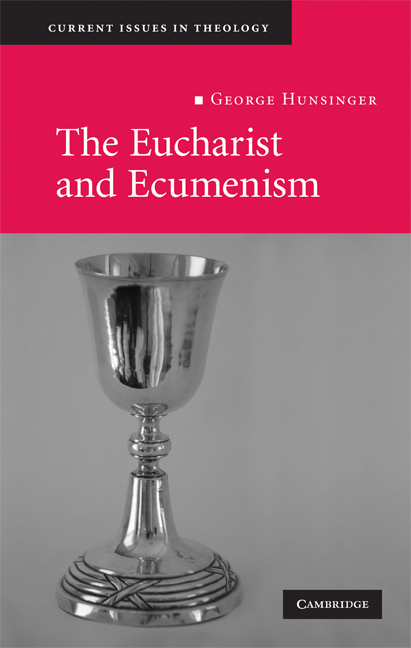
While in the current of writing a lecture on the Eucharist, I have been enjoying intincting – and, in some cases, re-intincting – into some great books: William T. Cavanaugh’s Torture and Eucharist: Theology, Politics, and the Body of Christ, Angel F. Mendez Montoya’s The Theology of Food: Eating and the Eucharist, Stephen Sykes’ Power and Christian Theology, among them. William Stringfellow’s essay ‘Liturgy as Political Event’ is also wonderful. I’m also enjoying George Hunsinger’s The Eucharist and Ecumenism: Let Us Keep the Feast, a book that deserves a very close read and is certainly among the boldest and most important studies available on the subject.

Hunsinger notes that Thomas Aquinas, who was among the most impressive of the pre-Reformation theologians, understood the role of the priest in the eucharist as in some sense mediating between Christ and the faithful. In other words, for Thomas, the priest was the central figure in the eucharistic sacrifice. So Hunsinger writes: ‘‘He [i.e., the priest] acted both “in the person of Christ” (in persona Christi) as well as “in the person of the church” (in persona ecclesiae) (ST 3.82.8). In the person of Christ, he consecrated the sacrament. In the person of the church, he offered Christ in prayer to God (ST 3.82.8). Whatever the priest did when acting in the person of Christ was taken up in turn by the people (ST 3.83.4). The priest’s union with Christ, however, was different than it was for the laity. “Devout layfolk are one with Christ by spiritual union through faith and charity,” explained Aquinas, but the priest was one with Christ “by sacramental power” (ST, 3.82.1). At his ordination the priest had received a special status, “the power of offering sacrifice in the church for the living and the dead” (ST 3.82.1). The priest was set apart from the people, and above them, by virtue of this sacramental power’ (pp. 114–5).

Luther, of course, would radically qualify – or extend – this notion in his argument that the priest symbolised the priesthood of all believers, while possessing no special powers of consecration and sacrifice in and of himself. Luther stated:

‘Thus it becomes clear that it is not the priest alone who offers the sacrifice of the mass; it is the faith which each one has for himself. This is the true priestly office, through which Christ is offered as a sacrifice to God, an office which the priest, with the outward ceremonies of the mass, simply represents. Each and all are, therefore, equally priests before God . . . For faith must do everything. Faith alone is the true priestly office. It permits no one to take its place. Therefore all Christian men are priests, all women are priestesses, be they young or old, master or servant, mistress or maid, learned or unlearned. Here there is no difference unless faith be unequal’. Martin Luther, Luther’s Works, Vol. 35: Word and Sacrament 1 (ed. J.J. Pelikan, et al.; vol. 35; Philadelphia: Fortress Press, 1999), 100–1.

Hunsinger, in Eucharist and Ecumenism, properly notes that Luther upheld the idea of grace alone by combining christological mediation with communal participation:

‘The believer and the community can be said to offer Christ by participating in Christ’s own self-offering, which in turn mediates them into eternal life with God. Inclusion in Christ’s priestly self-offering is at once the promise and the consequence of grace. At the same time, the place of the priest in the mass has been radically redefined. Christ the eternal priest does not operate in and through the visible priest, nor does the priest offer Christ as the invisible victim through the bread and the cup. The bread and the cup, for Luther, are the sacramental but not the sacrificial body and blood of Christ. That is, they are not the means of reciprocal self-offering to God by Christ, priest, and people. They are not the eucharistic means by which Christ is offered up. The bread and cup are simply a pledge of Christ’s faithfulness to his promises. It is not the priest but the faith of each believer that offers Christ to God. The role of the priest is simply to symbolize by outward ceremonies the one true priestly office, which is faith’. (p. 135)

The Reformed, following Calvin and the best of those who spoke in his wake, sought to witness to how the cross and the eucharist are held in a unity that does not violate but reinforces their distinction via two forms: The constitutive form is the cross while the mediating form is the eucharist. ‘The cross is always central, constitutive, and definitive, while the eucharist is always secondary, relative, and derivative. The eucharistic form of the one sacrifice does not repeat the unrepeatable, but it does attest what it mediates and mediate what it attests. What it mediates and attests is the one whole Jesus Christ, who in his body and blood is both the sacrifice and the sacrament in one. As the sacrifice, he is the Offerer and the Offering. As the sacrament, he is the Giver and the Gift. The Son’s sacrificial offering of himself to the Father for us on the cross is the ground of the Father’s sacramental gift of his Son to the faithful in the eucharist’ (Ibid. 151). As TF Torrance has shown in Theology in Reconciliation, the cross is the ‘dimension of depth’ in the eucharist. The eucharist has no significance in and of itself. Its significance is both derived and grounded in the cross. The cross alone is, as TF Torrance notes, the saving ‘content, reality and power’ of the eucharist. It is to this that the Reformed minister and church directs our gaze.

It was precisely such a position which led PT Forsyth, the theologian of the cross, in his lectures on The Church and the Sacraments, to offer the following statement:

The Lord’s Supper is the most complete and plenary of all the cultic ways of confessing the work of reconciliation, where the sin of humanity is conquered by the grace of God in a holy Kingdom. It is therefore the real centre of the Church’s common and social life. This should not be sought in social reunions, or ecclesiastical monarchy, or philanthropic cohesion, but in the spiritual region, in the worship, and the theology moulding it. For here we are summoned to what is our vital centre deep within all the individual wills that wish to unite, to what is the centre of the faith that makes the new Humanity, and to the goal which rounds all’. (p. 260)


Advent VI: ‘Gift’ by Marion Armstrong

Not then; and never since
Have we quite reached the stable, King and Prince,

Nor clearly seen the manger
As shepherd saw it, and as money-changer,

Nor worshiped with our hearts the small
Body which bore the weight of miracle;

But stand, have stood forever in our night
While the beloved Baby made of light

Sleeps in the stillness that his Father sent
Where animals’ eyes are eloquent.

And if (O God) I move from my self and come
And call the stable suddenly heaven and home

And bend my scarred unvirgin knee:

Receive, O Word, dumbstricken me.

– Marion Armstrong. ‘Gift’, The Christian Century, 22 December 1965, 1575.