Author: Jason Goroncy

The 2014 Global Institute of Theology

GIT-banner

My mate, Frans du Plessis, reminds me that it’s time to remind folk about the forthcoming meeting of the Global Institute of Theology:

The fourth Global Institute of Theology (GIT) is set to take place in San Jose, Costa Rica, 5–28 July 2014. The institute will be held in collaboration with and under the academic auspices of the Universidad Bíblica Latinoamericana (Latin American Biblical University).

The GIT is a bi-annual program by the World Communion of Reformed Churches (WCRC). Previously, it has been held in Ghana, United States, and Indonesia. The program is intended for theological students and pastors beginning their ministry. This year, up to 35 participants will be selected. Applicants should have a particular interest in ecumenical theology and mission. The WCRC will take necessary efforts to ensure that the student body will reflect gender and regional balance to represent the diversity of the Reformed family in the world today.

Through lectures, seminars, worship services, exposure visits, contextual experiences, the sharing of stories and participation in the life of the churches in Costa Rica, GIT participants will explore the theme of “Transforming Mission, Community, and Church.” Students will take part in a core course as well as two elective courses out of six possible choices.

“The ultimate goal of the GIT is to form a new generation of Reformed leaders who are fully aware of the faith dimension of contemporary challenges, including economic injustice and environmental destruction,” explains Douwe Visser, Executive Secretary for Theology at the WCRC, and Secretary of the GIT. “Costa Rica, a nation that set the goal to be climate neutral in 2021, and has been ranked number one in the ‘happy planet index’ will provide an interesting background for these discussions,” added Visser.

The GIT faculty will include, among others, Bas Plaisier (The Netherlands), Peter Wyatt (Canada), Aruna Gnanadason (India), Isabel Phiri (Malawi), Claudio Carvalhaes (United States), Philip Peacock (India), Hans de Wit (The Netherlands), and Roy May (United States).

Applications for the GIT will be accepted until 1 January 2014.

Further information can be obtained on the GIT website or via e-mail.

If you’re a young theologian who chooses to develop your work out of the Reformed tradition as ‘a matter of religious and theological conviction’ (to rip from James Gustafson), then I commend it highly.

Some stuff on the stove

wood-stove

Shouldn’t Baptist churches retrieve the practice of venerating the saints, that is, engaging in corporate worship acts designed not to worship the saints, but to remember, honor, learn from, and celebrate saints from our Baptist family and from other Christian communions? Until we regularly include commemoration of the saints in our worship celebrations, we will continue to neglect the opportunity to give proper value to those from our past who have borne courageous witness to faithful discipleship. Commemorative acts done in our Sunday morning services would provide a suitable accompaniment for the tradition some have already developed as part of their Vacation Bible School program, in which stories are told of great spiritual leaders worthy of emulation … [HT: Steven Harmon]

[Image: from Old Picture of the Day]

‘God dies in the world’: an interview with an artist

SAMSUNG

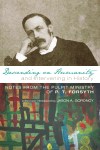
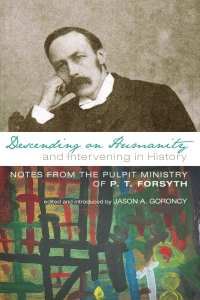
The front cover of my most recent publication, Descending on Humanity and Intervening in History: Notes from the Pulpit Ministry of P. T. Forsyth, includes a section of a painting (above) by my daughter Sinead. The decision to use her painting – a decision which, to be sure, required some grovelling for permission – was not, I hope, motivated by cutesiness but rather by a profound sense of the work’s fittingness to the book’s themes. The painting, which is used upside down, is called ‘Crosses’.

Forsyth.DescendingonHumanity.90702Now that Sinead and I have both finally seen the book in real life, I wanted to ask her again about the painting, about what it ‘means’ (her word), and about how it relates to the material in daddy’s book. So while on the way to school this morning, I conducted a brief ‘interview’ with Sinead. As part of that conversation, Sinead offered the following statement:

God dies in the world, and the God who dies in the world is the same God who dies in heaven. And yet somehow these two deaths, which are really the same, are related. In the end, it’s all really a mystery – but in the mystery the church is created and the world is saved. And that’s what my painting is about.

I buzzed.

[Copies of the book are available here or via here or by contacting me directly. If you are interested in reviewing the volume, then please contact James Stock at Wipf and Stock. And if you are interested in a copy signed by Sinead, then it’ll probably cost ya some serious dosh, or a packet of mints!]

Review: Manifesto for Learning: The Mission of the Church in Times of Change

ManifestoDonn Morgan, Manifesto for Learning: The Mission of the Church in Times of Change (New York: Morehouse Publishing, 2012). ISBN: 978-0-8192-2768-3; 96pp.

A guest-review by Kevin Ward.

This is a very brief little book that at first glance does not have much relevance for the church in New Zealand. It comes out of the crisis facing theological education in the US brought about by having far too many theological schools faced with rising costs, declining student numbers and reduced financial commitment from churches. That is a challenge for theological schools in New Zealand also, as I am aware both through teaching in one and being involved at executive level with both the New Zealand and Australia New Zealand Associations of such schools. However, as I read it I realised much of what was being discussed, both in terms of challenges and suggested ways ahead, was generally true for the church in New Zealand as well as theological education.

The core argument is that the mission of the church has three basic elements: worship, service and learning. He argues that while worship and service are regularly prioritised, learning is no longer regarded as ‘an important part of the church’s identity and mission’. ‘Service and worship without education and formation risks separating mission and ministry from fundamental parts of our identity, and creating a kind of amnesia concerning our Christian faith and its particular expressions’ (p. 38). This is a concern I also share and is identified in many recent studies, particularly among young people and young adults. Morgan takes a holistic view of this, not just concern about theological schools, and argues that the most important level of education is what happens at a congregational level. Here, in my observation, it is sadly neglected in many churches. The consequence of this lack of concern is, of course, a lack of commitment of resources to it, both at a congregational level and also in supporting theological education. Giving our scarce resources, service ministries or providing exciting worship is what counts.

The book is helpful in summarising some of the changes that have occurred over the past 50 years which have impacted on churches and theological schools in similar ways in New Zealand. ‘There continues to be debate about both the causes of and the solutions to the mainline churches’ decline. Because some churches continue to thrive, some say this is just a wake-up call for those in decline. But the overall numbers in many denominations reflect devastating change that would appear to require radical rethinking of the church’s mission, of “how to do and be church”’ (p. 17). Rather than thinking about these issues and the wider challenges of the state of the church as a whole, most focus has been on the survival of our particular community and its sustainability. This fosters a foxhole mentality. I would suggest this is true of both theological schools and local churches.

When it comes to looking at implementing the changes needed, Morgan suggests that it is like being in the middle of a three ring circus. The first ring represents the perennial issue of resources, especially financial, and the lack thereof. The second represents changes in church and society, which are, of course, related to the first. But while we spend much time discussing and obsessing about these, there is a third ring where ‘we try to put financial realities together with the changes in church and society as we reconsider mission and ministry’ (p. 61). This is the place where we need to not merely talk about structural change, but get through to doing it. This is the ring that is all-too-rarely entered. From my perspective it is a problem many theological schools have not addressed; namely, why a number in New Zealand have closed over recent years, and others are at crisis point (although I would add that it is one thing the Presbyterian Church has done well). But it is an even bigger issue for mainline churches, none more so than the PCANZ, and although we have been aware of the need for it for over a decade, have done precious little to address it.

The final chapter looks at some of the problems faced along the way of change, such as ‘inertia and investment in the status quo’, ‘particularity and diversity’, and ‘competition’, which are equally shared by churches and education schools. So while this book, at one level, is about challenges facing theological schools in the US, reading it provides many helpful insights and suggestions not only for similar institutions in New Zealand but also for the church in the very challenging context we find ourselves in, where time is no longer our friend.

Seminar on Debates about Religion and Sexuality

Max Beckmann - Adam and Eve, 1917Between 10–19 June, 2014, the Harvard Divinity School is running a ‘summer seminar for scholars, other writers or artists, religious leaders, and activists who are working on a first large project in which they hope to change the terms of current debates around religion and sexuality’. The seminar will be directed by Mark D. Jordan (Washington University, St. Louis) and Mayra Rivera Rivera (Harvard University), is limited to 12 participants, and HDS is picking up the tab for travel, accommodation and grub.

Applications are due 5 February, 2014, and questions may be directed to rsseminar@hds.harvard.edu.

More info here.

Review: Resilient Ministry: What Pastors Told Us About Surviving and Thriving

Bob Burns, Tasha D. Guthrie and Donald C. Guthrie, Resilient Ministry: What Pastors Told us about Surviving and Thriving (Downers Grove: IVP Books, 2013). ISBN: 978-0-8308-4103-5; 312pp.

A guest-review by Kevin Ward.

This is a book which every person working as a minister of the gospel would benefit from reading – indeed, more than reading, but also reflecting on and, in light of that, making changes to how they live and work. We are all aware that many of those who enter ministry in response to what they perceive as a life time calling drop out within a relatively short period of time. Precious few of those I trained with nearly four decades ago are still in church ministry. What kills them off is not what goes into sermons or worship services but, as the authors of this book point out, matters of life skills, behaviour patterns and character. This book not only identifies the core issues but also makes suggestions of what needs to change and how to action that.

Rather than just building on anecdotal evidence or personal experience, the book is based on solid scientific research. The team created three pastoral peer groups or cohorts (who were primarily Presbyterian) who met three times a year for two years. They were interviewed to identify the ministry issues they wanted to discuss. They then read books on those subjects, listened to experts who were brought in and then discussed the issues in their groups. The discussions were recorded, transcribed and analysed.

From the transcripts, the researchers identified five themes that they believe are keys to sustaining pastoral excellence. These were:

1. Spiritual formation. Ministers can be so busy in the multiple tasks of ministry that they neglect their own spiritual wellbeing, the source from which ministry flows. They need to internalise the spiritual rhythms of reflection, worship, sabbath and prayer.

2. Self-care. The ongoing development of the whole person: physical, mental, emotional, relational. This involves a range of practical issues including identifying allies and confidants, establishing an exercise routine, planning intellectual development and holidays and creating and keeping good boundaries.

3. Emotional and cultural intelligence. These are related to being aware of oneself and also attentive to and aware of other people, places and social dynamics. Much has been written recently about the importance of emotional intelligence in leadership but the awareness of cultural intelligence, crucial in our increasingly diverse world, is only just emerging.

4. Marriage and family. Unlike many jobs ministers are never really ‘off the clock’, and so the demands of ministry can constantly intrude on marriage and family time. It is, then, critical to be intentional about giving focussed uninterrupted time to spouse and children. The significance of the contribution of the spouse to a minister’s resilience in ministry came through again and again.

5. Leadership and management. I found these chapters full of good insight and found helpful the way they talked about these as the ‘poetic’ and the ‘plumbing’ side of leadership, both of which are essential to good and resilient ministry. The management side can be found addressed in many books but the poetic side of leadership is much more intuitive and harder to explain and there are some helpful concepts here.

As well as having lots of good information the book has questions for personal evaluation and reflection throughout, as well as suggestions for further reading and exploring through media. This is an area I have taught in for the past 15 years or so, and this book is as a helpful as any I have come across. It is both informed and practical. As well as its personal use for ministers, it would be ideal for a group of ministers to read and discuss together and perhaps also to work through with the lay leadership in their church. I certainly intend using it as an important text for my students.

[Those interested in reading more on this topic might like to check out Jason’s series On the Cost and Grace of Parish Ministry]

October stations …

SAMSUNGReading:

Listening

Link love

Leunig love

Leunig-iPad-The Lost Art

Leunig - Words for mystery

[Source: The Age]

School is No Place for a Reader

readingThis piece by Jennifer A. Franssen rang too many bells to not repost:

A perplexing fate awaits a reader in an elementary school. There is no place for this strange child in classroom, library or playground. Watching my daughter caught in this predicament I find myself troubled by the paradox of an institution charged with teaching children to read that seems unable to offer either welcome or nourishment to the ardent reader within its walls.

With the arrival of the child came the books. From the shelves of used bookshops, thrift stores, libraries and Oma’s house, from the Amazon and Indigo warehouses, out of wrapped packages at Christmas and birthdays the books arrived like an endless small town fair parade – floats, marchers, brass bands, clowns – some finer than others, in crowds bunched together or singly straggling, not well-marshalled, but hanging together somehow. Each met with narrowing, gleaming eyes – what will this one do? Mother Goose, the Grimms, Kipling, Seuss, Beatrix Potter, Edward Lear and the Ahlbergs. A perverse favourite known as “Josh and Jude” that put readers-aloud into hypnotic trance.

By the time the child started school she had taught herself to read. Joining the carnival, she kept company with her favourites as long and as often as she liked. She met Moomintroll and Mary Poppins, Dido Twite and Pippi Longstocking, Loki and Laura Ingalls, Borrowers and Bastables, Swallows and Amazons. Awake and dreaming she gazed on Asgard, Olympus, Canaan, and Camelot. She lived at Willoughby Chase, Villa Villekula, and Greene Knowe. She stopped reading only when the book was pried from her small hands.

The books from school came home in a Ziploc bag with a detailed letter explaining how her parents or caregiver should read with her at home every night for ten minutes. The first small ten-page book was called “Noise,” its recurring line “Yukka, dukka, yukka, dukka, ya, ya, ya.” There was one book to last the week. “Noise” was the beginning of a parade as well. All entries wore the same uniform, had the same number of performers and arrived at precise weekly intervals. The drill lasted ten months a year for four years. In December of the first year, the child said she wanted to get up off the kerb and go home.

I

At the parent-teacher interview, the child’s mother sits in a small chair, knees at her chest.

“I wondered about the reading,” says the mother. She holds up two books – The Borrowers, from home, and A Bad Day, from school. “Do you have any books more like this one she just finished reading? She’d love to bring something more like this home from school, and it might . . . well, make more sense than sending these other kinds of books home.”

“Sequential levelled readers” are making their punctual way to the house in the backpack, one every week. The teacher leans forward and says, mysteriously, “There is a difference between decoding and comprehension. Perhaps she is decoding that book, but she isn’t comprehending it.” Raised fingers twitch around his words.

II

From junior kindergarten to Grade 2, the child’s classes march linewise down the hall to the school library for a weekly visit. Pre-selected books in a box wait to be grabbed and checked out at the end of library period. The students file in and obediently sit down. The librarian dims the lights and presses play on the DVD player. The child reads in the dark as the videos play. The librarian confiscates the book. “Stop reading and watch this movie.”

III

During library period in grade 4 the librarian teaches the children computer skills: making their names appear in various colours and fonts on the screen and designing brochures. At the end of the period there are a few minutes to check out two books. Most children decline the offer. The child sees a book she wants high on the top shelf and asks the librarian to reach it for her. “No. You can’t have anything with a yellow sticker. They are too hard for you. You might be able to read it, but you wouldn’t understand it. Pick one of the books with green stickers.” Green stickers mark the spines of The Magic School BusThe Babysitters’ Club and The Pokemon Guidebook. The book the child has just finished reading, Oliver Twist, is not in the library at all.

IV

It is the first day of school in grade 3. All morning the child looks forward to recess. The pavement is still warm in September. She will make a pillow of her jacket and lean against the brick wall, reading. The bell rings. The teacher pulls her from the line on the march downstairs, “Give me the book. You have toplay outside during recess.”

That afternoon, the child tucks The Two Towers inside the sleeve of her jacket before she makes her way outside. Vigilant against unauthorised reading, the teacher looms in the stairwell. She puts her hand out. “Give me the book. That’s sneaky – hiding that book under your jacket.” Then, very slowly and clearly, “Don’t – be – sneaky.”

V

The teacher calls the child’s mother. “She has to stop talking in class about the books she’s reading. It’s very insensitive. She’s making other students feel bad.”

“They feel bad? Why? What is she saying?”

“She said that Harry Potter isn’t hard to read.”

* * *

School is no place for a reader. An object of suspicion and a source of discord in the classroom, the reading child is a threat to school harmony. Her act of reading is itself a provocation to authority. She must be stopped and made to play team games or gaze dumbly at a screen. The silent reader dangerously escapes supervision and the escape is most threatening when the content of the book is unknown.

But reading boosterism is everywhere. Notices in the hallways advertise the Book Fair. Slogans abound. “Reading Rocks!” “Reading is Cool!” “I ª 2 Read!” Oracular posters prophesy “TODAY A READER, TOMORROW A LEADER.” A spurious promise. Reading seems at least as likely to undermine a desire to “lead” as to encourage it. In the act the reader retreats from the world, makes herself absent from the forum. When I think of “readerly leadership” Tolstoy’s General Kutuzof comes to mind – observing, waiting, delaying action, frustrating the ambitions of courtiers and counsellors. His was a leadership prone to doubt, aware of the vagaries of chance, and the unpredictability and frequent futility of action – “When in doubt, don’t.”

The Book Fair tables are filled with things that aren’t books – pencil sharpeners, stamp art kits, novelty pens – and things that only look like books – video game character guides, Lego sets packaged in a book form, One Direction Fact Books, Power Rangers and Angry Birds advertisements disguised as “Early Readers.” The Book Fair is a hoax.

Not only does school present a shallow conception of what reading is, the experience of school offers almost no opportunity to read with pleasure. Readers need relatively quiet libraries and classrooms well-stocked with excellent books, tended by well-read teachers and librarians always ready to suggest a book or to read out loud with enthusiasm and familiarity with the story.

The judgement of teachers and librarians putting books in the hands of children should be formed through wide reading, experience and appreciation of written language. Instead a member of one school library committee in Ontario can say that he doesn’t see any difficulty at all in consolidating two school libraries into one, smaller, space. After all, he never has any of his students check a book out of the library. “What’s the point? They should be using Wikipedia.” His fellow member (two of this type, on one small school board committee!) concurs, “I have taken loads of courses over the years – upgrades, professional development, content courses – I have never needed to read a single book. No one reads books anymore. It’s all articles and PowerPoint.”

School libraries are filled with computers and the shelves are filled with dreck based on video games, cartoons and movies. It is said that this is the only way to tempt children away from screen to page, but these book impostors are created to foster and capitalize on an appetite for a product. Is it likely that “Barbie in a Mermaid Tale,” printed out as sixteen pages of dull and disjointed summary, will increase the odds of the child reading Alice in Wonderland or Swallows and Amazons? Whatever the market may cast before consumers, school should not be its enthusiastic accomplice in corrupting the taste and abilities of the young. We must know these things for what they are. The Pokemon Character Guide is not a book, it is a toy. Children ought to have toys, but they should also have books.

Chances for reading in school are too frequently squandered on something else – computer training (a ludicrous idea equivalent to teaching students how to operate a DVR or a microwave oven), fundraising, and, most egregiously, watching mainstream commercial movies and television programs. Why, if reading is universally agreed to be essential to learning, if we all “ª” reading, would teachers choose to fill those inevitable unplanned 50-minute periods with a movie rather than have students read to themselves, or hear a book read aloud? Every child in school lives in a world throbbing with noise and the constant flickering of video display. Why would a movie ever displace the chance of a quiet hour with a book in school?

Sitting in waiting rooms with children over the years I have had the same experience time and again: when I open a book and read out loud every child in the room wanders over. They stop complaining, leave behind their iPod or NintendoDS. Children are transfixed by books read aloud. They should hear books and poetry often. Even if we adults rarely, or never, speak well, through reading out loud our children will hear the cadence of beautiful language. Children will listen to words, will imitate purely for the pleasure it gives them. Even the youngest children in the schoolyard parrot insidious pop song lyrics like “So here’s my number, so call me maybe.” Surely this has less meaning for them than Jabberwocky? And unlike Carroll’s nonsense, the pop lyric is devoid of the invention and impact of language shaped by formal considerations.

I have read a great deal in these pages and elsewhere about the demise of a literary sensibility and the dwindling number of discerning and independent-minded readers, not only among the population at large, but also, and more inexcusably, among university students, professors, publishers and critics. We are reaping a crop sown in the soil of elementary school, fertilised with Scholastic pseudo-book order forms, literacy texts, and reading logs, and grown in the glass house of bookless classrooms and school libraries converted into computer labs.

Lest we think the Ziploc reading bag a local phenomenon, here is poet and children’s writer Michael Rosen on the British “reading scheme” (in his 2007 Patrick Hardy Lecture):

Schools want and need parents to be partners in the education of the children. . . . But in this matter of reading – how should parents be partners? When? Where? And with what? Is the parents’ role to be a matter of reading the book a child comes home with? More times than not, in more schools than not, I have a pretty strong feeling this book isn’t actually what I’d call a book. It’s more a kind of pamphlet or booklet that tells some strange inconsequential tale about a group of people who don’t say things in any kind of recognisable, nor indeed utterly fantastical way. They seem to talk mostly in short statements in the form of instructions, intentions and conclusions, ‘I am going out.’ –  ‘I am happy.’ Is this what the teachers mean by reading with your children?

MatildaThat fierce and erratic writer for children, Roald Dahl, created in his eponymous heroine Matilda the archetype of the avenging autodidact book lover. She discovers her uncanny powers in the rage provoked when her father tears her book apart. She first comes to the attention of the nightmarish headmistress Miss Trunchbull as the impossible child reader of Nicholas Nickleby, a book the Trunchbull praises for the liberality with which the “admirable” headmaster Wackford Squeers uses his stick on his pupils:

“A fine book, that. But I don’t suppose this bunch of morons we’ve got here will ever read it because by the look of them they are never going to learn to read any thing!”
“I’ve read it,” Matilda said quietly.

“Read what?”
Nicholas Nickleby, Miss Trunchbull.”
“You are lying to me madam!” the Trunchbull shouted, glaring at Matilda. “I doubt there is a single child in the entire school who has read that book, and here you are, an unhatched shrimp sitting in the lowest form there is, trying to tell me a whopping great lie like that! Why do you do it? You must take me for a fool! Do you take me for a fool, child?”

Dahl’s own schooldays were remembered bitterly in his autobiographical story, “Lucky Break.” He felt the only worthwhile learning in his long, expensive and brutal English boarding school education came during two and a half weekly hours spent with one Mrs O’Connor, who supervised the boys while the teachers made their Saturday morning outing to a country pub. To each boy, she gave a copy of her six-page list of the most significant works of English literature and she talked about and read aloud from one of these books during each of her visits. “And the result of this,” wrote Dahl, “was that by the age of thirteen I had become intensely aware of the vast heritage of literature that had been built up in England over the centuries. I also became an avid and insatiable reader of good writing.”

Matilda’s Mrs O’Connor appears as the village librarian, the kindly Mrs Phelps, whose very great service is to aid and abet Matilda’s precocious reading while rejecting the prohibitions and ignorant judgments routinely pronounced against child readers:

“Mr Hemingway says a lot of things I don’t understand,” Matilda said to [Mrs Phelps]. “Especially about men and women. But I loved it all the same. The way he tells it I feel I am right there on the spot watching it all happen.”
“A fine writer will always make you feel that,” Mrs Phelps said. “And don’t worry about the bits you can’t understand. Sit back and allow the words to wash around you, like music.”

Dahl gives us a vivid image of the misfit child reader in school and the antipathy she can provoke in teachers. He also shows us the ease with which a sympathetic adult can make a place for the child – Let her read books.

Why should school be such hostile territory for readers? Why this ambivalence toward reading?

In part, at least, a difficulty is thrown up by the imperative to pursue a “literacy agenda” – the teaching of reading as a functional skill and the concomitant concern about testing results has left little place in school for literature.

In the fulfilment of the literacy agenda – enabling functional and useful reading – it really doesn’t matter what books kids are reading, so long as they’re learning how to read. Levelled readers, The Magic TreehouseThe Ninjago Guidebook, Barbie movie derivatives – the texts are disposable and fundamentally interchangeable. Because it is easier to test and assess based on a system of sequential readers, because it is easier to trick students into picking up a book because it looks and sounds like a television programme, the shelves are stocked with such things in the name of efficiency. The way that literacy is pursued in schools has profound implications for books. Readers of CNQ – writers, editors, publishers, critics, booksellers – take heed. Children’s education in literature and, but more often or, literacy prepares the field on which you carry out all your endeavours. The literacy agenda has resulted in the near elimination of actual books from schools. Peter Hunt describes the situation in Children’s Literature: “[A] utilitarian culture sees the ability to read and write as paramount and looks for simple methods of achieving it. . . . The teaching methods . . . eliminate fiction on the overt grounds that it is too complex, and on the covert grounds that the unrestrained imagination is not politically malleable.”

Arguably, the literacy agenda is a limiting approach that ill serves all children in schools. It is inarguable that it ill serves those who are already readers.

Does it make any sense for the child who is reading fluently, far beyond her grade level, to spend hours in school learning “strategies” for sounding out words, completing phonics worksheets and reading basic introductory texts? Is it wise to have her sit in school for years waiting for a time when she will be taught, when she will be challenged and drawn deeper into her ability? What might be done for this reader? Teachers already have a great deal to do in addressing the many problems and challenges in the classroom, but does that absolve schools from doing what they might for readers?

Perhaps a talent for reading is more easily and readily overlooked than a talent for mathematics. Certainly it seems widely felt that identifying and fostering talent in math is essential to national economic success. Millions of dollars in government funding are available for Science Technology Engineering and Math (so-called “STEM”) initiatives from kindergarten to grade 12 with the goal of “developing the next generation of STEM leaders to fuel business innovation.” A plethora of specialist math and science programs are available in schools – Scientist in the School, Science Fairs, Math Olympiad, FIRST Robotics competitions, among others – programs that recognize the importance of students interacting with knowledgeable practitioners in the field.

In my experience, the usual approach to talented readers is to keep them busy with extra writing assignments – book reports, independent study projects and worksheets. Asking them to make predictions before, during and after reading, to explain how predictions help them understand their reading, to make connections between text and text, text and self, text and world. I instinctively dislike this approach. I might be persuaded that it is an attempt to break down the actual engagement with literature into teachable component “skills,” but it produces only a parody of thinking. And applied to a ten-page, 60-word text it is just nonsense.

The earliest version of writing about reading in school is the reading log. The kindergartener draws a face in the box beside the title to show how she felt about the book – the mouth curved up or down, or sliding across the face in a straight line, resisting, I think, the demand that she make a judgement. The reading log expands and continues through the grades and the smiling or frowning faces must become prompted opinions: “I liked/did not like this book because . . .” Virginia Woolf thought giving an opinion of a book forced the reader to “get outside that cloud of fertile, but unrealized, sensation which hangs about a reader, to solidify it, to sum up. . . . [The reader] says it is a great book or a bad book. Yet, as he knows, when he is content to read only, it is neither.” Doesn’t that “cloud of fertile but unrealized sensation” sound like childhood? Let it linger for the child reader.

In searching for something to offer young readers in school, perhaps we ought be guided by those most experienced and able of readers – writers.

Eudora Welty remembered in One Writer’s Beginnings her mother instructing the public librarian that the 9-year old girl had permission to read “any book she wants from the shelves, children or adult.” Eleanor Farjeon rejoiced in her family’s “Little Bookroom” – filled with the precious dust of ages – “a lucky dip for a child who had never been forbidden to handle anything between covers.”

Let the books work on the reader, and let the reader do work that will make her consider and become more familiar with the form of written language.

She might study Latin – a language not for conversation or writing, but for reading. Again, Welty: “It took Latin to thrust me into bona fide alliance with words in their true meaning. Learning Latin . . . fed my love for words upon words, words in continuation and modification, and the beautiful, sober, accretion of a sentence.” Our own John Metcalf regretted in his memoir not having learned the ancient languages from his elementary school years. This would indeed be a gift to the young reader. If this seems far-fetched consider that in the UK and the US the study of Latin in primary schools is growing rapidly through programmes developed by classics organizations outside the school system, and being met with eager appetite by students and parents.

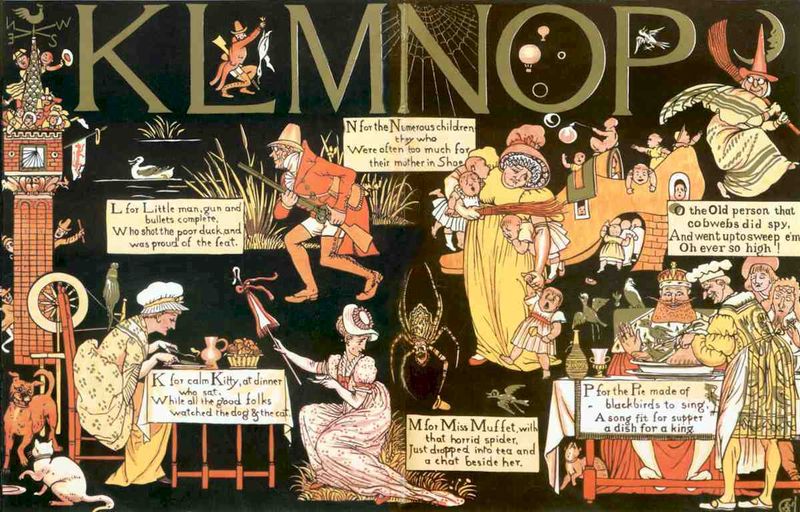
KLMNOPShe might commit poetry to memory. Clive James wrote that what “we need to make explicit, for the benefit of our children if not ourselves, is that the future of the humanities as a common possession depends on the restoration of a simple, single ideal: getting poetry by heart.” Through memorizing she will acquire a feel for metre and might be taught to scan poetry and be introduced to a vocabulary of form that has the taste, delicious to the child reader, of the esoteric and encoded. In encouraging child readers to think about what they are reading perhaps we cannot do better than having them memorize and perform it. Reading a poem or play out loud is, in fact, a retelling and a work of understanding – one that does not require a reductive judgement.

If we can imagine a school that allows children to read widely for pleasure, spreading before them a large and varied collection of excellent books; that makes time for them to read and to listen; that instructs them in the form of words and written language; that fosters their imaginative engagement with reading and teaches them to resist facile judgements; if we keep before us Woolf’s idea of the reader, who –

must check the desire for learning at the outset; if knowledge sticks to him well and good, but to go in pursuit of it, to read on a system, to become a specialist or an authority, is very apt to kill . . . the more humane passion for pure and disinterested reading. . . . For the true reader is essentially young. He is a man of intense curiosity; of ideas; open-minded and communicative, to whom reading is more of the nature of brisk exercise in the open air than of sheltered study.

– then we will have begun to imagine a place for a reader in school.
The Story of Dr Beryl Howie

Beryl HowieIt was 1958 when the London-based Ludhiana Fellowship invited Beryl Howie, a young and newly qualified New Zealand obstetrician/gynaecologist, to join the staff of the Ludhiana Hospital in India. In this invitation, Beryl recognised God’s calling, and went to India.

It was no easy challenge. In addition to undertaking a very busy clinical load, she also had to learn at least one of two local languages. Along the way, she was sustained by her faith in God, faith which motivated not only her medical work, but which also encouraged the study of the Bible among the students and patients that she had come to love. It came as a bit of a shock, therefore, when just before she was due for her first furlough the Ludhiana Fellowship told her that they had decided to move their support to training Indian doctors and asked her to find support elsewhere. Bewildered but not undetermined, and after exploring several options, she soon accepted an invitation from the Presbyterian Church of New Zealand to become one of their missionaries and, in 1963, she set off under new colours but to essentially the same job.

Over the next few years, while Beryl’s own workload stretched, so too did the old buildings in which she worked and which became increasingly inadequate for the burgeoning number of patients and new theatre equipment which arrived. She was soon dreaming about a new hospital for women and, during her next furlough, she challenged the New Zealand churches to raise $500,000 towards this. People all over New Zealand took enthusiastically to the project. When they had reached $100,000, the New Zealand Government offered to contribute $500,000 if the project raised that amount by Christmas. This challenge sparked off further enthusiasm among New Zealand churches. Several other missionaries were ‘at home on leave’ from India and others with a strong interest in Ludhiana helped to enthuse congregations and individuals to great heights. Suffice to say that Beryl returned to India with the plans and funding to begin planning for a new hospital and to start building.

Teaching Hundreds to Heal Millions

At the same time, she continued to work towards raising the standard of care of patients and developing higher educational and treatment standards of doctors, nurses and midwives.

But there was another encouraging development. When Beryl first came to India, all newly-trained doctors with any available funding went to the UK and, if possible, the USA for postgraduate training. Most of them then looked for work there and didn’t return to India but rather supported their families from the high salaries they now earned. Beryl longed to change the natural path of graduates to keep them in India to serve their own compatriots. To that end, quality advanced training would have to be available. By 1980, 84% of all graduates in obstetrics and 29 of her MD graduates remained in practice in India.

In 1981, Beryl finally left India and found work in two other missionary challenges – one was to write a text book on obstetrics and gynaecology specifically for students in India , and the other was to visit missionaries all over South East Asia and further encourage the development of improved healthcare.

After finally retiring to New Zealand, she was honoured with an honorary doctorate in science by the University of Otago.

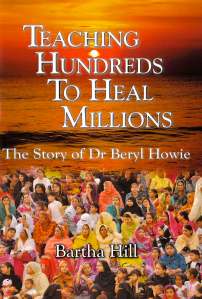
My friend Bartha Hill has just authored a beautiful little book on Howie – Teaching Hundreds To Heal Millions: The Story of Dr Beryl Howie – and those in Dunedin are warmly welcome to attend its launch on Sunday 17 November, at 2 pm, at Highgate Presbyterian Church, Maori Hill, Dunedin.

Stages of procrastination

This cartoon, sent to me by a dear friend who gives every appearance of knowing a great deal about the topic in question, gave rise to a chuckle … and I like to share my chuckles:

Stages of Procrastination

It reminded me of Updike’s assertion that ‘vagueness and procrastination are ever a comfort to the frail in spirit’.

‘The Conversion of the Māori’: a review

Timothy Yates, The Conversion of the Māori: Years of Religious and Social Change, 1814–1842 (Grand Rapids: Wm. B. Eerdmans, 2013). ISBN 978-0-8028-6945-6. 150pp.

A guest post by Graeme Ferguson

When James Hamlin, my great, great grandfather, joined the CMS mission at Paihia in 1826, he came as an artisan lay missionary. His trade was flax dressing. He quickly found that not only was the New Zealand flax a distinctively different species, but also that the Māori knew a great deal more about flax weaving than he did. As a result, his life changed direction. He became a fluent idiomatic Māori linguist able to contribute to the translation of the Scriptures into Māori; he was a trusted mediator and negotiator between warring tribes; he was a faithful catechist and church planter in places where Pākehā rarely penetrated; he was a dogged explorer and a good farmer. In the last years of his long service, Selwyn was finally persuaded against his better judgement to ordain him. (Hamlin, after all, was not a ‘gentleman’.) With his wife, Elizabeth, they had twelve children. Two sons intermarried with local tribes-people so that their descendants reflect the unity in diversity of the meeting of the races in the development of this country. At Captain Symonds request, he called the hui of the Manukau tribes, in the area of Awhitu to witness the Treaty of Waitangi. Te Whero Whero who was present, ensured that few Manukau chiefs signed, since his authority as Māori king and Paramount Chief of Tainui was not to be compromised.

Hamlin’s life of undistinguished, faithful service encapsulates many of the questions that any writer on the formative years of the New Zealand mission needs to confront. It is with these questions that I approached Timothy Yates’ book in Eerdmans’ series Studies in the History of Christian Missions (SHCM).

Yates’ overview of the development of the Christian mission in New Zealand is a competent survey. It recognises the role of Māori in transmitting the Gospel so that missionaries in newly planted stations already found worshipping communities who had been told the Christian story. This could have been further developed. He deals with the relations between Anglican, Methodist and Catholic missions but may not have adequately considered the fraught nature of the different expectations in each group. He deals judiciously with difficulties relating to inappropriate moral lapses by Kendall, Yates and others and alludes to the tensions people coped with in establishing communities in the bush.

The strength of his work lies in his assiduous reading of the correspondence and reports between missionaries and their sending agencies – the CMS, the MMS and the Marist order in Paris. But the writer gives me less confidence that he has an adequate grasp of the socio-cultural context in New Zealand, within which the missions operated. He also shows both linguistic and geographic insecurity that does not enhance his work. (My favourites are the mis-spelling of Te Whero Whero, and various odd adjectival forms of Māori  places.) My evaluation is that the work is ‘worthy’ rather than ‘insightful.’

My first question relates to the way he interprets his primary source documents. The question is: who were these reports written for and what did they expect to hear? How far were they written to accommodate European attitudes and expectations which may or may not reflect the situation on the ground? To what extent could the recipients grasp what was happening in the encounter between the missionaries and the people of the land? I suspect that a healthy suspicion of what was being written is called for.

Secondly, I am interested to know what the effective points of contact were within which the Gospel was able to be shared. What was being offered and what was really being heard? Yates draws attention to the insights into local society and practices that the more insightful missionaries observed which were essential to good understanding and communication. I am interested in the differences the Gospel made in how people lived.

Thirdly, I would like to know the tenets of the Gospel that were in the forefront of missionary proclamation, what was heard and the degree to which it was appropriated and internalised. These people had very limited access to resources. Each mission had its catechism and tradition of teaching in books, like Wesley’s Forty Four Sermons or Pearson on the Creed, but few resources beyond these basic texts. All taught through methods of catechesis but in each case the content would be culturally alien to their hearers. There is the further question of the pedagogical value of catechesis as an educational tool.

Coupled with this is the role of worship in expanding the mission. Large groups are reported as gathering to worship. What were they doing? How far was worship another expression of traditional spirituality and how far an imposed foreign structure? What was going on?

The way in which missionary families lived within the host communities is crucial. The fact that many lived with mutual respect and good will and were trusted is a mark of the practical wisdom many brought to their service. I suspect that their impact was primarily experiential as they lived out the Gospel in community in the tradition of nineteenth century romantic sensibility.

A further question relates to extending the missions. One would like to know where the concentrations of population were that led to establishing stations in what are now oddly inaccessible places. Yates did this in discussing siting the initial station at Rangihoua because of the protection Ruatara was able to offer. I would like it more widely considered.

The overarching question is: what did the local people hear and what did they make their own? To what extent was the Gospel indigenised and internalised? This question is crucial and finds its high point in the reception of the Treaty of Waitangi itself. The dominant narrative on that occasion utilised the thought forms and cultural images of nineteenth-century evangelical Christianity on issues of covenant and promise, rule and governance, responsibility and citizenship, the rule of law and the place of land. The Treaty could be ratified in many places because those interpreting the terms of the Treaty were trusted in their communities. Like the wider transmission of the Gospel, the Treaty was reinterpreted in local cultural terms in order to be received and accepted.

While there is much of interest in Mr Yates’ book, it is written from the perspective of a disengaged observer. Years ago, Archbishop Appleton commented that if he were to have his time as a missionary in Burma over again, he would don a saffron robe and sit and listen for seven years before he began to share the good news of the Gospel. I suspect that more engaged listening would have improved this present study.

‘Descending on Humanity and Intervening in History’ is now available

Forsyth.DescendingonHumanity.90702After a very long gestation period, I’m truly delighted to finally announce the birth of Descending on Humanity and Intervening in History: Notes from the Pulpit Ministry of P. T. Forsyth. As I mentioned in a previous post, it has been a pregnancy marked by great joy and hope, and, I might add, by very few bouts of morning sickness.

The book includes a marvelous foreword by Professor David Fergusson, a lengthy (and, I hope, helpful) introduction to Forsyth’s preaching ministry written by myself, and, from Forsyth’s pen, forty-eight sermons, over half of which are previously unpublished. It seeks to introduce Forsyth, his thought, his ministry, and the Word he served, to a new generation of readers, to provide those already familiar with his writings some new material to digest, and to encourage preachers – and those who hear the Word of the Lord through them, or in spite of them – to not abandon the ‘earth’s foremost part’ (as Herman Melville described the pulpit), especially at a time when the storms are so inexorable and the spoils of exile are so scrumptious.

It will, of course, be up to others to judge, but I think that the book would make a judicious gift for any minister, theology student, historian, or general reader. You can order copies here or via here or by contacting me directly.

If you are interested in reviewing the volume, then please contact Amanda Vanderhoof at Wipf and Stock.

Mother and baby are feeling great, and the siblings proud.

‘Missional God, Missional Church’: a review

Ross Hastings, Missional God, Missional Church: Hope for Re-evangelizing the West (Downers Grove: IVP Academic, 2012). ISBN: 978-0-8308-3955-1; 321pp.

A guest post by Kevin Ward.

The words ‘missional’ in general and ‘missional church’ in particular are real buzz words in the church at the moment, and nowhere more so than within the PCANZ. Put ‘missional’ in front of anything and it legitimates it. The missional movement has much to offer in thinking about our current situation and its challenges going forward, and is something I have engaged with ever since the book Missional Church (edited by Darrell Guder) was published in 1998 – yes that’s how long it has been around for. My great concern is that it has rapidly become a fad, and like so many of those that have come and gone in the forty-plus years I have been involved in church leadership, it too will go. Ross Hastings’ book is, I believe, one of the most important and helpful of all the books that have been published with the word ‘missional’ in the title. This is largely because it is called ‘Missional God, Missional Church’. The order is important. A missional church flows out of a missional God, and so the first task we face as a church is not developing new forms of ‘missional’ churches or new programmes that will make our existing churches missional, but actually coming anew to a proper understanding of who the God whom we know and experience through the Father’s sending of Jesus and the Father and Son’s sending of the Spirit truly is.

Hastings takes us back to these key foundational understandings, before moving us on to envision what this means for our understanding of the church and how we engage with the world in God’s mission in it. In the missional movement the key text is John 20:21, ‘As the Father has sent me so I am sending you’, which is followed by Jesus breathing the Spirit onto the disciples. Sadly, in the life of the church this has played second fiddle to Matthew 28:19–20. Hastings frames the whole book around a wonderful exposition of John 20:19–23, which he calls ‘the greatest commission’, arguing that in this picture of the frightened disciples huddled in the upper room with Jesus in their midst, all of the elements needed for the church to fulfil its calling as the community of the God of mission are present.

Based on a sound Trinitarian theology, the book moves on to develop a solid ecclesiology and missiology, both of which reflect the character of the God whose life they flow from. One of the great values of the book is that it corrects many of the false dichotomies that can be found in so much other work. The missional God is both a sending God and a gathering God, and so the church needs to both send and gather. Flowing from this, therefore, the church needs to be both deep and wide, grounded in the traditions of the faith as an alternative community but taking God’s shalom far and wide into the world. Both worship and mission are intrinsic to the life of the church. To do the latter it needs to inculturate the gospel without becoming enculturated itself. In other words, incarnate the gospel into the culture of the context it finds itself in without accommodating itself to it. Indeed, the theology of culture and personhood in the book is one of its great treasures. When it comes to the practice of mission, Hastings has a broad and holistic understanding of mission – what Renee Padilla calls integrated mission, which is much more true to a biblical understanding than the rather limited concept found in much of the missional church material. There are two final things I am pleased to find in this book. Missing in much of the other literature is a great love of and passion for the church, which while not being the goal of God’s mission, is certainly critical in it. Much of the missional church material takes a critical and almost dismissive stance toward the church. ‘The essential sociality of salvation, implies the essential institutionality of the church. The question is not whether the church is an institution, but rather what kind of institution is it’ (p. 133). Finally, Hastings gives adequate attention to the role of the Spirit in both the life of the church and God’s mission, something that is missing in much of the other material.

Ross Hastings parents were missionaries for 60 years in Africa, he has PhDs in both science and theology, has served as minister in two urban churches, and now teaches theology at Regent College in Vancouver. All of these factors help to make this a book which combines solid biblical and theological understanding, clear social and cultural analysis, pastoral empathy for people and the church, and a deep concern for mission in western societies – a wonderful holistic treatment. I cannot recommend it enough for those who are concerned to work in the deep and integrated way that is necessary if our churches are to truly live out the life that our missional God is calling us to.

Position: Director, Presbyterian Church Schools’ Resource Office

Applications are now invited for the position of Director of the Presbyterian Church Schools’ Resource Office. In 2011, an office was established to strengthen and support the Christian character of the thirteen schools and colleges around the country that are affiliated to, or associated with, the Presbyterian Church of Aotearoa New Zealand. This role consists largely of supporting chaplains and religious education teachers in their work, and the compilation and development of curriculum resources.

The office is run by the Knox Centre for Ministry and Leadership on behalf of the church schools. It is currently located in Auckland, but can be relocated if necessary.

This is a half-to-two-thirds-time position.

The successful candidate will have a theological qualification, a teaching Diploma, and proven experience in chaplaincy and/or teaching. Knowledge of, and/or ministry within, the Presbyterian Church and the Reformed tradition will be an advantage.

Enquiries about the position (including requests for a job description) should be directed to the Principal of the Knox Centre for Ministry and Leadership, the Very Rev Dr Graham Redding (phone: 03 473 0784; email).

Applications should be submitted to the Principal of the Knox Centre for Ministry and Leadership, either in hard copy (address: Knox College, Arden St., Opoho, Dunedin 9010) or electronically (email) by 15 November 2013.

Leunig on Cirque Canberra

Michael Leunig‘s latest three cartoons are a fitting commentary on Cirque* Canberra:

Leunig-Wedding--Oct-9

MPs

Travel Expenses

Plus, one from a few weeks earlier:

Politics-21-Sept

* There is, of course, another  and equally truthful  way of thinking about the image of the circus. I think, for example, of William Stringfellow‘s reflections on the circus as an event of the eschaton. Picking up the image in the wake of Ingmar Berman and Georges Rouault, Stringfellow propose that we recognise circuses as parables of the kingdom and, as such, as parodies of the world as it is. I suspect that Leunig would like that image too.

A wee note on ‘hypothetical universalism’ in the Reformed tradition

John_Owen by John_Greenhill

One of the recurring themes that crops up in conversations with my students is over the various articulations of and arguments for and against soteriological universalism. And, from time to time, some of my students are even interested in knowing what the Reformed tradition (my students are, after all, trying to be Presbyterians!) has to say on the subject. And so I was delighted to find (among some less salutary material, to be sure) a helpful wee discussion on non-Amyraldian hypothetical universalism in English Reformed orthodoxy in Richard’s Muller’s essay ‘Diversity in the Reformed Tradition: A Historiographical Introduction’ wherein Muller writes:

‘Given that there was a significant hypothetical universalist trajectory in the Reformed tradition from its beginnings, it is arguably less than useful to describe its continuance as a softening of the tradition [as Jonathan Moore does]. More importantly, the presence of various forms of hypothetical universalism as well as various approaches to a more particularistic definition renders it rather problematic to describe the tradition as “on the whole” particularistic and thereby to identify hypothetical universalism as a dissident, subordinate stream of the tradition, rather than as one significant stream (or, perhaps two!) among others, having equal claim to confessional orthodoxy’.