Month: August 2010

August exploits …

From the reading chair: A People Betrayed: The Role of the West in Rwanda’s Genocide by Linda Melvern; Colossians and Philemon: An Introduction and Commentary by NT Wright; Critical Reflections Of Stanley Hauerwas’ Theology Of Disability: Disabling Society, Enabling Theology edited by John Swinton; The Disabled God: Toward a Liberatory Theology of Disability by Nancy L Eiesland; The Good and Beautiful God: Falling in Love With the God Jesus Knows by James Bryan Smith; Christian Identity (Studies in Reformed Theology) edited by Eddy Van Der Borght; Counterpoint by RS Thomas; Uncommon Gratitude: Alleluia for All That Is by Joan Chittister & Rowan Williams; The Promise of the Father: Jesus and God in the New Testament by Marianne Meye Thompson; How to Read a Poem: And Fall in Love with Poetry by Edward Hirsch; Teachers As Cultural Workers: Letters to Those Who Dare Teach by Paulo Freire; Theological Fragments: Essays in Unsystematic Theology by Duncan B. Forrester; Very Little … Almost Nothing: Death, Philosophy and Literature by Simon Critchley; Foundations of Dogmatics, Vol. 1 by Otto Weber; Reformational Theology: A New Paradigm for Doing Dogmatics by Gordon J. Spykman; Care of the Soul : A Guide for Cultivating Depth and Sacredness in Everyday Life by Thomas Moore; Bread Baking: An Artisan’s Perspective by Daniel T. DiMuzio; Books of Amos and Hosea by Harry Mowvley; Resist!: Christian Dissent for the 21st Century edited by Michael G. Long.

Through the iPod: U2 Go Home – Live from Slane Castle by U2; London Calling: Live in Hyde Park by Bruce Springsteen & The E Street Band; Foundling by David Gray; All Delighted People by Sufjan Stevens.

On the screen: Edge of Darkness; Where the Wild Things Are; Shelter; Shutter Island; The Infidel; The Wolfman; After Life; Into the Storm; Into the Wild.

On the cost and grace of parish ministry – Part III

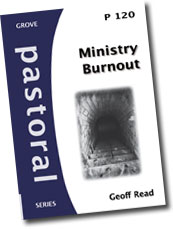
Mistaken attitudes to the issue surrounding clergy burnout are not helped by the frequent interchangability of the terms ‘burnout’ and ‘stress’. While related phenomena, burnout and stress describe different realities. In his wee booklet Ministry Burnout (Grove Books, 2009), Geoff Read makes the point that ‘stress is essentially the physiological or psychological response to many different sorts of situations and demands … Burnout is one response to sustained exposure to certain sorts of stressors. A person reaches a state of burnout when the three factors of emotional exhaustion, detachment and sense of lack of achievement have reached a level of such severity that the person’s ability to function is significantly impaired’ (p. 6).

I was encouraged to see Read here drawing upon work undertaken by Leslie Francis whose own research in the area of psychological health and professional burnout has yielded very important findings. Francis’ research suggests that personality is the strongest predictor of burnout; that ‘personality factors provide a better prediction of burnout than personal, contextual, family or ministry factors raise important questions for selection, formation and support of those called to ordained ministry’ (p. 20). Two studies conducted in 2004 among Anglican and Roman Catholic ministers highlighted ‘the centrality of extraversion and of neuroticism in predicting clergy susceptibility to burnout … Put crudely, neurotic introverts are much more likely to become victims of burnout than stable extroverts, and this holds true across a range of different ministry contexts’. (Leslie Francis and D.W. Turton. ‘Recognizing and Understanding Burnout Among Clergy: A Perspective from Empirical Theology’, in Building Bridges Over Troubled Waters: Enhancing Pastoral Care and Guidance. Edited by David Herl and Mark L. Berman. Lima: Wyndham Hall, 2004, 315). Francis also co-authored (with Rodger Charlton, Jenny Rolph, Paul Rolph, and Mandy Robbins) the report ‘Clergy Work-Related Psychological Health: Listening to the Ministers of Word and Sacrament within the United Reformed Church in England’, published in Pastoral Psychology 58/2 (2009): 133–149. The report was the first ever published study of work-related psychological health of United Reformed Church (URC) ministers, and drew upon conversations with 58 URC ministers serving in the West Midland Synod. The report drew a number of noteworthy conclusions:

  1. Those surveyed are ‘aware of suffering from high levels of negative affect and who yet succeed in deriving high levels of satisfaction from their ministry. A responsible Church should not, however, allow the high level of positive affect acknowledged by the ministers to mask the deleterious effects of high levels of negative affect. The problems of high levels of negative affect, poor work-related psychological health and professional burnout among ministers of word and sacrament within the United Reformed Church are too serious to be ignored’.
  2. Although there are clearly many areas in common between the experiences of URC ministers and those serving in other denominations in England, there may be some areas of stress that are being highlighted in distinctive ways by URC ministers. ‘These areas included the pressures generated by serving in a denomination which has experienced significant decline both in membership and in ordained ministers, but which has not reduced its number of churches in comparable ways. Ministers are serving multiple churches characterised by dwindling and ageing congregations. There is a feeling of uncertainty in the air regarding the long-term sustainability of the United Reformed Church and such uncertainty is bad for the morale of ministers’.
  3. Overall, ministers have low expectations regarding the ability of the URC to support their needs and to protect their work-related psychological health. ‘Such low expectations may or may not be an accurate reflection of the real state of things, but it is nonetheless a worrying reflection on how the denomination itself addresses the psychological health needs of its ministers’.
  4. Overall, ministers welcomed the survey, and ‘saw it as a positive sign that the wider Church was concerned about and committed to addressing the issues of clergy stress, professional burnout and poor work-related psychological health among ministers. Awareness of these issues, the ministers argued, needs to be urgently raised throughout the Church as a whole’.

But back to Read. Read writes about the need for clarity around ministry roles, and the need for pastors to be able to answer the vocational question, ‘Why do I do what I do?’ That this question is taken seriously is essential, he insists, for being able to make meaningful decisions about the use of time in the how and what of ministry. ‘It empowers clergy to shift from a reactive ministry, driven by the expectations and demands of others, to one that is proactive, intentional and driven by conviction’ (p. 16). And he names three areas which merit particular attention in relation to burnout: the now-but-not-yet gap between the ontological and eschatological realities in which we live and life as it is experienced in the here and now; living with conflict and criticism; and the ambiguity of role.

One thing that I really appreciate about Read’s booklet is the stress that he places upon the question of our identity in Christ. Drawing upon Henri Nouwen’s The Return of the Prodigal Son, and Wendell Freist’s article ‘Understanding and Prevention of Missionary Burnout’ (Taiwan Mission Quarterly, 1992), Read argues that while the question of our identity in Christ is one which all Christians share, ‘the representative dimension of priesthood and profile of other “professional Christians” does mean that any deficits will be under particular and sustained pressure’ (p. 13). He points to the way that Jesus’ own ministry began as ‘highly significant and instructive’ insofar as it followed the pattern of identity, vocation and only then ministry, and suggests that ‘without a clear sense of identity and purpose, clergy are subject to the stress of either the chronic effort to fulfil [others’] expectations – acting like a plate spinner dashing to keep numerous plates in the air – or living with the chronic pain of never truly being themselves – like a left-handed person forced to write with the right hand’ (pp. 13–4). He continues:

In his work on burnout originally addressed to OMF missionaries, Dr Wendell Friest describes two distinct missionary types. Type A is characterized by a sense of self worth and self-acceptance based on achievement. Type B finds identity in giving and meeting the needs of others. Both lead to driven lives that Friest characterizes as achievement fatigue (Type A) and compassion fatigue (Type B). Like Nouwen, Friest believes that reconnecting with the freedom that is rooted in our identity in Christ is a crucial resource for the Christian in combating burnout, for both Type A and B temperaments. This involves not just the theological but also experiential movement from slave to sin, to son/daughter of God, and then on to a freely chosen slavery or servanthood.

The heart of the good news is the restoration of God the Father’s original purposes for his children: the status of sonship rather than slavery (Gal 4.4–7). But, so often, experience lags behind the theological reality and so acceptance and identity can remain rooted in slavery or addiction to achievement or meeting others’ expectations. Burnout can be not only a result of such slavery but also a key opportunity to face this disconnect between what we preach and what we experience. Burnout can become an invitation to connect experientially with the transforming power of grace in terms of our identity. Freedom simply to ‘be’ replaces the drive to have to ‘do’ to prove something (Type A) or assuage the guilt of being unable to fulfil all the needs of others (Type B). This newfound freedom finds expression in ministry, enabling one ‘… to get back into the slave modality without losing the son-daughter modality.’ Friest calls this Slave Modality 2, what I prefer to call servanthood. In Christ we see this voluntary self-emptying as described in Philippians 2.5–11. Paul’s prized status as ‘slave’ (1 Cor 9.19) is one he freely adopts. It is clear from Romans 12.1 that this is a voluntary decision on the part of the individual, a free response to God’s merciful adoption of us as sons and daughters.

Friest comments, ‘If we are slaves to God unwillingly because we feel this is God’s demand, something he has imposed or exacted, there will never be joy in our lives – only complaining (maybe repressed), resentment, and bitterness … [But] in being both a child of God and a slave of God we are identifying with Jesus. We are free “to be abased, and … to abound” (Phil 4.12).’ We can enjoy life without guilt, and we can serve without drivenness or compulsion, and without a need for achievement or recognition.

Both models of identity also invite conscious reconnecting with the one who calls and, prior to that, who simply loves us. This is a spirituality that is relational, about me as me rather than just me as a minister. What is my God like? Have I unconsciously distorted my perception of him too? Is there a disconnect between the God of grace I say I believe in and proclaim and the image of him that I actually live and take into my vocation and on into my functioning in ministry? Allowing God to be God to us enables a growing experience of one’s identity in Christ to re-emerge. This is rooted in grace and unconditional love rather than just existing with an identity dependent on performance and the opinion of others. (pp. 15–6)

_____

Other posts in this series:

On the cost and grace of parish ministry – Part II

Earlier this decade, Peter Kaldor and Rod Bullpitt wrote Burnout in Church Leaders (Adelaide: Openbook Publishers, 2001), The book drew upon, and sought to collate and comment upon, Australian findings gathered in the 1996 National Church Life Survey (the NCLS was completed by around 4,400 senior ministers/pastors/priests in around 25 denominations) and the then-named Catholic Church Life Survey (the 1996 CCLS sampled 256 parish priest and 97 assistant parish priests). They record that while variations in levels of burnout exist, burnout is ‘clearly a significant issue for the churches at large’. They noted that higher than average burnout scores were recorded for church leaders serving in Anglican, Reformed, Lutheran, Presbyterian, Church of the Nazarene, Roman Catholic and the Salvation Army; and that there were (surprisingly) lower than average burnout scores among Pentecostal denominations, and some smaller denominations, including the Wesleyan and Brethren churches. They note: ‘Such a result may surprise some, given the high stress that can be associated with large and growing churches, which are more common in the Pentecostal denominations. This is where a distinction between positive and negative stress may be important. The pressures of work in congregations that feel they are going somewhere may generate stress that is positive and energising, rather than negative and leading to burnout’ (p. 13). They also note that younger leaders are more susceptible to burnout (p. 13), and that it is, apparently, ‘more stressful to be a charismatic minister in a non-Pentecostal denomination that it is to a pastor in a Pentecostal denomination’ (p. 16).

Kaldor and Bullpitt conclude that, overall, the average burnout score for Protestant church leaders was 38.5%; Catholic parish priests participating in the CCLS averaged 39.4%. They also draw attention to findings from the Alban Institute Burnout Inventory (AIBI) which measures the levels of risk for stress and burnout among church leaders. These are:

  • 56%        Borderline to burnout (for the record, I polled in this category)
  • 21%        Not an issue
  • 19%        Burnout is an issue
  • 4%          Extreme burnout

This suggests, as they note, that for at least 23% of all Protestant church leaders, burnout is a major issue. In addition, a further half are potential candidates for burnout. The figures are similar for Catholic priests, for whom around 27% burnout is a major issue while a further 52% are potential candidates for burnou

Kaldor and Bullpitt also highlight that while one may raise some questions about the applicability of the Alban Institute classification for the Australian context, the results are confirmed by other questions in the NCLS. Around 11% of Protestant/Pentecostal church leaders and 9% of Roman Catholic leaders agree or strongly agree that they often do not feel they are the right person for the job in their particular congregation or parish. Such people have significantly higher levels of burnout, scoring around 50 on the AIBI, compared to an average of 38, placing them firmly at the high burnout end of the spectrum. Moreover, something in the order of 12% of Protestant leaders and 8% of Roman Catholic leaders say they ‘often’ think of leaving the ministry and an identical percentage (12%) from both groups diagnose themselves as having high or very high levels of stress. The results of the survey show that more clergy place themselves at the high end of the stress scale than at the low end, and that clergy recognise in themselves the seeds of a problem.

Kaldor and Bullpitt proceed to note that this is ‘not just an issue for paid leaders’, but is also a ‘critical issue’ for the church at large. While the remainder of their study (which I commend) goes on to address in greater detail some of the reasons behind this ‘critical issue’, they conclude the opening chapter with these words:

‘It would seem that a significant number of senior ministers/pastors/priests in Anglican and Protestant congregations in Australia are suffering severe burnout and are at risk of leaving the ministry.

The figures from Catholic priests participating in the CCLS suggest similar levels of burnout to their non-Catholic counterparts.

These results may well constitute the tip of the iceberg for the churches in this country. It is quite likely that they understate levels of burnout. There is always some measure of error in self-reporting, and clergy may underestimate their levels of stress out of a desire to be seen (to others or to themselves) as competent in their roles. This is certainly the perception of those who are responsible for caring for church leaders.

In addition, these results are for people currently exercising senior leadership within congregations and parishes across Australia. It does not include those who are no longer in congregational/parish ministry, fulfilling other tasks in the churches or working in quite different fields. It does not include the many people who have moved out of full-time ministry altogether, possibly as a result of burnout.

Rowland Croucher and John Mark Ministries claim that there are possibly as many as 10,000 people who have left full-time ordained congregational ministry across Australia, a similar number to the number serving in congregations across all denominations. In their survey of ex-pastors, they found 40% either not worshipping anywhere or not using their ministry gifts in any way with a congregation or parish … While there are many reasons for leaving the ministry, it is clear that stress and burnout are responsible for a significant number of casualties’. (pp. 11–12)

_____

Other posts in this series:

On the cost and grace of parish ministry – Part I

‘The pastoral vocation is to help people grow spiritually, resist their lowest impulses and adopt higher, more compassionate ways. But churchgoers increasingly want pastors to soothe and entertain them. It’s apparent in the theater-style seating and giant projection screens in churches and in mission trips that involve more sightseeing than listening to the local people.

As a result, pastors are constantly forced to choose, as they work through congregants’ daily wish lists in their e-mail and voice mail, between paths of personal integrity and those that portend greater job security. As religion becomes a consumer experience, the clergy become more unhappy and unhealthy’. – G. Jeffrey MacDonald, ‘Congregations Gone Wild’.

As one charged with both a responsibility for the training and supervision of pastors, and who has himself crashed – and watched many colleagues crash – against the rocks of burnout and depression, this is a topic of particular interest to me. To be sure, I am no expert on these issues, but I thought that I might use this forum to do some tentative thinking out loud about this topic over coming months. [Recent weeks have seen some attention in the media and around blogdom given to the matter of clergy burnout: see, for example, here, here, here, here, here, here, here, here, here, here and here. This is, of course, no new news to clergy, though others seems to be interested.]

As sobering as much of the reading and statistics are, on their own they are more paralysing than aiding. Still, they do point to part of the story, and so are worth recalling. So, for example, consider the conclusions found in the USA and published recently by Pastoral Care Inc., namely that:

  • 90% of the pastors report working between 55 to 75 hours per week.
  • 80% believe pastoral ministry has negatively affected their families. Many pastor’s children do not attend church now because of what the church has done to their parents.
  • 95% of pastors do not regularly pray with their spouses.
  • 33% state that being in the ministry is an outright hazard to their family.
  • 75% report significant stress-related crisis at least once in their ministry.
  • 90% feel they are inadequately trained to cope with the ministry demands.
  • 80% of pastors and 84% of their spouses feel unqualified and discouraged as role of pastors.
  • 90% of pastors said the ministry was completely different than what they thought it would be like before they entered the ministry.
  • 50% feel unable to meet the demands of the job.
  • 70% of pastors constantly fight depression.
  • 70% say they have a lower self-image now than when they first started.
  • 70% do not have someone they consider a close friend.
  • 40% report serious conflict with a parishioner at least once a month.
  • 33% confess having involved in inappropriate sexual behavior with someone in the church.
  • 50% of pastors feel so discouraged that they would leave the ministry if they could, but have no other way of making a living.
  • 70% of pastors feel grossly underpaid.
  • 50% of the ministers starting out will not last 5 years.
  • 10% of ministers will actually retire as a minister in some form.
  • 94% of clergy families feel the pressures of the pastor’s ministry.
  • 80% of spouses feel the pastor is overworked.
  • 80% spouses feel left out and underappreciated by church members.
  • 80% of pastors’ spouses wish their spouse would choose a different profession.
  • 66% of church members expect a minister and family to live at a higher moral standard than themselves.
  • The profession of ‘Pastor’ is near the bottom of a survey of the most-respected professions, just above ‘car salesman’.
  • 4,000 new churches begin each year and 7,000 churches close.
  • Over 1,700 pastors left the ministry every month last year.
  • Over 1,300 pastors were terminated by the local church each month, many without cause.
  • Over 3,500 people a day left the church last year.
  • Many denominations report an “empty pulpit crisis”. They cannot find ministers willing to fill positions.

And the #1 reason listed in that survey for why pastors leave the ministry was that ‘Church people are not willing to go the same direction and goal of the pastor. Pastor’s believe God wants them to go in one direction but the people are not willing to follow or change’. Perhaps this reflects MacDonald’s statement above.

[NB: Pastoral Care Inc. attribute these figures to research carried out by themselves, by The Fuller Institute and by George Barna. Mick Crowl has rightly, to my mind, flagged some concern about the accuracy of these statistics. Still, their general tone is confirmed in other findings.]

And Anne Jackson, in her recently published Mad Church Disease: Overcoming the Burnout Epidemic (pp. 48–9), lists the following (sobering) figures on (US) clergy health:

  • 71 percent of all ministers admitted to being overweight by an average of 32.1 pounds [14.59 kg]. One-third of all ministers were overweight by at least 25 pounds [11.36 kg], including 15 percent who were overweight by 50 pounds [22.73 kg] or more.
  • Two-thirds of all pastors skip a meal at least one day a week, and 39 percent skip meals three or more days a week.
  • 83 percent eat food once a week that they know they know they shouldn’t because it is unhealthy, including 41 percent who do this three or more days a week.
  • 88 percent eat fast food at least one day a week, and 33 percent eat fast food three or more days a week.
  • 50 percent get the recommended minimum amount of exercise (30 minutes per day, three times a week); 28 percent don’t exercise at all.
  • Four out of ten ministers (approximately 39 percent) reported digestive problems once a week, with 14 percent having chronic digestive problems (three days per week).
  • 87 percent don’t get enough sleep at least once a week, with almost half (47 percent) getting less sleep than they need at least three nights a week. Only 16 percent regularly get the recommendation of eight hours or more per night.
  • 52 percent experience physical symptoms of stress at least once a week, and nearly one out of four experiences physical symptoms three or more times a week.

I am not interested here to engage with the details of these statistics. To be sure, they indicate important and painful realties for many pastors, their partners and their children. I am interested here, however, in thinking more generally about this prevalent reality, and to exploring some theological and other resources that witness to more life-giving ways for pastors … and for the rest of us.

_______

Other posts in this series:

On the perspicuity of Scripture

Once upon a time, when describing the ‘power of the Word of God’, Uncle Karl referred to the ‘magic of biblical thought and language … to which we must not on any account remain insensible, but which we can and must allow to have its due effect. As the essential pre-requisite for a biblical exegesis which does not remain confined to grammatical-historical matters, there is needed an intuition, an ability to detect the dæmonic magic of the Bible’ [CD I/2, 674]. Barth was concerned here, as elsewhere, with the freedom of the Word ‘in its illimitability or its equality over against other powers’, one feature of which concerns the reality that the early generations of Protestant reformers championed; namely, the perspicuity of Scripture. While writing some Bible studies on Amos recently, I have been encouraged to employ that great principle of hermeneutics. (Apparently, it’s a principle that works for other parts of the Bible too!). Anyway, that all brought to mind some quotes that I once gathered on the doctrine, quotes that I thought worth sharing here:

‘Scripture is self-interpreting and perspicuous by virtue of its relation to God … The clarity of Scripture is a function of its place in the divine self-demonstration, and of the Spirit’s work of ordering the mind, will and affections of the reader towards what Calvin called “heavenly doctrine”. Perspicuity only makes sense when seen in a soteriological context, that is, in relation to God’s act as Word and Spirit and the creature’s act of faith. Like other properties of Scripture, such as sufficiency, efficacy or perfection, clarity is not a formal or natural property of the text considered in isolation … Rather, Scripture is clear because through the Spirit the text serves God’s self-presentation. Properly speaking, it is not Scripture which is self-interpreting but God who as Word interprets himself through the Spirit’s work … Scripture is clear because of the Spirit’s work in which creaturely acts of reading are so ordered towards faithful attention to the divine Word that through Scripture the light of the gospel shines in its own inherent splendour. Perspicuity is thus not a way of suggesting that reading is superfluous; it is about the way in which faithful reading within the economy of revelatory grace is not sheerly spontaneous but a receptive act of the intelligence of faith … In sum: Scripture’s clarity is neither an intrinsic element of the text as text nor simply a fruit of exegetical labour; it is that which the text becomes as it functions in the Spirit-governed encounter between the self-presenting saviour and the faithful reader. To read is to be caught up by the truth-bestowing Spirit of God’. – John Webster, Holy Scripture: A Dogmatic Sketch (Cambridge: Cambridge University Press, 2003), 93–5.

‘The canon of the Reformation scholars was to take the clear passages and use them to test the obscure. That was to be the principle to guide the Church. Cranks and doctrinaires might fix on unique and obscure passages which fascinated their angular or mystic minds. They might puncture these texts and then colour the whole of the Bible with a dilution of the theosophy which oozed from them. To this day ill-taught and self-taught people frame amateur fantastic theologies in that way. And the poor churches are bewildered by the gropings of unfortunate men who were told at college only that they must make their own theology. Do you wonder that the result of such teachng is collapse for church or college? But the sound principle of old was otherwise. And it remains sound to-day. We should use the clear to interpret the obscure. But that is not exactly what they mean who say that the Bible must be read by way of a selection of certain parts. They would proceed by the way of dissection. They would act critically rather than hermeneutically. They would cut out certain pieces as being Bible, and discard certain others as intrusions on the Bible; and the discarded portions would not be interpreted by the rest, but rather neglected, and practically ejected from the canon’. – P.T. Forsyth, The Church, the Gospel and Society (London: Independent Press, 1962), 75–6.

‘To put it briefly, there are two kinds of clarity in Scripture, just as there are also two kinds of obscurity: one external and pertaining to the ministry of the Word, the other located in the understanding of the heart. If you speak of the internal clarity, no man perceives one iota of what is in the Scriptures unless he has the Spirit of God. All men have a darkened heart, so that even if they can recite everything in Scripture, and know how to quote it, yet they apprehend and truly understand nothing of it. They neither believe in God, nor that they themselves are creatures of God, nor anything else, as Psalm 13[14:1] says: “The fool has said in his heart, ‘There is no god.’” For the Spirit is required for the understanding of Scripture, both as a whole and in any part of it. If, on the other hand, you speak of the external clarity, nothing at all is left obscure or ambiguous, but everything there is in the Scriptures has been brought out by the Word into the most definite light, and published to all the world’. – Martin Luther, Luther’s Works, Vol. 33 : Career of the Reformer III (Philadelphia: Fortress Press, 1999), 28.

‘It is a wondrous and beneficial thing that the Holy Spirit organised the Holy Scriptures so as to satisfy hunger by means of its plainer passages, and remove boredom by means of its obscurer ones.’ … ‘If you cannot yet understand [a passage of Scripture], you should leave the matter for the consideration of those who can; and since Scripture does not abandon you in your infirmity, but with a mother’s love accompanies your slower steps, you will make progress. Holy Scripture, indeed, speaks in such a way as to mock the proud readers with its heights, terrify the attentive with its depths, feed great souls with its truth and nourish little ones with sweetness.’ – Augustine, in Kathryn Greene-McCreight, Ad Litteram: How Augustine, Calvin, and Barth Read the “Plain Sense” of Genesis 1-3 (New York: Peter Lang Publishing, 1998), 164,167.

So back to Amos, and that with Jeremiah’s help, and Luke’s. Ah … the dæmonic magic of the Bible!

Judgement Day: the date is set

While some real skeptics abound, notable biblical scholar Harold Camping has determined after a close study of  Scripture that Jesus will be using his return ticket on May 21, 2011. [That’s a Saturday; so much for resting on the Sabbath!]. Camping, who sounds like he’d be good mate of Chris Tilling‘s, has reached this conclusion by juggling the date of Jesus’ crucifixion (previously unknown, but praise be! revealed to Mr Camping as precisely April 1, AD33) with the numbers 5, 10 and 17, which are apparently linked with atonement, completeness and heaven.

The details of the calculation are too wonderful and mysterious to go into here, but the glorious news is that, after 2,000 years of delays and rescheduling, a date has finally been set for the rapture and last judgement. So now is the time to plan your holidays around the event, to empty out your bank account on my Wishlist, and to reach out to the wicked heathen with this sexy bumper sticker.

You can learn more – and pick up your free stickers, postcards, business cards and pocket calendars, and more – here and here.

The only question that remains is: which kind of virgin will you be?

[HT: Ship of Fools]

On resisting the chaotic non-conformity of private, virtuoso theologies

‘Throughout the history of the Reformed tradition, the central place both for the ongoing hermeneutic process urged in the confessions, and for the general influence of the confessions in the Church, has been the pastoral office through preaching, teaching, oversight, and leadership. Correspondingly, it is chiefly the minister of the word, among the other ordained ministries, who is held accountable in the constitutional questions for following the leading and guidance of the confessions of faith. Appropriately, theological education was in the past structured by the theology of the confessions. Rather strongly, thus, I wish to remind those of us that find our calling in theological education that it is scandalous for a faculty member in any discipline in the church’s seminaries not to be able to locate his or her work and thought and teaching matter with relation to the confessional teachings. We do not want again the old teaching oath, or any teaching oath at all, and the inevitably stifling conformity it promotes. But neither do we want the On resistsing that leave the relation of thought to life in the empirical church to the improvisation of individual ministers. Further, theological education carried out in programs of continuing education or presbytery projects of many types, should be oriented by a reasonable awareness of what the Church teaches in its confessional and creedal literature.

More broadly, it is the educational ministry of the Church on all levels that should bear the chief responsibility for a confessionally rooted hermeneutic, worship, and mission. The idiom of the tradition, whether in words or ethic, needs to be exercised in spiritual, biblical, theological, and ethical education.

It would be well, we often think, if one might be just a Christian, and not a Presbyterian, Catholic, or Methodist. But so, it might seem, is the case with language. What if we could avoid German or English and just speak language? But it doesn’t work. Esperanto is a wonderful idea, but like Basic English a few years back, it is bereft of the richness of meaning and naturalness of a true language. So a theological Esperanto, or ecumenical Esperanto—for the time being at least—leaves us far from the concrete reality in which we live and speak. The idiom of the Reformed tradition, when fully understood, is the ground and motive both for ecumenical awareness and progress, and for other kinds of reform and advance. Not abandonment, but reform, as new light breaks forth from Scripture and illuminates new situations in our culture and environment and in the world Church, is the promising idiom of our tradition’. – Edward A. Dowey Jr., ‘Confessional Documents as Reformed Hermeneutic’, Journal of Presbyterian History 79, no. 1 (2001), 58.

There he goes, tacking against the fields’ uneasy tides …

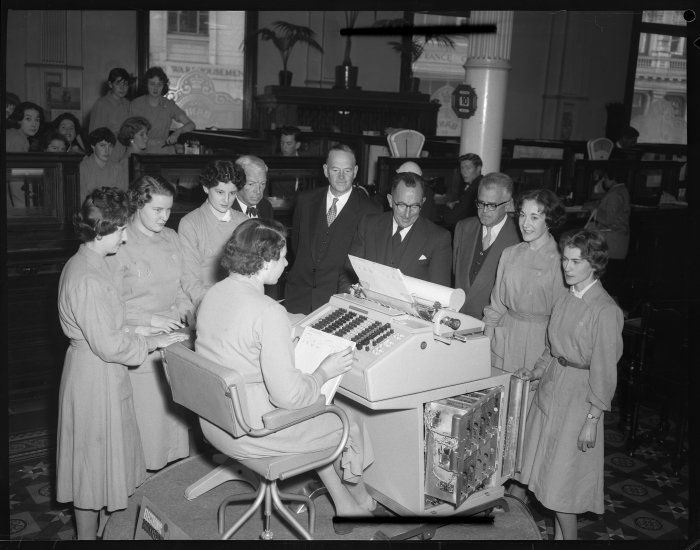
[Image: Members of the staff of the Bank of New Zealand, on Lambton and Customhouse Quays, Wellington, gather around the first electronic book-keeping machine installed in the bank, 1960. HT: National Library of New Zealand]

Neutral education?

‘There is no such thing as a neutral education process. Education either functions as an instrument which is used to facilitate the integration of generations into the logic of the present system and bring about conformity to it, or it becomes the “practice of freedom”, the means by which men and women deal critically with reality and discover how to participate in the transformation of their world’. – Jane Thompson, in Peter Mayo, Gramsci, Freire and Adult Education: Possibilities for Transformative Action (Global Perspectives on Adult Education and Training) (New York: St Martin’s Press, 1999), 5.

Gavin D’Costa on a Theology of Religions

In this video, Gavin D’Costa talks about his ‘move to the right’ from Rahner to the nouvelle théologie and Barth (‘the one key influence in this move … who [got] to the truth more than most Catholic thinkers’), about inclusivism, exclusivism and pluralism (which is ‘a type of exclusivism’), about soteriological universalism, and about post-mortem conversion.

Choosing a school for your child

So anyway, this week, following a process significantly more taxing upon one’s mind and conscience than that which attends the purchase of a house, we finally settled on a school for our daughter. After shortlisting two schools, here’s what swung it for us:

  1. It’s right next door to the fush ‘n’ chup shop, which means healthy lunches and so fit minds.
  2. It’s over the road from the fushing ‘n’ hunting shop, which means that I’ll be significantly more excited about doing school pick-ups and drop offs, and that kids who aren’t interested in taking up pansie sports like netball and touch rugby can pop over and buy a crossbow or gun and take up some really worthwhile sport like sheep- and/or zombie-hunting. I’m all for cat culls too.
  3. The main road which runs right through the middle of the campus encourages the entire local community to get involved in the battle to keep class sizes down. (This means fewer queues at the hunting shop too.)
  4. They offer free drum lessons!

So on your bike kid … have fun out there, and if you learn how to count or think along the way, then that’s OK; we can deal with that later. And as fa spellin an stuff wee got spel cheque noow aniwaye cept that mynes not workeeng. So just stick with the basics – playtimes and fush ‘n’ chup lunches.

BTW: For those of you who currently reside in other sectors of the empire, this video (sent to me by a guy whose wife – or son – stole my Bible; so not the most reputable of types) may help decode some of this post:

The Floyd Theses on Interim Ministry

Rick Floyd has posted a wonderfully-provocative and long-overdue discussion starter on ‘interim’ ministry. It begs reposting:

1. The chief purpose of long interim ministries is to provide a regular supply of jobs for ministers who are unwilling or unable to take a settled pastorate.  This is not a good thing.  Although a good interim minister can be a gift to a congregation, he or she is no substitute for a settled pastor.  Interims work to contract, they often don’t live in the communities they serve, and they are not going to stay.  It is a different kind of ministry, and the longer a church has an interim minister the longer it is deprived of the covenantal relationship that comes with having a called and settled minister.

2. During my 30 years in the ministry the length of interim ministries has expanded from a few months to two or three years (or more.) Meanwhile settled ministries are getting shorter, so the only difference seems to be less accountability on the part of the interim minister. Many seem to prefer it that way.

3. Interim ministers were once typically retired experienced pastors who preached, did pastoral care, and kept a light hand on the organization while the congregation sought a new settled pastor.

4. Today, interim ministers lead elaborate congregational self-studies, change the structures, rewrite the by-laws, and generally move the furniture around in ways that were once considered to be the job of a settled leader.

5. The reason that the extended length and the frenetic re-shuffling of interim ministry is justified as necessary is because the leave-taking of a pastor is considered to be such a trauma that only expert interim leadership can help the congregation heal from it and prepare for new leadership. It is true that there are such traumatic situations, such the death of a pastor, cases of clergy abuse or misconduct, or where there has been profound conflict. These situations may well call for extended interims. But the new model for interim ministry assumes that every transition needs such a long and intense interim. They do not. Why then are all interims expected to be so long? See #1.

6. The model for much interim ministry is a family system model where congregations are seen as dysfunctional systems and the former pastor (actually called the BFP “beloved former pastor” in some interim training) is seen as the problem. Sometimes this is true. Usually it is not, but the one-size-fits all template is demeaning to former pastors who have served faithfully. One must wonder if it can be possible that every pastor’s predecessor was incompetent, lazy, controlling or evil.

7. Long interims frequently dissipate the momentum of many church programs, make the congregation feel adrift, lose the allegiance of many long-term members, and often leave the new settled pastor with a much-diminished congregation. This scorched-earth policy allows for little continuity between pastorates, and means the new pastor often must “re-invent the wheel” in a new setting.

8. Interim ministers have their own networks, and often work outside the existing judicatory processes. They can and often do function as a free-floating class of paladins for hire that raises fundamental questions about the meaning of ordination and the accountability of the ordained.  Ordaining someone to interim ministry is a (new) practice that needs serious scrutiny.

9. Because the models of interim ministry are derived largely from psycho-social systems theory and/or corporate management models they have little regard for the church’s own grammar of how to be church. These interim models are very thin on the ground when it comes to theology. This mirrors a general trend in ministry toward professional identity over the ancient churchly arts of soul-craft and ministry of the Word of God.

10. Lay persons in leadership during a time of pastoral transition are well-advised to carefully query potential interim ministers about their model of interim ministry. Question the assumption that every church needs a two or three year interim. Maybe you do, but ask why? Ask if the interim is planning on doing a lot of restructuring, and if so, why? The congregation should decide what it needs from an interim, and not hire an interim to tell it what it needs from him or her. An interim is just that, an interim who gets you through a period to allow the “search and call” process to take place. The rule of an interim should be like a doctor: “Do no harm.” A good interim will leave a small footprint.

Barth on the being and knowledge of God

Who was it that said recently that a day without reading something from Uncle Karl is a day wasted, or something to that effect? Well today, a friend of mine reminded me of this interesting passage (not least in light of the fruitful discussion that arose from my post on Ten (Draft) Propositions on the Missionary Nature of the Church) from Uncle Karl (CD §28), who, at least on my reading, properly refuses to collapse epistemology and ontology:

‘When we ask questions about God’s being, we cannot in fact leave the sphere of His action and working as it is revealed to us in His Word. God is who He is in His works. He is the same even in Himself, even before and after and over His works, and without them. They are bound to Him, but He is not bound to them. They are nothing without Him. But He is who He is without them. He is not, therefore, who He is only in His works. Yet in Himself He is not another than He is in His works. In the light of what He is in His works it is no longer an open question what He is in Himself. In Himself He cannot, perhaps, be someone or something quite other, or perhaps nothing at all. But in His works He is Himself revealed as the One He is. It is, therefore, right that in the development and explanation of the statement that God is we have always to keep exclusively to His works (as they come to pass, or become visible as such in the act of revelation)—not only because we cannot elsewhere understand God and who God is, but also because, even if we could understand Him elsewhere, we should understand Him only as the One He is in His works, because He is this One and no other. We can and must ask about the being of God because as the Subject of His works God is so decisively characteristic for their nature and understanding that without this Subject they would be something quite different from what they are in accordance with God’s Word, and on the basis of the Word of God we can necessarily recognise and understand them only together with this their Subject.

At the same time we must be quite clear on the other side, that our subject is God and not being, or being only as the being of God. In connexion with the being of God that is here in question, we are not concerned with a concept of being that is common, neutral and free to choose, but with one which is from the first filled out in a quite definite way. And this concretion cannot take place arbitrarily, but only from the Word of God, as it has already occurred and has been given to us in the Word of God. This means that we cannot discern the being of God in any other way than by looking where God Himself gives us Himself to see, and therefore by looking at His works, at this relation and attitude—in the confidence that in these His works we do not have to do with any others, but with His works and therefore with God Himself, with His being as God.

What does it mean to say that “God is”? What or who “is” God? If we want to answer this question legitimately and thoughtfully, we cannot for a moment turn our thoughts anywhere else than to God’s act in His revelation. We cannot for a moment start from anywhere else than from there.

What God is as God, the divine individuality and characteristics, the essentia or “essence” of God, is something which we shall encounter either at the place where God deals with us as Lord and Saviour, or not at all. The act of revelation as such carries with it the fact that God has not withheld Himself from men as true being, but that He has given no less than Himself to men as the overcoming of their need, and light in their darkness—Himself as the Father in His own Son by the Holy Spirit. The act of God’s revelation also carries with it the fact that man, as a sinner who of himself can only take wrong roads, is called back from all his own attempts to answer the question of true being, and is bound to the answer to the question given by God Himself. And finally the act of God’s revelation carries with it the fact that by the Word of God in the Holy Spirit, with no other confidence but this unconquerable confidence, man allows being to the One in whom true being itself seeks and finds, and who meets him here as the source of his life, as comfort and command, as the power over him and over all things.

If we follow the path indicated, our first declaration must be the affirmation that in God’s revelation, which is the content of His Word, we have in fact to do with His act. And first, this means generally—with an event, with a happening. But as such this is an event which is in no sense to be transcended. It is not, therefore, an event which has merely happened and is now a past fact of history. God’s revelation is, of course, this as well. But it is also an event happening in the present, here and now. Again, it is not this in such a way that it exhausts itself in the momentary movement from the past to the present, that is, in our to-day. But it is also an event that took place once for all, and an accomplished fact. And it is also future—the event which lies completely and wholly in front of us, which has not yet happened, but which simply comes upon us. Again, this happens without detriment to its historical completeness and its full contemporaneity. On the contrary, it is in its historical completeness and its full contemporaneity that it is truly future. “Jesus Christ the same yesterday and to-day and for ever” (Heb. 13:8). This is something which cannot be transcended or surpassed or dispensed with. What is concerned is always the birth, death and resurrection of Jesus Christ, always His justification of faith, always His lordship in the Church, always His coming again, and therefore Himself as our hope. We can only abandon revelation, and with it God’s Word, if we are to dispense with it. With it we stand, no, we move necessarily in the circle of its event or, in biblical terms, in the circle of the life of the people of Israel. And in this very event God is who He is. God is He who in this event is subject, predicate and object; the revealer, the act of revelation, the revealed; Father, Son and Holy Spirit. God is the Lord active in this event. We say “active” in this event, and therefore for our salvation and for His glory, but in any case active. Seeking and finding God in His revelation, we cannot escape the action of God for a God who is not active. This is not only because we ourselves cannot, but because there is no surpassing or bypassing at all of the divine action, because a transcendence of His action is nonsense. We are dealing with the being of God: but with regard to the being of God, the word “event” or “act” is final, and cannot be surpassed or compromised. To its very deepest depths God’s Godhead consists in the fact that it is an event—not any event, not events in general, but the event of His action, in which we have a share in God’s revelation.

The definition that we must use as a starting-point is that God’s being is life. Only the Living is God. Only the voice of the Living is God’s voice. Only the work of the Living is God’s work; only the worship and fellowship of the Living is God’s worship and fellowship. So, too, only the knowledge of the Living is knowledge of God’.

– Karl Barth, Church Dogmatics II.1 (ed. G.W. Bromiley and T.F. Torrance; trans. T.H.L. Parker, et al.; Edinburgh: T&T Clark, 1957), 260–3.

So if you’ve read this far you can now sleep tonight in the full knowledge that your day wasn’t a complete waste of time. Certainy mine wasn’t: I drank gallons of Milo, finished marking a ute-load of assignments, and read some Barth. Oh, and we also decided on a school for our daughter, or at least I think we did!

‘The bodice of my new costume caught on the handlebar …’

Stanley Hauerwas on the place and calling of the elderly

‘Our communities depend on memory to understand what makes us who we are. If you think life is fundamentally about consuming and not about such memories, then the elderly have no place in your world. But I believe that the older you get, the more obligations you have to those who are part of your life to remember your mistakes—and the mistakes of the community—so you can be part of the articulation necessary, hopefully to avoid some of those mistakes in the future.

So everything depends on the assumption that life is made up of wisdom that is derived from these many lives and many judgments over time. We can pass this on to the next generation. My emphasis on the importance of sharing stories is crucial in that regard because stories are contingent on the tellers. The elderly have to become good tellers of the stories that make the community who they are’. – Stanley Hauerwas, ‘For the Faithful, There Is No ‘Florida’

‘April Peepers, Flaubert, and Springsteen’, by Robert Cording

Now that the sun’s hanging around longer,
These first warm evenings bring
The peepers up out of the muck, aroused
By temperatures and a ferocious desire
To peep and trill a hundred times a minute,
Nearly six thousand times a night,
Each wet, shining body a muscle of need
That says faster, louder, faster, louder.

Life, life to have erections, that’s what it’s
All about—that’s Flaubert ringing
In my old ears, some drained chamber
Of the heart pumping again, interrupting
My bookish evening. I should tie myself
To my chair or stopper my ears. But I’m up
And answering my sirens’ call, overcome
By some need to be outside, to be
Part of this great spring upheaval.

In the dark amid their chorus, I hold
A flashlight on a peeper that pulses
Under its skin, its entire body a trill reaching
Toward a silent female, and now I’m calling
To my wife to come out, to hurry,
And when she finds me, I swear I feel as if
I’m shining like something that has come up
From deep under the earth, and singing

It ain’t no sin to be glad you’re alive.

– Robert Cording, ‘April Peepers, Flaubert, and Springsteen’ in Love Poems and Other Messages for Bruce Springsteen (ed. Bosveld Jennifer; Columbus: Pudding House Publications, 2009), 64.

Stringfellow on masturbation, sex and the search for self

‘[One] who persists into adulthood in the practice of masturbation is likely to be one who remains profoundly immature sexually, fearing actual sexual contact with a partner, becoming and being sexually retarded. The main danger and damage in masturbation is not in the conduct itself, but in the fantasy life that invariably accompanies the conduct. That life will hardly ever be a sexually fulfilling one, and indeed masturbation is probably most obviously another variety of sexual sublimation – one in which the sexual identity and capability of the person remains stalemated, indefinite, confused, and apparently self-contained. Masturbation is not antisocial per se, but the deep suppression of sexuality which it represents will frequently provoke some other superficially nonsexual, antisocial behavior. And even if the sublimation of masturbation is never relieved, either in sexual relationship with another human being or in some antisocial, apparently non-sexual behavior, the real tragedy – the destructive and dehumanizing fact about masturbation – is its obvious unfulfillment and crude futility among the varieties of sexual activity’ …

‘Such is the mystery of sex and love that what in sex may be dehumanizing, depraved, or merely habitual, may become human, sacramental, and sanctified. For sex to be so great an event as that, it is essential for one to know who he is as a person, to be secure in his own identity, and indeed, to love himself.

Too often sex does not have the dignity of a sacramental even because it is thought to be the means of the search for self rather than the expression and communication of one who has already found oneself and is free from resort to sex in the frantic pursuit of identity. It is wrong to assume that sex is in itself some way of establishing or proving one’s identity or any resolution of the search for selfhood. One who does not know oneself and seeks to find oneself in sexual experience with another will neither find self nor will he respect the person of a sexual partner. Often enough, the very futility of the search for identity in sex will increase the abuse of both one’s own self and one’s partner. The pursuit of identity in sex ends in destruction, in one form or another, for both the one who seeks oneself and the one who is used as the means of the search. No one may show another who he is or she is; no one may give another life; no one can save another.

How then shall one discover who one is as a human being if sex provides neither the means nor the answer? And how shall one be emancipated from the power of sin in sex and in other realms as well?

In Christ.

In Christ. That means in beholding Christ who is in his own person the true human, the person living in the state of reconciliation with God, with himself, with all men, with the whole creation.

In Christ. That means in discerning that God ends the search for self by himself coming in this world in search of men. For the person, [sic] who knows that he has been found by God no longer has to find self.

In Christ. That means in surrendering to the presence and power of death in all things including sex and , in that event, in the very midst of death, receiving a new life free from the claim of death.

In Christ. That means in accepting the fact of God’s immediate and concretely manifest love for human life, including one’s own little life. Finding, then, that one’s own life is encompassed in God’s love for the world.

In Christ. That means in knowing that in the new life which God gives to humans there is no more a separation between who a person is and what a person does. That which one does, in sex or anything else, is a sign of who one is. All that one does become sacraments of new life.

In Christ. That means in realizing radical fulfillment as a person in the life of God in this world; such radical fulfillment that abstinence in sex is a serious option for a Christian though it is never a moral necessity.

In Christ. That means in enjoying God’s love for all humanity and all things in each and every event or decision of one’s own life.

In Christ. That means in confessing that all life belongs to God, and but for him there is no life at all’.

– William Stringfellow, Instead of Death (Eugene: Wipf & Stock, 2004), 50–1, 54–5.