Hans Küng on Rome’s worst credibility crisis since the Reformation

According to Hans Küng‘s latest open letter to Catholic bishops, Benedict XVI is reponsible for making worse just about everything that is wrong with the Roman Catholic Church: ‘Without a doubt, he conscientiously performs his everyday duties as pope, and he has given us three helpful encyclicals on faith, hope and charity. But when it comes to facing the major challenges of our times, his pontificate has increasingly passed up more opportunities than it has taken’. Küng proceeds to list these missed opportunities:

  • opportunity for the rapprochement with the Protestant churches. Küng specifically has in mind here the Anglican Church.
  • opportunity for long-term reconciliation with Jews.
  • opportunity for dialogue with Muslims in an atmosphere of mutual trust.
  • opportunity for reconciliation with the colonised indigenous peoples of Latin America.
  • opportunity to help the people of Africa by allowing the use of birth control to fight overpopulation and condoms to fight the spread of HIV.
  • opportunity to make peace with modern science by clearly affirming the theory of evolution and accepting stem-cell research.
  • opportunity to make the spirit of the Second Vatican Council the compass for the whole Catholic Church, including the Vatican itself, and thus to promote the needed reforms in the church. Küng considers this point to be ‘the most serious of all’.

And then there’s the ‘scandal crying out to heaven – the revelation of the clerical abuse of thousands of children and adolescents, first in the United States, then in Ireland and now in Germany and other countries. And to make matters worse, the handling of these cases has given rise to an unprecedented leadership crisis and a collapse of trust in church leadership’.

Finally, Küng offers six challenges to bishops. These are summarised as:

1. Do not keep silent: By keeping silent in the face of so many serious grievances, bishops taint themselves with guilt. When they feel that certain laws, directives and measures are counterproductive, they should so in public. ‘Send Rome not professions of your devotion, but rather calls for reform!’

2. Set about reform: Too many in the church and in the episcopate complain about Rome, but do nothing themselves.

3. Act in a collegial way: Bishops should not act for themselves alone, but rather in the community of the other bishops, of the priests and of the men and women who make up the church.

4. Unconditional obedience is owed to God alone: ‘Although at your episcopal consecration you had to take an oath of unconditional obedience to the pope, you know that unconditional obedience can never be paid to any human authority; it is due to God alone. For this reason, you should not feel impeded by your oath to speak the truth about the current crisis facing the church, your diocese and your country. Your model should be the apostle Paul, who dared to oppose Peter “to his face since he was manifestly in the wrong”! (Galatians 2:11). Pressuring the Roman authorities in the spirit of Christian fraternity can be permissible and even necessary when they fail to live up to the spirit of the Gospel and its mission’.

5. Work for regional solutions.

6. Call for a council: ‘Just as the achievement of liturgical reform, religious freedom, ecumenism and inter-religious dialogue required an ecumenical council, so now a council is needed to solve the dramatically escalating problems calling for reform’.

By way of response, George Weigel, considers this latest ‘piece of vitriol’ of Küng’s to be ‘the low-point of a polemical career in which you have become most evident as a man who can concede little intelligence, decency, or good will in his opponents.’

Weigel’s basic argument is that Küng has his facts wrong. He accuses Küng of

  • being ‘blithely indifferent to the doctrinal chaos besetting much of European and North American Protestantism, which has created circumstances in which theologically serious ecumenical dialogue has become gravely imperiled’.
  • of ignoring recent scholarship about Pius’ ‘courage in defense of European Jewry’.
  • of misrepresenting the effects of Benedict XVI’s 2006 Regensburg Lecture in which he mentioned Islam.
  • of displaying no comprehension of what actually prevents HIV/AIDS in Africa.
  • of being oblivious to the scientific evidence underwriting the Church’s defense of the moral status of the human embryo.

According to Weigel, Küng’s basic problem is that he ‘lost the argument over the meaning and the proper hermeneutics of Vatican II’.

You can read all of Weigel’s reponse here.

Seems like a good time to recite the Nicene Creed:

We believe in one holy catholic and apostolic Church.
We acknowledge one baptism for the forgiveness of sins.
We look for the resurrection of the dead, and the life of the world to come. Amen.

Preparing for Ascension Sunday

‘[F]aith exists not only in hope in the epiphany of Christ; it is bound up with the veiling of Christ, with the ascension, and here we come back to the other reason for the ascension or the purposed withdrawal of Christ from sight. Faith can exist only where there is a gap, an eschatological reserve, between the present and the future, between actual participation in the kingdom here and now and the future manifestation of its glory. Let us consider it like this. If Jesus had manifested his full divine glory on earth so that men and women were confronted face to face with the ultimate majesty of God, then they would have been damned on the spot; they would have been face to face with the final judgement. But the veiling of his ultimate glory meant that Jesus was giving people a chance to repent; he was holding them at arm’s length away, so to speak, giving them time to repent, room for decision. He came veiling his glory, yet revealing himself obliquely, so as to give people enough light to believe but not enough finally to blind them or judge them. That is why he refused to give a compelling demonstration of himself, but sought to evoke faith. Faith is not sight, but faith answers to revelation that is yet only in part, for faith exists in the gap between partial and final manifestation. Faith is, therefore, essentially eschatological in its inner nature.

Now the ascension means that Jesus Christ has withdrawn himself from sight and history in order to allow the whole world time for repentance. He holds back the final unveiling of his glory and majesty, holds back the final judgement when there will be no time to repent, and when, as the Apocalypse puts it, the person that is filthy will be filthy still. That gap between the times is the eschatological time when this present age is already interpenetrated by the age to come, but it is time when the new age in all its glory is as yet veiled from sight, in order to leave room to preach the gospel and give all opportunity for repentance and faith. Thus the world-mission of the church is part of God’s grace, for it is God’s grace alone that keeps back the dissolution of this age’. – Thomas F. Torrance, Atonement: The Person and Work of Christ (ed. Robert T. Walker; Downers Grove: IVP Academic/Paternoster, 2009), 434–5.

‘As [Jesus] ascends, creation is healed. The gulf between heaven and earth caused by human sin is bridged; the rift of our ancient wound is closed. The ‘flesh of man’ is able to go where it was always intended but had ever been prevented since the Fall – into the courts of heaven and the immediate presence of God. This is the foretaste of ‘the glorious freedom of the children of God’ in which the entire creation will be ‘liberated from its bondage to decay’ (Romans 8:21). The ascending, triumphant King is the firstfruit of the new creation. Such is the victory procession of the ascension … The victory of Jesus, celebrated in the ascension, inaugurates his reign as the God-human enthroned at the right hand of the Father. This economy will continue until the entire creation in Christ Jesus, led by Christ Jesus, submits to the Father and the Triune God again fills all in all. The ascension, then, is the promise of a more complete victory. Our King has gone forth to his throne; he will come again in splendour. In this hope, the church has found its identity in the world, and the more the church has embraced the place of its ascended Lord, the more it has advanced his kingdom …

For the present situation of the church, a proper doctrine of the ascension preserves the vital core of historic orthodox Christology: Jesus who walked among us was, and is, truly a man, and also fully God. The ascension provides the narrative structure upon which the clothing of the doctrine may be hung. For the ascension locates our understanding of the person of Christ squarely within Jesus-history. Our doctrines are not merely speculations imposed on Jesus, but rather arise from reflection upon what happened to Jesus as well as what he said and did. We find, to our relief and felicity, that the historical frame bears the full weight of the Christology.

In fact, the doctrine of the ascension keeps us from collapsing our understanding of the person of Christ into any of the Christological distortions of the present age. For not only does Jesus continue now in our flesh, he continues in his divinity. The fully human Jesus is and ever shall be fully God. The Son of God from eternity, in the fullness of time, took our humanity up into himself as he became incarnate in Jesus. Now, he will keep our humanity in himself beyond all time. So we may joyfully resonate with the doxology of Professor [Hugh Ross] Mackintosh, who frequently declared: ‘When I look into the face of Jesus Christ and see the face of God, I know that I have not seen that face elsewhere and could not see it elsehow, for he and the Father are one’. The ascension as an essential part of the story of Jesus protects the doctrine of his person against the pluralizing tendencies of our culture. The ascension was a singular event (as was, of course, the resurrection and indeed the whole course of Christ’s sojourn with us) that demands a proper understanding of Jesus to account for it. I believe Professor Mackintosh would agree that not only ‘if we regard him as Saviour’ but also if we regard Jesus as ascended, ‘we must see him at the centre of all things. We must behold him as the pivotal and cardinal reality, round which all life and history have moved. That is a place out of which his Person simply cannot be kept’. When we know the triumphant Jesus as continuing in his full humanity and divinity through the ascension, we are open to the splendour of the riches of understanding him as our head and firstfruits …’. – Gerrit Scott Dawson, Jesus Ascended: The Meaning of Christ’s Continuing Incarnation (London/Phillipsburg: T&T Clark/P&R Publishing, 2004), 71, 72, 90–1.

‘Identification’, by Geoffrey Bingham

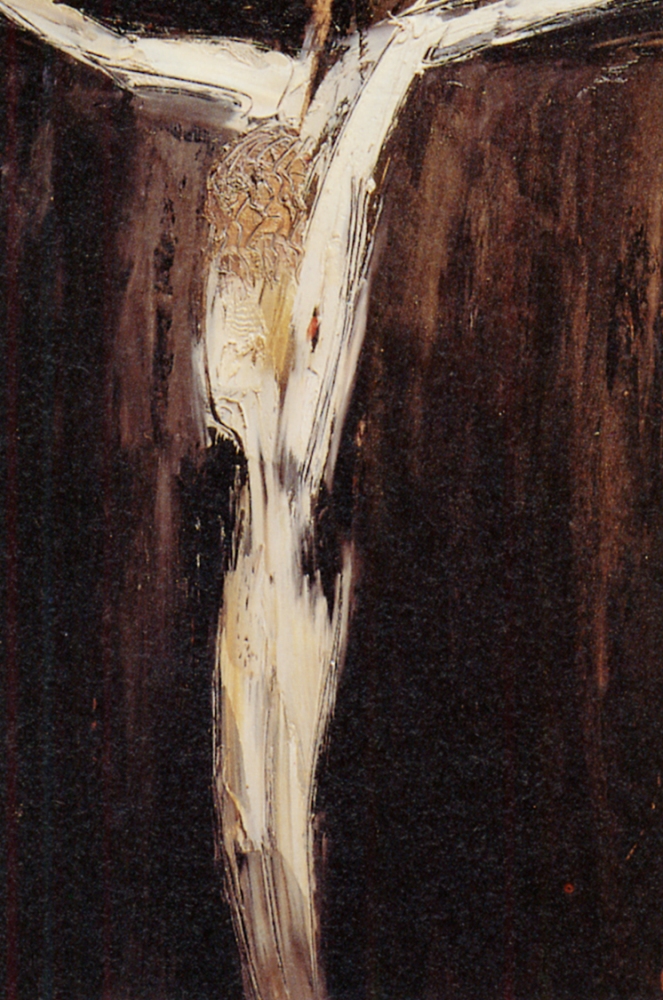
William Congdon, "Crucifixion No.2", 1960

In the dark reaches of Golgotha’s anguish,
His cold and nerveless hands—
Heavy with the pain of entire human sin,
And all cosmic evil (embracing all time)—
Reached out in a purposeful groping,
An attempted desire to reach,
Reach me, the lonesome, loathsome object
Of his insistent love.

In that moment I knew—in the moment of pain
And the high, wild cry—I knew he had embraced me,
Become me wholly as I was in my dream,
In my ineluctable anger and hate,
With all the dark deceits of my heart.

Me he became, and he anguished
As the intolerable pollution spread
Across the pure reaches of his holy self,
Drawing there out of me
The evil that was mine alone.

In the soft silence of his tomb I lay,
One with him in the unconquerable peace,
And with him I rose
When the world dawned new,
And I was the new man.

— Geoffrey C. Bingham, ‘Identification’, in All Things of the Spirit (Blackwood: New Creation Publications, 1997), 1.

Theology in Aotearoa: Two Conferences

1. The Systematic Theology Association of Aotearoa New Zealand is holding its Annual Conference in Dunedin on 11-12 November 2010.

The principal theme of the conference will be ‘Ecclesiology’. Those interested in presenting papers should send an abstract of 200-300 words addressing the theme to Murray Rae by 30 June. Papers to be presented at the conference should be no longer than 45 minutes in duration.

In addition to the principal theme of the conference there will also be opportunity for postgraduate students working in other areas of Systematic Theology to present shorter papers on the theme of their postgraduate research. Such papers will be of 30 minutes duration and an abstract of 200-300 words should likewise be submitted to Murray Rae by 30 June.

Submissions from postgraduate students on the principal theme of the conference will also be welcome.

2. The Laidlaw-Carey Graduate School is sponsoring a colloquium on the theme The Theology and Practice of Lament. The colloquium will explore cultural and theological implications of texts and practices of lament and/or complaint. Potential papers, should address complaint/lament with a focus on spiritual/theological dimensions so might include:

  • readings of biblical or other complaint or lament literature (Psalms, Job, Lamentations etc)
  • studies of historical or contemporary lament songs
  • pastoral perspectives on the contemporary practice of lament
  • theological reflections
  • cross cultural perspectives on lament practices
  • post Holocaust reflections
  • contemporary political reflections

The colloquium will take place in Auckland on 10-11 February 2011, with a view to publishing a book with the same title in 2011. Enquiries and abstracts (before 31 July 2010) should be addressed to Miriam Bier or Tim Bulkeley.

On self-appointed contemporary guardians of orthodoxy

‘There are two things the self-appointed contemporary guardians of orthodoxy seem to forget: (1) orthodoxy was never a guarantee of certainty, but of mystery; and (2) the opposite of faith is not doubt, but apathy.

Augustine spoke to the first point when he reminded us that after we have said everything we can about God we must remember that the God we have described is still not the God who is. As Daniel Migliore has said: “True faith must be distinguished from fideism. Fideism says we reach a point where we must stop our inquiry and simply believe; faith keeps on seeking and asking.” The goal of orthodoxy is to resist the simplistic reductions of irreconcilable realities, realities which invite (even demand) continued interrogation.

George MacDonald, the Scottish writer whom C. S. Lewis called his greatest influence, speaks to the second point in his fairy tale, The Princess and the Goblin: “People must believe what they can, and those who believe more must not be hard upon those who believe less.” The church is not a club; least of all the kind of club with which you beat others over the head.

MacDonald’s admonition is just as important to theology as is Augustine’s, and perhaps even more crucial for the church to hear today. A church rattled by threats from without and within is tempted to retreat into a cocoon of fideism, demanding the unquestioning belief of adherents. But a retrenched faith lacks the energy, imagination and love to engage the world for the sake of the gospel, and a defensive faith tends to prosecute its most creative minds and adventurous spirits precisely when it needs them most’. – Michael Jinkins, ‘Orthodoxy as guarantor of mystery‘.

Some classic Forsyth on the Church, its worship and its service

‘The greatest product of the Church is not brotherly love but divine worship. And we shall never worship right nor serve right till we are more engrossed with our God than even with our worship, with His reality than our piety, with His Cross than our service. It is well to dream and to talk much of brotherly love. But the brethren who love best and the love that loves longest are made by the Gospel. It is this they confess in loving, as they confess it in other ways also. Christian charity is not the sweet reasonableness of culture, nor is it natural kindliness of temper. To the lover of righteousness it does not come easy. It grows only on the stem of Christian faith, which is the tree of the Cross and its righteousness. The good live by faith and work by love. Never did Paul dream that his song of Christian love would be turned to belittle or to belabour the Christian faith on which alone it grows. The Church is the greatest product of history, and the greatest product of the Church is a holiness answering the holiness that made it, which is Holy Love. The first commandment of the Cross is “Be ye holy, for I am holy.” Its call is for the confession, worship, and service of that divine Holiness of love which is the spring of our Redemption. The service of God is the root, the service of man is but the fruit. True, by their fruits shall we know them; but not produce them. The fruits are the evidence, not the principles. Love does more to show faith than to produce it. Grace produces it. We live by that faith in holy Love whose fruit is to be a love not only kind, but, still more, holy’. – Peter T. Forsyth, The Church and the Sacraments (London: Independent Press, 1947), 25–6.

Today is PT Forsyth’s birthday.

‘Peregrine Falcon, New York City’, by Robert Cording

On the 65th floor where he wrote
Advertising copy, joking about
The erotic thrall of words that had
No purpose other than to make
Far too many buy far too much,
He stood one afternoon face to face
With a falcon that veered on the blade
Of its wings and plummeted, then
Swerved to a halt, wings hovering.

An office of computers clicked
Behind him. Below, the silence
Of the miniature lunch time crowds
And toy-like taxis drifting without
Resolve to the will of others.
This bird’s been brought in, he thought,
To clean up the city’s dirty problems
Of too many pigeons. It’s a hired beak.

Still he remained at the tinted glass
Windows, watching as the falcon
Gave with such purpose its self
To the air that carried it, its sheer falls
Breaking the mirrored self-reflections
Of glass office towers. He chided
Himself: this is how the gods come
To deliver a message or a taunt,
And, for a moment, the falcon
Seemed to wait for his response,
The air articulate with a kind of
Wonder and terror. Then it was gone.

He waited at the glass until he felt
The diminishment of whatever
Had unsettled him. And though
The thin edge of the falcon’s wings
Had opened the slightest fissure in him
And he’d wandered far in thought,
He already felt himself turning back
To words for an ad, the falcon’s power
Surely a fit emblem for something.

– Robert Cording, Common Life: Poems (Fort Lee: CavanKerry Press, 2006), 11–12.

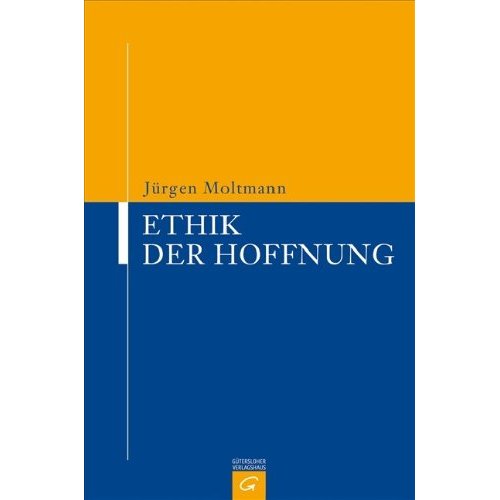
Jürgen Moltmann’s Ethik der Hoffnung

Now here’s something worth hanging out for: Jürgen Moltmann’s latest offering Ethik der Hoffnung. It’s due out on 26 July. In the meantime, all we have is the blurb:

‘Mit der »Theologie der Hoffnung« begründete Jürgen Moltmann 1964 seinen internationalen Ruf. Die politische Botschaft dieses Buches: Christliche Existenz und gesellschaftliches Handeln gehören zusammen. Jetzt folgt endlich die lang erwartete »Ethik der Hoffnung«. Darin entwirft Moltmann die Grundlinien einer Ethik der Hoffnung, die für ihn leitend waren und sind. Er macht deutlich, wie aus einer Perspektive der Theologie der Hoffnung ethische Sichtweisen, ethische Urteile und konkretes Handeln aussehen könnten.

Nach einem grundlegenden Kapitel über den Zusammenhang von Eschatologie und Ethik folgen drei Schritte: Moltmann fragt nach einer Ethik des Lebens in Abgrenzung gegen eine Ethik des Todes, nach einer Ethik der Erde angesichts der ökologischen Herausforderungen der Gegenwart und schließlich nach einer Ethik der Gerechtigkeit angesichts der wachsenden gesellschaftlichen und globalen Ungleichgewichte im sozialen Miteinander.

Dies ist kein Lehrbuch, aber ein auf ethische Praxis ausgerichteter Entwurf mit Handlungsvorschlägen in Hoffnungshorizonten’.

It’s almost as exciting as this.

Henri Blocher on evil, the cross, and hope

Recently, I’ve been posting on the mystery of suffering and evil (see here, here, here, here and here). And then Kim Fabricius reminded me of Henri Blocher’s Evil and the Cross, a book that I had placed on my bibliography but hadn’t read for many years. It was good to revisit it (thanks Kim!). Here’s a few snipperts:

“The agony of the Christian mind wrestling with the problem of evil seems at first sight a sign of weakness. Is it not an admission of its inability to resolve the principal objection, its powerlessness even to begin chipping away at the ‘rock of atheism’? On reflection, however, we would suggest that things appear differently.

If we bowed to the incomprehensible as a way out every time that we found ourselves in difficulties, there would be grounds for suspicion about such a procedure – it would be sheer irresponsibility, the abdication of reason. People are too ready to fall back on the action of ‘mystery’, and also to confuse mystery with the absurd – which Scripture never does. But we would argue that the mystery of evil is the one unique inscrutable mystery, as unique as evil itself, sui generis. Far from being absurd, it corresponds precisely with the experience of evil, with its two facets: unjustifiable–reality …

We may take these thoughts further. The sense of evil requires the God of the Bible. In a novel by Joseph Heller, ‘while rejecting belief in God, the characters in the story find themselves compelled to postulate his existence in order to have an adequate object for their moral indignation’. Moltmann too has perceived that you suppress all protest against suffering, if you suppress God: ‘Since that time no atheism can fall below Job’s level’. When you raise this standard objection against God, to whom do you say it, other than this God? Without this God who is sovereign and good, what is the rationale of our complaints? Can we even tell what is evil? Perhaps the late John Lennon understood: ‘God is a concept by which we measure our pain,’ he sang. Might we be coming to the point where the sense of evil is a proof of the existence of God?

We do not understand the why of evil. But we can understand that we cannot understand. Human reason is made to trace the connections in God’s created order, and to weave harmonious patterns from them; to understand means to integrate. A rational solution to the problem of evil would necessarily imply that evil was an integral part of the harmony that came forth from God! Similarly, to go back from sin to its ‘real possibility’, before it came into the world, means applying to it the logic of continuity which obtains in the processes of the creation. But evil is disruption, discontinuity, disorder, alienness, that which defies description in creational terms (except negatively!). Seeking its causal explanation, its ontological reason, its why, is tantamount to seeking, by the very nature of that seeking, to reconcile it with the rest, in other words to justify it. (The ‘rest’ is in fact what is ‘just’.) To understand evil would be to understand that evil is not ultimately evil. The French have a saying, that to understand all is to forgive all; here, understanding all would mean to excuse everything.

Evil is not there to be understood, but to be fought. The absence of any solution to the theoretical problem of the emergence of evil is one side of the coin; the other side, something still more precious than righteous indignation, is the solution to the practical problem of the suppression of evil. What you appear to lose on the speculative level you gain on the existential level. And we have in mind particularly the far horizon of the practical task, the end of evil, something of far greater interest than its origin. Then will end the cries of ‘How long?’ which express a far heavier burden than the cries of ‘Why?’ … If beneath the outward appearance of evil there were hidden something good, why would anyone want to see it disappear? If God were not sovereign, how would he bring under his control what is not dependent on him? If God concealed darkness within himself, how would it not be eternal, like him? But ‘God’s solid foundation stands firm’ (2 Tim. 2:19). When wild hopes disappear into thin air, the foundation of hope comes into view, the sovereignty of the God who fights against evil, and who invites us to join him in the battle.

God battles with evil, and will conquer it. Or rather, God has battled with it and he has conquered it. We have kept the supreme consideration to the end: that other ‘T’ formed by two small beams of wood on the hill called Golgotha, Skull Hill. There the darkness of the mystery deepened, from the sixth hour until the ninth, the place from which shines forth the light.

In the light of the cross, how could there be any doubt about the three propositions [the evil of evil, the lordship of the Lord, the goodness of God; see p. 100] at the heart of the Christian position? The sheer and utter evilness of evil is demonstrated there: as hatred in the mockery of the criminals who also hung there; as hateful in the weight of guilt which could be removed only by the sacrifice of the Lamb of God. Even if I think of the benefits for myself, when I see my Lord suffering there, I cannot say: Felix culpa. Rather, I feel shame and indignation, against evil and against myself. The complete sovereignty of God is demonstrated there: all this happened ‘by God’s set purpose and foreknowledge’ (Acts 2:23), for it was necessary that the Scriptures be fulfilled, those which bore witness to the destiny that the Lord had assigned to his Servant. If there is a revolting ‘scandal’, it is unquestionably that of Judas’s betrayal, and like the squalid reconciliation of Herod and Pilate it accomplished ‘what your power and will had decided beforehand should happen’ (Acts 4:28). Of no other event is it attested so fully that God ‘willed’ it. The unadulterated goodness of God is demonstrated there. At the cross, who would dare entertain the blasphemy of imagining that God would, even to the slightest degree, comply with evil? It brought him death, in the person of his Son. Holiness stands revealed. Love stands revealed, a pure love; there is no love greater. Because of the cross we shall praise his goodness, the goodness of his justice, the goodness of his grace, through all eternity. At the cross, God turned evil against evil and brought about the practical solution to the problem. He has made atonement for sins, he has conquered death, he has triumphed over the devil. He has laid the foundation for hope.

What further demonstration do we need? …

Just as evil still torments people, casting a dark cloud over their happiness, polluting and plaguing their mind and conscience, so too the problem of evil remains without any rational solution. It is stuck fast in their mind like a thorn, even when that mind has been renewed by grace and belongs to the most faithful disciple … If we look to remove the thorn completely, we simply drive it in deeper, and a poisonous abscess forms, that of some kind of deceitful Gnosticism. The explanations put forward by theologians with the very best of intentions simply amount to concealing the real evil of evil and titivating its ugly horror, even when they do not go so far as to insult the pain of the victims by providing the criminals with excuses. Holy Scripture alone completely resists this temptation. The Bible says nothing which might in the least measure diminish the offence of evil; it refuses any attenuation, whether optimistic or pessimistic. Such faultlessness … is nothing short of miraculous and deserves our notice; it indicates a source of inspiration which is of a different kind from human reflection. What have we discovered?

At the heart lies the inscrutable mystery of the first appearance of evil. Why? How? Where does it come from? It cannot be explained by being made an initial ingredient of existence, or the price that has to be paid, on our microscopic scale, for universal harmony. These so-called solutions, which cut the nerve of human indignation and give cheap relief to the sense of guilt, run straight into the testimony of Scripture. The Lord God is preparing to judge a world that is overflowing with all kinds of abomination – he does not underestimate the gravity of what is intolerable – but on the sixth day of the creation he had rejoiced to behold a created world which ‘was very good’. It contained not the slightest embryonic presence of evil, since it was in its entirety ‘from him and through him and to him’. From the source of goodness there could not flow anything that was bitter (cf. Jas. 3:12). Even less could it be conceived that God would become the accomplice of evil by raising it up for the purpose of acting as his instrument or as a convenient foil.

Then, if it is true that evil arises from the misuse of created freedom, that of the devil and then that of human beings, that does not give us any final explanation either. How was evil born of a freedom that was good? To argue that evil is there and therefore was possible, and that doing evil was a real possibility arising from that freedom, is to cover up the discontinuity of that singular fact – singularly singular. It is completely to pass over its monstrous unwarrantedness; evil is already interpreted as a natural ingredient of existence, if it is taken as something that is consistent with goodness. Scripture bears the opposite testimony, and denies that the human will may ever become independent of God. It is God who rules his creation as sovereign, in accordance with his own design, according to the revelation he has given us in his Word written, even the choices that are aimed against him. The sovereignty of God, which is affirmed times without number in his own revelation, makes his permission of evil an impenetrable mystery.

Divine sovereignty, however, is indispensable to the denunciation of evil, for it alone can guarantee the order with respect to which evil is denounced as disorder. It is short-sightedness together with an absent-minded dash of anthropomorphism which plays with the empty notion of a form of divine sovereignty to which God himself has set limits. It is better to observe that the three branches of the capital T of the biblical doctrine, i.e. the abhorrent nature of evil, the goodness of God, and his absolute sovereignty, assign to evil its position of utter loathsomeness, of being an unjustifiable reality, and ratifies our initial, wholesome reaction against it of shame and indignation.

When we join the book of Job and the ninth chapter of Paul’s letter to the Romans by forgoing the rational explanation of the origin of evil, we find ourselves moving on to the answer to the question, ‘What is evil?’ It is, of course, formally defined as something that is contrary to the will of God and yet permitted by him; but if we ask what is its ‘essence’, its ‘nature’, the elucidation runs up against the impenetrability of the mystery. The phenomenon does not belong to the order of the creation; neither is it an independent principle, for it draws its force from the created realm that it corrupts. It is neither really ‘something’ (for it is not from God, from whom all things come forth), nor really ‘nothing’. It is neither a metaphysical datum nor a surface effect that can be easily dispersed. Georges Florovsky commented on this radically disturbing alienness in these terms:

Evil is divided within itself; it is a discord and a disharmony, inordinatio. Evil is ambiguous, unstable, variable. It has no character of its own … Nature itself is affected, nature itself is no longer pure. It is a dynamic disorder, a dynamic or functional perversion which is not yet consolidated in a metaphysical transformation … The existence of evil is a parasitic existence, evil lives by means of good, ex ratione boni. The elements are the same in the original world and the fallen world. But the organizing principle has changed. And although it is dynamic, the perversion is irreversible. Whoever has gone down into the abyss of evil, of his own will, is unable to climb back out.

Here again, theological analysis agrees with the simple experience of ordinary people.

The absence of any theoretical solution … opens the way for the practical answer to the question: ‘Lord, how long? The three inseparable biblical truths form the springboard of hope. They alone authorize us to expect the suppression of evil. But the inscrutable enigma puts forth a horrifying new shoot, which lengthens into the persistence of evil, even its revival, after the death and resurrection of Christ. If the Messiah has come, the Saviour, if he has won the victory over evil, if he has set up his kingdom, how are we to account for the succeeding nineteen centuries? Could the kingdom not have reached us, in spite of Matthew 12:28?

A ray of light pierces the gloom. It comes from the cross. The impenetrable mystery of evil meets the paradoxical mystery of the cross. The mystery of Golgotha is that of the darkness which turns to light, as the Psalmist said, for God and for us – for us by God (Ps. 139:11f.). We understand that we cannot understand, and even a little more. At the cross we find the verification of God’s mastery over evil, of his incorporating it within his plan, of his using evil men, and of his freedom from all suspicion of complicity in it. The mere mention of this last hypothesis, even though it is made in order to brush it aside, is profoundly disturbing, as if we were on the verge of blaspheming. At the cross we find confirmation that evil does not belong metaphysically to the condition of the human race; to a catastrophe in history, God reacts in human history. At the cross is revealed how his kingdom comes about: not by might (of weaponry), or by power (of worldly means), but by the Spirit of sacrifice (Zc. 4:6); not by the subjection of multitudes to slavery, in the manner of the great rulers of this world, but by the service of the Son of Man (Mt. 20:25–28); for the kingdom is not of this world (Jn. 18:36). The way of the kingdom requires that it spread most unobtrusively, by spiritual influence. It conquers people’s hearts, by their unconstrained acceptance of, and adherence to, the Word, its preaching and its call. Hence the stay of execution for the old world, the permission of continuing evil, and the margin of freedom left to the devil who is giving vent to his great fury, for he is aware how little time he has left (Rev. 12:12). Hence the association of the kingdom with the suffering and the patient endurance in Jesus (Rev. 1:9).

But why is the kingdom set up in such a way, if another way could have spared so much weeping, so much bloodshed? We have come to the threshold of the secret and hidden wisdom, revealed by the Spirit, in words taught by the Spirit, and that none of the rulers of this age understood, what has not been conceived by any human mind (1 Cor. 2:7ff.). We have a special wisdom to seek out in the mystery of the cross. Not that this mystery gives us leave to overturn the concepts of orthodox Christian doctrine, such as downplaying the omnipotence of God as stated in Holy Scripture (after the death of Christ, as well as before it), and promoting a ‘powerless God’; that is the kind of ‘wisdom’ that the rulers of this age endorse. The Pied Piper philosophers of our world will gladly take that path, reflecting as it does the vagaries of their humanism, their ideological manoeuvres and their all too human resentment. The wisdom of God in the event of the cross maintains its unique, concrete character, spelt out with total clarity by what the cross achieved: perfect redemption and propitiation. In short, at the cross evil is conquered as evil.

The wisdom of the way of the cross is that it attacks evil according to the ambiguity of its unique nature, and its illegitimate status. If evil simply boiled down to the ‘local’ imperfection of every finite being, exaggerated by an optical illusion, Christ would have had to do no more than teach, or else initiate his disciples into the liberating vision, like a Zen master; but evil is something other, and it is at the cross that it is conquered, in quite another manner. If evil were a substance, an entity, comparable to some great power in the created order, it would have been sufficient to deploy a superior force against it, assuming that the opposing parties had enough in common for such a meeting to be conceivable; but evil is something other, and it is at the cross that it is conquered, in quite another manner.

At this point a misunderstanding arises for some people. They imagine Christ overcoming the devil at the end of a spiritual duel by his superior strength; or they speak of the elimination of evil, swallowed up by love, as if it were some kind of chemical operation of absorption and dissolution. Scripture is careful to avoid these misleading images. It speaks of the evil one being disarmed by the expiatory blood which alone washes away sins. The power of the devil over human beings is that of accusation, as his name, Satan, the accuser, indicates (Rev. 12:10ff; Col. 2:14f.).

Lastly, if evil corresponded to a necessary moment in the forward movement of a dialectical sequence of events, it would be left behind by its own progression to a higher synthesis. But evil is something other, and it is at the cross that it is conquered. Good Friday is anything but speculative. The free sacrifice, unique and once for all, is the reverse of the illustration of the fruitfulness of the Negation in a universal chain of logic. At the cross evil is conquered as evil: corruption, perversion, disorder, a parasite, and yet also weighed down with the load of the people it has led astray and deep in debt from the responsibility incurred.

Evil is conquered as evil because God turns it back upon itself. He makes the supreme crime, the murder of the only righteous person, the very operation that abolishes sin. The manoeuvre is utterly unprecedented. No more complete victory could be imagined. God responds in the indirect way that is perfectly suited to the ambiguity of evil. He entraps the deceiver in his own wiles. Evil, like a judoist, takes advantage of the power of the good, which it perverts; the Lord, like a supreme champion, replies by using the very grip of the opponent. So is fulfilled the surprising verse: ‘With the pure you show yourself pure; and with the crooked you show yourself perverse’ (Ps. 18:26, NRSV).

It is exactly this, the sin of sins, the murder of the Son, which accomplishes this work in a double manner. It provides the opportunity for love to be carried to its very peak, for there is no greater love than to give one’s life for one’s friends (Jn. 15:13). And as this gift contains no element of a romantic suicide (like Tristan or Romeo), the death unjustly inflicted becomes the ‘wages’ earned by the sin of the world, borne by the Lamb of God. It constitutes the ransom paid to liberate sinners, for they are prisoners of the law of God, the One who is Son of God and Son of Man, the head of the new humanity taking upon himself the debt of his own people (Mt. 20:28; Gal. 3:13, 21; Col: 2.14, etc.). It is in this way that he triumphs over sin, guilt and death. It involves a double coincidence. Evil culminates in murder; by taking away the life of the other person, sin brings about the successful conclusion of its essential intention, the rejection of the Lord and of whoever bears his image. By contrast love, which is ‘being for the other person’, culminates in the gift of one’s own life in favour of someone else. Furthermore, the requirement of right order, which is the order of love according to God, is that evil be punished by death, but it permits the brother and head to intervene in love and take over the debt in place of the guilty party. Here lies the mystery of the victory:

I see the depths of my pride, curiosity, concupiscence. There is no link between me and God or Jesus Christ the righteous. But I he was made sin for me. All your scourges fell upon him. He is more abominable than I, and, far from loathing me, feels honoured that I go to him and help him. But he healed himself and will heal me all the more surely [Pascal].

The secret and hidden wisdom of the Lord has caused to coincide the ignoble murder and the act of supreme love of the righteous for the unrighteous, the expiation, by his death in their place, of their sins. At the cross, evil is conquered by the ultimate degree of love in the fulfilment of justice.

A more elaborate treatment of evil would expose, in addition to its reversal (the suppression of the other person), the twisted leer of counterfeit love, false love, love in which the warped outlines are still recognizable. It would also show how death, the secret goal of sin from the very beginning (Jn. 8:44; Rom. 8:6), is of necessity the retribution that befalls it, rather than any other punishment; and also how the primacy of love, which is the foundation of humanness, permits the transfer of responsibility. It would thus further elucidate the connection between Calvary and the problem of evil. But we have seen enough to recognize in the mystery of the cross the divine answer to the unanswerable question of evil: de profundis, ‘out of the depths’ (Ps. 130:1), springs light, despite the impenetrability of the enigma.

Such is the glory of the cross that one would be tempted to explain the permission of evil by this end, that love, put to the test, reveals itself in its ultimate intensity. One last time, we must resist the attraction of this thought, for it would cause us to fall back into a pseudo-rational Gnosticism; it would attribute to a holy God a calculating mind which would utterly appal him. We have no other position than at the foot of the cross. After we have been there we are given the answer of the wisdom of God, which incenses the advocates of optimistic theodicies or of tragic philosophies. God’s answer is evil turned back upon itself, conquered by the ultimate degree of love in the fulfilment of justice.

This answer consoles us and summons us. It allows us to wait for the coming of the crucified conqueror. He will wipe away the tears from every face, soon“.

– Henri Blocher, Evil and the Cross: An Analytical Look at the Problem of Pain (trans. David G. Preston; Leicester: Inter-Varsity Press, 1994), 102–4, 128–33.
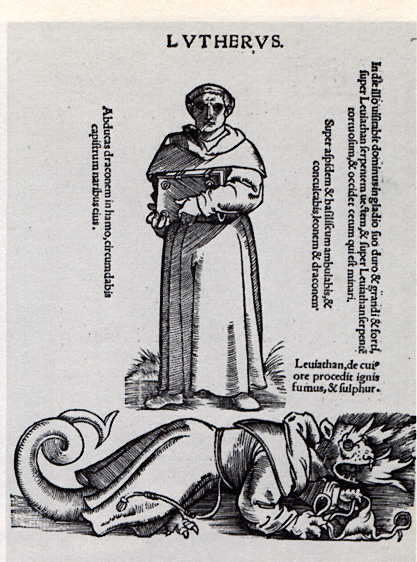
‘Luther and the Devil’, by Robert Cording

Over the coming six or seven weeks, I’d like to share some poems, one a week, probably on Wednesdays, from Robert Cording’s very rich collection of work published as Common Life: Poems.

Here’s the first:

‘Luther and the Devil’, by Robert Cording

When I began to lecture on the Psalms and I was sitting
in the refectory after we had sung matins, studying and
writing my notes, the Devil came and thudded three times
in the storage chamber as if dragging a bushel away.
— Martin Luther

Someone once remarked the medieval air
Was so thick with demons, a needle dropped
Randomly from heaven would have to pierce
One or two on its way down. These days
We’re more likely to believe in poltergeists
Than the heavy-footed, skulking Adversary
Who shows up in Luther’s little story.

Now, when Milton’s Satan of obdurate pride
And stedfast hate can be understood in terms
Of sibling rivalry, how quaint that path
Through the Psalms seems; likewise, the soul
Disturbed by the racket of a jealous Devil
Who needs to be wherever God is. Who believes
That figure of a bushel being dragged away?

Yet we catch certainly a glimmer of Luther’s
Pain over the sure step gone astray,
The barbed hours to come when nothing satisfies,
When that dull thudding in the storage chamber
Seems everywhere, centerless, and there is
No escape from the tightly spiralled Nautilus
Of the self that endures by choosing blindly.

And so perhaps we can come to understand again
Why, when Luther turns back to the Psalms
And his writing, he looks hard for the Devil
Harbored in his words, having learned too often
How that old Adversary shows up each time
The soul comes close to letting itself be found,
His soft mouth whispering one more illusory solace.

– Robert Cording, Common Life: Poems (Fort Lee: CavanKerry Press, 2006), 9–10.

Public conversations with Paul Oestreicher

The Centre for Theology and Public Issues and the National Centre for Peace and Conflict Studies (both of the University of Otago) are hosting a public conversation with Canon Paul Oestreicher.

Paul Oestreicher has had an extremely interesting career – from being a refugee in Dunedin from Germany in 1939 and a student at Otago, to co-founding and chairing Amnesty International, to pioneering the Centre for International Reconciliation at Coventry Cathedral, to being both an Anglican priest and a Quaker chaplain – and this will be a rare opportunity to hear, not just about his current research, but about his past work and what has driven him to devote his whole life to the cause of peace-making, East-West reconciliation, human rights and disarmament. Paul was last year awarded a Doctorate of Divinity by Otago University where he is currently a Visiting Fellow at the National Centre for Peace and Conflict Studies.

This public conversation will take place in the Allen Hall (corner of Union and Leith Streets, near the Clocktower on campus) on Thursday 6 May from 5.30-6.45pm. Contact: Ann Hassan.

The other public conversation that Canon Oestreicher will engage in has been organised by the Otago University Amnesty International Group. It will take place in Archway Lecture Theatre 2, at 6pm on Monday 10th May. At this event, Paul will be speaking about his own experiences as a refugee from Germany to Dunedin in 1939, his work with Amnesty and why we should all care, and take action, on human rights abuses around the world. Enquiries for this event can be directed to Stefan Fairweather.

Bonhoeffer’s hymns

I spent some time today trying to find the music for three hymns whose lyrics were all authored by Dietrich Bonhoeffer.

The first one was ‘In boundless mercy God has called’. It is reproduced in several publications, including The Hymnal of the United Church of Christ (1974) #251; The New Century Hymnal (1995), #413; Glory to God (PCUSA, 2013) #818; and Worship and Praise (Hope), #75. (Thank you to Edward Sewell for drawing my attention to these references.)

The second hymn was ‘O Lord my God, I thank thee that thou hast brought this day to its close’. It is reproduced in The United Methodist Hymnal (1989), #689.

The third hymn, ‘We turn to God when we are sorely pressed’, is more commonly reproduced. Its words come from Bonhoeffer’s poem ‘Christen und Heiden’, translated as ‘Christians and Unbelievers’ in his Letters and Papers from Prison:

Men go to God when they are sore bestead,
Pray to him for succour, for his peace, for bread,
For mercy for them sick, sinning, or dead;
All men do so, Christian and unbelieving.

Men go to God when he sore bestead,
Find him poor and scorned, without shelter or bread,
Whelmed under weight of the wicked, the weak, the dead;
Christians stand by God in his hour of grieving.

God goes to every man when sore bestead,
Feeds body and spirit with his bread;
For Christians, heathens alike he hangeth dead,
And both alike forgiving.

— Dietrich Bonhoeffer, Letters and Papers from Prison (ed. Eberhard Bethge; trans. Reginald H. Fuller; London: SCM Press, 1954), 167–68.

I sourced music for this poem from two places: Together in Song, Australian Hymn Book II, #240 (which also includes Bonhoeffer’s more well-known hymn ‘By gracious powers so wonderfully sheltered’, #617), and the Church Hymnary, Fourth Edition, #393. This is available in either a full music and words edition or a melody and words edition.

One of the things that I found really interesting here was comparing the different ways that this poem had been translated. The original reads:

Menschen gehen zu Gott in ihrer Not,
flehen um Hilfe, bitten um Glück und um Brot,
um Errettung aus Krankheit, Schuld und Tod.
So tun sie alle, alle, Christen und Heiden.

Menschen gehen zu Gott in Seiner Not,
finden ihn Arm, geschmäht, ohne Obdach und Brot,
sehn ihn verschlungen von Sünde, Schwachheit und Tod.
Christen stehen bei Gott in Seinem Leiden.

Gott geht zu allen Menschen in ihrer Not,
sättigt den Leib und die Seele mit seinem Brot,
stirbt für Christen und Heiden den Kreuzestod,
und vergibt ihnen beiden.

Together in Song, Australian Hymn Book II translates it thus:

All go to God when they are sorely placed,
they plead to him for help, for peace, for bread,
for mercy, for them sinning, sick or dead.
We all do so in faith or unbelief.

We all go to God when he is sorely placed,
find him poor, scorned, unsheltered, without bread,
whelmed under weight of evil, weak or dead.
We stand by God then, in his hour of grief.

God comes to us when we are sorely placed,
body and spirit feeds us with his bread.
For everyone, he as a man hangs dead:
forgiven life he gives all through his death.

And the Church Hymnary, like so:

We turn to God when we are sorely pressed;
we pray for help, and ask for peace and bread;
we seek release from illness, guilt, and death:
all people do, in faith or unbelief.

We turn to God when he sorely pressed,
and find him poor, scorned, without roof and bread,
bowed under weight of weakness, sin, and death:
faith stands by God in his dark hour of grief.

God turns to us when we are sorely pressed,
and feeds our souls and bodies with his bread;
for one and all Christ gives himself in death:
through his forgiveness sin will find relief.

Robert Frost was right: ‘Poetry is what is lost in translation’.

April bests …

From the reading chair: Atonement: The Person and Work of Christ by T.F. Torrance; Divine Empathy: A Theology of God by Edward Farley; The Knot of Vipers, by François Mauriac; Reformed Worship by Howard L. Rice & James C. Huffstutler; God’s Inescapable Nearness by Eduard Schweizer; Aussie Gems: Cindy Ella by Tom Champion & Glen Singleton; Aussie Gems: Redback on the Toilet Seat by Slim Newton & Craig Smith; Participating in God: A Pastoral Doctrine of the Trinity by Paul S. Fiddes; The Doors of the Sea: Where Was God in the Tsunami? by David Bentley Hart; Theology & Ministry in Context & Crisis: A South African Perspective by John W. de Gruchy; Good and Evil by Edward Farley; Common Life: Poems by Robert Cording.

Through the iPod: Women and Country by Jakob Dylan; Hold on to Me by The Black Sorrows; X&Y by Coldplay; Symphony No. 6; Into the Twilight; Summer Music by Sir Arnold Bax; Infamous Angel, My Life and The Way I Should by Iris DeMent; Paganini: Violin Concertos with Salvatore Accardo; Nothing Like the Sun and The Dream of the Blue Turtles by Sting; Leave Your Sleep by Natalie Merchant; Standard Songs for Average People by John Prine & Mac Wiseman; Fair & Square by John Prine.

On the screenBoy [2010]; Endgame [2009]; The White Ribbon [2009]; God on Trial [2008]. BTW: I also saw von Trier’s Antichrist, the most hideous and uninteresting film I’ve seen this year.

By the bottle: Wasp, by Invercargill Brewery.

Public Lecture: Mysticism in the Abrahamic Faiths

The Otago Tertiary Chaplaincy & the Dunedin Abrahamic Interfaith Group are hosting a public lecture by Rabbi Niles Goldstein on ‘Mysticism in the Abrahamic Faiths‘. All are welcome.

Details: Monday 17 May in Archway 3 Lecture Theatre, University of Otago; 7.30-8.45pm.

Niles Elliot Goldstein is Rabbi Emeritus of a progressive synagogue (New Shul) in Manhattan, Downtown New York where he served as its spiritual leader from its founding in 1999 until 2009. Prior to this he was a senior fellow at the National Jewish Center for Learning and Leadership, a program officer at The Steinhardt Foundation, and the assistant rabbi at Temple Israel in New Rochelle. He is a member of the Central Conference of American Rabbis and the New York Board of Rabbis. He is a former US Army Chaplain and Law Enforcement Chaplain. He was active in offering counseling in Manhattan post-9/11.

Niles holds an honors B.A. in philosophy from the University of Pennsylvania and received an M.A. and his Ordination from the Hebrew Union College-Jewish Institute of Religion. He teaches across the USA and internationally on issues in mysticism and spirituality, values and leadership, the environment, and on new models for religious life in the 21st century. He lives in Brooklyn with his wife Michele.

He is the author or editor of nine books, including the award-winning Gonzo Judaism: A Bold Path for Renewing an Ancient Faith, and his writing has appeared in many publications, including Newsweek, the Los Angeles Times, Newsday, The Forward, and Moment. His latest book is entitled The Challenge of the Soul: A Guide for the Spiritual Warrior (2009).

‘Mozart’s Starling’, by Robert Cording

A little fool lies here
Whom I hold dear—
—Mozart, lines of a poem for his pet starling

None of his friends understood.
A poem for a bird?—
and a funeral, and the ridiculous
request that they dress in formal attire.

But when Mozart whistled a yet-to-be
fragment of a piano concerto
in the marketplace, the bird
may have sang it back to him—

the starling appears in his diary
of expenses, May 27, 1784,
along with a transcription of its song.
What fun they must have had,

he whistling a melody, the bird,
a virtuoso mimic, echoing it back,
interspersed among its clicks
and slurs and high-pitched squeals.

Music to Mozart’s ears,
that dear bird who sang incessantly
for the duration of its three
short years in Mozart’s company.

His little fool was wise indeed—
it could hear a squeaking door,
a teapot letting off its steam,
a woman crying or rain pinging

in metal buckets and gurgling
in gutters, even a horse’s snort
or Mozart scratching notes,
and sing it back until Mozart, too,

could hear the cockeyed,
nonstop music in the incidental
bits and pieces of the world going by,
the exuberant excess of it all.

— Robert Cording, ‘Mozart’s Starling’.

Two items of note …

Two items of note:

1. Some historians of the Presbyerian tribe will be keen to know that the latest issue of The Historical Journal includes an article by Alasdair Raffe on ‘Presbyterianism, Secularization, and Scottish Politics after the Revolution of 1688–1690’ (Volume 53, Issue 02, June 2010, pp. 317–337). Here’s the abstract:

‘This article assesses the significance of Presbyterian ideas of church government in Scottish politics after the revolution of 1688 intrinsic right of the church: its claim to independent authority in spiritual matters and ecclesiastical administration. The religious settlement of 1690 gave control of the kirk to clergy who endorsed divine right Presbyterianism, believed in the binding force of the National Covenant (1638) and the Solemn League and Covenant (1643), and sought to uphold the intrinsic right. An ambiguous legal situation, the criticisms of episcopalian clergy and politicians, and the crown’s religious policies helped to make the Presbyterians’ ecclesiological claims a source of instability in Scottish politics. Meetings of the general assembly and, after 1707, the appointment of national fast and thanksgiving days were particularly likely to spark controversy. More broadly, the article questions two narratives of secularization assumed by many previous scholars. It argues that Scottish politics was not differentiated from religious controversy in this period, and that historians have exaggerated the pace of liberalization in Scottish Presbyterian thought’.

2. The other breaking story is that N.T. Wright has been appointed to a Chair in New Testament and Early Christianity at St Andrews.

Mythologies to live – and to die – by

‘The greatest tragedy of the church and of our people I see, at this moment in time, lies in the fact that in the powerful popular movement a purified, glowing, national feeling is linked up with a new paganism, whose unmasking and attacking is more difficult than with free-thinking religion, not only on emotional grounds, but because it goes around in Christian clothing’. So penned Dietrich Bonhoeffer in 1931 during his first trip to North America, and published in No Rusty Swords (p. 69). This temptation, so powerfully resisted in Bonhoeffer’s own person, is also identified by Joe Jones in his exciting book On Being the Church of Jesus Christ in Tumultuous Times (reviewed here). In the Introduction, Jones recalls how throughout the church’s life there has been a ‘constant temptation to Christians to regard their national cultural identity as more basic than their Christian identity’ (p. xxi). This too is my concern, a concern nicely echoed in Ben Myers’ recent post on Anzac Day and the god of war, a subject which I too posted on last year under the name Aliens in the Church: A Reflection on ANZAC Day, National Flags and the Church as an Alternative Society. This shared concern seeks to speak into the confusion about the most basic self-understanding of the people of God, about our identity in the world and about which ‘mythology’ we choose to have our minds and lives most shaped by. Jones rightly, to my mind, contends that one symptom of the disarray in the church today is that most of us are more decisively formed and informed by our national identity than by our identity as disciples of an-other kingdom.

Jones proposes that the decisive identity for the church is an identity grounded in affirming Jesus Christ as Lord and Saviour. Without some clarity about the priority among our various socially-conferred and socially-constructed identities, the church will, he contests, be utterly incapacitated to think pertinently about much at all, including issues about war and peace, and about its own unique identity, as well as its own theologically-determined political and economic life. He writes: ‘In the absence of a vigorous self-understanding grounded in the Gospel of Jesus Christ, the church devolves into being no more than a mirror image of the values – the discourses and practices – that shape the world in which it lives. Hence, being the church of Jesus Christ in tumultuous times at least involves understanding what it means simply in all times and places to be that community that is the Body of Christ in the world’. He continues: ‘This problem is most acute for the so-called ‘liberals’ and the so-called ‘conservatives’ among the church, for both seem determined to think about the war and terror simply according to the their liberal or conservative political dispositions. Completely lost in this is how to think and act, first and foremost, from the perspective of being a confessing and disciplined member of the Body of Christ in the world. Put another way: the discourses of the church should be the means by which Christians come to construe the world of the nation-states, with their internal and external politics, as the world over which Jesus Christ reigns’ (p. xxii).

We ought to thank God for those ministers and churches who on this recent Anzac Day refused to baptise a pagan ‘mythology’ but instead embraced the opportunity to engage creatively, graciously and prophetically with the soul of the community around them, to identify points of contact with that wider community, to encourage public discourse about the deepest realities of human being, and to hold up a new imagining of human community grounded in Jesus alone. That next year’s ANZAC Day falls on Easter Monday, only helps – one hopes – to make that conversation even more arresting, the clash of ‘mythologies’ even more striking, and the choice before us even more stark.

Who said it?

It’s been around six weeks since our last ‘Who said it?’ competition, so probably time for another round (not that we need an excuse or anything). Here’s one from the archives:

‘Can it be just that God should bring beings into the world unprotected by an infinite armour of foresight against the infinite chances and temptations to wrong, and yet hold them liable to infinite punishment when they had gone wrong? … Punish a man for his sin, that is just; punish him for ages (if in that other world you can reckon time), that may be just; but make no end of punishing him for that sin, reduce him from a man to a devil and keep him there, let him become for ever vile, mainly because he was ignorant to start with, that is not just … Preach the eternal, unappeasable wrath of God upon lost souls and you offer men a devil to worship’.

So, who said it?

We’ll wrap it all up on Friday.