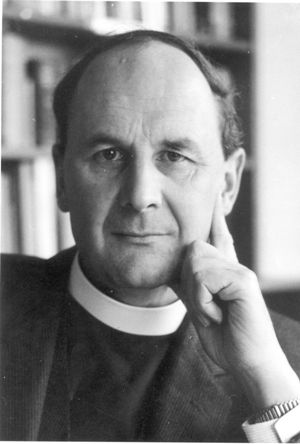
 In recent days, I’ve been lecturing on Christianity without God and the Nihilism of the Secular. We’ve mainly been looking at Mr Feuerbach and his children Karl (Marx), Sigmund (Freud), Don (Cupitt), Lloyd (Geering), Karen (Armstrong) and Alain (de Botton), as well as their much-abused and massively-misunderstood neighbours, especially Rudolf Bultmann and Paul Tillich. After I’d written my lectures – isn’t that so often the way these things go! – I came across a very helpful article by Tom Wright. ‘Doubts about Doubt: Honest to God Forty Years On’ (published in the Journal of Anglican Studies in 2005) is Wright’s insightful reading of John Robinson’s most controversial (and, in some ways, his least interesting) book Honest to God and the theo-cultural milieu which gave rise to it and which goes a significant way to explaining its popularity and ongoing incarnations. Wright’s concluding paragraph provides what I think is a tempting taster to the whole essay:
 Robinson had his finger on a real problem in postwar UK church life and, in a measure, theology. I believe the problem was mostly or largely caused not by the New Testament and historic Christianity itself, but by the way in which the post-Enlightenment world had assimilated and re-expressed the Christian faith. What Robinson referred to when speaking of supra- or supernaturalism belonged within an essentially deist or Epicurean framework, and he was struggling with the unwelcome consequences of people being unable to relate to their absentee landlord, and simultaneously puzzling over the fact that some people did not find this a problem. The huge popularity of his book shows that he struck a chord with a great many people. The tragedy of Honest to God, as I perceive it, is that Robinson did not see that what he was rejecting was a form of supernaturalism pressed upon Christianity by the Enlightenment; that he did not therefore go looking for help in finding other ways of holding together what the classic Christian tradition has claimed about God, the world, and Jesus; that in addressing these ontological questions he never laid out the parallel moral ones, or explored the ways in which, centrally, the Christian Scriptures and tradition address them; and that in consequence his high modernist construct now looks very shaky in the cold light of a postmodern dawn, as well as in the warmer light of the mainstream Christian alternative. The good news is that, precisely once the postmodern critique has done its work, we can see that there are other ways of retrieving the ancient Jewish and early Christian witness and faith – a daunting and difficult task, no doubt, but one still full of promise and possibility. In honouring John A.T. Robinson, we should perhaps evoke the famous saying of his seventeenth-century namesake: God has yet more light to break out of his holy word.
There is always, of course, much more that Wright could have said; he has a habit of stopping one or two stations short of the station with the best coffee (i.e., he’s theologically undercooked). But I found his article very helpful in framing some of the larger and social contexts of Robinson’s book. I’ve uploaded a copy of the article here.











 jasongoroncy.com