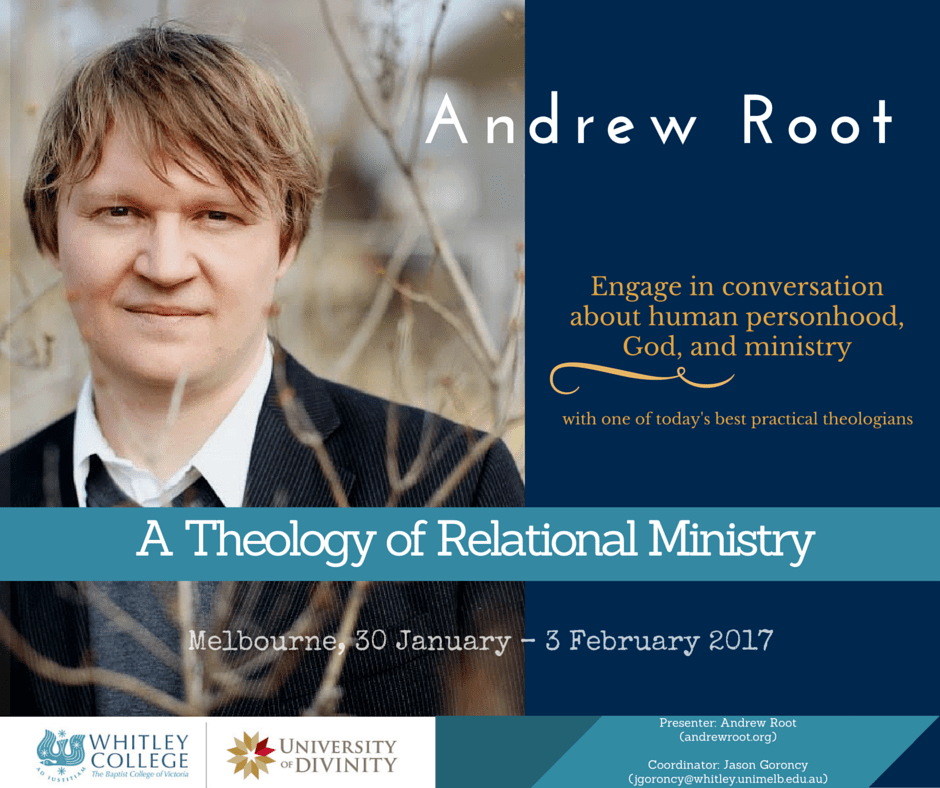
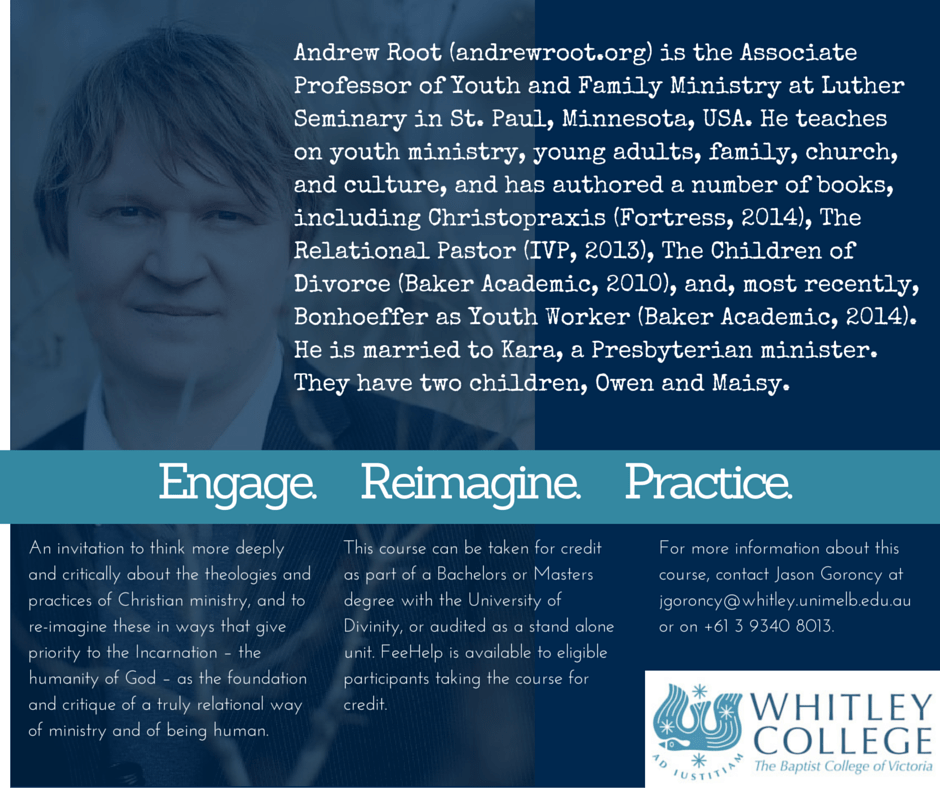
A Theology of Relational Ministry, with Andrew Root

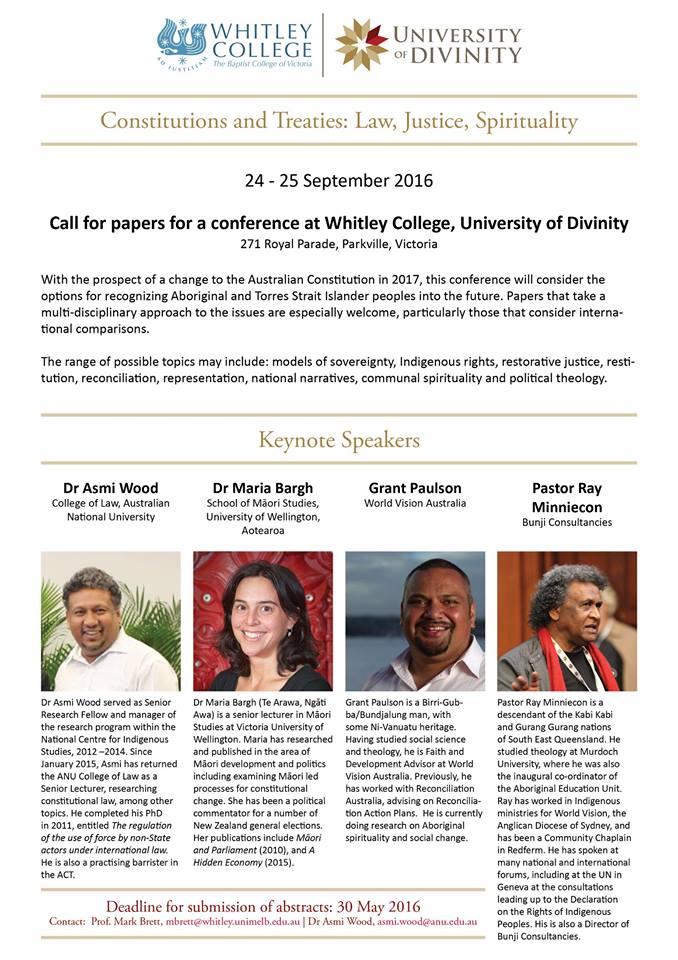
I’m very pleased indeed to announce that Andy Root will be coming to Melbourne early next year to teach a one-week course on the theology of relational ministry. The course will be of interest to all involved in Christian ministry and leadership, from children’s ministry workers and youth pastors, to congregational ministers (ordained or lay), and to those working in aged care and various chaplaincy roles. More details will follow in due course, but here are the basics:

Promo 1

Promo 2

What does the cross of Christ reveal?

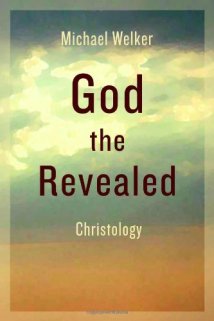
Welker ChristologyOne of the joys of teaching a christology unit this semester has been the excuse that it has occasioned to getting around to reading Michael Welker’s book God the Revealed: Christologya book that’s been sitting relatively untouched on my shelves for a few years now. The chapters are short, intelligent, and deeply engaging. In other words, they are a busy teacher’s dream. In one of them, titled ‘The Cross Reveals Not Only the Suffering, but also the Judging and Saving God’, Welker offers seven claims about the significance of the cross as revelation. They’re worth sharing, not only because it offers a taste of Welker’s style, but also because his summary statements (in bold) are just such a wonderful witness to the evangelical faith of the church:

  1. The cross reveals the terrifying, godforsaken situation of human beings, a situation they themselves, however, do not recognise as such. The representative world, in a curious mixture of anxiety, fear, and aggressivity, turns against God’s presence in the life and ministry of Jesus. ‘The cross’, says Welker, ‘discloses a situation that could not but plunge the world into profound despair were the world truly to grasp it; as it is, however, the world is able simply to pass over or disregard it in dull unconsciousness, with a shrug of the shoulders, or even gleefully. The cross of Christ is the expression of the godforsaken condition of human beings, a condition they yet try to disguise even though they themselves have brought it about’.
  2. The cross reveals the diastasis of God and humankind, God and world. It ‘calls into question or … even puts an end to any and all lighthearted theologies that make their peace with the “dear Lord,” that try to engage God and human beings in a kind of enduring but unproblematic partnership, or that otherwise propagate a peaceful ongoing relationship between God and human beings’.
  3. The cross reveals the profundity of the sin of the world. It stands for the triumph of the powers of the world over the presence and revelation of God. It reveals that our efforts to understand sin solely or principally in individual terms dangerously downplay the cosmic and violent character of the powers that both parade and masquerade themselves under the guise of religion, law, politics, and public morality. In light of the cross, ‘it becomes clear’, says Welker, ‘that even God’s “good law” can turn into an instrument of lies and deception under the power of sin. Jesus Christ is crucified in the name of religion, of global power politics, with reference to both Jewish and Roman law, and with the approval or even under the pressure of public opinion’.
  4. The cross reveals the danger that God’s revelation might not reach human beings because God may well withdraw from them. Drawing here upon Eberhard Jüngel’s work, Welker argues that what emerges in the cross ‘is the serious danger that God and world, God and humankind, “have died to each other” in a wholly disastrous sense’; i.e., in the sense that ‘this person is dead for me – I have absolutely no relationship or connection with this person now, nor do I want any’. The cross reveals that God has delivered human beings ‘over to their own [nothingness]. The cross not only reveals the danger that the world might close itself seamlessly off from God, utterly renouncing or even taking up a posture of opposition against God, it also reveals the danger that God, too, might no longer seek and find access to that very world’. It exposes the dreadful possibility that the cry of dereliction – ‘My God, my God, why have you forsaken me?’ – is in fact the last and most truthful assessment of the situation, both for creation and for God.
  5. The cross, however, also reveals God’s own suffering; it reveals not only the suffering of Jesus Christ, but also that of the triune God who through the sending of Jesus simultaneously seeks to reveal God’s proximity to human beings. Again drawing on Jüngel, Welker refers to this as ‘God’s inner disruption or as disruption within God. Through the cross, God is confronted with the death and sin of the world in a way that calls into question not only Jesus’s life, but also the divine life itself’.
  6. The cross reveals the abyss in which the very deity of God is most profoundly called into question. Here, ‘the creative God is confronted with chaos’, and that confrontation ‘reveals a suffering or impotence on God’s part’ which resides ‘deep within the deity itself’.
  7. Insofar as the cross reveals God’s pain and impotence, so also does the inner communion between Creator, Spirit, and Jesus Christ become discernible over against a world that closes itself off from God. The One revealed in the cross is the One who has ‘entered into the abyss of human misery and horror, subjecting itself not only to natural death, but also to the abyss of extreme separation from God, which various biblical traditions call “hell”. The cross reveals God’s descent into hell. It reveals that God … is no stranger to hell, that God suffers from hell and allows the divine life itself, in the figure of the crucified Resurrected [sic], to be enduringly characterized by this very suffering’. From eternity into eternity, the cross reveals the divine love that suffers for the other.

‘Mother Julian’

Rogier van der Weyden - Julian of NorwichMalcolm Guite has shared his beautiful sonnet about Julian of Norwich – ‘Mother Julian’. It’s worth sharing again:

Show me O anchoress, your anchor-hold
Deep in the love of God, and hold me fast,
Show me again in whose hands we are held,
Speak to me from your window in the past,
Tell me again the tale of Love’s compassion
For all of us who fall onto the mire,
How he is wounded with us, how his passion
Quickens the love that haunted our desire.
Show me again the wonder of at-one-ment
Of Christ-in-us distinct and yet the same,
Who makes, and loves, and keeps us in each moment,
And looks on us with pity not with blame.
Keep telling me, for all my faith may waver,
Love is his meaning, only love, forever.

– Malcolm Guite, ‘Mother Julian’, in The Singing Bowl (London: Canterbury Press, 2013), 82.

Ten Impressions of Whitley College: One Year On

imagesI’ve been teaching at Whitley College for just over a year now. During that time, I’ve formed a heap of impressions about the place. Here’s ten of them:

  1. It is a community soaked in the rhythms and practices of prayer and of Bible reading. On Mondays, Tuesdays, and Wednesdays, staff and students gather together to read Holy Scripture and to pray for the world, the church, the denomination and congregations we serve, and for students and residents of the College. There’s something almost monastic about the place.
  2. It is a community – and this is not unrelated to the rhythms of prayer and of Bible reading – marked by friendship, food, and a sense of belonging. As a modern commuter college with a large number of part time students, and a significant number of more-recent arrivals to Australia, and a timetable that spreads over the whole week, this is no easy feat, but I feel that Whitley makes a really good fist of being a community marked by God’s hospitality.
  3. It is a community of learning and of formation. It celebrates the truth that there is no incongruity between loving God with our hearts, with our hands, and with our brains. It is, in other words, a community which encourages the integration of worship, service, and academic scholarship, each existing only in a tandem of formation with the other two in a delightful expression of the gospel’s great freedom. Whitley is sometimes charged (most often by those with little or no direct experience of the place) with being ‘liberal’. If by that is a suggestion that its faculty have abandoned commitment to the one great apostolic, catholic, and trinitarian faith of the church, then I’m yet to see any evidence that would support such a charge.
  4. It is a community of wonderful cohorts of students – people who are engaged with their studies, engaged with the world, and engaged in communities of faith and of Gospel service in the world. This includes an impressive and growing postgraduate community pursuing higher-level study and research.
  5. It is a community marked by an incredibly-rich texture of cultural and theological and other diversities. It is, in fact, a microcosm of the transposable nature of the Body of Christ. Insofar as it is this, it is also a community in which people really are served to better live in and with an increasingly diverse Australia.
  6. It is a community that seems to carry a unique sense of vocation – and the burdens that attend such – to serving Christians in theological education in those many under-resourced parts of our region.
  7. It is a community which, like God, loves the world. The world, which is on God’s heart too, matters here. Put otherwise, Whitley is characterised by a spirit of deliberate refusal to exist in some kind of religious bubble, or to let the world go to the dogs, as it were.
  8. It is a community that loves the church, that is always trying to ask questions of the church about how it can better serve the church’s work and witness to Jesus in the world. Being a denominational college serving in a diverse university context is never an easy space to straddle, but it seems to me that Whitley really does seek to walk that space with genuine integrity and with an attitude of service.
  9. It is a community which usually meets in gorgeous and conveniently-located Parkville, with great access by public transport. I take the train to Royal Park, from which it’s less than a 10-minute walk through what often feels and sounds like an avairy of parrots, and usually has me arriving at work in a good mood.
  10. It is a community where people testify to feeling safe and to feeling stretched – safe to explore questions that faith asks, and stretched to know that faith’s destination is as mysterious as is the journey. This is important to me.

Australia is going to hell

p1_nauruforweb


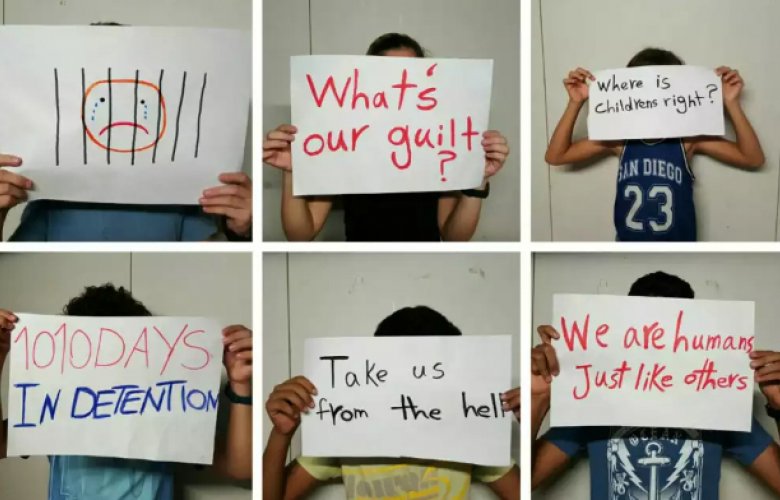
‘It is clear that the Turnbull Government’s policy [on asylum seekers], focused only on deterrence with no feasible pathway to permanent migration in a resettlement country is leaving people desperate and without hope’, said Richard Marles, the same guy who declared that ‘offshore processing has been the single most important policy that any Australian government has made’.

Something about pots and black kettles comes to mind. More significantly, however, such statements mark the tragic reality that it is very difficult to reach any other conclusion than that the moral decadence represented and fed by Australia’s two most supported political parties is a disgrace that can only end in hell, along with all who support such. For what is hell but ‘the suffering of being no longer able to love’ (Father Cosima). Are we there yet? Are we there yet? Are we there yet?

[Image: The Saturday Paper]

Always Being Reformed

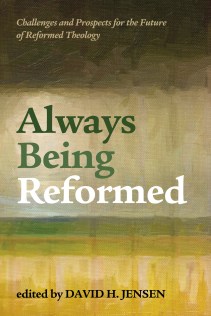
PICKWICK_TemplateA new collection of essays on reformed theology, arising from a wonderful conference hosted by Austin Seminary, has just been published. Always Being Reformed: Challenges and Prospects for the Future of Reformed Theology was edited by David Jensen, who was also a contributor to the volume along with Cynthia Rigby, Carlos Cardoza-Orlandi, Deborah van den Bosch, Henk van den Bosch, Grace Ji-Sun Kim, Lameck Banda, Margit Ernst-Habib, Martha Moore-Keish, Mary Fulkerson, Meehyun Chung, and Bill Greenway. The collection includes a few scribbles from me too.

My essay is titled ‘Semper Reformanda as a Confession of Crisis’. It is unambitious and simple in its three broad aims, each of which earns a section. The first section is an attempt to identify the historical beginnings and theological intentions of the aphorism semper reformanda, and to trace some of the ways in which the commitment to this virtue of the reformed project has evolved. The second, and longest, section asks more specifically about how that commitment relates to reformed patterns of confessing. Principally, what I argue for here is that to confess the faith in the spirit of the semper is to confess that the Christian community is, at core, in a state of crisis. The final section attempts to place on the table one theo-political commitment that might call for reevaluation; namely, how the reformed conceive of their relationship vis-à-vis the modern state. I take it that this section is an implication of the previous one – i.e., an implication of the gospel’s eschatological character and what it means to be a community unsettled, unpredictable, and unreliable when it comes to its relationship with whatever current arrangements might be in place in the world.

I look forward to seeing the book when it arrives, and to revisiting some of the wonderfully-stimulating essays therein.

The conference was memorable in many ways. So was Austin. It was there that I met, for the very first time, a quiscalus quiscula.


Richard Flanagan on Syria’s great exodus

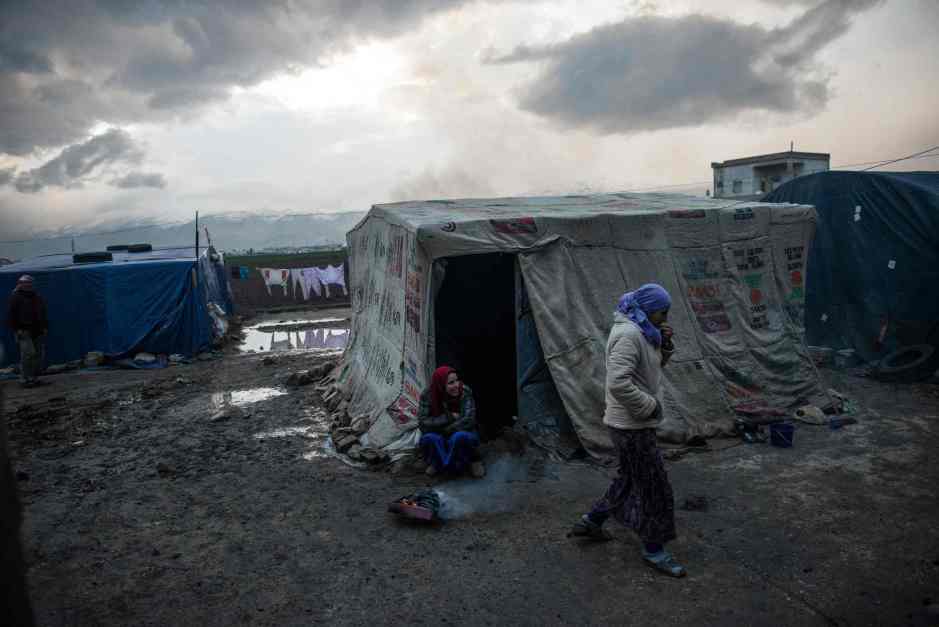
Syrian refugees live in the shell of a bombed-out factory in the Bekaa valley, Lebanon

The CEO of World Vision Australia, the Rev Tim Costello, recently invited Richard Flanagan and Ben Quilty to visit Lebanon, Greece, and Serbia, and so to see (and smell, and taste, and hear … and feel) first hand something of the Syrian refugee crisis. It was a smart move.

Richard wrote up something of that experience for the Guardian. (Apparently, a fuller account is coming. I very much look forward to reading it.) And then earlier this week, he was interviewed by Richard Fidler. The interview is deeply moving, and witnesses to the paradoxes of the human condition – from the deep grace of human hospitality and of hope’s desperate determinations, to our ugliest forms of opportunism, both economic (the story of the life death-jackets was outrageous) and political – the disgrace of using refugees (and other already-vulnerable persons, for that matter) as political bargaining chips rather than leaning unreservedly into fuller implications of the fact that, in Flanagan’s words, ‘that terrible river of the wretched and the damned flowing through Europe is my family. And there is no time in the future in which they might be helped. The only time we have is now’.

You can listen to the interview here.

[Image: Lynsey Addario/Guardian]

Who is Jesus?

This coming semester at Whitley College, I’ll be teaching a unit called Who is Jesus?

Here’s a little about it:

I’m really looking forward to teaching this unit – alongside one on my other favourite JC, Johnny Calvin – and to the insights that emerge as my students and I engage with the following texts, among others:

I. WHO IS CHRIST FOR US TODAY? ON THE QUESTS FOR THE HISTORICAL JESUS

  • Stephen E. Fowl, ‘Reconstructing and Deconstructing the Quest for the Historical Jesus’, Scottish Journal of Theology 42 (1989), 319–33.
  • Thomas P. Rausch, Who is Jesus?: An Introduction to Christology (Collegeville, MN: Liturgical Press, 2003), Chapters 1 and 2.

II. SECOND TESTAMENT CHRISTOLOGY – INTERCHANGE, UNION, AND RESURRECTION: ST PAUL’S APOCALYPTIC CHRIST 

  • Douglas A. Campbell, ‘Christ and the Church in Paul: A “Post-New Perspective” Account’, in Four Views on the Apostle Paul, ed. Michael F. Bird (Grand Rapids, MI: Zondervan, 2012), 113–43.
  • Louis Martyn, ‘The Apocalyptic Gospel in Galatians’. Interpretation 54, no. 3 (July 2000), 246–66. 

III. SECOND TESTAMENT CHRISTOLOGY – PORTRAITS OF BELIEF 

  • Gerald O’Collins, ‘The Jewish Matrix’, in Christology: A Biblical, Historical, and Systematic Study of Jesus, 2nd ed. (Oxford: Oxford University Press, 2009), 21–43.
  • Francis Watson, ‘The Quest for the Real Jesus’, in The Cambridge Companion to Jesus, ed. Markus Bockmuehl (Cambridge: Cambridge University Press, 2001), 156–69.

IV. EARLY SETTLEMENTS ­– I 

  • Gregory of Nazianzus, ‘To Cledonius the Priest against Apollinarius (Ep. CI)’, in A Select Library of Nicene and Post-Nicene Fathers of the Christian Church, Second Series. Volume 7: S. Cyril of Jerusaelm, S. Gregory Nazianzen, ed. Philip Schaff and Henry Wace (Edinburgh/Grand Rapids, MI: T&T Clark/Wm. B. Eerdmans, 1989), 439–43.
  • Irenæus, ‘Against Heresies’, in The Ante-Nicene Fathers: Translations of the Writings of the Fathers down to A.D. 325. Volume I: The Apostolic Fathers – Justin Martyr – Irenæus, ed. Alexander Roberts and James Donaldson (Edinburgh/Grand Rapids, MI: T&T Clark/Wm. B. Eerdmans, 1993), III.16­–22 (pp. 440–55).
  • Tertullian, ‘Against Praxeas; in which he defends, in all essential points, the doctrine of the Holy Trinity’, in The Ante-Nicene Fathers: Translations of the Writings of the Fathers down to A.D. 325. Volume III: Latin Christianity: Its Founder, Tertullian, ed. Alexander Roberts and James Donaldson (Edinburgh/Grand Rapids, MI: T&T Clark/Wm. B. Eerdmans, 1993), Chapters 27–30 (pp. 623–27).

V. EARLY SETTLEMENTS – II

  • Athanasius, Athanasius on the Incarnation: The Treatise De Incarnatione Verbi Dei, trans. The Religious of C. S. M. V., 2nd ed. (London: A. R. Mowbray, 1953), 25–64.

VI. CHRIST IN CELLULOID

  • The film Ordet, directed by Carl Theodor Dreyer.
  • Robert Barron, ‘Christ in Cinema: The Evangelical Power of the Beautiful’, in The Oxford Handbook of Christology, ed. Francesca Aran Murphy (Oxford: Oxford University Press, 2015), 475–87.

VII. THE SAVING GOD

  • Anselm, ‘Why God Became Man’, in Anselm of Canterbury: The Major Works, ed. Brian Davies and G. R. Evans (Oxford: Oxford University Press, 1998), I.xi–xxi, II.iv–xx (pp. 282–307, 317–54).
  • John D. Zizioulas, ‘Biblical Aspects of the Eucharist’, in The Eucharistic Communion and the World, ed. Luke B. Tallon (London: T&T Clark, 2011), 1–38. 

VIII. THE DYING GOD 

  • Eberhard Jüngel, God as the Mystery of the World: On the Foundation of the Theology of the Crucified One in the Dispute between Theism and Atheism, trans. Darrell L. Guder (Edinburgh: T&T Clark, 1983), 343–68.
  • Karl Barth, The Humanity of God, trans. John Newton Thomas and Thomas Wieser (London: Collins, 1961), 37–65. 

IX. THE RESURRECTED AND COMING GOD

  • Hans W. Frei, The Identity of Jesus Christ: The Hermeneutical Bases of Dogmatic Theology, Expanded and updated ed. (Eugene, OR: Cascade Books, 2013), 140–50.
  • Jürgen Moltmann, ‘The Resurrection of Christ: Hope for the World’, in Resurrection Reconsidered, ed. Gavin D’Costa (Oxford: Oneworld, 1996), 73–86.
  • Rowan Williams, Resurrection: Interpreting the Easter Gospel, 2nd ed. (London: Darton, Longman and Todd, 2002), 68–90.

X. GOD IN THE GALLERY 

  • Jeremy Begbie, ‘Christ and the Cultures: Christianity and the Arts’, in The Companion to Christian Doctrine, ed. Colin E. Gunton (Cambridge: Cambridge University Press, 1997), 101–18.
  • Robin M. Jensen, ‘Jesus Up Close’, Christian Century 120, no. 19 (2003), 26–30.
  • Lawrence S. Cunningham, ‘Christ in Art from the Baroque to the Present’, in The Oxford Handbook of Christology, ed. Francesca Aran Murphy (Oxford: Oxford University Press, 2015), 506–16.

XI. CHRIST IN THE CONTEMPORARY WORLD: CONTEXTUAL CHRISTOLOGIES

  • Benjamin Myers, ‘“In his own strange way”: Indigenous Australians and the Church’s Confession’, Uniting Church Studies 16, no. 1 (2010), 39–48.
  • Stuart Piggin, ‘Jesus in Australian History and Culture’, in Mapping the Landscape: Essays in Australian and New Zealand Christianity: Festschrift in Honour of Professor Ian Breward, ed. Susan Emilsen and William W. Emilsen, American University Studies (New York, NY: Peter Lang, 2000), 150–67.
  • The Rainbow Spirit Elders, Rainbow Spirit Theology: Toward an Australian Aboriginal Theology, 2nd ed. (Hindmarsh: ATF Press, 2012), 55–74.
  • Stanley Jedidiah Samartha, ‘Indian Realities and the Wholeness of Christ’, Missiology 10, no. 3 (1982), 301–17.

XII. THE FINALITY OF JESUS CHRIST IN A PLURALIST WORLD?

  • Gavin D’Costa, ‘Christ, the Trinity and Religious Plurality’, in Christian Uniqueness Reconsidered: Myth of Pluralistic Theology of Religions, ed. Gavin D’Costa, Faith Meets Faith (Maryknoll, NY: Orbis Books, 1990), 16–29.
  • John Hick, ‘Christology in an Age of Religious Pluralism’, Journal of Theology for Southern Africa 35 (1981), 4–9.

If you’re keen to know more, it’s not too late to enrol ;-) The unit can be taken at either undergraduate or postgraduate level, as well as online (at UG or PG level) from anywhere the World Wide Web has reached.

Alan P. F. Sell (1935–2016): A Service of Thanksgiving

Dr Karen Sell has asked if I might make public the details below about the thanksgiving service being arranged following the death of Alan Sell:

You are warmly invited to

A Service of Thanksgiving for the Gospel
 on occasion of the death of
 Alan Philip Frederick Sell
 at
 The Church of Christ the Cornerstone
 Saxon Gate
 Milton Keynes
on
 Thursday March 3rd 2016 at 2.15 pm.

Refreshments will follow the Service.

If so wished donations may be sent to
Willen Hospice, Milton Road, Milton Keynes, MK15 9AD.

Alan Philip Frederick Sell (1935–2016): Per Crucem ad Lucem

Alan SellI am grieved to learn (via Kim Fabricius) that my dear friend Alan Sell, who had been quite unwell for some time now, has died. In an email sent to United Reformed Church ministers (current and retired), Helen Lidgett (Synod Clerk, East Midlands Synod) stated:

I am deeply saddened to report the death of Rev Professor Alan Sell. He died peacefully, content, and with great dignity at 9.00 pm on Sunday February 7th in Willen Hospice in Milton Keynes. Details of the Green Burial and Thanksgiving Service will be forwarded shortly.

Our thoughts and prayers are with Alan’s wife, Karen and their family.

Alan’s qualifications were: BA; BD; MA; DD; DLitt; PhD; HonDD; Hon DTh; FSA FRHistS; He was ordained in 1959 and had a very fruitful and world-wide ministry:

1959–1964: Sedbergh & Dent
1964–1968: Hallow, Worcester & Ombersley
1968–1983: Theological Lecturer & Professor in UK
1983–1987: Theological Secretary WARC
1988–1992: Theological Lecturer & Professor in Canada
1992–2001: United Theological College Aberystwyth

In retirement he continued to write and contribute to theological debate, including a valuable contribution to the discussion on the marriage of same sex couples at East Midands Synod in March 2015.

Alan was a good friend, and a wonderful encourager to me. I shall miss him and our frequent correspondences very much. Already, the world certainly feels poorer without him.

In pace requiescat et in amore Alan.

You can read my reviews of some of Alan’s work here:

Living betwixt and between muddle and ambiguity

Royal Cave, Buchan Caves Reserve. © Jason Goroncy, 2016

‘Royal Cave’, Buchan Caves Reserve. © Jason Goroncy, 2016

Over these past days, I have been reminded again that at our best, to be human, and to be human community, is to live betwixt and between muddle and ambiguity. We are, unavoidably, marked by profound inconsistencies and misdirected hopes. We are an enigma – even, and perhaps especially, to ourselves.

A few months ago, the former Archbishop of Canterbury Rowan Williams gave an outstanding lecture on what George Orwell can teach us about the language of terror and war. In that lecture, he drew not only upon Orwell’s work but also upon that of the Trappist monk, poet, and social activist Thomas Merton, and he argued that each in their own way were concerned with the power and the misuse of language. Williams suggested that ‘our current panics about causing “offence” are, at their best and most generous, an acknowledgement of how language can encode and enact power relations’.

Certainly, the spirit of the age in which we live is characterised by efforts to entrench unquestionable power, power that makes unwelcome voices of dissent, and which feels little or no responsibility to those who do not serve its own proximate interests.

According to Williams, our thoughts and wrestles and debates about those questions which really matter for the flourishing of life often expose ‘a deep unwillingness to have things said or shown that might profoundly challenge someone’s starting assumptions. If there is an answer to this curious contemporary neurosis, it is surely not to be found in the silencing of disagreement but rather in the education of speech: how is unwelcome truth to be told in ways that do not humiliate or disable? And the answer to that question is inseparable from learning to argue – from the actual practice of open exchange, in the most literal sense “civil” disagreement, the debate appropriate to citizens who have dignity and liberty to discuss their shared world and its organisation and who are able to learn what their words sound like in the difficult business of staying with such a debate as it unfolds’.

Isn’t that one of the reasons that we place ourselves in communities of faith? I often tell my children that one of the main reasons we go to church is so that we can learn and practice loving people that we don’t really like that much – people who irritate us, people who we find odd and who we’d never be seen dead with otherwise, people who frustrate us and hurt us and disappoint us. We belong to the church because that is how we hope to learn the truth that is required for our being truthful about ourselves and about one another. What is the Christian community if it is not a unique training ground for learning the lessons of being the kind of community that God intends for all humanity – for learning that to be truly human is to belong to and to relate to and to do life with those who are other than ourselves, those whom God has joined together?

And so we eat and drink – not only with friends, but also with strangers, with enemies and with betrayers … and with our own inner demons. For that is the context in which Christ makes himself available to us.

Prayers of a Secular World: a review

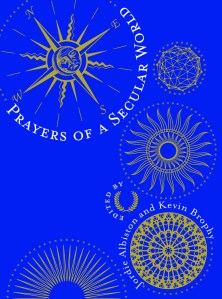
Prayers_FC_HR1Prayers of a Secular World. Edited by Jordie Albiston and Kevin Brophy; introduction by David Tacey. Carlton South: Inkerman & Blunt, 2015. 160pp, ISBN: 978-0-9875401-9-5.

Inkerman and Blunt recently published a new anthology of work, a relatively little book by an impressive range of some 80 mostly Antipodean poets, some very well known, others hardly at all. The collection, Prayers for a Secular World, was edited by Melbourne poets Jordie Albiston and Kevin Brophy, and is introduced, fittingly so, with a brief essay by David Tacey on the religious nature of secularism. The latter helps to orient the reader to some of the terrain they are about to enter.

In their call for submissions, the editors said that they were ‘looking for poems of wonder and celebration, poems that mark the cycle of the day – dawn, midday, evening, night – the seasons, the progression of planets, the evolution of weather; poems of becoming – first steps, first words, transitions, epiphanies and inspirations; poems of belief and of doubt, pleas for protection, poems of remembrance and blessing, of forgiveness and redemption, poems of gratitude’. Short of the sternest editorial policing, such an invitation almost guarantees, more than most edited collections I think, the kind of hotchpotch smorgasbord of aptitude evident in the volume’s final form. Still.

The book’s title – which echoes Donna Ward’s claim, in Australian Love Poems, that ‘poems are prayers of the secular world’ – appears, at first glance, to promote the somewhat late-Victorian idea that poets are the new priests. But the pages therein are marked by a welcome avoidance of such presumption, their words occupied with patterns of time and of place, of dying and of encountering the world anew, and with the sounds of landscapes mostly suburban, where the majority of its readers, no doubt, dwell and pass through. In a review published in The Australian, Geoff Page noted of the title: ‘They are certainly not be [sic] “prayers” in the intercessory sense but they are contemplative and very likely to widen and diversify the metaphysical sensibilities of all but the most hardened of fundamentalists ­– who, no doubt, already have their own (more limited) rewards in view’. This is a point worth repeating, especially perhaps for those uncomfortable, in Tacey’s words, with the notion that ‘the transcendent doesn’t happen elsewhere, apart from the world, but is a dimension of the world’. Still, the publisher’s description of the book as ‘a meditation on living in a post-religious world’ strikes me as very odd – odd not only as a sketch of the book’s content, but also odd in terms of its assessment of things. Observers of the cultural landscape of our day might well enquire what world exactly is being spoken of here.

There is, for many, the perennial temptation to will oneself into a kind of authenticity. Such efforts are an expression of a romanticism that either refuses or forgets to weave into the solidest realities a knowledge of its loss. The result is, as the poet Christian Wiman has observed, a ‘soft nostalgia’. There are here, happily, a good number of notable exceptions to what might otherwise be merely another unwelcome example of such, of groping disorientated by a handful of tamed Emersonian ghosts trying to iron out the highs and lows of life apparently naïve to the view that our being of dust does not equate to an uncritical defence of some pathetic form of natural theology. In this volume, poems by Chris Wallace-Crabbe, Andrew Lansdown, Fiona Wright, Robyn Rowland, Debi Hamilton, Ron Pretty, Anne Elvey, Michelle Cahill, and David Brooks, for example, serve this end particularly well. So do, I think, these two contributions:

‘Da Barri Barri Bullet Train’, by The Diwurruwurru Poetry Club with Mista Phillip

we bin get up with mista an habim gooda one feed
we bin jumpin da mudika
an millad bin go lunga bush
mimi an kukudi bin come too
an dey bin singim kujika
dey bin learnim us mob
for sing im kujika
we likim learn for sing us mob kujika
wen us mob bin lyin down in da darkes
darkest night I bin look da barri barri
e bin movin really really like da bullet train
I bin hold ma mimi really tight
da fire us mob bin make next ta millad mob
poking tongue like a big one king brown
an millad mob listen noise one side na water
must e bin da buffalo drinkin water
den us bin listen da croc bin snap da buffalo
da gnabia out there too
an he bin make us mob so frightn
but ma mimi bin sing out
hey you mob stop all da noise
ma mimi bin start to sing
da song na us mob country
sing in da old language
dem old people did sing
an make millad mob so shiny an strong
an I bin lyin da listen na mimi
I bin feel really really safe
den I musta bin go sleep

And

‘Eucalyptus Regnans’, by Meredi Ortega

for Brandi

that was some fiery trajectory you took, moving to Kinglake
to be among giants and clouds
I recall you dying once before
…….. .. run down at the crossing, going home for lunch

but you’re on Yea oval, among the nightied and discalceate
and you’re okay
road posts gone
all delineators and signs, the way forward and way back
…….. ..only black stags, ash deafening

one charred fence post
and your old weatherboard like a kind of gloating, it falls to you
…….. ..to be the lucky one
better to believe in regnans than luck, they have what it takes
martyrdom, lofty sentiments
…….. ..all crown and nimbus and resurrection

up on the mountain, no one knows if lyrebirds
are mimicking silence
…….. ..volunteers go into the wasteland, leave songs out
musk and fern and siltstone tunes

it rains and then some
…….. ..and the green is giddying
stags wash white, their millioned saplings serry
…….. ..knit roots, squeeze out the other then each other
ashes move up the escarpment and up
to the yellow-raddled cockatoo, yellow-eyed currawong, to the sun
and you are in the very dawn of things
… believing in God’s love

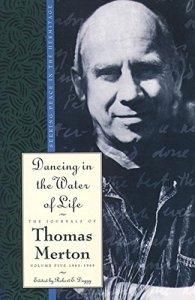
Dancing in the Water of LifeHere’s a wonderful confession from Thomas Merton, which even in its brevity dares to say more than we can really know this side of the dirty mirror:

Automatic and compulsive routines that are simply silly – and I don’t take them seriously. All the singing, the “speaking in tongues,” etc. Funny. I see how easily I could go nuts and don’t especially care. I see the huge flaws in myself and don’t know what to do about them. Die of them eventually, I suppose, what else can I do? I live a flawed and inconsequential life, believing in God’s love. But faith can no longer be naïve and sentimental. I cannot explain things away with it. Need for deeper meditation. I certainly see more clearly where I need to go and how (surprising how my prayer in community had really reached a dead end for years and stayed there – fortunately I could get out to the woods and my spirit could breathe). Still, Gethsemani too has to be fully accepted. My long refusal to fully identify myself with the place is futile (and identifying myself in some forlorn and lonesome way would be worse). It is simply where I am, and the monks are who they are: not monks but people, and the younger ones are more truly people than the old ones, who are also good in their own way, signs of a different kind of excellence that is no longer desirable in its accidentals. The essence is the same.

Renounce accusations and excuses.

– Thomas Merton, Dancing in the Water of Life: Seeking Peace in the Hermitage, ed. Robert E. Daggy, The Journals of Thomas Merton, Volume 5: 1963–1965 (New York, NY: HarperCollins, 1998), 328.

With thanks to Mary Luti for drawing my attention to some of these words.

A little commendation for The Givenness of Things

IMG_3343

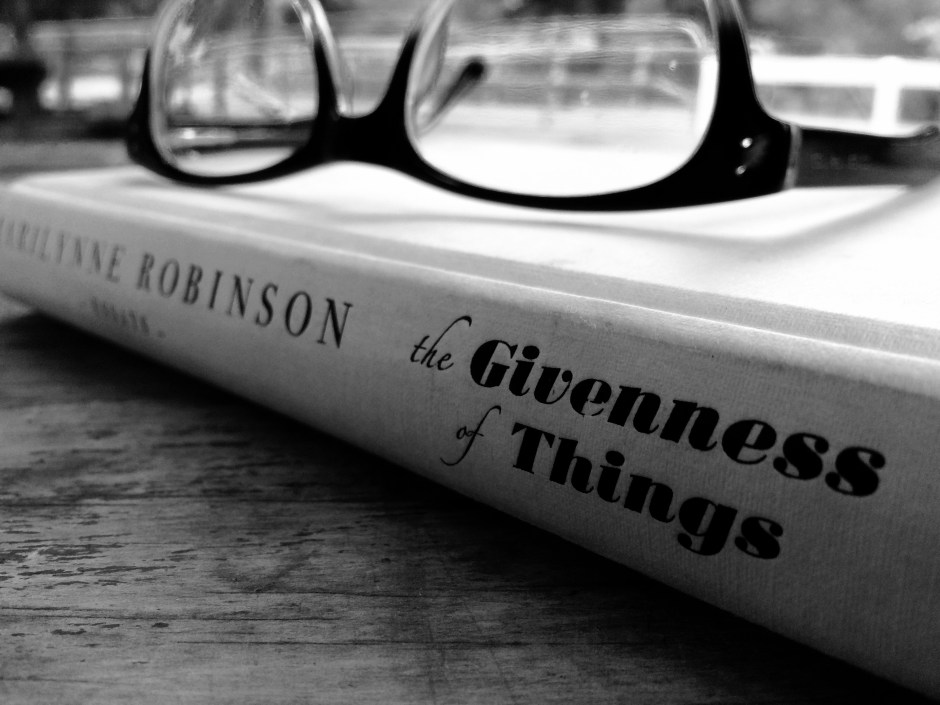
I want to commend Marilynne Robinson’s recent book The Givenness of Things.

The result of this collection of wise and intelligent essays on profoundly human themes, proclivities, and experiences – like poverty, theology, freedom, randomness, fear, fads, greed, faith, science, and alarmism, breathed through with decent doses of Shakespeare, Calvin, Locke, and Saints Matthew and Luke, and marked by a remarkably high christology – is a perspicacious map which assists those of us living in and with Western cultures to read better the signs of the times, and to live better orientated towards those things that will outlast all else. A gift, from one who on her next birthday will be seventy.

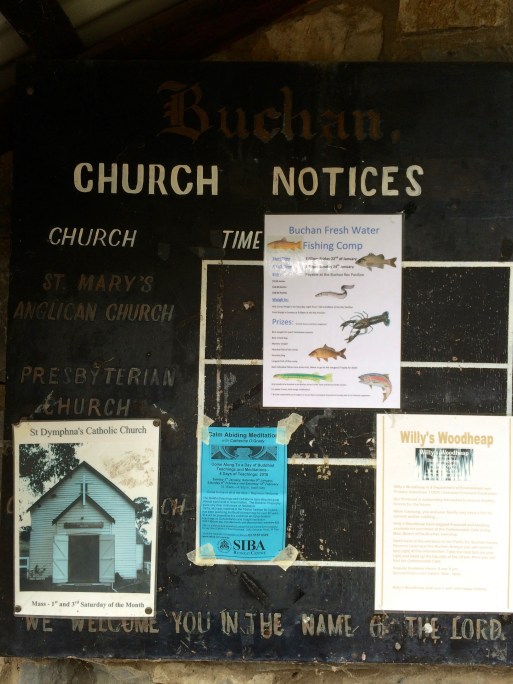
I read large amounts of this book while sitting by two kangaroos – a big one, and a little one. They seemed to enjoy my company as much as I did theirs, and that of this book. And nearby hung this sign, another telling commentary on the state of things:

IMG_3356

Rowan Williams’s lectures on ‘Christ and the Logic of Creation’

Hulsean LecturesRowan Williams has begun delivering his series of public lectures on the subject of ‘Christ and the Logic of Creation’. This series of Hulsean Lectures traverses the following ground:
12 January 2016: A Mediaeval Excursion: Aquinas’s Christology and its aftermath.

19 January 2016: Defining the Problem: from Paul to Augustine.

26 January 2016: Logos and logoi: A Byzantine breakthrough.

2 February 2016: The Last of the Greek Fathers? An unfamiliar Calvin.

9 February 2016: Centres and Margins: Bonhoeffer’s Christ.

16 February 2016: ‘In Whom all Things Cohere’: Christ and the logic of finite being.

And while my attention is turned towards Cambridge, I will also mention Ian McFarland‘s recent Inaugural Lecture. The subject: The Crucial Difference: For a Chalcedonianism without Reserve.

The Eucharist ‘puts an end to every war waged by heavenly and earthly enemies’

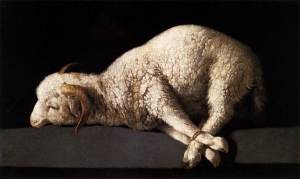
Francisco de Zurbarán, Agnus Dei (1635–40). Prado Museum, Madrid.

Francisco de Zurbarán, Agnus Dei (1635–40). Prado Museum, Madrid.

A good read here from William Cavanaugh. Here’s a snippet:

True sacrifice can never be the immolation of a victim, making the other poor dumb bastard die for his country. True sacrifice is nothing other than the unity of people with one another through the participation in the sacrifice of Jesus Christ. Christ’s sacrifice reverses the idea that one must achieve domination over the enemy to achieve unity. Christ instead takes on the role of victim, absorbs the violence of the world instead of deals it out, and thereby offers a world in which reconciliation rather than violence can hold sway.

This is why the Eucharist is the antidote to war for Augustine. In the Eucharist, the whole economy of scarcity and competition that leads to war is done away with. Augustine makes clear that God does not need to be appeased as the Roman gods do. God is abundance, not lack, so participation in God’s life in the body of Christ does away with competition over scarce goods among people. True sacrifice is unity, and true unity is the participation of the human community in God’s life …

War depends on dividing up the world in such a way that some are excluded from this drama. We prefer to make rigid distinctions between friend and enemy, between our virtue and their depravity. We are thereby licensed to ignore the role our own interventions in their world may have had in stirring up their animosity toward us. When faced with war, we might do better to respond first in a penitential key. At the beginning of World War II, the Catholic Worker newspaper ran a headline: “We Are Responsible for the War in Europe.”

Christians who embrace non-violence are often accused of unrealistically trying to impose a perfectionist ethic on mere sinful human beings. I find it remarkable that travelling to the other side of the world to shoot people is considered somehow everyday and mundane, while refraining is considered impossibly heroic.

The reason we should reject violence is not from a prideful conviction that we are the pure in a world full of evil. The gospel call to non-violence comes from the realization that we are not good enough to use violence, not pure enough to direct history through violent means. Peacemaking requires not extreme heroism, but a humble restraint in identifying enemies, and an everyday commitment to caring for members of one’s body in mundane ways: feeding the hungry, clothing the naked, visiting the sick and imprisoned, all of whom, Jesus says, are Jesus himself.

Christian non-violence imitates Jesus’s nonviolence, but it also participates in Jesus’s self-emptying into sinful humanity, his sharing in the brokenness of the world. It is this peacemaking that we enact in sharing the broken bread of the Eucharist.

Seeking descriptions of baptism in modern literature

Giovanni GuareschiMy friend Alison is compiling a set of 40 short readings for Lent (I’ve posted a few of my own over the years), each of which is about the experience of baptism. She is especially keen to find descriptions of baptism in modern literature. So far, she has readings from Wendell Berry, Sara Miles, Marilynne Robinson, Vincent Donovan, Stanley Hauerwas, Giovanni Guareschi, Martin Luther King, Jr., William Kloefkorn, and others, including some from Dr Luke’s Book of Acts. She is also considering readings from Annie Dillard, Barbara Taylor Brown, Annie Lamott, Langston Hughes and others.

Alison is looking for suggestions for additional readings, particularly those from Indigenous, Asian, or African writers.

So, any suggestions folks?