Pastoral Ministry

On the cost and grace of parish ministry – Part IV

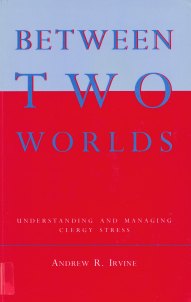
Andrew Irvine’s book Between Two Worlds: Understanding and Managing Clergy Stress (London: Mowbray, 1997) is a helpful study on a number of fronts. As the book’s title suggests, Irvine argues that ‘often behind the “masks” of office hides a person caught in two worlds between the authenticity of personhood and the role and expectation of office’. He asks, ‘With whom can this tension be shared? To whom can the inner doubts, fears and even “sins” be disclosed? Are others, whose masks seem more authentic than ours, invaded by these same realities in their lives?’ (p. xiii). The book examines the personal world of pastors and the factors which contribute to a ‘profession fraught with tension and subject to excess stress’ (p. xiii).

Irvine begins, in the first chapter, by identifying and discussing some of the biblical, historical, societal, and personal factors that shape the foundation for pastoral ministry before turning, in Chapter Two, to discuss both the positive and negative, and internal and external, features of stress. Among the internal features he names ‘success issues’, ‘sexuality’, ‘guilt’, ‘perfectionism’, ‘theological issues’, ‘identity issues’ and ‘authority dynamics’. I found his observations on the last two in this list, in particular, to be the most significant.

Irvine, who completed his PhD dissertation on ‘Isolation and Pastoral Ministry’ (St Andrews, Unpublished, 1984), had already hinted at the magnitude of identity in his Introduction where he noted that often, caught up in the trappings of office, it is the minister who, forgetting his/her own humanity, imposes the stress of non-being. And here he draws on the work of Carl Jung, who in two articles on the ego, warns of ‘the danger of over-identification with the “role” of an office and, in that act, the forgetting of the identity of the total self with all the intrinsic value of the inner person’ (p. xii). Later on, Irvine cites again from Jung’s well-known 1953 essay ‘The Relations Between the Ego and the Unconscious’ (published in Two Essays on Analytical Psychology, Collected Works 7; London: Routledge and Kegan Paul), recalling how, for Jung, an individual can become trapped behind mask of a persona and thereby ‘takes a name, earns a title, represents an office, he is this or that’ (Jung, p. 156, para. 246). In other words, there is the danger of one’s identity becoming to greater or lesser degree ‘synonymous with the “role” of office, from which many cannot escape. In all functions of life, at least those visible to the outside observer, the clergy may be “Reverend So-and-So” or “the minister at Saint James”, the “woman minister from St David’s”, and so on’ (p. 28). In support, Irvine cites from psychiatrist Robert McAllister who, in 1965, penned the following observation:

The clergyman seems to me to be constantly involved in his environment in a way that does not characterize any other profession or vocation. He develops an overworked sense of identity with his clerical role. He cannot be anything but a clergyman at anytime, whether he is on vacation or at work or in the privacy of his room. A physician, a lawyer, a bricklayer, a carpenter … can be something else, can get completely away from his profession or trade.

And Irvine suggests that the problem ‘is even greater for the spouse of the clergyperson who becomes a second-string description, “the husband/wife of the/our minister”’ (p. 28). He continues: ‘All of this raises a multiplicity of questions of identity for the clergy. Not least of these questions is how the individual, that person behind the mask/persona, can find true relationship which nurtures and strengthens. In the loss of personal identity which occurs when relationship is predominantly based on office or role there is the anxiety of unfulfilment and the inner self becomes starved for healthy depth interaction. A false identity is established based on role, where in desperation the individual seeks fulfilment and relationship. Not only is the stress of loss of personal identity great in itself, but it disallows opportunity to alleviate pressure through expression of inner need, desires, doubts and fears’ (p. 28).

On the related-matter of authority dynamics (relating to issues of control and loss), Irvine notes that ‘this is not an easy question to address with clergy, for pietism looks unfavourably on such things in ministry’ (p. 29). He confesses that the desire for power and authority is a part, if not a controlling aspect, of our make-up, and that the milieu of the Church does not guarantee an exception to this. The question of authority – and its loss – is especially pressing, he writes, ‘in a world where more and more people are highly educated’ and where ‘a greater responsibility for decision making is encouraged in the workplace and a more “businesslike” way of doing things has evaded and in some cases replaced the “spiritual” procedures of the past’ (p. 29).

These all constitute what Irvine calls ‘internal features of stress’. The mirror side – the ‘external features of stress’ – are also named: ‘personal space’, ‘societal pressures’, ‘relational dynamics’, ‘colleague dynamics’, ‘vocational demands’, ‘family issues’ and ‘theological issues’. Concerning the latter, I shall say more in later posts. But here I wish to draw attention to what Irvine says about ‘vocational demands’. Irvine notes that it seems as though pastors  are particularly at risk of over-identification with the tasks of ministry which mean that life’s stresses converge with vocational stresses and the all-consuming tasks of ministry. When this occurs, the issues of family, societal demands and other personal requirements intersect and may become ‘overshadowed by the factors of vocation’ (p. 35). He proceeds to identify three separate sets of expectations which serve as a source of conflict: (i) the actual expectations of the faith community; (ii) those that lie within the pastor themselves; and (iii) imaginary expectations.

On the first of these, Irvine notes that the expectations of church communities are both diverse and dependent on those things which have served to shape its membership. ‘In fact, the diversity of expectations is so great’, he suggests, ‘that the task of fulfilling all, in most cases, would be nigh to humanly impossible. Even the more official expectations of the church, those which originate from the appointed boards of the church, originate from those things which have shaped the board/committee and their vision for ministry through that church in that community’ (p. 35).

On the second, namely those expectations that lie within pastoral practitioners themselves, Irvine contends that each pastor will ‘have their own expectation as to what constitutes ministry and the way in which they see their personal gifts for ministry being utilized specifically within that church and community. Again this originates from those factors which have shaped their vision of ministry and probably to a large degree their training and experience’ (p. 35).

The imaginary expectations, the third named, are the ‘assumed expectations that the clergy thinks the church expects of them’. These may, Irvine insists, ‘be based on the comments or insinuations of a few, an isolated occurrence or may be purely illusory. These are often the factors which drive the clergy the hardest and prompt the comment “He/she is his/her own worst enemy”’ (p. 35).

Irvine also suggests that despite the middle-class nature of Christian communities, pastors are ‘often placed in a position of living beneath the level of both parishioners and community’. The continuing tradition of church-provided housing places ministers in ‘a position of having no equity in the real-estate market, often making retirement, and the anxiety of approaching retirement, difficult. The whole monetary aspect of the ministry brings with it considerable difficulty’ (p. 36).

As tempted as I am to do so, I don’t want to précis the entire book here. The remainder of the book, which I commend, attends to the following topics: The stresses that attend a lost and changing identity, the unique stresses that attend being a woman in ministry, the risks that attend various levels of relationship, the problem, types and root causes of isolation, issues of sexuality and identity, of stress in the vicarage and the dynamics that attend family life and needs, the quest for identity and wholeness, issues of integrating perspectives of exteriority and interiority, spiritual development, models and systems of support, and matters of self-assessment and balance.

I do, however, want to draw attention to Irvine’s very basic words on the discipline of journaling, some of which I found helpful, not least because I have recently taken up journaling again after many years of looking at a closed book and of discerning that blogging is no substitute for the practice.

Irvine begins by noting that journaling is an ancient Christian practice – from the apostles who kept records of their journeys, encounters and conversations, to Augustine’s masterful Confessions. Irvine understands journaling as ‘a tool of self-measurement which, when properly used, chronicles for us the place of beginning against which we measure progress and, ultimately, ending. Without this measure, movement becomes indiscernible except in broad terms and predominately external components. For instance, we can recall early years of ministry in terms of major events and movement, but lose much of the sharpness of the cutting edge of our thought which motivated those actions during that time period. So soon we forget the impact of the moment with all its joys and pain’ (p. 192).

And journaling, he insists, helps in other ways too: ‘There is always a discrepancy between what we think we do or have done, and what actually has transpired. For instance I may think I balance my time well on sabbatical between the research, writing, speaking engagements, conference presentations, goal setting with colleagues and the sabbath rest badly needed. My journal records soon revealed that my tendency towards being a workaholic has short-changed the sabbath rest and that there is need for readjustment’. Journaling can, therefore, be both ‘brutally revealing’ and ‘absolutely essential’. He continues:

Journal keeping also records significant thoughts, emotions and reactions as one interacts with the diversity of life. Written in the aftermath of such actions it records how one’s life and faith interacted. It is in that interaction within our own lives that depth of understanding comes, enabling us to provide care and concern for others. It is the record of our journey, common with all humanity, which allows the empathy to interface with the lives of others. (p. 193)

Irvine then offers some advice pertaining to setting up a journal. He talks – against the advice of some spiritual directors – about making journal keeping ‘a habit’, of seeing journaling as part of a daily spiritual exercise, and of keeping it simple: ‘Simplicity and a process that is user-friendly is the key to sustaining a journal. For the computer literate such records can be recorded and stored by that means. The more traditional method of utilizing a notebook works for some while for others the ease of writing on a computer and the tangible form of the hardcopy has led to the use of ringbinders for computer print-offs. Whatever works for the individual is best’ (p. 194). For what it’s worth, there’s no way that I could journal on a computer. I need paper, heavy paper, and preferably a fountain pen and/or a 4B pencil.

Whatever the process used, Irvine properly notes that confidentiality and security remain essential, and he also addresses the question of the final disposal of the journal, whether before or after one’s death: ‘each person will need to determine their own process for this. Some have commissioned a trusted friend to dispose of the documents in the case of death while others have recorded their request in a will along with all other dispersal of property. This is personal, but needs to be considered’ (p. 194).

Irvine also encourages that rather than keeping a ‘general journal’ that each time period be considered in the light of certain guided questions which, he believes, will ‘assist in identifying the matter of balance in each time period’ (p. 194). Similarly, he notes, specific sections of the journal may be kept for theological insights, biblical reflections, goal setting or any such area as is deemed helpful by the recorder: ‘The journal will contain both the record of the task of ministry and the personal journey of the individual. It should be remembered here that the assessment is of balance and a sense of wholeness of being. The record of doing is important, but equally so is the record of reflection and inner discovery’ (p. 194).

I confess to finding this stocktaking approach to journaling brutally sterile and promoting of a form of individualistic and anthropocentric navel-gazing that is, among other things, bad for the back, and I find myself reaching for the trump card that Irvine himself provides; namely, ‘Whatever works for the individual is best’. But Irvine offers the following framework as a guide, and that birthed from much experience, and so I reproduce it here by way of encouragement to those for whom such a template may be more inspiring:

Daily Journal

(Record under separate headings)

[1] What occupied most of your time today?

[2] What is/was your predominant feeling as the day came to a close?

[3] What provided you with the greatest sense of satisfaction?

[4] What was the greatest source of frustration/anxiety?

[5] Describe time spent with family and in personal relationships.

[6] Did you find time for your own personal space for relaxation, exercise and rest?

[7] What challenged your thinking?

[8] What was your source of spiritual renewal today?

[9] Other comments or observations on the day:

Weekly Journal

(Record a short weekly review at the end of each week)

[1] What seem to be the predominant factors/issues of the week?

[2] What, upon reflection, was the greatest accomplishment of the week?

[3] What provided the greatest sense of frustration?

[4] What building did you do during the week of relationships with family, friends and others?

[5] What spiritual renewal/strength did you receive during the week and from what source did this come?

[6] What stewardship was exercised over your physical being?

[7] Were there aspect(s) of your life neglected during the week? If so, which? Why?

[8] Other comments or observations on the week:

Monthly Summary

Using the weekly summaries for reflection, complete a short monthly review using the guide questions as outlined under the heading for Weekly Journal.

I conclude this post with Kafka: ‘I won’t give up the diary again. I must hold on here, it is the only place I can’. [Franz Kafka, I Am a Memory Come Alive: Autobiographical Writings (ed. Nahum Norbert Glatzer; New York: Schocken Books, 1974), 21]

◊◊◊

Other posts in this series:

On the cost and grace of parish ministry – Part III

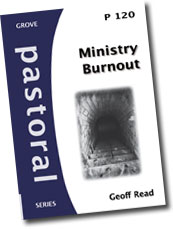
Mistaken attitudes to the issue surrounding clergy burnout are not helped by the frequent interchangability of the terms ‘burnout’ and ‘stress’. While related phenomena, burnout and stress describe different realities. In his wee booklet Ministry Burnout (Grove Books, 2009), Geoff Read makes the point that ‘stress is essentially the physiological or psychological response to many different sorts of situations and demands … Burnout is one response to sustained exposure to certain sorts of stressors. A person reaches a state of burnout when the three factors of emotional exhaustion, detachment and sense of lack of achievement have reached a level of such severity that the person’s ability to function is significantly impaired’ (p. 6).

I was encouraged to see Read here drawing upon work undertaken by Leslie Francis whose own research in the area of psychological health and professional burnout has yielded very important findings. Francis’ research suggests that personality is the strongest predictor of burnout; that ‘personality factors provide a better prediction of burnout than personal, contextual, family or ministry factors raise important questions for selection, formation and support of those called to ordained ministry’ (p. 20). Two studies conducted in 2004 among Anglican and Roman Catholic ministers highlighted ‘the centrality of extraversion and of neuroticism in predicting clergy susceptibility to burnout … Put crudely, neurotic introverts are much more likely to become victims of burnout than stable extroverts, and this holds true across a range of different ministry contexts’. (Leslie Francis and D.W. Turton. ‘Recognizing and Understanding Burnout Among Clergy: A Perspective from Empirical Theology’, in Building Bridges Over Troubled Waters: Enhancing Pastoral Care and Guidance. Edited by David Herl and Mark L. Berman. Lima: Wyndham Hall, 2004, 315). Francis also co-authored (with Rodger Charlton, Jenny Rolph, Paul Rolph, and Mandy Robbins) the report ‘Clergy Work-Related Psychological Health: Listening to the Ministers of Word and Sacrament within the United Reformed Church in England’, published in Pastoral Psychology 58/2 (2009): 133–149. The report was the first ever published study of work-related psychological health of United Reformed Church (URC) ministers, and drew upon conversations with 58 URC ministers serving in the West Midland Synod. The report drew a number of noteworthy conclusions:

  1. Those surveyed are ‘aware of suffering from high levels of negative affect and who yet succeed in deriving high levels of satisfaction from their ministry. A responsible Church should not, however, allow the high level of positive affect acknowledged by the ministers to mask the deleterious effects of high levels of negative affect. The problems of high levels of negative affect, poor work-related psychological health and professional burnout among ministers of word and sacrament within the United Reformed Church are too serious to be ignored’.
  2. Although there are clearly many areas in common between the experiences of URC ministers and those serving in other denominations in England, there may be some areas of stress that are being highlighted in distinctive ways by URC ministers. ‘These areas included the pressures generated by serving in a denomination which has experienced significant decline both in membership and in ordained ministers, but which has not reduced its number of churches in comparable ways. Ministers are serving multiple churches characterised by dwindling and ageing congregations. There is a feeling of uncertainty in the air regarding the long-term sustainability of the United Reformed Church and such uncertainty is bad for the morale of ministers’.
  3. Overall, ministers have low expectations regarding the ability of the URC to support their needs and to protect their work-related psychological health. ‘Such low expectations may or may not be an accurate reflection of the real state of things, but it is nonetheless a worrying reflection on how the denomination itself addresses the psychological health needs of its ministers’.
  4. Overall, ministers welcomed the survey, and ‘saw it as a positive sign that the wider Church was concerned about and committed to addressing the issues of clergy stress, professional burnout and poor work-related psychological health among ministers. Awareness of these issues, the ministers argued, needs to be urgently raised throughout the Church as a whole’.

But back to Read. Read writes about the need for clarity around ministry roles, and the need for pastors to be able to answer the vocational question, ‘Why do I do what I do?’ That this question is taken seriously is essential, he insists, for being able to make meaningful decisions about the use of time in the how and what of ministry. ‘It empowers clergy to shift from a reactive ministry, driven by the expectations and demands of others, to one that is proactive, intentional and driven by conviction’ (p. 16). And he names three areas which merit particular attention in relation to burnout: the now-but-not-yet gap between the ontological and eschatological realities in which we live and life as it is experienced in the here and now; living with conflict and criticism; and the ambiguity of role.

One thing that I really appreciate about Read’s booklet is the stress that he places upon the question of our identity in Christ. Drawing upon Henri Nouwen’s The Return of the Prodigal Son, and Wendell Freist’s article ‘Understanding and Prevention of Missionary Burnout’ (Taiwan Mission Quarterly, 1992), Read argues that while the question of our identity in Christ is one which all Christians share, ‘the representative dimension of priesthood and profile of other “professional Christians” does mean that any deficits will be under particular and sustained pressure’ (p. 13). He points to the way that Jesus’ own ministry began as ‘highly significant and instructive’ insofar as it followed the pattern of identity, vocation and only then ministry, and suggests that ‘without a clear sense of identity and purpose, clergy are subject to the stress of either the chronic effort to fulfil [others’] expectations – acting like a plate spinner dashing to keep numerous plates in the air – or living with the chronic pain of never truly being themselves – like a left-handed person forced to write with the right hand’ (pp. 13–4). He continues:

In his work on burnout originally addressed to OMF missionaries, Dr Wendell Friest describes two distinct missionary types. Type A is characterized by a sense of self worth and self-acceptance based on achievement. Type B finds identity in giving and meeting the needs of others. Both lead to driven lives that Friest characterizes as achievement fatigue (Type A) and compassion fatigue (Type B). Like Nouwen, Friest believes that reconnecting with the freedom that is rooted in our identity in Christ is a crucial resource for the Christian in combating burnout, for both Type A and B temperaments. This involves not just the theological but also experiential movement from slave to sin, to son/daughter of God, and then on to a freely chosen slavery or servanthood.

The heart of the good news is the restoration of God the Father’s original purposes for his children: the status of sonship rather than slavery (Gal 4.4–7). But, so often, experience lags behind the theological reality and so acceptance and identity can remain rooted in slavery or addiction to achievement or meeting others’ expectations. Burnout can be not only a result of such slavery but also a key opportunity to face this disconnect between what we preach and what we experience. Burnout can become an invitation to connect experientially with the transforming power of grace in terms of our identity. Freedom simply to ‘be’ replaces the drive to have to ‘do’ to prove something (Type A) or assuage the guilt of being unable to fulfil all the needs of others (Type B). This newfound freedom finds expression in ministry, enabling one ‘… to get back into the slave modality without losing the son-daughter modality.’ Friest calls this Slave Modality 2, what I prefer to call servanthood. In Christ we see this voluntary self-emptying as described in Philippians 2.5–11. Paul’s prized status as ‘slave’ (1 Cor 9.19) is one he freely adopts. It is clear from Romans 12.1 that this is a voluntary decision on the part of the individual, a free response to God’s merciful adoption of us as sons and daughters.

Friest comments, ‘If we are slaves to God unwillingly because we feel this is God’s demand, something he has imposed or exacted, there will never be joy in our lives – only complaining (maybe repressed), resentment, and bitterness … [But] in being both a child of God and a slave of God we are identifying with Jesus. We are free “to be abased, and … to abound” (Phil 4.12).’ We can enjoy life without guilt, and we can serve without drivenness or compulsion, and without a need for achievement or recognition.

Both models of identity also invite conscious reconnecting with the one who calls and, prior to that, who simply loves us. This is a spirituality that is relational, about me as me rather than just me as a minister. What is my God like? Have I unconsciously distorted my perception of him too? Is there a disconnect between the God of grace I say I believe in and proclaim and the image of him that I actually live and take into my vocation and on into my functioning in ministry? Allowing God to be God to us enables a growing experience of one’s identity in Christ to re-emerge. This is rooted in grace and unconditional love rather than just existing with an identity dependent on performance and the opinion of others. (pp. 15–6)

_____

Other posts in this series:

On the cost and grace of parish ministry – Part II

Earlier this decade, Peter Kaldor and Rod Bullpitt wrote Burnout in Church Leaders (Adelaide: Openbook Publishers, 2001), The book drew upon, and sought to collate and comment upon, Australian findings gathered in the 1996 National Church Life Survey (the NCLS was completed by around 4,400 senior ministers/pastors/priests in around 25 denominations) and the then-named Catholic Church Life Survey (the 1996 CCLS sampled 256 parish priest and 97 assistant parish priests). They record that while variations in levels of burnout exist, burnout is ‘clearly a significant issue for the churches at large’. They noted that higher than average burnout scores were recorded for church leaders serving in Anglican, Reformed, Lutheran, Presbyterian, Church of the Nazarene, Roman Catholic and the Salvation Army; and that there were (surprisingly) lower than average burnout scores among Pentecostal denominations, and some smaller denominations, including the Wesleyan and Brethren churches. They note: ‘Such a result may surprise some, given the high stress that can be associated with large and growing churches, which are more common in the Pentecostal denominations. This is where a distinction between positive and negative stress may be important. The pressures of work in congregations that feel they are going somewhere may generate stress that is positive and energising, rather than negative and leading to burnout’ (p. 13). They also note that younger leaders are more susceptible to burnout (p. 13), and that it is, apparently, ‘more stressful to be a charismatic minister in a non-Pentecostal denomination that it is to a pastor in a Pentecostal denomination’ (p. 16).

Kaldor and Bullpitt conclude that, overall, the average burnout score for Protestant church leaders was 38.5%; Catholic parish priests participating in the CCLS averaged 39.4%. They also draw attention to findings from the Alban Institute Burnout Inventory (AIBI) which measures the levels of risk for stress and burnout among church leaders. These are:

  • 56%        Borderline to burnout (for the record, I polled in this category)
  • 21%        Not an issue
  • 19%        Burnout is an issue
  • 4%          Extreme burnout

This suggests, as they note, that for at least 23% of all Protestant church leaders, burnout is a major issue. In addition, a further half are potential candidates for burnout. The figures are similar for Catholic priests, for whom around 27% burnout is a major issue while a further 52% are potential candidates for burnou

Kaldor and Bullpitt also highlight that while one may raise some questions about the applicability of the Alban Institute classification for the Australian context, the results are confirmed by other questions in the NCLS. Around 11% of Protestant/Pentecostal church leaders and 9% of Roman Catholic leaders agree or strongly agree that they often do not feel they are the right person for the job in their particular congregation or parish. Such people have significantly higher levels of burnout, scoring around 50 on the AIBI, compared to an average of 38, placing them firmly at the high burnout end of the spectrum. Moreover, something in the order of 12% of Protestant leaders and 8% of Roman Catholic leaders say they ‘often’ think of leaving the ministry and an identical percentage (12%) from both groups diagnose themselves as having high or very high levels of stress. The results of the survey show that more clergy place themselves at the high end of the stress scale than at the low end, and that clergy recognise in themselves the seeds of a problem.

Kaldor and Bullpitt proceed to note that this is ‘not just an issue for paid leaders’, but is also a ‘critical issue’ for the church at large. While the remainder of their study (which I commend) goes on to address in greater detail some of the reasons behind this ‘critical issue’, they conclude the opening chapter with these words:

‘It would seem that a significant number of senior ministers/pastors/priests in Anglican and Protestant congregations in Australia are suffering severe burnout and are at risk of leaving the ministry.

The figures from Catholic priests participating in the CCLS suggest similar levels of burnout to their non-Catholic counterparts.

These results may well constitute the tip of the iceberg for the churches in this country. It is quite likely that they understate levels of burnout. There is always some measure of error in self-reporting, and clergy may underestimate their levels of stress out of a desire to be seen (to others or to themselves) as competent in their roles. This is certainly the perception of those who are responsible for caring for church leaders.

In addition, these results are for people currently exercising senior leadership within congregations and parishes across Australia. It does not include those who are no longer in congregational/parish ministry, fulfilling other tasks in the churches or working in quite different fields. It does not include the many people who have moved out of full-time ministry altogether, possibly as a result of burnout.

Rowland Croucher and John Mark Ministries claim that there are possibly as many as 10,000 people who have left full-time ordained congregational ministry across Australia, a similar number to the number serving in congregations across all denominations. In their survey of ex-pastors, they found 40% either not worshipping anywhere or not using their ministry gifts in any way with a congregation or parish … While there are many reasons for leaving the ministry, it is clear that stress and burnout are responsible for a significant number of casualties’. (pp. 11–12)

_____

Other posts in this series:

On the cost and grace of parish ministry – Part I

‘The pastoral vocation is to help people grow spiritually, resist their lowest impulses and adopt higher, more compassionate ways. But churchgoers increasingly want pastors to soothe and entertain them. It’s apparent in the theater-style seating and giant projection screens in churches and in mission trips that involve more sightseeing than listening to the local people.

As a result, pastors are constantly forced to choose, as they work through congregants’ daily wish lists in their e-mail and voice mail, between paths of personal integrity and those that portend greater job security. As religion becomes a consumer experience, the clergy become more unhappy and unhealthy’. – G. Jeffrey MacDonald, ‘Congregations Gone Wild’.

As one charged with both a responsibility for the training and supervision of pastors, and who has himself crashed – and watched many colleagues crash – against the rocks of burnout and depression, this is a topic of particular interest to me. To be sure, I am no expert on these issues, but I thought that I might use this forum to do some tentative thinking out loud about this topic over coming months. [Recent weeks have seen some attention in the media and around blogdom given to the matter of clergy burnout: see, for example, here, here, here, here, here, here, here, here, here, here and here. This is, of course, no new news to clergy, though others seems to be interested.]

As sobering as much of the reading and statistics are, on their own they are more paralysing than aiding. Still, they do point to part of the story, and so are worth recalling. So, for example, consider the conclusions found in the USA and published recently by Pastoral Care Inc., namely that:

  • 90% of the pastors report working between 55 to 75 hours per week.
  • 80% believe pastoral ministry has negatively affected their families. Many pastor’s children do not attend church now because of what the church has done to their parents.
  • 95% of pastors do not regularly pray with their spouses.
  • 33% state that being in the ministry is an outright hazard to their family.
  • 75% report significant stress-related crisis at least once in their ministry.
  • 90% feel they are inadequately trained to cope with the ministry demands.
  • 80% of pastors and 84% of their spouses feel unqualified and discouraged as role of pastors.
  • 90% of pastors said the ministry was completely different than what they thought it would be like before they entered the ministry.
  • 50% feel unable to meet the demands of the job.
  • 70% of pastors constantly fight depression.
  • 70% say they have a lower self-image now than when they first started.
  • 70% do not have someone they consider a close friend.
  • 40% report serious conflict with a parishioner at least once a month.
  • 33% confess having involved in inappropriate sexual behavior with someone in the church.
  • 50% of pastors feel so discouraged that they would leave the ministry if they could, but have no other way of making a living.
  • 70% of pastors feel grossly underpaid.
  • 50% of the ministers starting out will not last 5 years.
  • 10% of ministers will actually retire as a minister in some form.
  • 94% of clergy families feel the pressures of the pastor’s ministry.
  • 80% of spouses feel the pastor is overworked.
  • 80% spouses feel left out and underappreciated by church members.
  • 80% of pastors’ spouses wish their spouse would choose a different profession.
  • 66% of church members expect a minister and family to live at a higher moral standard than themselves.
  • The profession of ‘Pastor’ is near the bottom of a survey of the most-respected professions, just above ‘car salesman’.
  • 4,000 new churches begin each year and 7,000 churches close.
  • Over 1,700 pastors left the ministry every month last year.
  • Over 1,300 pastors were terminated by the local church each month, many without cause.
  • Over 3,500 people a day left the church last year.
  • Many denominations report an “empty pulpit crisis”. They cannot find ministers willing to fill positions.

And the #1 reason listed in that survey for why pastors leave the ministry was that ‘Church people are not willing to go the same direction and goal of the pastor. Pastor’s believe God wants them to go in one direction but the people are not willing to follow or change’. Perhaps this reflects MacDonald’s statement above.

[NB: Pastoral Care Inc. attribute these figures to research carried out by themselves, by The Fuller Institute and by George Barna. Mick Crowl has rightly, to my mind, flagged some concern about the accuracy of these statistics. Still, their general tone is confirmed in other findings.]

And Anne Jackson, in her recently published Mad Church Disease: Overcoming the Burnout Epidemic (pp. 48–9), lists the following (sobering) figures on (US) clergy health:

  • 71 percent of all ministers admitted to being overweight by an average of 32.1 pounds [14.59 kg]. One-third of all ministers were overweight by at least 25 pounds [11.36 kg], including 15 percent who were overweight by 50 pounds [22.73 kg] or more.
  • Two-thirds of all pastors skip a meal at least one day a week, and 39 percent skip meals three or more days a week.
  • 83 percent eat food once a week that they know they know they shouldn’t because it is unhealthy, including 41 percent who do this three or more days a week.
  • 88 percent eat fast food at least one day a week, and 33 percent eat fast food three or more days a week.
  • 50 percent get the recommended minimum amount of exercise (30 minutes per day, three times a week); 28 percent don’t exercise at all.
  • Four out of ten ministers (approximately 39 percent) reported digestive problems once a week, with 14 percent having chronic digestive problems (three days per week).
  • 87 percent don’t get enough sleep at least once a week, with almost half (47 percent) getting less sleep than they need at least three nights a week. Only 16 percent regularly get the recommendation of eight hours or more per night.
  • 52 percent experience physical symptoms of stress at least once a week, and nearly one out of four experiences physical symptoms three or more times a week.

I am not interested here to engage with the details of these statistics. To be sure, they indicate important and painful realties for many pastors, their partners and their children. I am interested here, however, in thinking more generally about this prevalent reality, and to exploring some theological and other resources that witness to more life-giving ways for pastors … and for the rest of us.

_______

Other posts in this series:

On resisting the chaotic non-conformity of private, virtuoso theologies

‘Throughout the history of the Reformed tradition, the central place both for the ongoing hermeneutic process urged in the confessions, and for the general influence of the confessions in the Church, has been the pastoral office through preaching, teaching, oversight, and leadership. Correspondingly, it is chiefly the minister of the word, among the other ordained ministries, who is held accountable in the constitutional questions for following the leading and guidance of the confessions of faith. Appropriately, theological education was in the past structured by the theology of the confessions. Rather strongly, thus, I wish to remind those of us that find our calling in theological education that it is scandalous for a faculty member in any discipline in the church’s seminaries not to be able to locate his or her work and thought and teaching matter with relation to the confessional teachings. We do not want again the old teaching oath, or any teaching oath at all, and the inevitably stifling conformity it promotes. But neither do we want the On resistsing that leave the relation of thought to life in the empirical church to the improvisation of individual ministers. Further, theological education carried out in programs of continuing education or presbytery projects of many types, should be oriented by a reasonable awareness of what the Church teaches in its confessional and creedal literature.

More broadly, it is the educational ministry of the Church on all levels that should bear the chief responsibility for a confessionally rooted hermeneutic, worship, and mission. The idiom of the tradition, whether in words or ethic, needs to be exercised in spiritual, biblical, theological, and ethical education.

It would be well, we often think, if one might be just a Christian, and not a Presbyterian, Catholic, or Methodist. But so, it might seem, is the case with language. What if we could avoid German or English and just speak language? But it doesn’t work. Esperanto is a wonderful idea, but like Basic English a few years back, it is bereft of the richness of meaning and naturalness of a true language. So a theological Esperanto, or ecumenical Esperanto—for the time being at least—leaves us far from the concrete reality in which we live and speak. The idiom of the Reformed tradition, when fully understood, is the ground and motive both for ecumenical awareness and progress, and for other kinds of reform and advance. Not abandonment, but reform, as new light breaks forth from Scripture and illuminates new situations in our culture and environment and in the world Church, is the promising idiom of our tradition’. – Edward A. Dowey Jr., ‘Confessional Documents as Reformed Hermeneutic’, Journal of Presbyterian History 79, no. 1 (2001), 58.

The Floyd Theses on Interim Ministry

Rick Floyd has posted a wonderfully-provocative and long-overdue discussion starter on ‘interim’ ministry. It begs reposting:

1. The chief purpose of long interim ministries is to provide a regular supply of jobs for ministers who are unwilling or unable to take a settled pastorate.  This is not a good thing.  Although a good interim minister can be a gift to a congregation, he or she is no substitute for a settled pastor.  Interims work to contract, they often don’t live in the communities they serve, and they are not going to stay.  It is a different kind of ministry, and the longer a church has an interim minister the longer it is deprived of the covenantal relationship that comes with having a called and settled minister.

2. During my 30 years in the ministry the length of interim ministries has expanded from a few months to two or three years (or more.) Meanwhile settled ministries are getting shorter, so the only difference seems to be less accountability on the part of the interim minister. Many seem to prefer it that way.

3. Interim ministers were once typically retired experienced pastors who preached, did pastoral care, and kept a light hand on the organization while the congregation sought a new settled pastor.

4. Today, interim ministers lead elaborate congregational self-studies, change the structures, rewrite the by-laws, and generally move the furniture around in ways that were once considered to be the job of a settled leader.

5. The reason that the extended length and the frenetic re-shuffling of interim ministry is justified as necessary is because the leave-taking of a pastor is considered to be such a trauma that only expert interim leadership can help the congregation heal from it and prepare for new leadership. It is true that there are such traumatic situations, such the death of a pastor, cases of clergy abuse or misconduct, or where there has been profound conflict. These situations may well call for extended interims. But the new model for interim ministry assumes that every transition needs such a long and intense interim. They do not. Why then are all interims expected to be so long? See #1.

6. The model for much interim ministry is a family system model where congregations are seen as dysfunctional systems and the former pastor (actually called the BFP “beloved former pastor” in some interim training) is seen as the problem. Sometimes this is true. Usually it is not, but the one-size-fits all template is demeaning to former pastors who have served faithfully. One must wonder if it can be possible that every pastor’s predecessor was incompetent, lazy, controlling or evil.

7. Long interims frequently dissipate the momentum of many church programs, make the congregation feel adrift, lose the allegiance of many long-term members, and often leave the new settled pastor with a much-diminished congregation. This scorched-earth policy allows for little continuity between pastorates, and means the new pastor often must “re-invent the wheel” in a new setting.

8. Interim ministers have their own networks, and often work outside the existing judicatory processes. They can and often do function as a free-floating class of paladins for hire that raises fundamental questions about the meaning of ordination and the accountability of the ordained.  Ordaining someone to interim ministry is a (new) practice that needs serious scrutiny.

9. Because the models of interim ministry are derived largely from psycho-social systems theory and/or corporate management models they have little regard for the church’s own grammar of how to be church. These interim models are very thin on the ground when it comes to theology. This mirrors a general trend in ministry toward professional identity over the ancient churchly arts of soul-craft and ministry of the Word of God.

10. Lay persons in leadership during a time of pastoral transition are well-advised to carefully query potential interim ministers about their model of interim ministry. Question the assumption that every church needs a two or three year interim. Maybe you do, but ask why? Ask if the interim is planning on doing a lot of restructuring, and if so, why? The congregation should decide what it needs from an interim, and not hire an interim to tell it what it needs from him or her. An interim is just that, an interim who gets you through a period to allow the “search and call” process to take place. The rule of an interim should be like a doctor: “Do no harm.” A good interim will leave a small footprint.

Hauerwas on Christian Ministry and Speaking Christian

‘God knows what possesses anyone to enter the ministry in our day. The lack of clarity about what makes Christians Christian, what makes the church the church, and continuing ambiguity in our diverse denominations about ordination itself should surely make anyone think twice about becoming a minister. Moreover the lack of consensus about what it might mean for anyone to act with authority in our society and the church cannot help but make those of us who are not ministers wonder about the psychological health of those who tell us they are called to the ministry.

Too often I fear the ministry is understood by many Christians as well as many who become ministers, to be but one expression of the more general category of something called a “helping profession.” A minister is a social worker with “a difference.” “The difference” is thought to have something to do with God, but it is not clear exactly what difference that difference is to make for the performance of your office.

As a result many who enter the ministry discover after a few years of doing the best they can to meet the expectations of those they serve— expectations such as whatever else you may do you should always be nice—end up feeling as if they have been nibbled to death by ducks. They do so because it is assumed that since pastors do not work for a living those whom the minister serves, or at least those who pay them, can ask the minister to be or do just about anything. Though it is often not clear how what they are asked to do is required by their ordination vows, those in the ministry cannot say “no” because it is not clear what their “job” is in the first place.

Many in the ministry try to protect themselves from the unlimited demands and expectations of their congregations by taking refuge in their families, some alternative ministry such as counseling, or, God help us, a hobby. Such strategies may work for a while, but often those who employ these strategies discover that no spouse can or should love another spouse that much; that even after you have done C.P.E. you are still stuck with the life you had before you were trained in C.P.E.; and a hobby turns out to be just that—a hobby.

The failure of such strategies, I think, throws some light on clergy misconduct. I wish I could attribute the sexual misconduct characteristic of some Methodist clergy to lust, but I fear that most people in the Methodist ministry do not have that much energy. I think the problem is not lust, but loneliness. Isolated by the expectations of the congregation, or the challenge of developing friendships with some in the church without those friendships creating divisions in the church, too often results in a profound loneliness for those in the ministry. Unfortunately, the attempt to overcome that loneliness can take the form of inappropriate behavior.

There is another alternative. You can become a scold urging the church to become more socially active in causes of peace and justice. This may earn you the title of being “prophetic,” but such a strategy may contribute to the incoherence of the ministerial task. For it is not at all clear why you needed to be ordained to pursue causes of peace and justice. It is a great challenge for ministers who would lead their congregations to be more socially active to do so in a manner that does not result in the displacement of worship as the heart of the church.

… what you have learned to do in seminary is read. By learning to read you have learned to speak Christian. That you have learned to read and speak means you have been formed in a manner to avoid the pitfalls I have associated with the contemporary ministry. For I want to suggest to you that one of the essential tasks of those called to the ministry in our day is to be a teacher. In particular, you are called to be a teacher of language. I hope to convince you that if you so understand your task, you will discover that you have your work cut out for you. But that is very good news because you now clearly have something to do.

Yet in the book of James (3:1-5) we are told:

not many of you should become teachers, my brothers and sisters, for you know that we who teach will be judged with greater strictness. For all of us make many mistakes. Anyone who makes no mistakes in speaking is perfect, able to keep the whole body in check with a bridle. If we put bits into the mouths of horses to make them obey us, we guide their whole bodies. Or look at ships: though they are so large that it takes strong winds to drive them, yet they are guided by a very small rudder wherever the will of the pilot directs. So also the tongue is a small member, yet it boasts of great exploits.

The problem, according to James, is no one has found a way to tame the tongue. Because the tongue cannot be tamed it becomes a “restless evil, full of deadly poison.” The tongue is the source of discord because it at once makes it possible to bless the Lord and Father yet curse those who are made in the image of God. That we bless and we curse from the same mouth is but an indication of how dangerous the tongue is for those who have learned God will care for his world through patient suffering.

If James is right, and I certainly think he is, then how can I suggest to you that if you are to serve the church well in the ministry you must become a teacher and, in particular, a teacher of a language called Christian? I do so because I think the characterization of the challenges facing those going into the ministry is the result of the loss of the ability of Christians to speak the language of our faith. The accommodated character of the church is at least partly due to the failure of the clergy to help those they serve know how to speak Christian. To learn to be a Christian, to learn the discipline of the faith, is not just similar to learning another language. It is learning another language.

But to learn another language, to even learn to speak well the language you do not remember learning, is a time-consuming task. You are graduating from seminary, which I assume means that you have begun to learn how to speak as well as teach others how to talk, as we say in Texas, “right.” For as I suggested there is an essential relation between reading and speaking—it is through reading that we learn how to discipline our speech so that we say no more than needs to be said. I like to think that seminaries might be best understood as schools of rhetoric where, as James suggests, our bodies—and the tongue is flesh—are subject to disciplines necessary for the tongue to approach perfection.

That the tongue is flesh is a reminder that speech is, as James suggests, bodily. To speak well, to talk right, requires that our bodies be habituated by the language of the faith. To be so habituated requires constant repetition. Without repetition—and repetition is but another word for the worship of God—we are in danger of losing the grammar of the faith. At least part of your task as those called to the ministry is to help us, as good teachers do, acquire the habits of speech through the right worship of God’.

– Stanley Hauerwas, ‘Speaking Christian: A Commencement Address for Eastern Mennonite Seminary’, The Mennonite Quarterly Review 84 (2010), 441–44.

Around: ‘Love seeketh not itself to please’

‘The Clod and the Pebble’

‘Love seeketh not itself to please,
Nor for itself hath any care,
But for another gives its ease,
And builds a heaven in hell’s despair.’

So sung a little clod of clay,
Trodden with the cattle’s feet,
But a pebble of the brook
Warbled out these metres meet:

‘Love seeketh only Self to please,
To bind another to its delight,
Joys in another’s loss of ease,
And builds a hell in heaven’s despite.’

The Reverend Michael Scott

Tom Arthur asks pastors if they would rather be like Donald Trump or Michael Scott. His own preference, unsurprisingly, is for Michael Scott, and here’s why:

‘I couldn’t put my finger on my preference for Michael Scott over Donald Trump until the most recent episode of “The Office.” Cohesion in the office falls apart as the sales department becomes more important in the company and ends up getting bigger paychecks. All of a sudden money and success come into the story. Michael says that this office breakdown is because they used to “make friends first, make sales second.”

Here’s my leadership takeaway. “The Office” is the kind of place where friendship takes precedence over almost every other goal. When I first started watching I wondered why the characters didn’t just quit and go work someplace else. But then I realized that there is a deep honesty in the show, and honesty leads to commitment. People are who they are, even in all their embarrassing glory, and somehow they keep working together (but do they ever actually do any work?). Somehow Michael Scott holds all these people together amidst their eccentric personalities and crazy dysfunctions.

That’s a different kind of success than the kind that Trump symbolizes, and it’s the kind of success that a pastor should be aiming for. Sometimes successful pastoral leadership looks quite different than what the world calls success. Sometimes it looks like Michael Scott’.

Walking unhampered – and strangely – among the golden lampstands

Last Sunday, Andrew Stock and more than half (around 100) of the Brisbane Destiny Church [whose website has been pulled offline] walked out of church. This is nothing exceptional in itself, not least of all, it would seem, in less sensible denominations. And not a few have interpreted this action as a sign of courage and integrity, applauding Stock as one who at least has ‘the guts to stand up to the Tamaki machine’. Among the many things that I find most disturbing about this story, however, is today’s report that ‘new pastors have [already] been appointed to run Brisbane’s Destiny Church’ (an outcrop of Brian Tamaki’s Destiny Church in New Zealand).

Is this a sign of a ministry which has failed to foster maturity among the members of God’s flock which remain? And/or is this yet another example that bolsters the claim that one of the markers of a cult is an unwillingness – or inability – to be ‘community’ without a ‘dynamic’ personality at the helm, one who has ‘strong leadership qualities and the ability to cast vision’? Possibly, though I’m in no position to really know.

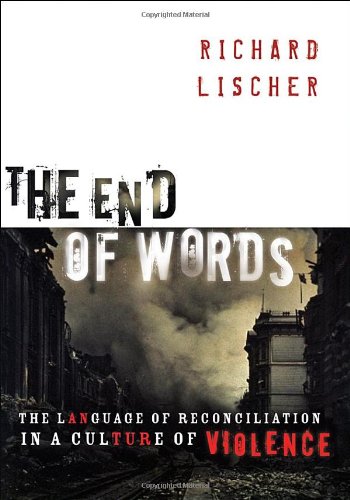
Contrast Destiny’s pastoral search model with something I posted a while back from Richard Lischer about Lutherans:

‘Lutherans fill their vacancies more deliberately than any of the churches in Christendom. Vacant congregations go months without thinking about choosing a new leader, and pastors, once they have received a call, may sit on it for additional months before hatching a decision. The time isn’t used for negotiating more favorable terms; it is simply filled with prayer and dormancy. The President-elect of the United States names a Cabinet faster than the smallest Lutheran congregation picks a pastor, because Lutherans consider the latter process far more important. All is left to prayer and the brooding of the Spirit, and everyone knows the Spirit always works slowly’. – Richard Lischer, Open Secrets: A Memoir of Faith and Discovery, 220.

Perhaps it’s a good time to recall some of PT Forsyth’s advice on ‘How To Help Your Minister’.

Either way, it seems that the sovereign Lord still walks unhampered – and strangely – among the golden lampstands …

‘Pastors aren’t Prophets: Some Unsolicited Advice for Newly-Minted Ministers’, by Rick Floyd

Rick Floyd is a seasoned minister and a very astute theologian who has posted a wonderful and wise reflection on pastoral ministry for ‘newly-minted ministers’. I appreciated it so much that I’m going to re-post it here in its entirety. I reckon that there’s wisdom here that needs to be shared.

‘Too many of our new pastors in the mainline church leave the ministry after a few years. There are many reasons why this happens, but for whatever reason, it is not good.  It’s bad for them and bad for the church, and it is bad stewardship to train someone who only serves a short time.

Some of these ministers should never have been ordained in the first place, and the gatekeepers didn’t do their due diligence. Some were lacking the necessary “gifts and graces” for ordained ministry, which doesn’t mean they didn’t have a different and effective ministry in the church.

There are far too many sad situations where a ministry fails for one reason or another, where hopes are shattered, and a young (or not so young) person is saddled with a financially crippling debt for the years in seminary they paid for in loans.

Being a pastor of a church is a hard job.  I was one for thirty years.   Despite the nonsense being promulgated by the “experts,” faithful pastoring is not a matter of working a certain number of hours (or “units” as they are now sometimes called.) It’s a vocation that takes up most of your waking hours,

When a congregant really needs you, it doesn’t matter whether it is your day off. If you asked me how many seasoned pastors are burned out to one degree or another, I would say, “All of them, if they are really doing their job.” That is why pastors need to exercise radical self-care, pray constantly, and accept the fact, that not being yourself God, you cannot do all that is demanded of you.

Now I readily admit that there is some truth to the whole boundary/take care of yourself/take time for yourself movement. But like all partial truths it is not the whole truth.  The church once had a useful word, now much out of favor, for when one piece of the truth gets blown out of proportion.  The word is heresy.

One of the modern heresies (but by no means the only one) of the contemporary mainline church, is that you can have something akin to a normal 40 hour a week professional life and be a faithful pastor.  It isn’t true.  A pastor’s life, and the life of the pastor’s family is necessarily involved in the community of their congregation in season and out of season.  Sometimes, even often, it is wonderful; other times it isn’t.  That’s the way it goes.  It isn’t the Canyon Ranch spa.  I often say being a pastor is the best vocation there is, but perhaps the worst job.  If you are not called to it, it is something you really don’t want to do.

When I started as a pastor thirty-five years ago I was well trained and well educated and didn’t have a clue what I was really supposed to do. I learned quickly. One of the things I learned was that you have to love your congregants, even the unlovable, of which there are far too many, and who take up a good deal of your time.  If and when you find yourself loving them, you know you are on your way to really being a pastor.  Some of them you will just never learn to love, and you have to turn them over to God, who does.

I had been a anti-war and civil rights activist in college and seminary, and had gone to jail for my causes, but when I got into the pastorate I learned very quickly that you can’t be a prophet until you have earned the peoples’ trust. This means years of marrying and burying and sitting by sick beds and in hospital rooms.

If you do this well they may be ready to hear hard truths from the pulpit.  They may not. Certainly Isaiah’s prophecies fell on deaf ears.

New ministers who have grown up in the church have a leg up, because they know its rhythms and customs, it’s “grandeur and misery.”

But today many of our ministerial candidates haven’t grown up in the church. Some of them turn out to be our best ones, but they are at a disadvantage.  They don’t know the church’s music and it’s well-worn liturgies.  They don’t know the joys of a community strawberry festival on a warm spring day, or the energy and agony of a capital-funds campaign to get a  new boiler.

They often come to seminary or divinity school in a process of self-discovery, which is fine. Most of us did that to one degree or another. I recall from seminary that the ones who knew they wanted to be a minster since the age of six were best avoided, and probably needed therapy.

Now seminary is a good place to learn many useful things, like that David didn’t write all (or perhaps any) of the Psalms, that the Scriptures are thick and have a literary history, and that the heresies we see around us are as old as the church.  If one is lucky, you’ll find a mentor or two, and be able to intern in a healthy church who will love you and teach you what it means to be the church.

What seminaries are not good at (because its not really their job) is forming men and women into Christians, much less teach them how to be faithful pastors.  Christian formation is primarily the church’s job, not the schools, although they can help out.

There are many fine teachers and students in these schools, and I don’t want in any way to impugn their integrity or their faith.

At the same time, we are seeing too many newly-minted pastors who come to seminary, not only to find themselves, but with a passion for a social cause or causes, which is fine.  I certainly had mine. In seminary the flame of their passion is often fanned by others who share it, which is also fine.

But if all you know of the faith is what you learn in divinity school you are at a distinct dis-advantage.  And if the main reason you accept a call from a congregation is to promote your passion and cause then your soul is in danger, and so is the life of a congregation.

Because the congregation you go to may or may not share your passions. It can be dangerous either way.

If they agree with most of your views, be they liberal or conservative, the temptation is to self-justification and self-righteousness, and a tendency to see sin and evil as “out there” in your ideological adversaries, and not also in your own heart and soul. Then the great insight expressed by the Reformers’ axiom simul justus et peccator, that we are at the same time justified and sinners, is lost. This danger in the mainline church can exist in some ministers for their entire careers and they will never even now it.

The other temptation is perhaps more dangerous, at least in mainline churches. That is to go to your first congregation where they don’t share your passion for your social cause or causes, and you scold them for it. You do not learn to love them, and they do not learn to love you, and eventually your ministry fails.

Typically we are too polite to ever actually fire anyone (although it does happen), but there are other ways to get you to leave, the best one being to so discourage you that you lose heart and leave. Some, too many, of our new pastors actually seek out this kind of martyrdom, and when they are inevitably cast out, they can then turn and say how stiff-necked and hard-hearted their congregation was. But my sympathy for them is limited. Congregations can be stiff-necked and hard-hearted and even abusive. This is nothing new.  Just go read Exodus or First Corinthians.

But congregations can be also be wonderful, supportive, gracious, and long-suffering, especially if they sense you are really trying to be their faithful pastor.

The late great Bill Coffin, a prophet himself, once told a bunch of us young ministers (about 1972) a story (which my version here will be only a loose approximation) about one of his students from Yale.

The young pastor was in hot water for his deeply prophetic views and fiery pulpit pronouncements on social issues (it was Vietnam time, and the nation was deeply divided.) The lay leaders wanted to fire him. As the discussion heated up, one of them, a banker, prominent member and very conservative, stood up and said, “You can’t fire him, he’s our pastor. It’s true that he’s a real pinko, and I can’t stand most of the stuff he says from the pulpit, but when my wife was dying he came to see her every day. He’s staying.” And he did.  Bill went on to say that if you are a faithful pastor, your flock will give you great freedom to pursue your passions, be it peace and justice work, or collecting butterflies.

A dear rabbi friend of mine who is well up in his eighties told a bunch of us a powerful story last week. He had been an army chaplain in the Korean War, and, perhaps because of that, he was a firm supporter of the Vietnam War. But when our National Guard opened fire and killed some students who were peacefully protesting the war at Kent State University in 1970, he had a change of heart, and he changed his mind. And on the next High Holy Days in the fall, when he preached to the biggest congregation of the year, he apologized to them and asked them to forgive him, admitting that he had been wrong about the war. This story brought tears to my eyes.

He had been their faithful rabbi by then for fifteen years, and he stayed for another dozen or so. The Vietnam War by 1970 was very unpopular, especially here in what until last December was sometimes called by conservatives “The Peoples Republic of Massachusetts.” I am sure that many of his congregants had been hearing sermons they didn’t agree with for some time. But he had earned the right. And when he finally repented publicly, he was indeed a prophet with the full attention of his people. From then on, when he spoke out against the war, he had every ear.

So at the right time and place you can sometimes be both a prophet and a pastor. But you’d better be a pastor to the people first, because that is your primary calling. If you just want to be a prophet, I suggest you go work for a political action organization’.

Andrew Root on (youth) ministry

Andrew Root is the Assistant Professor of Youth and Family Ministry at Luther Seminary in St. Paul, Minnesota. He is also the author of Relationships Unfiltered: Help for Youth Workers, Volunteers, and Parents on Creating Authentic Relationships, Revisiting Relational Youth Ministry: From a Strategy of Influence to a Theology of Incarnation, Children of Divorce, The: The Loss of Family as the Loss of Being, and The Promise of Despair: The Way of the Cross as the Way of the Church.

In this 31 minute video, Andrew explains the difference between influence and place-sharing in youth ministry. What he says pertains to all ministry, not just that related to young people. You can also listen to the talk here.

Want more? You can find more of Andrew here and here. Also

On hospitality

Been thinking lately about how a theology of divine hospitality might better inform – and be informed by – pastoral practice, and then I came across this statement in Wolfgang Vondey’s fascinating book, People of Bread: Rediscovering Ecclesiology (New York: Paulist Press, 2008):

‘The Old Testament presents a harsh condemnation of inhospitable behavior. God’s judgment of Sodom shows that hospitality is not simply a social obligation but also an expression of the personal, moral responsibility of God’s people to others as well as to God. Jerusalem’s unflattering comparison with Sodom reveals not only the consequences of neglecting to offer one’s bread to strangers; it also underlines the effort necessary to engage in deliberate interaction and fellowship with those who are not from among us. Abraham is commissioned to teach his descendents the way of God’s justice and righteousness exhibited in the offer of hospitality and the sharing of companionship with those in need. As descendants of Abraham, the Israelites are called to be a people of bread who extend their companionship to the world.

The repeated emphasis on the “alien” is a fundamental element of the sharing of bread in the Hebrew scriptures. The memory of God’s hospitality in Israel’s experience of the exodus, when the Israelites were aliens in the land of Egypt, proves to be the motivation for Israel’s own extension of hospitality. God showed hospitality to Israel when the people were strangers, aliens, and outcasts. Marginalized and reduced to slavery, the Israelites found that they were no strangers to God. Companionship with God did not remove Israel’s alien status in the land of Egypt. However, God’s display of hospitality provided an environment in which the Israelites could experience companionship with one another and with God in the fellowship of bread.

God’s extension of hospitality allowed Israel to understand the moral failures of their past in a new light. God’s provision of bread invited Israel to participate in the sharing of stories from their past, enjoying the unexpected solidarity and impartiality of the present, and anticipating an unprecedented opportunity for freedom in the future. God’s provision of bread accompanied an even more daring display of hospitality: the deliverance of Israel from a life of exploitation and oppression. The people of bread experienced their God as the ultimate host who delivered them from a life of alienation and elevated them to be God’s chosen nation.

The sharing of bread with the stranger introduces the fellowship (koinonia) of God’s people to the notion of hospitality, a community-building practice performed on the basis of what Alasdair MacIntyre calls the “virtues of acknowledged dependence.” This dependence comes in the form of both the freedom and the responsibilities of companionship. Those who are liberated from their alien existence through God’s companionship are set free to extend God’s hospitality to all those who have remained strangers in the world. The Old Testament makes the experience of marginality and alienation normative for an understanding of hospitality. The extension of hospitality forms a bridge between the host and the guest by removing from their relationship the boundaries that inhibit solidarity and equality. Companionship with the stranger becomes an instrument of liberation, solidarity, and transformation.

Hospitality as a liberating and transforming practice of companionship is always particular, never generic. The relationship between host and guest stands at the forefront of the particular challenge of hospitality. Abraham’s and Lot’s displays of humility to their guests illustrate the attitude and behavior characteristic of the host’s role. Standing at the threshold of his own community, the host rushes out to meet the strangers, extending the realm of his companionship to those he does not know and breaking the sphere of alienation. In honest humility, the host identifies himself as the servant of his guests, offering not a favor but a service to those who are now no longer strangers but masters. In turn, the guests accept the invitation and are liberated from their alien status to participate in the fellowship of bread with those who likewise do not remain strangers but have become companions. Both host and guest forsake their position in their own communities for the sake of companionship. Put differently, the primary motivation for hospitality is the vision to live in a world without strangers.

The ambiguity about the identity of host and guest is a particularly important element in an ethic of hospitality. As John Koenig states, hospitality refers “not to a love of strangers per se but to a delight in the whole host-guest relationship, in the mysterious reversals and gains for all parties that may take place.” The willingness to forsake one’s position in the community for the sake of strangers comes with an uncertain risk attached. This risk lies neither in the host nor the guests themselves but in the community in which the act of hospitality takes place. Defending one’s hospitality to strangers, in the midst of a community that does not participate in the companionship, can make the host a stranger as well. At that point, hospitality comes at a greater cost than companionship. The preservation of hospitality at all costs requires from the very beginning a willingness to forsake one’s social status, community, or class by identifying one’s whole life and being with the fate of the stranger. As Scott H. Moore remarks, “To invite the stranger into one’s home is to make that which is private public and to introduce what is public into the private.” The sharing of bread with the stranger remains the most tangible expression of the commitment to companionship and the execution of righteousness and justice beyond the realm of one’s own community.

The challenge of hospitality as a surrender of oneself is well illustrated in the example of God’s hospitality at the exodus. In the biblical texts, hospitality to strangers is portrayed from the very beginning as a theological relationship mirroring the human companionship with God: hospitality to others is hospitality to God. The bread shared with the stranger is a service directed ultimately to God. John Chrysostom placed particular emphasis on this aspect:

This is hospitality, this is truly to do it for God’s sake. But if you give orders with pride, though you bid him take the first place, it is not hospitality, it is not done for God’s sake. The stranger requires much attendance, much encouragement, and with all this it is difficult for him not to feel abashed; for so delicate is his position, that whilst he receives the favor, he is ashamed. That shame we ought to remove by the most attentive service, and to show by words and actions, that we do not think we are conferring a favor, but receiving one, that we are obliging less than we are obliged.

Chrysostom stressed the idea that the motivation for hospitality among God’s people is born not only out of an identification of oneself with the stranger but also out of an identification of the stranger with God. Hospitality is the challenge to see in the stranger also the presence of God. In other words, the Israelites are asked to share their bread with strangers not because they are a people of bread but because they are the people of God. The freedom of extending one’s companionship to the marginalized and outcasts of society is a gift from God that establishes a testing ground for hospitality in commemoration and imitation of God’s companionship with the world. Hospitality thus becomes a means of both service to the world and worship of God, as we are reminded in this third-century homily:

For if you really wish to worship the image of God, you would do good to humans, and so worship the true image of God in them … If therefore you wish truly to honor the image of God, we declare to you what is true; that you should do good to and pay honor and reverence to everyone, who is made in the image of God. You should minister food to the hungry, drink to the thirsty, clothing to the naked, hospitality to the stranger, and necessary things to the prisoner. That is what will be regarded as truly bestowed upon God.

For the people of God, the primary challenge of hospitality is not only to abide by the rules of social and economic equality and solidarity but also to acknowledge God as the recipient of their moral actions. The bread shared with the stranger is companionship with God extended to the world as a reflection of God’s justice and righteousness.

From an ecclesiological perspective, hospitality is an extension of the covenant relationship with God into the world. In the covenant, the people of bread acknowledge God as the God of hospitality. The premise and goal of all hospitality is God’s companionship with humankind. The bread shared with the stranger is God’s bread. More precisely, however, the biblical texts portray the people of God as a catalyst for the extension of God’s invitation to the world. Israel is singled out as a chosen nation based not on their own achievement but on God’s love (see Deut 7:7–8). Hospitality to the stranger is a reflection of God’s hospitality in Israel’s past, particularly the commemoration of the Passover as a celebration of the final and eternal liberation of God’s people. In this sense, Israel’s call to companionship is also a prophetic sign of God’s extended hospitality to the world in the future.” The promise of God’s eschatological hospitality remains connected to the image of bread: Israel’s bread will not fail, the produce of the ground will be rich and plenteous (see Isa 30:25; 51:14; 55:10–11). The people of God are commissioned “to share their bread” not only with one another but with the stranger, the Gentiles, the foreign nations who one day will partake in God’s fellowship of bread (see Isa 58:7; 60:10–13; Ezek 47:21–23). The sharing of God’s companionship makes God’s hospitality available to those who are still outside of God’s covenant and invites them to share in the eternal fellowship at God’s table.

The sharing of God’s bread introduces to the world the story of God’s people, redirecting the world to an experience of God’s hospitality, and opening up possibilities for companionship with God. The fourth-century bishop Ambrose of Milan reminds us that the hospitality of God’s people is seen as a recommendation of God and approval of God’s people in the eyes of the world. The biblical texts portray hospitality as a call to keep the doors open for the stranger and for God in order to share in solidarity, equality, and unity in the fellowship of bread. This invitation is an indication that God’s covenant ultimately extends beyond the nation of Israel to all of humankind. The God of hospitality asks the people of bread to forsake a life of indifference, self-centeredness, and isolation for the sake of companionship with those who are not of the same nation, race, gender, culture, or faith.

Significantly, God’s call to show hospitality to the world takes place in an environment of sin, violence, isolation, and hostility. The free and selfless display of hospitality provides a key for the establishment of God’s justice and righteousness in the world. God’s challenge to invite the alien and outsider is accompanied by the equally challenging command to remain distant from the transgression and wickedness of the world.

Do not intermarry with them, giving your daughters to their sons or taking their daughters for your sons, for that would turn away your children from following me, to serve other gods. Then the anger of the LORD would be kindled against you, and he would destroy you quickly. But this is how you must deal with them: break down their altars, smash their pillars, hew down their sacred poles, and burn their idols with fire. For you are a people holy to the LORD your God; the LORD your God has chosen you out of all the peoples on earth to be his people, his treasured possession. (Deut 7:3–6)

The concrete display of hospitality shows clear elements of both invitation and separation. The message of the Old Testament is to invite the stranger but to separate from Sodom. Hospitality is an invitation directed to the unprivileged and outcasts of society. The host exercises “the option or love of preference for the poor” by inviting them to find refuge and shelter among the people of God. On the other hand, hospitality provides an environment in which God’s justice and righteousness are established in the world. Host and guest are liberated to enter into companionship with one another and with a holy God. In this way, they become companions to each other but strangers to the world. Ultimately, the display of hospitality serves an act of separation of both host and guest from unrighteousness and sin.

Finally, the notion of hospitality reveals that the execution of God’s justice and righteousness is not restricted to a sinful world but is equally directed at God’s people. Those who were once strangers are called to forsake but not to forget their alienation and oppression. God’s people are motivated to companionship with the oppressed, the poor, and the stranger because they have experienced oppression, poverty, alienation, and sin but no longer participate in them. For those who were once persecuted it is a moral imperative to display hospitality to those who continue to suffer persecution. Morality, then, is the function of life in which the self-centered person extends an invitation to include others in his or her life. Together, host and guest enter a realm of hospitality in which shared moral action can be established on the basis of companionship with God. The call of God’s people to show hospitality is not simply a call to still the hunger of the world but to invite a divided world into a holy and consecrated companionship with God. God’s provision of bread thus remains a testing ground for the solidarity of God’s people with the fate of the world.

The New Testament emphasizes the social and moral responsibility of God’s people with particular force and infuses the challenge of hospitality with further meaning. In the community of the first Christians, the significance of companionship with God and the world is emphasized and transformed by the life, death, and resurrection of Jesus Christ. The image of bread in the Gospels hearkens back to the meaning of bread as a representation of the human relationship with God and with one another and finds its climax in the identification of the bread with the body of Christ. In the celebration of the Lord’s Supper, the human and divine extension of hospitality merge into one gracious invitation to participate in the sharing of the bread of life’. (pp. 97–104)

Two worthwhile pieces on ministry

1. Kate Murphy reflects on whether youth ministry is killing the church:

‘when our children and youth ministries ghettoize young people, we run the risk of losing them after high school graduation … I think I’ve done youth ministry with integrity. But I may have been unintentionally disconnecting kids from the larger body of Christ. The young people at my current congregation—a church that many families would never join because “it doesn’t have anything for youth”—are far more likely to remain connected to the faith and become active church members as adults, because that’s what they already are and always have been’.

2. Joseph Small (who is no stranger to this blog) on why ‘clergy’ and ‘laity’ ought be dropped from all Presbyterian usage:

‘Clergy and laity are two words that should never escape the lips of Presbyterians … Ministry within the church needs to be the responsibility of all the leaders — deacons, elders and pastors … Deacons, Small noted, have too often been relegated to serving coffee on Sunday and sending flowers to shut-ins … Elders “have become the board of directors of a small community service organization.” And … “What happened to ministers? They became clergy,” and clergy have ’emerged as the power in the church.” The divided role of ordained leadership in the church needs to change … and the walls between ordained offices torn down. Deacons are called to “leading the whole church in the ministry of compassion and justice … Elders should ‘share equally in the administration of the ministry of word and sacrament,” … [and] the “primary role” of ministers should be that of “teacher of the faith.”

Small said he favors use of the terms “teaching elders” and “ruling elders.” But … “ruling does not mean governing.” The correct meaning … “is rule like a measuring stick.” Ruling elders measure the congregation’s “fidelity to the gospel” and the “spiritual health of the congregation.” Small called ordained leaders in the church to be “genuine colleagues in ministry.”

Without collegial ministry, he said, the position of pastor becomes one of a lonely leader. He described the history of ministers in the United States as one of accumulated roles, where responsibilities always have been added but never withdrawn. Beginning on the frontier, Small said, pastors were called to be revivalists to “inspire and uplift.” When small towns grew on the prairie, the ministers were still expected to “know more about the faith,” but in addition to being inspirational preachers, ministers were expected to be community builders. As small towns grew into cities, ministers, he said, were expected to also be therapists, who helped those in the congregation “cope” with new stress.

As cities grew, ministers became “managers of an increasingly complex social organization called the church,” and today a pastor is expected to be a entrepreneur and innovator. “It’s just one more layer added on …’.

Richard Lischer’s Open Secrets: Part IX, On Lutherans

We’ll make this the final post on Lischer’s, Open Secrets. Fittingly, it’s on Lutherans:

‘Lutherans fill their vacancies more deliberately than any of the churches in Christendom. Vacant congregations go months without thinking about choosing a new leader, and pastors, once they have received a call, may sit on it for additional months before hatching a decision. The time isn’t used for negotiating more favorable terms; it is simply filled with prayer and dormancy. The President-elect of the United States names a Cabinet faster than the smallest Lutheran congregation picks a pastor, because Lutherans consider the latter process far more important. All is left to prayer and the brooding of the Spirit, and everyone knows the Spirit always works slowly’. – Richard Lischer, Open Secrets: A Memoir of Faith and Discovery, 220.

Here’s a list of the earlier posts:

A Script to Live (and to Die) By: 19 Theses by Walter Brueggemann

These 19 theses by Walter Brueggemann are the most interesting thing I’ve read all day [to be sure, it’s been a bit of an admin marathon today], an encouraging invitation to those of us striving to live by, and to train others to live by, what Brueggemann calls ‘the alternative script’:

1.        Everybody lives by a script. The script may be implicit or explicit. It may be recognised or unrecognised, but everybody has a script.

2.        We get scripted. All of us get scripted through the process of nurture and formation and socialisation, and it happens to us without our knowing it.

3.         The dominant scripting in our society is a script of technological, therapeutic, consumer militarism that socialises us all, liberal and conservative.

4.        That script (technological, therapeutic, consumer militarism) enacted through advertising and propaganda and ideology, especially on the liturgies of television, promises to make us safe and to make us happy.

5.        That script has failed. That script of military consumerism cannot make us safe and it cannot make us happy. We may be the unhappiest society in the world.

6.        Health for our society depends upon disengagement from and relinquishment of that script of military consumerism. This is a disengagement and relinquishment that we mostly resist and about which we are profoundly ambiguous.

7.        It is the task of ministry to de-script that script among us. That is, to enable persons to relinquish a world that no longer exists and indeed never did exist.

8.        The task of descripting, relinquishment and disengagement is accomplished by a steady, patient, intentional articulation of an alternative script that we say can make us happy and make us safe.

9.        The alternative script is rooted in the Bible and is enacted through the tradition of the Church. It is an offer of a counter-narrative, counter to the script of technological, therapeutic, consumer militarism.

10.    That alternative script has as its most distinctive feature – its key character – the God of the Bible whom we name as Father, Son, and Spirit.

11.    That script is not monolithic, one dimensional or seamless. It is ragged and disjunctive and incoherent. Partly it is ragged and disjunctive and incoherent because it has been crafted over time by many committees. But it is also ragged and disjunctive and incoherent because the key character is illusive and irascible in freedom and in sovereignty and in hiddenness, and, I’m embarrassed to say, in violence – [a] huge problem for us.

12.    The ragged, disjunctive, and incoherent quality of the counter-script to which we testify cannot be smoothed or made seamless because when we do that the script gets flattened and domesticated and it becomes a weak echo of the dominant script of technological, consumer militarism. Whereas the dominant script of technological, consumer militarism is all about certitude, privilege, and entitlement this counter-script is not about certitude, privilege, and entitlement. Thus care must be taken to let this script be what it is, which entails letting God be God’s irascible self.

13.    The ragged, disjunctive character of the counter-script to which we testify invites its adherents to quarrel among themselves – liberals and conservatives – in ways that detract from the main claims of the script and so to debilitate the focus of the script.

14.    The entry point into the counter-script is baptism. Whereby we say in the old liturgies, “do you renounce the dominant script?

15.    The nurture, formation, and socialisation into the counter-script with this illusive, irascible character is the work of ministry. We do that work of nurture, formation, and socialisation by the practices of preaching, liturgy, education, social action, spirituality, and neighbouring of all kinds.

16.    Most of us are ambiguous about the script; those with whom we minister and I dare say, those of us who minister. Most of us are not at the deepest places wanting to choose between the dominant script and the counter-script. Most of us in the deep places are vacillating and mumbling in ambivalence.

17.    This ambivalence between scripts is precisely the primary venue for the Spirit, so that ministry is to name and enhance the ambivalence that liberals and conservatives have in common that puts people in crisis and consequently that invokes resistance and hostility.

18.    Ministry is to manage that ambivalence that is crucially present among liberals and conservatives in generative faithful ways in order to permit relinquishment of [the] old script and embrace of the new script.

19.    The work of ministry is crucial and pivotal and indispensable in our society precisely because there is no one except the church and the synagogue to name and evoke the ambivalence and to manage a way through it. I think often I see the mundane day-to-day stuff ministers have to do and I think, my God, what would happen if you took all the ministers out. The role of ministry then is as urgent as it is wondrous and difficult.

[These theses were presented at the Emergent Theological Conversation, September 13-15, 2004, All Souls Fellowship, Decatur, GA., USA]

‘The proclamation of the word … has no functional equivalents in secular culture’

‘Most ministers were “set apart for the gospel”, as Paul says of himself … The preacher’s vocation was once a kind of circle that began and ended in the word. Whatever it was that made you a minister was aimed at its eventual public expression. The minister’s whole existence was concentrated to a point of declaration. Today, however, the circle has been broken.

Our culture devalues proclamation while elevating other associated forms of ministry such as counseling or community work …

But the proclamation of the word cannot be professionalized. It has no functional equivalents in secular culture. It cannot be camouflaged among socially useful or acceptable activities. Its passions are utterly nontransferable. The kerygmatic pitch, as Abraham Heschel said of the prophet’s voice, is usually about an octave too high for the rest of society. If you are filling out a job application, see how far it gets you to put under related skills: “I can preach”.

When ministers allow the word of God to be marginalized, they continue to speak, of course, and make generally helpful comments on a variety of issues, but they do so from no center of authority and with no heart of passion. We do our best to meet people’s needs, but without the divine word we can never know enough or be enough, because consumer need is infinite. We are simply there as members of a helping profession. We annex to our ministry the latest thinking in the social sciences and preface our proclamations with phrases like ‘modern psychology tells us,’ forgetting that the word ‘modern’ in such contexts usually indicates that what follows will be approximately one-hundred years out of date. What we lack in specialized knowledge we can only offset in time by making ourselves compulsively available to anyone in need.

I am convinced that no seminarian or candidate sets out to minister with such reduced expectations, and not everyone succumbs to this scenario, but ultimately the marginalization of the word of God fractions it into a hundred lesser duties’.

Richard Lischer, The End of Words: The Language of Reconciliation in a Culture of Violence (The Lyman Beecher Lectures in Preaching). (Grand Rapids/Cambridge: Wm. B. Eerdmans, 2005), 22-24.

[H/T: Kim Fabricius]

New Sidebar Category: Pastoralia

I’m starting to pull together some new sidebar items under the subject of Pastoralia. Really happy to hear of any suggestions, but here’s what I’ve linked to thus far:

Richard Lischer’s Open Secrets: Part III, On Homiletical Gridlock

‘Like most preachers, I grossly overestimated the importance of my part in the sermon. When I thought of preaching, I did not consider it to be a congregation’s reception of the word of God, but a speaker’s command of the Bible’s hidden meanings and applications, which were served up in a way to showcase the authority and skill of the preacher. In those days the gospel lived or died by my personal performance. My preaching was a small cloud of glory that followed me around and hung like a canopy over the pulpit whenever I occupied it. How ludicrous I must have appeared to my congregation.

In my first sermon I explained the meaning of an epiphany, not the Epiphany of God in the person of Jesus – no, that would have been too obvious – but the category of epiphanies in general. To this end, I drew at length on the depressing short stories of James Joyce in Dubliners. “Each of these stories has one thing in common,” I said. “In each the central character comes to a deeper and more disturbing understanding of himself. Nothing really happens in these stories except that in the midst of the daily routine a character is unexpectedly exposed to the predicaments of estrangement in his own life. One man realizes that his wife has never loved him. Another recognizes that he is trapped in his vocation. Another finds himself to be a hopeless failure. The human condition is full of such epiphanies …”

Before I could talk about Jesus, I apparently found it necessary to give my farmers a crash course in the angst-ridden plight of modern man. With the help of clichés from Joyce, Heidegger, Camus, and even Walker Percy, I first converted them to existential ennui so that later in the sermon I could rescue them with carefully crafted assurances of “meaning” in a meaningless world. Along the way I defiantly refuted Marx’s view of religion as an opiate that permits us to escape the hard realities of existence. It didn’t concern me that the problem of meaninglessness had not occurred to my audience or that Marx’s critique of religion rarely came up for discussion at the post office.

It’s not that I minimize the importance of the major themes of modernity. No doubt my parishioners would have understood themselves better had they opened their eyes to the intellectual context of their lives. But they did not and could not. The giants of modern thought – Darwin, Marx, Nietzsche, Freud, Sartre – and the movements they unleashed, would never touch New Cana. My parishioners lived in a prison whose view was limited to the natural world and the most obvious technologies of the twentieth century. Aside from formulaic complaints about Communists, perverts, and radicals, they did not engage the modern world.

But then I did not bother to engage their world either. It did not occur to me that I needed a new education. I treated the rural life as an eccentric experience in ministry. I was a spectator once again, as I had been in college, watching a slide show of interesting scenes and odd characters. And since I was the viewer and they were the viewees, I was in control. When I preached, I always stood above my parishioners and looked down upon them.

Consequently, my sermons carried too many prerequisites to be effective. About 90 percent of my listeners had not graduated from high school; the majority of that group had not attended high school. There was no one with a four-year college degree in the church with the exception of a regular visitor named Darryl Sheets, our Lone Intellectual, who was principal of the high school in nearby Cherry Grove. Darryl regularly cornered me in long and fruitless conversations on the possible meanings of the Hebrew word for “young woman” in Isaiah 9:14 and how they all pointed to “Virgin.” But the truth is, Darryl and his wife Marvel didn’t drive all the way to Cana because of my expertise in Hebrew or the intellectual content of my sermons. Darryl was a tongue-speaking, fire-anointed charismatic who for some reason suspected that I might be one, too. It didn’t take him long to figure out he was wrong, and then we saw quite a bit less of Darryl and Marvel.

My audience paid a heavy price for the gospel. The farmers had to swallow my sixties-style cocktail of existentialism and psychology before I served them anything remotely recognizable. I implicitly required them to view their world and its problems through my eyes. All I asked of them was that they pretend to be me.

The only person who appreciated my sermons was my wife, who, like me, lived from books. Tracy was completing her course work for a Ph.D. in English and, therefore, considered poetry and literary allusions to be the most natural of all forms of communication. What’s a sermon without, “Perhaps Milton said it best when he wrote …” But among the rest of the congregation my preaching produced a standoff of sensibilities: If the idea for a sermon did not come from a book, I was not interested in pursuing it. If it did not emerge from life, my parishioners were not interested in hearing about it. In a few short months we had achieved homiletical gridlock’. – Richard Lischer, Open Secrets: A Memoir of Faith and Discovery, pp. 73–5.

Some more weekly wanderings

And here he is with Jan Garbarek & Manu Katche: