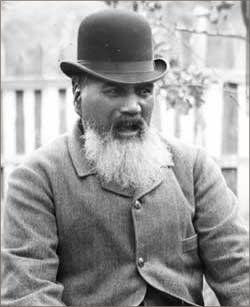
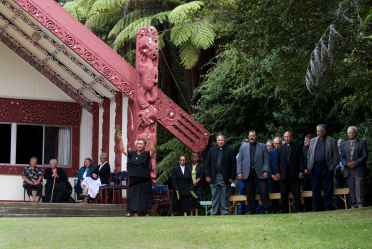
The Rev Wayne Te Kaawa, the Moderator of Te Aka Puaho (the Māori Synod of the Presbyterian Church of Aotearoa New Zealand) has helpfully produced a bilingual Māori and English resource for ministers and worship leaders who may need resources to aid them with a tangi, funeral and unveiling. It can be downloaded here.
New Zealand
The cruel and godless practice of live animal exports
Recently, I posted a video of David Clough’s lecture ‘Rethinking Animality: Towards a New Animal Ethics’. One of the reasons that I drew attention to that lecture was because I consider the work that David (and others too) is engaged in around this issue to be incontrovertibly ‘vital’ [from the late fourteenth century Latin vitalis, meaning ‘of or belonging to life’]. Any society that takes lightly the killing of animals (those creatures whom Dietrich Bonhoeffer refers to as the brothers whom Adam loves), as do those societies with which I am most familiar, has grossly misjudged the sheer giftedness of life itself and is, it seems to me, already well on the way to responding lightly to and of justifying various forms of homicide and deathliness in its midst, blinded by the lie that the life of any creature belongs to something or someone other than God. This is why Karl Barth, for example, argued with due passion that ‘the slaying of animals is really possible only as an appeal to God’s reconciling grace’, and that we ought to have very good reasons for why we might claim the life of another creature for ours. Human beings can only kill an animal, Barth avers, knowing that it does not belong to us but to God alone, and that in killing it – an act which itself is incredibly traumatic, as I can testify – one surrenders it to God in order to receive it back from God as something one needs and desires. ‘The killing of animals in obedience is possible’, Barth contends, ‘only as a deeply reverential act of repentance, gratitude and praise on the part of the forgiven sinner in face of the One who is the Creator and Lord of humanity and beast’. Here Barth’s words compliment the Jewish tradition which champions the need to avoid tzar baalei chayim – causing pain to any living creature – and insists that where animals are killed that they are done so ‘with respect and compassion’, most properly by way of shechita.
With that, I come to the subject of this post; namely, live animal exports. Animals Australia reports that
every year millions of Australian animals are exported live for slaughter. Those who survive the journey often endure brutal treatment and conscious slaughter. Cattle, sheep and goats are sent throughout the Middle East and South East Asia — to countries with no laws to protect them from cruelty. Tens of thousands of animals don’t survive the sea journey and those that do disembark into countries where they are transported, handled and then slaughtered in appalling ways. Most animals slaughtered overseas have their throats cut while they are fully conscious, leading to an incredibly painful and prolonged death. Since 2003, Animals Australia has conducted numerous investigations into the treatment of animals exported from Australia. The evidence from investigations in the Middle East and South East Asia has consistently revealed the willingness of Australia’s live export industry, and consecutive Federal Governments, to export live animals despite appalling cruelty in importing markets.
While Australia remains by far the world’s largest exporter of sheep and cattle, this is not, of course, only an Australian issue. Earlier this year, the New Zealand Herald, for example, reported a ‘Boom in live cattle exports to China’, although thanks to the Customs Exports Prohibition (Livestock for Slaughter) Order these are mostly for breeding purposes, and recent protests at the Port of Dover in the UK are evidence that exporting of live cattle remains a practice in the UK and the EU, with exports going mainly to Italy and France.
This video, produced by Animals Australia, testifies to the cruel and godless practices that attend the live export of animals:
Clearly, this is a political as well as a moral issue (not that the two can ever be separated); and as the Australian Federal election draws near, I wish to publicise my support for the campaign by Animals Australia and Ban Live Export against the sickening and anti-vital practice of live animal exports. I learned recently that one of the Coalition’s priorities, should it win the election, is to ‘apologise’ to Indonesia (a country that receives some 45% of Australia’s live animals) for the Labour Government’s five week trade suspension in 2011, a suspension put in place in direct response to an ABC Four Corner’s program, ‘A Bloody Business’, which exposed the practices that attend live animal exports. In Australia, with the exception of Independent Senator Nick Xenophon, it has been The Greens who have consistently spoken out against this practice and who have sort to (re)introduce the Live Animal Export (Slaughter) Prohibition Bill (2012) into the Senate. And in New Zealand, from which there has been no live animal exports for slaughter since 2003, it is again The Green Party who have tried to maintain pressure to restrict the export of live animals. (I don’t mention this in order to propagandise for The Greens, but simply to report a fact.)
Here is the campaign video produced by Animals Australia:
Opposition Leader Tony Abbott, and the other Coalition party leaders, seem to have forgotten – or, just couldn’t give a rats about – the outrage that Australians felt after that program aired, the facts therein being also corroborated by the live export industry’s own reports. Certainly, it is difficult to see how any formal apology to the Indonesian government or business groups could do anything other than serve to send a message that animal abuse is condoned. To my mind, this ought to be an important election issue. It is certainly an important theological issue. So if you are a fellow Australian citizen, or have your name on the electoral role, then please consider joining me in supporting this campaign.
Jobs for historians? – yeah right!
… that’s what I thought, but it seems that the Waitangi Tribunal, a permanent commission of inquiry that researches and reports on claims submitted by Māori under the Treaty of Waitangi Act 1975, is serious about seeking to appoint two historians and one senior historian.
- Information on the historian positions, including the job description and application form and process, is available here. Applications close 19 July.
- Information on the senior historian position, including the job description and application form and process, is available here. Applications close 10 July.
Should you require any further information, please email Jonathan West.
‘Outspoken: Coming Out in the Anglican Church of Aotearoa New Zealand’ – a review
Liz Lightfoot (ed.), Outspoken: Coming Out in the Anglican Church of Aotearoa New Zealand (Dunedin: Otago University Press, 2011). ISBN: 9781877578083; 218pp.
A guest review by André Muller
In mid-2009, Liz Lightfoot, an independent researcher working under the supervision of Dr John Paterson of the University of Waikato, interviewed eleven subjects as part of a project aimed at documenting the stories of gay and lesbian people within the Anglican Church of Aotearoa New Zealand. Whatever the merits of the ‘Listening Process’ upon which the Anglican Communion embarked in the wake of the 1998 Lambeth Conference, it has become clear that many gay and lesbian Anglicans feel that their stories have not in fact been heard. In publishing the edited versions of her interviews, Lightfoot hopes, in a modest way, to redress this situation, if only by showing that at least some gay and lesbian people have been so hurt by the Church as to have abandoned all hope that the ‘Listening Process’ is anything other than a charade concealing a profound lack of courage on the part of those charged with leading the Church. If this reveals an irony at the heart of a project commended as a contribution to that process, it is perhaps one that brings a measure of clarity to the situation in which Anglicans (and, by analogy, members of other Churches), find themselves, by drawing attention to the limits of an official process that has, by its inability to bring about effective change, done a great deal to foster cynicism on the part of the very people it is claiming to serve. Such a process is yet to prove itself a means by which the complexity and depth of the often painful experiences of gays and lesbians within the Church is rendered audible to clergy and laity alike. To talk of the need for honest dialogue while in practice allowing a ‘don’t ask, don’t tell’ policy to flourish at both official and unofficial levels, is simply to have failed to hear the voices of gays and lesbians.
It may seem rather strange to press the logic of Lightfoot’s book in this way, since it is presented as a piece of qualitative research that aims to conform to academic standards (indeed, it is published by a university press). But Lightfoot is aware that the role she is playing is more than that of the neutral observer. She believes her research to be ‘primarily about justice and about what is done, how people are treated in the name of God’ (p. 15), and this as a way of outworking a ‘gospel bias … to the oppressed and towards justice … to the suffering and towards healing … to the captives and towards liberation’. Given such commitment, it is curious then that Lightfoot hedges at the very moment when most is at stake, claiming that when it comes to the issue of homosexuality, ‘the definitions of justice, healing and liberty are up for debate’. This is fine in so far as empirical descriptions of the way in which that issue, or rather, set of issues, is being played out within the Anglican Communion go, but it is clear that the justice with which her research is concerned is incommensurate with policies that would exclude gays and lesbians from full participation in the Church. To appeal here, as Lightfoot does, to the supposed ability of the Anglican Church to accommodate a range of views on the subject, or worse, to theological clichés that insist that ‘God is beyond theology’ and ‘sexuality is no barrier to God’s love’ (p. 16) is to beg the very question at stake. It is hard, particularly when reading the introduction, not to feel that Lightfoot wants to answer that question while, at the same time, pretending that she isn’t.
The bulk of Lightfoot’s book is, of course, taken up with the edited versions of the interviews she conducted between May and July 2009. The experiences of the eleven interviewees are, as one might expect, enormously diverse, and it would be perilous to attempt any generalisations were it not for the fact that Lightfoot herself encourages us to do so by offering at the end of each interview some reflections that ‘might help the reader’s understanding of the participant’s experience’, and by summing up the key themes that emerge from her interviews in a concluding ‘postscript’. There is a quite proper sophistication to the analysis Lightfoot offers in the concluding pages of her book, recognising that the process of ‘coming out’ is an enormously complicated one for gay and lesbian people within the Church. ‘The cost of integrity in the church is devastatingly high’, one of the interviewees remarks, and Lightfoot sees in this comment a way of approaching one of the key problems that gay and lesbian Christians face. Indeed, notions of personal integrity, and therefore, notions of the self, play a profoundly important role in many of the experiences of Lightfoot’s interviewees. To cite but one example, after coming out to his wife (of more than thirty years) and children, ‘Rob’ (all the names are pseudonyms) tells Lightfoot that he decided to write them a letter, saying ‘I love you and all the rest of those nice, humane and truthful things but I have to be true to myself too. There’s not much point living a lie and having you people happy and me not. I’ve got another thirty years perhaps, if I play it right’. If many of the other interviewees come off sounding less childish than this, the imperative to be ‘true to myself’ is one that continually resurfaces throughout the book as an explanation, even justification, for often painful, and sometimes tragic, decisions.
At this point we begin to see the sort of work that is being done by Lightfoot’s insistence that ‘people’s lives are sacred ground’. Although it is not immediately clear what she means by this claim, it effectively functions as a way of forestalling any attempt to question the Emersonian framework that supplies the moral imperative to be ‘true to myself’. It was the American novelist and host of A Prairie Home Companion, Garrison Keillor, who once remarked that Ralph Waldo Emerson had a great deal to answer for, not least because his writings encouraged men and women who would have made fine accountants and bus drivers and lawyers, to become very bad writers and musicians and artists, and to find in their supposedly artistic temperaments the warrant for jettisoning ordinary virtues like kindness and patience. They were told to throw caution to the wind, to escape from the ordinary obligations and responsibilities that constrained their lives, and to be true to themselves. Only the selves they were being true to were selves in the process of becoming monstrous precisely to the degree that they were being extricated from concrete and unspectacular obligations to others. Monstrous and, we might add, incoherent (which may be the same thing), since the attempt to orientate myself, to find my bearings within the world, by appealing to myself is necessarily self-defeating. Not only does it trade upon an essentialism that is profoundly problematic – a stable self, at one remove from our interactions with others (a self, therefore, behind the public, historical self), that is simply there to be known; it also presumes that knowledge of that self is a rather straightforward affair. It was the early church theologian Augustine of Hippo who pointed out that we are not, in fact, perspicuous to ourselves; that we cannot simply lay ourselves out like a map. There is no vantage point from which we can obtain a clear enough vision of ourselves for us to be able to say, at any one point in our lives, ‘now, at last, I am truly being myself’.
The question here is whether the Emersonian logic to which many of the interviewees in Lightfoot’s book appeal as in some sense offering justification for actions they have committed can actually do the work it is claiming to do. When ‘Rob’ tells his family that he has to ‘be true’ to himself, or ‘Edward’ says that one of the best things about his new homosexual life is ‘just being open … just being myself’ (p. 33), or ‘Janet’ suggests that the root cause of the sense of emptiness she felt while married was that she was ‘unfulfilled in terms of who I am’ (p. 41), or ‘Gareth’ says that it is out of ‘my spiritual journey that I’ve discovered and come to terms with who I am’ (p. 151), even when ‘Naomi’ says that ‘the Church is my home, where I am myself’ (p. 118), one has to ask whether the sort of clarity that is being presumed here is the sort of clarity that human beings can have with respect to themselves. And if it is not, we have to admit that if we are to try to come to terms with the experiences of those interviewed in Lightfoot’s book, we must press them to provide deeper, more adequate, accounts of those experiences. ‘What precisely do you mean when you say you are just being yourself?’ is the sort of a question a good interviewer ought to ask. At the very least, we might expect Lightfoot’s postscript to contain some analysis of the Emersonian framework that plays such an important role in many of the interviewee’s account of their experiences. Instead, Lightfoot offers her readers an exemplarist Christology that has itself been thoroughly domesticated by that framework. ‘What I see in the life of Jesus’, Lightfoot writes, ‘is someone integrated. Not someone living, as we all do to some extent, on conflicting, disparate planes. He was what he seemed; he was what he claimed to be’ (p. 214). To point out that such a picture of Jesus bears little resemblance to those offered in the Gospels would be to misunderstand what it is that Lightfoot is doing here. She is not commenting on the historical, flesh-and-blood Jesus, but rather seeking to legitimate one particular – and highly modern – account of what it means to be human. ‘My understanding is that our Christian journey is one towards integration of the parts of us that we might prefer not to face’ (p. 214). Only an Emersonian could write of the Christian life in such terms, freeing it from any real connection to the life and death of Jesus of Nazareth, indeed, reinventing that life so that it conforms to pictures of what it means to be human that would have been sheerly unintelligible to pre-moderns.
Lightfoot’s book is marked by a curious naivety. She wants to make a number of substantive claims without engaging in the sort of critical analysis that those claims demand if, that is, they are to be convincing. She asserts, and then pulls back at the very points when most is at stake. In so doing, she is not serving the subjects of her interviews, but abandoning them. Neither is she serving her readers, who find that they are unable to gain real purchase on the experiences of those they are reading about precisely to the extent that the notion of ‘being myself’ remains unexamined. In the end, what we are left with are stories that in themselves are rather unremarkable: a man leaves his wife for his gay lover, only to find that some people in his local church are not sympathetic; a devout woman discovers that she is a lesbian, and has to rethink certain aspects of the conservative theology with which she was brought up; and so on. Such stories are valuable in their way, but not very interesting. And this because Lightfoot does not allow us to get into the inside of them, in the way, for example, that Conrad enables us to gain some purchase on the experiences of Tuan Jim, or Stryon on those of Peyton Loftis. If Lightfoot is right to say that selves are ‘sacred’, then this must be an invitation not to call a halt to our enquiry, but to probe further, knowing that in the end, as Augustine understood, it not we who confer meaning on our lives, but one who is closer to us than we are to ourselves.
The Tendering of New Zealand’s Restorative Justice Services: Robbing Peter to Pay Paul
A guest post by Janet Sim Elder
The recent announcement that government tendering of Restorative Justice (RJ) services throughout Aotearoa New Zealand to a smaller number of providers based here in NZ or from offshore is imminent. Judith Collins, Minister of Justice, has also announced there an increase of funding of $4.42 million in the May budget. Clearly this National Government wants to expand services.
A good thing you might say. Yes it is, but … and there is a large ‘but’. Ministry staff numbers entrusted with servicing the Restorative Justice groups around the country have gradually diminished over the last thirteen years since we in Dunedin and three other jurisdictions trained and were part of the world-first pilot of RJ as an alternative way of doing justice within the Justice system.
From a vibrant, forward-thinking, large group of public servants, the staff in this unit now number about five. The logic is, I suspect, that it is much easier and more cost efficient for a small group of Ministry staff to work with a handful of providers; the fewer the better.
Restorative Justice Aotearoa, the national grouping of all RJ services in NZ, is not in a position to put in a tender for all those services and is clearly not interested in doing so.
Nicola Taylor, the feisty Director of Anglican Family Care in Dunedin under whose umbrella we work as Restorative Justice Otago, providing long-term, highly professional and skilled work in bringing victims and offenders together to hear each other’s stories and to begin repair of the harms caused by offending, has decided we have no other option than to submit a tender ourselves. It’s risky because we have no certainty we will be successful, and because there is no contingency plan if we fail. Our story will be replicated throughout the country for the other RJ providers.
So we are committed to going all out for a strong bid to provide services in our Otago region. We have a depth and breadth of experience and are known and trusted by victims and offenders alike, as well as by local professionals working within and around the court system. This all has to be done in a few short weeks rather than months. Anglican Family Care is committing resources including in governance and making tenders to ensure we put in the best tender we can.
If you can help with brief letters of support for our bid, or for the RJ group near you elsewhere in the country in the same boat as we are, then, who knows, Peter does not have to be robbed in order to pay Paul and both might have a chance to live life in all its fullness!
To help out, please contact:
Restorative Justice Otago
c/- Anglican Family Care
PO Box 5219
Dunedin, Otago, NZ
email
p: +64 3 477 0801
The Māori Prophets
Māori Television is running what promises to be a fascinating seven-part series on The Māori Prophets. Here’s the blurb:
The Māori prophets are an incredible part of our nation’s history. The Prophets is a fascinating seven-part series presented by Anglican Priest and historian, Reverend Hirini Kaa.
From the time the Bible began to be widely translated into te reo Māori in the 1830s through to the middle of the 20th century, the show chronicles the lives, beliefs and social conditions that saw these messianic figures rise from within Māori communities.
Starting with leaders like Papahurihia, the first prophet to draw on Māori and Christian doctrine, emerging with a new form of traditional Māori spirituality to more well-known prophets (Te Kooti, Te Whiti and Tohu and Ratana), The Prophets unveils an incredible part of our nation’s history.
Thus far, only the first episode in the series has been aired. It – and presumably, in time, those episodes forthcoming – can be viewed here.
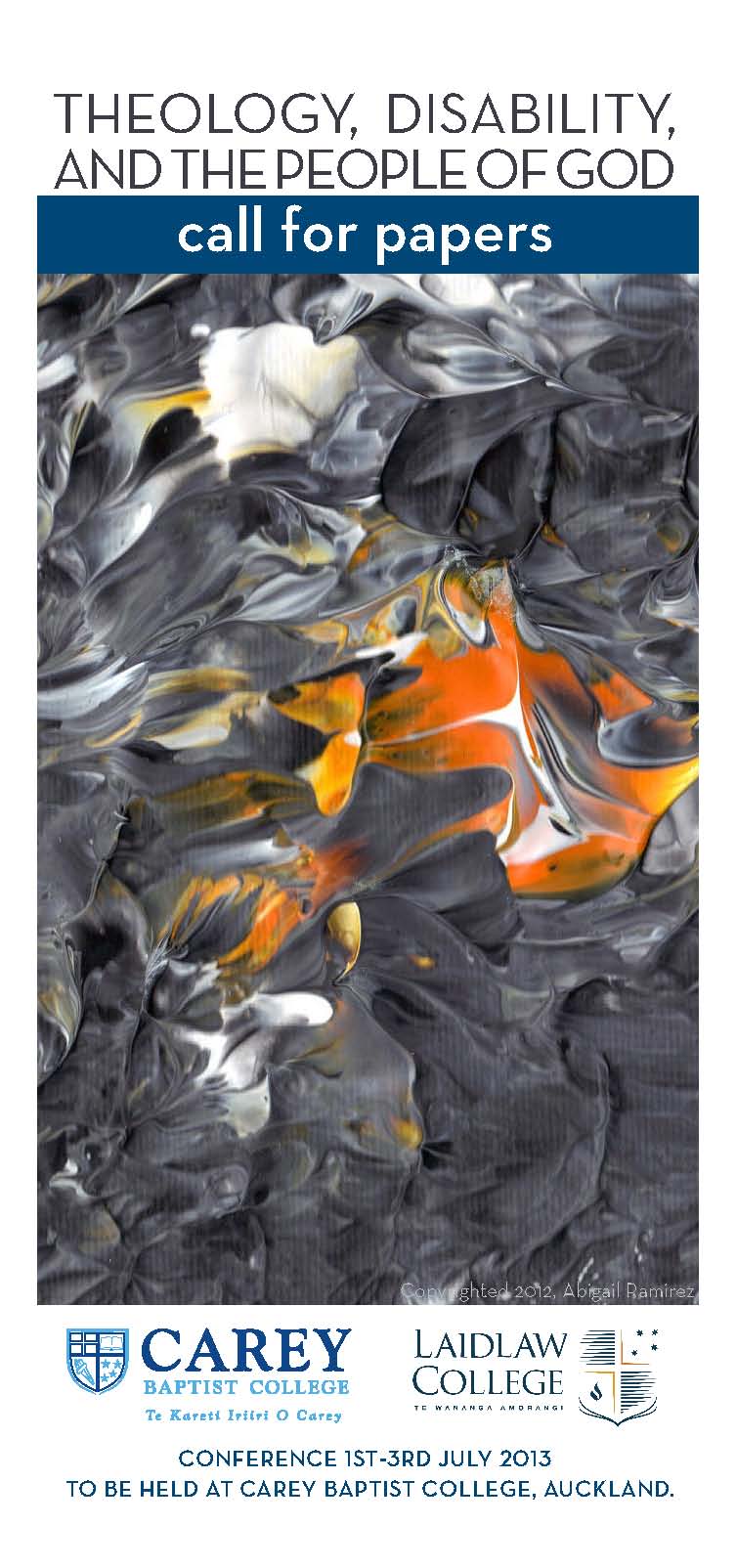
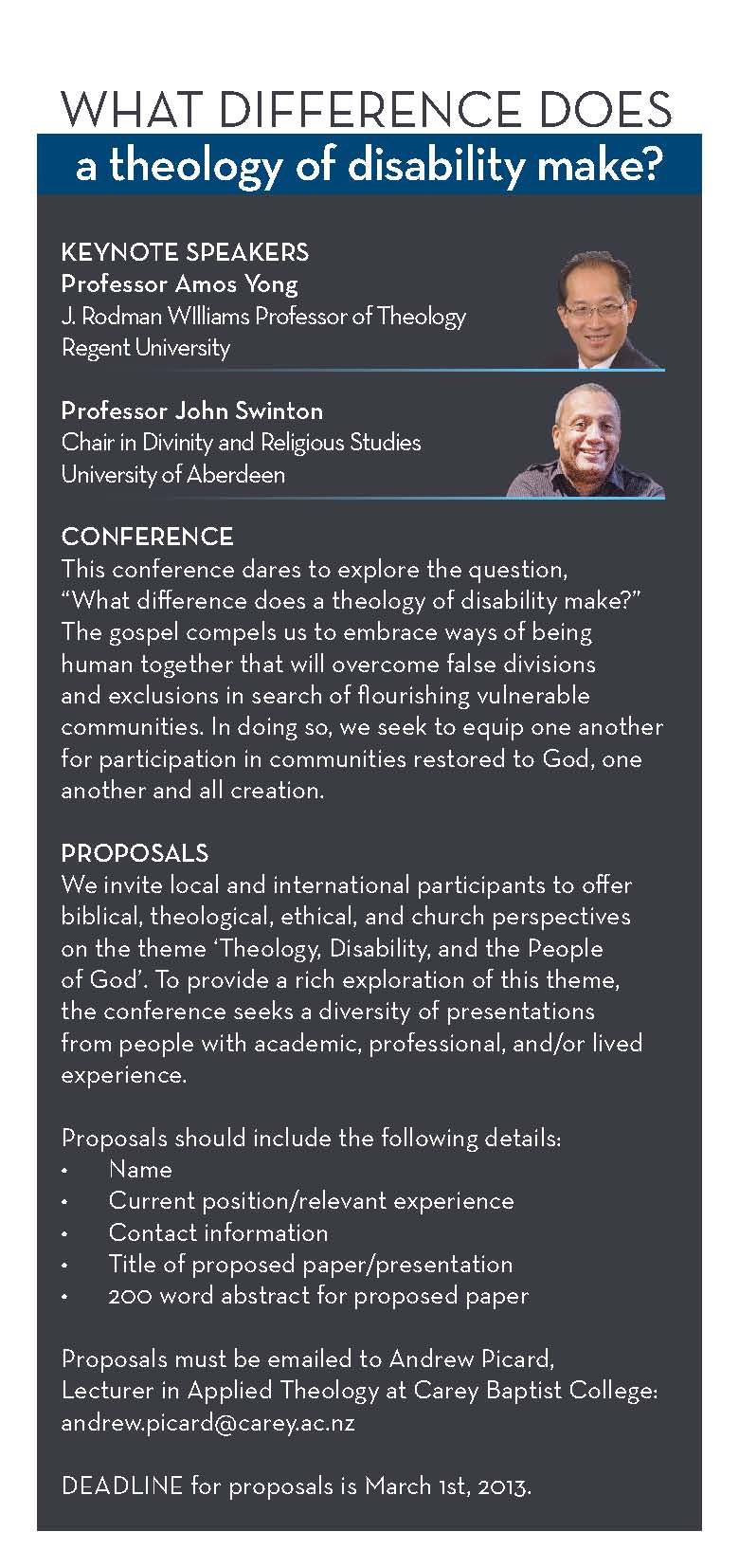
Theology, Disability, and the People of God: a conference
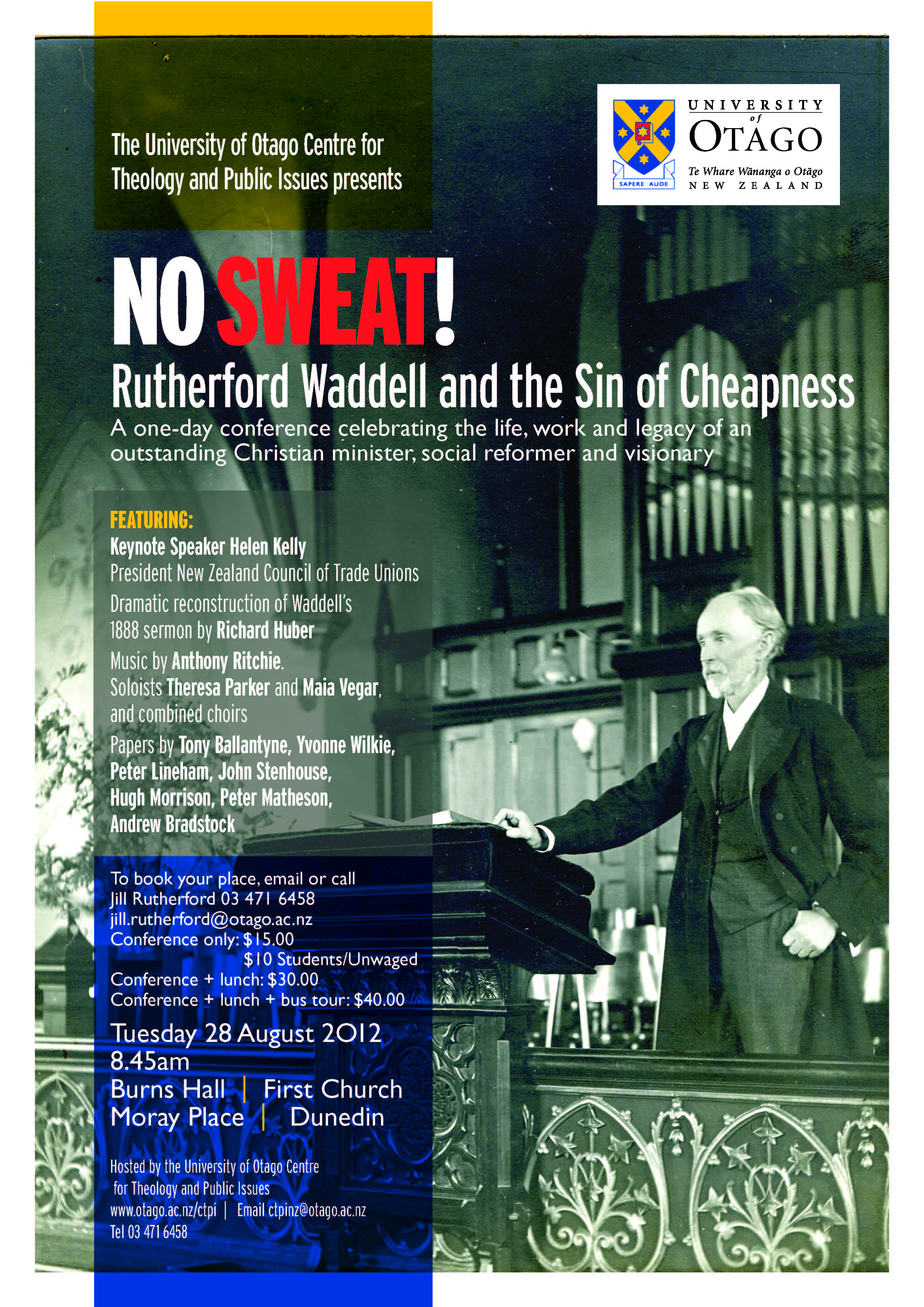
Rutherford Waddell Conference
The University of Otago’s Centre for Theology and Public Issues is planning a one-day conference to celebrate the life, work and legacy of the inspirational Christian minister, social reformer and visionary Rutherford Waddell. Here’s the flyer:
I can still remember my first exposure to Waddell’s writing. It was his delightful collection of essays published as The Fiddles of God and Other Essays. One of those ‘other essays’ was entitled ‘The Lure of the Trout’; this title alone was enough to make me fall in love with the guy. Now it’s true that I’ve fallen in love many times before (and almost as easily out of it again) but I can confess that my affection for him has continued to grow (perhaps I’m still falling) the more I have immersed myself in his exquisite prose – fed as it is by healthy doses of John Ruskin, Emily Brontë, George Eliot and James Lane Allen – and the more I have learnt about his extraordinary ministry right here in my home town of Dunedin. James Gibb once described Waddell as a man who ‘lived under the spell of Christ’. It’s a good description. Suffice it to say that I’m really looking forward to this gig.
For those readers of PCaL unfamiliar with Waddell, here’s the relevant entry, written by Ian Breward, from the Dictionary of New Zealand Biography:
Rutherford Waddell was born in Ballyroney, County Down, Ireland, probably sometime between 1850 and 1852. His father was the Reverend Hugh Waddell, a Presbyterian minister; his mother, Jean Reid, was the sister of Thomas Mayne Reid, a famous writer of adventure stories. Rutherford’s mother died when he was small and he was brought up by an aunt. He was educated at a national school where the teacher was brutal; Waddell regarded the years as wasted. At the age of 14 he became a draper’s apprentice in Banbridge for four years, after which he decided to follow the calling of his father and older brother, Hugh, in the ministry. He graduated MA from Queen’s University in Ireland in October 1875 and also studied at the Presbyterian Theological College, Belfast, from 1874 to 1876. On 27 January 1877, at Dublin, he married Kathleen Maud Ashton Newman. They were to have one daughter, Muriel Alice Newman, who was born on 28 April 1882.
Rejected both for missionary service in Syria and by an Irish congregation, Waddell accepted an invitation to join the ministry of the Canterbury Presbyterian Church Extension Association. He sailed with his young wife to Lyttelton, New Zealand, on the Piako, arriving in May 1877. After a short supply ministry at St Paul’s Church in Christchurch, he was inducted to the charge of Prebbleton and Lincoln on 25 September 1877. Called to the flourishing new charge of St Andrew’s Church in Walker Street (Carroll Street), Dunedin, Waddell was inducted on 18 April 1879 to minister to about 300 members, including many of Dunedin’s leading citizens.
Suspect because of his radical belief that the Christian gospel should be actively interpreted through social justice, Waddell soon won the confidence of the congregation and exercised wide influence through his writing and commitment to civic affairs. In 1888 he was one of the founders of the Dunedin and Suburban Reserves Conservation Society and in 1888 and 1889 an early supporter of technical education. In the parish at the Walker Street mission hall, which opened in 1888, he set up a savings bank, a free library and the first free kindergarten (1889). He also developed a wide range of literary, religious and educational societies, along with a cricket club, gymnasium, and debating and mutual improvement societies. Waddell was deeply committed to overseas missions; the congregation supported three missionaries as well as providing a spiritual home for many students for the ministry.
Waddell was well read. His knowledge of classic and contemporary English literature went with wide reading in theology, economics and sociology, all carefully recorded in notebooks. In his student days he was decisively influenced by reading George Eliot’s Adam Bede. Young and old found his sensitivity to their doubts and questions one of the most attractive features of his ministry. He was deeply compassionate, but was not content just to offer help in his own parish. Reading in politics and social science convinced him that social change was possible, but with this went the conviction that changed laws must be accompanied by changed lives.
Waddell played a leading part in exposing sweated labour in Dunedin (he himself had worked long hours for nothing as a draper’s apprentice in Banbridge). In October 1888 he delivered a sermon at St Andrew’s Church on the ‘sin of cheapness’, arguing that a lust for bargains was forcing prices down to a point where wages fell below subsistence level. In November he took the matter to the Synod of the Presbyterian Church of Otago and Southland and a motion was passed deploring the existence of sweating in New Zealand. The press took up the matter and revealed cases of sweating in Dunedin. His blend of prophetic passion and skilful use of the press and public meetings led in 1890 to a royal commission on sweating on which he served. Its recommendations were an important part of the foundation for the social legislation of the 1890s. Waddell believed that trade unions were an essential part of reform: he became the first president of the Tailoresses’ Union of New Zealand from 11 July 1889. He was also actively involved in temperance reform, the Bible in schools movement and was one of the main supporters of the First Offenders’ Probation Act 1886, a pioneering penal reform.
As well as being a notable minister and social reformer, Waddell was an active journalist and editor of the national Presbyterian weekly, the Christian Outlook (later called the Outlook), from 1894 to 1902. Forced by a breakdown in health to give up that responsibility, he continued to write elegant and thought-provoking columns for the Evening Star under the name ‘Ror’ for 27 years. His other notable achievement was to initiate the deaconess order in the Presbyterian Church of New Zealand. In March 1901 Sister Christabel Duncan, one of the first to graduate from the Presbyterian Deaconess Institute in Melbourne, began her duties among the poor in St Andrew’s parish. Her stipend for the first year was paid by Waddell, but the caution of the deacons was overcome by the end of the year and they became her enthusiastic supporters. In addition, Christabel Duncan was actively involved in the expansion of the Presbyterian Women’s Missionary Union, working as travelling secretary for two years from 1918.
Lightly built and with a slight speech impediment, Waddell became one of the country’s most notable preachers, whose sermons were published in their thousands. He pushed himself to his physical limits and had to take sick leave in 1882, 1886, 1902 and 1913. The last years of his ministry were hampered by severe deafness. He retired in 1919, after a remarkable career. Kathleen Waddell became a chronic invalid and died in Seacliff Mental Hospital on 7 September 1920.
Rutherford Waddell married Christabel Duncan at Melbourne on 3 December 1923. He stayed intellectually vital during his last years; in 1929 he was first president of a fellowship of New Zealand writers. Despite illness he continued to hunt, fish and enjoy golf. He died in Dunedin on 16 April 1932, survived by his wife. Waddell was an important liberalising influence in the Presbyterian church, demonstrating that it was possible to be evangelical and missionary without being rigidly tied to the confessionalism of a strong group in the Synod.
Yanks and Kiwis
In his recent book Fairness and Freedom: A History of Two Open Societies – New Zealand and the United States – which I’m yet to read (a fact which doesn’t always give me reason to pause from offering comment) – David Hackett Fischer observes that whereas public discourse and public policy in America is dominated by the rhetoric of freedom and liberty, here in New Zealand the same are organised around the principles of fairness and social justice. Throwing Australia into this mix would make a fascinating study and, I think, challenge some of Fischer’s conclusions. Still, Fischer’s sounds like an attractive thesis (nicely summarised in this article), and I look forward to checking out the book. (Just as good, however, might be reading a review of the book by American ex-pat Kim Fabricius.)
‘Karitane, New Year’s Day’

An ancient fugue echoes
echoes from the beach near
the steep hill at Waikouaiti
across the bay towards
Karitane as another receding
tide near Old Head Street
exposes a feast of fresh
clams. Red-billed gulls and
caspian terns in saturnalia,
but still they squabble and
dash in bursts, their lowered
necks across drying sand.
An old man with
a bright blue t-shirt and
a bright yellow life-jacket, who
gently paddles an undersized
purple sea kayak. A
dog looks on. I guess
you could say that it’s
unimpressed. And a dozen
or so kids drop
baited lines from the pier
now also looking remarkably hopeful,
though less than was
true an hour ago.
And as the wind picks
up, a woman with calves
like boab trees waddles
past with a fluffy
dog far too energetic for
such a place, and the
water’s surface begins to
break. It is afternoon
after all – the time for
tide’s turning and a welcomed
coolness from the stinging
Otago sun. The auditory
and the gustatory notes creep
towards the repeat bar.
© Jason Goroncy
1 January 2012
NZ Election 2011, by the Old Masters
Janet Sim Elder: Doing justice honourably
The focus of the next meeting of the NZ Presbyterian Research Network will be a lecture by my dear friend Janet Sim Elder on ‘The Challenge of Changing the Justice Landscape: How do we do justice honourably with victims, reduce recidivism and change public attitudes?’
Join us at the Knox Centre Seminar Room (Hewitson Wing, Knox College, Arden Street, off Opoho Road) on Thursday 10 November, 2011. We kick off with wine and nibbles at 5pm, and then Janet jumps into the hot seat from 5.30 until around 7.00. All are welcome.
‘How precious did that grace appear’: a story from Down Under
It’s so good to hear stories birthed by, and which witness to, the kingdom of God in our midst. For many months now, Martin Stewart, a friend of mine and fellow Presbyterian minister who, with his partner Anne, is nothing less than obsessed with the crazy and wreckless and completely-irresponsible nature of divine grace, has been spearheading what is an inspiring (in every sense of that word) project. Some of that journey has been documented on Martin’s blog, and yesterday, the Presbyterian Church of Aotearoa New Zealand posted the following media clip. I’m sharing the love:
On Sunday 14 August 2011 Presbyterian church-goers gave more than $70,000 – 365 $200 New World Supermarket vouchers – to homes in part of the red zone on the east side of Christchurch.
“The vouchers were given out to homes with no strings attached”, says the Rev Martin Stewart. “The homes are all in an area perceived as not needing help, so they hadn’t received much.”
After their regular Sunday church service, 130 people from St Stephen’s Presbyterian in Bryndwr, St Giles in Papanui and St Mark’s in Avonhead, went door-to-door to share the vouchers with people whose resources have been stretched more thinly than their own.
Martin says that “going over to that side of the city was sobering. There were many sad stories of struggle and wondering what is next. Without exception those who handed out the vouchers were touched by the welcomes they received”.
The Rev Martin Stewart, the driving force behind the project and minister of St Stephen’s and moderator of the Presbyterian Church’s Presbytery of Christchurch, says, “$70,000 was raised, some donated by people from here but most from far off places like Scotland … and Auckland! Foodstuffs offered a discount enabling us to purchase even more vouchers”.
The idea for the vouchers came in April, Martin says, when Highgate Presbyterian Church in Dunedin, (Martin was formerly the minister there) gave him and his wife Anne money to distribute in Christchurch “as we saw fit. The next day we gave the first $1000 of that money to a young family we did not know, and that we had heard life was tough for, in the damaged Avon loop area. I wrote about it on my blog and then someone from Wellington sent $15,000 – it soon ballooned to $70,000. It has been like witnessing the miracle of the loaves and the fishes right before our eyes”.
Martin says in many ways 365 vouchers to 365 homes is barely touching the need out east in Christchurch city. “It really is like we have only got a little bit of play-lunch to share and there are 5000 people hungry. But we sense that we are not alone in this enterprise. We believe that Jesus’ ‘kingdom of God’ is in this and we simply don’t know what kind of ripple of hope the vouchers will generate in the lives of the people we share them with. We are sure something good will come of it and that in a multitude of ways people who receive vouchers will pay it forward in some way.”
Systematic Theology Association of Aotearoa New Zealand – annual meeting
The annual meeting of STAANZ (Systematic Theology Association of Aotearoa New Zealand) will be held in Auckland, at Epsom Baptist Church, 6 Inverary Rd, Epsom, beginning a 0900 on Wednesday 7 December and concluding at 1700 on Thursday 8 December. The topic this year is ‘Trinity’. There is a call for papers, and abstracts can be emailed to Nicola Hoggard-Creegan before the end of August.
Some interesting Sunday reading
Matthew Dickerson on food and the culture of Hobbits- Richard Beck shares a fourfold Franciscan blessing
- Michael Wood on The Tree of Life
- Some more doodlings from Kim Fabricius
- Apparently, Hone should be complemented, not condemned
- Steve Holmes on how much Scripture to preach on
Doing justice honourably
A guest post by Janet Sim Elder.
A crucial question in this election year is how do we do justice honourably with both victims and offenders? How can recidivism continue downwards and how do public attitudes change to being solidly evidence-based? How do we face the challenge of changing the justice landscape? Can we provide the moral courage to help our society take steps towards a more just and merciful society?
Biblical pillars of doing justice and loving mercy [Micah 6:8b] are heavily strained in NZ. We rush to apportion blame rather than ask who has been hurt by crime. We mete out a retributive ‘justice’ which perpetuates further injustices. We legislate for three strikes and there is no more mercy. Have we the moral courage to do the harder task? To ask the restorative questions ‘Together, how can we put this right? Are forgiveness and reconciliation possible?’.
Voices which have shaped increasingly punitive justice policies recently with both major political parties have come from a minority. Populist politicians listen to these voices above others. Shameful stripping of citizenship for all prisoners is the latest in punitive legislation in the news as I write.
Voices we might listen to more attentively as we prepare to vote include the Chief Justice, the Rt Hon Dame Sian Elias, Judge Sir David Carruthers Chair of the Parole Board[1], and Chief Family Court Judge Andrew Becroft – all with intimate knowledge of our justice system.
They all firmly support evidence-based change, and a better informed wider society, alongside the Silverstream Declaration soon to be released by the organisations which wrote the Declaration at the “Breaking down the Barriers” Conference in October 2010. Sponsors of this landmark gathering in Upper Hutt were Prison Fellowship New Zealand [PFNZ], Prison Chaplaincy Service of Aotearoa NZ, Pathway Trust, Pillars Inc. and the Salvation Army. National and international research was shared by experts in their fields, showing conclusively there are alternatives that do work to get prison numbers down.
The conference confirmed we need together to do more about the impact of crime on victims, that Restorative Justice works positively for both victims and offenders alike. When prisons treat people with more dignity and compassion, reoffending goes down. We could benefit from having open prisons like Norway where dislocated families have visiting rights over a weekend with their parent. Children see their dads on the weekend. Imagine that!
With an incarceration rate soaring over most other OECD countries[2], the most painful question is – could we become a less punitive society? There’s been a 35% increase in population in 187 NZ prison sites in the last five years! Corrections is now the largest government department. Fiscal sense? The Silverstream Declaration suggests it’s ‘fiscally irresponsible’ to be building more prisons.[3] Reputable international evidence is mounting that incarceration does not work for most offenders.
Working in Restorative Justice, I gain the growing conviction that victims’ stories of crimes (from burglary to rape and brutal murder) are stories to be told to offenders. To stand in their victims’ shoes is the darkest place to be, but easily avoided. Courageously telling stories, in a safe place, face to face, is what can turn both the lives of victims and offenders around towards life no longer dominated by painful pasts. The best apology victims say they want is when they know the offender will never commit the crime against anyone, ever again.
Offenders, male and female, find it very difficult to rehabilitate. Creative, hopeful ways forward were outlined at the conference: projects bringing church and community group resources together to address reintegration issues facing people as they return to life in the complex world outside the prison.[4]
What does the Gospel story teach about God’s ‘justice and mercy’ and how we act towards other human beings? The supreme example comes from Jesus on the cross.
‘Revealed in his dying prayer, “Father, forgive them for they know not what they do,” is the conviction that justice in itself is not enough, that the humanity of the perpetrators of injustice must be upheld alongside the humanity of the victims, and that justice must serve still higher goals of reconciliation, healing and rehabilitation…’[5].
If we want to change the justice landscape, say ‘no more’ to quick-fix legislation, knee-jerk, non-evidence-based reactions embodied in flaky legislation, we must seriously become better informed. In the light of God’s generous giving to us in Christ, we cannot do less.
[1] A recent survey by the Board over the last ten years on serious criminals released on parole showed the number re-offending in any one month over that time was reduced from 100 incidents per month ten years ago to the most recent average of 45 incidents per month.
[2] NZ has the fourth highest rate of any OECD country except the USA (1), Mexico (2) and the Czech republic (3). Communication from Barry Matthews, CE Corrections [07/10/10].
[3] The average cost p.a. to keep one prisoner incarcerated is $90,000. It costs an average $3,600 for a year’s community service sentence.
[4] See www.pfnz.org.nz.
[5] Graham Redding: Crime and Justice: a Biblical and Theological Perspective, from Crime & Justice (pub. PCANZ October 2010)
A note on the Formula, Liberty of Conscience and the Declaratory Act
In 1930, the minister J.A. Asher and the elder J.S. Butler of the Presbytery of Hawke’s Bay supported an overture from the Presbytery to the General Assembly of the Presbyterian Church of New Zealand. It read:
Whereas this Presbytery of Hawke’s Bay, being of the opinion that Question 2, appointed to be asked of elders on the occasion of their ordination to the office, having reference to the Westminster Confession of Faith, has given rise to considerable difficulty; has resulted in men declining to accept the office of eldership, who have been in every way qualified for such office, to the detriment of the interests of our Church; hereby overtures the General Assembly that Question 2 be omitted from the questions in connection with the ordination of elders.
An examination of the Year Book of the period shows that Question 2, asked of all office-bearers of the Presbyterian Church of the time reads: ‘Do you sincerely own and believe the system contained in the Westminster Confession of Faith; and do you acknowledge the said doctrine as expressing the sense in which you understand the Holy Scriptures; and will you constantly maintain and defend the same, and the purity of worship in accordance therewith?’
Perhaps some laymen being ordained to office found this question too much to ask. Even in the early parts of the twentieth century, the Westminster Confession, a document written in dense legal language several centuries old, was too impenetrable for them to answer Question 2 in good conscience. Unlike the Bible it had no ‘revised standard version’. Rather than omitting Question 2, the General Assembly moved to revise the questions for the ordination of elders. At the same time the Church of Scotland was proceeding in the same direction and the Presbyterian Church of New Zealand chose to wait on the parent church to create a new formula and adopted a similar one with questions replacing the Formula of Subscription in 1936. The new form of the formula read:
I believe the fundamental doctrines of the Christian Faith contained in the Westminster Confession of Faith and other subordinate standards of the Church. I acknowledge the Presbyterian government of this Church to be agreeable to the Word of God, and promise that I will submit thereto and concur therewith. I promise to observe the order of worship and the administration of all public ordinances as the same are or may be allowed in this Church.
The formula was not amended again until the General Assembly of the Presbyterian Church of Aotearoa New Zealand in 2010 to read:
I believe in the Word of God in Scriptures of the Old and New Testaments and the fundamental doctrines of the Christian Faith contained in the Kupu Whakapono and Commentary, the Westminster Confession of Faith and other subordinate standards of this Church. I accept that liberty of conviction is recognised in this Church but only on such points as do not enter into the fundamental doctrines of Christian Faith contained in the Scriptures and subordinate standards. I acknowledge the Presbyterian government of this Church to be agreeable to the Word of God and promise to submit to it. I promise to observe the order and administration of public worship as allowed in this Church.
The General Assembly carried the motion that the Formula be reworded as above. While it was sent to the presbyteries and church councils, consideration to report back at the 2012 General Assembly it was adopted ad interim. There was some debate in the Assembly. My feeling is that the General Assembly did not compare the old and new versions of the Formula and that the new version has some innovations on which there could be improvements.
Firstly if the phrase in the Word of God in Scriptures of the Old and New Testaments needs to be added to the Formula then I think it should come after the subordinate standards. As it reads it conflates the authority of the Scriptures with that of the subordinate standards. While placing the Scriptures as pre-eminent is appealing, placing it as our ultimate authority is much clearer. Without further research, which probably goes back to the Church of Scotland’s version of the Formula, I suspect that the earlier generation decided that not placing the Scriptures here avoided controversy. Their intention is not without merit.
Secondly I suggest that the word conviction should be amended to read conscience. Liberty of Conscience has a long history in the Presbyterian Church going back to the Declaratory Act. It was first passed by the Church of Scotland in 1892, then by the then independent Synod of Otago and Southland in 1893, and by the united Presbyterian Church of New Zealand in 1901. Reading the Declaratory Act it seems evident that the church of this period had problems accepting that God elected some for salvation and some for damnation, especially those who died before the age of decision-making. This is an age when literature suggested that children came from heaven and if they died before a certain age that they could join the angels. Conscience has precedence in the Church’s terminology, conviction does not. To me conviction suggests belief or opinion while conscience is the prompting of the Holy Spirit. That is a significant difference.
Finally, I would strike out the words but only. To paraphrase the Gospels, what comes out of a butt goes into the sewer! But is a conjunction, a balancing word that contrasts a negative clause with a positive one, the negative clause coming first and the positive clause after the conjunction. Liberty of conviction is in the negative clause of the sentence, and the fundamental doctrines of Christian faith in the positive. The sentence reads like a big stick to police ordained ministers and elders. Agreement with this sentence suggests that too much liberty of conviction or conscience cannot be trusted. Conform or else we will have you thrown out of office! Removing it would encourage more faith in our leadership.
I believe that Asher and Butler’s overture in 1930 remains a challenge for the modern church and we still don’t know the answer. We have the Subordinate Standards of the Church. Our shared knowledge of them remains shallow. They are beyond our grasp of understanding: the words are too clever, too pretty. We might give more consideration to the Terms and Conditions taking out membership on Facebook than we do to the Formula of Ordination and to our Confessions. It lies in the too hard basket.
‘Scottish Seeds in Antipodean Soil: the development of Presbyterian worship in Aotearoa New Zealand’
Recently, I drew attention to a public lecture that Graham Redding would be giving on the development of Presbyterian worship in Aotearoa New Zealand. Last night, to a crowded room, Graham delivered what was a fascinating lecture in which he traced the contours and patterns of worship trends in NZ Presbyterianism from its Reformation and Scottish roots, through its early colonial characteristics, to the modern era.
Drawing upon a host of indigenous examples and personalities, notably Harold Turner, Helmut Rex, John Henderson and John Dickie (pictured left), Redding concluded that ‘there is a desperate need for a revitalisation of worship in the Presbyterian Church. In my view, if such a revitalisation is to be of enduring significance, it is unlikely to take place independently of a recovery of core liturgical principles that undergird and inform the practice of Christian worship. Our church needs ministers and liturgists committed to this fundamental task’.
A copy of the full lecture, ‘Scottish Seeds in Antipodean Soil: the development of Presbyterian worship in Aotearoa New Zealand’, is available here. I’ve also uploaded a copy of the audio which can be downloaded from here.
And while I’m drawing attention to lectures, here are the links to three lectures by Walter Kaufmann on existentialism:
Reading Maurice Gee … finally
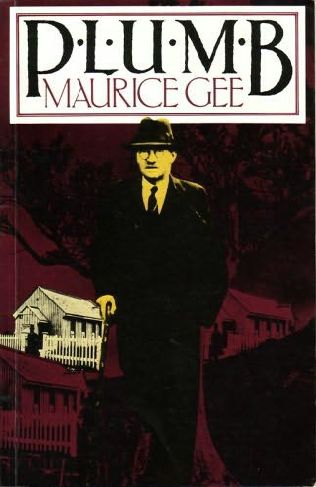
There can be little doubt that among the most exciting things about living in any part of the world is becoming acquainted with the local (farmers) markets, the cuisine, the drink, the music, the slangs … and the stories. And then there are the local writers. While one looks in vain to discover any decent Kiwi journalists being published in this country (to be sure, there are some fantastic bloggers), it’s another game entirely when it comes to academics, poets, and writers of fiction. One of the first enquiries I made even before I landed on the southern climbs that I now call ‘home’ concerned Kiwi authors, and particularly those given to spin a good yarn. And among the names that kept appearing was the Whakatane-born writer Maurice Gee. Gee has penned some thirty novels, and a host of short stories. But the place to begin with Gee, I was repeatedly told, was with his highly-acclaimed book Plumb (1978). So after collecting dust on the bedside box for not a few months, I finally got around to reading Plumb, a book somewhat reminiscent of Marilynne Robinson’s Gilead and Home (with their themes of family, doubt, faith, healing, secrets, generations and death) and which paints the story of the Revd George Plumb, a character moulded in no small part upon Gee’s own grandfather, a pacifist who was sent to prison for his convictions. Here are some of my favourite sentences from Plumb:
- ‘Life on the margins has a pain the sharper for my knowledge that here those I love are in a state of exile’. (p. 3)
- ‘The Presbyterians of Emslie went to their church for religious reasons, not to be told how go conduct their lives’. (p. 57)
- ‘But whoso hath this world’s goods, and seeth his brother have need, and shutteth up his bounds of compassion from him, how dwelleth the love of God in him? A good question, and not to be answered by donations to charity’. (p. 62)
- ‘I [i.e., George Plumb] tried to explain to her [Meg, his daughter] my belief in man’s spiritual destiny … I talked in large optimistic terms – because I had lost my path. I was in darkness again and felt I might never come out of it, and so I made loud noises to persuade back my memories.’ (p. 204)
With the seed of enthusiasm for Gee’s writing now firmly planted, it will certainly not be so long before I read him again. I already have three more in the pile ready to go: Prowlers, Going West, and Live Bodies; and then, of course, there’s the final two volumes in the Plumb trilogy – Meg and Sole Survivor – which trace the ‘Plumb’ story over a further two generations. Yeah for Gee!
An update on Christchurch from the Moderator of Christchurch Presbytery
Martin Stewart serves as the Moderator of the Christchurch Presbytery, and as one of the ministers at St. Stephen’s Church and Community Centre. He is a highly-respected leader of the Presbyterian family here in New Zealand and in the midst of all that is pressing upon his time, emotions and energy, he is managing to keep the wider church informed about what is happening on the ground in Christchurch. Here is his latest reflection, and a pastoral letter penned in his capacity as Moderator:
‘I ventured across town today to the sea-side suburb of Redcliffs to help a woman load up stuff on a trailer – she is moving with her children to Queenstown – I had conducted her husband’s funeral late last year – the load for her is horrendous. We have been told to avoid travelling unnecessarily and we have heeded that. But heading over there was a real eye-opener. The scenes of devastation across the city are one thing on TV and quite another thing seeing it with my own eyes. What a mess and what dust! The piles of sand/dirt on the streets become normal, as does damage to every second or third building. I am surprised to find myself seeing these things and not reacting – it is as if this is has become normal. It is all abnormal, but the all-consuming nature of it numbs me.. Someone sent me the attached photo of the dust at the point of the earthquake – it is frightful.
The trip over was at 9am and I got there much faster than I anticipated in 20 minutes. Heading home at 11.30am was a different story, it took an hour and a half! The main arterial routes are all damaged.
Rev Dugald Wilson and I have been working for the last five months on earthquake matters for the Presbytery. We met with the assessors manager working for the Presbyterians on Friday. He was quite cut up by what he has seen and heard – he is a fine guy and because of this earthquake he will be bumped up the chain and not as available to us as he has been. He along with the insurers manager and engineer firm manager that we have been working with are all church-goers – it has really helped – we feel that the peculiarities of our ways of working are understood. Our assessor friend told us that this event along with September is the largest insurance event in the history of world insurance (recognising also that we are a high-level insured society). It is also the worst earthquake to hit an urban area in the world – not in magnitude but in the nature of the forces caused by the shallowness of the quake and its proximity to a city. With that knowledge, it is remarkable that there weren’t more fatalities. Every day or two the police reduce the projected number of fatalities, and the news today about there being no bodies in the Anglican Cathedral reminds us again that we have escaped the kinds of horror that many other cities and regions in the world have suffered.
The 600 food boxes from the Wellington Presbyterian churches have been delivered and the team have made their way back home’.
Here’s a wee video that tells something of that story:
A Pastoral Letter from the Moderator
Dear friends
What a troubled season we are in. The unfolding tragedy as bodies are pulled from the rubble in our city is simply horrible – we rejoiced that we had escaped fatalities in September, but now we lament the loss of many – the task ahead will be carried out with heavy hearts and take an extraordinary amount of energy. Our hearts go out to the many families and friends who are grieving the loss of loved ones. We are also mindful of the many hundreds of people who are working tirelessly for the welfare of our city – thank God for them all. Many are working in places of extreme danger – what a blessing they are.
We are having to juggle a multitude of tensions in these times – tragedy and triumph, loss and gain, death and life, despair and hope. So often news of human tragedies of great magnitude come to us from far-off places across the waters, but this time it is our city, our families and neighbours, and our houses, businesses and churches that are affected. I hope and pray that you are finding solace in your faith and support in your church families – draw deep from the well of God’s grace, and I also pray that you are discovering new opportunities to love and serve your neighbours and find the face of God in the faces of those who are around us.
The Presbytery has mobilised on a range of fronts – I list just some of them here:
1. Parish Twinning – linking west wide churches with the east side harder hit ones. Rev Hamish Galloway has written the following: “Heard of twin cities – what about twin parishes! Some of our parishes have been badly hit by the earthquake, others have come through with buildings and homes largely intact. This is a time to support each other and we are all looking for ways to do that. In the ancient wisdom of Ecclesiastes 4, two are better than one and a cord of three strands is not easily broken! The invitation is for those who are stronger in the present situation and those who have been hit badly to talk about forming a supportive relationship around things like facilities, personnel, services, etc … What parish can your parish begin this conversation with? What would the relationships look like? We would love to see these conversations initiated and then grow into genuine twin relationships. We would love to hear about it too as it unfolds so that where it is working we can share this as an inspiration to others.
2. A Mobile Minister – we are exploring the possibility of having one of our ministers circulating among the east-side churches – offering support and being a conduit between need and help. What this looks like and what form it takes will unfold in the next while, but in the meantime I have asked Rev Darryl Tempero to work in my name as a liaison person with the east-side churches in our care. He is also the point person helping arrange time out in North Auckland for people.
3. Emergency and relief accommodation – we are receiving many offers of accommodation for people in need from all over the country. Liz Whitehead is coordinating this. It can be for respite as well as emergency. To enquire about this please contact Liz via email or phone 027 257 7112 or (03) 314 8110.
4. Linking with all churches – the Revs Darryl Tempero and Phil King are establishing our linking with the inter-church group who have significant people and skill resources able to be directed to where there is need.
5. Building damage – we are attending to the processes of having buildings inspected by structural engineers, making buildings safe, restoration, and in some cases demolition, with assessors and insurers. We had made significant progress on this prior to 22 February. We anticipate that the problems in outlying areas will still progress swiftly, but given the needs in the CBD and in residences, the restoration process (assessment, costings, etc.) will be a longer process this time. Rev Dugald Wilson and I continue to be the ones to talk to about any issues you have. We work closely with all of the parish liaison people appointed last year. Sadly, St George’s in Linwood has already been demolished. We anticipate that the St Paul’s Trinity Pacific, Berwick Street, and St John’s in Lyttleton churches will also be demolished, and there are serious issues with the Knox, Mt Pleasant and North Avon churches. This is not an easy time.
6. Caring for the carers – I am concerned for the well-being of those who have responsibility for pastoral care, especially the ministers. Finding our way ahead is going to take a very long time and I encourage Sessions and Parish Councils to encourage their ministers to attend supervision, take appropriate time off each week, a weekend a term, and also to have at least a week of leave on the near horizon. I ask you to please be generous in helping your ministers look after themselves.
7. PCANZ appeal – the Presbyterian Church has launched an appeal to support our churches. Congregations and individuals can make an offering by direct bank credit to the Presbyterian Church of Aotearoa New Zealand, account number 02 0500 0086963 00 with the reference: CHQUAKE, or mail their offering to, Financial Services, Presbyterian Church of Aotearoa New Zealand, PO Box 9049, Wellington 6141. There is information about this on the PCANZ webpage. As a Presbytery we have asked the Assembly office to handle all donations and letters of support so that we are freed from that administrative load. Congregations have been invited to seek financial relief. It would help if I could be informed of any plans you have to access this.
8. Messages of Support – the PCANZ website has also listed many of the letters of support from around the world. They are very encouraging – the prayers of millions are with us.
9. Stories – the Archives Department of our church has also been offering informative material about what is happening here along with things of a historical nature. Yvonne’s blog is well-worth a regular visit.
I encourage folk to approach the Presbytery with any concerns you have or information you need. The Presbytery is here to resource you in your partnership in God’s mission in your communities. Our resources are stretched and we are tired, but we are not alone – we have one another and God’s enabling Spirit is our strength. Our Lord calls to those who are weak and heavy-laden to come to him and find rest and their burdens eased.
May the grace of our Lord Jesus Christ, the love of God, and the fellowship of the Holy Spirit be with you all.
Martin Stewart
Moderator
If you are of the praying kind, please keep Mart and the people of New Zealand in your prayers.