Church

‘Towards Global Inclusion of LGBT People Within Catholic Communities’

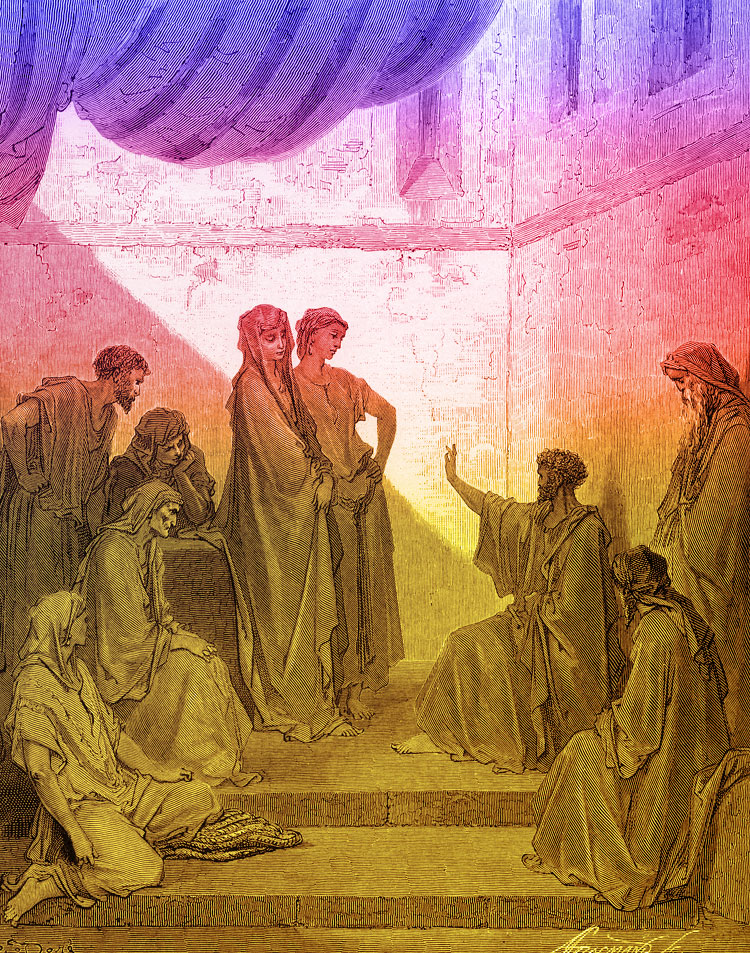
Acts 10. Peter in the House of CorneliusRecently, James Alison was in Rome speaking at The Ways of Love conference. He gave what was a characteristically stimulating, courageous, constructive, and timely lecture titled ‘Towards Global Inclusion of LGBT People Within Catholic Communities’. I repost it here:

I’d like to ask you to join me as we imagine ourselves as participants in a familiar scene from Scripture. The scene is from Acts 10, but imagined from a small distance: looking back a week or so after the events that are described. We are in the house of the Roman Centurion Cornelius, in Caesarea. Maybe we are family members, maybe servants or slaves. Along with Cornelius, we have long been accustomed to being second-class citizens in the house of God. When we accompany our master to the Synagogue, we are called “God-fearers” and are allowed to attend and follow the worship from a carefully separated space. This is because while we know the one God of Israel to be true, and we follow with attention the preachers of Moses, we have not fully converted. So we have not been circumcised if we are male, nor have we taken on board the full yoke of Moses’ law with its observances and commandments.

We attend, then, aware that we are considered impure, and not to be touched. We are often treated with courtesy, and even genuine friendliness by the insiders, though this is invariably tinged with a certain distance and condescension, as befits dealings with those who are not true insiders, and so can’t really be full participants in what it’s all about.

But last week something weird happened. Cornelius had sent three of us to Joppa to invite someone called Peter to visit us. Peter had accepted the invitation, and had actually come into our house, which was, in itself, an oddity, since he was religiously observant, and not a Gentile like us. It wasn’t some mistake: he was quite strong-minded about it, telling us boldly that even though we knew it to be unlawful “for a Jew to associate with, or visit a Gentile” he had become convinced that “God has shown me that I should not call anyone profane or unclean.”

When invited by Cornelius to speak, Peter began by telling us that he truly understood “that God shows no partiality, but in every people anyone who fears him and does what is right is acceptable to him.” Then he told us about a message of peace that had been sent to Israel, one about which we had, in fact, heard some sketchy accounts before. This message had been sent through someone called Jesus, the Anointed One. It turned out that Peter was a friend of this Jesus, from Nazareth, who had been a prophet full of works of power. This man had been put to death as a seditious blasphemer, as if under a curse from God. But God, by raising Jesus from the dead, had shown that the so-called curse, which we had all heard read from the Torah of Moses, had nothing to do with Him. And Jesus had been seen since then by many of the people who had accompanied him beforehand. Indeed had eaten and drunk with them. It had become clear that he had been the long-awaited fulfilment of a series of prophecies, even though he’d fulfilled them in a way no one could possibly have expected. Having been treated by the religiously observant as someone worthy of condemnation, in fact he had turned out to be acting entirely with God’s approval. In this way, by his vindication, he up-ended much of the received way of understanding God among the religiously observant of his people.

Well, it wasn’t clear that Peter had fully grasped the bit he mentioned about God showing no partiality, since he seemed to think, at least at the beginning, that he was telling us something about Israel. And certainly the guys he’d brought with him hadn’t grasped it at all. Yet, as Peter talked, we all found ourselves on the inside of a great movement of the Spirit, praising God and talking in strange languages. We were all astounded, especially the guys who’d come with Peter, since they had seen this before, but among the circumcised. They just couldn’t believe that this was also happening among us second-class citizens.

And yet, as the scene developed, it became clear that what Peter had said about God showing no partiality among peoples, and God telling him not to call anyone impure or profane, was actually true, far truer than Peter himself had seemed to understand at first. We were finding ourselves insiders in this movement of the Spirit just as he and they were, and on absolutely the same terms of equality, without any distinction. What was even more astounding to all of us was how this then led Peter to tell his colleagues to baptize us.

We’d heard a bit about this sign: on being baptized, some among the circumcised people had found themselves sharing in some sort of being involved in Jesus’ life and death. They had discovered themselves emboldened to be sons and daughters of God, becoming part of a priestly people Jesus had inaugurated in his life and death: a priestly people that was in fact the fulfilment of what Israel had always been called to be. And Peter, there in our master´s house, suddenly recognized that the substance of what Baptism was about had evidently manifested itself among us who were Gentiles. How, then, could he withhold the sign from us? So he told his companions to baptize us with water. And we were amazed to find ourselves insiders in the life of God, sharers in God´s holiness, without any distinction based on any of Peter’s, or our own, previous understanding of what was needed to be an insider in the life of God.

Well, each one of us was as shocked as the person next to them: the first-class citizens finding themselves on the same level as us, with all their purity and sense of separateness deflated, and having to overcome a certain repugnance about dealing with people like us; and the second class citizens having to get used to taking ourselves seriously and behave as sons and daughters, rather than dirty servant children who had a sort of built in excuse for impurity.

As you can imagine, word of this got out pretty quickly. Some of Peter’s more scrupulous friends and colleagues were quite upset, and thought that Peter, who had a reputation for being impetuous, had been in some sense frivolous or cheap in having acted as he did. So Peter had to explain himself to them in Jerusalem. Luckily, he didn’t buckle. Even though there was a great pressure on him to backpedal and to apologize for what he had done (thus saving the face of those who really need there to be people like us, so that they can feel special). In fact he told them all quite clearly: “The Spirit told me to go with them and not make a distinction between them and us.” He also described how the Holy Spirit had fallen on us all while he talked, and how he had realized that “If then God gave them the same gift that he gave us when we believed in the Lord Jesus Christ, who was I that I could hinder God?” That gave the scrupulous cause to ponder, and little by little they began to realize that even we could be included inside the same gift of forgiveness as they, with the life that flows from it.

Well, that was a few days ago…we’re still waiting to see what the consequences are, what it’s going to look like for us all to be co-insiders in the House of God, sons and daughters with equal dignity, all sharing in a priesthood whose single purity requirement is of the heart. It’ll be interesting to see: will they drop their ritual food law for us? Will they treat our family structures as equal to theirs in terms of what counts as proper marriage? What will they make of us not having to be circumcised, not having to keep all the commandments that make up their purity code? And what will we make of the freedom of finding ourselves first class citizens, insiders, daughters and sons, not servants or outsiders in the life of God, but starting just as we are. What will be the shape of the holiness that is coming upon us?

I think this account gives a sense of where we find ourselves as LGBT Catholics at this moment, and I would like to develop with you four points that flow from it.

A Matter of Basic Christianity

First, owing to what we have been through over the last years as LGBT Catholics, it has become clearer and clearer to us what the shockwaves emanating from Jesus’ death and resurrection were really about. Jesus in his teaching and by his powerful signs had borne witness to God who had nothing to do with a purity code, no tolerance for any religious exercises, such as sacrifices, that replaced or got in the way of the reconciliation between human beings that he longed to bring about. He did, however, have a very great deal of interest in those considered unacceptable by the society of his day. Eventually he was considered blasphemous and seditious by a confluence of the religious and the civil authorities, and he was murdered. His murder was carried out in such a way as for him to fall under the officially designated curse of God.

The fact of his resurrection was much more than the demonstration of the existence of an afterlife, something many of his contemporaries believed in any case. It was the vindication from on high that the whole of the religious and political structure that had put him to death was under judgment from God. In other words, that he, Jesus, who had looked, to all extents and purposes, like a blasphemous and seditious transgressor, had been telling the truth about who God is in his teaching. This means that anyone at all, from any nation under the sun, who can perceive that he or she has been in some way involved in the sort of false and violent construction of goodness or badness which Jesus up-ended, can be forgiven for this, and so can enter into participating in the life of the Living God without any special external markings.

It is because of this that there is, formally speaking, no Christian religious law from outside us. The Image of Himself that God gave us in Jesus was not that of a Lawmaker, but that of the self-giving Victim of both civil and religious lawmakers. Given this self-definition of God, no definition of people derived from the outside of who they are, and which might make them pure or impure, sacred or profane, could stand. Instead there is only the understanding that starting exactly from where we are, exactly as we are, we are invited to become daughters and sons of God, insiders in God’s house. What God calls good is not some external definition, pleasing some lawgiver, but what is good for us. That which is human is loved, and is stretched through love into sharing in the life of God. It is not in our lopping off bits of ourselves, psychologically or physically, that we are saved: in spite of ourselves, by agreeing to jump through certain hoops, as it were. Rather, it is in our discovering and becoming who we were really meant to be all along, that we come to reflect the glory of our Creator. This, instead of the much-diminished version of ourselves that we had somehow got caught up in, and from which Jesus’ death and resurrection shocks us into freedom.

But this has been exactly our experience as LGBT Catholics over the last thirty or so years. It has become clearer and clearer, until it is now overwhelmingly clear, that what used to seem like a self-evident description of us was in fact mistaken.  We were characterized as somehow defective, pathological, or vitiated straight people; intrinsically heterosexual people who were suffering from a bizarre and extreme form of heterosexual concupiscence called “same-sex attraction.” That description, which turned us, in practice, into second-class citizens in God’s house, is quite simply false. It turns out that we are blessed to be bearers of a not particularly remarkable non-pathological minority variant in the human condition. And that our daughterhood and sonship of God comes upon us starting as we are, with this variant being a minor but significant stable characteristic of who we are. One, furthermore, which gives gracious shape to who we are to be. Of course, that daughterhood, that sonship, turns the characteristic into something more as we overcome the concupiscence that is proper to us all as humans, developing and humanizing our capacity to love so that we become ever fuller sharers in the life of God.

And this means something quite significant: the only way a teaching can genuinely be Catholic is if it is bringing to mind something that really is the case about the human beings in question. Thus, the moment it becomes clear that what used to seem like an accurate description of who we are, a description which imagined that it sought our good, is not in fact accurate, but quite simply mistaken, then at that very moment it ceases to be possible to maintain that the teaching that flows from that description is Catholic. For the Catholic teaching follows the discovery of what the Creator shows us really is.

In other words, as in the book of Acts, the Holy Spirit does not wait for Peter’s permission before starting to produce sons and daughters of God. Quite the reverse. In fact Peter finds himself learning that what he had thought to be something true about God´s holiness and the necessity of abiding by the Book of Leviticus in order to enter into that holiness, was not the case. As he undergoes this learning, so the purity code becomes relativized, coming to be received as a non-binding series of taboos: ways of defining people from the outside rather than saying anything about who they are starting from themselves.

And this is exactly where we find ourselves: without it being the case that there is anything at all that Peter and his companions can do to stop it. As the Creator has made abundantly clear to us what really is the case, through the normal, Spirit-inspired human process of learning about Creation by which we enter as insiders into God’s Wisdom, so the teaching concerning us being bearers of an objective disorder inclining us to intrinsically evil acts has revealed itself to be a taboo, thus not from God, and so not a proper part of Catholic teaching.

Catholicity, Rather than Inclusion

My second point is to try and draw out some consequences of this. You asked me to speak to the title “Towards Global Inclusion of LGBT people within Catholic communities,” and yet the theological approach which I offer you is not really about inclusion of LGBT people within Catholic communities, any more than Acts 10 was about the inclusion of Gentiles within Jewish communities: a cap-in-hand exercise in which second-class citizens request, and are given humble places at a first class table. No. What we have instead is the somewhat amazing realisation that, exactly in the degree to which it has become clear that we are simply the bearers of a not particularly remarkable non-pathological minority variant in the human condition, in that moment, as we find ourselves seeking the Lord, we are found to be bearers of Catholicity on terms of equality with everyone else. Catholicity gets to be redefined, through no merits of our own, by the objective element of humanity that we bring to the table simply being present as such.

Why is this important? Because it means that it is not we who find ourselves adapting to someone else’s house-rules. All those in the house find ourselves adapting to the fact that, together with Peter, we are all learning something new about being human  And that all our understanding of good and bad, insider and outsider is going to change because of this. The process is obviously much more painful and difficult, at least initially, for those who had a strong stake in promoting a form of public goodness in which we were bit-players, as necessary examples of what was wrong. And much more joyful for those of us who are finding that after all we have been telling the truth. It is not the case, as we were so often told, that we are simply being particularly self-indulgent, or that our love is harmful to others, or that we are crazy to think that we are normal, or that we have been misled by hedonism and relativism into purely subjective, unrealistic desires that are part of some dehumanising trap.

Please notice what happens as this work of the Spirit becomes evident, as our participation as joint bearers of Catholic truth-telling becomes apparent. First of all, there is rage and hatred from those who had a strong investment in what had seemed to be from God, but turned out to be just another idolatrous taboo demanding sacrifice. These people need help and mercy, our magnanimity rather than our resentment. Above all, we should not seek to provoke them or scandalize them, tempting though it be. Next there is something rather subtler, which I think we should look at carefully. This comes from those who are not full of rage, but who have a love for the old wineskins. These people wish to say something like “Well yes, we see that there has been a problem with how the Church has handled gay people in the past. And none of us want to continue with that. However the Church has a right, in tolerant, multicultural societies not to allow itself to be defined by what is in fact true about human beings. Instead we insist on the right to be able to keep alive our own, pious ways of doing things without interference.”

But here’s the trouble: the moment people head down that path they are refusing Catholicity and creating a church in their own image. Because they are turning the Catholic Church into a group defined by certain house rules, which are independent of reality. In other words, they are recreating a form of holiness that is over against others considered to be impure or profane. This is a regression to Second-Temple Judaism. At the very moment people do this, they automatically exclude themselves from the Catholicity of the Church, for they are seeking to turn it not into God’s sign of God’s longing for all humans to be reconciled with God through Jesus, but instead into their own sign of their own longing for a particular group with a strong group identity and carefully defined boundaries concerning who is in and who is out.

So please, I beg you, don’t, out of some misguided courtesy, think that such people define what Catholicity is. Catholicity is defined by God alone, as God shocks us by breaking down all our socially and culturally constructed barriers, by leading us into truth about our being Jesus’ brothers and sisters, creating equal-heartedly a way of being human together that doesn’t call for any form of comparison, one that flows from the Crucified One who forgives us.

Another slight variant on this theme comes from those who say: “Yes, there is something wrong with the way the church has handled LGBT people, but you shouldn’t be in a hurry to change anything. Let the hierarchy organize, in a proper and peaceful manner, any change that must be made.” That is to say, those who can’t even bring themselves to recognize publicly that we have been telling the truth, and they have been binding our consciences based on a taboo, are insisting on managing a change towards truthfulness on their own schedule. They should be so lucky! This is not how the Spirit of God works, as the account from Acts makes clear. The Spirit leads us into all truth, kicking, protesting, shocked and dishevelled, by insisting on producing boldness of speech in season and out, when it is convenient and when it is not. And those who are most shocked and come running along last are those who think that any change should be managed by them on their terms, preferably without their losing face by having to admit that they too need forgiveness.

No, truthfulness does not wait for the convenience of those wedded to untruth before peeking out. Itbreaks out, as if from captivity, bearing witness to the One who sent it to run wild among us, and takes us on a giddy, and ultimately joyful ride. The Spirit does bring the peace that comes with truth, but not by following the schedule of those whose fear would hold it back. Peter was truly Petrine in listening to the Spirit and recognizing he had been wrong about what makes for holiness. It was in doing so that he became a precarious-seeming centre of unity who was in fact a Rock, while all the forces of reaction sought to buffet him about. Neither he, nor his colleagues, set the agenda or the timetable.

Preparation for Evangelization

My third point is: what does this say about our life in different cultures? One of the things people say is: “All this about LGBT people is a decadent Western value and we should defend ourselves against it.” But the people they are defending themselves against are not decadent westerners, but their own brothers and sisters, Ugandans, Nigerians, Iranians, Russians, Saudis, Jamaicans. These are our sisters and brothers who have discovered something true about themselves, and about their capacity for love, and know that what is true makes sense to them. And here is what is remarkable: this discovering of something that is true is working in exactly the way that the Gospel said it would, and following just the dynamic of the Spirit that flows upon us from Jesus. And yet bizarrely, Christian leaders of all denominations are joining together with leaders of other religious organisations, ones that not only do not know of the Holy Spirit, but are in some cases adamantly opposed to the existence and enlivening effect of any such thing. Such leaders would rather fence themselves round with all the trappings of “religion” than spread the Good News of the One who has relativized all religious formalities in order to bring us into a new humanity starting from the rejected and precarious.

But this means that we LGBT Catholics can step into the forefront of the evangelization that Pope Francis has asked us to, and we can do so as delighted and joyful recipients of this new humanity. We, as well as anyone, know how the Spirit of God humanizes us, not destroying culture, but defanging it from all that is violent and destructive of who humans are called to be. We know that thanks to Jesus there is no such thing as religiously pure or impure food, there are no such things as religiously mandated forms of mutilation, genital or otherwise. We know that only culture, and never God, has demanded the veiling and covering of the glory of the head and hair of women. We know that the same Spirit that taught us these things, making available to us what is genuinely true, has enabled us to discover the graced banality of our minority variant condition, allowing it to be the shape of our love that turns us into witnesses of God’s goodness as we are stretched out towards those who are genuinely suffering from terrible injustice and deprivation.

This does not merely mean that we are able to pass on a piece of information to others. It means that we are bearers of Catholicity in our flesh. We have found ourselves prepared to be bearers of the Gospel precisely because of this most Catholic of things: we have been intimately part of the process of self-critical correction of culture which is how the Spirit keeps the church faithful and alive. So in each culture in which we live we are thus in a great position to help our sisters and brothers undo the quite local and particular taboos, violence, and structures which masquerade as being of God, but are in fact the work of idols. Who would have thought that it would be LGBT Catholics who could bear witness to the freshness of the Gospel, the way it brings creation alive, even the value of natural law, not as a trap but as an adventure? Talk about the stone that the builders rejected!

Holiness, Speech and Witness

My final point. What is the shape of the holiness that is coming upon us? The most debilitating effect of the taboo under which we have labored is not that it prohibited certain sexual acts. That has never held many of us back. Not even, as has become abundantly clear, many of those who took on the burden of some sort of formal commitment to avoid such acts. No, the debilitating effect of the taboo, as of any infection by idolatry, is that it damages the imagination, making it impossible to imagine the good. When our concupiscence was falsely defined as an objectively disordered form of heterosexual desire, then of course all of our acts were as bad as each other, and we had no incentive to humanize them. “No snacking between meals” might be a useful instruction if it teaches people to prepare for enjoying the next meal better. But “no snacking between meals, and in your case, no meal either” is a sure recipe for binge- snacking.

But now, thank heavens, we are beginning to discover what might be the shape of the meal, or meals, towards which it might be worth ordering our appetites. So please, as part of our discovering the shape of the holiness that is coming upon us, now that we are no longer second class citizens with a resentful victimary excuse for our lack of dignity, let us allow our imaginations to be enlivened by the Spirit. We are already discovering some of the ways in which we can share in Christ’s self-giving towards others – civil marriage, adoption of children, and in some cases freely chosen singleness of life. (This latter was, of course, impossible under the teaching of the taboo – we used to be taught that we had no option but to be celibate, and thus the option was not really free, since it was not leaving a good for a good, but avoiding an evil which it was our solemn duty to avoid anyhow). In what other ways are we going to discover what we are called to become as a blessing for others?

Here is a hint: let us not allow this holy work of the enlivened imagination to be overshadowed by those who would rather have the discussion without addressing the question of whether we are in fact objectively disordered or not. In the New Testament, no one who insisted that the Gentiles needed to be circumcized in order to be saved had anything genuine to offer in the discussion concerning appropriate shapes of holiness among the baptised Gentiles. Just so, no one who is unable to concede the legitimacy, the potential for purity, of our loving flowing from who we are, is able to offer genuine help in our working out of what sort of marriage or adoption laws are appropriate for us, let alone what the appropriate forms of liturgy might be.

Many religious authorities in different countries try to hide behind the claim that in “defending Marriage” they are not doing or saying anything about or against gay and lesbian people. If they are honest in this, then let them show that their own conscience is not bound by taboo. Let them clearly renounce the notion that gay people in partnership, about whom they claim they are not talking, are ipso facto indulging an objective disorder, are impenitent practitioners of grave sin, and thus would be seeking to sanctify something that can never be approved. Once these authorities have shown that their conscience is free, and thus that there is, in their understanding, no rivalry between the form of flourishing proper to heterosexuals in marriage, and what might turn out to be the appropriate forms of flourishing for us, then, by all means, they may have something genuinely helpful to offer us all. Because they will legitimately be able to contemplate something of how, in our case, as in theirs, grace perfects nature. Something, that is, which flows from who we are, rather than in spite of what we are. However, for as long as their allegiance is to the taboo, they can be no judges of our flourishing.

No, the truthfulness and peace, the zest for the real, that come with the consciousness of being a daughter or a son: only these dare birth the imagination of the arduous good that is coming upon us. An arduous good to which we may justly aspire, and in the working out of which we hope to be found. The boldness that flows from being able to speak truthfully out of an unbound conscience is not an extrinsic add-on to being Christian. It is intrinsic to what being Christian is all about. It leads to being able to bear witness, without which there is no Christianity. For us linguistic animals, being able to talk cleanly and openly is essential to being able to live cleanly and openly. It is as we talk and share with each other the experiences of love and of becoming that we will discover in our relationships who we are called to be.

Here we are, gathered in the city of Peter. Let us ask for the prayers of Paul the Apostle of the Gentiles, who was not afraid to call Peter out for backsliding, and who taught us: “Omnia munda mundis”—all things are pure for those who are pure. St Paul the Apostle, pray for us.

[The image, ‘Peter in the House of Cornelius, Acts 10:1–48’, is taken from The Official King James Bible Online. I figured that if the KJV was good enough for the Apostle Paul, then it’s good enough for the blog too.]
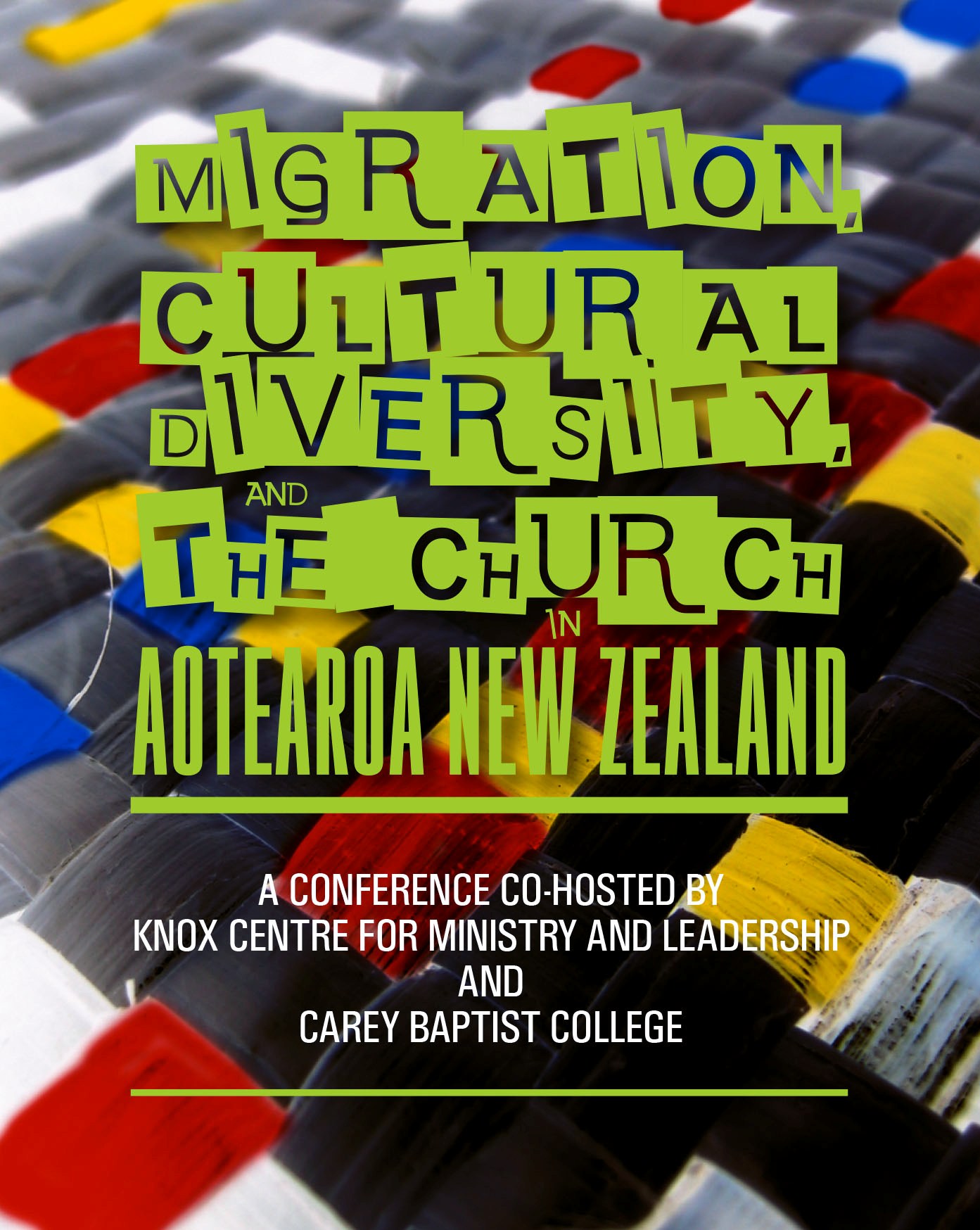

Migration, cultural diversity, and the church in Aotearoa New Zealand

?????My colleague, Kevin Ward, has posted a wee reflection on a recent conference that he co-organised around the themes of migration, cultural diversity, and the church in Aotearoa New Zealand. His observations have implications not only for church life in NZ but also for that in other places in the world, as these words from Phillip Jenkins suggest:

Let me suggest to you that in 30 years, there will be two sorts of church in the world. There’ll be the ones that are multi-ethnic, transnational, and multi-continental. They are constantly battling over issues of culture, lifestyle, worship, and constantly in conflict, debate and controversy. And those are the good ones. The other churches will have decided to let all these trends pass them by. They’ll live just like they’ve always done with an average age in their congregations of 80. Personally, I’d much rather be in one of the ones that is recognizing, taking account of the expansion with all the debates and controversies.

You can read the rest here.

The Marriage Amendment Act One Year On: How are the Churches Responding?

kiwisLast night, the Centre for Theology and Public Issues and the Otago University Students’ Association Queer Support co-hosted a public event on how churches are responding to the Marriage Amendment Act that passed through the New Zealand parliament last year. A wide number of people were invited to speak at the event, five of whom said ‘Yes’. These were Kelvin Wright (Anglican Bishop of Dunedin), Greg Hughson (Methodist Minister and Otago University Chaplain), Mark Chamberlain (Roman Catholic Priest at the Church of the Holy Name and Otago University Chaplain), Bruce Hamill (Minister at Coastal Unity Presbyterian Church and Convenor of the Doctrine Core Group for the Presbyterian Church of Aotearoa New Zealand), and Neill Ballantyne (Queer Support Officer, OUSA).

Each were invited to respond to the following three questions:

Question 1: In general Christian Churches in New Zealand were opposed to the amending of the Marriage Act to include couples of the same gender. This passed on the 17th of April 2013. This amendment allowed for ministers to refuse to marry a couple for matters of conscience. In your experience how are the churches responding to this change and in your opinion how do you think they should respond?

Question 2: It has been said that there is a sense of inevitability that the church will become more inclusive in its attitudes towards LGBT people and sexual morality. How would you respond to this claim?

Question 3: What does the marriage equality process show about the relationship between church and society in New Zealand on issues of morality. Are the churches still able to give moral leadership to wider society or is wider society giving leadership to the church?

Kelvin did well to highlight the nature of Anglicanism as broad and determined to hold together, through its polity and eucharistic centre, irreconcilable positions on all manner of subjects, a characteristic for which it remains deeply indebted to Queen Elizabeth I. Greg documented something of the long and painful journey that New Zealand Methodists have travelled on their road to, in 2003, signing a Memorandum of Understanding  which would allow diversity of opinion on the matter of marriage of LGBT persons and which made it possible for people to stand together with their differences and ‘with integrity’. Mark draw attention to the nature of all human sexuality and relationships as ‘gift’, stressed that the church must walk a difficult path of being deeply immersed in the culture while not being held captive to public opinion and to take its marching orders from the Gospel as interpreted through, and in continuity with, Scripture and the tradition. He could not, therefore, envisage a time when Rome might change its line on marriage. He did not, as far as I can remember, use the language of ‘sacrament’, although such was clearly informing his definition of marriage. Neill’s overall point last night was a good one – that the inclusive nature of the kingdom (or ‘queendom’) of God is radically at odds with the expressions of pharisaism and gate-keeperism that too often characterises those communities called to bear witness to that kingdom – but he might have found a more gracious and considerate way to make it.

The stand out response, in my view, was that by Bruce (who managed to cram a two-hour lecture into about 10 minutes!). Below is a transcript of his response:

–––––––––––––––––––––––––––––––––––––––––––––––––––––––––––––

Thanks for the privilege of being part of this forum and also for the commitment of CTPI to let theology out of the closet (so to speak) on this issue.

Let me speak about what I know a little about – the Presbyterian Church of Aotearoa New Zealand – my denomination. Our response as a denomination was to reaffirm a traditional definition of marriage in stark contrast to the Act. This decision came after many years of bitter conflict in our General Assemblies, first over homosexuality and leadership and more recently over same-sex marriage. At this point the conservative view is in the ascendancy and consistently gets over 60% of the vote on these matters. It looks as if this next Assembly will be no exception and I suspect there will be a move to ensure that those minister’s whose conscience calls them to reject the national church position will no longer have the possibility of ‘conscientious objection’ on this matter.

I know that the denominational response is what the ‘public’ sees. However, in my view the denominational response is unlikely to be the best response. Let me explain. In my view, churches need to respond with discernment in community – and denominational bodies are not really communities (certainly not primary communities) let alone communities of discernment. Even the way most local Presbyterian congregations are structures means that thy usually don’t function well in this way.

Before I say something about what I think the Church should have done (and why), a few comments on Question 3.

I think the response of the church to date shows at least two things about the relationship between church and society.

  1. It shows that the wider society has been profoundly influenced by Jesus Christ and his crucifixion, and his decision to live in solidarity, without violence, with those who were the victims of society. We cannot underestimate the influence of this story on our culture in the West.
  2. It also shows a willingness on the part of the church not to take the decisions of the wider society as morally authoritative. Both of these things I take to be good things.

As for moral leadership, I think this is a loaded and not particularly helpful question. You could say that both Church and Society are giving moral leadership but with a different set of morals, or in different directions. The question assumes that there are universal moral principles at stake here that all parties agree on and then someone just needs to act on or make statements on in order to give leadership. If there is no such thing then it’s not a question of who’s leading who but of who’s leading in the right direction. In other words the question of who’s leading who can only be answered in the context of a wider narrative of what the good life is. For Christians this is really about what it means to live in conformity to and communion with Christ and thus ‘with the grain of the universe’.

The irony is that, in my view, the wider society, with its willingness to make space for minority groups, seems to be more closely conformed to Christ on this matter than those who claim to be Christian.

To return to Question 1: In my view what the PCANZ should have done is not simply to reaffirm the traditional definition of marriage but should have been prompted to rethink the limits and nature of our understanding of marriage. Actually in 2012 when the PCANZ did reaffirm a traditional definition there was also a motion put to the Assembly that the Doctrine Core Group (which I convene) produce a discussion paper on the theology of marriage. The motion was rejected. It was only in February of this year that the Council of Assembly did call for a discussion document, which we have since produced.

What I want to do today is offer four reasons, from within the tradition itself, in support of a rethink.

  1. As a protest wing of the catholic church, we of the reformed tradition have a little motto which goes ‘the reformed church is constantly being reformed’ (we like to say it in Latin so no one understands it). I think the point is a simple one. The institutions within which the people of God live their lives are not platonic forms. There is constant pressure from the triune God for their reform. The working out of the gospel means that the church is always learning how to be the church. Reform of institutions is something we are called to do on good authority. Both Jesus and the Apostles were right into it. Think of Israel’s great institutions – the Temple, the Purity Codes and the Sabbath – none of which came of unscathed with their encounter with Jesus of Nazareth. Not to mention the way Jesus profoundly challenged the centrality of ‘Family’. I often wonder whether Jesus’ motto ‘the Sabbath was made for human beings, not human beings for the Sabbath’ might well apply to marriage. Think of Peter’s vision of unclean creatures and the way it paved the way for a rethink of ethnic identity. Look at Paul’s deconstruction of the role of the Torah (Law) in the light of Jesus’ coming. Should we exempt marriage from such reforming processes? It seems to me that the onus is clearly on the traditionalists to come up with a reason for why the incarnation makes no real difference to how we think about marriage.
  1. Secondly, in Christian ethics, nature and the structures of creation play a subordinate role to the ‘new creation’ in Christ (see, e.g. Gal 3.28). This is to say that Christians understand human life and action in the light of its ‘end’ (eschatologically). For us the fulfilment of creation’s purposes, the ‘kingdom of God’, has arrived in the middle of time interrupting all our practices and redirecting them towards a new form of life. The good life is an embodiment of the future made possible now. In Paul we see this as he elaborates on the close connection between the church’s relationship to Christ (which he calls ‘a profound mystery’) and the marriage relationship. A similar analogy is drawn in Hosea. And both, as Rowan Williams observes in his wonderful essay ‘The Body’s Grace’, remind us that ‘there is a good deal [in the Bible] to steer us away from assuming that reproductive sex is a norm, however important and theologically significant it may be.’ When the Bible talks of marriage it has little interest in the pragmatics of human reproduction. And so the case can be made that whatever biological assumptions have been made up until quite recently in discussion of marriage, these things don’t really get to the point of marriage as the church is learning to practice it in the light of the eschaton.
  1. Having said that, the ‘kingdom of God’ arises in the context of an old creation and is not divorced from biology and history. An account of marriage must in turn take into account any new understanding of creation and of human biology and psychology (and so on). Scientific disciplines help us at precisely this point. In the ancient world of the biblical writers there was little understanding that the dynamic processes of human desire might be constrained and structured according a same-sex orientation as well as a heterosexual one. This is a significant mandate for reconsidering the modes of marital expression that the kingdom of God might take among the people of God. So (1) the call to reform (2) the priority of eschatology (3) the biological context, and finally what I want to call …
  1. Marriage as sanctification: The biological context of the Christian life suggests to us that there are some partners, for some of us, who are apposite without being opposite. It may be that this situation ought not to bar same sex couples from marriage precisely because of the significance role that marriage can play in Christian discipleship. If indeed the bodily relatedness, the one-fleshness of marriage is a kind of icon of the trinity (the relatedness of God) and if indeed it reflects something of the mystery of Christ and his body, if indeed it is a discipline of learning to love our nearest neighbour as our self, if in short it is really about sanctification, then the conservative elements in the church may be effectively seeking (in the words of Eugene Rogers) to ‘deprive same-sex couples not so much of satisfaction as of sanctification.’ (A lot more needs to be said here of course). Because bodies matter in salvation. Because we are being saved as embodied creatures in all the particularity of our limitation, then we should seriously consider revising the limits of our doctrine of marriage. To quote Eugene Rogers again ‘no conservative I know has seriously argued that same-sex couples needs sanctification any less than opposite-sex couples’.

For these four reasons I say, it’s time for a rethink.

In conclusion (and in response to Q. 2): Is a more inclusive church inevitable? There is no inevitability this side of the eschaton. However, if we don’t define ‘church’ according to the particular institutions that claim that title, I remain hopeful (confident even) that God will raise up communities who will find ways of including LGBT people in the way of Jesus Christ.

‘Synod’, by Bill Wallace

synod

Synod –
    a piece of time stolen from the rest of life;
    a Law book infested, resolution dominated monument to the status quo;
    a time for living in the ‘cloud cuckoo’ land of statement,
        letter, and a world controlled by church leaders;
    an occasion when right answers are given to wrong questions
        and democracy is worshipped as deity.

Synod is
    a place where illusions are reinforced –
    for the solemn, it provides evidence that life is a machine operating on dour efficiency;
    for the passive, proof that they have no contribution to make;
    for the lively, confirmation that the rest are rather dull and dim-witted;
    for the pious, a demonstration that they alone are in touch with God.

Synod –
    the district feast
    in which clowns have been replaced by committees;
    overeating by verbal obesity
    and the celebration turned into a question.

    Now, before the insecure take umbrage
    and the machine revenge,
    let me hasten to add
    that these are the thoughts of one for whom

    SYNOD HAS COME ALIVE

    because he now sees every human gathering,
    whether on church premises or not,
    as part of the age-old struggle,
    the struggle to be truly human –
        to be liberated from the chains which we make for ourselves,
        to escape from the masks which we choose to wear
            and
        to see people and things as they really are.
            In short

Synod is
    beginning to become an act of worship in which
    resolutions become devotions,
    people become prayers,
    and the laughter of the inner child
    becomes the adult’s life force.

‘O God, help us
    with joy to see the ridiculous behind the reasonable,
    with hope to see the world bursting out of the church,
    with love to see the people taming the machine;
Then the groan in Synod
will evidence the labour of new birth
rather than the death cry of the living church
crushed by its own organization’.

Communion: On Being the Church – the Lutheran–Reformed Joint Commission

Lutheran-Reformed dialogue - Communion. On Being the Church_Page_01The latest report of the Lutheran–Reformed Joint Commission between the Lutheran World  Federation and the World Communion of Reformed Churches is now available. Its title is Communion: On Being the Church. To read and/or download the report, click on the pretty picture.

Dialogue of Love: Breaking the Silence of Centuries: a review

John Chryssavgis (ed., with contributions by Brian Daley and George Florovsky), Dialogue of Love: Breaking the Silence of Centuries (New York: Fordham University Press, 2014). 96pp. ISBN: 9780823264001.

A guest review by Graeme Ferguson

Dialogue of Love was prepared to coincide with the meeting between Pope Francis and Bartholomew, Patriarch of Constantinople, on 25 May this year in Bethlehem. Dr Chryssavgis – who has edited three volumes of the writings of Patriarch Bartholomew, along with his own writings on ecology, on the theology of the Desert Fathers, and on spirituality – is one of Australia’s leading theologians with wide ecumenical experience. He is ideally suited to edit this celebratory gift to the Church both East and West. (He has recently been elevated to the post of Ecumenical Archdeacon of the Throne by the Patriarch.)

Although the meeting between the leaders of the Churches of the East and of the West was overshadowed in the secular news by other significant gestures by Pope Francis during his weekend visit to Jordan and Israel, it marked fifty years of changing relations between the Churches since the day when Patriarch Athenagoras and Pope Paul VI first greeted each other in Jerusalem in May 1964. When Athenagoras was asked by reporters what he would say to the Pope, he replied: ‘I came here to say “good morning” to my beloved brother, the Pope. You must remember that it has been five hundred and twenty five years since we have spoken to one another!’ This breach was the ‘great silence’ that had marred any communication between East and West.

Dr Chryssavgis details the steps in the ‘pilgrimage towards unity’ with loving regard and a fine attention to the momentous nature of the changes first raised in the Second Vatican Council. This chapter gives an insightful overview of the steps that have been taken. Relations between East and West have become cordial and mutually gracious.

Fr. Daley has been closely associated with the theological conversations between the Churches in North America. He deals with the theological questions that have needed to be considered in ecumenical conversations. His chapter is a fine reminder of the way ecumenical courtesies are fostered and developed as people work together to overcome the breaches of past centuries.

The third contribution is a previously-unpublished paper giving Fr George Florovsky’s evaluation of the 1964 meeting where he dealt with the questions that gave rise to the breach and the style of dialogue needed to move once more towards unity. He writes of the hope that lies beyond the contradictions in the self-understanding of the Church of Rome, as the watchman watches for the morning to break (Isa 22.11). Florovsky taught in Edinburgh as well as Princeton, and helped both catholic and protestant theologians to act with respect and grace towards each other.

Together, these articles focus well the grace and courage with which the leaders of the Churches bring to their meetings with each other. They are theologically perceptive, written by people who engage in the dialogue as it continues, and convey a sense of joyous hope as people begin to discern the outlines of a restored and reconciled Church. Dr Chryssavgis has prepared a gift which warms the heart as it stimulates the mind. It is an encouragement to continue the pilgrimage further.

_________________________________________________________________________________________________________

Graeme Ferguson is the former Principal of United Theological College, Sydney.

The risky business of being ‘reformed’

end of the lineIn her book Moving Forward, Looking Back: Trains, Literature, and the Arts in the River Plate, Sarah Misemer describes the trains of Argentina as symbolising ‘the dialectical influences of the forward trajectory (progress/future), while at the same time embodying the backward glance (regression/past)’. When travelling on an old train in particular, despite being aware of the technology that makes such eccentric carriage possible, one can have a sense that even though one is moving forward, there is also the sense that one ‘travels into a quaint and less mechanized’ world, escaping backwards in time.

The same theme is picked up by artist Michael Flanagan in his brief essay ‘The Backward Glance’. He explores the intersection between time and memory, suggesting that our vision of the past operates akin to the view of a disappearing landscape glimpsed from within a moving train: ‘How can the Past ever be anything but a mystery … We see life as if from the end car of a speeding train, watching through the rear window as the tracks slip away beneath us … everything passing, receding, disappearing into a point on the horizon’.

Insofar as this is true of our experience of train travel, the same might be said of our thinking about Christian community – we can lament that our past ebbs too quickly. Such lament can encourage the creation of romanticised images, like those of nineteenth-century artists George Angas and Gottfried Lindauer who Europenised the New Zealand landscape. Flanagan calls this the ‘nostalgia problem’.

At the other end of the train are those who seek to drive on, aware only of what lies in front. Like perpetual teenagers, they are those for whom the past is forgotten and irrelevant; indeed, it is not even part of their being today.

But here the analogy breaks down, particularly for those of us who profess to be concerned with the project called ‘reformed’: we have no tracks upon which to travel, and even the existence of the train itself is not a sure thing. Entirely bereft of the familiar and the certain, the reformed – i.e., that churchly tribe of which Presbyterians form the largest part – are concerned to live entirely dependent upon God’s speech, upheld solely by the Word who continuously calls us into being. To be reformed is to be always open to the risky possibility that what one hears from God tomorrow might be entirely at odds with what one heard yesterday.

Such a situation poses a real challenge – and opportunity! – for a tradition concerned to confess the faith by way of formal statements. One of the hazards of writing confessions, for example, is that institutions are then tempted to build upon them, to trust in them, to look to them to do the work of safeguarding whatever it is that the institution most values – to turn the living Word of God into a ‘thing’. Even the desire to confess and embody our unity in Christ can mask efforts which are at core idolatrous: namely, to locate the unity of the Body of Christ in something – in a ‘thing’ – rather than in the person of Christ himself and his claims upon us, claims which precede and bring under judgement all our efforts.

The Christian community is called to be at once more free and more bound than a train. It is called to be entirely unburdened from all efforts to keep it from falling off the rails, and it is called to be entirely bound to him who alone brings it into love’s true freedom.

_________________________________________________________________________

This piece first appeared in ‘Theology Matters’, Spanz 58 (Winter 2014), 16. A pdf version is available here.

mission: a statement

Pablo Picasso, 'The dove and its little ones' (Lithograph, 1947)

Pablo Picasso, ‘The dove and its little ones’ (Lithograph, 1947)

As a people claimed by the Spirit of the gospel, we believe that God desires to gather all creation under the reign of Jesus Christ, to bring all creation into unbridled communion with and in God, and with itself. To this end, God – the very One who, in the movement of missionary love, continually broods over creation and initiates a friendship with Abraham pregnant with promise – elects a people called Israel, makes them into a priestly nation to offer worship on behalf of all the world’s nations and peoples with a view to their reconciliation to God; and, in the fulness of time, God, in Jesus of Nazareth, moves anew into the world in order to reconcile all things to God; and God also calls forth a new community who, with Israel and with Jesus, participates in and bears witness (martyria) to God’s own loving and reconciling activities in the world. Born of the life, death and resurrection of Jesus, this new community is called ‘the Christian community’ (or ‘the church’).

We believe that the Christian community, a creation of God’s Word in election, is a people called by God to participate and share in God’s mission in this world – to be a humble, prophetic and celebratory sign, embodiment and hope-filled foretaste of life in the coming reign of God. It is a people sent by God in the name of Jesus and the power of the Holy Spirit to witness to, and to represent, the liberating, empowering, healing, and reconciling love of God wherever such is identified. It is a people empowered by God to embody in its own life the mystery of salvation and the transfiguration of creation.

Mission, therefore, is not an ‘optional extra’ for the Christian community but is of its essence, finding both its genesis and its telos in the trinitarian relations and in God’s own movement into the world, the object of God’s love. The Christian community cannot be true to itself apart from this action of bearing servant witness (martyria) (i) to God’s will for the salvation and transformation of the world; (ii) to God’s command to maturing discipleship; (iii) to God’s compassion, mercy and advocacy for the poor, the needy and the marginalised; (iv) to God’s vision for the flourishing of societies that reflect the justice of love and seek the end to unjust structures; and (v) to God’s desire for the integrity of a creation liberated from abusive, irresponsible and destructive actions.

Kerry Enright: an interview

Kerry Enright and Pastor BerlinLast night’s edition of the ABC program Sunday Nights, hosted by John Cleary, included an interview with the Rev Dr Kerry Enright, the outgoing National Director of UnitingWorld, and a friend of mine. During the interview, Kerry reflects upon two of his favorite topics – the catholic nature of the church as gift from God and as sign to the world, and on the role of the church in civil society (here the discussion is focused particularly on Fiji, Australia and New Zealand). He also talks a bit about his forthcoming appointment as minister of Knox Church (Presbyterian) in Dunedin. I’m looking forward to welcoming Kerry back to Dunedin, and back to the PCANZ, soon. You can listen to the interview here.

And while I’m mentioning Kerry, there’s also an older interview in which he talks about God’s mission and about the significance of partnerships that UnitingWorld enjoys:

A wee rant on the unwelcoming church

‘The feeling of being unwanted is the most terrible poverty’. – Mother Theresa 

Everything is a sign, literally. No-thing points to nothing. And over the past few weeks, I’ve been noticing some very literal  and very disturbing  signs around some churches that I’ve visited; signs which indicate, at the very least, some serious confusion about the nature and raison d’être of the community that gathers together in the name of Hospitable Love. Film isn’t able to capture the mustiness and temperature (or lack thereof) of some of the depressing solitary confinement cells (sometimes these are called ‘play area’, or ‘cry room, or ‘creche’) that I’ve seen recently, but here are just a few shots (including one that I pulled from somewhere else on the web) of some other signs that I’ve happened across:

This slideshow requires JavaScript.

For those who may be interested, I’ve uploaded a copy of Peter Corney’s wee and somewhat dated booklet, The Welcoming Church. It has some good practical ideas in it. But seriously, folks; hospitality is not rocket science. If someone takes the trouble to visit your home, the least you can do is to let them in, say hello, brew them a coffee, feed them, let them change their kid’s nappy (and use your rubbish bin), find something to talk about, make sure they know where the loo is, remember their name, enjoy them, participate in the movement of ek-stasis which characterises the good cheer of the universe itself, and bless them with a bag of vegetables, a curry, or a bottle of homemade lemonade to take away when they leave. It takes a little bit of thought and effort but, like I said, it’s not rocket science.

So why is it that there are some faith communities, including those made up of some of the nicest individuals you will ever meet, that are just so unwelcoming, or whose public environment, at least, is such? To be sure, there’s a job here for some theology of architecture and of interior design. And at the risk of doing a René Girard, I guess that there’s something too to be said about the DNA of those attracted to serve as community gate keepers. But wherever there is a shortage of the former, that ball needs to be picked up. And where the latter prevails, where such inhospitable demons exist, such need to be exorcised, along with their footprints, if the Body of Christ is to look, feel and smell less decapitated than it often appears. Surely love demands  and seeks  no less.

Sometimes it’s the little things, eh …

Rant over.

By the way, I’m happy to receive by email any photos that I can add to this collection.

some thursday drop-offs

Drop-off-AreaIt’s been a while since I shared some link love. Let me remedy that:

On being catholic

Pieter Bruegel the Elder - The Tower of Babel 1563 aLast week, I was in Rüdlingen for a very fruitful gathering of the Network of Reformed Theologians associated with the work of the World Communion of Reformed Churches. (I chair the working group on Church and Society). One of the real gifts of being part of such a network, and of our regular face-to-face meetings, is that it occasions a situation in which it is extremely difficult, unattractive, and wasteful to engage in theological ruminations in non-catholic ways.

Catholicity, of course, does not mean uniformity; neither does it equate to the flattening of ethnic/cultural realities, a blending or hybridisation of such to the extent that all that remains is theo-cultural soup. But catholicity is, in fact, intrinsically related to the most radical particularity, the sui generis movement of the God who suckled on Mary’s breast. Responsible Christian theology will want to insist that both true unity and catholicity are possible only in the man Jesus Christ, the Son of the catholic God in whom particularism does not cancel out the universal horizon of love’s creative movement. It is the church’s claim, in other words, that the only reality that makes the church both catholic and one is not any particular form or set of practices but its catholic Lord who in his very person – i.e., in the hypostatic union – is the reconciliation between God and the warring factions that characterise the history of human cultures and relations, is the undoing of Babel’s achievement.

Moreover, in Christ, we learn to tell the truth not only about ourselves but also about our ‘others’, the recognition of which leads to what Miroslav Volf calls ‘double vision’ (the ability to view not only ‘from here’ but also ‘from there’) and thereby make possible the embrace of the other in such a way that both ‘our’ otherness and ‘their’ otherness is affirmed and blessed, made porous without loss of distinctives, and individual limitations transcended. Presupposing that we can both stand with a given tradition and learn from other traditions, and drawing upon Hannah Arendt’s notion of an ‘enlarged way of thinking [which] needs the presence of others “in whose place” it must think, [and] whose perspective it must take into consideration’, Volf describes the process by which ‘double vision’ is able to take place. It happens, he says,

by letting the voices and perspectives of others, especially those with whom we may be in conflict, resonate within ourselves, by allowing them to help us see them, as well as ourselves, from their perspective, and if needed, readjust our perspectives as we take into account their perspectives. Nothing can guarantee in advance that the perspectives will ultimately merge and agreement be reached. We may find that we must reject the perspective of the other. Yet we should seek to see things from their perspective in the hope that competing justices may become converging justices and eventually issue in agreement.

Responsible Christian theology will, I think, want to be explicit in grounding such talk of ‘double vision’ in trinitarian terms; i.e., in imitation of and participation in the triune dialogue. And there are important implications here too for interfaith engagement – that such be informed by a vision of the Triune Life who is both host and guest – and, as David Dark intimates, for the kinds of behaviour that characterise international politics:

To label entire populations – or even sections of the globe – as ‘enemy’ is bad theology, and no government that does so can claim to be operating in any mindful way ‘under’ God. To allow an all-too-human governing body to describe the world for us is to hand over our God-given duty to the likes of a phone book or a demonic stronghold. We have to take our thinking back. The same summons is communicated by Iraqi Christians who publicly pray that American Christians might consider more deeply their understanding of the body of Christ. Does our understanding of this communion move beyond national boundaries when it really counts? Do our imaginations, the way we think about other people, acquiesce to the idolatrous and destructive divisions of nation-states? The defensive distance we maintain between ourselves and the people we see in images of war and deprivation is a deadly construct.

Apocalyptic identity: How ‘new’ is the new identity? – a comment on Gal 3.27–28 & 1 Cor 7.17–24

identityIn his essay on ‘The Apocalyptic Gospel in Galatians’, J. Louis Martyn insists that Paul’s apocalyptic theology – particularly in Galatians – is ‘focused on the motif of invasive movement from beyond’. In other words, Paul is concerned to track the shape of God’s ‘fundamental and determining line of movement’ and its ecclesial/missional implications. He writes:

In Paul’s gospel … the fundamental and determining line of movement is God’s. Since the antidote to what is wrong in the world does not lie in the world, the point of departure – on the apocalyptic landscape – from which there can be movement to set things right cannot be found in the world, or in any of its ideas of bad news and good news.

In short, it is not as though, provided with a good religious foundation for a good religious ladder, one could ascend from the wrong to the right. Things are the other way around. God has elected to invade the realm of the wrong – ‘the present evil age’ (1:4) – by sending God’s Son and the Spirit of the Son into it from outside it (4:4–6). And it is in this apocalyptic invasion that God has liberated us from the powers of the present evil age. Galatians is a particularly clear witness to one of Paul’s basic convictions: the gospel is not about human movement into blessedness (religion); it is about God’s liberating invasion of the cosmos (theology).

The divine movement in Jesus Christ and specifically in his cross, Martyn avers, is set against the ‘community-destroying effect of Sin as a cosmic power’ and the creation of an embodied new community characterised by mutual service in the world and by the putting to death of religion and the boundaries – ethnic and otherwise – that religion is concerned to preserve, often taking up the tools of violence in order to do so. He writes:

The Christ who is confessed in the formula solus Christus is the Christ in whom there is neither Jew nor Gentile. Instead of being the holy community that stands apart from the profane orb of the world, then, the church of this Christ is the active beachhead God is planting in a war of liberation from all religious differentiations. In short, it is in the birth and life of the church that Paul perceives the polarity between human religion and God’s apocalypse. Thus, a significant commentary on Paul’s letters can be found in the remark of Dietrich Bonhoeffer that ‘God has founded his church beyond religion …’.

Such a claim immediately raises the question about just how ‘new’ is this ‘active beachhead’ that God has created and/or is creating. Certainly there ought to be no (over-realised) talk of the community being anything other than truly worldly. And although we must go on to say something about the fact that the community resides in the world as ‘aliens and strangers’ (1 Pet 2.11), it is, in fact, the most worldly of communities, called and given over by the Word for a vocation entirely in this world but dependent entirely on resources from outwith. We might even say that apart from the church there is no world. This need not, of course, be to claim any more than Barth is hinting at when he reminds us that

The only advantage of the Church over against the world is that the Church knows the real situation of the world. Christians know what non-Christians do not … It belongs to the Church to witness to the dominion of Christ clearly, explicitly, and consciously.

One of the clearest expressions of this witness (made explicit in the Galatian letter) is when the Christian community resists the temptation to define itself along lines determined by the old creation and instead is defined by the apocalyptic reality dawned in Christ’s resurrection from the old order. So 3.27–28:

As many of you as were baptised into Christ have clothed yourselves with Christ. There is no longer Jew or Greek, there is no longer slave or free, there is no longer male and female; for all of you are one in Christ Jesus.

The baptismal liturgy drawn upon here presupposes that clothes are removed, an act which signifies a departure from ‘the old self with its practices and [being] clothed … with the new self’ (Col 3.9–10); i.e., with Christ who is himself both ‘the “place” in which the baptized now find their corporate life’ and the announcement of the old cosmos’ end. In this new situation, ‘there is no longer Jew or Greek, there is no longer slave or free, there is no longer male and female; for all of you are one in Christ Jesus’ (Gal 3.28). Martyn suggests elsewhere that while in the Epistle to the Galatians Paul is only interested in the first pair of opposites (i.e., the relationship between ‘Jew’ and ‘Gentile’), the text here presents a table in which certain pairs of opposites were identified as the elements that, it was believed, give to the cosmos its dependable structure. To therefore ‘pronounce the nonexistence of these opposites is to announce nothing less than the end of the cosmos’.

Religious, social, and sexual pairs of opposites are not replaced by equality, but rather by a newly created unity … so fundamentally and irreducibly identified with Christ himself as to cause Paul to use the masculine form of the word ‘one’. Members of the church are not one thing; they are one person, having been taken into the corpus of the One New Man.

St Paul was unwavering in his conviction that ‘God was making a new creation by drawing into one church both Jews and Gentiles’, believing that it was not enough simply to maintain a spiritual unity in the church catholic; the unity created in the second – or last – Adam needed to be seen and experienced in a concrete and local social reality as well. The break in sharing meals together would end the social unity of the church against the divisive forces of human recalcitrance.

While St Paul in Galatians is uninterested in attending to the distinction between ‘male and female’, our attendance to such can serve to sharpen our appreciation of the Apostle’s overall argument in this passage and to highlight how it exemplifies the apocalyptic nature of the Gospel that he was intent on proclaiming. In Galatians 3.28, the words ‘male and female’ seem to refer back to the Genesis narrative as if to say the distinction and differentiation was important then but in Christ those created distinctions cease to be relevant to God’s purposes; that is, they are superseded by participation in Christ, in the new creation.

The Synoptics, of course, reveal an astonishing tension on matters of sexual differentiation and family. On the one hand – say the example of Jesus’ response to the question about divorce – Jesus is content to employ the ancient and widespread assumptions based on the fact of how things were (or were perceived to be) ‘from the beginning of creation’ (Mark 10.6), suggesting an ethic grounded in (at least) the abiding functional goodness of creation. On the other hand, when informed that his biological mother and brothers were waiting for him, Jesus’ response indicates a re-evaluation of family relationships based not on the logic of the old creation but of the radical newness of the new eschatological family defined around himself (Mark 3.33–35). He is, it would seem, the new creation in nuce.

There is clearly a discernible tension here between theological arguments offered on the basis of creation and those made on the gospel’s power to bring about a new reality. We see this tension not only in the Gospels but also in Paul’s writing itself. So, for example, in Romans 1.18–32, Paul employs an argument explicitly based on creation and draws certain conclusions from ‘the things [God] has made’ in ‘the creation of the cosmos’ (Rom 1.20). In Galatians 3 and 6, however, Paul employs an entirely different – we might even say ‘opposite’ – logic when he argues that it is ‘explicitly not creation, but rather the new creation in which the building blocks of the old creation are declared to be nonexistent’ that the church is to take her theological and ethical cues from.

The divine affirmation recorded in Genesis 2 – ‘It is not good that the man should be alone (Gen 2.18) – is now brought under the scrutiny of the inbreaking of a new reality in the resurrection resulting in a different answer to Adam’s problem. ‘Now the answer to loneliness is not marriage, but rather the new-creational community that God is calling into being in Christ, the church marked by mutual love, as it is led by the Spirit of Christ (Gal 3:28b; 5:6,13, 22; 6:15)’. Of course, in a different context, Paul’s polemic takes different shape. So in the Corinthian correspondence, for example, the strict dichotomy between old and new is not so strictly championed and the pastor-missionary-theologian will ‘negotiate the relation between new creation and creation by advising married people to be married as though not being married (1 Cor 7:20)’. The apocalyptic realism underscored so heavily in Galatians cannot – if Paul is to be our theological guide – be simply employed to create a template to be placed on all and every situation. Rather, the theologian’s task calls for much more sensitivity than that, and requires equal attention to the particularities of context. So James Dunn:

It must be stressed again that this recognition of the historical relativity of the word of God does not diminish its authority as word of God. Precisely to the contrary, it sets scripture free to function as word of God in the way intended. If we insist, with the logic of the inerrancy school, that scripture must always say precisely the same thing in every historical context, then we muzzle scripture: we filter the word of God through a systematizing and harmonizing process which filters out much that God would say to particular situations, and lets through a message which soon becomes predictably repetitive, whatever the scripture consulted. Why should it be so hard to accept that God speaks different words to different situations (because different situations require different words)? In Jesus Christ, God committed his word to all the relativities of historical existence in first-century Palestine. Paul did not hesitate to express the gospel in different contexts, terms which no doubt would sound contradictory if they were abstracted from these contexts into some system and harmony which paid no heed to these contexts (1 Cor 9:20f.) – hence the apparent conflict between Paul and James (cf. Rom 3:28, ‘justified by faith apart from works’; James 2:26, ‘faith without works is dead’). Mark did not hesitate to press the implications of Jesus’ words about true cleanliness with a view presumably to the Gentile mission (Mark 7:19); whereas Matthew softened the force of the same words, since he had the Jewish mission in view (Matt 15:17). If we ignore such differentiation of the word of God in and to different situations, we rob scripture of its power to speak to different situations. It is only when we properly recognise the historical relativity of scripture that our ears can be properly attuned to hear the authoritative word which God speaks to us in the words of scripture here and now.

While 1 Corinthians 7.17–24, words which appear in an epistle addressed to a ‘multi-ethnic community’ (Witherington) existing in an ethnically and religiously diverse population, is principally concerned with social rather than ethnic realities, it is possible that we might observe here a general principle – ‘to remain as you are’ – that concerns both. In a recent study, J. Brian Tucker surveys and assesses ways in which the Apostle Paul negotiates and transforms existing social identities of the Christ-followers in Corinth in order to extend his gentile mission. He notes that the apostle is concerned to form a Christ-movement identity in the diaspora churches in such a way that previous ethno-social identities are not abrogated but are genuinely transformed ‘in Christ’. Rejecting the view that the church is a community in which such identities are so radically relativised as to be rendered meaningless, Tucker argues (on the basis of 1 Corinthians 7.17, 20 and 24) that Paul’s ‘primary ideological perspective’ is that Christ-followers should remain in the situation they were in when God called them. ‘The result of this interpretive move’, he suggests, ‘is that Paul, rather [than] seeking to obliterate existing social identities, is seen as one drawing from these to form diverse expressions of Christ-movement identity’. He concludes that for Paul, the continuation of various social and ethnic identities remains an open question and is always situationally determined. We might here wish to follow Gordon Fee and insist that such situational determination is determined first and foremost by God’s call rather than by the situation itself, and that the challenge that 1 Corinthians 7 poses to us is that believers need to learn to live out their calling before God in whatever situation they are found, letting the call of God itself ‘sanctify to oneself the situation’.

This is indeed consistent with what we observe throughout the Pauline corpus; namely, that the retention of one’s particularity in Christ is a basic characteristic in our understanding of the process of identity-construction as Christ-followers. This means, among other things, that ‘despite our enormous potential for identity construction, not all structures are feasible or available to us’ as identity builders. ‘We are forced to start from where we are and, in the world of Paul’s day, that meant as either Jews or gentiles, accepting these components to a great extent as part of the given’. So Philip Esler:

In any particular case, therefore, we need to be open to the possible stubbornness of ethnic affiliation, while not underestimating the power of individuals and groups to modify ethnic identity for particular social, political or religious ends.

It is important to note also, particularly if St Paul is to be our guide here, that the construction of identity in Christ occurs within a complex of layers of significant sub-identities (so Rom 11.1; Phil 3.5–6) all of which are important although not equally so and none of which ought to dethrone the primacy of baptismal identity in Christ. So William Campbell:

Paul shares with gentiles in Christ the primary identity-marker which is faith in Christ. He shares with gentiles a special bond as apostle to the gentiles but he differs from them in that he is both Jewish and, by divine commission, apostle to the gentiles. So whilst Paul shares the primary identification of being in Christ, this is accompanied by a differentiation in terms of ethnic and cultural affiliation. He is an Israelite but they are not Israelites despite being in Christ.

To be in Christ is not universal and the same for all peoples. Paul’s converts from the nations are clearly designated by him as gentiles throughout his letters. His strong insistence on their not becoming Jews underlines the fact that for Paul Jew and gentile are fundamental categories and that however much Jews and gentiles share in Christ this in no wise makes them the same … In Christ ethnic difference is not transcended but the hostility that accompanies this should be … Paul’s theologizing is dynamic and he by no means views his converts as continuing in an unchanged existence. They are continually changed by being in Christ but this involves their transformation as Jews or as gentiles, not into some third entity.

So what is being championed by the Apostle Paul (in Galatians, 1 Corinthians, and elsewhere) is not that humanity has been liberated from religious boundaries in order to take up residence as a citizen of a secular, desacralised world, but rather that those baptised into Christ are now to live in the reality of Christ as both the boundary and centre of their existence, a boundary which includes all humanity in our cultural/ethnic/gendered/social/historical particularities. Christ’s kenotic community therefore must not violate the divine-human solidarity announced and secured in the hypostatic union by placing boundaries between itself and the world. But this is not all, for, the radical solidarity created in the incarnation also creates a dissonance between that which depends upon arrangements which are passing away and those which depend upon and point to the coming reign of God. Put otherwise, the incarnation and the coming of the eschatological Spirit announce that ‘historical precedence must give way to eschatological preference’. So John Zizioulas insists that even Jesus must be liberated from his past history in order to bring to the present history of the church his eschatological presence and power:

Now if becoming history is the particularity of the Son in the economy, what is the contribution of the Spirit? Well, precisely the opposite: it is to liberate the Son and the economy from the bondage of history. If the Son dies on the cross, thus succumbing to the bondage of historical existence, it is the Spirit that raises him from the dead. The Spirit is the beyond history, and when he acts in history he does so in order to bring into history the last days, the eschaton.

Rick Floyd on the lost soul of the procedural church

Some years ago now, my dear friend Rick Floyd shared a wonderful wee parable about pastoral ministry. It was called ‘Prepare Three Envelopes’. He then followed it up with an insightful midrash which bears repeating:

One of the rules I live by is to never explain a joke, but I’m going to break that rule to talk about my recent post: Prepare Three Envelopes: A Parable about Pastoral Ministry.

As several of you have pointed out it is an old joke. John McFadden said he “kicked the slats out of his crib laughing” the first time he heard it. Several of you told me different variations on the one I told, which I think I first heard from Peter Wells, my canny former area minister.

Many of you said it was both funny and painful. Bob Grove-Markwood said, “I laughed, I cried.” Verlee Copeland said she wished “it were funnier for that bell tolls for us all.” It surely resonated with many clergy, which is no accident.

The joke itself was just the frame I used for the picture I wanted to draw. I put the joke in an extended shaggy dog style to accomplish several things. First, I wanted the heroine to be a bit of a cipher and not a fleshed-out character, so that clergy could fill in their own particulars and relate to her situation. I made her a woman pastor so that the parable wouldn’t be seen as strictly autobiographical, although there is more of my own story in it than is entirely comfortable.

I wanted to evoke a certain kind of congregation, what I will call here the procedural church. Now such a congregation doesn’t exist as an ideal type, but I believe most mainline congregations have features of what I will describe.

As I have written elsewhere (“Introduction” to When I Survey the Wondrous Cross) I believe the dominant mode of reflecting on congregational life in our time is not theological (as I believe it should be), but managerial, psychological, and political.

So a managerial congregation will borrow outlooks and methods from the corporate world, and be preoccupied with metrics, goals, objectives, and outcomes largely cast without use of the church’s historic grammar. My reference to the second envelope was a small swat at this approach.

The psychological congregation sees its life in therapeutic terms, and employs the language of health and pathology, of addiction and recovery, and co-dependence. This model loves to talk about boundaries. My little dig at interim ministry comes from my conviction that the family systems model employed by many interim ministers is a blunt tool to deal with complex congregational life, and often scapegoats former pastors, which the Intentional Interim Network dismissingly refers to in their training as BFP’s, Beloved Former Pastors. As a beloved former pastor myself I feel this outlook is disrespectful to dedicated leaders who have given their lives for the church.

The political church sees itself as a change-agent in an unjust and oppressive society, and understands its mission to advance a series of predetermined causes. The bond between congregants is political like-mindedness, and those who don’t “get it” are likely to be driven away without regret. This kind of church, usually liberal in the mainline, fosters a paranoid style, which demonize those who disagree with it. They are always railing against the Religious Right, but actually provide a mirror image of those they fear and distrust, a shadow side Religious Left.

Now I must insert the mandatory self-evident truth that there are genuine insights in all these approaches, and wise leaders should avail themselves of whatever is useful in the culture. Having said that, what is striking to me about the procedural church is the dominance of its perspective over the church’s own grammar.

Congregations can partake of all three of these procedural approaches in various combinations, but what they all share is a procedurally driven church whose agenda takes little account of the church’s own rich heritage of congregational self-understanding derived from scripture and tradition. Ecclesiology, the sub-category of theology that thinks deeply about the church, has a long and deep ecumenical storehouse of insights on how to be the church that are largely ignored or forgotten. Leander Keck, in his fine book, The Church Confident, once compared the contemporary church with folks who inherit a fine old mansion, but choose rather to live in a pup tent in the back yard.

So notice that in Prepare Three Envelopes I never mention God, Jesus Christ, the Holy Spirit, the Trinity, the Scriptures, the sacraments, the creeds, or Christian doctrine. Our heroine does pray, but whether it is Christian prayer is left an open question.

I tried to evoke a kind of flatness in this imaginary congregation. We don’t see our pastor preparing or delivering a sermon, baptizing a baby, presiding at the eucharist, praying by a sickbed, or standing by a grave, even though these activities take up a good deal of any pastor’s time in real life. What we do see her doing is strategizing and attending meetings, the hallmarks of the procedural church.

Now at the end of the parable our heroine is burned-out because she has been driving this frenetic congregational juggernaut out of her own soul, which is now seriously depleted. And if there is one feature common to all three kinds of procedural congregations it is this endless frenetic activity, what P.T. Forsyth once called “The Sin of Bustle.”

The procedural church is functionally atheistic, in that everything depends on us, and nothing depends on God, other than to bless and sanctify the works of our hands.

Morale is bad in the procedural church. Brad Braxton’s sudden and sad departure from Riverside Church has lit up the blogosphere with comments from clergy who feel ill-used by their congregations. There is always plenty of blame to go around in any church kerfuffle, but my perception of many congregations is that their fights and preoccupations about procedure, in Braxton’s case over his salary package, arise because they do not know how to be church.

They know how to manage organizations, they know how to analyze family systems, and they know how to drive a political agenda. But when it comes down to being the church of Christ, to hear his living voice in sermon and text, to eat his sustaining bread, to share his cruciform life, to know that it is his ministry we are called to share and not just be our own voluntary association, not so much! And clergy can blame toxic congregations all they want, but isn’t it the work of the ordained ministry to keep these things before them?

Without sound teaching, faithful preaching, lively and sacramental worship, and enriching group life, the congregation can have all the procedures down and still have lost its soul.

An ‘authentic’ church is a church which sees itself as ‘the bearer of a question’

I spent some time today reflecting on these words from Rowan Williams’ extraordinary essay ‘Women and the Ministry: A Case for Theological Seriousness’. (The essay appears in Feminine in the Church, and is also available here.) [HT: Chris Green for drawing my attention to this essay]:

If we had to choose between a Church tolerably confident of what it has to say and seeking only for effective means of saying it, and a Church constantly engaged in an internal dialogue and critique of itself, an exploration to discover what is central to its being, I should say that it is the latter which is the more authentic – a Church which understands that part of what it is offering to humanity is the possibility of living in such a mode. What the Church ‘has to say’ is never a simple verbal message: it is an invitation to entrust your life to a certain vision of the possibilities of humanity in union with God. And to entrust yourself in this way is to put your thinking and experience, your reactions and your initiatives daily into question, under the judgement of the central creative memory of Jesus Christ, present in his Spirit to his community.

I turned then to Mike Higton’s wonderful book, Difficult Gospel: The Theology of Rowan Williams, wherein he offers a stimulating commentary on these words of Williams’. I thought that it was worth sharing:

If the reality which the Church helps us to explore – the reality which it teaches – is that ‘ceaseless movement towards the Father’, then we need to be cautious about how we express the nature of the Church’s teaching. It is not going to be simply the doling out of well-understood truth – a case of those who have reached and understood the truth handing out that truth to others. Rather the Church will teach by inviting others to join with it in learning, and by pointing them to the sources from which it itself is slowly learning …

Rather than thinking of the Church as the bearer of answers, it might be better to think about the Church as the bearer of a question – the bearer of the question which the Gospel poses; we might say with Williams that the Church is ‘[t]hat which transmits God’s question from generation to generation’. The Church teaches by pointing away from itself to the transforming, upsetting impact of Jesus – pointing not so much to a stable, achieved religious system as to a disruption which can bring all systems of religious practice and knowledge face to face with a reality that cannot be exhausted by any system. The Church’s paradoxical task is to preserve this questioning – to find concrete forms of life, stable practices, and a learnable language that will keep alive the possibility of our hearing this disruption, and which will allow it to be felt deeper and far wider than the circle of its original impact’ (pp. 69–70).

Keith Dyer on healthy New Testament churches

I am grateful for good teachers, and Keith Dyer was certainly one of mine. He taught me about the centrality of apocalyptic in the New Testament, that the Book of the Revelation is one of the most bold and politically-charged pieces of literature ever penned, and that Rudolf Bultmann is one of the good guys. More importantly, he taught me that you didn’t have to switch off your brain in order to read the Bible and to be a Christian, and that following Jesus is inextricably bound up with the concrete life of communities. It was good to read today a recent piece written by Keith, and to hear again through the words his warm voice, his love for Scripture, and his service with the people of God. Here are the closing words from his reflection on healthy New Testament churches:

Healthy churches are transforming churches, not perfect churches. Transforming churches are both being transformed and also transforming the wider community — they breathe in, and they breathe out. They take note of the various models and arrangements for leadership and governance in the New Testament, and learn from the history of the church since then, to embody ways of being and doing that keep them close to the Way of Jesus.

Healthy churches can continue to thrive when differences are expressed passionately by their members. The whole point of the ‘body of Christ’ image (1 Cor 12-14) is that we are one body, but all different, and each and every one gifted differently for the benefit of the whole.

Healthy churches do not decide things based purely on rule by the majority and formal business procedures. Democracy in itself is not a Christian form of governance. It may be the best we have for our Nation and States, but Christian communities are the body of Christ, and 51% of Christ cannot tell 49% of Christ they are wrong. Rather, we Baptists agree to act on the basis of consensus — by overwhelming, if not 100%, majority. That may take time and a lot of praying and talking to achieve, and so sometimes we use the 67% majority as a guide. So be it.

If in the end a small minority is to be overruled by a large majority, the arguments and objections of the minority should be recorded clearly in the record of meeting. It may well be that the words of such prophets provide the foundation for the subsequent reconstruction of the community after the majority have been proved wrong. Thus it was for Jeremiah, that great prophet in the shalom (= health and wholeness) tradition of Israel, and we should always be ready to acknowledge that possibility when we face stubborn resistance within our own community of faith.

It may even be that we part company on an issue, but hopefully in doing so, we can agree that ‘Paul should go to the Gentiles, and Peter to the Jews’, or ‘Barnabas and Mark to Cyprus, and Paul and Silas to Galatia’, and thereby the transforming mission of God to all humanity can benefit regardless.

You can read the rest here.

Ruminating on a broad tradition

Christian Rohlfs, ‘God seeks out Abraham’, 1921. Staatsgalerie, Stuttgart.

In a recent post, I suggested that both culturally and theologically, the Reformed tradition is – at its best – a broad tradition, captive to neither ethnic nor cultural boundaries, nor to either the left or the right of the theological spectrum. I also noted that the Reformed believe that the politicising of the body of Christ along lines which limit the love and availability of God are a scandal against the Table of the Lord.

I’ve been thinking a bit more this afternoon about this Reformed conviction, and it seems to me that it both represents and gives rise to a number of commitments. I will note just five related matters:

  1. The Church is justified – and kept justified – by the grace of God alone and not by our efforts. All our efforts as both a claimed and proclaiming people ought to be directed towards bearing witness to this truth.
  2. Our unity in Christ, made concrete in the forgiveness of sins, means that all other distinctives are subdominant features of our being together.
  3. No one cultural or theological consortium has a monopoly on the experience or truth of God. This is not only to confess something about the fact that divine revelation is always sheer and surprising gift, but it is also to gesture towards the observation that if our knowledge and love of God (and, conversely, as Calvin noted, our knowledge and love of ourselves) is to deepen, we need to resist moves towards mono-culturalism in all its forms, whether theological, ethnic, sexual, geographic, etc. The Jerusalem Conference (recorded in Acts 15) represents, among other things, precisely such a commitment to mature in the gospel through wrestling and living together with the gospel-culture-ethical rub.
  4. The ‘other’ is not our enemy but represents God’s radical invitation to open-ended life, to dialogue, to prayer, to repentance, to growth, to transformation, to love, and to relationships characterised by mutuality, creativity, openness, trust and presence. Here one recalls the profound work of Jewish philosopher Martin Buber [and, we could add, that of Ricœur, Bonhoeffer, Sartre, and others] and particularly his essay I and Thou wherein he gestures towards the truth that it is not only one’s communion with the ‘other’ that makes human life meaningful, but also that such communion is a necessary counterpart to our communion with One who is always our ‘Other’. To give food to the hungry and drink to the thirsty, to welcome the stranger and clothe the naked, and to take care of the sick and visit the prisoner is, by the work of God, to come face to face with Jesus Christ (Matt 25; cf. Heb 13.2).
  5. To confess ‘I believe in Jesus Christ’ is, therefore, to both resist the temptation to domesticate God and to confess the absolute imperative to remain in fellowship with those with whom we disagree and with those whom we do not yet understand precisely because they too are in fellowship with God. As I wrote earlier, Jesus does not grant us the liberty to choose our friends. Rather, whenever Jesus comes to us he always brings his friends along with him as well … and he helps us to love them.

Mission and the Priesthood of Christ

On Friday night, I had the privilege and joy of addressing the elders of the Southern Presbytery at their AGM in Invercargill. The topic that I was asked to speak about was mission and the priesthood of Christ. (Two other speakers would reflect on the other two classic offices – prophet and king.) A number of people have asked me for a copy of my talk. Here it is:

Church welcome signs and the divine hospitality

It doesn’t happen very often but every now and then, and usually more then than now, one happens across a church welcome sign that does not reinforce something of what is completely embarrassing about being a church person and which even goes some way towards bearing witness to the divine hospitality itself. This sign from the Our Lady of Lourdes Catholic Community is one such example:

We extend a special welcome to those who are single, married, divorced, gay, filthy rich, dirt poor, y no habla Ingles. We extend a special welcome to those who are crying new-borns, skinny as a rail or could afford to lose a few pounds.

We welcome you if you can sing like Andrea Bocelli or like our pastor who can’t carry a note in a bucket. You’re welcome here if you’re “just browsing,” just woke up or just got out of jail. We don’t care if you’re more Catholic than the Pope, or haven’t been in church since little Joey’s Baptism.

We extend a special welcome to those who are over 60 but not grown up yet, and to teenagers who are growing up too fast. We welcome soccer moms, NASCAR dads, starving artists, tree-huggers, latte-sippers, vegetarians, junk-food eaters. We welcome those who are in recovery or still addicted. We welcome you if you’re having problems or you’re down in the dumps or if you don’t like “organized religion,” we’ve been there too.

If you blew all your offering money at the dog track, you’re welcome here. We offer a special welcome to those who think the earth is flat, work too hard, don’t work, can’t spell, or because grandma is in town and wanted to go to church.

We welcome those who are inked, pierced or both. We offer a special welcome to those who could use a prayer right now, had religion shoved down your throat as a kid or got lost in traffic and wound up here by mistake. We welcome tourists, seekers and doubters, bleeding hearts … and you!

Straining to hear what the Spirit is saying to the churches

It’s always encouraging to hear ministers asking questions about what it means to be ‘church’ in a particular time and location. Here’s a clip of the Rev. LeeAnne Watkins, Rector at St. Mary’s (St. Paul, Minnesota), giving voice to some of the challenges that she is facing as she seeks to live out her ordination vows with faith, and to lead the people of God in her neck of the woods with courage:

To be sure, there’s much more conversation that needs to happen here – about the nature of church itself and of the church’s participation in the missio dei, about the task of witness, about the shape of Christian vocation in the world, about the nature of ‘the world’ itself, about the church’s teaching role, about the prophetic role of ministry, about what and who sets the agenda for the church’s and minister’s work, about where the body of Jesus is to be found, about the isolation, support, networking and emotional health of ministers, about why the consumer/attractional model of church is a fizz, &etc. – and it’s not as if LeeAnne is the only one engaged in this important conversation, but she at least articulates how many minister’s feel as they, with others who have an ear to hear, strain to ‘listen to what the Spirit is saying to the churches’ (Rev 2 & 3).