Books

December stations …

Reading:

Listening

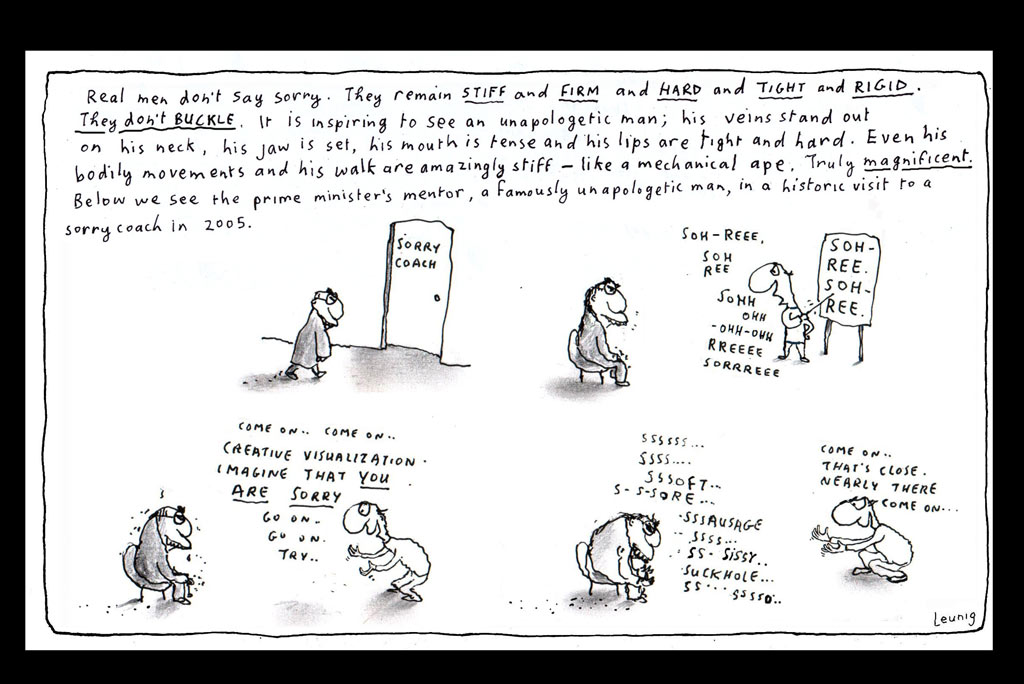
Leunig love

Real Men

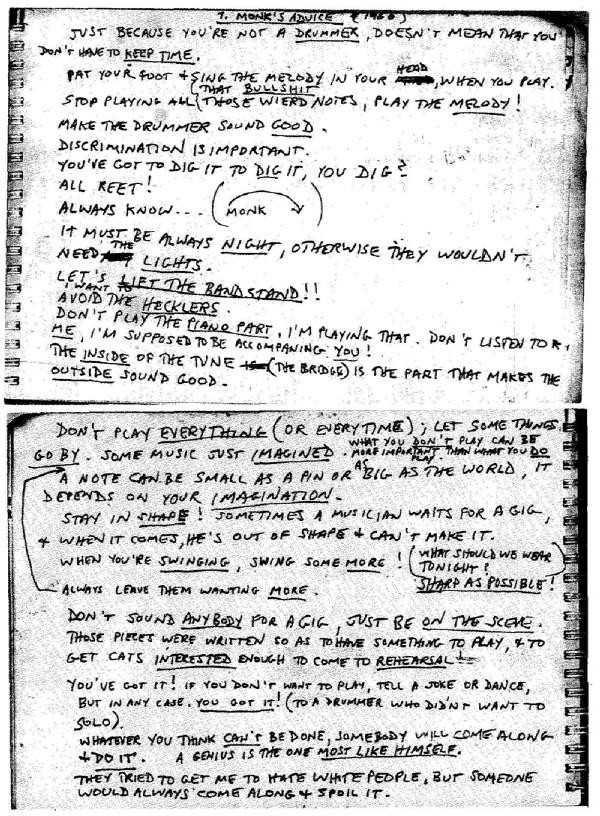
And finally, to end the year and all – a gift especially for those likely to be sucked in to making New Year’s resolutions – some advice from Thelonious Monk:

Advice from Thelonious Monk

… and some great sounds to see the new year in with:

2013: some favourites, some thanks

Amidst all that I have read, re-read, listened to and watched during this past year, I am especially grateful for having read, re-read, listened to, and watched the following:

Books

Biblical Studies

Biography

Cooking

Fiction

History

Philosophy

Poetry

Theology

Music

Films

I am equally grateful to those readers of this blog, and to those fellow wayfarers in blogdom, who have recommended some of these gems.

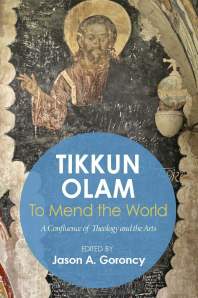
I am grateful too that this year has seen the birth of three books that I have either written or edited – Hallowed Be Thy Name: The Sanctification of All in the Soteriology of P. T. ForsythDescending on Humanity and Intervening in History: Notes from the Pulpit Ministry of P. T. Forsyth, and, most recently, ‘Tikkun Olam’ To Mend the World: A Confluence of Theology and the Arts. I hope that each of these prove beneficial – and rollicking good fun – for those who take up and read them.

As 2013 approaches expiration, I wish to sincerely thank readers of Per Crucem ad Lucem for stopping by, for reading my periphrastic prose, for offering comment (both online and via email), and for subscribing to and linking to posts. I hope that you have been blessed by what and by who you have encountered here, and I look forward to continuing a further leg or two of the pilgrimage with you. Ngā mihi o te Tau Hou ki a koutou katoa.

Now available: Tikkun Olam—To Mend the World

Tikkun Olam CoverI am delighted to announce that my latest edited volume – Tikkun Olam—To Mend the World: A Confluence of Theology and the Arts – is now available. It has received kind endorsements from Jeremy Begbie and Paul Fiddes, and the Table of Contents reads:

Foreword: Alfonse Borysewicz
Introduction: Jason Goroncy

1. “Prophesy to these Dry Bones”: The Artist’s Role in Healing the Earth — William Dyrness
2. Cosmos, Kenosis, and Creativity — Trevor Hart
3. Re-forming Beauty: Can Theological Sense Accommodate Aesthetic Sensibility? — Carolyn Kelly
4. Questioning the Extravagance of Beauty in a World of Poverty — Jonathan Ryan
5. Living Close to the Wound — Libby Byrne
6. The Sudden Imperative and Not the Male Gaze: Reconciliatory Relocations in the Art Practice of Allie Eagle — Joanna Osborne and Allie Eagle
7. Building from the Rubble: Architecture, Memory, and Hope — Murray Rae
8. The Interesting Case of Heaney, the Critic, and the Incarnation — John Dennison
9. New Media Art Practice: A Challenge and Resource for Multimedia Worship — Julanne Clarke-Morris
10. Silence, Song, and the Sounding-Together of Creation — Steven Guthrie

A brief section from the Introduction provides a summary of each chapter:

The essays compiled in this volume, each in their own way, seek to attend to the lives and burdens and hopes that characterize human life in a world broken but unforgotten, in travail but moving toward the freedom promised by a faithful Creator. Bill Dyrness’s essay focuses on the way that the medieval preference for fiction over history has been exactly reversed in the modern period so that we moderns struggle to make a story out of the multitude of facts. Employing Augustine’s notion of signs as those which move the affections, the chapter develops the notion of poetics as the spaces in peoples’ lives that allow them to keep living and hoping, suggesting one critical role that art can play in imagining another world, a better world. For art offers to carry us to another place, one that doesn’t yet exist, and in this way offers hope and sustenance to carry people through the darkest times. This is illustrated by the outpouring of Haiku after the recent tsunami in Japan, or in the spaces made available for poetry in Iraq. Most importantly, it is underwritten by the centrality of lament in the biblical materials wherein we are reminded that lament and prophecy provide aesthetic forms that carry believers toward the future that God has planned for the world.

The essay by Trevor Hart considers the place of human “creativity” (artistic and other sorts) and seeks to situate it in relation to God’s unique role as the Creator of the cosmos. It draws on literary texts by Dorothy Sayers and J. R. R. Tolkien, as well as theological currents from Jewish writers and Christian theologians, to offer a vision of human artistry as (in Tolkien’s preferred phrase) “sub-creation,” a responsible participation in a creative project divinely initiated, ordered, and underwritten, but left deliberately unfinished in order to solicit our active involvement and ownership of the outcomes.

Beauty, Hans Urs von Balthasar has suggested, is “a word from which religion, and theology in particular, have taken their leave and distanced themselves in modern times by a vigorous drawing of boundaries.” More recently, a number of theologians have addressed this distance and attempted to dismantle the boundaries widely assumed between certain Protestant theologies and the realm of the arts or aesthetics. In her essay, Carolyn Kelly seeks to contribute to that communal exploration by addressing the particularly imposing boundary line demarcating, on the one hand, Reformed affirmations of the beauty of Truth and, on the other, a Romantic commitment to the truth of Beauty. Kelly reflects on what Romantic and aesthetic “sensibility” might gain from its modern counterpart and, in turn, what Reformed theological “sense” might have to gain from a re-cognition of Beauty.

But what place is there for extravagant works of beauty in a world tarnished with the ugliness of poverty and injustice? This is a question taken up by Jonathan Ryan in his essay. Beginning with the recollection of the disciples’ objection to an extravagant act of beauty retold in Mark 14:4, Ryan allows the “anointing at Bethany” narrative in Mark 14 to frame this question and to suggest the legitimacy—and necessity—of works of beauty and creativity for bearing witness to God’s extravagant love for the world.

Libby Byrne’s essay explores the premise that the artist’s calling is to “live close to the wound.” Locating this contention within the nexus that seems to exist between art, theology and philosophy, she argues that we are able to consider the prevailing conditions required for the artist to work toward the task of mending that which is broken, and, drawing on theory from Matthew Del Nevo and Rowan Williams, Byrne helps us understand the importance of melancholy and vulnerability in the sacramental work of human making. She provides examples of how this theory may work in practice with particular reference to the work of Anselm Kiefer and finally with her own studio practice, reminding us that it takes courage to choose to live and work close to our wounds, and also that by so doing the artist not only opens themselves to the possibility of transformation but also offers to others gifts that reverberate within the world and that call us to healing and wholeness.

New Zealand artists Allie Eagle and Joanna Osborne discuss the Sudden Imperative, Eagle’s art project that reframes much of the ideology she held as a feminist separatist during the 1970s. They also outline a reappraisal of direction and motivation in Eagle’s thinking and highlight the theological and reconciliatory center of her current art practice.

Murray Rae takes up the question posed by Theodor Adorno following the Jewish Holocaust and considers whether art can have anything at all to say in the face of evil or whether some evils might, in fact, be unspeakable. Through a consideration of architecture and, in particular, the work of Daniel Libeskind at Ground Zero and in the Jewish Museum in Berlin, Rae contends that while architecture, along with the arts more generally, has no power to redeem us, much less to make amends, it can nevertheless give expression to our memories, our sorrow, and our penitence. He concludes that art may also reveal the extent to which the Spirit is at work within us, prompting us toward forgiveness and reconciliation and a true mending of the world.

In his essay on the Irish poet Seamus Heaney, John Dennison argues that one of the most notable—and least understood—aspects of Heaney’s trust in the good of poetry and the arts in general is the way in which his account approximates religious faith. Some critics have been encouraged toward the conclusion that Heaney’s poetics constitutes an active (if heterodox and often apophatic) extension of Christian theology through the arts. Most importantly here, John Desmond in his book Gravity and Grace argues that Heaney’s writings assume certain fundamentals that mark his transcendental cultural poetics as Christian. Central to Heaney’s thought, Desmond insists, is the doctrine of the Incarnation. Christian doctrine, and in particular the doctrine of the Incarnation, is indeed central to understanding the character of Heaney’s public commitment to the restorative function of art. But, Dennison argues, if we attend to the development and structures of Heaney’s thought, we can see how this influential account of the arts’ world-mending powers is not so much extensive with Christian soteriology as finally delimited by the biblical and theological descriptions it knowingly appropriates. It allows us to see, also, the degree to which Heaney’s trust in the adequacy of poetry turns on a refracted after-image of Christian doctrine, particularly that of the Incarnation.

Julanne Clarke-Morris’s offering proposes that multimedia worship and worship installations would benefit from a more consistent approach to aesthetics and context than is often the norm. She suggests that new media art forms offer communities of faith a range of ready-made critical practices that could amiably be brought to bear in the case of liturgical installation art. Seeking to draw attention to the coherence and communicative power of multimedia liturgical installations in order to improve both their accessibility and artistic credibility, she investigates some significant insights from virtual reality art, immersion art, multimedia installation art, and site-specific art as resources for preparing worship installations and assessing their effectiveness.

The closing essay, penned by Steven Guthrie, bears witness to ways in which Christian scripture and the Christian theological tradition both testify to a natural world that has a voice; one that not only speaks, but sings. The Hebrew prophet Isaiah speaks of mountains and hills “bursting forth in song” (Isaiah 55), and St John exiled on the island of Patmos listens with astonishment to “every creature in heaven and on earth and under the earth” singing (Revelation 5). This idea is taken up in turn by Augustine, Boethius and many others in the tradition, where it is often joined to the Pythagorean idea of “the music of the spheres.” According to this tradition, all of creation comprises a finely tuned symphony, the combined voices of which articulate the Creator’s praise. This tradition of thought—conceiving of the world as a singing creation—is a valuable resource for all who hope to faithfully care for God’s world. The musical creation described by Augustine and other theologians is a beautiful and profoundly interconnected cosmos, filled with an astonishing harmony of human and non-human voices. In this universal song, humans have a vital but circumscribed role. Silence, song and harmony have the capacity to make us more—or less—fully aware of, and more—or less—responsive to the world we inhabit. Music may act as a kind of aural armor by which we shut out the voices of the creation and others who inhabit it. It may also be a weapon by which we dominate the surrounding space. Or music may be a schoolmaster from whom we learn attentiveness and responsiveness, and with which we might join with all creation to participate in God’s symphonic work of healing the creation.

More information about the book is available here.

Parents. Children.

Yesterday, with all the grief that attends just completing reading a great book, and with all the joy-in-anticipation of beginning a new one, I began reading Andrew Solomon’s Far From the Tree: Parents, Children and the Search for Identity. This deeply personal and somewhat cathartic book is about the forming and reforming of identities, those attributes and values which are passed down from parent to child across generations not only through strands of DNA but also through shared cultural norms (vertical identities), and those traits that are foreign to one’s parents ‘and must therefore acquire identity from a peer group’ (horizontal identities), identities which ‘may reflect recessive genes, random mutations, prenatal influences, or values and preferences that a child does not share with his progenitors’.

Through a series of reflections on deafness, dwarfism, autism, Down syndrome, disability, prodigies, schizophrenia, rape, crime, and transgender sexuality, Solomon is concerned to challenge notions of ‘ordinary’ and ‘extraordinary’, to examine the value judgements we carry, create, project and/or dismiss about such, and to ward off temptations to play down the ambiguities and ambivalences that surround notions of extra/ordinary.

In lieu of the likely event that I do not get around to writing a review of the book, and because I wanted to share something of my interest so far in reading this book – and for the consideration of fellow parents – here’s the (scene-setting) opening two paragraphs:

‘There is no such thing as reproduction. When two people decide to have a baby, they engage in an act of production, and the widespread use of the word reproduction for this activity, with its implication that two people are but braiding themselves together, is at best a euphemism to comfort prospective parents before they get in over their heads. In the subconscious fantasies that make conception look so alluring, it is often ourselves that we would like to see live forever, not someone with a personality of his own. Having anticipated the onward march of our selfish genes, many of us are unprepared for children who present unfamiliar needs. Parenthood abruptly catapults us into a permanent relationship with a stranger, and the more alien the stranger, the stronger the whiff of negativity. We depend on the guarantee in our children’s faces that we will not die. Children whose defining quality annihilates that fantasy of immortality are a particular insult; we must love them for themselves, and not for the best of ourselves in them, and that is a great deal harder to do. Loving our own children is an exercise for the imagination.

Yet blood, in modern as in ancient societies, is thicker than water. Little is more gratifying than successful and devoted children, and few situations are worse than filial failure or rejection. Our children are not us: they carry throwback genes and recessive traits and are subject right from the start to environmental stimuli beyond our control. And yet we are our children; the reality of being a parent never leaves those who have braved the metamorphosis. The psychoanalyst D. W. Winnicott once said, “There is no such thing as a baby—meaning that if you set out to describe a baby, you will find you are describing a baby and someone. A baby cannot exist alone but is essentially part of a relationship.” Insofar as our children resemble us, they are our most precious admirers, and insofar as they differ, they can be our most vehement detractors. From the beginning, we tempt them into imitation of us and long for what may be life’s most profound compliment: their choosing to live according to our own system of values. Though many of us take pride in how different we are from our parents, we are endlessly sad at how different our children are from us’.

November stations …

Reading:

Listening
Leunig

Real Men

Launching

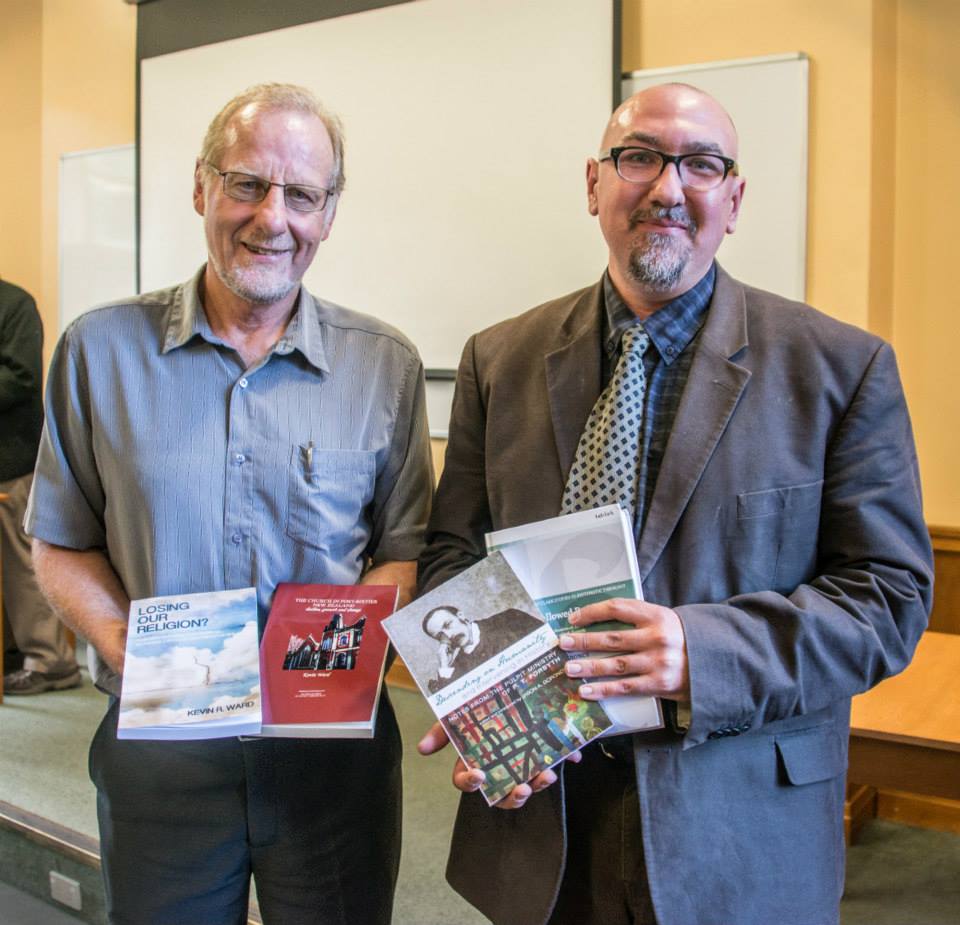
Book LaunchLast night, the Knox Centre hosted the launch of four books:

John Stenhouse and John Roxborogh spoke to Kevin’s books, and Mike Crowl and Murray Rae spoke to mine. All did a super job. It was a great night. Post-launch, the two authors (and a few others) then partied on with Chinese food and whiskey. The gastronomical combo seemed to work well.

Mike has since posted what he really would have liked to have said, some reflections on his experience of reading P T Forsyth.

Those unable to make it along to the launch can still pick up a copy of the books at the special book launch price. If you’re interested, please contact either Kevin or myself.

‘God dies in the world’: an interview with an artist

SAMSUNG

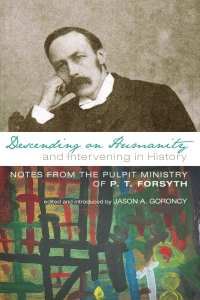
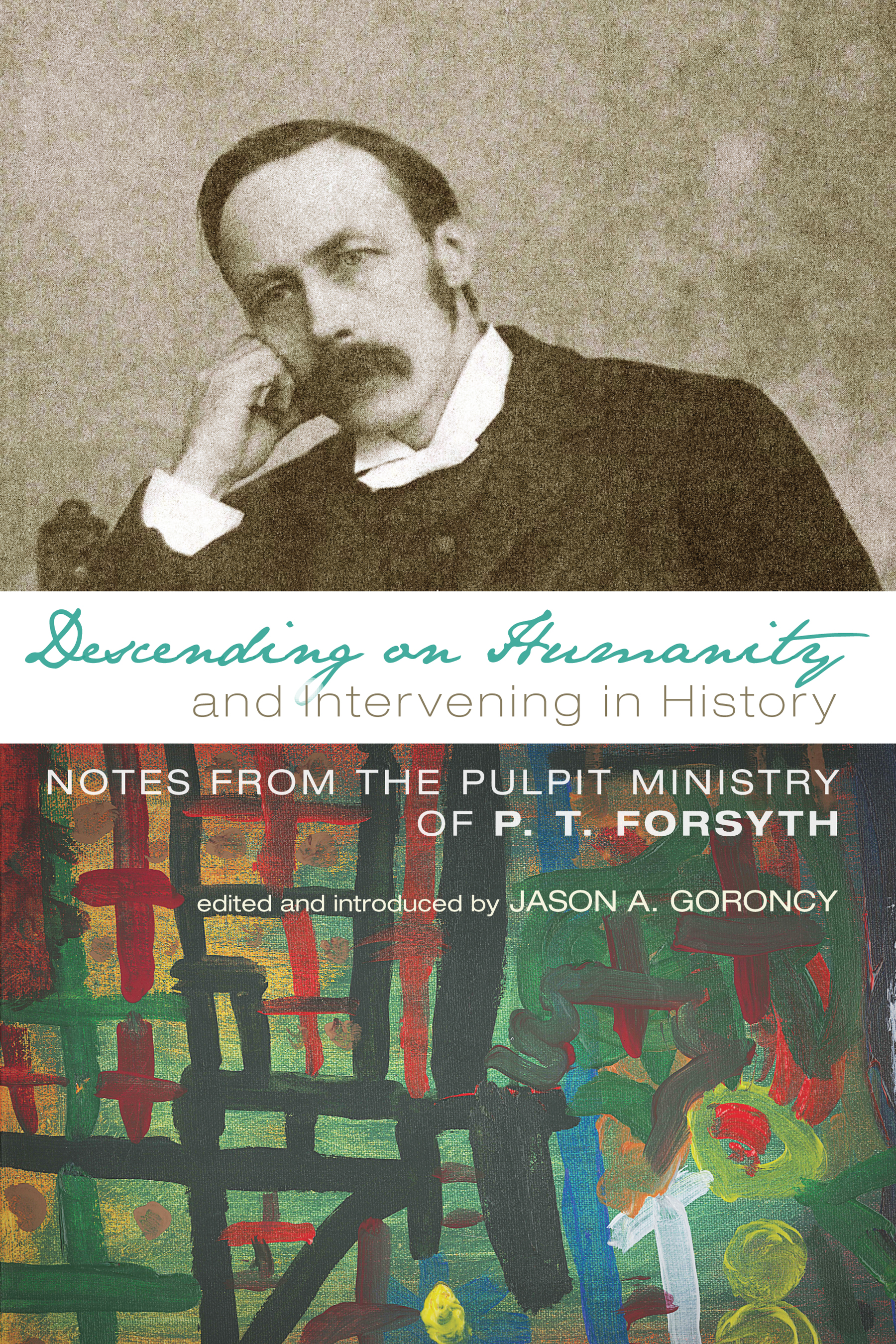
The front cover of my most recent publication, Descending on Humanity and Intervening in History: Notes from the Pulpit Ministry of P. T. Forsyth, includes a section of a painting (above) by my daughter Sinead. The decision to use her painting – a decision which, to be sure, required some grovelling for permission – was not, I hope, motivated by cutesiness but rather by a profound sense of the work’s fittingness to the book’s themes. The painting, which is used upside down, is called ‘Crosses’.

Forsyth.DescendingonHumanity.90702Now that Sinead and I have both finally seen the book in real life, I wanted to ask her again about the painting, about what it ‘means’ (her word), and about how it relates to the material in daddy’s book. So while on the way to school this morning, I conducted a brief ‘interview’ with Sinead. As part of that conversation, Sinead offered the following statement:

God dies in the world, and the God who dies in the world is the same God who dies in heaven. And yet somehow these two deaths, which are really the same, are related. In the end, it’s all really a mystery – but in the mystery the church is created and the world is saved. And that’s what my painting is about.

I buzzed.

[Copies of the book are available here or via here or by contacting me directly. If you are interested in reviewing the volume, then please contact James Stock at Wipf and Stock. And if you are interested in a copy signed by Sinead, then it’ll probably cost ya some serious dosh, or a packet of mints!]

October stations …

SAMSUNGReading:

Listening

Link love

Leunig love

Leunig-iPad-The Lost Art

Leunig - Words for mystery

[Source: The Age]

The Story of Dr Beryl Howie

Beryl HowieIt was 1958 when the London-based Ludhiana Fellowship invited Beryl Howie, a young and newly qualified New Zealand obstetrician/gynaecologist, to join the staff of the Ludhiana Hospital in India. In this invitation, Beryl recognised God’s calling, and went to India.

It was no easy challenge. In addition to undertaking a very busy clinical load, she also had to learn at least one of two local languages. Along the way, she was sustained by her faith in God, faith which motivated not only her medical work, but which also encouraged the study of the Bible among the students and patients that she had come to love. It came as a bit of a shock, therefore, when just before she was due for her first furlough the Ludhiana Fellowship told her that they had decided to move their support to training Indian doctors and asked her to find support elsewhere. Bewildered but not undetermined, and after exploring several options, she soon accepted an invitation from the Presbyterian Church of New Zealand to become one of their missionaries and, in 1963, she set off under new colours but to essentially the same job.

Over the next few years, while Beryl’s own workload stretched, so too did the old buildings in which she worked and which became increasingly inadequate for the burgeoning number of patients and new theatre equipment which arrived. She was soon dreaming about a new hospital for women and, during her next furlough, she challenged the New Zealand churches to raise $500,000 towards this. People all over New Zealand took enthusiastically to the project. When they had reached $100,000, the New Zealand Government offered to contribute $500,000 if the project raised that amount by Christmas. This challenge sparked off further enthusiasm among New Zealand churches. Several other missionaries were ‘at home on leave’ from India and others with a strong interest in Ludhiana helped to enthuse congregations and individuals to great heights. Suffice to say that Beryl returned to India with the plans and funding to begin planning for a new hospital and to start building.

Teaching Hundreds to Heal Millions

At the same time, she continued to work towards raising the standard of care of patients and developing higher educational and treatment standards of doctors, nurses and midwives.

But there was another encouraging development. When Beryl first came to India, all newly-trained doctors with any available funding went to the UK and, if possible, the USA for postgraduate training. Most of them then looked for work there and didn’t return to India but rather supported their families from the high salaries they now earned. Beryl longed to change the natural path of graduates to keep them in India to serve their own compatriots. To that end, quality advanced training would have to be available. By 1980, 84% of all graduates in obstetrics and 29 of her MD graduates remained in practice in India.

In 1981, Beryl finally left India and found work in two other missionary challenges – one was to write a text book on obstetrics and gynaecology specifically for students in India , and the other was to visit missionaries all over South East Asia and further encourage the development of improved healthcare.

After finally retiring to New Zealand, she was honoured with an honorary doctorate in science by the University of Otago.

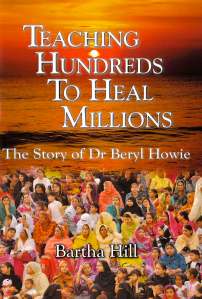
My friend Bartha Hill has just authored a beautiful little book on Howie – Teaching Hundreds To Heal Millions: The Story of Dr Beryl Howie – and those in Dunedin are warmly welcome to attend its launch on Sunday 17 November, at 2 pm, at Highgate Presbyterian Church, Maori Hill, Dunedin.

‘Descending on Humanity and Intervening in History’ is now available
Forsyth.DescendingonHumanity.90702After a very long gestation period, I’m truly delighted to finally announce the birth of Descending on Humanity and Intervening in History: Notes from the Pulpit Ministry of P. T. Forsyth. As I mentioned in a previous post, it has been a pregnancy marked by great joy and hope, and, I might add, by very few bouts of morning sickness.
The book includes a marvelous foreword by Professor David Fergusson, a lengthy (and, I hope, helpful) introduction to Forsyth’s preaching ministry written by myself, and, from Forsyth’s pen, forty-eight sermons, over half of which are previously unpublished. It seeks to introduce Forsyth, his thought, his ministry, and the Word he served, to a new generation of readers, to provide those already familiar with his writings some new material to digest, and to encourage preachers – and those who hear the Word of the Lord through them, or in spite of them – to not abandon the ‘earth’s foremost part’ (as Herman Melville described the pulpit), especially at a time when the storms are so inexorable and the spoils of exile are so scrumptious.

It will, of course, be up to others to judge, but I think that the book would make a judicious gift for any minister, theology student, historian, or general reader. You can order copies here or via here or by contacting me directly.

If you are interested in reviewing the volume, then please contact Amanda Vanderhoof at Wipf and Stock.

Mother and baby are feeling great, and the siblings proud.

September stations …

Tilda SwintonReading:

Listening:

Watching:

  • Babel
  • The Pillars of the Earth
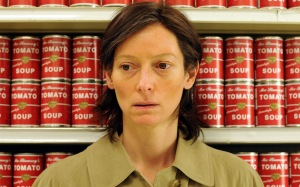
  • We Need to Talk About Kevin. This is one of the most extraordinary films I’ve seen in many years, with an absolutely astonishing performance by Tilda Swinton. (On a less enthusiastic note, Australia’s ‘MA 15+’ rating is severely misjudged.)

August stations …

Reading:

  • Hannah Arendt: For Love of the World by Elisabeth Young-Bruehl. An impressive and well-researched biography on one of the most untwitter-like characters of the twentieth century.
  • Wild Red Horses by Alan Marshall. This one’s worth reading just for the great story ‘Singing to God’.
  • The Word of God and Theology by Karl Barth. An energetic and fresh translation, with excellent critical notes, of some of Uncle Karl’s most important essays. An absolute ‘must-read’ for preachers!
  • Complicity in the Holocaust: Churches and Universities in Nazi Germany by Robert P. Ericksen. A very helpful study and, if Ericksen’s right, an important corrective to many widely-held misconceptions.
  • Tradition and Dissent by Davis McCaughey. A fascinating collection of addresses from one of the great Antipodean minds of the twentieth century. Thank you Belfast!

Listening:

Watching:

An(other) update on Descending on Humanity and Intervening in History

Forsyth.DescendingonHumanity.90702I’m delighted to inform readers of Per Crucem ad Lucem that it is looking increasingly likely that my forthcoming book Descending on Humanity and Intervening in History: Notes from the Pulpit Ministry of P.T. Forsyth will be available sometime around October (and so in good time for Christmas). The project has taken considerably longer – and considerably more energy – than I had imagined when I first embarked on it many moons ago. That said, it has been a project marked by great joy, and with hope that the final product may be a blessing to all who take up and read and, beyond such persons, to others.

The folk at Wipf and Stock, and especially Charlie Collier, Matthew Wimer (the typesetter) and Amelia Reising (the cover designer), have again been great to work with.

A wee update on Descending on Humanity and Intervening in History

Forsyth - 1892A number of folk have written to ask me where things are at with my forthcoming bookDescending on Humanity and Intervening in History: Notes from the Pulpit Ministry of P.T. Forsyth. I’m pleased to report that things are progressing well. The proofs are looking great, and the cover designer is just working on producing something agreeable. In the meantime, the book has received the following kind endorsements:

‘Far from being a collection of cozy meditations, here are challenging, biblically rooted, theologically powerful, pastorally concerned essays and sermon notes by Britain’s most stimulating theologian of the twentieth century. Church members will be energized; preachers will be prompted towards relevant exposition. This book is the product of much persistent burrowing by Jason Goroncy, whose substantial introduction is an exemplary piece of scholarship in its own right. We are greatly indebted to him’. – Professor Alan P. F. Sell, University of Wales Trinity Saint David

‘Few modern theologians have displayed the combination of intellectual energy, rhetorical power, and pastoral commitment of P. T. Forsyth. In this valuable collection of Forsyth’s sermons, many of them hitherto unpublished, we encounter a conviction too often absent in church and academy alike – that theology and preaching belong vitally together. In these striking examples of that vision, contemporary readers will find much to learn, challenge, and inspire’. – Ivor J. Davidson, University of St Andrews

July stations …

Jayber CrowReading:

Listening:

Watching:

An update on my forthcoming book ‘Descending on Humanity and Intervening in History’

Forsyth 16A week or so ago, I received  finally  the first proofs for my forthcoming book Descending on Humanity and Intervening in History: Notes from the Pulpit Ministry of P.T. Forsyth (Pickwick Publications). I’m really delighted with the typesetter’s efforts, and genuinely excited to see this 350+ page baby  which consists of forty-eight sermons (most of which are previously unpublished), a Foreword by David Fergusson, and an Introduction by yours truly – finally near full term. All going to plan, she should be ready to pop in the next few months. Of course, I’ll announce the birth soon after I know about it. In the meantime, here is a wee taster, an ultrasound (to keep the running metaphor alive), from the Preface wherein I attend to the matter and logic of the book’s title:

A note about the title of this volume is in order too. The phrase “descending on men and intervening in history” appears in Forsyth’s Yale lectures. In the section wherein the phrase appears, Forsyth was concerned about religious liberalism’s tendency towards vagueness and detachment from a more intellectually and morally rigorous or “positive” religion that speaks to the deep crises of human history and experience. The former understands Christ to be the product rather than the creator of the Church, reduces the history of redemption to “the ascending history of the race developed with God’s aid,” and begins from ideas and ends in the theological suicide of positive belief and distinctive experience. The so-called “positive” theology of the New Testament, however, is chiefly concerned with God’s moral action of overcoming human sin and the hallowing of God’s own name in the creation in order that God might hear an echo of himself therefrom. Whereas the former merely proposes prerequisites for and conditions of reconciliation, the latter bears witness to the reconciliation that has already taken place in Jesus Christ, trumpeting that we are already in a healed situation and “not merely in a world in process of empirical reconciliation.” Also, the gospel descends on, rather than arises from, us:

It is not a projection of [our] innate spirituality. It is revealed, not discovered, not invented. It is of grace, not works. It is conferred, not attained. It is a gift to our poverty, not a triumph of our resource. It is something which holds us, it is not something that we hold. It is something that saves us, and nothing that we have to save. Its Christ is a Christ sent to us and not developed from us, bestowed on our need and not produced from our strength, and He is given for our sin more than for our weakness.

So Forsyth could describe the experience of faith as that which rests on God’s finished work and then “takes a line,” appealing to “our moral mettle” and calling us not to mere consideration and pondering but to “moral verve and vigilance,” to stake the entirety of our being and eternity on selection, decision, and committal. This choice, Forsyth averred, depicts the gulf faced by preachers, a gulf that Forsyth believed is as wide and as irreconcilable as that between being a herald of the gospel and an advocate of culture. The former, Forsyth said, “will make you strangers and sojourners in the world, the other citizens of the world . . . One will make you apostles of Christ, and one will make you champions of humanity. One will make you severe with yourself, one will make you tender with yourself. One will commend you to the naughty people, and one will commend you to the nice.” He continues:

Now of these two tendencies one means the destruction of preaching. If it cease to be God’s word, descending on men and intervening in history, then it will cease as an institution in due time. It may become lecturing, or it may become oratory, but as preaching it must die out with a positive Gospel. People cannot be expected to treat a message of insight from man to man as they do a message of revelation from God to man. An age cannot be expected to treat a message from another age as they treat a message from Eternal God to every age. Men with the passion of the present cannot be expected to listen even to a message from humanity as they would to one from God. And if humanity redeem itself you will not be able to prevent each member of it from feeling that he is his own redeemer.

In other words, Forsyth sees at stake here nothing less than the nature of the gospel as grace, as that foreign word that descends and intrudes and makes alive, rather than that which arises from our own situation and in the end merely coddles a frondeur race in its blindness and recalcitrance. The latter promises to raise the dead while having nothing but death’s machinery with which to do so—machinery reluctant, moreover, either to name the corpse as corpse or even to attend to the right grave. But not so the preacher of grace, the preacher who, with words given, names a thing for what it is and by such naming participates in grace’s continuing event by which all things are being made new. To so recall Forsyth’s plea here is to recall that he was, of course, ministering at a time when the theology of the day was radically out of joint with the situation confronting the human community in Europe, when the easy optimism heralded as the new orthodoxy was about to be crushed under the press of catastrophic historical events. In response, Forsyth attacked the amorality of established theology and raised a too-lonely voice in plea for a staurocentric theology of redemption.

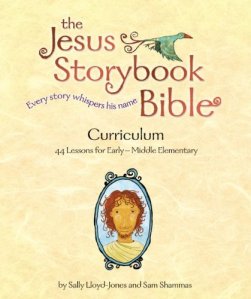
Sally Lloyd-Jones and Sam Shammas, The Jesus Storybook Bible Curriculum Kit – a review

JSBBSally Lloyd-Jones and Sam Shammas, The Jesus Storybook Bible Curriculum Kit (Grand Rapids: Zondervan; 2012) – a review

A guest post by Judy Goroncy (the great)

Over the past two terms, our church’s Sunday School has been using The Jesus Storybook Bible Curriculum, the focus of which is to teach ‘the Story beneath all the stories in the bible’. As the product description has it:

There are lots of stories in the Bible, but all the stories together tell one Big Story: The Story of how God loves his children and comes to rescue them. It takes the whole Bible to tell this Story. And at the centre of the Story, there is a baby.

The Jesus Storybook Bible (JSBB) includes 21 stories from the Old Testament, and 23 from the New Testament. Each week’s accompanying lesson is based on one of the stories and follows a similar structure ­– a time to recap previous stories, a relevant activity, the story time (which can be presented by either the teacher, or with the use of the accompanying DVD/CD), unpacking the story (technically called exegesis), reflection on Jesus’s location in the story, prayer, learning the memory verse, and completion of a hand-out. One of the real strengths and blessings of the programme is that it is concerned at every point to teach the great Story of the Bible rather than focus attention on presenting a series of seemingly unrelated ancient religious stories that remain largely unconnected to their principle purpose. Every part of the JSBB, in other words, is concerned to bear witness to the One who is God’s principal revelation; namely, Jesus. ‘Every story in the Bible whispers his name’.

We have found the programme to be geared more towards children aged 4–7. However, those aged 2–10 seemed to all benefit from and enjoy it too. Accounting for holidays and other ‘interruptions’, the curriculum takes about a year-and-a-half to work through. The lessons are easy to prepare, are clearly set out, and come with various helpful media aids. Because the lessons are presented chronologically, connections can be made between the stories and so enable children – and their teachers too – to build on what they have learnt in previous weeks. Hand-outs provide not only an opportunity for children to revisit the teaching and memory verses, but also assist and encourage parents/caregivers to be aware of what the kids are learning at Sunday School, and so encourage further discussions about the Story beyond the Sunday morning.

Despite there being so much focus on the Bible, learning memory verses, learning books of the Bible, etc., we have felt it imperative that the children look up the verses in their own Bible (a real one and not the JSBB). While this component is not specified in the curriculum, we believe that it is vital that the children have an understanding that all the stories come from the ‘actual’ Bible and that they become familiar with and are able to look up books, chapters and verses in their own Bible.

As we draw near to the end of the Old Testament section, the children are enjoying opportunities to present what they have learnt to the rest of the congregation, typically through the Sunday morning service. They present an overview of the key events and people in the Old Testament in the form of drama, bible readings, memory verses and song, using all to bear witness to God’s Great Rescue Plan in Jesus.

I cannot recommend this curriculum highly enough. Too often, our children’s programmes are so geared at entertainment, or are so diluted of content, that the true message of what Christ has done is lost. This programme takes seriously God’s love, our sin, and that we need Jesus, our Saviour, to redeem us and our lost world.

June stations …

The Collected Poems of George Mackay BrownReading:

Listening:

Watching: