Author: Jason Goroncy

‘Story of God’, by Michael Crotty

Story of God’

My story of God seems
pass the tambourine
and do we have a dollar
here for Jesus.
Essentially, it is
disaster relief,
as history made
not in tutorials,
but from middens of waste.
Best interpretations
are so far off the mark
they must be a laugh
if they last a decade,
then like the wireless
of the forties
maybe derivations will remain.
Create a phonetic alphabet
with one sound missing
randomly chosen by algorithm
in a very limited edition
to be printed on a sheet
of guillotined B4
in six point calibri
and you may start
to get the picture.
When futility had truly tired of me,
only devotion would let it be.

Michael Crotty

[Source: Eureka Street]

David Bentley Hart interview: ‘Revolutionary Christianity and its alternatives’

The Centre for Public Christianity has generously made available a six-part interview with David Bentley Hart wherein Hart talks about the impact of Christianity on the West, some questionable interpretations of history, suffering and the problem of evil and why he remains a believer.

  1. The violence of Christian history
  2. The new atheists and an ugly God
  3. Ethics and the good life
  4. Nostalgia for a pagan past
  5. Gnosticism and alternative gospels
  6. Suffering and the problem of evil

The full interview is also available here as a download via iTunes.

Who said it?

It’s time again for another ‘Who said it?’ competition. From whose mouth/pen did the following words come:

‘Aristotle claimed superiority for the poet over against the historian on the ground that the latter was only concerned with the detail of what Alcibiades did and suffered; while the former probed the universal import of Oedipus’ suffering. The Gospel writers (Mark and Luke as well as John) are in this respect nearer to Aristotle’s poets than to his historians; they guess and hint a universal import in those events whose detail they chronicle, constrained to this effort by the mystery of the resurrection to which their often stumbling and contradictory conclusions bear witness. The authentic Anselmian theology of the atonement is ultimately continuous with the Evangelists’ interpretation of the details they record … This interpretation of Christ’s passion is grounded in the manner of its presentation in the Gospels, where … the universal is manifested through the particular – the judgement of God through the particularities of human envy, and cruelty, through the grim actualities of Judas’ greed, of Caiaphas’ cold raison d’état, of Pilate’s self-regarding capitulation. It is Jesus who tears away the masks from their faces, his witness to the truth the ordeal imposed upon him by his fidelity. Even the women of Jerusalem who lament his fate, are warned in almost harsh tones, of the disaster that awaits their city, oblivious of the summons to a new way offered them by Jesus. Human pretension is stripped bare, and the judgement of God accepted in an action profoundly tragic in its cost’.

Closing on Friday. No cheating.

Some recent wanderings

Walking unhampered – and strangely – among the golden lampstands

Last Sunday, Andrew Stock and more than half (around 100) of the Brisbane Destiny Church [whose website has been pulled offline] walked out of church. This is nothing exceptional in itself, not least of all, it would seem, in less sensible denominations. And not a few have interpreted this action as a sign of courage and integrity, applauding Stock as one who at least has ‘the guts to stand up to the Tamaki machine’. Among the many things that I find most disturbing about this story, however, is today’s report that ‘new pastors have [already] been appointed to run Brisbane’s Destiny Church’ (an outcrop of Brian Tamaki’s Destiny Church in New Zealand).

Is this a sign of a ministry which has failed to foster maturity among the members of God’s flock which remain? And/or is this yet another example that bolsters the claim that one of the markers of a cult is an unwillingness – or inability – to be ‘community’ without a ‘dynamic’ personality at the helm, one who has ‘strong leadership qualities and the ability to cast vision’? Possibly, though I’m in no position to really know.

Contrast Destiny’s pastoral search model with something I posted a while back from Richard Lischer about Lutherans:

‘Lutherans fill their vacancies more deliberately than any of the churches in Christendom. Vacant congregations go months without thinking about choosing a new leader, and pastors, once they have received a call, may sit on it for additional months before hatching a decision. The time isn’t used for negotiating more favorable terms; it is simply filled with prayer and dormancy. The President-elect of the United States names a Cabinet faster than the smallest Lutheran congregation picks a pastor, because Lutherans consider the latter process far more important. All is left to prayer and the brooding of the Spirit, and everyone knows the Spirit always works slowly’. – Richard Lischer, Open Secrets: A Memoir of Faith and Discovery, 220.

Perhaps it’s a good time to recall some of PT Forsyth’s advice on ‘How To Help Your Minister’.

Either way, it seems that the sovereign Lord still walks unhampered – and strangely – among the golden lampstands …

‘Pastors aren’t Prophets: Some Unsolicited Advice for Newly-Minted Ministers’, by Rick Floyd

Rick Floyd is a seasoned minister and a very astute theologian who has posted a wonderful and wise reflection on pastoral ministry for ‘newly-minted ministers’. I appreciated it so much that I’m going to re-post it here in its entirety. I reckon that there’s wisdom here that needs to be shared.

‘Too many of our new pastors in the mainline church leave the ministry after a few years. There are many reasons why this happens, but for whatever reason, it is not good.  It’s bad for them and bad for the church, and it is bad stewardship to train someone who only serves a short time.

Some of these ministers should never have been ordained in the first place, and the gatekeepers didn’t do their due diligence. Some were lacking the necessary “gifts and graces” for ordained ministry, which doesn’t mean they didn’t have a different and effective ministry in the church.

There are far too many sad situations where a ministry fails for one reason or another, where hopes are shattered, and a young (or not so young) person is saddled with a financially crippling debt for the years in seminary they paid for in loans.

Being a pastor of a church is a hard job.  I was one for thirty years.   Despite the nonsense being promulgated by the “experts,” faithful pastoring is not a matter of working a certain number of hours (or “units” as they are now sometimes called.) It’s a vocation that takes up most of your waking hours,

When a congregant really needs you, it doesn’t matter whether it is your day off. If you asked me how many seasoned pastors are burned out to one degree or another, I would say, “All of them, if they are really doing their job.” That is why pastors need to exercise radical self-care, pray constantly, and accept the fact, that not being yourself God, you cannot do all that is demanded of you.

Now I readily admit that there is some truth to the whole boundary/take care of yourself/take time for yourself movement. But like all partial truths it is not the whole truth.  The church once had a useful word, now much out of favor, for when one piece of the truth gets blown out of proportion.  The word is heresy.

One of the modern heresies (but by no means the only one) of the contemporary mainline church, is that you can have something akin to a normal 40 hour a week professional life and be a faithful pastor.  It isn’t true.  A pastor’s life, and the life of the pastor’s family is necessarily involved in the community of their congregation in season and out of season.  Sometimes, even often, it is wonderful; other times it isn’t.  That’s the way it goes.  It isn’t the Canyon Ranch spa.  I often say being a pastor is the best vocation there is, but perhaps the worst job.  If you are not called to it, it is something you really don’t want to do.

When I started as a pastor thirty-five years ago I was well trained and well educated and didn’t have a clue what I was really supposed to do. I learned quickly. One of the things I learned was that you have to love your congregants, even the unlovable, of which there are far too many, and who take up a good deal of your time.  If and when you find yourself loving them, you know you are on your way to really being a pastor.  Some of them you will just never learn to love, and you have to turn them over to God, who does.
I had been a anti-war and civil rights activist in college and seminary, and had gone to jail for my causes, but when I got into the pastorate I learned very quickly that you can’t be a prophet until you have earned the peoples’ trust. This means years of marrying and burying and sitting by sick beds and in hospital rooms.

If you do this well they may be ready to hear hard truths from the pulpit.  They may not. Certainly Isaiah’s prophecies fell on deaf ears.

New ministers who have grown up in the church have a leg up, because they know its rhythms and customs, it’s “grandeur and misery.”

But today many of our ministerial candidates haven’t grown up in the church. Some of them turn out to be our best ones, but they are at a disadvantage.  They don’t know the church’s music and it’s well-worn liturgies.  They don’t know the joys of a community strawberry festival on a warm spring day, or the energy and agony of a capital-funds campaign to get a  new boiler.

They often come to seminary or divinity school in a process of self-discovery, which is fine. Most of us did that to one degree or another. I recall from seminary that the ones who knew they wanted to be a minster since the age of six were best avoided, and probably needed therapy.

Now seminary is a good place to learn many useful things, like that David didn’t write all (or perhaps any) of the Psalms, that the Scriptures are thick and have a literary history, and that the heresies we see around us are as old as the church.  If one is lucky, you’ll find a mentor or two, and be able to intern in a healthy church who will love you and teach you what it means to be the church.

What seminaries are not good at (because its not really their job) is forming men and women into Christians, much less teach them how to be faithful pastors.  Christian formation is primarily the church’s job, not the schools, although they can help out.

There are many fine teachers and students in these schools, and I don’t want in any way to impugn their integrity or their faith.

At the same time, we are seeing too many newly-minted pastors who come to seminary, not only to find themselves, but with a passion for a social cause or causes, which is fine.  I certainly had mine. In seminary the flame of their passion is often fanned by others who share it, which is also fine.

But if all you know of the faith is what you learn in divinity school you are at a distinct dis-advantage.  And if the main reason you accept a call from a congregation is to promote your passion and cause then your soul is in danger, and so is the life of a congregation.

Because the congregation you go to may or may not share your passions. It can be dangerous either way.

If they agree with most of your views, be they liberal or conservative, the temptation is to self-justification and self-righteousness, and a tendency to see sin and evil as “out there” in your ideological adversaries, and not also in your own heart and soul. Then the great insight expressed by the Reformers’ axiom simul justus et peccator, that we are at the same time justified and sinners, is lost. This danger in the mainline church can exist in some ministers for their entire careers and they will never even now it.

The other temptation is perhaps more dangerous, at least in mainline churches. That is to go to your first congregation where they don’t share your passion for your social cause or causes, and you scold them for it. You do not learn to love them, and they do not learn to love you, and eventually your ministry fails.
Typically we are too polite to ever actually fire anyone (although it does happen), but there are other ways to get you to leave, the best one being to so discourage you that you lose heart and leave. Some, too many, of our new pastors actually seek out this kind of martyrdom, and when they are inevitably cast out, they can then turn and say how stiff-necked and hard-hearted their congregation was. But my sympathy for them is limited. Congregations can be stiff-necked and hard-hearted and even abusive. This is nothing new.  Just go read Exodus or First Corinthians.

But congregations can be also be wonderful, supportive, gracious, and long-suffering, especially if they sense you are really trying to be their faithful pastor.

The late great Bill Coffin, a prophet himself, once told a bunch of us young ministers (about 1972) a story (which my version here will be only a loose approximation) about one of his students from Yale.

The young pastor was in hot water for his deeply prophetic views and fiery pulpit pronouncements on social issues (it was Vietnam time, and the nation was deeply divided.) The lay leaders wanted to fire him. As the discussion heated up, one of them, a banker, prominent member and very conservative, stood up and said, “You can’t fire him, he’s our pastor. It’s true that he’s a real pinko, and I can’t stand most of the stuff he says from the pulpit, but when my wife was dying he came to see her every day. He’s staying.” And he did.  Bill went on to say that if you are a faithful pastor, your flock will give you great freedom to pursue your passions, be it peace and justice work, or collecting butterflies.

A dear rabbi friend of mine who is well up in his eighties told a bunch of us a powerful story last week. He had been an army chaplain in the Korean War, and, perhaps because of that, he was a firm supporter of the Vietnam War. But when our National Guard opened fire and killed some students who were peacefully protesting the war at Kent State University in 1970, he had a change of heart, and he changed his mind. And on the next High Holy Days in the fall, when he preached to the biggest congregation of the year, he apologized to them and asked them to forgive him, admitting that he had been wrong about the war. This story brought tears to my eyes.

He had been their faithful rabbi by then for fifteen years, and he stayed for another dozen or so. The Vietnam War by 1970 was very unpopular, especially here in what until last December was sometimes called by conservatives “The Peoples Republic of Massachusetts.” I am sure that many of his congregants had been hearing sermons they didn’t agree with for some time. But he had earned the right. And when he finally repented publicly, he was indeed a prophet with the full attention of his people. From then on, when he spoke out against the war, he had every ear.

So at the right time and place you can sometimes be both a prophet and a pastor. But you’d better be a pastor to the people first, because that is your primary calling. If you just want to be a prophet, I suggest you go work for a political action organization’.

Lecturing Position in Biblical Studies

The School of Theology at the University of Auckland seeks to appoint a Lecturer in Biblical Studies with expertise in Hebrew Bible, but capacities to teach into the New Testament. The position may expand to include studies of Emerging Judaism in the future.

The successful applicant will be expected to undertake research, to teach at introductory undergraduate, advanced undergraduate and postgraduate levels, and to supervise research students for the MTheol and PhD degrees.

Applicants will be expected to have a PhD or equivalent in Biblical Studies, some research publications and teaching experience.

Applications close on 21 March 2010.

For more information contact Elaine Wainwright.

‘Why I still go to church’

Why I still go to church’

This moment
Which doesn’t drift away.

John Foulcher
‘Why I go to church’

never for the flat parish choirs

sometimes for tea-towelled shepherds
and tinselled sleepy angels

possibly for the story of St Martin de Porres
who promised the rats he’d feed them
if they stopped annoying the prior

certainly not for the sermon that never asks
can Neanderthal men be saved?
can a single death two thousand years ago
redeem the hypothetical populations
of 55 Cancri’s planets 41 light years away?

partly because even if no one is there
sometimes in the vaster spaces
of St Kit’s, I feel a charged stillness

always because of the kneeling, the touch
of fingers on forehead, the taste of the host
the red, green, purple rhythms of seasons
wisdom of parables, music of psalms

now because of you kneeling
beside me, thumbing the scarred leather
of the little mass-book your grandmother
hid at the back of her Protestant linen-press

and perhaps because driving up Canberra Avenue
when the spire of St Stephen’s briefly aligns
with the national flagpole soaring
like Lucifer above Parliament House, the Big Syringe
of modern communication on Black Mountain,
the stone steeple has human dimensions.

Charlotte Clutterbuck [HT: Eureka Street]

February bests …

From the reading chair: Concerning The True Care of Souls by Martin Bucer [the appearance of this volume – the first ever translation in English! – is a momentous landmark]; People of Bread: Rediscovering Ecclesiology by Wolfgang Vondey; Cross-Shattered Christ: Meditations on the Seven Last Words by Stanley Hauerwas; Words for Silence: A Year of Contemplative Meditations by Gregory Fruehwirth; On Religion: The Revelation of God As the Sublimation of Religion by Karl Barth; Thinking about Christ with Schleiermacher by Catherine L. Kelsey.

Through the iPod: Keepers, Workbench Songs, and Somedays The Song Writes You by Guy Clark; Going Somewhere by Colin Hay; Arrogance Ignorance and Greed by Show of Hands; Too Long in the Wasteland by James McMurtry; Cimarron Manifesto by Jimmy LaFavel; Live and No Deeper Blue by Townes Van Zandt; American VI: Aint No Grave by Johnny Cash. Did I mention Somedays The Song Writes You by Guy Clark? Absolutely brilliant!!!!

On the screen: Two Weeks [2007]; Dead Man Walking [1995].

Only in the gospel …

‘[Only] in the gospel do we so behold God as that we may love God. It is there, and there only, where God stands revealed as an object of confidence to sinners — and where our desire after Him is not chilled into apathy by that barrier of human guilt which intercepts every approach that is not made to Him through the appointed Mediator. It is the bringing in of this better hope, whereby we draw nigh unto God — and to live without hope is to live without God, and if the heart be without God the world will then have all the ascendency. It is God apprehended by the believer as God in Christ who alone can dispost it from this ascendency … Retain a single shred or fragment of legality with the gospel, and you raise a topic of distrust between man and God. You take away the power of the gospel to melt and to conciliate’. – Thomas Chalmers, ‘The Expulsive Power of a New Affection’, in The Works of Thomas Chalmers, D.D.: Complete in One Volume (Philadelphia: A. Towar/Hogan and Thompson 1833), 384, 387.

[H/T: Noel Due]

Walter Brueggemann on biblical theology and skillful hermeneutical moves

‘… the discipline of biblical theology needs no “case” to be made for it, and certainly not by me. There is deep and wide ferment in the field, indicating that scholars and interpreters across the theological spectrum are ready to be engaged in work that is fresh and suggestive. It is possible that such an interpretive enterprise may be primarily historical, that is, reading old texts to see what they “meant.”

My own interest is much more “confessional,” as I am a church person who reads for the sake of the faith and life of my community. I suppose, without great intentionality, that I read according to Ricoeur’s nice pairing of “suspicion and retrieval.” The “suspicion” is an awareness that every text and every reading, including my own, is laden with ideological interest. This is true of skeptics, minimalists, and fideists of all kinds. The “retrieval” is to see what may be said after one has done rigorous criticism. What one finds, after criticism, is that there is still this character “God,” who continues to haunt and evoke and summon and address. No sort of criticism, so it seems to me, finally disposes of that character. Now it may be that the character is an act of literary imagination; or it may be that the character is indeed an agent who is in, with, and under the text. Either way, one cannot dispose of that character. I find myself moving back and forth between a literary character and an active agent. Either way, that character haunts and causes everything to be redefined.

But being haunted by this character is not just a confessional act for “believers.” I believe the best exposition of this testimony for “non-believers” is by Terry Eagleton in his Terry Lectures at Yale. Eagleton is not a “believer,” but he takes seriously the claims of this text that are more than “literary.” Eagleton shows that the claims are not merely cognitive and so readily dismissed by “silly atheists.” Rather, Eagleton sees that the claims of the tradition are that this holy character is linked to the valuing of “the scum” of the earth. The point is a practical one, not an intellectual one …

Given the current frailty of the capitalist system and the fact that the “big money” continues to grow while ordinary people increasingly become poor and homeless, I suspect that this character, embedded in this tradition, is a wake-up call for contemporary social-political thought. It is not difficult to imagine that dominant ideologies and narrative explanations of reality have reached a dead end. For that reason I judge that it is a worth-while effort, regardless of one’s “faith commitments,” to continue to pay attention to and exposit this character and the tradition that clusters around the character. I understand that to be the work of biblical theology. Such a perspective refuses to be boxed in by the critical categories of Enlightenment rationality, for it is a reach behind that rationality to see about the haunting that cannot be so readily dismissed. I take that to be an important task. And if some judge it not to be important, it is at least interesting …

The capacity to find an alternative to biblicism or historical criticism requires skillful hermeneutical moves, whether made intentionally or intuitively. If one begins with the assumption of neighborly covenant—the outcome of Sinai—then neighborliness becomes the test for policy and practice. Such a focus does not resolve all of the complexities of real-life decisions, but it does preclude from consideration some possibilities that are anti-neighborly and anti-covenantal. Such an approach does not just find a specific text, as is so often done, but participates, as we are able, in the “world” that is constructed by the text. It is odd and disappointing that some of the loudest citers of texts love to refer to specific texts but have no interest in or awareness of the broad claims of the text or the way in which the dots are connected to provide an alternative vision of social reality and derivatively, an alternative mandate about social reality. Thus I believe that the clue to fruitful connections is a practice of imagination that is self-aware and well-informed about the complexity of the issues. There is no reason for biblical interpreters to be simplistic or to imagine that easy or ready connections can be made …

As I have gotten older and as our social scene has become more dysfunctional, I have become more aware of the ways in which the central claims of the Bible contradict the practices of our culture. This means, in my judgment, that now as never in my lifetime the full and bold articulation of biblical claims is urgent as a serious offer in our pluralistic society. There are no easy accommodations between those claims and the dominant modes of our culture, even though the old model in which I was nurtured—“Christ transforming culture”—mostly imagined an easier connect. My practical hope is not very great. I do think that the younger generation in our society is not so boxed in on the hard questions as are many older people. I think, moreover, that the growing diversity in our society may offer openness for genuinely human options, as I do not think that our diverse and younger population will settle easily for the old answers of the privileged. After all of that, of course, our hope is not a pragmatic one; it is an evangelical one, that God is faithful and that God’s purposes will out. The wonder of the Biblical tradition is that the holy purposes of God cohere readily with the pain of the vulnerable. It is entirely possible that the convergence of holy purpose and vulnerable pain may “change the wind,” as Jim Wallis voices it. Since the old resolutions of our problems are clearly now failed, there may be an openness to initiatives that are more humane. That of course depends on courageous, sustained testimony… and it is a fearful time’. – An interview with Walter Brueggemann.

‘Look, daddy, this is you’: A view from the other side

This is how my daughter sees me. Little wonder that she rarely takes me seriously.

… and apparently I look nothing at all like Jesus (must be Jesus’s serious acne problem that distinguishes us), whom she also rarely takes seriously:

[A note: to my shame, my daughter remains completely ignorant – or just dismissive – of Calvin’s and Barth’s and Kierkegaard’s judgement against visual representations of Jesus. Neither does she appear to have learnt the Ten Commandments yet (and certainly not the big #5). At this rate, she’ll make a great Presbyterian!].

Jimmy Dunn on theology

‘Theology begins with an unwillingness to believe that the reality of human beings and human society can be fully explained solely in material terms. Its agenda and subject matter is the exploration of how an openness to a different or fuller explanation of those realities is best articulated and an exploration of how the consequences of such openness bear upon individuals and society, their beliefs, the axioms and principles of social conduct and responsibility. Theology in the specific sense of God-talk is a particular subset of that exploration — the theistic premise regarded as the most appropriate starting point to construct a positive alternative to the purely materialistic explanation of what is — though the openness in many cases will include an openness to the possibility that the theistic premise is itself wrong or misleading’. – ‘An Interview with James Dunn’.

BTW: Fortress Press, from whom this interview comes, has also posted interviews with the following scholars:

Ruminate, and ‘Weekend Plans’ by David Holper

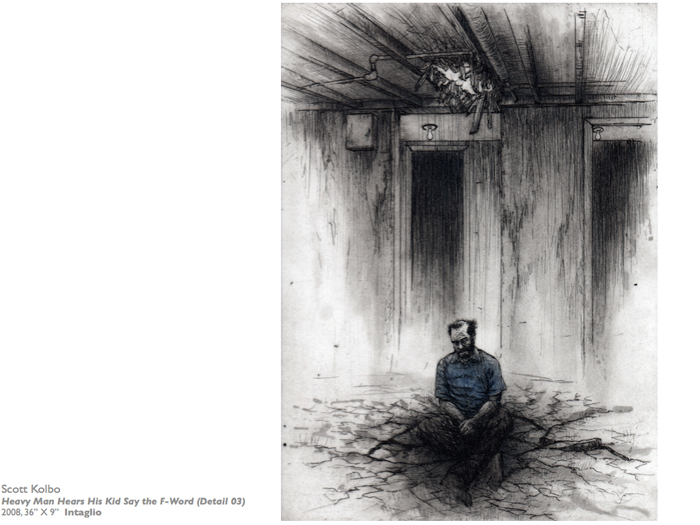
This week, I received my first hard copy of Ruminate (Issue 14, Winter 2009–2010). First impressions? It’s beautifully produced, and aesthetically yummy. Now, having read through it all, I remain delighted. This edition – like most – comprises of mainly poetry, but also includes two short stories, and is peppered with some provocative images (ink and charcoal, serigraphy, intaglio) by Scott Kolbo. Here’s my favourite poem from this issue:

‘Weekend Plans’, by David Holper

In a talk I recently heard, the speaker said
that at 50, a man has less than
1500 weekends left in his life.
Having chewed on this fact for the last week,
I now realize that my 1499th weekend is coming.

And so I’m making big plans:
On this 1499th remaining Saturday,
I plan to grade a stack of student papers.
But knowing that there are only so many of these
Saturdays to sit through,
I am planning on writing the most
remarkable comments and grades
I have ever composed.

Instead of pointing out where the prose clunks,
I will say that the sentence over which I stumble
reminds me of a ’62 Fiat convertible
I once owned, a car that ran well enough
when I bought it,
until I rear-ended a truck one day
and the front end crumbled
pushing the radiator back just enough
that the fan chewed a hole through
the back end,
the blades not only making an unearthly racket,
but also bleeding the radiator dry
and leaving a green stain on the pavement.

And instead of pointing out that a comma is not a coma,
that noone and alot are two words,
that a manor is a large country house
(in a manner of speaking)
and that collage
is not an institution of higher learning,
I will point out to them that Shakespeare, too,
invented new spellings and words
so that rather than see their grades as a kind
of condemnation,
they might rather embrace these marks as a sort of celebration
of their wild and anarchic spirit
which has emancipated itself from all bounds,
from all pedestrian, prosaic concerns
on this glorious, remaining 1499th Saturday.

The church family

One of the (many) books currently on my desk awaiting review is Anthony Robinson’s Changing the Conversation: A Third Way for Congregations, and after reading this wee piece, it’s just moved a little higher up the list. He writes:

‘Many of the congregations that claim “We’re a family,” lose sight of larger transformative purposes and settle, instead, for the comfort and satisfaction of their members. The core purpose of a congregation – growing people of faith and helping people and communities move from despair to hope – gives way to lesser and even contrary purposes like keeping people happy. While it may not be a necessary outcome of the use of the family image, many congregations that gravitate towards it seem to make member comfort and satisfaction their de facto purpose.

That may be because “family” suggests to people something like, “We’re all loving and nice here.” That in turn often means no hard questions are asked and no honest challenges are allowed. It wouldn’t be nice.

I can think of other reasons to be cautious about “family” as our image for church. Families sometimes keep secrets that shouldn’t be kept in order to keep from bringing shame on the family name. And families aren’t typically that easy to join. Two of our sons were married in recent years. Turns out that putting families together is a fairly complex dance.

One last issue. The use of the term “family,” may communicate to people who are not married or to the married without children that they don’t quite fit. “Our church is a family,” morphs into “our church is for families.”

Keeping the family members happy, having everyone know everyone else and get along like “a happy family,” isn’t really the point for Christian congregations. Their goal and purpose is both different and higher.

Perhaps other biblical images like “People of God,” “Creation of the Holy Spirit,” or “Body of Christ” are better ecclesiological images? It’s not that these images don’t also have potential pitfalls. It is the case, however, that unlike “family” they are uncommon enough that people seldom have their own set ideas about what they mean. In some congregations, I hear leaders address the congregation simply as “church.” That too seems promising, reminding the gathered community that they are the Church of Jesus Christ (and the building is not).

If we must use “family,” we should be aware of the way that Jesus, while using “family,” also subverts conventional understandings of family and challenges their usual boundaries with a thoroughly new vision of “family.”’

Moltmann to give Lenten lectures: ‘Reflections on the Cross’

Jürgen Moltmann is to give the 2010 public Lenten Lectures at The American Church in Paris on the following topics:

  • “The Passion of Christ – Compassion of God” – Tuesday, March 16
  • “The Passion of Christ – God’s Solidarity with Victims” – Wednesday, March 17
  • “What does Christ’s passion mean for God?” – Thursday, March 18

More details here.

I’m so miffed that I can’t be there.