Author: Jason Goroncy

Reformation Day: 25 Theses

1. Anyone who thinks you can cherry-pick the sixteenth century Reformations for solutions for today’s church and society is an idiot.

2. Anyone who thinks you can ignore the Reformations has their head in the sand.

3. Music, art, and literature were transformed by the Reformations.

4. The Reformations also triggered the Peasants’ War: the greatest social upheaval in Europe before the French Revolution.

5. Genuine Reformations always spell trouble.

6. Reformations begin and end with our understanding of God.

7. God spells trouble.

8. From Luther to Teresa of Avila, faith begins with doubt, ecstasy begins with despair.

9. Reformations begin and end with our understanding of Christ.

10. ‘If you will not taste the bitter Christ, you will eat yourself sick of honey’. (Thomas Müntzer)

11. Reformations begin and end with our understanding of Holy Spirit.

12. ‘God’s Spirit is within you, read/Is woman shut out, there, indeed?’ (Argula von Grumbach)

13. In today’s churches heart and mind are out of kilter.

14. In our music and our liturgy we say we yearn for transformation.

15. In our thinking, however, we have given up on the future.

16. We Presbyterians feel we have lost our Church, nationally.

17. Many in the churches feel we have lost the way, politically.

18. There were many Reformations: humanist, Catholic, Lutheran, Reformed, Radical, and communal.

19. None of them gave up on the future.

20. All of them found the way to that future, however, in a recapitulation of the origins.

21. To go forward we need to go back.

22. ‘Traditionalism is the dead faith of the living. Tradition is the living faith of the dead’. (Jaroslav Pelikan)

23. The Church likes to domesticate, to tame the Bible. The Reformations recognized it as dangerous memory, as liberation, as a wild animal.

24. ‘Almaist in everie private house the buike of Gods law is red and understand in oure vulgaire language’. (1579; Geneva Bible).

25. God is gift.

– Peter Matheson, 31 October, 2011

Seneca on the difference between philosophy and theology

Regular readers of Per Crucem ad Lucem will probably have observed that I’ve been meandering my way (in a somewhat slow version of what Ben Myers once called ‘binge reading‘) through Seneca’s works. (My other current binge, by the way, is Iris Murdoch’s work.) It’s been a real treat so far, and has even made me contemplate doing some serious study in classics. I can’t understand how anyone who has ever read Letters from a Stoic, or Dialogues and Essays, or Seneca’s wee essay On the Shortness of Life (an experience somewhat akin to reading Dostoyevsky’s Crime and Punishment for the first time – you’re left completely naked!) could not be entirely mesmerised with the guy. And in an age of ‘friending’, for example, his Selected Letters are simply must reading (alongside, say, Jacques Ellul’s The Technological Society). Anyway, because I suspect that most readers of this blog are both theo-blog readers and Seneca virgins, and because I’m desperate to ‘shout from the housetops what I’ve heard whispered in the darkness’ (Matt 10.27) of my own reading time, I thought I’d try and offer to you dear reader an apple or apricot or whatever fruit it is that snakes like to advertise around goodies so close to the tree of life, and that by way of some words from Seneca on the difference between philosophy and theology:

‘In my opinion, Lucilius, excellent man, the difference between philosophy and other areas of study is as great as the difference, within philosophy itself, between the branch concerned with humans and the one concerned with the gods. The latter is more elevated and more noble; it allows itself immense scope; it is not satisfied with the eyes; it suspects that there is something greater and more beautiful that nature has placed beyond its sight. (2) In brief, the difference between the two is as great as the difference between god and human beings: the one branch teaches what should be done on earth; the other what is done in the heavens; the one dispels our wrongdoings and brings a light up close to us so that the uncertainties of life can be clearly discerned; the other rises far above the darkness in which we stumble around, whisks us away from the shadows, and leads us to the source of light’.

– Lucius Annaeus Seneca, Natural Questions (trans. Harry M. Hine; The Complete Works of Lucius Annaeus Seneca; Chicago: The University of Chicago Press, 2010), 136.

‘Beyond Occupy’

Bill Keller‘s recent piece ‘Beyond Occupy‘ (New York Times, 31 October 2011, A21) is certainly one of the best reflections I’ve read so far on the Occupy movement. Here ’tis:

Since I was passing through India on a reporting project, I decided to drop in on Anna Hazare, the anticorruption campaigner whose admirers speak of him as the reincarnation of Gandhi. Kisan Baburao Hazare (“Anna” is a Marathi honorific meaning “older brother”) has been a figure in provincial Indian affairs for decades, but he galvanized attention this year when his threat to fast to the death shamed the government into endorsing reforms. I wondered what Hazare, as an exemplar of a venerable style of civil pressure, made of Occupy Wall Street.

Back home, the Occupiers have been pandered to (“Love your energy!”); patronized (“Here, I’ve drafted you a list of demands …”); co-opted by unions, celebrities and activists for various causes; demonized by the right; arrested and tear-gassed in some cities; and taken lightly by the likes of me. They have been a combination national mood ring and political Rorschach test. Perhaps by consulting someone who is a serious candidate for the pantheon of protest, I thought, I could sharpen my own understanding of what the Occupy project means.

About the time I put in my request for an interview, Hazare, exhausted by his latest hunger strike and weary of the media melodramas that have bedeviled his team, announced that he had taken an indefinite “vow of silence.” This raised questions in my mind — Was he planning to continue his protest as a mime? — but of course I had little hope of getting answers from him because … well, you see the problem.

So I went to visit his associate, Kiran Bedi, who battled for reforms as India’s first policewoman before joining Hazare. Bedi speaks with the intense energy of a high-voltage circuit. No vow of silence for her. And it turned out the subject of Occupy Wall Street has been very much on the minds of Team Anna.

For those who haven’t been following the story, Hazare, 74, is a small landowner’s son with a seventh-grade education, a middle-class background by Indian standards of the time. He first gained some attention by using his army pension to help turn his ancestral village in Maharashtra into a model of rural development — building schools, organizing a dairy cooperative, fighting caste discrimination and alcoholism. One of his early successes as an organizer was a state law that required a vote on banning alcohol in a village if 25 percent of the women — the suffering wives of the indolent and abusive drunks — demanded it.

In his younger days he was given to vigilante tactics — smashing illegal stills, flogging drunks — but in his 60s he adopted the time-honored Indian pressure tactic of the indefinite fast, which, when it works, succeeds through a combination of public fascination and official shame. The political fast has a rich history in societies like India and Ireland that have some experience of starvation and an acute public sense of honor. I can’t imagine it catching on in America, especially if our national compassion is reflected in the likes of Ron (“Let Them Die on the Hospital Doorstep”) Paul and Herman (“If You’re Not Rich, It’s Your Own Fault”) Cain. But in India it is an effective form of coercion. One poll found 87 percent public support for Hazare’s 12-day August fast, and his hunger strikes almost always end in concessions.

Obviously, India is not America, but both countries were born in popular protest (against the same empire) and I found it instructive to examine my Occupying countrymen from this vantage point.

Like Occupy Wall Street, Hazare embodies a national frustration with broken democratic institutions. Indeed, India’s government makes our paralyzed Congress look nimble. Like Occupy, Hazare’s grand grievance is the wholesale diversion of wealth from the middle class and poor to the unworthy few — in India’s case through payoffs, patronage and thievery, in America’s through tax and regulatory policies that have expanded the gap between the richest few and everyone else.

In many telling respects, however, that’s where the similarities end.

“When we started the movement, it was like Occupy,” Bedi told me. “But we went beyond Occupy.”

For starters, while Occupy Wall Street is consensus-oriented and resolutely leaderless, Hazare is very much the center of attention. There was an anticorruption movement before Hazare, but it was fractious and weak until he supplied a core of moral authority. When he announces his intention to starve himself, he parks himself on an elevated platform in a public place, thousands gather, scores of others announce solidarity hunger strikes, and TV cameras congregate, hanging on his every word. Hazare and his entourage can seem self-important and high-handed, but he is a reminder that leadership matters.

Second, the Occupiers are a composite of idealistic causes, many of them vague. “End the Fed,” some placards demand. “End War.” “Get the money out of politics.” Much of the Occupy movement resides at the dreamy level of John Lennon lyrics. “Imagine no possessions. …”

Hazare, in contrast, is always very explicit about his objectives: fire this corrupt minister, repeal that law bought by a special interest, open public access to official records.

His current mission is the creation of a kind of national anticorruption czar, a powerful independent ombudsman. The measure is advancing, and Team Anna hovers over the Parliament at every step, paying close attention to detail, to make sure nobody pulls the teeth out of it. Instead of a placard, Bedi has a PowerPoint presentation.

Occupy Wall Street is scornful of both parties and generally disdainful of electoral politics. Team Anna (yes, they call themselves that) likewise avoids aligning itself with any party or candidate, but it uses Indian democracy shrewdly, to target obstructionists. Recently Hazare turned a special election for a vacant parliamentary seat into a referendum, urging followers to vote against any party that refused to endorse his anticorruption bill. Hazare has also called for an amendment to the election laws to require that voters always be offered the option of “None of the Above.” When it prevails, parties would have to come up with better candidates.

“What really changes them,” Bedi said of recalcitrant politicians, “is the threat of losing an election.”

The Occupation has at least a strong undercurrent of anticapitalism. Not in India. An attempt to spark an Indian offshoot of Occupy Wall Street — a Facebook campaign branded with pictures of Che Guevara — went pretty much nowhere. Capitalism is one thing most Indians believe in; indeed, as my colleagues in the Delhi bureau have been illustrating in a fascinating series of articles this year, the entire economy is a great capitalist workaround. Hazare’s aim is to stop a political class from usurping the fruits of capitalism.

“We’re not anticapitalism,” Bedi told me. “We’re pro-integrity.”

I UNDERSTAND that it is not the job of a protest to draft legislation, to elect candidates, to agree on a 10-point plan for fixing what ails us. But that does not mean the job of fixing what ails us is any less urgent or admirable. At some point you need the unglamorous business of government, which entails not consensus but hard choices and reasoned compromise. The job of protest is to mobilize a mood — but to mobilize it with purpose.

“Occupy has been, to my mind, an engaging movement, and it’s driving home the message, to the banks, to the Wall Street circles,” Bedi said. “That’s exactly the way Anna did it. But we had a destination. I’m not aware these people — what is their destination? It’s occupy for what?”

I’m prepared to celebrate when the Occupiers — like the lone hunger artist of India — accomplish something more than organizing their own campsite cleanup, demonstrating their tolerance for tear gas, and distracting the conversation a little from the Tea Party. So far, the main achievement of Occupy Wall Street is showing up.

I also enjoyed Andrew Geddis’ recent piece in the ODT, but found this video of Slavoj Žižek simply amusing.

A new Updike book, Higher Gossip

Forget (nearly) everything else you’re reading: there’s a new posthumous collection of essays, reviews, poems and stories from John Updike‘s brilliant pen – Higher Gossip: Essays and Criticism. As I type, my ordered copy is in the hands of the USPS, which means that it could arrive any time between next week and some future Christmas. In the meantime, I’ve had to content myself with some reviews – one here, and another one here wherein Updike’s writing is described thus:

‘He was unstintingly alert to the significance with which, sometimes desperately, we invest the smallest incidents and sensations — especially in retrospect, when “customary reticence is discarded, as needless baggage from the forsaken world of midlife responsibilities,” and “our tears fatten upon our memories of joy.” He wrote with tactile intensity about everything, be it a boy petting with his first girlfriend in the car as moonlight “anointed her bare front with the shadows of raindrops still clinging to the windshield” or the feel of fingering the “merry dimples” of a golf ball’.

And while I’m mentioning reviews, I’ll give a shout out to this review of Julian Barnes’ The Sense of an Ending, a brilliant book (and worthy winner of the 2011 Booker Prize), and certainly one of my favourite reads this year.

‘Carnival of the Animals’, by Michael Leunig

1. PROLOGUE.
When human beings began to walk
Upon hind legs and learned to talk
And say, “We are no longer creatures …”
They covered up their natural features
And set about becoming clever –
Enough to ruin the earth forever.
And as sophistication grew
The world became a human zoo.
Where human types in many cages,
Sang their songs on little stages
Staring sadly through the bars
Towards the distant moon and stars.
So lend your ears and come with me
Into this weird menagerie.

2. PRESIDENTS AND PRIME MINISTERS. (LION)
Presidents and Prime Ministers are magnificent creatures;
They’re magnificent at making speeches.
Which tell us of our national glory
The stirring and redeeming story
That we are good and the others bad
That we are happy – the others sad
Then having said these wondrous things
Our leaders stand like queens and kings
So noble, truthful, just and wise.
That tears of gladness fill our eyes.
Until, upon election day
We vote and have them flushed away.

3. THE COMMON PERSON. (ROOSTER)
Now let’s imagine if we can
A fanfare for the common man:
Bright and bold and lyrical –
Perhaps that’s too satirical –
If we pause to contemplate
The common person’s current state
Considering the simple facts
Of how the modern person acts:
Running here, running there,
Agitation and despair,
Incurably Titanic –
The common man is manic.
The modern world in disarray.
It might be time to sit and pray
And let Camille Sain-Saens express
An anthem for this crazy mess:
For nothing could be truer.
Than this fanfare for the insecure.

4. THE TOURIST. (JACKASS)
The tourist runs away from home
And all the roads that lead to Rome
Are packed with speeding human ants
Wearing lightweight tourist pants
Catching buses, catching trains
Catching colds in aeroplanes
Hurtling to everywhere;
Through the streets and through the air
Faster faster, more and more.
Through another hotel door
Photograph it, see it all
See another Chinese wall
One more continental shelf.
Tourist you should see yourself.

5. THE OLD, OLD MAN. (TURTLE)
The old, old man is a weary beast;
He pulled the plough, he pulled the cart
Through the famine and the feast;
It broke his back, it broke his heart
But it did not break the magic spell
That gave him wings to drift and fly
With music that he loved so well
To sweethearts floating in the sky.

6. ME
The me slowly emerges
And when it does it’s splendid;
Delightful inner urges
All beautifully extended.
The me just simply must
Unto itself be true
And absolutely thrust
Its life into the blue.
The me is full and rounded
And ripe and sweet and free.
It’s great to be surrounded
By a lovely peaceful me.

7. STRANGERS (KANGAROO)
Unfinished.

8. THE DEPARTED. (FISH)
Don’t fret too much for the Departed.
Even though they leave you broken hearted.
Have no fear
They WILL reappear
When you’re alone and unprepared
They will just turn up. Do not be scared.
Be still. Do not turn away;
There is something wise they have come to say
To you and to you alone;
Some plain and simple thing already known
They will touch you and say,
“It’s alright, everything will be OK”
Or something just like that, short and clear.
Then casually they will turn and softly disappear
Leaving you elated and in perfect peace
The meaning of life and death will then increase
And your love for the departed one will grow.
There is so much more you will get to know
About love that is unassailable.
So long as you make yourself available.

9. JERKS (MULES)
Jerks know all the lurks
Jerks get all the perks.
Nothing really irks
Like the murkiness of jerks.
Jerks know all your quirks
Jerks do all the smirks
Nothing really works
Like the murkiness of jerks.

10. ECCENTRICS (COOKOO)
The eccentric is a mysterious creature
Peculiar behaviour is its notable feature
Lost and alone in a world of conformity
Where oddness is seen as a dreadful deformity.
Yet, of all the creatures, the true non-conformist
Is often the brightest, the boldest and warmest.

11. THE BELOVED. (BIRDS)
The beloved brings intoxication – for a while.
Then some time later the beloved brings – a smile.
And later on the beloved brings a few concerns.
And later on the beloved brings a rash that burns.
And later on the beloved brings a sleepless night.
And then the beloved brings a dreadful fright.
And so the beloved brings us to our senses.
And that is where the greatest love commences.

12. MEGALOMANIACS (PIANISTS)
Megalomaniacs want control
Because they do not trust the soul.
In every living situation
A megalomaniac seeks domination.
Megalomaniacs want their way
To make a better world they say;
To fix the breakages and cracks
Of other megalomaniacs.

13. THE CHILD (FOSSILS)
The human child at a tender age
Is often placed into a cage
Where it is trained to join the cult
Of acting like a nice adult.
The nice adult then goes all sad
And starts to act a little mad
Until it turns completely wild
And liberates its inner child.
Childhood must be had when young
Something like when spring has sprung
Let the birds and angels sing
Childhood is the time of spring.

14. THE NAKED LADY. (SWAN)
The strange naked lady is wonderfully plump–
So soft, so large and complete.
Magnificent bosom and fabulous rump
Just gliding along through the street.
Slowly and gracefully – light as a cloud
A faraway look in her eye
Humming a sweet little song to the crowd
And holding a rose to the sky
But why is she naked and where are her clothes
And what is her medical history?
She’s simply the lady that nobody knows:
A divine and miraculous mystery.

15. THE GRAND PARADE.
And so we come to the grand parade
Where all the sounds of joy are made
As we finally open every cage
And let the humans out to rage
And dance along with hands on hips;
To roll their heads and pout their lips;
Characters bright and characters shady;
The prime Minister shall dance with the Naked Lady,
The sad old man will be reconciled
With the beautiful truth of his inner child,
And sweet Palestinians with sweet Israelis
Will blow fanfares of peace on their ukuleles.
Then the humans creatures shall finally see.
That where there is love – THEY ARE FREE.

– Michael Leunig, Carnival of the Animals (Sydney: Macmillan, 2000), np.

Looking for God – a short reflection

He will come like last leaf’s fall.
One night when the November wind
has flayed the trees to bone, and earth
wakes choking on the mould,
the soft shroud’s folding.

He will come like frost.
One morning when the shrinking earth
opens on mist, to find itself
arrested in the net
of alien, sword-set beauty.

He will come like dark.
One evening when the bursting red
December sun draws up the sheet
and penny-masks its eye to yield
the star-snowed fields of sky.

He will come, will come,
will come like crying in the night,
like blood, like breaking,
as the earth writhes to toss him free.
He will come like child.

– Rowan Williams, The Poems of Rowan Williams (Grand Rapids: Wm. B. Eerdmans, 2004), 31.

A few Wednesdays ago, I was exploring the vibrant and crowded city of Mumbai. With a population of over 20 million, Mumbai is India’s most populous city, and the fourth most populous in the world. It’s a city of colour, of noise, and of enormous energy.

There were many memorable experiences: simply navigating my way across the road, for example, or holding my breath while praying for life at the rear of a speeding and bald-tyred rickshaw while the driver checked messages on his cell phone, or fighting to get my graceful frame on and then off a moving second-class train carriage – moving, because that’s the only way you have anything of a skerrick of a chance of getting on or off the train in the first place. I’ve never seen so many people pressed into one space. Also crowded though, and more violently etched on my memory, is the kilometres and kilometres of Mumbai slums. As with some of the places I visited and stayed in Burma, it is impossible to put this image into words. Of course, one of the ever-present dangers in theology attends our perpetual and inescapably-inadequate attempts to find words for everything, especially for God, as if by writing or speaking about things, or about God, we can somehow harbour control over, or a sense of distance from, them. But I digress.

That Wednesday was also the first time in my life when I encountered someone who seriously tried to sell me some children. In fact, I was offered 3 children for 900 rupees, which is 200 rupees more than I had just paid for a scarf for my partner. These small children – they can’t have been older than 5 or 6 – were standing around barefoot on what was literally a small sea of broken glass, mostly light bulbs it seems, where they were attempting to retrieve small pieces of metal and other parts that could then be sold. A kid’s gotta live.

I uttered an ancient prayer – ‘Where is God?’

And I found myself hearing again Rowan Williams’ words, that God ‘will come, will come/will come like crying in the night/like blood, like breaking/as the earth writhes to toss him free/He will come like child‘.

It was only a few days later when, in Mangalore, some 900 kilometres away, I had the privilege to share a meal with Rev Dr Manohar Chandra Prasad who serves as president of the Dalit Christian Federation in Karnataka, and as bishop of the Church of South India. Not only did he generously give me a short but utterly-fascinating course in Dalit politics, hierarchy, hermeneutics, and history, but he also spoke to me of God’s plan for the liberation of all oppressed people’s via God’s action of becoming incarnate, not as a one-off act but rather as a continual act of God’s becoming among us. He also spoke of God identifying himself with the ‘least of us’, taking up the exploitation and oppression into his own body, and becoming the first among the oppressed and the marginalised.

In The Pseudonyms of God, a book penned against the backdrop of the Vietnam War, Robert McAfee Brown invites us to imagine finding ourselves in a place where we are waiting for some tremendous manifestation of God’s activity. He invites us to imagine a situation where we have heard – or thought we had heard – a promise that God would intervene in our situation, and that it was now clear that the time was at hand. Where would we look for God?

Brown suggests that we might most likely be found looking ‘in one of the great nations, where as many people as possible would be exposed to this important fact; surely in a well-established family with much influence; surely in such a way that all the resources of public opinion and mass media could be used to acquaint people with what had happened; surely it would be the most public and open and widely accessible event possible’ (pp. 84–85). He then paints a scenario more in keeping with the event of God’s disclosure now known to us:

A child would be born into a backward South African tribe, the child of poor parents with almost no education. He would grow up under a government that would not acknowledge his right to citizenship. During his entire lifetime he would travel no more than about fifty miles from the village of his birth, and would spend most of that lifetime simply following his father’s trade – a hunter, perhaps, or a primitive farmer. Toward the end he would begin to gather a few followers together, talking about things that sounded so dangerous to the authorities that the police would finally move in and arrest him, at which point his following would collapse and his friends would fade back into their former jobs and situations. After a short time in prison and a rigged trial he would be shot by the prison guards as an enemy of the state. (p. 85)

Those who have heard the message of Jesus ought not to be surprised to hear that the only God there is is the outcasted God, and to find the outcasted God among the outcast. Is this not the message of Matthew 25?:

When the Son of Man comes in his glory, and all the angels with him, then he will sit on the throne of his glory. All the nations will be gathered before him, and he will separate people one from another as a shepherd separates the sheep from the goats, and he will put the sheep at his right hand and the goats at the left. Then the king will say to those at his right hand, “Come, you that are blessed by my Father, inherit the kingdom prepared for you from the foundation of the world; for I was hungry and you gave me food, I was thirsty and you gave me something to drink, I was a stranger and you welcomed me, I was naked and you gave me clothing, I was sick and you took care of me, I was in prison and you visited me.’ Then the righteous will answer him, “Lord, when was it that we saw you hungry and gave you food, or thirsty and gave you something to drink? And when was it that we saw you a stranger and welcomed you, or naked and gave you clothing? And when was it that we saw you sick or in prison and visited you?’ And the king will answer them, “Truly I tell you, just as you did it to one of the least of these who are members of my family, you did it to me. (vv. 31–40)

We must look for signs of the Servant-God’s presence among those who serve. Numbered among the world’s neglected and forgotten castes, we must expect to hear the echo of God’s voice among those who are oppressed. The pieta-like image on the left recalls that since 800 million of the planet’s people suffer from hunger and malnutrition, we might well expect that God’s availability is made tangible in loaves and fishes, rice and safe drinking water. Since God’s identification with the world involves God’s becoming creaturely, perhaps we ought look for God not (only?) in ‘holy’ places or by means of ‘holy’ words, but also in the very common and ordinary things of life, in the well-over 500 million people living in what the World Bank has called ‘absolute poverty’. Are these not those gathered up in the one great movement of divine emptying and filling? ‘We will not be surprised to discover’, Brown writes, ‘that [God] suffered also, nor will we flinch when Bonhoeffer pronounces the initially disturbing words, “Only the suffering God can help,” even though it is probably the ultimate in the pseudonymous activity of God that he could be acquainted with grief’ (p. 86).

The words ‘only the suffering God can help’ come from Bonhoeffer’s Letters and Papers from Prison. And it’s worth hearing the context – both literary and historical/political – from which these words come:

The same God who is with us is the God who forsakes us (Mark 15:34!). The same God who makes us to live in the world without the working hypothesis of God is the God before whom we stand continually. Before God, and with God, we live without God. God consents to be pushed out of the world and onto the cross; God is weak and powerless in the world and in precisely this way, and only so, is at our side and helps us. Matt. 8:17 makes it quite clear that Christ helps us not by virtue of his omnipotence but rather by virtue of his weakness and suffering! This is the crucial distinction between Christianity and all religions. Human religiosity directs people in need to the power of God in the world, God as deus ex machina. The Bible directs people toward the powerlessness and the suffering of God; only the suffering God can help. (pp. 478–79)

Bonhoeffer reminds us that in the economy of grace, Jesus is God’s grand pseudonym, the supreme occurrence of God acting in ways contrary to our expectation. And so if we miss God’s presence in the world, it will not be because God is absent. It will be because we have been looking in the wrong places.

As with so many of the great saints, such looking drove the imprisoned Bonhoeffer, again and again, to prayer – to prayer for his fellow prisoners, to prayer for those charged with performing the ‘difficult duty’ of guarding them, to prayer for himself:

God, I call to you early in the morning,
help me pray and collect my thoughts,
I cannot do so alone.
–––––
In me it is dark, but with you there is light.
I am lonely, but do not abandon me.
I am faint-hearted, but from you comes my help.
I am restless, but with you is peace.
In me is bitterness, but with you is patience.
I do not understand your ways, but you know [the] right way for me.
–––––
Father in heaven,
Praise and thanks be to you for the quiet of the night.
Praise and thanks be to you for the new day.
Praise and thanks be to you for all your goodness and faithfulness in my life thus far.
You have granted me much good,
now let me also accept hardship from your hand.
You will not lay on me more than I can
You make all things serve your children for the best.
–––––
Lord Jesus Christ,
you were poor and miserable, imprisoned and abandoned as I am.
You know all human need,
you remain with me when no human being stands by me,
you do not forget me and you seek me,
you want me to recognize you and turn back to you.
Lord, I hear your call and follow.
Help me!
–––––
Holy Spirit,
Grant me the faith
that saves me from despair and vice.
Grant me the love for God and others
that purges all hate and bitterness,
grant me the hope
that frees me from fear and despondency.
Teach me to discern Jesus Christ and to do his will.
–––––
Triune God,
my Creator and my Savior,
this day belongs to you. My time is in your hands.
Holy, merciful God,
my Creator and my Savior
my Judge and my Redeemer,
you know me and all my ways and actions.
You hate and punish evil in this and every world
without regard for person,
you forgive sins
for anyone who asks you sincerely,
and you love the good and reward it
on this earth with a clear conscience
and in the world to come with the crown of righteousness.
Before you I remember all those I love,
my fellow prisoners, and all
who in this house perform their difficult duty.
Lord, have mercy.
Grant me freedom again
and in the meantime let me live in such a way
that I can give account before [you] and others.
Lord, whatever this day may bring – your name be praised.

– Bonhoeffer, Letters and Papers from Prison, pp. 94–96.

I do not, of course, want to foster the impression that the looking (or groping; see Acts 17.27) for God is solely, or even primarily, a human activity. Even in prayer, the prime mover is always God. As I have written elsewhere, it is principally God and not us who is on the prowl, awaiting God’s own time to enact the ‘terrible death leap and single blow’ upon us. To be found by God is to be made love’s victim.

Sunday school attendance well below par

‘At a conference of Presbyterian Sunday school workers, held in First Church Hall yesterday morning, the Rev. J. McCaw, of Lower Hutt, brought forward the following motion: – “That this conference of Sunday school superintendents and workers calls attention to the fact that, owing to increasing desecration of the Sabbath, the work of the Sunday school teacher is being increasingly hampered. In view of the importance of this work in the development of national character, the conference appeals to golf and other clubs to refrain from employing boys in occupations on Sunday that interfere with attendance at church and Sunday school.”

The mover said he had previously complained of golfers in his district waylaying the children on their way to Sunday school and seeking to entice them to the golf links. The evil was very widespread. Mr W. A. Patterson, of Khandalla, seconded the motion, which was carried unanimously’.

– Otago Daily Times, 9 November, 1911.

On Moby-Dick

‘“Moby-Dick” is not a novel. It’s barely a book at all. It’s more an act of transference, of ideas and evocations hung around the vast and unknowable shape of the whale, an extended musing on the strange meeting of human history and natural history. It is, above all, a sui-generis creation, one that came into the world as an unnatural, immaculate conception …

In an age of uncertain faith, then as now, “Moby-Dick” resembles a religious tract, an alternative testament. Little wonder that one of its early set-pieces is Father Mapple’s fire-and-brimstone sermon from the prow-shaped pulpit in the Seamen’s Bethel, New Bedford, or that Philbrick takes the title for his own first chapter, “The Gospels in This Century,” from Melville’s wry and rather Wildean remark on the unsalability of his work: “Though I wrote the Gospels in this century, I should die in the gutter.” As he told Nathaniel Hawthorne, “I have written a wicked book, and I feel as spotless as the lamb.”

When I finally began reading “Moby-Dick” (had I wasted my time before then?), I found I couldn’t put it down. I’d carry about with me a tiny, Oxford World Classics edition, anonymously bound in blue cloth, to be studied chapter by chapter, like the Bible or the Koran, as I sat on the Tube or on an airplane, or in the early hours of the morning. As Philbrick exhorts his readers, ” ‘Moby-Dick’ is a long book, and time is short. Even a sentence, a mere phrase will do.”

Much of the impact of Melville’s book on any fierce new convert is implicit in that sense of time travel. Sometimes I read it and I feel like I’m going backward, fast. It reads like something that was written before books were invented, yet it is utterly modern—pre-postmodern, perhaps. It is part of its own prediction, as if it and its characters had been there all along, and had only been waiting to be written. Just as in the real New Bedford’s Bethel a pulpit-prow had to be built, in the nineteen-sixties, because so many visitors expected to find one there; and, just as Melville wrote vividly of Nantucket, an island that he had yet to visit, much of “Moby-Dick” is conjured out of the air and the sea’.

– Philip Hoare, What “Moby-Dick” Means to Me

Murmurations

Sigmund Freud once observed that birds ‘don’t seem to be submitted to the same laws of gravity as us’, and yet apart from gravity they would die for they need gravity to swallow. I was thinking about this this morning, over good coffee and reasonable porridge, while I was reading about murmurations (the technical name for a flock of starlings whose phenomenal flight patterns signal that winter is on the way), and sitting spell-bound by this recently-posted clip by British filmmakers Liberty Smith and Sophie Windsor Clive:

Janet Sim Elder: Doing justice honourably

The focus of the next meeting of the NZ Presbyterian Research Network will be a lecture by my dear friend Janet Sim Elder on ‘The Challenge of Changing the Justice Landscape: How do we do justice honourably with victims, reduce recidivism and change public attitudes?’

Join us at the Knox Centre Seminar Room (Hewitson Wing, Knox College, Arden Street, off Opoho Road) on Thursday 10 November, 2011. We kick off with wine and nibbles at 5pm, and then Janet jumps into the hot seat from 5.30 until around 7.00. All are welcome.

NT Wright’s Inaugural Lecture: ‘Imagining the Kingdom: Mission and Theology in Early Christianity’

It was nearly four years ago now when I had the joy of hearing NT Wright lecture in St Andrews. It was one of the James Gregory Public Lectures, and his topic was ‘Can a Scientist Believe in the Resurrection?’. Since then, of course, Tom Wright has been appointed to a Chair in New Testament and Early Christianity at that same university, and where just last week he gave his Inaugural Lecture titled ‘Imagining the Kingdom: Mission and Theology in Early Christianity’. Here’s a snippet:

The four gospels … are thus appropriately named ‘gospel’, in line both with Isaiah 40 and 52 and with the contemporary pagan usage. They themselves, in telling the story of how God became king in and through Jesus, invite their readers to the imaginative leap of saying, ‘Suppose this is how God has done it? Suppose the world’s way of empire is all wrong? Suppose there’s a different way, and suppose that Jesus, in his life, death and resurrection, has brought it about?’ And the gospels themselves, of course, contain stories at a second level, stories purportedly told by Jesus himself, which were themselves, in their day, designed to break open the worldview of their hearers and to initiate a massive imaginative leap to which Jesus gave the name ‘faith’. The gospels invite their readers, in other words, to a multiple exercise, both of imagining what it might have been like to make that leap in the first century (both for Jesus’ hearers and then, at a second stage, for their own readers) and, as a further stage again, of imagining what it might be like to do so today. For too long gospel study has been dominated by the attempt to make the gospels reflect, simply, the faith-world of the early church. Why, after all, the radical critics used to say, would the early Christians have been particularly interested in miscellaneous stories of what Jesus actually said or did, when all that really mattered was his saving death, making the gospels simply ‘passion narratives with extended introductions’? The conservative response has been that early converts would naturally want to know more about this Jesus in whom they had come to place their faith. But this stand-off, on both sides, has usually failed to reflect the larger question: that the gospels tell the story of Jesus not out of mere historical anecdotage or faith-projection, but because this is how Jesus launched the kingdom of God, which he then accomplished in his death and resurrection. Even to hold this possibility in one’s head requires, in today’s western church, whether radical or conservative, no less than in the non-Christian world, a huge effort of the imagination.

This imagination, like all good right-brain activity, must then be firmly and thoroughly worked through the left brain, disciplined by the rigorous historical and textual analysis for which the discipline of biblical studies has rightly become famous. But, by itself, the left brain will produce, and has often produced, a discipline full of facts but without meaning, high on analysis and low on reconstruction, good at categories and weak on the kingdom.

You can read the whole lecture here.

‘The Incarnate One’, by Edwin Muir

The windless northern surge, the sea-gull’s scream,
And Calvin’s kirk crowning the barren brae.
I think of Giotto the Tuscan shepherd’s dream,
Christ, man and creature in their inner day.
How could our race betray
The Image, and the Incarnate One unmake
Who chose this form and fashion for our sake?

The Word made flesh here is made word again
A word made word in flourish and arrogant crook.
See there King Calvin with his iron pen,
And God three angry letters in a book,
And there the logical hook
On which the Mystery is impaled and bent
Into an ideological argument.

There’s better gospel in man’s natural tongue,
And truer sight was theirs outside the Law
Who saw the far side of the Cross among
The archaic peoples in their ancient awe,
In ignorant wonder saw
The wooden cross-tree on the bare hillside,
Not knowing that there a God suffered and died.

The fleshless word, growing, will bring us down,
Pagan and Christian man alike will fall,
The auguries say, the white and black and brown,
The merry and the sad, theorist, lover, all
Invisibly will fall:
Abstract calamity, save for those who can
Build their cold empire on the abstract man.

A soft breeze stirs and all my thoughts are blown
Far out to sea and lost. Yet I know well
The bloodless word will battle for its own
Invisibly in brain and nerve and cell.
The generations tell
Their personal tale: the One has far to go
Past the mirages and the murdering snow.

– Edwin Muir, ‘The Incarnate One’ in The Penguin Book of Religious Verse (ed. R.S. Thomas; Harmondsworth: Penguin, 1963), 55.

October stations …

Reading:

Some re-reads:

Listening:

Watching:


New Apps:

  • I guess it was inevitable, but the AAR/SBL App for iPhone/iPad/iPod Touch has arrived.

Hemingway on writing

‘In going where you have to go, and doing what you have to do, and seeing what you have to see, you dull and blunt the instrument you write with. But I would rather have it bent and dull and know I had to put it to the grindstone again and hammer it into shape and put a whetstone to it, and know that I had something to write about, than to have it bright and shining and nothing to say, or smooth and well-oiled in the closet, but unused’. – Ernest Hemingway, ‘Preface to “The First Forty-nine”‘, in The Complete Short Stories of Ernest Hemingway (New York: Simon and Schuster, 1987), 3–4.

Some vodcast shout outs

Time away typically allows me the chance to catch up on some of my favourite podcasts and vodcasts, and to clear some room in my iTunes library. Two of my favourite vodcasts are Insight and 101 East. I just wanted to give a wee shout out about some interesting recent episodes from both. From Insight:

and from 101 East:

On the Cost and Grace of Parish Ministry

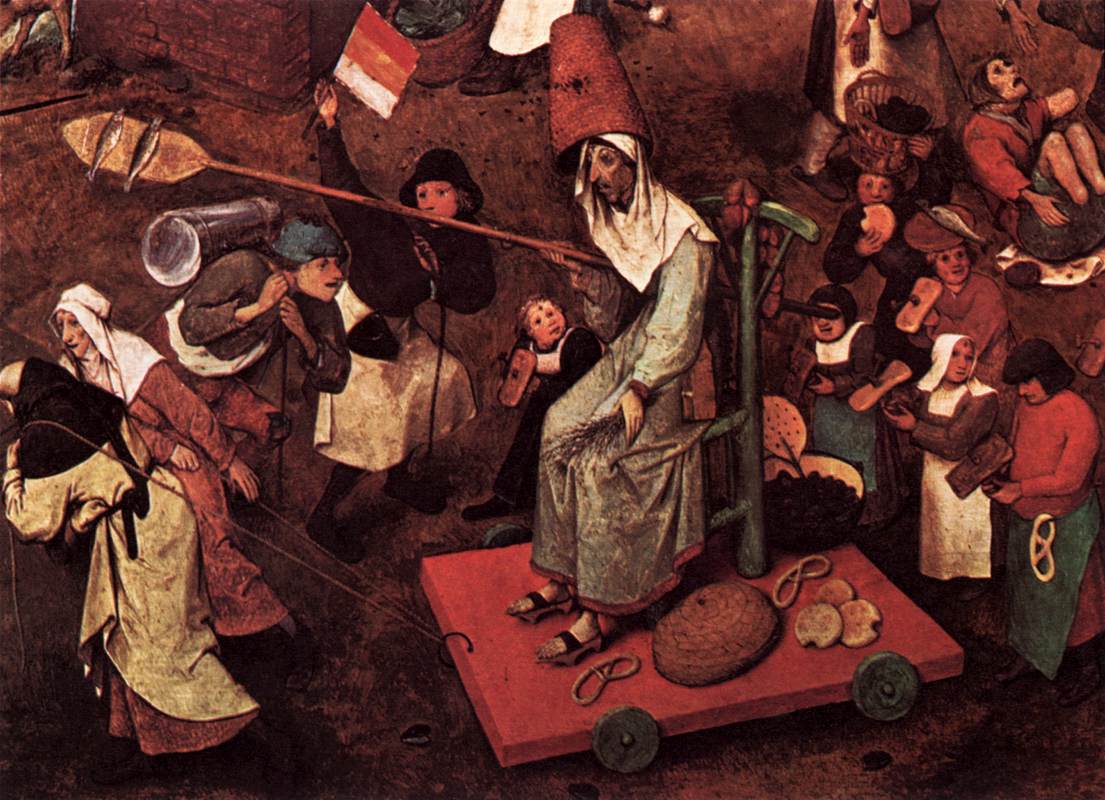
Pieter Bruegel , 'The Fight between Carnival and Lent' (detail)

With every intention of getting back to this series next year, here’s the links so far to my series of posts on the cost and grace of parish ministry:

Human artistry and the adding of value to creation

While preparing some lectures recently on theology and the arts, I was struck again by one limitation that both art and Christian theology share – namely, the impossibility of absolute innovation. As Rowan Williams noted, ‘To add to the world, to extend the world and its possibilities, the artist [like the theologian] has no option but to take his [or her] material from the world as it is’. Even our best attempts at liberation from words, from the determinations of human language and imaginings, can only carry us so far as we are brought to what Williams calls ‘a complete imaginative void, the dark night of an utter alienation from the “available” world, “the desert of the heart”’.

Still, the human response of taking up ‘material from the world as it is’ does not obviate the truth that the world is God’s, nor suggest that God ‘“made something” and then wondered what to do with it’. Rather, as Ruth Etchells puts it in A Model of Making: Literary Criticism and its Theology, ‘from the first the creative purpose was one of profound and secure relationship’. And, it seems, if such a relationship is to be truly characterised by love, then its prime instigator will also create ‘room’ for creation to be itself. In other words, God’s love achieves its end not through brute force but by patient regard for what Emmanuel Levinas termed the ‘otherness of the other’. To be sure, God never retreats from creation into some kind of self-imposed impotence, but rather remains unswervingly faithful, interested and involved in all that goes on. But this is not to suggest that all is, so to speak, in order. And so Christians, when they speak of creation, will want to speak, as many physicists too will want to do, not only of creation’s order and but also of its disorder, not only about its being but also about its becoming, and about the space that God has granted the world, space which implies some risk, and which can neither be ignored nor annihilated if all there is is to be brought to love telos; i.e., to all that ‘God has prepared for those who love him’ (1 Cor 2.9).

Not a few scholars and practitioners are now talking about the sense in which art serves to make this space meaningful, and of the way that art is concerned to transform created things, to improve creation, to add value to creation, to, in Auden’s words, ‘make a vineyard of the curse’. J.R.R Tolkien understood this well, as his fairy stories and indeed his entire project of mythopoesis attest his concern to not merely ennoble, challenge and inspire, but also to heighten reality itself, to invite us to look again at familiar things, and see them as if for the first time. Jacques Maritain, too, in Creative Intuition in Art and Poetry, once wrote that ‘Things are not only what they are. They ceaselessly pass beyond themselves, and give more than they have …’. In other words, it is claimed that there is absolutely nothing passive going on when a painter picks up a piece of charcoal, or a dancer performs Swan Lake. Abraham Kuyper was right to insist in his 1898 Stone lectures that art ‘discover[s] in those natural forms the order of the beautiful, and … produce[s] a beautiful world that transcends the beautiful of nature’. And others, too, have spoken of the way that the arts contribute to the transformation of disorder, bearing witness to the belief that creation is not indispensable to God’s liberating purposes for all that God has made, purposes which point not to a return to a paradise lost but to a creation made new, a making new which apprehends the reality of human artistry and which proceeds in the hope that both the location and the vocation of the children of God is inseparable from creation itself.

Alfonse Borysewicz on his art

For regular readers of Per Crucem ad Lucem, the name of New York-based artist Alfonse Borysewicz will be somewhat familiar. While on a trip recently to the USA, I had the privilege and joy of staying with Alfonse and his family, during which time my appreciation of his work and its importance at this moment in history was more-deeply confirmed. (I was almost-equally impressed with the intimate knowledge he had of, and affection he displayed about, NYC’s subway system). Alfonse’s bookshelves betray a mind that has long-wrestled with theology, philosophy and aesthetics. But like most artists, Alfonse is more comfortable speaking into and through his art than he is speaking about his art. Still, he does a good deal of, and good job with, the latter too. Here he is in a recent interview produced by Calvary Baptist Church in Grand Rapids:

A welcoming church

I’ll soon be in India. The e-correspondence thus far indicates that I’ll be met by some very welcoming people. I guess that I’ll also be looking for a welcoming church. So while engaging in some brief online research this morning, the pic-of-the-crop thus far on the welcoming-church front goes to this small village church [source] on the highway that connects Mangalore to Bangalore:

… though there’s wisdom in sometimes just keeping an open mind in case a more inviting option presents itself:

This slideshow requires JavaScript.