Month: August 2008

Eschatology and the doctrine of God

‘Every statement of Christian eschatology … is an inference from some basic truth in its doctrine of God, and must be judged and tested accordingly … Every truth about eschatology is ipso facto a truth about God … What God is, is what in history He asserts Himself to be’. – John Arthur Thomas Robinson, In the End, God: A Study of the Christian Doctrine of the Last Things (London: James Clarke & Co., 1950), 31, 36, 37.

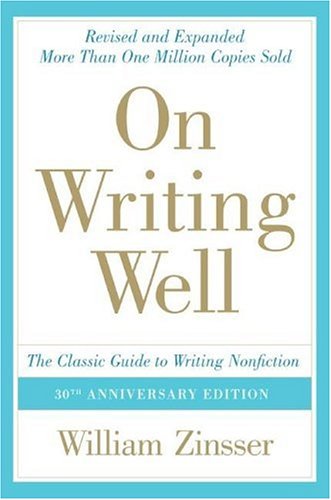
On Writing Well – II

It is little wonder that the child of a society drowning in ‘unnecessary words, circular constructions, pompous frills and meaningless jargon’ should be named ‘Clutter’. This child is, according to Zinsser, ‘the disease of American writing’, and one of the main culprits named  throughout his book On Writing Well, a book I introduced in an earlier post. [Incidentally, I’m moving house today and this same child is magically appearing in every room. Yes I should be packing boxes, or vacuuming, or anything but blogging].

In Chapter 2, entitled, ‘Simplicity’, Zinsser presses that one of the secrets of good writing is to ‘strip every sentence to its cleanest components’. He contends that words that serve no function, or are too long, need to go because they weaken a sentence’s strength. Moreover, adverbs that carry the same meaning as an already-used verb must be exterminated immediately. He also notes in passing that these sentence-murderers ‘usually occur … in proportion to education and rank’. I thought: Another reason why Richard Bauckham and NT Wright are so unique.

As I read this chapter, I must confess to mixed feelings: The thesis-writer in me – suffering from a major dose of verbal diarrhoea – was bearing the full brunt of the ‘guilty-as-charged’ word. The poet in me wanted to throw the book away by page 7 because here is a recipe that seems to sap every bit of play out of prose. But I stuck with it and, once I stopped to hear what he was saying, was glad I did.

So how can we avoid birthing such an evil little child? Zinsser’s answer: ‘Clear our heads of clutter. Clear thinking becomes clear writing: one can’t exist without the other’. But what if I like my cluttered head? What if I’m scared to be without it? Then apparently we can get away with it … but only for a paragraph of two.

Just as well I only write one or two paragraphs at a time …

Previous posts in this series: Part I.

Karl Barth on the relationship between justification and sanctification

‘When, however, we speak of justification and sanctification, we have to do with two different aspects of the one event of salvation. The distinction between them has its basis in the fact that we have in this event two genuinely different moments. That Jesus Christ is true God and true man in one person does not mean that His true deity and His true humanity are one and the same, or that the one is interchangeable with the other. Similarly, the reality of Jesus Christ as the Son of God who humbled Himself to be a man and the Son of Man who was exalted to fellowship with God is one, but the humiliation and exaltation are not identical. From the christological ἀσυγχύτως and ἀτρέπτως of Chalcedon we can deduce at once that the same is true of justification and sanctification. As the two moments in the one act of reconciliation accomplished in Jesus Christ they are not identical, nor are the concepts interchangeable. We are led to the same conclusion when we consider the content of the terms. In our estimation of their particular significance we must not confuse or confound them. Justification is not sanctification and does not merge into it. Sanctification is not justification and does not merge into it. Thus, although the two belong indissolubly together, the one cannot be explained by the other. It is one thing that God turns in free grace to sinful man, and quite another that in the same free grace He converts man to Himself. It is one thing that God as the Judge establishes that He is in the right against this man, thus creating a new right for this man before Him, and quite another that by His mighty direction He claims this man and makes him willing and ready for His service. Even within the true human response to this one divine act the faith in which the sinful man may grasp the righteousness promised him in Jesus Christ is one thing, and quite another his obedience, or love, as his correspondence, to the holiness imparted to him in Jesus Christ. We shall speak later of the indestructible connexion between these. But it is a connexion, not identity. The one cannot take the place of the other. The one cannot, therefore, be interpreted by the other’. – Karl Barth, Church Dogmatics IV/2 (Edinburgh: T&T Clark, 2004), 503.


PT Forsyth on our assurance

Forsyth consistently asserts that the Church’s faith rests not on some ‘subjective sanctity’ but on a ‘real principle’ – the objective work of Christ. This faith finds personal expression in his own experience of grace: ‘God has made life out of my shipwreck’, he says in his sermon on Ezekiel 37, ‘that is my experience. He has opened my grave and made me live; he has clothed my bones with flesh, and stirred me with life and hope; and if he has done that for me, then the incredible miracle is in principle done that saves the world.’ Here Forsyth gives voice to his conviction that he has been saved by that which saved the whole world. ‘It took a world salvation to save me, and what I know in this matter for me I foreknow for mankind.’ In other words, Forsyth is certain of his salvation because God has saved the world.

Now because Forsyth understands election both christologically and as related to God’s wider eschatological purposes concerning universal righteousness (as in Calvin, who in the Institutes deals with election at the end of Book Three, i.e. after he has expounded the persons and works of God), his doctrine of assurance avoids the anxiety-producing effects that have accompanied that Calvinist tradition that traces its roots through Beza and Perkins. Forsyth identifies that no matter how pastorally well-intended the federal theologians were, one result of decayed and pietistic federal Calvinism has been ‘a welter and a haze in which the soul turns for assurance from itself and its piety … to seek in the sacraments a stay and comfort which the elect found at a higher source’. Forsyth directs us to look to Christ in whom we are given the objective ground our election and so of assurance.

PT Forsyth on the certainty of our election in Christ

‘Now for this tremendous certainty [of election] there is no other foundation than the historical revelation and salvation in Christ as the eternal and comprehensive object of God’s loving will and choice, the Captain of the elect. We have not sufficient ground outside that for believing or trusting such a God. We cannot start with a view of God reached on speculative or other similar grounds, and then use Christ as a mere means for confirming it or giving it practical effect. That would mean a certainty higher than Christ’s, and the superfluity of Christ when the end had been reached. Which is not the Christian Gospel, be that Gospel right or wrong. In that Gospel our final certainty can never be detached from what Christ did, what He is and does for eternity. The eternal election is in Christ, “Mine elect in whom My soul delighteth”; and only in Christ does faith at every stage realise it. Hence it has been well pointed out that we must not preach election to produce the certainty of Christian faith, but preach Christ and faith in Him to give us the certainty of our election’. – Peter T. Forsyth, The Principle of Authority in Relation to Certainty, Sanctity and Society: An Essay in the Philosophy of Experimental Religion (London: Independent Press, 1952), 353.

Aung San Suu Kyi Refuses to Accept Food

In a developing move, detained pro-democracy leader Aung San Suu Kyi refused to accept a food delivery to her home one week ago, according to the exiled National League for Democracy – Liberated Area. The exiled group released a statement on Monday saying that Suu Kyi has refused to accept food from members of her party for nine days.

Last week, Aung San Suu Kyi cancelled two scheduled meetings with United Nations Special Envoy Ibrahim Gambari during his visit to Rangoon. Observers said that Suu Kyi’s refusal to meet with the UN envoy showed her disappointment with his failed attempts to broker a solution to the country’s decades-old political standoff.

Aung San Suu Kyi has been under house arrest for 13 of the past 19 years. During most of this time, her food has been supplied exclusively by her colleagues.

[Source: Scoop]

James K. Baxter: ‘Song to the Lord God on a Spring Morning’

The guitar is playing in the morning
And the tame goat browses on heads of grass
Close to the sawing block. I hear the voices
Of many friends on this spring day
Like music to me, because God has lifted
A mountain from my soul, and the winter has gone.

Alleluia. Adonai.

I need not complain that youth has gone
Or that the sins of morning
Haunt me at noonday. Whoever has lifted
The burden of Christ will find that an armful of dry grass
Is the same weight as the cross. Man only lives for a day
Yet he can hear the singing of strong voices.

Alleluia. Adonai.

Love is the answer to the dark voices
Of the demons that trouble us when youth has gone,
Saying, “You fool, you have had your day
And wasted it.” The spirit of a spring morning
When the wind moves gently over the grass
Is enough to tell us that the stone at the door of the tomb has
been lifted.

Alleluia. Adonai.

I have seen the boulder lifted
From the back of the tribe. I have heard their singing voices.
I have felt their hands like the wind on the grass
Stroking my cheek, when it seemed all hope had gone,
“Piki to ora ki a koe. The morning
Has come. E koro, be glad and eat a kai with us today.”

Alleluia. Adonai.

Therefore, whatever another day
May hold for meexile, darkness, and the rod of Pharoah lifted
to scourge my backthis brightness of morning
Cannot die. The murmur of many voices
Will stay with me when the light has gone
And my days are like an acre of burnt grass.

Alleluia. Adonai.

So small a price to pay! The Maori bones beneath the grass
Of the graveyard sing of the resurrection day
When chains of darkness will be gone
And the yoke of sorrow will be lifted
From the necks of the poor. A choir of many voices
Goes with me into the blood-red morning.

Alleluia. Adonai.

The light of a new morning is bright on the grass
And the voices of the poor are welcoming the day
When the cloud of night will be lifted and Pharoahs kingdom gone.

Alleluia. Adonai.

– James K. Baxter, ‘Song to the Lord God on a Spring Morning’ [1972]

Burma is hosting 2092 Political Prisioners

On the late night and early morning of 21st-22nd August 2007, one year ago, after leading peaceful protests against the sudden hike in fuel and commodity prices, 13 leading members of the 88 Generation Student’s Group were arrested by the Burmese authorities. They are:

Min Ko Naing (Paw Oo Tun): now more than 17 years total detention, Jimmy (Kyaw Min Yu): total detention more than 15 years, Mya Aye: a total of more than 8 years in detention, Ko Ko Gyi: a total time in detention of 14 years and 8 months Kyaw Kyaw Htwe (Marky): nearly 13 years in detention Arnt Bwe Kyaw: over 9 years in detention Pyone Cho: total of over 16 years in detention, Min Zeya: total of 7 years and 5 months detention Nyan Lin: a total of 7 years detention Ko Zeya: over 13 years and 7 months in detention Panneik Tun: a total of 8 years detention Zaw Zaw Min: a total of 1 year and 1 month detention Thet Zaw: already served a total of 10 years and 4 months.

These arbitrary arrests are part of an ongoing systematic persecution of activists, both social and political, by the Burmese Junta. In the last year there have been around 900 arrests of activists, some for things like helping the relief operation following Cyclone Nargis. Currently there are at least 2092 Political Prisoners being held in detention across Burma.

Political Prisoners in detention suffer massive hardships, inflicted on them systematically by the authorities, including severe physical and psychological torture, many interrogations, starvation, malnutrition and many different and serious health problems due to the conditions they have been held under. They also suffer prolonged and unlawful detention, no access to proper legal counsel, no free or fair trials and a methodical intrusion into their lives by the Burmese authorities, and those of their families and associates, both during their detention and throughout the times that they have been released. Due to this treatment throughout their years in detention, all Political Prisoners develop weak health, and are susceptible to illness. For example: Hla Myo Naung (member of 88 Generation Students Group, held in Insein prison, arrested at eye clinic, now awaiting sentence) has already lost the sight in one of his eyes and his other eye will also soon be blind, due to the neglect of the authorities in not providing proper medical treatment.

The current situation of the above 13 student leaders, arrested this time last year is that they have not seen a lawyer since their detention, and some of the charges under which they were first arrested have been changed. Some of them and their family members are not sure under which charges they are being held. None of them have been brought before a court of any kind, or been subject to a trial. None of them have been sentenced. Some are suffering from severe health problems and have not yet received proper medical treatment. Among the most urgent cases are Ko Min Ko Naing, whose eyesight is failing, has some serious health complications with his heart and has pain walking due to a problem with his foot and Ko Mya Aye is suffering from heart disease.

Including the last year, the 13 student leaders listed above, have served a total time in detention of 140 years and 1 month so far. That is enough. AAPP pays tribute to these Activists for their service to their country, their total commitment, creativity and strength in the face of a brutal military regime. AAPP strongly condemns the Burmese regime, who acts with impunity, for their systematic persecution of these activists. They have suffered these abuses because of their outspoken belief in human rights, their love for their country and their determination to replace military dictatorship with democracy in Burma.

Source: Scoop

On Writing Well – I

Within weeks of beginning my doctoral work I happened across these words by Winston Churchill: ‘Writing a book is an adventure. To begin with, it is a toy and an amusement; then it becomes a mistress, and then it becomes a master, and then a tyrant. The last phase is that just as you are about to be reconciled to your servitude, you kill the monster, and fling him out to the public’. It took some time before it really came home to me that writing a PhD is not like writing a book, but these words have stuck with me all the same, and apply not a little to writing a thesis.

One of the things I’ve most enjoyed about the whole thesis process has been the act of writing itself. I love playing with words, discovering their etymology and thesaurus partners, and how long-neglected words can be re-employed to serve new meanings.

I’ve been making my way through William Zinsser’s On Writing Well. It’s a book which has undergone multiple editions (mine is the fourth); and while it is a little dated in parts (my ed. is 1990), and is geared more for the journalist than the researcher, it has served me well as both an encouragement and as guide of late. Consequently, I want to devote a number of posts to it.

Zinsser has written for Life and for The New Yorker, and for thirteen years with the New York Herald Tribune. He has also published numerous titles on writing. A recurring theme in this book is that writing is hard work: ‘If writing seems hard’, he notes, it’s because it is hard. It’s one of the hardest things people do’. It reminds me of something Oscar Wilde once said, ‘I was working on the proof of one of my poems all the morning, and took out a comma. In the afternoon I put it back again’. Zinsser repeatedly presses that while there are different kinds of writers and methods, the essence of writing is rewriting.

In the first chapter, Zinsser recalls that at the heart of all nonfiction writing is ‘personal transaction’. Good nonfiction needs both humanity and warmth, not just the facts! He writes: ‘Good writing has an aliveness that keeps the reader reading from one paragraph to the next, and it’s not a question of gimmicks to “personalize” the author. It’s a question of using the English language in such a way that it will achieve the greatest strength and the least clutter’.

James K. Baxter: ‘Air Flight to Delhi’

Air Flight to Delhi

In Thailand, song of water dwellers,
Rivers like lizards spreading
Brown silt into the sea.
Moisture in the hollow of a hand.
The old ideograph of peace
Tempted me, with card-playing
On a hard mattress, light between
Bamboo slats. Such love is contraband.

In a room taken for the night
Sluicing the chest and thighs. Dressed
In loose pyjamas. Lying
Insomniac under the giant fan.
I knew the undesired accomplice
Some sky or water demon
Twisting the locks of the mind.

Light will come at length to the dark room
Where the blind soul to its own incubus
Murmurs, ‘I am.’ The Goan shepherd
Sleeping at noon below the pepper vine
Is held alive in Xavier’s smile,
Has diamonds to lose: but here
Egyptian darkness staggers in the sun.

Seven plagues. Black beaks of crows.
Vultures in grey dinner suits.
Nepotism and the leper’s stump.
The stone of Sisyphus rolled on the heart.
These wounds that I must understand:
This country of the banyan and the ape.

The homeless in the Mogul tombs
Cannot despair because they do not hope,
On the great star wheel pulled apart
Show the disastrous innocence
Of one who murders in his sleep.

The cross is clouded here with market dust.

Luci Shaw: ‘Recognition’

Who on earth saw him first, knowing
truly who he was? Belly to belly, when
John, prophet in utero, distinguished
in the natal soup the fetal bones, the body
curled like a comma, eyes tight, skull
packed with universal wisdom,
this unborn cousin began to dance.

And when she, birth-giver—
her ordinary vision arrowing down between
her legs through pain and straw to her son’s dark,
slime-streaked hair, to his very skin, red with
the struggle of being born—she lifted him
to her breast, kissed the face of God,
and felt her own heart leap.

– Luci Shaw, ‘Recognition’

‘Responsibilities’: Chomsky on Iraq

In a video interview recently aired on Channel 4, Chomsky offered the following verdict on the responsibilities of the aggressors in Iraq:

“I would like to remind myself and others in the United States and Britain that aggressors have no rights, they have only responsibilities.

“The first responsibility is to pay massive reparations for the crimes they have carried out. That extends in the case of Iraq to include support for Saddam through his worst atrocities after the war with Iran.

“After the savage first Gulf War when George Bush authorised the crushing of the rebellions that might have overthrown him, the murderous sanctions and of course the war and its aftermath.

“And their second responsibility is to hold the perpetrators accountable.

“And finally, and crucially, to attend to the voices of the victims, which are not a secret. The Pentagon has just released its latest study of opinions in Iraq. It was optimistic, it said. Iraqis have shared beliefs, so there’s hope for reconciliation.

“The shared beliefs turn out to be that the United States and Britain are responsible for the Sectarian warfare and all of its horrors and they should leave Iraq to Iraqis.”

“And we should finally resolve to ensure that we are never again responsible for such terrible crimes.”

Relatedly, the School of Law and the Boston University Anti-War Coalition at Boston University recently hosted Chomsky for a lecture on ‘Modern-Day American Imperialism: Middle-East and Beyond’. It goes for 2 hours and is also avaliable from Boston University’s iTunes site.

Faith in the Frame

On Sunday 31 August, the UK TV station ITV will air the first in a 10-part series on religious art. The series is called Faith in the Frame. The TimesOnline have also run a story on it.

Each each episode will focus on one painting. The ten chosen are:

The Resurrection, Cookham, by Stanley Spencer

The White Crucifixion, by Marc Chagall

The Massacre Of The Innocents, by Pieter Breughel

The Wenhaston Doom, Anonymous

The Crucifixion In The Isenheim Altarpiece, by Matthias Grünewald

The Arezzo Frescoes, by Piero della Francesca

The Garden of Earthly Delights, by Hieronymous Bosch

The Upper Room, by Chris Ofili [The NT Times ran an interesting article on this piece here]

Lux Eterna, by Ana Maria Pacheco

The Mystic Nativity, by Botticelli

Alongside presenter Melvyn Bragg,  each programme will involve two or three invited guests who will offer their own refections on the work. These guest include:

Jonathan Jones – art critic for The Guardian

Tim Marlow – writer and broadcaster

Antony Sutch – Franciscan monk and broadcaster

Imtiaz Dharker – poet and artist

Richard Harries – former bishop of Oxford

Sarah Dunant – novelist and broadcaster

Howard Jacobson – novelist

Jackie Wullschlager – art critic for the Financial Times

Rowan Williams – Archbishop of Canterbury

Andrew Graham-Dixon – art expert, broadcaster and writer

Joanna Woodall – expert on Northern Renaissance art at The Courtauld Institute

Martin Kemp – Professor of Art History at Oxford University

Michael Berkeley – composer and broadcaster

Eamon Duffy – Professor of Divinity at Cambridge University

Ekow Eshun – Artistic Director of the Institute of Contemporary Arts

John Harvey – Professor of Art at the University of Wales


FaceBook In Reality

It’s sometimes really quite difficult to explain to Facebook-addicts why the whole Facebook thing is so uselessly annoyingly. In fact, sometimes they even try to lure you back by promising you all the photos and groovy new applications in the world if you will just bow down and click ‘re-open your account’. When such tempter’s surround, send them this clip. It will make no difference to them, of course, because what they really need is death and resurrection into newness of Facebook-free life. But it does remind you why you made the best decision of your life when you hit that wee button – ‘suspend/delete your account’.

I say, come ye out from them and be ye free. (I’m a hypocrite of course)

To check out …

No time for blogging today but here’s a few things to check out:

  • David Congdon reports on a worrying trend in tertiary education.
  • ‘Gregory MacDonald’ reflects on how embracing Universalism has impacted his life.
  • Ben Meyers tells us how for Milton, those living outside Eden are ‘no longer fit for participation in the political sphere’.
  • Mick Dobson talks about some long overdue business for Australians.
  • How good was this!
  • And this Revelation definitely did not take long to grow on me.