Pastoral Ministry

Prophesying to dry bones: Some encouragement for preachers

There can be little doubt that one of the real gifts that P.T. Forsyth bequeaths to the Church is the encouragement of her pastors to forego the ‘sin of bustle’ that would see them running errands for the culture motivated in no small part by an attempt to convince the world – and the church! – of the use, value and worthiness of their vocation, and to instead give themselves to preach the Gospel, to believe in that divinely-ordained foolishness, and to trust its effects to God.

Those who carry the burden – a joyous burden to be sure, but a burden nonetheless – of preaching week after week will no doubt be familiar with that anxiety that attends the final read through the manuscript, the fruit of one’s wrestling with the very real possibility of God’s communication – which is nothing less than God’s self-disclosure – to those not only desperate to hear the Word of life but also to those long deafened by the drums of seemingly-endless counter words, that Saturday night feeling that, despite all one’s best efforts, things for tomorrow’s sermon just don’t seem right, that the fire that burns so freshly in the heart of the biblical witness has all but been snuffed out by the time the sermon was penned, and perhaps the best that one can now hope for is a decent night’s sleep and to simply trust that something that one says on the morrow might find fertile soil. To be sure, to believe in preaching is to believe in miracles or, more properly, it is to believe in One who not only already longs to speak but who also ‘gives life to the dead and calls into existence things that do not exist’ (Romans 4.17). Moreover, to believe in preaching is to believe that such calling into existence occurs via the irresponsible method of liberally sowing seeds whether in places where there is no soil, or on rocky ground, or among thorns, or in fertile and productive soil (see Matthew 13).

To those who so believe – or who wish to believe in such things in spite of all appearances – I hope that these words of Forsyth’s from a sermon on Ezekiel’s prophecy to the dry bones, and to the Spirit, preached over a century ago might come as an encouragement:

‘God takes the man of little faith, takes him like Ezekiel, carries him back in spirit through history to the dark ages of Europe; plants him beside a church with its faith dried and enterprise dulled into mere orthodoxy beneath the Pagan empire. He sets you in the valley of the dark ages, when the Spanish Moors had more light and life than the Christians of Europe. He asks you, “Can these bones live? You cannot say, but God’s answer is the wonderful eleventh, twelfth, and thirteenth centuries. The past was not dead; the Church is never without its recuperative power somewhere. As the body of Christ, it must rise, and cannot be holden of death, howsoever long the torpor may be.

Or again, God takes you onward, and sets you in another dismal valley, the church of the Borgias and Medicis, amongst the parched bones of faith, when the former revival had shrunk to a mere renaissance, when Paganism was not in the Empire but in the Church’s own heart and head. He points you to the wicked Church of all the cultures at Rome in the valley of the fifteenth century, when the faithful had all but ceased to be. “Can these bones live?” You see not how. God’s answer is Luther, Calvin, and the sixteenth century, the rediscovery of St. Paul, the coronation of faith, the vitalising of Europe, Puritanism, the birth of democracy, the rise of constitutionalism, Free Churchism, and the dawn of modern times. No, the past is not dead.

And once more He plants you by the English Church of last century, with Deism outside, and drought within, but no thirst. Can they live? God’s answer is Wesley and the Evangelical revival, Newman and the Oxford revival, and much more that I cannot name because I must single out the feature which has gathered us here – modern missions. I doubt if any such answer has ever been given to the prophet’s question as this. We have the answer before our eyes. The world has it, and it is often as smoke in its eyes. But the men who first faced the problem, and first moved in these missions had not this answer before their eyes, they had it before their faith alone. They were prophets indeed, in the true inspired line, for they had it in their souls only. They had it surer there in their faith than many of us who have it in our sight. They lived in the valley of the eighteenth century, but their souls stood upon Pisgah; they saw the Promised Land, and all things delivered unto Christ of the Father. They had Imperial minds, but they had also holy methods. They saw the bones stirred and clothed, and men trooping from their living graves at the call of the Spirit alone. They saw races roused, rescued, civilised by the Gospel. Nay, they saw more; they saw the Church itself converted to missions, a bony Church quickened, fleshed, and marshalled anew. They saw that the Church must be reconverted if it was to survive, but they also saw that it would be reconverted, because they had the Spirit that makes the Church, and felt the first flutter of His breast. And the Church did need this reconversion. There was not among the heathen more contemptuous opposition to missions than these men met sometimes in the Church at home. When we speak of the great effect of the Church on the heathen, let us not forget the great blessing of the heathen to the Church. The receiving of them has been to the Church itself life from the dead. The Church has more faith in its own Gospel because of its proved power abroad; it is more sure of its own word, and it feels that it is not only a mighty word, a true word, but a more genial and pitiful word. The old bones live again in a humaner life. Every missionary is preaching to the Church that sent him no less than to the churches he found. When we speak of the action of grace, think also of the reaction of grace, the force of its recoil; deep calleth unto deep. The Gospel’s word to the world includes also its echo to the Church. Missions are an integral part of the Church and a source of new life to it, and the missionaries are prophets that call flesh upon our bones. To convert the heathen is to bless and serve the Church. These missionaries are not hobby-riders that the Church patronises; they are organs, agents, and deputies of the Church itself. They do not act alongside of us, but for us; they are the long arms of the Church and the limbs by which it covers the breadth of the world. The man to whom missions are a fanatic fad, and not his own concern, has yet to learn the soul of the Christian Gospel and the secret of the Church’s life …

Some members of the Church – yea, some Churches themselves – make a greater problem than even the world or the heathen does. They make us ask, “Can these bones live?” These people who go to church, who uphold their Church, who would fight for their Church, would make civil war for its privileges, who have more fight than faith in them, whose souls are exceedingly filled with contempt, and they have a name to live, but are spiritually dead, who care for their Church chiefly as partisans, or because it is a centre of social rank or of juvenile amusements – can they live? What preacher but is cast into occasional despair by that question as he looks upon many spiritual skeletons around him? What preacher has not many a time to answer with Ezekiel that they can only live by some miracle of God; he, poor son of man, has failed, and is hopeless. He is preaching, perhaps, out of duty more than inspiration; he often prophesies in obedience rather than in hope. Well, preach hope till you have hope; then preach it because you have it. “Prophesy over these bones; call out to the Spirit,” says the Lord. At the Lord’s call, if not at your own impulse, call; call with a faith of life when the sense of life is low; speak the word you are bidden, and wait for the word you feel; and then the matter is the Lord’s, and you win a new confidence in the midst of self-despair.

But it is not with bones or mummies that the preacher has chiefly to do. He comes, let us say, and lifts a vital voice. He is a man of parts and force; he collects a following, he is the centre of an interesting congregation. It looks well, comfortable; it is no skeleton crowd, it has flesh and blood. What is lacking? Perhaps the things that are not revealed to flesh and blood, the unearthly lustre in the eye, and movement in the mien, the Spirit of life. It is a congregation possibly, not a church; it is not dry, but it is not inspired; it is cultured possibly, but it is not kindled. The spirit has not come to stay, and there is not amongst them the shout of a king. So far, perhaps, it is only education, culture, that the preacher has supplied; it is mere religion, not regeneration. The bones are clothed, but not quickened; they know about sacred things, but they do not know about the Holy Ghost.

So prophesy once more, Son of man, saith the Lord. Prophesy to the Spirit of life; preach, but, still more, pray; invoke the abiding Spirit to enter these easy forms. They are less dismal than they were, but still too dull. Court for their sake the spirit and cultivate the discernment of the Spirit. Amid the many airs that fan them, amid the crowd of vivacious interests that tickle them as they pass, make the Spirit of a new life blow on them. Above every other influence woo and wait upon the Spirit. Trace and press the Spirit of God; in every providence seize the Divine grace, subdue the spirit of the age to the Spirit of Christ; set up among the critics the Judge of all the earth. Preach the Spirit which not only clothes the skeletons decently and comfortably, but set them on their feet in the Kingdom of God. Preach what cast down imaginations and high things to the obedience of Christ; proclaim that Spirit which turns mere vitality into true life, mere comfort into the mighty peace; turn your worldly skeletons, by all means, into living congregations, but, above all, turn your congregation into a living Church.

And how shall you do that if your appeals to men have not been preceded by your cry to the Spirit, if your action on them is not inspired by your wrestling with God? Only then can you turn a crowd into a people, and a people into the Kingdom of God. That is the way to turn your Aceldama into the habitation of a multitude, and your multitude into a spiritual phalanx. Prophesy no more to the bones, preach no more as if it were dead worldlings you had; pray to the Spirit of God and preach to the spirit of man. Preach as to those who have begun to live and seek life. Never mind about current literature, mind the deep things of God. Preach to them great things. Let the trivial rubbish alone that occupies too much of our Church interest. It is possible to lose the soul in the effort to win souls. Dwell less upon the minor truths, dwell more upon the mighty truths which grow mightier by iteration. Take care of the spiritual pounds, and the current pence will look after themselves. Preach character by all means more than has been done, but preach it through a Gospel which takes the making of character out of your hands. Preach the Lord’s Supper more often, and the tea-meetings less, as the Church’s social centre and family hearth. Do not preach about goodness less, but about grace more. Do not preach self-denial, preach a cross that compels self-denial. Don’t mistake fervour and ardour for the Holy Ghost; do not take the flush for the blood or the blood for the life. Bring to men the Spirit, prophesy to the spirit in them; bring to them great demands – it is the demands of life that make men, is it not? Tax them, ask of them great sacrifices. We grow up as we lay down. Sacrifice before faith? No, first the sacrifice which is faith. There is no such tax on self-will as faith, no such sacrifice of our self-satisfaction as true faith, faith of the right kind, faith which is a cross as well as a trust in a cross and a resurrection, too. Trouble them, trouble them with the stir of a higher life. Living water is always troubled, it is an angel’s trace upon the pool. Leave them not at ease; do not stop with putting on the flesh that just saves them from being skeletons. Infuse the flesh with the spirit; propose a great task, a thing incredible, and keep it before them till they rise to it. Does not the spirit make demands on us which no preacher can venture to do? Does not something in our own soul as he prophesies stir us, rebuke us, exact from us more than we dare? All the movements the true prophets store escape beyond their dreams and demands’.

– from Jason A. Goroncy (ed.). Descending on Humanity and Intervening in History: Notes from the Pulpit Ministry of P.T. Forsyth. Eugene: Wipf & Stock, forthcoming.

Writing to the choir: Facebook and ‘the new scourge of writing’

Out from a brief blogging hiatus I come to draw attention to Lisa Lebduska’s recent piece – ‘The Facebook Mirror’ – and the dangers that the social media leader poses for writing and writers:

‘Facebook presents far more danger than the cultivation of lowercase first-person “i”s and emoticons :). The real threat posed by Facebook is not that it ruins writers’ ability to punctuate or encourages them to replace words with pictures. The problem with Facebook is that it nurtures one of writing teachers’ greatest foes – the teenage fantasy that writers write only to themselves and to those who are just like them.

Although Facebook is properly classified as “social software,” it is more accurately categorized as mirror-ware, a whole new kind of social that consists only of us and our self-projections. And it is that mirror, that seductive invitation to reflect us and only us back to ourselves that damns us.

On Facebook, we post pictures to represent ourselves: our best, shiniest, toothiest, happiest/sexiest ponderer/wanderer/adventurer. The fairest ones of all. Or we post some other person or object as icon. Puppy, baby, six-year old self. The poor person’s version of identity airbrushing. To deepen the portrait, we post our status, likes and dislikes – bananas, skiing, taxes – and photo albums of grand vacations, graduations and celebrations. To our walls we announce opinions, as they come. What we find good, stupid, evil, sexy.

Facebook writers expect homogeneity from their audience. All readers read the same observation, and insights in the same way, regardless of who they are, what they know, what they need to know or even what they seek. Facebook writers do not select, shape or color moments and thoughts for particular readers. They trade the pleasure of imagining the absent reader for the imagined adoring gaze of selves. And they expect their friends to “like” their posts, pictures etc. immediately, and to shower them publicly with praise.

With Facebook, we don’t need to explain why Obama should be elected or gays shouldn’t be allowed to marry or a hundred seagull photos merit viewing. If birds bore our friend Gerard, too bad. If Gerard didn’t vote for Obama or has a male partner, that’s too bad, too.

Although our Facebook friends include those we haven’t seen in years, decades, even, we can pretend that they share our experiences, our views, and our general disposition towards life. No justification, no explanation.

On Facebook we never think outside the four walls of the self, and we need never imagine readers different from us. We expect neither argument nor curiosity nor challenge. Just a thumbs up or down.

Teachers spend years working to broaden students’ intellectual worlds beyond their own virtual backyards. We challenge them to discover ideas that come from individuals who might be very unlike them; people they would never conceive of friending, or if asked to friend would be more than likely to ignore. Or who don’t have computers.

So is Facebook truly the new scourge of writing? Maybe not. Like all tools of such ubiquity and power, Facebook must be recognized for what it is – a medium that invites carefully polished reflections of our favorite self. But writers generally write for readers other than that self. We need, then, to provide contexts that allow our students to know and consider those readers. How often do we ask students to hear, read and truly understand a viewpoint different from their own? How often do we expect them to think of someone, anyone, other than themselves? The ability to imagine a perspective other than our own – the idea of an audience consisting of curious minds rather than adoring fans – defines our most effective writers’.

While I’m not buying everything at Café Lebduska, there are some important implications here for pastors and teachers (and theo-bloggers). Too few of us, it seems, intentionally read literature which challenges profoundly our own worldview and practice and, at least in the circles most commonplace to me, seek and/or create opportunities to speak into hostile environments where swords might be sharpened by the wrestle (Eph 6.12; 1 Tim 1.18; 6.12; 2 Tim 4.7) rather than dulled by the all-too-common proclivity towards the cozy, the monotonous and the pedestrian – what Lebduska names ‘the teenage fantasy’ and what I simply call ‘the boring’. There are, of course, those who seem to go out of their way to speak only to Babylonians, and sometimes preaching to the choir, as it were, might be just that too. For what it’s worth, it seems to me that the focus for most pastors/teachers/theo-bloggers should be given to bearing witness to the for-ness rather than against-ness announced in the gospel, but there remains an against-ness which must be discerningly spoken as well. Moreover, there can be no question here that both strategies are undertaken in love for the other and for the truth. But if Ernest Hemingway is right when he says that ‘there is nothing to writing. All you do is sit down at a typewriter and bleed’, and if the great Salvation Army preacher Samuel Logan Brengle is also right when he avers that ‘the great battles, the battles that decide our destiny and the destiny of generations yet unborn, are not fought on public platforms, but in the lonely hours of the night’, then there remains something poisonous about the Facebook ‘mirror-ware’ which threatens to undermine, at the very least, the task of the writer, and preacher.

And speaking of mirrors, it’s not as if they’re all destructive; for there is, of course, another mirror where those so called might look – namely, into the mirror of our election, Jesus Christ, who is both our friend and enemy, and who both thumbs us, our ministries and our statuses ‘up’ and ‘down’, although the later only that he made do the former (Rom 11.32).


‘My Novices: late 1950s’, by Brother Paul Quenon

Young men came
looking for
–don’t know what–
Left the place
looking for
–don’t know what–
Of these I had no regrets.

Some came, seemed like
looking–
heard some talk about
–what–
stayed awhile
and left
talking like– Well,–
like somewhat.

Serious young men came looking.
took up talk about,
–don’t know what,
stayed long and left
talking
about everything what-not.

Some came completely
clear and sure about
what–
Those I sent away.

Silent young men, a few,
came looking for–
don’t know what–
stayed
and kept on looking
stayed and never got to
what–
wore out,
died,
had never stopped looking for
what–
For these I have no regrets.

All of these I loved, but
seems the part I loved the best
was–
don’t know what–

[HT: PBS Religion & Ethics]

Entering the New Theological Space: A Review

John Reader and Christopher R. Baker, eds, Entering the New Theological Space: Blurred Encounters of Faith, Politics and Community. Explorations in Practical, Pastoral and Empirical Theology (Farnham/Burlington: Ashgate, 2009), pp. xiii + 241, £55.00, ISBN 978-0-7546-6339-3.

Nicholas Lash, in his book Holiness, Speech and Silence: Reflections on the Question of God, gives voice to the difficulty of thinking Christianly in ‘a culture whose imagination, whose ways of “seeing” the world and everything there is to see, are increasingly unschooled by Christianity and, to a considerable and deepening extent, quite hostile to it’. He notes the serious and dangerous demands posed in such a situation by continuing to hold the Gospel’s truth rather than paying mere lip-service to ‘undigested information’ (p. 4). Believing that the time has come to help missiological communities to engage and digest in the linear spaces opened up between post-Christendom politics and interfaith actualities, institutional monads and inter-organisational networks, rural and urban spaces, the status of paid and unpaid, and the contested and evolving relationship between faith and science, for example, the contributors to Entering the New Theological Space seek, in different ways, to map such space ‘by means of a triangulation between narrative, praxis and theory’, to ‘offer some idea of the complexity and interdisciplinarity associated with this new space’ – a so-called ‘third space’, the ‘space of the both/and’ (p. 5), a more fluid space which discards the oft-maintained binarism of the either/or space – and to assist readers to analyse the significance of such ‘blurred encounters’ which, the editors believe, are ‘forcing the church to develop increasingly fluid and experimental forms’ (p. 10).

Each of the fifteen essays in this volume are in their own way stimulating, and most are well-researched and eruditely penned. They cover a range of topics, from John Atherton’s ethical-economical-theological reflection on a ‘pilgrimage’ down Edinburgh’s Royal Mile to explore places where ‘inevitable and potentially creative’ (p. 25) ‘“edges” have become mainstream’ (p. 19), to Malcolm Brown’s essay on the ‘social atomisation’ and ‘rootlessness’ (p. 70) of London’s suburbs, to Margaret Goodall’s exploration of human personhood in a thought-provoking essay on dementia, to Clare McBeath’s piece which asks whether a community or a city can be said to ‘suffer from mental illness’ (p. 147), to Philip Wagstaff’s reflection on the fluidity and stability of rural ministry.

Two essays merit special mention: Martyn Percy’s considers the nature of the cultural dynamics, implicit theology and ‘invisible religion’ (p. 179; the phrase is Thomas Luckmann’s) that continue to birth requests for baptism (or ‘christening’) of children from non-churched families. He writes concerning the ‘deeply coded ways in which people talk and act about God’, that ‘religious language is carried in the emotion, timbre and cadence of worship’ and that ‘deeply coded language is not [necessarily] a strategy for avoiding explicit theological language’ (p. 184). Percy’s attempt to sketch a theology of cultural conversation, and to explore some implications of such conversations for missional and risky engagement in the ‘areas of overlap and hinterlands between the life of the church and the world’ (p. 179) merits further thought.

Drawing upon the work of Bruno Latour and Slavoj Žižek, and bringing their thought into conversation with events surrounding the 2007 outbreak (in Surrey) of foot and mouth disease, John Reader contributes an intriguing, if somewhat undercooked, essay on the nature, possibility and linguistic challenges posed to truth speech by the mutual encounter of science and theology. He concludes by stating that it is ‘only by keeping the insights and theories of both faith and science in circulation’ that we can be ‘certain of remaining “in the truth”‘, and that it is ‘only by loading into the process that contact with the wider world’ that we ‘avoid an unhealthy closure of questioning and debate’ (p. 208).

Some reservations: the noticeable absence in this volume of any discussion on the significance and place of technology (blogging, social media and gaming, for example) in theological and ecclesial discourse and praxis, and vice-versa, represents a disappointing gap. Also, there is in this volume a significant number of typological, grammatical and factual errors (John Knox, for example, was not the ‘first Presbyterian minister of St Giles and Scotland’ (p. 20)), errors which one expects would be corrected before print and to be rare in a book wearing such an inflated price tag. Finally, while one may well concur that ‘all the essays in this book are a testament to the ongoing adaptability and robust mutuality of Christian thought and the church’ (p. 7), if this volume represents ‘the new theological space’ then one might be forgiven for observing that, with one or two exceptions, such space is a little light on the theology front.

These reservations aside, not a few of the essays in this volume deserve wide reading, and the ongoing conversations encouraged therein are to be commended. Social planners, missiologists, pastoral practitioners and those training them will all benefit from reading this book, and from taking up the challenge to engage in the interdisciplinary and multilayered interstices of cultural, political and theological realities.

Some encouragement for preachers

In Luke 12, Jesus tells his ‘little flock’ a number of things: He tells them (and here I’m following Eugene Peterson’s paraphrase) to not fuss about what’s on the table at mealtimes or if the clothes in their closet are in fashion. He directs them to look at the ravens, free and unfettered, to not be tied down to a job description, and to be carefree in the care of God. He commands them to be generous, to give to the poor, and to keep their shirts and lights on waiting for the master to return. To all of which Peter replied, ‘Master, are you telling this story just for us? Or is it for everybody?’ And the Master said, ‘Let me ask you: Who is the dependable manager, full of common sense, that the master puts in charge of his staff to feed them well and on time? Blessed is the person who is doing their job when the master shows up’.

In light of this Lukan text, Robert Farrar Capon (in Kingdom, Grace, Judgment: Paradox, Outrage, and Vindication in the Parables of Jesus) suggests that preachers labour under three distinct requirements:

First, they are to be faithful (pistoí). They are called to believe, and they are called only to believe. They are not called to know, or to be clever, or to be proficient, or to be energetic, or to be talented, or to be well-adjusted. Their vocation is simply to be faithful waiters on the mystery of Jesus’ coming in death and resurrection. What the world needs to hear from them is not any of their ideas, bright or dim: none of those can save a single soul. Rather, it needs to hear – and above all to see – their own commitment to the ministry of waiting for, and waiting on, the only Lord who has the keys of death (Rev. 1:18).

Second, the clergy are to be wise (phrónimoi). They are not to be fools, rich or poor, who think that salvation can come to anyone as a result of living. The world is already drowning in its efforts at life; it does not need lifeguards who swim to it carrying the barbells of their own moral and spiritual efforts. Preachers are to come honestly empty-handed to the world, because anyone who comes bearing more than the folly of the kerygma – of the preaching of the word of the cross (1 Cor. 1:21, 18) – has missed completely the foolishness (mōrón) of God that is wiser (sophōteron) than [human beings]. The wise (phrónimos) steward, therefore, is the one who knows that God has stood all known values on their heads – that, as Paul says in 1 Cor. 1:26ff., [God] has not chosen the wise, or the mighty, or the socially adept, but rather that [God] has chosen what the world considers nonsense (ta mōrá) in order to shame the wise (sophoús), and what the world considers weak (ta asthené) in order to shame the strong. The clergy are worth their salt only if they understand that God deals out salvation solely through the klutzes (ta agené) and the nobodies (ta exouthenéména) of the world-through, in short, the last, the least, the lost, the little, and the dead. If they think God is waiting for them to provide them with classier help, they should do everybody a favor and get out of the preaching business. Let them do less foolish work …

[And thirdly], … preachers are stewards whom the Lord has ‘set over his household servants to provide them with food at the proper time.’ After all the years the church has suffered under forceful preachers and winning orators, under compelling pulpiteers and clerical bigmouths with egos to match, how nice to hear that Jesus expects preachers in their congregations to be nothing more than faithful household cooks. Not gourmet chefs, not banquet managers, not caterers to thousands, just Gospel pot-rattlers who can turn out a decent, nourishing meal once a week. And not even a whole meal, perhaps; only the right food at the proper time. On most Sundays, maybe all it has to be is meat, pasta, and a vegetable. Not every sermon needs to be prefaced by a cocktail hour full of the homiletical equivalent of Vienna sausages and bacon-wrapped water chestnuts; nor need nourishing preaching always be dramatically concluded with a dessert of flambéed sentiment and soufléed prose. The preacher has only to deliver food, not flash; Gospel, not uplift. And the preacher’s congregational family doesn’t even have to like it. If it’s good food at the right time, they can bellyache all they want: as long as they get enough death and resurrection, some day they may even realize they’ve been well fed. (pp. 243–5).

2010: ‘It was the best of times …’

‘It was the best of times, it was the worst of times, it was the age of wisdom, it was the age of foolishness, it was the epoch of belief, it was the epoch of incredulity, it was the season of Light, it was the season of Darkness, it was the spring of hope, it was the winter of despair, we had everything before us, we had nothing before us, we were all going direct to heaven, we were all going direct the other way – in short, the period was so far like the present period, that some of its noisiest authorities insisted on its being received, for good or for evil, in the superlative degree of comparison only’. – Charles Dickens, A Tale of Two Cities.

Best books

Theology

Biography

Ministry

History

Cooking

Poetry

Best albums

1. Officium Novum by Jan Garbarek & The Hilliard Ensemble.
2. The Age of Miracles by Mary-Chapin Carpenter.
3. Foundling by David Gray.
4. Scratch My Back by Peter Gabriel.
5. Sacrificium by Cecilia Bartoli.
6. Women and Country by Jakob Dylan.
7. 100 Miles From Memphis by Sheryl Crow.
8. Great and Small by Butterflyfish.
9. Downtown Church by Patty Griffin.
10. No Better Than This by John Mellencamp.

Honorable mentions: All Delighted People by Sufjan Stevens; The Age of Adz by Sufjan Stevens; Leave Your Sleep by Natalie Merchant; Go by Jónsi; April Uprising by The John Butler Trio; The Promise by Bruce Springsteen; The Astounding Eyes of Rita by Anouar Brahem; American VI: Aint No Grave by Johnny Cash; San Patricio by The Chieftains & Ry Cooder; In Person & On Stage by John Prine; How I Learned to See in the Dark by Chris Pureka.

Best films

1. How I Ended This Summer
2. Winter’s Bone
3. Abandoned
4. The Infidel
5. Shutter Island
6. Boy

Overrated films

Worst films

Best TV shows

1. An Idiot Abroad (Series 1)
2. Rev

Some Personal Highlights

On the cost and grace of parish ministry – Part XIV

‘Never shall I forget that night, the first night in camp, which has turned my life into one long night, seven times cursed and seven times sealed. Never shall I forget that smoke. Never shall I forget the little faces of the children, whose bodies I saw turned into wreaths of smoke beneath a silent blue sky.

Never shall I forget those flames which consumed my faith forever.

Never shall I forget that nocturnal silence which deprived me, for all eternity, of the desire to live. Never shall I forget those moments which murdered my God and my soul and turned my dreams to dust. Never shall I forget these things, even if I am condemned to live as long as God Himself. Never’. (Elie Wiesel. Night, 45).

So penned Elie Wiesel in the moving record of his childhood in the death camps of Auschwitz and Buchenwald. For Wiesel, as for countless others – both inside and outside the camps – the systematic extermination of millions of human beings – whether Jews, political activists, homosexuals, or others – meant the death of faith and of God. In fact, as John de Gruchy perceptively notes in his Theology and Ministry in Context and Crisis: A South African Perspective, ‘suffering is especially a problem for the person who believes, or who wants to believe in God. Yet, paradoxically, the problem can only be handled from the perspective of faith’ (p. 102).

There can be no real argument that ‘suffering is built into the fabric of human existence’ (Ibid., p. 97), and that questions of suffering pose the most real and existentially-alive challenge to belief in God. Suffering, the kind of suffering that ‘plucks the tongue from the head and the voice from the heart’ (Daniel Berrigan in Hans-Ruedi Weber, On a Friday Noon: Meditations Under the Cross, p. 28), is both a challenge and opportunity for Christian belief as well as for pastoral ministry because it is held to demonstrate the logical incoherence of Christianity.

One of the most influential novels of last century was The Plague (1947) by the French-Algerian author, philosopher, and journalist Albert Camus (1913–1960). The Plague recalls a plague (oddly enough) which is causing untold suffering and death, underscoring the universal condition of humankind. Dr Reuss, the main character, a compassionate physician, says at one point, ‘Since … the world is shaped by death mightn’t it be better for God if we refuse to believe in Him and struggle with all our might against death, without raising our eyes toward the heaven where He sits in silence?’ (p. 128.). Elsewhere there is a scene where a priest, an unbeliever and the doctor surround the bed of a little boy who is dying. He suffers in pain. The priest asks God for help: ‘My God, spare this child’ (p. 217). The boy dies. Later the priest declares, ‘That sort of thing is revolting because it passes our human understanding. But perhaps we should love what we cannot understand’. The doctor responds: ‘“No, Father. I’ve a very different idea of love. And until my dying day I shall refuse to love a scheme of things in which children are put to torture”’ (p. 218).

At another time, Camus was returning home from church when a six year old girl asked him why little girls starve in Africa while she has plenty to eat: ‘Doesn’t God love them as much as he does me?’ His inability to provide an answer birthed the conclusion that there was no God. To this, C.S. Lewis may have replied (as he did in The Problem of Pain) that

‘The problem of reconciling human suffering with the existence of a God who loves, is only insoluble so long as we attach a trivial meaning to the word “love”, and look on things as if man were the centre of them. Man is not the centre. God does not exist for the sake of man. Man does not exist for his own sake. “Thou hast created all things, and for thy pleasure they are and were created.” We were made not primarily that we may love God (though we were made for that too) but that God may love us, that we may become objects in which the Divine love may rest “well pleased”. To ask that God’s love should be content with us as we are is to ask that God should cease to be God: because He is what He is, His love must, in the nature of things, be impeded and repelled, by certain stains in our present character, and because He already loves us He must labour to make us lovable’. (p. 36)

On 4 June 1886, T.H. Huxley penned a letter to a Sir John Skelton. The letter concluded with these words: ‘… there is amazingly little evidence of “reverential care for unoffending creation” in the arrangements of nature, that I can discover. If our ears were sharp enough to hear all the cries of pain that are uttered by men and beasts, we should be deafened by one continuous scream! And yet the wealth of superfluous loveliness in the world condemns pessimism. It is a hopeless riddle’ (Leonard Huxley, Life and Letters of Thomas Henry Huxley, in Three Volumes, 2:353). Again, the question of suffering is unquestionably among the most difficult for faith, and so for pastoral ministry. So Jürgen Moltmann in The Trinity and the Kingdom: The Doctrine of God: ‘It is in suffering that the whole human question about God arises … [Suffering] is the open wound of life in this world’ (pp. 47, 49). So too Lance Morrow, in a Time Magazine article entitled ‘Evil’:

‘The historian Jeffrey Burton Russell asks, ‘What kind of God is this? Any decent religion must face the question squarely, and no answer is credible that cannot be given in the presence of dying children’. Can one propose a God who is partly evil? Elie Wiesel, who was in Auschwitz as a child, suggests that perhaps God has ‘retracted himself’ in the matter of evil. Wiesel has written, ‘God is in exile, but every individual, if he strives hard enough, can redeem mankind, and even God himself’’.

This situation is, in Moltmann’s words, ‘the open wound of life’ in which honest pastoral ministry happens. In the post-Auschwitz world, questions of suffering and theodicy have determined, dominated and challenged theology. As Rabbi Richard L. Rubenstein put it in After Auschwitz: History, Theology, and Contemporary Judaism:

‘I believe the greatest single challenge to modern Judaism arises out of the question of God and the death camps. I am amazed at the silence of contemporary Jewish theologians on this most crucial and agonizing of all Jewish issues. How can Jews believe in an omnipotent, beneficent God after Auschwitz? Traditional Jewish theology maintains that God is the ultimate, omnipotent actor in the historical drama. It has interpreted every major catastrophe in Jewish history as God’s punishment of a sinful Israel. I fail to see how this position can be maintained without regarding Hitler and the SS as instruments of God’s will. The agony of European Jewry cannot be likened to the testing of Job. To see any purpose in the death camps, the traditional believer is forced to regard the most demonic, anti-human explosion of all history as a meaningful expression of God’s purposes. The idea is simply too obscene for me to accept’. (p. 171)

And others too have asked:

‘You will sooner or later be confronted by the enigma of God’s action in history’. (Elie Wiesel, in One Generation After, as Cited in Richard L. Rubenstein and John K. Roth, Approaches to Auschwitz: The Holocaust and Its Legacy, p. 327)

‘Given the classical theological positions of both Judaism and Christianity, the fundamental question posed by the Holocaust is not whether the existence of a just, omnipotent God can be reconciled with radical evil. That is a philosophical question. The religious question is the following: Did God use Adolf Hitler and the Nazis as his agents to inflict terrible sufferings and death upon six million Jews, including more than one million children?’ (Ibid., p. 327)

‘The God of Holy Nothingness is ‘omnipresent’, although not in the usual sense meant by theologians. This God resides within destruction. The Holy Nothingness generates this-world and its vicissitudes from out of its own fecund plenitude. Yet, a God so involved in the world and its attendant suffering becomes deeply complicit and can only invite the wrath and enmity of her aggrieved children’. (Zachary Braiterman, (God) after Auschwitz: Tradition and Change in Post-Holocaust Jewish Thought, pp. 99–100)

And Martin Buber, in On Judaism, asks, ‘How is life with God still possible in a time in which there is an Auschwitz?’ He acknowledges that one might still ‘believe in’ a God who permitted the Shoah to happen, but he questions the possibility of hearing God’s word, let alone entering into an I-Thou relationship with God: ‘Can one still hear His word? Can one still, as an individual and as a people, enter at all into a dialogical relationship with Him? Dare we recommend to the survivors of Auschwitz, the Job of the gas chambers: “Give thanks unto the Lord, for He is good; for His mercy endureth forever”?’ (p. 224).

And we could go on, citing proposed responses from Epicures, from David Hume, from Gottfried Leibniz, from John Stuart Mill, from Richard Dawkins, from C.S. Lewis, from Thomas Aquinas, from David Bentley Hart, and from others. But the intro to this post has been long enough to introduce the point that one of the surprising features of life for many when they enter the ministry is confrontation with grief and suffering of immense depth. The pastor dare not trot out glib answers which only increase the suffering and betray her or his lack of understanding. But does this mean that pastors can only, and/or must, remain silent? Yes and No.
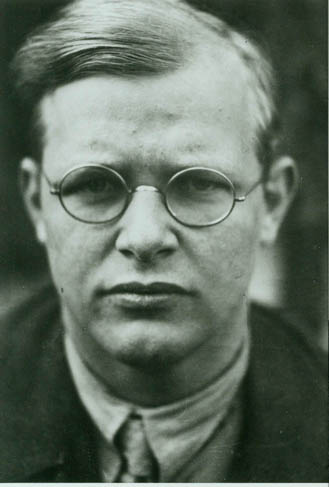
Enter one qualified to help pastors out at this point – the Lutheran pastor/theologian Dietrich Bonhoeffer (1906–1945). And I want to draw here upon John S. Conway’s fine essay, ‘A Meditation upon Bonhoeffer’s Last Writings from Prison’ in Glaube – Freiheit – Diktatur in Europa und den USA: Festschrift für Gerhard Besier zum 60. Geburtstag (ed. Katarzyna Stokłosa and Andrea Strübind; Göttingen: Vandenhoeck & Ruprecht, 2007), 235–44.

One of the most radical challenges to the traditional views of God’s omnipotence and of divine impassibility has come from Bonhoeffer’s pen. On 19 December 1944, from his bleak underground prison in the cellars of the Gestapo headquarters in central Berlin, Bonhoeffer sat down to write a Christmas letter to his fiancée, Maria von Wedemeyer (For more on their correspondence, see Love Letters from Cell 92). In what was to be his final greeting, Bonhoeffer included in that letter a poem to be shared with his parents. The poem, which has been made into a wonderful hymn known as ‘By Gracious Powers’, reads like this:

With every power for good to stay and guide me,
comforted and inspired beyond all fear,
I’ll live these days with you in thought beside me,
And pass, with you, into the coming year.

The old year still torments our hearts, unhastening:
the long days of sorrow still endure;
Father, grant to the souls thou hast been chastening
that thou hast promised, the healing and the cure.

Should it be ours to drain the cup of grieving
even to the dregs of pain, at thy command,
we will not falter, thankfully receiving
all that is given by thy loving hand.

But should it be thy will once more to release us
to life’s enjoyment and its good sunshine,
that which we’ve learned from sorrow shall increase us,
and all our life be dedicate to thine.

To-day, let candles shed their radiant greeting:
lo, on our darkness are they not thy light
leading us, haply, to our longed-for meeting? –
Thou canst illumine even our darkest night.

When now the silence deepens for our hearkening
grant we may hear thy children’s voices raise
from all the unseen world around us darkening
their universal pæan [song of triumph], in thy praise.

While all the powers of Good aid and attend us
boldly we’ll face the future, be it what may.
At even, and at morn, God will befriend us,
and oh, most surely on each new year’s day! (in Letters and Papers from Prison)

These seven short verses bespeak of Bonhoeffer’s trust in God’s enduring and comforting presence during what was the sixth Christmas season of the war and a time of impending and overwhelming disaster. By this time, Bonhoeffer had already been in Tegel prison for nineteen months, mainly in Cell 92. He had been arrested in April 1943 on suspicion of being involved in smuggling Jewish refugees into Switzerland. The investigations had dragged on without resolution for a year and a half. But then in October 1944 he had been transferred to the far more ominous Interrogation Centre of the Gestapo’s main headquarters in downtown Berlin. He now faced the even more severe charges of abetting the conspiracy which had unsuccessfully attempted to assassinate Adolf Hitler a few months earlier. He would likely be arraigned before the Chief Justice of the People’s Court, Roland Freisler, whose vindictiveness had already sentenced thousands to death for treason against the Reich, and was to do the same to Dietrich’s brother, Klaus. In the meantime the Gestapo was relentlessly trying to entrap him into incriminating confessions about his friends and relatives. What kind of a faith could withstand such ruthless pressures and still witness to God’s powers of goodness?

In this context, Bonhoeffer’s thoughts revolve around the cumulative and appalling suffering of so many people at this crucial stage of the war. From his contacts with the anti-Nazi resistance, he had learnt of the dreadful crimes committed by his countrymen against millions of Jews, Poles, Russians, gypsies and the mentally handicapped. He was equally aware that millions of his own countrymen, including members of his family, had been misled into losing their lives in the service of the Reich’s machinery of violence. How could this suffering be reconciled with a loving Christ? Where is God in all this? Why doesn’t God intervene to put a stop to it? It was just at this critical juncture that Bonhoeffer heard the news that the planned assassination of Hitler had failed. The likely consequences were all too clear, and the tone of his thinking and writing was from then on increasingly filled with foreboding. His preoccupation with suffering and death becomes even more forceful. The imagery and significance of Christ’s crucifixion became ever more real. Out of this came his shortest, but perhaps most memorable, poem, written in the same month, ‘Christians and Others’:

Men go to God when they are sore bestead [placed],
Pray to him for succour, for his peace, for bread,
For mercy for them sick, sinning, or dead;
All men do so, Christian and unbelieving.

Men go to God when he sore bestead,
Find him poor and scorned, without shelter or bread,
Whelmed under weight of the wicked, the weak, the dead;
Christians stand by God in his hour of grieving.

God goes to every man when sore bestead,
Feeds body and spirit with his bread;
For Christians, heathens alike he hangeth dead,
And both alike forgiving. (in Letters and Papers from Prison)

This poem arose out of Bonhoeffer’s bible readings and meditations on the subject of suffering. He was certainly not just preoccupied with his own fate, but rather overwhelmed by the lethal prospects which all his friends in the resistance movement now faced. He knew enough about personal anguish to give authenticity to his statements on suffering. His purpose was to clarify his understanding of a theologia crucis, a theology of the cross.

The poem opens with the universal human desire for relief, for removal of pain, for cessation of suffering, for an end to hunger, for the cleansing of a guilty conscience, for deliverance from death. This makes their religion a form of spiritual pharmacy. But all too often these prayers are not answered. By 1944 the mass murders seemed unstoppable. And Bonhoeffer interpreted the events as Christ being tortured and crucified anew but this time on Nazi Golgothas. Why did God not respond to such heartfelt petitions? Why does it seem that heaven is silent?

Bonhoeffer proposed something of a response to these kinds of questions in his letter dated 16 July 1944:

‘The God who lets us live in the world without the working hypothesis of God is the God before whom we stand continually. Before God and with God we live without God. God lets himself be pushed out of the world and on to the cross. He is weak and powerless in the world, and this is precisely the way, the only way, in which he is with us and helps us. Matt. 8.17 [‘This was to fulfill what had been spoken through the prophet Isaiah, “He took our infirmities and bore our diseases”‘] makes it quite clear that Christ helps us, not by virtue of his omnipotence, but by virtue of his weakness and suffering’. (Letters and Papers from Prison, p. 134)

Bonhoeffer argues that to be a Christian is to stand by Christ in his hour of grieving, on the cross, in jail, in the bombed-out streets and concentration camps. This is a reversal of what ‘religious’ people typically expect.

So Bonhoeffer:

‘Here is the decisive difference between Christianity and all religions. Man’s religiosity makes him look in his distress to the power of God in the world: God the deus ex machina. The Bible directs man to God’s powerlessness and suffering; only the suffering God can help. To that extent we may say that the development towards the world’s coming of age … opens up a way of seeing the God of the Bible, who wins power and space in the world by his weakness’. (ibid)

Abraham Heschel, in his brilliant work The Prophets, helpfully reminds us that for the Hebrew prophets, ‘divine ethos does not operate without pathos … [God’s] ethos and pathos are one. The preoccupation with justice, the passion with which the prophets condemn injustice, is rooted in their sympathy with divine pathos’ (1:218). So we read in Isaiah 63.9–10,

In all their affliction he was afflicted,
and the angel of his presence saved them;
in his love and in his pity he redeemed them;
he lifted them up and carried them all the days of old.
But they rebelled and grieved his holy Spirit;
therefore he turned to be their enemy,
and himself fought against them.
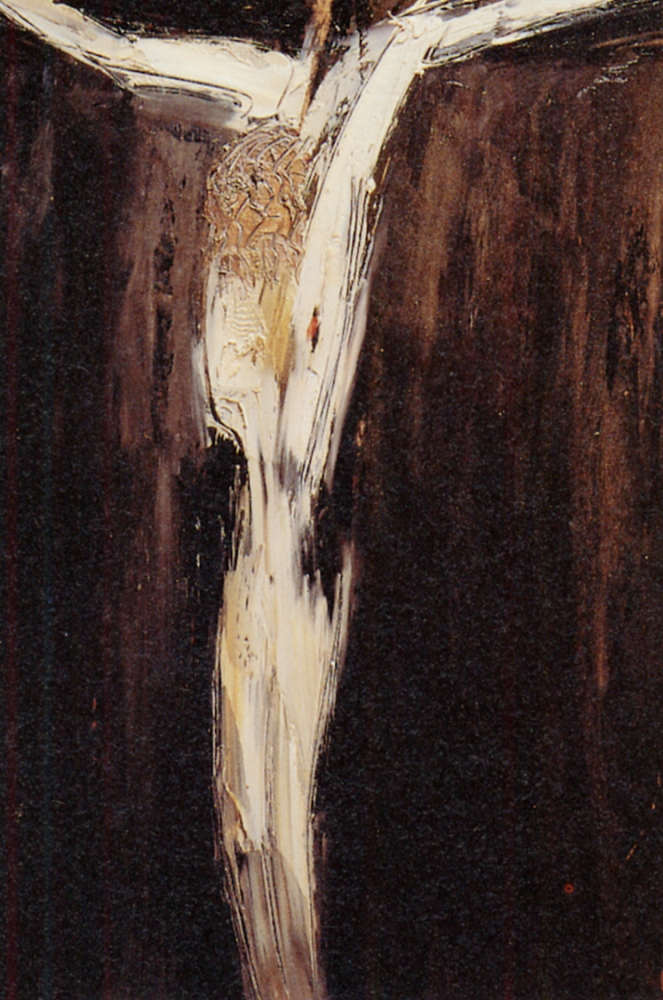
God suffers because God is holy love. If God were incapable of wrath, of being moved to grief by injustice and oppression, God would not be holy; if God were incapable of suffering, of being moved to grief by the pain and agony of the victims of society, God would not be omnipotent love. In his The Crucified God, Moltmann draws out the connection between the wrath and the love of God as grounded in the life of covenant:

‘[If] one starts from the pathos of God, one does not think of God in his absoluteness and freedom, but understands his passion and his interest in terms of the history of the covenant. The more the covenant is taken seriously as the revelation of God, the more profoundly one can understand the historicity of God and history in God. If God has opened his heart in the covenant with his people, he is injured by disobedience and suffers in the people. What the Old Testament terms the wrath of God does not belong in the category of the anthropomorphic transference of lower human emotions to God, but in the category of the divine pathos. His wrath is injured love and therefore a mode of his reaction to men. Love is the source and the basis of the possibility of the wrath of God. The opposite of love is not wrath, but indifference. Indifference towards justice and injustice would be a retreat on the part of God from the covenant. But his wrath is an expression of his abiding interest in man. Anger and love do not therefore keep a balance. ‘His wrath lasts for the twinkling of an eye,’ and, as the Jonah story shows, God takes back his anger for the sake of his love in reaction to human repentance. As injured love, the wrath of God is not something that is inflicted, but a divine suffering of evil. It is a sorrow which goes through his opened heart. He suffers in his passion for his people’. (pp. 171–2)


God grieves, then, because of the rebellion of his people; God grieves because of the broken relationship between himself and his creation; God grieves because of the inevitable consequences of human sin and rebellion; God grieves because he remembers what might have been; God grieves because love always hopes! Moltmann talks about the way that God is ‘injured by disobedience and suffers in the people’ who deserve their suffering, but what of the victims of their injustice? What of those who because of the faithlessness of the people of God find it difficult to believe in God?

de Gruchy is helpful here. Again from Theology and Ministry in Context and Crisis:

‘… it is not so much God who is beyond belief, but the church which has lost its credibility. Indeed, if God has become a problem it is precisely because those who claim to believe in God have too often denied him in practice. The credibility of the church’s testimony today is bound up not so much with its intellectual ability to defend the faith, to solve the theodicy problem as traditionally stated, … but far more with the willingness of the church to participate in the suffering of Christ for the sake of the world. And this means to share in the struggle for justice. To be sure, the justification of God can only be resolved eschatologically, but that takes place penultimately in history through authentic witness to the kingdom of God. The God in whom we believe, the God revealed in the crucified Messiah, the God who is present even when he is experienced as absent, and absent when we think he is present, this God has opted to be on the side of those who suffer because of the oppression of others’. (p. 123)

And de Gruchy helpfully reminds us that the suffering of God described so poignantly and powerfully in the Old Testament is not just grief caused by a sinful and disobedient people; it is also suffering with and on behalf of those who suffer as a result of Israel’s sin – the poor, the oppressed, the hungry, the lowly and innocent ones (see p. 113). And he cites from Terence Fretheim’s The Suffering of God: An Old Testament Perspective, p. 108: ‘The human cry becomes God’s cry, God takes up the human cry and makes it God’s own’. This is precisely what Bonhoeffer, in Discipleship, called God’s ‘hour of grieving’, an hour in which and a grieving of such that God invites his people to participate. The church is not simply the community of Christ which suffers vicariously for others. It is also itself the suffering church and itself the victim of oppression.

Certainly Bonhoeffer knew well that the sufferings and deaths he was daily made aware of could not be ascribed to the moral failings of the individuals concerned. Rather these tribulations had, and have, to be understood as the result of collective human willful sinfulness. But God has not withdrawn into a remote impassivity. Rather, God suffers alongside his creation. To repeat:

Men go to God when he sore bestead,
Find him poor and scorned, without shelter or bread …


The depths of divine suffering are reached in the cross where God finds himself ‘whelmed under weight of the wicked, the weak, the dead’.


So what should the responses of Christians, and of pastors, be? Not like others, who merely pass by, to whom the sight of a dead Jew on a cross is nothing. But Christians in this situation of crisis have a particular and significant calling. As Bonhoeffer notes in the last line of verse 2: ‘Christians stand by God in his hour of grieving’. In a letter written to his friend Eberhard Bethge shortly after the poem was completed, Bonhoeffer expanded on this line:

‘This is what distinguishes Christians from pagans. Jesus asked in Gethsemane, ‘Could you not watch with me one hour?’. That is a reversal of what the religious man expects from God. Man is summoned to share in God’s sufferings at the hands of a godless world.

He must therefore really live in the godless world, without attempting to gloss over or explain its ungodliness in some religious way or other. He must live a ‘worldly’ life, and thereby share in God’s sufferings. To be a Christian does not mean to be religious in a particular way, to make something of oneself (a sinner, a penitent, or a saint) on the basis of some method or other, but to be a man – not a type of man, but the man that Christ creates in us. It is not the religious act that makes the Christian, but participation in the sufferings of God in the secular life. That is metanoia: not in the first place thinking about one own needs, problems, sins, and fears, but allowing oneself to be caught up into the way of Jesus Christ, into the messianic event, thus fulfilling Isa. 53 now …

This being caught up into the messianic sufferings of God in Jesus Christ takes a variety of forms in the New Testament. It appears in the call to discipleship, in Jesus’ table-fellowship with sinners, in ‘conversions’ in the narrower sense of the word (e.g. Zacchaeus), in the act of the woman who was a sinner (Luke 7) – an act that she performed without any confession of sin – in the healing of the sick (Matt. 8.17; see above), in Jesus’ acceptance of children. The shepherds, like the wise men from the East, stand at the crib, not as ‘converted sinners’, but simply because they are drawn to the crib by the star just as they are. The centurion of Capernaum (who makes no confession of sin) is held up as a model of faith (cf. Jairus). Jesus ‘loved’ the rich young man. The eunuch (Acts 8) and Cornelius (Acts 10) are not standing at the edge of an abyss. Nathaniel is ‘an Israelite indeed, in whom there is no guile’ (John 1:47). Finally, Joseph of Arimathea and the women at the tomb. The only thing that is common to all these is their sharing in the suffering of God in Christ. That is their ‘faith’. There is nothing of religious method here. The ‘religious act’ is always something partial; ‘faith’ is something whole, involving the whole of one’s life. Jesus calls men, not to a new religion, but to life’. (Letters and Papers from Prison), pp. 135–6)

But where shall we find the strength and the grace to become such disciples? Verse 3 of the poem boldly asserts that, despite the sins we have all committed, despite the barriers we have all erected, despite all our efforts to behave like others, religiously, nevertheless God visits all people in their distress:

God goes to every man when sore bestead,
Feeds body and spirit with his bread;
For Christians, heathens alike he hangeth dead,
And both alike forgiving.

The second line here draws our attention to the eucharist where by sharing with us his body and his blood, Christ draws us into his pain and suffering. To repeat from the poem which we began our discussion on Bonhoeffer with:

Should it be ours to drain the cup of grieving
even to the dregs of pain, at thy command,
we will not falter, thankfully receiving
all that is given by thy loving hand.
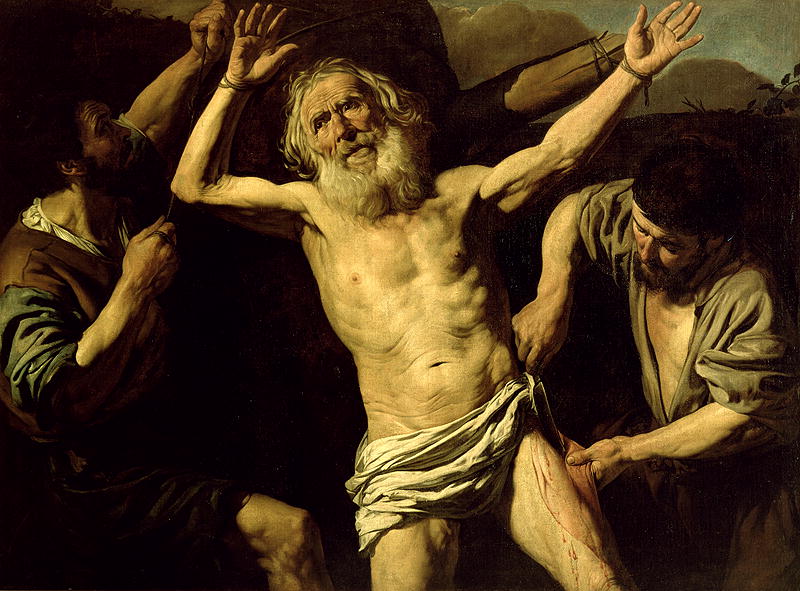
Here we are reminded of what Bonhoeffer explores more fully in Discipleship, namely that in his total identification with humanity in incarnation, and then by calling us into fellowship and discipleship with himself, Christ bids us to ‘come and die’.

‘The cross means sharing the suffering of Christ to the last and to the fullest. Only a man thus totally committed in discipleship can experience the meaning of the cross. The cross is there, right from the beginning, he has only got to pick it up: there is no need for him to go out and look for a cross for himself, no need for him to deliberately run after suffering. Jesus says that every Christian has his own cross waiting for him, a cross destined and appointed by God. Each must endure his allotted share of suffering and rejection. But each has a different share: some God deems worthy of the highest form of suffering, and gives them the grace of martyrdom, while others he does not allow to be tempted above that they are able to bear. But it is the one and the same cross in every case.

The cross is laid on every Christian. The first Christ-suffering which every man must experience is the call to abandon the attachments of this world. It is that dying of the old man which is the result of his encounter with Christ. As we embark upon discipleship we surrender ourselves to Christ in union with his death – we give over our lives to death. Thus it begins; the cross is not the terrible end to an otherwise godfearing and happy life, but it meets us at the beginning of our communion with Christ. When Christ calls a man, he bids him come and die. It may be a death like that of the first disciples who had to leave home and work to follow him, or it may be a death like Luther’s, who had to leave the monastery and go out into the world. But is the same death every time – death in Jesus Christ, the death of the old man at his call. Jesus’ summons to the rich young man was calling him to die, because only the man who is dead to his own will can follow Christ. In fact every command of Jesus is a call to die, with all our affections and lusts. But we do not want to die, and therefore Jesus Christ and his call are necessarily our death as well as our life. The call to discipleship, the baptism in the name of Jesus Christ means both death and life. The call of Christ, his baptism, sets the Christian in the middle of the daily arena against sin and the devil. Every day he encounters new temptations, and every day he must suffer anew for Jesus Christ’s sake. The wounds and scars he receives in the fray are living tokens of this participation in the cross of his Lord. But there is another kind of suffering and shame which the Christian is not spared. While it is true that only the sufferings of Christ are a means of atonement, yet since he has suffered for and borne the sins of the whole world and shares with his disciples the fruits of his passion, the Christian also has to undergo temptation, he too has to bear the sins of others; he too must bear their shame and be driven like a scapegoat from the gate of the city. But he would certainly break down under this burden, but for the support of him who bore the sins of all. The passion of Christ strengthens him to overcome the sins of others by forgiving them. He becomes the bearer of other men’s burdens – ‘Bear ye one another’s burdens, and so fulfill the law of Christ’ (Gal. 6.2). As Christ bears our burdens, so we ought to bear the burdens of our fellow-men. The law of Christ, which it is our duty to fulfil, is the bearing of the cross. My brother’s burden which I must bear is not only his outward lot, his natural characteristics and gifts, but quite literally his sin. And the only way to bear that sin is by forgiving it in the power of the cross of Christ in which I now share. Thus the call to follow Christ always means a call to share the work of forgiving men their sins. Forgiveness is the Chrislike suffering which it is the Christian’s duty to bear.

But how is the disciple to know what kind of cross is meant for him? He will soon find out as he begins to follow his Lord and to share his life.

Suffering, then, is the badge of true discipleship. The disciple is not above his master. Following Christ means passio passive, suffering because we have to suffer. That is why Luther reckoned suffering among the marks of the true Church, and one of the memoranda drawn up in preparation for the Augsburg Confession similarly defines the Church as the community of those ‘who are persecuted and martyred for the gospel’s sake’. If we refuse to take up our cross and submit to suffering and rejection at the hands of men, we forfeit our fellowship with Christ and have ceased to follow Him. But if we lose our lives in his service and carry our cross, we shall find our lives again in the fellowship of the cross with Christ. The opposite of discipleship is to be ashamed of Christ and his cross and all the offense which the cross brings in its train.

Discipleship means allegiance to the suffering Christ, and it is therefore not at all surprising that Christians should be called upon to suffer. It is a joy and token of his grace. The acts of the early Christian martyrs are full of evidence which shows how Christ transfigures for his own the hour of their mortal agony by granting them the unspeakable assurance of his presence. In the hour of the cruelest torture they bear for his sake, they are made partakers in the perfect joy and bliss of fellowship with him. To bear the cross proves to be the only way of triumphing over suffering. This is true for all who follow Christ, because it was true for him’. (pp. 43–6)

In October, Bonhoeffer was transferred to the far more ominous and menacing Gestapo prison in central Berlin. But the evidence that we have is that his own faith and trust in his crucified Lord led him to identify more and more with the future hope of resurrection beyond death. So he could therefore face the inevitable testing through suffering by affirming his belief in God’s guiding hand, and the assuredness of God’s nearness. In his final poem ‘By the powers of Good’, the central verse takes up this issue:

Should it be ours to drain the cup of grieving
even to the dregs of pain, at thy command,
we will not falter, thankfully receiving
all that is given by thy loving hand.
When C.S. Lewis lost his wife he wrote at one point in his anguish: ‘Talk to me about the truth of religion and I’ll gladly listen. Talk to me about the duty of religion and I’ll listen submissively. But don’t come talking to me about the consolations of religion or I shall suspect that you don’t understand’ (A Grief Observed, 23). And yet the task of providing consolation has always been a significant part of the work of a pastor. It is, in many ways, a task among the most difficult for the pastor. It is difficult because questions of suffering involve us in the depths of our humanity. And it is difficult because mere human words have no answer to the mystery of suffering.

Here we could do much worse that simply listen to the experience of Nick Wolterstorff who, in grief after losing his 25-year-old son Eric in a mountain climbing accident, penned the wonderfully-moving Lament for a Son:

‘What do you say to someone who is suffering? Some people are gifted with wNicords of wisdom. For such, one is profoundly grateful. There were many such for us. But not all are gifted in that way. Some blurted out strange, inept things. That’s OK too. Your words don’t have to be wise. The heart that speaks is heard more than the words spoken. And if you can’t think of anything at all to say, just say, “I can’t think of anything to say. But I want you to know that we are with you in your grief.”

Or even, just embrace. Not even the best of words can take away the pain. What words can do is testify that there is more than pain in our journey on earth to a new day. Of those things that are more, the greatest is love. Express your love. How appallingly grim must be the death of a child in the absence of love.

But please: Don’t say it’s not really so bad. Because it is. Death is awful, demonic. If you think your task as comforter is to tell me that really, all things considered, it’s not so bad, you do not sit with me in my grief but place yourself off in the distance away from me. Over there, you are of no help. What I need to hear from you is that you recognize how painful it is. I need to hear from you that you are with me in my desperation. To comfort me, you have to come close. Come sit beside me on my mourning bench.

I know: People do sometimes think things are more awful than they really are. Such people need to be corrected-gently, eventually. But no one thinks death is more awful than it is. It’s those who think it’s not so bad that need correcting.

Some say nothing because they find the topic too painful for themselves. They fear they will break down. So they put on a brave face and lid their feelings-never reflecting, I suppose, that this adds new pain to the sorrow of their suffering friends. Your tears are salve on our wound, your silence is salt.

And later, when you ask me how I am doing and I respond with a quick, thoughtless “Fine’’ or “OK,” stop me sometime and ask, “No, I mean really.” (pp. 34–5)

It is imperative to the integrity of its witness that the Church takes suffering and grief with the utmost seriousness. And as for death – Death sucks! There is simply nothing positive we can say about it, nor should we seek to live in peace with it. So Wolterstorff again:

‘Someone said to Claire, “I hope you’re learning to live at peace with Eric’s death.” Peace, shalom, salaam. Shalom is the fulness of life in all dimensions. Shalom is dwelling in justice and delight with God, with neighbor, with oneself, in nature. Death is shalom’s mortal enemy. Death is demonic. We cannot live at peace with death.

When the writer of Revelation spoke of the coming of the day of shalom, he did not say that on that day we would live at peace with death. He said that on that day “There will be no more death or mourning or crying or pain, for the old order of things has passed away.”

I shall try to keep the wound from healing, in recognition of our living still in the old order of things. I shall try to keep it from healing, in solidarity with those who sit beside me on humanity’s mourning bench’. (p. 63)

In the face of death, suffering and grief, what the Church is given to know and to hope in and to proclaim is the word of the cross and resurrection. We have no other word! Moltmann’s The Crucified God is characteristically helpful here:

‘The cross of Christ is not and cannot be loved. Yet only the crucified Christ can bring the freedom which changes the world because it is no longer afraid of death. In his time the crucified Christ was regarded as a scandal and foolishness. Today, too, it is considered old-fashioned to put him in the centre of Christian faith and of theology. Yet only when [human beings] are reminded of him, however untimely this may be, can they be set free from the power of the facts of the present time, and from the laws and compulsions of history, and be offered a future which will never grow dark again. Today the church and theology must turn to the crucified Christ in order to show the world the freedom he offers. This is essential if they wish to become what they assert they are: the church of Christ, and Christian theology … Whether or not Christianity, in an alienated, divided and oppressive society, itself becomes alienated, divided and an accomplice of oppression, is ultimately decided only by whether the crucified Christ is a stranger to it or the Lord who determines the form of its existence … In Christianity the cross is the test of everything which deserves to be called Christian’. (pp. 1, 3, 7)

‘We must not only ask whether it is possible and conceivable that one man has been raised from the dead before all others, and not only seek analogies in the historical structure of reality and in the anticipatory structure of reason, but also ask who this man was. If we do, we shall find that he was condemned according to his people’s understanding of the law as a ‘blasphemer ‘ and was crucified by the Romans, according to the divine ordinance of the Pax Romana, as a ‘rebel.’ He met a hellish death with every sign of being abandoned by his God and Father. The new and scandalous element in the Christian message of Easter was not that some man or other was raised before anyone else, but that the one who was raised was this condemned, executed and forsaken man. This was the unexpected element in the kerygma of the resurrection which created the new righteousness of faith’. (p. 175)

‘This deep community of will between Jesus and his God and Father is now expressed precisely at the point of their deepest separation, in the godforsaken and accursed death of Jesus on the cross’. (pp. 243–44)

‘The death of Jesus on the cross is the centre of all Christian theology … The nucleus of everything that Christian theology says about God is to be found in this Christ event. The Christ event on the cross is a God event. And conversely, the God event takes place on the cross of the risen Christ. Here God has not just acted externally, in his unattainable glory and eternity. Here he has acted in himself and has gone on to suffer in himself. Here he himself is love with all his being’. (pp. 204, 205)

So in the face of death, suffering and grief, the Church is called to:

  1. point to Jesus, the Crucified God, who reveals God’s endangering goodness and suffering love;
  2. participate in God’s cruciform life by suffering with those who suffer and working to relieve and eliminate suffering. Such cruciformity constitutes the ethical dimension of the theology of the cross found throughout the NT and the Christian tradition. Paradoxically, because the living Christ remains the crucified one, cruciformity is Spirit-enabled conformity to the indwelling crucified and resurrected Christ. It is the ministry of the living Christ, who re-shapes all relationships and responsibilities to express the self-giving, life-giving love of God that was displayed on the cross. Although cruciformity often includes suffering, at its heart cruciformity – like the cross – is about faithfulness and love.

Many of those who have suffered devastating grief or dehumanising pain have, at some point, been confronted by near relatives of Job’s miserable comforters, who come with their clichés and tired, pious mouthings. These relatives engender guilt where they should be administering balm, and utter solemn truths where their lips ought to be conduits of compassion. They talk about being strong and courageous when they should just shut and weep … and pray to the God ‘who comforts the downcast’ (2 Cor 7.6), who is the ‘God of all comfort’ (2 Cor 1.3), who intercedes for us both when we can articulate what we want to say and when all we have are groans, and to whom not even death represents the end.

But there is a further posture that we are invited, by God, to maintain. And that is the posture of protest prayer. I am reminded here of Karl Barth’s statement, that ‘to clasp hands in prayer is the beginning of an uprising against the disorder of the world’ (cited in John W. de Gruchy, Cry Justice: Prayers, Meditations, & Readings from South Africa, 23). A Christian response to evil is not theodicy, but struggle – the struggle of taking God’s side against the world’s disorder, and of refusing to treat evil as an acceptable part of a larger harmonious vision. Only to the extent that we can confess that nothingness has been vanquished in the self-nihilation of Christ, and met with, struggled with, and overcome may we say that we ‘know’ something of sin and evil’s reality, and be able to speak hopefully of its end.

Finally, for now, the continuity/discontinuity of Jesus’ resurrection provides the ontological basis for Christian hope, promising that of whatever post-resurrection life consists, it is hope in something other than endless continuity. And as meaningful as life’s plots and subplots might be, it is the end (and the more improbable the better) that confers meaning on the whole. It is to bear witness to this end that pastors labour.

◊◊◊

Other posts in this series:
Here and there …


On the cost and grace of parish ministry – Part XIII

In the two previous posts in this series, I have been reflecting briefly on the relationship between baptism and ordination. Both – and that together – are a divine summons to a life of discipleship. Here I want to suggest that we ought to understand ‘ordination’ not only in relation to baptism, but also in relation to God’s wider work of calling forth faith, to God’s work of guiding and enabling the whole community of faith, to God’s concern of shalom-making for all people. Ordination ought to be seen in the light of this broader movement of the divine will – that is, in the context of God’s good purposes for creation. So, the ministry to which a pastor is ordained is deeply and inherently about a life in God, and it means participation in that life, and in that life’s economy as it turns towards the world. This means that ordination makes no sense not only apart from baptism but – and more fundamentally – apart from Jesus Christ, and apart from his service to the Father on behalf of the world. So T.F. Torrance:

‘Christ was Himself the diakonos par excellence whose office it was not only to prompt the people of God in their response to the divine mercy and to be merciful themselves, not only to stand out as the perfect model or example of compassionate service to the needy and distressed, but to provide in Himself and in His own deeds of mercy the creative ground and source of all such diakonia. He was able to do that because in Him God Himself condescended to share with men their misery and distress, absorbed the sharpness of their hurt and suffering into Himself, and poured Himself out in infinite love to relieve their need, and He remains able to do that because He is Himself the outgoing of the innermost Being of God toward men in active sympathy and compassion, the boundless mercy of God at work in human existence, unlimited in His capacity to deliver them out of all their troubles’. – Thomas F. Torrance, ‘Service in Jesus Christ’ in Theological Foundations for Ministry: Selected Readings for a Theology of the Church in Ministry (ed. Ray S. Anderson; Edinburgh/Grand Rapids: T&T Clark/Wm. B. Eerdmans, 1979), 718.

While it is fair to say that pastoral ministry in the contemporary West is attended by some unique pressures, including an increasing lack of clarity over the role of the pastor, none who have read any church history, let alone the Bible (think, for example, of brother Moses), could reasonably conclude that the concerns surrounding clergy ill-health and burnout to which I drew attention in the earliest posts in this series (I, II, III, IV & V) are problems foreign to earlier generations of ministers. Augustine, for example, once got so near to burnout that he had to turn away from his duties for a six-month sabbatical. In his book Augustine and the Catechumenate, William Harmless lists six factors that Augustine associated with burnout: (i) a failure to rely of the judgement of the faithful; (ii) boredom; (iii) the fear of making a mistake; (iv) an apathetic congregation; (v) the fear of being interrupted; and (vi) grief of heart (pp. 133–40). And one of the deep truths that Augustine reminds us of is that Christian existence is life-in-community, and with that community’s history, catechumenate and sacraments. It is these realities, Augustine believed, that tired ministers ought to turn to: to eat of the Body of Christ is to be refreshed; to drink of his Blood is to live (see, for example, his ‘Sermon on John 6.53’).

In more recent times, PT Forsyth has observed a ‘general sense of unrest’, of ‘inner unrest’ and ‘mental mobility’ of ministers, many of whom themselves are quite blind to the veracity of their own situations. ‘A very great number wish to change their sphere’, he said. Forsyth, who was a college principal, notes the lack of adequate training of ministers, and laments that some ‘leave college without the love or habit of Bible study; or without the reserve principles which come out to settle things in the most dangerous period, which is middle life; and so they devote themselves to nothing – beyond the weekly tale of work’. He continues:

‘In due course comes exhaustion and the “sinking feeling.” They have nothing in which they can collect and possess themselves from the tension and distraction of the place and the hour. They never arrive. And what they read adds to the dissipating effect. It is largely the newspapers, religious or other, or it is similar fugitive products; which is like reading the commentaries before studying the passage. That is to say, their mind is being bombarded with tiny particles of fact or fancy in a constant stream; and the vibration, largely unconscious at the time, accumulates to a chronic and mysterious unrest. How many would increase their peace and power of mind if they would eschew newspapers [and he may have added ‘the internet’] for a year. Yet to do it postulates the very power which is desired. Or if they were driven to more deliberate prayer in order to neutralize the atmosphere of criticism and mental dissipation in which a press age plunges them. For lack of it men may easily become dilettanti not in theology only but in soul, religious amateurs instead of spiritual masters, mere seekers, and experimenters instead of experts of the Gospel and adepts of faith. And our creed may come to suffer from what the doctors now call tea-ism – tremors due to the abuse of sedatives …

I have often found in my own case, too, that the preparation of sermon after sermon, with a constant change of subject, produced an effect of unrest. The mind loses the continuity, the self-possession, that belongs to stability and power. I have found I was apt to prepare my sermons better than myself. Is that an uncommon experience – to spend more on preparing a sermon than on preparing the message, and to spend least of all on preparing oneself for the total work of the ministry? It is with the preaching as it is with the prayer – the great and hard thing is preparing oneself, and preparing not for the occasion but for the vocation. Should the message not be the overflow of the preacher’s life experience, and the sermon the ebullition of the message?

I am sure the real and general secret of the unrest is spiritual, whether my diagnosis in detail be accurate or not; whether it be the case with each individual or not. The disease is secularity of interest. We imbibe much of it from the quivering age’. Revelation Old and New, 105–7.

◊◊◊

Other posts in this series:

Heiko Oberman on Reformed preaching


‘The sermon does not have to try desperately to be actual because it has the highest possible actuality … The sermon is … apocalyptic in the sense that, far from merely referring to the final evaluation of our records, it reveals to us now in time and space the final will of God for the individual Christian: it is God’s last word, to which no syllable will be added. For this reason the Reformation could preach the certitudo salutis, the certainty of salvation, because he who will judge us is the same who fulfilled the law. In the words of Calvin: ‘When a Christian looks into himself he finds cause to be afraid or even to despair … [But] he will win a sure hope of eternal perseverance when he considers that he belongs to Him who cannot fall or fail’. It gives pause to realize that this message which proved to lend the Reformation movement its reconciling and liberating power has virtually disappeared from the Protestant pulpit’. – Heiko A. Oberman, ‘Preaching and the Word in the Reformation’, Theology Today 18, no. 1 (1961), 19.

On the cost and grace of parish ministry – Part XII

In my previous post, I spoke of baptism as ordination to ministry, seeking to bear witness to the reality that baptism speaks God’s word of life and God’s summons to a life of discipleship. All that follows – such as the practice in my own tradition of calling some to the ordered or ‘specific ministries’ of the church, what we call ‘ordination’ – is essentially functional. So Joseph Small in his fine essay ‘Ordination and Authority’: ‘Ordination to one of the church’s ordered ministries is not the simple recognition that a person possesses “gifts for ministry” or that a particular office suits a person’s abilities. Nor does ordination follow naturally from a person’s “sense of call.” Ordination is certainly not about access to position, influence, and power in the church. Instead, ordination is the church’s act of recognizing the movement of the Holy Spirit in the interactions among the church’s ordering of ministries, its standards for these ministries, and its current needs, together with prayerful discernment by persons, congregations, and presbyteries’.

Ordination means that ministers ought to take their primary ‘job description’ not from some local contract that he or she may have entered into but from their ordination vows, vows which are themselves grounded in baptism, that act of the Church which is grounded in the gospel. So there is something of a trajectory from the divine economy to local ordination (even though it is a trajectory that the Church and its ministers has very often misread and abused in the grab for power). This means that here in New Zealand, Presbyterian ministers must do the following:

  • Confess Jesus Christ as Saviour and Lord;
  • Believe that they are called by God and the Church to the ministry of Word and Sacrament;
  • Receive the witness of the Bible as the supreme rule of faith and life, and undertake to preach from the Bible in order to make Jesus Christ known;
  • Celebrate the sacraments of Baptism and Holy Communion with the people of God;
  • Accept that the Apostles’ and Nicene Creeds witness to the core faith of the holy catholic Church, and accept the Westminster documents and the Kupu Whakapono and its accompanying Commentary as witnesses to the Reformed tradition of faith;
  • Relying on the power of the Holy Spirit, commit oneself to the study of the Bible, to model one’s life and ministry on Christ, and to be faithful in prayer;
  • Share in the life and work of the Presbytery and the courts of the Church to uphold the doctrine, worship, government and discipline of the Church, and at all times seek its unity and peace;
  • Accept the call to minister to a particular parish and congregation.

Such vows provide shape and direction to – and place much-needed boundaries around – the task of pastoral ministry. Clearly there is nothing here about the need for ministers to be doing everything! So Brad Greenberg: ‘The big problem clergy have is the ability to say no … it’s only gotten harder in a world where pastors friend their flock on Facebook and are always reachable by cell call or text’.

In a recent sermon on Temptations and Triumphs of Ministry, Kenneth L. Carder properly recalled:

‘Baptism defines who we are, who our family is and what our ministry entails … Our primary calling, then, is to accept and live our baptismal identity! That is a ministry we share as laity and clergy. Ordination does not supersede baptism. Rather, it derives from baptism. And the bedrock calling of the ordained and commissioned is to support the baptized in living their identity in the world. There is no higher calling than our baptismal calling. Baptism has to do with our being as beloved daughters and sons of God: it is who we are. The glorious, triumphant news is that it is all a gift. We cannot earn our worth and relationship as God’s son or daughter any more than we earned our right to be born. Baptism is God’s affirmation, “Do not fear, for I have redeemed you; I have called you by name, you are mine” (Isaiah 43:1). Therefore, our worth lies in the One to whom we belong, and nothing can take that from us, not even death itself! And the glorious good news is that it is all a gift. We call it grace. Our basic identity and worth are not the triumph of our efforts. They are the free gift of God. In the words of the Epistle of First John: “See what love the Father has given us, that we should be called children of God; and that is what we are. … Beloved, we are God’s children now; what we will be has not yet been revealed. What we do know is this: when he is revealed, we will be like him, for we will see him as he is” (3:1–2)’.

He continues:

‘Ordained and commissioned ministry is especially susceptible to trying to prove and earn our worth [i.e. to reject our baptisms and to embrace a self-constituted existence]. One means is by what one of my faculty colleagues at Duke calls “being a quivering mass of availability” – meeting people’s expectations and superficial desires rather than identifying the hungers that cannot be satisfied with bread. Or using the pastoral role to ingratiate ourselves to the masses so they will applaud us, validate our importance, and fill our need for praise and affirmation. The consequences can be catastrophic boundary violations and traumatic abuse of the pastoral relationship; and [this shadow] is often manifested in using congregations as steppingstones in career advancement, which is fleecing the sheep rather than shepherding them. A prayer that I have prayed almost every day of my 50 years of ministry is “Oh God, do not let me be unduly distracted today by either criticism or praise.”

The ministry offers numerous substitutes for baptism as our identity and ministry – size of church, titles, ecclesial positions. We are part of a culture that values worth on the basis of what we know, how we look, what we own, what we produce. Our appointments, salaries, attendance, budgets, ranking on the “work sheet,” political clout and awards become our identity. What we do replaces who we are; being is replaced with doing. Such proofs of our identity are like trying to fill our deep hunger to be somebody with bread made from stone.

Another deadly temptation is the abuse of power inherent in being called by God, confusing political and institutional power with love. Or, rather than being formed by the power of love, we are shaped by the love of power. The tempter showed Jesus the kingdoms of this world and said, “If you … will worship me, it will all be yours.”

Henri Nouwen reminds us that “one of the greatest ironies of the history of Christianity is that its leaders constantly gave in to the temptation of power – political power, military power, economic power, or moral and spiritual power.” He adds that “power offers an easy substitute for the hard task of love. It seems easier to be God than to love God, easier to control people than to love people, easier to own life than to love life”’.

As I have written elsewhere (in a reflection on 2 Corinthians 11.16–12.10):

Here is grace’s way – of Israel’s birth through a barren womb. Here is grace’s way – of the champion from Gath killed by Jesse’s youngest son. Here is grace’s way – of the Word taking on fallen flesh and stubbornly refusing to be fallen in it. Here is grace’s way – of ostracised women being commissioned as proclaimers of God’s good news. Here is grace’s way – that the deepest revelations of God are not given to the wise and understanding but to infants. Here is grace’s way – that God has a deliberate policy of positive discrimination towards nobodies, that the kingdom of God belongs to the poor and that the earth will be inherited by the meek. Here is grace’s way – love your enemies and bless those who make life hell for you. Here is grace’s way – of God making foolish and weak the wisdom and power of the world. Here is grace’s way – of God putting his treasure into jars of clay in order to show that God’s all-surpassing power is from God and not from us. Here is grace’s way – that only in humiliation do we find God exalting us, only in dying do we find God making us alive, only in throwing our lives away do we find God giving life back to us. Here is grace’s way – of power being brought to an end in weakness. Here is grace’s way – that we might actually be more use to God with our thorns than without them. Only when I am weak, am I strong.

There is something else that is important to include at this point in this series of posts; namely, that the justification of the Church and of its ministry is not the work the minister. If and when justification is made, it will be the free act of God. At the very least, this truth should divert the Church away from the temptation to engage in those attempts which foster self-righteousness, smugness, and fact-denying illusion. So Richard John Neuhaus warns that pastoral ministry is not the Church’s office of public relations: ‘Our job is not to project a more positive “image” of the Church, as that term is used in the communications media. Our task is to take seriously the biblical images or models of the Church that illuminate the Church’s full mission as the sign of humanity’s future. As we take this biblical understanding of the Church seriously, there is ever so much in the empirical Church of which we must be relentlessly critical’. And Neuhaus proceeds to offer an ever-timely warning about collapsing the Church and the Kingdom of God:

‘Whatever else we may be guilty of, we are not guilty of the fact that the Church is not the historical consummation of the Kingdom of God. Far from our being embarrassed by the limitations of the existent Church, it is among our chief responsibilities to underscore the truth that the Church is not to be confused with the Kingdom of God. The Christian community points toward that Kingdom. In some important respects it anticipates that Kingdom. But the Church is as far in time from the Kingdom as is the whole creation of which the Kingdom is the universal future. The disappointment, discontent, and frustration that the world feels over its distance from perfection is also our disappointment, discontent, and frustration. In this sense, the Church is emphatically part of the world; indeed, as Paul describes it in Romans 8, the Church is the most restlessly yearning part of the whole creation. The difference is that we know the reason for the hope of perfection that is within us (1 Pet. 3). That reason is the preview or proleptic appearance of our hope vindicated in the resurrection of Jesus the Christ. Living in communion with him, we not only share but articulate and intensify the world’s discontent. Our gospel is not the gospel of optimism, which is, after all, simply a different way of looking at things. It is not simply an angle of vision but a new datum that we proclaim to the world. That datum, which is the message and life of Jesus, is the reason for the hope that is within us and, if only they knew it, the foundation and rationale of hope within all people. And so, because we do not pretend that the Church is the Kingdom of God, we offer no excuses for its not being the Kingdom of God. There will be no satisfactory Church, no Church that can be embraced without ambiguity, until the world of which the Church is part is satisfactorily ordered in the consummation of God’s rule. In short, we cannot get it all together until God has gotten it all together in the establishment of the Messianic Age’. – Richard John Neuhaus, Freedom for Ministry (Grand Rapids: Wm. B. Eerdmans, 1992), 23–4.

◊◊◊

Other posts in this series:

On the cost and grace of parish ministry – Part XI

I made the claim earlier that the crisis in ministerial and churchly identity is a crisis that finds it genesis in a defunct christology. This ought to be no surprise, for the Church is the body of Christ. And I drew attention to T.F. Torrance’s claim that everything for the Church depends on Christ’s humanity and substitutionary work. I have spoken a little of the implications of Christ’s humanity. Now let me press a little more on the church’s dependence upon Christ’s substitutionary work, and that by way of offering an essential clarification.

History leaves us with little question about the fact that when the substitutionary elements in Christ’s work are emphasised at the expense of the participatory elements – when, for example, salvation is reduced to an application of Christ’s merits as some sort of external transaction and the grace of union with Christ (of which Calvin was so fond) all but abandoned – then this inevitably sponsors the notion of the Church as a mere institution. [For an antidote, see Mike Gorman’s Inhabiting the Cruciform God: Kenosis, Justification, and Theosis in Paul’s Narrative Soteriology, and Todd Billings’ Calvin, Participation, and the Gift: The Activity of Believers in Union with Christ, and Braaten’s & Jenson’s Union with Christ: The New Finnish Interpretation of Luther]. It is this element of participation that I have been trying to emphasise here precisely because the implications of such a doctrine for pastoral practice and identity are so radically fruitful and liberating.

But lest we distort or impose limits upon the richness of Christ’s person and undermine his call to discipleship, we might also highlight the sense in which service is also a response to the love of God in Christ. But here again, the reality and form of this service is grounded in the vicarious humanity of Jesus Christ (see T.F. Torrance’s article on ‘Service in Jesus Christ’ published in Theological Foundations for Ministry). In other words, the response of the creature is constituted in and made possible by participation with Christ. To confess that service is the response to the love of God, therefore, is to confess that service is determined by the relationship established with and maintained by God, and not by any outcomes. Put differently, Christian service is, from first to last, about grace. Service, therefore, cannot stand on its own outside of the God-human relation (which itself in constituted in the hypostatic union). Little wonder then that service for service’s sake finally results in boredom and despair, and that preachers that seek to ‘whip-up’ the faithful by throwing them back upon their own resources participate in murder rather than resurrection. This reminds us too that service is not about servitude, but about freedom and the movement of love. It also recalls God’s provision of powers for service, and that Christ’s servants ought not assume authority for the service they undertake nor are they responsible for any results that arise. They must look for no reward beyond the joy of the relation itself.

This is only possible because in the incarnation of the Word God has undertaken to wear our humanity, to heal our brokenness and to put to death the idolatry that reigns from within the depths of human existence. Only in the humanity of God, therefore, lies the creative ground and source of true diakonia. And it is at this point that we finally come to where we might have begun: with baptism, and to the stunning truth that baptism is ordination to ministry. Indeed, baptism reminds us – among other things – of the fact that ministry is what the whole people of God is called to. The ‘Book of Order’ of the Presbyterian Church of Aotearoa New Zealand puts it thus: ‘Baptism invites us to share in God’s mission through our own vocation and commitment to God’s new and coming world. This vocation and commitment take shape in a range of occupations and activities in society’

Eugene Peterson once wrote:

‘The biblical fact is there are no successful churches. There are, instead, communities of sinners, gathered before God week after week in towns and villages all over the world. The Holy Spirit gathers them and does his work in them. In these communities of sinners, one of the sinners is called pastor and given a designated responsibility in the community. The pastor’s responsibility is to keep the community attentive to God. It is this responsibility that is being abandoned in spades’. – Eugene Peterson, Working the Angles: The Shape of Pastoral Integrity (Grand Rapids: Wm. B. Eerdmans, 1987), 2.

So the need to keep recalling the truth proclaimed in baptism, including the truth that the tools for Christian ministry are to be found underwater. Learning to breathe underwater, then, is the challenge of being Church.

◊◊◊

Other posts in this series:

[Image: Time]

On the cost and grace of parish ministry – Part X

In an earlier post, I drew attention to some words from Michael Jinkins’ (in Called to Be Human: Letters to My Children on Living a Christian Life) about the relationship that exists between friendship and a thoroughly-human life. I suggested there that ‘effective pastoral ministry is impossible apart from friendship precisely because human flourishing is impossible apart from friendship. Only non-human pastors can go it alone, those particularly uninterested in being associated with the imago dei in creation’. In this post, I wish to return to this topic, and that again by way of Jinkins. In his book, Letters to New Pastors, which is a collection of letters from a mature pastor to fictional recipients, Professor Jinkins notes that while friendship is no harder for pastors than it is for others, ‘what is more difficult for pastors is finding safe places to share their struggles and frustrations’ (p. 167). He continues:

‘Ministers often tell me they just don’t feel comfortable being vulnerable with certain colleagues. Sometimes they feel least safe with colleagues in their own denomination, especially if these colleagues might play a role in their future calls. Ministers also tell me they cannot be completely vulnerable with members of their congregations. I think what they’re basically saying here is that they don’t want to confuse their role as pastor or transgress a boundary that might undermine their calling’. (p. 168)

And this raises the question of whether pastors can be friends with members of their own congregations. Jinkins again:

‘On the face of it, this is one of those questions you want to answer unequivocally: “Yes, of course. If you can’t be friends with members of your congregation, who can you be friends with?” One retired pastor told me that several of his oldest, closest friends come from the congregations he has served over the years. He’s gone on vacations with them, named his children after them, and so forth. He said it is simply foolish and arrogant for pastors to pretend that they can’t be friends with members of their congregations.

Other pastors tell me something different. While they maintain deep and affectionate relationships with members of their congregations, relationships they refer to as friendships, they try never to lose sight of the larger obligation they have to serve as pastor to and to lead the whole congregation. They work hard to remind themselves of their role as pastors, which means there may be times when the congregation’s claim on them has priority over the claims of a particular friend’. (p. 168)

Most pastors with whom I have discussed this topic at any length will inevitably describe the tension that exists here between these two realties. Jinkins warns of the dangers associated with both minimising and over-maximising this tension, before recalling that such tension is not unique to pastors, that many friendships require negotiating just such straits: ‘I do think we have to be particularly careful about doing anything that might invite the charge of favoritism that can emerge in a congregation around friendships with the pastor. We need to take this very seriously. We need to keep a healthy measure of self-criticism in play to make sure our friendships do not lead us to compromise our pastoral responsibilities for the whole congregation. The congregation needs us to be its pastor, and we simply must not compromise that calling. But I cannot imagine life as a pastor without real friendships among the people with whom I serve Christ’ (p. 169).

◊◊◊

Other posts in this series:

[Image: Jankel Adler, ‘Two Rabbis’. 1942. Oil on canvas, (86 x 112.1 cm). Museum of Modern Art]

On the cost and grace of parish ministry – Part IX

In my most recent post in this series, I made the claim that to engage in Christian ministry is to take up an invitation to participate in the life of God. Indeed, it is to enter into God’s rest. To enter such rest is to be, in Irenaeus’ words, ‘fully alive’. More wonderfully, it is to be ‘the Glory of God’. In this post I wish to ruminate on the Decalogue’s fourth word; namely, that which concerns the grace of Sabbath, the rest which renews and restores:

‘Remember the sabbath day, and keep it holy. Six days you shall labor and do all your work. 10 But the seventh day is a sabbath to the Lord your God; you shall not do any work – you, your son or your daughter, your male or female slave, your livestock, or the alien resident in your towns. For in six days the Lord made heaven and earth, the sea, and all that is in them, but rested the seventh day; therefore the Lord blessed the sabbath day and consecrated it’. (Exod 20.8–11)

Whereas the First Word is about how we honour God with our loyalty, the Second about how we honour God with our thought life, the Third about how we honour God with our words, this Fourth Word concerns how we honour God with our time. This word has nothing at all to do with legalistic notions associated with various brands of Sabbatarianism. It does have everything to do with rest and with God’s invitation that we enter his rest. This word is all about the use of our time in a rhythm of toil and rest, work and worship. It reminds us that the goal of God’s creation is not humanity, but Sabbath. And unlike the other six days, the seventh day has no end. In other words, we live in the Sabbath now. The Sabbath of God is the whole history of the world from the sixth day until the end (of time).

Few commandments in holy writ so cut across the grain of Western society as this one. In his book, The Soul of Ministry: Forming Leaders for God’s People, Ray Anderson devotes an entire chapter to the matter of Sabbath. He speaks of the ‘slave master self’ that lurks at the edges of the human psyche. Whether it be a demanding parent or boss or job, like Israel we too carry this virus with us – a ‘hidden virus with an insatiable appetite for healthy flesh’ (p. 60). While Israel had just been redeemed from a dehumanising bondage in Egypt, they were yet to be redeemed from the bondage that existed in their very being. And so not only would they need to learn ‘the discipline of the Sabbath’ for their own well-being, but they would also need to learn ‘the theology of the Sabbath’ in order to strengthen their faith and to give perspective to their hope.

Anderson writes:

‘Without a theology of the Sabbath, the discipline of the Sabbath would itself become a slave master as, in fact, quickly happened. By the time of Jesus, the Sabbath discipline had become a law more severe and sacred than any moral imperative. Paradoxically, liberation from the taskmaster of the sabbath law was a primary occasion for the condemnation and execution of Jesus. That which was to be a sacrament of liberation, of renewal and restoration, had become a rigid and inhumane rule from which liberation was effected by the ministry of Jesus!’

Sabbath is not about taking a ‘day-off’ – what Eugene Peterson calls ‘a bastard Sabbath’ (in Working the Angles: The Shape of Pastoral Integrity, p. 66); rather it is a conscious effort of entering into, and responding to, the rhythms and actions of Spirit at work in creation. It is realising that God is not waiting for us to wake up to begin working each day, but that God is working already and inviting us, when we awake, firstly to listen, and only then to join in.

Sabbath time is not a time that proves its worth or justifies itself. It is not a time to ‘get things done’. It is a time of rest, of ‘not-doing’. No Patmos visions. No Sinai’s. No Mounts of Transfiguration. It is, put simply, the sanctification of time.

Thinking about Sabbath recalls that the Sabbath was God’s way of operating before it became ours. (Geoffrey Bingham’s The Law of Eternal Delight is helpful here). So Genesis 1.31–2.3:

‘God saw everything that he had made, and indeed, it was very good. And there was evening and there was morning, the sixth day. Thus the heavens and the earth were finished, and all their multitude. And on the seventh day God finished the work that he had done, and he rested on the seventh day from all the work that he had done. So God blessed the seventh day and hallowed it, because on it God rested from all the work that he had done in creation’.

There is no commandment here for us concerning what we should do with this day. What there is is a sense of completeness. On the seventh day – not at the end of the sixth day – God stopped creating. But that does not mean that God is finished working. Rather, God keeps on sustaining and providing for his creation. God is, in every sense, ‘the faithful Creator’ (1 Pet 4.19).

The other thing that Genesis 1 and 2 highlight is that the goal of God’s creation is not humanity but Sabbath. Creation was not finished until God made the Sabbath. The seventh day was not God’s day off. It was the day God finished creating and rested. Also, unlike the other six days, the seventh day has no end. When we read through Genesis 1 we notice a rhythm: ‘And God said … and there was evening and there was morning, the first day. And God said, … and there was evening and there was morning, the second day … the third day … the fourth day … the fifth day … the sixth day’. But when we get to the seventh day there is no end because the seventh day is all the history of the world from the end of the sixth day until the end of time itself. In other words, we are living in the seventh day now. This is what we were made for – to enter into God’s rest.

And what was creation’s seventh day was, for the primal couple, only their second. Might it not be significant that immediately after creating them God thrust them into his rest? Might it not be that the reason that there remains a Sabbath-rest for the people of God (Heb 4.9) is precisely because we are those who live in God’s own rest; i.e., in God’s finished work in creation and redemption. The people of God are those who take seriously Jesus’ cry ‘It is finished’ and live in the truth that we have no rest apart from that in the crucified and risen Lamb! Jesus Christ is our Sabbath rest!

Sabbath makes no sense apart from its relationship to the creation, and to the covenant that God has made with creation. It is little surprise then that it is the only one of the Ten Words that finds its voice in the creation narratives, completing both the creation itself, and marking the beginning of creation’s growth and renewal by God. We might also note here that the Sabbath command was revealed to Israel in hard-copy form at Sinai before they set down to write the creation account. In other words, Genesis makes most sense (and matters most) because Exodus has happened. Only in this order – redemption then creation – is the theo-logic of the Fourth Word preserved. This recalls not only that redemption and creation are interwoven, but also that Israel already had a theology of redemption and creation before they had a theology of the Fall, sin and death.

The second creation account reads: ‘Thus the heavens and the earth were finished, and all their multitude. And on the seventh day God finished the work that he had done, and he rested on the seventh day from all the work that he had done’ (Gen 2.1–2). On these verses, Anderson notes: ‘The sixth day represents the culmination of creaturely possibility, while the seventh day represents the possibility and creative conclusion that God provides. A theology of the Sabbath, therefore, is a theology of God’s Sabbath ministry of completion of his work. This is the ministry of renewal and restoration’ (pp. 62–3).

In the Book of Hebrews, the author understands the Sabbath rest as synonymous with the Israelites journey from slavery to liberation, from a land of mud and whips to that ‘flowing with milk and honey’ (Exod 3.8, 17; 13.5; 33.3). The author describes entry into this land of promise as ‘entering into God’s rest’ (Heb 3.11, 18; 4.3), identifying this entering by citing the second creation account in Genesis (Heb 4.4; Gen 2.2). The author of Hebrews suggests that the redeemed Israelites failed to enter into this rest because of their disobedience. Thus the invitation to enter into the rest remains: ‘So then, a sabbath rest still remains for the people of God; for those who enter God’s rest also cease from their labors as God did from his’ (Heb 4.9–10).

Anderson notes that ‘the Sabbath rest of God can be understood as the continuing ministry of God “completing his work” on the seventh day. The seventh day is the end of the sixth day. This end goal represents the last or final work of God. The seventh day, therefore, provides an end-goal orientation for the sixth day. As the ‘last day’, the seventh day now casts its light back into the sixth day, the next to the last day’ (p. 63). Recalling Dietrich Bonhoeffer, Anderson reminds us that while the last day is the ultimate, the next to the last is the penultimate. It is the ultimate (the seventh day) that gives meaning to the penultimate (the sixth day). In other words, today makes sense because of tomorrow. Furthermore, tomorrow does not eliminate the significance of today so much as provide a proper context, dignity and perspective for the environment in with earthly existence is lived out and apart from which the six days would seem pointless and endless. ‘Anticipation of the seventh day, even from the first day of the week, makes what would otherwise be unbearable something that can be accepted as having only limited power and duration’ (p. 63).

The Sabbath requirement also reminds us that there is more to life than work. This is not because work is a bad thing indeed, work is just as ‘holy’ as rest from it – but the Sabbath was given to (in)form the usage of all our time. In Deuteronomy 5, the reason given for Sabbath-keeping is that our ancestors in Egypt went for something like 400 years without rest. Under Egyptian slavery they were compelled to work – they never had a day off. They were considered slaves, not people. Hands, work units for building bricks for shrines of death. And so when they were redeemed they were released into a rest that had eluded them for hundreds of years. Their Sabbath was identified with their salvation. That is why, it seems to me, that as part of the Sabbath they were not only to rest but to celebrate their redemption. And not only them but also their servants and their livestock and the sojourners among them. This was a gift to the whole covenant community because when God brings us out of bondage he frees us so we are no longer slaves to our work. So Jesus’ words: ‘Come to me, all you that are weary and are carrying heavy burdens, and I will give you rest. Take my yoke upon you, and learn from me; for I am gentle and humble in heart, and you will find rest for your souls. For my yoke is easy, and my burden is light’ (Matt 11.28–30). Jesus comes into our sixth day with the invitation, ‘come with me into my own Sabbath rest’.

So we given a glimpse here into the truth that the Sabbath is God’s grace gift for all round renewal. We were not created to be at it all the time, to be slaves to our work, or to our egos, or to a day. Remembering the Sabbath day, therefore, has to do with trusting in Christ whether or not we make or break the day. It has to do with trusting that Christ is working on the Sabbath in our place. It has to do with the liberating  reality that this world does not revolve around us and what we are doing. It has to do with saying ‘Yes’ to Jesus’ invitation to come and enter into his rest. It has to do with making a conscious effort of entering into and responding to the rhythms and actions of the God who is always at work. It has to do with God’s work of bringing humanity into his rest. It has to do with God ‘finishing’ his ancient work of renewal and restoration and healing and liberation from oppression and sin and abuse and injustice and all else that restricts human flourishing. That is where the Pharisees got it so wrong and Jesus got it so right (see Matthew 12.1–13 and John 5.1–18). Jesus was accused of ‘working’ on the Sabbath. Of course he was working on the Sabbath! What else would God be doing on the Sabbath but healing and liberating a groaning creation from the bondage of the sixth day and bringing it into the very rest that it was all created for!

The fourth commandment is not given to bind us up in legalistic knots. It is given so that we might not be slaves anymore to anything, but rather we might enjoy our won-freedom and rest in God. It is given that we might not try to live as though God does not exist. It is given that we might participate in the ministry and rest of Jesus. In other words, it is an invitation to trust in One who watches over us, who neither slumbers nor sleeps, and who works for us. So Matthew 6.25–34:

‘Therefore I tell you, do not worry about your life, what you will eat or what you will drink, or about your body, what you will wear. Is not life more than food, and the body more than clothing? Look at the birds of the air; they neither sow nor reap nor gather into barns, and yet your heavenly Father feeds them. Are you not of more value than they? And can any of you by worrying add a single hour to your span of life? 28 And why do you worry about clothing? Consider the lilies of the field, how they grow; they neither toil nor spin, yet I tell you, even Solomon in all his glory was not clothed like one of these. But if God so clothes the grass of the field, which is alive today and tomorrow is thrown into the oven, will he not much more clothe you – you of little faith? Therefore do not worry, saying, “What will we eat?’ or “What will we drink?’ or “What will we wear?’ For it is the Gentiles who strive for all these things; and indeed your heavenly Father knows that you need all these things. But strive first for the kingdom of God and his righteousness, and all these things will be given to you as well. “So do not worry about tomorrow, for tomorrow will bring worries of its own. Today’s trouble is enough for today’.

Jesus’ work as the Incarnate Son takes place during the sixth day and is done with a view of bringing to completion the creation which he began as the Word of God. Thus he taught that ‘the Sabbath was made for humankind, not humankind for the Sabbath’, and that ‘the Son of Man is lord even of the Sabbath’ (Mark 2.27–28). Through the Spirit, the Son of Man continues the Father’s work of healing, restoring, liberating, comforting, forgiving not only on the sixth day, but also on the Sabbath. By doing this, the ‘lord of the Sabbath’ is setting a precedent that ought to find expression in every day of the week. (See, for e.g., Rom 14.5–6; cf. Col 2.16).

Anderson writes:

‘The original consecration of the seventh day as the Sabbath left the other six days unconsecrated, as it were. Only on the evening of the sixth day could the Israelite stand with his or her back to these days and step into the day consecrated by the renewal and restoration of the Lord. On this day they were to celebrate life as a gift of Yahweh, with no efforts of their own needed beyond the necessary chores. The point was that they were to leave behind the struggle to live by their own efforts and live out of the gracious provision of God. Those who attempted to carry over into this consecrated day some tasks related to their own purpose were severely judged. Some were even put to death for this violation. Even so small a matter as gathering sticks for the fire on the Sabbath caused the death of one man (Num 15:32–36). The enormity of the violation was not determined by the scale of the incident, but because it served to undermine the entire fabric of the covenant grounded in grace alone. The ‘slave driver’ within must be exposed and removed before we can experience the full deliverance of our humanity from bondage. Grace does not stop with the removal of external conditions of oppression and pain, but seeks deep inner healing and recovery’. (pp. 64–5)

Through their disobedience, the primal couple fell out of the rest that was given to them to enjoy. As a consequence, their death became sealed with that of the sixth day. The Sabbath, therefore, served as a ‘sacramental bridging of this abyss’ (p. 65) which offered immediate relief from nature’s powers and the threat of death. While the six days would always be lived under these powers, the seventh day provided relief, renewal, and restoration that pointed towards a final jubilee and the hope of the reconciliation of all things to God. Saint Paul also witnesses to something of this:

‘For the creation waits with eager longing for the revealing of the children of God; for the creation was subjected to futility, not of its own will but by the will of the one who subjected it, in hope that the creation itself will be set free from its bondage to decay and will obtain the freedom of the glory of the children of God’ (Rom 8.19–21).

This setting free happens in and through Jesus Christ who in his incarnation entered into the nothingness and dread of human depravity in order to bring creation into the saving rest of God. The Bible’s word for this action is ‘grace’. Grace is never a soft thing. Grace is a man groaning on a cross, dying on a bitter tree, not only for his friends but also for those who would wish him and his Father dead. Grace is God redeeming in holy love. Grace is God in his eucatastrophic action in the face of Nature’s catastrophe. Grace is God taking seriously the scandalous nature of sin’s offence, and himself going down into the experience of nothingness and dread, into hell, into death, into the furnace of his own wrath, into the radical depths of its wound, in order to save. There can be no higher gift. This grace alone, the grace of the initiating Father, lived in the obedient Son, and made alive through the Spirit, carries humanity home and brings creation into the Sabbath rest of God. Only then can Paul sing: ‘For I am convinced that neither death, nor life, nor angels, nor rulers, nor things present, nor things to come, nor powers, nor height, nor depth, nor anything else in all creation, will be able to separate us from the love of God in Christ Jesus our Lord’ (Rom 8.38–39).

Now the ‘Lord who is the Sabbath’ calls us into his rest in order that we might join him in doing the things that he is doing ‘on the Sabbath’ every day of the week. There can be no place here for that Sabbatarianism that consecrates one day out of all the others. In Christ, every day is about Sabbath rest, renewal and healing, that our entire ministry may be performed under the grace-aegis of God. To keep the Sabbath is never about conformity to rules and regulations (Col 2.22), but is about conformity to Christ who is the Lord of the Sabbath.

I conclude this post with a wee poem that I penned recently. It is titled ‘Sabbath’:

Sabbath means
living with limits –
with the limits of time: of millennia, of centuries, of minutes and of seconds,
with the limits of creatureliness,
with the limits of creation itself,
with the limits of knowing.

Sabbath means
living with faith –
faith in the muscle of ancient and unbroken promises,
faith in the magic of rest,
faith in the remorselessness of Love’s ongoing endeavour;
Wendell Barry is right: ‘Great work is done while we’re asleep’.

Sabbath means
living with hope –
hope that the deepest reality and creation’s flourishing do not revolve around me,
hope in the renewing power of stillness,
hope that both pools and rapids (in)form the life of the one river,
hope that a community – whose roots are long and deep, and whose shoots recur fresh and green – has heard rightly.

Sabbath means
living with love –
love of one’s self and of one’s other,
love of election to vocation,
love of the law of eternal delight,
love of what is,
and love of the other days, for ‘the Sabbath cannot survive in exile, a lonely stranger among days of profanity’ (Abraham Heschel).

© Jason Goroncy,
2 September 2010
Bannockburn

◊◊◊

Other posts in this series:

[Image: Vincent van Gogh, ‘Noon: Rest From Work (After Millet)’. 1889–90; Musée d’Orsay, Paris]

On the cost and grace of parish ministry – Part VIII

If there is a crisis in ministerial and churchly identity, it is, I propose, a crisis that finds it genesis in a defunct christology. One of the critical questions for every Christian – pastors too! – concerns the confidence we have in the gospel itself, which is really confidence in God and his Christ and should not in any way be confused with self-confidence. Much of the ‘leadership’ literature that lands on a pastor’s desk or in a pastor’s inbox – and which finds its voice in sermons and pastoral counsel – constitutes a wave of temptation to employ the powers of this present age for ministry. Much of this is hard to resist. With the enormous stress birthed by dwindling congregations, the temptation to turn inward and/or to ‘manage the institution’ rather than ‘serve the gospel’ is potent. And with the command to stones to become loaves of bread comes a loss of the memory that the Church is a creature of the Word (creatura verbum Dei), is an entity formed by the gospel alone, and for the gospel alone. This means that its capacity for being a community in the world lies wholly in the gracious God, whose work creates a radical dependence on the gospel which itself is the act and Word of God judging our false allegiance to idols, defeating evil powers and calling us to know and witness to God. In every sense, therefore, the Church is the Church insofar as it glories in the weakness and foolishness of the cross and repents of its theologies of glory.

So there exists a radical connection between the doctrine of justification and pastoral ministry. Put differently, we might say that everything for the Church depends on Christ’s humanity and substitutionary work. If this is not clear, the Church will become dependent on the pastor’s humanity, on her or his personality and action, and/or on its own programmatic existence which is destined for death. All around us is what TF Torrance describes as the Protestant psychological Sacerdotalism which displaces the humanity of Christ as leader of the community and sole substitute for our life, and leaves the Church with mere human alternatives to the one saving work of God secured in Christ’s humanity. So often in ministry we seek justification in terms of what is seen. We seek an outcome in order to justify our ministry. (This helps to keep the ecclesiastical sociologists in business, and those who draft endless ‘reviews’). But all ministry is God’s ministry. And we are called to participate in that ministry. When we fail to realise or fulfill our calling, it is often because we have neglected or abandoned or rejected the actuality that our calling is a participation, and not a proprietorship. Put otherwise, there is no such thing in and of itself as ‘the Church’ or as ‘ministry’. There is only God, and a people created and called out by God to witness to God and to God’s creation of God’s marvellous grace by which reality is (re-)constituted and by which all things live and breathe and worship and die and live again.

Some years ago, Ray Anderson penned a wonderful paper on ‘A Theology of Ministry’ (published in Theological Foundations for Ministry) in which he argued that ‘ministry precedes and produces theology’. By ‘ministry’, he meant that which ‘is determined and set forth by God’s own ministry of revelation and reconciliation in the world’. The task of the Church is to reflect on, to bear witness to, and to participate in, this ministry as set forth by God. Neither the Church nor her doctors and pastors and sessions stand on their own and determine the shape and content and ground of ministry. And so Anderson continues, ‘To say that all ministry is God’s ministry is to suggest that ministry precedes and determines the Church’. Clearly what Anderson was contending for was that the way we see ministry is essential to how we understand the Church. So when we call the pastor ‘the minister’ we are confessing that her ministry expresses something about the way the Church understands its own existence. The nature of ministry is the nature of the Church, and the minister par excellence, the leitourgos, is Jesus Christ himself (Heb 8.1).

In that same collection, James Torrance shows us how Jesus Christ is the minister in the true sanctuary that the Lord has set up. Jesus ministers to the Father on our behalf. All ministry is, first and foremost, the ministry of the Father who demonstrates his love to us in sending the Son (who himself does not act on his own accord, but carries out the will of the Father) that we might have life in him (John 5.17, 19, 30; 6.38; 1 John 4.9). The Son’s ministry is about, among other things, revelation (John 1.18) and reconciliation (2 Cor 5.17–19) in response to the will of the Father. And the Spirit, as the other paraclete, continues the ministry of the Son of bearing witness to the Father’s holy love (John 14.26; 15.26; 16.7, 13–15; Rom 8.9–15). To think about Christian ministry, and to engage in such, therefore, is to take up an invitation to participate in the very life of God – Father, Son and Spirit in their mutual witness to each other, and to the world. It is also, to borrow language from the Book of Hebrews, to ‘enter God’s rest’ (4.10), on which I will say more in the next post in this series.

Anderson also argued that ‘Christ’s primary ministry is to the Father for the sake of the world, not to the world for the sake of the Father’. This means that it is the purpose and joy of the Father, and not human needs, which determines the prime nature of Christ’s ministry (John 6.38). And in the Holy Spirit the Church is given to participate in Christ’s ministry to the Father for the sake of the world. Again, only in the context of this vision of the ministry of the Triune God does it make any sense to talk about the Church – the called-out people of God, the ekklesia – and its ministry. Ecclesiology, as Colin Gunton noted in On Being the Church: Essays on the Christian Community, is controlled by the tri-personed community of God. This means that the Church – if it truly is to be the Church – has no business in running its own agenda – indeed, it has no agenda! To press on as if it did, or to be concerned with one’s own preservation, is to uproot oneself from the very soil of what constitutes it. That is, it is to be ‘made a waste; it shall not be pruned or hoed, and it shall be overgrown with briers and thorns’ (Isa 5.6).

◊◊◊

Other posts in this series:

On the cost and grace of parish ministry – Part VII

In his book, Called to Be Human: Letters to My Children on Living a Christian Life, Michael Jinkins tells of a letter that he received from a young minister. [BTW: I highly recommend Jinkins’ wonderful wee book, Letters to New Pastors]. This young minister recalls how he loves being a pastor, but is struggling to find his way through a long and bitter church conflict. Meanwhile, a variety of routine pastoral crises keep nipping like Chihuahuas at his heels. And, in the midst of all of this, he and his young wife are coping with the wondrous and life-changing event of the arrival of their first baby. The letter went on to highlight that his life had become so off kilter that he had almost completely lost the joy he knew when he entered the ministry. Jinkins’ response was to recall that ‘learning to live a balanced life is never easy, and even joyful events can sometimes contribute to life’s crises. But finding balance in the life of ministry – and this includes the preparation for ministry – is one of the greatest challenges of this vocation’. Jinkins cites Calvin’s view that ultimately it is our calling that sustains us in ministry. ‘But sometimes it is hard to sort through the accumulation of life’s debris, the flotsam and jetsam that move with every new tide’.

Jinkins then turns to Seneca’s Letters from a Stoic, impressed as he is with the wisdom, sensitivity and humanity evidenced in the Roman Stoic philosopher’s Epistulae morales ad Lucilium. Reflecting on Seneca’s Letters, Jinkins writes:

‘Too often, it seems to me, Christians fail to treasure the fact that we are human … Maybe the reason we lose our balance in the first place is related to the fact that we under-appreciate our humanity, that we as Christians forget that we are human. We treat our bodies with contempt. We ignore our limitations. We indulge in the self-destructive myth of our own indispensability. And we violate the sacred principle of Sabbath. Then we go to our physicians or our therapists or our pharmacists asking them to calm the symptoms of the illnesses we have induced, without any intention of dealing with the underlying causes’. (p. 119)

One of the things that Jinkins proceeds to reflect on concerns the deep relationship between friendship and a thoroughly-human life. And here he again cites Seneca:

‘There are certain people who tell any person they meet things that should only be confided to friends, unburdening themselves of whatever is on their minds into any ear they please. Others again are shy of confiding in their closest friends, and would not even let themselves, if they could help it, into the secrets they keep hidden deep down inside themselves. We should do neither. Trusting everyone is as much a fault as trusting no one … Similarly, people who never relax and people who are invariably in a relaxed state merit your disapproval – the former as much as the latter. For a delight in bustling about is not industry – it is only the restless energy of a hunted mind. And the state of mind that looks on all activity as tiresome is not true repose, but a spineless inertia’.

Jinkins appreciates Seneca’s warning us to be ‘attentive to the hidden compulsions that drive us’, and he recounts how the experience of CPE (which I wish was compulsory for all our interns in the PCANZ) was so helpful here. It was in CPE – where he experienced being peeled like an onion – that Jinkins learned that ‘the success of my theological education depended on the success of an even more basic human education, the education which Kierkegaard describes as the curriculum a person “goes through in order to catch up with himself.” Anyone, Kierkegaard writes, “who will not go through this course [of study] is not much helped by being born in the most enlightened age”’. Jinkins continues:

‘The compulsions that lead us to talk when we should be silent and to be silent when we should speak, the compulsions that drive us to inappropriate actions and inappropriate inaction can only be dealt with when we find the courage to name them. Iwas unable to find the courage to name these compulsions and to deal with them until I knew (really knew!) that there is nothing in the world that can separate us from the love of God. The balanced life is a life liberated (or at least on the road to being liberated) from the unseen, unexamined compulsions and hidden forces that toss and turn us. Seneca understood the dangers of those inner forces and compulsions, although we have a real advantage over him in that we know something about God’s grace that can liberate us from them. Seneca also understood the importance of friendship for living a balanced life. C.S. Lewis in a letter to his friend Arthur Greeves called friendship “the greatest of worldly goods.” Lewis told his friend, “Certainly to me [friendship] is the chief happiness of life. If I had to give a piece of advice to a young [person] about a place to live, I think I should say, ‘sacrifice almost everything to live where you can be near your friends”’.

The calling to pastoral ministry can and often does separate us geographically – and sometimes in other ways too – from those we love. But we need friends. I remember Geoffrey Bingham once commenting that pastors are expected to be friends to all, but few have any friends of their own. Might it be that one of the main contributors to clergy burnout is a paucity of friends? Effective pastoral ministry is impossible apart from friendship precisely because human flourishing is impossible apart from friendship. Only non-human pastors can go it alone, those particularly uninterested in being associated with the imago dei in creation.

While doing some study recently on 2 Timothy, I was struck by the depth of affection in Paul (or the author) for Timothy, who he remembers ‘constantly in [his] prayers night and day’ (1.3). Recalling Timothy’s tears, Paul writes of longing to see Timothy in order to be ‘filled with joy’ (1.4). Paul is concerned that Timothy may be embarrassed by his current state in prison and invites Timothy to join with him in ‘suffering for the gospel’ (1.8). Paul also notes with pain the abandonment of those in Asia who turned away from him (naming Phygelus and Hermogenes), and with thanksgiving the ‘household of Onesiphorus, because he often refreshed me and was not ashamed of my chain’, recalling that ‘when Onesiphorus arrived in Rome, he eagerly searched’ for Paul and found him (1.15–17). Throughout the letter, Paul proceeds to encourage Timothy to stay steadfast to the truth of the gospel, to ‘proclaim the message with persistence whether the time is favourable or unfavourable’ (4.2), and to resist the temptation to abandon the ministry of the word, reminding him that such a determination will come at cost, and that ‘all who want to live a godly life in Christ Jesus will be persecuted’ (3.12). It strikes me that this is the tone of a true friend and fellow worker. The letter closes with Paul’s personal appeal to Timothy to ‘do your best to come to me soon’ (4.9), ‘do your best to come before winter’ (4.21), and not only come yourself but also bring Mark along as well (4.11). Moreover, ‘when you come’, Paul writes, ‘bring the cloak that I left with Carpus at Troas, also the books, and above all the parchments’ (4.13). I repeat: Effective pastoral ministry is impossible apart from friendship (and possibly parchments!).

While reading 2 Timothy, I remembered Barth’s comments in the Preface to Church Dogmatics III/4 where he expresses gratitude for ‘so much understanding and confidence, comfort and encouragement, friendship and co-operation, from so many people … both near and in many distant places (even in Germany, with a fidelity which I find very moving) … [who] in writing, in print, by telegraph and over the air .. moved, shamed and delighted’ him (pp. xiii–xiv). And later on in the same volume, he writes of the real honour of friendship, the koinonia in the ministry entrusted by God, reminding us that friendship is a gift of our union in the one Mediator Jesus Christ:

‘It is in service that two men learn to know and respect one another, not by simply observing or thinking about one other, or even by living with one another, however great their concord or even friendship, in indolence or caprice, self-will or arrogance. So long as it depends on these factors, they can only underestimate or overestimate one another and miss the real honour which they both have, since each can only miss his own honour. Mere companions and comrades cannot appreciate either their own honour or that of the other. The honour of two men is disclosed and will be apparent to both when they meet each other in the knowledge that they are both claimed, not by and for something of their own and therefore incidental and non-essential, but for and by the service which God has laid upon them. This alone is the school of true self-estimation and mutual respect. But it really is this’. (CD III/4, 659)

But Barth also warns of the danger of making an idol out of friendship. Only in Christ is friendship free from the tyrannies of idolatry, and the consequent pain birthed when the idols topple, as is inevitable. In the anxieties that attend the condition called ‘being human’, Barth suggests, in CD IV/2, that such anxiety relates firstly to our ‘ignorance of God’, our ‘unwillingness to honour and love [God] as God’ (p. 475), to be, as he writes elsewhere, ‘friends of God’ (‘Our truth is our being in the Son of God, in whom we are not enemies but friends of God …’. CD II/2, 158; cf. CD II/2, 344, 745; CD III/3, 285–87; CD III/4, 40, 503, 576; CD IV/1, 251, 432). He continues:

‘In his anxious care man has secured and bolted himself against God from the very outset. He thinks that he can and should deal with God as if He were not God but a schema or shadow which he has projected on the wall. Is it not inevitable, then, that he should not have hearing ears or seeing eyes for His self-revelation? How can he believe in Him and love Him and hope in Him and pray to Him, however earnestly he may be told, or tell himself, that it is good and right to do this, and however sincerely he may wish to do so? In his care he blocks up what is for him too open access to the fountain which flows for him. Care makes a man stupid.

But when we turn to the horizontal plane care also destroys human fellowship. It does this in virtue of the unreality of its object. The ghost of the threat of a death without hope has no power to unite and gather. It is not for nothing that it is the product of the man who isolates himself from God. As such it necessarily isolates him from his fellow-men. It not only does not gather us but disperses and scatters us. It represents itself to each one in an individual character corresponding to the burrow from which he looks to the future and seeks to grasp its opportunities and ward off its dangers. Care does not unite us. It tears us apart with centrifugal force. We can and will make constant appeals to the solidarity of care, and constant attempts to organise anxious men, reducing their fears and desires to common denominators and co-ordinating their effects. But two or three or even millions of grains of sand, however tightly they may be momentarily compressed, can never make a rock. Anxious man is a mere grain of sand. Each individual has his own cares which others cannot share with him and which do not yield to any companionship or friendship or fellowship or union or brotherhood, however soundly established. By his very nature he is isolated and lonely at heart and therefore in all that he does or does not do. Even in society with others he secretly cherishes his own fears and desires. His decisive expectation from others is that they will help him against the threat under which he thinks he stands. And it is just the same with them too. Cares can never be organised and co-ordinated in such a way as to avoid mutual disappointment and distrust and final dissolution. And behind disappointment and distrust there lurks, ready to spring, the hostility and enmity and conflict of those who are anxious. It is a rare accident if different cares, although not really uniting, do at least run parallel and thus do not lead to strife. For the most part, however, they do not run parallel for long, but soon intersect. And, unfortunately, they do not do so in infinity, but in the very concrete encounters of those who are anxious. What is thought to be the greater anxiety of the one demands precedence over what is supposed to be the lesser anxiety of the other. The desires of the one can be fulfilled only at the expense of the desires of the other. Or the intersection is because they fear very different things, or – even worse – because the one desires what the other fears, or the one fears most of all what the other desires most of all. It is only a short step from a fatal neutrality to the even more fatal rivalry of different cares and those who are afflicted by them. If care itself remains – and it always does, constantly renewing itself from the source of the false opinion of human temporality – we find ourselves willy-nilly on this way in our mutual relationships, and we have no option but to tread it. There can be no genuine fellowship of man with man. There can only be friction and quarrelling and conflict and war. Care dissolves and destroys and atomises human society. In its shadow there can never arise a calm and stable and positive relationship to our fellow and neighbour and brother. It awakens the inhuman element within us’. (pp. 476–77)

So one is a friend when they have ‘the freedom, the ability, to be spontaneously good to another – a voluntary friend of God and therefore of [others]. As such [a person] does not do anything alien or accidental. [One] is not “friendly” amongst other things – casually – when [one] gives [themselves] to God and [to their brother or sister. One] does that which is most proper to him [or her. One] loves in doing it’ (CD IV/2, 833).

To return to Jinkins: Jinkins rightly notes that ‘friends keep us in balance. Friends keep us from taking ourselves too seriously. Often a friend’s laughter is a signpost pointing to our own absurdity, turning the light of grace on a fault so we can correct it. A friend may be the only person who loves you enough to read your sermon manuscript for the next week and tell you: “I know how you feel; but you shouldn’t say that in your sermon.” Or, “I agree with you and I’d be angry too; but don’t mail that letter.” Or, “I understand why you feel the way you do; but for God’s sake don’t do this.” On the high wire of life and Christian ministry, there are times when the net below us is unsure and the wire on which we balance has become frayed. Sometimes the only thing that we have to steady ourselves is a friend’s voice. The words may be spoken in reproof or in comfort. But if you know they are spoken in friendship, they may just save you from yourself’.

In a follow up letter to his son Jeremy, Jinkins again picks up on Seneca and the so-called ‘balanced life’, noting that ‘the life to which we are called in Jesus Christ is not necessarily a balanced life. The Christian life (and this extends to the life of Christian ministry) is, in a way, a profoundly unbalanced life. The Christian life is not simply the life of moderation described by Seneca the Stoic. The Christian life is a life of holy excess – not fanaticism, but excess nonetheless’. To illustrate, he cites from a diary that Reinhold Niebuhr kept as a young pastor (published as Leaves from the Notebook of a Tamed Cynic) wherein Niebuhr wrote of himself:

‘I am not really a Christian … I am too cautious to be a Christian. I can justify my caution, but so can the other fellow who is more cautious than I am. The whole Christian adventure is frustrated continually not so much by malice as by cowardice and reasonableness … A reasonable person adjusts his moral goal somewhere between Christ and Aristotle, between an ethic of love and an ethic of moderation. I hope there is more of Christ than of Aristotle in my position. But I would not be too sure of it’.

And later in this same diary, Niebuhr says: ‘It is almost impossible to be sane and Christian at the same time, and on the whole I have been more sane than Christian. I have said what I believe, but in my creed the divine madness of a gospel of love is qualified by considerations of moderation which I have called Aristotelian, but which an unfriendly critic might call opportunistic’.

Most of us, I suspect, operate how Jinkins describes himself: as benefiting greatly from our reading of the Stoics, but preferring to dine with the Epicureans. Or what is probably more accurate is that we live in a tension between ‘the good life’ as defined by the ancient Greek philosophers and ‘the call of Jesus Christ’ to take up our cross and follow him. ‘There is indeed something of a “divine madness” about the gospel of Jesus Christ. There is an outlandish, outrageous, insane extravagance about God’s mercy that acts without reservation and without the expectation of getting anything in return. But it is precisely in this holy madness that God reveals his own humanity, and shares it with us’ (p. 125).

I plan to return to this question of friendships in a latter post. But for now, it’s time to re-read 2 Corinthians, … and Dostoevsky, … and MacKinnon …

◊◊◊

Other posts in this series:

On the cost and grace of parish ministry – Part VI

In a previous post in this series, I drew attention to a study leave project undertaken by Diane Gilliam-Weeks. I suspect that Diane is right (especially so long as the practices she is encouraging are built in to the formation process rather than treated as an isolated subject), but the issue painted thus threatens to individualise both problem and solution. For the high rate of clergy burnout reflects not only sick persons but also sick institutions; churches, as PT Forsyth put it,

‘that seem to live in an atmosphere of affable bustle, where all is heart and nothing is soul, where men decay and worship dies. There is an activity which is an index of more vigour than faith, more haste than speed, more work than power. It is sometimes more inspired by the business passion of efficiency than the Christian passion of fidelity or adoration. Its aim is to make the concern go rather than to compass the Righteousness of God. We want to advance faster than faith can, faster than is compatible with the moral genius of the Cross, and the law of its permanent progress. We occupy more than we can hold. If we take in new ground we have to resort to such devices to accomplish it that the tone of religion suffers and the love or care for Christian truth. And the preacher, as he is often the chief of sinners in this respect, is also the chief of sufferers. And so we may lose more in spiritual quality than we gain in Church extension. In God’s name we may thwart God’s will. Faith, ceasing to be communion, becomes mere occupation, and the Church a scene of beneficent bustle, from which the Spirit flees. Religious progress outruns moral, and thus it ceases to be spiritual in the Christian sense, in any but a vague pious sense’. – The Preaching of Jesus and the Gospel of Christ, 119.

Rick Floyd, too, has recently reminded us, rightly in my view, that ‘much [though certainly not all: beware the scapegoat!] of what passes for burnout is merely the symptoms of an untenable arrangement’. He continues: ‘Clergy have both sold and been sold a bill of goods that they can neither deliver to the church nor receive delivery from the church. And since the mainline churches (at least in America) are an institution experiencing a half-century of precipitous institutional decline the opportunities for failure and disappointment are almost limitless. The measures of success the world values will most likely elude the minister. Indeed, a “successful minister” is an anomaly in a faith with a cross at its center. It takes a hearty sense of Christian vocation to handle this. For many the very nature of the task will get you quickly to burnout. And, as the models for ministry has become increasingly professionalized, more and more ministers will find themselves wondering what they have got themselves into. The prescriptions for burnout typically ignore this fundamental disconnect between Christian vocation and cultural expectation. They only address the symptoms … So clergy burnout seems to me to be largely about the identity crisis of the mainline church, and the vocational crisis of its ministers. And a realistic assessment of the situation from a worldly point of view offers little to be hopeful about’.

There are, of course, other things that might be profitably explored in a series of posts like this, such as how a theology of creation, of vocation (as Rick highlights), and of Sabbath might inform the habits and identity of ministers of Word and Sacrament and of the communities of the baptised they serve with. But I want to suggest a different tact here, and it’s one motivated by what I observe as a distinct lack of christology (and its anthropological and ecclesiological implications) in the conversations that typically take place whenever discussions on clergy welfare arise. I am here guided by those insightful words from Karl Barth: ‘An abstract doctrine of the work of Christ will always tend secretly in a direction where some kind of Arianism or Pelagianism lies in wait’ (CD IV/1, 128).

We must not attempt to veil or bury the issues and pains that attend pastoral ministry by hiding behind theological jargon. Rather, we must, in fact, to do the opposite – to expose these issues and pains. And the Christian theologian will want to undertake such exposure in light of the ministry of God in Jesus Christ, and that in order to, among other things, see if there are what Lorine Niedecker calls ‘atmosnoric pressure[s]’ at work. My conviction is that there is much to be gained in thinking more deeply through some of the implications of what it means when the Church claims that to follow Jesus’ cruciform example by suffering with those who suffer, and working to relieve and eliminate suffering, carries one into the place of God’s own suffering in the world. While I am passionate about the urgency of promoting and practicing better clergy ‘wellness’, anyone who has drunk from 2 Corinthians (and other places) will know that there remains something inherently fundamental in the very nature of Christian ministry itself that will not and cannot and must not seek insulation from the cruciform suffering that attends our witness to the God of the cross and which constitutes the ethical dimension of the theology of the cross found throughout the NT and in the Christian tradition. [I have touched on this elsewhere]. The living Christ remains the crucified one, and cruciformity means Spirit-enabled conformity to, and participation in, the life of the crucified and resurrected Christ. It is the ministry of the living Christ, who re-shapes all relationships and responsibilities to express the self-giving, and so life-giving, love of God that was manifest in the action of the cross. Although cruciformity often (and perhaps always) includes suffering, at its heart cruciformity is about faithfulness and love. Cruciformity, moreover, is concerned with what a friend of mine calls ‘kenotic, and not self-abnegating love’, a love for God, for others, and for oneself as a child of God and member of God’s community whether proleptically or ‘already’. What I mean is that while there is a suffering which comes from sin, hardness of heart, selfishness, hatred and greed, etc. – i.e., from a refusal to live in the reality of our forgiveness and to embrace the means of grace given us – there is also a suffering which comes in the cause of the Gospel itself (2 Cor 4.7–15; 6.4–10; Isa 50.4–11). This includes, but is not limited to, the suffering that arises in seeing people’s hearts harden to the Gospel. Such is the privilege of service: ‘Love bears all things, believes all things, hopes all things, endures all things’ (1 Cor 13.7). And at the same time faith actually grows under the pressures (Acts 5.41; Jn 15.18–27). Barth may have been thinking along these lines when he penned these words:

‘For when man stands in the service of God, he must be able sometimes, and perhaps for long periods, to be still, to wait, to keep silence, to suffer and therefore to be without the other kind of capacity … The power which comes from Him is the capacity to be high or low, rich or poor, wise or foolish. It is the capacity for success or failure, for moving with the current or against it, for standing in the ranks or for solitariness. For some it will be almost always be only the one, for others only the other, but usually it will be both for all of us in rapid alternation … Either way, it is grace, being for each of us exactly that which God causes to be allotted to us’. (Karl Barth, Church Dogmatics 3/4 (Edinburgh: T&T Clark, 1961), 396, 397)

Uncle Karl also knew that the ministry of the gospel is also a cause of constant joy, not because suffering in and of itself is enjoyable but because it involves at its heart a participation in the life of the God of joy. So, he wrote: ‘The real test of our joy of life as a commanded and therefore a true and good joy is that we do not evade the shadow of the cross of Jesus Christ and are not unwilling to be genuinely joyful even as we bear the sorrows laid upon us’. (Barth, CD 3/4, 396, 397).

◊◊◊

Other posts in this series:

On the cost and grace of parish ministry – Part V

Carol Howard Merritt’s recent piece on What Causes Pastors to Burnout? concludes with a sobering challenge: ‘It is clear’, she writes, ‘that we cannot continue to train so many people and have them leaving the profession after a couple of years’. And then she asks: ‘So can we begin to imagine churches in which pastors can flourish? How can we communicate these problems to our congregations? What can we do for pastors who are starting out that might ease some of these tensions? What do you wish someone had done for you?’

I recently posed these questions to a group of fellow Presbyterian ministers here in Aotearoa New Zealand. They spoke of churches having a ‘Christendom mindset, rather than a missional one’, of the need for better leadership development, of the benefit of team ministry and of the indispensability of collegiality, of not taking oneself too seriously and remembering that ‘ministry is not all about you and what you do, but about who God is and what God is doing in Christ’, about having a realistic sense of the time and of the times we live in, about the fact that ‘ministry is not at people but with people’, and about why conflict with, and grumbles about, others and ‘the church’ often escalate because of a leader’s ‘trying to bully people into something different rather than working alongside, building trust, and finding a way ahead that is appropriate for the people of that place and time’, and that ‘too often ministers (and sometimes the people) embark on a totally unrealistic set of expectations’. Others spoke of the need for time out, of study leave provisions fostering learning, reflection and refreshment in ministry, and of the requirement for professional supervision which ‘provides a useful context in which to reflect and if need be to vent off some of the pressures and experiences we have in ministry’. There was also the suggestion that there might be value in gathering ministers together in order to reflect together on ministry: ‘I wonder if a facilitated discussion might be a useful way to give us an insight into wider ministry and to identify common difficulties and challenges. Perhaps a small investment in this may be a real value to people in ministry and help avoid the personal loss they and their families feel, and the cost to the wider church of people leaving ministry because of burnout’. This latter point picks up on something else that I’ve been giving some brainstorming energy to of late; namely, the desirability of developing regional or presbytery-based workshops (say 3 times/year) for re-fuelling teaching/ruling elders and other leaders via facilitated discussions which address pastoral, theological, devotional and missiological topics and upskilling. I saw this work with much benefit in Victoria where the Baptist Union ran semi-regular Rev Up! seminars, and wherein the real value (as I saw it) was in the way the gatherings sponsored a stronger sense of community and mutual accountability in the church (and clergy) family, and discouraged the professional isolation, burnout, disconnectness, and what we might call a lack of stimulation or imagination in pastoral ministry. It also was concerned to encourage an increase in theological literacy among church leaders. All around copious amounts of good coffee and fresh muffins.

But I digress. One of the ministry interns that I have the privilege of teaching and learning from also weighed in on the conversation. He was concerned particularly with a quote that appeared in another piece that I had drawn attention to – Paul Vitello’s article ‘Taking a Break from the Lord’s Work’, which ran in The New York Times. This intern was particularly concerned with Vitello’s claim that pastors ‘tend to be driven by a sense of a duty to God to answer every call for help from anybody, and they are virtually called upon all the time, 24/7’. It is the sense of ‘call’, here secularised as ‘duty’, that grabbed his attention: ‘That word [call], I’m sure, has been central to all of us as we wrestle with what it means to be a minister of Word and Sacrament. My experience so far in my internship placement is that while a slightly nebulous understanding of call is spoken about with regards to ministers, members of my congregation at least do not associate that word with their own journeys.  Rather they speak often about their Christian duty (and that of others). Now, I’m not meaning to suggest that “call” and “duty” are mutually exclusive concepts, but I do wonder how much a sense of the call of God to all believers (ministers included) is replaced with a sense of individual duty where the roles of clergy and laity are qualitatively and quantitatively different’. Another suggested that Vitello moves ‘much too easily from the disputed and diverse causes of the problem to the very individualistic solution of “time out”‘, and that ‘often the pragmatic solution is the way to avoid the broader issues which surround the whole institution of ordination and the perspective on the world assumed by it’. These fellow ministers are onto something really important here; something that I think that Hauerwas too may be able to help us with (this recent address is just one example), and to which I hope to return to in a later post.

According to Brad Greenberg, ‘Part of the problem … stems from the fact that once a pastor has invested in his or her career, it’s exceptionally difficult to make a career change when burnout occurs. You don’t have to believe the law is just to be a high-earning attorney. But when a pastor’s faith slips, there really isn’t anywhere for them to turn’. By the way, Rowland Croucher has a helpful piece on Stress and Burnout in Ministry that’s worth checking out.

Another minister shared some findings from his own research on this topic undertaken a few years ago which suggested that there is a high likelihood of burnout when (i) the workload doesn’t meet the expectation/capability; (ii) there is a lack of reward (not just financial); (iii) there is a lack of control and autonomy; and (iv) there is a loss of a sense of community. Also, iIn her study leave project, ‘Ministry unplugged and restrung: Making time a sacrament – interior practice for ministry in the world’, Diane Gilliam-Weeks, a Presbyterian minister, argued that unless we build sound spiritual disciplines into our expectation of ministry then church leaders will continue to collapse under the pressure that these disciplines were given to combat: ‘The disciplined practice of contemplative prayer provides not only opportunity for increased intimacy with God, but daily time and space in an attitude of consent and surrender in which to rest, refocus and recharge batteries while God works on us’. She continues:

‘I observe that many of my brothers and sisters in ministry continue to be unknowingly driven, not by the model of Jesus who frequently went off by himself to a quiet place, but by cultural and familial programmes for approval and security. Consequently many feel haggard and victimised by the considerable demands of ministry and some are forced to take time off to recover from burn out or leave ministry in despair and disappointment.

Today our theological and ministry formation in the PCANZ is in my view outstanding. However, it’s my observation that while our ministers have a well integrated intellectual appreciation of the faith, they may lack the disciplines for developing an ever deeper intimacy with God that transforms the whole person. They have little or no familiarity with what the ancient church used to call ‘the three Vias’. [via purgativa, via illuminativa, and via unitiva.]

This is why I’ve come to the conclusion that any curriculum for ministry formation which does not have a place for the history and practice of contemplative prayer is incomplete and inadequate’.

◊◊◊

Other posts in this series: