Jesus Christ

The Service of Intercession

Moses MosaicKarl Barth once noted that ‘Even within the world to which it belongs, it [the Church] does not exist ecstatically or eccentrically with reference to itself, but wholly with reference to them, to the world around. It saves and maintains its own life as it interposes and gives itself for all other human creatures’ (CD IV.3.2, 762). There can be no doubt that this ministry of intercession certainly involves prayer, but prayer without diakonia is not true prayer, even as diakonia without prayer is not true diakonia. Authentic intercession also involves a struggle against evil, identification with those who are estranged and alienated, and an ‘argument’ with God on behalf of those who have become disenfranchised from God, from human community and from creation. We might recall here Moses’ intercession for those who have worshipped the golden calf:

On the following day Moses said to the people, ‘You have committed a great sin. But now I shall go up to Yahweh: perhaps I can secure expiation for your sin.’ Moses then went back to Yahweh and said, ‘Oh, this people has committed a great sin by making themselves a god of gold. And yet, if it pleased you to forgive their sin …! If not, please blot me out of the book you have written!’ (Exodus 32:30–32)

Inherent in this intercession of responsible action is a sharing of guilt. This recalled something that I read recently in Bonhoeffer’s Ethics, (the implications of which we might also profitably tease out with a copy of TF Torrance’s The Mediation of Christ in hand). I cite Bonhoeffer:

[The] structure of responsible action includes both readiness to accept guilt and freedom.

When we once more turn our attention to the origin of all responsibility it becomes clear to us what we are to understand by acceptance of guilt. Jesus is not concerned with the proclamation and realization of new ethical ideals; He is not concerned with Himself being good (Matt. 19.17); He is concerned solely with love for the real man, and for that reason He is able to enter into the fellowship of the guilt of men and to take the burden of their guilt upon Himself. Jesus does not desire to be regarded as the only perfect one at the expense of men; He does not desire to look down on mankind as the only guiltless one while mankind goes to its ruin under the weight of its guilt; He does not wish that some idea of a new man should triumph amid the wreckage of a humanity whose guilt has destroyed it. He does not wish to acquit Himself of the guilt under which men die. A love which left man alone in his guilt would not be love for the real man. As one who acts responsibly in the historical existence of men Jesus becomes guilty. It must be emphasized that it is solely His love which makes Him incur guilt. From His selfless love, from His freedom from sin, Jesus enters into the guilt of men and takes this guilt upon Himself. Freedom from sin and the question of guilt are inseparable in Him. It is as the one who is without sin that Jesus takes upon Himself the guilt of His brothers, and it is under the burden of this guilt that He shows Himself to be without sin. In this Jesus Christ, who is guilty without sin, lies the origin of every action of responsible deputyship. If it is responsible action, if it is action which is concerned solely and entirely with the other man, if it arises from selfless love for the real man who is our brother, then, precisely because this is so, it cannot wish to shun the fellowship of human guilt. Jesus took upon Himself the guilt of all men, and for that reason every man who acts responsibly becomes guilty. If any man tries to escape guilt in responsibility he detaches himself from the ultimate reality of human existence, and what is more he cuts himself off from the redeeming mystery of Christ’s bearing guilt without sin and he has no share in the divine justification which lies upon this event. He sets his own personal innocence above his responsibility for men, and he is blind to the more irredeemable guilt which he incurs precisely in this; he is blind also to the fact that real innocence shows itself precisely in a man’s entering into the fellowship of guilt for the sake of other men. Through Jesus Christ it becomes an essential part of responsible action that the man who is without sin loves selflessly and for that reason incurs guilt. – Dietrich Bonhoeffer, Ethics (ed. Eberhard Bethge; trans. N.H. Smith; London: SCM, 1955), 209–10.

BonhoefferBonhoeffer (who my wife often confuses with Jason Alexander, a.k.a. George Costanza) then turns to consider the implications of this theology of Christ’s vicarious humanity for the human conscience and its relationship with law:

When Christ, true God and true man, has become the point of unity of my existence, conscience will indeed still formally be the call of my actual being to unity with myself, but this unity cannot now be realized by means of a return to the autonomy which I derive from the law; it must be realized in fellowship with Jesus Christ. Natural conscience, no matter how strict and rigorous it may be, is now seen to be the most ungodly self-justification, and it is overcome by the conscience which is set free in Jesus Christ and which summons me to unity with myself in Jesus Christ. Jesus Christ has become my conscience. This means that I can now find unity with myself only in the surrender of my ego to God and to men. The origin and the goal of my conscience is not a law but it is the living God and the living man as he confronts me in Jesus Christ. For the sake of God and of men Jesus became a breaker of the law. He broke the law of the Sabbath in order to keep it holy in love for God and for men. He forsook His parents in order to dwell in the house of His Father and thereby to purify His obedience towards His parents. He sat at table with sinners and outcasts; and for the love of men He came to be forsaken by God in His last hour. As the one who loved without sin, He became guilty; He wished to share in the fellowship of human guilt; He rejected the devil’s accusation which was intended to divert Him from this course. Thus it is Jesus Christ who sets conscience free for the service of God and of our neighbour; He sets conscience free even and especially when man enters into the fellowship of human guilt. The conscience which has been set free from the law will not be afraid to enter into the guilt of another man for the other man’s sake, and indeed precisely in doing this it will show itself in its purity. The conscience which has been set free is not timid like the conscience which is bound by the law, but it stands wide open for our neighbour and for his concrete distress. And so conscience joins with the responsibility which has its foundation in Christ in bearing guilt for the sake of our neighbour. (pp. 212–3)

This got me thinking: What might be some implications of Moses’ prayer, and Bonhoeffer’s words, for pastoral ministry? And for that of the people of God as a whole?

I’m still thinking …

Christ is our Peace: A reflection on Ephesians 2:11–22

Chagall - The White Crucifixion, 1938

Marc Chagall, 'The White Crucifixion', 1938

What does it mean to share Christ’s peace with each other?

Chapter 2 of Paul’s letter to the saints in Ephesus opens with an exposition of the lavish mercy and love of God by which we who were ‘dead in sin’ are made ‘alive with Christ’. Paul makes it clear that this divine action has been concerned to create a new entity in the world by which God brings blessing to the nations and through which God displays the glory of his grace to the principalities and powers in the heavenly realms. And Paul is concerned that we understand that this new reality to which the church bears witness is inseparably identified with Jesus Christ – that is, all we have and all we are and all we will ever be is now in Christ.

And then, from verses 11–22, Paul unpacks something of what it means to be in Christ. He talks about circumcision and uncircumcision. He talks about the commonwealth of Israel and about a new kind of citizenship. And he talks about the household of God and of a new temple in which God dwells by the Spirit. Now all of these things had deep connotations in the First Century, but this does not mean that they are confined to the First Century!

Like our own land, that of the regions around the Mediterranean during the First Century were made up of a vast number of culturally- and ethnically-diverse groups. But in all of that, there existed no greater cultural or religious divide as that between Jews and non-Jews (Gentiles) – a divide most obvious when it came to issues pertaining to the temple. Both groups had a different understanding of history and of where history is heading, a different understanding of who God is, a different understanding of revelation, a different understanding of worship, a different understanding of why we are here, a different understanding of how to live together as human community. And along with these different understandings was a deep hatred for one another that went both ways.

The Jew had an immense contempt for the Gentiles. The Gentiles, said the Jews, were created by God to be fuel for the fires of hell. God, they said, loves only Israel of all the nations he had made … It was not even lawful to render help to a Gentile mother in her hour of sorest need, for that would simply bring another Gentile into the world. Until Christ came, the Gentiles were an object of contempt to the Jews. The barrier between them was absolute. If a Jewish boy married a Gentile girl, or if a Jewish girl married a Gentile boy, the funeral of that Jewish boy or girl was carried out. Such contact with a Gentile was the equivalent of death. [William Barclay, cited in John R.W. Stott, God’s New Society: The Message of Ephesians (Leicester: Inter-Varsity Press, 1979), 91].

And for their part, the Gentiles viewed the Jews with attitudes that ranged from curiosity to perplexity to fierce persecution. Judea was not an easy place for Herod to rule. We don’t have time to go into all the background of this but what we do need to see is that the barriers between these two groups – like that between Serbs and Croats – were long-standing and, to human eyes, insurmountable.

We have, to our shame I think, gotten used to using adjectives to describe different Christians. So we talk about ‘Chinese’ Christians, or ‘Palangi’ Christians, or ‘born-again’ Christians, or ‘Catholic’ Christians, or ‘gay and lesbian’ Christians, as if what really unites us is not the fact that we are in Christ so much as it is our ethnicity, or our difference from others. And we’re not wanting to suggest that these adjectives aren’t true, or that they’re completely erased by the transformation that comes in Christ. But we do want to confess that in Christ, we are no longer defined, and still less separated, by them. So Paul to the Galatians:

… for in Christ Jesus you are all children of God through faith. As many of you as were baptised into Christ have clothed yourselves with Christ. There is no longer Jew or Greek, there is no longer slave or free, there is no longer male and female; for all of you are one in Christ Jesus. (Gal 3:26–28)

Here too the issue pertains to our identity: Who are we? What is our relationship with – and obligation to – others? What might it mean when Paul says that ‘now in Christ Jesus you who once were far off have been brought near by the blood of Christ. For he is our peace; in his flesh he has made the two one and has broken down the dividing wall of hostility between us’? What does it mean that Jesus has taken our place of alienation? That in his cross, he became the prodigal? That he left the security of the Father’s house and went off into the far country? And in that far country, in the desert of his alienation, he gathered all of humanity to himself and reconciled us together and to God. He brought us home! He created one new ‘man’. What does it mean that he has taken responsibility for all that would compromise our relationship with God and with each other? And what might it mean that in his wounds he has healed all that separates man from man, and woman from woman, and tribe from tribe, and Jew from Gentile, and husband from wife, and child from parent, and you and I from God? What might it mean when Paul writes in Colossians 1 that …

God was pleased to have all his fullness dwell in him, and through him to reconcile to himself all things, whether things on earth or things in heaven, by making peace through his blood, shed on the cross. (Col 1:19–20)

The peace created in Christ is more than just that which transcends ethnic divides. We also have to think about political and cosmic, moral and righteous, intellectual and psychological, physical and metaphysical walls as well. As one commentator has written:

Jesus Christ has to do with whatever divisions exist between races and nations, between science and morals, natural and legislated laws, primitive and progressive peoples, outsiders and insiders. The witness of Ephesians to Christ is that Christ has broken down every division and frontier between [human beings]. And even more, Ephesians adds that Christ has reconciled [humanity] with God!

To confess Jesus Christ is to affirm the abolition and end of division and hostility, the end of separation and segregation, the end of enmity and contempt, and the end of every sort of ghetto! Jesus Christ does not bring victory to the [person] who is on either this or that side of the fence. Neither rich nor poor, Jew nor Greek, man nor woman, black nor white, can claim Christ solely for [themselves]. [Markus Barth, The Broken Wall: A Study of the Epistle to the Ephesians (London: Collins, 1960), 37.]

So Bruce Hamill reminded the folk at Coastal Unity parish recently:

We belong to [Christ] … because he has made peace … not because he merely teaches us about peace, or preaches peace, or encourages peace, but because in his own body he has made peace and broken down the enmity … And the purpose of his life and death is to create a single new humanity in Christ – a humanity of peace … but a humanity which is peace in Christ.

And … the biggest barrier to this humanity of peace … is the thought that enmity must be killed by Christ … it is the thought that we need to have peace made for us first before we can make it ourselves. Most of us believe we can kill the enmity ourselves, if we think it exists at all. We are confident that we can make peace our self, even if it is only purifying our own attitude. In general we struggle to admit our need to have our old humanity killed, so that Christ can create us into a single new humanity. We find that demeaning! However, it is the beginning of the Christian life. Christianity begins with a death, (our death) or it doesn’t begin at all.

So to return to the question with which we began: What does it mean to share Christ’s peace with each other? And from here I draw upon Timothy Radcliffe’s superb book, Why God to Church?: The Drama of the Eucharist (pp. 161–74.) For many, the exchanging of the sign of peace can be embarrassing and awkward. We might offer a peck on the cheek to members of our family or to friends, but strangers are more likely to receive a distant nod or a polite handshake. But it was not always so.

During the Middle Ages the kiss of peace was a solemn moment of reconciliation in which social conflicts were resolved. The community was restored to charity before Holy Communion could be received. One of the earliest preaching missions entrusted to the Dominicans and Franciscans was what was called ‘The Great Devotion’ of 1233. Northern Italian cities were torn apart by division which in some cases amounted to civil war. And the climax of the preaching was the ritual exchange of the kiss of peace between enemies. Here at the table – in the eating of one loaf and the drinking of one cup – was enacted the reconciliation made real in Christ.

And here at the table, we confess that we Christians have often been unimpressive witnesses to Christ’s peace. Our history is marked by aggression, intolerance, rivalry and persecution. These days we usually avoid the extremes of some early Christians, rarely poisoning each other’s chalices or arranging ambushes of our opponents. But we still tend to succumb to the dominant ethos of our competitive and aggressive society, though rarely with the clarity of a First World War general who instructed his chaplain that he wanted a bloodthirsty sermon next Sunday ‘and would not have any texts from the New Testament’.

I want to suggest that when we offer each other a sign of peace we are not so much making peace as we are accepting and confessing the Christ who is our peace. To be a member of the Church is to share Christ’s peace, however nervous or awkward we may feel. I recall the challenging words of Thomas Merton: ‘We are already one. But we imagine that we are not. And what we have to recover is our original unity. What we have to be is what we are’. [Thomas Merton, The Asian Journal of Thomas Merton (ed. Patrick Hart, et al.; New York: New Directions Publishing, 1975), 308]

When we offer each other Christ’s peace we are doing no less than accepting the basis upon which we are gathered together. We recognise that we are here together not because we are friends or because we enjoy the chummy atmosphere, or because we have the same theological opinions, but because – and only because – we are one in Christ’s indestructible peace. That’s why we gather as church: to exchange the kiss of peace with strangers, to exchange the sign of our Lord’s victory in the face of all that assaults human community.

John records that on the evening of the resurrection, ‘the first day of the week, … the doors of the house where the disciples had met were locked for fear of the Jews, [and] Jesus came and stood among them and said, “Peace be with you”’ (John 20:19). The disciples are locked in the upper room for fear of the Jews, and Jesus passes through the walls and doors erected by their fear and by doing so reveals the way in which the limitations of our present bodily communion are overthrown. If Jesus is shown as walking through locked doors then it is because he is the one in whom all barriers are transcended. God is love, and love does not love walls.

When a French Dominican celebrated a family funeral after WWII he saw that the congregation was deeply divided. On one side of the aisle were those who had belonged to the Resistance and on the other those who had collaborated with the Nazis. He announced that the funeral Mass would not even begin until the kiss of peace had been exchanged. This was a wall that had to fall before it would have made any sense to pray together for the resurrection of their dead brother. Hanging onto alienation is mortal. It is, in the words of Ann Lamott, like drinking rat poison and then waiting for the rat to die.

Jesus’ invitation to this table means his embrace of all the ways in which our communion is faulty, subverted or betrayed. Here, in bread and wine, he takes into his hands all our fear, betrayal, lies, cowardice, shame, pain, isolation, distances, silences, misunderstandings and disloyalties, saying, ‘This is my body, given for you’.

Together we sing for joy that Christ comes, that he returns to our midst in the Eucharist, to strengthen us in our struggles, to share with us the burden of each day, to speak to us of peace when our minds are troubled, and to put the hope of eternal life in our hearts in that hour when our way seems to be entering the shadow of death. Here again we see that in spite of the barriers we have erected, the Eucharist is a sacrament of unity, joining us all in the same triumphant joy that the presence of the risen Lord gives to his Church. [Jean-Daniel Benoît, Liturgical Renewal: Studies in Catholic and Protestant Developments on the Continent (ed. Geoffrey W. H. Lampe; trans. Edwin Hudson; Studies in Ministry and Worship; London: SCM Press, 1958), 16]

And so in this bread and wine, Christ is really present to us, even more present than we are to each other, more bodily. He is truly the embodied Word of God who pulls down every barrier. That’s what it means for him to say to us, ‘Peace be with you’. For him to be risen is, then, not just to be alive once more: it is to be the place of peace in whom we meet and are healed.
Markus Barth on Ephesians 2:15

Barth Ephesians 1-3‘The pacification carried out by Jesus Christ is an act of creation. This distinguishes it from sheer transformation or improvement, or from the unification of diverse elements by revealing a common feature … The beginning and first fruit of the new creation is called “a single new man” (lit. one new man”). Translations such as “new humanity,” “new nature,” “new personality” are not to be recommended because they create the impression that out of two (old) things, a new thing was made. But the text does not describe the creation of a combination of things, e.g. heaven and earth, or the production of a new concept or type of humanity or personality. It speaks only of the creation of a new person, “a single new man”. – Markus Barth, Ephesians 1–3 (The Anchor Bible; vol. 34; Garden City: Doubleday, 1974), 308, 309.

Rowan Williams on the Ascension

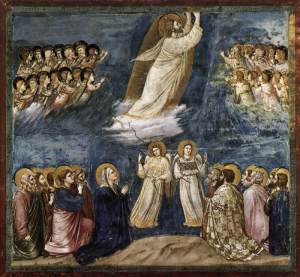
Giotto - The Ascension

Giotto, 'The Ascension'. Scrovegni Chapel, Padua.

‘The ascension of Jesus … becomes a celebration of the extraordinary fact that our humanity in all its variety, in all its vulnerability, has been taken by Jesus into the heart of the divine life …. [The] Ascension is a celebration of the glory of humanity, the unlikely possibilities of people like you and me, the eternal potential locked up in our muddled struggling lives. And a celebration too of God’s capacity, through his Holy Spirit, to reach into those parts of humanity that are so far from glorious, that are rebellious and troubled and broken, to breathe through them, to take them home, to drop them into that fire and melt them and recast them. The promise of the Father is that we as Christians will receive that level and dimension of divine life that we call ‘Holy Spirit’, so that, like Jesus, we will find that nothing human is alien to us. And the promise of the Father is that by the love of Christ spreading through us and in us, the world may be brought home to Christ, who brings it home to his Father’. – Rowan Williams, ‘A sermon by the Archbishop of Canterbury at the Ascension Day Sung Eucharist’.

Lent Reflection 3: Gerhard Forde on Jesus’ cry of desolation

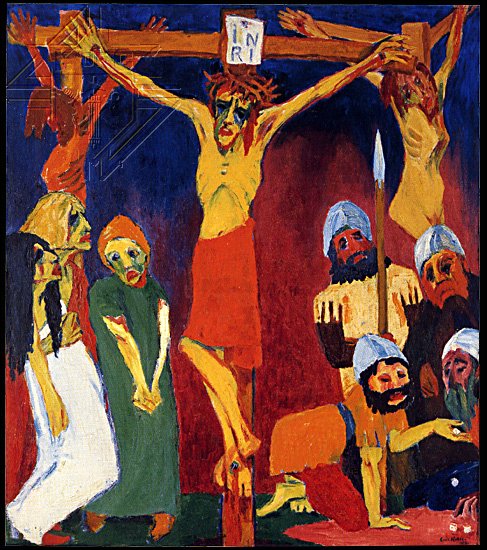
emil-nolde-crucifixion-1912‘Most everyone – conservative, orthodox, or liberal – seems to have trouble thinking the cry [of desolation] could be real. It seems as though having dispatched him to a humiliating, cruel, and agonizing death, we are surprised and shocked that he should find it all that bad. We just can not give up on making him our religious hero, desperately seeking in him the last spark of divinity, the courage, the faith, that will somehow see him through and thus enable us to avoid facing the end. There must be some way for him to transcend the fate to which we have dispatched him. It is as though by crucifying him we had merely provided the occasion for him to exercise his divinity, or as though as his murderers we hope that our crime was all a bad dream. For if he goes into the blackness of death forsaken even by God, what chance do we have?

But that is, of course, precisely the point. We have no chance. He comes to die for us, to enter into the blackness, the nothingness of death alone. Thus he goes the road of being human to the end. But it is even more than that. He took our place. He took our nature, being born under the law. He was made a curse for us, and he followed the course to death on the cross. In the end he cries out in an agony that Mark concentrates into the totally human question, “Why?” And there is no answer. Beyond the “Why?” there is only God. We are, once again, simply brought up against God. God is done to us. The true human can only wait on God here. “Father, into your hands I commend my spirit.” The human Jesus brings us to that end. This is his self-emptying (kenosis). Not that he divests himself temporarily of some divine prerogatives, but that he pours himself out into that last desolate cry.

Only by so pouring himself out can he finally be for us. Were he to hold something back or somehow to be protected from the stark reality of the death, he would be our lawgiver but not our Savior. His dying words to us would be some sort of admonition to stop our perfidy, shape up, and perhaps take him down from the cross before it all goes too far. His dying would be perhaps just the supreme example of how to die, and so the most strenuous law of all. That, one might say, is the theological way of taking him down from the cross. Only by truly dying does he put an end to us as old beings so that we can be made new. Only so do we come up against the one who calls into being that which is from that which is not’. – Gerhard O. Forde, Theology is for Proclamation (Minneapolis: Fortress Press, 1990), 112-3.

Lent Reflection 2

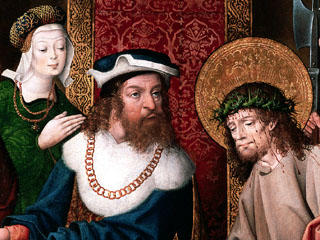
Pontius Pilate‘To the picture of the free but divinely ordained determination of the existence of Jesus to this outcome there must also be added everything that is said in the Gospels about the world around, in which the “wicked husbandmen” are given particular prominence as the decisive agents. We are not set at an indeterminate point in world history. The passion of the Son of Man is, of course, the work of the Gentiles, of Pilate and his race, but only secondarily and indirectly. Pilate has to be there, In more than one respect, especially as the responsible (although not really responsible) representative of government, he is one of the central figures in the Gospel story. Unwillingly and unwittingly he is the executor Novi Testamenti (Bengel). For by delivering Jesus to him, Israel unwittingly accomplishes-“they know not what they do” (Lk. 23:34)-His handing over to humanity outside Israel, and the Messiah of Israel becomes the Saviour of the world. Again, as Pilate delivers him to his men for execution, he is the man by whose will and work the divine act of redemption is accomplished. It is not the case however, as in some schematic presentations, that Israel and the Gentiles, Church and state, co-operated equally in accusing and condemning Jesus and destroying Him as a criminal. It is not for nothing that the one who initiates this action is the apostle Judas, and in his person the elect tribe of Judah to which Christ Himself also belonged, and in Judah (the Jews, as they are summarily described in John) the chosen and called people of Israel. It is in this sphere that we find ourselves in the passion story. We are not really in the main theatre of world history, but in the vineyard of the Lord. It is Israel, represented by its spiritual and ecclesiastical and theological leaders, but also by its vox populi, that refuses and rejects and condemns Jesus and finally delivers Him up as a blasphemer to the Gentiles, to be executed by them as a political criminal, although Pilate is quite unable and unwilling to pronounce Him guilty as such, and only causes Him to be put to death unjustly and against His better judgment. It was to this delivering up by this Israel which rejected and condemned Him, to death at the hands of this people, to this conclusion of His history that Jesus gave up Himself, and was given up by God. This is what we must always keep before us in our understanding of His passion’. – Karl Barth, Church Dogmatics IV.2 (ed. G.W. Bromiley and T.F. Torrance; trans. G.W. Bromiley; Edinburgh: T&T Clark, 1958), 260.

Lent Reflection 1

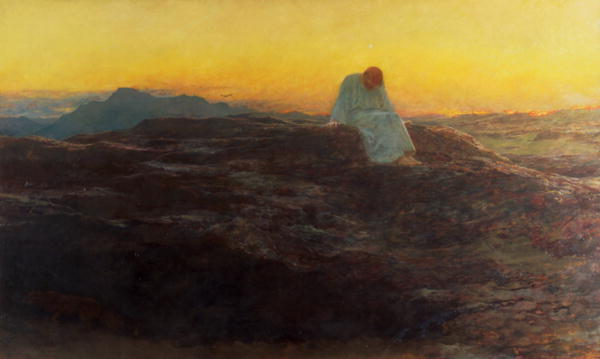
christ-in-the-wilderness-1898

Briton Riviere, 'Christ in the Wilderness' (1898)

That obedient life which resisted temptation in both desert and garden culminated in an obedient death, a death concerned with holiness’ gracious victory. In Christ, God put himself onto the gallows of public shame – he descended into hell – from where he not only exposed himself to the actual onslaught and grasp of evil until it had done its worst, but confessed the holiness that undergirds not only his own Triune life, but all life.

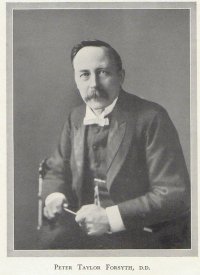
So Forsyth:

Purity is shamed by human sin. Holiness carries it as a load, and carries it to its destruction. In the great desertion Christ could not feel Himself a sinner whom God rejects. For the sinner cannot carry sin; he collapses under it. Christ felt Himself treated as the sin which God recognises and repels by His very holiness. It covered and hid Him from God. He was made sin (not sinful, as I say). The holiness of God becomes our salvation not by slackness of demand but by completeness of judgment; not because He relaxes His demand, not because He spends less condemnation on sin, lets us off or lets sin off, or lets Christ off (“spared not”); but because in Christ judgment becomes finished and final … [The Work of Christ, 160]

Thus what is at stake in the two great temptations is far more than the destiny of this one man; it is the entire telos of creation itself, and God’s existence with it. In his humanity God declares the moral order of creation sanctified along with himself – Creator and creation are now one. Christ ‘sanctifies the whole lump of humanity by sanctifying Himself as the firstfruits’ [A.B. Bruce, The Humiliation of Christ In its Physical, Ethical and Official Aspects (Edinburgh: T&T Clark, 1895), 350].

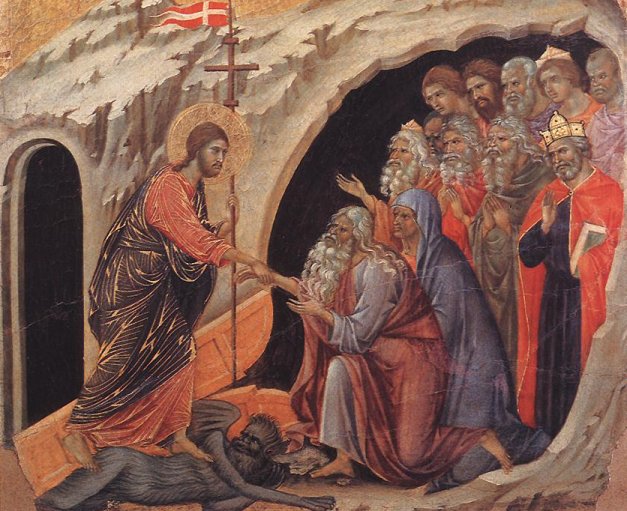
‘Adam, where are you?’

descent‘God … has gone to search for Adam, our first father, as for a lost sheep. Greatly desiring to visit those who live in darkness and in the shadow of death, He has gone to free from sorrow Adam in his bonds and Eve, captive with him … “I did not create you to be a prisoner in hell. Rise from the dead, for I am the life of the dead”‘. – ‘Ancient Homily for Holy Saturday’, ascribed to Epiphanius of Constantia, cited in Catechism of the Catholic Church (Homebush: Society of St Pauls, 1994), 165:

Forsyth on measuring sin

sin‘Sin … is not measured by a law, or a nation, or a society of any kind, but by a Person. The righteousness of God was not in a requirement, system, book, or Church, but in a Person, and sin is defined by relation to Him. He came to reveal not only God but sin. The essence of sin is exposed by the touchstone of His presence, by our attitude to Him. He makes explicit what the sinfulness of sin is; He even aggravates it. He rouses the worst as well as the best of human nature. There is nothing that human nature hates like holy God. All the world’s sin receives its sharpest expression when in contact with Christ; when, in face of His moral beauty, goodness, power, and claim, He is first ignored, then discarded, denounced, called the agent of Beelzebub, and hustled out of the world in the name of God’. – PT Forsyth, Missions in State and Church: Sermons and Addresses (London: Hodder & Stoughton, 1908), 56-7.

A Challenge Towards Hospitality

‘Where welcoming gays and lesbians in congregations translates into a denial of their calling to ministry and a dismissal of same-sex partnerships; where welcoming the homeless means a remote corner of the church building may be reserved for “their” use; where extending hospitality to children means removing them from worship and whisking them away to a dingy and cluttered room, the hospitality of Jesus’ name is not extended … [T]o name Jesus in acts of hospitality and care is to be caught up in the entire trajectory of Jesus’ ministry. To speak his name is to be drawn into the way of Jesus Christ: away of vulnerable love made real in the flesh that opens us radically to others. This is not a way of privilege, superiority, and trumpeting exclusion, but covenant, vulnerability, and difference. To welcome in the name of Jesus means that others have a claim on us.’ – David H. Jensen, Graced Vulnerability: A Theology of Childhood (Cleveland: Pilgrim Press, 2005), 132.

Forsyth on the holiness of Christ

Forsyth‘We have seen in Christ a holiness the prophet did not know. It is not less solemn, it is not less sublime, but it is more sweet, it is more deep, it is more abiding. It is not a vision, but a presence and a power. We have seen through the smoke which filled the house. We have seen the face of Him that sat upon the throne. We have seen the Cross upon the altar. We have seen that the holiness of God is the holiness of love. There is no such awful gulf fixed between the King and the creature. We too are kings in Him. The word we hear is judgment indeed, and fear, but it is more. It is our judgment laid on the Holy. It is such mercy, pity, peace, and love. It is, indeed, infinite tenderness; but it is soul tenderness, it is moral tenderness, it is atoning, redeeming tenderness. It is the tenderness of the Holy, which does not soothe but save. It is love which does not simply comfort, and it is holiness which does not simply doom. It is holy love, which judges, saves, forgives, cleanses the conscience, destroys the guilt, reorganises the race, and makes a new world from the ruins of the old’. – PT Forsyth, Missions in State and Church: Sermons and Addresses (London: Hodder & Stoughton, 1908), 233.

How do we get at the entire personality of Christ?

‘How do we get at the entire personality of Christ? The account in the Gospels is too meager for our purpose, and to many it has been made by criticism more or less unstable. With these data we are more successful in reaching the character than the person, though even the character cannot be depicted on modem, intimate, and psychological lines. The motivation, the pragmatism, cannot easily be traced, if at all. As we go into the Gospels it becomes clearer that they were not put there to depict a character, or to be a monument to a personality, but to lead up to the great crisis and victory which, for the first Christians, made Christ Christ before a Gospel was written, even in rudiment. The Gospels have a tendency. There is a movement in them. They hurry, with many a leap, to a dénouement, to a goal in which the movement “arrives,” where the deep fire flames. They make for a crisis where the center of gravity lies. And, as the interest concentrates, the treatment expands. They are more ample as they draw to the close. They spend a disproportionate space on the passion, and on all the precincts of the Cross. Their stream is never so broad as when it enters the sea and disappears. The Gospels have the work of Christ on the Cross for their goal, as the Epistles have it for their center. Redemption is their Leitmotiv.’ – P.T. Forsyth, ‘Christ’s Person and His Cross’. The Methodist Review 66 (1917), 9-10.

The Image of God

‘For [the Father] has rescued us from the dominion of darkness and brought us into the kingdom of the Son he loves, in whom we have redemption, the forgiveness of sins. The Son is the image of the invisible God, the firstborn over all creation. For in him all things were created: things in heaven and on earth, visible and invisible, whether thrones or powers or rulers or authorities; all things have been created through him and for him. He is before all things, and in him all things hold together. And he is the head of the body, the church; he is the beginning and the firstborn from among the dead, so that in everything he might have the supremacy’. – St Paul, Colossians 1:13-18.

Ray Anderson on the ‘difference’ Christ makes

‘The kenotic community as an imperative which the Incarnation demands permits no distinction between the Christian and the non-Christian which resides intrinsically in the Christian (or the church) as such. When one ‘defines’ the church or the Christian, then, the distinctive must be solely in the ‘difference’ which has its source in the historical transcendence of God. The ‘difference’ is Christ, not that redemption is set over against creation, but so that man is liberated to participate in Christ’s ek-static fulfillment of all creaturehood through the life of the Spirit. The ‘difference’ is the centre (Christ) and not in distinctions drawn between men, or between the church and the world as entities’. – Ray S. Anderson, ‘Living in the World’, in Ray S. Anderson (ed.)., Theological Foundations for Ministry: Selected Readings for a Theology of the Church in Ministry. Edinburgh/Grand Rapids: T. & T. Clark/Wm. B. Eerdmans, 1979, 591.

Marie Magdalen’s complaint at Christ’s death

Sith my life from life is parted:
Death come take thy portion.
Who survives, when life is murdred,
Lives by meere extortion.
All that live, and not in God:
Couch their life in deaths abod.

Seely starres must needes leave shining,
When the sunne is shaddowed.
Borrowed streames refraine their running,
When head springs are hindered.
One that lives by others breath,
Dieth also by his death.

O true life, sith thou hast left me,
Mortall life is tedious.
Death it is to live without thee,
Death, of all most odious.
Turne againe or take me to thee,
Let me die or live thou in mee.

Where the truth once was, and is not,
Shaddowes are but vanitie:
Shewing want, that helpe they cannot:
Signes, not salves of miserie.
Paynted meate no hunger feedes,
Dying life each death exceedes.

With my love, my life was nestled
In the sonne of happinesse:
From my love, my life is wrested
To a world of heavinesse.
O, let love my life remove,
Sith I live not where I love.

O my soule, what did unloose thee
From thy sweete captivitie?
God, not I, did still possesse thee:
His, not mine, thy libertie.
O, too happie thrall thou wart,
When thy prison, was his hart.

Spitefull speare, that breakst this prison,
Seate of all felicitie,
Working thus, with double treason,
Loves and lifes deliverie:
Though my life thou drav’st away,
Maugre thee my love shall stay.

Robert Southwell (1561?-1595)

Image: ‘Mary Magdalene’, by Anthony Frederick Augustus Sandys; ca. 1860

On Bastard Philosophies, Stolen Generations, and the Forgiveness of Sins

Writing of Bacon, Locke and Scottish common sense philosophy (uncritically lumped together), Nevin writes: ‘The general character of this bastard philosophy is, that it affects to measure all things, both on earth and in heaven, by the categories of the common abstract understanding, as it stands related to simply to the world of time and sense’. – John W. Nevin, Human Freedom and a Plea for Philosophy: Two Essays (Mercersburg: P. A. Rice, 1850), 42. Cited in Alan P. F. Sell, Testimony and Tradition: Studies in Reformed and Dissenting Thought (Aldershot: Ashgate, 2005), 173.

This leads me to draw attention to a recent reflection by Aussie theologian, Frank Rees, on what it means for the new democratically-elected Australian government to say sorry for past and not-so-past sins, and why ‘sorry is not the hardest word: indeed, it will be a word of life’. Frank’s post is a timely reminder of how ‘bastard philosophies’ don’t bring life, but only death; in this case that death bred of fear, misunderstanding (of the issues, of people, and of the gospel itself) and mistrust, the wounds of which will probably take decades, if not centuries, to heal.

In a related post, Rory suggests that the apology to Australia’s stolen generation should be made on our behalf by the Governor General rather than by the Prime Minister. He writes: ‘He is the head of government in Australia, and he holds a position that is above party politics. Whatever you think about the virtues or otherwise of the current government, surely addressing this part of our history is bigger than who won the last election. I can only think that an apology coming from the GG would better speak for the nation, and it would allow the apology to loose itself from any particular party’.

I think I like this (Are there any good reasons – constitutional or otherwise – for why this cannot, or should not, happen?). But regardless of from whose vicarious lips the apology comes, one hopes that it may also model and encourage the way of life and a softening of heart (and a less bastardly-informed philosophy) for other people, governments and organisations. One hopes … [I confess to having no such confidence in human nature of itself to bring about such a change of heart. This too must be a work of the Spirit].

Frank’s and Rory’s posts reminded me of Stevan Weine’s book, When History Is a Nightmare: Lives and Memories of Ethnic Cleansing in Bosnia-Herzegovina, a volume which includes some powerful documentary of those closely affected by the tragedies attending the recent conflict in the Balkans. One such testimony witnesses:

I remember Bosnia as a beautiful and peaceful country. We all lived together. Before the war, it was unnecessary to know if your neighbor was Serb, Croat, Muslim or Jew. We looked only at what kind of person you were. We were all friends. But now I think it is like a kind of earthquake. A huge catastrophe. After this war nothing will be the same. People will live, but I think they will not live together. they will not share the same bread like before. Maybe they will be neighbors, but I think the close relationship will not exist any more. Because the Bosnian people, especially the Muslim people, had a bad experience, partly as a result of our attitude. (p. 13)

In his brilliant treatment on forgiveness, The Cleansing of the Memories, Geoffrey Bingham reminds us that ‘memory has always been a problem with mankind. It may seem a curious thing that man can be troubled by his past, as also delighted by it. Some memories bring a renewal of shock and trauma when they come unbidden’. Bingham proceeds to speak of ‘God’s holy amnesia’, of ‘the Divine forgetfulness’ or ‘the Divine non–remembering’. ‘God refuses to remember our sins! If then God refuses to remember our sins, why should we choose remember them?’ While our consciences never let anyone off the hook, Bingham writes, ‘God–through Christ–has so purged our sins, that they have been worked out to exhaustion and extinction, and all their power of guilt, penalty and pollution has been erased. In other words there are–effectively –no sins to remember! God has not simply ignored our sins. He has destroyed them, forever! … Of course–from time to time–we will remember the sins we once did, but we must not make them back into substantial things. God has denuded them of substance, of guilt, power and pollution. If they come to us in memory, then in faith in the Cross we should say, ‘Whilst you represent the sins I committed, you have no substance. God has emptied you, purified you, and taken away the guilt which accompanied you. You are wraiths, ghosts of the past come back to haunt me via the accusations of Satan and his hosts, but you have no substance’. [See The End of Memory: Remembering Rightly in a Violent World by Miroslav Volf, and my post here on Redeeming Bitterness – An Interview with Miroslav Volf].

I have just finished reading Wilhelm Herrmann’s Systematic Theology (Dogmatik), which I recommend. At one point, he notes that ‘It is the realization of the impossibility of friendship with God that creates in us the religious consciousness of guilt. Obviously we cannot be quit of this burden of guilt by any effort for our own betterment; for the sense of guilt before God will paralyse our courage to start a new life’. To all who have tried to be quit of the burden of guilt by their own efforts, Herrmann’s words sound out as a prophetic rebuke and caution against the futility and arrogance of such resolve. This is one of the reasons why in the final chapter of his The Wondrous Cross (reviewed here), Steve Holmes suggests that the message of penal substitution remains an important one to teach us about God’s love, about forgiveness and about justice – for both victims and perpetrators. He writes:

Penal substitution will, of course, teach us something about justice and guilt. It will teach us first that justice cannot and will not ever be set aside. Not that there can never be forgiveness – of course not – the point of the story is precisely that there can be, and is: while crimes cannot be forgotten, yet at the same time they must also be forgiven. Cases of child abuse, where the abuser has used shaming mechanisms so successfully that none of his victims ever speak; cases of corruption, where the politician has cynically sold favours and hidden her misdeeds well enough never to be discovered; cases of war crimes, where the military officer has callously committed certain deeds, feeling secure in the knowledge that they will not come to light: these are the types of cases and situations where penal substitution becomes an important story to tell.

For the victims in such situations, the story of penal substitution holds the promise that there is justice in this world, even for the worst crimes, or the best-hidden atrocities …

For the perpetrators in these situations, the story of penal substitution holds out the invitation to stop trying to escape their crimes by their own efforts, and to find, if they dare to face up with honesty and repentance to what they have done, full and free forgiveness in Christ.

In a recent paper I heard, Alan Torrance bore witness to the truth that it is only by virtue of Christ’s vicarious humanity that we discover the two forms of liberation that are intrinsic to atonement: first, liberation as victimisers for our sin of victimisation; and second, liberation as victims from the bitterness and hatred that attend the sense of irreversible injustice, the hurt of damaged lives, irretrievably lost opportunities, and all the other evils that result from sin. There is liberation here, he said, because precisely at the point where we cannot forgive our enemies the Gospel suggests that our sole representative, the sole priest of our confession, does what we cannot do – he stands in and forgives our victimisers for us and in our place as the One on behalf of the many – and then invites us to participate in the very forgiveness he has realised vicariously on our behalf. On these grounds we are not only permitted to forgive but obliged and indeed commanded to forgive others. Alan said, ‘Where we are not entitled to forgive, the crucified Rabbi is. And where we are unable to forgive, we are given to participate in his once-and-for-all forgiveness and to live our lives in that light and from that centre – not least in the political realm’. He cited his dad (JB Torrance), who defined worship as ‘the gift of participating by the Spirit in the Son’s communion with the Father’. The consequence of any ethic, therefore, that warrants the name ‘Christian’ must be conceived in parallel terms, namely as the gift of participating by the Spirit in the incarnate Son’s communion with the Father. ‘Forgiveness’, Alan stressed, ‘is the gift of participating in a triune event of forgiveness. In an act of forgiveness, the Father sends the Son, who, by the Spirit, forgives as God but also, by the Spirit, as the eschatos Adam on behalf of humanity. The mandate to forgive must be understood in this light.’

The ‘apology’ that will be made when the federal government next sits is ultimately possible because in Christ, God has already confessed humanity’s sins and forgiven all parties. To say ‘sorry’ is to take up Christ’s invitation to us to ‘participate in that forgiveness that he has realised vicariously on our behalf’. It is, as Alan presses, to participate in a triune event of forgiveness in which the Father sends the Son, who, by the Spirit, forgives. And, it is to participate by the Spirit, in the action of the last Adam on behalf of humanity, to the joy of the Father. Whether or not the Australian Government (or Governor-General), those of the Stolen Generation (and their families/nations), and all Aussies (even Faris QC) know that this is what it means to say ‘Sorry’ and ‘Receive the forgiveness of sins’ does not undermine the reality that the very human actions of confession and forgiveness are at the heart of what it means to be imago dei, and to participate in the ministry of the Triune God in our maimed and besmirched world.

‘For he himself is our peace, who has made us both one and has broken down in his flesh the dividing wall of hostility’ (Eph 2:14).

‘See to it’, therefore, ‘that no one takes you captive by philosophy and empty deceit, according to human tradition, according to the elemental spirits of the world, and not according to Christ. For in him the whole fullness of deity dwells bodily, and you have been filled in him, who is the head of all rule and authority. In him also you were circumcised with a circumcision made without hands, by putting off the body of the flesh, by the circumcision of Christ, having been buried with him in baptism, in which you were also raised with him through faith in the powerful working of God, who raised him from the dead. And you, who were dead in your trespasses and the uncircumcision of your flesh, God made alive together with him, having forgiven us all our trespasses, by canceling the record of debt that stood against us with its legal demands. This he set aside, nailing it to the cross. He disarmed the rulers and authorities and put them to open shame, by triumphing over them in him’. (Col 2:8-15)

Colin Gunton’s ‘The Barth Lectures’: A Review

Colin E. Gunton, The Barth Lectures (transcribed and edited by Paul H. Brazier; T&T Clark, London/New York, 2007). xxiv + 285 pages. ISBN: 9780567031402.

While he fruitfully enjoyed a life-long engagement with and formation by Karl Barth’s work, produced numerous articles on various aspects of such, and lectured on Barth most years he taught at King’s College London, Colin Gunton never fulfilled his ambition to pen a monograph devoted solely to this his favourite theologian. Had he done so, these lectures (recorded and transcribed almost verbatim by Paul Brazier, complete with charts, diagrams, live-questions and Gunton’s responses) would have served as the basis.

Chapters 1-3 attend to the intellectual, historical and theological background to Barth’s thinking. Beginning with a focus on Enlightenment philosophy as it finds voice in Kant, Schleiermacher and Hegel – all three of whom ‘identified Christianity too closely with modern culture’ (p. 17) – Gunton then turns to Barth’s early theological formation in the nineteenth-century liberalism of Harnack and Herrmann, as well as to some other voices and ideas that impinged on Barth’s theological development – Johann Christoph Blumhardt (who also influenced Moltmann), Albert Schweitzer and Franz Overbeck through whom eschatology was re-confirmed on the theological radar. Barth’s engagement with existentialism (Kierkegaardian and other) and theologies of ‘religion’, ‘crisis’ and ‘dialectics’ are introduced in the second and third lectures, and re-appear subsequently throughout. Certainly, for the Swiss theologian, ‘no road to the eternal world has ever existed except the road of negation’ (p. 33). Thus when Gunton later comes to unpack something of the charge concerning Barth’s ‘irrationality’ through the continuing influence of Der Römerbrief, empiricism, and Barth’s ‘assertive style’, the United Reformed Church minister notes:

The influence of empiricism, especially on the minds of English and American theologians, cannot be dismissed. The English, or to be more pertinent, the Anglican theological mind is shaped by a philosophical tradition that does not find Barth’s approach to theology easy to understand let alone agree with … Part of our intellectual tradition makes it hard for us to understand – particularly an Anglican tradition. Anglicans on the whole like things to be nice and middle way, the via media. And there is not much of the middle way in Karl Barth! … Barth’s assertive style does make it difficult for mild-mannered establishment Anglicans to cope with. (p. 66)

Whether critiquing Augustine, Calvin, Kant, the ‘Absolutely Pagan’ Hegel (p. 17), or the ‘great opponent’ Schleiermacher (p. 15), Gunton repeatedly identifies that the crucial question for the author of the groundbreaking Der Römerbrief remains ‘how much of your intellectual method hangs on something foreign to Christianity?’ (p. 42; cf. pp. 52-3). To this end, Gunton also devotes an entire lecture (pp. 53-63) to Barth’s 1931 work on Anselm, Fides quaerens intellectum, and to the Archbishop’s understanding of the relationship between ‘proof’, ‘reason’ and ‘faith’. He later writes: ‘Barth is a post-Reformation thinker with the rallying cry, by scripture alone and by faith alone! Barth found in the Reformation tradition a conception of theology based on a view of God that is linked with human salvation. The problem for Barth with the Scholastic tradition is that they begin with a rational view of God – a rational idea of God abstracted from human salvation. Barth begins with scripture because the God of scripture is about salvation not philosophical argument’ (p. 69). And on a comparison with Schleiermacher: ‘the problem with beginning with religion is that it is not theological, it can be, it can lead into theology, but in essence it is not: religion is an experiential concept, not a theological concept. Barth wants a theology that is theological right from the very outset. Barth considers that Roman Catholics and Protestants such as Schleiermacher are wrong in thinking that there can be a non-theological basis for theology. Barth is a theologian you see, to the fingernails’ (p. 69).

From Chapter Four onwards, Gunton turns to Barth’s Church Dogmatics, acutely aware that ‘there is nothing as boring as résumés of Barth’s Dogmatics‘ and that ‘the way to get into Barth is to select and to read – read him, there is no substitute!’ (p. 71). Over the next 190 pages, this is precisely what Gunton masterfully helps us do; whether on Barth’s theological prolegomena, his witness to the three-fold Word, trinity, the doctrine of God proper, election, christology, soteriology, ethics and creation, we are all along driven by the only thing of theological interest for Barth, the question ‘Who is the God who makes himself known in Scripture?’ (p. 77). ‘When Barth is at his best’, Gunton writes, ‘he looks at the biblical evidence in detail; when he is weak he tends to evade it’ (p. 119)

A few tastes from ‘5. Barth on the Trinity and the Personal God’:

Barth is anti-foundationalist … God’s revelation is self-grounded; it does not have to appeal to anything else beyond itself. Because it is revelation through itself, not in relation to something else, because it is self-contained, lordship means freedom. This is characteristically Barthian: a characteristically Barthian phrase. Lordship means freedom – freedom for God, absolutely central for Barth’s theology. (p. 78)

The basis of all theology lies in the fact that revelation does happen … This revelation is Christological: Jesus Christ is God’s self-unveiling. The Father cannot be unveiled, but the Father reveals through the Son. This is imparted through the Holy Spirit. A little artificial I actually think, but you can see what he is actually trying to do: he is trying to show that inherent in the structure of God’s presence in Jesus Christ is a Trinitarian view of God … The point here is that in Jesus Christ we see the limits, the possibilities of the knowability of God … So Barth in a way is still retaining this dialectical structure: veiling-unveiling, knowability -unknowability, revelation-hiddenness … In the end you have only got paradox … God preserves his privacy. (pp. 79-80)

The logic is that if God is like this in time then because he doesn’t con us, so to speak, he doesn’t pull the wool over our eyes, because he is a revealing God, then that is what God is. So don’t think that the God we meet in Jesus is one God and that the God of eternity is entirely different from Jesus. The God you meet in Jesus is no different from the God you might meet if you were able to have a direct view of eternity. (p. 83)

Barth is against all mathematics in theology – he is against theories and ideas propounded down the centuries by theologians whereby examples are given of the Trinity, where three things make one; Augustine was often doing this, it is pure analogy or an attempt at analogy, which generally fails to offer any theological elucidation … I don’t like Augustine. I think he is the fountainhead of our troubles. (pp. 84, 96)

[Barth] is often accused of modalism, and I think he is near it … I think he is on a bit of a knife-edge myself, but then all theology is on a knife-edge, it is such a difficult discipline. [Barth] wants to do what the Cappadocians did, and Barth thinks he has done it better with this term – ‘modes of being’. Well, I don’t agree with him, but that is the way he puts it. (pp. 88-9)

Theology is our interpretation of God’s self-interpretation. God interprets himself to us, that is what revelation is. Our response is to interpret this faithfully, or as Jüngel would put it, responsibly … We move from faith to understanding. We move from a grateful acceptance of revelation to an attempt to understand as best we may what that revelation means for God and ourselves. And the understanding consists in the fact that we can talk of God as Father, Son and Spirit. It is so obvious that we should, isn’t it! We might talk of God as a tyrannical monad, but the fact that we can talk of God as Father, Son and Spirit is, so to speak, a demonstration after the event that we are making sense, that God is making sense, our theology makes sense. (p. 91)

And from ‘8. Ethics: Church Dogmatics Chapter VIII:

I do think that there is a problem of abstractness because there isn’t really in Barth, I think (and I say this tentatively), I think that there isn’t really in Barth an account of how this relationship between God and the moral agent takes shape. There is not much of a principle of formation. How are people formed so as to take one ethical direction rather than another? Barth is relatively weak in ecclesiology; that is, some account of how ethics are shaped by the community of belief. He is so anxious not to tie God down; that is always his anxiety, not to tie God down. (p. 133)

Throughout, Gunton is rousing his 30-40 mostly MA and PhD students (although the lectures were intended for undergraduates and so leave considerable ground un-traversed and engage minimally with secondary literature) to ‘read as much of the man himself’ not least because ‘the people that write about him are much more boring than he is’ (p. 9; cf. p. 39). In a sense, this is one book to ‘listen to’ more than to ‘read’. At times, it’s a bit like the difference between a live album and a studio version. Not all the notes are spot on, but the energy – filled with a depth of theological and pastoral insight that betray years of wrestling with the things that matter – is all there.

Such wrestling means that whether expounding a key motif in Barth’s theology or fielding questions, Gunton reveals not only a deep indebtedness to Barth’s work, but also points of divergence. He is upfront in the first lecture: ‘Not everyone buys into Barth … I don’t, all the way along the line, as I get older I get more and more dissatisfied with the details of his working out of the faith … over the years I think I have developed a reasonable view of this great man who is thoroughly exciting and particularly, I can guarantee, if you do this course, that you will be a better theologian by the third year, whether or not you agree with him – he is a great man to learn to think theologically with’ (p. 10; see the prefaces to his Theology Through the Theologians and to the second edition of The Promise of Trinitarian Theology). Clearly, Gunton is no clone of Barth. Though mostly unnamed, he draws upon Coleridge, Owen, Zizioulas and Polanyi as allies in order to attain a measure of distance from Barth’s theology (and that of Barth’s student Moltmann), notably on creation, trinitarian personhood (Gunton prefers the Cappadocians), natural revelation, Jesus’ humanity, Christ’s priesthood, the Word’s action as mediator of creation, ecclesiology, and an over-realised eschatology, among other things (see pp. 52, 74, 82, 88-90, 96, 133, 142, 148, 170-1, 186, 200, 212, 227, 236, 250, 253-4, passim). Not alone here, Gunton reserves his strongest criticisms for what he contends is Barth’s weak pneumatology (for which he blames Augustine and the filioque): there is ‘not enough of the Spirit accompanying and empowering Jesus at different stages of his ministry’ (p. 200). Again: ‘the second person of the Trinity is made to do a bit more than he does in Scripture’ (p. 212). Gunton is always cautious and respectful however: Barth ‘never really forgets anything, he is too good a theologian for that. And when you are criticizing Barth it is only a question of where he puts a weight; he never forgets anything, he is too good a man for that’ (p. 171). Even on the Spirit, Gunton suggests that he can only be critical here because of what he has learnt from Barth already: ‘That’s the great thing about Barth: he enables you to do other things that aren’t just Barth but yet are empowered by him. Yes, that’s his greatness’ (p. 200).

While the reformed theologian is ‘too-multi-layered a thinker to have one leading idea’ if there is one, Gunton suggests it is that of covenant: ‘that from eternity God covenants to be the God who elects human beings into relation with himself’ (p. 149), that from eternity the triune God is oriented towards us. Gunton’s chapter on Barth’s revision of God’s election in CD II/2 is an astounding example of his adroitness and élan as a theological educator. Not many teachers could summarise so sufficiently and with such economy (just 12 pages!) what for Barth is the root of all things, ‘creation, atonement, all’ (p. 115), that is, election. Gunton concludes by (over?)-suggesting that Barth’s effort was ‘a huge improvement in the crude determinism of the Augustinian tradition, which did not represent a gracious God. The Augustinian doctrine replaces grace with gratuity: God gratuitously chooses group A and not group B – this is not the God who seeks out the lost [even Judas] and does not reject them’ (p. 121).

This volume is significantly more than merely a course on the theology of the twentieth century’s superlative theologian. It is also a reminder that to read Barth attentively is to be introduced to a broader dogmatic and philosophical tradition. Moreover, it is to be led to do so by one of Britain’s ablest pedagogues. A foreword by Christoph Schwöbel and a warm introduction by Steve Holmes prepare us for one of the freshest introductions to Barth available. Again, we are placed in Professor Gunton’s debt.

Kenoticism

‘And thus we shall have to posit the incarnation itself precisely in the fact that he, the eternal Son of God, the second person of the deity, gave himself over into the form of human limitation, and thereby to the limits of a spatio-temporal existence, under the conditions of a human development, in the bounds of an historical concrete being, in order to live in and through our nature the life of our race in the fullest sense of the word, without on that account ceasing to be God. Only so does there occur an actual entrance into humanity, an actual becoming-one with it, a becoming-man of God; and only so does there result that historical person of the mediator which we know to be the God-man’. – Gottfried Thomasius, ‘Christ’s Person and Work. Part II: The Person of the Mediator’, in God and Incarnation in Mid-Nineteenth Century German Theology (ed. Claude Welch; A Library of Protestant Thought; New York: Oxford University Press, 1965), 48.

O where, o where have all the good kenoticists gone? Christology needs them now more than ever.