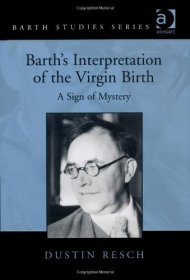
 Barth’s Interpretation of the Virgin Birth: A Sign of Mystery, by Dustin Resch. Farnham/Burlington: Ashgate, 2012. ix + 218pp; ISBN 978 1 4094 4117.
In Barth’s Interpretation of the Virgin Birth, Dustin Resch (Assistant Professor of Theology and Dean of the Seminary at Briercrest College and Seminary) offers us a clearly written introductory survey to Barth’s presentation of the doctrine of the virgin birth, unencumbered with detail and critical interaction.
With a view to setting Barth’s contribution in its theological context, the study begins, appropriately, with a brief overview of the doctrine in the Western tradition. Here, particular attention is given to treatments by Irenaeus, Augustine, Aquinas, Luther, Calvin, Schleiermacher, Strauss and Brunner, and to the ways that the pre-Reformation articulations of the tradition tended to evaluate the doctrine in terms of its ‘fittingness’ with the broader themes of christology, pneumatology and original sin. This emphasis, Resch argues, ‘slipped into the background during the Reformation, which aimed to chasten what the Reformers took to be undue speculation, particularly about Mary’ (p. 36), only to emerge again during the modern period, albeit in ways that argued for its fundamental un-fitness in the courtroom of critical biblical scholarship and modern biology, and therefore without any significant theological value. Resch proceeds to argue that Barth takes up the Augustinian heritage of the virgin birth, but revises it such that Barth believes he escapes the criticisms of its modern despisers. The success or otherwise of Barth’s efforts here are left largely untested by Resch.
In the second chapter, Resch offers an exposition of the methodological and exegetical features of Barth’s development of the doctrine from his early work at Göttingen and Münster up to the introductory volume of Die Kirkliche Dogmatik. Locating Barth’s unembarrassed claims on the virgin conception vis-à-vis the Augustinian, Schleiermacherian, Harnackian and modern Roman Catholic traditions, and as a dogmatic bookend to Jesus’ miraculous resurrection, Resch convincingly rehearses throughout the ways in which, for Barth (post-Münster), the virgin birth functions as a fitting theological ‘sign’ (Zeichen) of the mystery of the incarnation – rather than making any claims about the constitutive significance of Jesus’ person as the Logos incarnate or about biology and the wonders of parthenogenesis – which directs the church to a number of its basic dogmatic claims. As P.T. Forsyth – the so-called ‘Barthian before Barth’ (a great compliment to Barth!) – had earlier shown, the virgin birth is really a theological rather than a critical question. It is not a necessity created by the integrity and authority of Scripture per se but a necessity created (if at all) by the solidarity of the gospel, and by the requirements of grace. In terms of epistemology, for example, it recalls that ‘the beginning of our knowledge of God … is not a beginning which we can make with God. It can be only the beginning which God has made with us’ (CD II/1, 190). For Barth, the Bible’s presentation of the miracle of the virgin birth has ‘no ontic but [only] noetic significance’ (Credo, p. 69), its concern being the mystery of God’s free grace. Hence the Bible evidences a complete lack of concern with scientific explanation and is wholly concerned with the question of the sheer mystery and grace of revelation, a mystery and grace which announce, among other things, the foundationless nature of all our presuppositions about, and our semi-Pelagian gropings for, God. It is, literally, to begin again at the beginning; i.e., with God’s self-giving in Jesus Christ. Ontology, in other words, for Barth, must always precede epistemology.
Notwithstanding the comments made above vis-à-vis Scripture, Resch suitably notes, however, that Barth’s treatment of the virgin birth as a sign relating to the mystery of the incarnation rather than as a constitutive element of Christ’s person was one that was ‘derived exegetically and was not a theological decision made simply to avoid the criticism of modern theology’ (p. 62). So Resch:
For Barth, the criteria by which the church should make its decision to adopt the biblical attestation of the virgin birth into its understanding of the biblical message should be the same as the criteria by which the New Testament authors themselves decided to incorporate the virgin birth into their witness. In both cases, questions of the age and source value of the tradition were not conclusive. Instead, the doctrine was accepted because of its ‘fit’ with the central elements of Christian faith. (pp. 73–74)
 This theological reading of the Gospel texts, as Resch notes in a number of places, enabled Barth to avoid many of the charges often laid at Augustinian interpretations of the doctrine, and that while guarding the mystery of Christ’s person from being collapsed into a general truth or principal. That said, Resch is also concerned to map how, for Barth, the virgin birth functions as a ‘paradigm’ through which to understand not only the shape of God’s work upon human beings but also something about the corresponding posture of faith’s being-before-God, features borne out well by Resch not only in terms of Barth’s treatment of Mary but also, and perhaps especially, through his attendance to the largely ignored figure of Joseph who ‘clearly has no capacity for God, but rather is elected to serve Christ in the world as his guardian. Understood this way’, Resch notes in a later chapter, ‘Joseph becomes an excellent metaphor for Barth’s view of the church’ (p. 175). In Barth’s own words:
Though I am very averse to the development of ‘Mariology’, I am very inclined to ‘Josephology’, because in my eyes Joseph has played a role with respect to Christ which the church should adopt. I know that the Roman Church prefers to compare its role with the glorious role of Mary. It brings the Christian message to the world in the same way in which Mary has given us Christ. But the comparison deceives. The church cannot give birth to the Redeemer; but it can and must serve him with humble and discrete enthusiasm. And that was exactly the role that Joseph played, who always held himself in the background and left all fame to Jesus. Exactly that should be the role of the church, if we want the world to rediscover the glory of the Word of God. (‘Über die Annäherung der Kirchen: Ein Gesprach zwischen Karl Barth und Tanneguy de Quénétain’, Junge Kirche: protestantische Monatshefte 24 (1963): 309)
Chapter Three is concerned to examine Barth’s doctrine of the virgin birth in relation to his presentation of Christ’s sinless humanity and original sin in the Church Dogmatics. In particular, Resch maps the ways that, for Barth, Christ’s birth through the virgin Mary attests to both the ‘Yes’ of God’s grace to humanity and, because of the absence of a human father, to God’s ‘No’ of judgment against sinful human beings: ‘The natus ex Maria virgine unambiguously negates the possibility of viewing revelation and reconciliation as a possibility latent within human beings by describing the mystery of the sovereign act of God in the incarnation. It does this “by an express and extremely concrete negative”. This negative – symbolized by the removal of the man – indicates the limitation of human participation in the incarnation’ (p. 85).
In Chapter Four, Resch brings Jesus’ conception into conversation with Barth’s pneumatology, noting how the former, which remains sui generis, functions, for Barth, as a pattern for, and a heuristic tool – ‘a distinctive mark’ – to interpret, the work of the Spirit in the lives of those who ‘perceive and accept and receive [Jesus Christ] as the Reconciler of the world and therefore as their Reconciler’ (CD IV/1, 148). It is argued that, just as Mary was enabled by the Spirit to conceive Christ within her womb, so too are Christians enabled by the same Spirit to receive the revelation and reconciliation of God.
Mary’s role in Barth’s theology is given fuller attention in the final chapter where Resch helpfully outlines how Barth’s treatment of Mary’s ‘readiness’ (Bereitschaft) before God informs both his understanding of the relationship between divine grace and human agency, and his evaluation of Roman Catholic Mariology, noting the ways that Barth’s acceptance of the virgin birth happens by the same criteria by which he rejects Mariology; namely, with its fit with the mystery of the incarnation. ‘Barth’s main problem with Mariology’, Resch avers, ‘is simply that in it Mary is treated in relative independence from Christ. While never completely severed from Christ, Mary has come to have her own special dignity, merit and ministry. In contrast with the Councils of Ephesus and Chalcedon, and particularly the New Testament, according to Barth, Roman Catholic Mariology fails to use the term Theotokos as an exclusively Christological title … The Catholic Mary is, for Barth, the symbolic portrayal of the philosophical concept of the analogia entis’ (pp. 168–69, 177). Conversely, Barth will insist that human readiness for God – and God’s readiness for humanity – is found in, and is synonymous with, Christ alone.
Throughout the essay, Resch successfully illustrates ways that Barth’s thinking on the virgin birth remains both broadly Augustinian insofar as the doctrine relates to that of original sin, and radically revisionist insofar as Barth departs from Augustine’s interpretation of the virgin birth as that which mysteriously preserves Christ from the tainting effects of concupiscence and original sin and conceives it instead as a symbol of the dialectic that the incarnation itself announces – the futility of all human willing, acting and striving for the grace of God, and the divine determination and gracious freedom to call into existence things that do not exist (Rom 4.17).
Readers (and I suspect Resch himself too) may well be left asking, however, whether Resch has bought too uncritically into Barth’s Protestant critique of Mariology, and whether his heavy reliance on a somewhat limited scope of Barth’s work (mainly The Great Promise and CD I/2) leaves his presentation less satisfying than it might be. More frustrating, however, is the exhausting repetition throughout the book. Where the reader may be hoping to find a new vista around the next corner, or an idea further developed in conversation with other themes pertaining to the subject (e.g., the doctrines of election and creation, the relationship between ‘sign’ and ‘ontology’ and between this particular ‘sign’ and other ‘signs’, the relationship between the objective basis and subjective experience of faith’s participation in the faithfulness of Christ as the vicarious human given by God, discipleship and prayer, how Mary’s and Joseph’s fittingness relates to that of other characters throughout the Bible, etc. are all left too uncooked) or with at least some significant secondary literature, the reader discovers instead that he is simply back where he has been numerous times before, and little the wiser for the effort. I suspect, nonetheless, that we are not here dealing with a case of an author who does not know where the real questions lie – indeed, he identifies some very worthwhile trajectories for further thought in his conclusion; Barth’s rather one-dimensional presentation of Mary divorced from her existential situation, for example – but perhaps with a matter of confidence and/or energy to traverse there within the bounds of this project. One hopes that in future work, he builds on the reliable foundation laid here.
[In due course, a version of this review will appear in The Journal of Theological Studies]














 jasongoroncy.com