Book Review

Steve Hely on book reviewers

Most writers, from time to time, elect to set aside a little ink in order to get a few things off their chest. And it’s not uncommon for writers – and here I’m thinking of the likes of Charlotte Brontë, Dorothy Sayers and Kurt Vonnegut, to name just a few – to blow off a little steam about book reviewers (Brontë, for example, referred to them as ‘Astrologers, Chaldeans, and Soothsayers’). But in his very unextraordinary book, How I Became a Famous Novelist, Steve Hely takes the most sustained and pathetic shot at book reviewers that I’ve encountered:

I try not to hate anybody. ‘Hate is a four-letter word,’ like the bumper sticker says. But I hate book reviewers.

Book reviewers are the most despicable, loathsome order of swine that ever rooted about the earth. They are sniveling, revolting creatures who feed their own appetites for bile by gnawing apart other people’s work. They are human garbage. They all deserve to be struck down by awful diseases described in the most obscure dermatology journals.

Book reviewers live in tiny studios that stink of mothballs and rotting paper. Their breath reeks of stale coffee. From time to time they put on too-tight shirts and pants with buckles and shuffle out of their lairs to shove heaping mayonnaise-laden sandwiches into their faces, which are worn in to permanent snarls. Then they go back to their computers and with fat stubby fingers they hammer out ‘reviews.’ Periodically they are halted as they burst into porcine squeals, gleefully rejoicing in their cruelty.

Even when being ‘kindly,’ book reviewers reveal their true nature as condescending jerks. ‘We look forward to hearing more from the author,’ a book reviewer might say. The prissy tones sound like a second-grade piano teacher, offering you a piece of years-old strawberry hard candy and telling you to practice more.

But a bad book review is just disgusting.

Ask yourself: of all the jobs available to literate people, what monster chooses the job of ‘telling people how bad different books are’? What twisted fetishist chooses such a life? (pp. 146–47)

Certainly, it’s difficult to take this vitriol seriously. Perhaps it’s tongue in cheek, or satire. Yes, many reviewers are little more than poorly paid hookers for publishing companies or newspapers. Yes, many reviewers betray little evidence of actually having read the book under consideration, or of knowing its location in and contribution to the wider canon. Yes, many reviewers do appear to be ‘condescending jerks’. But Hely seems to have some seriously unresolved issues here, perhaps the most serious of all is that he appears to be entirely unfamiliar with John Updike who, as far as I am aware, never in all his days shoved a heaping mayonnaise-laden sandwich into his face.

The reviewer as gate-keeper

By and large, I enjoy reading and writing book reviews. And I’ve mentioned before about my chat with a friend about the purpose of book reviews wherein he offered the following description of the reviewer’s task:

To help the writers know they are understood and appreciated without too much attention to their mistakes, to help the readers know whether or not it is for them, to identify one or two critical issues worth discussing along the way, and to ease the conscience of the reviewer about all the free books s/he has acquired through this means, not all of which were ever read.

I still like my friend’s ‘reviewer job description’ and, as a rule, it represents what I hope to do when I’m reviewing a book. During a recent binge with Updike (now there’s a reviewer!), my antennae were re-alerted to my responsibility as a reviewer to engage critically with the text/s under my surveillance, to dwell longer – though not for too long – in those somewhat less salutary spaces (whether they be factual or editorial) within the book’s covers, particularly when the book is otherwise especially praiseworthy, or when the author is a friend. By neglecting such a task, it seems to me that reviewer’s are doing neither the author nor the reader a favour, are abrogating an important responsibility, and are left feeling like the bookseller’s unpaid serf who has sold short the book’s author, publisher (good publishers and editors do care about this kind of thing), readers, and the reviewer’s own academic credibility (not that I hold the latter too tightly anyway).

One of my favourite bloggers, Mary Beard (professor in classics at Cambridge), recently had this to say about reviewing:

If reviewing doesn’t act as a gate-keeper of sorts, the success of a book will come down only to the size of its publicity budget and the enthusiasm of its publishers’ tweets.

Of course, gate-keepers worthy of hire will be those who are cognisant of, and honest about, the limits of their knowledge; but they will endeavour to humbly keep gate, which is, I’m assuming, a somewhat different job to being a tourist guide, or to being an author’s, publisher’s, or bookseller’s hooker. Gate-keepers worthy of hire will certainly be those who, in Stephen Burn‘s words, talk less ‘about themselves, spinning reviews out of their charming memories or using the book under review as little more than a platform to promote themselves and their agendas’. They will also be those who will, and that as best they can, tell the truth like Presbyterians; i.e., decently and in order.

Some book reviews you may have missed

For those who missed them, here’s a few links to some books that I reviewed last year here at Per Crucem ad Lucem:

Other reviews can be found here.

some monday morning link love

Art that Tells the Story: a commendation

We homo sapiens are, essentially, both a storied people and a story-telling people. So, a basic human question is not primarily, ‘What am I, as an individual, to do or decide?’ but rather, ‘Of what stories do I find myself a part, and thus who should I be?’; for we literally live by stories. The Church, too, understands itself as a pilgrim people, as a people storied on the way, as a people whose very way becomes the material which shapes the narrative that has long preceded it and which is being written with it. It understands that being human never begins with a white piece of paper. As Alasdair MacIntyre rightly reminds us in After Virtue: A Study in Moral Theory, we never start anywhere. Rather, we simply find ourselves within a story that has been going on long before our arrival and will continue long after our departure. Moreover, Christian community begins with being found in the very act of God’s self-disclosure, an act which, in Jamie Smith’s words, ‘cuts against the grain of myths of progress and chronological snobbery’ and places us in the grain of the universe. And what – or, more properly, who – is disclosed in that crisis of discovery is one who provides memory, unity, identity and meaning to the story of our life. So Eberhard Jüngel: ‘We are not … simply agents; we are not just the authors of our biography. We are also those who are acted upon; we are also a text written by the hand of another’. Hence it is not just any story by which the Church lives but rather a particular story given to it – namely, Israel’s story in which, in the words of R.S. Thomas, it ‘gaspingly … partake[s] of a shifting identity never [its] own’.

Back in 1993, Robert Jenson wrote a great little piece titled ‘How the World Lost Its Story’ (First Things 36 (1993), 19–24). He opened that essay with these words:

It is the whole mission of the church to speak the gospel … It is the church’s constitutive task to tell the biblical narrative to the world in proclamation and to God in worship, and to do so in a fashion appropriate to the content of that narrative, that is, as a promise claimed from God and proclaimed to the world. It is the church’s mission to tell all who will listen, God included, that the God of Israel has raised his servant Jesus from the dead, and to unpack the soteriological and doxological import of that fact.

To speak the gospel and, in Jenson’s parlance, to ‘do so in a fashion appropriate to the content of that narrative’, the Church is given a pulpit, a font and a table; in fact, many pulpits, fonts and tables. And these remain the principle ‘places’ where the people of God can expect to hear and to see and to taste and to learn and to proclaim the story into which they have been gathered, redeemed and made an indispensable character. This is not, however, to suggest that these are the only places wherefrom the free and sovereign Lord may speak, nor to aver in any way that the gospel is somehow kept alive by the Church’s attempt to be a story teller, for the story is itself nothing but God’s own free and ongoing history in Jesus. As Jüngel put it in God as the Mystery of the World, ‘God does not have stories, he is history’. To speak gospel is literally to proclaim God, speech that would be a lie and completely empty were it not the story of God with us, of the saving history which has become part of God’s own narrative, of the world which has, in Jesus Christ, become ‘entangled in the story of the humanity of God’ (Jüngel), a story at core kerygmatic and missionary, and unfinished until all its recipients are included in its text. For, as Jenson has written in his much-too-neglected Story and Promise, the story of Jesus – who is the content of the gospel – ‘is the encompassing plot of all men’s stories; it promises the outcome of the entire human enterprise and of each man’s involvement in it’. To know this man’s story, therefore, is to know not only the story of God but also our own story. Indeed, it is the story that makes human life possible at all. As Jenson would write elsewhere, ‘Human life is possible — or in recent jargon “meaningful” — only if past and future are somehow bracketed, only if their disconnection is somehow transcended, only if our lives somehow cohere to make a story’.

And here we come up against the perennial question of human speech, and it’s back to Jüngel (and to Peter Kline’s article on Jüngel and Jenson) to help me out: ‘The language which corresponds to the humanity of God’, writes Jüngel, ‘must be oriented in a highly temporal way in its language structure. This is the case in the language mode of narration, [or] telling a story’. In other words, if Kline reads Jüngel correctly, Jüngel is suggesting that narrative or story is the mode of human language which most appropriately corresponds to the form of God’s life among and with us. Commenting on Jüngel, Kline argues that narrative alone witnesses to the change from old to new, can capture the movement and becoming in which God has his being, corresponds to the eschatological event of Jesus’ death and resurrection, and brings ‘the word of the cross’ to expression in a way apposite to us. So Jüngel: ‘God’s humanity introduces itself into the world as a story to be told’. Kline notes that for Jüngel, the church is given a story to tell, but, in Jüngel’s words, it ‘can correspond in [its] language to the humanity of God only by constantly telling the story anew’. God’s humanity ‘as a story which has happened does not cease being history which is happening now, because God remains the subject of his own story . . . God’s being remains a being which is coming’. The community, Kline says, tells only the story of Jesus Christ’s history, and so it constantly looks back to what has happened. Yet the telling of this story is also always new because God’s entrance into human language that once happened continues to happen again and again as Jesus Christ continues to live in the freedom of the Spirit. God is not confined to his once-enacted history, to one language or culture; history does not consume God. So Jüngel again: ‘God who is eschatologically active and who in his reliability is never old [is] always coming into language in a new way’.

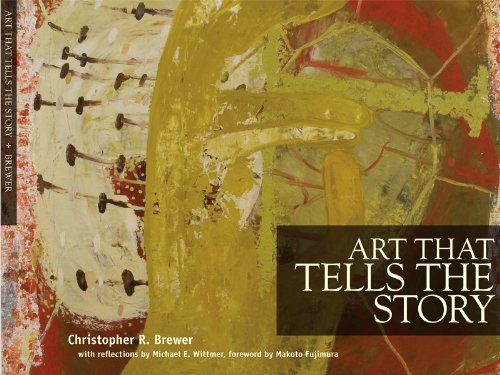
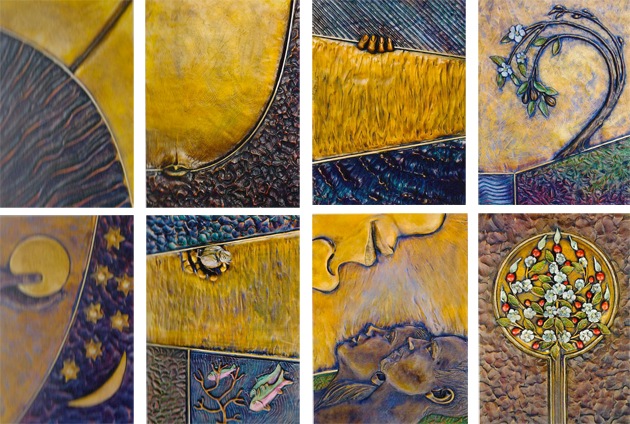
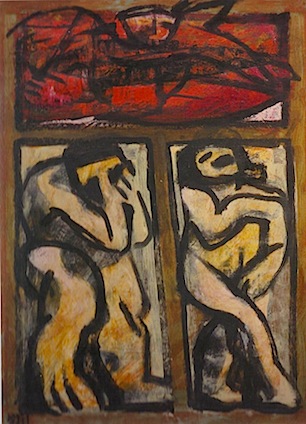
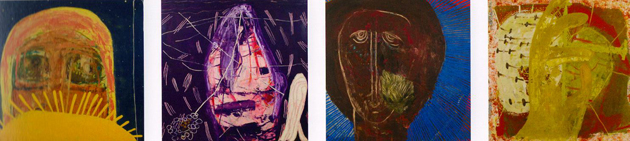
‘Telling the story anew’. ‘God … [is] always coming into language in a new way’. Which brings me to Chris Brewer’s new book, Art that Tells the Story. Others have already summarised the book, so let me simply say that Art that Tells the Story is a freshly-presented and beautifully-produced book which attempts to tell the old, old story … again. Boasting some intriguing prose (by Michael E. Wittmer) and coupled with well-curated images from a diverse array of accomplished visual artists including Jim DeVries, Wayne Forte, Edward Knippers, Barbara Februar, Clay Enoch, Julie Quinn, Michael Buesking and Alfonse Borysewicz, among others, herein, word and image work in concert to open readers up to hear and see again, and to hear and see as if for the first time, the Bible’s story of creation, fall, redemption, and consummation, inviting – nay commanding!, for the gospel is command – readers to comprehend in this story their own, and to enter with joy into the narrative which is the life of all things. A book this beautiful ought to be in hardback; but may it, all the same, find itself opened and dialogued with next to many coffee mugs, and in good and diverse company. Like its subject, this is one to sit with, to be transformed by, and to share with others.

Flannery O’Connor once confessed, in Mystery and Manners, that ‘there is a certain embarrassment about being a story teller in these times when stories are considered not quite as satisfying as statements and statements not quite as satisfying as statistics’. ‘But’, she continued, ‘in the long run, a people is known, not by its statements or statistics, but by the stories it tells’. And so the dogged persistence of theologians and artists. Indeed, it is stories – in fact, a particular, if not very short or simple, story – that Brewer’s book is primarily concerned to tell. That his chosen medium is the visual arts reminded me of something that NT Wright once said, and which is, I think, worth repeating:

We have lived for too long with the arts as the pretty bit around the edge with the reality as a non-artistic thing in the middle. But the world is charged with the grandeur of God. Why should we not celebrate and rejoice in that? And the answer sometimes is because the world is also a messy and nasty and horrible place. And, of course, some artists make a living out of representing the world as a very ugly and wicked and horrible place. And our culture has slid in both directions so that we have got sentimental art on the one hand and brutalist art [on] the other. And if you want to find sentimental art then, tragically, the church is often a good place to look, as people when they want to paint religious pictures screen out the nasty bits. But genuine art, I believe, takes seriously the fact that the world is full of the glory of God, and that it will be full as the waters cover the sea, and, at present (Rom 8), it is groaning in travail. Genuine art responds to that triple awareness: of what is true (the beauty that is there), of what will be true (the ultimate beauty), and of the pain of the present, and holds them together as the psalms do, and asks why and what and where are we … And our generation needs us to do that not simply to decorate the gospel but to announce the gospel. Because again and again, when you can do that you open up hermeneutic space for people whose minds are so closed by secularism that they just literally cannot imagine any other way of the world being. I have debated in public … with colleagues in the New Testament guild who refuse to believe in the bodily resurrection and, again and again, the bottom line is when they say ‘I just can’t imagine that’, the answer is, ‘Smarten up your imagination’. And the way to do that is not to beat them over the head with dogma but so to create a world of mystery and beauty and possibility, that actually there are some pieces of music which when you come out of them it is much easier to say ‘I believe in the Father and the Son and the Holy Spirit’ than when you went in.

Art that Tells the Story is grounded upon the premise that artists and theologians can not only help us to see better, but also that like all human gestures toward the truth of things, the work of artists can become an instrument through which God calls for our attention. And here I wish to conclude by re-sounding a call trumpeted by Michael Austin in Explorations in Art, Theology and Imagination:

Theologians must be on their guard against commandeering art for religion, must allow artists to speak to them in their own language, and must try to make what they can of what they hear. What they will hear will tell of correspondences and connections, of similarities, of interactions and of parallel interpretations and perceptions which will suggest a far closer relationship of essence between art and religion than many theologians have been prepared to acknowledge. As the churches at the beginning of the twenty-first century become more fearful and therefore more conservative there may be fewer theologians prepared to take the risks that embracing a truly incarnational religion demands of them. In particular what they hear may suggest to them that their many (often contradictory) understandings of God and redemption and salvation in Christ need to be radically reconsidered if a new world is to be made.

Chris Brewer’s Art that Tells the Story is just such an attempt. It’s good stuff.

Around the boab trees

There’s some good reading around at the moment. Here’s a few pieces I’ve enjoyed:

Telling our story: two book commendations

Stories have always played an indispensable role in human life. Whether via oral tradition or in written form, stories provide a framework for transmitting values, heritage, culture and traditions, even for transmitting the self across spaces and generations, for keeping the self alive, as it were. Stories also enable us to acquire expectations about the world. These expectations then provide a framework for organising other pieces of incoming information. In short, without stories, we cannot process our experiences. Without stories, we do not know who we are. It is certainly true that the people of God have long known this, and even if that knowledge has at times been submerged deep in the common memory, our being and witness is grounded in story, a particular story to be sure – the very story of God – but a story nonetheless.

And here comes a rub; for as Flannery O’Connor once noted, ‘there is a certain embarrassment about being a story teller in these times when stories are considered not quite as satisfying as statements and statements not quite as satisfying as statistics; but in the long run, a people is known, not by its statements or statistics, but by the stories it tells’. So tell stories we must. And, of course, the Church has a long tradition of telling and re-telling its own story. And there are radical implications for so doing, for, as Rowan Williams observes in Lost Icons, ‘Every “telling” of myself is a retelling, and the act of telling changes what can be told next time, because it is, precisely, an act, with consequences. The self lives and moves in, and only in, acts of telling – in the time taken to set out and articulate a memory, the time that is a kind of representation (always partial, always skewed) of the time my material and mental life has taken, the time that has brought me here … The process of “making” a self by constructing a story that is always being told is a prosaic and universal one’ (p. 144).

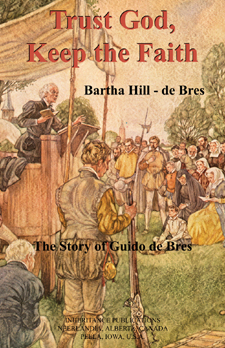
There are at present two books on my desk which seek to contribute to this long tradition of helping the Church to know itself by retelling its own story. As it happens, they are both books which are accessible to children, which is particularly exciting because I’m always on the hunt for ways to tell my children, and others too in my community of faith, their own story. The first is by New Zealand writer Bartha Hill, and is called Trust God, Keep the Faith: The Story of Guido de Bres. It recounts the inspiring story of pastor and theologian Guido de Bres. De Bres was a student of both Calvin and Beza, and is best known as the author of the Belgic Confession (1561). The book paints the story of de Bres against the background of an eventful sixteenth century in Europe, events which proved to be costly for many of those who stood on the Protestant side of church reform. It can be ordered from Inheritance Publications or, if you are in New Zealand, directly from the author. For the latter, contact Bartha directly via email.

The second book is John Calvin by Simonetta Carr, and is nicely illustrated by Emanuele Taglietti. It is published by Reformation Heritage Books and is targeted at children from 6–12 years of age. Like Hill’s book on de Bres, Carr’s too wonderfully introduces readers (and their imaginations) to the narrative, humanity and rich theological contribution of its subject, and does so in a clear, readable and attractive way. The Church, and its young families, is much in need of the kind of resources that these two small volumes evidence. Both would make great gifts too.

Candour reviews

I recently accepted the illustrious mantle of reviews editor for Candour, a magazine for ministers and leaders of the Presbyterian Church of Aotearoa New Zealand. The aim is that each edition of Candour will include a medium-length review of some kind, mostly of books but hopefully also of plays, music, dance and film. Consequently, I’m now on the hunt for possible reviewers, i.e., for those who would be willing to do the occasional review, and pick up a ‘free’ book in the process. If you’d like your name added to the list of reviewers that I can call on from time to time, then please let me know via email, indicating the kind of areas (e.g., missiology, history, fiction, prayer, etc.) that you are most interested in writing about, and any relevant qualifications you may have.

Eberhard Busch, Barth: A Review

Eberhard Busch, Barth (trans. Richard Burnett and Martha Burnett; Nashville: Abingdon Press, 2008). viii+95pp. ISBN 9780687492466.

Those who help us read and understand the great theologians of the church are themselves a great gift to the church. In this volume, an eminent doyen of contemporary Barth scholarship, Eberhard Busch, with striking clarity and warmth, and with unequalled familiarity (at least in print) with his subject, introduces neophytes and those long-familiar with Karl Barth to the Reformed theologian’s life, location and work.

Busch, who is Professor Emeritus for systematic theology at Georg-August-Universität in Göttingen, provides readers with a map which, if followed carefully, will assist them to more accurately locate Barth’s contribution within a wider landscape of theological conversation and, more particularly, to navigate their way into Barth’s magnum opus, Die Kirchliche Dogmatik, highlighting key markers apart from which Barth’s readers easily wander off course, and steering readers clear of the slippery climbs of the secondary literature. Busch is an outstanding guide.

The book begins with an entrée into Barth’s early period as an assistant pastor in Geneva from 1909 to 1911 (a period in which he was fundamentally shaped by the theological liberalism associated with Schleiermacher), his ministry at Safenwil, and his move by 1916 into the strange new world of the bible wherein he discovered the Godness of God, the grace of revelation which ‘hits us’ like an ‘arrow from the other side of the shore’ (p. 5). In Chapter Two, ‘The Rise of the Confessing Church’, Busch traces the way that Barth pressed his theological knowledge into the service of the church, championing the reality that the one binding Word of God is Jesus Christ. Here, Busch introduces readers to the Barmen Declaration, noting that ‘wherever the church looses herself from any bond which is to God’s Word and at the same time to worldly power, wherever she listens solely to God’s Word, she will not cease to speak out politically, but she will do so from a different position’ (p. 12). In Chapter Three, Busch lays out the ecclesial, political and historical context in which Barth penned his thirteen-volume Church Dogmatics, attending to the part that reason, natural theology, freedom and church played in Barth’s thought, and sketching Barth’s involvement, after the Second World War, in ecumenical efforts, in post-Vatican II discussions as well as discussions with American theologians from 1962 onwards.

Having so set the scene, the remainder of the book, pages 23–83, are given to summarising Barth’s Dogmatics. Beginning with an explanation of Barth’s understanding of the graced nature of theology, of the fact that divine speech ‘is not and can never be a presupposition that falls into our hands’ (p. 26), Busch attends to Barth on religion, faith, knowledge, the trinity, divine freedom, the relationship between Israel and Church in the one covenant of grace – the reconciliation which is ‘so essential that the covenant would risk falling “in the void” … were it not fulfilled’ (p. 43) in Jesus Christ – God’s calling and bringing of creation into correspondence with his covenant, God’s triumph in the creation of faithful servants in their own free decision (what Barth in CD II/2 calls the ‘autonomy of the creature’), the relationship between Gospel and Law, prayer, the sin which is nothing, real and misunderstood, the relationship between sanctification and justification, theodicy, and Christian community in relation to Christ, the world and the vocation ‘to be God’s witness within her own times’ (p. 76). Busch concludes by outlining how Barth understands Christ’s resurrection and its relationship to ‘historical facts’ (p. 80), to history itself as past, present and future are bound together in Christ, and to Christian hope. Each chapter concludes with a set of questions for further reflection.

A junior cousin to Busch’s earlier book The Great Passion: An Introduction to Karl Barth’s Theology (Eerdmans, 2004), significantly briefer than Bromiley’s Introduction to the Theology of Karl Barth, and more lightweight than Hunsinger’s How to Read Karl Barth, Busch’s Barth is a genuine introduction which impressively fulfils the brief of the ‘Abingdon Pillars of Theology’ series (of which it is a part) – of assisting college and seminary students to ‘grasp the basic and necessary facts, influence, and significance of major theologians’.

Hinterland Theology: A Stimulus to Theological Construction: A Review

Alan P.F. Sell, Hinterland Theology: A Stimulus to Theological Construction (Studies in Christian History and Thought; Milton Keynes/Colorado Springs/Secunderabad: Paternoster, 2008). xvi+715pp.

In his book Defending and Declaring the Faith: Some Scottish Examples 1860–1920 (1987), Alan Sell had already demonstrated his ardour and gift for bringing the dead back to life, for turning strangers into friends, and for wading the small streams and largely-inaccessible rivers on the landscape of British ecclesiastical life. Now, over two decades later, Professor Sell, in Hinterland Theology: A Stimulus to Theological Construction, turns his binoculars south to introduce readers to some other forgotten saints, to those whose writings are not the staple of general undergraduate courses. These are the second eleven (actually ten), if you like, of Nonconformist Dissent – drawn from among those who served the Church in the wake of the Toleration Act of 1689 after which there was ‘no longer one authority to which appeals on religious questions could be lodged’ (p. 54), and in the wake of the Enlightenment and the Evangelical Revival, and in the wakes of modern biblical criticism and theological liberalism. From the outset, Sell suggests that ‘we have not fully understood the Lockes and Barths of this world until we have investigated what the hinterland people made of them’ (p. 2).

Drawing upon letters, sermons, tracts and monographs, and with an eye on doctrinal controversies, the prevailing intellectual winds, and impressively alert to pastoral challenges, Sell has penned an encyclopaedic dictionary of rarely-mentioned theologians – Thomas Ridgley, Abraham Taylor (who ‘shot across the London sky like a volatile theological meteor’ (p. 41)), Samuel Chandler, George Payne, Richard Alliott, David Worthington Simon, T. Vincent Tymms, Walter Frederick Adeney, Robert S. Franks and Charles S. Duthie. Apart from Chandler, who was Presbyterian, and Tymms, who was Baptist, the rest were Congregationalists, and all but two (or perhaps three) were sons of the manse. Each chapter begins with a comprehensive biography of the chosen personality before turning to introduce and then engage with their thought, contribution and intellectual location. A familiar encore of themes appear over the period surveyed (1667 to 1981), including deism, miracles, apologetics, supernaturalism, Bible, Trinity, theism, Arianism, Calvinism, Unitarianism, Roman Catholicism, theological method, the eternal generation of the Son, kenotic christology, divine impassibility, natural theology, ecclesiology and pastoral ministry, among others, suggesting that theological adjustments and time-lags, and the ongoing ‘construction through conversations’ (p. 1) conducted by hinterland theologians, significantly stimulated the philosophico-theological landscape, and bore significant fruit – for good and for ill – in the Church.

After a brief Introduction, the book is presented in five parts. In Part One, ‘In the Wake of Toleration’, and with colour and wit, Sell introduces us to Thomas Ridgley whose ‘greatest contribution lay in the field of theological education’ (p. 13), and to Abraham Taylor and his defence against John Gill’s charge of antinomianism, and his plunge into the debates over the doctrinal declension betrayed in eighteenth-century trinitarian controversies and, in particular, his dissatisfaction in these matters with fellow Congregationalist, Isaac Watts. (Taylor charged Watts with sponsoring Sabellianism and Socinianism, with teaching that Christ possessed a super-angelic spirit, and with displaying a lack of clarity over the nature of divine personhood, among other things). Sell also introduces us to Samuel Chandler, the ‘moderate Calvinist’ and ‘apostle of liberty of conscience and freedom of thought’ (p. 85) who also wrestled with John Gill (on the relationship between morality and the will of God) and with Anthony Collins, John Locke and Thomas Morgan (on deism), and with John Guyse (on what it means to preach Christ),who spoke at Watts’ internment, who (from 1732 to 1739) was a prime advocate of the repeal of the Test and Corporation Acts that precluded Dissenters from holding state or civic office’ (p. 77) and whose greatest talents most conspicuously shone forth from the pulpit.

In Part Two, ‘In the Wake of Enlightenment and Revival’, Sell considers the life and contribution of George Payne, a thinker who ‘set out to be “useful” but was perceived as “dangerous”’ (p. 123). Sell’s discussion here introduces us to the landscape of early-nineteenth century thinking on metaphysics and ethics, on moderate Calvinism, and on the Trinity. Sell turns next to the inexorable logician and winsome evangelist Richard Alliott, who was ‘among the first Congregationalists to notice Schleiermacher in print’ (p. 191) and who, while longing for the revival of the Church, insisted that there would be no revival until believers ‘experience within stronger faith in the presence and word of our God, in the finished work of Christ, [and] in the indwelling of the Spirit in our hearts’ (p. 200). But Alliot, who by 1860 held the Chair of Theology and Philosophy at Spring Hill College,  held no misconceptions that ‘piety by itself will not sustain a ministry’ and that ‘scholarship will render a preacher more effective’ (p. 203). Sell describes Alliot, who authored Psychology and Theology (1855), as ‘a theologian between the times’ in whom ‘classical theism’s cosmological-causal head came together with Romanticism’s heart, and the whole was undergirded by the Evangelical Revival’s concern for souls’ (p. 222).

Part Three is titled ‘In the Wake of Modern Biblical Criticism’. Here we are acquainted with David Worthington Simon, T. Vincent Tymms, and Walter Frederick Adeney. Describing Simon as ‘the most spiritually anguished, the slowest-burning, and the most pioneering scholar – and hence the most highly suspect – to fall with the confines of this book’ (p. 227), Sell recalls Simon’s study at Lancashire College and in Germany (a land to which he returned again), his oversight of the newly formed church at Birkenhead from 1855, and his call to serve as Resident Tutor and Professor of Theology at Spring Hill College, ‘an institution where at least relatively open theological enquiry was the order of the day’ (p. 236), and then, from 1883, as Principal of the Scottish Congregational Theological Hall in Edinburgh, and thereafter as Principal of Yorkshire United Independent College on Bradford (1893 until 1907). Alive to the changing intellectual environment, Simon, championing what Sell names as a ‘biblical-historical-pneumatic epistemology’ (p. 250), championed a marriage of both intellectual and spiritual depth, resisting attempts by some to divorce the historical and the spiritual and arguing that the soul’s relation to God is not independent of biblical facts. From Simon, Sell turns to Tymms, tracing the Baptist theologian’s journey from Regent’s Park College, to his pastorates at Berwick, Accrington and Clapton, to Vice-President of the Baptist Union of Great Britain and Ireland, to President of the London Baptist Association, and to the Presidency of Rawdon College, Leeds. Sell reflects on Tymms’ widely-read book, The Mystery of God, and his embroilment in controversies over Bible translation, particularly as such affected the Indian mission field. He notes that Tymms distinguished himself by encouraging ‘original thought among his students rather than … prepar[ing] them for examinations’ (p. 311), and by his Forsyth-like witness to the centrality of Christ’s Cross which has ‘irradiated the world with light, and is filling the moral universe with songs of everlasting joy’ (p. 317). Tymms would press further still, insisting in his stimulating and judicious book The Christian Idea of Atonement, that ‘the cross is God’s definition of Himself’ (p. 340). Moreover, the cross is, Tymms insists, the only word of theodicy available to the Christian: ‘The cross is … precious because it reveals that God is not a mere passionless watcher of an agonising evolution, but is Himself a partaker of the universal travail, and has been constrained by love to take the chief labour on Himself’ (p. 345). Sell introduces us next to Adeney, Congregationalist minister turned Professor of Church History and New Testament, whose attention to the centrality of the cross fell some way short of Tymms’, but among whose enviable gifts included an ability to ‘write at varying degrees of technicality, and … a particular concern to reach ministers, people in the pews, and children’ (p. 366). He was one of those ‘believing biblical critics’, like Westcott, Hort, Peake and W.H. Bennett, who ‘harvested the fruits of modern biblical criticism in such a way that only the most suspicious conservative evangelicals’ (p. 410) would think to accuse him of undermining Scripture. No advocate of sentimental theology, Adeney championed the truth of God’s fatherly love – love expressed in the ‘essentially Christian’ (p. 399) doctrine of the Trinity – as ‘the source and spring of the Christian gospel’ (p. 395). Still, he warned that ‘speculation about God always plunges us into darkness’, an observation which draws the following comment from Sell: ‘It is, no doubt, an unsanctified thought, but one sometimes feels that some present-day theologians think that they know as much about the inner working of the Trinity as some older Calvinist divines thought they knew about God’s inscrutable will’ (p. 411).

‘In the Wake of Theological Liberalism’ is the equally-revealing title of Part Four, and the subjects here are Robert S. Franks and Charles S. Duthie. Again, Sell locates each personality in their biographical and intellectual context before turning to introduce and appraise their writings and thoughts. Sell highlights the former’s engagement with the thought of Kant, Abelard, Anselm, and Schleiermacher, and the latter’s engagement with Pascal, Barth, Thielicke, Ferré and Tillich. Of these last two named, Duthie’s introducing of their thought to both Church and students (he spent 30 years of his life training ministers) was ‘not because [he agreed] with all the main positions they occupy but because [he felt] deeply that they are concerned to fashion a living theology for our own time, a theology which is faithful to the “given” Gospel in terms of man’s predicament today’ (p. 521). In calling the Church to its evangelistic task, Duthie suggested that we not only read Tillich with Barth in hand, but also the reverse.

After 562 pages, Sell still has more to say, and the book’s final part is a 71-page conclusion wherein Sell retraces the landscape he has just surveyed, recapitulates key themes, offers suggestions about contemporary practice, and recalls that the voices of hinterland theologians – past and present – are ‘frequently constructive, occasionally provocative, and variously stimulating. They have pertinent observations to share on our current theological agenda, and they challenge us by reminding us of some themes which we may have been inclined to overlook’ (p. 635).

Readers already familiar with Professor Sell’s writing will know that he is a meticulous researcher whose reading is extensive, whose commitment to ecumenism is exemplary, whose love for, and devotion to, the Nonconformist tradition is contagious, who is not shy of noting error and distortion of the Gospel when and where he sees it, whose acumen for critically-identifying contemporary theological trends is cultivated and well coached, and whose writing betrays not a few hours of pastorally-informed reflection. While Hinterland Theology could certainly have done with a more meticulous proof-reader, with this hefty tome Sell has given us a rich resource. That he decided to take the trouble to write this book leaves the Church in his debt. This volume will be of interest to historians, theologians, philosophers, and a must-read for those with a particular interest in British Nonconformity.

 

Entering the New Theological Space: A Review

John Reader and Christopher R. Baker, eds, Entering the New Theological Space: Blurred Encounters of Faith, Politics and Community. Explorations in Practical, Pastoral and Empirical Theology (Farnham/Burlington: Ashgate, 2009), pp. xiii + 241, £55.00, ISBN 978-0-7546-6339-3.

Nicholas Lash, in his book Holiness, Speech and Silence: Reflections on the Question of God, gives voice to the difficulty of thinking Christianly in ‘a culture whose imagination, whose ways of “seeing” the world and everything there is to see, are increasingly unschooled by Christianity and, to a considerable and deepening extent, quite hostile to it’. He notes the serious and dangerous demands posed in such a situation by continuing to hold the Gospel’s truth rather than paying mere lip-service to ‘undigested information’ (p. 4). Believing that the time has come to help missiological communities to engage and digest in the linear spaces opened up between post-Christendom politics and interfaith actualities, institutional monads and inter-organisational networks, rural and urban spaces, the status of paid and unpaid, and the contested and evolving relationship between faith and science, for example, the contributors to Entering the New Theological Space seek, in different ways, to map such space ‘by means of a triangulation between narrative, praxis and theory’, to ‘offer some idea of the complexity and interdisciplinarity associated with this new space’ – a so-called ‘third space’, the ‘space of the both/and’ (p. 5), a more fluid space which discards the oft-maintained binarism of the either/or space – and to assist readers to analyse the significance of such ‘blurred encounters’ which, the editors believe, are ‘forcing the church to develop increasingly fluid and experimental forms’ (p. 10).

Each of the fifteen essays in this volume are in their own way stimulating, and most are well-researched and eruditely penned. They cover a range of topics, from John Atherton’s ethical-economical-theological reflection on a ‘pilgrimage’ down Edinburgh’s Royal Mile to explore places where ‘inevitable and potentially creative’ (p. 25) ‘“edges” have become mainstream’ (p. 19), to Malcolm Brown’s essay on the ‘social atomisation’ and ‘rootlessness’ (p. 70) of London’s suburbs, to Margaret Goodall’s exploration of human personhood in a thought-provoking essay on dementia, to Clare McBeath’s piece which asks whether a community or a city can be said to ‘suffer from mental illness’ (p. 147), to Philip Wagstaff’s reflection on the fluidity and stability of rural ministry.

Two essays merit special mention: Martyn Percy’s considers the nature of the cultural dynamics, implicit theology and ‘invisible religion’ (p. 179; the phrase is Thomas Luckmann’s) that continue to birth requests for baptism (or ‘christening’) of children from non-churched families. He writes concerning the ‘deeply coded ways in which people talk and act about God’, that ‘religious language is carried in the emotion, timbre and cadence of worship’ and that ‘deeply coded language is not [necessarily] a strategy for avoiding explicit theological language’ (p. 184). Percy’s attempt to sketch a theology of cultural conversation, and to explore some implications of such conversations for missional and risky engagement in the ‘areas of overlap and hinterlands between the life of the church and the world’ (p. 179) merits further thought.

Drawing upon the work of Bruno Latour and Slavoj Žižek, and bringing their thought into conversation with events surrounding the 2007 outbreak (in Surrey) of foot and mouth disease, John Reader contributes an intriguing, if somewhat undercooked, essay on the nature, possibility and linguistic challenges posed to truth speech by the mutual encounter of science and theology. He concludes by stating that it is ‘only by keeping the insights and theories of both faith and science in circulation’ that we can be ‘certain of remaining “in the truth”‘, and that it is ‘only by loading into the process that contact with the wider world’ that we ‘avoid an unhealthy closure of questioning and debate’ (p. 208).

Some reservations: the noticeable absence in this volume of any discussion on the significance and place of technology (blogging, social media and gaming, for example) in theological and ecclesial discourse and praxis, and vice-versa, represents a disappointing gap. Also, there is in this volume a significant number of typological, grammatical and factual errors (John Knox, for example, was not the ‘first Presbyterian minister of St Giles and Scotland’ (p. 20)), errors which one expects would be corrected before print and to be rare in a book wearing such an inflated price tag. Finally, while one may well concur that ‘all the essays in this book are a testament to the ongoing adaptability and robust mutuality of Christian thought and the church’ (p. 7), if this volume represents ‘the new theological space’ then one might be forgiven for observing that, with one or two exceptions, such space is a little light on the theology front.

These reservations aside, not a few of the essays in this volume deserve wide reading, and the ongoing conversations encouraged therein are to be commended. Social planners, missiologists, pastoral practitioners and those training them will all benefit from reading this book, and from taking up the challenge to engage in the interdisciplinary and multilayered interstices of cultural, political and theological realities.

Friending: Real Relationships in a Virtual World – a wee review

My friend Lynne Baab has a new book out – Friending: Real Relationships in a Virtual World (IVP). Via an array of stories gleaned from many dozens of interviews, Lynne, who has a PhD in communications and who blogs at Gathering Voices, maps the ways that new technologies and social media are changing the form that many friendships take (even the word ‘friend’ itself has become a verb), threaten to both cheapen as well as promote friendship, and invite us to reassess the nature(s) of friendship itself. She wants to know what makes friendships work, what actions initiate and nurture friendships, why nothing in friendships is permanent, and what does it look like to be a friend in a world shrunken by new communication technologies. Lynne, who is a Facebook devotee, writes with great enthusiasm and warmth, in a very personal style, with a complete absence of academic jargon, with an open Bible, and with an eye on practical concerns. Don’t expect here a treatise on friendship in the manner of a Seneca, or an Augustine, or a critical discussion on the use of technology itself, as that offered by Jacques Ellul – it’s simply not that kind of book. Each chapter concludes with a set of questions for reflection, journaling, discussion or action that could well serve as the basis for group discussion, or a conversation among friends.

You can read the first chapter here, and watch Lynne talking about her book here, here and here.

Community of the Transfiguration: a commendation

Paul Dekar’s book, Community of the Transfiguration: The Journey of a New Monastic Community (Cascade Books, 2008), maps the historical, theological, liturgical, and missiological life of Holy Transfiguration Monastery [HTM], or what many of us know better as The Breakwater Community – a Baptist monastic community in Geelong, near Melbourne. HTM was birthed in the early 1970s and bound together by ‘a common calling to contemplative prayer, simplicity, a Eucharistic focus, and the nurture of monastic spiri­tuality’ (p. 33). How this birth happened, and the shape that the life birthed has taken, and is taking, is a focus of this book; it is, however, by no means the only focus.

Dekar, who is Professor Emeritus of Evangelism and Mission at Memphis Theological Seminary and (as I understand it) a ‘Companion in identifica­tion with HTM as a spiritual home’, locates the story of the Breakwater Community among the wider stories and history of Christian monasticism in both its ancient and contemporary forms: ‘HTM exhibits many generic traits of its monastic forebears and of the new monastic communities. These include the centrality of Jesus Christ, communal life under a rule of life, vital worship, use of the visual arts, care for youth, care for the natural world; and ministries among marginalized persons. In this sense, the life of Community mem­bers is neither unique, nor original, perhaps only “newly born … a spirit and an endless trying, changing and beginning again”’ (p. 57). That the members of the Community have sought to explore and live out of traditional monastic spiri­tuality for over thirty-five years has, in Dekar’s words, ‘made the Community somewhat of a working model, or bridge, between past and contemporary forms of monastic religious life’ (pp. 61–62).

Dekar believes that ‘the radical love Community members have extended to lay people, pastors, denomi­national leaders, critics, and even enemies is perhaps its greatest gift’ (p. xvi). That I can count myself as one among many who has been, on more than one occasion, the recipient of the hospitable love of this extraordinary and permission-giving community (once in the form of home-made lemonade and a pumpkin – food for the journey, so to speak), is but one the reasons that I was so keen to read this book. From my brief experience and observation as a pastor in the Baptist Union of Victoria, among the greatest gifts bestowed by the Breakwater Community to the wider Church is the centrality, rhythm, and theological maturity afforded to gathered worship, and the attendant invitation to live all of life as an expression of and participation in the One who gives himself in the eucharist. It is, I believe, appropriate, then, that Dekar devotes a significant portion of the book to introducing readers to some of the liturgical resources and prayers authored by the Community, and to outlining the theology and practice of HTM’s worship, the shape that a community in which ‘the nurture of warm, personal intimacy with the Holy Trinity’ (p. 89) lies at the heart of common life.

On occasion, Dekar gets sidetracked from the main story and expends ink on some of his additional interests which, although loosely related to the book’s subject, disrupt its flow. Still, this moving and challenging book records a fascinating and important – albeit small – chapter of the story of Victorian Baptists, and locates that story in both a wider and more grassroots ecumenical and catholic context. Those already familiar with the inspirational life and witness of the Breakwater Community and its relationship with the Baptist family in Victoria, and those interested in hearing a more detailed account of one community that religion sociologists might locate in a movement known as ‘New Monasticism’, will find much of interest here.

The Wisdom of Stability: A Review

In The Wisdom of Stability: Rooting Faith in a Mobile Culture (Brewster: Paraclete Press, 2010), Jonathan Wilson-Hartgrove seeks to write a book about ‘staying put and paying attention’. In a culture characterised by unprecedented mobility, he believes that ‘the most important thing most of us can do to grow spiritually is to stay in the place where we are’ (p. 1). The author insists that the life of Spirit is, in Rowan Williams’ words, impossible ‘in abstraction from the actual business of living in the body of Christ, living in concrete community. The life of intimacy with God in contemplation is both the fruit and the course of a renewed style of living together’. Or, in Wilson-Hartgrove’s words, ‘Apart from stability in the life of a community, the songs of Zion quickly begin to sound like wishful thinking’ (p. 63).

Drawing from the experiences of the monastic fathers and mothers, and from his own journey now as a minister of St. Johns Baptist Church and member of Rutba House, Wilson-Hartgrove properly argues that the practices of stability cannot be ‘reduced to a quick fix for the spiritual anxiety of a placeless people’, and that ‘if our feelings of rootlessness are what drive us to the practice, we’ll need something more than an immediate sense of relief to help us stay’ (pp. 110–11). He turns then to consider three ‘midday demons’ which require resistance if we are to be serious about not being perpetual pot plants but being planted in soil where our roots have room to reach deeper. These are ambition, boredom and vanity.

He writes of ambition: ‘ambition tempts us to forsake the mundane for the sake of unlimited growth – or, at least, new opportunities. We are so easily unimpressed by the ordinary, longing for the feeling of excitement that comes with a new task to take up, new people to engage, new challenges to face (p. 114). And of boredom: ‘Whereas ambition pushes us toward perpetual motion, boredom paralyzes, leaving us unable to love our neighbors or even take care of our own basic needs. Though different in character, these midday twins tempt us to the same lack of care. In their grip, it is impossible for us to find joy in community’ (p. 118). And of vanity: ‘Vainglory comes midway along our journey to suggest that all our care is best directed toward self-preservation … Vainglory will try to persuade us that there is nothing more important in the world than our own stability, encouraging us to defend it at all costs against any potential threat’ (pp. 122, 123).

There is wisdom in these words, and there’s much to like about the book. Still, I have two reservations about commending it: First, it’s nauseatingly repetitive, yet another example of a standard article-length piece being padded out to make a book. Second, and more substantially, there is, surprisingly, a drift towards an unearthed nostalgia here which works to undermine the author’s basic thesis. (It may be, of course, that my cultural eyeglasses are simply the child of a different prescription to those of Wilson-Hartgrove’s.) Walter Brueggemann once observed of memory that it is that which ‘may be enmeshed in a nostalgic longing for normalcy and “the good old days,” when life was simple and agrarian, settled, and well-ordered. That nostalgia is all intertwined with evangelical memory, so that the nostalgia has a vague religious feeling about it. There is a need to sort out the normative memory from this other vague yearning’. I’m unconvinced that Wilson-Hartgrove (in this volume) succeeds fully in doing the kind of sort out that Brueggemann, rightly to my mind, calls for.

For me, the highlight of the book was this poem (on p. 106):

The house was built in ’98,
prior to my arrival.
And a big maple tree at the corner of the porch
was run over and buried lots of times by wagons
moving in materials to build the house.
And the other maples what Daddy had planted,
they had no trouble at all.
But they all died and this one lived that had such rough treatment.
And there’s a saying
“Rough weather makes good timber.”
It may be
that the trouble with folks today
is that they’re raised like hothouse flowers,
and they don’t have much to go on
at the end.

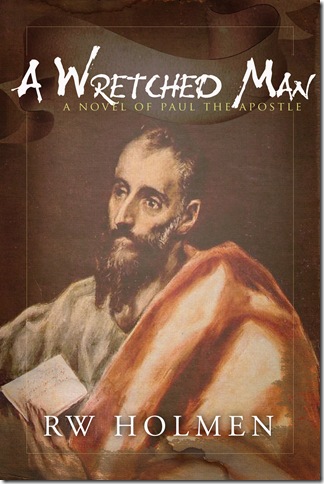
A Wretched Man: A Novel of Paul the Apostle – a review

I remember the first time I read Gerd Theissen’s The Shadow of the Galilean. It was the early 90s. The book is an outstanding achievement. Interweaving the latest in biblical scholarship with an imagination fuelled by Scripture’s heart and with an evangelical zeal to simply tell the story, Theissen helped to bring the Gospels, and their central character, to life for me. And he reinforced for me what I think I first learned via a deep immersion in the liturgical practices of my faith community – that the communication of divine truth demands the work of the very imagination it is determined to sanctify. So Jonathan Edwards: ‘Unless you use imagination, unless you take a truth and you image it – which of course is art – you don’t know what it means’. Or, as Nicholas Lash puts it in Holiness, Speech and Silence: Reflections on the Question of God, and citing John Henry Newman first up:

‘It is not reason that is against us, but imagination.’ … The ways in which we ‘see’ the world, its story and its destiny; the ways in which we ‘see’ what human beings are, and what they’re for, and how they are related to each other and the world around them; these things are shaped and structured by the stories that we tell, the cities we inhabit, the buildings in which we live, and work, and play; by how we handle – through drama, art and song – the things that give us pain and bring us joy. What does the world look like? What do we look like? What does God look like? It is not easy to think Christian thoughts in a culture whose imagination, whose ways of ‘seeing’ the world and everything there is to see, are increasingly unschooled by Christianity and, to a considerable and deepening extent, quite hostile to it.

In such a situation, continuing to hold the Gospel’s truth makes much more serious and dangerous demands than mere lip-service paid to undigested information. Unless we make that truth our own through thought, and pain, and argument – through prayer and study and an unflinching quest for understanding – it will be chipped away, reshaped, eroded, by the power of an imagining fed by other springs, tuned to quite different stories. And this unceasing, strenuous, vulnerable attempt to make some Christian sense of things, not just in what we say, but through the ways in which we ‘see’ the world, is what is known as doing theology.

This is precisely why I welcomed reading Obie Holmen’s A Wretched Man: A Novel of Paul the Apostle. Holmen seeks to do with the Apostle to the Gentiles something like what Theissen did with Jesus ‘the Apostle and High Priest of our confession’ (Heb 3.1) – situate Paul in his geographical, social, historical and psychological landscape, and gift us with a creative way of hearing afresh the letters that make up the bulk of the New Testament.

According to Holmen, prior to his fire-side conversion-encounter with Yeshua (Jesus), ‘Paulos (Paul), the defender of orthodoxy, had acquired a proud identity and a status; self-righteousness became the dressing for his wounds, masking his inner torment’ (p. 75). Indeed, ‘the wretched man wandered the streets of Tarsos, lost and alone, accursed and condemned’ (p. 54). Thereafter, Holmen paints Paulos as one who is seeking to carve out the implications – for Torah, for Jewish privilege, for our understanding of God, etc. – of this radical encounter with Yeshua. The entire story takes place, markedly, against Paul’s own conflict – the ‘inner torment’ – between his inherited (and then reconstituted) theology and his homosexuality, the latter manifest in his relationship with Gentile friend Arsenios. Augustine once suggested, to the shock of some of his fellow bishops, that St Paul may have been ‘greatly tainted by sexual desires’. In his portrait of the gay Apostle Paul, Holmen exploits this suggestion beyond what the old bishop of Hippo may have had in mind, and some readers may well lay the book down because of such. But such action would, in my view, represent a premature judgement.

A Wretched Man is no The Shadow of the Galilean, to be sure, but Holmen is a gifted writer, and his well-researched yarn is certain to encourage readers to read the Bible in a new light, with a deepened awareness of the groundedness of its message, with a new appreciation of the real humanity of its figures, and – I suspect most importantly for the author – a renewed wonderment of the magic of divine grace.

An annotated name index would help the reader. The book has a dedicated website here.

School(s) for Conversion – a commendation

On 14 January 1935, Dietrich Bonhoeffer penned the following words to his brother Karl-Friedrick: ‘… the restoration of the church will surely come only from a new type of monasticism which has nothing in common with the old but a complete lack of compromise in a life lived in accordance with the Sermon on the Mount in the discipleship of Christ. I think it is time to gather people together to do this …’

Whether we are thinking about explicitly religious, or of broader, expressions of new ways of being human community, the birthing of new types of monasticism has long been a feature of ecclesial existence. While having at times drifted in and out of neomonastic communities, and while wrestling frequently with the kingdom-foreignness of the way of being-in-communion that my own introverted default setting reboots to, I’ve mainly been an intrigued onlooker who has read very little in the last decade or so that has come from within the movements themselves that articulates in any depth the intentionalism of such life together. (Whether or not all such communities characterise the ‘new type of monasticism’ for which Bonhoeffer longed is not the point here.)

But I’ve been eager to read and think more. I was delighted, therefore, to discover Wipf and Stocks’ New Monastic Library Series, of which School(s) for Conversion: 12 Marks of a New Monasticism, a book edited by The Rutba House, is a part. (I’m also currently reading Community of the Transfiguration: The Journey of a New Monastic Community by Paul R. Dekar, and “Follow Me”: A History of Christian Intentionality by Ivan J. Kauffman, both of which I’m enjoying immensely.)

The ‘new’ monasticism differs from the ‘old’ in a number of ways. Here are three, for example: (i) vows of celibacy, poverty and obedience are relatively rare; (ii) while geographic proximity of members is preferable, it is not necessary; and (iii) distinctive religious habits have been largely replaced by non-distinctive Levis.

The movement of the Spirit from which this book is birthed sees itself as characterised by the following twelve marks:

1) Relocation to the abandoned places of Empire;

2) Sharing economic resources with fellow community members and the needy among us;

3) Hospitality to the stranger;

4) Lament for racial divisions within the church and our communities combined with the active pursuit of a just reconciliation;

5) Humble submission to Christ’s body, the church;

6) Intentional formation in the way of Christ and the rule of the community along the lines of the old novitiate;

7) Nurturing common life among members of intentional community;

8) Support for celibate singles alongside monogamous married couples and their children;

9) Geographical proximity to community members who share a common rule of life;

10) Care for the plot of God’s earth given to us along with support of our local economies;

11) Peacemaking in the midst of violence and conflict resolution within communities along the lines of Matthew 18; and

12) Commitment to a disciplined contemplative life.

This book attends to these marks, one chapter on each, exploring each theme drawing upon Scripture, contemporary examples, and personal experience.

Taking up Alasdair MacIntyre’s challenge to construct ‘local forms of community within which civility and the intellectual and moral life can be sustained through the new dark ages which are already upon us’, the contributors to this volume believe that when such longing as this instructs the church, ‘the local forms of community for which MacIntyre calls are no longer primarily for the sustenance of intellectual and moral life. Nor are they communities that withdraw from the world to insure their own survival and the flourishing of their members. Rather, within the life of the church a new monasticism exists to sustain knowledge of the gospel of the kingdom that was proclaimed, embodied, and accomplished in Jesus Christ. And the communities of the new monasticism exist for the sake of witness to Jesus Christ who is the life and hope of the world’.

This book is written not by theoreticians or monasticism-virgins cutting their idealistic and yuppie teeth in a utopian wilderness for a while before retreating back to ‘the real world’. Rather, these challenging essays betray a maturity and realism that one might expect from those who have the runs on the board, so to speak, whose commitment to embodying the kingdom which is truly the life of the ‘real world’ is humbling and utopia-destroying, and who love the church as God’s community in travail and often so slow to be on the way.

Jürgen Moltmann’s Ethics of Hope: Eschatological Possibilities For Moral Action: A Review

A review of Timothy Harvie, Jürgen Moltmann’s Ethics of Hope: Eschatological Possibilities For Moral Action (Ashgate New Critical Thinking in Religion, Theology and Biblical Studies; Aldershot: Ashgate, 2009).

It was Karl Barth who, in his Ethik (1928), reminded us that Christian theology is always ethics, that ethics belongs to theology proper precisely because God makes himself responsible for us, and that ‘ethics as a theological discipline is the auxiliary science in which an answer is sought in the Word of God to the question of the goodness of human conduct’. It is of little surprise, therefore, that such a commitment is shared by one of Barth’s most prolific students, Jürgen Moltmann, whose own articulations concerning theological ethics remain valuable though, in his own words, ‘an unfinished task and an unfulfilled wish’ (p. ix).

Timothy Harvie’s volume (a ‘slightly revised version’ of his doctoral dissertation submitted to the University of Aberdeen and supervised by Professor John Webster) represents an attempt to consider and extend an unfinished trajectory in Moltmann’s theology; namely, and appropriately, an ethics of hope. It is, in the words of its author, ‘not a piece of applied ethics engaging specific moral quandaries or the nature of Christian virtues’ but rather ‘an attempt to theologically describe the sphere of Christian moral action and the means by which this is enabled to take place’ (p. 3). Harvie makes it clear in the Introduction that his essay will argue that Moltmann does not begin with antecedent ethical presuppositions and then mould dogmatics to fit these concerns. Rather, ‘Moltmann begins with an investigation of theological concerns stemming from the biblical history and then attempts to articulate the moral relevance this theological conception has for the current social situation of humanity’ (p. 6).

The book is divided into two parts. In Part I, Harvie attends to the christological, pneumatological and eschatological foundations for an ethics of hope, and offers readers (and particularly those unfamiliar with Moltmann’s oeuvre) an accessible entrée into a number of vistas fundamental to Moltmann’s theological project. Through four chapters, Harvie’s aim is to rehearse how Moltmann is principally concerned with articulating the Christian gospel, and subsequently concerned to point to how the Church’s convictions about the gospel inform her ethical assertions.

He opens with a chapter on hope and promise, noting that the generative thrust and unambiguous priority of Christian hope, for Moltmann, is birthed in the divine promise given in a particular locus in history, and creating and securing a new trajectory for history and for human existence: ‘In the midst of a history wrought with injustice, turmoil and sin, the promise of God (given definitively in the resurrection of Jesus Christ) secures a new future which contravenes the sinful status quo of the present with a new creative work of God for a redeemed cosmos. This new, creative work secured in the promise is a novum in history which moves towards the present’ (p.15). Harvie proceeds to cite Moltmann – ‘The simple prolongation of the status quo no longer provides a future for which it is worth living’ (p. 26) – and avers that eschatological hope grounded in the cross-resurrection means that Christian living becomes subversive, demanding not onlookers but, in Moltmann’s words, ‘combatants’ (p. 26). The promise of God in Jesus Christ creates in history an interval between promise and fulfilment, a Zwischenraum or ‘between-space’, which sets in motion a way of living adumbrated in the promised future but ‘enacted through the creative work of God in such a way that in Christ humans [i.e., the Exodus community, Exodusgemeinde] may now participate in this space … in contradistinction to the world’ (p. 28). This way of living is ‘life commensurate with the Kingdom of God’ (p. 36).

The Kingdom of God, another topic of decided importance for Moltmann, is the subject of Chapter Two. Herein, Harvie outlines the way that Kingdom and christology are inextricably bound up together, and attends to the way that, for Moltmann, the Kingdom represents not only a positive description of the content of Christian hope but also ‘a foil to critique societal situations [Moltmann] perceives to be unjust’ (p. 40). Jesus’ embodiment of the Kingdom, it is noted, means table fellowship with sinners, liberating proclamation and praxis for the poor, and healing to the broken.

Chapters Three and Four attend to the role that pneumatology and the doctrine of the trinity, respectively, play in Moltmann’s theology, and how each informs the ethical shape of his theology of hope. With clarity, Harvie outlines that while, for Moltmann, the trinitarian history of the divine life with the world begins with the history of the promise, a history which culminates in the death and resurrection of the Son, it is the faithful and historical efficacy of the Spirit which ‘constitutes the continuing presence of the Kingdom’ in both Church and world. ‘This’, he continues, ‘in no way denigrates the future horizon of Christian hope for the Kingdom, but rather structures the initial fulfilment of the divine promise, which creates a surplus of expectation and hope for the eschatological novum’ (pp. 57–8). He notes how, for Moltmann, those empowered by the Spirit are ‘led to be non-conformists with the unfulfilled present, which leads to death. The Church, through the work of the Spirit, is empowered to resist in its Zwischenraum of tension, to overcome death with life, violence with peace, and hate with love’ (p. 92). Harvie is critical of Moltmann’s emphasis on a ‘universal society’ (p. 85), arguing that such ambiguity blurs the distinction between the Spirit’s work in the Church and in wider society. In Chapter Four, Harvie gathers up many of the already-attended-to themes and brings them into dialogue with Moltmann’s exposition on the trinity, noting that the creature’s moral living does not equate principally to imitatio of the trine life so much as, by the Spirit, being ‘taken up into the divine communion as an-other … to participate in and live out of the divine love’ (p. 109). Herein, as Moltmann explains it, the ‘lived circulation’ (p. 118) which is the divine life has two kinds of openness: first, there is an intra-Trinitarian openness between the three persons; second, and implying no deficiency of being, the Trinity is open for communion with creation. ‘This divine openness’, Harvie suggests, ‘fundamentally alters the moral life of the Christian through justification and sanctification’ (p. 122). In an interesting conversation with work by Carl Schmitt and Richard Bauckham, Harvie notes how Moltmann’s thoroughly trinitarian theology creates an eschatological ethic which rejects both clerical and political monotheisms, and he follows Bauckham’s critique of Moltmann that the tendency to inadequately distinguish between the triune life in se and the social life of creatures has ‘no biblical basis’ (p. 128). Turning then to the way that creatures participate by the Spirit in the fellowship of love, Harvie considers how, for Moltmann, the notion of divine apatheia both sponsors a utopian hope and undermines the command to be ‘present in open, loving solidarity with those who suffer’ (p. 135).

Harvie then turns – in Part II – to a more focused consideration of the ethical shape that the theological foundations he has outlined in Part I take in creaturely existence. He does this via three discussions on hope: on (i) time and space for hope, (ii) hope for humanity, and (iii) hope for the economy.

In the first of these, what I found to be the most stimulating part of the book, Harvie draws upon Augustine and Bauckham to very helpfully explicate how Moltmann understands, and makes use of, christologically-determined categories of time over against, say, Kathryn Tanner’s ‘futureless eschatology’ (what Carl Braaten calls ‘eschatology sans eschaton’) and time’s modern myths, and how these then inform what Moltmann wishes to aver about the theo-ethical implications of such in the kingdom of God wherein space – conceived as both Zeitraum and Zwischenraum – is opened up for hope and moral action. The present earthly time – the time of promise – is ‘characterized by expectation and anticipation of the novum which is anticipated in the promise and ensured by the divine faithfulness’ (p. 151) and, by the tension created between the divine-human covenant which existentially orients creaturely perspective to the future, sensitises covenant partners to the incongruous nature of their surroundings. Contra Mark Lewis Taylor and Rubem Alves, Harvie notes that, for Moltmann, ‘the ethical space envisioned in a moral theology of hope is not simply the space of human structures where moral action is attempted through one’s own empowerment to one’s own end. Rather, it is a space created by the promise of God through the death and resurrection of Christ in which human structures are transformed by the efficacious work of the Holy Spirit to manifest the eschatological Kingdom. This space orients Christian moral action, through the divine promise, to the future. The result is that this space is then in tension with those structures, circumstances and actions which are not located within the Kingdom of God or brought about through the beneficent work of God through the Spirit’ (p. 167).

Harvie turns, in the final two chapters, to the subjects of human nature, human dignity and human rights, and to outline how he understands Moltmann’s theology of hope might inform conversations about economics. He rightly notes that for Moltmann, the imago Dei depends upon, and says more about, God than it does upon any human trait per se, that the imago Christi is paramount for an ethics of hope, and that ‘it is precisely at this Christologically focused point within eschatological history that the Zwischenraum of tension … is understood to constitute the sphere of Christian moral action’ (p. 172). He also rightly notes that ‘the claim that human beings have equal and intrinsic worth is difficult to maintain as a universal presupposition apart from God’s revelation as creator and redeemer of the world’ (p. 181).

These concluding chapters, however, are disappointingly conservative in their application of the ethic that Moltmann’s thought invites. Harvie proposes no genuine protest to the structures of that world put to death in the crucified God, and very little hint of the novum created by the radical interruption of Jesus’ resurrection and the life that this event births. The praxiological content of the eschatological Zwischenraum which is characterised as life in the Spirit, in other words, is left drastically underdeveloped. The ethical implications of Moltmann’s professional project call for a more radical engagement – or what Ernst Wolf calls a ‘creative discipleship’ – of the ecclesia than Harvie outlines here. Moreover, as Moltmann avers in Theologie der Hoffnung, we must speak not only of the historic transformation of social and public life but also of the suffering, self-surrender, self-expenditure and sacrifice that attend such ‘day-to-day obedience’, and which mark a different way from the glories of self-realisation and the miseries of self-estrangement arising from ‘hopelessness in the world of lost horizons’ – ways disclosed to the laos tou theou in the future of the crucified God in whose life they participate, and to whom they look for the coming of the kingdom in fulness. At the end of the day, Harvie tumbles into the very trap that Hauerwas outlines (and which Harvie cites on p. 183): ‘One of the things that bothers me about such discourse is the designation “us,” meaning Christians, and “them,” meaning the poor. Such language inherently presupposes that Christians have no convictions that might not make them poor. As a result we privilege our place as rich Christians who can justify our being rich because we are concerned about justice’.

While the essay is unduly repetitive, it is amiably unencumbered with distractive engagements with secondary literature and side issues. Where these are relevant, they are appropriately attended to, and that so as not to sidetrack the reader from the main line of enquiry; namely, Moltmann’s own presentation of a foundation for an ethic grounded in trinitarian space-making and orientated toward the future in the kingdom of life and love. And while the ethical implications drawn by Harvie are, to my mind, drastically undercooked, there can be little doubt that those interested in exploring a rich theological foundation for Christian ethics will find much here of value.

The Purple Crown: The Politics of Martyrdom: A book note

The Purple Crown: The Politics of Martyrdom (Polyglossia: Radical Reformation Theologies) by Tripp York. Scottdale/Waterloo: Herald Press, 2007. Pp 199. $19.99, ISBN 978-0-8261-9393-0.

Through recalling the truthful performances and writings of the early church (e.g., Ignatius of Antioch, Polycarp and Cyprian) and of those on all sides of the Reformation, through examination of Augustine’s account of the analogical relationship between the Civitas Dei and the Civitas Terrena (each with their rival soteriologies), through a biography of Oscar Romero which is itself ‘a gospel’, and drawing heavily on the work of William Cavanaugh and John Howard Yoder, York reflects on the natures of, and relationship between, word and deed, and reminds us that martyrdom is the kind of public, political and liturgical witness – a second baptism, and ‘a moment in rhetoric’ (p. 146) – that unapologetically reveals the world to be the world, and reminds the church, as does the eucharist itself, that ‘allegiance to the heavenly city presumes an exilic posture that confers a missionary stance’ that sometimes, though not always, takes the shape of martyrdom (p. 100). But martyrs are not victims; neither is martyrdom tragic. Rather, as York reminds us, the logic of martyrdom belongs in the world of the apocalyptic, the witness participating in ‘the ongoing creation of not an alternative world but an authentic world: a world inaugurated by the cross and the empty tomb’ (p. 147). While few readers will follow York on every point, and many will want to go deeper and wider than this essay does, this book is a clear, insightful and ecclesiologically-fruitful introduction to the relationship between martyrdom and discipleship.

Reading the Decree: Exegesis, Election and Christology in Calvin and Barth: A Review

Reading the Decree: Exegesis, Election and Christology in Calvin and Barth, by David Gibson. Pp. xiii + 221. London/New York: T&T Clark, 2009, ISBN 9 780567 468741.

In the summer of 1922, the young Karl Barth taught a course on the theology of Calvin. As he struggled to prepare lectures, he immersed himself passionately in Calvin’s thought – even cancelling his other announced course (on the Epistle to the Hebrews) so that he could concentrate solely on the Reformer’s writings. In a letter penned to Eduard Thurneysen that same year, Barth expressed his astonishment at the strangeness and power of what he had discovered: ‘Calvin is a cataract, a primeval forest, a demonic power, something directly down from Himalaya, absolutely Chinese, strange, mythological; I lack completely the means, the suction cups, even to assimilate this phenomenon, not to speak of presenting it adequately. What I receive is only a thin little stream and what I can then give out again is only a yet thinner extract of this little stream. I could gladly and profitably set myself down and spend all the rest of my life just with Calvin’. Certainly any project which attempts to bring these two giants into conversation is, to say the least, ambitious; particularly, perhaps, when it comes to their respective doctrines of election.

Unprepared to simply accept various readings of Calvin’s and Barth’s doctrines of election, David Gibson, in a ‘lightly revised version’ (p. xi) of his PhD dissertation completed at the University of Aberdeen under the supervision of Francis Watson, turns to Calvin’s corpus (particularly to his commentaries and to the Institutes) and to Barth (CD II/2 principally) in order to investigate and then compare their respective articulations of the doctrine, and to enquire about what relationship election has with christology in their projects. Moreover, Gibson is concerned to attend carefully to their exegeses, and to the ‘role of text-reception in theological construction’ (p. 11) in both thinkers. His argument is that ‘the exegetical presentations of Christology and election in Calvin and Barth expose a contrasting set of relationships between these doctrinal loci in each theologian’ (p. 1) and that this differing relationship between the two doctrines flows from and informs two contrasting approaches to the interpretation of Scripture. Gibson helps his readers appreciate how, for both Calvin and Barth, doctrine and exegesis are not tasks to be taken in isolation, but are, rather, united around, in different ways, the subject of their enquiry; namely, Jesus Christ and the caelesti decreto.

Employing and qualifying Richard Muller’s distinction between ‘soteriological christocentrism’ (so Calvin) and ‘principial christocentrism’ (so Barth), Gibson suggests a corresponding hermeneutical distinction – ‘extensive’ and ‘intensive’. A ‘Christologically extensive’ hermeneutic is evident, Gibson contends, when ‘the centre of Christology points outwards to other doctrinal loci which have space and scope to exist in themselves at a measure of distance from Christology and from each other’. Here christology ‘may influence and shape’ other loci, but christology neither dictates nor controls them. This, Gibson argues, represents Calvin’s christology. Conversely, a ‘Christologically intensive’ hermeneutic describes when ‘the christological centre defines all else within its circumference. Within this circle, Christology draws everything else to itself so that all other doctrinal loci cannot be read in Scripture apart from explicit christological reference’ (p. 15). So Barth, whose intensively christological hermeneutic ‘privileges the name of Jesus Christ in ways which go significantly beyond Calvin’s understanding of how Christology functions in exegesis’ (p. 27).

Gibson traces these two distinctions through Calvin’s and Barth’s approaches to christology, election and hermeneutics, illustrating that while much of the same grammar is employed, and many of the same biblical texts examined, and while their respective exegeses of election exist within ‘christological horizons which show how doctrine itself may be a hermeneutic’ (p. 16), Calvin and Barth often sing in different keys, and at times different songs though with no less exegetical reasoning in either.

In Chapter 2 – ‘Christology and Election’ – Gibson deepens his basic thesis by further sketching the relationship between Christ and election in Calvin’s and Barth’s exegeses. He argues that, while Barth’s position is not as radical as some recent interpreters have claimed, Barth’s understanding of the pre-existent Jesus as the subject of election sponsors two different understandings of election’s trinitarian basis than we see in Calvin. Gibson’s basic point here is that Calvin’s christocentrism emerges as distinctively soteriological while Barth’s is radically principial: ‘Calvin’s theology allows us to speak of Christ and the decree, but Barth’s theology to say that Christ is the decree’ (p. 30).

In Chapter 3, Gibson illustrates his thesis in detail by outlining Calvin’s and Barth’s reading and use of Romans 9–11. He shows that both theologians operate with different understandings of the relationship between covenant and election because of the location that each grants to christology. This leads to two contrasting ideas of Israel’s vocation and relationship to the Church. Moreover, whereas for Barth, Christ himself is the subject of election, and for whose sake Israel’s election occurs, Calvin reads Romans 9–11 as an exposition of the eternal decree in which christology recedes into the background. In other words, christology, for Calvin, is concerned with the economy of salvation rather than, as it is for Barth, with the eternal ground of salvation itself. Gibson concludes the chapter by asserting that ‘whereas for Calvin, Israel is typological of the church, for Barth both Israel and the church are typological of Christ, so that both forms of the community are “initially the two different but then inseparably related aspects of the fulfilment of the one covenant of grace in Christ”. These radically different conceptions of the covenant in Calvin and Barth issue directly from different forms of christocentrism’ (p. 153).

Gibson turns then in the final chapter to survey how christology shapes the way that his two subjects read Scripture. His aim here again is to show how Calvin’s christologically-extensive theology of interpretation explains how he intends election to be read in Scripture, and how this differs from Barth’s christologically-intensive approach. Gibson describes the latter’s reading of election as a ‘hermeneutic of patience and complexity, of interaction between the individual, multi-faceted predestinarian texts and the christological whole of which they are a part’ (p. 192). He also explores how ‘underlying these different hermeneutical approaches are two fundamentally different conceptions of the doctrine of revelation’ (p. 155).

There is much to commend about Gibson’s study: (i) He offers the reader a clear, careful and fair reading of Calvin and Barth on a doctrine that is, in the latter’s words, ‘the sum of the Gospel’ (CD II/2, p. 3); (ii) He is refreshingly appreciative of the ways in which the connections and motifs internal to Barth’s own thought are deeply indebted to the Reformed tradition, and particularly to Calvin: ‘For all his independent and creative genius, Barth’s theology is profoundly catholic, soaked in dialogue and debate with centuries of tradition and modulated with a Reformed accent’ (p. 18); (iii) The comparative reading (in §3) of Romans 9–11 yields much that is fruitful, and superbly illustrates the thesis of the entire volume. But, to my mind, the supreme value of Gibson’s study is (iv) the reminder – and there is little doubt that current Calvin and Barth scholarship needs such! – that at core, both Calvin and Barth are exegetes of Scripture, and that the neglect of the exegetical contours which shape their respective dogmatic projects is ruinous to providing a faithful reading of their corpuses. ‘For both interpreters, Holy Scripture is the quarry from which their dogmatic structure for election is hewn. Repeatedly, in the writings of both theologians, the emphasis on reception – it is in Scripture and not in their own theologizing that election is properly learned – is accompanied with a stress on right reception’ (p. 198). Gibson also addresses a brief word to contemporary Barth scholarship: ‘It is likely that where Barth’s doctrine of election is debated without attention to his practice as an exegete, and specifically to the very question which mattered most to him – “Does it stand in Scripture?” – then a debate occurs within parameters which Barth himself would not have recognized’ (p. 199). Such an approach is to be enthusiastically welcomed.

There are, however, a few less-satisfying aspects of what is otherwise a very valuable study. I will name five: (i) To my mind, Gibson appropriates too uncritically Muller’s reading of Calvin, and those readers less confident that Muller has read Calvin rightly may well be left wondering just how robust Gibson’s argument is; (ii) The focus of Gibson’s treatment of Barth tends to be too narrowly focused on CD II/2 and so neglects to attend to the nuances and developments in Barth’s understanding and articulation of election in other places. This leads at times to a flatter presentation of Barth’s (and of Calvin’s) thought than if greater attention had been paid to the historical and polemical natures of their projects. In Barth’s case, for example, of the way that his ‘principial christocentrism’ serves as protest to post-Kantian theology; (iii) Not a few readers will be disappointed that there is so little engagement with the secondary literature. For example, while Matthias Gockel’s and Suzanne McDonald’s PhD theses on Barth and T.F. Torrance’s study on Calvin’s hermeneutics are less concerned with the detail of biblical exegesis in their subjects than is Gibson, Gockel’s project is quickly dismissed (on p. 26) and any engagement with McDonald’s and Torrance’s work, and the kinds of systematic terrain that they are concerned to explore, is noticeably absent from Gibson’s essay. They would, if handled carefully, inform and strengthen its own foci; (iv) Most readers would no doubt prefer that extended quotations in Latin be accompanied with translation; and (v) Finally, Gibson resists offering any substantial critique or evaluation of his subjects’ method and doctrinal conclusions. Such may have served to draw out in constructive detail some of the places where Calvin and Barth are less than rewarding to us.

These reservations aside, this study deserves a wide reading, and will be of particular interest to Calvin and Barth scholars, to those interested in the development of the theo-logic of the doctrine of election in the Reformed tradition, and to those who are interested in seeing how two of that tradition’s major voices – one early modern and one late modern – read and used the Bible.

Intimate Horizons: The Post-Colonial Sacred in Australian Literature – A Review

Intimate Horizons: The Post-Colonial Sacred in Australian Literature, by Bill Ashcroft, Frances Devlin-Glass, and Lyn McCredden. (Adelaide: ATF Press, 2009), vi + 364 pp. IBSN 9781921511790

Intimate Horizons is an erudite and intriguing overture to post-colonial Australian literature and, via such, into the psyche of a nation. Its enquiry proceeds on the assumption that the twentieth-century’s final defeat of the gods is injudicious and that Australian authors working after the savageries of two world wars – and as indigenous peoples began to speak back to their colonisers, and in so doing open up new vistas of understanding about the land and about human relationships – began to “encounter the sacred as a region of difference, transformation and empowerment” (2).

The clear movement of Australian literature at the middle of the century is away from time – and its correlates such as history and rationality – to space which overwhelms it, and to the bodies and the proximate material world, and their stories, around which space is constituted. The conclusion to be made from this is that the literary engagement with place during this period, veering away from the horizontal sublime towards the sense of the sacred in the proximate, ordinary and material world, undertakes an unconscious movement towards Aboriginal experience, towards place as an embodied presence – characteristic of Aboriginal culture. (22–3)

The works of Francis Webb, Roland Robinson, David Malouf, and others, echo a fugue of common themes replayed across genres and decades, and which relate to the sacredness of place and embodiment, and the production of aesthetic “presence,” both of which are demotic and proximate, which stand in tension with those inherited forms from Europe, and “in which the sacred is glimpsed outside structure of interpretation” (18). Indeed, the authors of this volume (Bill Ashcroft, Frances Devlin-Glass and Lyn McCredden) believe that art and literature have been the “cultural discourses most successful in shedding the European yoke” (4) and have created, in Joseph Addison’s words, a “spacious horizon” as liberating as it is terrifying and which intimates distance and “placelessness” (8) that overwhelms the colonial imagination, disrupting the Romantic notion of the sublime and opening up the way to an acuity of the sacred in the broad spaces that characterise the horizontal experience of place. The authors are particularly critical of that literature which “seeks refuge in a melancholic and privileged mythologising of Australian history and white settler responses to it” (258).

Perceptive chapters on Patrick White (who “seemed to promise a new imagining of what is meant to be Australian” (33)), James McAuley (whose poetry speaks in a “haunted, homeless and displaced register” (105)), and Judith Wright (whose “‘parabolic’ vision … ‘runs beside or beyond the world of everyday’” (143)), are complemented with follow-up chapters exploring the “creative collision/encounter of paradigms of bush nationalism … and earthed sacredness” (165), and, drawing upon the work of Xavier Herbert, Kim Scott and Alexis Wright, “versions of the Indigenous sacred” (206) which find voice from the ecological depths of indigenous epistemology.

Chapter Seven, perhaps the most engaging of the chapters, surveys some contemporary Australian poetry which invites us to embrace questions of sacredness – a “theology of the earth” (285) – through “an immersion in the material world of place and time, and the material processes of poetic language” (244). Here we are introduced to poems by Kevin Hart, Robert Adamson, Gwen Harwood, Les Murray, Robert Gray, Lionel Fogarty and Sam Wagan Watson, whose poetry “triggers possibilities for change, even as it keeps the horrors of the colonial past in sight (283). Heirs to Webb and Wright, each of these poets, it is argued, when read within the context of the sacred, can be seen “grappling in new, demotic forms of language with the thisness of place, … with the intricate, lived realities of history in Australia” (245), and that partly by a refusal to be “pale reflections of European forms and ideas” (250). Such particularities, it is suggested, “are never merely backdrops to the poetry; nor does some abstracted ‘other’ seem to be the desired goal. Rather, in different but related ways, the poets confront this palpable, earthed, proximate place, Australia, through processes that do not cede any simplistic or monolithic access to the sacred” (245). This is evident, our authors observe, in “the drive to find new words” – “earthed, demotic languages of the sacred” – in order to respond to the “tangible realities of this place” (248). One place where this drive is evidenced is when Murray (a Roman Catholic) and Gray (one deeply influenced by Buddhist and Dharmic thought) are brought into conversation: “Gray’s Australia is permeated by the moral and spiritual meditativeness of a solitary poet, a cosmopolitan intellectual and sensualist, given to the detailed ‘thinginess’ of this place, but facing finally towards universalising formulations garnered across the centuries, into his reading and writing. Murray’s is a much more embattled, idiosyncratic and restless imagination” (277).

The final chapter considers the ways in which contemporary Australian fiction operates in a continual and heteroglossic dialogue with “earlier voices, a dialogue between different perceptions of the sacred sublime, and increasingly a dialogue between white and Aboriginal, between meaning cultures and presence cultures … [and which] constantly avoids closure” (288). It is one thing to suggest that the apotheosis of language adheres to an “intimation of the horizon of meaning at the edge of language” (321), to treat language as in some sense “sacramental” (232), to avoid monologism and to embrace a “multiplicity of voices” (288); it is another entirely to avoid clarifying the basis upon which such a discourse might take place. It is of little help to the reader to confess (after wading through over 300 pages!) that this book “avoids defining the term [‘the sacred’] because the very ground of our discussion – the concept of Presence, of meaning which exceeds final interpretation – makes definitions useless” (325). To be sure, I am not calling here for a kind of “doctrinal statement,” what I take the authors to mean by “orthodoxy” (288). Rather, as a Christian theologian, I wish to suggest that the dialogue and quest for new languages that a “metaphorically displaced society” (318) is groping after are literally given to us not in silence (as the authors suggest) but in the noise of divine incarnation, in the enfleshment of the divine in a particular location and story – in the ordinary – which is indeed “realised in the creative imagination” (300). As it stands, the pseudo-mysticism assumed throughout the book is as destructive of discursive knowledge as it is of birthing ethical action, concerns which are, I suspect, not far from some of the writers herein considered.

Those with deep allergies to natural theology – of the grammar of “place that remains the path to the sacred” (32) – will find much herein to baulk at: in its starkness, a borrowed fight which reminds the reader that while escape into cosmic emotions contemplating the grandeurs of antipodean place and space has some draw, any enlargement of the intelligence and calm of the mind is offset by the starvation of the soul groping for what Murray calls “unpurchased lifelong plenishment.”

The authors of Intimate Horizons assume much of their readers. They assume knowledge of Australian history, of post-colonial literature, of aboriginal spirituality, of the basic contours of theological grammar, of current discourse around race-relations, of the sense and sacramentality of place, and of antipodean attitudes to sentimentalism and religion. Some grasp of Heidegger’s notion of “Being” would be of help too.

The book highlighted again for me the legitimacy of Ian Anderson’s claim (in his Introduction to Blacklines: Contemporary Critical Writing by Indigenous Australians, edited by Michele Grossman), that “in the context of settler colonial states, such as Australia, colonial structures have never been dismantled. Colonial ways of knowing are not historical artefacts that simply linger in contemporary discourse. They are actively reproduced within contemporary dynamics of colonial power. Yet this fundamental observation does not really seem to have penetrated mainstream postcolonial theory” (24). Still, this stimulating book invites, and deserves, close reading. It helps one read Australian fiction and poetry – and, indeed, a national mythology – with more informed and sharpened eyes.

[An edited version of this review is to appear in Colloquium in due course]