Author: Jason Goroncy

‘One Heart’, ‘Baptism’, and ‘Old Story’ by Franz Wright

There are two poets whose work I’ve been devouring of late: RS Thomas and Franz Wright. I will write more about the former at some other stage, of why the Welshman’s words haunt me in the hours I ought to be sleeping and of why he may in fact be one of the poets that I’ve been listening for for all my life. This wee post, however, is about Wright, an American poet writing with a different energy to Thomas’, and whose words, which are no less honest, move at a pace which betrays that he inhabits not only a different time, but a younger nation as well.

Published about a year ago, in a NYT article titled ‘Dark Glamour’, Daisy Fried writes about Franz Wright’s poems:

‘Wright’s poems sometimes feel insufficient, but also, in that insufficiency, authentic. Is there really any such thing as reconciliation? the poet seems to ask, even as he yearns for reconciliation. Anyone else might have come to terms with this quandary years ago. But poetry, like quandaries, should be unsolvable. What’s bothersome about Franz Wright is what keeps his poetry alive, and makes him worth coming back and back to’.

While these may not be the most striking examples, there is, I think, in this Pulitzer Prize-winning poet’s poems ‘One Heart’, ‘Baptism’ and ‘Old Story’ (all published in Walking to Martha’s Vineyard), instances of what Fried is eluding to:

◊◊◊

One Heart

It is late afternoon and I have just returned from
the longer version of my walk nobody knows
about. For the first time in nearly a month, and
everything changed. It is the end of March, once
more I have lived. This morning a young woman
described what it’s like shooting coke with a baby
in your arms. The astonishing windy and altering light
and clouds and water were, at certain moment,
You.

There is only one heart in my body, have mercy
on me.

The brown leaves buried all winter creatureless feet
running over dead grass beginning to green, the first scent-
less violet here and there, returned, the first star noticed all
at once as one stands staring into the black water.

Thank You for letting me live for a little as one of the
sane; thank You for letting me know what this is
like. Thank You for letting me look at your frightening
blue sky without fear, and your terrible world without
terror, and your loveless psychotic and hopelessly
lost
with this love.

◊◊◊


Baptism

That insane asshole is dead
I drowned him
and he’s not coming back. Look
he has a new life
a new name
now
which no one knows except
the one who gave it.

If he tastes
the wine now
as he is allowed to
it won’t, I’m not saying it
will
turn to water

however, since You
can do anything, he
will be safe

his first breath as an infant
past the waters of birth
and his soul’s, past the death water, married–

Your words are spirit
and life.
Only say one
and he will be healed.

◊◊◊

Old Story

First the telephone went,
then
the electricity.

It was cold,
and they both went to sleep
as though dressed for a journey.

Like addictions condoned
from above evening
fell, lost

leaves waiting
to come back as leaves–
the long snowy divorce. . .

That narrow bed, a cross
between an altar
and an operating table. Voice

saying, While I was alive
I loved you.
And I love you now.


Naming God

Long-time readers of Per Crucem ad Lucem will know of my abiding interest in discussions about naming God; which reminds me, my friend Rick Floyd has two fantastic posts here and here on this topic. Anyway, inspired by Robert Jenson, Stanley Hauerwas has written a stimulating piece on this same topic. Here’s a few snippets:

‘… it should not be surprising that in a culture which inscribes its money with “In God We Trust,” atheists might be led to think it is interesting – and perhaps even useful – to deny god exists. It does not seem to occur to atheists, however, that the vague god which some seem to confuse with trust in our money cannot be the same God who raised Jesus from the dead, having before raised Israel from Egypt’.

‘… We, like the people of Israel, would like to think we get to name God. By naming God we hope to get the kind of God we need, that is, a god after our own likeness. We can make the “more” that must have started it all after our own image. But God refuses to let the people of Israel – or us – assume that we can name the One who will raise Israel from Egypt. Only God can name God. That, moreover, is what God does’.

‘… The God we worship is not a vague “more” that exists to make our lives meaningful. The God we worship is not “the biggest thing around.” The God we worship is not “something had to start it all.” The God we worship is not a God that insures that we will somehow get out of life alive. The God we worship is not a God whose ways correspond to our presumptions about how God should be God.

That God has come near to us in Christ does not mean that God is less than God. God is God and we are not.

Yet we believe that the God we worship has made his name known. We believe we have been given the happy task of making his name known. We believe we can make his name known because the God we worship is nearer to us than we are to ourselves – a frightening reality that gives us life. We believe that in the Eucharist, in the meal of bread and wine, just as Jesus is fully God and fully man, this bread and this wine will, through the work of the Spirit, become for us the body and blood of Christ.

To come to this meal in which bread and wine become for us the body and blood of Christ is to stand before the burning bush. But we are not told to come no closer. Rather we are invited to eat this body and drink this blood and by so doing we are consumed by what we consume becoming for the world God’s burning bush.

By being consumed by the Divine Life we are made God’s witnesses so that the world may know the fire, the name, Jesus Christ’.

[Image: bLaugh]

‘It is one of those faces’, by R.S. Thomas

It is one of those faces
beginning to disappear
as though life were at work
with its eraser. It drizzles
at the window through which
I regard it. As one realising
its peril, it accosts me
in silence at every corner
of my indifference, appealing
to me to save it gratuitously
from extinction. There was a moment
it became dear to me, a skull
brushed by a smile as the sun
brushes a stone through ravelled
passages in the hill mist.
Must I single it with a name?
I am coming to believe,
as I age, so faithful its attendance
upon the eye’s business, it is myself
I court; that this face, vague
but compelling, is a replica
of my own face hungry for meaning
at life’s pane, but blearing it
over as much with my shortness
of faith as of breath.

– R.S. Thomas, Counterpoint (Newcastle upon Tyne: Bloodaxe Books, 1990), 46.

A prayer for the meeting of the General Assembly

As the Presbyterian Church of Aotearoa New Zealand prepares to gather for its General Assembly next week, it’s a time not only for reading through hundreds of pages of reports and recommendations, but also to be praying. So …

Almighty God,
in Jesus Christ you called disciples
and, by the Holy Spirit, made them one church to serve you.
Be with members of our General Assembly.
Help them to welcome new things you are doing in the world,
and to respect old things you keep and use.
Save them from empty slogans or senseless controversy.
In their deciding,
determine what is good for us and for all people.
As this General Assembly meets,
let your Spirit rule,
so that our church may be joined in love and service to Jesus Christ,
who, having gone before us,
is coming to meet us in the promise of your kingdom. Amen.

– Presbyterian Church (U.S.A.), Book of Common Worship, prepared by the Theology and Worship Ministry Unit for the Presbyterian Church (U.S.A.) and the Cumberland Presbyterian Church (Louisville: Westminster/John Knox Press, 1993), 805.

Jim Wallis on Faith, Ethics and Public Life

A guest post by Andrew Bradstock.

With his rare ability to challenge people to think afresh about the issues of the day, and consider how religious faith can transform hope-less situations into hope-ful ones, Jim Wallis is always worth hearing.

But with so many news items at present involving ‘faith’ in different ways – from the threats to burn the Koran and proposal for a Muslim community centre near Ground Zero in the US, to the Pope’s visit to the UK, to the debates here and elsewhere about what it means to be ‘secular’, to the ongoing conflicts in Iraq, Afghanistan and Israel/Palestine – this is a particularly apposite time to get the insider’s perspective that a global commentator and White House adviser like Wallis is able to give.

There is a rare opportunity to hear Jim Wallis in person in Dunedin next week, and I hope you are planning to seize it!

Next Tuesday, 28 September, from 2.00 – 6.00 pm at First Church in Moray Place, Wallis will speak at a Conference on Faith, Ethics and Public Life. The main event of the afternoon will be the Howard Paterson Memorial Lecture in Public Theology, to be introduced by the Vice Chancellor, Prof David Skegg, and delivered by Jim Wallis at 4.30 pm, and also included in the programme are a ‘public conversation’ with Mr Wallis and the launch of his new book, Rediscovering Values.

Full information about the programme is available here, where you can also book your ticket (tickets are just $20 ($15 concession) including refreshments). Admission to just the Memorial Lecture at 4.30 pm is of course, as with all University open lectures, free, though in the event of the venue being full priority will be given to full ticket-holders.

As anticipated, this being Jim Wallis’s only South Island event tickets are going quickly, so do make sure you get yours now to avoid disappointment.  I look forward to seeing you!

Andrew Bradstock

Howard Paterson Professor of Theology and Public Issues
Department of Theology and Religion
University of Otago
PO Box 56 Dunedin 9054

Preaching Luke 16.19–31

Thinking ahead to this Sunday’s lectionary readings, those preparing sermons on Luke 16.19–31 (not an easy text to tackle, or to be tackled by) may find some help in the following places:

‘God’s fool, God’s jester’, by R.S. Thomas

God’s fool, God’s jester
capering at his right hand
in torment, proving the fallacy
of the impassible, reminding
him of omnipotence’s limits.

I have seen the figure
on our human tree, burned
into it by thought’s lightning
and it writhed as I looked.

A god has no alternative
but himself. With what crown
plurality but with thorns?
Whose is the mirthless laughter
at the beloved irony
at his side? The universe over,
omniscience warns, the crosses
are being erected from such
material as is available
to remorse. What are the stars
but time’s fires going out
before ever the crucified
can be taken down?
Today
there is only this one option
before me. Remembering,
as one goes out into space,
on the way to the sun,
how dark it will grow,
I stare up into the darkness
of his countenance, knowing it
a reflection of the three days and nights
at the back of love’s looking –
glass even a god must spend.

– R.S. Thomas, Counterpoint (Newcastle upon Tyne: Bloodaxe Books, 1990), 36–7.

Leonard Cohen, Happy Birthday

I really wasn’t going to post today, but it’s Leonard Cohen‘s 76th birthday, and as I count down the weeks until the Christchurch concert, I’ve just discovered (to my rapturous joy and my wife’s inconsolability) his latest album released last week – Songs From The Road – a cd/dvd package of 12 live tracks performed across the globe during Cohen’s 2008–2010 tour.

And also this poem, ‘I have not lingered in European monasteries’:

I have not lingered in European monasteries
and discovered among the tall grasses tombs of knights
who fell as beautifully as their ballads tell;
I have not parted the grasses
or purposefully left them thatched.

I have not held my breath
so that I might hear the breathing of God
or tamed my heartbeat with an exercise,
or starved for visions.
Although I have watched him often
I have not become the heron,
leaving my body on the shore,
and I have not become the luminous trout,
leaving my body in the air.

I have not worshipped wounds and relics,
or combs of iron,
or bodies wrapped and burnt in scrolls.

I have not been unhappy for ten thousands years.
During the day I laugh and during the night I sleep.
My favourite cooks prepare my meals,
my body cleans and repairs itself,
and all my work goes well.

– Leonard Cohen, ‘I Have Not Lingered In European Monasteries’, in Stranger Music: Selected Poems and Songs (New York: Vintage Books, 1994), 18.

So happy birthday Mr Cohen, a man who ‘has a way to betray the revolution’.

On the cost and grace of parish ministry – Part VIII

If there is a crisis in ministerial and churchly identity, it is, I propose, a crisis that finds it genesis in a defunct christology. One of the critical questions for every Christian – pastors too! – concerns the confidence we have in the gospel itself, which is really confidence in God and his Christ and should not in any way be confused with self-confidence. Much of the ‘leadership’ literature that lands on a pastor’s desk or in a pastor’s inbox – and which finds its voice in sermons and pastoral counsel – constitutes a wave of temptation to employ the powers of this present age for ministry. Much of this is hard to resist. With the enormous stress birthed by dwindling congregations, the temptation to turn inward and/or to ‘manage the institution’ rather than ‘serve the gospel’ is potent. And with the command to stones to become loaves of bread comes a loss of the memory that the Church is a creature of the Word (creatura verbum Dei), is an entity formed by the gospel alone, and for the gospel alone. This means that its capacity for being a community in the world lies wholly in the gracious God, whose work creates a radical dependence on the gospel which itself is the act and Word of God judging our false allegiance to idols, defeating evil powers and calling us to know and witness to God. In every sense, therefore, the Church is the Church insofar as it glories in the weakness and foolishness of the cross and repents of its theologies of glory.

So there exists a radical connection between the doctrine of justification and pastoral ministry. Put differently, we might say that everything for the Church depends on Christ’s humanity and substitutionary work. If this is not clear, the Church will become dependent on the pastor’s humanity, on her or his personality and action, and/or on its own programmatic existence which is destined for death. All around us is what TF Torrance describes as the Protestant psychological Sacerdotalism which displaces the humanity of Christ as leader of the community and sole substitute for our life, and leaves the Church with mere human alternatives to the one saving work of God secured in Christ’s humanity. So often in ministry we seek justification in terms of what is seen. We seek an outcome in order to justify our ministry. (This helps to keep the ecclesiastical sociologists in business, and those who draft endless ‘reviews’). But all ministry is God’s ministry. And we are called to participate in that ministry. When we fail to realise or fulfill our calling, it is often because we have neglected or abandoned or rejected the actuality that our calling is a participation, and not a proprietorship. Put otherwise, there is no such thing in and of itself as ‘the Church’ or as ‘ministry’. There is only God, and a people created and called out by God to witness to God and to God’s creation of God’s marvellous grace by which reality is (re-)constituted and by which all things live and breathe and worship and die and live again.

Some years ago, Ray Anderson penned a wonderful paper on ‘A Theology of Ministry’ (published in Theological Foundations for Ministry) in which he argued that ‘ministry precedes and produces theology’. By ‘ministry’, he meant that which ‘is determined and set forth by God’s own ministry of revelation and reconciliation in the world’. The task of the Church is to reflect on, to bear witness to, and to participate in, this ministry as set forth by God. Neither the Church nor her doctors and pastors and sessions stand on their own and determine the shape and content and ground of ministry. And so Anderson continues, ‘To say that all ministry is God’s ministry is to suggest that ministry precedes and determines the Church’. Clearly what Anderson was contending for was that the way we see ministry is essential to how we understand the Church. So when we call the pastor ‘the minister’ we are confessing that her ministry expresses something about the way the Church understands its own existence. The nature of ministry is the nature of the Church, and the minister par excellence, the leitourgos, is Jesus Christ himself (Heb 8.1).

In that same collection, James Torrance shows us how Jesus Christ is the minister in the true sanctuary that the Lord has set up. Jesus ministers to the Father on our behalf. All ministry is, first and foremost, the ministry of the Father who demonstrates his love to us in sending the Son (who himself does not act on his own accord, but carries out the will of the Father) that we might have life in him (John 5.17, 19, 30; 6.38; 1 John 4.9). The Son’s ministry is about, among other things, revelation (John 1.18) and reconciliation (2 Cor 5.17–19) in response to the will of the Father. And the Spirit, as the other paraclete, continues the ministry of the Son of bearing witness to the Father’s holy love (John 14.26; 15.26; 16.7, 13–15; Rom 8.9–15). To think about Christian ministry, and to engage in such, therefore, is to take up an invitation to participate in the very life of God – Father, Son and Spirit in their mutual witness to each other, and to the world. It is also, to borrow language from the Book of Hebrews, to ‘enter God’s rest’ (4.10), on which I will say more in the next post in this series.

Anderson also argued that ‘Christ’s primary ministry is to the Father for the sake of the world, not to the world for the sake of the Father’. This means that it is the purpose and joy of the Father, and not human needs, which determines the prime nature of Christ’s ministry (John 6.38). And in the Holy Spirit the Church is given to participate in Christ’s ministry to the Father for the sake of the world. Again, only in the context of this vision of the ministry of the Triune God does it make any sense to talk about the Church – the called-out people of God, the ekklesia – and its ministry. Ecclesiology, as Colin Gunton noted in On Being the Church: Essays on the Christian Community, is controlled by the tri-personed community of God. This means that the Church – if it truly is to be the Church – has no business in running its own agenda – indeed, it has no agenda! To press on as if it did, or to be concerned with one’s own preservation, is to uproot oneself from the very soil of what constitutes it. That is, it is to be ‘made a waste; it shall not be pruned or hoed, and it shall be overgrown with briers and thorns’ (Isa 5.6).

◊◊◊

Other posts in this series:

The ‘calm, gentle, reasonable Calvin’

In his In the Beauty of the Lilies, John Updike wrote of the ‘calm, gentle, reasonable Calvin’, an image reinforced by THL Parker:

The reader [of Calvin’s sermons] will have noted the low key in which he speaks. There is no threshing himself into a fever of impatience or frustration, no holier-than-thou rebuking of the people, no begging them in terms of hyperbole to give some physical sign that the message has been accepted. It is simply one man, conscious of his sins, aware how little progress he makes and how hard it is to be a doer of the Word, sympathetically passing on to his people (whom he knows to have the same sort of problems as himself) what God has said to them and to him. We even notice that … there is not one direct imperative in the second person. He is content to pass on the message, to declare how unwilling ‘we’ are to accept it and how weak ‘we’ are in general, how slack and rebellious, and then to use the firm but gentle first person plural imperative, ‘let us …’. Yet he is never weak. Sin is never condoned, never treated lightly. Its gravity in the sight of God, the eternal curse that lies upon every departure from the Law, every falling short of God’s standard, are continually and relentlessly driven home. But because he is always aware of his solidarity in sin with all his hearers, there is no moral brutality of the strong Christian bullying the weak. Nevertheless, we must certainly not give the impression that butter would not melt in his mouth. There are some things that rouse his anger. One is injustice, and especially injustice under the cloak of legality. Another is deliberate and flagrant opposition to the Gospel by those who had sworn to uphold it’ – THL Parker, Calvin’s Preaching (Edinburgh: T&T Clark, 1992), 118–9.

Saturday Link Love

Thinking about the (living) nature of tradition

Igor Stravinsky once wrote that ‘Real tradition is not the relic of a past that is irretrievably gone. It is a living force that anticipates and informs the present’. I got thinking about this recently when sparked by a comment over at James Hoffmann’s blog, a blog mainly about coffee. Rejecting ‘the idea that tradition is something immutable, something to be preserved and studied’, he proposes that that we think about tradition as ‘little more than persistent ideas, roughly copied using the human mind’. He continues:

‘Their memetic nature means that a tradition will adapt and change in order to be valuable and be passed on. What distinguishes tradition from historical cultural artifact is relevance to the current culture. What is traditional is not correct, nor perfect, it is merely useful enough to keep alive as an idea’.

He then asks what this has to do with coffee. His answer: ‘Espresso is Italy in 1950 would be further away from espresso in Italy in 2010 than espresso in the USA in 2010. I hope, and strongly suspect, that espresso in Italy today will be abhorrent to an Italian in 2060. Tradition must evolve’.

I love this way of thinking about tradition (and coffee) as dynamic. Indeed, one nature of tradition is that the retelling of traditions typically births stories which themselves become part of the tradition itself. In other words, traditions are living things, birthing realities. So, for example, in his book, Celtic Christianity: Making Myths and Chasing Dreams, Ian Bradley helpfully recalls how (through 6 epochs or distinct movements of what he calls ‘Celtic Christian revivalism’) the tradition has co-opted and even bastardised Celtic faith and created a mythology with serves its current interests, whether political, ecclesiological or missional.

Or we might prefer to think along lines drawn by Jürgen Moltmann in The Church in the Power of the Spirit:

The tradition to which the church appeals, and which it proclaims whenever it calls itself Christ’s church and speaks in Christ’s name, is the tradition of the messianic liberation and eschatological renewal of the world. It is impossible to rest on this tradition. It is a tradition that changes men and from which they are born again. It is like the following wind that drives us to new shores. Anyone who enters into this messianic tradition accepts the adventure of the Spirit, the experience of liberation, the call to repentance, and common work for the coming kingdom. Tradition and reformation, what abides and what changes, faithfulness and the fresh start are not antitheses in the history of the Spirit. For the Spirit leads to the fellowship of Christ and consummates the messianic kingdom. (p. 3)

Two further thoughts on tradition, the first from Steve Holmes, the latter from Katherine Sonderegger:

‘When we learn to listen to the tradition faithfully, not assuming that we already know what we shall hear, but instead allowing earlier voices their own integrity, we will inevitably be surprised by the strangeness of much what is said. At that point we will be faced with a choice: we might take the modern way of patronising earlier voices by assigning them to their ‘place in history’, and so pretending that they have nothing to say to us; or we might believe that to listen to these voices in all their strangeness, and to regard their positions as serious, and live, options is actually a theological imperative. Perhaps the most two obvious areas where this will be true are sexual ethics and biblical interpretation …’. – Steve Holmes, Listening to the Past, 86.

‘It is to be admitted on all sides, I believe, that religions are deeply traditional in character-to their glory or shame-and do not find transformation over and out of their past an easy act, or a welcome one. Indeed, it is this very traditionalism that has made observers of religion-sociologists or anthropologists-keen to compare or conflate religions with the social ideals and structures that they mirror and guide. It is not simply the reductionism of Ludwig Feuerbach, or rather only a caricature of him, that stands behind the association of religion with social practice and ideal. Instead, Emile Durkheim and Max Weber see in religion what historians have long recorded: the antiquarian nature of religious dress and language; the preservation of older, sometimes ancient custom in ritual and rite; the fondness for the old and customary in guilds and furnishings; the retention of laws, texts, and titles from an earlier age that slowly become the cultural and technical terms of the religious world; and finally, the backwardlooking posture of religious teaching that loves its own past and sees in those ancient teachings wisdom that shapes and instructs the new … Tradition is not simply the church’s past. It is not even its living or continuous past. Tradition is both a body of teaching, practice, and lore, and an attitude toward that body. Tradition – to echo a favorite phrase of the Protestant scholastics – is both the piety by which we honor the past and the piety that we honor. It is a communion with the saints and their witness to God that makes them our contemporaries in the life of faith. “The past,” William Faulkner wrote in a haunting phrase, “is not dead; it is not even past.” So we might say of tradition. It possesses a quality of the present that resides in our midst, not in fact because of our recollection or use of it, but rather because as a cloud of witnesses, it participates in the eternal history of God made present in the Spirit to us now. Tradition is itself, in this way, a part of the trinitarian and christological dogmas of the church, and draws its power from the divine reality on which it depends and is given grace to echo’. – Katherine Sonderegger, ‘On the Holy Name of God’, Theology Today 58:3 (October 2001): 387, 389.

On the cost and grace of parish ministry – Part VII

In his book, Called to Be Human: Letters to My Children on Living a Christian Life, Michael Jinkins tells of a letter that he received from a young minister. [BTW: I highly recommend Jinkins’ wonderful wee book, Letters to New Pastors]. This young minister recalls how he loves being a pastor, but is struggling to find his way through a long and bitter church conflict. Meanwhile, a variety of routine pastoral crises keep nipping like Chihuahuas at his heels. And, in the midst of all of this, he and his young wife are coping with the wondrous and life-changing event of the arrival of their first baby. The letter went on to highlight that his life had become so off kilter that he had almost completely lost the joy he knew when he entered the ministry. Jinkins’ response was to recall that ‘learning to live a balanced life is never easy, and even joyful events can sometimes contribute to life’s crises. But finding balance in the life of ministry – and this includes the preparation for ministry – is one of the greatest challenges of this vocation’. Jinkins cites Calvin’s view that ultimately it is our calling that sustains us in ministry. ‘But sometimes it is hard to sort through the accumulation of life’s debris, the flotsam and jetsam that move with every new tide’.

Jinkins then turns to Seneca’s Letters from a Stoic, impressed as he is with the wisdom, sensitivity and humanity evidenced in the Roman Stoic philosopher’s Epistulae morales ad Lucilium. Reflecting on Seneca’s Letters, Jinkins writes:

‘Too often, it seems to me, Christians fail to treasure the fact that we are human … Maybe the reason we lose our balance in the first place is related to the fact that we under-appreciate our humanity, that we as Christians forget that we are human. We treat our bodies with contempt. We ignore our limitations. We indulge in the self-destructive myth of our own indispensability. And we violate the sacred principle of Sabbath. Then we go to our physicians or our therapists or our pharmacists asking them to calm the symptoms of the illnesses we have induced, without any intention of dealing with the underlying causes’. (p. 119)

One of the things that Jinkins proceeds to reflect on concerns the deep relationship between friendship and a thoroughly-human life. And here he again cites Seneca:

‘There are certain people who tell any person they meet things that should only be confided to friends, unburdening themselves of whatever is on their minds into any ear they please. Others again are shy of confiding in their closest friends, and would not even let themselves, if they could help it, into the secrets they keep hidden deep down inside themselves. We should do neither. Trusting everyone is as much a fault as trusting no one … Similarly, people who never relax and people who are invariably in a relaxed state merit your disapproval – the former as much as the latter. For a delight in bustling about is not industry – it is only the restless energy of a hunted mind. And the state of mind that looks on all activity as tiresome is not true repose, but a spineless inertia’.

Jinkins appreciates Seneca’s warning us to be ‘attentive to the hidden compulsions that drive us’, and he recounts how the experience of CPE (which I wish was compulsory for all our interns in the PCANZ) was so helpful here. It was in CPE – where he experienced being peeled like an onion – that Jinkins learned that ‘the success of my theological education depended on the success of an even more basic human education, the education which Kierkegaard describes as the curriculum a person “goes through in order to catch up with himself.” Anyone, Kierkegaard writes, “who will not go through this course [of study] is not much helped by being born in the most enlightened age”’. Jinkins continues:

‘The compulsions that lead us to talk when we should be silent and to be silent when we should speak, the compulsions that drive us to inappropriate actions and inappropriate inaction can only be dealt with when we find the courage to name them. Iwas unable to find the courage to name these compulsions and to deal with them until I knew (really knew!) that there is nothing in the world that can separate us from the love of God. The balanced life is a life liberated (or at least on the road to being liberated) from the unseen, unexamined compulsions and hidden forces that toss and turn us. Seneca understood the dangers of those inner forces and compulsions, although we have a real advantage over him in that we know something about God’s grace that can liberate us from them. Seneca also understood the importance of friendship for living a balanced life. C.S. Lewis in a letter to his friend Arthur Greeves called friendship “the greatest of worldly goods.” Lewis told his friend, “Certainly to me [friendship] is the chief happiness of life. If I had to give a piece of advice to a young [person] about a place to live, I think I should say, ‘sacrifice almost everything to live where you can be near your friends”’.

The calling to pastoral ministry can and often does separate us geographically – and sometimes in other ways too – from those we love. But we need friends. I remember Geoffrey Bingham once commenting that pastors are expected to be friends to all, but few have any friends of their own. Might it be that one of the main contributors to clergy burnout is a paucity of friends? Effective pastoral ministry is impossible apart from friendship precisely because human flourishing is impossible apart from friendship. Only non-human pastors can go it alone, those particularly uninterested in being associated with the imago dei in creation.

While doing some study recently on 2 Timothy, I was struck by the depth of affection in Paul (or the author) for Timothy, who he remembers ‘constantly in [his] prayers night and day’ (1.3). Recalling Timothy’s tears, Paul writes of longing to see Timothy in order to be ‘filled with joy’ (1.4). Paul is concerned that Timothy may be embarrassed by his current state in prison and invites Timothy to join with him in ‘suffering for the gospel’ (1.8). Paul also notes with pain the abandonment of those in Asia who turned away from him (naming Phygelus and Hermogenes), and with thanksgiving the ‘household of Onesiphorus, because he often refreshed me and was not ashamed of my chain’, recalling that ‘when Onesiphorus arrived in Rome, he eagerly searched’ for Paul and found him (1.15–17). Throughout the letter, Paul proceeds to encourage Timothy to stay steadfast to the truth of the gospel, to ‘proclaim the message with persistence whether the time is favourable or unfavourable’ (4.2), and to resist the temptation to abandon the ministry of the word, reminding him that such a determination will come at cost, and that ‘all who want to live a godly life in Christ Jesus will be persecuted’ (3.12). It strikes me that this is the tone of a true friend and fellow worker. The letter closes with Paul’s personal appeal to Timothy to ‘do your best to come to me soon’ (4.9), ‘do your best to come before winter’ (4.21), and not only come yourself but also bring Mark along as well (4.11). Moreover, ‘when you come’, Paul writes, ‘bring the cloak that I left with Carpus at Troas, also the books, and above all the parchments’ (4.13). I repeat: Effective pastoral ministry is impossible apart from friendship (and possibly parchments!).

While reading 2 Timothy, I remembered Barth’s comments in the Preface to Church Dogmatics III/4 where he expresses gratitude for ‘so much understanding and confidence, comfort and encouragement, friendship and co-operation, from so many people … both near and in many distant places (even in Germany, with a fidelity which I find very moving) … [who] in writing, in print, by telegraph and over the air .. moved, shamed and delighted’ him (pp. xiii–xiv). And later on in the same volume, he writes of the real honour of friendship, the koinonia in the ministry entrusted by God, reminding us that friendship is a gift of our union in the one Mediator Jesus Christ:

‘It is in service that two men learn to know and respect one another, not by simply observing or thinking about one other, or even by living with one another, however great their concord or even friendship, in indolence or caprice, self-will or arrogance. So long as it depends on these factors, they can only underestimate or overestimate one another and miss the real honour which they both have, since each can only miss his own honour. Mere companions and comrades cannot appreciate either their own honour or that of the other. The honour of two men is disclosed and will be apparent to both when they meet each other in the knowledge that they are both claimed, not by and for something of their own and therefore incidental and non-essential, but for and by the service which God has laid upon them. This alone is the school of true self-estimation and mutual respect. But it really is this’. (CD III/4, 659)

But Barth also warns of the danger of making an idol out of friendship. Only in Christ is friendship free from the tyrannies of idolatry, and the consequent pain birthed when the idols topple, as is inevitable. In the anxieties that attend the condition called ‘being human’, Barth suggests, in CD IV/2, that such anxiety relates firstly to our ‘ignorance of God’, our ‘unwillingness to honour and love [God] as God’ (p. 475), to be, as he writes elsewhere, ‘friends of God’ (‘Our truth is our being in the Son of God, in whom we are not enemies but friends of God …’. CD II/2, 158; cf. CD II/2, 344, 745; CD III/3, 285–87; CD III/4, 40, 503, 576; CD IV/1, 251, 432). He continues:

‘In his anxious care man has secured and bolted himself against God from the very outset. He thinks that he can and should deal with God as if He were not God but a schema or shadow which he has projected on the wall. Is it not inevitable, then, that he should not have hearing ears or seeing eyes for His self-revelation? How can he believe in Him and love Him and hope in Him and pray to Him, however earnestly he may be told, or tell himself, that it is good and right to do this, and however sincerely he may wish to do so? In his care he blocks up what is for him too open access to the fountain which flows for him. Care makes a man stupid.

But when we turn to the horizontal plane care also destroys human fellowship. It does this in virtue of the unreality of its object. The ghost of the threat of a death without hope has no power to unite and gather. It is not for nothing that it is the product of the man who isolates himself from God. As such it necessarily isolates him from his fellow-men. It not only does not gather us but disperses and scatters us. It represents itself to each one in an individual character corresponding to the burrow from which he looks to the future and seeks to grasp its opportunities and ward off its dangers. Care does not unite us. It tears us apart with centrifugal force. We can and will make constant appeals to the solidarity of care, and constant attempts to organise anxious men, reducing their fears and desires to common denominators and co-ordinating their effects. But two or three or even millions of grains of sand, however tightly they may be momentarily compressed, can never make a rock. Anxious man is a mere grain of sand. Each individual has his own cares which others cannot share with him and which do not yield to any companionship or friendship or fellowship or union or brotherhood, however soundly established. By his very nature he is isolated and lonely at heart and therefore in all that he does or does not do. Even in society with others he secretly cherishes his own fears and desires. His decisive expectation from others is that they will help him against the threat under which he thinks he stands. And it is just the same with them too. Cares can never be organised and co-ordinated in such a way as to avoid mutual disappointment and distrust and final dissolution. And behind disappointment and distrust there lurks, ready to spring, the hostility and enmity and conflict of those who are anxious. It is a rare accident if different cares, although not really uniting, do at least run parallel and thus do not lead to strife. For the most part, however, they do not run parallel for long, but soon intersect. And, unfortunately, they do not do so in infinity, but in the very concrete encounters of those who are anxious. What is thought to be the greater anxiety of the one demands precedence over what is supposed to be the lesser anxiety of the other. The desires of the one can be fulfilled only at the expense of the desires of the other. Or the intersection is because they fear very different things, or – even worse – because the one desires what the other fears, or the one fears most of all what the other desires most of all. It is only a short step from a fatal neutrality to the even more fatal rivalry of different cares and those who are afflicted by them. If care itself remains – and it always does, constantly renewing itself from the source of the false opinion of human temporality – we find ourselves willy-nilly on this way in our mutual relationships, and we have no option but to tread it. There can be no genuine fellowship of man with man. There can only be friction and quarrelling and conflict and war. Care dissolves and destroys and atomises human society. In its shadow there can never arise a calm and stable and positive relationship to our fellow and neighbour and brother. It awakens the inhuman element within us’. (pp. 476–77)

So one is a friend when they have ‘the freedom, the ability, to be spontaneously good to another – a voluntary friend of God and therefore of [others]. As such [a person] does not do anything alien or accidental. [One] is not “friendly” amongst other things – casually – when [one] gives [themselves] to God and [to their brother or sister. One] does that which is most proper to him [or her. One] loves in doing it’ (CD IV/2, 833).

To return to Jinkins: Jinkins rightly notes that ‘friends keep us in balance. Friends keep us from taking ourselves too seriously. Often a friend’s laughter is a signpost pointing to our own absurdity, turning the light of grace on a fault so we can correct it. A friend may be the only person who loves you enough to read your sermon manuscript for the next week and tell you: “I know how you feel; but you shouldn’t say that in your sermon.” Or, “I agree with you and I’d be angry too; but don’t mail that letter.” Or, “I understand why you feel the way you do; but for God’s sake don’t do this.” On the high wire of life and Christian ministry, there are times when the net below us is unsure and the wire on which we balance has become frayed. Sometimes the only thing that we have to steady ourselves is a friend’s voice. The words may be spoken in reproof or in comfort. But if you know they are spoken in friendship, they may just save you from yourself’.

In a follow up letter to his son Jeremy, Jinkins again picks up on Seneca and the so-called ‘balanced life’, noting that ‘the life to which we are called in Jesus Christ is not necessarily a balanced life. The Christian life (and this extends to the life of Christian ministry) is, in a way, a profoundly unbalanced life. The Christian life is not simply the life of moderation described by Seneca the Stoic. The Christian life is a life of holy excess – not fanaticism, but excess nonetheless’. To illustrate, he cites from a diary that Reinhold Niebuhr kept as a young pastor (published as Leaves from the Notebook of a Tamed Cynic) wherein Niebuhr wrote of himself:

‘I am not really a Christian … I am too cautious to be a Christian. I can justify my caution, but so can the other fellow who is more cautious than I am. The whole Christian adventure is frustrated continually not so much by malice as by cowardice and reasonableness … A reasonable person adjusts his moral goal somewhere between Christ and Aristotle, between an ethic of love and an ethic of moderation. I hope there is more of Christ than of Aristotle in my position. But I would not be too sure of it’.

And later in this same diary, Niebuhr says: ‘It is almost impossible to be sane and Christian at the same time, and on the whole I have been more sane than Christian. I have said what I believe, but in my creed the divine madness of a gospel of love is qualified by considerations of moderation which I have called Aristotelian, but which an unfriendly critic might call opportunistic’.

Most of us, I suspect, operate how Jinkins describes himself: as benefiting greatly from our reading of the Stoics, but preferring to dine with the Epicureans. Or what is probably more accurate is that we live in a tension between ‘the good life’ as defined by the ancient Greek philosophers and ‘the call of Jesus Christ’ to take up our cross and follow him. ‘There is indeed something of a “divine madness” about the gospel of Jesus Christ. There is an outlandish, outrageous, insane extravagance about God’s mercy that acts without reservation and without the expectation of getting anything in return. But it is precisely in this holy madness that God reveals his own humanity, and shares it with us’ (p. 125).

I plan to return to this question of friendships in a latter post. But for now, it’s time to re-read 2 Corinthians, … and Dostoevsky, … and MacKinnon …

◊◊◊

Other posts in this series:

‘To be alive then’, by R.S. Thomas

To be alive then
was to be aware how necessary
prayer was and impossible.

The philosophers had done
their work well, demolishing
proofs we never believed in.

We were drifting in space-
time, in touch with what we had
left and could not return to.

We rehearsed the excuses
for the deficiencies of love’s
kingdom, avoiding our eyebeams.

Beset, as we were,
with science’s signposts, we whimpered
to no purpose that we were lost.

We are here still. What
is survival’s relationship
with meaning? The answer once

was the bone’s music at the lips
of time. We are incinerating
them both now in the mind’s crematorium.

– R.S. Thomas, Counterpoint (Newcastle upon Tyne: Bloodaxe Books, 1990), 44.

On the cost and grace of parish ministry – Part VI

In a previous post in this series, I drew attention to a study leave project undertaken by Diane Gilliam-Weeks. I suspect that Diane is right (especially so long as the practices she is encouraging are built in to the formation process rather than treated as an isolated subject), but the issue painted thus threatens to individualise both problem and solution. For the high rate of clergy burnout reflects not only sick persons but also sick institutions; churches, as PT Forsyth put it,

‘that seem to live in an atmosphere of affable bustle, where all is heart and nothing is soul, where men decay and worship dies. There is an activity which is an index of more vigour than faith, more haste than speed, more work than power. It is sometimes more inspired by the business passion of efficiency than the Christian passion of fidelity or adoration. Its aim is to make the concern go rather than to compass the Righteousness of God. We want to advance faster than faith can, faster than is compatible with the moral genius of the Cross, and the law of its permanent progress. We occupy more than we can hold. If we take in new ground we have to resort to such devices to accomplish it that the tone of religion suffers and the love or care for Christian truth. And the preacher, as he is often the chief of sinners in this respect, is also the chief of sufferers. And so we may lose more in spiritual quality than we gain in Church extension. In God’s name we may thwart God’s will. Faith, ceasing to be communion, becomes mere occupation, and the Church a scene of beneficent bustle, from which the Spirit flees. Religious progress outruns moral, and thus it ceases to be spiritual in the Christian sense, in any but a vague pious sense’. – The Preaching of Jesus and the Gospel of Christ, 119.

Rick Floyd, too, has recently reminded us, rightly in my view, that ‘much [though certainly not all: beware the scapegoat!] of what passes for burnout is merely the symptoms of an untenable arrangement’. He continues: ‘Clergy have both sold and been sold a bill of goods that they can neither deliver to the church nor receive delivery from the church. And since the mainline churches (at least in America) are an institution experiencing a half-century of precipitous institutional decline the opportunities for failure and disappointment are almost limitless. The measures of success the world values will most likely elude the minister. Indeed, a “successful minister” is an anomaly in a faith with a cross at its center. It takes a hearty sense of Christian vocation to handle this. For many the very nature of the task will get you quickly to burnout. And, as the models for ministry has become increasingly professionalized, more and more ministers will find themselves wondering what they have got themselves into. The prescriptions for burnout typically ignore this fundamental disconnect between Christian vocation and cultural expectation. They only address the symptoms … So clergy burnout seems to me to be largely about the identity crisis of the mainline church, and the vocational crisis of its ministers. And a realistic assessment of the situation from a worldly point of view offers little to be hopeful about’.

There are, of course, other things that might be profitably explored in a series of posts like this, such as how a theology of creation, of vocation (as Rick highlights), and of Sabbath might inform the habits and identity of ministers of Word and Sacrament and of the communities of the baptised they serve with. But I want to suggest a different tact here, and it’s one motivated by what I observe as a distinct lack of christology (and its anthropological and ecclesiological implications) in the conversations that typically take place whenever discussions on clergy welfare arise. I am here guided by those insightful words from Karl Barth: ‘An abstract doctrine of the work of Christ will always tend secretly in a direction where some kind of Arianism or Pelagianism lies in wait’ (CD IV/1, 128).

We must not attempt to veil or bury the issues and pains that attend pastoral ministry by hiding behind theological jargon. Rather, we must, in fact, to do the opposite – to expose these issues and pains. And the Christian theologian will want to undertake such exposure in light of the ministry of God in Jesus Christ, and that in order to, among other things, see if there are what Lorine Niedecker calls ‘atmosnoric pressure[s]’ at work. My conviction is that there is much to be gained in thinking more deeply through some of the implications of what it means when the Church claims that to follow Jesus’ cruciform example by suffering with those who suffer, and working to relieve and eliminate suffering, carries one into the place of God’s own suffering in the world. While I am passionate about the urgency of promoting and practicing better clergy ‘wellness’, anyone who has drunk from 2 Corinthians (and other places) will know that there remains something inherently fundamental in the very nature of Christian ministry itself that will not and cannot and must not seek insulation from the cruciform suffering that attends our witness to the God of the cross and which constitutes the ethical dimension of the theology of the cross found throughout the NT and in the Christian tradition. [I have touched on this elsewhere]. The living Christ remains the crucified one, and cruciformity means Spirit-enabled conformity to, and participation in, the life of the crucified and resurrected Christ. It is the ministry of the living Christ, who re-shapes all relationships and responsibilities to express the self-giving, and so life-giving, love of God that was manifest in the action of the cross. Although cruciformity often (and perhaps always) includes suffering, at its heart cruciformity is about faithfulness and love. Cruciformity, moreover, is concerned with what a friend of mine calls ‘kenotic, and not self-abnegating love’, a love for God, for others, and for oneself as a child of God and member of God’s community whether proleptically or ‘already’. What I mean is that while there is a suffering which comes from sin, hardness of heart, selfishness, hatred and greed, etc. – i.e., from a refusal to live in the reality of our forgiveness and to embrace the means of grace given us – there is also a suffering which comes in the cause of the Gospel itself (2 Cor 4.7–15; 6.4–10; Isa 50.4–11). This includes, but is not limited to, the suffering that arises in seeing people’s hearts harden to the Gospel. Such is the privilege of service: ‘Love bears all things, believes all things, hopes all things, endures all things’ (1 Cor 13.7). And at the same time faith actually grows under the pressures (Acts 5.41; Jn 15.18–27). Barth may have been thinking along these lines when he penned these words:

‘For when man stands in the service of God, he must be able sometimes, and perhaps for long periods, to be still, to wait, to keep silence, to suffer and therefore to be without the other kind of capacity … The power which comes from Him is the capacity to be high or low, rich or poor, wise or foolish. It is the capacity for success or failure, for moving with the current or against it, for standing in the ranks or for solitariness. For some it will be almost always be only the one, for others only the other, but usually it will be both for all of us in rapid alternation … Either way, it is grace, being for each of us exactly that which God causes to be allotted to us’. (Karl Barth, Church Dogmatics 3/4 (Edinburgh: T&T Clark, 1961), 396, 397)

Uncle Karl also knew that the ministry of the gospel is also a cause of constant joy, not because suffering in and of itself is enjoyable but because it involves at its heart a participation in the life of the God of joy. So, he wrote: ‘The real test of our joy of life as a commanded and therefore a true and good joy is that we do not evade the shadow of the cross of Jesus Christ and are not unwilling to be genuinely joyful even as we bear the sorrows laid upon us’. (Barth, CD 3/4, 396, 397).

◊◊◊

Other posts in this series:

‘Joy is the serious business of Heaven’

This morning I was at St Margaret’s in Frankton (part of the Wakatipu Community parish) where I met some wonderful folk, resisted going fishing, and preached on Luke 15:1–10. The sermon was partly inspired by these words on joy by CS Lewis, and those of Karl Barth on the miracle of the love of God:

‘I do not think that the life of Heaven bears any analogy to play or dance in respect of frivolity. I do think that while we are in this ‘valley of tears,’ cursed with labour, hemmed round with necessities, tripped up with frustrations, doomed to perpetual plannings, puzzlings, and anxieties, certain qualities that must belong to the celestial condition have no chance to get through, can project no image of themselves, except in activities which, for us here and now, are frivolous. For surely we must suppose the life of the blessed to be an end in itself, indeed The End: to be utterly spontaneous; to be the complete reconciliation of boundless freedom with order – with the most delicately adjusted, supple, intricate, and beautiful order? How can you find any image of this in the ‘serious’ activities either of our natural or of our (present) spiritual life? – either in our precarious and heart-broken affections or in the Way which is always, in some degree, a via crucis?: No, Malcolm. It is only in our ‘hours-off,’ only in our moments of permitted festivity, that we find an analogy. Dance and game are frivolous, unimportant down here; for ‘down here’ is not their natural place. Here, they are a moment’s rest from the life we were placed here to live. But in this world everything is upside down. That which, if it could be prolonged here, would be a truancy, is likest that which in a better country is the End of ends. Joy is the serious business of Heaven’. – CS Lewis, Prayer: Letters to Malcolm (London: Collins, 1977), 94–5.

‘God’s loving is concerned with a seeking and creation of fellowship without any reference to an existing aptitude or worthiness on the part of the loved. God’s love is not merely not conditioned by any reciprocity of love. It is also not conditioned by any worthiness to be loved on the part of the loved, by any existing capacity for union or fellowship on his side … The love of God always throws a bridge over a crevasse. It is always the light shining out of darkness. In His revelation it seeks and creates fellowship where there is no fellowship and no capacity for it, where the situation concerns a being which is quite different from God, a creature and therefore alien, a sinful creature and therefore hostile. It is this alien and hostile other that God loves … This does not mean that we can call the love of God a blind love. But what He sees when He loves is that which is altogether distinct from Himself, and as such lost in itself, and without Him abandoned to death. That He throws a bridge out from Himself to this abandoned one, that He is light in the darkness, is the miracle of the almighty love of God’. – Karl Barth, Church Dogmatics II.1 (ed. G.W. Bromiley and T.F. Torrance; trans. T.H.L. Parker, et al.; Edinburgh: T&T Clark, 1957), 278.

Here’s how I concluded:

If these two parables teach us anything at all about repentance, it is that the whole of our life is ‘finally and forever out of our hands and that if we ever live again, our life will be entirely the gift of some gracious other’ [Robert Farrar Capon, The Parables of Grace, 39]. The Gospel is the announcement that God finds us not in the garden of improvement but in the desert of death. It’s precisely from death that we are brought home. And these parables are about coming home. They speak to us about the nature of lostness, and about the necessity of experiencing lostness if we are to experience homecoming. ‘Weary or bitter or bewildered as we may be, God is faithful, He lets us wander so we will know what it means to come home’ [Marilynne Robinson, Home, 102]. So they teach us something about the nature of God.

They also give us a hint … of what history is about: that history is the time that God creates in order to find and to restore the lost. And, finally, these parables give us a hint about how that time will end, offering us every hope to believe that our stories do not end at the grave. Even hell is no obstacle, for this is a God who, in Jesus Christ, comes not only into the far country in search of us, but who also descends into the very depths of hell in order to carry us home. This is the God of relentless grace – the Hound of Heaven – and it is he and not death or any human decision who will decide how history ends. This is what it means to call God the judge of the living and the dead. Like the good shepherd in Ezekiel 34 who searches for the lost and rescues them from all the places where they are scattered, Jesus’ work is not done until all come home. He keeps seeking the lost, even in the grave. He seeks those who have refused his love. He seeks those who have abandoned his love. He seeks those who have never known of his love. He seeks those for whom life has ended prematurely. In Christ, there is no such thing as empty time, or ‘dead’ time, for all time is filled with Christ’s lordship over the living and the dead, and filled with experience of the Spirit who is the giver of life …

And here in Luke 15 we are given a picture of the nature of God, an insight into the purpose of history, and, I believe, a glimpse of how history ends, of how your life ends and my life ends – of how the lives of those we love and of those who have made life hell for us, will end – with celebration, with a banquet, with the extravagant joy with which God welcomes the found and eats with them, … with homecoming.

Hauerwas on Christian identity, and on being sent into the world

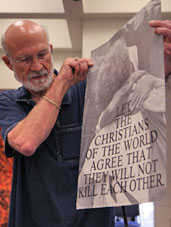
‘”We’re all congregationalists now.” I don’t particularly like it, but we are. How to ensure given that reality that Eucharistic assemblies are not separate from each other is one of the great challenges before us. The role of the bishop is very important to make sure that Eucharistic assemblies are not isolated from one another. There are also other ways to do it. Certainly sending people from one congregation to another helps. But how we recover Christian unity in the world in which we find ourselves is a deep challenge. By “unity,” I don’t mean just agreement about ecclesial organization; I mean the refusal of Christians to kill one other. I think that the division of the church that has let nationalism define Christian identity is one of the great judgments against the Reformation in particular’.

‘Christians have to engage the world in which we find ourselves. We’re in love with the world because God is in love with the world. Therefore, we want the world to know what God has given us. Of course, I’ve never asked Christians to refrain from being politically engaged. I just want them to be there as Christians. What it means to be there as Christians is to be shaped by the body and blood of Christ, which has been done for the world. The closing prayer after our Eucharist celebration includes: Send us now into the world in peace and grant us strength and courage to love and serve you with gladness and singleness of heart through Christ our Lord, Amen. How could that be a retreat? I can’t imagine how the Eucharist can be self-containing if you’re sent out from it’.

– Stanley Hauerwas & Andy Rowell, ‘The Gospel Makes the Everyday Possible’.

On the cost and grace of parish ministry – Part V

Carol Howard Merritt’s recent piece on What Causes Pastors to Burnout? concludes with a sobering challenge: ‘It is clear’, she writes, ‘that we cannot continue to train so many people and have them leaving the profession after a couple of years’. And then she asks: ‘So can we begin to imagine churches in which pastors can flourish? How can we communicate these problems to our congregations? What can we do for pastors who are starting out that might ease some of these tensions? What do you wish someone had done for you?’

I recently posed these questions to a group of fellow Presbyterian ministers here in Aotearoa New Zealand. They spoke of churches having a ‘Christendom mindset, rather than a missional one’, of the need for better leadership development, of the benefit of team ministry and of the indispensability of collegiality, of not taking oneself too seriously and remembering that ‘ministry is not all about you and what you do, but about who God is and what God is doing in Christ’, about having a realistic sense of the time and of the times we live in, about the fact that ‘ministry is not at people but with people’, and about why conflict with, and grumbles about, others and ‘the church’ often escalate because of a leader’s ‘trying to bully people into something different rather than working alongside, building trust, and finding a way ahead that is appropriate for the people of that place and time’, and that ‘too often ministers (and sometimes the people) embark on a totally unrealistic set of expectations’. Others spoke of the need for time out, of study leave provisions fostering learning, reflection and refreshment in ministry, and of the requirement for professional supervision which ‘provides a useful context in which to reflect and if need be to vent off some of the pressures and experiences we have in ministry’. There was also the suggestion that there might be value in gathering ministers together in order to reflect together on ministry: ‘I wonder if a facilitated discussion might be a useful way to give us an insight into wider ministry and to identify common difficulties and challenges. Perhaps a small investment in this may be a real value to people in ministry and help avoid the personal loss they and their families feel, and the cost to the wider church of people leaving ministry because of burnout’. This latter point picks up on something else that I’ve been giving some brainstorming energy to of late; namely, the desirability of developing regional or presbytery-based workshops (say 3 times/year) for re-fuelling teaching/ruling elders and other leaders via facilitated discussions which address pastoral, theological, devotional and missiological topics and upskilling. I saw this work with much benefit in Victoria where the Baptist Union ran semi-regular Rev Up! seminars, and wherein the real value (as I saw it) was in the way the gatherings sponsored a stronger sense of community and mutual accountability in the church (and clergy) family, and discouraged the professional isolation, burnout, disconnectness, and what we might call a lack of stimulation or imagination in pastoral ministry. It also was concerned to encourage an increase in theological literacy among church leaders. All around copious amounts of good coffee and fresh muffins.

But I digress. One of the ministry interns that I have the privilege of teaching and learning from also weighed in on the conversation. He was concerned particularly with a quote that appeared in another piece that I had drawn attention to – Paul Vitello’s article ‘Taking a Break from the Lord’s Work’, which ran in The New York Times. This intern was particularly concerned with Vitello’s claim that pastors ‘tend to be driven by a sense of a duty to God to answer every call for help from anybody, and they are virtually called upon all the time, 24/7’. It is the sense of ‘call’, here secularised as ‘duty’, that grabbed his attention: ‘That word [call], I’m sure, has been central to all of us as we wrestle with what it means to be a minister of Word and Sacrament. My experience so far in my internship placement is that while a slightly nebulous understanding of call is spoken about with regards to ministers, members of my congregation at least do not associate that word with their own journeys.  Rather they speak often about their Christian duty (and that of others). Now, I’m not meaning to suggest that “call” and “duty” are mutually exclusive concepts, but I do wonder how much a sense of the call of God to all believers (ministers included) is replaced with a sense of individual duty where the roles of clergy and laity are qualitatively and quantitatively different’. Another suggested that Vitello moves ‘much too easily from the disputed and diverse causes of the problem to the very individualistic solution of “time out”‘, and that ‘often the pragmatic solution is the way to avoid the broader issues which surround the whole institution of ordination and the perspective on the world assumed by it’. These fellow ministers are onto something really important here; something that I think that Hauerwas too may be able to help us with (this recent address is just one example), and to which I hope to return to in a later post.

According to Brad Greenberg, ‘Part of the problem … stems from the fact that once a pastor has invested in his or her career, it’s exceptionally difficult to make a career change when burnout occurs. You don’t have to believe the law is just to be a high-earning attorney. But when a pastor’s faith slips, there really isn’t anywhere for them to turn’. By the way, Rowland Croucher has a helpful piece on Stress and Burnout in Ministry that’s worth checking out.

Another minister shared some findings from his own research on this topic undertaken a few years ago which suggested that there is a high likelihood of burnout when (i) the workload doesn’t meet the expectation/capability; (ii) there is a lack of reward (not just financial); (iii) there is a lack of control and autonomy; and (iv) there is a loss of a sense of community. Also, iIn her study leave project, ‘Ministry unplugged and restrung: Making time a sacrament – interior practice for ministry in the world’, Diane Gilliam-Weeks, a Presbyterian minister, argued that unless we build sound spiritual disciplines into our expectation of ministry then church leaders will continue to collapse under the pressure that these disciplines were given to combat: ‘The disciplined practice of contemplative prayer provides not only opportunity for increased intimacy with God, but daily time and space in an attitude of consent and surrender in which to rest, refocus and recharge batteries while God works on us’. She continues:

‘I observe that many of my brothers and sisters in ministry continue to be unknowingly driven, not by the model of Jesus who frequently went off by himself to a quiet place, but by cultural and familial programmes for approval and security. Consequently many feel haggard and victimised by the considerable demands of ministry and some are forced to take time off to recover from burn out or leave ministry in despair and disappointment.

Today our theological and ministry formation in the PCANZ is in my view outstanding. However, it’s my observation that while our ministers have a well integrated intellectual appreciation of the faith, they may lack the disciplines for developing an ever deeper intimacy with God that transforms the whole person. They have little or no familiarity with what the ancient church used to call ‘the three Vias’. [via purgativa, via illuminativa, and via unitiva.]

This is why I’ve come to the conclusion that any curriculum for ministry formation which does not have a place for the history and practice of contemplative prayer is incomplete and inadequate’.

◊◊◊

Other posts in this series:

On the cost and grace of parish ministry – Part IV

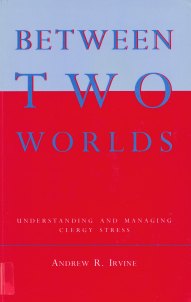
Andrew Irvine’s book Between Two Worlds: Understanding and Managing Clergy Stress (London: Mowbray, 1997) is a helpful study on a number of fronts. As the book’s title suggests, Irvine argues that ‘often behind the “masks” of office hides a person caught in two worlds between the authenticity of personhood and the role and expectation of office’. He asks, ‘With whom can this tension be shared? To whom can the inner doubts, fears and even “sins” be disclosed? Are others, whose masks seem more authentic than ours, invaded by these same realities in their lives?’ (p. xiii). The book examines the personal world of pastors and the factors which contribute to a ‘profession fraught with tension and subject to excess stress’ (p. xiii).

Irvine begins, in the first chapter, by identifying and discussing some of the biblical, historical, societal, and personal factors that shape the foundation for pastoral ministry before turning, in Chapter Two, to discuss both the positive and negative, and internal and external, features of stress. Among the internal features he names ‘success issues’, ‘sexuality’, ‘guilt’, ‘perfectionism’, ‘theological issues’, ‘identity issues’ and ‘authority dynamics’. I found his observations on the last two in this list, in particular, to be the most significant.

Irvine, who completed his PhD dissertation on ‘Isolation and Pastoral Ministry’ (St Andrews, Unpublished, 1984), had already hinted at the magnitude of identity in his Introduction where he noted that often, caught up in the trappings of office, it is the minister who, forgetting his/her own humanity, imposes the stress of non-being. And here he draws on the work of Carl Jung, who in two articles on the ego, warns of ‘the danger of over-identification with the “role” of an office and, in that act, the forgetting of the identity of the total self with all the intrinsic value of the inner person’ (p. xii). Later on, Irvine cites again from Jung’s well-known 1953 essay ‘The Relations Between the Ego and the Unconscious’ (published in Two Essays on Analytical Psychology, Collected Works 7; London: Routledge and Kegan Paul), recalling how, for Jung, an individual can become trapped behind mask of a persona and thereby ‘takes a name, earns a title, represents an office, he is this or that’ (Jung, p. 156, para. 246). In other words, there is the danger of one’s identity becoming to greater or lesser degree ‘synonymous with the “role” of office, from which many cannot escape. In all functions of life, at least those visible to the outside observer, the clergy may be “Reverend So-and-So” or “the minister at Saint James”, the “woman minister from St David’s”, and so on’ (p. 28). In support, Irvine cites from psychiatrist Robert McAllister who, in 1965, penned the following observation:

The clergyman seems to me to be constantly involved in his environment in a way that does not characterize any other profession or vocation. He develops an overworked sense of identity with his clerical role. He cannot be anything but a clergyman at anytime, whether he is on vacation or at work or in the privacy of his room. A physician, a lawyer, a bricklayer, a carpenter … can be something else, can get completely away from his profession or trade.

And Irvine suggests that the problem ‘is even greater for the spouse of the clergyperson who becomes a second-string description, “the husband/wife of the/our minister”’ (p. 28). He continues: ‘All of this raises a multiplicity of questions of identity for the clergy. Not least of these questions is how the individual, that person behind the mask/persona, can find true relationship which nurtures and strengthens. In the loss of personal identity which occurs when relationship is predominantly based on office or role there is the anxiety of unfulfilment and the inner self becomes starved for healthy depth interaction. A false identity is established based on role, where in desperation the individual seeks fulfilment and relationship. Not only is the stress of loss of personal identity great in itself, but it disallows opportunity to alleviate pressure through expression of inner need, desires, doubts and fears’ (p. 28).

On the related-matter of authority dynamics (relating to issues of control and loss), Irvine notes that ‘this is not an easy question to address with clergy, for pietism looks unfavourably on such things in ministry’ (p. 29). He confesses that the desire for power and authority is a part, if not a controlling aspect, of our make-up, and that the milieu of the Church does not guarantee an exception to this. The question of authority – and its loss – is especially pressing, he writes, ‘in a world where more and more people are highly educated’ and where ‘a greater responsibility for decision making is encouraged in the workplace and a more “businesslike” way of doing things has evaded and in some cases replaced the “spiritual” procedures of the past’ (p. 29).

These all constitute what Irvine calls ‘internal features of stress’. The mirror side – the ‘external features of stress’ – are also named: ‘personal space’, ‘societal pressures’, ‘relational dynamics’, ‘colleague dynamics’, ‘vocational demands’, ‘family issues’ and ‘theological issues’. Concerning the latter, I shall say more in later posts. But here I wish to draw attention to what Irvine says about ‘vocational demands’. Irvine notes that it seems as though pastors  are particularly at risk of over-identification with the tasks of ministry which mean that life’s stresses converge with vocational stresses and the all-consuming tasks of ministry. When this occurs, the issues of family, societal demands and other personal requirements intersect and may become ‘overshadowed by the factors of vocation’ (p. 35). He proceeds to identify three separate sets of expectations which serve as a source of conflict: (i) the actual expectations of the faith community; (ii) those that lie within the pastor themselves; and (iii) imaginary expectations.

On the first of these, Irvine notes that the expectations of church communities are both diverse and dependent on those things which have served to shape its membership. ‘In fact, the diversity of expectations is so great’, he suggests, ‘that the task of fulfilling all, in most cases, would be nigh to humanly impossible. Even the more official expectations of the church, those which originate from the appointed boards of the church, originate from those things which have shaped the board/committee and their vision for ministry through that church in that community’ (p. 35).

On the second, namely those expectations that lie within pastoral practitioners themselves, Irvine contends that each pastor will ‘have their own expectation as to what constitutes ministry and the way in which they see their personal gifts for ministry being utilized specifically within that church and community. Again this originates from those factors which have shaped their vision of ministry and probably to a large degree their training and experience’ (p. 35).

The imaginary expectations, the third named, are the ‘assumed expectations that the clergy thinks the church expects of them’. These may, Irvine insists, ‘be based on the comments or insinuations of a few, an isolated occurrence or may be purely illusory. These are often the factors which drive the clergy the hardest and prompt the comment “He/she is his/her own worst enemy”’ (p. 35).

Irvine also suggests that despite the middle-class nature of Christian communities, pastors are ‘often placed in a position of living beneath the level of both parishioners and community’. The continuing tradition of church-provided housing places ministers in ‘a position of having no equity in the real-estate market, often making retirement, and the anxiety of approaching retirement, difficult. The whole monetary aspect of the ministry brings with it considerable difficulty’ (p. 36).

As tempted as I am to do so, I don’t want to précis the entire book here. The remainder of the book, which I commend, attends to the following topics: The stresses that attend a lost and changing identity, the unique stresses that attend being a woman in ministry, the risks that attend various levels of relationship, the problem, types and root causes of isolation, issues of sexuality and identity, of stress in the vicarage and the dynamics that attend family life and needs, the quest for identity and wholeness, issues of integrating perspectives of exteriority and interiority, spiritual development, models and systems of support, and matters of self-assessment and balance.

I do, however, want to draw attention to Irvine’s very basic words on the discipline of journaling, some of which I found helpful, not least because I have recently taken up journaling again after many years of looking at a closed book and of discerning that blogging is no substitute for the practice.

Irvine begins by noting that journaling is an ancient Christian practice – from the apostles who kept records of their journeys, encounters and conversations, to Augustine’s masterful Confessions. Irvine understands journaling as ‘a tool of self-measurement which, when properly used, chronicles for us the place of beginning against which we measure progress and, ultimately, ending. Without this measure, movement becomes indiscernible except in broad terms and predominately external components. For instance, we can recall early years of ministry in terms of major events and movement, but lose much of the sharpness of the cutting edge of our thought which motivated those actions during that time period. So soon we forget the impact of the moment with all its joys and pain’ (p. 192).

And journaling, he insists, helps in other ways too: ‘There is always a discrepancy between what we think we do or have done, and what actually has transpired. For instance I may think I balance my time well on sabbatical between the research, writing, speaking engagements, conference presentations, goal setting with colleagues and the sabbath rest badly needed. My journal records soon revealed that my tendency towards being a workaholic has short-changed the sabbath rest and that there is need for readjustment’. Journaling can, therefore, be both ‘brutally revealing’ and ‘absolutely essential’. He continues:

Journal keeping also records significant thoughts, emotions and reactions as one interacts with the diversity of life. Written in the aftermath of such actions it records how one’s life and faith interacted. It is in that interaction within our own lives that depth of understanding comes, enabling us to provide care and concern for others. It is the record of our journey, common with all humanity, which allows the empathy to interface with the lives of others. (p. 193)

Irvine then offers some advice pertaining to setting up a journal. He talks – against the advice of some spiritual directors – about making journal keeping ‘a habit’, of seeing journaling as part of a daily spiritual exercise, and of keeping it simple: ‘Simplicity and a process that is user-friendly is the key to sustaining a journal. For the computer literate such records can be recorded and stored by that means. The more traditional method of utilizing a notebook works for some while for others the ease of writing on a computer and the tangible form of the hardcopy has led to the use of ringbinders for computer print-offs. Whatever works for the individual is best’ (p. 194). For what it’s worth, there’s no way that I could journal on a computer. I need paper, heavy paper, and preferably a fountain pen and/or a 4B pencil.

Whatever the process used, Irvine properly notes that confidentiality and security remain essential, and he also addresses the question of the final disposal of the journal, whether before or after one’s death: ‘each person will need to determine their own process for this. Some have commissioned a trusted friend to dispose of the documents in the case of death while others have recorded their request in a will along with all other dispersal of property. This is personal, but needs to be considered’ (p. 194).

Irvine also encourages that rather than keeping a ‘general journal’ that each time period be considered in the light of certain guided questions which, he believes, will ‘assist in identifying the matter of balance in each time period’ (p. 194). Similarly, he notes, specific sections of the journal may be kept for theological insights, biblical reflections, goal setting or any such area as is deemed helpful by the recorder: ‘The journal will contain both the record of the task of ministry and the personal journey of the individual. It should be remembered here that the assessment is of balance and a sense of wholeness of being. The record of doing is important, but equally so is the record of reflection and inner discovery’ (p. 194).

I confess to finding this stocktaking approach to journaling brutally sterile and promoting of a form of individualistic and anthropocentric navel-gazing that is, among other things, bad for the back, and I find myself reaching for the trump card that Irvine himself provides; namely, ‘Whatever works for the individual is best’. But Irvine offers the following framework as a guide, and that birthed from much experience, and so I reproduce it here by way of encouragement to those for whom such a template may be more inspiring:

Daily Journal

(Record under separate headings)

[1] What occupied most of your time today?

[2] What is/was your predominant feeling as the day came to a close?

[3] What provided you with the greatest sense of satisfaction?

[4] What was the greatest source of frustration/anxiety?

[5] Describe time spent with family and in personal relationships.

[6] Did you find time for your own personal space for relaxation, exercise and rest?

[7] What challenged your thinking?

[8] What was your source of spiritual renewal today?

[9] Other comments or observations on the day:

Weekly Journal

(Record a short weekly review at the end of each week)

[1] What seem to be the predominant factors/issues of the week?

[2] What, upon reflection, was the greatest accomplishment of the week?

[3] What provided the greatest sense of frustration?

[4] What building did you do during the week of relationships with family, friends and others?

[5] What spiritual renewal/strength did you receive during the week and from what source did this come?

[6] What stewardship was exercised over your physical being?

[7] Were there aspect(s) of your life neglected during the week? If so, which? Why?

[8] Other comments or observations on the week:

Monthly Summary

Using the weekly summaries for reflection, complete a short monthly review using the guide questions as outlined under the heading for Weekly Journal.

I conclude this post with Kafka: ‘I won’t give up the diary again. I must hold on here, it is the only place I can’. [Franz Kafka, I Am a Memory Come Alive: Autobiographical Writings (ed. Nahum Norbert Glatzer; New York: Schocken Books, 1974), 21]

◊◊◊

Other posts in this series: