Author: Jason Goroncy

Rules of the Church Choir

A couple of times a year, I find myself getting roped into singing in the church choir. Now don’t get me wrong; it’s not that I don’t enjoy belting out the odd tenor line from time to time. I can even cope – just – with the early Sunday morning practices. It’s just that, even with the bribery of fresh coffee involved, I never know exactly why I’m there, and how to conduct myself appropriately – i.e., in a manner worthy of a church chorister – when I am there. So it was no small thing when I discovered one Sunday morning, sticking out from among old songbooks shoved behind the largely-abandoned organ, that our church’s choir actually has some time-honoured ‘rules’ and ‘hints’. It would seem that these ‘rules’ and ‘hints’ have been lovingly authored by a certain Mr W. Paget Gale (the one-time organist and choirmaster) and Mr W. S. Mitchell (the one-time secretary and treasurer of the choir), and that under the holy guidance of the Rev A. C. W. Standage, M. A. To be sure, the august rabble with whom I am periodically gathered to sing carols, hymns and spiritual songs seem, at least in light of these ‘rules’, to be the most antinomian of Presbyterians. But, to be fair, they probably haven’t ever had presented to them Mr Gale’s and Mr Mitchell’s riot act ‘Rules of the Church Choir’.

So, without further ado, here they are:

I’ll consider it my mission to make these wise and life-giving practices of grace clear to our current choir mistress; one who is, by every measure, extremely talented, but who is herself clearly a little sloppy when it comes to doing choir ‘decently and in order’ – not that she has an easy crew to work with!

‘Lament for Her Absence’, by John Paisley

Since you have gone
my world is shattered like a pool
tormented by stones. In every place
I wear a thread-bare coat
of loneliness and underneath
the mid-day sun I shiver
inwardly. At night the moon
grows cold, the stars malicious.

Since you have gone
I scan in vain the endless
crowd seeking your face
and daily haunt the places
where I shared your company.
Distance is meaningless
for no step brings me nearer you
or further from you. Time’s
mechanism jammed, each hour
hangs like a heavy cog
around my neck.

Since you have gone
I cannot quiet the restless
harbour of my heart. My hands
hang helpless by my side
nor can they wind the clock
of days to your arrival.
All things stand sombre;
frozen in the still grey
light of evening,
And even in these lines
something is missing.

John Paisley

Paul Fiddes on why we speak of God as ‘Trinity’

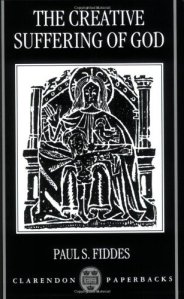
‘We only speak of God as Trinity, as a complex of relationships, because we find God revealed in the cross which involves a set of relationships. When we ask, “Who is God?” we are confronted by an event which we can only describe in relational terms: we speak of a son relating to a Father in suffering and love. There is a son crying out to a Father whom he has lost (“My God, why have you forsaken me?”) and so there is implied a Father who suffers the loss of a son, with a Spirit of abandonment between them. At the same time as they are most separated they are most one, for they are united in loving purpose: in love the Father gives up the Son and in love the Son gives up himself for us, and the Spirit of love is between them. In these relationships the world and human beings are necessarily included, and any other Trinity is a spinning out of hypotheses. It is for us that the Father gives up the Son to death, and so the “for us” is included in whatever is meant by the eternal begetting of the Son by the Father. There can be no self-sufficient, self-contained society of the Trinity, for God has not chosen to be in that way’. – Paul S. Fiddes, The Creative Suffering of God (Oxford: Clarendon Press, 1988), 123.

‘Simpler Pastoral Education for Simpler Times? A modest proposal’

As the Dean of Studies for my teaching institution, part of my responsibility is to advise and educate my denomination (and others) about the academic requirements that our church has set for its own ministers – for those about to begin their training, for those who are obligated by their ordination to engage in ongoing learning, for those ministers who are seeking to join our church from outwith, etc., etc. Unfortunately, there’s hardly a working day that goes by when I don’t feel ‘the squeeze’, when I am not having to resist the calls (and those not only, and occasionally not at all, from students) of dumbing down that John Stackhouse describes in this recent piece published in Faith Today:

Isn’t it great pastoring has become so much easier nowadays, so much less challenging than before? Now, if only theological education would clue in and change accordingly!

Andrew Walls, the great Scottish historian of world missions at the University of Edinburgh, notes how academic requirements for British missionary candidates rose during the 19th century. Missionaries who were to move to China or India – and learn those languages, understand those cultures, and connect the Christian faith properly with those complex religious and philosophical traditions – needed a broad and rigorous education. At least a university degree in the humanities was demanded plus specific missionary training.

Into the 20th century, major Canadian denominations continued to expect a university degree in the humanities or social sciences plus a degree in theology for their clergy here at home as well. “BA, BD” (Bachelor of Arts, Bachelor of Divinity) became the standard for Anglicans, Lutherans, Presbyterians, Methodists and later United Church pastors, with similar training required of Catholic priests. And as educational levels increased among the Canadian population at large, especially  after 1960, smaller evangelical denominations raised their expectations accordingly. Bible schools turned into Bible colleges, and increasingly a seminary qualification – the Bachelor of Divinity, now relabelled a master’s degree (MDiv), although otherwise largely unchanged – was expected on top of a university diploma in something, if not always in a relevant discipline.

Nowadays, however, leaders of certain popular churches in the United States and Canada mock the “semitaries” that supposedly neutralize rather than “release” the holy entrepreneurship characteristic of their kind of religion. Seminaries themselves are cutting degree requirements, paring back on biblical languages, church history, doctrine, and other apparently optional courses so students can finish more quickly and cheaply.

In fact more and more institutions are trumpeting the virtues of online learning in which you don’t have to leave home at all but can read books, listen to lectures and write assignments (when you can make time), with episodes of Skyping or Tweeting or Facebooking to compensate for the loss of sustained and reinforcing contact and conversation offered by traditional (= “old-fashioned”) schools.

It is interesting to compare the rise and decline of pastoral education with the continued rise of medical education. There wasn’t all that much physicians could do to help before the age of antiseptics, anaesthesias and antibiotics. But as the 20th century dawned, medical training increased apace, until by mid-century a physician was expected to undertake half a dozen years of university level training plus at least a year of interning before practising independently, while specialists studied for years more. Medical challenges have always been huge, and as medical knowledge grew, we expected our physicians to grow with it.

Happily, however, pastoring apparently isn’t like that. No, pastoral challenges in Canada today have greatly diminished. You’ve noticed that, haven’t you? Canada is becoming a more and more ethnically uniform country, so pastors need no longer know how to understand different cultures – say, those of India or China.

Canadians are attending post-secondary education less and less, so we don’t need a similarly educated person to help us co-ordinate the gospel with our lives. Just give us a charismatic speaker with great storytelling ability and a big heart.

Biomedical issues, political challenges, cultural currents, financial questions, technological innovations – everything is much, much simpler to understand today, so our pastors can be simpler people too.

Yes, let’s expect less of our clergy and theological schools. Let’s demand, in fact, that seminaries reduce degree requirements, lower standards for their professors, drop their tuition charges accordingly and give our next generation of pastors what they need – an education that is cut-rate, compromised and convenient. (Read between the lines of some of those seminary ads. That’s what they’re offering.)

Sure, those who care for our bodies need the best education we can possibly afford to give them. Can you imagine entrusting yourself or your child to a physician who learned medicine online? The idea is scandalous.

But what about those who teach us the Word of Life in the era of the Internet, the global village, multiculturalism and secularization? Do pastors need intellectually rigorous education anymore?

Do they?

As I see it, this is not a fight born of the triumph of modernity’s confidences. It is a fight born of the best of pastoral, theological and missiological instincts and is undergirded by a conviction that what old-time Presbyterians used to refer to as ‘an educated clergy’ is still one of the best gifts that the church can give to itself, and so to the world. And as I have noted earlier on this blog:

And as for ‘educated clergy’, Carnegie Samuel Calian (who is President Emeritus of Pittsburgh Theological Seminary) put it well when he reminded us that ‘Everything we learn at seminary is for someone else … The aim of seminary education is not simply to produce an educated clergy, but even more so to build up the people of God to become an educated congregation in Christ. The practice of learning is for the purpose of giving hope to others’.

It is precisely for this end that pastors must be readers. So if pastors don’t want to read for themselves (which is a completely ridiculous position to hold, but is evidently possible), then they ought to read, read and read for those they have been called to love and serve.

Thanks to Terry Wright and to Amanda MacInnis for drawing my attention to John Stackhouse’s piece, and for Amanda’s own perceptive comments on this issue.

Evangelical Calvinism

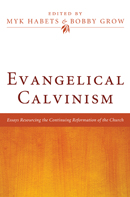
Congratulations to Myk Habets and Bobby Grow on the bringing to birth of Evangelical Calvinism: Essays Resourcing the Continuing Reformation of the Church. It’s good to see this baby come full term. The Table of Contents reads:

Prologue: Union in Christ: A Declaration for the Church. Andrew Purves and Mark Achtemeier

Introduction

1: Theologia Reformata et Semper Reformanda. Towards a Definition of Evangelical Calvinism. Myk Habets and Bobby Grow

Part 1: Prolegomena – Historical Theology

2: The Phylogeny of Calvin’s Progeny: A Prolusion. Charles Partee

3: The Depth Dimension of Scripture: A Prolegomenon to Evangelical Calvinism. Adam Nigh

4: Analogia Fidei or Analogia Entis: Either Through Christ or Through Nature. Bobby Grow

5: The Christology of Vicarious Agency in the Scots Confession According to Karl Barth. Andrew Purves

Part 2: Systematic Theology

6: Pietas, Religio, and the God Who Is. Gannon Murphy

7: “There is no God behind the back of Jesus Christ:” Christologically Conditioned Election. Myk Habets

8: A Way Forward on the Question of the Transmission of Original Sin. Marcus Johnson

9: “The Highest Degree of Importance”: Union with Christ and Soteriology. Marcus Johnson

10: “Tha mi a’ toirt fainear dur gearan:” J. McLeod Campbell and P.T. Forsyth on the Extent of Christ’s Vicarious Ministry. Jason Goroncy

11: “Suffer the little children to come to me, for theirs is the kingdom of heaven.” Infant Salvation and the Destiny of the Severely Mentally Disabled. Myk Habets

Part 3: Applied Theology

12: Living as God’s Children: Calvin’s Institutes as Primer for Spiritual Formation. Julie Canlis

13: Idolaters at Providential Prayer: Calvin’s Praying Through the Divine Governance. John C McDowell

14: Worshiping like a Calvinist: Cruciform Existence. Scott Kirkland

Part 4

15: Theses on a Theme. Myk Habets and Bobby Grow

Epilogue: Post Reformation Lament. Myk Habets

Preaching and the virtue of untidiness

Recently, I read Thomas Long’s What Shall We Say?: Evil, Suffering, and the Crisis of Faith. In some ways, the book promises more than it delivers. Where it does deliver, however, is with Long’s persistent reminder and call that ‘preachers do not have the luxury of dismissing in the pulpit a serious question that arises from the pews’. I love that. Given Long’s proven track record in writing some of the best books on preaching around (although my favourite of his books remains Accompany Them with Singing), it is perhaps unsurprising that some of the richest insights shared in What Shall We Say? have to do with preaching. Here’s a taster:

‘Sometimes people assume that preaching works this way: a preacher prepares a sermon during the week, finishes it at some point – maybe Friday afternoon or Saturday night – and then gets up and preaches the finished product in worship on Sunday. This may be the way it appears on the surface, but experienced preachers know better: sermons are never actually finished. There are always loose ends, questions that could have been pursued in more depth, stones left unturned, intriguing aspects of the biblical text unexamined, thoughts not quite fully baked, an untidiness at the heart of things. At some point, though, preachers have to take what they have, stand up, and speak. Preachers do not preach because the sermon is finished; they preach because it is Sunday. The time has come.

That sermons are never finished is actually a good thing. Sermons get presented in incomplete form not because of procrastination or negligence – not most of the time, anyway – but because preaching mirrors the character of faithful theology and of the Christian life itself. Karl Barth once described God’s revelation as “a bird in flight.” By the time we have paused to snap a photo, write a systematic theology, or craft a sermon, the bird has flown on. “All theology is provisional,” said theologian Arthur C. McGill. “It is the movement … from darkness toward the light, so that as movement no point along its way has permanent or final validity.”’

– Thomas G. Long, What Shall We Say?: Evil, Suffering, and the Crisis of Faith (Grand Rapids: Wm. B. Eerdmans, 2011), 114.

‘Jacob Recalls the Fight at Peniel’ by John Paisley

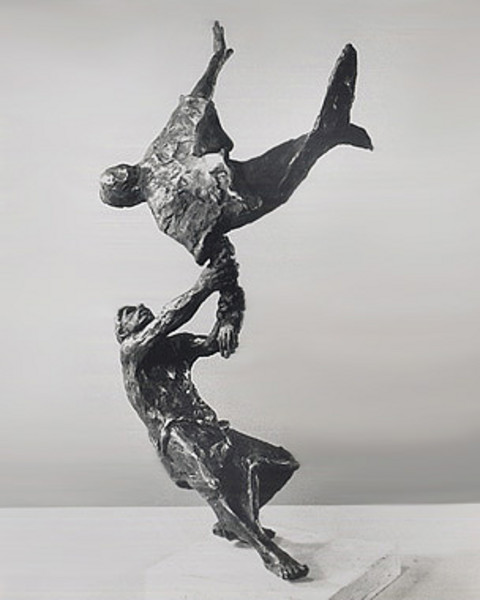
‘Jacob Wrestling with the Angel’, by Don Saco

Upon that night the others were away –
Wives, children, all the troubled world
And I was there alone and quiet until he came
Unheralded, mysterious. As one awaking from a dream
I knew, at first, only that I struggled, then slowly
Grew aware of my antagonist, a dark one
Naked to the waist with gleaming skin,
With well-proportioned form. Then when his face
Came near, I saw his bright and piercing eyes,
A brow majestic crowned with flying hair.

All night I wrestled with him on my bed of earth
And stronger were his limbs than any man’s.
And as we twisted, muscles growing taut
And bodies seeping, his breath was hot, his touch
Like fire, a torment. He closed about me like
A night with clouds, and at the bottom of a
Dizzy gulf he wounded me.

………………………………………I fought him
With super-human strength, instinctively,
Nor could I tell if it was fear or hope
That drove me on. He seemed to hold me in
His power, yet overcame me not. Then as the light
Began to glimmer in the east he bore me upwards
As an eagle bears her young and all the earth
Fell reeling far beneath and as we rose
The air was parting. And there he left me, lonely
On a crag, to vanish nameless.

………………………………………But when the risen
Sun had turned the rocks to gold and earth
To green, it shone at last on me. I found
Both joy and pain and could not separate
The two, yet humbly thanked him for a prize
Worth wrestling for on any night;
All nights ’till break of day.

And in the wake of his feet/The desert will bloom

Earlier this week, I was reflecting on Luke 4.1–13. Three things struck me:

  1. The Spirit who confirmed Jesus in such a public manner at his baptism (i.e., his coronation as king) where his complete identity with estranged humanity was so shockingly made public now led him away from the crowds and into the wilderness.
  2. This movement from public to aloneness, and from fulness to famishment, does not represent an abandonment of his calling and identity to be the God who is with and for us, but precisely the reverse; it is God going deeper into the human situation. Here is God entering into the depths of humanity’s estrangement and famishment and recalcitrance and doggedly refusing to be estranged and famished and recalcitrant in it. Here he is, standing on humanity’s side, as it were, and refusing the way of humanity turned away from God – of refusing to live by bread alone, of refusing to compromise the exclusivity of worship and service which is due to God alone, and of refusing to put God to the test.
  3. By recapitulating the same series of temptations that Israel faced in the Sinai desert and yet responding with faith rather than with distrust, this true Israelite and second, or last, Adam is actually bending humanity back into our true relationship with God. In other words, Jesus is in the desert for the same reason that he was standing in the Jordan River – for us!

In a recent post, I drew attention to the Dunedin poet John Paisley. He was certainly someone familiar with the experience of wilderness. Sometime during the 70s, he penned ‘Forty Days and Forty Nights’ wherein I think he gave voice to his belief that there was not only some deep connection between his own life and that of the One who was led by the Spirit into the wilderness, but also something of the truth that the triune decision that Jesus become our vicarious Saviour brings about a situation that the Son needs to not only be deeply embedded in the human plight but also and equally be the one who stands alone before God. Here’s the poem:

‘Forty Days and Forty Nights’

He has gone out from us
Into a place where no roads are,
And at each tired step over
The sand and among the sun-warmed
Rocks, he looks for the road
Which only he shall tread.

He has gone out from us
And left us in the bustling market
Or the crowded streets, building
Our thoughts like bridges
Over an abyss of hours, feverish
And furtive, caught between
Means and ends, slaves
At our towers of air.
There in a wasteland out of
Bricks that we rejected he will build
Walls to outlast all time.
There he will face, alone, dark-hooded
Thoughts by day and night,
And he shall not eat
Till he has won the bread
Of suffering, and he shall not rest till
He has given up the sleep of men.

He has gone out from us
But he will come again,
And always as he moves through
Coast and day, demons will fall
Before the swords of angels,
And in the wake of his feet
The desert will bloom.

‘Christmas’, by John Paisley

As promised in my previous post, here’s a poem by John Paisley. It’s titled ‘Christmas’:

Out of a light preceeding
Light, into a darkness which is ours,
A spark, an ember from His fire
Falling, breathed on by lips invisible,
Fuel for a furnace tended by
Viewless hands and deep
Inside, molten like steel,
Plastic like clay,
This glowing, throbbing lump,
This helplessness, this
Hope, this fancy.

Did the mountains bow their peaks
Aged with snow, or the black
Earth heave for joy?
Did the rivers pause in their
Headlong rush to the sea?
Nothing spoke the immutable
Hills or the sky,
And the world moved on
Relentless, making its money and its
Love, minding its own business.
Even that brilliant star tracking
Across the night was observed
By few, and three unknown
Astrologers in a distant land were
All that thought to follow it.

Out of a light preceeding
Light, into a darkness which is ours,
He came, and still he comes;
Silently, imperceptibly: and
At that moment a world is born
Anew, while knowing nothing
Of its own deliverance.

On discovering John Paisley

The demise of the local book shop is more than a mere kink in the history of civilisation as we know it. It is a sign that the end is nigh, that the four horsemen have donned their stirrups, and that the fiancée of God better get her nickers on and her face spruced up quick smart.

Of course, the sad and dangling sign that reads ‘Closing Down’ also announces an opportunity for the sagacious book buyer to exploit the situation to the absolute hilt, and to put some further pressure on the stumps that hold up that corner of the house where the library is situated.

Such is the situation a mere stones throw away from my study; or at least a stones throw away for someone who possesses omnipotent stone-throwing capabilities. I visited that scene of negation three times last week, and each time feeling somewhat like the grim reaper I have walked out with at least two bags of books – at $2 a book! – evidence, among other things, of one of my many addictions … and of my intelligent tastes.

The first time I stumbled into this sacrament of culture’s demise (as much to get out of the rain as for anything else I’m ashamed to say) I stumbled not to buy, not on this occassion anyway, but simply to smell pages. With the rising waft of wet carpet and the air reeking of the body odour of some forty-something woman who was hogging the self-help section, I was encouraged (is that too weak a word?) to move on to the cookbook section (one of my favourites), and then, just around the corner, as if my nose had discovered the smell of sweet basil for the first time, I was conjoined to the poetry section. ‘Section’ is perhaps too inflated a word to describe what was the smallest collection of poetry books you could imagine in a book shop; there must have been fewer than 30 volumes. But among that lot, two stupefied my cornea – Roy Fuller’s Owls and Artificers: Oxford Lectures on Poetry (not technically a book of poems, but when the pickins is slim and all that) and Collected Poems by a Dunedin-based poet that I had never heard of, a man by the name of John Paisley.

After reading the first few dozen poems by Paisley, I was intrigued and I wanted to know more about their author. To be sure, it’s not that all of his poems are wonderful – they aren’t; but there’s something about Paisley’s spirit that gripped me last week, and since too. I want to know more about this man, and the more I find out, the more fascinated I am, and the more I want to know. Thus far, here’s what I’ve been able to find out about John Paisley: He was born in Wellington in 1938; four years later his family moved to Dunedin. He attended Waitaki Boys’ High School and then the University of Otago, where he completed an MA in English on the poets Charles Brasch and James K. Baxter (to whose memory he penned the poem ‘Community at Jerusalem’). He commenced training as a Presbyterian minister at Knox College (where I work), but had to withdraw due to ill health. His sister, Dawn Ross, in a wee introduction to his Collected Poems, described her brother as ‘an eccentric person’ and as ‘different’. He later travelled to and lived in a variety of places, and held down a number of jobs. He wrote numerous poems and performed at poetry readings. He had one poetry collection (This Night in Winter) published during his lifetime, and two further collections were published following his death (Vigils and Collected Poems).

In a short essay, ‘Commentary on Religious Poems for Reading’, Paisley describes his own work as a poet thus:

I make no claims to be a religious poet myself. If anything, I am perhaps a poet who writes the occasional religious poem. But while most of the time my attention and my writing is taken up with other and more secular concerns, my religious poetry is important and significant to me and my development, both as a person and as a writer. It is not without significance that when many years ago I lost contact with reality for a few weeks altogether, I attended a party at the house of a friend and for sometime recited a long religious poem (spontaneously composed) to a room full of surprised and eventually indifferent guests. The poem is not among my papers, and I have no memory of having ever written it. But the fact that even in the state of insanity, my preoccupation was a religious one, speaks volumes in itself.

And about poetry itself, he writes:

It is easy for us to forget in the 20th century how closely the poetic spirit and vision is bound up with religion. In our tradition – the Judaic Christian one, there is a long line of poets beginning at Moses and the author of the book of Job, with David, Solomon and Isaiah, Jeremiah, Ezekiel and the other prophets and ending i with Jesus and St. John. The Bible was only the beginning, the list is endless and will only mention one now – St. John of the Cross – the beauty of whose poetry approaches the angelic.

Poetry in general and religious poetry in particular has at its heart the metaphor, which is a figure of speech where one object comes to represent or stand for another, for example, take William Blake (another great religious poet of last century), who said when he looked at the sun, he saw a choir of angels. It also has at its heart the myth which is a story which has a metaphorical meaning. Nowadays, we have so lost contact with the Poetic vision that we find it very difficult to understand the myths of the past and even more difficult to create our own myths in order to interpret our experience of life, and this disability on our part can become dangerous. When our myths become inarticulate, or we try to live without them, they enter into the dark depths of our subconscious and their presence there becomes a constant source of danger, a smouldering furnace springing up from time to time with the destructive force of a supposedly extinct volcano. Only when our imagination has been captured and put to work in a realm in which it has room to breathe and move, are we in any sense of the word saved from this destruction. A philosophy, ideology, or religion which fails to touch the imagination fails in the end even to satisfy the reason.

In addition to poetry, Paisley also wrote plays, stories and some non-fiction, including an article on Naaman which was published in the ‘Evangelical Presbyterian’ in 1968. He sometimes used one of several pseudonymns; some work is signed Edward Penmore, Jon Darlo Gibealli, Albert Twimmon and Wilfred Penmore. It seems that he only ever had one commissioned piece, ‘Lord Jesus look on this we do’, a poem commissioned by the chaplain at Cherry Farm Hospital (a psychiatric hospital where John may have been a patient), and that that poem has since been set to music by Colin Gibson. From his teens onwards he struggled with mental illness, a condition which was ‘both serious and crippling’. He took his own life in 1984.

As I read the collection through to its end, I discovered a maturing poet and gentle human being, one who moves from an anxious obsession with answers to a deep fascination with and a journey into a vortex of questions, and into the incomprehensibility of human dreaming in search of love and of love’s end, of ‘a purpose [which] holds its ground’.

My plan is to post, over the next few weeks, a number of his poems here at PCaL. To that end, and to kick things off, here’s ‘Credo and Petition’:

I am tired of folly’s smiles,
Of false wax faces in the dizzy gallery,
The image and the paper mask.
And hollow is a chromium gilded heaven:
Hollow like unending, idle bliss beyond the grave.
Give me instead the fateful thunder of the clouds,
Barbed lightning, all that can destroy
And yet bring truth.

Who hourly holds aloft the burning sun
And comes so kindly bearing warmth and life?
He finds me struggling on the steps of my becoming
And shares with me the pain-wracked torturing
Of limbs upon the wooden world.
Of Him I ask now out of hope:
A weeping on the dark, mis-shapen stone of days bygone;
A stamping at the doorway of the beaten earth,
That paths may form and doors may open.

May stations

Reading:

Listening:

Watching:

Afraid of roots and depths …

jorge_mayet_de_misDiscovering the work of Arnold Kenseth – a poet, liturgist and preacher from Massachusetts – has been for me one of the real joys of the past two years. For that discovery I owe a debt to my dear friend Rick Floyd. Four of Kenseth’s books grace my desk at the moment, and one my bedside table. (The loo is spared for CS Lewis books, for fishing and gardening magazines, and for other ‘spiritual’ reading.) All of Kenseth’s books are true friends to those charged with the responsibility of leading public worship, and to those charged with the responsibility of being human and not mere decoration in the world. [Public health warning: Those contemporary readers especially allergic to the use of non-politically-correct language that frequented writing until recently may choose, sadly, to steer clear of Kenseth. But for those of us who can more easily distinguish between a piece of rubber and a shoe, drink deeply!]. Anyway, here’s one of the prayers assigned for this Sunday past:

O God, we live not so much in light or dark as in the gray middle, the muddle, the meager, the half-felt, the half-known, the half-delighted in. Not wanting joy, we are unprepared for sorrow; not accepting sorrow, we are unprepared for joy. Afraid of roots and depths, we have no tree, no height. O Lord, shake down the paper houses that we hide in and spill us out on the ground of thy strength. Unfasten us from fear, and set us free in trust. Undwarf our souls that we may come alive and grow within thy giant love; through Jesus Christ our Lord. Amen.

– Arnold Kenseth, Sabbaths, Sacraments, and Seasons: A Collection of Meditations, Prayers, and Canticles (Philadelphia/Boston: Pilgrim Press, 1969), 51.

Amen indeed.

Image: Jorge Mayet, De Mis Vivos y Mis Muertos, 2008. Electrical wire, paper, acrylics, and fabric. 143 x 84 x 84 cm. The Saatchi Gallery, London.

It doesn’t matter that I lost my shoes

‘It doesn’t matter’, by Fougasse (Cyril Kenneth Bird), 1943.

It doesn’t matter that I lost my shoes
It doesn’t matter that I don’t sit still at the table
It doesn’t matter that I spilt daddy’s coffee all over the carpet
It doesn’t matter that I always leave the door open when the heater’s on
It matters that my leggings are just the right length, below the knee.

It doesn’t matter that I didn’t do my reader
It doesn’t matter that I dinted the car with my bike
It doesn’t matter that I speak rudely on the phone to grandma
It doesn’t matter that I bang my brother’s head against the wall
It matters that my milk is above the princess’s eyes on my cup.

It doesn’t matter that I keep my hair in knots
It doesn’t matter that I wear the same undies for six days
It doesn’t matter that I go to school inadequately dressed (and late)
It doesn’t matter that I have a bedroom the state of which is hardly indistinguishable from Christchurch’s Red Zone
It matters that we don’t always do bread and wine at church.

It doesn’t matter that I never flush the toilet
It doesn’t matter that I then leave the tap running
It doesn’t matter that Angry Birds are rotting my brain
It doesn’t matter that I use half a bottle of sauce on a single sausage which I only then half eat
It matters that I can miss three bars on the monkey bars, and that I get to show dad how cool I am.

© Jason Goroncy
26 May, 2012

The Westminster Confession of Faith

Today I discovered that the Westminster Confession of Faith, an English document which is Scottish in the same way that Crowded House and Phar Lap are Australian, is no more impressive – and hardly any less wordy – in comic form!

I’m looking forward to teaching on this later this year.

[Note: I reckon that we get Chris Tilling, who seems to like this sort of poppycock, to draw us up a better chart as part of his ecumenical service/penance to the reformed community. All in favour say ‘aye’ (another born-in-England-made-in-Scotland word). I have idea of the history of the word ‘pleas’, though it sounds kind of Flemish]

Felicem diem natalem, Martin

Today is Martin Stewart’s birthday. Martin is a wise friend of mine, a respected leader and compassionate soul who, despite every effort to stem the tide of inevitability, is ageing more rapidly than most. To celebrate, I decided to share a poem with Martin by one of my favourite poets, R.S. Thomas. The poem is titled ‘Ninetieth Birthday’:

You go up the long track
That will take a car, but is best walked
On slow foot, noting the lichen
That writes history on the page
Of the grey rock. Trees are about you
At first, but yield to the green bracken,
The nightjars house: you can hear it spin
On warm evenings; it is still now
In the noonday heat, only the lesser
Voices sound, blue-fly and gnat
And the stream’s whisper. As the road climbs,
You will pause for breath and the far sea’s
Signal will flash, till you turn again
To the steep track, buttressed with cloud.

And there at the top that old woman,
Born almost a century back
In that stone farm, awaits your coming;
Waits for the news of the lost village
She thinks she knows, a place that exists
In her memory only.
You bring her greeting
And praise for having lasted so long
With time’s knife shaving the bone.
Yet no bridge joins her own
World with yours, all you can do
Is lean kindly across the abyss
To hear words that were once wise.

By way of response, Martin, upon finding his reliable plastic turtle ink and quill set stashed away in the bottom of the bedside table and buried behind a half-finished bottle of whisky, a small tin of Revatio capsules (that he keeps forgetting to take), a well-worn copy of Robert Farrar Capon’s Between Noon and Three: Romance, Law, and the Outrage of Grace, a set of broken headphones, and a half-eaten packet of plain crisps, set about scribbling his own poem this afternoon. To be sure, when it comes to poetry Martin’s no Thomas, though he’s a tryer, so cudos to him for that:

There is a bad boy in the church – Goroncy,
a theologian, in his prime.
Should we be asking Mr Baker* to send in a Commission,
or do we leave it alone this time?

If I wasn’t so old, doddery and frail
I’d give Goroncy a little piece of my mind.
But alas ‘little’ is all I have left, and what’s there I’m fast loosing,
(along with my money, my hair, and my time).

So I will suffer in near silence
at the passing of my years
And while envying him that wee dram, (of which I’d like to share!)
I’ll humbly give God thanks, for this life,
and Goroncy’s good cheers.

Then, some hours later, and while innocently enjoying a few moments at the botanical gardens near home here in Dunedin, I was struck by this sign –

– upon which I turned to the kids saying, ‘OK, let’s go feed the ducks’.

A wee dram will be enjoyed tonight in honour of the birthday boy!

‘Otago Peninsula’, by Brian Turner

There, beneath a portcullis of rain
lie the bones of time-rent men and women.

They lie awash in the slush
that saddened and sometimes defeated them.

Scabby hedges cling to the slopes
of hills yoked by sky.

Here the whole range of earth’s colours
sprawl on paddock, stone wall and crumpled sea.

Nothing is left untouched by sparse sunlight,
slanting rain, fists of wind punching

the ribs of the land. Here, under tough grasses
and the crust of sheep and cattle tracks

crumble the fondest dreams and prophecies.
No one came who stayed to conquer, no one came

who was not beaten down
or turned away for another time.

– Brian Turner, ‘Otago Peninsula’ in Ancestors (Dunedin: John McIndoe, 1981).

Music and Theology in the European Reformations

The Katholieke Universiteit Leuven is planning to host a ‘Music and Theology in the European Reformations’ conference on 19–21 September 2012 at which theologians, historians, biblical scholars and musicologists will come together to consider the relationship between music and theology during the sixteenth century with a particular emphasis on the question of reformation in all its forms (Lutheran, Calvinist, Catholic, and Radical).

More information is available here, and short paper proposals can be submitted via here before 15 May.

‘Jesus Summons Forth’

Jesus saw Lazarus.
Lazarus was likely in heaven,
as dead as a pear
and the very same light green color.
Jesus thought to summon him
forth from his grave.
Oh hooded one, He cried,
come unto Me.
Lazarus smiled the smile of the dead
like a fool sucking on a dry stone.
Oh hooded one,
cried Jesus,
and it did no good.
The Lord spoke to Jesus
and gave Him instructions.
First Jesus put on the wrists,
then He inserted the hip bone,
He tapped in the vertebral column,
He fastened the skull down.
Lazarus was whole.
Jesus put His mouth to Lazarus’s
and a current shot between them for a moment.
Then came tenderness.
Jesus rubbed all the flesh of Lazarus
and at last the heart, poor old wound,
started up in spite of itself.
Lazarus opened one eye. It was watchful.
And then Jesus picked him up
and set him upon his two sad feet.

His soul dropped down from heaven.
Thank you, said Lazarus,
for in heaven it had been no different.
In heaven there had been no change.

– Anne Sexton, ‘Jesus Summons Forth’ in The Complete Poems (Boston: Houghton Mifflin Company, 1981), 341–42.

Bad sermons

Like most people who hang around churches, I hear a lot of bad sermons. Some of them are my own. And from time to time, I also read some bad sermons. I also read about what makes bad sermons. (Ironically, or perhaps not, these essays are often written by someone who themselves is a dismal preacher.) So when PT Forsyth suggests that ‘with its preaching Christianity stands or falls’, I hope like mad that he’s wrong, even while secretly acquiescing with his assessment of God’s strange ways with us. Anyway, I was recently reading Bonhoeffer’s novella titled ‘Sunday’ which appears in his Fiction from Tegel Prison material (I’m slowly making my way through Bonhoeffer’s works this year). Therein, he offers us one of the best expositions I’ve yet read on the bad sermon, and on the costliness of such. Here’s an excerpt:

Frau Karoline Brake sat upright on the park bench, her eyes lost in the red splendor of blossoms and in the dark green foliage. A few brimstone butterflies fluttered in the hushed stillness of shimmering sunlight. The birds’ soft rustling in the hushes, their voices now almost silenced by the fire of the sun climbing toward noon, the chirping of crickets, the mosquitoes’ fine, bright hum – all these sounds reached her ear, penetrating the stillness. Feeling happy and profoundly thankful, she breathed in the fullness of the summer air.

Suddenly a shadow passed across her face. She had heard another miserable sermon. She had walked out of church in a very bad mood, and only the radiant blue sky and nature’s summery light had made her feel better. But now she felt her rage rising once again within her. What rubbish she had been forced to listen to again. Could one blame the children and grandchildren who, for years now, had let her go to church alone? She could still hear her oldest grandson’s precocious words as he had accompanied her to church for the last time: “You know, Grandma, we’ve outgrown this kind of preacher wisdom just like we’ve outgrown our Latin teachers rattling off Ostermann’s exercises. I really can’t understand how you can bear to listen to it Sunday after Sunday.”

At the time she had replied, “Dear boy, what’s important is not that something is new, but that it’s right. And we need to hear what’s right again and again, because unfortunately we keep forgetting it.”

“I don’t understand,” he had replied. “I don’t forget it at all. On the contrary, I can recite all these sanctimonious clichés backwards and forwards.”

‘‘Yes, you know them in your head and your lips can rattle them off my dear, but the heart and the hand learn more slowly.”

She had said this and yet did not feel right about saying it, for what they had heard in the sermon was neither new nor right. It was sanctimonious prattle, and to her mind that was the worst thing that could happen from the pulpit. Perhaps she should have admitted that openly to her grandson. Perhaps she should have said to him: “You mustn’t confuse Christianity with its pathetic representatives.” But he was a smart boy and would not have spared her a reply: “Anything that has such pathetic representatives can’t have much power left; I’m interested in what is alive and relevant today, not in a dead faith of the past.”

How could one argue with that? To distinguish between original Christianity and the church today was really a feeble attempt to justify it. After all, what mattered was simply whether the Christianity in which Frau Brake had grown up and lived her life still existed today, and whether or not it lives in its current representatives. Every bad sermon was another nail in the coffin of the Christian faith. It could no longer be denied that here, in this suburb in any event, hot air had taken the place of God’s Word.

Frau Karoline Brake no longer saw the bushes in full bloom; she could no longer feel the pleasure of the warm July sun. Instead she saw her children and grandchildren before her mind’s eye and uttered a quiet “Oh, well!” In her voice was a little amazement about the ways of the world, a little worry about her own inability to change them, but also a good bit of that calm assurance with which older people entrust the future to hands stronger than their own. But, as if she had already let herself go too far with this little sigh, Frau Karoline straightened her body with a quick, rather indignant jerk, stood up, and strode resolutely through the park to the street that led to her home.

No, she was not the kind who gave up easily. You could tell from the way she walked that she was making decisions as she went along. She would see that this old windbag of a preacher left this pulpit, or that a second pastor, a preacher of the word of God, would be called to the parish.  She rejected the idea of speaking to the windbag again. She had made several attempts, but had been met with nothing but vain defensiveness and hollow officiousness. In fact, she had felt the pastor avoiding her glance since these visits, and she had heard by the grapevine that he had thwarted her reelection to the parish council [Gemeindekirchenrat]. Some said he emphasized that she must be spared because of her age; others said he thought her strange. He even went so far with some as to accuse her of intolerable presumption. There was no doubt about it; he was afraid of her because she saw through him. Despite these events she had continued to go to his church every Sunday, even when she had long since given up hope of ever hearing the word of God from him. She had taken this humiliation upon herself as a salutary discipline. But in the end she had had enough. It wasn’t so much for her own sake; she had learned through the years to ignore the talk and to focus on the few words which contained truth. She could have continued this way for the rest of her life. But more important things were at stake. The congregation, the whole town, her own family was deprived of the word of God and that meant that their whole life must sooner or later lose its center. This could remain hidden for a while yet; memory and tradition could postpone complete disintegration for a while yet.

But her grandchildren’s generation would need to find new ways of its own, and several things these young people had said had led their grandmother to recognize the first signs of protest, even of revolt. It was not the young people’s fault if things were as they were. Rather, the older people let things take their course so unperceptively, without insight or concern. That was the worst thing about it. Frau Karoline Brake had asked herself tacitly whether it could be God’s will to bring judgment over this generation by withdrawing God’s word from them. But even if it were so, she told herself, God would also want people to resist [widersetzen] this judgment, to take God at his word and not let him go until he blessed them. But why was she so alone with her ideas and opinions? Why did hardly anyone who had been in church today, except the old sexton, notice that all they had heard were hollow phrases and cheap clichés? Why did the educated, of all people, fail so completely in their discernment? To be sure, they hardly ever went to church, but when they had to attend a baptism or wedding they always found the “speech” [Rede], as they called the sermon, very lovely, very artistic, very modern, very relevant. The old woman shook her head dejectedly and was totally lost in her thoughts when she heard a voice behind her.

“Good morning, my dear Frau Bürgermeister, hasn’t the dear Lord blessed us with another beautiful day?” It was the neighbor, Direktor Warmblut’s widow, who was also walking home from church. She had already greeted two or three other women from the neighborhood on their way home and was now hurrying after Frau Karoline Brake to reach her before they arrived at their houses. It wasn’t easy for this short, rather plump woman to catch up to her neighbor, who was ten years her senior. Now she ran breathless with a shiny, red face beside the agile and stately figure, who presented a rare picture of moderation and dignity in her gray dress, gray silk parasol, gray hair, and the dry gray skin of her intelligent face.

“Good morning,” said Frau Brake with her quiet, clear voice. “Yes, the sun does us good; we need it, too.”

“Oh, I do hope things are going well with you. What wonderful health the dear Lord has given you! Well, of course, he loves you and why shouldn’t he? Such a blessed family life, and you their beloved grandmother, the idol of all the grandchildren. Oh, these charming children, and they’re growing up now. But they’re still good, cast in the same mold, and why shouldn’t they be? How fortunate for you, to be surrounded by your family – just think, my dear Frau Bürgermeister, I have had such trouble again the last few days. Oh, I know, the heavier the cross, the closer to heaven, and why shouldn’t it be so? But just think, my daughter Hilde’s husband has left the church and doesn’t want their child baptized. I’ve shed so many tears over it. What would my dear husband, God rest his soul, have said about it? And what will people think of us, and what will become of the poor little wretch? Yes, and I’m almost ashamed to admit it, my Hilde doesn’t seem to mind at all. She says the child can decide later on for herself what she wants. That really hurt me – and coming from my own daughter! And all this to the widow of a man of such an honorable position! I just can’t understand it. I always told her about the dear Lord and prayed with her. She always had to go to church with me, and even at her wedding the pastor gave her such lovely maxims to learn, and she always had the saying over her bed, “Do right and fear no one.” Believe me, dearest Frau Bürgermeister, I haven’t been able to sleep for nights fretting over my daughter. But during the sermon today all that blew over, and now I’m relieved and happy. Oh, and the dear Lord has given us our dear church and our dear pastor, too, who has such a beautiful way with words, so down-to-earth and close to the people. Forgive me, Frau Bürgermeister, I know you don’t always agree with him, but today, don’t you agree, today he outdid himself.”

“Yes, today he really outdid himself, Frau Direktor.”

“You see, you see, oh, I’m so happy that you agree. Didn’t he say it beautifully? Yes – uh, what did he say, anyway? It’s so lovely one could never convey it. But it really doesn’t matter at all, you can just feel it and it’s so uplifting and you don’t even quite know why, isn’t that right, dearest Frau Bürgermeister.”

“Yes, you really don’t quite know why.”

“Well, anyway, he said everyone should live the way they see fit and then it will be the right way, and it doesn’t matter that much to the dear Lord whether the little one is baptized or not, right, Frau Bürgermeister? And it really doesn’t matter that much at all whether my little Hilde goes to church or not. We’re all free people, after all, that’s how he expressed it. Oh, what a wonderful idea! So liberating, so deep, and why shouldn’t it be, right, dearest Frau Bürgermeister? In fact, he had a Bible passage. Now what was it about again?”

“Yes, indeed, what do you think it was about, Frau Direktor?”

“Yes, what was it about, anyway? Oh – you’re getting me all confused, Frau Bürgermeister. But it really doesn’t matter at all, does it?”

“No, it really doesn’t matter at all, because it wasn’t about the Bible passage at all. He wanted to preach about plucking the ears of corn on the Sabbath and about the verse, ‘The Son of Man is lord of the sabbath.’ Instead of saying that Christ may do things because he is Christ, but that doesn’t give us the right to do them by any means, and that if Christ keeps the Sabbath by breaking it, then we first have to learn how to keep the Sabbath holy in earnest, by keeping it – instead of saying that, he babbled on about the freedom of all human beings, and that people may do whatever they think is right, and that we should spend Sunday out in nature rather than in church, and that it doesn’t matter so much at all because the dear Lord is so kind and sweet and good that he isn’t even capable of wrath. My dear Frau Direktor, did it escape you again that the pastor said what you wanted to hear; but didn’t preach the word of God?”