Author: Jason Goroncy

On jobs for Christians

Article 16 of The Apostolic Tradition of Hippolytus of Rome (c. 215) notes that there are (or were) some occupations that are simply deemed incompatible with being a Christian. (Parallel lists appear in Tertullian’s De idololatria (c. 211) and De spectaculis (c. 197–202)). What immediately strikes me about the catalogue of occupations that would render one ineligible from admission into the catechumenal process is the commitment to a non-violent ethic and an evading of the praxes of idolatry before you even begin the journey. In some ways, I guess it would be like refusing someone who works for one of the subsidiaries of News Corporation or for a bank who profits from usury from attending an Alpha Course:

If someone is a pimp who supports prostitutes, he shall cease or shall be rejected. If someone is a sculptor or a painter, let them be taught not to make idols. Either let them cease or let them be rejected. If someone is an actor or does shows in the theater, either he shall cease or he shall be rejected. If someone teaches children (worldly knowledge), it is good that he cease. [It seems that this prohibition, which is particularly strong in Tertullian’s thought, is based on the logic that teachers were required to teach about pagan gods and to observe pagan festivals, a bit like teacher’s today observing Anzac Day or Melbourne Cup day, I suppose.] But if he has no (other) trade, let him be permitted. A charioteer, likewise, or one who takes part in the games, or one who goes to the games, he shall cease or he shall be rejected. If someone is a gladiator, or one who teaches those among the gladiators how to fight, or a hunter who is in the wild beast shows in the arena, or a public official who is concerned with gladiator shows, either he shall cease, or he shall be rejected. If someone is a priest of idols, or an attendant of idols, he shall cease or he shall be rejected. A military man in authority must not execute men. If he is ordered, he must not carry it out. Nor must he take military oath. If he refuses, he shall be rejected. If someone is a military governor, or the ruler of a city who wears the purple, he shall cease or he shall be rejected. The catechumen or faithful who wants to become a soldier is to be rejected, for he has despised God. The prostitute, the wanton man, the one who castrates himself, or one who does that which may not be mentioned, are to be rejected, for they are impure. A magus shall not even be brought forward for consideration. An enchanter, or astrologer, or diviner, or interpreter of dreams, or a charlatan, or one who makes amulets, either they shall cease or they shall be rejected. If someone’s concubine is a slave, as long as she has raised her children and has clung only to him, let her hear. Otherwise, she shall be rejected. The man who has a concubine must cease and take a wife according to the law. If he will not, he shall be rejected.

While some may argue – and have indeed argued – that such a holding of the keys is the flip side of the church refusing to bury certain people because of their association with particular vocations, at the very least such a list invites us to not only consider what the church today might catalogue as occupations that render one ineligible for baptism and so for life in the community of God (of course, it is difficult to imagine how such a radically disparate and commercialised body not only outside of but also within Rome could today agree on anything, let alone pronounce on vocational anathemas), but also to think about how the call to repentance is among the first words that the kingdom of God proclaims. It also invites us to wonder more deeply about St Paul’s claim ‘where sin increased, grace abounded all the more’, and about the size and reach of Paul’s God.

A wee update on ‘Hallowed Be Thy Name’

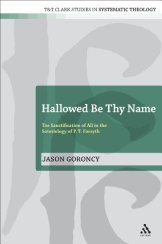
I was deeply encouraged this morning to discover that Professor Murray Rae has penned the following review/endorsement of one of my forthcoming books, Hallowed Be Thy Name: The Sanctification of All in the Soteriology of P. T. Forsyth (T&T Clark):

In this fine book Jason Goroncy engages in a critical and appreciative assessment of the theological work of P.T. Forsyth by directing our attention to the ways in which Forsyth understands divine action in terms of the Lord’s prayer’s first petition. This focus serves well the task of exploring the richness of Forsyth’s work. Goroncy’s beautifully crafted prose and astute theological judgement combine in a compelling case that Forsyth deserves to be reckoned with still.

I have just learned too that the book is scheduled for publication in March next year.

‘Some’, by Daniel Berrigan

To the Plowshares 8, with love.

Some stood up once, and sat down.
Some walked a mile, and walked away.

Some stood up twice, then sat down.
“It’s too much,” they cried.
Some walked two miles, then walked away.
“I’ve had it,” they cried,

Some stood and stood and stood.
They were taken for fools,
they were taken for being taken in.

Some walked and walked and walked –
they walked the earth,
they walked the waters,
they walked the air.

“Why do you stand?” they were asked, and
“Why do you walk?”

“Because of the children,” they said, and
“Because of the heart, and
“Because of the bread,”

“Because the cause is
the heart’s beat, and
the children born, and
the risen bread.”

– Daniel Berrigan [HT: Anthony Dancer]

New Position: Director, Knox Information and Research Centre

The Presbyterian Church of Aotearoa New Zealand is seeking to appoint a Director for the newly created Knox Information and Research Centre. The Centre is located in the Hewitson Building at Knox College in Dunedin and incorporates the Hewitson Library and the Archives of the Presbyterian Church. Applications close 19 October, 2012. Enquires about this position should be directed to the Rev Dr Graham Redding (email; phone: +64 3 4730784). Applications are to be sent to the Assembly Executive Secretary (email; or AES, Presbyterian Church of Aotearoa New Zealand, PO Box 9049, Wellington 6141, New Zealand). A job description can be downloaded here.

God and the great heresy of lawn care

… and then God said:
Frank, you know all about gardens and nature. What in the world is going on down there on the planet? What happened to the dandelions, violets, milkweeds and stuff I started eons ago? I had a perfect no-maintenance garden plan. Those plants grow in any type of soil, withstand drought and multiply with abandon. The nectar from the long-lasting blossoms attracts butterflies, honey bees and flocks of songbirds. I expected to see a vast garden of colors by now. But, all I see are these green rectangles.

ST. FRANCIS:

It’s the tribes that settled there, Lord. The Suburbanites. They started calling your flowers ‘weeds’ and went to great lengths to kill them and replace them with grass.

GOD:

Grass? But, it’s so boring. It’s not colorful. It doesn’t attract butterflies, birds and bees; only grubs and sod worms. It’s sensitive to temperatures. Do these Suburbanites really want all that grass growing there?

ST. FRANCIS:
Apparently so, Lord. They go to great pains to grow it and keep it green. They begin each spring by fertilizing grass and poisoning any other plant that crops up in the lawn.

GOD:

The spring rains and warm weather probably make grass grow really fast. That must make the Suburbanites happy.

ST. FRANCIS:

Apparently not, Lord. As soon as it grows a little, they cut it-sometimes twice a week.

GOD:

They cut it? Do they then bale it like hay?

ST. FRANCIS:

Not exactly, Lord. Most of them rake it up and put it in bags.

GOD:

They bag it? Why? Is it a cash crop? Do they sell it?

ST. FRANCIS:

No, Sir, just the opposite. They pay to throw it away.

GOD:

Now, let me get this straight. They fertilize grass so it will grow. And, when it does grow, they cut it off and pay to throw it away?

ST. FRANCIS:

Yes, Sir.

GOD:

These Suburbanites must be relieved in the summer when we cut back on the rain and turn up the heat. That surely slows the growth and saves them a lot of work.

ST. FRANCIS:

You aren’t going to believe this, Lord. When the grass stops growing so fast, they drag out hoses and pay more money to water it, so they can continue to mow it and pay to get rid of it.

GOD:
What nonsense. At least they kept some of the trees. That was a sheer stroke of genius, if I do say so myself. The trees grow leaves in the spring to provide beauty and shade in the summer. In the autumn, they fall to the ground and form a natural blanket to keep moisture in the soil and protect the trees and bushes. It’s a natural cycle of life.

ST. FRANCIS:

You better sit down, Lord. The Suburbanites have drawn a new circle. As soon as the leaves fall, they rake them into great piles and pay to have them hauled away.

GOD:

No!? What do they do to protect the shrub and tree roots in the winter to keep the soil moist and loose?

ST. FRANCIS:

After throwing away the leaves, they go out and buy something which they call mulch. They haul it home and spread it around in place of the leaves.

GOD:

And where do they get this mulch?

ST. FRANCIS:

They cut down trees and grind them up to make the mulch.

GOD:

Enough! I don’t want to think about this anymore. St. Catherine, you’re in charge of the arts. What movie have you scheduled for us tonight?

ST. CATHERINE:

‘Dumb and Dumber’, Lord. It’s a story about …

GOD: 
Never mind, I think I just heard the whole story from St. Francis.

[Source unknown]

And if you reckon that St Francis is kind of overstating things a little, you clearly haven’t visited the Berkshires, and you definitely haven’t seen Rick Floyd‘s neck of the woods. Of course, there are some stellar exceptions which would earn the divine approval – Rick’s ‘garden’, for example. Sadly, Frank’s vision for garden care is also all but lost on those who look after at least this section of the grounds of the Basilica of San Francesco d’Assisi in Assisi:

Chickpea and pea curry

Ingredients

Chickpeas – 2 cans
Green peas – 2 cups (frozen peas are OK)
Vegetable stock – 4 cups
Canola oil – 1 tbsp
Turmeric – 1/4 tsp
Minced ginger – 1 tsp
Minced garlic – 1 tsp
Pureed tomato – 1 can
Salt – 1 tsp
Garam masala – 1 tsp
Red chillies – 2 deseeded (or to taste)
Coriander leaves – 10 sprigs, finely chopped

Method

1. Heat oil in pot over medium flame.
2. Once hot, add turmeric, minced ginger and garlic, and pureed tomatoes, in that order.
3. Mix well and add 1 tsp of salt and cook until the oil begins to separate from the mixture.
4. Add garam masala and chillies and stir.
5. Take a potato masher and gently mash some of the chickpeas, and then add to pot.
6. Add stock and chopped coriander leaves, and bring to boil.
7. Simmer over medium heat until sauce reaches desired thickness.
8. Serve hot with rice, chapatis or rotis, and cold beer.

The Los Angeles Theology Conference

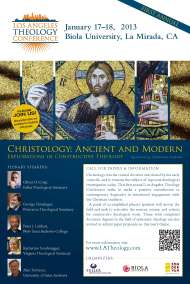
Zondervan Academic – which is part of the Murdoch empire – are partnering with Biola University and Fuller Theological Seminary to launch the annual Los Angeles Theology Conference. The inaugural gathering will take place January 17–18, 2013 on the Biola University campus, and will explore the dangerous and disruptive theme – Christology, Ancient and Modern: Explorations in Constructive Theology.

The impressive band of speakers includes Oliver Crisp, George Hunsinger, Peter Leithart, Katherine Sonderegger and Alan Torrance.

More information about paper proposals and registration is available here.

some thursday afternoon link love

Finally, I want to give a big shout out to a friend, minister and musician named Malcolm Gordon. Malcs has been busy writing material for his latest album. (You can check out some of his earlier work here and here. You can even get some of it for free here.) The songs have grown out of his preaching ministry at St Paul’s Presbyterian in Katikati, in the Bay of Plenty. For a while now, Malcs has known that most of our theology (good and bad) is sung. He writes: ‘That’s how we retain and take ownership of anything, we hum it, we whistle it – we take the word made flesh and make it a song’.

Malcolm has recently stepped out of parish ministry to make more space for this wildly unpredictable gift of music, and he’s about to head into the studio to record an album that has the tentative working title, ‘Into the deep.’ You can listen to the title track itself here:

About this song, Malcolm writes: ‘This song seems to capture the incredible feeling of being out of our depth as we seek to follow the call of God into something that doesn’t even seem to exist yet. Still God’s word is a creative word, making so as it calls us to – well here’s hoping!’

Malcolm is currently and shamelessly trying to raise funds to complete the album through the mixing and mastering stage. So if you like what you hear, and want the church to hear more of it, and sing more of it, then please consider helping him out through this campaign on Social backing.

‘A Cure of Souls’, by Denise Levertov

The pastor
of grief and dreams

guides his flock towards
the next field

with all his care.
He has heard

the bell tolling
but the sheep

are hungry and need
the grass, today and

every day. Beautiful
his patience, his long

shadow, the rippling
sound of the flocks moving

along the valley.

– Denise Levertov, ‘A Cure of Souls’, in Poems, 1960–1967 (New York: New Directions Publishing, 1983), 92.

Reading Gillian Rose

There is something healing about happening across a volume so intimate, so heteroclite, so linguistically unwasteful and conceptually unselfish, and so intelligently mature – both philosophically and emotionally – that you feel not only that you are reading the world’s only available copy but also safe enough to weep in the author’s presence, to dwell in the broken middle, and then to emerge hopeful of being a better lover. It is, ironically, probably not the kind of book you would ever loan to anyone else, but you simply know that you will spend your remaining days both promoting and betraying its gift. Gillian Rose’s memoir, Love’s Work, is everything like that. Here’s a few lines on the book’s main theme – love:

‘However satisfying writing is – that mix of discipline and miracle, which leaves you in control, even when what appears on the page has emerged from regions beyond your control – it is a very poor substitute indeed for the joy and the agony of loving. Of there being someone who loves and desires you, and he glories in his love and desire, and you glory in his every-strange being, which comes up against you, and disappears, again and again, surprising you with difficulties and with bounty. To those this is the greatest loss, a loss for which there is no consolation. There can only be that twin passion – the passion of faith.

The more innocent I sound, the more enraged and invested I am.

In personal life, people have absolute power over each other, whereas in professional life, beyond the terms of the contract, people have authority, the power to make one another comply in ways which may be perceived as legitimate or illegitimate. In personal life, regardless of any covenant, one party may initiate a unilateral and fundamental change in terms of relating without renegotiating them, and further, refusing even to acknowledge the change. Imagine how a beloved child or dog would respond, if the Lover turned away. There is no democracy in any love relation: only mercy. To be at someone’s mercy is dialectical damage: they may be merciful and they may be merciless. Yet each party, woman, man, the child in each, and their child, is absolute power as well as absolute vulnerability. You may be less powerful than the whole world, but you are always more powerful than yourself.

Love is the submission of power …

To grow in love-ability is to accept the boundaries of oneself and others, while remaining vulnerable, woundable, around the bounds. Acknowledgement of conditionality is the only unconditionality of human love.

Exceptional, edgeless love effaces the risk of relation: that mix of exposure and reserve, of revelation and reticence. It commands the complete unveiling of the eyes, the transparency of the body. It denies that there is no love without power; that we are at the mercy of others and that we have others in our mercy. Existence is robbed of its weight, its gravity, when it is deprived of its agon’.

– Gillian Rose, Love’s Work (London: Chatto & Windus, 1995), 54–55, 98–99.

Nicholas Lash on ‘spirituality’ and ‘religion’

‘When people say (as they do, it seems, with increasing frequency) that they are more interested in “spirituality” than in “religion”, they usually seem to mean that they prefer the balm of private fantasy, the aromatherapy of uplifting individual sentiment, to the hard work of thought and action, the common struggle to make sense of things, to redeem and heal the world. When church leaders are exhorted to concentrate on “spiritual” affairs, the implication sometimes seems to be that these things are different from, and loftier than, such mundane matters as proclaiming good news to the poor and setting at liberty those who are oppressed’. – Nicholas Lash, Holiness, Speech and Silence: Reflections on the Question of God (Aldershot: Ashgate, 2004), 92–3.

August stations …

Reading:

Listening:

Watching:

Position vacant: Director, Presbyterian Church Schools Office

Applications are invited for the position of Director of the Presbyterian Church Schools Office.

The purpose of the position is to:

  1. serve and strengthen the relationship between the Presbyterian Church of Aotearoa New Zealand and those church schools which are affiliated to and associated with it;
  2. develop and coordinate the provision of resources in keeping with the Christian and Presbyterian/Reformed character of those schools;
  3. provide support and encouragement to those engaged in the provision of Religious Education and Chaplaincy in Presbyterian Church Schools;
  4. engage with the leaders of Presbyterian Church Schools about what it means to have this special character

This is a part-time position commencing in February 2013.

Enquiries, including requests for a copy of the Job Description, can be directed to the Principal of the Knox Centre for Ministry and Leadership.

The successful applicant will be theologically trained, have a background in education, and be familiar with the Presbyterian and Presbyterian Church School contexts.

Applications can be emailed to the Principal of the Knox Centre for Ministry and Leadership, Graham Redding. The deadline for applications is 30 September 2012.

Mission and the Priesthood of Christ

On Friday night, I had the privilege and joy of addressing the elders of the Southern Presbytery at their AGM in Invercargill. The topic that I was asked to speak about was mission and the priesthood of Christ. (Two other speakers would reflect on the other two classic offices – prophet and king.) A number of people have asked me for a copy of my talk. Here it is:

‘The Vernacularies’, by Brian Turner

Beware of strangers, the children are told.
In other words, just about everyone,
the message being it’s not worth
trying to find a saint
among the legions of sinners,
time’s too precious.

…………………………..Or so the old joker
who lives in the shack up the road reckons,
says he’s in the dark most of the time
though he’s working on it. ‘I’m
up with the vernacularies,’ he says
with a grin like a crack in schist.
‘I’m trying to shed some light
on the meaning of life.’

…………………………..My mother
would have approved of his manners,
said there’s a lesson for you
and reminded me of the need to
take people as you find them
and don’t go looking for the dark side
for that’s where the spiders are.

She could have said light and dark
go together like sweet and sour,
but she didn’t. You can put her
tact down to her age
and a certain intrinsic female poise
that goes with being a good woman
all her life, someone
unspectacularly spectacular.

You can make a pact
with someone like that
though there’s no guarantee
it will get you to heaven.

Kashmiri Butter Chicken

I’ve been making my way through Sara Lewis’ recipes in her attractively-produced book Ultimate Slow Cooker. (Technically, I purchased this book for my partner, but it was in much the same spirit as when I, as a ten-year-old or so, bought my babcia a cricket set; old habits die hard.) By far the best grub to come out of this collection thus far is the Kashmiri Butter Chicken. Here’s the low down, slightly modified from Lewis’ directions:

Serves 4
Preparation time: 30 mins
Cooking time: 5–7 hours
Cooking temperature: Low

Ingredients
2 onions, quartered
4 garlic cloves
6cm fresh root ginger, peeled
1 large red chilli, halved and de-seeded
8 boneless, skinless chicken thighs
1 tbsp canola oil
25g butter
1 tsp cumin seeds, crushed
1 tsp fennel seeds, crushed
4 cardamom pods, crushed
1 tsp paprika
1 tsp ground turmeric
1/4 tsp ground cinnamon
300ml chicken stock
1 tbsp light muscovado sugar
3 tbsp tomato purée
7 tbsp cream (or 5 tbsp of double cream)
salt
rice and/or naan bread

To garnish
2 tbsp flake almonds, toasted
sprigs of coriander

Method
1) Preheat the slow cooker.
2) Blend the onions, garlic, ginger and chilli in a food processor (or chop very finely).
3) Cut each chicken thigh into 4 pieces. Heat the oil in a large frying pan and add the chicken, a few pieces at a time, until all the meat has been added. Cook over a high heat until evenly browned. Lift the chicken pieces out of the pan with a slotted spoon and transfer to a plate.
4) Add the butter to the frying pan and, when it (i.e., the butter, not the pan) has melted, add the onion paste. Cook over a more moderate heat until it is just beginning to colour. Stir in the crushed seeds, cardamom seeds and pods and ground spices. Cook for 1 minute, then mix in the stock, sugar, tomato purée and salt. Bring to the boil, stirring.
5) Transfer the chicken to the slow cooker pot, pour the onion mixture and sauce over the top and press the chicken below the surface of the liquid. Cover and cook for 5–7 hours.
6) Stir in the cream and serve garnished with toasted flaked almonds, sprigs of coriander, and plain steamed rice and/or warm naan bread.

Stuck for a partnering beer? Try Kingsfisher or Kalyani Black Label or Kings Black Label premium pilsner.

[Note: the image is from Lewis’ book. I’m yet to learn the art of good food photography (which is something that today’s cookbook authors/publishers seem more interested in than in the actual recipes). Furthermore, after I’ve cooked and served, the last thing I feel like doing is farting around trying to take photos while dinner gets cold.]

Hearing and responding to Jesus Christ

So what is happening when a person hears and responds to Jesus Christ? Two things strike me. The first thing to say is that someone is not acting out on their own bat, so to speak. Every movement towards God is a movement that is already happening inside the triune life, and so it’s a kind of prayer, a listening and participation in the divine conversation. Here I am reminded of a recent sermon by Rowan Williams in which he writes:

When I pray, I ask God to bring me into that mystery of love, to bring me into that pouring out and pouring back of love between the Father, the Son and the Holy Spirit. I ask to be dropped into that ocean and carried along with its energy, its life.

Out of that, of course, come all sorts of other bits of praying. If you start there it makes sense to acknowledge that you have got things wrong, to acknowledge that you have failed – as in that wonderful song we sang earlier, ‘I am free to fail’, one of the most important messages any Christian can have. If I know that I am dropped into the ocean of God’s love, then I am not afraid to acknowledge just how much I have got wrong, just how much growing I still need to do. As I drop into that mystery I can say, ‘There is no comparison. Your goodness, your love, your abundance, your generosity are so immense that I cannot hold a light to them – I know how awful it must look. But hey, here I am in the ocean anyway. Let it come in, let it flood me through’. That is how our prayer includes confession.

And then in the context of that dropping into the love of God, we can also say to God, ‘You, God, must be passionate for the healing and the peace of my neighbours. You must care for their life, their openness to love and forgiveness. So I bring them to you knowing what you want for them. I put them in your hands because I know you want their life’. That is how we pray for one another, how we pray for peace in the world, and how we pray for our fellowship as a Church. Saying to God, ‘We know what you want for us and our neighbours’. That is the prayer of intersession, as we pray for each other.

The second thing to note is that a miracle has taken place; specifically, a miracle about the nature of Christian preaching itself. As one theologian put it, ‘No one has ever heard the gospel from the lips of a human being’; i.e., from the lips of a human being other than Jesus. If I have heard the gospel, then the who that I have heard is not the preacher but Jesus Christ. This reality describes both the possibility and the impossibility of preaching.

So when a person hears and responds to Jesus Christ (who is the Father’s right hand) one is gathered up by the Spirit (the Father’s left hand) to share in the inner relations of God’s own life and love with Christ by the Spirit in such a way that the very life of God is made to reverberate in us, and our very life is brought to reverberate in the spaciousness of God’s. This is sheer gift. As this happens, the Church recognises her true nature and purpose as centered with Christ in God in such a way that all her faith and obedience is a joyful and thankful sharing in and with the actual mission and ministry of the living Christ.

Live blog: women’s 200 metre final, London Olympics

0800: I’m waiting for the final of the women’s 200-metre race to begin. I’m watching it on free-to-air tv. I have a mug of earl grey tea and an empty breakfast bowl. I’m liking the look of Shelly-Ann Fraser-Pryce and wishing that I had her hair.

0801: They’re off!

0801: They seem to be running faster than I could. This will not be a surprise to many.

0801: Allyson Felix has won. Her hair is definitely not as cool.

0802: Not sure the live blog format quite works for these events.

0810: I’m still thinking about Shelly-Ann Fraser-Pryce’s hair. Time for a shower and to get ready for work.

‘A preacher’s morning hours’

God doesn’t seem to be too
interested in keeping office hours
and very few sermons are written
when the sun is up.
When it comes, the divine speech
almost always comes sometime during
the third watch. The sermons are
almost always long and taxing;
these are no homilies or ‘thoughts
for the day’. I ebb,
beaten, taken again to the lynching
tree; am wrenched once more
asunder.

© Jason Goroncy
7 August, 2012

On the art of disassociation

‘When the Catholic novelist closes his own eyes and tries to see with the eyes of the Church, the result is another addition to that large body of pious trash for which we have so long been famous’. So penned Flannery O’Connor in Mystery and Manners. In such ecclesiolatrous gogglesness, the Christian artist, O’Connor believes, sacrifices reality birthed and fostered through extra-ecclesial but no-less graced experience in favour of a sole voice very likely to soon sing out of key. And O’Connor calls for an end to what she understands to be a false dichotomy while drawing attention to a genuine tension which is neither false nor one typically handled with due care. O’Connor’s concern, however, is not here to dissolve this tension between what the church sees and what the artist sees; rather, she wishes to understand the nature of the Catholic artist’s responsibility to look with both eyes, as it were. The real vocation of (prophetic) artists, she argues, is to achieve and communicate a wholeness of vision, and to take a stand on such a vision rather than engage in enterprises about which side in the conflict is more correct or more fitting. This can only be done through the artist’s willingness to look at what is there to see – and further, to what is not yet seen. Either way, we are talking about activities of hope. (Here, too, the artist and the preacher have much in common.)

It seems to me that Jacques Maritain is trumpeting an analogous (though not the same) melody in Art and Scholasticism and the Frontiers of Poetry when he writes:

Do not make the absurd attempt to disassociate in yourself the artist and the Christian. They are truly one, if you are truly Christian, and if your art is not isolated from your soul by some system of aesthetics. But apply only the artist to the work; precisely because the artist and the Christian are one, the work will derive wholly from each of them.

To press even further, or perhaps to press backwards, I would still want to argue (with Paul Ricœur and others) for a more pronounced expression of and commitment to communal (ecclesial and other) existence; that the Christian artist – whether a prophet or not – does not carve out her own story ex nihilo, as it were, but rather works both at different levels of consciousness in the streams and side pools of narratives – and of that most basic of all Narratives – into which her existence and vocation have been gathered up and formed, and in a network of relationality in which her existence and vocation find the kind of meaning that is both healing and abiding. There is an acute difference, it seems to me, between disregarding one’s own eyes in favour of those of others alone (so O’Connor’s concern), and abandoning the cloud of witnesses altogether. The former posture is, among other things, a denial of our being-as-responsible. The latter is a performance (understood in its positive sense) of proper humility, hope and love, and an act of faith born of the conviction that whenever Jesus comes to us he always tends to bring his friends along with him as well. In like vein, there is no art without community.