Author: Jason Goroncy

On the American presidency

Vote Mad (1)

Ah, 2007; the good ol’ days:

‘The current politics of popularity, and the reality show atmosphere that surrounds presidential elections, have not held the nation in good stead. We labor under the myth of our own goodness and believe that it doesn’t matter who runs the nation, since the balance of power between the branches of government, and a free activist press will protect us from our own bad choices. Recent history proves that we must pay more attention to the criteria by which individuals are selected, because twenty-first-century high stakes political strategies can neutralize even the best laid plans of the nation’s founders … The next President of the United States should be a twenty-first-century thinker and visionary, a woman or man whose sense of responsibility includes a personal and political identity that is deeply connected to the lives of others in the world. An American presidency is never confined to the political interests of the electing nation; this is an office that influences the world and accordingly requires a leadership model predicated on integrity and vision’.

– Barbara Holmes, ‘The Politics of Vision: Transforming the Presidency’, Political Theology 8, no. 4 (2007), 417, 418.

‘Memo to J.C.’

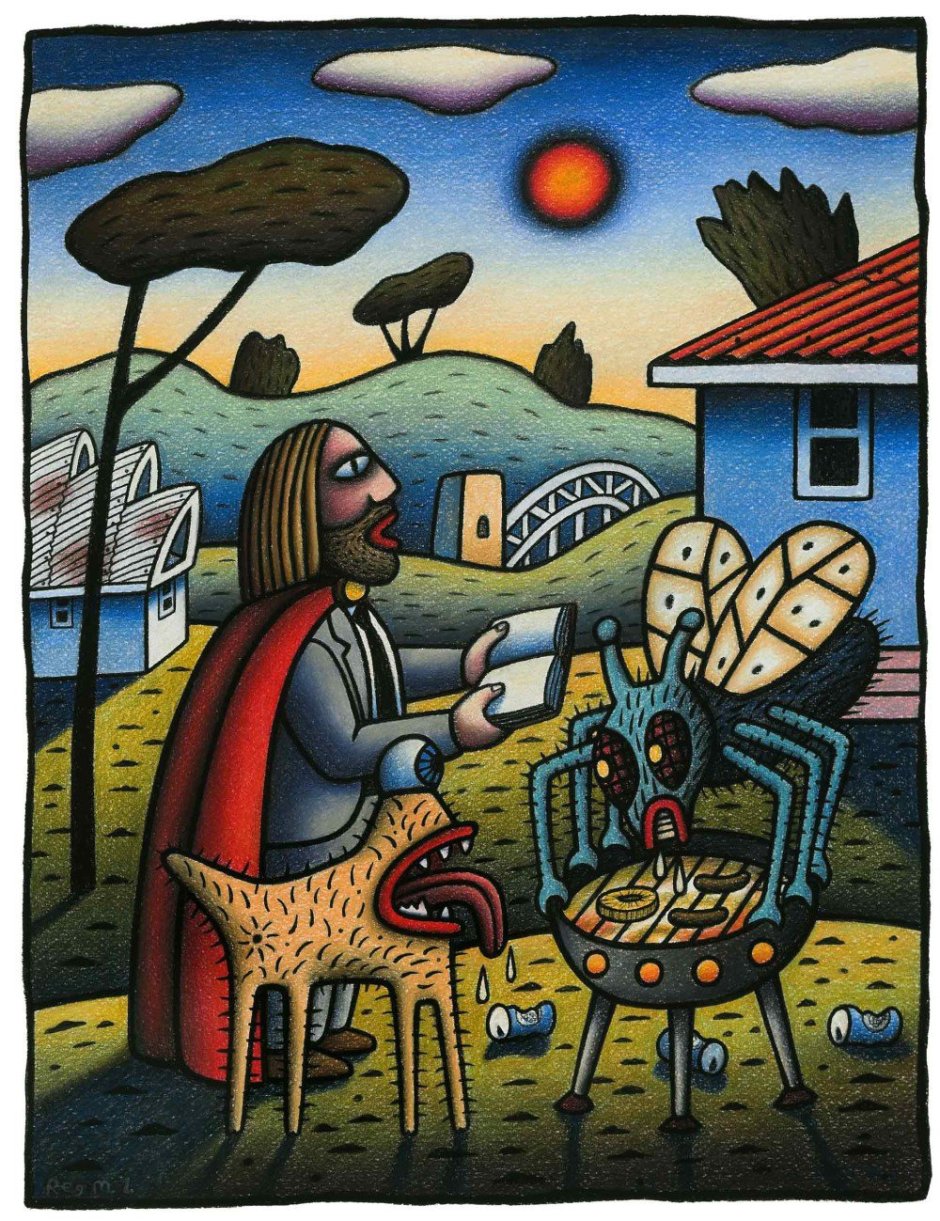
BBQ, Australia Jesus by Reg Mombassa

When you were down here JC and walked this earth,
You were a pretty decent sort of bloke,
Although you never owned nothing, but the clothes on your back,
And you were always walking round, broke.
But you could talk to people, and you didn’t have to judge,
You didn’t mind helping the down and out
But these fellows preaching now in your Holy name,
Just what are they on about?
Didn’t you tell these fellows to do other things,
Besides all that preaching and praying?
Well, listen, JC, there’s things ought to be said,
And I might as well get on with the saying.
Didn’t you tell them ‘don’t judge your fellow man’
And ‘love ye one another’
And ‘not put your faith in worldly goods’.
Well, you should see the goods that they got, brother!
They got great big buildings and works of art,
And millions of dollars in real estate,
They got no time to care about human beings,
They forgot what you told ‘em, mate;
Things like, ‘Whatever ye do to the least of my brothers,
This ye do also unto me’.
Yeah, well these people who are using your good name,
They’re abusing it, JC,
But there’s people still living the way you lived,
And still copping the hypocrisy, racism and hate,
Getting crucified by the fat cats, too,
But they don’t call us religious, mate.
Tho’ we got the same basic values that you lived by,
Sharin’ and carin’ about each other,
And the bread and the wine that you passed around,
Well, we’re still doing that, brother.
Yeah, we share our food and drink and shelter,
Our grief, our happiness, our hopes and plans,
But they don’t call us ‘Followers of Jesus’,
They call us black fellas, man.
But if you’re still offering your hand in forgiveness
To the one who’s done wrong, and is sorry,
I reckon we’ll meet up later on,
And I got no cause to worry.
Just don’t seem right somehow that all the good you did,
That people preach, not practise, what you said,
I wonder, if it all died with you, that day on the cross,
And if it just never got raised from the dead.

– Maureen Watson, ‘Memo to J.C.’, in The Oxford Book of Australian Religious Verse, ed. Kevin Hart (Melbourne: Oxford University Press, 1994), 223–23.

[Image: Reg Mombassa, ‘BBQ’, from the Australian Jesus series]

On Hitler: ‘We engaged him for our ends’

Hitler‘Hitler didn’t reach the chancellorship by his own efforts, but was put there by supercilious idiots who assumed they could manage this vulgarian. “We engaged him for our ends”, said the despicable Franz von Papen. A year later, in the Night of the Long Knives, von Papen was grovelling to save his own neck’.

– Neal Ascherson, ‘Hopping in His Matchbox’, London Review of Books 38, no. 11 (2016), 23.

Innovation, Renewal, and Betrayal

Innovation

I’ve been reading Michael Welker again, this time his essay on ‘Travail and Mission: Theology Reformed According to God’s Word at the Beginning of the Third Millennium’, published in Toward the Future of Reformed Theology: Tasks, Topics, Traditions. I was struck by Welker’s use of the word ‘innovation’ to describe the reformed habit of semper reformanda, the subject I tackle in my contribution to this book. Incidentally, Michael Jinkins, in his delightful little book The Church Transforming, also likens the reformed maxim to the idea of ‘innovation’, and draws upon the work of Edwin Friedman, a rabbi and leading proponent of family systems theory, and upon Friedman’s notion of ‘adventurous leadership’ as the only effective antidote to the anxiety that grips people, organisations, and institutions today, noting the apparent insanity of the Renaissance explorers who sailed west to discover a new trade route to the east and by doing so helped medieval Europe become ‘unstuck’ from its anxiety and conformity to convention and thus ushered in the Renaissance. In some sense, Jinkins argues, Luther and Calvin and the whole Protestant movement during the sixteenth century were products of the ‘Age of Unstuckness’, the ‘Age of Adventure and Exploration’. He suggests too that ‘the thing we most need today in our church in this profoundly anxious time is a similar spirit of adventure in leadership’. But I digress …

Back to Welker. Welker suggests that while the Reformed community has made its mark on the dialogue with the social sciences and with jurisprudence throughout the twentieth century, and has been one of the most actively committed proponents of the ecumenical movement, ‘it seems that precisely Reformed theology’s delight in innovation and new departures, its interdisciplinary, cultural, and ecumenical openness, has brought it into a profound crisis at the end of the twentieth century’. This crisis, he avers, finds its nexus in the rapid, diverse and diffuse cultural and social developments that have characterised the Western industrialised nations. Welker believes that Reformed theology with its special openness for contemporary cultural developments has been particularly tested and assaulted by these developments in ways in which other theologies, perhaps those with more dogmatically- or liturgically-oriented ‘brakes’, have been less vulnerable. The theologia reformata et semper reformanda seems ‘to be at the mercy of the shifting Zeitgeist’, and the profile of Reformed theology seems to have disintegrated into ‘a plethora of attempts to engage contemporary moral, political, and scientific trends, either strengthening them or fighting them’. Exposure to continual renewal has left Reformed theology both vulnerable to losing its profile through the ‘cultural stress of innovation’, and in danger of betraying its ‘typical mentality and spiritual attitude’.

Welker’s prescription for response to this ‘travail’ is to clarify our understanding of, and attend to the address of, the word of God over against the cacophony of competing utterances, addresses and presentations. Such ‘evangelical freedom’ will mean not only joining the ancient Hebrew prophets in naming the perversion of justice, the misuse of the cult, and the refusal to practice mercy, but also drawing repeated attention to ‘the situation in which religion, law, politics, morality, rulers and ruled, natives and foreigners make common cause against God’s word and God’s presence’, and bearing witness to the creative power of the Word of God who ‘overcomes the power of sin, renews and lifts up Christian persons and communities in the church of all times and regions of the world, and radiates a beneficent influence on their environments’.

It seems to me that such freedom also invites a change of direction (metanoia) regarding the Church’s yielding to three temptations: (i) the turn inwards, or the burying of itself, in its own affairs to the almost-complete neglect of any meaningful engagement with non-churchly cultures; (ii) the engagement in a flurry of welfare activities, or what P. T. Forsyth once referred to as ‘affable bustle’, the focus and essential content of which is set by the moment’s popular interest. (The Reformed principle of ecclesia reformata, semper reformanda is, of course, a call to being reformed by the Spirit and the Word rather than an invitation to an ‘endless cycle of idea and action, endless invention, [and] endless experiment’ (T. S. Eliot) for its own sake); and (iii) the uncritical alignment with the most sympathetic leaders of other faiths and programs in a profession of loyalty to ‘Truth’. This situation was acutely observed more than half a century ago by Lesslie Newbigin in his little essay ‘The Quest of Unity through Religion’.

[Image: Tabbert]

Jennifer Strauss, ‘The Anabaptist Cages, Münster’

Jan van Leyden1535
Jan van Leyden, Prisoner:

It is enough that God is with me;
I need no priest.

The Sentence:

And let the bodies of those condemned–
Krettech, Knipperdolling, Jan ‘the King’ –
Being brought from the place of execution
Be severally hung in iron cages
Wrought to that purpose.
And let the aforesaid cages hang
High on the steeple of St Lambert’s,
That being the place of first offending.
And let the people thus remember
What follows of misery and excess
When foolish men puffed up by wicked pride
Despise the just and natural laws
Of God and princes.

The Polygamous Wife:

Brag in the wind, old bones!
Preach in your stinking cage till the trumpets sound
To set to partners in that resurrection dance
Where there’ll be neither marriage nor giving in marriage.
Dreaming, we thought you promised with God’s voice
Our spirit’s freedom, but woke to find
You’d bound us harder than ever before
In marriage and childbed. A prisoner to his cell,
Battering at hateful walls, you entered my flesh.
Sisters in God? Did a brotherly hand
Slash off my friend’s head in the market-place
For ‘disobedience’? Did you not hear us all
Pray in our hearts with our first martyr
‘See to it heavenly Father – if you’re Almighty –
That I’m no more forced to mount this marriage-bed.’?
You could say that He answered. I say rather
Let them toll the cages, not the bells,
Let the cages cry to the Sunday city
‘Where is God now? Your God? Our God?
Where is God? Is God? Where?

The Priest of St Lambert’s:

God in my hands: shall I offer Him then
To a congregation with eyes glazed
By terror and something more – a terrible greed
Unsated by mere symbols of torn flesh?
The Bishop says that God is Love,
The Bishop says God is in the wafer,
The Bishop says the Church is in God:
I would set down God and Church together
For my hands’ bones ache with weight
Even as the beams of the church groan
With the spire’s burden. Last night
In the chancel I found another crack.
Every night I beg my God
That the great stones fall
And set me free, that the earth
Open, and swallow me whole.
But is it the same unanswering God
He cried to, breaking upon the wheel?
If I spoke my doubts they’d call me
At best possessed and hunt a witch to burn
At worst, corrupt with heresy.
I have seen exorcism, I have been
Shown the instruments of interrogation;
I am too afraid. In dreams the altar rails
Close round to cage me in.
If the Church be the instrument of God
Let Him use it and make an end.

The Girl:

Every night my heart knocks in its cage of ribs.
If it got out, how they’d startle
These grave masters, hitching their pants,
Laying down coins and solemn reflections
On fallen man. Thoughts are like stones.
My lover’s hands were gentle, to me at least.
Let them think they have him, rags of flesh,
Snared in their iron cage. I know
I can charm him out. Every night
Between midnight and dawn he sings in my thighs.
They’ll not burn me; by day
I creep about in the roots of the city,
By night I have my protectors.
What are beliefs? We might have had children.
In love he’d call me his mouse, his rabbit –
They crunched his bones in the teeth of their traps,
They flayed him living with red-hot tongs.
I vowed the day they set his corpse
To dangle on their ‘House of Love’
I’d never think of God again.

1982

The Tourist:

They seem so insignificant there on the steeple,
Quiet as a birdcage after the bird has flown;
Centuries of rain have rinsed the stones of anguish,
If they are crumbling it’s not from the workings of blood;
Terrible things are done, now as yesterday.
Leaving through sunlit woods, I watch a hawk
Sweep, hover and strike. Unheard on the wind
The thin wail of whatever small furred thing
Had blundered into the open, natural prey.
Leaving Europe, I pack away a Manichean postcard:
The world as God’s cage for heretics.

– Jennifer Strauss, ‘The Anabaptist Cages, Münster’, in The Oxford Book of Australian Religious Verse, ed. Kevin Hart (Melbourne: Oxford University Press, 1994), 208–10.

Theology and Issues of Life and Death: A Review

Theology and Issues of Life and Death

A guest post from Scott Jackson

John Heywood Thomas, Theology and Issues of Life and Death (Eugene, Oregon: Cascade Books, 2013). ISBN: 13:978-1-62032-228-4; xx+136pp.

According to philosophical theologian John Heywood Thomas, Christian theology must vindicate itself by addressing practical questions: When does life being? How can we die with dignity? How can we uphold human values in the face of rapid advances in medicine and technology? To meet this need, these thematic essays mobilize concepts from Christian thought and modern philosophy to address contemporary moral decision making. Thomas, professor emeritus at the University of Nottingham, writes, ‘What I want to show is that Theology is of temporal as well as eternal use and that it has light to shed on problems that concern us and guidance to offer us in our perplexities as we live our lives in this world’ (p. xvi). By and large, Thomas succeeds at this task with sensitivity, erudition and an engaging style. The collection is somewhat eclectic and lacks a central thesis; still, these seven essays, which were developed from public lectures and previously unpublished pieces, hang together fairly well.

Thomas draws from his extensive research into Kierkegaard’s existential philosophy and theology. He reiterates the Danish philosopher’s clear distinction between time and eternity and his characteristic emphasis upon the lived dialectic of existence. Like his mentor Paul Tillich, Thomas conceives theology as a ‘boundary’ discourse that impinges upon the human sciences at the level of their existential rootedness in ultimate reality. Thomas quotes Aquinas and catholic spiritual writers with ease. In one of the more engaging aspects of this collection, moreover, he draws from literary sources, showing a special affinity for the poets from his Welsh heritage who share his surname (Gwen Thomas, Dylan Thomas and R.S. Thomas), and he teases out religious implications from these works.

Thomas rejects typically modern dichotomies in religion and morality. Thus, for example, he insists that all philosophy and theology stem from existential commitment and the authors’ specific contexts, as Kierkegaard taught; yet, as Tillich insisted, religious thought also entails a speculative dimension (Thomas does not share the postmodern antipathy to asking big questions.) Good theology, he holds, transcends the dichotomy between theory and practice and embraces the keenest insights of contemporary research. In this vein, he goes beyond the absolute stance of the Roman Catholic against abortion and argues that the contemporary science of brain development can help us address the question of when human life begins. Still, as Christians, we cannot rely merely upon modern notions of individual rights when facing problems in medical ethics: All our deliberations must be framed by our paradoxical situation as ‘created creators’ and by the central events of our redemption in Jesus Christ. Similarly, in our common human experience, we respect the bodies and last wishes of the deceased, and these commitments inform the practice of transplant surgery, tempering the utilitarian impulse to treat bodies as mere sources for parts to save the living.

Some of the most provocative insights in this book emerge from the author’s attempt to frame a theology of death and a ‘theology of the funeral’. Although Thomas references the Christian story explicitly and seems fairly comfortable with traditional religious language, he also seeks to respect the mystery that permeates the meaning and ending of human life. Thus, he affirms the resurrection hope believers share in Christ, but he refuses to speculate about the character of our post-mortem existence. In faith we proclaim that the frontier line between time and eternity has been overcome in Christ’s death. Whatever eternal life means is not something we can know before we experience it. Still, scripture provides images – e.g., the last supper as eschatological banquet. In conversation with Sartre, Heidegger and Rahner, Thomas explores the notion of death as the quintessential act of human freedom that gives meaning and shape to life as a whole. Moreover, today, contemporary climate science urges us to ponder the spectre of death on a global scale and points to a potential catastrophe for life on earth. Western individualism does us a grave disservice as we face questions of ecology and sustainability; yet, Christian eschatology has always had ‘cosmic’ strands that may help us learn to take the natural world more seriously; Thomas engages such thinkers as Jürgen Moltmann and Teilhard de Chardin, who have offered powerful models for addressing these questions.

Some readers, no doubt, are likely to find these essays unsatisfying. Thinkers who seek a bolder and more direct account of how Christian witness may inform contemporary moral issues – including some liberationists, postliberals and radical orthodox thinkers – may find Thomas too indebted to modernist philosophy and theology. Nonetheless, the author engages his resources with skill and thoughtfulness. Contemporary Christians, especially lay and ordained ministers, can find much in Thomas’ work to challenge and broaden their perspective on some of the most vexing issues of our day.

Scott Jackson, a member of the Episcopal Church, is a theologian and independent scholar who lives in western Massachusetts. He is a regular contributor to the wonderful blog Die Evangelischen Theologen.

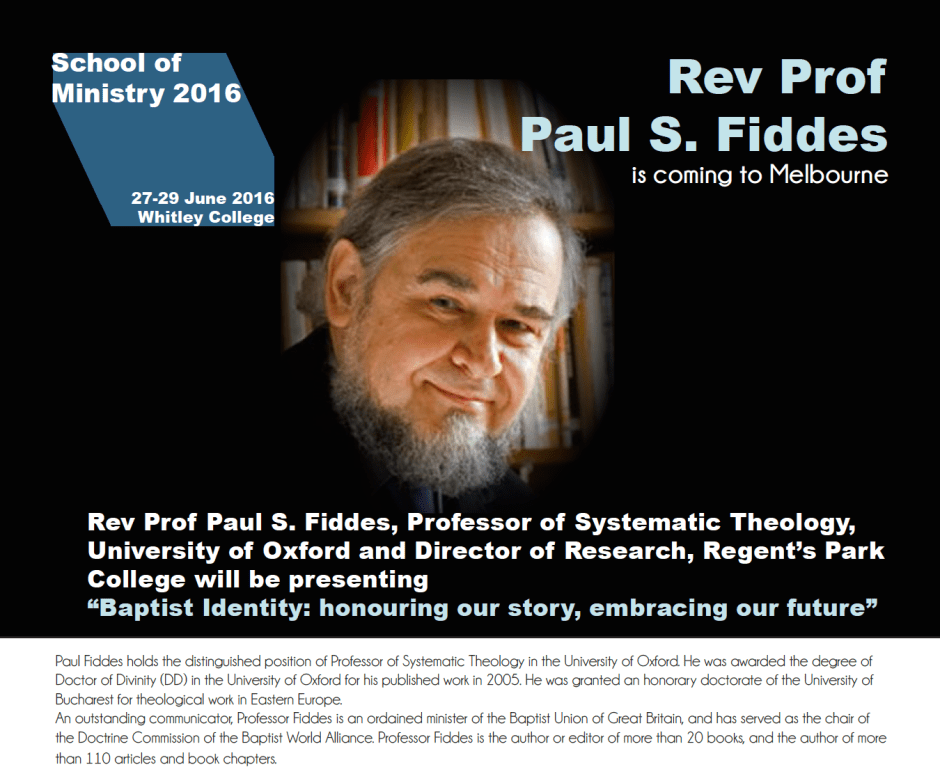
Whitley College to host Professor Paul Fiddes

SOM 2016 Fiddes 1

Each year, Whitley College puts on this thing called ‘The School of Ministry’, three days marked by worship, some teaching (via keynote talks and workshops), and eating together. I haven’t been to a lot of these over the years because I’ve been out of the country, but the ones that I have been able to get along to have been very worthwhile. For example, it was at one of these gigs that I first heard Chris Marshall introducing his extraordinary work on restorative justice (published as Beyond Retribution: A New Testament Vision for Justice, Crime, and Punishment, a book that was followed up a decade or so later with his Compassionate Justice), and I remember hearing Richard Foster talking about patterns of prayer, and I remember hearing Paul Fiddes speaking about baptism and the creative suffering of God in ways that I didn’t know were even possible.

This year, we welcome again Professor Paul Fiddes to address the theme of Baptist identity. Paul’s is certainly one of the most outstanding theological minds of our time, and a great teacher. I can’t wait to hear him again.

More information about the program and registration can be found here.

Rowan Williams: An Interview

Rowan Williams 12In this insightful and encouraging interview, conducted with Terence Handley MacMath and first published in the Church Times, Rowan Williams ruminates on teaching, church leadership, theological education, funding, experiencing God, faith, the theological task, reporting on charities, his greatest influences, and reassuring and loved sounds. His comments – particularly those about the relationship between Christ and the world – are all the more pertinent given recently-published pieces in the mainstream media about what most of us, I suspect, have known for so long now, about Britain’s ‘disappearing Christianity’ and Christian extinction’.

My work is teaching, writing, studying, plus lots of administration and raising funds for the college, and chairing Christian Aid. Probably most of my time goes on college, and a variety of teaching events for churches and schools.

I’m currently giving a series of lectures here on the history of the doctrine of Christ, trying to tease out how thinking about Christ clarifies the relation between God and creation overall.

As Archbishop, you’re constantly responding to things, and even if you do get some writing done — as I did, a bit — it tends to be issue-focused. I like having the chance of some longer breaths for thinking through questions.

When I was in post, the urgent questions were often serious theological ones, if rather heavily disguised at times; so I found myself reflecting hard about the nature of authority in the Church, and what it meant to speak about the interdependent life of the Body of Christ. That latter point continues to be absorbing for me, and I think that this term’s lectures will have reflected that a bit — thinking about the inseparable connection between what we say about Jesus Christ, and what we say about the community that lives in him.

A bishop has to be a teacher of the faith. That is, he or she has to be someone who is animated by theology and eager to share it — animated by theology in the sense of longing to inhabit the language and world of faith with greater and greater intelligence, insight, and joy. So, yes, bishops need that animation and desire to help others make sense of their commitment.

Arguments about priestly training go round and round, don’t they? Too theoretical, too pragmatic, not enough of this, not enough of that. . . My worry is, if we focus too much on curriculum — what should the modules be? — we may somehow fail to connect things up in a big picture in which pastoral care, sacramental life, prayer, scripture, social and political perspective, and doctrine all interweave. We need to have that interconnectedness in our minds constantly, as we seek to shape future ordained ministry, because that is what provides the deepest resource for arid and frustrating times. And that is what guarantees that we have something to offer our society that’s more than simply religious uplift, moral inspiration, or nice experiences.

A lot of debate in and out of the Church is shadow-boxing, because people don’t recognise what the questions are. Of course, recognising what the questions are does not remotely guarantee that you will agree, but it helps to know what you’re disagreeing about, and stops you resorting to tribal slogans, whether secular or religious. My old friend and colleague Oliver O’Donovan is particularly good at this excavation of basic questions, and has been a great help and inspiration.

In an ideal world, government and educational establishments would recognise that theology is as significant a study as other humanities. But, given that the study of the humanities in general is so badly supported these days, I’m not holding my breath. It’s anything but an ideal world.

This means that I would plead with the Church to take seriously the need for investing in theological education at all levels — to recognise that there is a huge appetite for theology among so many laypeople, and thus a need for clergy who can respond and engage intelligently. The middle-term future may need to be one where there are more independent centres of theological study outside universities, given the erosion of resources in higher education, and I think it’s time more people started thinking about what that might entail in terms of funding.

British theology is more cosmopolitan than when I started studying it. In the Sixties, people writing about doctrine in the UK were not very enthusiastic about Continental writers (though it was different for New Testament scholars); and modern Roman Catholic theology was largely ignored. Now we read far more widely, I think, and we’re more ready to take time over the intricacies of historical arguments rather than dismiss them as tiresome and unnecessary complications.

There’s more critical interest in the history of spirituality, and more willingness to let it come into the territory of doctrine. All this is to the good. My sadness is the decline of institutional resources for theology in the UK: limited funds for research, and theology departments under threat.

It’s hard to pin down my first experience of God, but I suppose [it was] through shared worship in the Presbyterian chapel of my childhood, and a strong sense — when I was around eight, and my grandmother, who lived with us, was dying — of God’s care and providence, and the presence of the crucified Christ. Shared worship is still a major part of how I encounter God, but, from my teens, this has been balanced by a growing hunger for silence before God.

I’ve never felt any real disjunction between academic theology and faith. I’ve found that studying the development of Christian doctrine has excited me, and helped me see something of the veins and sinews of faith. My research has arisen out of my desire to understand better what we say as people of faith.

Apart from the obvious question about how we Anglicans manage the tension of living in a diverse global church — where we need a more robust theology of what interdependence does and doesn’t mean — I think my biggest concern is that we don’t have a rich enough Anglican theological consensus on the sacramental nature of the Church. That’s eucharistic ecclesiology, to put it in technical language.

Underrated theologians? John Bowker, Olivier Clément, Andrew Shanks.

Theology has a modest but vital part to play in the Church’s mission. We need to keep asking questions about how we’re using our language, so that we don’t get stuck with unexamined habits of speech, don’t assume that true formulations about God tell us everything about him, don’t forget the sheer scale of what we are daring to speak about. Theology helps with all this. And it helps clarify what we believe about human nature and destiny, which is of real importance for a world that is often deeply unsure or confused about the roots of human dignity.

Theologians don’t necessarily ask the same questions as others do, but there is a continuity, and theologians need the skill and patience to draw out those continuities. That’s why it is important that there are writers who try to work in the boundaries between academic theology and secular culture, and those who try to put the great governing themes of classical theology into plainer words. Mike Lloyd is a good example.

I was an only child. My father worked as an engineer, and my mother had lifelong health and mobility problems. They were both Christians, though reticent and sometimes uncertain about it. My wife, Jane, of course, is well-known in her own right as a teacher and writer. We have a daughter who teaches in an inner-city primary school, and a son studying drama at university. Both would still call themselves Christian, though they slip in and out of the institutional life of the Church.

The most reassuring, loved sound to me is the door opening when my wife or children come home.

Some irresponsible and hostile reporting about charities was the last thing that made me angry. Nationally and internationally, charities are expected to pick up the slack where statutory provision drops away — yet they’re subjected not just to proper demands for accountability, but often to what looks like wilfully negative and undermining reporting, focused on excessive salaries, inadequate monitoring of expenditure, intrusive fund-raising, and so on. These things all happen, and need to stop happening; but just how representative are the hostile headline stories, especially where international aid is concerned?

I’m happiest when I’m at the Pembrokeshire coast on family holidays.

Augustine has probably been the greatest theological influence above all, but also Vladimir Lossky, who was the focus of my doctoral research; Barth, Bonhoeffer, Austin Farrer, Donald MacKinnon, James Alison. I don’t know if Simone Weil is allowed to count as a theologian; I don’t always agree with her by any means, but she was a huge influence at several points. Among specific books, I remember Bonhoeffer’s prison letters; Charles Williams’s He Came Down From Heaven; Herbert McCabe, Law, Love and Language; Hans Urs von Balthasar, Elucidations.

The greatest influences in my life have been the parish priest in my teenage years; the Benedictine monk who was my spiritual director; and Jane and the children.

I pray most for patience, freedom to forgive and let go of hurt — for myself and for the whole Church and human family — and for the rescue of the vulnerable: the abused, hungry, terrified, wherever they are.

If I had to choose a companion to be locked in a church with for a few hours, I’d toss up between St Augustine, T. S. Eliot, and Bonhoeffer, from the past. In the present — family apart — Salley Vickers, Michael Symmons Roberts, or Kathleen Norris.

Theological education: a gift from the reformed

there-s-a-sea-in-my-bedroom

What insights and gifts do various church traditions offer to each other, and to the world?

Well, the Orthodox remind us that this girl is old, much older than you think. In fact, she’s a real nanna. The Pentecostals remind us that this girl likes to experiment. The Seventh Day Adventists remind us that the graffiti on the back of the dunny door announcing that this girl likes Marcion, who also goes by the name of ‘Marci’, is just slander. The Anglicans remind us that this girl plays best when she’s playing with all sorts of different girls. (‘Anglicans’ who don’t get this might as well become Brethren.) Speaking of which, the Brethren remind us that this girl shows us that weirdness can be catholic too. The Baptists remind us that this girl is supposed to have a thing about unprotected sex with civil authorities, and that she has a mind of her own. The Presbyterians/Reformed remind us that this girl is a bit of a nerd. The Methodists remind us this girl can sing! The Lutherans remind us that this girl can drink! The Salvos remind us that this girl can go without drinking at all because her arms and legs alone keep her alive. And the Roman Catholics remind us that this girl is not a girl at all but actually a boy who likes playing dress ups.

Now the thing that I really want to reflect on here is the gift that each of these habits and idiosyncrasies are to each other, and how much poorer this girl would be were any of these features made to be unwelcome, or not given opportunity and space to flourish. I’ll take one – the Presbyterian/Reformed commitment to education.

In his little book The Church Transforming: What’s Next for the Reformed Project?Michael Jinkins writes:

The Reformed project has always promoted theological education to support and strengthen the church in its mission. We live at a moment, however – an axial moment in the history of the church – when some question the rationale for the theological education of those called to lead the church. Today we must argue convincingly for a theologically well-educated ministry if we care about the quality of preaching and the worship of God, of pastoral care and counseling, of Christian teaching and nurture, of mission, service, and evangelism. We must make this argument powerfully if we care about the nurturing of a church that can grapple with the social and cultural challenges it faces. Theological education will not solve every problem: it will not heal our every disease or deliver us from every evil. But theological education can teach us that we don’t have to be mean or stupid to follow Jesus of Nazareth. And in our culture today, this is one of the most countercultural messages we can articulate.

Education, including theological education (a subject about which I’ve blogged a bit before), proved to be fundamentally important in the birthing of the Reformed movements in the sixteenth century, both through Grandpa Calvin’s emphasis on catechesis and the ‘sermon’, and through the establishment, in 1559, of the Genevan Academy, which became the training ground for an ‘educated clergy’ and the nursery of Reformed movements in France, the Netherlands, England, Poland, Scotland, and elsewhere.

In his masterful biography on Calvin, Bruce Gordon has observed that ‘Schools were, in Calvin’s mind, essential to the building of Christian society’. Calvin shared with the Genevans a commitment to the humanism of the great European centres. This commitment found expression in the creation of and widespread support for the Academy, which had two parts – the schola publica which trained ministers and the schola privata where Genevan children, each of whom was believed to be a gift from God, were schooled. The schola privata, in particular, received substantial support – a claim buoyed by the fact that it was provided with new buildings, and it received nearly 20% of the city’s annual budget in 1559–60, money gained largely from the dissolution of the monasteries. In addition, citizens of Geneva were required to bequeath legacies to the Academy in their wills, and were expected to pray for the Academy and its work.

Undergirding such a commitment is a deeper commitment to the world itself. The church has often faced the temptation to disengage from the world, to take a turn inwards and focus almost entirely on churchly matters, to become a mere sect. By and large, the Reformed have resisted this temptation.

Indeed, historically, one of the real gifts that the Reformed have bequeathed to the wider Church and to the discipline of theology has been the rigour with which it has applied the life of the mind in the service of God and of God’s work in the world. So Jinkins:

From the first, Reformed Christians have sought to advance the best thinking in the face of superficiality, superstition, bad religion, social reactivity, and anxiety. As expressions of confidence that Christian faith and the promotion of knowledge go hand-in-hand, the Reformed project established the first programs of universal education, founding universities, graduate schools, and teaching hospitals as it moved across the world. Today the world’s problems have become extraordinarily complex, and many religious people try to prove their religious devotion by refusing to test their convictions intellectually or by seeking to silence those with whom they disagree. Now more than ever, we as Reformed Christians must foster the curiosity and intellectual openness that have driven us to think deeply, for there is desperate need for faithful people who are bold and unflinching thinkers, people who will use their best knowledge and concerted intellect to engage and mend a broken world.

So we are thinking here about the habit of the Reformed to love God – and so God’s world – with our mind, as well as with our heart, soul, and strength. The Reformed are typically among those in the body of Christ who worry most about what will become of Christian faith – and, indeed, of the world – if Christians fail to love God and God’s world with a love schooled and tenacious enough to ask – and to keep asking – the tough, deep, critical and sometimes intractable questions about life. They are among those who are ‘concerned about what it will mean for our faith if we choose to ignore life’s most profound mysteries and insoluble riddles’, who are ‘concerned about the integrity of the church if we abandon the curiosity that is unafraid to swim at the deep end of the pool, if we jettison a passion for ideas, for knowledge, and for wisdom for their own sake’ and who are equally ‘disturbed about what will become of society if persons of faith retreat from the public sphere, where ideas must fight for their lives among competing interests, where justice is served by vigorous argumentation and intelligent action as much as by high ideals’. They are certainly among those who believe that the greatest heresy the church faces today is not atheism but superficiality, and its attendant ‘cult’.

To cite Jinkins, again:

Occasionally I hear editors of church publications or church growth consultants arguing that Christian laypeople just aren’t interested in theology, or that laypeople aren’t interested in the history of their faith or, worse still, that laypeople simply can’t understand complicated ideas. Yet, when I speak in congregations around the country, I regularly encounter crowds of lively, intelligent laypeople hungry to know more about their faith. These are laypeople, incidentally, who in their daily lives run businesses and shape economies, teach, read or even write important books on a variety of serious subjects, argue legal cases before judges and juries, write laws that shape our common life, and cure our diseases of the mind and body. These laypeople are tired of being infantilized at church. They want to understand their faith more deeply. The comments of the laypeople I meet, people who want to learn more about their faith, are often along the lines of what an elderly woman said … one Sunday after [Tom Long] had preached in one of the many congregations in which he speaks around the country. As he was making his way from the pulpit to the sanctuary exit, the woman stepped forward to greet him. Earlier in the evening, Tom had invited members of the congregation to share with him any messages they’d like him to take back to the future ministers he teaches in seminary. As this woman stepped forward, Tom greeted her with the question, “Is there a message you’d like me to take back to the seminary, something you’d like me to tell our students?” “Yes, there is,” she said. “Tell them to take us seriously.” Now, I know that not every person in our churches, or indeed in our society, craves to understand God (or anything else) more deeply. But I would also maintain that at the core of the gospel there is a sacred mandate – we call it “the Great Commission – to go into all the world to make disciples, teaching them to obey everything that I have commanded you” (Matt. 28:20). The word disciple translates a Greek word that means “pupil” or “willing learner.” As church leaders, then, we have this duty, this mission, this commission: to teach, to kindle curiosity, to expand knowledge, to renew minds, to make our people wiser. And there are many, many people only too eager to learn.

The Reformed emphasis on the importance of education needs to be tempered, however, with the kind of humility that the Reformed emphasise concerning human personhood in general, and about the noetic effects of what its Augustinian forebears named ‘the Fall’. Truth, as the saying goes, is the first casualty of war. But self-criticism is among the first casualties of insecurity, especially those brands of insecurity that transform thinking people into an unthinking herd.

Christian faith, on the other hand, thrives on a spirit that resists taking itself too seriously. Healthy girls know how to party, and they do. As G. K. Chesterton once suggested, angels can fly because they take themselves lightly. Devils, on the other hand, fall under the weight of their own self-regard. But God help us all when Presbyterians and Uniting Church folk start parking their brains in the shopping cart, as some of their own members and not a few of their ecclesial cousins are want to do.

So, three cheers for serious theological education, wherever it’s happening.

Climate Change: More than an Environmental Issue

Sergey Ponomare, The New York Times

A guest post by Byron Smith

Why is climate change so often treated as ‘merely’ an environmental issue? Why are the true nature and scale of its implications for public health, water stress, food security, mass migration, global stability, conflict and ecological collapse so rarely spelled out in public? Whose interests are served by keeping this as an issue for tree huggers, bushwalkers and other nature lovers? And why do we keep getting told to recycle or change our lightbulbs when it only takes a few moments to realise that far, far more is needed?

Make no mistake: the scale of the climate crisis is so large as to threaten life as we know it. This includes placing into doubt the ongoing existence of global industrial society in its current form. Our climate-disrupting carbon pollution (mainly from burning coal, oil and gas) is the largest experiment we’ve ever conducted and though we might not yet know all the details, that the net outcome is likely to overwhelmingly, even catastrophically, negative is not in serious doubt. When you actually explore the fairly middle of the road likely impacts from continuing on a fossil-fuelled trajectory for a few more decades, it pretty quickly becomes apparent that we’re not just talking about things getting a little rougher at the margins. We’re looking at whole ecosystems (like the Great Barrier Reef) collapsing, agricultural production being smashed, trillions of dollars of infrastructure threatened, tens or hundreds of millions of people being displaced and all the consequent implications for global stability these imply.

To depart from such a trajectory onto a path where the societal damages might be merely substantial or staggering (rather than potentially fatal) requires the almost complete transformation of a number of the most powerful and profitable industries on the planet. This can be done, from a technological and economic point of view, and would even bring a whole range of co-benefits (such as avoiding most of the seven million annual deaths currently resulting from air pollution), but the losses in such a transition would be concentrated in many of the most powerful organisations on the planet. The losers would be all the companies (and shareholders) heavily reliant upon keeping dirty energy dirt cheap, but also those nations with the largest fossil fuel reserves.

Thus, for some time it has been in the interests of a lot of powerful people and organisations *not* to articulate clearly and repeatedly what is at stake. Most major corporations, corporate media and almost all governments know that outright denial is no longer tenable in the face of such an overwhelming consensus of data and experts. Yet many of these groups also recognise the hugely disruptive implications of directly acknowledging the scope of our predicament. Doing so would require huge changes to the status quo, the situation from which they currently benefit the most.

So, as a more or less deliberate way of keeping such explosive knowledge from affecting the population too drastically, the problem gets pegged as an ‘environmental’ issue. This stalling tactic ensures that it stays somewhere down the list of priorities; we’ll get to it at some point in the distant future and/or take a few symbolic greenwashing actions to create give an impression of being in control. While not directly embracing denial outright, this enables the proposal of various half and quarter measures that give the appearance of action without rocking the boat too much.

As an added bonus, the nature of climate science helps in this effort. Although the core of the science (enough to realise that serious action in required) can be well understood in a few minutes by anyone who completed primary school science, the details get incredibly complex. This provides countless opportunities for a deliberate misinformation campaign to throw plenty of dust into the air. Furthermore, the fact that the problem is cumulative and unfolds over decades helps to reduce the chance it was gain the same level of political urgency as a recession (or even the latest celebrity scandal).

But this isn’t just a story about nefarious entities keeping an innocent public in the dark. By and large, the public simply don’t want to know. Awakening to the scale of our predicament is deeply unsettling for most of us, and challenges basic cultural narratives by which we orient our lives (and for Christians, even some cherished theological assumptions). Since few of us like to have our identity upended, it suits most of us to keep the issue at arm’s length as well, embracing denial, or not looking too closely, or taking the word of political elites that their half-baked schemes will do the trick, or if a glimpse of the horror slips though then quickly putting it in the ‘too-hard-and-what-can-I-do-anyway’ basket.

Now there are in fact many experts, professional groups and advocacy groups who do articulate the climate issue through all its various implications, rather than treating it as ‘just’ an ‘environmental’ one. But they rarely get featured prominently or repeatedly in mainstream media. (By the way, this is one of the reasons why relying on corporate media to tell you which stories matter is a recipe for rarely/never hearing about stories that challenge the rule of the corporations.) And political leaders whose parties are funded and supported by fossil interests are unlikely to make more than superficial or very gradual changes. It is telling that in most political contexts, the parties that embrace actions more commensurate with the scale of the challenge are generally those that refuse support from corporations. Yet in Australia, this basically means the Greens, whose climate policies (while certainly not perfect) have been a couple of decades ahead of the majors. Ironically, however, this just reinforces for most people the idea that caring about climate is something basically reserved for ‘greenies’. Another win for the minimising ‘environmental’ framing.

Nonetheless, there are signs this may be gradually changing. For instance, President Obama has used the national security framework more than a couple of times (and has been relentlessly hounded by Republicans and corporate media pundits for doing so), as have a few other international leaders. But even then, the choice of framing remains primarily a vehicle for reinforcing the status quo (or a slightly modified form of it). For the US president to talk about national security functions first and foremost to imply not ‘let’s transform our dirty energy system and the dirty politics it helps engender’ so much as ‘let’s increase military/security spending some more’.

In this context, one of the most radical acts possible for an ordinary citizen is to open oneself to the full implications of climate science, to seek to understand why the status quo has failed to deal with this, to embrace the very uncomfortable emotional experiences this typically generates, and then to start thinking through what is actually necessary for a sane and just response (rather than merely what is deemed possible under assumptions acceptable to those currently in power).

And my hunch is that this is going to involve not just lots more clean energy while rapidly phasing out dirty energy, but also confronting the dirty politics that upholds the latter far past its use by date.

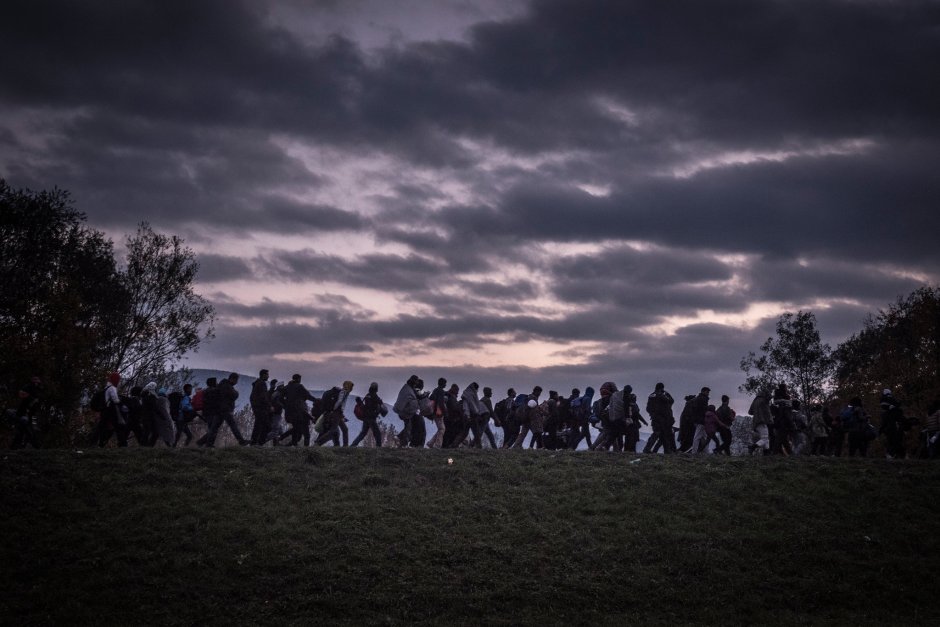
[Image: Sergey Ponomarev, The New York Times]

Some (pre-election) wisdom from Dietrich Bonhoeffer

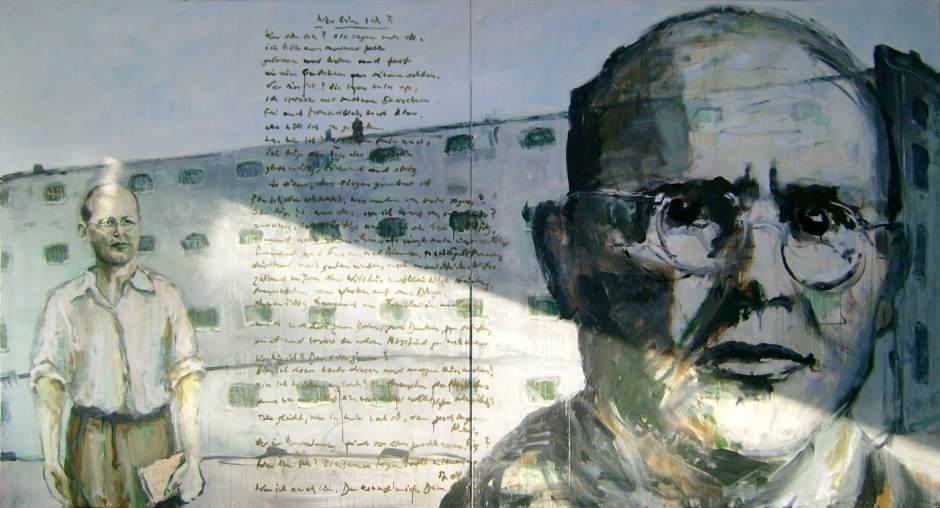
Letters and Papers from PrisonAs I contemplate, despair, protest, hope, pray, and engage in an upcoming election, I was very grateful this week to read, and to take the time to type up, some (pre-election) wisdom from brother Dietrich:

On Stupidity

Stupidity is a more dangerous enemy of the good than malice. One may protest against evil; it can be exposed and, if need be, prevented by use of force. Evil always carries within itself the germ of its own subversion in that it leaves behind in human beings at least a sense of unease. Against stupidity we are defenseless. Neither protests nor the use of force accomplish anything here; reasons fall on deaf ears; facts that contradict one’s prejudgment simply need not be believed – in such moments the stupid person even becomes critical – and when facts are irrefutable they are just pushed aside as inconsequential, as incidental. In all this the stupid person, in contrast to the malicious one, is utterly self satisfied and, being easily irritated, becomes dangerous by going on the attack. For that reason, greater caution is called for when dealing with a stupid person than with a malicious one. Never again will we try to persuade the stupid person with reasons, for it is senseless and dangerous.

If we want to know how to get the better of stupidity, we must seek to understand, its nature. This much is certain, that it is in essence not an intellectual defect but a human one. There are human beings who are of remarkably agile intellect yet stupid, and others who are intellectually quite dull yet anything but stupid. We discover this to our surprise in particular situations. The impression one gains is not so much that stupidity is a congenital defect but that, under certain circumstances, people are made stupid or that they allow this to happen to them. We note further that people who have isolated themselves from others or who live in solitude manifest this defect less frequently than individuals or groups of people inclined or condemned to sociability. And so it would seem that stupidity is perhaps less a psychological than a sociological problem. It is a particular form of the impact of historical circumstances on human beings, a psychological concomitant of certain external conditions. Upon closer observation, it becomes apparent that every strong upsurge of power in the public sphere, be it of a political or a religious nature, infects a large part of humankind with stupidity. It would even seem that this is virtually a sociological-psychological law. The power of the one needs the stupidity of the other. The process at work here is not that particular human capacities, for instance, the intellect, suddenly atrophy or fail. Instead, it seems that under the overwhelming impact of rising power, humans are deprived of their inner independence and, more or less consciously, give up establishing an autonomous position toward the emerging circumstances. The fact that the stupid person is often stubborn must not blind us to the fact that he is not independent. In conversation with him, one virtually feels that one is dealing not at all with him as a person, but with slogans, catchwords, and the like that have taken possession of him. He is under a spell, blinded, misused, and abused in his very being. Having thus become a mindless tool, the stupid person will also be capable of any evil and at the same time incapable of seeing that it is evil. This is where the danger of diabolical misuse lurk, for it is this that can once and for all destroy human beings.

Yet at this very point it becomes quite clear that only an act of liberation, not instruction, can overcome stupidity. Here we must come to terms with the fact that in most cases a genuine internal liberation becomes possible only when external liberation has preceded it. Until then we must abandon all attempts to convince the stupid person. This state of affairs explains why in such circumstances our attempts to know what “the people” really think are in vain and why, under these circumstances, this question is so irrelevant for the person who is thinking and acting responsibly. The word of the Bible that the fear of God is the beginning of wisdom declares that the internal liberation of human beings to live the responsible life before God is the only genuine way to overcome stupidity.

But these thoughts about stupidity also offer consolation in that they utterly forbid us to consider the majority of people to be stupid in every circumstance. It really will depend on whether those in power expect more from peoples’ stupidity than from their inner independence and wisdom.

Contempt for Humanity?

The danger of allowing ourselves to be driven to contempt for humanity is very real. We know very well that we have no right to let this happen and that it would lead us into the most unfruitful relation to human beings. The following thoughts may protect us against this temptation: through contempt for humanity we fall victim precisely to our opponents’ chief errors. Whoever despises another human being will never be able to make anything of him. Nothing of what we despise in another is itself foreign to us. How often do we expect more of the other than what we ourselves are willing to accomplish. Why is it that we have hitherto thought with so little sobriety about the temptability and frailty of human beings? We must learn to regard human beings less in terms of what they do and neglect to do and more in terms of what they suffer. The only fruitful relation to human beings – particularly to the weak among them – is love, that is, the will to enter into and to keep community with them. God did not hold human beings in contempt but became human for their sake.

Immanent Justice

It is one of the most astonishing experiences and also one of the most incontrovertible that evil – often in a surprisingly short span of time – proves itself to be stupid and impractical. That does not mean that punishment follows hard on the heels of each individual evil deed; what it does mean is that the suspension of God’s commandments on principle in the supposed interest of earthly self-preservation acts precisely against what this self-preservation seeks to accomplish. One can interpret in various ways this experience that has fallen to us. In any case, one thing has emerged that seems certain: in the common life of human beings, there are laws that are stronger than everything that believes it can supersede them, and that it is therefore not only wrong but unwise to disregard these laws. This helps us understand why Aristotelian-Thomistic ethics elevated wisdom to be one of the cardinal virtues. Wisdom and stupidity are not ethically indifferent, as the neo-Protestant ethics of conscience wanted us to believe. In the fullness of the concrete situation and in the possibilities it offers, the wise person discerns the impassable limits that are imposed on every action by the abiding laws of human communal life. In this discernment the wise person acts well and the good person acts wisely.

There is clearly no historically significant action that does not trespass ever again against the limits set by those laws. But it makes a decisive difference whether such trespasses against the established limit are viewed as their abolishment in principle and hence presented as a law of its own kind, or whether one is conscious that such trespassing is perhaps an unavoidable guilt that has its justification only in that law and limit being reinstated and honored as quickly as possible. It is not necessarily hypocrisy when the aim of political action is said to be the establishment of justice and not simply self-preservation. The world is, in fact, so ordered that the fundamental honoring of life’s basic laws and rights at the same time best serves self-preservation, and that these laws tolerate a very brief, singular, and, in the individual case, necessary trespass against them. But those laws will sooner or later – and with irresistible force – strike dead those who turn necessity into a principle and as a consequence set up a law of their own alongside them. History’s immanent justice rewards and punishes the deed only, but the eternal justice of God tries and judges the hearts.

Some Statements of Faith on God’s Action in History

I believe that God can and will let good come out of everything, even the greatest evil. For that to happen, God needs human beings who let everything work out for the best. I believe that in every moment of distress God will give us as much strength to resist as we need. But it is not given to us in advance, lest we rely on ourselves and not on God alone. In such faith all fear of the future should be overcome. I believe that even our mistakes and shortcomings are not in vain and that it is no more difficult for God to deal with them than with our supposedly good deeds. I believe that God is no timeless fate but waits for and responds to sincere prayer and responsible actions.

Trust

Few have been spared the experience of being betrayed. The figure of Judas, once so incomprehensible, is hardly strange to us. The air in which we live is so poisoned with mistrust that we almost die from it. But where we broke through the layer of mistrust, we were allowed to experience a trust hitherto utterly undreamed of. There, where we trust, we have learned to place our lives in the hands of others; contrary to all the ambiguities in which our acts and lives must exist, we have learned to trust without reserve. We now know that one can truly live and work only in such trust, which is always a venture but one gladly affirmed. We know that to sow and to nourish mistrust is one of the most reprehensible things and that, instead, trust is to be strengthened and advanced wherever possible. For us trust will be one of the greatest, rarest, and most cheering gifts bestowed by the life we humans live in common, and yet it always emerges only against the dark background of a necessary mistrust. We have learned to commit our lives on no account into the hands of the mean but without reserve into the hands of the trustworthy.

– Dietrich Bonhoeffer, Letters and Papers from Prison, ed. John W. de Gruchy, trans. Isabel Best, et al., vol. 8, Dietrich Bonhoeffer Works (Minneapolis, MN: Fortress Press, 2010), 43–47.

A Theology of Relational Ministry, with Andrew Root

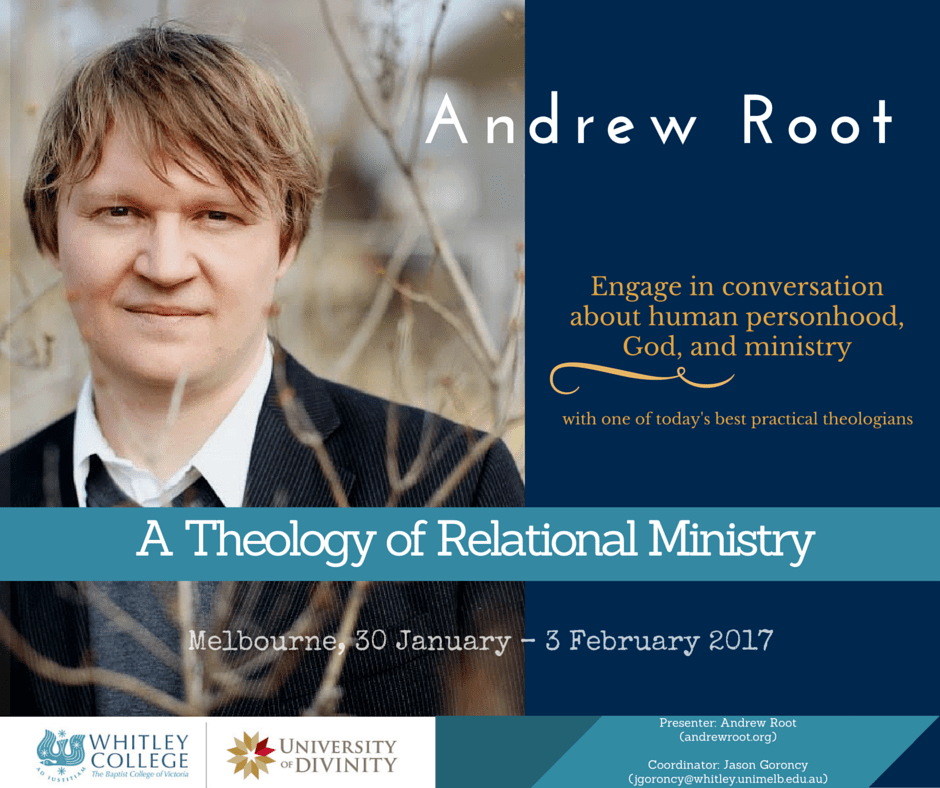
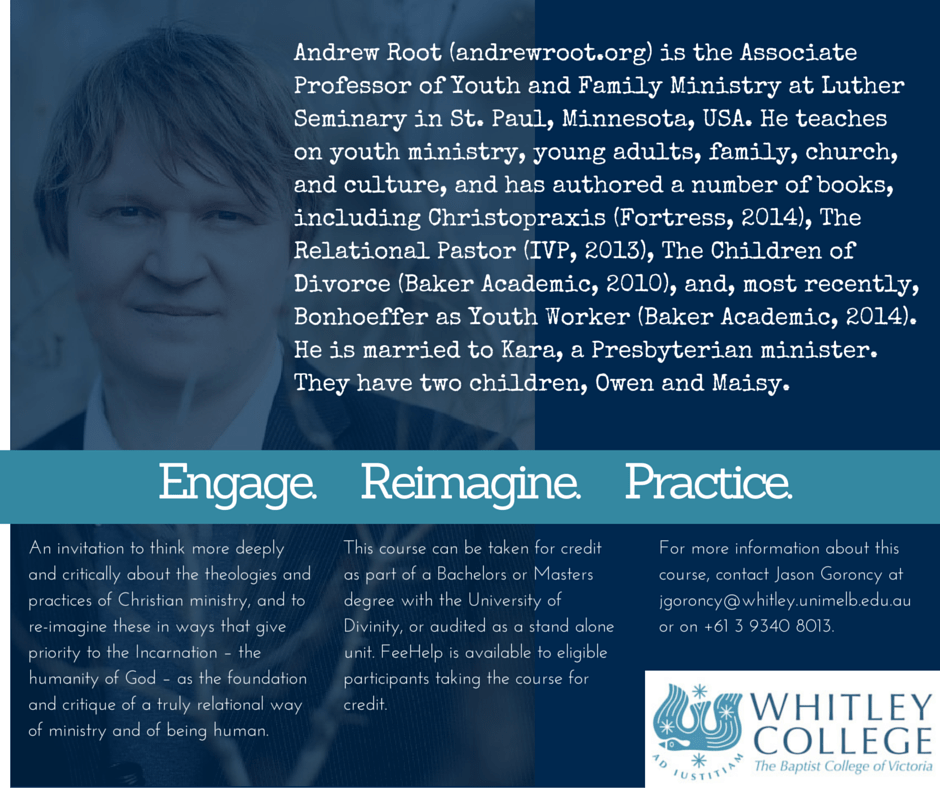
I’m very pleased indeed to announce that Andy Root will be coming to Melbourne early next year to teach a one-week course on the theology of relational ministry. The course will be of interest to all involved in Christian ministry and leadership, from children’s ministry workers and youth pastors, to congregational ministers (ordained or lay), and to those working in aged care and various chaplaincy roles. More details will follow in due course, but here are the basics:

Promo 1

Promo 2

What does the cross of Christ reveal?

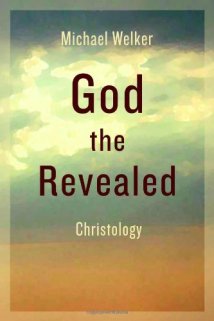
Welker ChristologyOne of the joys of teaching a christology unit this semester has been the excuse that it has occasioned to getting around to reading Michael Welker’s book God the Revealed: Christologya book that’s been sitting relatively untouched on my shelves for a few years now. The chapters are short, intelligent, and deeply engaging. In other words, they are a busy teacher’s dream. In one of them, titled ‘The Cross Reveals Not Only the Suffering, but also the Judging and Saving God’, Welker offers seven claims about the significance of the cross as revelation. They’re worth sharing, not only because it offers a taste of Welker’s style, but also because his summary statements (in bold) are just such a wonderful witness to the evangelical faith of the church:

  1. The cross reveals the terrifying, godforsaken situation of human beings, a situation they themselves, however, do not recognise as such. The representative world, in a curious mixture of anxiety, fear, and aggressivity, turns against God’s presence in the life and ministry of Jesus. ‘The cross’, says Welker, ‘discloses a situation that could not but plunge the world into profound despair were the world truly to grasp it; as it is, however, the world is able simply to pass over or disregard it in dull unconsciousness, with a shrug of the shoulders, or even gleefully. The cross of Christ is the expression of the godforsaken condition of human beings, a condition they yet try to disguise even though they themselves have brought it about’.
  2. The cross reveals the diastasis of God and humankind, God and world. It ‘calls into question or … even puts an end to any and all lighthearted theologies that make their peace with the “dear Lord,” that try to engage God and human beings in a kind of enduring but unproblematic partnership, or that otherwise propagate a peaceful ongoing relationship between God and human beings’.
  3. The cross reveals the profundity of the sin of the world. It stands for the triumph of the powers of the world over the presence and revelation of God. It reveals that our efforts to understand sin solely or principally in individual terms dangerously downplay the cosmic and violent character of the powers that both parade and masquerade themselves under the guise of religion, law, politics, and public morality. In light of the cross, ‘it becomes clear’, says Welker, ‘that even God’s “good law” can turn into an instrument of lies and deception under the power of sin. Jesus Christ is crucified in the name of religion, of global power politics, with reference to both Jewish and Roman law, and with the approval or even under the pressure of public opinion’.
  4. The cross reveals the danger that God’s revelation might not reach human beings because God may well withdraw from them. Drawing here upon Eberhard Jüngel’s work, Welker argues that what emerges in the cross ‘is the serious danger that God and world, God and humankind, “have died to each other” in a wholly disastrous sense’; i.e., in the sense that ‘this person is dead for me – I have absolutely no relationship or connection with this person now, nor do I want any’. The cross reveals that God has delivered human beings ‘over to their own [nothingness]. The cross not only reveals the danger that the world might close itself seamlessly off from God, utterly renouncing or even taking up a posture of opposition against God, it also reveals the danger that God, too, might no longer seek and find access to that very world’. It exposes the dreadful possibility that the cry of dereliction – ‘My God, my God, why have you forsaken me?’ – is in fact the last and most truthful assessment of the situation, both for creation and for God.
  5. The cross, however, also reveals God’s own suffering; it reveals not only the suffering of Jesus Christ, but also that of the triune God who through the sending of Jesus simultaneously seeks to reveal God’s proximity to human beings. Again drawing on Jüngel, Welker refers to this as ‘God’s inner disruption or as disruption within God. Through the cross, God is confronted with the death and sin of the world in a way that calls into question not only Jesus’s life, but also the divine life itself’.
  6. The cross reveals the abyss in which the very deity of God is most profoundly called into question. Here, ‘the creative God is confronted with chaos’, and that confrontation ‘reveals a suffering or impotence on God’s part’ which resides ‘deep within the deity itself’.
  7. Insofar as the cross reveals God’s pain and impotence, so also does the inner communion between Creator, Spirit, and Jesus Christ become discernible over against a world that closes itself off from God. The One revealed in the cross is the One who has ‘entered into the abyss of human misery and horror, subjecting itself not only to natural death, but also to the abyss of extreme separation from God, which various biblical traditions call “hell”. The cross reveals God’s descent into hell. It reveals that God … is no stranger to hell, that God suffers from hell and allows the divine life itself, in the figure of the crucified Resurrected [sic], to be enduringly characterized by this very suffering’. From eternity into eternity, the cross reveals the divine love that suffers for the other.

‘Mother Julian’

Rogier van der Weyden - Julian of NorwichMalcolm Guite has shared his beautiful sonnet about Julian of Norwich – ‘Mother Julian’. It’s worth sharing again:

Show me O anchoress, your anchor-hold
Deep in the love of God, and hold me fast,
Show me again in whose hands we are held,
Speak to me from your window in the past,
Tell me again the tale of Love’s compassion
For all of us who fall onto the mire,
How he is wounded with us, how his passion
Quickens the love that haunted our desire.
Show me again the wonder of at-one-ment
Of Christ-in-us distinct and yet the same,
Who makes, and loves, and keeps us in each moment,
And looks on us with pity not with blame.
Keep telling me, for all my faith may waver,
Love is his meaning, only love, forever.

– Malcolm Guite, ‘Mother Julian’, in The Singing Bowl (London: Canterbury Press, 2013), 82.

Ten Impressions of Whitley College: One Year On

imagesI’ve been teaching at Whitley College for just over a year now. During that time, I’ve formed a heap of impressions about the place. Here’s ten of them:

  1. It is a community soaked in the rhythms and practices of prayer and of Bible reading. On Mondays, Tuesdays, and Wednesdays, staff and students gather together to read Holy Scripture and to pray for the world, the church, the denomination and congregations we serve, and for students and residents of the College. There’s something almost monastic about the place.
  2. It is a community – and this is not unrelated to the rhythms of prayer and of Bible reading – marked by friendship, food, and a sense of belonging. As a modern commuter college with a large number of part time students, and a significant number of more-recent arrivals to Australia, and a timetable that spreads over the whole week, this is no easy feat, but I feel that Whitley makes a really good fist of being a community marked by God’s hospitality.
  3. It is a community of learning and of formation. It celebrates the truth that there is no incongruity between loving God with our hearts, with our hands, and with our brains. It is, in other words, a community which encourages the integration of worship, service, and academic scholarship, each existing only in a tandem of formation with the other two in a delightful expression of the gospel’s great freedom. Whitley is sometimes charged (most often by those with little or no direct experience of the place) with being ‘liberal’. If by that is a suggestion that its faculty have abandoned commitment to the one great apostolic, catholic, and trinitarian faith of the church, then I’m yet to see any evidence that would support such a charge.
  4. It is a community of wonderful cohorts of students – people who are engaged with their studies, engaged with the world, and engaged in communities of faith and of Gospel service in the world. This includes an impressive and growing postgraduate community pursuing higher-level study and research.
  5. It is a community marked by an incredibly-rich texture of cultural and theological and other diversities. It is, in fact, a microcosm of the transposable nature of the Body of Christ. Insofar as it is this, it is also a community in which people really are served to better live in and with an increasingly diverse Australia.
  6. It is a community that seems to carry a unique sense of vocation – and the burdens that attend such – to serving Christians in theological education in those many under-resourced parts of our region.
  7. It is a community which, like God, loves the world. The world, which is on God’s heart too, matters here. Put otherwise, Whitley is characterised by a spirit of deliberate refusal to exist in some kind of religious bubble, or to let the world go to the dogs, as it were.
  8. It is a community that loves the church, that is always trying to ask questions of the church about how it can better serve the church’s work and witness to Jesus in the world. Being a denominational college serving in a diverse university context is never an easy space to straddle, but it seems to me that Whitley really does seek to walk that space with genuine integrity and with an attitude of service.
  9. It is a community which usually meets in gorgeous and conveniently-located Parkville, with great access by public transport. I take the train to Royal Park, from which it’s less than a 10-minute walk through what often feels and sounds like an avairy of parrots, and usually has me arriving at work in a good mood.
  10. It is a community where people testify to feeling safe and to feeling stretched – safe to explore questions that faith asks, and stretched to know that faith’s destination is as mysterious as is the journey. This is important to me.

Australia is going to hell

p1_nauruforweb


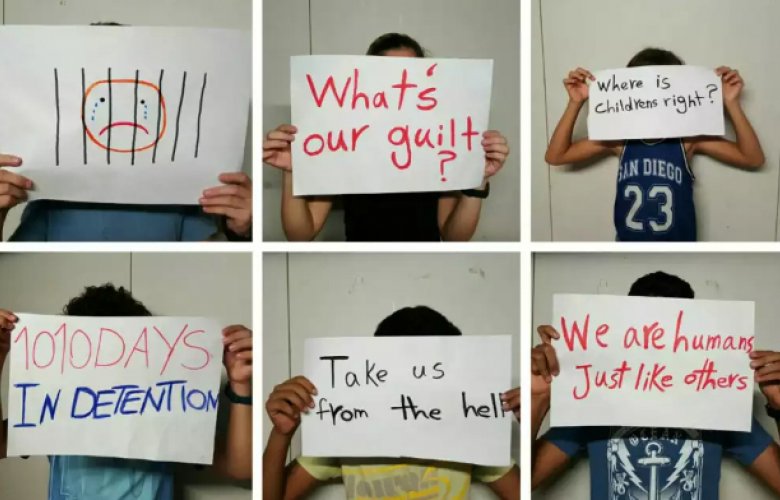
‘It is clear that the Turnbull Government’s policy [on asylum seekers], focused only on deterrence with no feasible pathway to permanent migration in a resettlement country is leaving people desperate and without hope’, said Richard Marles, the same guy who declared that ‘offshore processing has been the single most important policy that any Australian government has made’.

Something about pots and black kettles comes to mind. More significantly, however, such statements mark the tragic reality that it is very difficult to reach any other conclusion than that the moral decadence represented and fed by Australia’s two most supported political parties is a disgrace that can only end in hell, along with all who support such. For what is hell but ‘the suffering of being no longer able to love’ (Father Cosima). Are we there yet? Are we there yet? Are we there yet?

[Image: The Saturday Paper]

Always Being Reformed

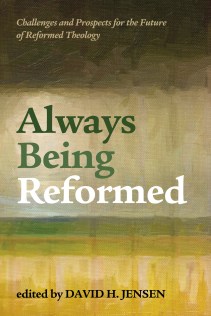
PICKWICK_TemplateA new collection of essays on reformed theology, arising from a wonderful conference hosted by Austin Seminary, has just been published. Always Being Reformed: Challenges and Prospects for the Future of Reformed Theology was edited by David Jensen, who was also a contributor to the volume along with Cynthia Rigby, Carlos Cardoza-Orlandi, Deborah van den Bosch, Henk van den Bosch, Grace Ji-Sun Kim, Lameck Banda, Margit Ernst-Habib, Martha Moore-Keish, Mary Fulkerson, Meehyun Chung, and Bill Greenway. The collection includes a few scribbles from me too.

My essay is titled ‘Semper Reformanda as a Confession of Crisis’. It is unambitious and simple in its three broad aims, each of which earns a section. The first section is an attempt to identify the historical beginnings and theological intentions of the aphorism semper reformanda, and to trace some of the ways in which the commitment to this virtue of the reformed project has evolved. The second, and longest, section asks more specifically about how that commitment relates to reformed patterns of confessing. Principally, what I argue for here is that to confess the faith in the spirit of the semper is to confess that the Christian community is, at core, in a state of crisis. The final section attempts to place on the table one theo-political commitment that might call for reevaluation; namely, how the reformed conceive of their relationship vis-à-vis the modern state. I take it that this section is an implication of the previous one – i.e., an implication of the gospel’s eschatological character and what it means to be a community unsettled, unpredictable, and unreliable when it comes to its relationship with whatever current arrangements might be in place in the world.

I look forward to seeing the book when it arrives, and to revisiting some of the wonderfully-stimulating essays therein.

The conference was memorable in many ways. So was Austin. It was there that I met, for the very first time, a quiscalus quiscula.