Year: 2009

‘Without’, by C.K. Stead

A View of Cape Stephens in Cook's Straits (New Zealand) with Waterspout, 1776Without

Crossing Cook Strait
going home to be
ordained in the

parish of his
father, while seas wished
by and the wind

had its say in the
wires, it came to
him there was no

God. Not that
God was sulking or had
turned His back—that

had happened
often. It was that God
wasn’t there, was

nowhere, a Word
without reference or
object. Who was

God? He was the
Lord. What Lord was
that? The Lord God. Back

and forth it went while
stern lifted, screw
shuddered, stars glowed

and faded. The
universe was losing
weight. It was

then he threw his
Bible into the
sea. He was a

poet and would
write his own. Happiness
was nothing

but not being
sad. It was your
self in this one and

only moment
without grief or
remorse, without God

or a future—sea,
sky, the decks
rolling underfoot.

– Christian Karlson Stead, ‘Without’ in The Red Tram (Auckland: Auckland University Press, 2004), 52–3.

[Image: William Hodges, ‘A View of Cape Stephens in Cook’s Straits (New Zealand) with Waterspout, 1776’, 1776.]

‘God will Transform’, by Jürgen Moltmann

Moltmann 2‘God will Transform: Destructive Judgement is a Godless Picture’

By Jürgen Moltmann

Since the Middle Ages, a conception of death and resurrection became fixed in Christian thinking that is deeply unchristian: the pictorial world of heaven and hell, the conception of a Last Judgement that rewards good works and punishes bad deeds to order the transition to the world to come. According to this notion, God’s judgement only knows two sentences: either eternal life or eternal death, either heaven or hell. If one asks what will come of the good visible creation, the earth and God’s other earthly creatures, the answer is everything will be burnt to ashes. This world will not be needed any more when the blessed will see directly in heaven without mediation by other creatures.

This idea of judgement is incomprehensible and hostile to creation. Are God the Judge and God the Creator different gods? Does the judging God destroy the faithfulness of the Creator to his creatures? This would be God’s self-contradiction or different gods. The Biblical trust in God is destroyed as well as trust in Jesus. The judging Christ with the two-edged sword has nothing to do with the preacher of the Sermon on the Mount Jesus of Nazareth healing the sick and forgiving sins. The idea of destructive punishment is an extremely godless picture.

However, there is another conception of world judgement. Injustice is a scandal. Victims do not die away. All the murderers do not find any rest. The hunger for justice remains as a torment in a world of violent crying. The powerless and oppressed hope for a world judge “who creates justice for those suffering injustice.” Israel’s psalms of lamentation are an eloquent example of true creative justice. God’s righteousness will “create” justice for victims, raising them from the dust and healing wounded life.

Later and under foreign influences, a universal criminal judge was made out of this saving Liberator in the biblical scriptures who judges good and evil and does not ask about the victims any more. A deed-oriented moral judgement according to the standard of retributive justice came out of a victim-oriented expectation of saving justice. Correcting this aberration means christianizing the idea of judgement so it is oriented in Israel’s original experience of God’s creative, saving and healing justice.

The New Testament offers staring-points. The New Testament understands Judgement Day as the “day of the Son of man” on which the crucified and resurrected Christ will be revealed and all the world before him. Both will appear out of their concealment in the light of truth, the Christ now hidden in God and the person hidden from him/herself. The eternal light will be revealed to them. What is now hidden in nature will be transparent because persons are physical and natural beings connected with the nature of the earth. We cannot be separated from the nature of the earth, neither in the resurrection nor in the end-time judgement.

Christ will be revealed as the crucified and resurrected victor over sin, death and hell, not as the avenger or retaliator. Christ will be revealed as the Everlasting One and leader of life. He will judge according to the justice he proclaimed and practiced through his community with sinners and tax collectors. Otherwise no one could recognize him.

God’s justice is a creative justice. The victims of sin and violence are supported, healed and brought to life by God’s righteousness. The perpetrators of sin and violence will experience a rectifying transformative justice. They will change by being redeemed together with their victims. The crucified Christ who encounters them together with their victims will save them. They will “die off” in their atrocities to be “reborn” to a new life.

Helping and supporting the victims and straightening the perpetrators as the victory of God’s creative justice over everything godless, not the great reckoning with rewards and punishments. This victory of divine justice leads to God’s great day of reconciliation on this earth, not to the division into blessed and damned.

Seen this way, the Last Judgement is not the end of God’s works. It is only the first step of a transformation out of transitoriness into intransitoriness. The new eternal creation will be created on the foundation of justice. Because the judgement serves this new creation of all things, its future-oriented justice is creative and not only a requiting justice referring to the past. It was the mistake of Christian tradition in picture and concept, piety and teaching to only see the judgement over the past of this world and not God’s new world through the judgement.

If a social judging occurs in the Last Judgement, it is in truth a cosmic judgement because the coming Christ is also the cosmic Christ. Already in the psalms, YHWH is called “to judge the earth.” All shattered relations in creation must be straightened out so the new creation can stand on the solid ground of justice and abide in eternity. All creatures should share in eternal being and in God’s eternal vitality. That will be a fundamental change of the cosmos and life. “God will indwell all things and be present in all things.” Then the nothingness will be destroyed and death annihilated. The power of evil will be broken and separated from all creatures. The misery of separation from the living God – sin – will end. Hell will be destroyed. Then the reign of glory will begin.

[Source: Publik-Forum; HT: Marc Batko, via Jürgen Moltmann group]

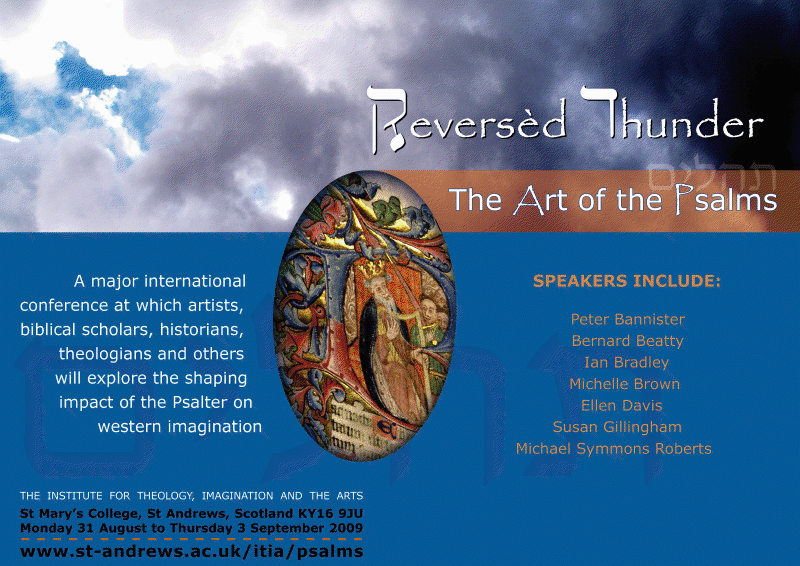
Conference: ‘Reversed Thunder: The Art of the Psalms’

Reversed Thunder

George Herbert once penned:

Engine against th’ Almightie, sinner’s towre,
Reversed thunder, Christ-side-piercing spear,
The six daies world-transposing in an houre,
A kinde of tune, which all things heare and fear

The tune of which all things hear and fear, the drama of Christ.  The Psalms, whilst not explicitly portraying Christ’s performance, pierce the core of our being. Few texts can have had a more decisive impact on Western culture across the centuries than the Psalter. Central to the scriptures that have shaped both Jewish and Christian faith, the Psalms have always enjoyed a prominent place in Western religious life. Their importance is reflected in a wide variety of modes of reception reaching beyond the specifically religious domain and maintaining a strong public presence even in the milieux of modernity. The Psalms have been widely appropriated and ‘sampled’ in the plastic arts, music, literature, and various other cultural forms, and their depths will be replumbed this August in a conference at St Andrews University titled ‘Reversed Thunder: The Art of the Psalms’.

The Institute for Theology, Imagination & the Arts at St Mary’s College, University of St Andrews invites you to participate in ‘The Art of Psalms’.  This major international conference will bring together artists, biblical scholars, historians, literary critics, theologians, and others to explore ways in which the ‘reversed thunder’ of the Psalter has shaped the identity not just of the Jewish and Christian traditions, but of Western culture more widely.

For more information please visit here or email Matt Farlow.

‘The Gospel of the Judgement and New Creation of All Things’, by Jürgen Moltmann

jurgen-moltmann

The Gospel of the Judgement and New Creation of All Things

By Jürgen Moltmann

What is the Goal of Christ’s Judgement?

The goal of helping victims and rectifying culprits is the triumph of God’s creative justice over everything godless in heaven, earth and below the earth, not the great reckoning with wages and punishments. This victory of divine justice leads to God’s great day of reconciliation on this earth, not to division of humankind into blessed and damned and the end of the world. On Judgement Day, “all tears will be wiped away from their eyes,” the tears of suffering and the tears of repentance. “There will be no mourning, crying or pain” (Rev 21,4). Thus the Last Judgement is penultimate, not ultimate and is not the end of God’s works. It is only a first step in a transition or transformation from transitoriness to intransitoriness. The new eternal creation created on the foundation of justice is definitive. Because the judgement serves this new creation of all things, its justice is a healing, creative justice re-establishing life according to this future, not a retaliatory justice referring to the past. The judgement serves the new creation, not sin and death as the great reckoning. It was the error of the Christian tradition in picture and idea, piety and teaching to see only judgement on the past and not God’s new world beyond the judgement and thus not believing the new beginning in the end.

The practice and endurance of evil are not always apportioned to different persons and groups of persons. Victims can also be perpetrators. In many persons, the perpetrator side and the victim side of evil are inseparably connected. The knowledge that the coming judge will judge us as perpetrators and as victims, reject the Pharisee in us and accept the sinner in us and reconcile us with ourselves. Judging victims and perpetrators is always a social judging. We do not stand isolated and dependent on ourselves before the judge as in human criminal courts or in nightly pangs of conscience. The perpetrators stand together with their victims, Cain with Abel, the powerful with the powerless, the murderers with the murdered. Humanity’s story of woe is inseparably joined with the collective history of culpability.

There are always unsolved and unsolvable social, political and personal conflicts where some become perpetrators and others victims of sin. As in the Auschwitz trials and the South African truth commission, victims have a long tormented memory while perpetrators have only a short memory if they have a memory at all. Therefore the perpetrators depend on the memories of their victims, must hear their reports and learn to see themselves with the eyes of their victims, even if this is frightening and destructive.

Dialectical Universalism

In conclusion, what practice follows from this future expectation? How do we visualize Christ’s coming justice?

An American friend asked his Baptist grandmother about the end of the world and she replied with the mysterious spine-chilling name “Armageddon.” According to Revelation 16,16, this is God’s end-time battle with the devil. Today the struggle of good against evil is generalized with the final victory of the good at the end. From this idea of the end, American fundamentalism developed a fantastic modern end-time struggle scenario. George W. Bush Jr. invented such a scenario, justifying “friend-enemy thinking” as a basic political category. To this end, he conjured the “axis of evil” reaching from Iraq to Iran and North Korea. “America is at war,” he announced after “September 11” and “whoever is not for us is against us.” America remains “at war” since no state had attacked the US but the criminal Islamic unit Al-Qaeda. In what war? The apocalyptic war called Armageddon has already started!

The judgement expectation common to Christianity and Islam has a very similar effect on the present. If the end of the world is God’s judgement over believers and unbelievers with the twofold end: believers in heaven and unbelievers in hell, the present will inevitably be ruled by religious friend-enemy thinking: here the believers in “God’s house” and there the unbelievers in the “house of war.” Since there is no hope for unbelievers, they can be punished here with contempt or terror. Unbelievers are enemies of believers since they are God’s enemies. Anticipation of the Last Judgement by separating people into believers and unbelievers and possibly persecuting unbelievers as God’s enemies is wrong because it is godless. God is not the enemy of unbelievers or the executioner of the godless. “For God has consigned all men to disobedience, that he may have mercy upon all” (Rom 11,32). Thus all people of whatever faith or unbelief must be seen as befriended by God’s mercy. God loves them whoever they are. Christ died for them and God’s spirit works in their lives. Thus we cannot be against them.

The all-embracing hope in God’s future explains this boundlessness of love. Why should we take seriously the faith, superstition or unbelief of others as God’s mercy? That was a theme for Christendom in the atheistic East Germany (DDR) state. This cannot be otherwise in our dealings with people of other religions that must be marked by God’s unconditional love. The difference between believers, persons of other faiths and unbelievers are real but are annulled in God’s mercy with everyone.

Christian universalism does not hinder but promotes taking sides for victims of injustice and violence. In a divided and hostile world, the universalism of God’s mercy with everyone is reflected in the well-known “preferential option for the poor.” God acts unilaterally in history in favour of victims and also saves perpetrators through them. Jesus calls the burdened and heavy-laden to himself, accepts sinners and sends the Pharisees away empty. For Paul, the community itself is a testimony for God’s unilateral action in favour of all people. “Consider your call, brethren: not many of you were wise according to worldly standards, not many were powerful, not many were of noble birth, but God chose what is foolish in the world to shame the wise. God chose what is weak in the world to shame the strong. God chose what is low and despised in the world, even things that are not, to bring to nothing things that are, so that no human being might boast in the presence of God.” (1 Cor 1,26-29). Therefore we sing “Sun of Righteousness, Arise in our Time.”

Ecumenical Church Hymn

Sun of righteousness,
arise in our time.
Dawn in your church
so the world can see.
Have mercy, O Lord.

Wake up, dead Christendom
from the sleep of security
so it hears your voice.
Have mercy, O Lord.

Behold the divisions
that no one can resist.
Great Shepherd, gather
everything that has lost its way or gone astray.
Have mercy, O Lord.

Open the gates to the nations.
Let no cunning or power
hamper your heavenly race.
Create light in the dark night!
Have mercy, O Lord.

Let us see your glory
in this time
And seek what creates peace
with our little strength.
Have mercy, O Lord.

Let us be one, Jesus Christ,
as you are one with the Father,
remaining in you always,
today and in eternity.
Have mercy, O Lord.

Power, praise, honour and glory
Are yours Most High always
As Most High is three in one,
Let us be one in him.
Have mercy, O Lord

[Source: Christ im dialog; HT: Marc Batko, via Jürgen Moltmann group]

June bests …

Letters to New PastorsBest books: Voicing Creation’s Praise, by Jeremy S. Begbie; Calvin: A Biography, by Bernard Cottret; Letters to New Pastors, by Michael Jinkins. (On Jinkins’ book: It’s been many moons since I read an entire book in a day, particularly in a day already replete with so many other commitments, but this one was impossible to put down. I think it’ll not be long before parts of it, at least, are revisited).

Best music: Dave Matthews Band, Big Whiskey And The GrooGrux King [2009]; Krzysztof Penderecki, St Luke Passion (Warsaw National Philharmonic Orchestra); Guy Clark, Keepers.

Best films: In Search of a Midnight Kiss [2007]; Så som i himmelen [2004]

Best drink: Glenmorangie, 18 Years Old

Blogging famine?

AucklandBlogging here at Per Crucem ad Lucem may be a little light on for the next few weeks. I’m off to Auckland tomorrow to do some teaching on theology and the arts, and on pastoral theology on issues pertaining to marriage. When I return, I’ll be thinking (and so probably blogging) about Calvin for a few weeks as I prepare a paper for the upcoming Calvin Rediscovered conference. At this stage, I’m thinking of a paper on Calvin as servant of the Word. But, on that, more to come.

Michael Jackson and the cult[ure] of dead celebrities

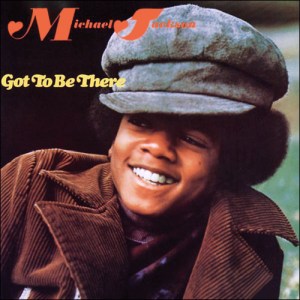
Michael JacksonRick Floyd, in his recent post on the death of Michael Jackson and the culture of celebrity, includes this insightful claim:

‘The church’s notion of the faithful dead as the communion of saints (see my Mystic Sweet Communion) has been replaced in popular culture by the cult of dead celebrities whose lives for the most part serve more as cautionary tales than good examples’.

Too true. This reminded me of Camus’ definition of culture as ‘the cry of men in face of their destiny’. Still, Jackson’s death is both a tragedy (even in Camus’ sense of that word) and a reminder that in the most unCamus-like economy of grace, hope hopes in the redemption who comes on the other side. For it is the triune God – and not Michael Jackson, and still less that army of fans and critics that he left behind – who has, in Jesus Christ, made the final call on this man’s life, and fate.

Yes, Jackson’s chapter is included in that growing book of ‘cautionary tales’, but that book is not the last in the series.

William H. Willimon: Advice for New Pastors

William Willimon

William Willimon recently posted an exceptional series of posts in the form of ‘advice’ for those starting in pastoral ministry. It is taken from a book edited by Allan Hugh Cole titled From Midterms to Ministry: Practical Theologians on Pastoral BeginningsI have pasted Bishop Willimon’s posts together into this one post. Read on seminarians, pastors and theological educators, and be encouraged … and challenged. This is one to keep coming back to and re-reading again, and again.


Between Two Worlds

In retrospect, my first year as a pastor was perhaps the most painful, frightening year of my entire ministry. Part of the terror that I experienced was my fear of failure, not simply to fail at being an effective pastor (I had little means of knowing what being “effective” would look like), but rather my fear that I had failed to discern God’s will for my life. What I had thought was my tortured, gradually dawning, wrestling with “call to the ministry,” might be revealed as something other than God’s idea. Looking back, I realize now that the early bumps and potholes that I experienced during the course of that first year were so disconcerting because each one of them made me wonder: maybe my friends are right. Maybe I don’t have what it takes to be a pastor. Perhaps the church really is a waste of my life.

As it turned out, I received more confirmation of my vocation in that first year than invalidation. Wonder of wonders, God really did occasionally speak through me to God’s people, God really did sometimes use me to work a wonder, and God’s people – some of them – really did respond to my ministry. I came to realize that much of my consternation was due, not to my own lack of preparation, or to inadequacies in me or in the church but rather to a move I was making from one world to another.

I recently heard Marcus Borg of the errant “Jesus Seminar” chide us pastors for protecting our congregations from the glorious fruits of “contemporary biblical scholarship.” There’s a brave new world of insight through the historical-critical study of Scripture! Don’t hold back from giving the people in the pew the real truth about Jesus as it has been uncovered by contemporary biblical scholarship and faithfully delivered to you in seminary biblical courses. He implied that even the laity, in their intellectual limitations, can take the truth about Jesus as revealed by Professor Borg and his academic friends.

Yet it seemed not to occur to Professor Borg that contemporary biblical scholarship, because it is asking the wrong questions of the biblical texts, and even more because it is subservient to a community that is at odds with communities of faith, may simply be irrelevant both to the church and to the intent of the church’s Scripture. Sometimes the dissonance between the church and the academy is due, not to the benighted nature of the church, but rather to the limited thought that reigns in the academy.

It took me a long time to learn this. As I said, I remember experiencing that dissonance in my first days in my first church in rural Georgia. I was the freshly minted product of Yale Divinity School now forlorn and forsaken in a poor little parish in rural Georgia. My first surprise was how difficult it was to communicate. If was as if I were speaking a different language. As I preached, my congregation impassively looked at me across a seemingly unbridgeable gulf.

At first I figured that the problem was a gap in education. (Educated people are continued to think this way when dealing with the uneducated.) I had nineteen years of formal education behind me; many of them had less than twelve. Most of my education involved lots of writing and talking, whereas they seemed taciturn and reserved.

I was impressed that they knew more about some things than I. Mostly, they talked and thought with the Bible. They easily, quite naturally referred to Scripture in their conversation, freely using biblical metaphors, sometime referring to obscure biblical texts that I had never read. If they had not read the masters of my thought – Bultmann, Tillich, and Barth, then I had no way to speak to them. I had been in a world that based communicating upon conversations about the thought of others, rather than worrying overmuch about my own thoughts. I realized that my divinity school had made me adept in construing the world psychologically, sociologically (that is, anthropologically) rather than theologically. The only conceptual equipment my people had was that provided by the church, whereas most of my means of making sense were given to me by the academy. Their interpretation of the world was not simply primitive, or simple, or naïve, as I first thought. Rather they were thinking in ways that were different from my ways of thinking. I came to realize that we were not simply speaking from different perspectives and experiences; it was as if we were speaking across the boundaries of two different worlds.

When a theologically trained seminary graduate like me confronts the sociological reality of the church, when a new pastor, schooled in a vision of the church as it ought to be, has his or her nose rubbed in the church as it is, it’s a collision that is the concern of this book. The leap between academia and ecclesia can be a challenge.

I want to avoid a characterization of the challenge as a leap between the goofy ideal (ecclesia as portrayed in the thoughtful academy) and the gritty real (ecclesia as it is in all its grubby mediocrity). Sometimes new pastors say, “Seminary did not prepare me for the true work of ministry,” or “There is too great a gap between what I was told in seminary and what the church really is.”

I do not want to put the matter in a way that privileges academia over ecclesia, as if to imply that to theological schools and seminaries has been given the noble vision of the real, true, faithful church whereas it has been given to the church the grubby, impossible task of actually being the church, putting all that high falutin’ theological theory into institutional praxis.

The challenge is not to stretch oneself between the ideal and the real, or the clash between the theoretical and the practical, the challenge is in finding oneself in the middle of an intersection where two intellectual worlds collide. True, there is often a disconcerting disconnect between the questions being raised in the seminary and the answers that constitute the church. Yet there may also be the problem that the seminary is preoccupied with the wrong questions, or at least questions that arise from intentions other than the Kingdom of God and its fullness.


The Seminary’s World

To be sure, it’s risky to attempt to characterize so complex and diverse a phenomenon as “the seminary.” My characterization arises out of nearly thirty years on a mainline protestant seminary faculty and visits, in the course of time, to over forty different theological schools. Some of my books have become standard texts in the curriculum of a few dozen seminaries, so I know at least a large part of the world of the seminary.

I am helped, in attempting to generalize about theological education, because the world of the seminary is more uniform and standardized than the world of the church. Seminaries, be they large or small, conservative or liberal, have more in common than the churches they serve. They have patterned their internal lives, constructed their curricula, selected their faculties, and have expectations of their students that are based more on the models of other seminaries than on the mission of the church. That’s only one of the problems of theological schools.

Seminaries, at least those in our church, labor under a growing disconnect between the graduates they are producing and the leadership needs of the churches these graduates are serving. This disjunction causes friction in and sometimes defeat of the transition between seminary and church for new pastors. For example, most protestant seminaries have organized themselves on the basis of modern, Western ways of knowing. The epistemology that still holds theological education captive is that which was borrowed from the modern university – detached objectively, the fact/value dichotomy, the separation of emotion and reason with the exaltation of reason as the superior means of knowing, the sovereignty of subjectivity, the loss of any authority other than the isolated, sovereign self pared with subservience to the social, cultural, and political needs of the modern nation state. (The best history of what happened in our seminaries in the Twentieth Century is by Conrad Cherry, Hurrying Toward Zion: Universities, Divinity Schools and American Protestantism, Indiana University Press, 1995.)

That’s saying a mouthful but it is an attempt to depict the intellectual “world” of the theological school that has a tough time honoring the intellectual restrictions of academia and the peculiarly sweeping mandate of the church of Jesus Christ.

The word “seminary” means literally “seed bed.” Seminary was meant to be the nursery where budding theologians are cultivated and seeds are planted that will bear good fruit, God willing, in the future. Trouble is, seminaries thought they could simply overlay those governmentally patronized, culturally confirmed ways of academic thinking over the church’s ways of thought, and proceed right along as if nothing had happened between the seminary as the church created it to be (a place to equip and form new pastoral leaders for the church) and the seminary as it became (another graduate/professional school).

In the world of the contemporary theological school, faculty talk mostly to one another (As Nietzsche noted, long ago, no one reads theologians except for other theologians.), faculty accredit and tenure other faculty using criteria derived mainly from the modern, secular research university. While the seminary desperately needs faculty who are adept at negotiating the tension between ecclesia and academia, faculty tend to be best at bedding down in academia. The AAR (American Academy of Religion) owns theological education.

One last disconnect I’ll mention: The seminary, by its nature, is a selective, elitist institution, selecting and evaluating its students with criteria that are derived from educational institutions rather than the ecclesia. In one sense, a theological school should be selective, astutely selecting these students who can most benefit Christ’s future work with the church. Trouble is, when criteria are applied that arise from sources other than the Body of Christ, we have the phenomenon of the church’s leadership schools cranking out people who have little interest in equipment for service to the church as it is called to be. If college departments of Religious Studies were not in decline, there would be something to do with the best of these seminary graduates. If the US Post Office were not holding its employees more accountable for their performance, the rest of them would have promising careers.

For instance, when my District Superintendents and I interviewed a group of soon to be graduates in one of our seminaries, we were distinctly unimpressed with their responses. Here we were before them saying, in effect, “We are a declining organization. We are looking for people who will come into the United Methodist ministry, take some risks, attempt to grow some new churches and new ministries, and help lead us out of our current malaise.” Yet the seminarians we were conversing with struck us as mostly those interested in being care givers to established congregations, caretakers of ministries that someone else long before them had initiated, and in general, to be people who were attracted to our church’s ministry precisely because they would never, ever have to take a risk with Jesus. 

When I was critical of the students we were meeting, one of the pastors with me said, “Look, you have people who have spent a lifetime in school learning nothing more than how to be in school. They have been taught by tenured faculty who have given their lives to doing well in academia and thereby getting tenure and never having again to take a risk in their lives. Faculty who are not held accountable for their performance or results are not likely to educate clergy who are focused on accountability or results.”

When seminaries appoint faculty who have little skill or inclination to traffic between academia and church, is there any wonder why the products of their teaching find that transition to be so difficult? Alas, what many graduates do is quickly to jettison “all that theology stuff” that seminary attempted to teach and relent to the “real world” of the congregation, the rest of their ministry simply flying by the seat of their pants. The seminary may self-flatteringly think of itself as the vanguard of the thought of the church when in reality it is an agent for the preservation of the church’s boring status quo.


The Church’s World

Seminarians who have been schooled in modern, Western notions that they are primarily individuals, detached persons whose main source of authority is their own subjectivity, have thereby been inculcated into the unchristian notion that they should think for themselves. What a shock to enter their first parish and find that church is an essentially group phenomenon, an inherently traditioned enterprise. Our most original thinking occurs when we think, not by ourselves, but with the saints. The best thing that seminary has done for its graduates, if it has done its work, is to introduce them to the burden and the blessing of the church’s tradition, to form them into advocates for the collective witness of the church, and to make believe that the church is God’s answer to what’s wrong with the world. Yet the way that the seminary engages the witness of the saints makes it difficult for new pastors to think with the saints.

For example, Scripture, the tradition of the church, has a privileged place in the communication of the church. Pastors are ordained, ordered to bear that tradition compellingly, faithfully, quite unoriginally before their congregations, not primarily so that their congregations can think through the tradition, but rather so that they can, in their discipleship incarnate Christian truth. We pastors are not free to rummage about in the recesses of our own egos, not free to consult other extraecclesial texts until we have first done business with Scripture and the great tradition. Alas, too much of today’s theological training (arising out of the German university of the Nineteenth Century) places the modern reader above the texts of the church, assuming a privileged, detached and superior position to the church’s historic faith. The academic guild stands in judgment upon the texts, raising questions about the texts. Thus it comes as a jolt for the seminarian to graduate and to find him or herself cast in the role of the ordained, the official who leads the church not in detached criticism of these texts but rather in faithful embodiment of the sacred texts.

In my book, Pastor: The Theology and Practice of Ordained Ministry (Abingdon, 2002), I observed that many seminarians tend to be introverted, reflective, personal seekers after God whereas the church is heavily politicized and communal. Pastors are supremely “community persons,” officials of an institution, leaders who the church expects to worry about community and group cohesion with a Savior whose salvation is always a group phenomenon. The seminarian who is trained occasionally to write a speech for a group of individuals, sometimes to do one-on-one counseling, to form intense personal relationships within a conglomerate of individuals, finds herself flung into a politically charged, complex organization, a family system that requires astute knowledge of group dynamics and wise leadership of a divisive group of people who have been caught in the dragnet of God’s expansive grace in Christ. When Chrysostom argued his own inadequacy to be a pastor or bishop, it was precisely this public quality of Christian leadership that he cited as the reason why he did not have what it takes to be a pastor.

Sadly, too often the seminary has taught its students to step back from the Christian tradition and its Scriptures, to reflect, learn to critique, and actively to question. True, such stepping back and critique are developmentally appropriate for the formation of the church’s leaders. Yet when the seminarian becomes a pastor, she takes her place as leader of an organization that has goals like embodiment, engagement, involvement, participation, and full-hearted commitment, embrace of the enemy, hospitality to the stranger, group cohesion, koinonia. The whole point of discipleship is not cool consideration of Jesus but rather following Jesus. The person who fails to make the move from being the lone individual, confronting the faith, tending his or her own spiritual garden, to the role of a public leader of a group, is the person who will have a tough time in the first parish.

Today many describe the ordained ministry as “servant leadership.” The peculiar service that the church needs from those who ordained is that they step up, lay aside their own spiritual quandaries, and speak for the church to the church. They must, as the bishop tells them in the ordinal, “take authority,” cultivating in themselves the habit of thinking more about the community and its needs than their own. Students who have been enculturated into the world of the academy – in which students must defer and submit to the authority of the professor, who has submitted to the authority of the academic guild – sometimes have difficulty standing up in a congregation and, in service to the community, taking charge, casting a vision, and taking the time and doing the work to build a group of allies who will join the pastor in moving toward responsibility for Christ’s mission into the world.

I, therefore, say to seminarians, upon their graduation, you are not just taking on a new job, you are moving to a new world.

Recently, I asked a group of our best and brightest new pastors what they would like most from the church and from me as their bishop. I was surprised to hear them all respond: “Supervision!” They yearn for help with the move between these two worlds because they realize the inadequacy of their preparation. Churches and judicatories must take this move more seriously and must develop better means of mentoring and supervising new pastors through this process.

As someone who now works with new pastors on that move from the world of the theological school to the world of the parish, I have some specific suggestions:

1. Devise ways to learn to speak their language. Laity sometimes complain that their young pastor, in sermons, uses “religious” words like “spiritual practice,” “liberation,” “empowerment,” “intentional community” (this is an actual list a layperson collected and sent to me) that no one understands and no one recalls having heard in Scripture. Such “preacher talk” makes the pastor seem detached, alien, and aloof from the people and hinders leadership.

2. At the same time, prepare yourself to become a teacher of the church’s peculiar speech to a people who may have forgotten how to use it. This may seem contrary to my first suggestion. My friend, Stanley Hauerwas, says that the best preparation for being a pastor today is previously to have taught high school French. The skills required to drill French verbs into the heads of adolescents are the skills that pastors need to teach our people how to speak the gospel. Trouble is, most seminarians are more skilled, upon graduation from school, to be able to describe the world anthropologically than theologically. They have learned to use the language of Marxist analysis or feminist criticism better than the language of Zion. We must be person who lovingly cultivate and actively use the church’s peculiar speech.

3. Keep telling yourself that the difference in thought between the laity in your first parish and that of your friends back in seminary is not so much the difference between ignorance and intelligence; it’s just different ways of thinking that arise out of life in different worlds. I recommend reading novels (Flannery O’Connor saved me in my first parish by writing true stories that sounded like they were written by one of my parishioners) in order to appreciate the thought and the speech of people who, while having never been initiated into the narrow confines of the world of theological education, are thinking deeply.

4. Remind yourself that while the seminary has an important role to play in the life of the church, it is the seminary that must be accountable to the church, not vice versa. It is my prejudice that, if you have difficulty making the transition from seminary to parish it is probably a criticism of the seminary. The Christian faith is to be studied and critically examined only for the purpose of its embodiment. Christians are those who are to become that which we profess. The purpose of theological discernment is not to devise something that is interesting to say to the modern world but rather to rock the modern world with the church’s demonstration that Jesus Christ is Lord and all other little lordlets are not.

5. Be open to the possibility that the matters that were focused upon in the course of the seminary curriculum, the questions raised and the arguments engaged, might be a distraction from the true, historic mission and purpose of the church and its ministry.

6. On the other hand, be open to the possibility that the church has a tendency to bed down with mediocrity, to accept the mere status quo as the norm, and to let itself off the theological hook too easily. One reason why the church needs theology explored and taught in its seminaries is that theology (at its best) keeps making Christian discipleship as hard as it ought to be. Theology keeps guard over the church’s peculiar speech and the church’s distinctive mission. Something there is within any accommodated, compromised church (and aren’t they all, in one way or another?) that needs to reassure itself, “All that academic, intellectual, theological stuff is bunk and is irrelevant to the way the church really is.” The way the church “really is” is faithless, mistaken, cowardly, and compromised. It’s sad that it is up to seminaries to offer some of the most trenc hant and interesting critiques of the church. Criticism of the church ought to be part of the ongoing mission of a faithful church that takes Jesus more seriously and itself a little less so. I pray that your theological education rendered you permanently uneasy with the church. Promise me that you will, throughout your ministry, never be happy with the church.

7. I pray that you studied hard in seminary, read widely, thought deeply because you are going to need all of that if you are going to stay long as a leader of the church. Your life would be infinitely easier and less complicated if God had called you to be an accountant or a seminary professor. Most of the stuff that you read in seminary will only prepare you really to grow and to develop after you leave seminary. Think of your tough transition into the parish as the beginning, not the end, of your adventure into real growth as a minister. Theology tends to be wasted on the young. It’s only when you run into a complete dead end in the parish, when you are aging and tired and fed up with the people of God (and maybe even God too) that you need to know where to go to have a good conversation with some saint in order to make it through the night. Believe it or not, it’s much easier to beg in in the ministry, even considering the tough transition between seminary and the parish, than it is to continue in ministry. A winning smile, a pleasing personality, a winsome way with people, none of these are enough to keep you working with Jesus, preaching the Word, nurturing the flock, looking for the lost. Only God can do that and a major way God does that is through the prayerful, intense reading, study and reflection that you can only begin in three or four years of seminary.

8. Try not to listen to your parishioners when they attempt to use you to weasel out of the claims of Christ. Much of the criticism that you will receive, many of their negative comments about your work, are just their attempt to excuse themselves from discipleship. “When you are older, you will understand,” they told me as a young pastor. “You have still got all that theological stuff in you from seminary. Eventually, you’ll learn,” said older, cynical pastors. Now it’s, “Because you are a bishop, you don’t really understand that I can’t….” God has called you to preach and to live the gospel before them and they will use any means to avoid it. Be suspicious when people encourage you to see the transition from seminary to the parish as mainly a time finally to settle in and make peace with the “real world.” Jesus Christ is our definition of what’s real and there is much that passes for “the way things are” in the average church that makes Jesus want to grab a whip in hand and clean house.

9. The next few years could be among the most important in your ministry, including the years that you spent in seminary, because they are the years in which you will form your habits that will make your ministry. That’s one reason why I think the Lutherans are wise to require an internship year in a parish, before seminary graduation, for their pastors and why I think that a great way to begin is to begin your ministry is as someone’s associate in a team ministry in a larger church. In a small, rural church, alone, with total responsibility in your shoulders, in the weekly treadmill of sermons and pastoral care, if you are not careful there is too little time to read and reflect, too little time to prepare your first sermons, so you develop bad habits of flying by the seat of your pants, taking short cuts, and borrowing from others what ought to be developed in the workshop of your own soul. Ministry has a wa y of coming at you, of jerking you around from here to there, so you need to take charge of your time, prioritize your work, and be sure that you don’t neglect the absolute essentials while you are doing the merely important. If you don’t define your ministry on the basis of your theological commitments, the parish has a way of defining your ministry on the basis of their selfish preoccupations and that is why so many clergy are so harried and tired today. Mind your habits.


The Necessity of Mentors

One of the most important decisions that a new pastor can make is to obtain a good pastoral mentor. Ministry is a craft. I am unperturbed when new pastors sometimes say, “Seminary never really taught me actually how to do ministry.” I think seminary is best when it instills the classical theological disciplines and exposes to the classical theological resources of the church, not so good at teaching the everyday, practical, administrative and mundane tasks of the parish ministry. One learns a craft, not by reading books, but by looking over the shoulder of a master, watching the moves, learning by example, developing a critical approach that constantly evaluates and gains new skills.

Selecting a mentor can be your greatest challenge as a new pastor. Few experienced pastors have the training or the gifts for mentoring a new colleague. The “Lone Ranger” mentality afflicts many lonely pastors and their work shows the results of their failure to obey Jesus’ sending of the Seventy “two by two” (Luke 10:1). Some senior colleagues are often threatened by your youth, or your idealism, or your talent, seeing their own failures and disappointments in the light of your future promise. You will encounter those experienced pastors whose main experience has been that of accommodation, appeasement, and disillusionment with the meager impact of their ministry. They have a personal stake in robbing you of your youthful energy and expectation for ministry. Their goal is to get you to say, “Well, I thought that ministry in the name of Jesus would be a great advent ure but now I’ve settled in and turned it into a modestly well paying job.”

Yet in asking someone to be your mentor, to look into your life, to show you how to do ministry as they have done it, is one of the most flattering and affirming things you can do for a senior colleague. The Christian ministry is too tough to be done alone. There is something built into the practice of Christian ministry that requires apprenticeship from Paul mentoring young Timothy to Ambrose guiding the willful Augustine, to Carlyle Marney putting his arm around me and saying, “Here’s what a kid like you has got to watch out for.” In my experience, one of the most revealing questions that I can ask a new pastor is, “Who are your models for ministry? Whose example are you following?”

One of the most decisive examples given to me, in my first months of ministry, was a negative one. I was attending my first Annual Conference. Between one of the sessions, an older, self-presumed wiser pastor took me aside and said, “Son, you seem ambitious and talented. Let me give you some advice that I wish someone had given me when I was at your age. Buy property at Junaluska (Lake Junaluska, the retreat center now Methodist resort near our Conference).”

Property at Junaluska?” I asked in wide-eyed stupidity.

“Right. Doesn’t have to be a house. Perhaps start with an undeveloped lot. Eventually move up to a home at Junaluska,” he continued. “Name me one person on the Bishop’s Cabinet who doesn’t have a house at Junaluska,” he responded before moving on to offer advice to some other promising young pastor.

I thought to myself, “Four years of college. Three years of seminary. Three years of graduate school for the purpose of a lousy mortgage at Lake Junaluska. This is what it’s all about?”

That interchange was one of the most significant in my first days as a United Methodist minister. It was encouragement for me to lay hold of the vocation that had taken hold of me. Standing there in the lobby of the auditorium, I prayed, “Lord, you have my permission to strike me dead if I ever degrade my vocation as that guy has degraded his.”

That I am here today, over thirty years after my transition from seminary to the pastoral ministry, writing this essay, suggests to me that I kept the solemn vow I made that day. More likely is that the Lord is infinite in mercy, full of forgiveness, and patient with those whom the Lord calls to ministry.

William H. Willimon

[Source: Parts I, II, III, IV]

Rethinking Serrano’s ‘Piss Christ’

Andreas Serrano - Piss Christ [1987]ABC’s Encounter Program recently re-ran a  conversation with David Freedman (Rabbi, Sydney), Robin Jensen (Professor of the History of Christian Worship and Art, Vanderbilt University, Nashville), Rod Pattenden (Director, Blake Prize for Religious Art), Steven Liew (Plastic surgeon, Sydney), Maureen O’Sullivan (Plastic surgery patient), and Christine Piff (Founder and CEO, Let’s Face It) on the topic of the human face. The conversations reflected on artistic representations of God, and modern cosmetic surgery and its relationship with experiences of facial disfigurement. It was a fascinating program (and it can be downloaded here). One the reflections that struck me was that of Rod Pattenden on Andreas Serrano’s much-debated photograph ‘Piss Christ’. I appreciated being invited (even compelled) to revisit this piece, and, in so doing, rethink and revisit some earlier reflections, questions and conclusions I drew from it both as a piece of art and as a christological statement. Here’s what Pattenden had to say:

This image is an image of a familiar crucifixion. Jesus is spread out upon a cross, probably it’s a little hard to see because we’re seeing it through an orange or red glowing light, with what appears to be bubbles. It looks like the crucifixion has been immersed in this kind of gaseous, underwater, soft orange light. So at first instance, it looks like a very pious image, something very familiar to us, but in a place which seems unfamiliar.

It’s only when we are told that the title is Piss Christ, that we immediately recoil, and as we understand the artist has made a photograph of a traditional plastic crucifix which he’s purchased in a gift store, and placed it in a large – presumably glass – container and filled it with urine, and photographed it. And so you have what seems like a moment of blasphemy, of an offence, of an artist transgressing what is familiar and pious and precious to a believing person, into a situation that seems horrendously offensive.

One of the issues we face as contemporary human beings, is that we live in the age of AIDS, and other diseases which are passed on by human body fluids, and so here is a crucifix placed in body fluids. So the artist – who describes himself as a faithful Catholic, and grew up in a family that was very pious – is actually making a theological connection in this work, about the very humanity of Jesus, and blood, and death, and what it is to suffer.

And what I like about it is that it reminds me that as a religious person I become very familiar with my symbols; I anaesthetise them, I dust them, I make them into gold and precious ornaments, and they become something safe on my shelf. And he reminds me that Jesus actually died and bled and suffered, and that this is offensive and grotesque and difficult. And that that’s a part of what it is to be human. So in the very offence that arises for particularly people of faith, in Serano’s images I think, is an opportunity to revisit the fundamental shock of the crucifixion, and the meaning of Jesus’ death and life.

Andrew Hudgins, in his (pungent and overstated) poem, Andres Serrano, 1987, echoes Pattenden’s claim that it’s in the naming of this photograph that we ‘recoil’, but that it’s not only in the naming:

If we did not know it was cow’s blood and urine,
if we did not know that Serrano had for weeks
hoarded his urine in a plastic vat,
if we did not know the cross was gimcrack plastic,
we would assume it was too beautiful.
We would assume it was the resurrection,
glory, Christ transformed to light by light
because the blood and urine burn like a halo,
and light, as always, light makes it beautiful.

We are born between the urine and the feces,
Augustine says, and so was Christ, if there was a Christ,
skidding into this world as we do
on a tide of blood and urine. Blood, feces, urine—
what the fallen world is made of, and what we make.
He peed, ejaculated, shat, wept, bled—
bled under Pontius Pilate, and I assume
the mutilated god, the criminal,
humiliated god, voided himself
on the cross and the blood and urine smeared his legs
and he ascended bodily unto heaven,
and on the third day he rose into glory, which
is what we see here, the Piss Christ in glowing blood:
the whole irreducible point of the faith,
God thrown in human waste, submerged and shining.

We have grown used to beauty without horror.

We have grown used to useless beauty.

Ray S. Anderson (1925-2009): Requiescat in pace

Anderson RayChristian D. Kettler (via Faith & Theology), Kim Fabricius (via Connexions) and Fuller Theological Seminary note the passing of Professor Ray S. Anderson. I was introduced to Professor Anderson’s work some twenty years ago, and since then it has had an increasingly influential impact on my pastoral ministry and teaching. It was Professor Anderson who taught me that ministry precedes theology, who modelled so eloquently what a theology and ministry determined by the incarnation might look like, and who helped – perhaps more than anyone else – to earth (though not uncritically) the mammoth contributions of Barth, Bonhoeffer and TF Torrance for many a young pastor. It is difficult to voice just how indebted to God I feel for this gracious servant.

For those who never had the pleasure of hearing Professor Anderson preach, his sermon on ‘The Gospel According to Judas’ and that on ‘The Ministry of Water’ (on John 2) can be downloaded via iTunes. There’s also two interviews with Professor Anderson available here and here.

Geoffrey Bingham: His ministry was wider than one church

BinghamI was bitterly disappointed that I was not able to make it to Geoffrey Bingham‘s funeral last week. Geoffrey was in many ways, as I’ve noted before, my grandfather in the faith. Certainly no creature has helped me more to see the heart of the Gospel in the Fatherhood of God and the revelation of that Fatherhood in the Cross. Thank God for this remarkable man. A copy of the funeral service has since been made available for download as MP3 or video from here.

Also, the Sydney Morning Herald recently published this obituary on Geoffrey Bingham by Lesley Hicks and John Sandeman:

‘Geoffrey Bingham was an author, soldier, prisoner of war, farmer, Anglican minister, evangelist, missionary, theologian, entrepreneur and down-to-earth thinker about life, love and community.

In the mid-1950s he packed the Garrison Church, Millers Point, on Sunday nights as he preached on holiness, influenced by stories of revival in East Africa brought back by the then Moore Theological College lecturer Marcus Loane, later Archbishop of Sydney.

Eventually, Bingham’s take on holiness changed and he rejected the Keswick-influenced view that a life of victory could be attained by faith. Instead, he adopted the reformed view that Christians will struggle against sin throughout their lives.

Geoffrey Cyril Bingham, who has died aged 90, was born in Goulburn, the sixth of nine children of Horace Bingham, a dentist and later farmer, and his wife Eileen (Dowling). Her father was originally a Tattersall’s bookmaker who was rich, and generous in philanthropy, but the family kept quiet about his earlier occupation.

Bingham grew up mainly in Wahroonga and all his life was conscious of what he called the Presence – the inescapable awareness of God. He began studies at Moore Theological College, but joined the army when World War II broke out, despite inclinations to pacifism.

He was assigned to the 8th Division Signals and left for Malaya in February 1941. A year later, he earned a Military Medal for outstanding courage and leadership under fire as Singapore fell to the Japanese. For the rest of the war, with a badly smashed leg, he was a prisoner in the Changi and Kranji camps.

The experiences of the war, especially the suffering of POWs in the Japanese camps, shaped or broke the faith of Christians who lived through them. Bingham was one whose faith was immensely strengthened and he developed a powerful and practical philosophy of how the law of love, the love Jesus Christ exemplified, could shape human behaviour and create community even amid extreme degradation.

He became camp librarian and shared his faith, focusing on the cross, in a way that inspired his fellow prisoners and gave them hope.

He discovered that even in that food-obsessed environment, close to death from starvation, it was possible, with freedom and even joy, to resist the temptation to claim the best and biggest of the rice cakes on offer and take the smallest.

Back home in 1946, Bingham married Laurel Chapman, a nurse, and farmed for some years before re-entering Moore College. His first (and only) parish was the Garrison Church. He then served with the Church Missionary Society in Pakistan from 1957 to 1966 and founded the Pakistan Bible Training Institute in Hyderabad.

He returned to Australia in 1967 to become principal of the Adelaide Bible Institute (now the Bible College of South Australia) at Victor Harbor. In 1973 he left the college and became an itinerant Bible teacher, and set up New Creation Publications, an independent, non-denominational ministry, with a second-hand duplicator in a borrowed farmhouse. Soon, as New Creation Teaching Ministries, it became the base for the rest of his life’s work.

Bingham’s early war stories, such as The Laughing Gunner, were published in The Bulletin. Short stories, novels, poetry and hymns, Bible commentaries and other theological writings, in total more than 200 books, poured from his pen over the years.

With teams of fellow teachers (now successors) such as Martin Bleby and Ian Pennicook, he established and led missions and annual or weekly preaching and teaching schools – at the NCTM headquarters in Victor Harbor and Coromandel Valley in South Australia, and in Chatswood in Sydney.

He was often invited abroad as well. He preached and taught in Britain, the US, New Zealand, Bangladesh, Pakistan, India, Sri Lanka, Afghanistan, Thailand and New Guinea.

Bingham remained an Anglican priest and pastor, but his vision and ministry was wider than one church. His influence extended across all denominations, including to the enthusiastic pentecostal churches. He never sought to compete with churches, only to supplement and strengthen them.

In 2005 he was appointed a member of the Order of Australia.

Geoffrey Bingham is survived by Laurel, five of their six children, 11 grandchildren and seven great-grandchildren’.

Dostoevsky on the mere sensation of a dream

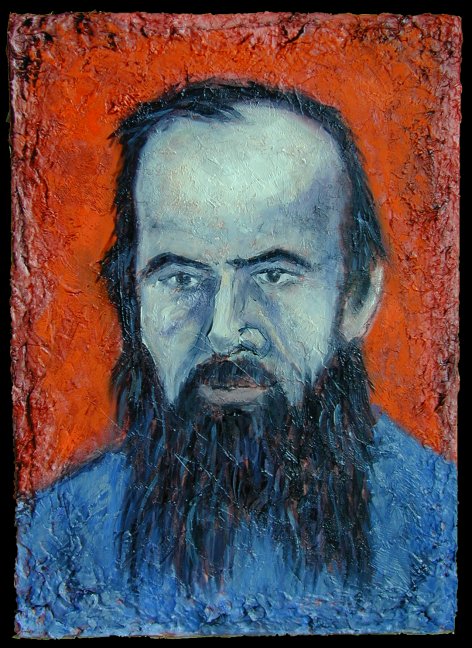
Dostoevsky, by Gregory Eanes‘Oh, everyone laughs in my face now, and assures me that one cannot dream of such details as I am telling now, that I only dreamed or felt one sensation that arose in my heart in delirium and made up the details myself when I woke up. And when I told them that perhaps it really was so, my God, how they shouted with laughter in my face, and what mirth I caused! Oh, yes, of course I was overcome by the mere sensation of my dream, and that was all that was preserved in my cruelly wounded heart; but the actual forms and images of my dream, that is, the very ones I really saw at the very time of my dream, were filled with such harmony, were so lovely and enchanting and were so actual, that on awakening I was, of course, incapable of clothing them in our poor language, so that they were bound to become blurred in my mind; and so perhaps I really was forced afterwards to make up the details, and so of course to distort them in my passionate desire to convey some at least of them as quickly as I could. But on the other hand, how can I help believing that it was all true?’ – Fyodor Dostoevsky, The Dream of a Ridiculous Man.

[Image: ‘Dostoevsky’, by Gregory Eanes]

Rowan Williams on mission

Rowan WilliamsThe good Archbishop Williams recently gave an address titled ‘God’s Mission and Ours in the 21st century’. [You can also listen to/download it here]. He unpacked Matthew 10 in order to answer 5 commonly-asked questions about mission: Where do we start? What do we say? What do we do? Why are we doing it? How do we plan it? He then turned to Matthew 28. Unsurprisingly, the whole thing is well worth reading, but here are some snippets that got me all fuzzy inside:

‘It’s of course a salutary reminder of the very general principle that mission is never a matter of taking God where he hasn’t been before, and introducing him to a lot of kind strangers. In every act of mission, God is there ahead of us. But by saying, ‘Go first to the lost sheep of Israel,’ Jesus is telling us that we need always to be alert to that prior history. We need to be reminded that mission is God’s before it is ours … So as we engage in mission, communicating the good news – the really new message of Jesus Christ and who he is and what he’s done – we will always be attending to the pattern of God’s presence and action, already there’. [I was immediately reminded here of Vincent Donovan].

‘Mission is not about introducing a distant and rather shy God to people that he’s never met before. It’s much more a question of saying to people that God is more interested in you than you are in God. And the good news is that if you show signs of interest of response, trust and love, then that interest turns into profound intimacy and relationship. God is nearer than you think. God is already on the way. So that what we say about God in mission is actually very closely connected with the question of where and how do we start? We start recognizing God who is there before us, and we say to the people with whom we’re speaking, ‘God is already at work in you and the challenge is for you to recognize this and give your heart and your will to cooperating with what God wants to do with and in you. Our assumption must always be that God has started’.

‘Mission is release from sickness, from death, literally, from isolation (leprosy), from the demonic and the destructive forces that suck human beings down into darkness both inside and outside. Mission is crucially about tangible change, visible release, a release that at the individual level is the release from guilt and fear in respect of God which at the public and corporate level is a release from despair and oppression, from poverty and inhumanity. But whether we’re talking about the individual or corporate, we are talking about change and a change in the life that you see around’.

‘Gratitude is why we do it, because we can’t help it. Why are we seeking to share the good news of Jesus Christ? It is because we have received without payment an inestimable gift, which will not stay still in our hands’.

In addressing the fifth question – ‘How do we plan mission?’ – Williams says, ‘we have to be very careful not to close doors by the way we plan: that is, we need to be lead by the sense of where God is actively opening doors and put the initiative and energy there in the trust that somehow that action will generate the resources we need – “For the labourers deserve their food”. Mission travels light. Mission is probably not best advanced by the spectacle of someone embarking on it encumbered with a massive weight of cultural or financial baggage’.

Turning to Matthew 28, and to Jesus’ command to ‘make disciples’, Williams reminds that ‘Making disciples is a matter of shaping people who are willing to go on learning from God. Interestingly, Jesus doesn’t seem to talk about making members, recruiting people to sign up: he wants disciples. He wants members of his body, not members of an organization. And the members of the body are those who share in the action of the body – a disciple is a learner, somebody who puts themselves to school under God and God’s Messiah. So go and make learners; encourage people to embark on the journey of discovering what the gift of God is. In mission when people see the new creation, the transformed reality that is set before them, they will need time to learn what it’s about. Don’t look for short cuts. Draw people in to the newness and mystery and excitement, and then let them know that it’s a lifetime’s work to find your way into it. Take the time that is needed for people to learn and to grow to be disciples. Of course Christ asks from his disciples service, obedience, sacrifice, but all the time Christ asks us to continue learning, day by day taking up the cross, walking this path and discovering as we go’.

Williams spoke encouragingly of the Fresh Expressions initiatives, and pressed that when it comes to mission the Church needs to take a ‘long-term view’. ‘Mission’, he says, ‘always requires an almost superhuman level of patience. When I look at the history of Christian mission, I find that the stories that move me most are not always the ones of rapid and widespread success, but the stories of those who, through a whole generation of apparent frustration have stayed with the particular situation, confident that God really is opening a door even if you can’t yet see it. There are many such stories. There are sad stories too, of successes that have proved short-lived where the enemies of the gospel have more or less extinguished what seemed to be great early promise. The long view is the most important, but because we live in a culture that is not at all in love with long views and likes short-term solutions whether in religion or politics, the Christian committed to patience is a very counter-cultural person and all the more important because of it. But even in local and prosaic settings, how very tempting it is to say that we want our results now, before the end of the year. We have justify what we’re doing in the shortest of short terms and that is a curse for churches, universities, charities, community regeneration projects, all sort of things in our society. And we need deep breaths and long views again’.

He also highlighted that one of the practical implications of mission is what he termed a ‘solid, three-dimensional liturgical life’. He said: ‘we need to find ourselves in a Church that has a deep rhythm of teaching and symbolizing of our faith. I don’t mean elaborate ceremonial and I don’t mean complicated externals. I mean a nourishing diet of sacramental worship with baptism and the Lord’s Supper at the heart of it, taking us again and again through the Christian year in ways that make the rhythm of the life of Christ second nature to us. Because that’s how the new creation is fleshed out in the life of the Church. And that’s what we’re asking people ultimately to become part of. It certainly doesn’t mean that when you’re engaged in mission or evangelism, the first thing you do with people is present them with the annual lectionary! But I do mean that in the long term, what we hope will happen in mission is that people come into that flow of Christ’s love that the Christian year and Christian worship represents. Each year Christians go through the story of waiting and expectation and fulfillment of Christmas, of baptism, temptation, passion and resurrection, ascension, the giving of the Spirit, and the great climax, the celebration of God, Father, Son and Holy Spirit, that we’ve just experienced on Trinity Sunday. And that annual rhythm, that taking time and going through the story, is so important in anchoring us to something other than what we happen to be thinking or feeling on any one day. None of what I’ve said is going to have its full effect on us unless we are aware of the need for our worship and community life as Christians to have that depth and solidity, that three-dimensional quality to it’.

That’s a lot of fuzzies …

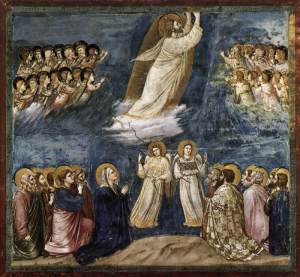
Rowan Williams on the Ascension

Giotto - The Ascension

Giotto, 'The Ascension'. Scrovegni Chapel, Padua.

‘The ascension of Jesus … becomes a celebration of the extraordinary fact that our humanity in all its variety, in all its vulnerability, has been taken by Jesus into the heart of the divine life …. [The] Ascension is a celebration of the glory of humanity, the unlikely possibilities of people like you and me, the eternal potential locked up in our muddled struggling lives. And a celebration too of God’s capacity, through his Holy Spirit, to reach into those parts of humanity that are so far from glorious, that are rebellious and troubled and broken, to breathe through them, to take them home, to drop them into that fire and melt them and recast them. The promise of the Father is that we as Christians will receive that level and dimension of divine life that we call ‘Holy Spirit’, so that, like Jesus, we will find that nothing human is alien to us. And the promise of the Father is that by the love of Christ spreading through us and in us, the world may be brought home to Christ, who brings it home to his Father’. – Rowan Williams, ‘A sermon by the Archbishop of Canterbury at the Ascension Day Sung Eucharist’.

Sex and Human Existence (or, Engaging Sex in the Right Places)

Magritte loversHalden’s and Ben’s recent posts on sex and personhood reminded me of Ray Anderson’s essay ‘Bonding Without Bondage’ (in On Being Family: A Social Theology of the Family). Anderson’s essay is on marriage, and begins by identifying a subtle but important distinction between a ‘theological’ view (i.e. that determined by theology proper and its Gospel shape) and an ‘ethical’ view (i.e. that determined by appeals to natural law) of marriage. The former is that held by Karl Barth, the latter by Emil Brunner. Anderson recalls that for Brunner marriage is not good in se, but only as it provides the optimum containment for what is otherwise unbridled impulse. For Brunner, sexuality is sanctified only through marriage, unless one chooses total abstinence. In other words, Brunner suggests that the erotic sexual impulse is an ‘unnatural’ and ‘unbridled biological instinct’ which can only be consecrated through marriage, or the ethical demand of abstinence (Love and Marriage, 183, 195). Barth, conversely, contends that human sexuality is a determination of human existence as the image and likeness of God and thus exists prior to, and independent of, marriage as a true order.

Anderson highlights that whereas for Brunner sexuality is sanctified as an ethical existence under the command of God only in the marriage relation, for Barth the command of God sanctifies human persons by including their sexuality within their humanity. In other words, the sexual relation of woman and man has already been constituted a true order of humanity, as an integral part of total humanity as male and female. Marriage, therefore, however conceived, integrates sexuality into total humanity.

Anderson observes that Brunner’s position of human sexuality ad extra to human personhood has serious consequences for understanding the role of sexuality in the case of the unmarried person as well as for a discussion of the matter of homosexuality. If we follow Brunner and understand the married couple as the basic model of man and woman as a community of love and all other relations as peripheral to it, then marriage will be offered as the highest – if not the only – possibility for authentic personhood. If, on the other hand, we follow Barth that humanity as determined by God is cohumanity, existing concretely as either male or female, then marriage (however conceived) is seen not as a ‘containment’ of that which has no other ethical point of reference, but as the ‘contextualizing’ of that which comes to expression in the total encounter of persons.

loversOne of the main points that Anderson seeks to bring home is that the divine command (‘What God has joined together …’) does not take place behind our backs, independent of human response and recognition. While marriage is grounded in God’s covenant love, it involves the mutual recognition, choice, and commitment of two people who are brought together by God in covenant partnership. God joins together actually as well as theoretically. God joins together in and by the encounter and decision of the two who form the union: not only on the basis of this human act of love but coincidental with it and as its objective validation. What begins as affection and feelings of love is absorbed into personal will expressed as commitment in marriage (with or without ‘a wedding’).

According to Barth, love, in contradistinction to mere affection,

‘may be recognised by the fact that it is determined, and indeed determined upon the life-partnership of marriage. Love does not question; it gives an answer. Love does not think; it knows. Love does not hesitate; it acts. Love does not fall into raptures; it is ready to undertake responsibilities. Love puts behind it all the Ifs and Buts, all the conditions, reservations, obscurities and uncertainties that may arise between a man and a woman. Love is not only affinity and attraction; it is union. Love makes these two persons indispensable to each other’. (CD III.4, 221)

Of course, one could – and indeed should – ask, what has love got to do with it?

Still, while certain to set marriage within the absolute determination of divine command, Anderson is equally concerned to not set marriage above the reality and practice of human existence. In this way, he avoids the idealism(s) often associated with marriage. He also notes that marriage can never be the solution to problems of personal unhappiness or loneliness. It can never be the relational horizon within which one expects to meet all his or her personal needs. Marriage, he contends, offers an expression of love and sexuality not realisable in any other human relationship, but it is no more human than any other human task or relationship. And, in particular, because marriage takes place under the divine command,

‘the sphere of the relationships of man and woman as they are embodied and lived out among us human beings is not simply a labyrinth of errors and failings, a morass of impurity, or a vale of tears at disorder and distress. For by the grace of God … there are always in this sphere individual means of conservation and rescue, of deliverance and restoration, assured points and lines even where everything seems to vacillate and dissolve, elements of order in the midst of disorder … And if there is no perfect marriage, there are marriages which for all their imperfection can be and are maintained and carried through, and in the last resort not without promise and joyfulness, arising with a certain necessity, and fragmentarily, at least, undertaken in all sincerity as a work of free life-fellowship. There is also loyalty even in the midst of disloyalty and constancy amid open inconstancy … Thus even where man does not keep the command, the command keeps man … He who here commands does not only judge and forgive: He also helps and heals’. (CD III.4, 239–40)

Adorno on dismantling the affirmative lie of culture

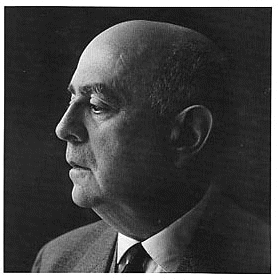
adornoA delightful morning spent meditating on two related thoughts from Theodor Adorno:

‘The eclipse of art which is being propagated by people who are either just plain thoughtless or resentful of art would be false and would play into the hands of conformism. Desublimation – the instantaneous, immediate gratification which art is supposedly able to furnish – is of course beneath art in terms of intra-aesthetic standards. But even in terms of real libidinal gratification, desublimation has little to offer …  The impoverished aestheticism that accompanies the sort of panting politics of the student movement is a complement of the general exhaustion of aesthetic vigour. To recommend the acceptance of jazz and rock-and-roll over Beethoven does nothing to dismantle the affirmative lie of culture. All it does is give the culture industry an excuse for more profit-taking and barbarity. The allegedly vigorous and uncorrupted essence of such products is in reality synthetically put together by the very powers that are the target of this supposed Great Refusal. They are worse than anything else’. – Theodor W. Adorno, Aesthetic Theory (ed. Gretel Adorno and Rolf Tiedemann; trans. C. Lenhardt; London/Boston/Melbourne/Henley: Routledge & Kegan Paul, 1984), 440–1.

‘The appeal to order alone, without concrete specificity, is futile; the appeal to the dissemination of norms, without these ever proving themselves in reality or before consciousness, is equally futile. The idea of an objectively binding order, huckstered to people because it is so lacking for them, has no claims if it does not prove itself internally and in confrontation with human beings. But this is precisely what no product of the culture industry would engage in. The concepts of order which it hammers into human beings are always those of the status quo. They remain unquestioned, unanalyzed and undialectically presupposed, even if they no longer have any substance for those who accept them. In contrast to the Kantian, the categorical imperative of the culture industry no longer has anything in common with freedom. It proclaims: you shall conform, without instruction as to what; conform to that which exists anyway, and to that which everyone thinks anyway as a reflex of its power and omnipresence. The power of the culture industry’s ideology is such that conformity has replaced consciousness. The order that springs from it is never confronted with what it claims to be or with the real interests of human beings. Order, however, is not good in itself. It would be so only as a good order. The fact that the culture industry is oblivious to this and extols order in abstracto, bears witness to the impotence and untruth of the messages it conveys. While it claims to lead the perplexed, it deludes them with false conflicts which they are to exchange for their own. It solves conflicts for them only in appearance, in a way that they can hardly be solved in their real lives. In the products of the culture industry human beings get into trouble only so that they can be rescued unharmed, usually by representatives of a benevolent collective; and then in empty harmony, they are reconciled with the general, whose demands they had experienced at the outset as irreconcilable with their interests. For this purpose the culture industry has developed formulas which even reach into such non-conceptual areas as light musical entertainment. Here too one gets into a ‘jam’, into rhythmic problems, which can be instantly disentangled by the triumph of the basic beat. Even its defenders, however, would hardly contradict Plato openly who maintained that what is objectively and intrinsically untrue cannot also be subjectively good and true for human beings. The concoctions of the culture industry are neither guides for a blissful life, nor a new art of moral responsibility, but rather exhortations to toe the line, behind which stand the most powerful interests. The consensus which it propagates strengthens blind, opaque authority. If the culture industry is measured not by its own substance and logic, but by its efficacy, by its position in reality and its explicit pretensions; if the focus of serious concern is with the efficacy to which it always appeals, the potential of its effect becomes twice as weighty. This potential, however, lies in the promotion and exploitation of the ego-weakness to which the powerless members of contemporary society, with its concentration of power, are condemned. Their consciousness is further developed retrogressively. It is no coincidence that cynical American film producers are heard to say that their pictures must take into consideration the level of eleven-year-olds. In doing so they would very much like to make adults into eleven-year-olds’. – Theodor W. Adorno, ‘Culture Industry Reconsidered’.

On Books …

BooksRick writes:

‘I’ve noticed a strange thing over the last few years. During that time I have been privileged to know and work with a number of young clergy and seminarians, men and women. Most of them are gifted, hard–working, dedicated and capable. There is a lot to like about them. But one thing is noticeably missing. They don’t love my books. They don’t stare at them, or touch them, or covet them. They don’t even notice them when they come into my study. They are more likely to notice and comment on my computer.

This worries me. Can the church maintain a “learned clergy” without instilling a love of books? Is it possible that books are really passé as some say? That in the future the digital age will restrict if not eliminate their use? I hope not. Because books are more than mere information. Throughout my life they have always been my companions and friends. They can invoke wonder and create mystery. They can witness to faith. They are grist for my sermonic mill. But they are more than that. They fuel not just my work but my imagination. I wouldn’t be the minister I am without them. I wouldn’t be who I am without them’.

Yes. Yes. Yes. How can anyone ever trust someone who doesn’t read? Like non-drinkers, there’s something sinister about people who avoid books. It’s really hard to justify that one deserves dinner at the end of a day wherein one has failed to read, discuss and recommended a decent book. And I mean a book, not a blog post or anything on a screen. It’s gotta be something caressable, capable of being made love with …

At a time when theological education and training for pastoral ministry is embracing a lowest-common denominator approach, we could certainly do worse than heed the words of Martyn Lloyd-Jones:

‘Time must be found for reading, and we turn now to the more intellectual type of reading. The first is theology. There is no greater mistake than to think that you finish with theology when you leave a seminary. The preacher should continue to read theology as long as he is alive. The more he reads the better and there are any authors and systems to be studied. I have known men in the ministry, and men in various other works of life who stop reading when they finish their training. They think they have acquired all they need; they have their lecture notes, and nothing further is necessary. The result is that they vegetate and become quite useless. Keep on reading; and read the big works’. Preaching and Preachers (Hodder and Stoughton, 1985), 177.

I mean really, who would take advice from a doctor who hasn’t read anything since the 1950s?

But there’s more. Non-readers, or people addicted to reading trash, clearly aren’t into ‘Ahs’! (and insofar as this is true, they’re not human in any recognisable sense). Vernon Sproxton explains:

‘There are good books, indifferent books, and bad books. Amongst the good books some are honest, inspiring, moving, prophetic, and improving. But in my language there is another category: there are Ah! Books …. Ah! Books are those which induce a fundamental change in the reader’s consciousness. They widen his sensibility in such a way that he is able to look upon familiar things as though he is seeing and understanding them for the first time. Ah! Books are galvanic. They touch the nerve-centre of the whole being so that the reader receives an almost palpable physical shock. A tremor of excited perception tipples through the person … Ah! Books give you sentences which you can roll around in the mind, throw in the air, catch, tease out, analyse. But in whatever l way you handle them, they widen your vision. For they are essentially Idea-creating, in the sense that Coleridge meant when he described the Idea as containing future thought – as opposed to the Epigram which encapsulates past thought. Ah! Books give the impression that you are opening a new account, not closing an old one down’. – Vernon Sproxton, ‘Introduction’,  to Fynn. Mister God, This Is Anna (London: Fount, 1979), 1-2.

And as for ‘educated clergy’, Carnegie Samuel Calian (who is President Emeritus of Pittsburgh Theological Seminary) put it well when he reminded us that ‘Everything we learn at seminary is for someone else …  The aim of seminary education is not simply to produce an educated clergy, but even more so to build up the people of God to become an educated congregation in Christ. The practice of learning is for the purpose of giving hope to others’. The Ideal Seminary (Westminster John Knox, 2003), p. 5.

It is precisely for this end that pastors must be readers. So if pastors don’t want to read for themselves (which is a completely ridiculous position to hold, but is evidently possible), then they ought to read, read and read for those they have been called to love and serve.

[Image: Andre Martins de Barros]

News from a Tyrannised Nation: a Karen Update

Karen VillageThree items just in from the Karen Human Rights Group:

Over 700 villagers flee to Thailand amidst fears of SPDC/DKBA attacks on a KNLA camp and an IDP camp in Pa’an District

Villagers in Pa’an District, Karen State, have begun fleeing to Thailand to avoid violence and forced recruitment as porters in possible a joint SPDC/DKBA attack on a KNLA camp in Dta Greh Township, located next to a now populous IDP camp along the Moei River, bordering Thailand. This news bulletin describes the events of the past four days in which SPDC and DKBA forces have advanced towards the KNLA camp and begun what appears to be preparation for an attack. SPDC soldiers have begun patrolling and have set up an 81 mm mortar not far from the site and displaced villagers living in the area have become increasingly concerned about their safety.


 Karen 1Don’t neglect rural Burma in calling for Suu Kyi’s release

Following the arrest of the American John Yettaw on May 5th 2009, Burma’s pro-democracy icon Daw Aung San Suu Kyi was charged with violating the terms of her house arrest, moved to Insein Prison and put on trial. The international community has responded to these events with a flurry of attention on Burma not seen since Cyclone Nargis last year. Heads of State, activists and newspaper editors have renewed calls for her immediate release. At the same time, Burma Army operations in Karen State and other rural ethnic areas along with their associated human rights abuses remain ongoing and widespread. Yet once again the situation of abuse in rural Burma has been marginalised in favour of the more high profile political drama in the country’s urban settings. In calling, quite rightly, for the release of Daw Aung San Suu Kyi, the international community must neither neglect the situation of abuse in rural Burma nor miss current opportunities to support those who face this abuse.


 Karen 2Whatever happened to the 2007 protesters?: Interviews with convict porters

This report presents January 2009 interviews with two former SPDC convict porters. Both men are originally from Arakan State, Western Burma, and participated in the 2007 demonstrations against the rising cost of living. These demonstrations culminated in September 2007 with the large-scale monk-led protests and subsequent military crackdown. Both men were arrested by SPDC authorities for their activities, forced to serve as porters for the Burma Army in Karen State and eventually escaped captivity. Their testimonies cover issues such as SPDC-sponsored murder of convict porters, corruption within Burma’s judiciary and systematic SPDC abuses perpetrated against prisoners. The interviews also give insight into the possible fates of other Burmese citizens who have tried to voice dissent in Burma’s authoritarian environment, whether as part of the September 2007 protests or otherwise.

Coleridge on the ‘Ground’ of God

After re-reading McCormack and Molnar recently, I began to make my way through Berkeley’s fascinating essay on Coleridge, where I was struck by this claim:

‘The most radical element of Coleridge’s account of the Trinity is the inclusion of a fourth term: the “Prothesis” or “Ground” of God. [Coleridge] insists that this ground be conceived as will, and bases his claims of the personality of God on this subtlety’. – Richard Berkeley, Coleridge and the Crisis of Reason (Houndmills: Palgrave Macmillan, 2007), 46.

Now I’m no Coleridge scholar (Steve Holmes is my Coleridge man), but might it be that good ol’ uncle Samuel has something to contribute to this debate among Barth’s interpreters?