Year: 2009
Australia’s Apartheid

Freemantle Prison
‘Since Rudd‘s apology, Aboriginal poverty indicators have gone backwards. His “Closing the Gap” programme is a grim joke, having produced not a single new housing project.
An undeclared agenda comes straight from Australia’s colonial past: a land-grab combined with an almost prurient need to control, harass and blame a people who have refused to die off, whose genius is their understanding of an ancient land that still perplexes and threatens white authority. Whenever Canberra’s politicians want to look “tough”, they give the Aborigines a good kicking: it is a ritual as sacred as Don Bradman worship or Anzac Day.
The indigenous affairs minister, Jenny Macklin, has decreed that unless certain communities hand over their precious freehold leases, they will be denied basic services. The Northern Territory contains abundant mineral wealth, such as uranium, and has long been eyed by multinationals as a lucrative radioactive waste dump. The blacks are in the way, yet again: so it is time for the usual feigned innocence. Rudd has said his government “doesn’t have a clear idea of what’s happening on the ground” in Aboriginal Australia. What? The learned studies pour forth as if the sorcerer’s apprentice is loose.
One example: the rate of incarceration of black Australians is five times that of black South Africans during apartheid. Western Australia imprisons Aboriginal men at eight times the apartheid figure, an Aussie world record.
On 16 November, a 12-year-old Aboriginal boy appeared in court charged with receiving a Freddo Frog chocolate bar from a friend who had allegedly taken it from a supermarket. Only the international headlines forced the police to drop the case. Two-thirds of Aboriginal children who have contact with the police are jailed; two-thirds of white children are cautioned. A young Aboriginal man was jailed for a year for stealing £12 worth of biscuits and soft drink’.
– John Pilger, ‘Return to a secret country’. New Statesman 26 November 2009.
It seems that I can’t put away my sackcloth and ashes just yet …
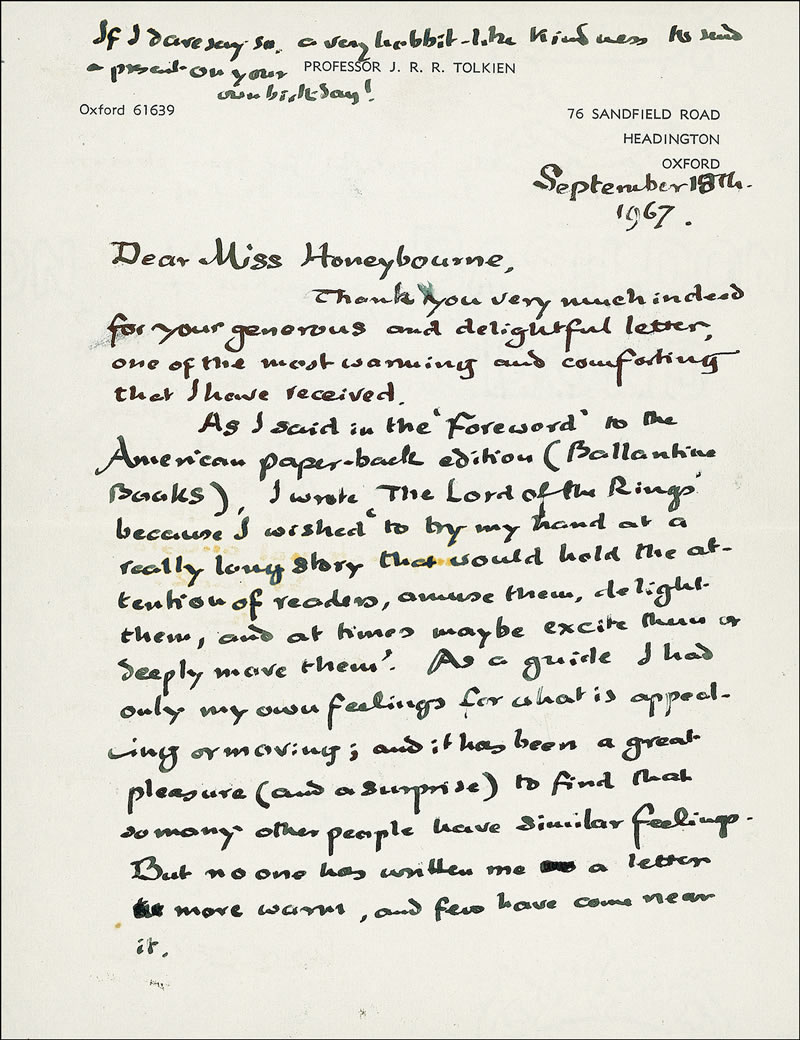
Why did Tolkien write The Lord of the Rings?
‘I wrote The Lord of the Rings because I wished “to try my hand at a really long story that would hold the attention of readers, amuse them, delight them, and at times maybe excite them or deeply move them”. As a guide I had only my own feelings for what is appealing or moving; and it has been a great pleasure (and a surprise) to find that so many other people have similar feelings’. – J.R.R. Tolkien, ‘Letter to Miss Elise Honeybourne’, 18 September 1967.
A more eligible Nobel prize candidate
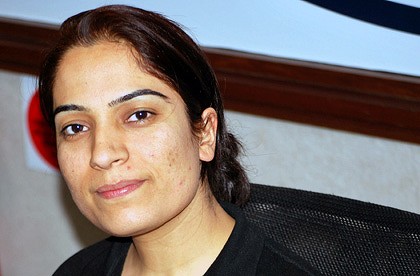 ‘The Nobel Peace Prize committee might well have made truly worthy choices, prominent among them the remarkable Afghan activist Malalai Joya. This brave woman survived the Russians, and then the radical Islamists whose brutality was so extreme that the population welcomed the Taliban. Joya has withstood the Taliban and now the return of the warlords under the Karzai government. Throughout, Joya worked effectively for human rights, particularly for women; she was elected to parliament and then expelled when she continued to denounce warlord atrocities. She now lives underground under heavy protection, but she continues the struggle, in word and deed’. – Noam Chomsky, ‘War, Peace, and Obama’s Nobel’. In These Times, November 5, 2009.
The Lord of the Rings: the 1940 version
This parody of The Lord of the Rings by O. Sharp is very clever, not least because it came out some 14 years before Tolkien’s book was published. It stars Humphrey Bogart as Frodo Baggins, Sydney Greenstreet as Gandalf, and Marlene Dietrich as Galadriel.
Einstein on ‘God’
 A letter that Richard Dawkins was an unsuccessful bidder on sold at auction in May 2008 for a meagre £170,000. The item in question was penned by Albert Einstein in January 1954, just a year before his death, and was addressed to philosopher Erik Gutkind after reading his book, Choose Life: The Biblical Call to Revolt. The letter reads:
Princeton, 3. 1. 1954
Dear Mr Gutkind,
Inspired by Brouwer’s repeated suggestion, I read a great deal in your book, and thank you very much for lending it to me … With regard to the factual attitude to life and to the human community we have a great deal in common. Your personal ideal with its striving for freedom from ego-oriented desires, for making life beautiful and noble, with an emphasis on the purely human element … unites us as having an “American Attitude.”
Still, without Brouwer’s suggestion I would never have gotten myself to engage intensively with your book because it is written in a language inaccessible to me. The word God is for me nothing more than the expression and product of human weakness, the Bible a collection of honorable, but still purely primitive, legends which are nevertheless pretty childish. No interpretation no matter how subtle can (for me) change this … For me the Jewish religion like all other religions is an incarnation of the most childish superstition. And the Jewish people to whom I gladly belong … have no different quality for me than all other people. As far as my experience goes, they are also no better than other human groups, although they are protected from the worst cancers by a lack of power. Otherwise I cannot see anything “chosen” about them.
In general I find it painful that you claim a privileged position and try to defend it by two walls of pride, an external one as a man and an internal one as a Jew. As a man you claim, so to speak, a dispensation from causality otherwise accepted, as a Jew of monotheism. But a limited causality is no longer a causality at all, as our wonderful Spinoza recognized with all incision …
Now that I have quite openly stated our differences in intellectual convictions it is still clear to me that we are quite close to each other in essential things, i.e. in our evaluation of human behavior … I think that we would understand each other quite well if we talked about concrete things.
With friendly thanks and best wishes,
Yours,
A. Einstein
Fascinating stuff. You can read the whole letter with commentary here.

… he is not ashamed to address a lifeless thing
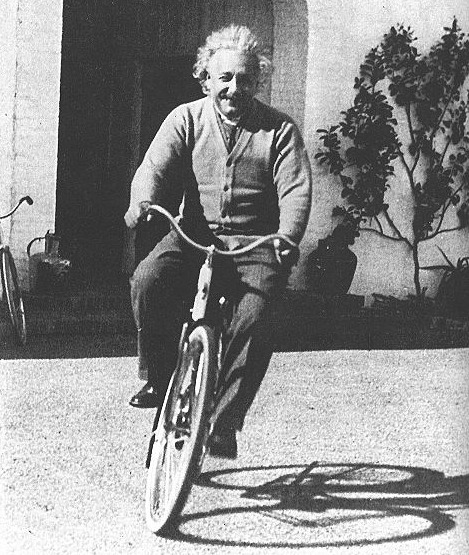
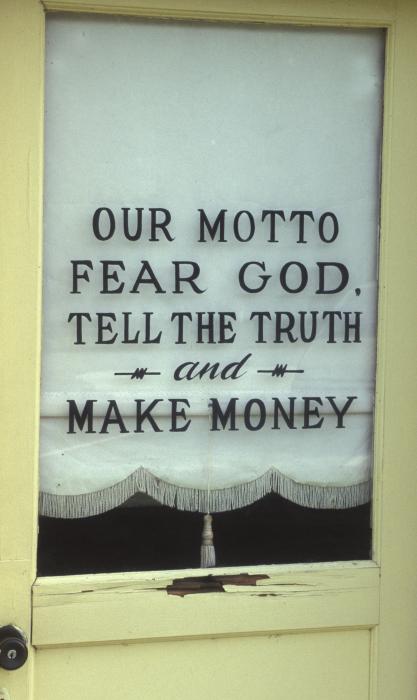 This relatively well-known photograph by Carl Purcell reminded me not only of Matthew 6:24, but also of Wisdom 13:1–19,
‘For all people who were ignorant of God were foolish by nature; and they were unable from the good things that are seen to know the one who exists, nor did they recognize the artisan while paying heed to his works; 2 but they supposed that either fire or wind or swift air, or the circle of the stars, or turbulent water, or the luminaries of heaven were the gods that rule the world. 3 If through delight in the beauty of these things people assumed them to be gods, let them know how much better than these is their Lord, for the author of beauty created them. 4 And if people were amazed at their power and working, let them perceive from them how much more powerful is the one who formed them. 5 For from the greatness and beauty of created things comes a corresponding perception of their Creator. 6 Yet these people are little to be blamed, for perhaps they go astray while seeking God and desiring to find him. 7 For while they live among his works, they keep searching, and they trust in what they see, because the things that are seen are beautiful. 8 Yet again, not even they are to be excused; 9 for if they had the power to know so much that they could investigate the world, how did they fail to find sooner the Lord of these things? 10 But miserable, with their hopes set on dead things, are those who give the name “gods” to the works of human hands, gold and silver fashioned with skill, and likenesses of animals, or a useless stone, the work of an ancient hand. 11 A skilled woodcutter may saw down a tree easy to handle and skillfully strip off all its bark, and then with pleasing workmanship make a useful vessel that serves life’s needs, 12 and burn the cast-off pieces of his work to prepare his food, and eat his fill. 13 But a cast-off piece from among them, useful for nothing, a stick crooked and full of knots, he takes and carves with care in his leisure, and shapes it with skill gained in idleness; he forms it in the likeness of a human being, 14 or makes it like some worthless animal, giving it a coat of red paint and coloring its surface red and covering every blemish in it with paint; 15 then he makes a suitable niche for it, and sets it in the wall, and fastens it there with iron. 16 He takes thought for it, so that it may not fall, because he knows that it cannot help itself, for it is only an image and has need of help. 17 When he prays about possessions and his marriage and children, he is not ashamed to address a lifeless thing. 18 For health he appeals to a thing that is weak; for life he prays to a thing that is dead; for aid he entreats a thing that is utterly inexperienced; for a prosperous journey, a thing that cannot take a step; 19 for money-making and work and success with his hands he asks strength of a thing whose hands have no strength’.
Žižek on Apocalypse, on the Future, and on Obama
 In an earlier post, I suggested that few will embrace every element of Žižek’s compassionate-Marxist panacea, but that his analyses of history’s big movements nevertheless remain insightful, often compelling, and usually fascinating. I’ve received a bit of e-flack for reading (and posting on) Žižek, but let me say again that I don’t draw attention to Žižek’s work because I agree with all his conclusions, or with how he gets there. Rather, I read Žižek for many of the same reasons that I read from traditions and centuries other than my own – because I’m grateful for anyone who helps me to think differently about the world, and to ask some different questions about reality and human experience than does the literature I most typically immerse myself in. Apart from all that, reading Žižek is, at times, just such great fun. [Who is this idiot blogger, i.e. me, who feels the need to defend his own reading habits!]
Anyway, that said, here’s more from Žižek’s First As Tragedy, Then As Farce; this time, on Apocalypse:
‘Apocalypse is characterized by a specific mode of time, clearly opposed to the two other predominant modes: traditional circular time (time ordered and regulated on cosmic principles, reflecting the order of nature and the heavens; the time-form in which microcosm and macrocosm resonate in harmony), and the modern linear time of gradual progress or development. Apocalyptic time is the “time of the end of time,” the time of emergency, of the “state of exception” when the end is nigh and we can only prepare for it. There are at least four different versions of apocalyptism today: Christian fundamentalism, New Age spirituality, techno-digital post-humanism, and secular ecologism. Although they all share the basic notion that humanity is approaching a zero-point of radical transmutation, their respective ontologies differ radically: Techno-digital apocalyptism … remains within the confines of scientific naturalism, and discerns in the evolution of human species the contours of our transformation into “post-humans.” New Age spirituality gives this transmutation a further twist, interpreting it as the shift from one mode of “cosmic awareness” to another (usually a shift from the modern dualist-mechanistic stance to one of holistic immersion). Christian fundamentalists of course read the apocalypse in strictly biblical terms, that is, they search for (and find) in the contemporary world signs that the final battle between Christ and the Anti-Christ is imminent. Finally, secular ecologism shares the naturalist stance of post-humanism, but gives it a negative twist-what lies ahead, the “omega point” we are approaching, is not a progression to a higher “post-human” level, but the catastrophic self-destruction of humanity. Although Christian fundamentalist apocalyptism is considered the most ridiculous, and dangerous, in its content, it remains the version closest to a radical “milenarian” emancipatory logic. The task is thus to bring it into closer contact with secular ecologism, thereby conceiving the threat of annihilation as the chance for a radical emancipatory renewal’. (pp. 93–4)
So what future does Žižek look to?
‘The future will be Hegelian … The only true alternative that awaits us – the alternative between socialism and communism – is the alternative between the two Hegels’.
Žižek contrasts Hegel’s ‘conservative’ vision (which points forward to what Žižek describes as ‘capitalism with Asian values’, as ‘a capitalist civil society organized into estates and kept in check by a strong authoritarian state with managerial “public servants” and traditional values’; he suggests that modern Japan comes close to this model), with the young Hegelianism evidenced in Haiti. He suggests: ‘It is as if the split into Old and Young Hegelians is to be re-enacted once again’. (p. 148)
He continues:
But what are the chances for an Hegelian Left today? Can we count only on momentary utopian explosions – like the Paris Commune, the Canudos settlement in Brazil, or the Shanghai Commune – which dissolve because of brutal external suppression or internal weaknesses, fated to remain no more than brief diversions from the main trajectory of History? Is communism then condemned to remain the utopian Idea of another possible world, an Idea whose realization necessarily ends in failure or self- destructive terror? Or should we remain heroically faithful to the Benjaminian project of the final Revolution that will redeem-through-repetition all past defeats, a day of full Reckoning? Or, more radically, should we change the field entirely, recognizing that the alternatives just proposed simply represent two sides of the same coin, that is, of the teleological-redemptive notion of history? Perhaps the solution resides in an eschatological apocalyptism which does not involve the fantasy of the symbolic Last Judgment in which all past accounts will be settled; to refer to another of Benjamin’s metaphors, the task is “merely” to stop the train of history which, left to its own course, leads to a precipice. (Communism is thus not the light at the end of the tunnel, that is, the happy final outcome of a long and arduous struggle – if anything, the light at the end of the tunnel is rather that of another train approaching us at full speed.) This is what a proper political act would be today: not so much to unleash a new movement, as to interrupt the present predominant movement. An act of “divine violence” would then mean pulling the emergency cord on the train of Historical Progress. In other words, one has to learn fully to accept that there is no big Other … (pp. 148–9)
And, in another place, Žižek offers the following reflection/commentary on ‘Obama’s victory’:
‘One can and should entertain cynical doubts about the real consequences of Obama’s victory: from a pragmatic-realistic perspective, it is quite possible that Obama will turn out to be a “Bush with a human face” making no more than a few minor face-lifting improvements. He will pursue the same basic politics in a more attractive mode and thus possibly even strengthen US hegemony, damaged as it has been by the catastrophe of the Bush years. There is nonetheless something deeply wrong in such a reaction – a key dimension is missing. It is in light of the Kantian conception of enthusiasm that Obama’s victory should be viewed not simply as another shift in the eternal parliamentary struggle for a majority, with all its pragmatic calculations and manipulations. It is a sign of something more. This is why a good American friend of mine, a hardened Leftist with no illusions, cried for hours when the news came through of Obama’s victory. Whatever our doubts, fears and compromises, for that instant of enthusiasm, each of us was free and participating in the universal freedom of humanity.
The reason Obama’s victory generated such enthusiasm was not only the fact that, against all the odds, it really happened, but that the possibility of such a thing happening was demonstrated. The same goes for all great historical ruptures – recall the fall of the Berlin Wall. Although we all knew about the rotten inefficiency of the communist regimes, we somehow did not “really believe” that they would disintegrate – like Henry Kissinger, we were all too much victims of a cynical pragmatism. This attitude is best encapsulated by the French expression je sais bien, mais quand même – I know very well that it can happen, but all the same (I cannot really accept that it will happen). This is why, although Obama’s victory was clearly predictable, at least for the last two weeks before the election, his actual victory was still experienced as a surprise – in some sense, the unthinkable had happened, something which we really did not believe could happen. (Note that there is also a tragic version of the unthinkable really taking place: the Holocaust, the Gulag … how can one accept that something like that could happen?)
This is also how one should answer those who point to all the compromises Obama had to make to become electable. The danger Obama courted in his campaign is that he was already applying to himself what the later historical censorship applied to Martin Luther King, namely, cleansing his program of contentious topics in order to assure his eligibility. There is a famous dialogue in Monty Python’s religious spoof The Life of Brian, set in Palestine at the time of Christ: the leader of a Jewish revolutionary resistance organization passionately argues that the Romans have brought only misery to the Jews; when his followers remark that they have nonetheless introduced education, built roads, constructed irrigation, and so on, he triumphantly concludes: “All right, but apart from the sanitation, education, medicine, wine, public order, irrigation, roads, the fresh-water system and public health, what have the Romans ever done for us?” Do the latest proclamations by Obama not follow the same line? “I stand for a radical break with Bush’s politics! OK, I pleaded for full support for Israel, for continuing the war on terror in Afghanistan and Pakistan, for refusing prosecutions against those who ordered torture, and so on, but I still stand for a radical break with Bush’s politics!” Obama’s inauguration speech concluded this process of “political self-cleansing” – which is why it was such a disappointment even for many left-liberals in the US. It was a well-crafted but weirdly anemic speech whose message to “all other peoples and governments who are watching today” was: “we are ready to lead once more”; “we will not apologize for our way of life, nor will we waver in its defense.”
During the election campaign, it was often noted that when Obama talked about the “audacity of hope,” about a change we can believe in, he relied on a rhetoric which lacked any specific content: to hope for what? To change what? Now things are a little clearer: Obama proposes a tactical change destined to reassert the fundamental goals of US politics: the defense of the American way of life and a leading role internationally for the US. The US empire will be now more humane, and respectful of others; it will lead through dialogue, rather than through the brutal imposition of its will. If the Bush administration was the empire with a brutal face, now we shall have the empire with a human face – but it will be the same empire. In Obama’s June 2009 speech in Cairo, in which he tried to reach out to the Muslim world, he formulated the debate in terms of the depoliticized dialogue of religions (not even of civilizations) – this was Obama at his politically-correct worst’. (pp. 107–9)
Why universities welcome theological colleges
 Today’s Eureka Street includes a piece by Neil Ormerod on ‘Why universities welcome theological colleges’. He concludes with this warning:
The movement [of theological education] to the university sector of course restores the ancient place of theology as a discipline within a university. But there are dangers in such a move. Theological colleges should be under no illusion that the interest of most of these universities extends beyond the financial. The colleges bring student numbers, and their theologians contribute relatively well to research outputs with minimal investment from the university. Apart from ACU they have no particular interest in theology for its own sake. A decline in student numbers or changes in government funding formulae for research could lead to a colder relationship. The last twelve months has proved tumultuous in the theological sector. The future is not likely to be less so.
The whole piece is worth reading, but his conclusion in particular invites reflection on a host of issues, one of which concerns the relationship between theology and religious studies. And that conversation reminds me of Karl Barth who, in his more generous moments, acknowledged the importance of various facets of religious studies, even though for Barth these could be never more than a beginning, and often a false start at that. The growing trend towards names like ‘religious studies’, ‘philosophy of religion’, ‘phenomenology of religion’, would seem, in Barth’s eyes, to give the game away. For Barth makes a quite fundamental distinction between ‘religion’ and ‘theology’, and the two are not to be confused. For Barth, ‘religion’ is something entirely human and concerns a human being’s search for God, a search so entirely fruitless or perverted that it ends with another god. Theology, on the other hand, is ‘God-talk’: not talk about God, for God is not an object that can form the content of our discourse, but rather the human response to, and participation in, the theologia that has already addressed, undressed and redressed us in Jesus Christ.
And whatever his critics may say of him, Barth’s work can never be faulted at this point. From the beginning, he is constantly aware of the demands of the subject. During the first year of his first university teaching appointment, in the academic atmosphere of Göttingen, Barth wrote to a friend:
To make you acquainted with my spiritual condition I will report to you what Barthold von Regensburg (AD 1272) once said: ‘A man who looks directly into the sun, into the burning radiance, will so injure his eyes that he will see it no more. It is like this also with faith; whoever looks too directly into the holy Christian faith will be astonished and deeply disturbed with his thoughts.’ And then he went on: ‘Often it seems to me problematic to what extent it is both good and possible to spend the thirty-four years that still separate me from my retirement at that task ‘being deeply disturbed with thoughts’. To be a proper professor of theology one must be a sturdy, tough, insensitive lump who notices absolutely nothing … will I perhaps in time myself become such a blockhead? Or explode? If you can see any third possibility, tell me of it for my comfort’. – Barth and Thurneysen, Revolutionary Theology in the Making: Barth-Thurneysen Correspondence, 1914-1925, 92–3.
Grant us more insensitive lumps O Lord.
Slavoj Žižek on liberalism, fundamentalism and the true Left
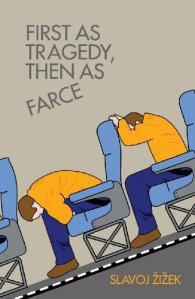 With my lectures for next two weeks (basically) written, I’ve turned to some fun reading: namely, Slavoj Žižek’s latest book, First As Tragedy, Then As Farce. It’s an unsurprisingly-passionate critique of contemporary capitalism post the recent so-called financial crash. While few will embrace every element of Žižek’s compassionate-Marxist panacea, his analyses of the big movements are very insightful, often compelling, and nearly always worth reflecting on – if for no other reason than that no-one quite says it like Žižek. Here he is on liberalism, fundamentalism and the true Left:
‘A true Left takes a crisis seriously, without illusions, but as something inevitable, as a chance to be fully exploited. The basic insight of the radical Left is that although crises are painful and dangerous they are ineluctable, and that they are the terrain on which battles have to be waged and won. The difference between liberalism and the radical Left is that, although they refer to the same three elements (liberal center, populist Right, radical Left), they locate them in a radically different topology: for the liberal center, the radical Left and the Right are two forms of the same “totalitarian” excess; while for the Left, the only true alternative is the one between itself and the liberal mainstream, the populist “radical” Right being nothing but the symptom of liberalism’s inability to deal with the Leftist threat. When today we hear a politician or an ideologist offering us a choice between liberal freedom and fundamentalist oppression, triumphantly asking (purely rhetorical) questions such as “Do you want women to be excluded from public life and deprived of their elementary rights? Do you want every critic or mocker of religion to be punishable by death?” what should make us suspicious is the very self-evidence of the answer – who would have wanted that? The problem is that such a simplistic liberal universalism long ago lost its innocence. This is why, for a true Leftist, the conflict between liberal permissiveness and fundamentalism is ultimately a false conflict – a vicious cycle in which two opposed poles generate and presuppose each other. Here one should take an Hegelian step backwards, placing in question the very measure from which fundamentalism appears in all its horror. Liberals have long ago lost their right to judge. What Horkheimer once said should also be applied to today’s fundamentalism: those who do not want to talk (critically) about liberal democracy and its noble principles should also keep quiet about religious fundamentalism. And, even more pointedly, one should emphatically insist that the conflict between the State of Israel and the Arabs is a false conflict: even if we will all come to perish because of it, it is a conflict which only mystifies the true issues.
How are we to understand this reversal of an emancipatory thrust into fundamentalist populism? In authentic Marxism, totality is not an ideal, but a critical notion-to locate a phenomenon in its totality does not mean to see the hidden harmony of the Whole, but to include within a system all its “symptoms:’ it antagonisms and inconsistencies, as integral parts. In this sense then, liberalism and fundamentalism form a “totality:’ for their opposition is structured so that liberalism itself generates its opposite. Where then do the core values of liberalism – freedom, equality, etc. – stand? The paradox is that liberalism itself is not strong enough to save its own core values from the fundamentalist onslaught. Its problem is that it cannot stand on its own: there is something missing in the liberal edifice. Liberalism is, in its very notion, “parasitic” relying as it does on a presupposed network of communal values that it undermines in the course of its own development. Fundamentalism is a reaction – a false, mystificatory reaction of course – against a real flaw inherent within liberalism, and this is why fundamentalism is, over and again, generated by liberalism. Left to itself, liberalism will slowly undermine itself – the only thing that can save its core is a renewed Left. Or, to put it in the well-known terms of 1968, in order for its key legacy to survive, liberalism will need the brotherly help of the radical Left’. – Slavoj Žižek, First as Tragedy, Then as Farce (London/New York: Verso, 2009), 75–77.
Hegel, Religion and Politics
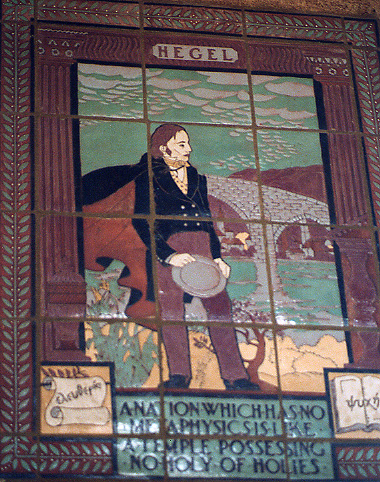
The Hegel Society of America has issued a call for conference papers that ‘investigate or problematize in new ways and in new connections the intersection of religion and politics in Hegel’s philosophy’. The deadline’s not until the end of January, so still some time to get something in. More info here, or contact Prof. Angelica Nuzzo.
Slavoj Žižek on capitalism, communism and anti-Communism in Post-Wall Eastern Europe
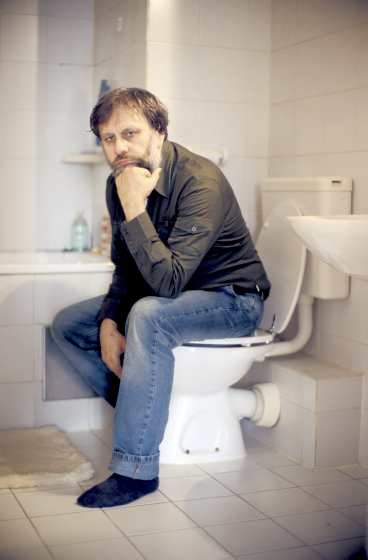 The latest LRB includes a fascinating reflection on capitalism, communism and anti-Communism in Post-Wall Eastern Europe by Slavoj Žižek. It’s well worth reading the whole piece, but here’s the conclusion:
… maybe post-Communist disappointment should not be dismissed as a sign of ‘immature’ expectations. When people protested against Communist regimes in Eastern Europe, most of them weren’t asking for capitalism. They wanted solidarity and a rough kind of justice; they wanted the freedom to live their own lives outside state control, to come together and talk as they pleased; they wanted to be liberated from primitive ideological indoctrination and hypocrisy. In effect they aspired to something that could best be described as ‘socialism with a human face’. Perhaps this sentiment deserves a second chance.
On a somewhat related issue, Jim posted recently on The Berlin Wall as symbol of the Gospel and I found this conversation on Germany, Guilt, Identity, and Memory really interesting.
3 feet under with no snorkel …

The paucity of regular blogging is an indication that it has been one of those weeks. The next 2-3 aren’t looking much better I’m afraid, after which time our regular blogging service will continue … Lord willing.
Sorry Rick, I’m all out of steroids at the moment.
The Answer? Richard Bauckham
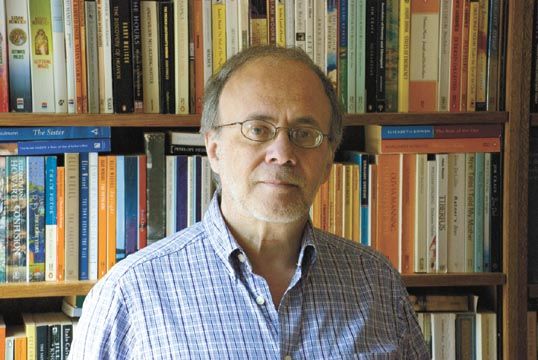 Thanks to all who participated in our latest Who Said It? competition here at Per Crucem ad Lucem. There were definately some intriguing suggestions. The correct answer, however, is Richard Bauckham, and the quote comes from his book Moltmann: Messianic Theology in the Making (Basingstoke: Marshall Pickering, 1987), 100. While there were no winners this time, those who guessed Moltmann deserve an extra chocolate.
We shall play again soon.
You are where you read
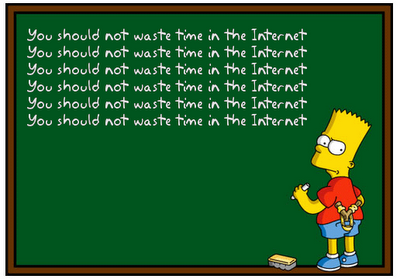 ‘Too much internet usage fragments the brain and dissipates concentration so that after a while, one’s ability to spend long, focused hours immersed in a single subject becomes blunted. Information comes pre-digested in small pieces, one grazes on endless ready meals and snacks of the mind, and the result is mental malnutrition. The internet can also have a pernicious influence on reading because it is full of book-related gossip and chatter on which it is fatally easy to waste time that should be spent actualy paying close attention to the books themselves, whether writing them or reading them’. – Susan Hill, Howards End is on the Landing: A Year of Reading from Home (London: Profile Books, 2009), 2.
Who’s buying this?
[HT: Jim Gordon and Amazon Reader]
‘For myself I am an optimist – it does not seem to be much use being anything else’
- St John’s Nottingham are developing a very exciting project – Interactive Multimedia Timeline: Exploring Christian theology and intellectual history.
- Rick Floyd offers a good defence of blogging in response to Stefan McDaniel’s case against it.
- A new journal to keep an eye on.
- A new must-have from Moltmann’s pen.
- Robert Fisk on America performing its familiar role of propping up a dictator.
- And check out the amazing Liu Bolin … The Invisible Man.
- Any apostrophe problems?
- Halden Doerge is on[to] something about the divine attributes.
- Ben Myers shares two splendid excerpts from his forthcoming AAR paper on J. Louis Martyn’s Galatians Commentary.
- Finally, a few years back I posted 12 wee reflections for Advent. I [probably] won’t be repeating this practice again this year but these Advent Reflections are still available online for those who might like to use them.
- And yeah, don’t forget to cast your vote in our Who said it? competition.

Vincent van Gogh on clergy

Letter from Vincent van Gogh to Theo van Gogh, Etten, September 1881
A few months ago, I happened across a most enjoyable wee read by Anton Wessels called Kind of Bible: Vincent Van Gogh as Evangelist. It was one of those wonderful finds that are ‘given’ to you when you’re eyes are scanning the library shelves for something else. Wessels’ basic thesis is that van Gogh’s work following his, so-called, fall into atheism, continued to ooze with evangelistic thrust. That that which spilled from his brush finds some continuum with that which flowed from his pen is evident in a number of his letters wherein he is – in fashion remarkably reminiscent of Kierkegaard – scathing of the clergy. One gains the clear impression that van Gogh thinks too highly of Jesus to take Christianity’s ‘men of the cloth’ too seriously. Many of the Dutch painters’ letters can now be read online and they really are a lot of fun to read. Anyway, here’s a few passing comments about clergy, written between 1881 (when Vincent was 28 years old) and 1884 (when he was a much-more mature 31 year old):
‘There really are no more unbelieving and hard-hearted and worldly people than clergymen and especially clergymen’s wives (a rule with exceptions). But even clergymen sometimes have a human heart under three layers of steel armour’. – Letter from Vincent van Gogh to Theo van Gogh (23 November 1881)
‘I do not remember ever having been in such a rage in my life. I frankly said that I thought their whole system of religion horrible, and just because I had gone too deeply into those questions during a miserable period in my life, I did not want to think of them any more, and must keep clear of them as of something fatal’. – Letter from Vincent van Gogh to Theo van Gogh (29 December 1881)
‘In case Father refers to my saying that, ever since I have acquired so much dessous les cartes, I haven’t given two pins for the morality and the religious system of the clergy and their academic ideas, then I absolutely refuse to take that back, for I truly mean it. It is just that when I am in a calm mood, I don’t talk about it, although it is a different matter when they try to force me to go to church, for instance, or to attach importance to doing so, for then I naturally tell them that it is completely out of the question’. – Letter from Theo van Gogh/Vincent van Gogh to Theo van Gogh (5–8 January 1882)
‘Clergymen often introduce “things of beauty” into a sermon, but it’s dismal stuff and dreadfully stodgy’. – Letter from Vincent van Gogh to Theo van Gogh (1–2 June 1882)
‘In point of fact, clergymen are among the most unbelieving people in society and dry materialists. Perhaps not right in the pulpit, but in private matters’. – Letter from Vincent van Gogh to Theo van Gogh (3 June 1883)
‘I believe you will approve of this feeling, even more so if you knew exactly what happened between him and me years ago, when I was very skeptical about the plan of studying, whether the promise to carry it through was sincere and well considered. I then thought that they had made the plan rashly and that I had approved of it rashly. And in my opinion it always remains an excellent thing that a stop was put to it then, which I brought about on purpose and arranged so that the shame of giving it up fell on me, and on nobody else. You understand that I, who have learned other languages, might have managed also to master that miserable little bit of Latin – which I declared, however, to be too much for me. This was a blind, because I then preferred not to explain to my protectors that the whole university, the theological faculty at least, is, in my eyes, an inexpressible mess, a breeding place of Pharisaism’. – Letter from Vincent van Gogh to Theo van Gogh (c. 22 September 1883)
‘Oh, I am no friend of present-day Christianity, though its Founder was sublime – I have seen through present-day Christianity only too well. That icy coldness hypnotized even me, in my youth – but I have taken my revenge since then. How? By worshipping the love which they, the theologians, call sin, by respecting a whore, etc., and not too many would-be respectable, pious ladies. To some, woman is heresy and diabolical. To me she is just the opposite’. – Letter from Vincent van Gogh to Theo van Gogh (October 1884)
And on theologians:
Today I have again been attacking a certain “bête noire” of mine, to wit, the system of resignation; I believe this “bête noire” is of the race of the hydra – that is to say the more serpent’s heads you cut off, the more spring up again. And yet there have been men who have succeeded in killing off such a “bête noir.” It is always my favorite occupation, as soon as I can find a spare half-hour, to resume the fight against this old “bête noir.” But perhaps you do not know that in theology there exists a system of resignation with mortification as a side branch. And if this were a thing that existed only in the imagination and the writings or sermons of the theologians, I should not take notice of it; but alas, it is one of those insufferable burdens which certain theologians lay on the shoulders of men, without touching them themselves with their little finger. And so – more’s the pity – this resignation belongs to the domain of reality, and causes many great and petites misères de la vie humaine. But when they wanted to put this yoke upon my shoulders, I said, “Go to hell!” And this they thought very disrespectful. Well, so be it. Whatever may be the raison d’être of this resignation, it – the resignation, I mean – is only for those who can be resigned, and religious belief is for those who can believe. And what can I do if I am not cut out by nature for the former, i.e. resignation, but on the contrary for the latter, i.e. religious belief, with all its consequences? – Letter from Vincent van Gogh to Anthon van Rappard (21 November 1881)
Life itself, too, is forever turning an infinitely vacant, dispiriting blank side towards man on which nothing appears, any more than it does on a blank canvas. But no matter how vacant and vain, how dead life may appear to be, the man of faith, of energy, of warmth, who knows something, will not be put off so easily. He wades in and does something and stays with it, in short, he violates, “defiles” – they say. Let them talk, those cold theologians. – Letter from Vincent van Gogh to Theo van Gogh (October 1884)
zizek.us
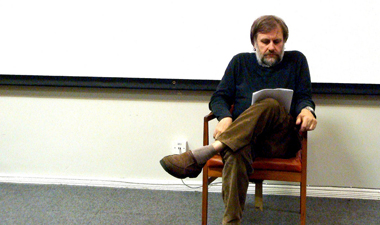
There’s a relatively new site dedicated to the work of Slavoj Žižek, the existence of which was only discovered by Žižek himself today. Recent posts include:
Slavoj Zizek: The Monstrosity of Christ
Slavoj Zizek on global crisis: First as Tragedy, Then as Farce
Resourcing Elders
 It’s not unusual for me to be contacted about reading resources, and typically it’s not too difficult to recommend some appropriate text(s). Today, I was asked what resources there are for elders serving in the Presbyterian/Reformed tradition. After a quick scramble, here’s what I came up with:
- Joan S. Gray, Spiritual Leadership for Church Officers: A Handbook (Louisville: Geneva Press, 2009).
- Ken Lawson and Stewart Matthew, Caring for God’s People: A Handbook for Elders and Ministers on Pastoral Care (Edinburgh: Saint Andrew Press, 1995).
- Ted A. Lester, ‘So, You’ve Been Elected an Elder …’ (Louisville: Congregational Ministries Publishing, 2001). This is a video/DVD.
- Phil A. Newton, Elders in Congregational Life: Rediscovering the Biblical Model for Church Leadership (Grand Rapids: Kregel Publications, 2005). This is a Baptist perspective on eldership.
- Colin H. Ray, ed., A Guide for Elders (Melbourne: Uniting Church Press, 1994).
- Lester J. Reid, A Resource for Elders, Sessions & Parish Councils (Wellington: Presbyterian Church of New Zealand. Department of Parish Development and Mission, 1997).
- Sheila Stephens, ‘Why Me?’ (Edinburgh: The Church of Scotland). This is a video and it comes with an accompanying 36 page handbook.
- Thomas F. Torrance, ‘The Eldership in the Reformed Church’, Scottish Journal of Theology 37 (1984): 503–18.
- Thomas F. Torrance, The Eldership in the Reformed Church (Edinburgh: Handsel Press, 1984).
- Thomas F. Torrance, Royal Priesthood: A Theology of Ordained Ministry (Edinburgh: T&T Clark, 1993).
- Tony Tucker, Reformed Ministry: Traditions of Ministry and Ordination in the United Reformed Church (London: United Reformed Church, 2003).
- Lukas Vischer, ed., Eldership in the Reformed Churches Today: Report of an International Consultation held at John Knox Centre in Geneva from August 26–31, 1990 (Geneva: World Alliance of Reformed Churches, 1991).
- Lukas Vischer, ed., The Ministry of the Elders in the Reformed Churches: Papers Presented at a Consultation held in Geneva in August 1990 (Berne: Evangelische Arbeitsstelle Oekumene Schweiz, 1992).
- D. Newell Williams, ‘Consultation on the significance of Eldership in the Reformed Tradition’, Mid-Stream 30 (1991): 353–55.
Now the concerning thing is that I may have discovered today that my inkling is confirmed: that the pickings really are slim in this area. Of course, I’ve love to have my inkling swiftly murdered by others who know more about this stuff than I do. In other words, I would be really excited to hear of some other resources (booklets/videos/books/tapestries/etc.) that people have found helpful in this area (and those not only from the Pressie/Reformed tribe).
Of course, there’s also a serious book or two that it would be great for such elders to read. Among these I would include:
- Ray S. Anderson, Minding God’s Business (Grand Rapids: Wm. B. Eerdmans, 1986).
- Ray S. Anderson, Ministry on the Fireline: A Practical Theology for an Empowered Church (Pasadena: Fuller Seminary Press, 1998).
- Andrew Purves, The Crucifixion of Ministry: Surrendering Our Ambitions to the Service of Christ (Downers Grove: InterVarsity Press, 2007).
- Andrew Purves, Reconstructing Pastoral Theology: A Christological Foundation (Louisville/London: Westminster John Knox Press, 2004).
- Lukas Vischer, ed., Christian Worship in Reformed Churches Past and Present (Grand Rapids: Wm. B. Eerdmans, 2003). This is an excellent collection of essays.
- Walter C. Wright Jr., Relational Leadership: A Biblical Model for Leadership Service (Carlisle: Paternoster, 2000). A revised edition of this came out this year but I’ve yet to see a copy.
- Walter C. Wright Jr., ‘The Ministry of Leadership: Empowering People’ in Incarnational Ministry: The Presence of Christ in Church, Society, and Family: Essays in Honor of Ray S. Anderson (ed. Christian D. Kettler and Todd H. Speidell; Colorado Springs: Helmers & Howard, 1990), 204–15.
Who said it?
 Time again for another ‘Who said it?’ competition. From whose mouth/pen did the following words come:
God’s trinitarian history for us makes him what he is for himself. There is no immanent Trinity supratemporally ‘behind’ God’s temporal, worldly history, so that he would be who he is independently of this history. This history is who he is.
Closing on Tuesday. No cheating.
[Note: I’ve had to repost this because for some strange reason the comments were off. Apologies to those who wanted to cast a vote but were unable. You can do so now. And I’ve extended the closing date: it’s now Tuesday.]
… and the answer is?
 jasongoroncy.com