Helmut Thielicke on preaching

It would be fair to say that I am not known for my speediness. That confessed, I am currently racing to finish off a wee manuscript on the sermons of PT Forsyth (hence the relative paucity of posts here at Per Crucem ad Lucem). So I’ve been thinking much of late not only about Forsyth but also about preaching. And in regards to the latter, it’s been fun to revisit some of my old reading notes on preaching. Here’s one from the pen of Helmut Thielicke that I wanted to share:

‘The aim of the sermon, after all, is to create something living and set it in motion. Consequently, it should be directed not only at the intellect, but must at the same time also be aimed at the conscience, will, and imagination. It is addressed to the whole person! Corresponding to the complexity of this goal are the wealth of reflections in which one is absorbed before one makes ones way to the pulpit.

The extremely pluralistic composition of my audience forced me to still further reflections. The different levels of education and social background necessitated an inquiry into that aspect of human nature that is common to all human beings, that center of their being in which – each in his own different way – human beings are moved by fear and hope, by their finitude, by ambition, desires, the search for meaning, by the burden of guilt and torment of conscience. My goal – and I strived to attain it at least partially – had to be above all to ensure that everyone could say afterwards (because he had been personally touched in this center of his being, “I was the subject of this sermon, he meant me.”

In order to find associations with the text for my sermon and so to illustrate it with images, stories, and a human touch, I constantly kept an eye open during my varied reading for anything I could use in the pulpit. I started various collections in files and card indexes in order to have suitable quotations and other material at hand. If this material then nevertheless failed to hit the mark, I could at least comfort myself with the fact that I had done all that I could.

I did not, by the way, keep to the prescribed readings, that is, to the texts stipulated for use in church sermons. At best these prescribed texts have one useful function, namely, they safeguard the preacher from misusing the text by preventing him from choosing a text simply as a motto for his pet ideas. Preachers who do this quickly preach themselves dry. Their only achievement is to cause deadly boredom – probably not only to the audience but also to themselves – by their constant rummaging through the remnants of a crop that has long since been completely harvested. A prescribed text is certainly the best protection against the law of inertia taking effect in this way. It is also possible for the preacher himself to build a defensive wall against this temptation. This can be done in the following way.

I forced myself to give series of sermons oriented towards a sequence of biblical texts or a single subject. This is how the aforementioned series on the Lord’s Prayer, the parables, the biblical creation story, the pastoral conversations of Jesus, the creed, and many others came about. I also gave openly “didactic” sermons, which were a sort of catechism lesson for adults, in which I explained, for instance, the theological significance of historic-critical textual research and allowed the congregation to take a look into the workshop of academic theology. This principle of preaching series of sermons proved to be fruitful for both sides. It was fruitful for the preacher because it subjected him to a salutary constraint and safeguarded him against arbitrarily choosing texts on his own authority. It was fruitful for the audience because their interest was sustained by the continuity and development of a particular subject or train of thought, as a result of which they always looked forward eagerly to the next sermon.

The fact that I brought current events into play in my sermons should not be taken to mean that I had been talking politics in the pulpit. In my opinion, there are two types of degenerate sermon, both of which, although very different in themselves, are today having a ruinous effect on the life of the church service.

The first of these decadent forms is the transformation of the sermon into a set political speech proclaiming a particular political position as the Christian position. In my experience, this mostly gains the upper hand among people whose spiritual substance is too diluted for them to give a rousing proclamation of the Gospel. They are then forced to give their sermons a political shot in the arm to lend their dead spirituality the appearance of life. But this form of sermon has no permanence. People very soon wonder why it should need the circuitous route of the pulpit to get this political message across and whether they could not get the same thing cheaper and without the Christian paraphernalia simply by going straight to a political meeting.

The second type of degenerate sermon is a certain ritualism that suppresses or at least obscures the personal faith of the individual through the excessive use of time-honored phrases and traditional musica sacra.

This brief look into the “theological laboratory” has not yet touched on what goes on inside the preacher. This remains hidden to outside eyes. I can only give the following hint at where one should look for an answer. Whoever sees so many eyes directed towards him is in great danger. He may believe that they are directed towards “him,” whereas he is in fact only the ambassador of another. In the sacristy of the Church of St. Michael there is a little altar where the preacher prepares himself to approach the pulpit and arms himself against the temptations that threaten him. This is all that I wish to say about this matter’.

– Helmut Thielicke, Notes from a Wayfarer: The Autobiography of Helmut Thielicke (trans. David R. Law; New York: Paragon House, 1995), 291–93.

Hauerwas on the Church and the abolition of war

In Hauerwas’ latest piece, ‘Ten Years and Counting: The Church and the Abolition of War’, we hear, near the eve of 9/11, themes long-echoed by Yoder’s most prolific publisher:

‘I want to convince Christians that war has been abolished. The grammar of that sentence is very important. The past tense is very deliberate. I do not want to convince Christians to work for the abolition of war, but rather I want us to live recognizing that in the cross of Christ war has been abolished.

So I am not asking Christians to work to create a world free of war. The world has already been saved from war. The question is how Christians can and should live in a world of war as a people who believe that war has been abolished’.

You can read the rest here.

I’ve also posted some resources on pacifism and war here.

John Webster on discipleship

Some six hours in the car today provided me with the opportunity to catch up on some of my MP3 and podcast listening. The highlight? Two older lectures by John Webster on discipleship from the 2005 Scottish Evangelical Theology Conference which was concerned with the theme of ‘Being Disciples, Making Disciples’. These are outstanding, and the question time helpful too. The lectures are available for download via the following links:

‘(Bend, motherfucker, bend.)’, by Chrissy Hamill

‘The arc of history is long, but it bends towards justice’. Martin Luther King Jr

The world is broken and tired and sad
Paralysed on the edge of a cliff.
And I am small and hurting.
And the aching is quiet and deep.

But the blood still pumps thick through my veins
And the air in my lungs is fire
Throw your money into the furnace
For I’m small and alive in the wind.

I will angry stamp till the puddles run red
until my feet are worn out and thin
I will scream to the wind till you cut out my throat
I will watch and I won’t close my eyes.

I will hold on to the sun till my fingers burn
I will grieve with each loss and each hurt
I will cry oceans and rivers until
I am nothing but shrivelled bones.

I will walk till I get to the end of the world
I will dance till I run out of room
And I will love with my toes and my knees and my soul
and my kidneys and liver and spleen.

For I’ve poured my heart into the river;
I’m dissolved and I’m bound and I’m free
Tied to the beating pulse of the current
I will sing as I flow to the sea.

Chrissy blogs over at Falling in love with the world.

Barth on the making and is-ness of the Christian

Recent weeks have seen me, from time to time, dipping into CD IV/4, and that for no other reason than for the sheer joy of reading Barth. Here’s one passage that I meditated on for some time:

‘The freedom of God in which is grounded man’s becoming free to be faithful to God as God is faithful to him, the freedom in which the Christian life thus has its absolutely unique origin, is the freedom of which He, the God of Abraham, Isaac and Jacob, has made use in supreme majesty and condescension in the history of Jesus Christ. This history is the change, impossible with men but possible with God, and indeed possible only by God’s actual judgment, in which a man becomes God’s friend instead of His enemy, a man who lives for Him instead of being dead for Him. It is the divine change which has been made for every man and which is valid for every man, but which is thankfully acknowledged, recognised and confessed by Christians. It is so as Jesus Christ is the One elected from eternity to be the Head and Saviour of all men, who in time responded to God’s faithfulness with human faithfulness as the Representative of all men. As and because He was this, as and because, in the name and stead of all, He was born and suffered and died as the Man of God, as and because He was manifested for all in His resurrection as the One who did this for all, the change which took place in His history took place for all. In it the turning of all from unfaithfulness to faithfulness took place. In this history of His the Christian life became an event as the life of all. A Christian, however, is a man from whom it is not hidden that his own history took place along with the history of Jesus Christ. As a word spoken to him and received by him in the living power of the Holy Spirit, this has been disclosed to him as the decisive event which establishes his existence as a Christian. He himself in the midst of all other men can see himself as one of those for whom and in whose place Jesus Christ did what He did. The Christian is a man whose life Jesus Christ has entered as the subject of that history of His. He is a man whose acknowledged, recognised and confessed Lord He has become. He is a man to whom Jesus Christ has given not just a potential but an actual share in that history of His. Thus Jesus Christ, His history, became and is the foundation of Christian existence; this and this alone. The Christian comes from Him, from His history, from knowledge of it; he also looks back thereto. This is the ground on which he stands and walks. This is the air which he breathes. This is the word which he has in his ears before, above and after all other words. This is the light, the one light, the incomparably bright light, which illumines him’. – Karl Barth, Church Dogmatics IV.4 (ed. Geoffrey W. Bromiley and Thomas F. Torrance; trans. Geoffrey W. Bromiley; Edinburgh: T&T Clark, 1969), 13­–14.

August stations …

Reading:

Listening:

Watching:

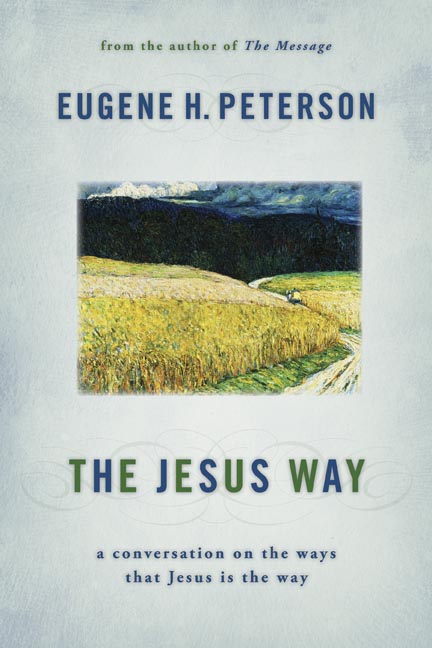
Eugene Peterson on The Jesus Way

Eugene Peterson’s The Jesus Way: A Conversation on the Ways That Jesus Is the Way will be released in paperback in a couple of weeks. Here’s the taster:

Here is a text, words spoken by Jesus, that keeps this in clear focus: “I am the way, the truth, and the life” (John 14:6). The Jesus way wedded to the Jesus truth brings about the Jesus life. We can’t proclaim the Jesus truth but then do it any old way we like. Nor can we follow the Jesus way without speaking the Jesus truth.

But Jesus as the truth gets far more attention than Jesus as the way. Jesus as the way is the most frequently evaded metaphor among the Christians with whom I have worked for fifty years as a North American pastor. In the text that Jesus sets before us so clearly and definitively, way comes first. We cannot skip the way of Jesus in our hurry to get to the truth of Jesus as he is worshiped and proclaimed. The way of Jesus is the way that we practice and come to understand the truth of Jesus, living Jesus in our homes and workplaces, with our friends and family.

A Christian congregation, the church in your neighborhood, has always been the primary location for getting this way and truth and life of Jesus believed and embodied in the places and among the people with whom we most have to do day in and day out. There is more to the church than this local congregation. There is the church continuous through the centuries, our fathers and mothers who continue to influence and teach us. There is the church spread throughout the world, communities that we are in touch with through prayer and suffering and mission. There is the church invisible, dimensions and instances of the Spirit’s work that we know nothing about. There is the church triumphant, that “great cloud of witnesses” who continue to surround us (Heb. 12:1). But the local congregation is the place where we get all of this integrated and practiced in the immediate circumstances and among the men, women, and children we live with. This is where it becomes local and personal.

The local congregation is the place and community for listening to and obeying Christ’s commands, for inviting people to consider and respond to Jesus’ invitation, “Follow me,” a place and community for worshipping God. It is the place and community where we are baptized into a Trinitarian identity and go on to mature “to the measure of the full stature of Christ” (Eph. 4:13), where we can be taught the Scriptures and learn to discern the ways that we follow Jesus, the Way.

The local congregation is the primary place for dealing with the particulars and people we live with. As created and sustained by the Holy Spirit, it is insistently local and personal. Unfortunately, the more popular American church strategies in respect to congregation are not friendly to the local and the personal. The American way with its penchant for catchy slogans and stirring visions denigrates the local, and its programmatic ways of dealing with people erode the personal, replacing intimacies with functions. The North American church at present is conspicuous for replacing the Jesus way with the American Way. For Christians who are serious about following Jesus by understanding and pursuing the ways that Jesus is the Way, this deconstruction of the Christian congregation is particularly distressing and a looming distraction from the Way of Jesus.

A Christian congregation is a company of praying men and women who gather, usually on Sundays, for worship, who then go into the world as salt and light. God’s Holy Spirit calls and forms this people. God means to do something with us, and he means to do it in community. We are in on what God is doing, and we are in on it together.

And here is how we are in on it: we become present to what God intends to do with and for us through worship, become present to the God who is present to us. The operating biblical metaphor regarding worship is sacrifice — we bring ourselves to the altar and let God do with us what he will. We bring ourselves to the eucharistic table and enter into that grand fourfold shape of the liturgy that shapes us: taking, blessing, breaking, giving — the life of Jesus taken and blessed, broken and distributed. That eucharistic life now shapes our lives as we give ourselves, Christ in us, to be taken, blessed, broken, and distributed in lives of witness and service, justice and healing.

But that is not the American way. The great American innovation in congregation is to turn it into a consumer enterprise. We Americans have developed a culture of acquisition, an economy that is dependent on wanting more, requiring more. We have a huge advertising industry designed to stir up appetites we didn’t even know we had. We are insatiable.

It didn’t take long for some of our Christian brothers and sisters to develop consumer congregations. If we have a nation of consumers, obviously the quickest and most effective way to get them into our congregations is to identify what they want and offer it to them, satisfy their fantasies, promise them the moon, recast the gospel in consumer terms: entertainment, satisfaction, excitement, adventure, problem-solving, whatever. This is the language we Americans grew up on, the language we understand. We are the world’s champion consumers, so why shouldn’t we have state-of-the-art consumer churches?

Given the conditions prevailing in our culture, this is the best and most effective way that has ever been devised for gathering large and prosperous congregations. Americans lead the world in showing how to do it. There is only one thing wrong: this is not the way in which God brings us into conformity with the life of Jesus and sets us on the way of Jesus’ salvation. This is not the way in which we become less and Jesus becomes more. This is not the way in which our sacrificed lives become available to others in justice and service. The cultivation of consumer spirituality is the antithesis of a sacrificial, “deny yourself” congregation. A consumer church is an antichrist church.

We can’t gather a God-fearing, God-worshipping congregation by cultivating a consumer-pleasing, commodity-oriented congregation. When we do, the wheels start falling off the wagon. And they are falling off the wagon. We can’t suppress the Jesus way into order to sell the Jesus truth. The Jesus way and the Jesus truth must be congruent. Only when the Jesus way is organically joined with the Jesus truth do we get the Jesus life.


‘Sabbath’

Sabbath means
living with limits –
with the limits of time: of millennia, of centuries, of minutes and of seconds,
with the limits of creatureliness,
with the limits of creation itself,
with the limits of knowing.

Sabbath means
living with faith –
faith in the muscle of ancient and unbroken promises,
faith in the magic of rest,
faith in the remorselessness of Love’s ongoing endeavour;
Wendell Berry is right: ‘Great work is done while we’re asleep’.

Sabbath means
living with hope –
hope that the deepest reality and creation’s flourishing do not revolve around me,
hope in the renewing power of stillness,
hope that both pools and rapids (in)form the life of the one river,
hope that a community – whose roots are long and deep, and whose shoots recur fresh and green – has heard rightly.

Sabbath means
living with love –
love of one’s self and of one’s other,
love of election to vocation,
love of the law of eternal delight,
love of what is,
and love of the other days, for ‘the Sabbath cannot survive in exile, a lonely stranger among days of profanity’ (Abraham Heschel).

© Jason Goroncy
2 September 2010
Bannockburn

‘End of August’, by Günter Eich

The white bellies of dead fish
loom among duckweed and rushes.
Crows have wings to enable them to escape death.
There are times I know that God
is most concerned with the fate of snails.
He builds them houses. We are not His favorites.

At night, the bus taking the football team home
leaves a white trail of dust.
The moon shines in the willow herb,
in concert with the evening star.
How near you are, immortality—in the wings of bats,
in the pair of headlights
nosing down the hill.

– Günter Eich, Angina Days: Selected Poems (trans. Michael Hofmann; Princeton/Oxford: Princeton University Press, 2010), 45.

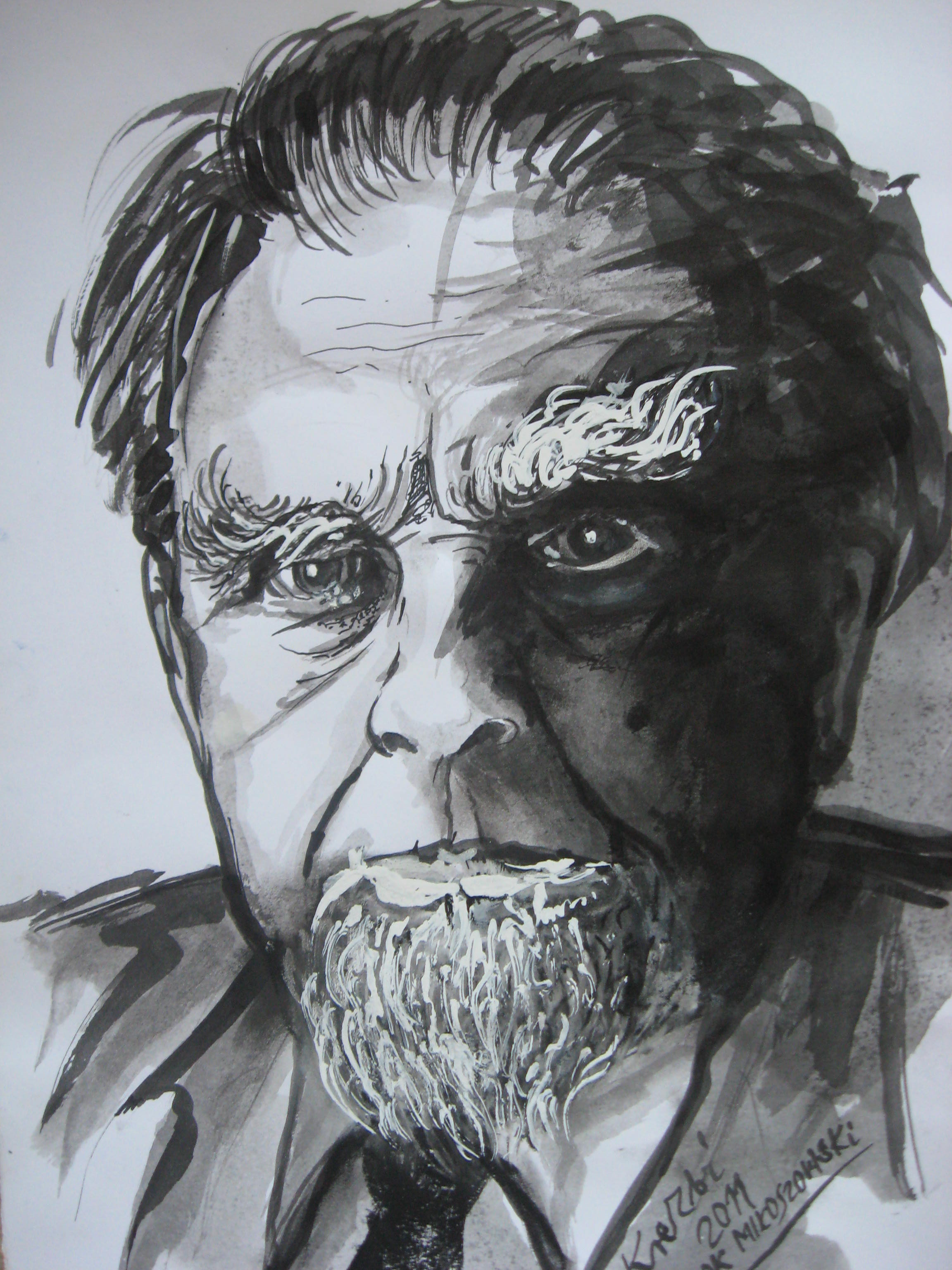
‘A Poem For the End of the Century’, by Czesław Miłosz

When everything was fine
And the notion of sin had vanished
And the earth was ready
In universal peace
To consume and rejoice
Without creeds and utopias,

I, for unknown reasons,
Surrounded by the books
Of prophets and theologians,
Of philosophers, poets,
Searched for an answer,
Scowling, grimacing,
Waking up at night, muttering at dawn.

What oppressed me so much
Was a bit shameful.
Talking of it aloud
Would show neither tact nor prudence.
It might even seem an outrage
Against the health of mankind.

Alas, my memory
Does not want to leave me
And in it, live beings
Each with its own pain,
Each with its own dying,
Its own trepidation.

Why then innocence
On paradisal beaches,
An impeccable sky
Over the church of hygiene?
Is it because that
Was long ago?

To a saintly man
–So goes an Arab tale–
God said somewhat maliciously:
“Had I revealed to people
How great a sinner you are,
They could not praise you.”

“And I,” answered the pious one,
“Had I unveiled to them
How merciful you are,
They would not care for you.”

To whom should I turn
With that affair so dark
Of pain and also guilt
In the structure of the world,
If either here below
Or over there on high
No power can abolish
The cause and the effect?

Don’t think, don’t remember
The death on the cross,
Though everyday He dies,
The only one, all-loving,
Who without any need
Consented and allowed
To exist all that is,
Including nails of torture.

Totally enigmatic.
Impossibly intricate.
Better to stop speech here.
This language is not for people.
Blessed be jubilation.
Vintages and harvests.
Even if not everyone
Is granted serenity.

– Czesław Miłosz, ‘A Poem For the End of the Century’, in Provinces (trans. Robert Hass; Manchester: Carcanet, 1993), 42–44.

‘A Song On The End Of The World’, by Czesław Miłosz

On the day the world ends
A bee circles a clover,
A fisherman mends a glimmering net.
Happy porpoises jump in the sea,
By the rainspout young sparrows are playing
And the snake is gold-skinned as it should always be.

On the day the world ends
Women walk through the fields under their umbrellas,
A drunkard grows sleepy at the edge of a lawn,
Vegetable peddlers shout in the street
And a yellow-sailed boat comes nearer the island,
The voice of a violin lasts in the air
And leads into a starry night.

And those who expected lightning and thunder
Are disappointed.
And those who expected signs and archangels’ trumps
Do not believe it is happening now.
As long as the sun and the moon are above,
As long as the bumblebee visits a rose,
As long as rosy infants are born
No one believes it is happening now.

Only a white-haired old man, who would be a prophet
Yet is not a prophet, for he’s much too busy,
Repeats while he binds his tomatoes:
There will be no other end of the world,
There will be no other end of the world.

– Czesław Miłosz, ‘A Song On The End Of The World’, in Czesław Miłosz, ed., Postwar Polish Poetry: an anthology (Berkeley/Los Angeles: University of California Press, 1983), 76–77.

≈≈≈≈

Need more Miłosz? Here’s a video of him reading some of his poetry, and talking about the poetry of Blake and Ginsberg:

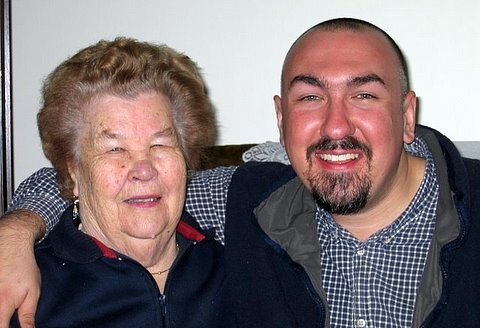
Requiescat in pace: Dusia Goroncy (1926–2011)

Many of my earliest memories seem to have grandparents in the frame, and many owe their origin to Babcia’s photo album – that collection of somewhat faded, browning and out-of-focus snapshots, many with heads carelessly decapitated, photos whose value as art is radically juxtaposed in comparison to their value as icons of sentiment and as a record of a story of her life; or, more accurately, the narrative of all our lives. For Babcia was the kind of person whose life was intricately and inseparably woven into our own. Indeed, in Babcia we have been graced with one whose identity is wrapped up in ours, whose identity as a sister, wife, mother, grandmother, matriarch, friend and neighbour was more voluminous than any identity that society might wish to allocate to her, but in whom blood was always thicker than water, even when conventional wisdom might desire otherwise.

And what story does that family photo album bear witness to? It gives us only hints of what Babcia’s life was like before she arrived at Cowra and then at Bonegilla migrant centre on these shores. From only a handful of photos, and a scattering of various stories have we been able to cut and paste together some image of what her life was like before her two sons arrived on the scene. I shall not dwell on that here, but only mention her birth on 16 April 1926 in Woronez, Russia, where she was also baptised, and her years as a farm worker in Selkentrop (a village still as tiny as it is rural) in the early 1940s in a Europe in the grip of fear, and of her falling in love with the gentle human being – Janek Goronze – who would be her husband until 1982. Birthing children and the turn Down Under created the opportunity for Babcia and Dziadek, together with many who would become their friends, to begin, as it were, again. One way that this beginning was celebrated was through countless parties and an abundance of food rarely known in a past life they all seemed intent on forgetting.

The photos bear witness to the fact that in those earlier days, when her strength was greater and her zest for life more uninhibited than it was in recent years, she enjoyed outings to roadside picnic grounds and rydzed-forests well-trodden by members of the Polish community, and even more adventurous expeditions to far-flung and exotic places like Rotorua in New Zealand. But Babcia was no woman of the world! Indeed, the photos tell of a woman who loved the simple and nearer things of life – family, flowers, and friends with whom she would gossip and laugh for hours so very excitedly (and loudly) on the phone, or over a seemingly-bottomless banquet of ham, gurki, cottage cheese and semi-stale rye bread, not to mention the kapusniak or borsch swimming in sour cream, and the pierogi, golabki, and babka. So deceived was she by the seduction of food that she seemed to believe that if the item bore the label ‘Weighwatchers’ it meant that you could actually eat three times as much and still lose weight. Those new to the Goroncy dining experience learnt quickly not to pile their plates too early in the drama, for it would not be long before they heard the words from one who grazed more than feasted, and from whose mouth would come the command, ‘Take more, you too skinny. Look – ham, potatoes … you want something else?’. Convinced by the conspiracy that ‘restaurants make you stomach poison’, Babcia was devoted to home cooking. But it was a passion not primarily birthed by a paranoia of restaurants, or by economic rationalism, though, no doubt, the latter was a factor for a generation formed in a landscape where scarcity was the norm. Her passion for cooking, rather, was birthed by the fact that this was a primary and joyful means by which she could serve her friends and family. Indeed, one could turn up at all hours of the night – and I frequently did – and she would jump out of bed and spring into action – ‘you want something to eat Jay’ – so concerned as she was that I was fading away. Indeed, she was nothing if not hospitable to people – whether to those known to her, or to strangers.

The photos also bear witness to her love of gardening, and particularly to her flowers; her love for shopping – the perpetual hunt for a bargain, a trait that her eldest son has inherited; her devotion to her favourite TV programs, among which was ‘The Young and Wrestles’; and, in more recent years, the fascinating friendship that she enjoyed with Bobby, the only dog I’ve ever met who has become increasingly-less housetrained over the years, reverting, it would seem, to something like the life he had before he was rescued by the RSPCA, and before he met Babcia. And that reminds me of a story. I remember when Judy and I bought Bobby as a gift for Babcia. She was so adamant that she didn’t want a dog and that we should take him back to North Melbourne straight away. But we were stubborn too – hey, it’s in the blood! – and eventually, we convinced her to keep Bobby on a two-week trial. If, after that time she still felt the same, we’d take him away. Within a week, we asked her how she was doing with Bobby and whether she wanted us to take him back. And she said, ‘I not give you for thousand dollar!’ And so their friendship began. It was really special, and actually quite funny at times, to see how she and Unc and Bobby related, and how quickly Bobby learnt to understand Polish.

And there are things that the photos tell less about, if at all.  They tell little of the way in which Babcia was a model of multicultural hospitality and friendship, happy as she was to share her life with her Macedonian and Italian and Chinese neighbours. They don’t tell of the time that she bowled up to Highpoint to see a movie on her own for the first time in her life – it was the Jesus film. Nor of the time that two of us took her to see Shakespeare in Love – an experience much more interesting, it must be said, than the movie was.

By far the most common subject in her albums, however, were her children, and their children, and their children. She loved us. And as much as her heart broke for each of us when things were going haywire, she rejoiced to hear every bit of news of our comings and goings, especially, I think, of us grandchildren, seeing in us, perhaps, a way of healing for fractures that had opened up in our family.

Much like she welcomed Unc, Babcia also welcomed a frightened teenaged-version of me into her home and daily life, and she was for me a safe and stable lifeboat around which I learnt to find my feet again. And so she was for many years thereafter – a fun and caring person to be around, even if sometimes very impatient, and one with whom I could truly be myself. I felt safe with her, even when she would harp on about things that I thought were significantly less than vital. And no matter how critical she might have been at times towards others – and, yes, she did, it must be said, possess quite a judgemental streak – to those foibles of her own family she was almost blind – or at least she tried to be so. And her unflinching and stubborn blindness extended also to herself. So, for example, this one who claimed to be  a ‘very good driver … never make me accident’, did not think twice about going anti-clockwise around a busy car park roundabout in order to secure a spot closer to her shop of choice.

One of the great things that that great Russian writer Fyodor Dostoevsky has taught me is that earthly life cannot flourish without the conviction that the narratives of growth and conflict and attention that characterise our life here are not fated to come to an end. But this is not to say that some things will not come to an end. With the writer of the final book of the Bible, Dostoevsky too believed in the coming of the day of shalom. The day of shalom, the day of peace, will not be characterised by a peace with death. With death, there can be no such peace. Rather the day of shalom means a time when there will be no more death or mourning or crying or pain, for the old order of things will have passed away. Though I am uncertain of the precise form that such an event will take, my faith in one for whom death is neither foreign nor the end of all things gives me reason to look forward to meeting Babcia again, to believing that life triumphs even over death. But until then, do widzenia Bubcia, do widzenia.

A Prayer

When the signs of age begin to mark my body,
and still more when they touch my mind;
when the ill that is to diminish me or
carry me off strikes from without
or is born within me;

When the painful moment comes in which I suddenly
awaken to the fact that I am ill or growing old;
when I realise that I must soon relinquish all whom
I hold dear and all in life that I have loved;
and above all at that last moment when I feel
I am losing hold of myself and am absolutely
passive within the hands of the great unknown
forces that have formed me;

In all those dark moments, O God, grant
that I may understand that it is you
who are painfully parting the fibres
of my being in order to penetrate
to the very marrow of my substance
and bear me away within yourself.
Amen.

On the sermons of PT Forsyth

It might well be argued that before he was anything else, PT Forsyth was principally a preacher. It would certainly not be going too far to say that the greatest portion of Forsyth’s public life was given over to preaching, and to encouraging preachers. To be sure, and by any standards, his literary output was significant. But by far the majority of the words in his published articles and books are sermons, or were ideas developed from sermons. And even those that are not betray the rhetorical form of one shaped by the pulpit and the task that attends that space. And this is not so strange, for Forsyth believed in preaching.

I too believe in preaching. I also believe that Forsyth has much still to teach us about preaching. To be sure, not everything about his own manner or approach remains helpful today, or is particularly worthy of emulation. (But of whom might that not be true!) Still, regarding the things that really matter, it is difficult to go past the likes of one like Forsyth. (We could add here too the names of Karl Barth, Eduard Thurneysen, James Denney, Helmut Thielicke, Paul Tillich and others.)

I have suggested before that one of the real gifts that the Aberdonian bequeaths to the Church is the encouragement of her pastors to forego the ‘sin of bustle’ that would see them running errands for the culture motivated in no small part by an attempt to convince the world – and the church! – of the use, value and worthiness of their vocation, and to instead give themselves to preach the Gospel, to believe in that divinely-ordained foolishness – what Forsyth calls ‘the folly of the cross’ – and to trust its effects to God.

Those who carry the burden – a joyous burden to be sure, but a burden nonetheless – of preaching week after week will no doubt be familiar with that anxiety that attends the final read through the manuscript, the fruit of one’s wrestling with the very real possibility of God’s communication – which is nothing less than God’s self-disclosure – to those not only desperate to hear the Word of life but also to those long-deafened by the drums of seemingly-endless counter words, that Saturday-night feeling that, despite all one’s best efforts, things for tomorrow’s sermon just don’t seem right, that the fire that burns so freshly in the heart of the biblical witness has all but been snuffed out by the time the sermon was penned, and perhaps the best that one can now hope for is to simply trust that something that one says might find fertile soil. To be sure, to believe in preaching is to believe in miracles; or, more properly, it is to believe in One who not only already longs to speak but who also ‘gives life to the dead and calls into existence things that do not exist’ (Romans 4.17). Moreover, to believe in preaching is to believe that such calling into existence occurs via the irresponsible method of liberally sowing seeds whether in places where there is no soil, or on rocky ground, or among thorns, or in fertile and productive soil.

I’m in the near-final currents of preparing a manuscript of some unpublished, and hard to find, sermons of Forsyth’s. This will be published by Wipf & Stock under the tentative title of ‘Descending on Humanity and Intervening in History’: Notes from the Pulpit Ministry of P.T. Forsyth. To those who also believe in preaching – or who wish to believe in preaching in spite of all appearances – I hope that the words of this volume might come as as much an encouragement to them as they have been for me.

As I write, I’m thinking about why people read Forsyth, why they should, and what strikes them when they do. One of my friends, who has himself published on Forsyth, has suggested that the answer lies somewhere in the fact that ‘Forsyth loved the Lord, knew the scriptures, and understood ahead of his time the pitfalls of both a vague liberalism and an obscurantist fundamentalism. He also knew the difference between theology and anthropology. And he could turn a phrase’. Another has been struck by the ‘affective tone of the whole; the desire to really embrace the Triune God in all the beauty, terror, majesty and mystery’. I agree with both of these statements, and the latter reflects too what Forsyth so appreciated about Jonathan Edwards’ theology, and Calvin’s for that matter. I will post some more thoughts in due course, but for now I’m very keen to hear yours. If you’d prefer to email rather than leave a comment online, then you can reach me here.

Unheard sermons

A friend of mine asks: ‘What are some particular subjects or passages that you have never heard a sermon on, which you would like to hear being addressed from a pulpit?’

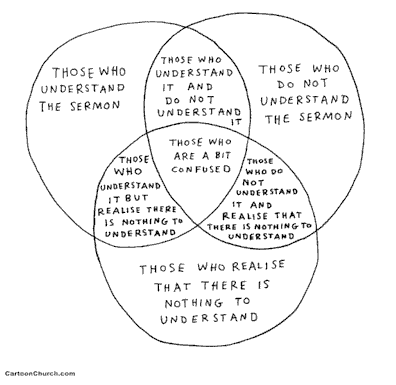
I’m sure to think of other topics, but in my haste I fired back the following suggestion: ‘The sermon and the responsibility of, and invitation/command to, the hermeneutical community to hear the Word of God; i.e. how do we hear the sermon’.

How would you answer my friend?

[Image: Dave Walker]

‘How precious did that grace appear’: a story from Down Under

It’s so good to hear stories birthed by, and which witness to, the kingdom of God in our midst. For many months now, Martin Stewart, a friend of mine and fellow Presbyterian minister who, with his partner Anne, is nothing less than obsessed with the crazy and wreckless and completely-irresponsible nature of divine grace, has been spearheading what is an inspiring (in every sense of that word) project. Some of that journey has been documented on Martin’s blog, and yesterday, the Presbyterian Church of Aotearoa New Zealand posted the following media clip. I’m sharing the love:

On Sunday 14 August 2011 Presbyterian church-goers gave more than $70,000 – 365 $200 New World Supermarket vouchers – to homes in part of the red zone on the east side of Christchurch.

“The vouchers were given out to homes with no strings attached”, says the Rev Martin Stewart. “The homes are all in an area perceived as not needing help, so they hadn’t received much.”

After their regular Sunday church service, 130 people from St Stephen’s Presbyterian in Bryndwr, St Giles in Papanui and St Mark’s in Avonhead, went door-to-door to share the vouchers with people whose resources have been stretched more thinly than their own.

Martin says that “going over to that side of the city was sobering. There were many sad stories of struggle and wondering what is next. Without exception those who handed out the vouchers were touched by the welcomes they received”.

The Rev Martin Stewart, the driving force behind the project and minister of St Stephen’s and moderator of the Presbyterian Church’s Presbytery of Christchurch, says,  “$70,000 was raised, some donated by people from here but most from far off places like Scotland … and Auckland! Foodstuffs offered a discount enabling us to purchase even more vouchers”.

The idea for the vouchers came in April, Martin says, when Highgate Presbyterian Church in Dunedin, (Martin was formerly the minister there) gave him and his wife Anne money to distribute in Christchurch “as we saw fit.  The next day we gave the first $1000 of that money to a young family we did not know, and that we had heard life was tough for, in the damaged Avon loop area.  I wrote about it on my blog and then someone from Wellington sent $15,000 – it soon ballooned to $70,000.  It has been like witnessing the miracle of the loaves and the fishes right before our eyes”.

Martin says in many ways 365 vouchers to 365 homes is barely touching the need out east in Christchurch city.  “It really is like we have only got a little bit of play-lunch to share and there are 5000 people hungry.  But we sense that we are not alone in this enterprise.  We believe that Jesus’ ‘kingdom of God’ is in this and we simply don’t know what kind of ripple of hope the vouchers will generate in the lives of the people we share them with. We are sure something good will come of it and that in a multitude of ways people who receive vouchers will pay it forward in some way.”

Rowan Williams addresses the House of Lords

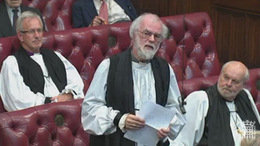
Rowan Williams, speaking as the Archbishop of Canterbury, has addressed the House of Lords in the wake of recent events in England. Here’s a snippet:

‘There are indeed, as we’ve been reminded, no quick answers here. And I believe one of the most significant questions that we ought to be addressing in the wake of these deplorable events, is what kind of education we are interested in, for what kind of a society. Are we prepared to think not only about discipline in classrooms, but also about the content and ethos of our educational institutions – asking can we once again build a society which takes seriously the task of educating citizens, not consumers, not cogs in an economic system, but citizens’.

The full speech can be read here.

Prior to his attendance at the House of Lords, Rowan Williams also offered this statement, and the communion he serves made available this prayer.

Also, and singing in a slightly-different key, Mike Ovey, the Principal of Oak Hill College, offers this reflection on looters, consumerism and a civilised society.


Telling our story: two book commendations

Stories have always played an indispensable role in human life. Whether via oral tradition or in written form, stories provide a framework for transmitting values, heritage, culture and traditions, even for transmitting the self across spaces and generations, for keeping the self alive, as it were. Stories also enable us to acquire expectations about the world. These expectations then provide a framework for organising other pieces of incoming information. In short, without stories, we cannot process our experiences. Without stories, we do not know who we are. It is certainly true that the people of God have long known this, and even if that knowledge has at times been submerged deep in the common memory, our being and witness is grounded in story, a particular story to be sure – the very story of God – but a story nonetheless.

And here comes a rub; for as Flannery O’Connor once noted, ‘there is a certain embarrassment about being a story teller in these times when stories are considered not quite as satisfying as statements and statements not quite as satisfying as statistics; but in the long run, a people is known, not by its statements or statistics, but by the stories it tells’. So tell stories we must. And, of course, the Church has a long tradition of telling and re-telling its own story. And there are radical implications for so doing, for, as Rowan Williams observes in Lost Icons, ‘Every “telling” of myself is a retelling, and the act of telling changes what can be told next time, because it is, precisely, an act, with consequences. The self lives and moves in, and only in, acts of telling – in the time taken to set out and articulate a memory, the time that is a kind of representation (always partial, always skewed) of the time my material and mental life has taken, the time that has brought me here … The process of “making” a self by constructing a story that is always being told is a prosaic and universal one’ (p. 144).

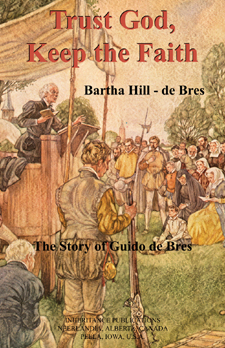
There are at present two books on my desk which seek to contribute to this long tradition of helping the Church to know itself by retelling its own story. As it happens, they are both books which are accessible to children, which is particularly exciting because I’m always on the hunt for ways to tell my children, and others too in my community of faith, their own story. The first is by New Zealand writer Bartha Hill, and is called Trust God, Keep the Faith: The Story of Guido de Bres. It recounts the inspiring story of pastor and theologian Guido de Bres. De Bres was a student of both Calvin and Beza, and is best known as the author of the Belgic Confession (1561). The book paints the story of de Bres against the background of an eventful sixteenth century in Europe, events which proved to be costly for many of those who stood on the Protestant side of church reform. It can be ordered from Inheritance Publications or, if you are in New Zealand, directly from the author. For the latter, contact Bartha directly via email.

The second book is John Calvin by Simonetta Carr, and is nicely illustrated by Emanuele Taglietti. It is published by Reformation Heritage Books and is targeted at children from 6–12 years of age. Like Hill’s book on de Bres, Carr’s too wonderfully introduces readers (and their imaginations) to the narrative, humanity and rich theological contribution of its subject, and does so in a clear, readable and attractive way. The Church, and its young families, is much in need of the kind of resources that these two small volumes evidence. Both would make great gifts too.