The scandal of Palm Sunday

photo

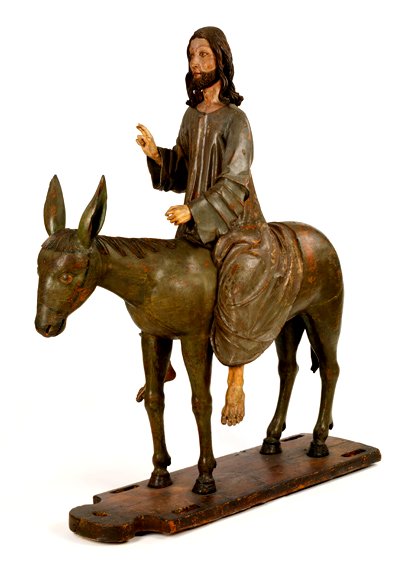
‘Christ on the Ass’, c. 1480. Limewood and pine, painted and gilded. Southern Germany. Victoria and Albert Museum, London.

There’s a little study on ‘The Scandal of Palm Sunday’ (based on Hebrews 2.18) in William Stringfellow’s Free in Obedience where he argues that Palm Sunday is not a day of triumph but of dramatic temptation for Christ, and ‘profound frustration’ for the disciples. Moreover, it is for us moderns a ‘symbol of the terrific confusion which burdens the Church as to the meaning and manner of the Christian witness in society … If only Palm Sunday were the outcome of Christ’s ministry, Christians would be rid of the gospel and free from all that distinguishes them as Christians from the rest of the world’ (p. 34). If Christ’s ministry ended here among palm branches and civic celebration, we could be spared the embarrassment of Judas’ betrayal, the apathy and cowardice of the remaining eleven, the mystery of the Last Supper, Gethsemane’s sweat and agony, the accusations of the authorities, the ridicule of the crowd, the cross and the descent into hell, the embarrassment of the resurrection and the ‘awful gift of Pentecost’ (p. 35). ‘Palm Sunday’, Stringfellow insists, ‘is no day of triumph; for Christians it is a day of profound humiliation’ (p. 37).

Two little musings on irony …

There are a handful of titles that simply never abandon my desk – The Collected Poems: 1945–1990 of R.S. Thomas*, and Bonhoeffer’s Letters and Papers from Prison, and The Book of Common Prayer, for example. And Dag Hammarskjöld’s Markings. (I’m currently awaiting my copy of Roger Lipsey’s substantial biography (752 pages!) to arrive. I was in Cambridge last week and heard Rowan Williams giving a talk about it. ‘nough said.) While Markings was significantly more popular with a generation older that mine than it is with my own (perhaps Lipsey’s book might change that for some?), I have lived with Markings now for almost two decades. And even though it’s not part of my daily diet, this morning I ‘took up and read’ again a few of the opening pages (which is more than enough with this book), and these words spent some time with me:

Tomorrow we shall meet,
Death and I –.
And he shall thrust his sword
Into one who is wide awake.

I’ll not post here my musings on these words, but the irony gestured to here reminded me of something else I saw in Cambridge and which spoke to me of the ironies of life, and of the playfulness of such. Here ’tis:

2013-03-14 09.41.40 (1)

* I just noticed that there are plans for the publication of some of Thomas’ Uncollected Poems due out mid year. This is very exciting.

Conference on the doctrine of the Trinity

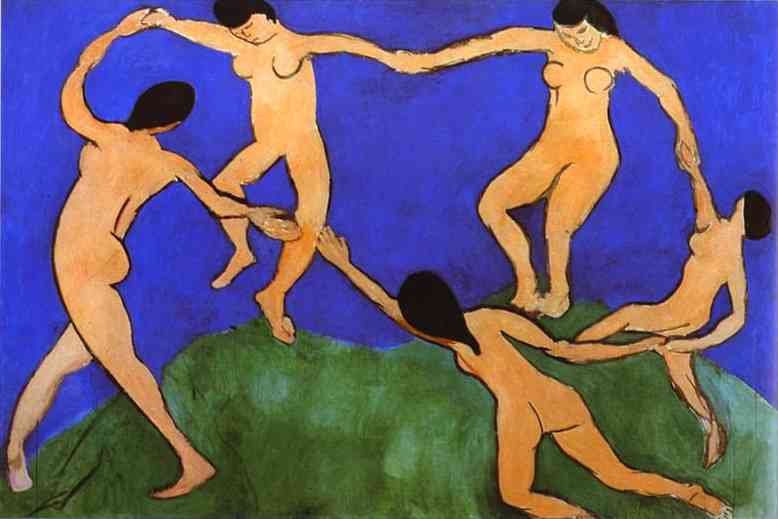
Henri Matisse - La DanseSt Mary’s College (University of St Andrews) is hosting what promises to be a very stimulating one-day conference on the doctrine of the Trinity. Here are the details:

Date: 30 April, 2013

Time: 9.30am – 5.30pm

Where: Parliament Hall, South Street, St Andrews

Cost: Free (but must email to register)

Programme:

Classical Views of the Doctrine of the Trinity:

  • Professor Paul D. Molnar, St John’s University, New York
  • Dr. Stephen R. Holmes, The University of St Andrews

Relational Views of the Doctrine of the Trinity:

  • Professor Paul S. Fiddes, University of Oxford
  • Dr. Thomas H. McCall, Trinity Evangelical Divinity School

Conference flyer is available here.

To register for this conference, or for more information, contact Jason Sexton.

The theologian as grammarian

John_the_Grammarian_as_ambassador_before_Theophilos_and_Mamun

‘Liberals are right that the language we use as Christians is not “literally” true; rather, it is figurative, poetic, imaginative language. But the orthodox are right in a more profound way: for the language of imagination – which is to say, biblical language – is the only language we have for thinking and speaking of God, and we receive it as the gift of the Holy Spirit. Theology deceives itself if it conceives of its task as translating the figurative language of scripture and piety into some more nearly literal discourse about God. The theologian’s job is not to tell fellow believers what they really mean; rather, it is to help the church speak more faithfully the language of the Christian imagination. The theologian is not a translator but a grammarian’. – Richard Bauckham and Trevor Hart, ‘The Shape of Time’ in The Future as God’s Gift: Explorations in Christian Eschatology (ed. David Fergusson and Marcel Sarot; Edinburgh: T&T Clark, 2000), 86.

Two forthcoming books on PT Forsyth

Forsyth 16Regular readers here at PCaL may be aware that my book Hallowed Be Thy Name: The Sanctification of All in the Soteriology of P. T. Forsyth (Bloomsbury/T&T Clark) is due out very soon; in just over a week. (Tasters are available here and here). I am also pleased to announce that another book on Forsyth, specifically on his preaching, will, if all goes to plan, be out on the heels of the aforementioned, i.e., sometime in mid-2013. Here are the details and the blurb for the back cover:

‘Descending on Humanity and Intervening in History’: Notes from the Pulpit Ministry of P.T. Forsyth. Eugene: Pickwick Publications, 2013.

This collection of forty-eight sermons, most of which are previously unpublished, discloses the integration of vocation and imagination in one of the greatest of Free Church theologians, P. T. Forsyth. At a time of fragmentation, when theological study has become too much removed from the task of the preacher, Forsyth’s work can remind us of the invigorating power of Christian doctrine interpreted and expounded in situations of pastoral and political exigency. Its capacity for the renewal of the church is evident again from this rich and timely anthology, here brought together and introduced by Jason Goroncy.

And Alan Sell has again been kind enough to compose the following deathless prose for its back cover:

Far from being a collection of cosy meditations, here are challenging, biblically rooted, theologically powerful, pastorally concerned essays and sermon notes by Britain’s most stimulating theologian of the twentieth century. Church members will be energized; preachers will be prompted towards relevant exposition. The book is the product of much persistent burrowing by Jason Goroncy, whose substantial introduction is an exemplary piece of scholarship in its own right. We are greatly indebted to him.

There are some tentative plans too to work on two additional books on Forsyth; but more on that at a later time …

Notes from London

SAMSUNGLondon, that wonder-filled city characterised by ‘the grey damp filthiness of ages’ (P. J. Harvey), is a city with absolutely no shortage of the bustle that attends the wellsprings of human civilisation. Following on from my meeting in Rüdlingen, I had opportunity to revisit the place last week; and I milked the brief time I had. Starved for cultural input, I enjoyed revisiting The British Museum (it really is the most extraordinary collection of stolen goods) where I was euphoricised by the lime plaster statutes from ‘Ain Ghazal in Jordan, the earliest large-scale representation of the human form and dated at around 7200BCE. And while it is not my favourite gallery, it was worthwhile too to revisit Tate Modern where I was reminded of the fact that the collection of work housed therein reflects both the groping for new meaning and the attempt to reject precisely such a quest in a world whose confidence and conscience was irreparably wounded on the battle fields of Flanders and in the execution chambers of (mostly) Eastern Europe. Time at Tate Britain was richly rewarding too, although I was saddened to discover that Ophelia, who usually hangs out in those hallowed halls, is in the US at the moment. I hope that she’s not too cold, or made too exhausted by the constancy of North American chatter. A day in the British Library (one genuine highlight of which is the Treasures Gallery), and a half day at the Victoria and Albert Museum also made up the brief visit.

Of course, no trip to London is complete without spending some time – and moula – in the West End. So I took in Simon Gray’s delightful play Quartermaine’s Terms, starring Rowan Atkinson, and, later that same day, Les Misérables. Not having seen the live show before, I was very excited about going, had a great seat, and was not disappointed. It was absolutely outstanding. In addition to a visit to the West End, the other must-see-every-time-I-visit-London highlight (and it probably helps that it’s free!) is the National Portrait Gallery. Feeling a little flat, still jet-lagged and gallery-exhausted, and with sore feet, there was a sense in which the last place that I wanted to be was wandering about another gallery/museum. Instead, I wanted beer and sleep. After succumbing to the former (and a quick power nap in the pub), I soldiered on to the NPG. I love that place, and within minutes my mood and energy had lifted, and with my Nexus in hand I penned a poem on Joshua Reynolds’ portrait of Samuel Johnson. In addition to the good Mr Johnson, this time the following subjects attracted my most sustained attention: Johns Milton and Bunyan, Williams Wilberforce, Shakespeare, Gladstone and Blake, Hannah Moore, the Lake Poets, Coleridge, Joseph Banks, Michael Dahl, Samuel Johnson, W. G. Grace, Charles Darwin, Benjamin Disraeli, Mary Seacole, Alfred Tennyson, Henry Irving, Holman Hunt, Ernest Henry Shackleton, T. S. Eliot (and Eliot again and again and &c), Ralph Vaughan Williams, plus an entire room of portraits by George Frederic Watts. O that I had more time to stay with and write poems about each one.

Speaking of ‘cultural input’, I also had the opportunity to meet the Tillings – Chris and Anja, his ‘ridiculously beautiful wife’. What a wonderful team they make, and what a fine chap – and preacher – Chris is. Chris preached at St Judes church on Colossians 4, drawing an important connection between Paul’s verses on prayer and the mention of names in the final chapter of the letter as being not an optional extra but a natural overflow/extension to the manner of life borne witness to in the earlier and more ‘theological’ chapters. It was really wonderful. His basic point was that there is no proclamation of Christ apart from human relationships. This makes sense for, among other things, when Christ comes he always seems to bring his friends along with him, apart from whom his life makes no sense. Then over coffee later in the week, Chris and I discussed theological education, his writing projects, and PT Forsyth. We didn’t solve all of the world’s problems, but we made a start. [Note: Although the tidy state of Chris’s office gives every indication that he not doing any serious theology, he assures me that the case is otherwise. The proof, as they say, shall be in the pudding.]

As delightful and as intoxicating as London is, however, like every other metropolis it suffers under a strange absence of a sense of not being a place where vegetables are grown, and meats cured, and nappies changed by the side of the road. For all its grime, and for all the time it affords on one’s feet, it lacks a sense of dirtiness; that is, of its location in earthdom. It is not the kind of place, in other words, where dogs – or their owners – appear to be at home, as it were. But bless you London. For the conservatism with which you embrace change, for the efficiency of good (albeit expensive) public transport, for decent pizza, for resplendent women wearing ear muffs and tastefully tailored coats, for conventional-looking men undaunted by the snow resting gently on their shiny bald heads, for making space for a tide of Polish and Ukrainian workers, for driving on the correct side of the road, for restaurants happy to attend to appetites well after 10pm, for stiff upper lips and for unreliable football teams, bless you.

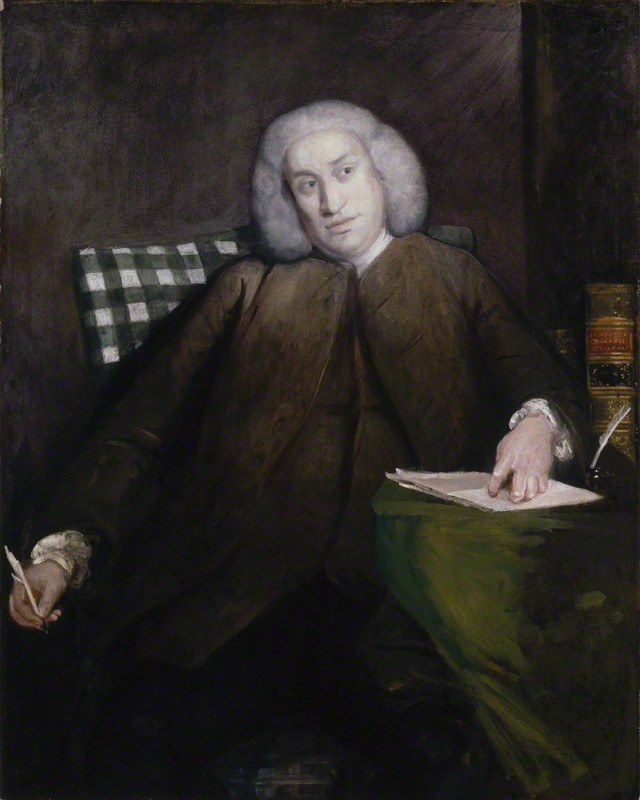
Samuel Johnson, 1709–84

'Samuel Johnson', by Sir Joshua Reynolds. Oil on canvas, 1756–1757. 1276 mm x 1016 mm. National Portrait Gallery, London.

‘Samuel Johnson’, by Sir Joshua Reynolds. Oil on canvas, 1756–1757. 1276 mm x 1016 mm. National Portrait Gallery, London.

The small off-white cardboard
plaque says that you were
plagued with nervous tics,
a victim of melancholia, and
a bit of a gasbag.
That may be true.
But Sir Joshua Reynolds (1723–92)
has made you appear
already in your Hades;
ashen, and clad in rags
already the colour of
the dust (of which you were formed
and to which you have long returned),
and all but abandoned for the
company of friends who gave you life;
and forgotten but for
the Dictionary that bears your name.
Certainly, you now hang alongside
a most uninteresting tribe,
and unaware, it seems, that
the adventurous and handsome Joseph Banks
hangs not 30 metres from you
in the next room, and that
the inspiring Charles Kingsley – and his fishing pole –
hangs on the wall in the room above.

– Jason Goroncy

On being catholic

Pieter Bruegel the Elder - The Tower of Babel 1563 aLast week, I was in Rüdlingen for a very fruitful gathering of the Network of Reformed Theologians associated with the work of the World Communion of Reformed Churches. (I chair the working group on Church and Society). One of the real gifts of being part of such a network, and of our regular face-to-face meetings, is that it occasions a situation in which it is extremely difficult, unattractive, and wasteful to engage in theological ruminations in non-catholic ways.

Catholicity, of course, does not mean uniformity; neither does it equate to the flattening of ethnic/cultural realities, a blending or hybridisation of such to the extent that all that remains is theo-cultural soup. But catholicity is, in fact, intrinsically related to the most radical particularity, the sui generis movement of the God who suckled on Mary’s breast. Responsible Christian theology will want to insist that both true unity and catholicity are possible only in the man Jesus Christ, the Son of the catholic God in whom particularism does not cancel out the universal horizon of love’s creative movement. It is the church’s claim, in other words, that the only reality that makes the church both catholic and one is not any particular form or set of practices but its catholic Lord who in his very person – i.e., in the hypostatic union – is the reconciliation between God and the warring factions that characterise the history of human cultures and relations, is the undoing of Babel’s achievement.

Moreover, in Christ, we learn to tell the truth not only about ourselves but also about our ‘others’, the recognition of which leads to what Miroslav Volf calls ‘double vision’ (the ability to view not only ‘from here’ but also ‘from there’) and thereby make possible the embrace of the other in such a way that both ‘our’ otherness and ‘their’ otherness is affirmed and blessed, made porous without loss of distinctives, and individual limitations transcended. Presupposing that we can both stand with a given tradition and learn from other traditions, and drawing upon Hannah Arendt’s notion of an ‘enlarged way of thinking [which] needs the presence of others “in whose place” it must think, [and] whose perspective it must take into consideration’, Volf describes the process by which ‘double vision’ is able to take place. It happens, he says,

by letting the voices and perspectives of others, especially those with whom we may be in conflict, resonate within ourselves, by allowing them to help us see them, as well as ourselves, from their perspective, and if needed, readjust our perspectives as we take into account their perspectives. Nothing can guarantee in advance that the perspectives will ultimately merge and agreement be reached. We may find that we must reject the perspective of the other. Yet we should seek to see things from their perspective in the hope that competing justices may become converging justices and eventually issue in agreement.

Responsible Christian theology will, I think, want to be explicit in grounding such talk of ‘double vision’ in trinitarian terms; i.e., in imitation of and participation in the triune dialogue. And there are important implications here too for interfaith engagement – that such be informed by a vision of the Triune Life who is both host and guest – and, as David Dark intimates, for the kinds of behaviour that characterise international politics:

To label entire populations – or even sections of the globe – as ‘enemy’ is bad theology, and no government that does so can claim to be operating in any mindful way ‘under’ God. To allow an all-too-human governing body to describe the world for us is to hand over our God-given duty to the likes of a phone book or a demonic stronghold. We have to take our thinking back. The same summons is communicated by Iraqi Christians who publicly pray that American Christians might consider more deeply their understanding of the body of Christ. Does our understanding of this communion move beyond national boundaries when it really counts? Do our imaginations, the way we think about other people, acquiesce to the idolatrous and destructive divisions of nation-states? The defensive distance we maintain between ourselves and the people we see in images of war and deprivation is a deadly construct.

‘Deixa a Cúria, Pedro!’, by Pedro Casaldáliga

BANANA PLANTATION WORKERSPedro Casaldáliga, who is bishop emeritus of São Félix do Araguaia, Brazil, has penned what I think is a challenging poem – ‘Deixa a Cúria, Pedro!’ – in response to Benedict XVI’s announced retirement. Here is an English translation of the poem:

Leave the Curia, Peter,
disassemble the Sanhedrin and the walls,
order all the impeccable scrolls to be changed
to words of life and love.

Let us go to the garden of the banana plantations,
undercover and by night, at any risk,
for there, the Master sweats the blood of the poor.

The tunic/vestment is this humble disfigured flesh,
so many cries of children unanswered,
and memories embroidered with the anonymous dead.

A legion of mercenaries besieges the frontier of the rising dawn
and Caesar blesses them in his arrogance.
In the tidy bowl, Pilate, legalistic and cowardly, washes himself.

The people are just a “remnant”,
a remnant of hope.
Leave them not alone among the guards and princes.
It’s time to sweat with His agony,
It’s time to drink the chalice of the poor,
lift the cross, devoid of certainties,
shatter the building — law and seal — of the Roman tomb,
and wake up to
Easter.

Tell them, tell us all
that the grotto of Bethlehem,
the Beatitudes,
and the judgement of love as food,
remain in force and steadfast.

Be no longer troubled!

As you love Him,
love us,
simply,
as an equal, brother.

Give us, with your smiles, your new tears
the fish of joy,
the bread of the word,
roses of embers …
… the clarity of the untrammeled horizon,
the Sea of Galilee,
ecumenically open to the world.

February stations …

Reading:

Listening:

Watching:

O God of earth and altar (Cum terra Deus arae)

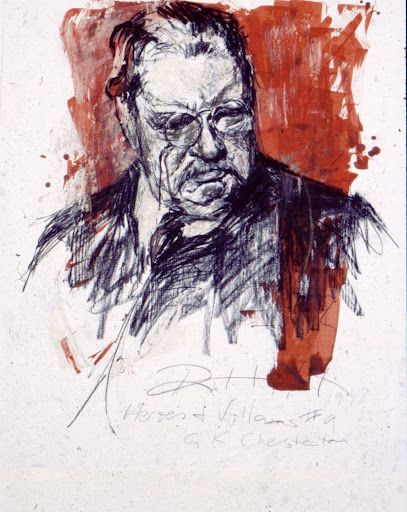
G K ChestertonO God of earth and altar,
Bow down and hear our cry,
Our earthly rulers falter,
Our people drift and die
The walls of gold entomb us,

The swords of scorn divide,
Take not thy thunder from us,
But take away our pride.

From all that terror teaches,
From lies of tongue and pen,
From all the easy speeches
That comfort cruel men,

From sale and profanation,
Of honour and the sword,
From sleep and from damnation,
Deliver us, good Lord!

Tie in a living tether
The prince and priest and thrall,
Bind all our lives together,
Smite us and save us all;
In ire and exultation
Aflame with faith, and free,
Lift up a living nation, 
A single sword to thee.

– G. K. Chesterton

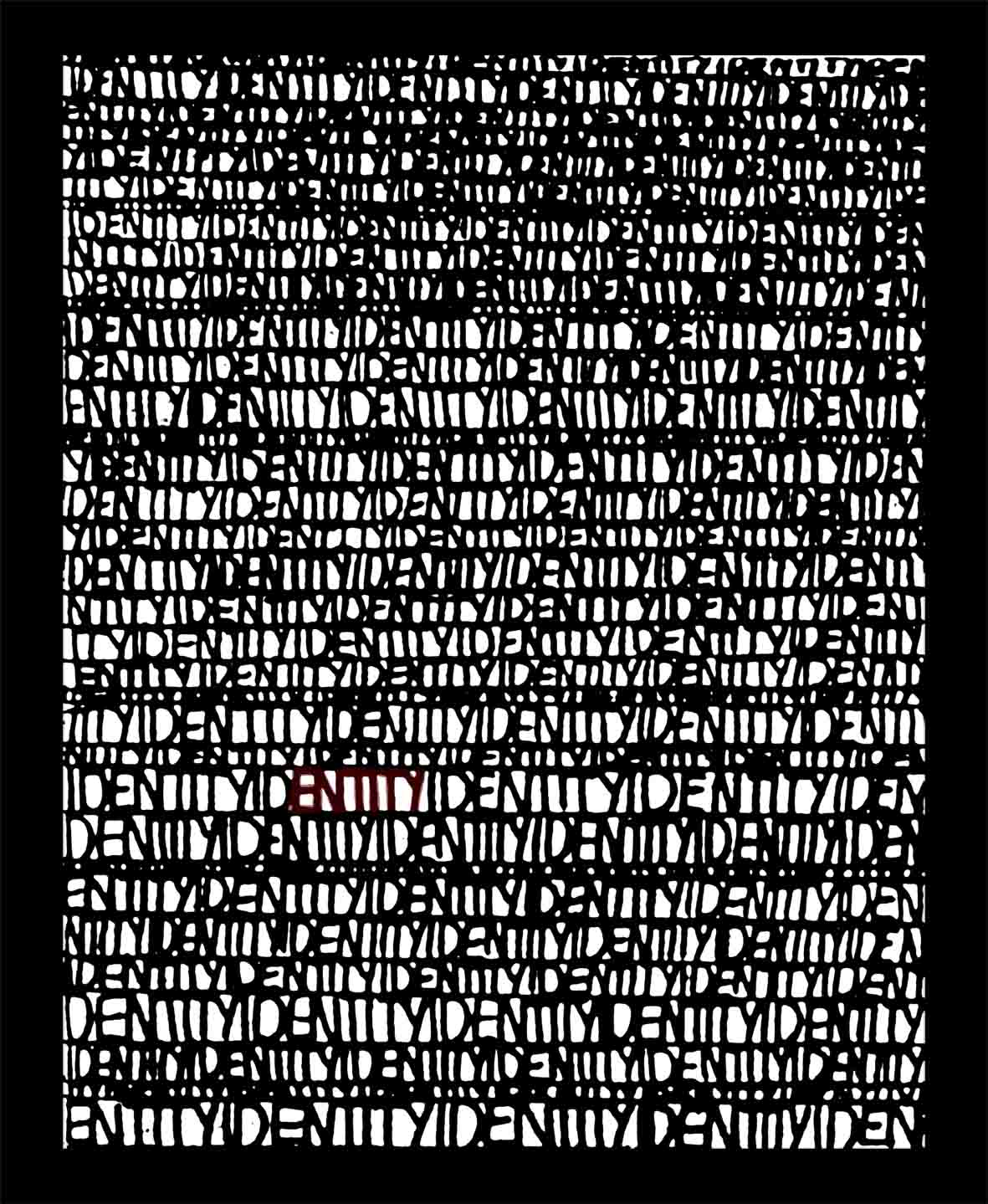
Apocalyptic identity: How ‘new’ is the new identity? – a comment on Gal 3.27–28 & 1 Cor 7.17–24

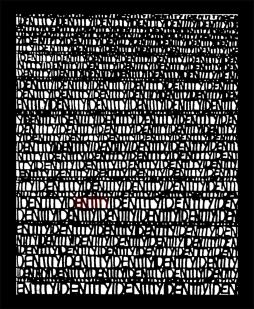
identityIn his essay on ‘The Apocalyptic Gospel in Galatians’, J. Louis Martyn insists that Paul’s apocalyptic theology – particularly in Galatians – is ‘focused on the motif of invasive movement from beyond’. In other words, Paul is concerned to track the shape of God’s ‘fundamental and determining line of movement’ and its ecclesial/missional implications. He writes:

In Paul’s gospel … the fundamental and determining line of movement is God’s. Since the antidote to what is wrong in the world does not lie in the world, the point of departure – on the apocalyptic landscape – from which there can be movement to set things right cannot be found in the world, or in any of its ideas of bad news and good news.

In short, it is not as though, provided with a good religious foundation for a good religious ladder, one could ascend from the wrong to the right. Things are the other way around. God has elected to invade the realm of the wrong – ‘the present evil age’ (1:4) – by sending God’s Son and the Spirit of the Son into it from outside it (4:4–6). And it is in this apocalyptic invasion that God has liberated us from the powers of the present evil age. Galatians is a particularly clear witness to one of Paul’s basic convictions: the gospel is not about human movement into blessedness (religion); it is about God’s liberating invasion of the cosmos (theology).

The divine movement in Jesus Christ and specifically in his cross, Martyn avers, is set against the ‘community-destroying effect of Sin as a cosmic power’ and the creation of an embodied new community characterised by mutual service in the world and by the putting to death of religion and the boundaries – ethnic and otherwise – that religion is concerned to preserve, often taking up the tools of violence in order to do so. He writes:

The Christ who is confessed in the formula solus Christus is the Christ in whom there is neither Jew nor Gentile. Instead of being the holy community that stands apart from the profane orb of the world, then, the church of this Christ is the active beachhead God is planting in a war of liberation from all religious differentiations. In short, it is in the birth and life of the church that Paul perceives the polarity between human religion and God’s apocalypse. Thus, a significant commentary on Paul’s letters can be found in the remark of Dietrich Bonhoeffer that ‘God has founded his church beyond religion …’.

Such a claim immediately raises the question about just how ‘new’ is this ‘active beachhead’ that God has created and/or is creating. Certainly there ought to be no (over-realised) talk of the community being anything other than truly worldly. And although we must go on to say something about the fact that the community resides in the world as ‘aliens and strangers’ (1 Pet 2.11), it is, in fact, the most worldly of communities, called and given over by the Word for a vocation entirely in this world but dependent entirely on resources from outwith. We might even say that apart from the church there is no world. This need not, of course, be to claim any more than Barth is hinting at when he reminds us that

The only advantage of the Church over against the world is that the Church knows the real situation of the world. Christians know what non-Christians do not … It belongs to the Church to witness to the dominion of Christ clearly, explicitly, and consciously.

One of the clearest expressions of this witness (made explicit in the Galatian letter) is when the Christian community resists the temptation to define itself along lines determined by the old creation and instead is defined by the apocalyptic reality dawned in Christ’s resurrection from the old order. So 3.27–28:

As many of you as were baptised into Christ have clothed yourselves with Christ. There is no longer Jew or Greek, there is no longer slave or free, there is no longer male and female; for all of you are one in Christ Jesus.

The baptismal liturgy drawn upon here presupposes that clothes are removed, an act which signifies a departure from ‘the old self with its practices and [being] clothed … with the new self’ (Col 3.9–10); i.e., with Christ who is himself both ‘the “place” in which the baptized now find their corporate life’ and the announcement of the old cosmos’ end. In this new situation, ‘there is no longer Jew or Greek, there is no longer slave or free, there is no longer male and female; for all of you are one in Christ Jesus’ (Gal 3.28). Martyn suggests elsewhere that while in the Epistle to the Galatians Paul is only interested in the first pair of opposites (i.e., the relationship between ‘Jew’ and ‘Gentile’), the text here presents a table in which certain pairs of opposites were identified as the elements that, it was believed, give to the cosmos its dependable structure. To therefore ‘pronounce the nonexistence of these opposites is to announce nothing less than the end of the cosmos’.

Religious, social, and sexual pairs of opposites are not replaced by equality, but rather by a newly created unity … so fundamentally and irreducibly identified with Christ himself as to cause Paul to use the masculine form of the word ‘one’. Members of the church are not one thing; they are one person, having been taken into the corpus of the One New Man.

St Paul was unwavering in his conviction that ‘God was making a new creation by drawing into one church both Jews and Gentiles’, believing that it was not enough simply to maintain a spiritual unity in the church catholic; the unity created in the second – or last – Adam needed to be seen and experienced in a concrete and local social reality as well. The break in sharing meals together would end the social unity of the church against the divisive forces of human recalcitrance.

While St Paul in Galatians is uninterested in attending to the distinction between ‘male and female’, our attendance to such can serve to sharpen our appreciation of the Apostle’s overall argument in this passage and to highlight how it exemplifies the apocalyptic nature of the Gospel that he was intent on proclaiming. In Galatians 3.28, the words ‘male and female’ seem to refer back to the Genesis narrative as if to say the distinction and differentiation was important then but in Christ those created distinctions cease to be relevant to God’s purposes; that is, they are superseded by participation in Christ, in the new creation.

The Synoptics, of course, reveal an astonishing tension on matters of sexual differentiation and family. On the one hand – say the example of Jesus’ response to the question about divorce – Jesus is content to employ the ancient and widespread assumptions based on the fact of how things were (or were perceived to be) ‘from the beginning of creation’ (Mark 10.6), suggesting an ethic grounded in (at least) the abiding functional goodness of creation. On the other hand, when informed that his biological mother and brothers were waiting for him, Jesus’ response indicates a re-evaluation of family relationships based not on the logic of the old creation but of the radical newness of the new eschatological family defined around himself (Mark 3.33–35). He is, it would seem, the new creation in nuce.

There is clearly a discernible tension here between theological arguments offered on the basis of creation and those made on the gospel’s power to bring about a new reality. We see this tension not only in the Gospels but also in Paul’s writing itself. So, for example, in Romans 1.18–32, Paul employs an argument explicitly based on creation and draws certain conclusions from ‘the things [God] has made’ in ‘the creation of the cosmos’ (Rom 1.20). In Galatians 3 and 6, however, Paul employs an entirely different – we might even say ‘opposite’ – logic when he argues that it is ‘explicitly not creation, but rather the new creation in which the building blocks of the old creation are declared to be nonexistent’ that the church is to take her theological and ethical cues from.

The divine affirmation recorded in Genesis 2 – ‘It is not good that the man should be alone (Gen 2.18) – is now brought under the scrutiny of the inbreaking of a new reality in the resurrection resulting in a different answer to Adam’s problem. ‘Now the answer to loneliness is not marriage, but rather the new-creational community that God is calling into being in Christ, the church marked by mutual love, as it is led by the Spirit of Christ (Gal 3:28b; 5:6,13, 22; 6:15)’. Of course, in a different context, Paul’s polemic takes different shape. So in the Corinthian correspondence, for example, the strict dichotomy between old and new is not so strictly championed and the pastor-missionary-theologian will ‘negotiate the relation between new creation and creation by advising married people to be married as though not being married (1 Cor 7:20)’. The apocalyptic realism underscored so heavily in Galatians cannot – if Paul is to be our theological guide – be simply employed to create a template to be placed on all and every situation. Rather, the theologian’s task calls for much more sensitivity than that, and requires equal attention to the particularities of context. So James Dunn:

It must be stressed again that this recognition of the historical relativity of the word of God does not diminish its authority as word of God. Precisely to the contrary, it sets scripture free to function as word of God in the way intended. If we insist, with the logic of the inerrancy school, that scripture must always say precisely the same thing in every historical context, then we muzzle scripture: we filter the word of God through a systematizing and harmonizing process which filters out much that God would say to particular situations, and lets through a message which soon becomes predictably repetitive, whatever the scripture consulted. Why should it be so hard to accept that God speaks different words to different situations (because different situations require different words)? In Jesus Christ, God committed his word to all the relativities of historical existence in first-century Palestine. Paul did not hesitate to express the gospel in different contexts, terms which no doubt would sound contradictory if they were abstracted from these contexts into some system and harmony which paid no heed to these contexts (1 Cor 9:20f.) – hence the apparent conflict between Paul and James (cf. Rom 3:28, ‘justified by faith apart from works’; James 2:26, ‘faith without works is dead’). Mark did not hesitate to press the implications of Jesus’ words about true cleanliness with a view presumably to the Gentile mission (Mark 7:19); whereas Matthew softened the force of the same words, since he had the Jewish mission in view (Matt 15:17). If we ignore such differentiation of the word of God in and to different situations, we rob scripture of its power to speak to different situations. It is only when we properly recognise the historical relativity of scripture that our ears can be properly attuned to hear the authoritative word which God speaks to us in the words of scripture here and now.

While 1 Corinthians 7.17–24, words which appear in an epistle addressed to a ‘multi-ethnic community’ (Witherington) existing in an ethnically and religiously diverse population, is principally concerned with social rather than ethnic realities, it is possible that we might observe here a general principle – ‘to remain as you are’ – that concerns both. In a recent study, J. Brian Tucker surveys and assesses ways in which the Apostle Paul negotiates and transforms existing social identities of the Christ-followers in Corinth in order to extend his gentile mission. He notes that the apostle is concerned to form a Christ-movement identity in the diaspora churches in such a way that previous ethno-social identities are not abrogated but are genuinely transformed ‘in Christ’. Rejecting the view that the church is a community in which such identities are so radically relativised as to be rendered meaningless, Tucker argues (on the basis of 1 Corinthians 7.17, 20 and 24) that Paul’s ‘primary ideological perspective’ is that Christ-followers should remain in the situation they were in when God called them. ‘The result of this interpretive move’, he suggests, ‘is that Paul, rather [than] seeking to obliterate existing social identities, is seen as one drawing from these to form diverse expressions of Christ-movement identity’. He concludes that for Paul, the continuation of various social and ethnic identities remains an open question and is always situationally determined. We might here wish to follow Gordon Fee and insist that such situational determination is determined first and foremost by God’s call rather than by the situation itself, and that the challenge that 1 Corinthians 7 poses to us is that believers need to learn to live out their calling before God in whatever situation they are found, letting the call of God itself ‘sanctify to oneself the situation’.

This is indeed consistent with what we observe throughout the Pauline corpus; namely, that the retention of one’s particularity in Christ is a basic characteristic in our understanding of the process of identity-construction as Christ-followers. This means, among other things, that ‘despite our enormous potential for identity construction, not all structures are feasible or available to us’ as identity builders. ‘We are forced to start from where we are and, in the world of Paul’s day, that meant as either Jews or gentiles, accepting these components to a great extent as part of the given’. So Philip Esler:

In any particular case, therefore, we need to be open to the possible stubbornness of ethnic affiliation, while not underestimating the power of individuals and groups to modify ethnic identity for particular social, political or religious ends.

It is important to note also, particularly if St Paul is to be our guide here, that the construction of identity in Christ occurs within a complex of layers of significant sub-identities (so Rom 11.1; Phil 3.5–6) all of which are important although not equally so and none of which ought to dethrone the primacy of baptismal identity in Christ. So William Campbell:

Paul shares with gentiles in Christ the primary identity-marker which is faith in Christ. He shares with gentiles a special bond as apostle to the gentiles but he differs from them in that he is both Jewish and, by divine commission, apostle to the gentiles. So whilst Paul shares the primary identification of being in Christ, this is accompanied by a differentiation in terms of ethnic and cultural affiliation. He is an Israelite but they are not Israelites despite being in Christ.

To be in Christ is not universal and the same for all peoples. Paul’s converts from the nations are clearly designated by him as gentiles throughout his letters. His strong insistence on their not becoming Jews underlines the fact that for Paul Jew and gentile are fundamental categories and that however much Jews and gentiles share in Christ this in no wise makes them the same … In Christ ethnic difference is not transcended but the hostility that accompanies this should be … Paul’s theologizing is dynamic and he by no means views his converts as continuing in an unchanged existence. They are continually changed by being in Christ but this involves their transformation as Jews or as gentiles, not into some third entity.

So what is being championed by the Apostle Paul (in Galatians, 1 Corinthians, and elsewhere) is not that humanity has been liberated from religious boundaries in order to take up residence as a citizen of a secular, desacralised world, but rather that those baptised into Christ are now to live in the reality of Christ as both the boundary and centre of their existence, a boundary which includes all humanity in our cultural/ethnic/gendered/social/historical particularities. Christ’s kenotic community therefore must not violate the divine-human solidarity announced and secured in the hypostatic union by placing boundaries between itself and the world. But this is not all, for, the radical solidarity created in the incarnation also creates a dissonance between that which depends upon arrangements which are passing away and those which depend upon and point to the coming reign of God. Put otherwise, the incarnation and the coming of the eschatological Spirit announce that ‘historical precedence must give way to eschatological preference’. So John Zizioulas insists that even Jesus must be liberated from his past history in order to bring to the present history of the church his eschatological presence and power:

Now if becoming history is the particularity of the Son in the economy, what is the contribution of the Spirit? Well, precisely the opposite: it is to liberate the Son and the economy from the bondage of history. If the Son dies on the cross, thus succumbing to the bondage of historical existence, it is the Spirit that raises him from the dead. The Spirit is the beyond history, and when he acts in history he does so in order to bring into history the last days, the eschaton.
The beard as sign

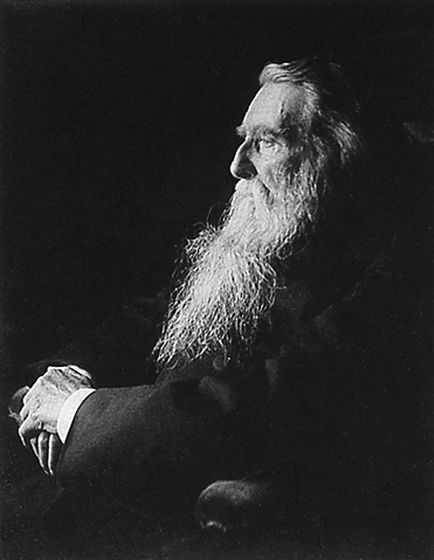
john_ruskin_1894Tonight, while taking a break from writing a paper on an entirely different subject, I was dipping into Sharon Weltman’s book Performing the Victorian: John Ruskin and Identity in Theater, Science, and Education. She recalls how Ruskin did not object to women playing men in the pantomime; not object, that is, ‘until they whip out their cigars’. The problem for Ruskin (as for his contemporaries, it seems) came down not only to those cigar-smoking women but also to the presence of that wonderful gift – a gift which Ruskin himself cultivated over the years – ‘the beard’. The problem with ‘the beard’, as with ‘the cigar’, Weltman suggests, is that it ‘symbolizes masculinity too forcefully for critical comfort. A conventionally feminine pantomine boy poses less of a sexual threat, especially since tights show off shapely female legs, often specifically admired by Victorian theater critics. But women with beards and cigars symbolically suggest morphological possibilities too unsettling and compromise gender boundaries too bluntly to pass unremarked’ (p. 32).

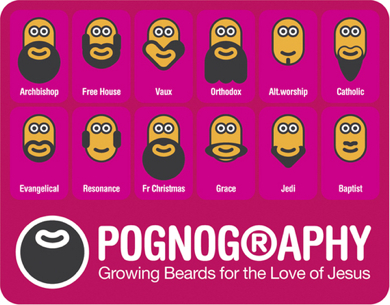
This got me thinking about what other kinds of ‘morphological possibilities’ beards might communicate – like how sheer laziness with the grooming side of things can communicate a lack of consideration of a partner’s longing for smooth chins – and of the ways which such might serve as social and ideological signs; and that led me to a couple of amusing images (from here and here) that I thought worth sharing:

Growing beards

The beards of ministry

Ecclesia and Ethics: An Eco-friendly and Economically-feasible Online Biblical Studies and Theology Conference

Ecclesia and Ethics: An Eco-friendly and Economically-feasible Online Biblical Studies and Theology Conference is an academic and ecclesial conference taking place on Saturday May 18th and Saturday May 25th 2013 in real-time via Webinar.

Main papers will be presented by N.T. Wright, Michael Gorman, Dennis Hollinger, Shane Claiborne, Stanley Hauerwas, Brian Rosner, Mariam Kamell, and Nijay Gupta. Additionally, there will be five Multiple Paper sessions throughout the conference, via five Virtual Rooms which will feature papers from a total of 20-25 selected papers.

No software will need to be purchased by presenters or attendees, and Webinar access is provided entirely for free due to a generous Capod Innovation Grant through the University of St Andrews in Scotland. Participants and attendees will be able to sign on, present, and listen to or watch presentations from anywhere in the world with a reliable internet connection and a computer. Registration for the conference consists of a $10/£7 (minimum) donation to a Recommended Charity.

Conference organisers are also seeking abstracts/papers which deal with the role and relationship of the Church to Christian Ethics and/or Moral Formation. Papers may be rooted in the areas of: the Exegesis of New Testament texts, New Testament Theology, the Exegesis of Old Testament texts, Biblical Theology, Practical Theology, Systematic Theology, or Theological Ethics. Selected candidates will present a 35-40 minute final paper (approx 5000-5500 words). All accepted papers will be considered for inclusion in the publication of the proceedings with T&T Clark. Interested parties are invited to submit a 250-300 word (max) abstract to ecclesiaethics@gmail.com for consideration from January 2013-March 2013.

For more information/registration, visit http://www.ecclesiaethics.com.

Jesus found!

Thanks to the help of Google Maps, I just discovered Jesus! Apparently, he lives in a wee creek that runs between Porters Lodge and Jesus Green in Cambridge, UK. (So he may, after all, be a Baptist but at least he’s not American.) He even has a lane and a college named after him.

Jesus

December-January stations …

GreenvoeReading:

Listening:

Watching:

The great new theology e-group experiment

Theology G+ GroupRecently, I undertook to begin building a wee e-community via Google Plus’s new ‘Communities’ feature. It’s called Theology: thinking faith together, and the intention is that it be a space ‘for the mutual sharing of and discussion about mature theological ideas (however developed) and resources which serve those who attend to the tasks of faith thinking’. The experiment is monitored by yours truly (believe me, and I know that this is difficult to verify with any degree of anything, but there are looneys out there who are even loonier than me), but if it sounds like something that you’re into, then consider joining in. It starts here.