Theology

A wee note on ‘hypothetical universalism’ in the Reformed tradition

John_Owen by John_Greenhill

One of the recurring themes that crops up in conversations with my students is over the various articulations of and arguments for and against soteriological universalism. And, from time to time, some of my students are even interested in knowing what the Reformed tradition (my students are, after all, trying to be Presbyterians!) has to say on the subject. And so I was delighted to find (among some less salutary material, to be sure) a helpful wee discussion on non-Amyraldian hypothetical universalism in English Reformed orthodoxy in Richard’s Muller’s essay ‘Diversity in the Reformed Tradition: A Historiographical Introduction’ wherein Muller writes:

‘Given that there was a significant hypothetical universalist trajectory in the Reformed tradition from its beginnings, it is arguably less than useful to describe its continuance as a softening of the tradition [as Jonathan Moore does]. More importantly, the presence of various forms of hypothetical universalism as well as various approaches to a more particularistic definition renders it rather problematic to describe the tradition as “on the whole” particularistic and thereby to identify hypothetical universalism as a dissident, subordinate stream of the tradition, rather than as one significant stream (or, perhaps two!) among others, having equal claim to confessional orthodoxy’.

Moltmann on the interactions between science and theology

Is the world unfinished? This is the title of Jürgen Moltmann’s 2011 Boyle Lecture, given on 8 February 2011 at St Lawrence Jewry, London, and subsequently published in Theology. Herein, Moltmann explores interactions between theology and the sciences, the ‘readabilty of the world’, and the non-contradiction that exists between the empirical concept of nature and the theological concept of creation. Moltmann also reflects on some themes more traversed in his thinking; namely, the nature of time and history and their openness to the future. The lecture’s gracious respondent was Alan Torrance, who takes on naturalism, temporalist accounts of time (‘the past is not ontologically annihilated by the so-called “passage of time”‘, Torrance argues), and, albeit too briefly, Moltmann’s presentation and use of the doctrine(s) of kenosis (a doctrine which I believe was/is too easily dismissed by some theologians who share Alan’s surname and which I would love to see Alan engage with more seriously at some stage).

An update on “Tikkun Olam”—To Mend the World: A Confluence of Theology and the Arts

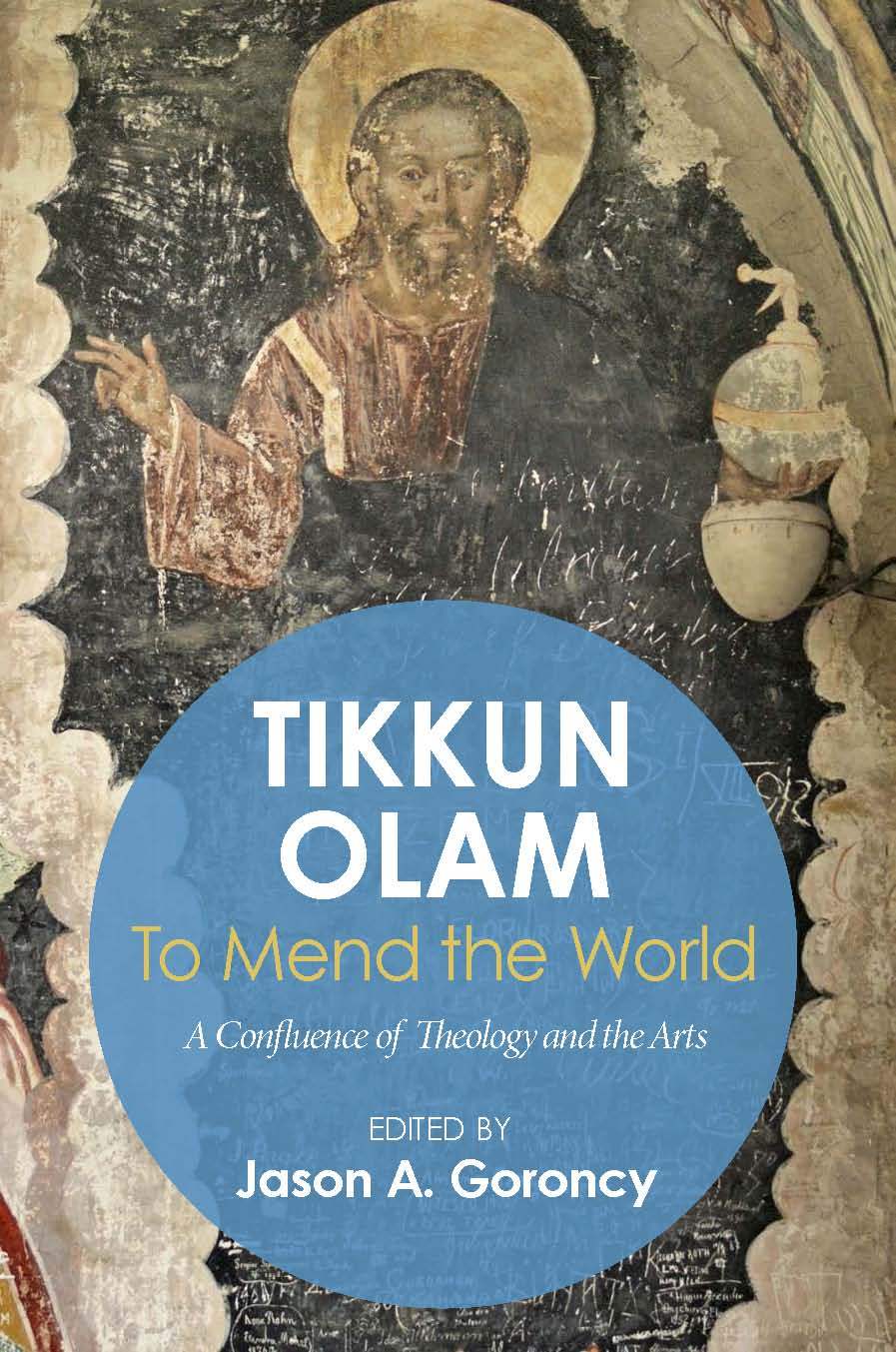
Tikkun Olam CoverRecently, the publishers, essayists and myself have picked up a gear or two with the final edits on the forthcoming book “Tikkun Olam”—To Mend the World: A Confluence of Theology and the Arts (Pickwick Publications). The book is a collection of essays premised on a very basic conviction that artists, theologians and others have things to learn from one another, things about the complex interrelationality of life, and about a coherence of things given and sustained by God. The essays therein attend to the lives and burdens and hopes that characterize human life in a world broken but unforgotten, in travail but moving towards the freedom promised by a faithful Creator. More specifically, they reflect on whether the world – wounded as it is by war, by hatred, by exploitation, by neglect, by reason, and by human imagination itself – can be healed. Can there be repair? And can art and theology tell the truth of the world’s woundedness and still speak of its hope?

The Foreword was written by New York-based artist Alfonse Borysewicz, and the Table of Contents reads thus:

  1. Introduction—Jason Goroncy
  2. “Prophesy to these Dry Bones”: The Artist’s Role in Healing the Earth—William Dyrness
  3. Cosmos, Kenosis and Creativity—Trevor Hart
  4. Re-forming Beauty: Can Theological Sense Accommodate Aesthetic Sensibility?—Carolyn Kelly
  5. Questioning the Extravagance of Beauty in a World of Poverty—Jono Ryan
  6. Living Close to the Wound—Libby Byrne
  7. The Sudden Imperative and Not the Male Gaze: Reconciliatory Relocations in the Art Practice of Allie Eagle—Jo Osborne and Allie Eagle
  8. Building from the Rubble: Architecture, Memory and Hope—Murray Rae 
  9. The Interesting Case of Heaney, the Critic, and the Incarnation—John Dennison
  10. New Media Art Practice: A Challenge and Resource for Multimedia Worship—Julanne Clarke-Morris
  11. Silence, Song, and the Sounding-Together of Creation—Steven Guthrie

Also, Jeremy Begbie and Paul Fiddes were kind enough to read the manuscript and to provide the following endorsements for the book:

‘Artistically sensitive, theologically rich, and eminently readable – this is a rare combination, but it is amply demonstrated in this fascinating set of essays’.

– Jeremy Begbie, Duke Divinity School, Duke University

‘Emerging from a theological symposium and an art exhibition, the essays in this book show in glorious profusion and profundity the marks of this double origin. Theologians, artists, literary scholars, and musicians combine to bear witness to a world that is broken and yet is also the stage for a decisive event of divine love and healing. These are essays full of insights about order and disorder, beauty and tragedy. Their achievement is to make the reader think and, above all, imagine’.

– Paul S. Fiddes, University of Oxford

When the book becomes available, I’ll be sure to let readers here at Per Crucem ad Lucem know.

Daniel Bell on ‘Just War and Christian Discipleship’

By way of a wee follow up to a recent post on ‘just war’ theory, I wish to draw attention to a talk, which I have only just gotten around to listen to, by Daniel Bell on ‘Just War and Christian Discipleship’, the subject of a book and of this pamphlet also by Bell. It’s a paper presented at Wheaton’s Theology Conference earlier this year on Christian Political Witness, and is available for download in both MP3 and MP4 formats.

PARK(ing) Day Eucharist

Parking day

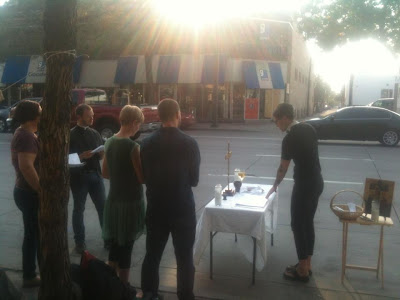
Now here’s a little invitation that I would love to see a few churches take up: PARK(ing) Day, which takes place this year on Friday 20 September, is ‘an annual worldwide event where artists, designers and citizens transform metered parking spots into temporary public parks’. And it occurred to me (and clearly to others too) that this just might be a great place, way and opportunity for Jesus’ friends – and his friends-to-be – to celebrate the Lord’s Supper; i.e., to proclaim the weird and inconvenient and public activity of God’s reign in the world.

And while it’s true that every now and then, reality protrudes ‘into the protective armor of illusion and the result is psychological havoc’, what’s not to welcome – and to like – about that!

Orthodox and Reformed in dialogue

Centre Orthodoxe du Patriarcat OEcumeniqueA guest post by Joseph D. Small

Followers of Per Crucem ad Lucem may have seen the video of Orthodox theologian George Dragas’ wonderful reminiscence of T.F. Torrance. In his remarks, Dragas mentioned the Orthodox-Reformed Dialogue, which he and Torrance co-chaired. The Dialogue resulted in a remarkable ecumenical achievement, the ‘Agreed Statement on the Holy Trinity’.

Ecumenical dialogues (a number of reports from which can be accessed here) often assume agreement on fundamental theological matters, focusing instead on neuralgic issues or comparative ecclesiology. But Torrance believed that mutual understanding of Trinity was the essential prerequisite for the viability of future dialogues on other themes. Only from acknowledgment of shared Trinitarian faith, Torrance believed, could the two church bodies proceed to discuss issues about which there might be less commonality, such as the nature of the church, ministry, and sacraments.

The ‘Agreed Statement on the Holy Trinity’ is precisely that, a statement that speaks with one voice. Unlike many reports that emerge from ecumenical dialogues, the Agreed Statement does not set out differing emphases or divergent positions. It begins by stating, ‘We confess together the evangelical and ancient Faith of the Catholic Church …’, and it is common confession that is articulated throughout. The Agreed Statement is divided into eight brief, densely packed sections, each one of which contains affirmations that are of enduring importance. The Agreed Statement on the Holy Trinity is a singular theological and ecumenical achievement. It is worth attention for its succinct articulation of the doctrine of the Trinity, and also for its demonstration of the very best in ecumenical engagement. The text is readily available here, as well as in Growth in Agreement II: Reports and Agreed Statements of Ecumenical Conversations on a World Level, 1982–1998 edited by Jeffrey Gros, Harding Meyer and William Rusch.

Sunday Hymn: ‘We sing a love that sets all people free’

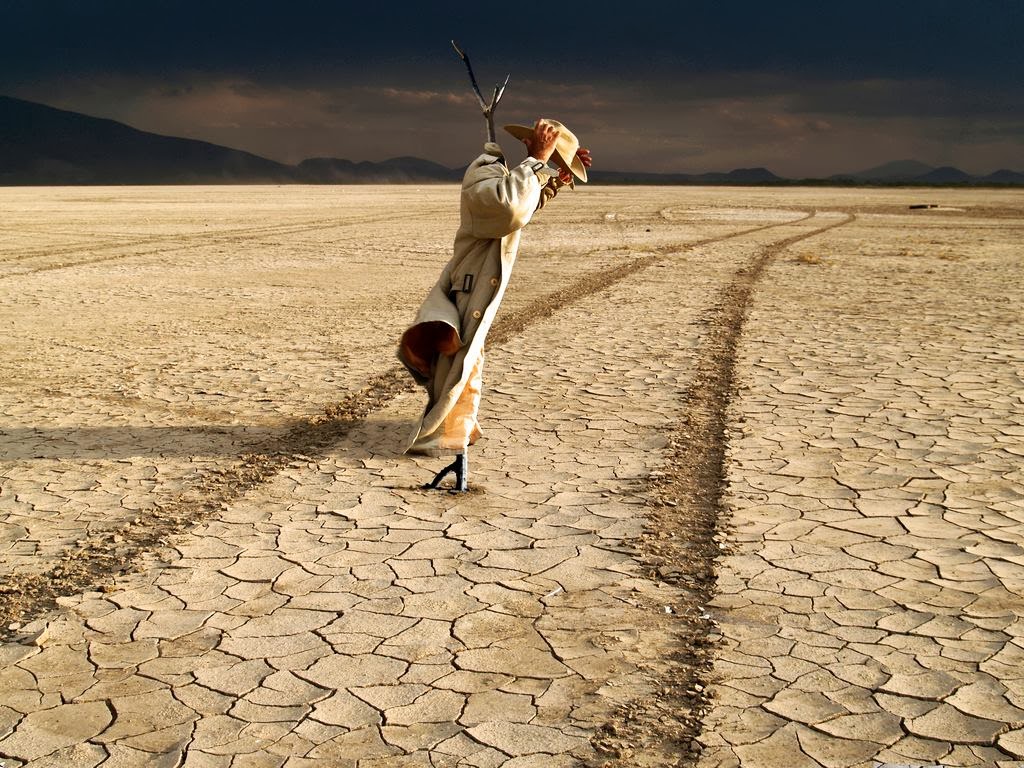
wind man

We sing a love that sets all people free,
that blows like wind, that burns like scorching flame,
enfolds the earth, springs up like water clear:
come, living love, live in our hearts today.

We sing a love that seeks another’s good,
that longs to serve and not to count the cost,
a love that, yielding, finds itself made new:
come, caring love, live in our hearts today.

We sing a love, unflinching, unafraid
to be itself, despite another’s wrath,
a love that stands alone and undismayed:
come, strengthening love, live in our hearts today.

We sing a love that, wandering, will not rest
until it finds its way, its home, its source,
through joy and sadness pressing on refreshed:
come, pilgrim love, live in our hearts today.

We sing the Holy Spirit, full of love,
who seeks out scars of ancient bitterness,
brings to our wounds the healing grace of Christ:
come, radiant love, live in our hearts today.

– June Boyce-Tillman

[Image: Svetlana Lazarova]

Some scribbles on the elderly as gift

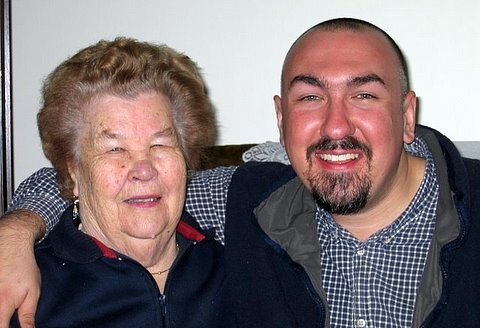
632614403133_0_BGOn a recent Sunday past, I had the joy of preaching on hope and memory to a wonderful group who were, on average, and at a guess, about twice my age. Not surprisingly, I loved being among them, and felt greatly privileged to share time together with them. And being with them made me do something I used to do a lot more of than I have in recent years – pause. More specifically, pause and reflect on why I really love being among the aged. That afternoon, I returned to my reading of Rowan Williams’ recently published book Faith in the Public Square (and therein to his address to the Friends of the Elderly, also available here) wherein he writes:

[A]geing brings much that is bound to be threatening; of course it entails the likelihood of sickness and disability and that most frightening of all prospects, the loss of mental coherence. But if this is combined with an unspoken assumption that the elderly are socially insignificant because they are not prime consumers or producers, the public image of ageing is bound to be extra bleak; and that is the message that can so easily be given these days. In contrast to a setting where age means freedom from having to justify your existence, age in our context is often implicitly presented as a stage of life when you exist ‘on sufferance’. You’re not actually pulling your weight; you’re not an important enough bit of the market to be targeted in most advertising, except of a rather specialised and often rather patronising kind. In an obsessively sexualised world of advertising and other images, age is often made to look pathetic and marginal. And in the minds of most people there will be the picture of the geriatric ward or certain kinds of residential institution.

To borrow the powerful expression used of our prisons by Baroness Kennedy, this is ‘warehousing’ – stacking people in containers because we can think of nothing else to do with them. From time to time, we face those deeply uncomfortable reports about abuse or even violence towards the vulnerable. Terrible as this is, we need to see it as an understandable consequence of a warehousing mentality.

As the Friends of the Elderly make plain in their literature, even if not precisely in these terms, the question of how we perceive age is essentially a spiritual one. If you have a picture of human life as a story that needs pondering, retelling, organising, a story that is open to the judgement and mercy of God, it will be natural to hope for time to do this work, the making of the soul. It will be natural to ask how the life of older people can be relieved of anxiety, and how the essentially creative work of reflection can be helped. It is not an exaggeration to say that, in such a perspective, growing old will make the greatest creative demands of your life. Furthermore, if we are all going to have the opportunity of undertaking reflection like this, it will be important that older people have the chance to share the task with the rest of us. The idea that age necessarily means isolation will be challenged. There is a sense that what matters for our own future thinking through of our life stories doesn’t depend on the sort of things that go in and out of fashion. That is why, in most traditional societies, the term ‘elder’ is a title of honour – as it is, of course, in the Christian Church, where the English word ‘priest’ is an adaptation of the Greek for ‘elder’. A person who has been released from the obligation to justify their existence is one who can give a perspective on life for those of us who are still in the middle of the struggle; their presence ought to be seen as a gift.

Incidentally, one of the most worrying problems in the impact of Western modernity on traditional culture is that it quite rapidly communicates its own indifference or anxiety or even hostility about age and ageing. Generation gaps open and it is no longer clear what there is to be learned. On our own doorsteps, we now have to confront a situation in, for example, the British Muslim community, where the status of older family members has been eroded by the prevailing culture around, creating a vacuum: of course it is natural and in many ways healthy for the young to examine and explore the received wisdom of their elders as they move towards maturity but when younger members of a community are left without signposts, they are more easily shifted towards extreme behaviour of one sort or another. It is as if, in the crises of these communities and the challenge they pose to the rest of our society, we see an intensified image of the tensions and unfinished business in our whole attitude to age and ageing.

We must not be sentimental. Age doesn’t automatically confer wisdom, and the authority of ‘elders’ of one sort or another can be oppressive, unrealistic and selfish. But when we completely lose sight of any idea that older people have a crucial role in pointing us to the way we might work to make better sense of our lives, we lose something vital. We lose the assumption that there is a perspective on our human experience that is bigger than the world of production and consumption. Work, sex, the struggle to secure our position or status, the world in which we constantly negotiate our demands and prove ourselves fit to take part in public life – what is there outside all this that might restore some sense of a value that is just given, a place that doesn’t have to be earned? A healthy attitude to the elderly, I believe, is one of the things that can liberate us from the slavery of what we take for granted as the ‘real’ world. Giving dignity to the elderly … is inseparable from recognising the dignity of human beings as such. Contempt for older citizens, the unthinking pushing of them to the edges of our common life, is a sure sign of a shrivelled view of what it is to be human. (pp. 244–46)

Here, Williams does a characteristically stellar job celebrating the invaluable gift that the elderly are to human community, and that while avoiding any sense of either reducing old people to commodities or apotheosizing them with a romanticism that seeks to shroud some of the ugliness that characterizes all human being.

From time to time I get asked how I feel about being part of an ‘ageing’ (which seems to be code for ‘dying’) institution like the Presbyterian Church here in New Zealand. One thing that immediately comes to mind is the incredible depth of memory that characterizes such a community, storied memory that helps us to understand who we are, why certain things matter, and why ‘realities’ like consumerism represent such an empty lie. Of course, I am grieved too that such an ageing community has fewer and fewer people each year to share its memory with – memory shaped by, among other things, decades of mistakes that need not be repeated, but will be.

This is part of the obligation laid upon the elderly; an obligation which, in my experience, too few rejoice to take up, and that for a great number of reasons that we need not go into here. But some do, of course, and in many such instances provide beautiful illustration of the claim that one really can teach an old dog new tricks; and, what’s more, many have learnt by now that there’s a joyous freedom in so learning some such tricks, and that not because by such one might progress anywhere but simply because learning new tricks can be surprisingly hilarious – the boisterous merriment of the Spirit. More importantly, such learnings-in-community – and the stories that accompany such – celebrate the relationality that lies at the deepest recesses of the universe’s grain.

Another great thing about being part of an institution filled with old people is that one is surrounded by so many more people who can teach me how to die – who have been given the time to teach me how to die and, hopefully, how to die well – and thereby be liberated from the horrible burden of having to always act as if one were younger, or older, or more indispensable, than one actually is. Exactly how this happens remains a mystery to me, although there seem to be conditions that surround the life of the aged that make such virtues real and not merely abstract possibilities. These include friendship, a humble assessment of human vocation, hope that rests in the all-embracing love of God, and a manifestly genuine aversion to twaddle.

But, to repeat, it’s not like this for all. Some old people live with consciences and hearts which have become so calloused over many years – through, among other things, the skill of self-justification – that it seems that it will take as long in the time beyond this time to soften such sisters and brothers enough that healing might take place and growth begin again. To employ a different metaphor, it is no slack knot that grace must undo; and for the elderly this knot has had longer to tighten. For the elderly, as for all – Peccator in re, iustus in spe! Of course, one need not squint too hard to see how industrialisation has contributed too to the very environments in which such knots are formed and then made to be what seems permanent. Consider, for example, words penned by Helmut Thielicke as he reflected on his first visit to the United States in the Spring of 1956, and in which he diagnosed a dire picture:

Elderly Americans constantly made a depressing impression upon me. I can still see the large hall of a hotel on the coast before me. Old ladies were sitting there with wrinkled faces that were not just made up but, frankly, plastered with cosmetics. To me they seemed like masks, consumed with boredom. They stared straight ahead, or looked with unseeing eyes through the gaps in the sun-blinds onto a street where nothing ever happened, or sat for hours in front of the television. A few of them played patience. The same was true of the old people with whom I lived in a house together for a few days. None of them ever read a book, at the most they might occasionally read a magazine. And always that unseeing stare and always television as a desperate protection against drowning in boredom. Some friends confirmed the correctness of this impression to me.

What is the origin of this despairing attitude to old age? One of the reasons is certainly not least the fact that people’s exclusive dependence upon the car kills any real attachment to the countryside. One can indeed wander all over nature and get to know it inside out, but despite this never actually experience it. When Moltke retired he was asked what there was now left for him to do, since he had always been such an active man. He replied: I shall watch a tree grow. How many elderly Americans could give a similar answer? (This question could, of course, also be directed at many elderly Europeans.)

The life that is determined exclusively by external influences prompts a sham vitality on the part of the individual. However, when contact with the outside world becomes weaker as the individual’s receptivity for impressions decreases and he is forced to have a life of his own, the pseudocharacter of his vitality inevitably becomes apparent. The friendly manners in America only inadequately disguise the fact that elderly people are often regarded as a burden. ‘But we don’t have elderly people like in Europe’, a clever woman once said to me with whom I had been discussing this problem and whose memory had perhaps caused her to idealize the Old World too much. ‘Such a thing as the serenity of old age is here rather the exception’, she said. Alongside this, there is also a sociological side to the problem of aging. This takes the form of an idolization of youth. After the loss of youth, life is regarded as a decline and people live in fear of this. That is why people basically do not have a positive attitude towards aging and do their utmost to conserve their youth. (Notes from a Wayfarer, pp. 311–312).

Once upon a time, in the time when we (in the West, at least) were less eager to shove our aged into holding pens, or what Williams refers to as ‘warehousing’, to await their death (these pens are sometimes called ‘nursing homes’), we were more likely to grow up alongside those living in the winter of their lives; that is, alongside those who are moving to die, alongside those who appear to be beginning even now to undergo a translation of life from time (i.e., time as we know it) to eternity (i.e., time as we will know it). Insofar as this is true, the elderly, or at least those elderly who have ceased engaging in the kinds of groping for justification and celebration of independence so characteristic of other adults, are among us as a kind of ‘sacrament’ of true being before God, as icons of God’s presence in frail flesh, as parables of the truth of human being-in-dependence-upon-the-other, and as signs that ‘the glory of human beings is not power, the power to control someone else … [but] the ability to let what is deepest within us grow’ (Jean Vanier, Befriending the Stranger).

In his final book to be published during his lifetime, P. T. Forsyth testified to the ways that ageing can also occasion immortal things becoming more real to us, of eternity being more deeply set in our heart. ‘We become’, he says, ‘more alert in a certain direction. We become more sensitive to what is deep than to what is lively, to a searchlight than to the flares, to what is the sure, permanent, and timeless thing in all movement’ (This Life and the Next, 54). This description does not tell the whole story, of course, but it does tell the story of some, perhaps even of many; and I consider myself blessed to be doing life among those who are alert in this way.

To be continued …

George Dion Dragas and an appreciation of T.F. Torrance

As one who sometimes finds himself bemoaning the fact that he has not yet been able to attend a gathering of the T.F. Torrance Theological Fellowship, I was delighted to discover tonight, via Alvin Kimel, a talk given at last year’s meeting by the Orthodox theologian George Dion Dragas. Reverend Dragas was a student of Tom Torrance, and many of the themes that characterised TF’s own work are evident here in this warm hearted presentation.

Plus the Q&A:

The cruel and godless practice of live animal exports

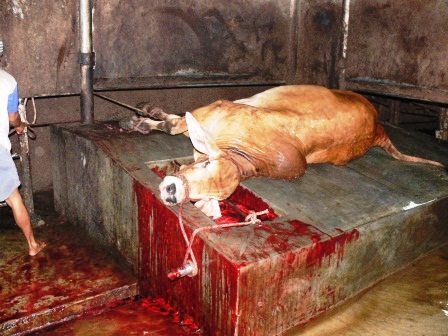
live-export-australian-steer-slaughtered-indonesiaRecently, I posted a video of David Clough’s lecture ‘Rethinking Animality: Towards a New Animal Ethics’. One of the reasons that I drew attention to that lecture was because I consider the work that David (and others too) is engaged in around this issue to be incontrovertibly ‘vital’ [from the late fourteenth century Latin vitalis, meaning ‘of or belonging to life’]. Any society that takes lightly the killing of animals (those creatures whom Dietrich Bonhoeffer refers to as the brothers whom Adam loves), as do those societies with which I am most familiar, has grossly misjudged the sheer giftedness of life itself and is, it seems to me, already well on the way to responding lightly to and of justifying various forms of homicide and deathliness in its midst, blinded by the lie that the life of any creature belongs to something or someone other than God. This is why Karl Barth, for example, argued with due passion that ‘the slaying of animals is really possible only as an appeal to God’s reconciling grace’, and that we ought to have very good reasons for why we might claim the life of another creature for ours. Human beings can only kill an animal, Barth avers, knowing that it does not belong to us but to God alone, and that in killing it – an act which itself is incredibly traumatic, as I can testify – one surrenders it to God in order to receive it back from God as something one needs and desires. ‘The killing of animals in obedience is possible’, Barth contends, ‘only as a deeply reverential act of repentance, gratitude and praise on the part of the forgiven sinner in face of the One who is the Creator and Lord of humanity and beast’. Here Barth’s words compliment the Jewish tradition which champions the need to avoid tzar baalei chayim – causing pain to any living creature – and insists that where animals are killed that they are done so ‘with respect and compassion’, most properly by way of shechita.

With that, I come to the subject of this post; namely, live animal exports. Animals Australia reports that

every year millions of Australian animals are exported live for slaughter. Those who survive the journey often endure brutal treatment and conscious slaughter. Cattle, sheep and goats are sent throughout the Middle East and South East Asia — to countries with no laws to protect them from cruelty. Tens of thousands of animals don’t survive the sea journey and those that do disembark into countries where they are transported, handled and then slaughtered in appalling ways. Most animals slaughtered overseas have their throats cut while they are fully conscious, leading to an incredibly painful and prolonged death. Since 2003, Animals Australia has conducted numerous investigations into the treatment of animals exported from Australia. The evidence from investigations in the Middle East and South East Asia has consistently revealed the willingness of Australia’s live export industry, and consecutive Federal Governments, to export live animals despite appalling cruelty in importing markets.

While Australia remains by far the world’s largest exporter of sheep and cattle, this is not, of course, only an Australian issue. Earlier this year, the New Zealand Herald, for example, reported a ‘Boom in live cattle exports to China’, although thanks to the Customs Exports Prohibition (Livestock for Slaughter) Order these are mostly for breeding purposes, and recent protests at the Port of Dover in the UK are evidence that exporting of live cattle remains a practice in the UK and the EU, with exports going mainly to Italy and France.

This video, produced by Animals Australia, testifies to the cruel and godless practices that attend the live export of animals:

Clearly, this is a political as well as a moral issue (not that the two can ever be separated); and as the Australian Federal election draws near, I wish to publicise my support for the campaign by Animals Australia and Ban Live Export against the sickening and anti-vital practice of live animal exports. I learned recently that one of the Coalition’s priorities, should it win the election, is to ‘apologise’ to Indonesia (a country that receives some 45% of Australia’s live animals) for the Labour Government’s five week trade suspension in 2011, a suspension put in place in direct response to an ABC Four Corner’s program, ‘A Bloody Business’, which exposed the practices that attend live animal exports. In Australia, with the exception of Independent Senator Nick Xenophon, it has been The Greens who have consistently spoken out against this practice and who have sort to (re)introduce the Live Animal Export (Slaughter) Prohibition Bill (2012) into the Senate. And in New Zealand, from which there has been no live animal exports for slaughter since 2003, it is again The Green Party who have tried to maintain pressure to restrict the export of live animals. (I don’t mention this in order to propagandise for The Greens, but simply to report a fact.)

Here is the campaign video produced by Animals Australia:

Opposition Leader Tony Abbott, and the other Coalition party leaders, seem to have forgotten – or, just couldn’t give a rats about – the outrage that Australians felt after that program aired, the facts therein being also corroborated by the live export industry’s own reports. Certainly, it is difficult to see how any formal apology to the Indonesian government or business groups could do anything other than serve to send a message that animal abuse is condoned. To my mind, this ought to be an important election issue. It is certainly an important theological issue. So if you are a fellow Australian citizen, or have your name on the electoral role, then please consider joining me in supporting this campaign.

Sunday Hymn: ‘On the turning away’

Ice people

On the turning away
From the pale and downtrodden,
And the words they say
Which we won’t understand.
‘Don’t accept that what’s happening
is just a case of others’ suffering
Or you’ll find that you’re joining in
The turning away’.

It’s a sin that somehow
Light is changing to shadow,
And casting its shroud
Over all we have known.
Unaware how the ranks have grown,
Driven on by a heart of stone,
We could find that we’re all alone
In the dream of the proud.

On the wings of the night
As the daytime is stirring,
Where the speechless unite
in a silent accord.
Using words you will find are strange,
Mesmerised as they light the flame,
Feel the new wind of change
On the wings of the night.

No more turning away
From the weak and the weary.
No more turning away
From the coldness inside.
Just a world that we all must share,
It’s not enough just to stand and stare.
Is it only a dream that there’ll be
No more turning away?

– David Gilmour & Anthony Moore

Jobs for historians? – yeah right!

Scott, Great moments in New Zealand history

… that’s what I thought, but it seems that the Waitangi Tribunal, a permanent commission of inquiry that researches and reports on claims submitted by Māori under the Treaty of Waitangi Act 1975, is serious about seeking to appoint two historians and one senior historian.

  • Information on the historian positions, including the job description and application form and process, is available here.  Applications close 19 July.
  • Information on the senior historian position, including the job description and application form and process, is available here.  Applications close 10 July.

Should you require any further information, please email Jonathan West.

‘Rethinking Animality: Towards a New Animal Ethics’

David Clough is a very fine Christian theologian who for many years now has been doing some great work to help us rethink our attitude to animals. Recently, he delivered a wonderful inaugural professorial lecture at The University of Chester (a university, to be sure, with some aesthetically-challenged lecture rooms) on the subject ‘Rethinking Animality: Towards a New Animal Ethics’, or Why Christians (& others) should stop eating animals from intensive farming. I thought it was worth sharing, so here it is:

On cooking Indian (plus a recipe for Paneer Tikka Masala)

Indian spicesThere is something highly addictive about Indian food. In fact, ‘scientists’ (which is the BBC’s name for the odd creatures who typically spend four-fifths of their life trying to secure funding in order to research things that half a dozen people in the world care enough about to bother reading the findings on; not that important matters have typically been the concern of the majority) like a crew at Nottingham Trent University a few years back claim that ‘just thinking about eating a curry can make people feel high and eating it arouses the senses and makes your heart beat faster’. But I‘m not concerned here with that kind of addiction.

Rather, I’m concerned about the addiction that attends cooking Indian food. There’s something about the range, the texture and the colour of the various spices, about a home (and a human nose) coming alive with exotic aromas from ingredients grown 14,000 kms away, about the wonderfully friendly and cricket-loving people who run those funky little Indian food marts, and, of course, there’s the thrill – as brimming with eschatological hope as anything ever was – that drives one to produce a curry as near perfect as creatures living anywhere north of the Bellingshausen Station are capable of. Like the thrill of anticipation that attends catching a trout on a fly pattern that you had tied yourself, so too is the joy of creating your own curry recipe (as opposed to simply copying one from some tried and true volume by Camellia Panjabi or Pushpesh Pant). There’s something gloriously physical, too, about preparing Indian dishes. You are involved in the process from go to whoa in ways that many other forms of cooking don’t seem to invite nearly as much. Cooking Indian announces to the cook – and to all who have eyes to see and noses to whiff and palates to tingle – that the only creation worth celebrating, the only creation that is, is the creatio continua. Cooking Indian, in other words, is a prophetic act which exposes the joyless lie of deism and celebrates the joyful freedom of the God of spice. To be sure, such an act of (sub-)creation, of participation in the movement of Spirit in creation – like that which attends fly tying – requires some time-consuming research, patience, and sometimes a few doozies along the way, as with many of life’s most valuable gifts. But the rewards are obvious to all who so venture out (and hopefully to those they cook for as well!).

Had I an editor, s/he would have no doubt deleted the previous paragraphs laden as they are with mixed metaphors and superfluous waffle irrelevant to any definition of a point that this post purports to be about, and demanded that I make plain this post’s purpose in ways that demand less ink and much less of the reader’s patience and time and theological lexica. But I don’t have an editor, so they’re staying put. And having now released a few things off my chest, I am delighted to share a wee recipe – one in progress, for are not all recipes symbols of the provisionality and, in some cases, the idolatry of our attempts at meaning making and of our strange groping for the Bread of Heaven? – for Paneer Tikka Masala. I do so with no apologies in advance for the inconsistent use of measurement systems (something that I’m confident that my intelligent readers will be able to cope with), and with a caveat lector around the fact that I reserve the right to edit the recipe as I further tweak it. Cooking as creatio continua.

By the way, I’m always keen to hear from readers who give the recipes posted here at PCaL a go, and/or who have suggestions arising from their own culinary efforts.

SAMSUNG

Paneer Tikka Masala

Serves 8–10

Ingredients

For the tikka:

  • 1kg of Paneer, cut into 1-inch cubes
  • 1 green capsicum, cut into 1-inch pieces
  • 1 red capsicum, cut into 1-inch pieces
  • 2 tbsp peeled, finely grated ginger
  • 4 garlic cloves, finely crushed
  • 2 tsp ground cumin
  • 2 tsp paprika
  • 1 tsp kashmiri chilli powder
  • 1 tsp garam masala
  • 12 tbsp yogurt
  • 6 tbsp olive oil

For the masala:

  • 8 tbsp ghee or olive oil
  • 3–4 medium-sized onions, very finely sliced
  • 2 tbsp peeled, finely grated ginger
  • 10–12 garlic cloves, crushed
  • 1 tsp ground turmeric
  • 3 tsp kashmiri chilli powder
  • 3 tsp paprika
  • 2 tsp coriander, finely ground
  • 2 tsp cumin, finely ground
  • 8 tbsp plain yogurt
  • 4 medium-sized tomatoes, peeled and finely chopped
  • 700 ml chicken stock
  • 1/2 tsp salt, or to taste
  • 1/2 cup tomato puree
  • 2 tsp kasoori methi, crushed
  • 1 tsp garam masala
  • 8 tbsp chopped coriander leaves
  • ½ cup cream

Method

1. In a non-reactive bowl, marinate the paneer and capsicum in the ginger, garlic, cumin, paprika, chilli powder, garam masala and yogurt. Mix well, cover, and refrigerate for a couple of hours. Pour yourself a drink.

2. When you’re ready to cook, it’s time to make the masala. Over medium heat, heat the olive oil in a large lidded pan (I use a large cast iron French oven made by Le Creuset. It has not failed me yet, with any dish). When the oil is hot, put in the onions, and stir until they brown (about 8–10 mins) but don’t burn the little fellas. Then add the ginger and garlic and keep stirring for about a minute. Then add the turmeric, chilli powder, paprika, coriander and cumin. Stir for about 10 seconds, and then add 1 tbsp of yogurt. Stir until it is absorbed (think stock and risotto!), and add the remaining yogurt in the same way – a tbsp at a time.

3. Now add the tomatoes, stopping along the way to give thanks to God for these amazingly versatile little friends, and then fry them for 5–6 minutes on low, or until they turn pulpy. Then add the stock, salt, and tomato puree and bring it all to a gentle simmer. Cover, reduce the heat to low, and simmer gently for 20 minutes, or until the sauce is as thick as a stubborn Methodist (OK, not quite that thick. Think, instead, of somewhere between a nice creamy Anglo-Catholic, that all-too-rare breed of high-church Presbyterian and an ol’ time charismaniac. In other words, thick but thin too. Better still, just think cream.). Stir in the kasoori methi, garam masala and chopped coriander leaves, and, checking the flavour, add more salt if needed. Add the cream, stir gently, and simmer uncovered on very low. Refill your glass and put on some Iris DeMent. If you’ve made it this far and it’s not looking like a complete disaster, then you’re a champion.

4. If you’re someone who likes super smooth gravy, then now is the time to set the blender onto the sauce. After blending, keep it simmering away on very low while you attend to step 5.

5. While the masala is simmering away uncovered, it’s time to cook the paneer and capsicum. Thread the marinated paneer cubes and capsicum onto skewers, brush with oil and grill until lightly browned on all sides. Take the paneer and capsicum off the skewers, place in the masala, stir in well, and serve immediately. (As an alternative to the skewer method, fry the paneer and capsicum in butter/oil until all sides are lightly browned. Or, as an additional but I think less successful alternative, brush each piece of paneer and capsicum with butter/oil and bake in a 180° celsius oven until lightly browned.)

6. Garnish with more chopped coriander leaves (if you’re into pretty food) and enjoy with naan or roti or rice (my preferred type of which is Sona Masoori). More importantly, enjoy it with friends and/or enemies.

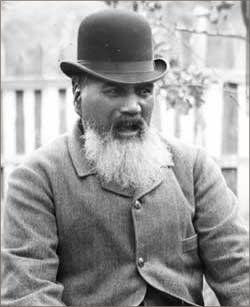
The Māori Prophets

Te WhitiMāori Television is running what promises to be a fascinating seven-part series on The Māori Prophets. Here’s the blurb:

The Māori prophets are an incredible part of our nation’s history. The Prophets is a fascinating seven-part series presented by Anglican Priest and historian, Reverend Hirini Kaa.

From the time the Bible began to be widely translated into te reo Māori in the 1830s through to the middle of the 20th century, the show chronicles the lives, beliefs and social conditions that saw these messianic figures rise from within Māori communities.

Starting with leaders like Papahurihia, the first prophet to draw on Māori and Christian doctrine, emerging with a new form of traditional Māori spirituality to more well-known prophets (Te Kooti, Te Whiti and Tohu and Ratana), The Prophets unveils an incredible part of our nation’s history.

Thus far, only the first episode in the series has been aired. It – and presumably, in time, those episodes forthcoming – can be viewed here.

When ten commandments is ‘too many’ …

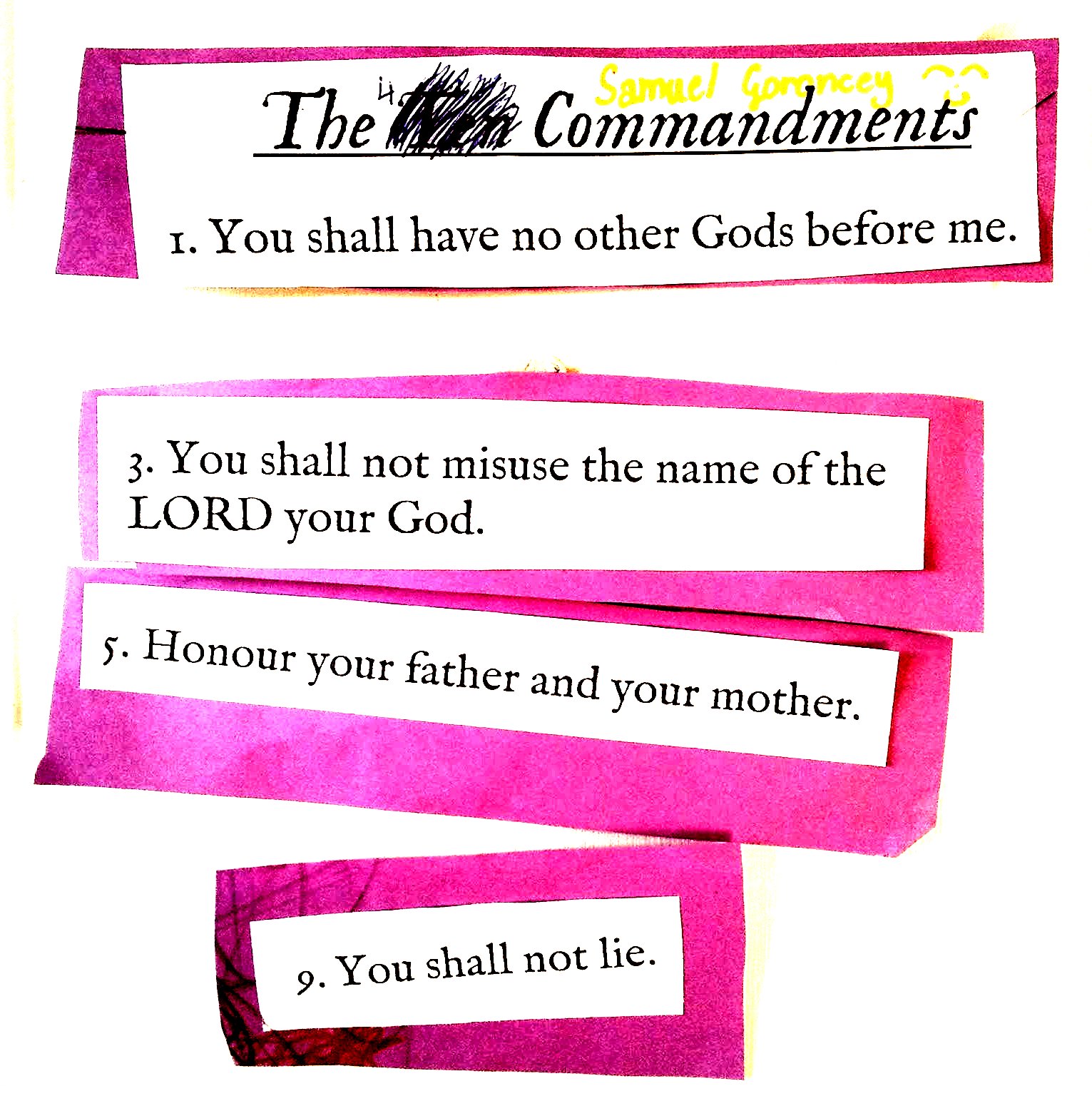
My son Samuel (2) is convinced that ten commandments is ‘too many’. (He doesn’t have a particularly developed doctrine of divine wisdom, and we haven’t done Leviticus yet, so I’m cutting him some slack!) And while he’s yet to learn how to spell his own surname properly, he’s probably onto something here, especially if Jesus is to be our guide on such matters (so Luke 10.27 and parallels). Anyway, Samuel has picked out his favourite the most important four:

4 commandments

Not a bad list. I tried to convince him about the one that says something about tidying up your room, but he wasn’t buying it. Still, I was pleased to see that #5 made the cut … for now.

some thursday drop-offs

Drop-off-AreaIt’s been a while since I shared some link love. Let me remedy that: