Humour

A rollicking take on obscurity

The scene is the office of the dean of admissions at Instant College. A pale adolescent approaches the dean, who is appropriately clad in flowing white memos.

STUDENT: Y-you sent for me, sir?

DEAN: Yes, my boy. We’ve decided to accept you as a student here at Instant.

STUDENT: Sir, I can’t tell you how pleased I am. I mean, my high school average is 65, I got straight Ds in mathematics, confuse the Norman Conquest with Dday, have a sub-average IQ, and got turned down by every other college in America. Yet in spite of all of this, you’ve accepted me.

DEAN: Not in spite of it, boy! Because of it!

STUDENT (dimly): Sir?

DEAN: Don’t you see? You’re a challenge. We’re starting with nothing—you. Yet before we’re through, corporations will seek your advice, little magazines will print your monographs on such arcane subjects as forensic medicine and epistemology, newspapers will publish your utterances as you enplane for conferences abroad.

STUDENT: Me?

DEAN: You. Because you will be an Expert.

STUDENT: An expert what?

DEAN: Just an Expert.

STUDENT: But sir, I don’t know anything and I can’t learn much. Not in four years, anyway.

DEAN: Why, my boy, we’ll have you out of here in an hour. All you need is the catalyst that instantly transforms the lowest common denominator, you, into an Expert.

STUDENT: Money? Power? Intellect? Charm?

DEAN: No. These things are but children’s toys compared to Jargon.

STUDENT: Jargon?

DEAN (turning to his textbook): The dictionary calls it “confused, unintelligible language: gibberish, a dialect regarded as barbarous or outlandish.” But we at Instant call it the Expert’s Ultimate Weapon. In 1967, it will hypnotize friends, quash enemies and intimidate whole nations. Follow me.

A school bell rings, and the entire faculty enters: Dr. Gummidge, professor of sociology; the Rev. Mr. Logos, head of the theological seminary; Dr. Beazle, head of the medical school; Mr. Flap, instructor in government; and finally, General Redstone, chief of the ROTC. Dr. Gummidge steps forward, conducts the student to an uncomfortable chair, mills about him like a lonely crowd, and begins.

GUMMIDGE: Remember Gummidge’s Law and you will never be Found Out: The amount of expertise varies in inverse proportion to the number of statements understood by the General Public.

STUDENT: In other words?

GUMMIDGE: In other words, never say “In other words.” That will force you to clarify your statements. Keep all pronunciamentos orotund and hazy. Suppose your mother comes to school and asks how you are doing. Do I reply: “He is at the bottom of his class—lazy and good-for-nothing”?

STUDENT: Why not? Everyone else does.

GUMMIDGE: I am not everyone else. I reply: “The student in question is performing minimally for his peer group and is an emerging underachiever.”

STUDENT: Wow!

GUMMIDGE: Exactly. If you are poor, I refer to you as disadvantaged; if you live in a slum, you are in a culturally deprived environment.

STUDENT: If I want to get out of a crowded class?

GUMMIDGE: You seek a more favorable pupil-teacher ratio, plus a decentralized learning center in the multiversity.

STUDENT: If I’m learning a language by conversing in it?

GUMMIDGE: That’s the aural-oral method. Say it aloud.

The student does and is completely incomprehensible. A cheer goes up from the faculty.

GUMMIDGE: From now on, you must never speak; you must verbalize.

STUDENT: Must I verbalize Jargon only to my peer group?

GUMMIDGE: Not at all. You can now use it even when addressing preschoolers. In his book Translations from the English, Robert Paul Smith offers these samples: “He shows a real ability in plastic conception.” That means he can make a snake out of clay. “He’s rather slow in group integration and reacts negatively to aggressive stimulus.” He cries easily. And “He does seem to have developed late in large-muscle control.” He falls on his head frequently.

STUDENT (awestruck): I’ll never be able to do it.

GUMMIDGE: Of course you will. The uninitiated are easily impressed. It’s all rather like the ignorant woman who learns that her friend’s son has graduated from medical school. “How’s your boy?” she asks. The friend clucks sadly: “He’s a practicing homosexual.” “Wonderful!” cries the first. “Where’s his office?” Do I make myself clear?

STUDENT: No, sir,

GUMMIDGE: Fine. Now open your textbook to the David Riesman chapter. Here is the eminent sociologist writing about Jargon: “Phrases such as ‘achievement-oriented’ or ‘need-achievement’ were, if I am not mistaken, invented by colleagues and friends of mine, Harry Murray and David C. McClelland … It has occurred to me that they may be driven by a kind of asceticism precisely because they are poetic men of feeling who . . . have chosen to deal with soft data in a hard way.” Now then, my boy, is there any better example of flapdoodle than that?

STUDENT: Well, how about these samples from Harvard Sociologist Talcott Parsons: “Adaptation, goal-attainment, integration and pattern maintenance.”

GUMMIDGE: Yes, first rate. Even I practice them, just as Horowitz plays the scales. Try them in a sentence. Two men open a store. Someone provides the cash. What’s that?

STUDENT: Adaptation?

GUMMIDGE: And then they entice customers—

STUDENT: Goal-attainment.

GUMMIDGE: They set up a sales staff—

STUDENT: Integration.

GUMMIDGE: And they don’t steal from the cash register.

STUDENT: They agree to maintain the wider values of the culture. That’s pattern maintenance.

GUMMIDGE: Perfect. See how complicated you can make things? Imagine what damage you can wreak in the schools where a situation is no longer practical, it is viable; where a pupil is no longer unmanageable, but alienated. Get it?

STUDENT: Got it.

GUMMIDGE: Do books have words and pictures?

STUDENT: No, sir, they have verbal symbols and visual representations.

GUMMIDGE: You’re on your way. For your final exam, read and commit to memory the 23rd Psalm Jargonized by Alan Simpson, president of Vassar College.

STUDENT (droning): “The Lord is my external-internal integrative mechanism. I shall not be deprived of gratifications for my viscerogenic hungers or my need-dispositions. He motivates me to orient myself towards a nonsocial object with effective significance.”

The student falls into a dreamlike trance during which Professor Gummidge tiptoes off and is replaced by the Rev. Mr. Logos, who continues the psalm.

LOGOS: “He positions me in a nondecisional situation. He maximizes my adjustment . . .” (As the student wakes up): I’m the Reverend Mr. Logos. Bless you, my son.

STUDENT: I see you’re wearing a turned-around collar and a yarmulke. Just what is your religion?

LOGOS: I am a theologian. Does that answer you?

STUDENT: No.

LOGOS: Splendid. How would you refer to a priest disagreeing with a minister?

STUDENT: As two guys arguing?

LOGOS: No, no, no! Religious leaders never argue, they have dialogues, or I-Thou relationships.

STUDENT: If their studies are mainly about Jesus?

LOGOS: They are Christocentrically oriented. If they are interpreting the Bible, hermeneutics is the term.

STUDENT: Can you predict what words will be In for the theological year ahead?

LOGOS: Certainly. Demythologizing, optimism, theology of hope, engage and commitment.

STUDENT: I like dialectic theology and conceptualism.

LOGOS: Forget them. They’re all Out. Concentrate on phenomenology, sociological inspiration, ethical activism, crisis of authority.

STUDENT: Suppose someone realizes that I don’t have the faintest idea what I’m talking about?

LOGOS: Then accuse him of objectification. If he doesn’t go away, ask him what he did before he got religion, before his ultimate faith-concern, or better still, Selbstverständnis.

STUDENT: But that’s not even English.

LOGOS: All the better. Many influential theologians wrote in German—Bultmann, Bonhoeffer, Barth—and German not only offers us a chance to obfuscate, it adds a tangy foreign flavor. For instance, there is Historic, meaning bare facts, Geschichte, meaning interpretive history.

STUDENT: Sort of like the difference between The World Almanac and Toynbee.

LOGOS: Remember Gummidge’s Law: don’t clarify!

STUDENT: Sorry.

LOGOS: Don’t let it happen again. Vorverständnis is one of my favorites. It means presupposition. Wissenschaft is far better than saying simply discipline or science, and anxiety sounds much deeper if you say Angst. If you grow weary of German, there is always Greek—almost everyone has seen Never on Sunday—with such splendid specimens as kerygma (message of the Scriptures) and agape (divine love).

STUDENT (writing furiously): Are you sure Jargon really works? In religion, I mean?

LOGOS: Does it? I quote from a distinguished cleric: “I can’t make heads or tails out of a great deal of what Tillich says.” The confessor is Dr. Billy Graham himself.

At this, the Rev. Mr. Logos is borne away by the laity to edit a book of his sermons entitled Through Exegesis and Hermeneutics We Arrive at Kerygma. In his place steps Dr. Beazle, who takes the student’s blood pressure, temperature, hemoglobin count and wallet.

BEAZLE: Now what kind of medical career do you want, physical or psychiatric?

STUDENT: I don’t know. I never thought about it.

BEAZLE: That’s a good start. Suppose we begin with plain everyday medicine. Was it not Herman Melville who wrote: “A man of true science uses but few hard words, and those only when none other will answer his purpose; whereas the smatterer in science thinks that by mouthing hard words he proves that he understands hard things.” Now you don’t want to be an ordinary man of true science when you can be a full-fledged Smatterer, do you?

STUDENT: I guess not.

BEAZLE: Very well, remember never to let the patient be fully aware of what is wrong. Even tonsillitis can be described as a malign hypertrophied condition that affects nares and pharynx and may result in paraphonia clausa. It was I, you know, who wrote the sign seen in hospitals: “Illumination is required to be extinguished on these premises on the termination of daily activities.”

STUDENT: Which means—

BEAZLE: Put out the lights when you leave.

STUDENT: Marvelous.

BEAZLE: It was nothing, really. We medical men have been confounding patients for years. As far back as 1699, the physician and poet Samuel Garth wrote: “The patient’s ears remorseless he assails/Murders with jargon where his medicine fails.” Still, physical medicine is nothing compared with psychiatry. There’s where we Jargonists truly have our day. Suppose a man loses his wife and is unable to love anyone because he is sad. What do I tell him?

STUDENT: Cheer up, there are lots of fish in the—?

BEAZLE (interrupting): Of course not. I intone: You have suffered an object loss in which you had an over-cathesis of libido and have been unable to decathect the libido and invest it in a new object. Do you follow me?

STUDENT: I think so.

BEAZLE: Then be warned: the public is on our trail; they now have learned the meanings of the “oses” and the “itises.” You had better replace them with “inadequacies,” and “dependencies,” tell the man who acts out fantasies that he is “role playing,” speak of the creation of a child as “exclusive electivity of dynamic specificity.”

STUDENT: And when the child is born?

BEAZLE: His development proceeds through “mutual synthesis carried on through a functional zone of mutuality.”

STUDENT: In short, he grows up.

BEAZLE: In long, he proceeds in a continuous unidirectional ever-varying interplay of organism and environment.

STUDENT: If a patient is unhappy?

BEAZLE: He is having an identity crisis.

STUDENT: But suppose he’s just unhappy?

BEAZLE: No one is just unhappy. Psych harder!

STUDENT: I’ll start immediately. I will follow Lionel Trilling’s dictum: no one will fall in love and get married as long as I’m present.

BEAZLE: What will they do?

STUDENT: Their libidinal impulses being reciprocal, they will integrate their individual erotic drives and bring them within the same frame of reference. How am I doing?

BEAZLE: Not badly, but I can still understand you.

STUDENT: Sorry. Day by day I will grow more obscure, until my patients and I completely fail to communicate.

BEAZLE: Oh, if only I could believe that! Smog, confuse, obfuscate!

He exits, to invent a cure for clarity and lucidity which he will sell to nine leading pharmaceutical firms. Mr. Flap and General Redstone come forward.

FLAP: Order of magnitude, expedite, implement, reorient, interoccupational mobility, mission oriented—

REDSTONE: Component forces, readiness levels, destruct—

STUDENT: Excuse me—

REDSTONE (ignoring him): Credibility, paramilitary department—wide contingency plans, pre-emptive war, scenario, remote area conflict. . .

FLAP: Expedite, channels, maximize, bureau potential—

STUDENT: Gentlemen, please, I—

DEAN: It’s no good, son. Once the civilian and the military start arguing, it can go on for years.

REDSTONE: Circular error probability, target systems, pipeline requirements, deterrent gaps . . . counterinsurgency . . . soft target . . .

The general grinds to a halt. Two enlisted men enter, paint him a neutral olive drab and carry him off to the Pentagon, where he will replace a computer.

FLAP (running down): Extended care facilities . . . oligopoly . . . input . . . phasein . . . interlocking intervention . . . (He creaks, coughs and crawls into a filing cabinet.)

DEAN (handing the student a diploma printed on sheeplike vinyl): We’ve done all we can for you, son. In George Orwell’s paraphrase: “The race is not to the swift—nor the battle to the strong . . . but time and chance—”

STUDENT: I know. “Objective considerations of contemporary phenomena compels the conclusion that success or failure in competitive activities exhibits no tendency to be commensurate with innate capacity, but that a considerable element of the unpredictable must be taken into account.”

DEAN: Exactly. (Moist of eye, he pats the new graduate on the head.) You can now take your pick of careers in medicine, religion, business and geopolitics—as well as wine-tasting and art criticism. And if you fail at everything, there’s a job for you at Instant College. (Calling after him as the student exits.) And remember, it is better to curse one candle than to light the darkness . . .

He extinguishes the lights, leaving the audience in blackness as

THE CURTAIN FALLS

[Source: ‘Essay: Right you are if you say you are – Obscurely’, Time Magazine, Friday, 30 December, 1966]
Yoga and alcohol: the results are in

Time for some Friday levity: New groundbreaking research confirms that excessive drinking gives you the same benefits as yoga does.

Savasana
Position of total relaxation.

http://www.mdig.com.br/imagens/brincadeira/yoga_russa_01.jpg

Balasa Balasana
Position that brings the sensation of peace and calm.

http://www.mdig.com.br/imagens/brincadeira/yoga_russa_02.jpg

Setu Bandha Sarvangasana
This position calms the brain and heals tired legs.
http://www.mdig.com.br/imagens/brincadeira/yoga_russa_03.jpg

Marjayasana
Position stimulates the midirift area and the spinal comumn.


http://www.mdig.com.br/imagens/brincadeira/yoga_russa_04.jpg

Halasana
Excellent for back pain and imsomnia.

http://www.mdig.com.br/imagens/brincadeira/yoga_russa_05.jpg

Dolphin
Excelent for the shoulder area, thorax, legs, and arms.

http://www.mdig.com.br/imagens/brincadeira/yoga_russa_06.jpg

Salambhasana
Great excersice to stimulate the lumbar area, legs, and arms.

http://www.mdig.com.br/imagens/brincadeira/yoga_russa_07.jpg

Ananda Balasana
This position is great for masaging the hip area.

http://www.mdig.com.br/imagens/brincadeira/yoga_russa_08.jpg

Malasana
This position, for ankles and back muscles.
http://www.mdig.com.br/imagens/brincadeira/yoga_russa_09.jpg


Why Men Shouldn’t be Ordained

Poussin OrdinationEarlier this year, the Knox Centre for Ministry and Leadership hosted Robert Jenson in an informal but riveting round table conversation about the eucharist and mission. In the midst of the discussion, Professor Jenson made the comment that the ecumenical movement (at least at ‘official’ levels) has reached a standstill, and he named as the reason the ordination of women. [Seems like a good time to recall Balthasar’s words: ‘But the most important requirement for [the ecumenical] venture is that both partners in the dialogue have God before them and not behind them. All movement must be towards God, the depth of whose wisdom and mystery appears always to increase’. Who Is a Christian? (London: Burns & Oates, 1968), 39.]

Anyway, now Halden has reposted an absolute ripper from Linda on why men shouldn’t be ordained. In fact, it’s so good that I’m reposting it here as well:

10. A man’s place is in the army.

9. For men who have children, their duties might distract them from the responsibilities of being a parent.

8. Their physical build indicates that men are more suited to tasks such as chopping down trees and wrestling mountain lions. It would be “unnatural” for them to do other forms of work.

7. Man was created before woman. It is therefore obvious that man was a prototype. Thus, they represent an experiment, rather than the crowning achievement of creation.

6. Men are too emotional to be priests or pastors. This is easily demonstrated by their conduct at football games and watching basketball tournaments.

5. Some men are handsome; they will distract women worshipers.

4. To be ordained pastor is to nurture the congregation. But this is not a traditional male role. Rather, throughout history, women have been considered to be not only more skilled than men at nurturing, but also more frequently attracted to it. This makes them the obvious choice for ordination.

3. Men are overly prone to violence. No really manly man wants to settle disputes by any means other than by fighting about it. Thus, they would be poor role models, as well as being dangerously unstable in positions of leadership.

2. Men can still be involved in church activities, even without being ordained. They can sweep paths, repair the church roof, change the oil in the church vans, and maybe even lead the singing on Father’s Day. By confining themselves to such traditional male roles, they can still be vitally important in the life of the Church.

1. In the New Testament account, the person who betrayed Jesus was a man. Thus, his lack of faith and ensuing punishment stands as a symbol of the subordinated position that all men should take.

And, in the comments, Kim Fabricius has added an eleventh reason: ’11. Jesus did not ordain men. He did not ordain women either, of course – but two wrongs don’t make a right’.

Committees

Leunig - rightsOh, give me your pity!
I’m on a committee,
Which means that from morning to night.

We attend and amend
And contend, and defend
Without a conclusion in sight.

We confer and concur,
We defer and demur,
We reiterate all of our thoughts.

We revise the agenda
With frequent addenda
And consider a load of reports.

We compose and propose,
We suppose and oppose,
And the points of procedure are fun,

But though various notions
Are brought up as motions
There’s terribly little gets done.

We resolve and absolve;
But we never dissolve,
Since it’s out of the question for us

To bring our committee
To end like this ditty,
Which ends with a period – thus.

– Anonymous, cited in Helen B. Schwartzman, The Meeting: Gatherings in Organizations and Communities (New York: Plenum Press, 1989), 207.

Calvin on illegal downloads

piracy global warming

According to Calvin, ‘[S]tealing is not simply committed with our hands, when … someone is able to steal another person’s money or coins. But stealing occurs when a man possesses what isn’t his, and when we don’t attempt to protect what God has put in a person’s hands’. (John Calvin, Sermons on the Ten Commandments (ed. Benjamin Farley; trans. Benjamin Farley; Grand Rapids: Baker, 1980), 190–1).

… but then he never knew about how P2P can save the planet.

‘The Young Lutheran’s Guide to the Orchestra’

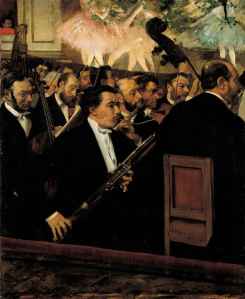
Degas- l'orchestre‘To each person, God gives some talent, such as writing, just to name one, and to many persons He has given musical talent, though not as many as think so. For the young Lutheran, the question must be: Do I have a genuine God-given musical talent, or do I only seem gifted in comparison to other Lutherans?

If your talent is choir or organ, there’s no problem. Choir members and organists can be sure their gift is from God because who else but God would be interested? Just like nobody gets fat on celery, nobody goes into church music for the wrong motives.

But for a Lutheran who feels led to play in an orchestra, the first question must be: Are you kidding? An orchestra?

In the Bible, we read about people singing and playing musical instruments, the harp, trumpet, psaltery, but always in praise of the Lord, not for amusement. We do not read that our Lord Himself ever played an instrument or enjoyed hearing others play theirs. The apostles did not attend concerts or go to dances. Are you sure this is what you want? Do you know what you’re getting into? Opera. Is that anyplace for a Christian? Don Juan and Mephistopheles and Wagner and all his pagan goddesses hooting and hollering, and the immorality – I mean, is anybody in opera married? You play in an orchestra, you’re going to wind up in opera, and the next thing you know, you’re going to be skipping Sunday mornings.

If you steer clear of opera and stick to orchestral concert music, where are the Christian composers? Modern ones are existentialists, the Romantics were secular humanists, the eighteenth century was all rationalists, and the seventeenth was Italians, except for Bach, and you can’t make a living playing Bach. You go in an orchestra, you’re going to be devoting your life to a lot of music that sort of swirls around in spiritual mystery searching for answers that people could find in the Bible if someone showed them where to look.

But if you’re determined to play in an orchestra, then you ought to ask yourself: Which instrument is the best one for a Lutheran to play? If our Lord had played an instrument, which one would he have chosen? Probably not a French horn. It takes too much of a person’s life. French horn players hardly have the time to marry and have children. The French horn is practically a religion all by itself. Should a Lutheran play the bassoon? Not if you want to be taken seriously. The name says it all: bassoon. Maybe you’d do it for a hobby (“Let’s go bassooning this weekend, honey!”) but not as your life occupation.

Many Lutherans start out playing clarinets in marching band and think of the clarinet as a Christian instrument, clear and strong and almost human, but a symphonic clarinet is different from the band clarinet: it’s sardonic, skeptical and definitely worldly. The English horn sounds Christian, maybe because we think of it as the Anglican Horn, but it’s so mournful, so plaintive. And so are English Horn players. They all have incredibly complicated problems, they’re all depressed, especially at night, which is when the concerts are. The oboe is the sensualist of the woodwind section, and if there’s ever a wind a Lutheran should avoid, it’s this one. In movie soundtracks, you tend to hear the oboe when the woman is taking off her clothes, or else later, when she asks the man for a cigarette. The flute is the big shot of the wind section. Jean-Pierre Rampal, James Galway, both millionaires (how many millionaire bassoonists are there?), because everyone knows it’s the hardest to play. To spend your life blowing across a tiny hole – it’s not really normal is it? The flute is a temptation to pride. Avoid it. The last member of the woodwind family is the flakiest, and that’s the piccolo. No Salvation Army Band ever included a piccolo and no piccolo virtuoso ever did an album of gospel music. This is not a devotional instrument.

violinWe come now to the string section. Strings are mentioned in the Scripture and therefore some Lutherans are tempted to become string players, but be careful. Bass, for example. An extremely slow instrument, the plowhorse of the orchestra, and bass players tend to be a little methodical, not inventive, not quick, not witty or brilliant, but reliable. This makes the instrument very tempting to German Lutherans. And yet, bass notes have a darkness and depth to them that, let’s face it, is sexual. And when bass players pick up their bows, I don’t think there’s any doubt what’s going on in their minds back there. The cello section seems so normal, and cellists seem like such nice people. The way they put their arms around their instruments, they look like parents zipping up a child’s snowsuit. They seem like us: comfortable, middle-range. And yet there is something too comfortable, maybe too sensual, about the cello. The way they hold the instrument between their legs: why can’t they hold it across their laps or alongside themselves? The viola section is not a nice place for a Lutheran and here you’ll have to have to take my word for it. I know violists and they are fine people until, late at night, they start drinking a few bottles of cheap red wine and roasting chickens over a pit in a vacant lot and talk about going to Yucatan with a woman named Rita. Don’t be part of this crowd. The violin is a problem for any Christian because it is a solo instrument, a virtuoso instrument, and we’re not solo people. We believe in taking a back seat and being helpful. So Christians think about becoming second violinists. They’re steady, humble, supportive. But who do they support? First violins. You want to get involved with them? The first violins are natural egotists. The conductor looks to them first, and most first violinists believe that the conductor secretly takes his cue from them, that he, a simple foreign person, gets carried away by listening to the violins and falls into a romantic, emotional reverie and forgets where in the score he is and looks to the concertmaster, the No. 1 first violin, to find out what’s going on: this is what violinists believe in their hearts. If the conductor dropped dead, the rest of the orchestra would simply follow the violin section, while the maestro’s body was carried away, and nobody would know the difference. Is this a place for a Lutheran to be? In the biggest collection of gold-plated narcissists ever gathered on one stage? No.

Let’s be clear about the brass section. First of all, the rest of the orchestra wishes the brass were playing in another room, and so does the conductor. His back is toward the audience, so they can’t see what he’s saying to the brass section; he’s saying: You’re too damn loud, shut the fuck up (in Italian, this doesn’t sound course at all). The brass section is made up of men who were at one time in the construction trades and went into music because the hours were better. They are heavy dudes, and that’s why composers wrote so few notes for them: because they’re juveniles. The tuba player, for example, is a stocky bearded guy who has a day job as a plumber. He’s the only member of the orchestra who bowls and goes deer hunting. It’s not an instrument for a sensitive Lutheran, and anyway, there’s only one tuba and he’s it. The trombonist is a humorist. He carries a water spray gun to keep his slide moist and often uses it against other members of the orchestra. A Shriner at heart, he knows more Speedy Gonzalez jokes than you thought existed. The trumpet is the brass instrument you imagine as Christian, thinking of Gideon and of the Psalms, but then you meet a real-life trumpet player and realize how militaristic these people are. They don’t want to wear black tie and play Bach, they want tight uniforms with shiny buttons, and they want to play as loudly as they possibly can. Most of the people who keel over dead at concerts are killed by trumpets.

There are two places in the orchestra for a Lutheran, and one is percussion. It’s the most Lutheran instrument there is. Percussionists are endlessly patient, because they don’t get to play much. Pages and pages of music go by where the violins are sawing away and the winds are tooting and the brass is blasting but the percussionist sits and counts the bars, like a hunter waiting for the quail to appear. A percussionist may have to wait for twenty minutes just to play a few beats, but those beats have to be exact and they have to be passionate and climactic. All that the epistles of Paul say a Christian should be – faithful, waiting, trusting, filled with fervor – are the qualities of the percussionist. The other Lutheran instrument, of course, is the harp. It is the perfect instrument for a Christian because it keeps you humble. You can’t gallivant around with a harp. Having one is like living with an elderly parent in poor health – it’s hard to get them in and out of cars, impossible to satisfy them. A harp takes fourteen hours to tune and remains in tune for twenty minutes or until somebody opens a door. It’s an instrument for a saint. If a harpist could find a good percussionist, they wouldn’t need an orchestra at all; they could settle down and make wonderful music, just the two of them’.

– Garrison Keillor, ‘The Young Lutheran’s Guide to the Orchestra’ in We Are Still Married (New York: Viking Penguin, 1989), 30–4.

It sounded reasonable at the time …

iraq‘I think there is a world market for maybe five computers’. – Thomas Watson, Chairman of IBM, 1943

‘[Television] won’t be able to hold on to any market it captures after the first six months. People will soon get tired of staring at a plywood box every night’. – Darryl F. Zanuck, Head of 20th Century-Fox, in 1946

‘We don’t like their sound. Groups of guitars are on the way out’. – Decca Records, rejecting The Beatles, in 1962

‘640K should be enough for anybody’. – Bill Gates, 1981

‘Some of the pharisees said, “Obviously, this man can’t be from God. He doesn’t keep the Sabbath”‘. – St John’s Gospel

FaceBook In Reality

It’s sometimes really quite difficult to explain to Facebook-addicts why the whole Facebook thing is so uselessly annoyingly. In fact, sometimes they even try to lure you back by promising you all the photos and groovy new applications in the world if you will just bow down and click ‘re-open your account’. When such tempter’s surround, send them this clip. It will make no difference to them, of course, because what they really need is death and resurrection into newness of Facebook-free life. But it does remind you why you made the best decision of your life when you hit that wee button – ‘suspend/delete your account’.

I say, come ye out from them and be ye free. (I’m a hypocrite of course)

In praise of beer … some be[er]atitudes

  • Not all chemicals are bad. Without chemicals such as hydrogen and oxygen, for example, there would be no way to make water, a vital ingredient in beer. – Dave Barry
  • Nothing quenches the thirst like a wheat beer, or sharpens the appetite like an India pale ale. Nothing goes as well with seafood as a dry porter or stout, or accompanies chocolate like an imperial stout. Nothing soothes like a barley wine. These are just a few of the specialty styles of beer. – Michael Jackson
  • So popular is beer, the world’s best-selling alcoholic drink, that it is often taken for granted. Yet scientific analysis shows that a glass of beer has within it as many aromas and flavors as fine wine. Not everyone understands this, but an increasing number of people do. – Michael Jackson
  • Whoever makes a poor beer is transferred to the dung-hill. – Edict, City of Danzig, 11th Century
  • Beer drinking doesn’t do half the harm as love-making. – Anonymous
  • Fermentation and civilization are inseparable. – John Ciardi (1916-1986)
  • Give me a woman who truly loves beer, and I will conquer the world. – Kaiser Wilhelm II (1859-1941)
  • He who drinks beer sleeps well/He who sleeps well cannot sin/He who does not sin goes to heaven/Amen. – Unknown German Monk
  • It is better to think of church in the ale-house than to think of the ale-house in church. – Martin Luther (1483-1546)
  • The selling of bad beer is a crime against Christian love. – Law, the City of Augsburg, 13th Century
  • A good local pub has much in common with a church, except that a pub is warmer, and there’s more conversation. – William Blake
  • Beer is proof that God loves us. – Ben Franklin
  • It is my design to die in the brew-house; let ale be placed to my mouth when I am expiring, that when the choirs of angels come, they may say, “Be God propitious to this drinker.” – Saint Columbanus, AD 612
  • From man’s sweat and God’s love, beer came into the world. – Saint Arnoldus
  • God made yeast, as well as dough, and loves fermentation just as dearly as he loves vegetation. – Ralph Waldo Emerson (1803-1882)
  • There are more old drunks than old doctors. – Anonymous
  • Of doctors and medicines we have in plenty more than enough … what you may, for the Love of God, send is some large quantity of beer. – Dispatch from the Colony, New South Wales, 1854
  • The Puritanical nonsense of excluding children and therefore to some extent women from pubs has turned these places into mere boozing shops instead of the family gathering places that they ought to be. – George Orwell (1903-1950)
  • Beer makes you feel the way you ought to feel without beer. – Henry Lawson
  • Wine is but single broth, ale is meat, drink, and cloth. – 16th Century English Proverb
  • At social parties no gentleman ever thought of leaving the table sober; the host would have considered it a slight on his hospitality. – F.W. Hackwood, comment on manners, 18th Century England
  • Beer … “a high and mighty liquor.” – Julius Caesar
  • Of beer, an enthusiast has said that it could never be bad, but that some brands might be better than others. – A.A. Milne
  • Beer, of course, is actually a depressant, but poor people will never stop hoping otherwise. – Curt Vonnegut, Jr., Hocus Pocus, 1990
  • He is not deserving the name of Englishman who speaketh against ale, that is, good ale. – George Borrow (1803-1881)
  • Ere’s to English women an’ a quart of English beer. – Rudyard Kipling
  • For a quart of Ale is a dish for a King. – Shakespeare (A Winter’s Tale)
  • I would give all my fame for a pot of ale and safety. – William Shakespeare (King Henry V)
  • There’s nothing as heartening as the sight of an empty pub in the morning, the shelves full and everything spick and span before the barbarian hordes come in. Them that drinks bottles spoil the look of the shelves but draught is a different story – you never see the barrel going down. – Patrick McGinley
  • No poems can live long or please that are written by water-drinkers. – Horace 65-8 BC
  • Work is the curse of the drinking classes. – Oscar Wilde
  • When I read about the evils of drinking, I gave up reading. – Henny Youngman
  • I’d rather have a bottle in front of me, than a frontal lobotomy. – Tom Waits
  • Beer is good food. – John Goodman
  • All other nations are drinking Ray Charles beer and we are drinking Barry Manilow. – Dave Barry
  • Without question, the greatest invention in the history of mankind is beer. Oh, I grant you that the wheel was also a fine invention, but the wheel does not go nearly as well with pizza. – Dave Barry’s Bad Habits
  • The problem with the world is that everyone is a few drinks behind. – Humphrey Bogart

    Photograph by Daniel Foucachon (http://www.foucachon.com)

  • Give a man a fish and he will eat for a day. Teach him how to fish, and he will sit in a boat and drink beer all day.
  • Give a man a beer, and he wastes an hour, but teach a man how to brew, and he wastes a lifetime.
  • He that buys land buys many stones, He that buys flesh buys many bones, He that buys eggs buys many shells, But he that buys good ale buys nothing else. – John Ray
  • Draft beer, not people.
  • People who drink light ‘beer’ don’t like the taste of beer; they just like to pee alot. – Capital Brewery, Middleton
  • Beer will always have a definite role in the diet of an individual and can be considered a cog in the wheel of nutritional foods. – Bruce Carlton
  • No soldier can fight unless he is properly fed on beef and beer. – John Churchill, First Duke of Marlborough
  • Always remember that I have taken more out of alcohol than alcohol has taken out of me. – Winston Churchill
  • Make sure that the beer – four pints a week – goes to the troops under fire before any of the parties in the rear get a drop. – Winston Churchill to his Secretary of War, 1944
  • ‘Sir, if you were my husband, I would poison your drink.’ – Lady Astor to Winston Churchill; ‘Madam, if you were my wife, I would drink it.’ – His reply
  • If God had intended us to drink beer, He would have given us stomachs. – David Daye
  • If you ever reach total enlightenment while drinking beer, I bet it makes beer shoot out your nose. – Deep Thought, Jack Handy
  • Sometimes when I reflect back on all the beer I drink I feel ashamed – Then I look into the glass and think about the workers in the brewery and all of their hopes and dreams. If I didn’t drink this beer, they might be out of work and their dreams would be shattered. Then I say to myself, ‘It is better that I drink this beer and let their dreams come true than be selfish and worry about my liver.’ – Deep Thought, Jack Handy
  • A woman drove me to drink and I didn’t even have the decency to thank her. – W.C. Fields
  • Everybody has to believe in something. … I believe I’ll have another drink. – W.C. Fields
  • I am a firm believer in the people. If given the truth, they can be depended upon to meet any national crisis. The great point is to bring them the real facts, and beer. – Abraham Lincoln
  • We old folks have to find our cushions and pillows in our tankards. Strong beer is the milk of the old. – Martin Luther
  • Prohibition makes you want to cry into your beer and denies you the beer to cry into. – Don Marquis
  • Why is American beer served cold? So you can tell it from urine. – David Moulton
  • He was a wise man who invented beer. – Plato
  • I would kill everyone in this room for a drop of sweet beer. – Homer Simpson
  • All right, brain, I don’t like you and you don’t like me – so let’s just do this and I’ll get back to killing you with beer. – Homer Simpson
  • I feel sorry for people who don’t drink. When they wake up in the morning, that’s as good as they’re going to feel all day. – Frank Sinatra
  • [I recommend] … bread, meat, vegetables and beer. -Sophocles’ philosophy of a moderate diet
  • This is grain, which any fool can eat, but for which the Lord intended a more divine means of consumption … Beer! – Robin Hood, Prince of Thieves, Friar Tuck
  • Fermentation may have been a greater discovery than fire. – David Rains Wallace
  • Beer: So much more than just a breakfast drink. – Whitstran Brewery sign
  • You can’t be a real country unless you have a beer and an airline – it helps if you have some kind of a football team, or some nuclear weapons, but at the very least you need a beer. – Frank Zappa
  • It is disgusting to note the increase in the quantity of coffee used by my subjects and the amount of money that goes out of the country in consequence. Everybody is using coffee. If possible, this must be prevented. My people must drink beer. – Frederick the Great
  • It was as natural as eating and, to me, as necessary. I would not have thought of eating a meal without drinking a beer. – Ernest Hemingway
  • Keep your libraries, your penal institutions, your insane-asylums … give me beer. You think man needs rule, he needs beer. The world does not need morals, it needs beer … The souls of men have been fed with indigestibles, but the soul could make use of beer. – Henry Miller
  • In my opinion, most of the great men of the past were only there for the beer. – Alan John Percivale Taylor, British historian (1906-1990)
  • Nothing quenches the thirst like a Wheat Beer, or sharpens the appetite like an India Pale Ale. Nothing goes as well with seafood as a Dry Porter or Stout, or accompanies chocolate like an Imperial Stout. Nothing soothes like a Barley Wine. These are just a few of the specialty styles of beer.” – Michael Jackson
  • Malt does more than Milton can/To justify God’s ways to Man.- A.E. Housman

[If you know of any more notes of praise for ‘the world’s oldest and most consumed alcoholic beverage’ then post in the comments]

On Indigenous Theology

“The ‘Programme for Theology and Cultures in Asia’ exemplifies the view that ‘indigenous theology’ is best carried out by considering the spirituality immanent in the symbols of a particular culture. If the symbols of Scottish culture are taken to be its indigenous, national drink (whisky), its national recipe (the haggis), and its famously indigenous musical instrument (the bagpipes), this would seem to suggest that indigenous Scottish theology should be characterized by spirit, guts … and large quantities of wind!” – Alan Torrance, ‘Being of One Substance with the Father’, in Nicene Christianity: The Future for a New Ecumenism (ed. Christopher Seitz; Brazos Press, 2001).

[HT: Mel]