Church

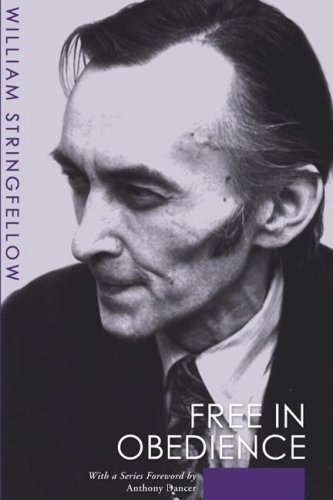
William Stringfellow, Free in Obedience – Part I

I like how Anthony Dancer describes reading Stringfellow:

Despite the polemic and rhetoric, Stringfellow’s writing is neither a fanciful manual nor some early type of Google search engine for the Christian life. Instead he rewards sustained and quiet engagement, offering us an ethic that is at once simple but never easy; he reminds us of the need to be vulnerable to the world and God, and to be obedient to the call to authenticity just where we are. He reminds us of the politically and totally transformative significance of the fact that the reign of the power of Death is over, and that we are no longer bound by fear, but can once again live truly, and wondrously, in freedom. In short, he reminds us who and where, in the Word of God, we are called to be. (Free in Obedience, xiii).

Free in Obedience, which takes its theme from the Letter to the Hebrews, began life as a book for Lenten study. Importantly for his presentation, Stringfellow discerns no real distance between the original recipients of the letter and the church today – ‘the Christians today are the Hebrews’ (p. 7). And just like the original recipients,

The modern churches and the present-day Christians must, if they are to qualify to address and act in this world amid all the technologies, institutional powers, dehumanizing threats, frightful dangers of extermination, and ruthless idols which encompass men, trust the gospel. They must trust it enough to rely upon the discernment of those of the people of God who in preceding ages spoke and acted in their times and in the world as they knew it in the confidence that the Word which they heard and celebrated is the same Word present, uttered, and received in the world as it is now. (p. 8)

That ‘Christ is crucified in the freedom of the resurrection’ (p. 15) means that ‘the people and the things with which an ordinary Christian comes into contact from day to day are the primary and most profound issues of his faith and practice’ (p. 16). Stringfellow charges that the reason that moderns do not appear to pay attention to the Christian faith or to take the Church seriously is because churches have too often given men and women the impression that ‘they do not care about [people] or the world. They have misled [people] into supposing that the Christian faith has nothing to do with the ordinary issues of daily life’ (p. 18). They have, as Nathan Kerr too observes, missed the fact that God’s interruption of history in Jesus Christ is unintelligible apart from its operativity within the ongoing contingencies and complexities of history, that the lived embodiment of Christ’s lordship as a sign of the Spirit’s ongoing conversion of history to God’s coming reign involves, in the freedom of the missio dei, the creation of ecclesial witness to the centres of earthly power. And they have, Stringfellow insists, escaped the reality and decadence of the cities and ‘moved to the suburbs – only to find out that the same problem of the mission of the Church still plagues them, since the suburbs are satellites of the city’ (p. 20). Those who have remained in the city have been hiding out. Clearly, it is the missio ecclesiae for which this Harlem-based lawyer concerned about the immobility of the city’s poor confined to their ghettos – existing in ‘subjection to the principalities that rule the city’ (p. 24) – is troubled by here:

The rudiment of mission is knowledge of the city because the truth and grace of the Incarnation encompasses in God’s care all that is the city. Mission in the city for the Church, and hence for Christians, means a radical intimacy with every corner and every echelon of the city’s actual life in order to represent and honor God’s concern for each fragment of the city’ (p. 22)

Stringfellow suffers from no illusion that the modern cities which have emerged from industrialization and urbanisation are places neither of freedom nor of society. Rather than being cities of salvation, they are places where feudalism survives, kept alive by the propaganda machines of industrial and commercial powers, and by the moral theologies of Protestantism. ‘Medieval demons are not dead … They were not exorcised in the building of the city. They still exist there. The city is their present realm and their plunder’ (p. 26).

This is the situation that the Church must weigh accurately, and not suppress or flinch at, if it is to cease its blushing and turn towards the city in love that risks all reputation and possession. In order to do so, it must make the traumatic move of getting out bed with the heretical ideology of the industrial revolution (which supposes that we might save ourselves) and into bed with the gospel. Here Stringfellow is calling for ‘the renewal of the sacramental integrity of the churches’ (p. 29).

Don’t forget Wipf & Stock’s offer to readers of Per Crucem ad Lucem of 40% off the retail price of any of the Stringfellow volumes. To obtain the 40% discount, just include the coupon code STRINGFELLOW with your order.

A word from the East on Yoder and Jenson

Brad East has posted some helpful notes on the similiarities and differences between the theology of Yoder and Jenson. It’s worth reading the whole thing, but here’s a taster on the question of the nature of the church:

‘Yoder sees the church as a minority people in exilic sojourn among the nations, a servant community sent on behalf of others and therefore unwilling to exercise coercion for any reason, but just so socially responsible insofar as cruciform servanthood is the grain of the cosmos and the only truly transformative power in human community. In other words, the life of the church is defined by Spirit-enabled apocalyptic discipleship to the concrete sociopolitical life and teachings of Jesus of Nazareth, crucified and risen.

Jenson sees the church … differently. Somewhere he says that the entire mission of the church is “the saying of the gospel.” Elsewhere he claims that the community of the church over time is literally the body of the risen Christ on the earth. He also states that, when Constantine asked the bishops to help run the empire, they had nothing else to say but “yes.” He believes with Augustine that the only truly just society is one that worships the true God, and that just war is possible in a legitimately Christian society. Finally, he is able to articulate and is energized by the vision and history of a (high) Christian culture, and speaks to American governance in the hopes that a Christian politics – namely, the right ordering of heterosexual marriage and the consequent protection of the unborn – might both win the day and lead to the formation of a more coherent society.

Moreover, of course, the church catholic for Yoder is the free church: dogma, creed, papal bull, ecumenical council – none of it is binding or revelatory for God’s people. And for Jenson, dogma is either always and everywhere true and binding for the church, or the church is not the same community as that of Peter and Paul. And to be sure, in a church divided, God may act for unity tomorrow – in the restoration of communion with Rome. Not so much for Yoder’.

Eucharist and the politics of power

‘The church expresses a corporate existence where divine agency interacts with human affairs, and such an interaction nurtures, that is to say gives life and shape to, the ecclesial body … [A] theopolitics of Christ’s Body in the Eucharist is rooted not exclusively in power, but, in a more primary sense, in divine caritas, which is expressed with a radical gesture of kenosis, reciprocity, and concrete communal practices. This is not to say that power is herein dismissed, or that the Eucharist is a sign of disempowerment. There is a politics of power here. Yet it is a power that integrates plenitude of desire; it is the paradoxical force of sacrifice on the cross; it is the humble power of bread broken into pieces for the purpose of sharing; it is the washing of feet that means a life of service to one another; it is the power of giving one’s life for the other. In other words, this is the theopolitical power of caritas, where the extraordinary embraces and transfigures the ordinary: God’s “sovereignty disclosed at the breaking of the bread,” as Samuel Wells remarks’. – Angel F. Méndez Montoya, The Theology of Food: Eating and the Eucharist (Chichester: Wiley-Blackwell, 2009), 115–6.

Changing the Conversation: A Third Way for Congregations: A Review

Anthony B. Robinson, Changing the Conversation: A Third Way for Congregations (Grand Rapids/Cambridge: Wm. B. Eerdmans, 2008), 199 pp; ISBN 978-0-8028-0759-5.

Changing the Conversation is a sequel to Anthony Robinson‘s most recent books Transforming Congregational Culture (2003) and What’s Theology Got to Do with It? Convictions, Vitality, and the Church (2006). It builds upon and complements work done by Diana Butler Bass, Darrell Guder, Michael Foss, Barbara Brown Taylor, Brian McLaren and others in their quest for the Church to find ‘a third way’ of being that moves beyond stereotyped polarities all-too-typical of its life and seeks a redefinition from a new centre which finds its pulse in its defining narrative – that is, in the divine economy. Robinson invites congregations to walk upon a way paved by the rediscovery of fresh language (which includes a rediscovery of ‘older words and concepts of the living tradition of our faith’ (p. 2)), the development of new conceptual frameworks, the formulation of new agendas and imaginings for being and doing church, and the fostering of new ways of framing both internal and external challenges and relations.

Robinson (who has served as an ordained Minister of the United Church of Christ and has remained in touch with the realities of congregational life), understands that change is an inevitable and indispensable part of congregational life, that good leaders know and embrace this, and that a significant part of healthy change involves ceasing the typically dead-end conversations that congregations engage in, embracing reality accurately, and framing the challenges adequately. Drawing upon Ron Heifetz’s distinction between technical problems and adaptive challenges, and rehearsing Peter Drucker’s two simple questions – ‘What business are you in?’ and ‘How’s business?’ – this book identifies and is shaped around ten conversations that Robinson believes are requisite in order to initiate, deepen, sustain and grow congregational and denominational life.

The opening chapter is concerned to map in broad outline some of the important historical and cultural shifts that have shaped, and been shaped by, the Church’s baptism of and in Christendom, and how the emergence of a post-Christendom North America is impacting historically mainline Protestant congregations and their ministry from one of chaplaincy to one of mission. One feature of Church that he believes will need to undergo a significant shift in both conceptuality and praxis concerns the role of pastors: ‘Instead of being chaplains to church and community, they will be congregational leaders and spiritual directors. They will not do most or all of their ministry on behalf of the larger church. They will support that ministry through preaching and teaching, mentoring and guiding’ (p. 29).

William Stringfellow once observed, ‘These are harsh days for Protestants in America. American Protestants suffer the pathetic anxieties of a people once ascendant and reigning, but now defensive and in retreat’. How congregations might respond creatively (and in ways that move beyond lament and complaint, bewilderment and apathy) to the challenges and opportunities of this post-Christendom situation is the subject of Chapter Two. Rather than denying or bemoaning the sea change, Robinson asks if congregations might find a way to discern God at work among them and to respond by birthing new and more productive conversations and hopeful, engaged responses. He reminds us that ‘the word “Protestant” does not mean perpetual protest’ but rather derives from pro (‘for’) and testari (‘to testify). So, he asks, ‘what testimony do we offer about God and about God’s work in our midst?’ (p. 44).

The third conversation, ‘A New Heart’, is an invitation to think about how the renewal of hearts and minds is at the centre of mainline Protestant congregations, is not reducible to a formula or recipe, and is always more important than any technique or program.

In Chapter Four, Robinson turns to the issue of leadership, arguing that the work of leadership in the post-Christendom period is to assist congregations to face their own most important challenges and make progress on them. He defines pastoral leadership as ‘mobilizing a congregation … to engage its own most pressing problems and deepest challenges’ (p. 84). Part of the task of leadership (not necessarily of the ‘ordained’) is to read the context and congregation, to name and describe the challenges accurately, and to ‘remind a congregation (or other group) of its theologically and biblically informed purpose and core values. In other words, leadership should keep before the congregation the issues of “who are we?” (core values) and “why are we here?” (purpose)’ (pp. 85–6). Robinson observes that many congregations suffer a ‘leadership vacuum’, that instead of pastoral leaders and governing boards, they have chaplains and a group that is either ‘listening to endless reports or trying to micro-manage the operational administration of the congregation. The future’, he continues, ‘belongs to congregations that call and empower pastors who are leaders, and then also call and prepare governing boards that provide effective policy direction and leadership’ (p. 96).

This directly raises the question of purpose, which is the concern of Chapter Five. The ‘Why are we here?’ question is, according to Robinson, always the most important question to begin with. He avers that congregations need reasonable clarity about their core purpose if they are to foster any new vitality and to shift, as Foss believes, from ‘a culture of membership to a culture of discipleship’ (p. 101). In making the important distinction between purpose and vision, Robinson, following C. Kirk Hadaway, contends that purpose is more important than vision, the former both precedes and shapes the latter: ‘Without a fairly clear sense of purpose, congregations can get caught up in the game of cultural catch-up or what’s newest and latest’ (p. 105).

Robinson continues to labour this distinction and its logic of priority in chapters six to eight, drawing upon Heifetz’s notions on ‘adaptive challenges’. In Chapter Six, the concern is to explore the relationship between vision and purpose, on how congregations move from naming their raison d’être, to identifying the key challenges and then authoring a vision statement or strategic plan that serves their ministry. One vital emphasis here is that the work of the congregation does not fall to experts or authorities, nor to the pastor, or a consultant, or a small group designated to solve their problems for them. Rather, Robinson insists that ‘it is the people with the problem themselves, the people facing the challenge, who do the work. If the work is “discovering again God’s purpose (mission) for our church,” we can’t simply assign that to a mission committee’ (p. 122). While he acknowledges that most congregations face a combination of technical problems and adaptive challenges, to the extent that they understand those challenges as technical problems only, they will fail. Moreover, they would have ‘missed important, God-given opportunities to experience new hearts and minds’ (p. 123).

In some ways Chapter Seven represents the book’s thesis most clearly: that the governance and organisation that many congregations are working with are outmoded and incompetent because designed for, and assuming of, a Christendom rapidly passing away. Here’s his basic point:

Underlying the Christendom-era structures of church life are two notions: (1) the best way to involve people in Christian life and church participation is to get them serving on a board or committee of the church; and (2) the job of laity is to manage the church. If your church assumes that the best way to involve people in Christian life and the church is to get them on a board or committee, there’s a good chance that your congregation will have a lot of boards and committees to accommodate them. The result is often structures that are either Byzantine in complexity or Catch-22-like in absurdity. The second unhelpful assumption is that the really important job of lay Christians is to manage the church, its buildings, finances, property, and personnel. This effectively takes the team off the playing field and gives it the task of managing the clubhouse. Instead of inviting people to do ministry, current systems invite them to manage the ministry. You put these two assumptions together and let the whole thing settle for some decades, and the result would make for a good Monty Python skit … Could it be that the real job of dedicated Christians is not to manage the work of the ordained or the operational administration of the church facility, but to represent Christ to the world? I suspect that many would affirm this in theory, yet our church structures tend not to support the theory (pp. 137–8, 140).

The eighth conversation attends to another arena of adaptive work facing mainline congregations; namely, public theology. It asks what shape and what voice the Church might embody in the public square in an age of redefined relations. ‘Death and Resurrection’ is the title of Chapter Nine. Here Robinson suggests that while, for some situations, congregational renewal is possible, sometimes a death – or something that looks and feels very much like death – is required before a resurrection is possible. The final conversation is a bit of a ‘Where to from now?’ chapter.

Changing the Conversation will be read with profit by denominational staff, seminarians studying congregational life, and leaders of congregations. It offers a clear vocalization of some important theses and synthesises some valuable material on mission and vision. That said, some readers will want to question whether Robinson himself offers a decisive enough severing from the Christendom mindset that he is so properly concerned about. At the very least, the book’s pages frequently require some translation from a North American congregational context into other local dialects. Finally, how one assesses this book depends largely on whether one is seeking a handbook of tools or nutrition for a renewing of ecclesiological imagination. While there are indications that Robinson is seeking to offer both, it is more of the former rather than the latter that is to be found in this book.
No faith is an island

In a previous post, I draw attention to a comment that Stanley Hauerwas made in an interview wherein, discussing Friendship and Community, he said:

‘The last thing in the world I want is a personal relationship with God. Our relationship with God is mediated. And that’s the reason why without the Church we know not God … Our faith is a mediated faith through people reformed by word and sacrament. So I would never trust myself to have a personal relationship with God’.

I was immediately struck by this comment, spurted out in true Hauerwasian style. And while I reckon that Hauerwas needed to introduce a distinction here between ‘personal’ and ‘individual’ (I assume that it is the latter that he most concerned with) I think that his basic point is right.

Paul Tillich, in one of his clearer bits of writing (and there aren’t many of those), also argued that ‘the life of faith is life in the community of faith, not only in its communal activities and institutions but also in the inner life of its members … There is no life of faith, even in mystical solitude, which is not life in the community of faith’. (Dynamics of Faith, 118)

This same word was brought home to me again recently when I was reading Robert McAfee Brown’s book Is Faith Obsolete? In that book, Brown makes the point that we do not believe by ourselves, as individuals in isolation; ‘we believe as part of a community of believers, whether the community is a Benedictine monastery, a communist cell, a Protestant congregation, a Jewish minyan, or a Hindu ashram’. He continues: ‘To be sure, we must personally appropriate the faith of the community to which we belong and make it our own, and in this sense Luther was right in insisting that everyone has to do his own believing just as everyone has to do his own dying. But we need to remember also that the faith we personally appropriate is the faith of the community, and this means that even the most internalized, existential act of personal commitment will bind us into a communal relationship of shared belief with others. Even if the faith I appropriate were somehow brand new, never before conceived, the product of no apparent community save my own internal dialogue with myself, if I really believed it to be true I would perforce share it with others and thus, whether I directly willed it or not, a new community would be created around it’ (p. 141).

There is, Brown insists, a relationship between faith and community which is ‘inextricably joined together’. ‘Community’, he writes, ‘can only be created around a faith; faith can only be creative within a community’. And then he helpfully proceeds to identify five ways in which community nurtures and strengthens the life of faith.

1. The community is an economy of relations wherein the faith of individuals can be tested against the faith of the community. ‘The community has a long history; better still, it has a memory, which means that it can put its history to use. The individual has a short history that needs frequent checking against the community’s longer history’ (p. 142). This means that the practices and learnings of the present are to be in critical relation with, and to exemplify, the life of faith as the creative appropriation of an open past.

2. The community is an economy of faithful relations where the faith of the community can be tested against the faith of the individual. This means that ‘any community that is truly a community must be able to suffer fools gladly and even embrace the heretics that threaten its peace. Since communities are almost always careful and conservative, they need the leaven of fresh ideas, along with new interpretations of old ideas, and these are contributions that only the most venturesome within their midst are likely to propound’ (p. 143). This, Brown insists, is how communities stay alive and grow. He cites Francis of Assisi, Martin Luther, Hans Küng and Daniel Berrigan, as examples of those who were used by God to bring fresh wine alongside old wineskins.

3. The community is an economy of relations of faith where the burdens of doubt can be shared. Faith always – and necessarily – involves risk, some of which are too overwhelming and potentially destructive to be shouldered by the individual alone. At such times, Brown reminds us, ‘the community can be the place for “the bearing of burdens,” where things too heavy to be borne individually can, at least during crucial moments, be borne corporately. It need not be a sign of individual weakness, but rather it can be a sign of communal strength, when an individual can say of the forgiveness of sins or the inevitability of the victory of the proletariat, or whatever: “Look, that part of it just doesn’t make sense to me right now. It did once, and I hope it will again, but for the moment the rest of you will have to do the believing for me”’ (p. 144). This quality of sharing is not to be interpreted as an exposure of weakness but rather as charismatic, i.e. as gift.

4. The community is an economy of relations which contributes to the life of faith precisely because it functions as the locale where faith can be celebrated and faith’s loves embodied, where the community’s members may ‘draw assurance that their faith is a future possibility for all because it is a present reality for a few’ (p. 145). Is this not precisely why we compose community-forming liturgies, and, conversely where we are made communities by that same liturgical action, in order that we might dramatise our graced convictions and spur each other on to participate in, and be continually recreated by, the faith we share and which has taken hold of us. At the very centre of this action, participation and recreation is the eucharist, that event-location around which communities gather to both remember, in the sense of recalling the past, and also to re-member themselves. There is an important (re-)ordering that needs to takes place here too, and that with ecumenical implications. We ought to eat and drink together first, and then talk theology. To invert this ordering is a nonsense. Debra Dean Murphy recently reminded us, ‘Through the sacramental gifts of Christ’s body and blood, the community receives itself – it becomes the body of Christ, blessed, broken, and shared. As the Great Thanksgiving says, we are made “one with Christ, one with each other, and one in ministry to all the world.” In this act the Church is united across time and distinctions between the global and the local are collapsed, for in every local assembly is the whole body – “the world in a wafer,” as Bill Cavanaugh has said’.

5. Finally, community is an economy of relations which ‘contributes to the life of faith by being the place where faith is energized to turn outward. Communities cannot remain ingrown, concerned only with their own inner life. They too must exemplify faith as the dynamic interrelationship of content and commitment. They must thrust their members out into the “strange land,” into the arenas of life not populated by the community’ (p. 146). In other words, the community called by God and re-membered around generous helpings of broken loaves and poured out bottles of Shiraz is ever the apostolic community, i.e., it is always a people being ‘sent’ out in order to invite others to the feast.

Perhaps Hauerwas’ comments are not so strange after all.

On boab trees and the healing of the nations

For not a few, the boab is considered to be Australia’s most grotesque tree. Found only on the flood plains and in rocky areas from the south-western Kimberley to the Northern Territory’s Victoria River, their huge, grey swollen trunks topped by a mass of contorted branches make a fascinating spectacle, especially during the dry season when they lose their leaves and are transformed into ‘the tree that was planted upside-down’.

The boab might serve as something of a parable of the church and even of the life of faith:

  • They are awkward looking.
  • They seem like they belong somewhere else. It’s almost as if they are grounded in another world.
  • They store a deep reservoir of moisture in their trunk that they need to survive in hot and harsh environments. A sign of an unhealthy church is one which seeks to maintain its life by drinking deeply only every so often (whether at the Reformation, or at the Billy Graham crusades of the 50s, etc.) and then trying to sustain its life by drawing upon those every descreasing floodwaters which have long become stagnant and toxic. Conversely, a healthy church is one that is planted by a living stream and which drinks of that stream often.
  • Their moisture serves as a lifeline to those who are lost in the bush.

Trees are used frequently in the Bible especially to describe both the life of faithlessness and of faithfulness, and sometimes of both in the same passage. So Jeremiah 17:

‘Thus says the Lord: Cursed are those who trust in mere mortals and make mere flesh their strength, whose hearts turn away from the Lord. They shall be like a shrub in the desert, and shall not see when relief comes. They shall live in the parched places of the wilderness, in an uninhabited salt land. Blessed are those who trust in the Lord, whose trust is the Lord. They shall be like a tree planted by water, sending out its roots by the stream. It shall not fear when heat comes, and its leaves shall stay green; in the year of drought it is not anxious, and it does not cease to bear fruit’. (vv. 5–8)

Here Jeremiah warns us of making human beings the source of our hope and strength, and that those who do so will be ‘like a shrub in the desert, and shall not see when relief comes. They shall live in the parched places of the wilderness, in an uninhabited salt land’. Rather we are called to be those whose ‘trust is the Lord’, and who are ‘like a tree planted by water, sending out its roots by the stream. It shall not fear when heat comes, and its leaves shall stay green; in the year of drought it is not anxious, and it does not cease to bear fruit’.

Such trust, of course, is grounded in another tree – Calvary’s tree, the tree whose roots are planted on the violent conveyor belt of human history but whose branches reach all the way to the New Jerusalem. It is a tree, according to St John’s vision recorded in the Book of the Revelation, that lives beside ‘the river of the water of life, bright as crystal’, and which flows ‘from the throne of God and of the Lamb through the middle of the street of the city’. John tells us that ‘on either side of the river is the tree of life with its twelve kinds of fruit, producing its fruit each month; and the leaves of the tree are for the healing of the nations’ (Rev 22:1–2).

And so this tree of Jeremiah’s vision which is planted by water and which sends out its roots by the stream does not stop establishing itself until all of the nations, all of creation, is healed; this is to be about its core business, and that healing takes place by the very gift of the tree itself.

This post was inspired by a prayer penned by Chandran Devanesen that Jim Gordon posted a few days ago, a slightly-modified version of which reads:

O Tree of Calvary
send thy roots deep down
into our hearts.
Gather together the soil of our hearts,
the sands of our fickleness,
the stones of our stubbornness,
the mud of our desires, bind them together
O Tree of Calvary,
interlace them with thy strong roots,
entwine them with the network
of thy love.

Some classic Forsyth on the Church, its worship and its service

‘The greatest product of the Church is not brotherly love but divine worship. And we shall never worship right nor serve right till we are more engrossed with our God than even with our worship, with His reality than our piety, with His Cross than our service. It is well to dream and to talk much of brotherly love. But the brethren who love best and the love that loves longest are made by the Gospel. It is this they confess in loving, as they confess it in other ways also. Christian charity is not the sweet reasonableness of culture, nor is it natural kindliness of temper. To the lover of righteousness it does not come easy. It grows only on the stem of Christian faith, which is the tree of the Cross and its righteousness. The good live by faith and work by love. Never did Paul dream that his song of Christian love would be turned to belittle or to belabour the Christian faith on which alone it grows. The Church is the greatest product of history, and the greatest product of the Church is a holiness answering the holiness that made it, which is Holy Love. The first commandment of the Cross is “Be ye holy, for I am holy.” Its call is for the confession, worship, and service of that divine Holiness of love which is the spring of our Redemption. The service of God is the root, the service of man is but the fruit. True, by their fruits shall we know them; but not produce them. The fruits are the evidence, not the principles. Love does more to show faith than to produce it. Grace produces it. We live by that faith in holy Love whose fruit is to be a love not only kind, but, still more, holy’. – Peter T. Forsyth, The Church and the Sacraments (London: Independent Press, 1947), 25–6.

Today is PT Forsyth’s birthday.

Mythologies to live – and to die – by

‘The greatest tragedy of the church and of our people I see, at this moment in time, lies in the fact that in the powerful popular movement a purified, glowing, national feeling is linked up with a new paganism, whose unmasking and attacking is more difficult than with free-thinking religion, not only on emotional grounds, but because it goes around in Christian clothing’. So penned Dietrich Bonhoeffer in 1931 during his first trip to North America, and published in No Rusty Swords (p. 69). This temptation, so powerfully resisted in Bonhoeffer’s own person, is also identified by Joe Jones in his exciting book On Being the Church of Jesus Christ in Tumultuous Times (reviewed here). In the Introduction, Jones recalls how throughout the church’s life there has been a ‘constant temptation to Christians to regard their national cultural identity as more basic than their Christian identity’ (p. xxi). This too is my concern, a concern nicely echoed in Ben Myers’ recent post on Anzac Day and the god of war, a subject which I too posted on last year under the name Aliens in the Church: A Reflection on ANZAC Day, National Flags and the Church as an Alternative Society. This shared concern seeks to speak into the confusion about the most basic self-understanding of the people of God, about our identity in the world and about which ‘mythology’ we choose to have our minds and lives most shaped by. Jones rightly, to my mind, contends that one symptom of the disarray in the church today is that most of us are more decisively formed and informed by our national identity than by our identity as disciples of an-other kingdom.

Jones proposes that the decisive identity for the church is an identity grounded in affirming Jesus Christ as Lord and Saviour. Without some clarity about the priority among our various socially-conferred and socially-constructed identities, the church will, he contests, be utterly incapacitated to think pertinently about much at all, including issues about war and peace, and about its own unique identity, as well as its own theologically-determined political and economic life. He writes: ‘In the absence of a vigorous self-understanding grounded in the Gospel of Jesus Christ, the church devolves into being no more than a mirror image of the values – the discourses and practices – that shape the world in which it lives. Hence, being the church of Jesus Christ in tumultuous times at least involves understanding what it means simply in all times and places to be that community that is the Body of Christ in the world’. He continues: ‘This problem is most acute for the so-called ‘liberals’ and the so-called ‘conservatives’ among the church, for both seem determined to think about the war and terror simply according to the their liberal or conservative political dispositions. Completely lost in this is how to think and act, first and foremost, from the perspective of being a confessing and disciplined member of the Body of Christ in the world. Put another way: the discourses of the church should be the means by which Christians come to construe the world of the nation-states, with their internal and external politics, as the world over which Jesus Christ reigns’ (p. xxii).

We ought to thank God for those ministers and churches who on this recent Anzac Day refused to baptise a pagan ‘mythology’ but instead embraced the opportunity to engage creatively, graciously and prophetically with the soul of the community around them, to identify points of contact with that wider community, to encourage public discourse about the deepest realities of human being, and to hold up a new imagining of human community grounded in Jesus alone. That next year’s ANZAC Day falls on Easter Monday, only helps – one hopes – to make that conversation even more arresting, the clash of ‘mythologies’ even more striking, and the choice before us even more stark.

Christianity is Empire

Over at The Jesus Manifesto, Mark Van Steenwyk is beginning a four-part series examining the ‘intrinisically oppressive nature of much of traditional Christianity’. Here’s a snippert from his first post – Christianity is Empire, Part 1:

‘The argument that Christianity is intrinsically oppressive is nothing new, but it persists. That’s because it is true. Christianity, at least as it is understood by the majority of Christians throughout the ages is inherently oppressive and will inevitably lead to Empire. A Christianity that is willing to use the Sword will always nurture Empire.

This may not always be the case with all Christians everywhere, and it certainly wasn’t true for the earliest followers of Jesus, but it is such a well-worn pattern of Christian practice that it would be foolish to simply dismiss those who argue that Christianity is inherently oppressive.

Traditional readings of Genesis (about subduing the land) mixed with traditional views of the Lordship of Christ (which gives his followers socio-religious superiority) mixed with the evangelistic impulse of the Great Commission (which gives us a mandate to extend Christ’s rule to the ends of the earth) are problematic enough as they stand. But if you add the willingness to use violence to accomplish these ends, you are creating the perfect empire cocktail.

If we are going to have a faith that resists domination, we need to re-examine our willingness to use the Sword to accomplish any Gospel-inspired goals. If a Christianity that is willing to use the Sword will always nurture Empire, we need to put away the sword’.

Material to evoke some good conversation, not least for those in my part of the world thinking about stuff to do with Anzac Day (a subject which birthed this post of mine last year on Aliens in the Church: A Reflection on ANZAC Day, National Flags and the Church as an Alternative Society).

Walking unhampered – and strangely – among the golden lampstands

Last Sunday, Andrew Stock and more than half (around 100) of the Brisbane Destiny Church [whose website has been pulled offline] walked out of church. This is nothing exceptional in itself, not least of all, it would seem, in less sensible denominations. And not a few have interpreted this action as a sign of courage and integrity, applauding Stock as one who at least has ‘the guts to stand up to the Tamaki machine’. Among the many things that I find most disturbing about this story, however, is today’s report that ‘new pastors have [already] been appointed to run Brisbane’s Destiny Church’ (an outcrop of Brian Tamaki’s Destiny Church in New Zealand).

Is this a sign of a ministry which has failed to foster maturity among the members of God’s flock which remain? And/or is this yet another example that bolsters the claim that one of the markers of a cult is an unwillingness – or inability – to be ‘community’ without a ‘dynamic’ personality at the helm, one who has ‘strong leadership qualities and the ability to cast vision’? Possibly, though I’m in no position to really know.

Contrast Destiny’s pastoral search model with something I posted a while back from Richard Lischer about Lutherans:

‘Lutherans fill their vacancies more deliberately than any of the churches in Christendom. Vacant congregations go months without thinking about choosing a new leader, and pastors, once they have received a call, may sit on it for additional months before hatching a decision. The time isn’t used for negotiating more favorable terms; it is simply filled with prayer and dormancy. The President-elect of the United States names a Cabinet faster than the smallest Lutheran congregation picks a pastor, because Lutherans consider the latter process far more important. All is left to prayer and the brooding of the Spirit, and everyone knows the Spirit always works slowly’. – Richard Lischer, Open Secrets: A Memoir of Faith and Discovery, 220.

Perhaps it’s a good time to recall some of PT Forsyth’s advice on ‘How To Help Your Minister’.

Either way, it seems that the sovereign Lord still walks unhampered – and strangely – among the golden lampstands …

‘Why I still go to church’

Why I still go to church’

This moment
Which doesn’t drift away.

John Foulcher
‘Why I go to church’

never for the flat parish choirs

sometimes for tea-towelled shepherds
and tinselled sleepy angels

possibly for the story of St Martin de Porres
who promised the rats he’d feed them
if they stopped annoying the prior

certainly not for the sermon that never asks
can Neanderthal men be saved?
can a single death two thousand years ago
redeem the hypothetical populations
of 55 Cancri’s planets 41 light years away?

partly because even if no one is there
sometimes in the vaster spaces
of St Kit’s, I feel a charged stillness

always because of the kneeling, the touch
of fingers on forehead, the taste of the host
the red, green, purple rhythms of seasons
wisdom of parables, music of psalms

now because of you kneeling
beside me, thumbing the scarred leather
of the little mass-book your grandmother
hid at the back of her Protestant linen-press

and perhaps because driving up Canberra Avenue
when the spire of St Stephen’s briefly aligns
with the national flagpole soaring
like Lucifer above Parliament House, the Big Syringe
of modern communication on Black Mountain,
the stone steeple has human dimensions.

Charlotte Clutterbuck [HT: Eureka Street]

The church family

One of the (many) books currently on my desk awaiting review is Anthony Robinson’s Changing the Conversation: A Third Way for Congregations, and after reading this wee piece, it’s just moved a little higher up the list. He writes:

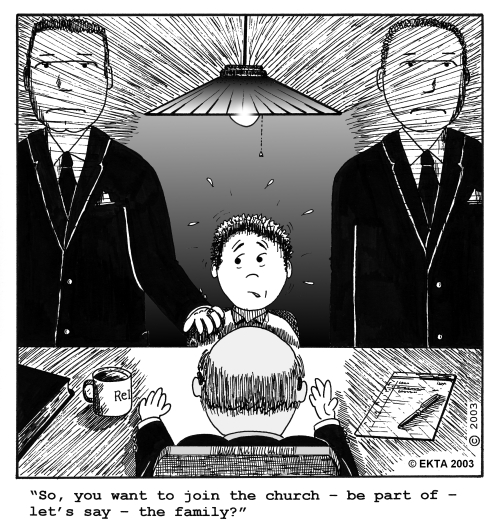
‘Many of the congregations that claim “We’re a family,” lose sight of larger transformative purposes and settle, instead, for the comfort and satisfaction of their members. The core purpose of a congregation – growing people of faith and helping people and communities move from despair to hope – gives way to lesser and even contrary purposes like keeping people happy. While it may not be a necessary outcome of the use of the family image, many congregations that gravitate towards it seem to make member comfort and satisfaction their de facto purpose.

That may be because “family” suggests to people something like, “We’re all loving and nice here.” That in turn often means no hard questions are asked and no honest challenges are allowed. It wouldn’t be nice.

I can think of other reasons to be cautious about “family” as our image for church. Families sometimes keep secrets that shouldn’t be kept in order to keep from bringing shame on the family name. And families aren’t typically that easy to join. Two of our sons were married in recent years. Turns out that putting families together is a fairly complex dance.

One last issue. The use of the term “family,” may communicate to people who are not married or to the married without children that they don’t quite fit. “Our church is a family,” morphs into “our church is for families.”

Keeping the family members happy, having everyone know everyone else and get along like “a happy family,” isn’t really the point for Christian congregations. Their goal and purpose is both different and higher.

Perhaps other biblical images like “People of God,” “Creation of the Holy Spirit,” or “Body of Christ” are better ecclesiological images? It’s not that these images don’t also have potential pitfalls. It is the case, however, that unlike “family” they are uncommon enough that people seldom have their own set ideas about what they mean. In some congregations, I hear leaders address the congregation simply as “church.” That too seems promising, reminding the gathered community that they are the Church of Jesus Christ (and the building is not).

If we must use “family,” we should be aware of the way that Jesus, while using “family,” also subverts conventional understandings of family and challenges their usual boundaries with a thoroughly new vision of “family.”’

Picking up some Hauerwas for Lent

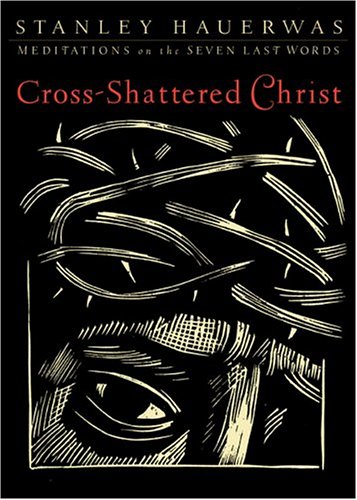
There’s one wee book of Hauerwas’ that I purchased during the past year and never got around to reading, namely Cross-Shattered Christ: Meditations on the Seven Last Words (Brazos Press, 2004). Lent seemed like the right time to dig in. So I found me a quiet moment tonight and read it. Here’s a few passages that I sat with for a while:

‘Everyday death always threatens the everyday, but we depend on our death-denying routines to return life to normality’. (p. 26)

On Luke 23:43: ‘What does it mean to say these are criminals?’ (p. 38)

Citing Rowan Williams: ‘God is in the connections we cannot make’. (p. 39)

‘Our attempt to speak confidently of God in the face of modern skepticism, a skepticism we suspect also grips our lives as Christians, betrays a certainty inappropriate for a people who worship a crucified God’. (p. 40)

‘Our salvation is no more or no less than being made part of God’s body, God’s enfleshed memory, so that the world may know that we are redeemed from our fevered and desperate desire to insure we will not be forgotten’. (p. 44)

‘In spite of the current presumption that Christianity is important for no other reasin than that Christians are pro-family people, it must be admitted that none of the Gospels portray Jesus as family-friendly’. (p. 50)

‘Jesus’s being handed over, Jesus’s obedience even to the point of death, Jesus’s cry of abandonment makes no sense if this is not the outworking of the mystery called Trinity. This is not God becoming what God was not, but rather here we witness what God has always been … The cross, this cry of abandonment, is not God becoming something other than God, is not an act of divine self-alienation; instead this is the very character of God’s kenosis – complete self-emptying made possible by perfect love’. (pp. 62–3)

‘This is not a dumb show that some abstract idea of god appears to go through to demonstrate that he or she really has our best interest at heart. No, this is the Father’s deliberately giving his Christ over to a deadly destiny so that our destiny would not be determined by death’. (p. 63)

‘We try … to compliment God by saying that God is transcendent, but ironically our very notion of transcendence can make God a creature after our own hearts. Our idea of God, our assumption that God must possess the sovereign power to make everything turn out all right for us, at least in the long run, is revealed by Jesus’s cry of abandonment to be the idolatry it is … In truth we stand with Pilate. We do not want to give up our understanding of God. We do not want Jesus to be abandoned because we do not want to acknowledge that the one who abandons and is abandoned is God. We seek to “explain” these words of dereliction, to save and protect God from making a fool out of being God, but our attempts to protect God reveal how frightening we find a God who refuses to save us by violence’. (pp. 64–5)

‘If God is not in Mary’s belly, we are not saved’. (p. 76)

‘”It is finished” is not a death gurgle. “It is finished” is not “I am done for.” “It is finished” will not be, as we know from the tradition of the ordering of these words from the cross, the last words of Jesus. “It is finished is a cry of victory. “It is finished” is the triumphant cry that what I came to do has been done. All is accomplished, completed, fulfilled work. The work that is finished, moreover, is the cross. He will be and is resurrected, but the resurrected One remains the One crucified. Rowan Williams reminds us of Pascal’s stark remark that “Jesus will be in agony until the end of the world.” This is a remark that makes unavoidable the recognition that we live in the time between the times – the kingdom is begun in Christ but will not be consummated or perfected until the end of the world. Williams observes that Pascal’s comment on Jesus’s on-going agony is not an observation about the deplorable state of unbelievers; it is instead an exhortation to us, those who believe in Christ. It is an exhortation not to become nostalgic for a supposedly lets compromised past or take refuge in some imagined purified future, but to dwell in the tension-filled time between times, to remain awake to our inability “to stay in the almost unbearable present moment where Jesus is.”‘ (pp. 83–4)

‘We are told in John 1:18 that without the Son no one can see the Father. Von Balthasar, therefore, reminds us “when the Son, the Word of the Father is dead, then no one can see God, hear of him or attain him. And this day exists, when the Son is dead, and the Father, accordingly, inaccessible.” This is the terror, the silence of the Father, to which Jesus has committed himself, this is why he cried the cry of abandonment. He has commended himself to the Father so he might for us undergo the dark night of death. Jesus commends himself to the Father, becoming for us all that is contrary to God. Christ suffers by becoming the “No” that the salvation wrought by his life creates. Without Christ there could be no hell – no abandonment by God – but the very hell created by Christ cannot overwhelm the love he has for us’. (p. 97)

‘Christ had no Christ to imitate’. (p. 99)

Two worthwhile pieces on ministry

1. Kate Murphy reflects on whether youth ministry is killing the church:

‘when our children and youth ministries ghettoize young people, we run the risk of losing them after high school graduation … I think I’ve done youth ministry with integrity. But I may have been unintentionally disconnecting kids from the larger body of Christ. The young people at my current congregation—a church that many families would never join because “it doesn’t have anything for youth”—are far more likely to remain connected to the faith and become active church members as adults, because that’s what they already are and always have been’.

2. Joseph Small (who is no stranger to this blog) on why ‘clergy’ and ‘laity’ ought be dropped from all Presbyterian usage:

‘Clergy and laity are two words that should never escape the lips of Presbyterians … Ministry within the church needs to be the responsibility of all the leaders — deacons, elders and pastors … Deacons, Small noted, have too often been relegated to serving coffee on Sunday and sending flowers to shut-ins … Elders “have become the board of directors of a small community service organization.” And … “What happened to ministers? They became clergy,” and clergy have ’emerged as the power in the church.” The divided role of ordained leadership in the church needs to change … and the walls between ordained offices torn down. Deacons are called to “leading the whole church in the ministry of compassion and justice … Elders should ‘share equally in the administration of the ministry of word and sacrament,” … [and] the “primary role” of ministers should be that of “teacher of the faith.”

Small said he favors use of the terms “teaching elders” and “ruling elders.” But … “ruling does not mean governing.” The correct meaning … “is rule like a measuring stick.” Ruling elders measure the congregation’s “fidelity to the gospel” and the “spiritual health of the congregation.” Small called ordained leaders in the church to be “genuine colleagues in ministry.”

Without collegial ministry, he said, the position of pastor becomes one of a lonely leader. He described the history of ministers in the United States as one of accumulated roles, where responsibilities always have been added but never withdrawn. Beginning on the frontier, Small said, pastors were called to be revivalists to “inspire and uplift.” When small towns grew on the prairie, the ministers were still expected to “know more about the faith,” but in addition to being inspirational preachers, ministers were expected to be community builders. As small towns grew into cities, ministers, he said, were expected to also be therapists, who helped those in the congregation “cope” with new stress.

As cities grew, ministers became “managers of an increasingly complex social organization called the church,” and today a pastor is expected to be a entrepreneur and innovator. “It’s just one more layer added on …’.

Richard Lischer’s Open Secrets: Part IX, On Lutherans

We’ll make this the final post on Lischer’s, Open Secrets. Fittingly, it’s on Lutherans:

‘Lutherans fill their vacancies more deliberately than any of the churches in Christendom. Vacant congregations go months without thinking about choosing a new leader, and pastors, once they have received a call, may sit on it for additional months before hatching a decision. The time isn’t used for negotiating more favorable terms; it is simply filled with prayer and dormancy. The President-elect of the United States names a Cabinet faster than the smallest Lutheran congregation picks a pastor, because Lutherans consider the latter process far more important. All is left to prayer and the brooding of the Spirit, and everyone knows the Spirit always works slowly’. – Richard Lischer, Open Secrets: A Memoir of Faith and Discovery, 220.

Here’s a list of the earlier posts:

A Script to Live (and to Die) By: 19 Theses by Walter Brueggemann

These 19 theses by Walter Brueggemann are the most interesting thing I’ve read all day [to be sure, it’s been a bit of an admin marathon today], an encouraging invitation to those of us striving to live by, and to train others to live by, what Brueggemann calls ‘the alternative script’:

1.        Everybody lives by a script. The script may be implicit or explicit. It may be recognised or unrecognised, but everybody has a script.

2.        We get scripted. All of us get scripted through the process of nurture and formation and socialisation, and it happens to us without our knowing it.

3.         The dominant scripting in our society is a script of technological, therapeutic, consumer militarism that socialises us all, liberal and conservative.

4.        That script (technological, therapeutic, consumer militarism) enacted through advertising and propaganda and ideology, especially on the liturgies of television, promises to make us safe and to make us happy.

5.        That script has failed. That script of military consumerism cannot make us safe and it cannot make us happy. We may be the unhappiest society in the world.

6.        Health for our society depends upon disengagement from and relinquishment of that script of military consumerism. This is a disengagement and relinquishment that we mostly resist and about which we are profoundly ambiguous.

7.        It is the task of ministry to de-script that script among us. That is, to enable persons to relinquish a world that no longer exists and indeed never did exist.

8.        The task of descripting, relinquishment and disengagement is accomplished by a steady, patient, intentional articulation of an alternative script that we say can make us happy and make us safe.

9.        The alternative script is rooted in the Bible and is enacted through the tradition of the Church. It is an offer of a counter-narrative, counter to the script of technological, therapeutic, consumer militarism.

10.    That alternative script has as its most distinctive feature – its key character – the God of the Bible whom we name as Father, Son, and Spirit.

11.    That script is not monolithic, one dimensional or seamless. It is ragged and disjunctive and incoherent. Partly it is ragged and disjunctive and incoherent because it has been crafted over time by many committees. But it is also ragged and disjunctive and incoherent because the key character is illusive and irascible in freedom and in sovereignty and in hiddenness, and, I’m embarrassed to say, in violence – [a] huge problem for us.

12.    The ragged, disjunctive, and incoherent quality of the counter-script to which we testify cannot be smoothed or made seamless because when we do that the script gets flattened and domesticated and it becomes a weak echo of the dominant script of technological, consumer militarism. Whereas the dominant script of technological, consumer militarism is all about certitude, privilege, and entitlement this counter-script is not about certitude, privilege, and entitlement. Thus care must be taken to let this script be what it is, which entails letting God be God’s irascible self.

13.    The ragged, disjunctive character of the counter-script to which we testify invites its adherents to quarrel among themselves – liberals and conservatives – in ways that detract from the main claims of the script and so to debilitate the focus of the script.

14.    The entry point into the counter-script is baptism. Whereby we say in the old liturgies, “do you renounce the dominant script?

15.    The nurture, formation, and socialisation into the counter-script with this illusive, irascible character is the work of ministry. We do that work of nurture, formation, and socialisation by the practices of preaching, liturgy, education, social action, spirituality, and neighbouring of all kinds.

16.    Most of us are ambiguous about the script; those with whom we minister and I dare say, those of us who minister. Most of us are not at the deepest places wanting to choose between the dominant script and the counter-script. Most of us in the deep places are vacillating and mumbling in ambivalence.

17.    This ambivalence between scripts is precisely the primary venue for the Spirit, so that ministry is to name and enhance the ambivalence that liberals and conservatives have in common that puts people in crisis and consequently that invokes resistance and hostility.

18.    Ministry is to manage that ambivalence that is crucially present among liberals and conservatives in generative faithful ways in order to permit relinquishment of [the] old script and embrace of the new script.

19.    The work of ministry is crucial and pivotal and indispensable in our society precisely because there is no one except the church and the synagogue to name and evoke the ambivalence and to manage a way through it. I think often I see the mundane day-to-day stuff ministers have to do and I think, my God, what would happen if you took all the ministers out. The role of ministry then is as urgent as it is wondrous and difficult.

[These theses were presented at the Emergent Theological Conversation, September 13-15, 2004, All Souls Fellowship, Decatur, GA., USA]

Richard Lischer’s Open Secrets: Part VIII, On Abortion

‘The Supreme Court’s decision in Roe v. Wade meant that country girls like Leeta or Teri or others like them, who found themselves “in trouble,” would have the option of privatizing their problem by removing the stigma of an unwanted pregnancy from the eyes of the congregation. It wouldn’t be necessary for the community to promise to help raise the child. The church would not have the opportunity to offer the hospitality of Jesus to a scared teenager and her family. Nor would it have a chance to fail to do so, as it had sometimes done in the past. No one would know. It was none of the community’s business’. – Richard Lischer, Open Secrets: A Memoir of Faith and Discovery, 208–9.

Richard Lischer’s Open Secrets: Part VII, On the Church Calendar

‘The Protestant church was already in the process of discarding the named Sundays of Lent and Easter even as we blessed and planted the seeds. Now they bear the evocative names “The First Sunday in Lent,” “the Second Sunday in Lent,” and so on. The fourth Sunday in Lent was once named Laetare, which means “rejoice.” It was known in the church as Refreshment Sunday. On this Sunday rose paraments replaced the traditional purple of Lent, and, psychologically and spiritually, we breathed a little easier. The color rose seemed to say, There’s light at the end of the tunnel. Even at the dead center of Lent, Christ is risen.

The Protestant church got rid of Laetare as well as Rogate and many of the other days for reasons I have never fully understood. It created a bland church calendar and liturgies du jour in the image of people who have been abstracted from place and history, who have no feel for the symbols and no memory of the stories. They live, work, and worship in climate-controlled buildings. They have largely adopted a digitalized language. Their daily routines override the natural rhythms and longings of life.

I can only say that the Latin words were not too much for my high school dropouts. The simple outline of church history didn’t overtax their imaginations. The liturgy and church year made sense to the farmers in New Cana, for who better than a farmer understands the circularities of life? The church year had a rhythm, and so did their lives.

Some would argue that the observance of Rogate arose in an agricultural world and is, therefore, irrelevant to all but the 1.7 percent of Americans who still live on farms. But my congregation understood the metaphor that underlay Rogate, which is this: When we do any kind of useful work, we join the act of creation in progress and help God keep the universe humming’. – Richard Lischer, Open Secrets: A Memoir of Faith and Discovery, 144–5.

The Body of Christ

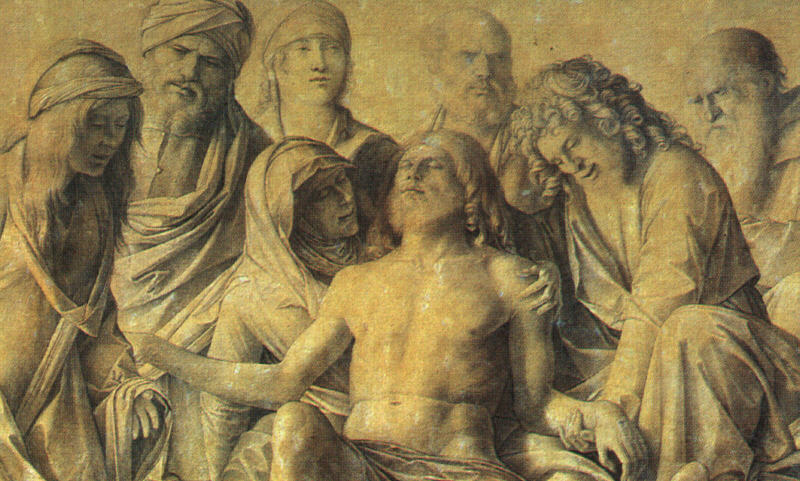
Giovanni Bellini, 'The Lamentation over the Body of Christ', c.1500

‘The church likes to refer to itself as the “Body of Christ”. But it behaves as if it thought it could be the Body of Christ painlessly, as if it could be the Body without having to be stretched, almost torn apart, as if it could be the Body of Christ without having to carry its own cross, without having to hang up on that cross in the agony of conflict. In thinking that it could be thus painlessly the church has made a lie out of the expression the “Body of Christ”’. – M. Scott Peck, The Different Drum: Community-Making and Peace (London: Rider & Co., 1987), 300.