Book Review

There he goes, tacking against the fields’ uneasy tides …

[Image: Members of the staff of the Bank of New Zealand, on Lambton and Customhouse Quays, Wellington, gather around the first electronic book-keeping machine installed in the bank, 1960. HT: National Library of New Zealand]

‘The bodice of my new costume caught on the handlebar …’

Theosis in the Theology of Thomas Torrance: A Review

A Review of Myk Habets, Theosis in the Theology of Thomas Torrance (Ashgate New Critical Thinking in Religion, Theology and Biblical Studies; Surrey: Ashgate, 2009), x + 212 pp. ISBN 978-0-7546-6799-5; EISBN: 978-0-7546-9407-6

This book represents the published version of Myk Habets’ PhD dissertation recently completed at the University of Otago under the supervision of Ivor Davidson. In the Introduction, Habets offers a brief outline of the history of the doctrine of theosis (or “divinisation” or “deification”) in both the Eastern Church (represented by Pseudo-Dionysius, Maximus the Confessor, John of Damascus, Symeon the New Theologian, Nicholas Cabasilas and Gregory Palamas) and in that of the West (here he considers Augustine, Aquinas, the Finnish School of Luther interpretation, John Calvin – in whose thought the notion of theosis finds its voice in the grammar of “union with Christ” – the Oxford Movement, the Wesleys and modern Pentecostalism). He suggests that T.F. Torrance functions as something of a mediating theologian insofar as his soteriology betrays a “creative continuity” (8) with both Eastern and Western notions of atonement and gathers them around “the controlling metaphor of theosis” (ix).

Through an examination of Torrance’s doctrines of creation, anthropology, incarnation, reconciliation and spirit-ecclesiology, Habets identifies that while theosis is not the central point of Torrancean soteriology, and that “direct references to theosis within Torrance’s work are relatively few” (14), (Torrance prefers to employ the grammar of “union,” “communion,” “participation,” “atoning exchange,” etc.), “it is a necessarily crucial integrating theme within his overall theological oeuvre” (16). Habets’ study examines these themes in their theological contexts and concludes that “what emerges is a complex but coherent Torrancean doctrine of theosis,” albeit one which raises “critical questions, deficiencies, and indications for further study” (15–16).

Chapter One explores Torrance’s claim in The Christian Doctrine of God that creation is “proleptically conditioned by redemption,” that from the beginning creation’s telos is both revealed and actualised in the incarnation. With striking clarity, Habets outlines the mutual history that creation and redemption share, a history which is brought together in a creative synthesis in Torrance’s doctrine of theosis. This work of theosis is the purpose of Holy Love’s gracious determination to not live for himself alone but to bring into being an-other, namely creation, which might share, in Torrance’s words, “the Communion of Love” which constitutes the Triune life. This, Torrance insists in the aforementioned book, is the “secret of the creation, hidden from the ages” but has now in Christ “become disclosed to us” (218), secured in the act of God’s incarnation, and fruited in the human experience of redemption which comes as the gift of the Holy Spirit. Habets contends that while “Christ is central to creation as a whole, [and] not simply to humanity” (27), humanity is given “the function and privilege” to assist creation to both “realise and evidence its rational order and beauty and thus to express God” and to “realise its priestly vocation, in order to bring forth the requisite praise that God deserves” (45).

In Chapter Two, Habets attends to the core of Torrance’s theology – Jesus Christ – and he outlines the redemptive nature of the Incarnation and how, for Torrance, Christ’s entire life concerns the work of divinisation. Rehearsing the central motifs in Torrance’s christology (namely, the retrospective/prospective aspects of the atonement, the homoousion, the vicarious humanity, mediation, and ascension of Christ, etc.), Habets recalls Torrance’s indebtment to the Greek Fathers in “constructing a doctrine of theosis around two distinct but interrelated movements” that take place in the hypostatic union (a doctrine with significant epistemological currency in Torrance’s thought), namely the “divinising” of the human nature of the Logos and the subsequent application of this to the human subject in “deification” (55). So Habets: “In the person of Jesus Christ we see true humanity partaking of true Divinity by nature in such a way that by union, communion, and theosis with Christ by the Spirit we too, by grace, can participate in the divine nature” (62). The ultimate achievement of this divinising action is reached in the ascension of the Son: “As a man, Jesus Christ has perfect fellowship with God, and because of the eternity of the hypostatic union, the one person of the Son is in the ‘place’ (topos) and ‘space’ (chora) of humanity in and with God” (89). While otherwise sympathetic to Torrance’s theology, Habets charges Torrance with a “lack of detailed attention to actual historical life of Christ” (83), with misrepresenting patristic sources, with embracing a form of divine passibility which leaves his christology too ambiguous at points (see 84–7), and, more substantially, with a deficient and underdeveloped pneumatology, particularly that as concerns the bond of union in Christ’s theandric nature. On the latter, Habets contends that Torrance’s over-correction of Edward Irving’s apparent Ebionite christology leads to Torrance going “too far in the direction of Alexandrian christology” (74) and so under-emphasising the atoning work of the Spirit in Christ’s life.

Habets turns, in Chapter Three, to examine the dynamics of how believers are brought into relationship with God. He properly highlights Torrance’s indebtment to Calvin (and to Barth) and argues that the Church’s doctrines of theosis are compatible with Reformed theology’s understanding of participation. In many ways, the discussion on union with Christ (97–115) takes us to the very heart of the Reformed account of the doctrine of theosis that Torrance represents. This informs Habets’ thesis that theosis functions as a “controlling metaphor that gives coherence to the disparate themes of Torrance’s soteriology” (94). Some readers may feel that Habets has overplayed his hand in proposing that the doctrine of union with Christ is determined by a deeper and distinct-though-related doctrine of theosis within Torrance’s theology; others, that Habets has not made his case, or that he remains too uncritical of the character of theosis that Torrance outlines and whether it remains too incompatible with the Reformed ontology with which Torrance otherwise operates. Habets is not unaware of these criticisms, however, and devotes some ink to wrestling with them. Throughout, Habets consistently avers that the hypostatic union means that humanity’s centre and God’s coincide, that in Christ the Triune God and humanity dwell in each other in mutual personal satisfaction in such a way that humanity is gathered up into the space of the triune community but without loss of creaturely status, nor blurring of the Creator–creature distinctives.

Pneumatology and ecclesiology are the subjects of Chapter Four, “Community and Communion.” Here Habets, in the most constructive of the book’s chapters, argues for the indispensability of an adequate pneumatology (which is “perhaps the least examined aspect of Torrance’s theology” (140)) for a doctrine of theosis as “it is here that the reality of the believer’s participation in the divine nature emerges” (139). He notes that the same Holy Spirit who equips and enables the incarnate Son to offer the “wonderful exchange” for us is also the “bond of love who unites believers to the incarnate Son and enables them to be drawn into the life of God” as well as “the bond of communion who constitutes the church as the locus of theosis” (139; cf. 168–70). Habets (tentatively) agrees with Jason Yeung’s assessment (in Being and Knowing: An Examination of T.F. Torrance’s Christological Science) that while Torrance is right to never isolate pneumatology from christology, Torrance’s pneumatology remains under-developed. Moreover, Habets charges that Torrance’s robust emphasis on the objective elements of soteriology are not matched by corresponding subjective aspects. He recalls the gracious action of God who in/by/with the Spirit unites the Church to the response, obedience, faith and worship of Jesus, and raises that communion up in Christ to participate in heaven’s worship and in the eternal communion of the triune family. Put short, “theosis is worship from beginning to end, for it is an active participation in Jesus Christ made possible by the Spirit” (192). The “central ecclesial acts” in which “theosis occurs” (170), Habets notes of Torrance’s thought, is in Baptism and Eucharist. “Participation in the sacraments is … the path to participation in the divine nature, a mystery of the faith that unites the believer to Christ by the Spirit” (184). Baptism functions as “the liturgical mediation of forgiveness” (176), as the event through which believers participate in the incarnate Son’s theopoiesis, and as that action which “inaugurates theosis in the believer” (178). Habets understands that the Eucharist, like Baptism, is a mediating rather than a constitutive form of God’s saving action. Moreover, it is a form in which Christ’s real presence reflects the hypostatic movement evident in the incarnation and in Christ’s priestly work. In answering the question “How close is the union that believers have with God in theosis by means of the Eucharist?”, Habets recalls Torrance’s claim that “No union, save that of the Persons of the Holy Trinity, could be closer, without passing into absolute identity, than that between Christ and His Church as enacted in the Holy Eucharist” (182).

The book’s conclusion draws together and recapitulates the main themes of the study before naming some concerns that the author has about some details of his subject’s theology, evidencing that Habets is a grateful though not uncritical reader of Torrance. Habets remains unconvinced, for example, of Torrance’s insistence that Christ assumed fallen human nature, that Torrance has done enough to articulate the compatibility between the model of theosis he is proposing and a Reformed doctrine of justification by faith, and that Torrance’s theology of unio mystica is pneumatalogically sufficient in those areas where the concern presses beyond epistemology. Moreover, Habets believes that Torrance’s theology of theosis, while compatible with the Church’s teaching and with contemporary scholarship, requires additional maturity, sophistication and some “specific discussion beyond that which he provides of what theosis ‘looks like’ in everyday life” (189).

While the book could do with an additional proofread and edit (there are a number of typographical and grammatical errors, particularly in the footnotes), it joins work by Colyer, McGrath, Dawson and Molnar as an insightful and clear introduction to Torrance’s extensive oeuvre, and makes a real contribution to ongoing conversations about the shape and location that the Christian doctrine of theosis assumes in systematic and ecumenical theology, and in theological anthropology.

[An edited version of this review is to appear in Colloquium in due course]

John Knox: An Introduction to His Life and Works: a wee review

Richard G. Kyle and Dale W. Johnson, John Knox: An Introduction to His Life and Works (Eugene: Wipf & Stock, 2009). xi + 208 pages. ISBN: 978-1606080900. Review copy courtesy of Wipf and Stock.

This volume, co-penned by two scholars well published on the book’s subject, traces the life and thought of John Knox. It does so not via an attempt at what we might call ‘straight biography’ but rather through a chronological examination and interpretation of his writings. The interpretation of Knox offered here is sympathetic but fair, helpfully introduces some secondary literature on Knox, avoids an over-romanticised reading of the preacher whom Stewart Lamont described as ‘a cross between Ian Paisley and the Ayatollah Khomeini’, and avoids the temptation succumbed to by many contemporaries biographers of judging too harshly the personalities of the past against the values of the present.

A very accessible and (apart from some editorial oversights and typos, for e.g., an incomplete bibliography, and who is T.F. ‘Torrence’?, on p. 21) well-researched introduction to a complicated yet decisive period in Scottish history, and that via the life and thought of one of its great saints. John Knox: An Introduction to His Life and Works is an easy book to commend, and those looking for a genuine entrée on the life and thought of a volcanic prophet with ‘the courage of a lion’ could do little better. Those hungry enough to also want a main course would be well served in the devouring of John Knox by Rosalind K. Marshall too.

Changing the Conversation: A Third Way for Congregations: A Review

Anthony B. Robinson, Changing the Conversation: A Third Way for Congregations (Grand Rapids/Cambridge: Wm. B. Eerdmans, 2008), 199 pp; ISBN 978-0-8028-0759-5.

Changing the Conversation is a sequel to Anthony Robinson‘s most recent books Transforming Congregational Culture (2003) and What’s Theology Got to Do with It? Convictions, Vitality, and the Church (2006). It builds upon and complements work done by Diana Butler Bass, Darrell Guder, Michael Foss, Barbara Brown Taylor, Brian McLaren and others in their quest for the Church to find ‘a third way’ of being that moves beyond stereotyped polarities all-too-typical of its life and seeks a redefinition from a new centre which finds its pulse in its defining narrative – that is, in the divine economy. Robinson invites congregations to walk upon a way paved by the rediscovery of fresh language (which includes a rediscovery of ‘older words and concepts of the living tradition of our faith’ (p. 2)), the development of new conceptual frameworks, the formulation of new agendas and imaginings for being and doing church, and the fostering of new ways of framing both internal and external challenges and relations.

Robinson (who has served as an ordained Minister of the United Church of Christ and has remained in touch with the realities of congregational life), understands that change is an inevitable and indispensable part of congregational life, that good leaders know and embrace this, and that a significant part of healthy change involves ceasing the typically dead-end conversations that congregations engage in, embracing reality accurately, and framing the challenges adequately. Drawing upon Ron Heifetz’s distinction between technical problems and adaptive challenges, and rehearsing Peter Drucker’s two simple questions – ‘What business are you in?’ and ‘How’s business?’ – this book identifies and is shaped around ten conversations that Robinson believes are requisite in order to initiate, deepen, sustain and grow congregational and denominational life.

The opening chapter is concerned to map in broad outline some of the important historical and cultural shifts that have shaped, and been shaped by, the Church’s baptism of and in Christendom, and how the emergence of a post-Christendom North America is impacting historically mainline Protestant congregations and their ministry from one of chaplaincy to one of mission. One feature of Church that he believes will need to undergo a significant shift in both conceptuality and praxis concerns the role of pastors: ‘Instead of being chaplains to church and community, they will be congregational leaders and spiritual directors. They will not do most or all of their ministry on behalf of the larger church. They will support that ministry through preaching and teaching, mentoring and guiding’ (p. 29).

William Stringfellow once observed, ‘These are harsh days for Protestants in America. American Protestants suffer the pathetic anxieties of a people once ascendant and reigning, but now defensive and in retreat’. How congregations might respond creatively (and in ways that move beyond lament and complaint, bewilderment and apathy) to the challenges and opportunities of this post-Christendom situation is the subject of Chapter Two. Rather than denying or bemoaning the sea change, Robinson asks if congregations might find a way to discern God at work among them and to respond by birthing new and more productive conversations and hopeful, engaged responses. He reminds us that ‘the word “Protestant” does not mean perpetual protest’ but rather derives from pro (‘for’) and testari (‘to testify). So, he asks, ‘what testimony do we offer about God and about God’s work in our midst?’ (p. 44).

The third conversation, ‘A New Heart’, is an invitation to think about how the renewal of hearts and minds is at the centre of mainline Protestant congregations, is not reducible to a formula or recipe, and is always more important than any technique or program.

In Chapter Four, Robinson turns to the issue of leadership, arguing that the work of leadership in the post-Christendom period is to assist congregations to face their own most important challenges and make progress on them. He defines pastoral leadership as ‘mobilizing a congregation … to engage its own most pressing problems and deepest challenges’ (p. 84). Part of the task of leadership (not necessarily of the ‘ordained’) is to read the context and congregation, to name and describe the challenges accurately, and to ‘remind a congregation (or other group) of its theologically and biblically informed purpose and core values. In other words, leadership should keep before the congregation the issues of “who are we?” (core values) and “why are we here?” (purpose)’ (pp. 85–6). Robinson observes that many congregations suffer a ‘leadership vacuum’, that instead of pastoral leaders and governing boards, they have chaplains and a group that is either ‘listening to endless reports or trying to micro-manage the operational administration of the congregation. The future’, he continues, ‘belongs to congregations that call and empower pastors who are leaders, and then also call and prepare governing boards that provide effective policy direction and leadership’ (p. 96).

This directly raises the question of purpose, which is the concern of Chapter Five. The ‘Why are we here?’ question is, according to Robinson, always the most important question to begin with. He avers that congregations need reasonable clarity about their core purpose if they are to foster any new vitality and to shift, as Foss believes, from ‘a culture of membership to a culture of discipleship’ (p. 101). In making the important distinction between purpose and vision, Robinson, following C. Kirk Hadaway, contends that purpose is more important than vision, the former both precedes and shapes the latter: ‘Without a fairly clear sense of purpose, congregations can get caught up in the game of cultural catch-up or what’s newest and latest’ (p. 105).

Robinson continues to labour this distinction and its logic of priority in chapters six to eight, drawing upon Heifetz’s notions on ‘adaptive challenges’. In Chapter Six, the concern is to explore the relationship between vision and purpose, on how congregations move from naming their raison d’être, to identifying the key challenges and then authoring a vision statement or strategic plan that serves their ministry. One vital emphasis here is that the work of the congregation does not fall to experts or authorities, nor to the pastor, or a consultant, or a small group designated to solve their problems for them. Rather, Robinson insists that ‘it is the people with the problem themselves, the people facing the challenge, who do the work. If the work is “discovering again God’s purpose (mission) for our church,” we can’t simply assign that to a mission committee’ (p. 122). While he acknowledges that most congregations face a combination of technical problems and adaptive challenges, to the extent that they understand those challenges as technical problems only, they will fail. Moreover, they would have ‘missed important, God-given opportunities to experience new hearts and minds’ (p. 123).

In some ways Chapter Seven represents the book’s thesis most clearly: that the governance and organisation that many congregations are working with are outmoded and incompetent because designed for, and assuming of, a Christendom rapidly passing away. Here’s his basic point:

Underlying the Christendom-era structures of church life are two notions: (1) the best way to involve people in Christian life and church participation is to get them serving on a board or committee of the church; and (2) the job of laity is to manage the church. If your church assumes that the best way to involve people in Christian life and the church is to get them on a board or committee, there’s a good chance that your congregation will have a lot of boards and committees to accommodate them. The result is often structures that are either Byzantine in complexity or Catch-22-like in absurdity. The second unhelpful assumption is that the really important job of lay Christians is to manage the church, its buildings, finances, property, and personnel. This effectively takes the team off the playing field and gives it the task of managing the clubhouse. Instead of inviting people to do ministry, current systems invite them to manage the ministry. You put these two assumptions together and let the whole thing settle for some decades, and the result would make for a good Monty Python skit … Could it be that the real job of dedicated Christians is not to manage the work of the ordained or the operational administration of the church facility, but to represent Christ to the world? I suspect that many would affirm this in theory, yet our church structures tend not to support the theory (pp. 137–8, 140).

The eighth conversation attends to another arena of adaptive work facing mainline congregations; namely, public theology. It asks what shape and what voice the Church might embody in the public square in an age of redefined relations. ‘Death and Resurrection’ is the title of Chapter Nine. Here Robinson suggests that while, for some situations, congregational renewal is possible, sometimes a death – or something that looks and feels very much like death – is required before a resurrection is possible. The final conversation is a bit of a ‘Where to from now?’ chapter.

Changing the Conversation will be read with profit by denominational staff, seminarians studying congregational life, and leaders of congregations. It offers a clear vocalization of some important theses and synthesises some valuable material on mission and vision. That said, some readers will want to question whether Robinson himself offers a decisive enough severing from the Christendom mindset that he is so properly concerned about. At the very least, the book’s pages frequently require some translation from a North American congregational context into other local dialects. Finally, how one assesses this book depends largely on whether one is seeking a handbook of tools or nutrition for a renewing of ecclesiological imagination. While there are indications that Robinson is seeking to offer both, it is more of the former rather than the latter that is to be found in this book.

The Joy of Teaching

Harry Hazel, The Joy of Teaching: Effective Strategies for the Classroom (Eugene: Pickwick Publications, 2010). xii + 158 pages. ISBN: 978-1-60608-613-1. Review copy courtesy of Wipf and Stock.

Since I read Ken Bain’s book What the Best College Teachers Do, I’ve tried to keep abreast with books on teaching, books which seek to hold up before me the teacher’s task and to encourage me to attend to its craft. Recently, I read The Joy of Teaching: Effective Strategies for the Classroom by Harry Hazel, Professor of Communication Arts at Gonzaga University and author of Art of Talking to Yourself and Others and The Power of Persuasion, and co-author of Communicating Effectively: Linking Thought and Expression.

In researching for this book, Hazel collected reactions from over one hundred North American teachers about why they like what they do. Most emphasised the joy of helping students learn and seeing those students develop their potential: ‘Good teachers challenge, cajole, prod, push and move each student as far as they can’ (p. 5). Hazel observes that while good teachers ‘give away’ knowledge, those who find little joy in giving to others will find little joy in teaching. Moreover, great teachers exhibit a passion for their profession which leaves no doubt that they enjoy, at a deep level, what they were doing. They hold learning in high esteem and are committed to ongoing formation and to professional development.

He shares a number of other findings:

  • excellence in teaching has more to do with an exceptional grasp of the material and clear communication techniques than with popularity.
  • the best teachers demand much of their students.
  • good teachers take time to find out how students in a class learn best, and then adapt. Like Bain, Hazel too notes that there is all the difference in the world whether we are teaching a subject to students or teaching students a subject, and that effective teachers will employ whatever method they believe will best develop an individual student.
  • good teachers respect and love their students: ‘It may seem obvious that liking students is a prerequisite to liking education, but some teachers don’t really like most of their students. They tolerate them because they have to. Once the class is over, they have little contact with them. Happy teachers, on the other hand, really like the students they encounter’ (p. 133).

Against Gerald Goldhaber’s prophecy (in Organizational Communication) on the death of the lecture, Hazel draws upon Plato, Aristotle and Joseph Lowman’s work in Mastering the Techniques of Teaching to defend the use of ‘what can be an excellent teaching tool’:

Properly delivered, a lecture lights up a room. If a teacher is well organized, presents her ideas clearly and sprinkles theory with riveting examples, she has a good chance of keeping the attention of her students. But if she speaks in a monotone, wanders all over her subject and hovers in the clouds of abstraction, most of her students will tune out. The bland lecture competes with the Quaalude as a way to induce sleep. (p. 37)

While some will find The Joy of Teaching a little anecdote-heavy (a sad trend, it seems, in much recent North American literature), and few engaged with adult-education will find much here that inspires, the book will certainly be read with profit by secondary school teachers and by those who care about what is happening in our high schools.

Incarnation Anyway: Arguments for Supralapsarian Christology: A Review

Incarnation Anyway: Arguments for Supralapsarian Christology, by Edwin Christian van Driel. Pp. xii + 194. Oxford: Oxford University Press, 2008, ISBN 978 0 19 536916 8. £45.

It was the brilliant John Duns Scotus who recalled that ‘God is not in a genus’ (Deus non est in aliquo genere), reminding us that our knowledge of God is impossible in any general sense. Indeed, Christian theology is premised on belief in divine self-disclosure and, moreover, that such disclosure is an act of grace. Duns Scotus also supposed that creation’s purpose and destiny concerns ‘co-lovers’ participating in the Triune life. It was for such that the Word of God became flesh, unveiling for us the causa finalis of our humanity. That this is God’s way for us – even if sin had not come into the human scene – bespeaks the inner meaning of the grace which precedes sin and testifies to the gospel logic of the incarnation.

Supralapsarianism, the subject of Edwin Chr. van Driel’s book Incarnation Anyway (a reworked version of his doctoral dissertation completed at Yale University), is a doctrine whose beginnings reach back at least as far as the twelfth century, even if van Driel’s treatment is concerned with its less hypothetically-speculative nineteenth- and early twentieth-century articulations. The first part of his essay (pp. 9–124) attempts to chart and examine the ways in which supralapsarian christology has been articulated. It does so via a consideration of three forms that the doctrine assumed in its nineteenth-century revival, namely in Friedrich Schleiermacher (‘the first major supralapsarian theologian since the Middle Ages’ (p. 9)), in Isaak August Dorner and in Karl Barth (on whom the most ink is spilt), attempting in each case to attend to the three ways in which God is thought to relate to God’s other – in redemption (Schleiermacher), in creation (Dorner), and in eschatological consummation (Barth). While there are occasions when readers may feel that van Driel constrains his subjects’ thought with a rigid logic foreign to their projects, in each case he attempts to expose the inner logic, coherence and strength of each articulation while not neglecting to draw attention to any weaknesses.

Van Driel argues that the conceptual structures of Schleiermacher’s supralapsarianism is determined both negatively and positively by the notion of absolute dependence and the inferred forms of divine omnipotence. He notes that, for Schleiermacher, sin is not excluded from the scope of divine causality – that God is the author of sin calls for a different locus for sin in the divine decree. God ordains sin in order to make humanity receptive to redemption. This move means that human sin acquires determining and logical priority over the incarnation. Indeed, van Driel outlines how in Schleiermacher’s schema, ‘sin and redemption are essential parts of our relationship to Christ. We need Christ because of our sin, and only because of our sin. If there were another reason why we relate to Christ, God would not have to introduce sin in the divine decree. We are connected to Christ only through his redemptive activity. There is no space for a meaningful relationship with Christ that is not marked by this’ (p. 25). And again: for Schleiermacher, ‘human beings will not be receptive to the divine gifts in Christ unless these gifts address an evil in their lives’ (p. 126). Under van Driel’s examination, the identified ‘fault lines’ in Schleiermacher’s ordo salutis (especially his sympathy with a felix culpa account) widen as the essay proceeds.

For Dorner, the incarnation is the necessary fruit of the divine decision to create ethical persons and of the divine determination that such become ‘full personalities’, a reality only possible in ‘interpersonal interaction with the ethical’ (p. 49). Dorner premises his arguments on the notion that God is a lover of love – the amor amoris – whose passion is to aggrandize the life of love in his other. This twofold surrender (of God to human beings, and of humans to God) is embodied in religion, the divine contribution to which is revelation, the consummation of which is the incarnation. For Dorner, the incarnation is a basic implication of God’s decision to create: ‘Decisive for whether one takes the incarnation to be means or end is what one takes to be the divine motivation behind it. For Dorner, the motivation for incarnation is embedded in the motivation for creation’ (pp. 59–60). This move, van Driel suggests, sponsors an unsatisfactory stepping stone in Dorner’s doctrine of creation and highlights what van Driel considers to be the most troubling and deep-lying ambiguity in Dorner’s supralapsarian christology. He continues:

In [Dorner’s] proposal, it is the necessity of God’s creative act that sets everything else in motion. God’s ethical necessity is expressed in the act of creation; given the nature of the ethical necessity, creation will be brought to consummation; given the same ethical necessity, this will be done by way of incarnation. None of this follows, though, when the act of creation is a contingent act. Of course, it could still be argued that God leads creation to consummation, and that the incarnation is central to consummation. In such a scenario, the governing divine act would not be given with God’s nature, but would be the result of a free act of God’s will. And if creation were embedded in God’s will rather than God’s nature, it would be better to start one’s theological account thereof not at the beginning but at the end of God’s work: What goal had God in mind when God freely called creation into being? What motivated God to create? Systematically this means that the argument for supralapsarian incarnation should not be embedded in the doctrine of creation but in eschatology. (p. 62)

With that note, van Driel turns to Barth’s ‘argument from consummation’, that requisite feature of Barth’s doctrine of election upon which van Driel will construct his own proposals. Van Driel observes how Barth’s supralapsarian christology takes its shape in his actualism. God’s election of Jesus Christ is primal in order, self-giving in nature, gracious in its motivation, creative in its effect, all-inclusive in its scope and supralapsarian in character, and the latter in a twofold sense – in terms of both predestination and christology: ‘Divine predestination is not a first step in a divine response to sin and neither is the incarnation … God’s election of Christ’s human nature is thus the first action in the divine relating to what is not God’ (pp. 67, 68). Again: ‘At the heart of Barth’s supralapsarianism lies … his reading of the biblical narrative as a narrative of election. Election is an eschatological category; and the eschaton is the first in order of the divine decrees. Object and subject of these decrees is Jesus Christ – not the Son as λóγος ασαρκος the preincarnate Word, but the Son as Jesus Christ, the incarnate Word. The incarnation stands thus at the very beginning of God’s relating to what is not God’ (p. 81). From here, van Driel turns to the question of the relationship between epistemology and sin: ‘That God unveils Godself by way of veiling is partly due to our sinfulness, but not wholly. The ontological and epistemic principles that govern divine revelation are not a result of sin, but given with the nature of Creator and creation. Incarnation, as the necessary means of divine self-disclosure, is therefore a supralapsarian event’ (p. 77).

Certainly Barth’s supralapsarian narrative recalls that creation forms the stage for covenant’s story – a story authored in the loving event called triune being, and whose meaning requires both soteriological and eschatological achievement – and that the creation which makes covenant possible does not exist for itself but for the gracious God upon whose will its future and being is contingent. However, according to his evaluation of Barth, van Driel identifies some adverse consequences of Barth’s account. He reserves most ink to attend to a concern regarding creational entropy, that ‘creation, in and by itself, will necessarily lapse into evil’ (p. 85) by ontological necessity. This elicits a helpful discussion by van Driel on time, eternity and history (pp. 111–17), and on the relationship between supralapsarianism and das Nichtige (pp. 118–24).

Building on Barth’s work (which van Driel finds to be the most satisfying of the three accents), van Driel turns in the second part (pp. 125–70) to expand on the notion of eschatological consummation, arguing that the logic of the incarnation is not contingent upon sin in any way (no felix culpa) but points to a divine will for (i) eschatological superabundance, (ii) the beatific vision, and (iii) divine friendship. The first of these attempts at a constructive argument is premised on the relation between the eschaton and the proton of creation, contending that the eschaton births an abundance and richness in intimacy with God and in human transformation which the proton did not know: ‘In Christ we gain more than we lost in Adam’ (p. 151). And because the notion of felix culpa makes such promise contingent upon sin (which by its very nature only alienates us from God), eschatological fulness (the embodiment of which happens in Christ) can only be understood in supralapsarian terms. Van Driel’s second supralapsarian argument directs us to the visio Dei. Here he extends his first argument and defends supralapsarianism on the basis that full enjoyment of the beatific vision for bodily beings requires sensory contact such as we are given sui generis in the incarnation, resurrection and ascension of the human God. Finally, van Driel arrives at the destination to which his entire essay seems directed, namely the notion of friendship with God and that of such a deep kind that the divine availability attested to in the logic of supralapsarian christology is the most compelling. Such friendship, van Driel avers, is not dependent finally on God’s desire to reconcile estranged humanity but rather in the very opposite truth: God’s desire to reconcile estranged humanity finds its origin in the divine will for friendship. The fullest expression of this will is undressed in the incarnation and best attested to in supralapsarian logic. Throughout, van Driel resists concerning himself with the hypothetical situation voiced by the medievals of whether the incarnation would have taken place had humanity not sinned, and concerns himself with ‘Christ as we have him’ (p. 164). He also exploits the tendency (as he sees it) in infralapsarianism to minimize the eschatological dimensions of creation and those inclinations to reduce creation to that which exists, falls and is then redeemed, in favour of an account which witnesses to the divine determination to bring creation to its goal in Jesus Christ apart from any dependency upon a creation-fall-redemption schema.

Against those who would defend some version of felix culpa (and here van Driel names Schleiermacher, Gregory, Milton and Barth), Incarnation Anyway challenges Supralapsarians to ‘explore the meaning of the incarnation, the presence of God among us, as an excellent good in and of itself, and not take refuge in a doctrine of sin to beef up incarnation’s meaning. We do not need the bad to enjoy Christ’ (p. 131). Again: ‘we do not have to preach sin before we can preach Christ; we can preach Christ as the offer of love and friendship with God; and it is thereafter, in the light of that offer of friendship and love, that human beings discover themselves as sinners’ (p. 166).

A final section (pp. 171–5) offers a very brief, but helpful, genealogy of supralapsarianism. Some readers may benefit by reading this section first.

Incarnation Anyway could have been a much better book than it is. Unfortunately, too frequently it reads somewhat like a collation of separate and uneven pieces, not a few of which seem largely unrelated to his subject. It is unclear, also, why van Driel reserves disproportionate space (pp. 90–101) in this forum to continuing his debate with Bruce McCormack. Or why he includes a discussion on ‘more-dimensional reality’ (pp. 167–69). As interesting as both conversations are, as they stand they contribute little to his overall thesis. More substantially, I remain incredulous of van Driel’s articulation of the distinction between incarnation as gift to human nature and that as gift to human persons. He suggests that for those who contend that the Word’s assumption of fallen flesh changes the ontological status of humanity from the inside out then the ‘logic of assumption’ does all the work, and Christ’s over-againstness of our human natures is undermined. While the distinction van Driel identifies remains valid, the inclination to separate them is unfortunate, the description and analysis offered for each is unclear, and the available resources for holding both together in the tradition (not least the Reformed tradition out of which the author speaks) is ignored, even if here the critique of Dorner and Barth finds some traction. Finally, this study most properly belongs to a larger project, as the Bibliographical Appendix indicates, and would have been strengthened significantly had its author attended more fully to the genesis and developments in supralapsarian thought in Rupert of Deutz, Robert Grosseteste, Alexander of Hales, Albert the Great and, perhaps especially, in John Duns Scotus and his theology of election. That said, van Driel’s essay remains a welcome and too-lonely contribution to a topic of great import, and leaves the reader eagerly anticipating more from his pen on this topic, especially in those areas where he offers his own constructive proposals.

So what’s the purpose of a book review?

While chatting recently to a friend about book reviews and their purpose, he came up with a definition: ‘To help the writers know they are understood and appreciated without too much attention to their mistakes, to help the readers know whether or not it is for them, to identify one or two critical issues worth discussing along the way, and to ease the conscience of the reviewer about all the free books s/he has acquired through this means, not all of which were ever read’. Doesn’t cover all bases, to be sure, but it’s as good a definition as I’ve encountered.

On writing book reviews

As someone who enjoys writing the odd book review, I was struck by this statement (re-)posted over at Mike Crowl’s blog:

‘Over the years, I have come to find writing book reviews even more distasteful than reading them. Part of this is my own fault, for being one of those old-fashioned holdouts who still believes that you should actually read the book before reviewing it. Sometimes I am only into the first 20 pages of a 500-page book when it becomes painfully clear that this one is a real dog. The rest of the ordeal is like crossing the Sahara Desert – except that often there are no oases. True, the reviewer gets to slaughter the author in print at the end of it all, but this merely appeases the desire for revenge, which only real blood would satisfy’. – Thomas Sowell, Some Thoughts about Writing (Stanford: Hoover Institution on War, Revolution, and Peace, 2001), 21.

Can’t say that I’ve ever felt like ‘slaughter[ing] the author in print’, but there’s still a pile of books on my desk awaiting review, so …

Transformation of the Self in the Thought of Friedrich Schleiermacher: A Review

A Review: Transformation of the Self in the Thought of Friedrich Schleiermacher, by Jacqueline Mariña. Pp. x + 270. Oxford: Oxford University Press, 2008, ISBN 978 0 19 920637 7. £61.

In this study, Jacqueline Mariña, a Professor of Philosophy at Purdue University, seeks to provide an exposition and analysis of the key metaphysical concepts undergirding Friedrich Schleiermacher’s thought regarding moral and spiritual transformation. She does so via an exegesis of the post-Enlightenment and post-Kantian metaphysics upon which the mature Schleiermacher develops his ethics – particularly the notions of self-consciousness and personal identity – and that in sustained conversation with some of the German theologian’s key dialogue partners, principally Kant, but also Spinoza and Leibniz, and, less so, Fichte and Jacobi, and with Platonic and Augustinian metaphysics of the self. Mariña also offers some helpful analyses of the development of Schleiermacher’s thought regarding ethics.

Mariña’s essay has notable merits, principal among them being its defence of Schleiermacher’s overall moral theory as both the cornerstone of his thought and a legitimate entrée for understanding his theology. She understands that Schleiermacher’s ethics are irreversibly engaged with his metaphysics of the absolute and the philosophy of religion. Building on the work of Frederick Beiser, she argues that ethical theory is ‘central to Schleiermacher’s outlook’ and that ‘it is in the sphere of ethics that religion has its ultimate meaning, for the fruit of all true religion lies in its transformative power over the self’ (p. 3). The significance of Schleiermacher’s achievement, Mariña argues, is that by focusing on religious experience and the transcendental conditions of subjectivity, Schleiermacher offers an account of religion unencumbered by reductionism and dogmaticism. Insofar as he does this, Mariña contends, Schleiermacher makes an important contribution to contemporary interreligious dialogue.

Drawing on Schleiermacher’s early essays On Freedom (1790–2), his notes on Kant’s second Critique (1789), the third of his Dialogues on Freedom (1789), and his review of Kant’s Anthropology from a Pragmatic Point of View (1799), the opening chapter, titled ‘The Philosopher’s Stone’, examines Schleiermacher’s struggle with Kant’s practical philosophy. Mariña notes that while he had some sympathies with Kant’s project, the early Schleiermacher became ‘increasingly dissatisfied with some of the deep philosophical problems posed by the notion of transcendental freedom’ (p. 16).

Chapters Two and Three provide an analysis of two early works (1793–94) by Schleiermacher on Spinoza, namely Spinozism and the Short Presentation of the Spinozistic System. Chapter Two examines Schleiermacher’s claim that there are no genuine individuals, and does so by way of considering Kant’s distinction between noumena and phenomena. Mariña argues that Kant’s analysis of transcendental subjectivity remains an important part of the early Schleiermacher’s thought and informs his decision to abandon Spinozism. She concludes: ‘Despite his familiarity with Kant’s arguments against the possibility of knowledge of the transcendent, in Spinozism Schleiermacher had already come to the conclusion that it is through the transcendental activity of the self that the soul comes into contact with what is genuinely real’ (p. 75). Chapter Three builds on the work undertaken in the previous chapter and considers more deeply issues of personal identity and (in agreement with Kant) our lack of access to a substantial noumenal self.

Mariña then turns to the influence of Leibniz – ‘a poor philosopher [who] from time to time … developed better insights’ (p. 109) – on Schleiermacher’s thought by way of discussion on Schleiermacher’s Monologen (1800) wherein Schleiermacher, playing on Leibniz’s notion of the self as a mirror of the world, envisions transcendentally-free beings expressing themselves into the world. The author recalls Schleiermacher’s appropriation of Kant’s critique of rational psychology and his avouchment that we have no access to knowledge of self as it is in itself. ‘Self-knowledge is only of the empirical self, and this means that the self knows itself only in its relation to that which is different from it and stands outside it. It is, therefore, through the world that the self comes to know itself’ (pp. 110–11). ‘Without the other, there is no knowledge of the self. The person expresses him or herself to the other, and the self as thus expressed is reflected back to the self in the self-consciousness of the other. Loss of the other is therefore a loss of oneself’ (p. 143). This contextualises and anticipates the later discussion on christology, and addresses a foundation of Schleiermacher’s employment of Leibniz’s (and Hegel’s) claim that it is ‘only in relation to a historical individual with a perfect God-consciousness’ that human beings can ‘achieve moral perfection. For only such a one who expresses the divine love perfectly knows the essence of all rational beings as their capacity to express the divine love. Such a one reflects this essence back to them so that they can thereby know themselves as beings that express the divine love’ (p. 144). Clearly, Schleiermacher has moved beyond Kant. The author here identifies key Leibnizian themes that Schleiermacher will develop further in his Dialektik (1814–15) and in Der christliche Glaube (1821–22); particularly the relationship between God and the self, and the self and the world, and the integration that occurs between one’s representation of the world and one’s own desires, and so one’s actions.

In Chapter Five, Schleiermacher’s 1805–06 works, Notes on Ethics, and his Outline of a Critique of Previous Ethical Theories (1803), serve as the basis for exploring the implications of ensouled human nature, and so a reality in which sensuously-conditioned desires can be infused with ethical content. Mariña considers how the teleology of moral action seeks the perfection of this world and not some other. She recognises (in a later chapter) that at the centre of Schleiermacher’s ethics lies the ‘non-transposable character of individuals and historical communities, each of which has a special character determined by a particular historical development’ (p. 168), and that ‘Schleiermacher recognized that not to acknowledge our situatedness can only lead to delusions of absolute knowledge having the most pernicious of consequences’ (p. 176), but unfortunately she does not take up Karl Barth’s suggestion, in The Theology of Schleiermacher, that we know Schleiermacher best when we understand him as a virtuoso of family life, in the society of relatives either of blood or of one’s own choosing (pp. 108–9).

The notion of ensoulment is further developed in Chapter Six, wherein Mariña probes the ensoulment of human nature through reason and through the establishment of community, and in Chapter Seven, ‘Transforming the Self through Christ’, in which the author recalls Schleiermacher’s christology (a subject which ‘encapsulates the whole of his theology’ (p. 187)) in terms of Christ’s own God-consciousness and in terms of Christ’s creating God-consciousness in others, consequently transforming their ethical outlook. Mariña contends that Schleiermacher’s Christ – the one who ‘defines what it means to be human’ (p. 196) – engages in person-forming activity, a work established in the original divine decree and which involves a transformation of ethic. Insofar as he does this, Christ is, in Schleiermacher’s words, ‘the completion of the creation of man’ (cited on p. 196). This means, Mariña contends, that for Schleiermacher, ‘Jesus is no mere teacher of morality, but that what he mediates is a relation to the ground of being and love, and thereby to the transcendental ground of all true religion and ethics’ (p. 197). Moreover, our assimilation into Jesus’ divine life is ‘achieved through the communication of his words and deeds’, both of which are required to effect the divine love in history and shape human self-consciousness and being in the world. ‘The divine love manifest in the life of the historical Jesus brings a new way of envisioning what it means to be a human being, and what it means to be in community’ (p. 219).

The final chapter returns to the challenges of religious pluralism which were broached in the introduction and does so via an analysis of arguments proffered in the 1821 edition of On Religion and in the second edition of Der christliche Glaube. Mariña argues that Schleiermacher’s thought provides a ‘generally coherent account of how it is possible that differing religious traditions are all based on the same experience of the absolute’ (p. 224). She further claims that religious differences are differences only in degree, not in kind. ‘It is because there is a single, fundamental experience to which all the world’s religions are related that there can be meaningful and significant dialogue among them’ (p. 243).

Mariña’s study has a number of strengths. Building upon her already published work on Schleiermacher and Kant, she offers a valuable analysis of several chief sources of Schleiermacher’s thought, and of Schleiermacher’s employment, discarding and development of some of their ideas through various stages of his own theological and philosophical maturation, properly observing the way in which Schleiermacher’s ethics are grounded upon his theological claims, that philosophical ethics is purposely descriptive of how divine causality finds shape in human community through individual persons. Insofar as she does this, Mariña’s essay fills a noticeable gap in the English-speaking literature, and is a welcome complement to works by Richard R. Niebuhr (Schleiermacher on Christ and Religion, 1964), Albert Blackwell (Schleiermacher’s Early Philosophy of Life: Determinism, Freedom, Phantasy, 1982), Brian Gerrish (A Prince of the Church: Schleiermacher and the Beginnings of Modern Theology, 1984), Julia A. Lamm (The Living God: Schleiermacher’s Theological Appropriation of Spinoza, 1996), Catherine L. Kelsey, (Thinking about Christ with Schleiermacher, 2003), and Richard Crouter (Friedrich Schleiermacher: Between Enlightenment and Romanticism, 2005).

Mariña’s argument could have been more persuasive had she attended further to a number of her claims: for example, the claim that Schleiermacher’s proposals concerning transcendental freedom are made at the cost of abandoning determinism. Readers may also be left unsatisfied that Mariña stops short of recounting how the transformation of self with which Schleiermacher is so concerned is effected, and what lay behind the author’s decision to give relatively little attention to Schleiermacher’s more mature ethics (for example, his lectures on philosophical ethics delivered at the University of Berlin between 1812–1830, a period which overlaps Hegel’s time at that same institution, or Schleiermacher’s six Akademieabhandlungen read before the Academy of Sciences between 1819 and 1830) which invite us to consider how language, tradition and institutions inform the moral shape of human being both universally and particularly, and which may have assisted Mariña to provide a more rigorous comparison between Schleiermacher’s early and later ethics and their relation to Schleiermacher’s christology developed in Der christliche Glaube (1821/22, 1830/31) – to which she appropriately turns in her penultimate chapter though fails to develop as fully as her project requires – and particularly the relationship between Jesus’ own God-consciousness, the ethical significance of the hypostatic union, and his mediating to us divine causality. Moreover, Schleiermacher’s privileging of God’s ecclesiological community as that creation of the Spirit with which Jesus’ religiosity is a contemporary reality is disregarded by Mariña. Here, some readers may also take issue that Mariña’s reading of Schleiermacher as positing unmediated moments of the feeling of absolute dependence (a notion which betrays Leibniz’ influence) are offered too independently of Schleiermacher’s careful underscoring of historical, social, theological and cultural contingencies and practices with which much of his philosophical ethics are concerned. Finally, while appropriately situating this project and its value against the backdrop of contemporary challenges posed by various forms of religious (and other) fundamentalism and inter-religious dialogue, the author minimises the obstacles to interreligious dialogue and overplays the profitability that Schleiermacher’s project offers therein.

Few will follow Mariña on every point, and those seeking a particularly transpicuous exposition of Schleiermacher’s thought might well be disappointed, but this remains a valuable essay all the same, and those wishing to engage with Schleiermacher’s abiding significance for ethics will not want to be without it.

Scott Cairns: ‘The End of Suffering: Finding Purpose in Pain’

End of SufferingScott Cairns’ most recent publication – The End of Suffering: Finding Purpose in Pain (Brewster: Paraclete Press, 2009) – invites a play on the word end. Cairns recalls that while we can believe that a day will come when suffering will be no more, we live now in ‘our puzzling meantime’, aware both that suffering is no end in itself but also that we sense something of ‘suffering’s purpose’, that ‘our own descents into suffering may turn out to be the occasions in which we – imitating [Christ’s] unique and appalling descent – come to know Him all the more intimately’ (p. 99). Here’s a further snippert:

Saint Isaac counsels, “Blessed is the person who knows his own weakness, because awareness of this becomes for him the foundation and the beginning of all that is good and beautiful.” Affliction appears to be our only reliable access to this kind of knowledge, this necessary confrontation with our own weaknesses, and this advantageous mitigation of our pride. And it seems to be the only way we come against self-esteem to glimpse and thereafter to know our condition, to appreciate our vulnerability, and to live according to this new and chastening light. (pp. 18–19)

Throughout this book, Cairns draws not only upon Saint Isaac, but also upon work by George Steiner, W.H. Auden, G.K. Chesterton, Dostoevsky (mainly his The Brothers Karamazov), Dietrich Bonhoeffer, Archimandrite Sophrony, Saint Theophan the Recluse, Kallistos Ware, Alexander Schmemann, Simone Weil, and others. This essay serves as not only an accessible reflection on suffering (it would be a good book to work through in small groups), but also as a nuanced entrée into the Christian tradition (particularly into its Orthodox branch), and into a way of doing theology that invites us to embrace – or, rather, to be embraced by – a new vision of life via the ‘puzzlement’ of our afflictions. Those already familiar with Cairns’ poetry (and if you’re not, shame on you!) will want to go back and re-read it. Those unfamiliar with Cairns the poet, will (hopefully) get enough of a taste of it in this essay that they will want to ‘take up and read’ [it].

The book concludes – appropriately – by recalling Alexander Schmemann’s reflection on Lent:

For many, if not for the majority of Orthodox Christians, Lent consists of a limited number of formal, predominantly negative, rules and prescriptions: abstention from certain food, dancing, perhaps movies. Such is the degree of our alienation from the real spirit of the Church that it is almost impossible for us to understand that there is “something else” in Lent – something without which all these prescriptions lose much of their meaning. This “something else” can best be described as an “atmosphere,” a “climate” into which one enters, as first of all a state of mind, soul, and spirit, which for seven weeks permeates our entire life. Let us stress once more that the what is lacking purpose of Lent is not to force on us a few formal obligations, but to “soften” our heart so that it may open itself to the realities of the spirit, to experience the hidden “thirst and hunger” for communion with God.

Cairns recalls how that for Schmemann, ‘a “quiet sadness” permeates the Lenten services themselves; “vestments are dark, the services are longer than usual and more monotonous, there is almost no movement.” He observes that despite the alternating readings and chants, “nothing seems to happen.” And so, he acknowledges, we stand for a very long time in this quiet, this sadness, this monotony. “But then we begin to realize that this very length and monotony are needed if we are to experience the secret and at first unnoticeable ‘action’ of the service in us. Little by little, we begin to understand, or rather to feel, that this sadness is indeed ‘bright,’ that a mysterious transformation is about to take place in us.” Moving through the sadness’, Cairns writes, ‘we glimpse the joy. We feel its effects on us and feel how it changes us. We are thereby led to a place where noises, distractions, and false importance of the street – of our dissipated lives – finally “have no access – a place where they have no power.” Similarly, then, in those seasons of our afflictions – those trials in our lives that we do not choose but press through – a stillness, a calm, and a hope become available to us; they are a stillness, a calm, and a hope that must be acquired slowly, because – as Father Schmemann says of our joy in Lent – “our fallen nature has lost the ability to accede there naturally.”’ We are obliged, Cairns insists, to ‘recover this wisdom slowly, bit by bit’. (pp. 112–14)

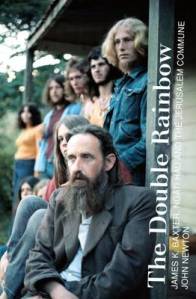
‘The Double Rainbow: James K. Baxter, Ngāti Hau and the Jerusalem Commune’: A Review

the-double-rainbowJohn Newton, The Double Rainbow: James K. Baxter, Ngāti Hau and the Jerusalem Commune (Wellington: Victoria University Press, 2009). 224 pages. ISBN: 9780864736031. Review copy courtesy of Victoria University Press.

John Newton’s engaging book, The Double Rainbow: James K. Baxter, Ngāti Hau and the Jerusalem Commune, examines the Ngāti Hau community that Aotearoa’s best-known poet James K. Baxter was instrumental in establishing at Hiruhārama, on the Whanganui River – ‘the country’s first and most influential experiment in “hippie” communalism’ (p. 38). As Newton notes in his Introduction:

The double rainbow is Baxter’s symbol for a mutually regenerative bicultural relationship. He recognised that the Pākehā majority ignored Māori culture, not just to the cost of Māori … but also to its own detriment. Pākehā, he wrote in 1969, a few months before he first moved to Jerusalem, ‘have lived alongside a psychologically rich and varied minority culture for a hundred years and have taken nothing from it but a few place-names and a great deal of plunder’. Pākehā culture’s material dominance was accompanied by an arrogance and ethnocentrism which left it spiritually impoverished.

He cites Baxter:

‘Ko te Maori te tuakna. Ko te Pakeha te teina …’ The Maori [sic] is indeed the elder brother and the Pakeha [sic] the younger brother. But the teina has refused to learn from the tuakana. He has sat sullenly among his machines and account books, and wondered why his soul was full of bitter dust …

And then offers the following commentary:

The cost was everywhere to be seen, but nowhere more plainly than among urban youth. For Baxter, their wholesale disaffection was a realistic verdict on the society they had inherited, a mainstream culture whose spiritlessness and meanness – to say nothing of its arrogance towards its neighbours – deserved no better. In the Māori world, by contrast, and particularly in Māori communalism, he believed he could see an alternative to this atomised majority culture – a system of values that answered to the longings and frustrations that he recognised, both in himself and in the young people around him. To establish an alternative Pākehā community that could ‘learn from the Maori side of the fence’ was to help restore, symbolically, the mana of the tangata whenua and to begin to resuscitate a Pākehā culture that was choking to death on its own materialism. (pp. 11–12)

Such constitutes the earth from which a functioning intentional community at Hiruhārama budded, a community made up largely of those for whom mainstream Aotearoan society meant fatherlessness.

While concerned to not diminish Baxter’s part in the formation of the Ngā Mōkai community but rather to place it in the context of a larger ‘utopian experiment’ (p. 88) he initiated, Newton seeks to ‘offer a stronger account of what Baxter achieved at Jerusalem by bringing into focus its collaborative dimension’ (p. 16). He properly contends that what the 41-year-old Baxter set in motion, and towards which the baby-boomer ‘orphanage’ of the damaged which was his living poetry bore witness to, was something considerably bigger than Baxter himself, and that the unique cohabitation and set of cultural negotiations which was embodied in the Whanganui River communities (particularly Ngāti Hau, Ngā Mōkai, the church – which was ‘threaded through the life of the river’ (p. 59) – and the Sisters of Compassion) draw attention to implications far beyond both Baxter or to the communities themselves. This, of course, is of the essence of Baxter himself, that before he was a hippie, he was ‘a Catholic, a Christian humanist, and an aspiring Pākehā-Māori’ (p. 36), he was a poet-prophet charged not simply with interpreting the social environment which he inhabited, but of actively improving it, of giving material shape to it. The book is loosely divided into three main sections: an introductory phase that addresses the pre-history of the community and Baxter’s first year of residence; a middle section that covers its heyday; and a downstream phase that describes the community’s various offshoots, and considers its legacy. The result – for the reader prepared to follow the narrative – is the stripping away of ‘cultural safety’.

Newton details further upon what we know of Baxter from other places while eloquently introducing us to a host of other equally-fascinating characters – Father Wiremu Te Awhitu, pā women Dolly, Alice, Lizzie and Wehe (who are often remembered as ‘substitute’ mothers (p. 89)), Aggie Nahona, and Denis O’Reilly among them. He also highlights Baxter’s visionary kinship with French-born nun Marie Henriette Suzanne Aubert with whom he shared ‘a staunch commitment to Māori, and to spiritual love as the first principle of a hands-on social mission’ (p. 45). Newton argues that this part of Baxter’s history ‘doesn’t get acknowledged in Baxter’s rhetorical point-scoring at the expense of the mainstream church. Without it, however, his own Jerusalem “orphanage” would never have eventuated. In one sense the debt is symbolic or poetic: the presence of the church at Jerusalem draws te taha Māori into dialogue with the other key spiritual driver of his later career, namely his Catholic faith … Baxter brought his showmanship, and his personal (some might argue, narcissistic) sense of mission. But he also brought with him – embodied, or enacted – the self-interrogation and social radicalisation that had seized hold of the Catholic Church globally in the wake of Vatican II. After the Berrigans and the draft card burnings, after liberation theology, what did the Christian mission imply in the context of ongoing colonial injustice?’ (pp. 46, 47)

Jerusalem was Baxter’s riposte to all those Pākehā institutions – the churches, the university, the nuclear family and so on – whose lack of heart and small-minded materialism were now failing Pākehā youth in the same way that Pākehā culture had always failed Maori. In looking for a remedy for the failings of Pākehā society, he found his prime inspiration in the communitarian virtues that he saw among Māori: aroha, mahi, kōrero, manuhiritanga. This was ‘learn[ingJ from the Maori side of the fence’: his community was to be modelled on the marae. Of course, in offering this open door the commune depended entirely on the hospitality of Ngāti Hau … But the commune was not just a place to live – a material shelter for whomever happened to be there … it was also a piece of political theatre. And the commune’s significance as a political intervention depended for its fullest expression on publicity: it was intended, at least in part, to be a spectacle, a City on a Hill! At the same time, it was integral to the kaupapa that it be open to all comers. This was the paradox that Baxter was confronted by: the more effectively this vision was communicated, the more would it lead to a pressure of numbers that would overwhelm the commune’s own capacity to provide for itself, and which eventually must wear out the patience of the local community. (p. 65)

Yet Newton is at pains to point out throughout his study that Hiruhārama is bigger than Baxter. Indeed, the bulk of the book is given to defending and illustrating this thesis, that Hiruhārama after Baxter entered into a period of unforeseen maturity, and particularly the maturity of its relationship with the pā. Community life under Greg Chalmers’ leadership may have been less eventful, but those years from 1972 do more to fulfil Baxter hopes of regenerative partnerships than those prior.

Two chapters are concerned with articulating the events birthed following the final closure of the community at Hiruhārama, and to highlighting that while a distinctive phase of the Ngā Mōkai narrative had reached its end, its impulse didn’t die with the community itself. Newton draws attention to a network of loosely affiliated houses – from flats and private homes, to crashpads and urban shelters, to far-flung intentional communities – which functioned as homes-away-from-home for a diasporic Ngā Mōkai whānau, a ‘network of initiatives which imported the Jerusalem kaupapa back into urban contexts’ (p. 154), and there ‘offering a dispersed community the chance of reconnection, reaffirmation and renewal’ (p. 164). He recalls Hiruhārama’s various germinations at Reef Point, Wharemanuka and Whenuakura. ‘With the shutting of the original commune, these “shoots of the kumara vine” [became] the focus of the Ngā Mōkai story. It’s here, in this ramshackle archipelago, that those who had been touched by Jerusalem attempted to keep alive the kaupapa’ (p. 131).

The penultimate chapter, ‘Baxter’s Wake’, re-spotlights Baxter, and is given to argue that Baxter’s literary legacy and his social legacy are ‘shoots of the same vine’ (p. 169):

‘Jerusalem’ was never an alternative to the poetry; it was part of it, its logical destination, even its most vivid accomplishment. In his burial on the river we find Baxter the poet and the Baxter the activist inextricably entwined. This integration was precisely his ambition, and the fact he achieved it is what makes these events still resonate. (p. 171)

So Newton appropriately accentuates Baxter’s formulation of the poet’s ethical task to be no mere interpreter of society but one who endeavours to make society more just. ‘It is this sense of embodied ethics … which leaps into focus when we think about Jerusalem’ (p. 179).

The Double Rainbow is the fruit of an incredibly-impressive amount of extensive and laborious research. Newton commendably resists romanticising Baxter, Baxter’s vision, or the Ngāti Hau ‘classroom’ itself. Those engaged in Baxter’s work and who want to better understand his Jerusalem Daybook or are interested in his biography, those seeking to understand, assess and inform Aotearoa’s multi-cultural, historical and spiritual landscape, those wanting to listen and to speak intelligently into contemporary debates about the relationship between government authorities and badge-wearing gangs carving out their own neo-tribal identity, and, more broadly, to a nation fascinated with re-carving a new national identity which buries settler mono-culturalism in its wake, and those devoted to the challenging work of inspiring, creating, leading, building, replanting and closing local and grassroots communities will be well-served to have Newton’s essay in hand. An invaluable and timely record, it is also certain to inform, impress and inspire.

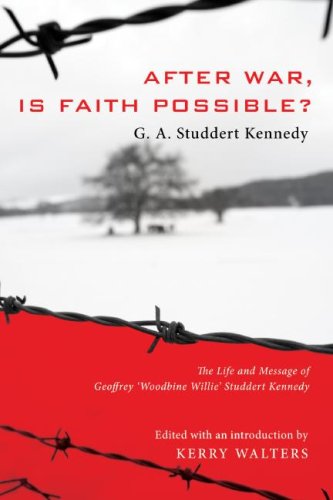
‘After War, Is Faith Possible?’: A Commendation


studdert-kennedyGeoffrey A. Studdert Kennedy, After War, Is Faith Possible?: The Life and Message of Geoffrey “Woodbine Willie” Studdert Kennedy (ed. Kerry Walters; Eugene: Cascade, 2008).
xii + 225 pages. ISBN: 978-1-55635-379-6. Review copy courtesy of Wipf and Stock.

One the real delights of my research into the thought of PT Forsyth has been revisiting, and in some cases discovering for the first time, others who were writing around the same time, and often of the same events. To re-read James Denney, or James Baldwin Brown, or FD Maurice, is one of the best ways one could spend a month … or two. Another giant personality to add to that list would have to be Geoffrey A. Studdert Kennedy, better known as ‘Woodbine Willie’. (I posted on ) My copies of Studdert Kennedy’s work, which are all over 90 years old, form a truly valuable part of my library and one to which I return not infrequently. Collected Poetry (London: Hodder & Stoughton, 1927), The Hardest Part (London: Hodder & Stoughton, 1918), I Believe: Sermons on the Apostles Creed (New York: George H. Doran, 1921), Rough Rhymes of a Padre (Toronto: Hodder & Stoughton, 1918) and The Wicket Gate, or Plain Bread (London: Hodder & Stoughton, 1923) all constitute exceptional reading.

And so I was absolutely delighted to discover that Wipf & Stock decided to republish some Woodbine Willie excerpts, all well chosen and just enough to plant an appetite in those who will no doubt want to hear more from ‘the bloody parson!’ (p. 12). The collection was edited by Kerry Walters, who also contributed a very fine introduction on Studdert Kennedy’s life and message, and a helpful bibliography of the primary and secondary literature.
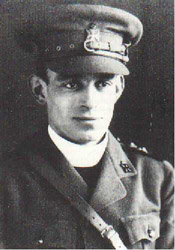
Woodbine Willie, (June 27, 1883 - March 8, 1929)

Woodbine Willie, (June 27, 1883 - March 8, 1929)

This WWI padre was, of course, one of the best-known and most-loved Christian pacifists of the early twentieth century. Unlike those theological yuppies who defend pacifism on purely ideological grounds and over a café latte in Lygon Street – informed by the Gospel or otherwise – Woodbine Willie’s commitment to pacifism was birthed in the trenches alongside frightened men and their dead mates. In all that he wrote, a number of questions incessantly occupied his thought: ‘Given the insanity and brutality of war (‘the universal disaster’; p. 14), what must the God who allows it be like? (p. 13); How is evil to be gotten rid of? (p. 3); What sort of universe ought an honest person believe in? (p. 15). His answer to these questions eventually led to the conviction that God is not sadistic, or indifferent to the world’s evil. Neither is God ‘Almighty’ enough to prevent such evils: ‘I see no evidence anywhere in nature of the Almighty Potentate Who guides and governs all things with His rod, and knows no failure and thwarting of His Will’ (p. 81). What God does do, Woodbine Willie insists (in Moltmannesque manner), is to suffer with and alongside humanity. This is love’s character – not raw despotic power but entering into the sorrows of the beloved. War then, which is evil in its most acute form, is ‘the test case for determining if Christianity can cope with evil’ (p. 21).

Against those who would ‘blather’ about the ‘glory of war’, or who would hold out hope for war being a converting ordinance, Woodbine Willie says that ‘war is pure undiluted, filthy sin. I don’t believe that it has ever redeemed a single soul – or ever will’ (p. 62):

War is only glorious when you buy it in the Daily Mail and enjoy it at the breakfast table. It goes splendidly with bacon and eggs. Real war is the final limit of damnable brutality, and that all there is in it. It’s about the silliest, filthiest, most inhumanly fatuous thing that ever happened. It makes the whole universe seem like a mad muddle. One feels that all talk of order and meaning in life is insane sentimentality. (p. 41)
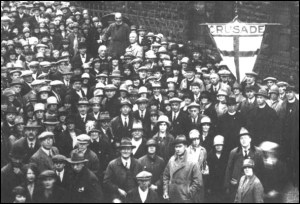
Geoffrey Studdert Kennedy speaking at Tredegar during an Industrial Christian Fellowship Crusade in 1928.

Geoffrey Studdert Kennedy speaking at Tredegar during an Industrial Christian Fellowship Crusade in 1928.

There are no words foul and filthy enough to describe war. Yet I would remind you that this indescribably filthy thing is the commonest thing in History, and that if we believe in a God of Love at all we must believe in the face of war and all it means. The supreme strength of the Christian faith is that it faces the foulest and filthiest of life’s facts in the crude brutality of the Cross, and through them sees the Glory of God in the face of Jesus Christ. (p. 49)

Waste of Muscle, waste of Brain,

Waste of Patience, waste of Pain,

Waste of Manhood, waste of Health,

Waste of Beauty, waste of Wealth,

Waste of Blood, and waste of Tears,

Waste of Youth’s most precious years,

Waste of ways the Saints have trod,

Waste of Glory, waste of God –

              War! (p. 50)

I cannot say that war, disease, pestilence, famine, and all the other characteristics of the process are good. If this word “Almighty” means that the Father could have made this world, and obtained the results He desires, in a thousand other ways, but that He deliberately chose this, that makes my gorge rise. Why in thunder choose this one? It is disreputable if He could have done it otherwise, without this cruelty and wrong. It is not commonly respectable. He must be an evil-minded blackguard, with a nasty disposition like a boy that likes pulling the wings off flies. I cannot get up any reverence for such a being. Why, bless my life, He tortures children, voluntarily tortures them to death, and has done so for thousands of years. I can’t stand that at all – it’s dirty; and when I am told that I must believe it, and that every detail of the process was planned out precisely as He wished, I begin to turn sick. Snakes, sharks, and blood-sucking vermin – what sort of a God is this? He chose this way because He gloried in it! That beats the band. It turns me clean up against the process. I cannot see its beauty for its brutality. I cannot hear the lark sing for the squealing of a rabbit tortured by a stoat, I cannot see the flowers for the face of a consumptive child with rotten teeth, the song of the saints is drowned by the groans of murdered men. (p. 75)

A soldier in time of war is not a person but a puppet, who moves when you pull strings. (p. 78)

… our armaments are symbols, not of our power, but of our weakness … Our military power is an exact index of our spiritual and moral impotence. (p. 79)

Life is one, from the single cell to the Savior in the flesh. I cannot separate swine from Shakespeare or Jellyfish from Jesus of Nazareth; they all are products of the process. So behind the process there must be a Spirit which is like the Spirit of man. (p. 81)
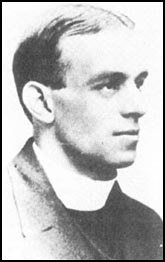
woodbine-willie-1I am not a pacifist (I’ve been too persuaded by Forsyth and Jüngel here), but reading Woodbine Willie continuously challenges me to ask myself whether I should be, whether our Lord’s command to ‘Love your enemies’ (Matt 5:44) really does, in Barth’s words, abolish ‘the whole exercise of force’. Either way, Barth is most certainly correct when he challenges: ‘In conformity with the New Testament, one can be pacifist not in principle but only in practice (praktisch Pazifist). But let everyone consider very carefully whether, being called to discipleship, it is possible to avoid – or permissible to neglect – becoming a practical pacifist!’ (Church Dogmatics IV/2, 549-50).

Faith does not mean that we cease from asking questions; it means that we ask and keep on asking until the answer comes; that we seek and keep on seeking until the truth is found; that we knock and keep on knocking until the door is opened and we enter into the palace of God’s truth. (p. 63)

Woodbine Willie dares us to keep on prayerfully asking the questions …

If the Church is to be a Church indeed, and not a mere farce – and a peculiarly pernicious farce, a game of sentimental make-believe – she must be filled to overflowing with the fire of the ancient prophets for social righteousness, with the wrath and love of the Christ. (p. 196)

The Church is not, and never can be, an end in itself; it is a means to an end; a means to the salvation of the world and the building of the Kingdom of God. It is not the Ark of Salvation for themselves, it is the Agent of Salvation for mankind. It is not a refuge of peace, but an army preparing for war. They seek in it, not security, but sacrifice. This is the infallible mark of the Church, the hallmark of the Cross. And if the sin of our modern slums, and the degradation that they cause; if the sin of our over-crowded, rotten houses, and the ugliness and vice they bring; if the sin of unemployment, with the damnation of body and soul that it means to men and women, boys and girls; if the sin of the heartless, thoughtless luxury at one end, standing out against the squalid and degrading poverty at the other; if the sin of commercial trickery and dishonesty, and wholesale defrauding of the poor; if the sin of prostitution, and the murder of women and children by venereal disease; if the sin of war, the very sin of sins, which is but the bursting into a festering sore of all the filth that the others have bred in years of miscalled peace; if all that is not laid upon the Church as a burden, and Christ’s members do not feel it as their own, then the Church is not a Church at all; and no amount of organization, propaganda, and evangelization can make it live. It has missed its vocation. (p. 167)


Around the traps …

dietrich-bonhoeffer

Thinking humanity, thinking family: Gary Deddo on Karl Barth’s Theology of Relations

gary-deddoGary Deddo‘s doctoral thesis, published as Karl Barth’s Theology of Relations: Trinitarian, Christological, and Human: Towards an Ethic of the Family (New York: P. Lang, 1999), fills a too-much neglected vista of Barth studies – the ethical implications of Barth’s theology for the family. Insofar as Deddo attends to this, his study carries Barth scholarship in a constructive direction, not only for ‘theologians’, but for all who determine to think theologically on issues germane to family life and ministry to/with/for families. Moreover, his essay is in itself a cogent and profitable introduction to the broader, fruitful and creative landscape of Barth’s theological anthropology – that human personhood is determined by and for the Word of grace. According to Deddo, this means at least the following six things:

A) Humanity’s being has the form of relationship to God which indicates that humanity is to, from and with God as Jesus himself has this form of relationship with God and so constitutes the form of relationship with God through Him in which humankind participates.

i) Humanity’s being has the form of a being from God and so a being united to God, but does not be without God, nor is to be confused with God. Because Jesus is both like humankind and yet unlike humankind, persons in general are united with Jesus but are not identical with him.

ii) Humanity’s being is in the form of being differentiated yet determined for communion with God. Because our Brother’s life is in esse koinonia and intra-relatio with the Father and Spirit, humankind too – to which in the incarnation the Father, Son and Spirit have determined to be for – is made to participate in the intra-trinitarian life of communion with the Father through the Son in the Spirit.

iii) Humanity’s being-in-relationship is a being of ordered correspondence of humanity with God and so humanity’s being is an image of and witness to God. Jesus corresponds in his being to God in that he is God’s presence with humanity, embodying in flesh – i.e. from the side of creation – God’s relationship with all humanity. Jesus is the enactment of the will and kingdom of God among us. Human being involves acting in a way which corresponds to who we are graciously made to be – God’s relations, the imago of the Imago, the daughters and sons of the Father of Jesus.

matisse-danceB) Humanity’s being in relation with God has also been given its covenantal content (action) and is so constituted in both form and content as a being for God. Thus, Jesus is not merely the revelation of who God and humanity are, but Jesus is by virtue of that relationship that God and humanity know. He is the one Mediator between God and humanity. He is the ontological reality of the divine-human relationship. Human being is constituted and maintained only by participation in the action of relation that the Son knows with the Father in the Spirit. There is no such thing as autonomy – for God or humans.

iv) Humanity’s relationship with God is a covenantal and so personal relationship of being for God. The life of Jesus – the divinely-elected Son who freely responds to God’s calling in and through the history of his relationship with God – is a life of thanksgiving, obedience, invocation, and freedom for God. The life of Jesus is true human personhood, and revelatory – unveiling for us that God is personal, and that humankind is established in Jesus and corresponds to Jesus who is the imago Dei.

v) Humanity’s being in relationship to God is a dynamic and eschatological history in which humanity becomes what humanity is graciously determined to be – for God. Humanity’s covenantal relationship with God is not intrinsic to human personhood qua human personhood (indeed, there is no such thing), but is the gift of divine grace enfleshed in Jesus Christ in whom – and in whom alone – humanity comes to exist and to exist in relation to God, and to have a future in relation to God. Humanity’s being is in becoming in relation to God.

vi) Humanity’s being in relationship means humanity’s being for God – transcending, proceeding and giving of humanity’s self in perpetual return. So Jesus – the Man for God – is God’s own self-giving and outgoing to humankind that humankind might be included in, and mirror, the inner Triune relations. The relations of God and humanity as revealed in Jesus are not external but internal relationships in which each participates in the life of the other. God’s action in Christ takes place so that humankind might participate in the Triune life – life itself. Humanity is not alien to God’s being, but of its essence.

Turning more specifically to the question of the family, Deddo proposes a ‘six-fold grammar of Relations’:

i. The God whom we worship in Jesus Christ is the Triune God who exists in loving covenantal communion and who has created, reconciled and redeemed us for participation in that very communion of Father and Son in the Spirit. The parent-child relationship is one unique context in which this communion may be communicated and reflected. But families find their true place not in conformity to society in general, but in communion within the Church, a family of families.

ii. As human beings we have our personhood only as a gift of being in covenantal communion with God which calls for our personal participation. This life of fellowship is to be manifested in lives of worship as the Church of Jesus Christ. It is in this context that each one of us, no matter what our family experience, hears and is reminded of our true identity as children of God and finds the norm for being parents and children in right relationship.

iii. The Church is a covenant community and as such can be understood as the household of God with God as our Father and Jesus as our Brother. It is the original ‘Family’ by which all other families are to operichoresisrder themselves in correspondence and witness to it. This is the true source for the renewal and healing of broken family relationships.

iv. Being parents is the divine gift of personal and covenantal participation in that ontological relationship of parent and child. Parents are those who in faith by grace beget and parent their children in terms of both promise and fulfilment. This constitutes a witness to, a correspondence to, an image of, God’s creation of us in promise with a view to our fulfillment. God does this by bringing us up by the Spirit to maturity according to the image of Jesus Christ and through His incarnation, crucifixion, resurrection, ascension, intercession and coming again.

v. Parents are those who order their domestic relations after the pattern of being members of the household of God, the Body of Christ, who acknowledge one Father and one Brother over them all. They see themselves as elder and younger brothers and sisters and all being the children of God, who belong together in a maturing communion with Him by the Spirit, thereby becoming conformed to Jesus Christ.

vi. They are those who, as individuals and as domestic families, are equipped and are sent out, who equip and send out their children to serve and extend their fellowship to others that they too might be included in this one family of God by that same Spirit.

Those already familiar with Ray Anderson’s work will find many echoes in Deddo’s, whose study I heartily comnmend.


Graced Vulnerability: A Theology of Childhood

As a parent – and a theologian – I’m always on the lookout for good children’s books, and good books about children … and good books in general. I’ve recently become aware of Graced Vulnerability: A Theology of Childhood by David H. Jensen. While I await my own copy to arrive, here’s a  review of the book that I read:

Taking seriously children qua children, Jensen issues a clarion call for Christians—theologians and others alike—to do the same. Tracing their place in the tradition, he notes the comparatively little attention afforded to children in theology and church. Cast as corrupt bearers of original sin, as those whose wills require breaking and reshaping, or as less than fully human entities on their way to personhood, children have been depicted and treated in ways that fall short of ancient Jewish and Jesus’ own norms and practices. A few voices have dissented, though at a comparative murmur and without providing adequate alternatives. Children remain largely devalued, even as church and society fail to counter their widespread abuse (local to global) amid war, poverty, disease, hunger, abusive sexual and labor practices, domestic violence, and crime. Jensen’s alternative “theology of childhood” draws on “the covenantal framework of children as full members in the household of God and the whisper of an ethic of care implicit in the gospel narratives of Jesus with children.” This theology calls Christians to become vulnerable with children as they attend to them, care for them in ways the tradition at its best has embraced, and enhance children’s lives as they are changed themselves to become like children. The means are the church’s distinct “practices of vulnerability”: peacemaking, baptism, sanctuary, and prayer. Crafting an original, rich, impassioned, keenly argued yet accessible book, Jensen has graced child and adult alike. His is constructive and practical theology at its best! – Allan Hugh Cole, Jr.

Sounds great. I’m looking forward to reading it. Gems will be shared. I’d be keen to hear comments from others who have already read, or are reading, this book.

Most of All, Jesus Loves You!

The folks at Discerning Reader have drawn our attention to a new (and wee) book by Noel Piper entitled Most of All, Jesus Loves You!. They write:

Not too long ago Mrs. Piper (wife of the illustrious John Piper) was taken to task on Amazon’s reader reviews for the lack of theological ballast in this book. Mrs. Piper even had the grace to respond with a personal apology to those parents whose expectations were so brutally dashed. But she did point out that the book’s audience was the younger toddler between age 2 and 3, a demographic that is woefully devoid of Christian material. Mrs. Piper and her illustrator, Debby Anderson, obviously perceived the need and produced this little book, which my toddler still enjoys even though he is now a young child. Every night when I tuck him in, I paraphrase the title, asking him, “How much does Daddy love you?” He answers, “So much!” with arms spread wide. Then I ask, “How much does Jesus love you?” He smiles and whispers, “Even more.” So you see, this little book of 16 pages and far less than 100 words has accomplished what it set out to do.

That’s over 100 less words that this post!

Dynamic Dads: How to be a hero to your kids

A Review: Dynamic Dads: How to be a hero to your kids, by Paul Pettit.

Paul Pettit is a man’s man. The president of Dynamic Dads and a former sports broadcaster who writes on a level geared to the average dad, this book is best suited for a man who either doesn’t have the time to invest in a 300 page tome, or would turn apoplectic at the simple thought of a 300 page tome.  This book is a mere seven chapters, punctuated by inset ‘Dynamic Dad’ textboxes. Prefacing each chapter is a selection of quotations drawn from surveys, journals, Scripture, and various other luminaries, while each chapter ends with discussion questions ostensibly written with a ‘Dynamic Dad’s’ accountability group in mind. Pettit begins with the following statement, reflecting his desire that this book would serve its readers:  “I hope reading this book helps you become a better father. Or to be more precise, I hope reading this book helps you to father better.” This incident of inversion is a promising opening to a book that promises much by its allusion to heroic fathering.

Yet another propitious early sign is the author’s assurance that this is not another “nine steps” or “follow this proven plan” type of book; he does not claim to possess some “secret formula that unlocks the fathering code.” Pettit draws the parallel that just as God is mysterious and His ways are “often difficult to track or explain,” so fathering is a messy business with no surefire manual, nor recipe for success. With these humble statements Pettit launches into the rationale for writing this book, supporting his findings by proffering disturbing statistics, helpfully placing them in proper perspective: “Statistics, however, are cold, lifeless numbers. They alert us to a problem and for that I am grateful. But rarely do they move us to feel or to act. In addition, numbers do not have names. Statistics represent people and things, but numbers are not the people themselves. My heart does not break for the statistics but for the children: children who have never had a bedtime storey read to them by an adult male…” Throughout the book Pettit reveals his burden for children who lack fathers, or truly fatherly figures. Here is the wellspring of this book, and it goes deep.

The second chapter addresses the priorities of a godly father. Firstly, Pettit underscores the field on which fatherly heroics are performed: “It’s in the day-to-day, run-of-the-mill activities of our life that we impact our children the most. Habits, routines, and heroes are made in the normal days, not at the annual visit to the theme park.” That’s not to say that regular family vacations aren’t indispensible opportunities which serve to bind a family together, but the point is taken. Secondly, Pettit places people priorities over against time priorities, in correct sequence: “I personally know of no better way to accomplish [the task of being a hero] than to be a hero at home. How? Work hard each day at becoming a servant leader in your home. Honor your wife. Interact with your children at a deep level. And commit yourself to great character and integrity.” Later he states, “Your family will only be as solid as your marriage”, yet he realizes that fathering is a sacrificial endeavor on the part of both the husband and the wife.

Theologically, I was fairly impressed. Not only does this book root all fatherhood in God the Father, which many books on fatherhood do, but it is solidly Trinitarian, which is quite a bit rarer: “what is the Father is saying repeatedly? He is saying, ‘Listen to my Son!’ Jesus Christ said, “Truly, truly, I say to you, the Son can do nothing of Himself…” Not only is Pettit concerned with the practical how-to’s of excellent fathering, he is careful to set out the theological underpinnings of fatherhood. He reflects a refreshing God-centered view of fathering: “we can’t compare God with an earthly father because doing so demeans God, but we can compare the actions of a good father with God and say, ‘In the ways that a father is acting as a good father, he’s acting like God acts.’ ”

Obligingly, Pettit brings theology home to roost. He owns that “In the real world that you and I occupy, dads engage us in the same manner as all humanity; fathers are fallen, imperfect beings with flawed motives and actions.” Therefore, we ought to teach our children that not only all fathers “trace their lineage back to the father of fathers, apple-crunching Adam”, but we ought also to actively instruct our children about sin, since “there is only one perfect Father and He is in heaven. The job of perfect father is filled. You need not apply” (author’s emphasis).

This book’s blemishes are few but worth mentioning. Most jarring is a recollection of a locker room event that monopolized an entire page of type and seemed only tenuously related to the point at hand. The author’s broadcasting roots are showing. Likewise, some references to pop psychology concepts such as father wounds, performance anxiety, self-esteem and natural male aggression didn’t seem to jive with the biblical care exhibited in the rest of the book. And I couldn’t really fathom that children would be excited about composing a family mission statement, nor that many dads would enjoy constructing a Legacy Map calculating net end results of quality time spent with their children. Those points aside, this book is a useful bottom-shelf introduction to excellent fathering. It’s appropriate to close with quote ardently calling for God-centered fathering, the only truly successful parenting in light of eternity:

“Let’s jump into this fray we call fathering. Let’s father as hard as we can until our sides ache and we feel like we can’t father one more day. Let’s father in selfless ways, continually pointing our wife and children to the Father of fathers.” Amen.

This review is taken from DiscerningReader.com

The Jesus Storybook Bible

We are grateful to Gordon Cheng for alerting us to The Jesus Storybook Bible: Every Story Whispers His Name; finally, a ‘big Bible picture’, as opposed to a heap of random and moralised stories.

Judging the book by its cover, Gordon notes that the book is ‘a small hardback, nearly square, and it looks like a better quality children’s storybook’. He also praises the artwork: ‘The illustration for Goliath in the David story is a hoot. The waves in the storm before Jesus speaks words of calm are shaped like the stylised waves depicted in traditional Oriental art. The Pharisees and Sadducees—boo and hiss—look like they stepped out of the Spanish inquisition, with their Pythonesque blood-red robes and hoods. Fire, water, sky, stars and the green, green grass are textured and the colours are suitably primary where they need to be.’

And then, just when we think he’s forgotten to comment on the actual words themselves, he applauds author Sally Lloyd-Jones as ‘a natural story-teller’ whose stories are ‘funny, friendly, sad, scary, joyful and playful’. Sounds just like the Bible to me. Here’s a snippert from the crossing of the Red Sea:

What were God’s people going to do? In front of them was a big sea. It was so big there was no way around it. But there was no way through it—it was too deep. They didn’t have any boats so they couldn’t sail across. And they couldn’t swim across because it was too far and they would drown. And they couldn’t turn back because Pharaoh was chasing them. They could see the flashing swords now, glinting in the baking sun, and the dust clouds, and chariot after scary chariot surging towards them. So they did the only thing there was left to do—PANIC!

You can read heaps more about it here.

Conversations with Poppi about God: A Review

Robert W. Jenson & Solveig Lucia Gold, Conversations with Poppi about God: An Eight-Year-Old and Her Theologian Grandfather Trade Questions (Grand Rapids: Brazos Press, 2006). 158 pages. ISBN: 97815874321613. Review copy courtesy of Brazos Press.

When was the last time you had a conversation about baptism, temptation, purgatory, time, economics, the Nicene Creed, creation, the Trinity, Christmas, metaphysics, church calendars, evil, indulgences, the Holy Spirit, liturgy, Lucifer, hamsters, a ‘really stupid’ bishop, the disestablishment of the Roman Church, the imago Dei, and a host of other things, all with the same person? When was the last time you did so with a person who just happens to be a world-renowned Lutheran, and ecumenical, theologian? When was the last time you did so with an eight-year-old who knows more about Dante than not a few philosophy undergrads?

In this remarkable book, we are invited to eavesdrop on a spontaneous and unscripted conversation between elementary schoolgirl Solveig Lucia Gold and her septuagenarian grandfather affectionately called ‘Poppi’, more formally known as the Reverend Canon Professor Dr. D. Robert W. Jenson, B.A., B.D., M.A., D.Theol., D.H.L., DD.

The book comprises the verbatim transcripts – with minor editing of ‘Ums’, ‘Well, buts …’ and ‘You knows…’, etc – of conversations recorded on a Radio Shack cassette recorder over a series of weekends in which Solveig visited her grandparents (‘Poppi’ and ‘Mimi’) in Princeton. After each session, Mimi typed it up.

The authors invite us to read their book ‘as you would a Platonic dialogue, though in this one, the role of Socrates goes back and forth’ (p. 10). Their discussion is more wide-ranging than most systematic theologies, and is filled with wit, warmth and wisdom.

Time for an example:

Solveig: How can God pick who goes to heaven or hell?

Poppi: By looking at Jesus, who loves you, Solveig.

Solveig: Can you show me?

Poppi: One way of saying what happened with Jesus is that Jesus so attached himself to you that if God the Father wants his Son, Jesus, back, he is stuck with you too. Which is how he picks you. (p. 20)

The young Episcopalian and her ‘sort of half Anglican and half Lutheran’ (p. 70) Poppi return to some themes a number of times over the weekends. One such theme that offers some of the book’s richest insights concerns the Spirit, or ‘God’s liveliness’ (p. 38), as the good Professor Dr Poppi likes to remind his granddaughter. Solveig tries on more than one occasion to argue a case that the second and third articles in the Creed ought to be reversed not only because ‘all of us share in the Spirit’ (Father and Son included), but also because that’s how you cross yourself. Poppi agrees, ‘Father, Spirit, Son is probably a better arrangement’ (p. 146). The Spirit is also ‘God’s own future that he is looking forward to’ (p. 42). They compare God’s liveliness with Santa Claus who is ‘sort of like a messenger from the Holy Spirit – in a way’ (p. 100), before coming to discern the spirits to see if they are from God, for whom to have Spirit means that he ‘doesn’t stay shut up in himself … but that the goodness and mercy – and wrath, when it comes to that – that is in God blows out from him to hit you and me. And that means that just like your spirit is yours and not mine, even though your spirit effects me, so God’s Spirit is his and not a spirit like Santa Claus’ (p. 101).

In between laughs, they talk about what it is about Holy Communion – Solveig’s ‘favourite part of going to church’ because she gets to ‘stretch and walk around a little’ (p. 31) – that means that ‘the wine should be the very best’ (p. 33) and that dissolvable bread should be banned. The meal should be appetising, and not like those baptisms ‘when they just dribble a couple of drops on the baby’ (p. 34). They also talk about a confirmation service led by ‘this weird bishop guy’ who is ‘really stupid’ (p. 34).

While I’m trying to resist the temptation to share every gem in the book (and there are lots), allow me one more, this time on heaven, purgatory, and hell:

Solveig: Do you think of where you might go after you die as two places or three places? I think of it as three places.

Poppi: What three is that?

Solveig: Heaven, purgatory, and hell.

Poppi: So you hold to the doctrine of purgatory?

Solveig: Yes.

Poppi: You know that is very controversial.

Solveig: Why? It’s in Dante, isn’t it?

Poppi: Well, it’s in Dante, yes. But of course, Dante isn’t exactly in the Bible.

Solveig: No. But he’s still …

Poppi: The thing about purgatory is that it’s a very reasonable idea. It’s just that we don’t know if it is true.

Solveig: Except … Maybe God thinks that you should just go to two places. If you are bad, he has no patience with you at all, and he will just sort you to go to heaven or hell. I think that is reasonable enough.

Poppi: That God is impatient?

Solveig: Yes.

Poppi: That’s where I think the notion of purgatory is reasonable. I don’t think the Bible talks about God’s being impatient in quite that way.

Solveig: If he isn’t impatient, maybe he doesn’t want us to spend time thinking about where we should go.

Poppi: You know that plate that your mother and father gave us that hangs on the wall in the dining room?

Solveig: Yes.

Poppi: Remember what it says on it?

Solveig: I don’t remember what it says.

Poppi: It says, ‘I desire not the death of the wicked.’

Solveig: ‘As I live, saith the Lord God, I have no pleasure in the death of the wicked.’

Poppi: Right. So the biblical God takes no pleasure in sending people to hell, and that’s why I think that purgatory is a reasonable idea. The problem is we don’t have any way of knowing whether the purgatory idea is true or not.

Solveig: It’s just Dante’s idea.

Poppi: Well, it was older than Dante.

Solveig: It was?

Poppi: Yes.

Solveig: Yes. Well, see, I think of Dante as a theologian, in a way.

Poppi: He was a very great theologian.

Solveig: Yeah, I know. I’m saying that he kind of liked to make up things he wasn’t quite sure about, if you know what I mean.

The delightful exchanges in this album offer us a model of how good theological dialogue can and should take place: with mutual respect and humility which delights in both the giving and the receiving; with an eye on the scripture, an eye on the tradition, and an eye on the world (for those who possess at least three eyes); and within an environment of safety in which no idea is too whacky and no avenue of enquiry cut off prematurely.

Carl Braaten’s words regarding this book are worth repeating,

Robert Jenson has created a new medium, with his granddaughter Solveig, to teach the basics of the Christian faith. Just as Martin Luther wrote his Small Catechism for children, this book of conversations covers the beliefs and practices of the Christian church – among them the commandments, the Lord’s Prayer, the Creed, and the sacraments – in a way that parents, regardless of their denomination, can confidently read and discuss with their children. Robert Jenson has translated the core convictions of his two volumes of Systematic Theology into simple truths that his eight-year-old grandchild can understand in the course of their unrehearsed and lively conversations. If you want to know what a sophisticated theologian really believes, listen to him explain the mysteries of the Christian faith to a child in simple terms without being simplistic.