Author: Jason Goroncy

‘The Young Lutheran’s Guide to the Orchestra’

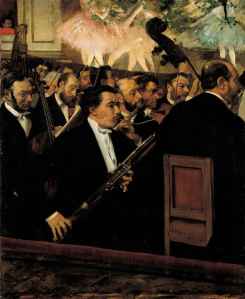
Degas- l'orchestre‘To each person, God gives some talent, such as writing, just to name one, and to many persons He has given musical talent, though not as many as think so. For the young Lutheran, the question must be: Do I have a genuine God-given musical talent, or do I only seem gifted in comparison to other Lutherans?

If your talent is choir or organ, there’s no problem. Choir members and organists can be sure their gift is from God because who else but God would be interested? Just like nobody gets fat on celery, nobody goes into church music for the wrong motives.

But for a Lutheran who feels led to play in an orchestra, the first question must be: Are you kidding? An orchestra?

In the Bible, we read about people singing and playing musical instruments, the harp, trumpet, psaltery, but always in praise of the Lord, not for amusement. We do not read that our Lord Himself ever played an instrument or enjoyed hearing others play theirs. The apostles did not attend concerts or go to dances. Are you sure this is what you want? Do you know what you’re getting into? Opera. Is that anyplace for a Christian? Don Juan and Mephistopheles and Wagner and all his pagan goddesses hooting and hollering, and the immorality – I mean, is anybody in opera married? You play in an orchestra, you’re going to wind up in opera, and the next thing you know, you’re going to be skipping Sunday mornings.

If you steer clear of opera and stick to orchestral concert music, where are the Christian composers? Modern ones are existentialists, the Romantics were secular humanists, the eighteenth century was all rationalists, and the seventeenth was Italians, except for Bach, and you can’t make a living playing Bach. You go in an orchestra, you’re going to be devoting your life to a lot of music that sort of swirls around in spiritual mystery searching for answers that people could find in the Bible if someone showed them where to look.

But if you’re determined to play in an orchestra, then you ought to ask yourself: Which instrument is the best one for a Lutheran to play? If our Lord had played an instrument, which one would he have chosen? Probably not a French horn. It takes too much of a person’s life. French horn players hardly have the time to marry and have children. The French horn is practically a religion all by itself. Should a Lutheran play the bassoon? Not if you want to be taken seriously. The name says it all: bassoon. Maybe you’d do it for a hobby (“Let’s go bassooning this weekend, honey!”) but not as your life occupation.

Many Lutherans start out playing clarinets in marching band and think of the clarinet as a Christian instrument, clear and strong and almost human, but a symphonic clarinet is different from the band clarinet: it’s sardonic, skeptical and definitely worldly. The English horn sounds Christian, maybe because we think of it as the Anglican Horn, but it’s so mournful, so plaintive. And so are English Horn players. They all have incredibly complicated problems, they’re all depressed, especially at night, which is when the concerts are. The oboe is the sensualist of the woodwind section, and if there’s ever a wind a Lutheran should avoid, it’s this one. In movie soundtracks, you tend to hear the oboe when the woman is taking off her clothes, or else later, when she asks the man for a cigarette. The flute is the big shot of the wind section. Jean-Pierre Rampal, James Galway, both millionaires (how many millionaire bassoonists are there?), because everyone knows it’s the hardest to play. To spend your life blowing across a tiny hole – it’s not really normal is it? The flute is a temptation to pride. Avoid it. The last member of the woodwind family is the flakiest, and that’s the piccolo. No Salvation Army Band ever included a piccolo and no piccolo virtuoso ever did an album of gospel music. This is not a devotional instrument.

violinWe come now to the string section. Strings are mentioned in the Scripture and therefore some Lutherans are tempted to become string players, but be careful. Bass, for example. An extremely slow instrument, the plowhorse of the orchestra, and bass players tend to be a little methodical, not inventive, not quick, not witty or brilliant, but reliable. This makes the instrument very tempting to German Lutherans. And yet, bass notes have a darkness and depth to them that, let’s face it, is sexual. And when bass players pick up their bows, I don’t think there’s any doubt what’s going on in their minds back there. The cello section seems so normal, and cellists seem like such nice people. The way they put their arms around their instruments, they look like parents zipping up a child’s snowsuit. They seem like us: comfortable, middle-range. And yet there is something too comfortable, maybe too sensual, about the cello. The way they hold the instrument between their legs: why can’t they hold it across their laps or alongside themselves? The viola section is not a nice place for a Lutheran and here you’ll have to have to take my word for it. I know violists and they are fine people until, late at night, they start drinking a few bottles of cheap red wine and roasting chickens over a pit in a vacant lot and talk about going to Yucatan with a woman named Rita. Don’t be part of this crowd. The violin is a problem for any Christian because it is a solo instrument, a virtuoso instrument, and we’re not solo people. We believe in taking a back seat and being helpful. So Christians think about becoming second violinists. They’re steady, humble, supportive. But who do they support? First violins. You want to get involved with them? The first violins are natural egotists. The conductor looks to them first, and most first violinists believe that the conductor secretly takes his cue from them, that he, a simple foreign person, gets carried away by listening to the violins and falls into a romantic, emotional reverie and forgets where in the score he is and looks to the concertmaster, the No. 1 first violin, to find out what’s going on: this is what violinists believe in their hearts. If the conductor dropped dead, the rest of the orchestra would simply follow the violin section, while the maestro’s body was carried away, and nobody would know the difference. Is this a place for a Lutheran to be? In the biggest collection of gold-plated narcissists ever gathered on one stage? No.

Let’s be clear about the brass section. First of all, the rest of the orchestra wishes the brass were playing in another room, and so does the conductor. His back is toward the audience, so they can’t see what he’s saying to the brass section; he’s saying: You’re too damn loud, shut the fuck up (in Italian, this doesn’t sound course at all). The brass section is made up of men who were at one time in the construction trades and went into music because the hours were better. They are heavy dudes, and that’s why composers wrote so few notes for them: because they’re juveniles. The tuba player, for example, is a stocky bearded guy who has a day job as a plumber. He’s the only member of the orchestra who bowls and goes deer hunting. It’s not an instrument for a sensitive Lutheran, and anyway, there’s only one tuba and he’s it. The trombonist is a humorist. He carries a water spray gun to keep his slide moist and often uses it against other members of the orchestra. A Shriner at heart, he knows more Speedy Gonzalez jokes than you thought existed. The trumpet is the brass instrument you imagine as Christian, thinking of Gideon and of the Psalms, but then you meet a real-life trumpet player and realize how militaristic these people are. They don’t want to wear black tie and play Bach, they want tight uniforms with shiny buttons, and they want to play as loudly as they possibly can. Most of the people who keel over dead at concerts are killed by trumpets.

There are two places in the orchestra for a Lutheran, and one is percussion. It’s the most Lutheran instrument there is. Percussionists are endlessly patient, because they don’t get to play much. Pages and pages of music go by where the violins are sawing away and the winds are tooting and the brass is blasting but the percussionist sits and counts the bars, like a hunter waiting for the quail to appear. A percussionist may have to wait for twenty minutes just to play a few beats, but those beats have to be exact and they have to be passionate and climactic. All that the epistles of Paul say a Christian should be – faithful, waiting, trusting, filled with fervor – are the qualities of the percussionist. The other Lutheran instrument, of course, is the harp. It is the perfect instrument for a Christian because it keeps you humble. You can’t gallivant around with a harp. Having one is like living with an elderly parent in poor health – it’s hard to get them in and out of cars, impossible to satisfy them. A harp takes fourteen hours to tune and remains in tune for twenty minutes or until somebody opens a door. It’s an instrument for a saint. If a harpist could find a good percussionist, they wouldn’t need an orchestra at all; they could settle down and make wonderful music, just the two of them’.

– Garrison Keillor, ‘The Young Lutheran’s Guide to the Orchestra’ in We Are Still Married (New York: Viking Penguin, 1989), 30–4.


Art: not a means to an end

Calvin Seerveld

‘Art is not a means to an end, it is not a function of something else. Art stands or falls on its own artistic contribution in God’s world, To think of art, or practise it, as a tool for some other purpose is to sell it out to a technocratic bent of mind, damning it to a permanent identity crisis and reducing it to a kind of colonial status at the beck and call of touring VIPs for approved cultural missions’. – Calvin Seerveld, Bearing Fresh Olive Leaves: Alternative Steps in Understanding Art (Willowdale: Toronto Tuppence Press, 2000), 11.

Trevor Hart on Science, Faith, the Arts, God and the Imagination

trevor-hartThe Centre for Public Christianity has made available four short video conversations filmed with Trevor Hart when Trevor was in Sydney last year to deliver the 22nd Annual New College Lectures at the University of New South Wales. (These talks are available for MP3 download here). Trevor is always worth listening too, and the videos are available here:

Cassidy on McCormack on Barth: Election and Trinity

The latest issue of The Westminster Theological Journal includes a piece by James J. Cassidy entitled ‘Election and Trinity’ in which he offers a ‘non-Barthian’ critique of Bruce McCormack’s reading of Barth’s ‘second’ doctrine of election. It’s a predictable argument: ‘… what McCormack has done is conflate the very Creator-creature distinction that he claims to maintain. Or, rather, he has collapsed the creature into the Creator, just as his Christology (with its ‘‘Reformed kenosis’’) collapses the humanity into the divinity of Christ’.

I have neither the time nor the desire to engage with Cassidy here, at least at this stage,  but simply wanted to draw attention to the article.

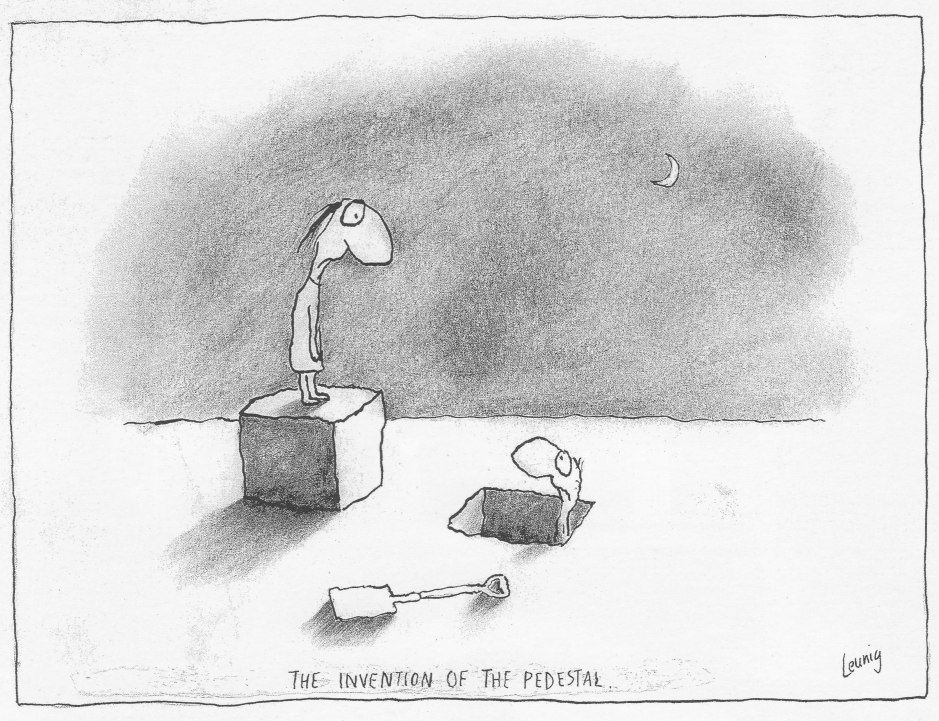
Leunig on Television

TV‘You see a society that’s provided for by television is a society that says it doesn’t need too many parks or natural situations for children to play in because television will look after them. So I think we, we start to construct the shape of our cities and our suburbs is built around this fact that people can be taken care of, they can be plonked in a room and absorbed in this virtual reality and reality itself becomes kind of a little bit degraded. I have a sense that it is mad making somewhere. That the quality of attention we give to each other as humans is degraded and diminished eventually with the sustained cultural usage’. – Michael Leunig

Ray Anderson on Marriage

‘Is it impossible for God to work in the life of one who has suffered an irretrievable loss of the “one flesh” relationship in such a way that he cannot or will not join this person together with another in a new marriage? Or, dare we suggest that the command of God can both put to death and raise again persons who experience dissolution of the marriage bond? Would it be too much to paraphrase the words of Jesus and say, “Marriage is made for man and not man for marriage!” If a theology of marriage insists that marriage is a work of God and exists under the command of God, there does seem to be a basis to suggest that in the situation where sinful humanity has experienced brokenness and loss, the commandment of God is the presence of God himself at the center of that person’s life to effect new being and new possibilities. This would be to take the authority of Scripture seriously as directing us to God himself as the one who summons us in Scripture to acknowledge him as the author of life rather than of a “law that kills.”

… Because God joins himself to the temporal social relationship consummated as a marriage and recognized by society and the church, that marriage is indissoluble on any grounds whatsoever other than the command of God. If a marriage comes to the point of utter breakdown so that it is a disorder rather than an order of human relationship, and inherently destructive to the persons involved, one can only seek to bring that relationship under God’s judgment. For Christians, this means that the breakdown of a marriage to the point of utter failure is a betrayal of the covenant love that God has invested in that marriage, and is therefore a sin. To attempt to find legal or moral grounds on which to be excused from the marriage contract is, in our opinion, untenable. The scriptural teaching on marriage and divorce clearly brings the marriage under the judgment of God as the one who has the absolute right of determining its status.

If Christians, and the church, do not have a process to deal with sin and with grace as a work of God, then there will be little hope for those who become victims and casualties of hopeless marriages. But where the work of God is understood as his contemporary presence and power under the authority of Scripture to release those who are in bondage and create a new status where “all things are new,” then the church as the community of Christ will have the courage to say NO to a continued state of disorder and YES to the forgiveness and grace of God that brings persons under a new authority of divine healing and hope. We are speaking here, by analogy, of a “death and resurrection” experience as the work of God in the midst of human lives. To create a “law of marriage” that would deny God the authority and power to put a marriage to death and to raise the persons to new life through repentance and forgiveness would appear to be a desperate and dangerous course of action. What God has joined together, indeed, let not man put asunder. But where God puts asunder as a judgment against sin and disorder, and therefore as his work, let not man uphold a law against God.

… The command of God by which marriage as a human, social relation is given the status of covenant partnership is a positive and rich resource of growth and renewal. What God “joins together” he attends with love and faithfulness. This is a promise and commitment of God himself to the marriage relation as a source of love, healing, and hope. The Christian community participates in this work of God by providing a context of support and enabling grace for each marriage that belongs to the community.

Those who undertake the calling of ministry to families through pastoral care and counseling have as their first priority the ministry of encouragement and support for marriages. This is a constructive and positive reinforcement of marriage and prevents its deterioration into a shell of the love and commitment it is meant to express. God is faithful to weak and problem-plagued marriages – not merely angry at unfaithfulness. God is patient and loving to marriages where love has been lost – not merely angry at our own anger and lovelessness. God is hopeful toward marriages that are ready to crash – not merely angry at our incompetence. God never gives up on his “joining together,” because God is himself the covenant partner of marriage. This produces a bonding that never is allowed to become bondage’. – Ray S. Anderson, ‘Bonding without Bondage’, in Ray S. Anderson and Dennis B. Guernsey, On Being Family: A Social Theology of the Family (Grand Rapids: Wm. B. Eerdmans, 1986), 103–4.

John Oman Conference

Oman2009 sees the 70th anniversary of the death of Professor John Oman. To mark the occasion there is to be conference on his life and ideas.

Oman, born in Orkney and alumni of Edinburgh, was a minister of the United Presbyterian Church and subsequently of the Presbyterian Church of England. After parish work in Paisley and Alnwick he was appointed Professor of Theology at Westminster College, Cambridge. He was also Principal of the College and Moderator of the English General Assembly. Oman was a creative theologian and philosopher of religion; his two best known books are Grace and Personality, in which he teaches that God is personal and always treats us as persons, and The Natural and Supernatural, in which he argues that all people have a felt awareness of God that prompts faith. Whilst Oman is not well known today, he was judged at the time of his death as ‘amongst the most original, independent, and impressive theologians of his generation and of his country’.

The anniversary conference is to be held at Westminster College, Cambridge from 15th–17th September 2009 and will feature local and international speakers, including Professors Stephen Bevans, George Newlands, Alan Sell and David Thompson. Topics will include Oman’s Christology, the intellectual and cultural context of his work, his response to Darwinism, and the importance of his work for contemporary missiology.

For enquiries, contact Adam Hood.

What keeps Protestant’s silent?

individualism 1

‘What keeps us silent is not spirituality, as with the Friends [Quakers], and we need not flatter ourselves it is, but an overdriven individualism, which makes us proudly timid, and which in other forms is dissolving our churches into mere associations, not to say audiences’. – Peter T. Forsyth, Intercessory Services for Aid in Public Worship (Manchester: John Heywood, 1896), 6.

[Image: CartoonStock]

‘The Double Rainbow: James K. Baxter, Ngāti Hau and the Jerusalem Commune’: A Review

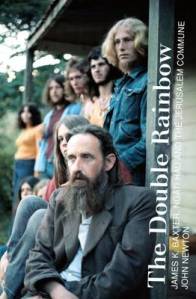
the-double-rainbowJohn Newton, The Double Rainbow: James K. Baxter, Ngāti Hau and the Jerusalem Commune (Wellington: Victoria University Press, 2009). 224 pages. ISBN: 9780864736031. Review copy courtesy of Victoria University Press.

John Newton’s engaging book, The Double Rainbow: James K. Baxter, Ngāti Hau and the Jerusalem Commune, examines the Ngāti Hau community that Aotearoa’s best-known poet James K. Baxter was instrumental in establishing at Hiruhārama, on the Whanganui River – ‘the country’s first and most influential experiment in “hippie” communalism’ (p. 38). As Newton notes in his Introduction:

The double rainbow is Baxter’s symbol for a mutually regenerative bicultural relationship. He recognised that the Pākehā majority ignored Māori culture, not just to the cost of Māori … but also to its own detriment. Pākehā, he wrote in 1969, a few months before he first moved to Jerusalem, ‘have lived alongside a psychologically rich and varied minority culture for a hundred years and have taken nothing from it but a few place-names and a great deal of plunder’. Pākehā culture’s material dominance was accompanied by an arrogance and ethnocentrism which left it spiritually impoverished.

He cites Baxter:

‘Ko te Maori te tuakna. Ko te Pakeha te teina …’ The Maori [sic] is indeed the elder brother and the Pakeha [sic] the younger brother. But the teina has refused to learn from the tuakana. He has sat sullenly among his machines and account books, and wondered why his soul was full of bitter dust …

And then offers the following commentary:

The cost was everywhere to be seen, but nowhere more plainly than among urban youth. For Baxter, their wholesale disaffection was a realistic verdict on the society they had inherited, a mainstream culture whose spiritlessness and meanness – to say nothing of its arrogance towards its neighbours – deserved no better. In the Māori world, by contrast, and particularly in Māori communalism, he believed he could see an alternative to this atomised majority culture – a system of values that answered to the longings and frustrations that he recognised, both in himself and in the young people around him. To establish an alternative Pākehā community that could ‘learn from the Maori side of the fence’ was to help restore, symbolically, the mana of the tangata whenua and to begin to resuscitate a Pākehā culture that was choking to death on its own materialism. (pp. 11–12)

Such constitutes the earth from which a functioning intentional community at Hiruhārama budded, a community made up largely of those for whom mainstream Aotearoan society meant fatherlessness.

While concerned to not diminish Baxter’s part in the formation of the Ngā Mōkai community but rather to place it in the context of a larger ‘utopian experiment’ (p. 88) he initiated, Newton seeks to ‘offer a stronger account of what Baxter achieved at Jerusalem by bringing into focus its collaborative dimension’ (p. 16). He properly contends that what the 41-year-old Baxter set in motion, and towards which the baby-boomer ‘orphanage’ of the damaged which was his living poetry bore witness to, was something considerably bigger than Baxter himself, and that the unique cohabitation and set of cultural negotiations which was embodied in the Whanganui River communities (particularly Ngāti Hau, Ngā Mōkai, the church – which was ‘threaded through the life of the river’ (p. 59) – and the Sisters of Compassion) draw attention to implications far beyond both Baxter or to the communities themselves. This, of course, is of the essence of Baxter himself, that before he was a hippie, he was ‘a Catholic, a Christian humanist, and an aspiring Pākehā-Māori’ (p. 36), he was a poet-prophet charged not simply with interpreting the social environment which he inhabited, but of actively improving it, of giving material shape to it. The book is loosely divided into three main sections: an introductory phase that addresses the pre-history of the community and Baxter’s first year of residence; a middle section that covers its heyday; and a downstream phase that describes the community’s various offshoots, and considers its legacy. The result – for the reader prepared to follow the narrative – is the stripping away of ‘cultural safety’.

Newton details further upon what we know of Baxter from other places while eloquently introducing us to a host of other equally-fascinating characters – Father Wiremu Te Awhitu, pā women Dolly, Alice, Lizzie and Wehe (who are often remembered as ‘substitute’ mothers (p. 89)), Aggie Nahona, and Denis O’Reilly among them. He also highlights Baxter’s visionary kinship with French-born nun Marie Henriette Suzanne Aubert with whom he shared ‘a staunch commitment to Māori, and to spiritual love as the first principle of a hands-on social mission’ (p. 45). Newton argues that this part of Baxter’s history ‘doesn’t get acknowledged in Baxter’s rhetorical point-scoring at the expense of the mainstream church. Without it, however, his own Jerusalem “orphanage” would never have eventuated. In one sense the debt is symbolic or poetic: the presence of the church at Jerusalem draws te taha Māori into dialogue with the other key spiritual driver of his later career, namely his Catholic faith … Baxter brought his showmanship, and his personal (some might argue, narcissistic) sense of mission. But he also brought with him – embodied, or enacted – the self-interrogation and social radicalisation that had seized hold of the Catholic Church globally in the wake of Vatican II. After the Berrigans and the draft card burnings, after liberation theology, what did the Christian mission imply in the context of ongoing colonial injustice?’ (pp. 46, 47)

Jerusalem was Baxter’s riposte to all those Pākehā institutions – the churches, the university, the nuclear family and so on – whose lack of heart and small-minded materialism were now failing Pākehā youth in the same way that Pākehā culture had always failed Maori. In looking for a remedy for the failings of Pākehā society, he found his prime inspiration in the communitarian virtues that he saw among Māori: aroha, mahi, kōrero, manuhiritanga. This was ‘learn[ingJ from the Maori side of the fence’: his community was to be modelled on the marae. Of course, in offering this open door the commune depended entirely on the hospitality of Ngāti Hau … But the commune was not just a place to live – a material shelter for whomever happened to be there … it was also a piece of political theatre. And the commune’s significance as a political intervention depended for its fullest expression on publicity: it was intended, at least in part, to be a spectacle, a City on a Hill! At the same time, it was integral to the kaupapa that it be open to all comers. This was the paradox that Baxter was confronted by: the more effectively this vision was communicated, the more would it lead to a pressure of numbers that would overwhelm the commune’s own capacity to provide for itself, and which eventually must wear out the patience of the local community. (p. 65)

Yet Newton is at pains to point out throughout his study that Hiruhārama is bigger than Baxter. Indeed, the bulk of the book is given to defending and illustrating this thesis, that Hiruhārama after Baxter entered into a period of unforeseen maturity, and particularly the maturity of its relationship with the pā. Community life under Greg Chalmers’ leadership may have been less eventful, but those years from 1972 do more to fulfil Baxter hopes of regenerative partnerships than those prior.

Two chapters are concerned with articulating the events birthed following the final closure of the community at Hiruhārama, and to highlighting that while a distinctive phase of the Ngā Mōkai narrative had reached its end, its impulse didn’t die with the community itself. Newton draws attention to a network of loosely affiliated houses – from flats and private homes, to crashpads and urban shelters, to far-flung intentional communities – which functioned as homes-away-from-home for a diasporic Ngā Mōkai whānau, a ‘network of initiatives which imported the Jerusalem kaupapa back into urban contexts’ (p. 154), and there ‘offering a dispersed community the chance of reconnection, reaffirmation and renewal’ (p. 164). He recalls Hiruhārama’s various germinations at Reef Point, Wharemanuka and Whenuakura. ‘With the shutting of the original commune, these “shoots of the kumara vine” [became] the focus of the Ngā Mōkai story. It’s here, in this ramshackle archipelago, that those who had been touched by Jerusalem attempted to keep alive the kaupapa’ (p. 131).

The penultimate chapter, ‘Baxter’s Wake’, re-spotlights Baxter, and is given to argue that Baxter’s literary legacy and his social legacy are ‘shoots of the same vine’ (p. 169):

‘Jerusalem’ was never an alternative to the poetry; it was part of it, its logical destination, even its most vivid accomplishment. In his burial on the river we find Baxter the poet and the Baxter the activist inextricably entwined. This integration was precisely his ambition, and the fact he achieved it is what makes these events still resonate. (p. 171)

So Newton appropriately accentuates Baxter’s formulation of the poet’s ethical task to be no mere interpreter of society but one who endeavours to make society more just. ‘It is this sense of embodied ethics … which leaps into focus when we think about Jerusalem’ (p. 179).

The Double Rainbow is the fruit of an incredibly-impressive amount of extensive and laborious research. Newton commendably resists romanticising Baxter, Baxter’s vision, or the Ngāti Hau ‘classroom’ itself. Those engaged in Baxter’s work and who want to better understand his Jerusalem Daybook or are interested in his biography, those seeking to understand, assess and inform Aotearoa’s multi-cultural, historical and spiritual landscape, those wanting to listen and to speak intelligently into contemporary debates about the relationship between government authorities and badge-wearing gangs carving out their own neo-tribal identity, and, more broadly, to a nation fascinated with re-carving a new national identity which buries settler mono-culturalism in its wake, and those devoted to the challenging work of inspiring, creating, leading, building, replanting and closing local and grassroots communities will be well-served to have Newton’s essay in hand. An invaluable and timely record, it is also certain to inform, impress and inspire.

A Prayer from the Birthday Boy

Forsyth 9.jpg‘O Lord, thou knowest our frame, and rememberest that we are dust. Pity the sorrows of such as are torn by undeserved pain. Refresh all that are worn by perpetual care. Light up the faith of the dying. And comfort the bereaved with Thy regard. Deliver the souls of those who are bound in the chain of their own misdeeds. And send Thy Pentecostal power and joy to those holy ones who have the world’s sin for a great burden upon their souls. We bear all our fear, and sin, and sorrow to the Redeemer who bears them all before Thee, and by His intercession heals them all’. – Peter T. Forsyth, Intercessory Services for Aid in Public Worship (Manchester: John Heywood, 1896), 19–20.

James K. Baxter: ‘Song to the Holy Spirit’

Wild Goose

Lord, Holy Spirit,
You blow like the wind in a thousand paddocks,
Inside and outside the fences,
You blow where you wish to blow.

Lord, Holy Spirit,
You are the sun who shines on the little plant,
You warm him gently, you give him life,
You raise him up to become a tree with many leaves.

Lord, Holy Spirit,
You are the mother eagle with her young,
Holding them in peace under your feathers.
On the highest mountain you have built your nest,
Above the valley, above the storms of the world,
Where no hunter ever comes.

Lord, Holy Spirit,
You are the bright cloud in whom we hide,
In whom we know already that the battle has been won.
You bring us to our Brother Jesus
To rest our heads upon his shoulder.

Lord, Holy Spirit,
You are the kind fire who does not cease to burn,
Consuming us with flames of love and peace,
Driving us out like sparks to set the world on fire.

Lord, Holy Spirit,
In the love of friends you are building a new house,
Heaven is with us when you are with us.
You are singing your songs in the hearts of the poor
Guide us, wound us, heal us. Bring us to the Father.

– James K. Baxter, ‘Song to the Holy Spirit’, in Collected Poems (ed. John Edward Weir; Oxford: Oxford University Press, 1979), 572.

James K. Baxter: ‘Letter from the Mountains’

Hemi at Jerusalem

Hemi at Jerusalem

Letter from the Mountains

There was a message. I have forgotten it.
There was a journey to make. It did not come to anything.
But these nights, my friend, under the iron roof
Of this old rabbiters’ hut where the traps
Are still hanging up on nails,
Lying in a dry bunk, I feel strangely at ease.
The true dreams, those longed-for strangers,
Begin to come to me through the gates of horn.

I will not explain them. But the city, all that other life
In which we crept sadly like animals
Through thickets of dark thorns, haunted by the moisture of women,
And the rock of barren friendship, has now another shape.
Yes, I thank you. I saw you rise like a Triton,
A great reddish gourd of flesh,
From the sofa at that last party, while your mistress smiled
That perfect smile, and shout as if drowning—
‘You are always—’
                        Despair is the only gift;
When it is shared, it becomes a different thing; like rock, like water;
And so you also can share this emptiness with me.

Tears from faces of stone. They are our own tears.
Even if I had forgotten them
The mountain that has taken my being to itself
Would still hang over this hut, with the dead and the living
Twined in its crevasses. My door has forgotten how to shut.

Encouragement for pastors to be pastors

eugene-petersonEugene Peterson is always worth listening to, and his writing on pastoral ministry is enormously encouraging. Here’s some snipperts from a Leadership interview with this pastor to pastors:

‘The most important thing a pastor does is stand in a pulpit every Sunday and say, “Let us worship God.” If that ceases to be the primary thing I do in terms of my energy, my imagination, and the way I structure my life, then I no longer function as a pastor. I pick up some other identity. I cannot fail to call the congregation to worship God, to listen to his Word, to offer themselves to God. Worship becomes a place where we have our lives redefined for us. If we’re no longer operating out of that redefinition, the pastoral job is hopeless. Or if not hopeless, it becomes a defection. We join the enemy. We’ve quit our basic work’.

‘I don’t ever want to convey that our primary job as pastors is to fix a problem. Our primary work is to make saints. We’re in the saint-making business. If we enter the human-potential business, we’ve lost our calling’.

‘I begin with the conviction that everything in the gospel is experience-able. As a pastor, whatever the person’s situation, you’re saying to yourself, This person can experience the gospel here. I haven’t a clue how it’s going to happen, but I’m willing to slog through whatever has to be slogged through and not give up. I will continue to keep the gospel clear on Sundays; I will continue to be a companion with this person on Fridays’.

‘You cannot go to a pulpit week after week and preach truth accurately without constant study. Our minds blur on us, and we need that constant sharpening of our minds. And without study, without the use of our mind in a disciplined way, we are sitting ducks for the culture’.

‘I get my job description from the Scriptures, from my ordination vows. If I let the congregation decide what I’m going to do, I’m as bad as a doctor who prescribes drugs on request. Medical societies throw out doctors for doing that kind of thing; we need theological societies to throw out pastors for doing the same thing. And if you give up prayer and study, you will soon give up the third area: people’.

‘Listening, paying attention to people is the most inefficient way to do anything. It’s tedious, and it’s boring, and when you do it, it feels like you’re wasting time and not getting anything done. So when the pressures start to mount, when there are committees to run to and budgets to fix, what’s got to go? Listening to people. Seeing them in their uniqueness, without expecting anything of them. You quit paying attention, and people get categorized and recruited. It doesn’t take long for pastors to become good manipulators. Most of us learn those skills pretty quickly. If you can make a person feel guilty, you can make him or her do almost anything. And who’s better at guilt than pastors?’

‘The person who prays for you from the pulpit on Sunday should be the person who prays for you when you’re dying. Then there’s a connection between this world and the world proclaimed in worship. Classically – and I have not seen anything in the twentieth century that has made me revise my expectation – a pastor is local. You know people’s names, and they know your name. There’s no way to put pastoral work on an assembly line … Pastoral care can be shared, but never delegated. If the congregation perceives that I exempt myself from that kind of work, then I become an expert. I become somehow elitist; I’m no longer on their level. Elitism is an old demon that plagues the church’.

‘The church is not a functional place. It’s a place of being’.

‘It’s odd: We live in this so-called postmodernist time, and yet so much of the public image of the church is this rational, management-efficient model. If the postmodernists are right, that model is passe; it doesn’t work any more. In that sense, I find myself quite comfortably postmodern. I think pastors need to cultivate “unbusyness.” I use that word a lot. My father was a butcher. When he delivered meat to restaurants, he would sit at the counter, have a cup of coffee and piece of pie, and waste time. But that time was critical for building relationships, for doing business. Sometimes I’m with pastors who don’t wander around. They don’t waste time. Their time is too valuable. They run to the tomb, and it’s empty, so they run back. They never see resurrection. Meanwhile, Mary’s wasting time; she’s wandering around. To be unbusy, you have to disengage yourself from egos – both yours and others – and start dealing with souls. Souls cannot be hurried’.

‘For me, being a pastor means being attentive to people. But the minute I start taking my cues from them, I quit being a pastor’.

‘Most pastoral work is slow work. It is not a program that you put in place and then have it happen. It’s a life. It’s a life of prayer’.

To read the whole interview: Part I; Part II.

Hauerwas on sex, marriage, politics and love

Jan van Eyck, ‘The Arnolfini Portrait’ (1434). Oil on oak panel of 3 vertical boards; National Gallery, London.

Jan van Eyck, ‘The Arnolfini Portrait’ (1434). Oil on oak panel of 3 vertical boards; National Gallery, London.

‘The dominant assumption has been that the evaluation of different kinds of sexual expressions should center on whether they are or are not expressive of love. On the contrary, the ethics of sex must begin with political considerations, because ethically the issue of the proper form of sexual activity raises the most profound issues about the nature and form of political community. I am not denying that sex obviously has to do with interpersonal matters, but I am asserting that we do not even know what we need to say about the personal level until we have some sense of the political context necessary for the ordering of sexual activity. Indeed, one of the main difficulties with the assumption that thc ethics of sex can be determined on the basis of interpersonal criteria is the failure to see how that assumption itself reflects a political option. To reduce issues of sexuality to the question of whether acts of sex are or are not fulfilling for those involved is to manifest the assumption of political liberalism that sex is a private matter. The hold this political theory has on us is illustrated by how readily we also accept the assumption that the private nature of sexuality does not involve issues of political theory …

‘We must understand that if Christians and non-Christians differ over marriage, that difference does not lie in their understanding of the quality of interpersonal relationship needed to enter or sustain a marriage, but rather in a disagreement about the nature of marriage and its place in the Christian and national community. Christians above all should note that there are no conceptual or institutional reasons that require love between the parties to exist in order for the marriage to be successful …

The requirement of love in marriage is not correlative to the intrinsic nature of marriage but is based on the admonition for Christians to love one another. We do not love because we are married, but because we are Christian. We may, however, learn what such love is like within the context of marriage. For the Christian tradition claims that marriage helps to support an inclusive community of love by grounding it in a pattern of faithfulness toward another. The love that is required in marriage functions politically by defining the nature of Christian social order, and as children arrive they are trained in that order.

Moreover, Christians should see that the family cannot, contrary to [Bertrand] Russell’s claim, exist as an end in itself nor by itself provide a sufficient check against pretentious rationalism. Such an assumption is but a continuation of the liberal perversion of the family and only makes the family and marriage more personally destructive. When families exist for no reason other than their own existence, they become quasi-churches, which ask sacrifices far too great and for insufficient reasons. The risk of families which demand that we love one another can be taken only when there are sustaining communities with sufficient convictions that can provide means to form and limit the status of the family. If the family does stand as a necessary check on the state, as Russell and I both think it should, it does so because it first has a place in an institution that also stands against the state – the church …

‘ … the ambivalence of the church toward marriage is grounded in the eschatological convictions which freed some from the necessity of marriage – i.e., singleness becomes a genuine option for service to the community. This is a dangerous doctrine indeed, for it is a strange community which would risk giving singleness an equal status with marriage. But that is what the church did, and as a result marriage was made a vocation rather than a natural necessity. But as a vocation, marriage can be sustained only so long as it is clear what purposes it serves in the community which created it in the first place. With the loss of such a community sanction, we are left with the bare assumption that marriage is a voluntary institution motivated by the need for interpersonal intimacy …

‘Many want to treat sex as just another form of communication – like shaking hands. I suppose in response to such a suggestion one can at least point out that sex is often more fun than shaking hands. However, the reason that we seem to assume that sex should be reserved for “special relations” is not that sex itself is special, but that the nature of sex serves the ends of intimacy. But intimacy is indeed a tricky matter to sustain, and that may be the reason why many have argued that marriage is necessary to provide the perduring framework to sustain intimacy.

Moreover, once the political function of marriage is understood to be central for the meaning and institution of marriage, we have a better idea of what kinds of people we ought to be to deal with marriage. Most of the literature that attempts to instruct us about getting along in marriage fails to face up to a fact so clearly true that I have dared to call it Hauerwas’s Law: You always marry the wrong person. It is as important to note, of course, as Herbert Richardson pointed out to me, that the reverse of the law is also true: namely, that you also always marry the right person. The point of the law is to suggest the inadequacy of the current assumption that the success or failure of a marriage can be determined by marrying the “right person.” Even if you have married the “right person,” there is no guarantee that he or she will remain such, for people have a disturbing tendency to change. Indeed, it seems that many so-called “happy marriages” are such because of the partners’ efforts to preserve “love” by preventing either from changing.

This law is meant not only to challenge current romantic assumptions but to point out that marriage is a more basic reality than the interpersonal relations which may or may not characterize a particular marriage. Indeed, the demand that those in a marriage love one another requires that marriage have a basis other than the love itself. For it is only on such a basis that we can have any idea of how we should love’.

– Stanley Hauerwas, ‘Sex and Politics: Bertrand Russell and “Human Sexuality”‘.

Aliens in the Church: A Reflection on ANZAC Day, National Flags and the Church as an Alternative Society

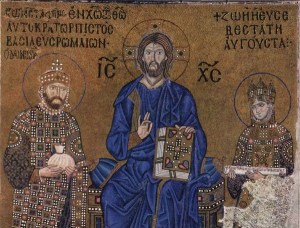
Hagia Sophia - Mosaic of Christ with Constantine IX and Zoe

Hagia Sophia - Mosaic of Christ with Constantine IX and Zoe

‘There is no agreement between the divine and the human sacrament, the standard of Christ and the standard of the devil, the camp of light and the camp of darkness. One soul cannot be due to two masters — God and Cæsar’. So was Tertullian’s response (in On Idolatry 19) to a question he posed of ‘whether a believer may turn himself unto military service, and whether the military may be admitted unto the faith, even the rank and file, or each inferior grade, to whom there is no necessity for taking part in sacrifices or capital punishments’.

My recent return to the Antipodes (after only 3 years) has been met with something of a shock at what I observe to be a distinct revival of patriotism in this part of the world symbolised not least in the hoisting of national flags. I can only interpret this as a public confession that the soul of the nation is distressed. Holding this thought, I remember once hearing (on tape) the great Welsh preacher Martyn Lloyd-Jones lamenting that the saddest day in ecclesiastical history was when Emperor Constantine converted to Christianity. (Of course, it may been different if Constantine had turned out to be a different kind of Emperor, but that’s not my point here). At the time, I wondered if this was a bit of an overstatement (a brilliant preacher’s rhetoric beclouding more constrained reflection on what is only one of millions of possible ‘saddest day’ candidates), but he was certainly onto something: that the Church’s jumping into bed with and baptising nationhood with its programs and events – such as Anzac Day – serves to highlight yet again that there is literally all the difference in the world between discipleship and citizenship, that with or without the third verse the Church cannot in good conscience sing the hymn ‘I vow to thee, my country’, words which were rung out at many a recent Anzac Day service. (And while I’m on Anzac Day services, let me tout that the Church can only faithfully recall the deaths that war has claimed if she does so as part of her proclamation against all war.)

The Church betrays its witness to the one Word of God when she includes a national flag among – or alongside – her emblems of worship. Nationalism and patriotism are always idolatrous enemies of a jealous Lord who tolerates no rivals. To see a national flag displayed in a place of Christian worship is to witness a message as scandalous and confusing as to see an ATM machine in a ‘church foyer’. Moreover, to witness (or to participate in) what Lesslie Newbigin described as ‘the Constantinian trap’ is to observe (and/or to participate in) the greatest of public failures – the denial of the Church’s font, table and pulpit, its raison d’être and its catholicity in the world. It is to preach that the greatest thing in the world – the Church – has become a chaplain of the State and its violent machinery. Paul Fromont recently gave voice to similar concerns by drawing upon Stanley Hauerwas’ writing as that concerned with ‘liberation’. For Hauerwas, he writes, this typically centres on a two-fold dynamic: (1) The liberation of the church from its captivity to agendas, values and practices intrinsically alien to its character and calling; and (2) liberation (in order to) restore the church to be and act as what [Hauerwas] terms a ‘free agent’ of the Kingdom appropriate to God’s agenda of the salvation of the cosmos and its re-creation (cf. Rev 21:1; Rom 8:22). I recall Hauerwas’ words from another context: to ‘worship in a church with an American flag’ means that ‘your salvation is in doubt’. Patriotism is no Christian virtue. (See Hauerwas’ Dissent from the Homeland, p. 184). The problem in Germany during the 1930s and 40s wasn’t that German Christians draped the cross with a Nazi flag; it was that they draped the cross with a flag full stop. Christian communities ought remove all national flags from their places of worship, and to do so at least as publicly as when they were first placed there. The removal should be accompanied by a public prayer of confession for despoiling the Church’s witness to its Lord, and to its own catholicity.

Flag flying in front of Cologne Cathedral, 1937

Cologne Cathedral, 1937

Against those who contend that the Church’s role is to baptise those creations of common good that the State concerns itself with, William Cavanaugh, in his brilliant essay, ‘Killing for the Telephone Company: Why the Nation-State is not the Keeper of the Common Good’ (Modern Theology 20/2, 2004), observes that Christian social ethics more often than not proceed on the false assumption that the responsibility for promoting and protecting the common good falls to the State. He avers:

The nation-state is neither community writ large nor the protector of smaller communal spaces, but rather originates and grows over against truly common forms of life. This is not necessarily to say that the nation-state cannot and does not promote and protect some goods, or that any nation-state is entirely devoid of civic virtue, or that some forms of ad hoc cooperation with the government cannot be useful. It is to suggest that the nation-state is simply not in the common good business. At its most benign, the nation-state is most realistically likened, as in MacIntyre’s apt metaphor, to the telephone company, a large bureaucratic provider of goods and services that never quite provides value for money. The problem, as MacIntyre notes, is that the nation-state presents itself as so much more; namely, as the keeper of the common good and repository of sacred values that demands sacrifice on its behalf. The longing for genuine communion that Christians recognize at the heart of any truly common life is transferred onto the nation-state. Civic virtue and the goods of common life do not simply disappear; as Augustine saw, the earthly city flourishes by producing a distorted image of the heavenly city. The nation-state is a simulacrum of common life, where false order is parasitical on true order. In a bureaucratic order whose main function is to adjudicate struggles for power between various factions, a sense of unity is produced by the only means possible: sacrifice to false gods in war. The nation-state may be understood theologically as a kind of parody of the Church, meant to save us from division. The urgent task of the Church, then, is to demystify the nation-state and to treat it like the telephone company. At its best, the nation-state may provide goods and services that contribute to a certain limited order – mail delivery is a positive good. The state is not the keeper of the common good, however, and we need to adjust our expectations accordingly. The Church must break its imagination out of captivity to the nation-state. The Church must constitute itself as an alternative social space, and not simply rely on the nation-state to be its social presence. The Church needs, at every opportunity, to “complexify” space, that is, to promote the creation of spaces in which alternative economies and authorities flourish. (pp. 266–7)

Cavanaugh contends that by regarding the nation-state as responsible for the common good, ‘the Church’s voice in such crucial moral matters as war becomes muted, pushed to the margins. Just war reasoning becomes a tool of statecraft, most commonly used by the state to justify war, rather than a moral discipline for the Church to grapple with questions of violence. The Church itself becomes one more withering “intermediate association”, whose moral reasoning and moral formation are increasingly colonized by the nation-state and the market. To resist, the Church must at the very least reclaim its authority to judge if and when Christians can kill, and not abdicate that authority to the nation-state. To do so would be to create an alternative authority and space that does not simply mediate between state and individual’ (p. 268). That is why one appropriate Christian witness might be the refusal of those who reside in States where funding goes to pay for the machinery of aggressive war to withhold a percentage of their income tax commensurate with the State’s war budget. (Here I have in mind Yoder’s essay ‘Why I Don’t Pay All My Income Tax’).

While the Church shares some cultural space with the world, it is not an institution alongside others, and it exists for the propping up of none. The Church, as Peter Leithart argues in Against Christianity, is both ‘an alternative world unto herself’, and a participant in the Spirit’s ‘subversive mission of converting whatever culture she finds herself in’. And the Church participates in the second only as she lives authentically as the first – i.e. as she embodies an alternative Societas determined by its own jealous Servant-Lord and shaped by its own unique narrative. Christendom can never undertake this mission because it can only propose ideas or offer the Church as a ‘new sort of religious association’, essentially no different to a local lawn bowls club. It does not form an alternative city, a ‘new, eschatological ordering of human life’. ‘Constantinianism … is a theological and missiological mistake’ (Rodney Clapp).

If Leithart is right that the mission of the Church involves the converting of culture then, as I intimated above, this can only happen as the congregation of Jesus lives uncompromisingly under a different economy and politic. The consequence of such living will inevitably provoke a declaration of war by the gods. History is indeed the battle for worship, as the Book of the Revelation bears witness to.

Anyway, back to the issue of the flag. Few have named the stakes as cogently and as carefully as Karl Barth, with whose words I bring this post to a close:

[The] combining of the Word of Jesus Christ with the authority and contents of other supposed revelations and truths of God has been and is the weak point, revealed already in the gnosis attacked in the New Testament, at almost every stage in the history of the Christian Church. The prophecy of Jesus Christ has never been flatly denied, but fresh attempts have continually been made to list it with other principles, ideas and forces (and their prophecy) which are also regarded and lauded as divine, restricting its authority to what it can signify in co-ordination with them, and therefore to what remains when their authority is also granted. Nor is this trend characteristic only of early and mediaeval Catholicism. It is seen in Protestantism too, from the very outset in certain circles, even in the Reformers themselves, and then with increasing vigour and weight, until the fatal little word “and” threatened to become the predominant word of theology even in this sphere where we might have hoped for better things in view of what seemed to be the strong enough doctrine of justification. It needed the rise of the strange but temporarily powerful sect of the German Christians of 1933 to call us back to reflection, and at least the beginning of a return, when the more zealous among them, in addition to their other abominations, awarded cultic honour to the portrait of the Führer. The overthrow of this whole attitude, and its provisional reversal, was accomplished in the first thesis of Barmen which is the theme of the present exposition. But there are other Christian nations in which it is customary to find a prominent place in the church for national flags as well as the pulpit and the Lord’s table, just as there are evangelical churches which substitute for the Lord’s table a meaningfully furnished apparatus for the accomplishment of baptism by immersion [or, one might add, that most holy of contemporary ecclesiastical furniture – the data projector and its accompanying screen]. These externals, of course, are trivial in themselves. But as such they may well be symptoms of the attempt which is possible in so many forms to incorporate that which is alien in other prophecies into what is proper to that of Jesus Christ. If these prophecies are prepared for this – and sooner or later they will make an open bid for sole dominion – the prophecy of Jesus Christ asks to be excused and avoids any such incorporation. If it is subjected to such combinations, the living Lord Jesus and His Word depart, and all that usually remains is the suspiciously loud but empty utterance of the familiar name of this Prophet. “No man can serve two masters” (Mt. 6:24). No man can serve both the one Word of God called Jesus Christ and other divine words’. – Karl Barth, Church Dogmatics IV.3.1 (ed. G.W. Bromiley and T.F. Torrance; trans. G.W. Bromiley; Edinburgh: T&T Clark, 1999), 101–2.

The grace of judgement and the judgement of grace

rembrandt-van-rijn-christ-crucified-between-the-two-thieves-1653

Rembrandt van Rijn, 'Christ Crucified between the Two Thieves' (1653), drypoint and burin, National Gallery of Art, Washington

‘If a message of grace tell us there was and is no judgment any more, and that God has simply put judgment on one side and has not exercised it, that cannot be the true grace of God. Surely the grace of God cannot stultify our human conscience like that! So we are haunted by mistrust, unless conscience be drowned in a haze of heart. We have always the feeling and fear that there is judgment to follow. How may I be sure that I may take the grace of God seriously and finally, how be sure that I have complete salvation, that I may entirely trust it through the worst my conscience may say? Only thus, that God is the Reconciler, that He reconciles in Christ’s Cross that the judgment of sin was there for good and all’. – Peter T. Forsyth, The Work of Christ (London: Hodder & Stoughton, 1910), 167–8.

Barth on love

Rembrandt, 'The Jewish Bride'. Rijksmuseum, Amsterdam

Rembrandt, 'The Jewish Bride'. Rijksmuseum, Amsterdam

‘Love does not question; it gives an answer. Love does not think; it knows. Love does not hesitate; it acts. Love does not fall into raptures; it is ready to undertake responsibilities. Love puts behind it all the Ifs and Buts, all the conditions, reservations, obscurities and uncertainties that may arise between a man and a woman. Love is not only affinity and attraction; it is union. Love makes these two persons indispensable to each other. Love compels them to be with each other’. – Karl Barth, Church Dogmatics III.4 (trans. A.T. Mackay, et al.; Edinburgh: T&T Clark, 1961), 221.