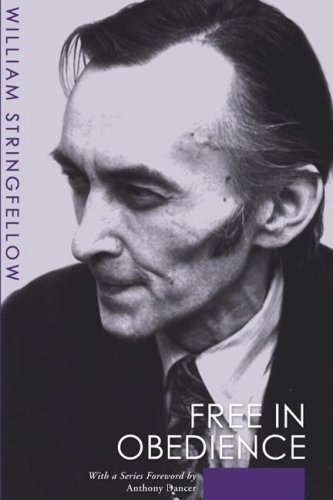
 Here’s the links to my posts on William Stringfellow’s wonderful book Free in Obedience:
Author: Jason Goroncy
William Stringfellow, Free in Obedience – Part V
The final chapter in Free in Obedience is a reflection on the freedom of God, which the opening paragraph describes thus:
‘The freedom of God in his ruling love for this world in this world is not at all coincident with, contingent upon, nor captive of the Church, much less so of the churches or of individual Christians. If the Church or those within the churches do not see and honor the freedom of God, if they will not thus acknowledge and worship God, if they persist in vain commendations of themselves instead of in gladness in the Word of God, if they indulge in boasting witness to themselves rather than bragging of their weakness to explain and attest God’s grace and strength, if they conceive of salvation as in part attributable to themselves and not wholly the gift of God’s initiative in this world, then God, as has been the case before, in his terrible and magnificent generosity with himself in the world, will simply find his own way of working his will and do without the churchly institutions and those who profess to be Christians and, so to speak, take over wholly himself the ministry of the Church’ (pp. 107–8).
This is a chapter written with Bonhoeffer-like boldness, where the demarcation often made (by pietists and moralists) between ‘being’ and ‘doing’ is erased, as is the case in love. So what then is the believer’s task in the world? It is, Stringfellow contends, ‘to so enjoy the Word in the world as to attest the veracity of the Word of God for all men in any and every event’ (p. 117), it is to witness to the one Word of God in the gospel, an action which is always an ‘inherently sacramental event’ (p. 117) and as such is a ‘festival of the event of reconciliation already taking place in the midst of history’ (p. 118). He warns that where the sacraments fail to represent the unity of being and doing in the Church then they become idols, ‘no different from the other principalities of tradition and institution in the world’ (p. 119) and their use then becomes idolatrous. He also warns that ‘when the forms of the sacraments become idols and the sacraments become radically secularized, the world is misled about the meaning and grandeur of God’s work and bewildered about the scope and substance of the Christian faith’ (p. 119). He writes about church offerings, about the daily work and witness of God’s people in the world, and about how Christian freedom consists of the acceptance of the fact of one’s own justification as the work of divine freedom which relieves believers of the anxieties over how God judges us. The believer can therefore live and act, whatever the circumstances, without fear of, or bondage to, either their own death or the works of death in the world. The believer is both enabled and authorised by the gift of the Spirit in baptism to ‘expose all that death has done and can do, rejoicing in the freedom of God which liberates all men, all principalities, all things from bondage to death’ (p. 128). He continues:
‘That being so, the Christian is free to give his own life to the world, to anybody at all, even to one who does not know about or acknowledge the gift, even to one whom the world would regard as unworthy of the gift. He does so without reserve, compromise, hesitation, or prudence, but with modesty, assurance, truth and serenity. That being so, the Christian is free, within the freedom of God, to be obedient unto his own death’. (p. 128)
Don’t forget Wipf & Stock’s offer to readers of Per Crucem ad Lucem of 40% off the retail price of any of the Stringfellow volumes. To obtain the 40% discount, just include the coupon code STRINGFELLOW with your order.
William Stringfellow, Free in Obedience – Part IV
‘The Church is born and lives … in the gift of Pentecost’ (p. 101). It is Pentecost, Stringfellow reminds us in Free in Obedience, that births the Church into the ‘awful freedom’ of Christ’s victory, a freedom from death, a freedom which empowers the people of God to live jubilantly ‘during the remaining time of death’s apparent reign, without escaping or hiding or withdrawing from the full reality of death’s presence … It is the freedom to live anywhere, any day, in such a way as to expose and confound the works of death and at the same time to declare and honor the work of Christ’ (pp. 75–6). This freedom is not given for God’s sake, or for the sake of the Church, but in order that the world may ‘recover wholeness and completion of life’ (p. 76). It represents, therefore, an act of divine generosity which gathers up in its ek-static movement a people called to witness to the grace, truth and power of Christ’s resurrection. Those so gathered are called into an ‘ethics of obedience’ (p. 76), a calling which involves a loosening of the grip on the principalities of race, class, ideology, commerce, status, etc., that hold the Church captive:
‘The principality of the nation is served by the silence of the Church on issues confronting society; the nation willingly tolerates a silent, uncritical, uninterfering Church concerned only with such esoteric things of religion as public worship’. (p. 85)
On the whole, the Church – largely confused about the freedom given in the gospel and ‘in which it was constituted at Pentecost’ (p. 88) – has been a faithful chaplain and ‘handmaiden’ (p. 95) to the State, dutifully blessing the State’s causes and idolatrous claims with a ‘dignity of allegiance that ought to be given only to God’ (p. 86). Those already familiar with Yoder’s and Kerr’s critiques of Constantinianism’s project of the politicisation of the church according to the terms of the state, the civil sovereigns, powers and principalities of this world, will find echoes here in Stringfellow.
After a discussion on the legitimacy and necessity of civil disobedience (though the Church is never to engage in civil disobedience as anarchists but only in order to affirm the nation’s true vocation), Stringfellow brilliantly outlines the proper relation between church and state (neither of which are ‘exempt from the fall’ (p. 98)) under God’s authority. He argues that ‘the Church vis a vis the nation is always in the position of standing against the nation in the nation’s bondage to death; at the same time, the Church is always in the position of standing for the nation in a most profound way that recalls the vocation for the nation in the service of God … The Church reminds the nation, as it is does any other principality, of the origin of its life, of the service it owes to God, and of the accountability of the nation to God in ruling the common life of men in society’ (pp. 92, 93). He also identifies the void in Protestant moral theology which fails to account for the way that those church bureaucrats who think that they control the institution are themselves slaves to the principalities of death.
‘This does not mean that Christians should be loath to work in churchly institutions, but it does mean that those who do should be aware of the reality which confronts them and should not be romantic about it because the principality bears the name “church.” Above all, they should be prepared to stomach the conflict which will surely accompany their use of the freedom from idolatry of even churchly principalities which Christ himself has secured’. (p. 99)
Stringfellow then engages with a wonderfully-helpful reflection of the ongoing power and significance of Pentecost (and of the authority present in Christian baptism) for shaping and determining Christian witness in a world in which King Jesus, possessed of the Holy Spirit, triumphantly encounters the powers and principalities of death – and death itself. ‘The Church, in the gratuity of Pentecost, is enabled to witness to God’s authority over the principalities in his victory over death by its knowledge of death, its discernment of the powers of death, and by unveiling and laying bare the works of death in this world’ (p. 102).
Don’t forget Wipf & Stock’s offer to readers of Per Crucem ad Lucem of 40% off the retail price of any of the Stringfellow volumes. To obtain the 40% discount, just include the coupon code STRINGFELLOW with your order.
‘After A Mockingbird’, by Robert Cording
 At my open window—the lurching runs
Of mews and whistles, mechanical arias,
Whirligigs of a robin’s snatched cheerily, cheerily, cheerily.
Too much, too much
Isn’t music, but this mocking-
Bird will not get down from its high perch,
Will not quit calling out, there’s no milk, no milk, no milk;
The car needs gas, the car needs gas;
Hurry, hurry, hurry; that tie? that tie? that tie?
Until the bird seems legion,
And mockingbirds look down
From the lilac’s every branch, dismantling me
One moment at a time. Yet after
It flies off, no more than the briefest incarnation,
I step away from my desk,
From the hallway clock ticking off the silence,
And, at the window, sunlight shouts in the grass,
Irises guzzle clear blue air down their throats,
The lilac’s purple honeycombs buzz with sweetness.
– Robert Cording, Common Life: Poems (Fort Lee: CavanKerry Press, 2006), 88.
William Stringfellow, Free in Obedience – Part III
In his chapter, ‘Christ and the powers of death’, Stringfellow continues to identify and speak to the principalities and powers, what moderns call ‘ideologies’, ‘institutions’ and ‘images’, the latter being a variety of angelic power manifest in the cultus of celebrity and exists independently of actual persons . So when someone like Marilyn Monroe, James Dean or Adolph Hitler dies, the image does not die but goes on to ‘a new and, some would say, more vigorous life’ (p. 53), and those who pay homage to the image are literally possessed by it.
The principalities of institution – corporations, government agencies, ecclesiastical organisations, unions and universities – demand uncompromised worship no less than do the images: ‘Everything else must finally be sacrificed to the cause of preserving the institution, and it is demanded of everyone who lives within its sphere of influence … that they commit themselves to the service of that end, the survival of the institution’ (p. 56). The principalities of institution offer invitations to bondage.
Having named the idolatrous powers of personality cult and principalities, Stringfellow then turns to the ideologies – totalitarian, democratic and capitalistic – all of which are given to nation-survival at all cost, all of which claim a person’s ‘loyalty, service and worship’ (p. 60), and all of which live in conflict not only with one another but as enemies of human being and flourishing. Indeed, ‘the separation from life, the bondage to death, the alienation from God which the fall designates’ (p. 62) is manifest in humanity’s bondage to the principalities and turn to them for salvation:
‘When a principality claims moral pre-eminence in history or over a man’s life, it represents an aspiration for salvation from death and a hope that service to the idol will give existence a meaning somehow transcending death’ (p. 64).
These are the very principalities and powers – ‘the awesome and manifold powers of death’ (p. 71) – that are confronted and overcome by Jesus Christ in his resurrection victory, ‘not for himself, but for us … His resurrection means the possibility of living in this life, in the very midst of death’s works, safe and free from death’ (p. 72). In his cross, Jesus bears the full brunt of the hostility of the principalities and powers towards him, submitting to their condemnation, accepting their committal of himself to death, and, in his resurrection, exposing, undoing and bringing to nought the false lords of history and the powers they represent.
Don’t forget Wipf & Stock’s offer to readers of Per Crucem ad Lucem of 40% off the retail price of any of the Stringfellow volumes. To obtain the 40% discount, just include the coupon code STRINGFELLOW with your order.
William Stringfellow, Free in Obedience – Part II
Stringfellow continues to expose the deathliness of the principalities and powers in his second study, ‘The Scandal of Palm Sunday’, which is based on Hebrews 2:18.
‘Men live in the city of death. All the cities and societies of the world are places of death’ (p. 31). The temptation that death holds out to us, Stringfellow avers, is to save us from death: ‘that is how cruel and vain and filled with guile death is’ (p. 31). Plato, Constantine, Rousseau, Jefferson and Marx are all authors of societal forms by which we are solicited, enticed and/or coerced into death’s service. But God is about planting and building a free society, and God does so among the dead. The foundation of this society can only rest on one who exercises freedom and authority over the machinery of death; namely Jesus Christ, who forgives the idolators of death, and who in his cross makes us members of his body. But,
Men hate the Cross because it means a salvation which is unearned, undeserved, unmerited. Men would much prefer God to punish them than to forgive them because that would mean that God is dependent upon men and needed their obedience to be their God. Then God would be in fact no different from an idol of race, nation, family, or whatever, and a man would feel justified either by his obedience to the idol or by the punishment of his disobedience. (p. 33)
Stringfellow believes that Palm Sunday is not a day of triumph but of dramatic temptation for Christ, and ‘profound frustration’ for the disciples. Moreover, it is for us moderns a ‘symbol of the terrific confusion which burdens the Church as to the meaning and manner of the Christian witness in society … If only Palm Sunday were the outcome of Christ’s ministry, Christians would be rid of the gospel and free from all that distinguishes them as Christians from the rest of the world’ (p. 34). If Christ’s ministry ended here among palm branches and civic celebration, we could be spared the embarrassment of Judas’ betrayal, the apathy and cowardice of the remaining eleven, the mystery of the Last Supper, Gethsemane’s sweat and agony, the accusations of the authorities, the ridicule of the crowd, the cross and the descent into hell, the embarrassment of the resurrection and the ‘awful gift of Pentecost’ (p. 35).
But here the wilderness tempter enters the city to tempt Christ, the embodiment of Israel in one person, with the same offer of worldly power, only this time he uses Messiah’s disciples to do the work. And again, Jesus is victorious over the temptations of death. ‘Palm Sunday is no day of triumph; for Christians it is a day of profound humiliation’ (p. 37).
Stringfellow believes that Palm Sunday represents an invitation to the Church to enter into the depths of the world’s existence with nothing to offer but their own lives. We can be so given to the world that we are, in Christ, secure from every threat that death may make. This givenness is the exercise of our ultimate freedom, and represents a sacramental rather than a moralistic witness. It means the Church’s involvement rather than distance, realism rather than withdrawal, knowledge rather than ignorance: ‘The ethics of witness to redemption are sacramental ethics of grace, rather than of prudence or of law’ (p. 39). This calls for being at the full disposal of the world with no strings attached and empirically free from the threat of death.
That is where the irony and confusion of so much of what is asserted to be Christian witness in society nowadays comes in. The mission to the city and specifically to the slums, the decrepit and depressed regions of the city, has been engineered by bodies, councils, committees, and commission who neither individually nor corporately are seriously or radically involved, and certainly not to the point of risking possession or reputations, much less death itself. Instead these ecclesiastical engineers ponder statistics of urban development, of the migration of races and nationalities, of the topography of the churches of the city; then they decide that a church building is needed here or a settlement house must be constructed there (p. 40).
I lost count of how many times Stringfellow talks in this chapter about ‘the ethics of witness’, but his point is in your face, and deserves to be.
Don’t forget Wipf & Stock’s offer to readers of Per Crucem ad Lucem of 40% off the retail price of any of the Stringfellow volumes. To obtain the 40% discount, just include the coupon code STRINGFELLOW with your order.
John Knox: An Introduction to His Life and Works: a wee review
 Richard G. Kyle and Dale W. Johnson, John Knox: An Introduction to His Life and Works (Eugene: Wipf & Stock, 2009). xi + 208 pages. ISBN: 978-1606080900. Review copy courtesy of Wipf and Stock.
This volume, co-penned by two scholars well published on the book’s subject, traces the life and thought of John Knox. It does so not via an attempt at what we might call ‘straight biography’ but rather through a chronological examination and interpretation of his writings. The interpretation of Knox offered here is sympathetic but fair, helpfully introduces some secondary literature on Knox, avoids an over-romanticised reading of the preacher whom Stewart Lamont described as ‘a cross between Ian Paisley and the Ayatollah Khomeini’, and avoids the temptation succumbed to by many contemporaries biographers of judging too harshly the personalities of the past against the values of the present.
A very accessible and (apart from some editorial oversights and typos, for e.g., an incomplete bibliography, and who is T.F. ‘Torrence’?, on p. 21) well-researched introduction to a complicated yet decisive period in Scottish history, and that via the life and thought of one of its great saints. John Knox: An Introduction to His Life and Works is an easy book to commend, and those looking for a genuine entrée on the life and thought of a volcanic prophet with ‘the courage of a lion’ could do little better. Those hungry enough to also want a main course would be well served in the devouring of John Knox by Rosalind K. Marshall too.
Lectures by T.F. Torrance, Interview with Trevor Hart
 Grace Communion International have made available for download T.F. Torrance’s lectures on the Ground And Grammar Of Theology. These were given in 1981 at Fuller Theological Seminary.
- Lecture 1
- Lecture 2
- Lecture 2 Q&A
- Lecture 3
- Lecture 3 Q&A
- Lecture 4
- Lecture 4 Q&A
- Lecture 5
- Lecture 5 Q&A
- Lecture 6
- Lecture 6 Q&A
- Lecture 7
- Lecture 7 Q&A
- Lecture 8
- Lecture 8 Q&A
- Lecture 9
- Lecture 9 Q&A
- Lecture 10
- Lecture 10 Q&A
 They have also uploaded a recent interview with Dr. Trevor Hart, in which Trevor (who was my Doktorvater) talks with characteristic clarity about the theology of Karl Barth, and about the vicarious humanity of Jesus Christ.
You can watch the interview here.
William Stringfellow, Free in Obedience – Part I
I like how Anthony Dancer describes reading Stringfellow:
Despite the polemic and rhetoric, Stringfellow’s writing is neither a fanciful manual nor some early type of Google search engine for the Christian life. Instead he rewards sustained and quiet engagement, offering us an ethic that is at once simple but never easy; he reminds us of the need to be vulnerable to the world and God, and to be obedient to the call to authenticity just where we are. He reminds us of the politically and totally transformative significance of the fact that the reign of the power of Death is over, and that we are no longer bound by fear, but can once again live truly, and wondrously, in freedom. In short, he reminds us who and where, in the Word of God, we are called to be. (Free in Obedience, xiii).
Free in Obedience, which takes its theme from the Letter to the Hebrews, began life as a book for Lenten study. Importantly for his presentation, Stringfellow discerns no real distance between the original recipients of the letter and the church today – ‘the Christians today are the Hebrews’ (p. 7). And just like the original recipients,
The modern churches and the present-day Christians must, if they are to qualify to address and act in this world amid all the technologies, institutional powers, dehumanizing threats, frightful dangers of extermination, and ruthless idols which encompass men, trust the gospel. They must trust it enough to rely upon the discernment of those of the people of God who in preceding ages spoke and acted in their times and in the world as they knew it in the confidence that the Word which they heard and celebrated is the same Word present, uttered, and received in the world as it is now. (p. 8)
That ‘Christ is crucified in the freedom of the resurrection’ (p. 15) means that ‘the people and the things with which an ordinary Christian comes into contact from day to day are the primary and most profound issues of his faith and practice’ (p. 16). Stringfellow charges that the reason that moderns do not appear to pay attention to the Christian faith or to take the Church seriously is because churches have too often given men and women the impression that ‘they do not care about [people] or the world. They have misled [people] into supposing that the Christian faith has nothing to do with the ordinary issues of daily life’ (p. 18). They have, as Nathan Kerr too observes, missed the fact that God’s interruption of history in Jesus Christ is unintelligible apart from its operativity within the ongoing contingencies and complexities of history, that the lived embodiment of Christ’s lordship as a sign of the Spirit’s ongoing conversion of history to God’s coming reign involves, in the freedom of the missio dei, the creation of ecclesial witness to the centres of earthly power. And they have, Stringfellow insists, escaped the reality and decadence of the cities and ‘moved to the suburbs – only to find out that the same problem of the mission of the Church still plagues them, since the suburbs are satellites of the city’ (p. 20). Those who have remained in the city have been hiding out. Clearly, it is the missio ecclesiae for which this Harlem-based lawyer concerned about the immobility of the city’s poor confined to their ghettos – existing in ‘subjection to the principalities that rule the city’ (p. 24) – is troubled by here:
The rudiment of mission is knowledge of the city because the truth and grace of the Incarnation encompasses in God’s care all that is the city. Mission in the city for the Church, and hence for Christians, means a radical intimacy with every corner and every echelon of the city’s actual life in order to represent and honor God’s concern for each fragment of the city’ (p. 22)
Stringfellow suffers from no illusion that the modern cities which have emerged from industrialization and urbanisation are places neither of freedom nor of society. Rather than being cities of salvation, they are places where feudalism survives, kept alive by the propaganda machines of industrial and commercial powers, and by the moral theologies of Protestantism. ‘Medieval demons are not dead … They were not exorcised in the building of the city. They still exist there. The city is their present realm and their plunder’ (p. 26).
This is the situation that the Church must weigh accurately, and not suppress or flinch at, if it is to cease its blushing and turn towards the city in love that risks all reputation and possession. In order to do so, it must make the traumatic move of getting out bed with the heretical ideology of the industrial revolution (which supposes that we might save ourselves) and into bed with the gospel. Here Stringfellow is calling for ‘the renewal of the sacramental integrity of the churches’ (p. 29).
Don’t forget Wipf & Stock’s offer to readers of Per Crucem ad Lucem of 40% off the retail price of any of the Stringfellow volumes. To obtain the 40% discount, just include the coupon code STRINGFELLOW with your order.
Reading William Stringfellow
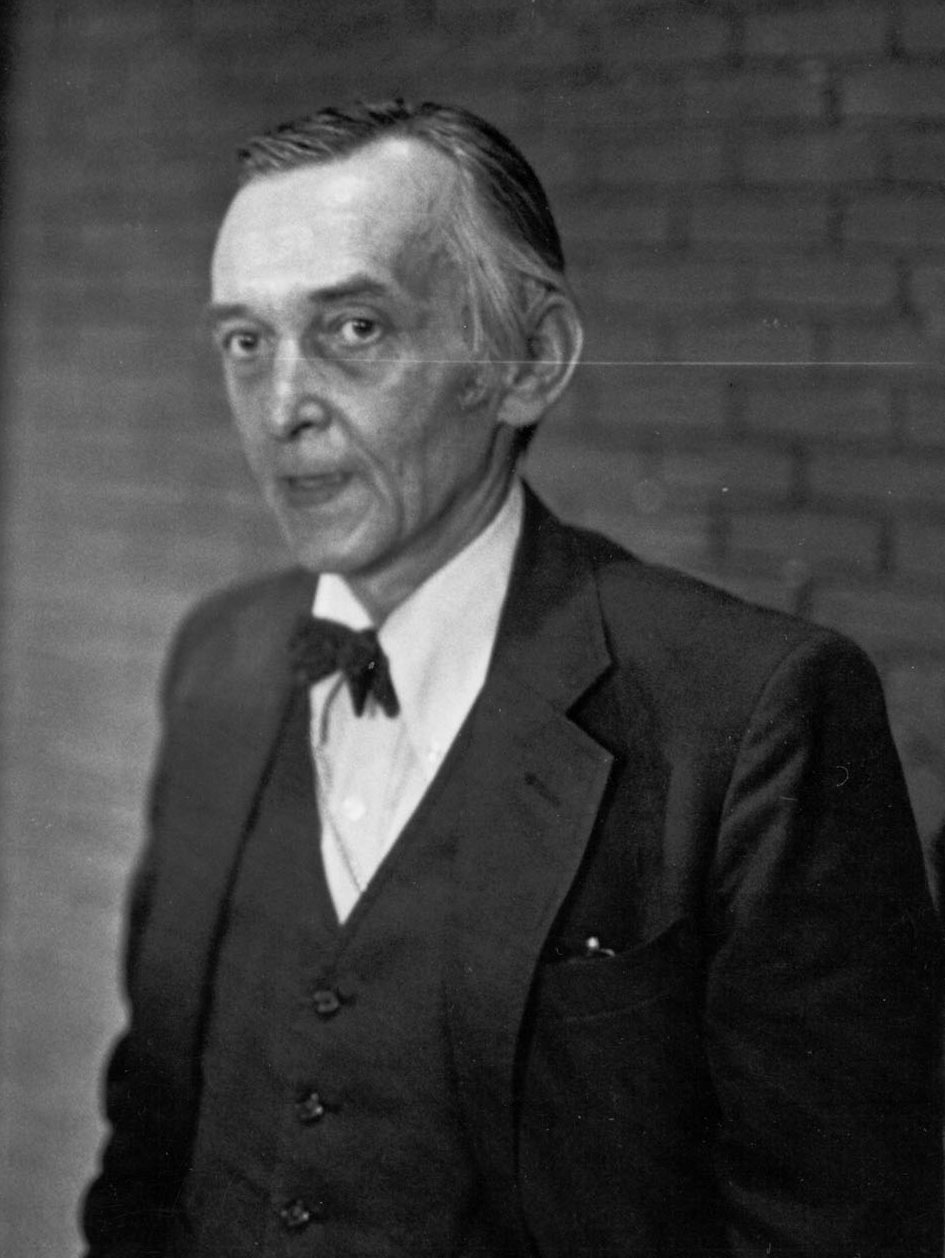 When someone of Rowan Williams’ calibre (and there are few of those) describes one of his contemporaries as ‘probably the most creative and disturbing Anglican theologian’ of the twentieth-century, we ought to sit up and take notice. Williams was talking about William Stringfellow, the exposer of our culture’s idols.
Over the next month or so, I hope to make my way through Stringfellow’s work (some of which I’ve read before, and some of which will be new), and to post some of my scribbles along the way. My agenda is two-fold: (i) to introduce you to the thought of a brilliant though still-too-under-appreciated twentieth-century theologian; (ii) to encourage you to pick up and read his work for yourself, whether on your own or – as may well be preferable – in small groups. But if the latter, you ought to heed Mary Perkins Ryan’s warning (in her ‘Introduction’ to Imposters of God) about Stringfellow and group reading: ‘no group, young or old, that [reads Stringfellow] as the basis for discussion will find its meetings dull. They might even become too exciting for comfort – and so might the lives of those who take seriously what this book has to say’.
Our friends over at Wipf & Stock have republished most of Stringfellow’s published material, an act for which we can be deeply grateful. They have kindly offered readers of Per Crucem ad Lucem 40% off the retail price of any of the Stringfellow volumes. This represents a fantastic opportunity to avail yourself of some of the most perceptive theological literature of the twentieth century, and all at a great price. To claim the 40% discount, just include the coupon code STRINGFELLOW with your order.
Here’s a list of the available Stringfellow titles:
- Count It All Joy
- Instead of Death
- The Bishop Pike Affair (with Anthony Towne)
- Suspect Tenderness (with Anthony Towne)
- Imposters of God
- A Private and Public Faith
- Conscience and Obedience
- A Simplicity of Faith
- Free in Obedience
- An Ethic For Christians and Other Aliens in a Strange Land
- My People is the Enemy
- The Death and Life of Bishop Pike (with Anthony Towne)
- A Second Birthday
- They Call Us Dead Men (by Daniel Berrigan)
- Dissenter in a Great Society
- The Politics of Spirituality
‘My Uncle’s Parrot’, by Robert Cording
 It’s the voice I hear, the one that comes
When my talk suddenly becomes preachy,
And my class of freshmen begin to nod
Their heads in assent as I’m delivering
Some grand moral claim for Wordsworth’s
Leech-gatherer, or declaring there is a way
To live out our lives hopeful and happy.
Or it comes when my wife, stepping
From a bath, her neck and belly and legs
Diamonded in the bathroom light, stands
Before me like some St. Agnes Eve vision,
And I believe that, yes, our bodies are
For climbing that ladder from pleasure
To pleasure upwards to the sublime.
Or when I see on the late night news
How a whole town, businesses included,
Turns out to re-erect a block of
Tornado-tossed houses and think we could
Learn to live in just that state of love,
The beginning of what could be
Endlessly multiplying loaves and fish.
Or even when late at night, alone,
Reading a good book and listening to
Vivaldi’s oboes, a cup of tea warming
My hands, I suddenly think, then and there,
That everything in my life has only had
The illusion of significance, that
The truth is absolute meaninglessness.
At all those times and more, I hear
The point-blank voice of my uncle’s parrot
Say, bullshit, the only word he could
Ever teach it, though the parrot possessed
An unerring sense of timing,
A pitch-perfect ear for the exact moment
In the conversation when its shrill trumpet
Was required: bullshit, it blared again
And again with the authority of a god
Who knew, as Pascal said, how to keep faith
And doubt off balance as he went on
Balancing both sides of every equation.
– Robert Cording, Common Life: Poems (Fort Lee: CavanKerry Press, 2006), 43–4.
Undergrad schmundergrad
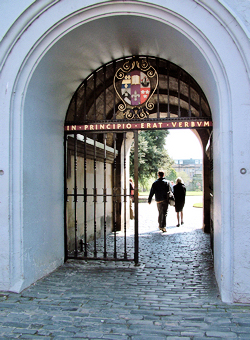 I’ve been reading a very fine essay by James Kirk on ‘The Religion of Early Scottish Protestants’ in Humanism and Reform: The Church in Europe, England, and Scotland, 1400-1643, wherein I was struck by the following:
‘In St Andrews University, too, humanist impulses and Erasmian evangelism are detectable in the creation of St Mary’s College, licensed by papal bull in 1538, to reinvigorate Catholic teaching and refute heresy, and in repeated efforts to erect a trilingual college, as advocated by the nephew of Cardinal Beaton, Archibald Hay, first as regent in Paris and then as Principal of St Mary’s. His dream was of a college not just for the study of the humanist disciplines of poetry, rhetoric, history and ethics, but for advanced training in theology by promoting the biblical tongues. Chaldaic and Arabic, he argued, ought to be taught as well as Greek, Hebrew, and Latin. More tangibly, in recommending the Scots humanist teacher at the College des Presles in Paris, John Douglas, for a post in St Andrews, Hay helped secure the services of a Paris bachelor of medicine (and probably also a doctor of theology) who, as Provost of St Mary’s, chose the Protestant path at the Reformation and as a contributor to the Reformers’ Book of Discipline in 1560 shared responsibility for the detailed discussion on reorganizing the universities. Douglas’s own arrival in St Andrews was followed with the appointment by 1556 of another Paris scholar, John Rutherford, to St Mary’s (later to head St Salvator’s), to teach philosophy, Greek, and Latin, a step which (despite his neo-Aristotelianism) helped strengthen the advance of the humanities within the University, for Rutherford (who also had medical interests) was well travelled in Europe, having lived in Bordeaux, Montaigne, Coimbra, Périgord, and Paris; and with the Reformation, he became a convert to Calvinism, owning copies of Calvin and Beza (and also Wolfgang Musculus, the reformer at Augsburg, on the Psalms)’. (p. 364)
As an ex-student of St Mary’s College, I was very interested to read this, and was led to wonder just how easy those undergrads – who manage to get a theology degree without having to read any Augustine or even having to master Chaldaic – have it these days. C’mon Steve, lift your teams’ game!
Holy Spirit in the World Today Conference talks
 Most of the talks from the recent Holy Spirit in the World Today Conference, a two day conference jointly sponsored by St Paul’s Theological College and St Mellitus College, are now available for download:
- Homily – Rowan Williams
- Whispers of God at Work, in Cyberspace, in the Media and among the Young – Ken Costa
- Interview with Professor Jürgen Moltmann
- The Church in the Power of the Spirit – Jürgen Moltmann
- Q&A with Professor Jürgen Moltmann and Archbishop Rowan Williams
- Key Issues in Pneumatology – David Ford
- One Spirit, Many Tongues: Globalization, Faith Traditions, and Human Flourishing – Miroslav Volf
- Filled with the Spirit – Sandy Millar
- Bible Reading – Jane Williams
- In the Spirit: Learning Wisdom, Giving Signs – David Ford
- Q&A with Miroslav Volf and David Ford – COMING SOON!
- Life in the Spirit: Identity, Vocation and the Cross – Graham Tomlin
A word from the East on Yoder and Jenson
 Brad East has posted some helpful notes on the similiarities and differences between the theology of Yoder and Jenson. It’s worth reading the whole thing, but here’s a taster on the question of the nature of the church:
‘Yoder sees the church as a minority people in exilic sojourn among the nations, a servant community sent on behalf of others and therefore unwilling to exercise coercion for any reason, but just so socially responsible insofar as cruciform servanthood is the grain of the cosmos and the only truly transformative power in human community. In other words, the life of the church is defined by Spirit-enabled apocalyptic discipleship to the concrete sociopolitical life and teachings of Jesus of Nazareth, crucified and risen.
Jenson sees the church … differently. Somewhere he says that the entire mission of the church is “the saying of the gospel.” Elsewhere he claims that the community of the church over time is literally the body of the risen Christ on the earth. He also states that, when Constantine asked the bishops to help run the empire, they had nothing else to say but “yes.” He believes with Augustine that the only truly just society is one that worships the true God, and that just war is possible in a legitimately Christian society. Finally, he is able to articulate and is energized by the vision and history of a (high) Christian culture, and speaks to American governance in the hopes that a Christian politics – namely, the right ordering of heterosexual marriage and the consequent protection of the unborn – might both win the day and lead to the formation of a more coherent society.
Moreover, of course, the church catholic for Yoder is the free church: dogma, creed, papal bull, ecumenical council – none of it is binding or revelatory for God’s people. And for Jenson, dogma is either always and everywhere true and binding for the church, or the church is not the same community as that of Peter and Paul. And to be sure, in a church divided, God may act for unity tomorrow – in the restoration of communion with Rome. Not so much for Yoder’.
May bests …
 From the reading chair: The Night Trilogy: Night, Dawn, Day by Elie Wiesel; A Simplicity of Faith: My Experience in Mourning and Free in Obedience by William Stringfellow; Christology: A Global Introduction by Veli-Matti Karkkainen; Emily Dickinson’s Approving God: Divine Design and the Problem of Suffering by Patrick J. Keane; Return to Rome: Confessions of an Evangelical Catholic by Francis J. Beckwith; The Plague by Albert Camus; Changing the Conversation: A Third Way for Congregations by Anthony B. Robinson (reviewed here); Theological Investigations, Volume 19 by Karl Rahner; Playing God: Poems About Medicine by Glenn Colquhoun; For Us Surrender Is Out of the Question: A Story from Burma’s Never-Ending War by Mac McClelland; Naming the Silences: God, Medicine, and the Problem of Suffering by Stanley Hauerwas.
Through the iPod: Bach Cantatas 57, 110, 151 by Bach Collegium Japan, Masaaki Suzuki; Sacrificium by Cecilia Bartoli; After the Morning and Hill of Thieves by Cara Dillon; Hindemith: Viola Sonatas, Vol. 1 by Lawrence Power Lawrence Power and Simon Crawford-Phillips; The Near Demise of The High Wire Dancer by Antje Duvekot; Nicola Porpora: Orlando by Olga Pitarch, Betsabee Hass Robert Expert.
On the screen: The Idiot (Hakuchi) [1951]; Winter in Wartime (Oorlogswinter) [2008]; We Can Be Heroes [2010]; Breaking the Silence: Burma’s Resistance [2009].
Reading Genesis 1:2
 A guest post by Rev. Dr John Emory McKenna. [John, a student of TF Torrance, serves as a Doctrinal Advisor to the Worldwide Church of God in California, as Professor & Vice-President at the World Mission University in Los Angeles, and as Adjunct Professor with Haggard Graduate School of Theology. He has published The Setting in Life for The Arbiter of John Philoponus, 6th Century Alexandrian Scientist and The Great AMEN of the Great I-AM: God in Covenant with His People in His Creation]
About Genesis 1:2, Karl Barth has written, “This verse has always constituted a particular crux interpretum – one of the most difficult in the whole Bible – and it is no small comfort to learn from Gunkel that it is a ‘veritable mythological treasure chamber.’”[1] After a rather thorough examination and analysis of the history of the exegesis this verse, the great Swiss theologian concluded in a fine print section of his reading, “Our only option is to consider v.2 as a portrait, deliberately taken from myth, as the world which according to His revelation was negated, rejected, ignored and left behind in His actual creation.”[2] Barth develops his understanding of ‘Das Nichtige’ (‘The Nothingness’), as belonging to the mystery of evil in the Biblical world, a world he reminds us that is very different from the one with which we are already only too familiar. The ‘chaos (תהו) and emptiness (בהו), ‘darkness’ (חשך) and ‘deep’ (תהום) of the ‘waters’ (מים) over which the Spirit of God ‘broods’ (מרחפת) in Genesis 1:2 are terms, then, that belong to the myths and idols of those views of the world that exists outside of God’s Revelation of His ‘Very Good’ Creation. Genesis 1:2 belongs to a confession, in common with the various ‘creation epics’ found among the nations of the Ancient Near East, that contradicts the perfection inherent to the Creation Week according Israel’s view of the world.[3]
In this post, I will argue that Barth’s understanding of the significance of Genesis 1:2 and his assertion that ‘Das Nichtige’ of Israel’s Creation Theory is only a partial grasp of the intent and purpose of the author of the confession of the Creation Week. I would argue that Barth’s grasp of the meaning of Genesis 1:2, achieved in the context of a general consensus accomplished by modern or post-modern methods of historical-critical methods of interpretation applied to Genesis, is only a partial understanding of the purpose of the significance of the confession. I will argue that, for suppositional reasons, the modern mind has become more comfortable with reading the creation out of chaos of v. 2 as the intent of the confession, when we tend to disregard the implication of doctrine of creatio ex nihilo found within the Judeo-Christian tradition of interpretation.[4] The willingness to divorce our understanding of chaos, emptiness, darkness, and the deep of the waters, over which the Spirit of God is said to ‘brood’, is the willingness of modern Biblical Theologians to remain separated from the meaning of the doctrine of creatio ex nihilo of v. 1, a meaning with which the early fathers of the Church steadily wrestled.[5] We will argue that the preference for reading the concept of ‘creation out of something’, without a confession of the ‘creation out of nothing’ doctrine, perpetuates a fragmentation in our understanding of the meaning of ‘Day One’ in the Creation Week inherent in the confession of Israel’s Moses, the great prophet of her history among the nations. We need to recover the interpretation of the early fathers of the Church and obtain a fresh grasp of the theological wholeness of the confession in our time our theology and its relationship with science.
The confession of the Creation Week possesses, from beginning to end, a wholeness the polemical power of which is purposed to call Israel among the nations in God’s Creation away from her idols and myths about the gods and the world. It posits a background whereby the other creation epics prevalent in the Ancient Near East are denied their claims to the reality of the world, of mankind, and of God. It would transform any language into that service that is true to the intention and purpose of the Voice Moses heard in the Burning Bush and in the events of the Exodus of Israel from Egypt. ‘The Beginning’ according to Moses’ claims that no other Voice than this Voice is to heard as the Creator of the world and its mankind. Against all the idol and myth-making among the nations surrounding Israel in the ANE, Israel as the People of God must bear witness to this One, who as the Creator is the Great I-AM and Lord of the world’s redemption. In the face of Moses’ witness as the Prophet in the Ancient World, mankind is to throw away its myths and idols about the world of the gods. This One is the Redeemer-Creator who as the Great I-AM would be known as the One He truly is, the Creator of ‘the Beginning’ in the Beginning.
Genesis 1:2 may not be construed as possessing, in common with the creation epics found and read among the nations in the ANE, a language influenced in its significance by the myths and gods of the ancient peoples, but a language meant to transform their beliefs into the real service of the Revelation that drove Moses to his confession. We will claim that, just as the Exodus of Israel is something new in the history of the world, Moses’ confession of the Creator, based upon the Revelation with him of the Redeemer, is something new in the history of the race’s understanding of the Creation and the Creator. The One of this Revelation is to be known as the true Creator of the heavens and the earth. The One of this Revelation, the Redeemer of Israel among the nations in His Creation, is to be known against the myths of the gods of the ancient peoples. This One is the True Creator who possesses nothing in common with the gods of the ancient worlds, with their cosmogonies, with their interactions with our kind, with the idol-making common to the times. Rather, with this One the reality of the world as God’s Creation is to known in its nature, free from the magic and the superstitions of these peoples. This is the One who is Israel’s Lord and God, the One who redemptive acts with Israel would have His People to know their true Creator. With His acts to deliver Israel from her bondage to Egyptian gods and Egypt’s Pharaoh, wrought through the priestly and prophetic servant of God Moses was called to be, Israel is commanded to understand and to throw away all her gods, her Mesopotamian gods, her Egyptian gods, her Canaanite gods, and so forth, and know Him as the Great I-AM He is. When Moses employs, then, the terms of his confession among the nations in the ancient world, he would transform their meaning and give them a new significance never before heard in the history of the world. We do well, I believe, to hear them on his terms and not our own.
The language of Moses’ confession, then, transforms the terms that may be found in common among the peoples of the nations in the ancient world into meaning that serves the Voice of God in His Beginning of the heavens and the earth and so forth. The Voice that spoke with him from the flames of the Burning Bush at Horeb is the Voice that speaks in the Creation Week. The events of the Exodus of Israel from Egypt all belong to this Voice. This is the Voice Moses learns to confess as the Creator with His Creation. To Israel with this Voice is given the knowledge that her Redeemer is none other than the Creator of the Creation. Moses’ confession is purposed to serve this Voice with an intention that belongs to the redemption of Israel in the Exodus and the knowledge of her Lord and God, the Creator of the Beginning. This is the One Lord God Israel must hear and follow. This is the Voice of the Great I-AM the One Lord God is. This is the Creator of the holy ground on which Moses stands at Horeb and on which Israel must always stand. This is the Creator. His Beginning is the Beginning confessed against all idols and idol-making about the gods of the world. This is the Lord God of space, time, and all things that exist as created realities. The power of Moses’ polemic ought never be allowed to escape our attention. It belongs to what is universal. It belongs to what is particular. It belongs to what mankind is under the heavens and upon the earth as rooted in this Self-Revelation of the Great I-AM the Lord God is with Moses, His Servant. The confession of the formation of ‘Day One’ of the Creation Week belongs to this Revelation. It is with this Beginning that Moses knows the ‘Very Good’ orders of the Creation Week, blessed by God. It is in the light of the Great I-AM the Redeemer is with His People among the nations that Israel can confess the Creator and His Creation.[6]
Israel’s history among the nations in God’s Creation then possesses a prophetic and priestly power we need to learn to grasp. Israel is made to bear witness to her Redeemer, Her Deliverer, as the Creator, who is none other than this Great I-AM that sent Moses for His People to Egypt. This One and no other ‘one’ delivers her from her bondage to her idols among the nations. No other One than this One gave her the Torah and Tabernacle of her history. No other One than this One freed her to serve Him as His Witness among the nations. This is the One and Only One, against all idols and idol-making, Israel must serve in her time and times in the world. The whole history of the Creation, Moses affirms, belongs to the priestly and prophetic power of Israel’s witness to this Creator and this Creation. Thus, the significance of the use of the Names, Lord and God, that Israel employs in her history, is to be found with the Voice of the Great I-AM. He is the One with her in His covenanted relationship for her in the world that gives meaning to her history and her language. We need steadily to hear the polemical nature of the argument of Moses’ confession from its beginning to its vision for her future in the world. We would argue that Moses’ confession of the Beginning is to be read, against all the idols and idol-making and mythologizing with the cosmogonies of the ancient peoples recorded throughout the ANE, is made with Israel’s priestly and prophetic service against these views of the world among the nations because it is rooted in the Self-Revealing and Self-Naming of the Great I-AM this Lord and God is for Israel and her history among the nations. It is the power of this redemption and its judgment that is also the history of the Redeemer-Creator of the whole world. When we will not to understand this ‘Beginning’, created out of nothing by this Creator and no other, we will not to understand the Divine Freedom and Sovereign Authority that commanded Moses with the People of God in the
Revelation to which the whole of the Bible is witness. When we will to understand Moses’ Confession in the service of this Revelation, we will to understand the heavens and the earth as home for mankind, created in the Image of God, the space and time that belongs holily to the real ‘Beginning’ begun in the Beginning by this One and no other ‘one’.
Moses confession thus demythologizes the ancient views of gods, men, and the nature of the world. The race is to be freed from the grip the caprice of these gods and their mythical places. Men are no longer to seek to appease with magic rituals and moralizing sacrifices pantheons of these deities. The superstitions of times past are not to shape and form the civilizations of the future. God, the Lord, has judged these gods as no-gods. They are less or worse than nothing. They belong to the wastelands of time and times past in the time of world history. In the light of Israel’s Exodus from the Egyptian pantheon, then, walks with Israel, as He did once upon a time in Paradise, the Creator God, known as the Lord, who would convert all peoples from the mythologies of their gods and cults to the freedom whose truth rests in the Great I-AM He truly is for them, a new found freedom made firm in the light of the Voice of the Great I-AM with Moses, the Servant of God. He is endowed with priestly and prophetic power for Israel’s freedom from her bondage to the idols and for her Redeemer-Creator, the One Creator of the heavens and the earth and their mankind as the Creation.
‘The Beginning’ of Moses’ Confession is to be understood, hand in glove then, as embracing the significance of Genesis 1:2, within the orders of the Creation established as the ‘First Day’ of the Creation Week in the life of Israel as the People of God among the nations. The whole of Week is blessed as ‘Very Good’ and a finished work with a polemical nature, then, we cannot allow to escape our attention. The gods and the myths of the nations are not ‘true’ about the Lord God of the Beginning of the World and its Mankind. The power of the ‘brooding’ (מרחפת) of God’s Spirit in v.2, interacting with ‘the Nothingness’ of the Creation in this ‘Beginning’, is to resonate with the whole of the blessed and very good Creation. Our understanding of the doctrine of creatio ex nihilo with His act in this ‘Beginning’ (ברא) as the God and Lord He is must be accomplished within the orders of this wholeness. We are invited to read the ‘speaking’ of God in verse 3 in resonance with ‘the Nothingness’ of v. 2. and the ‘brooding’ in concert with verses 4 and 5 and the formation of ‘Day One’ of this Week. Genesis 1:1 is thus meant to entail all the acts of the Creator in the Creation Week. We are invited to listen in on an account of the harmony of the ‘Days’ from the Beginning to the Blessed finish of the work of Creation. Without this concert, we will miss the beauty of the Week, its polemical intention and it purpose as background for Moses’ confession about the ten generations that are told as the Book of Genesis in Moses’ service to the Great I-AM. We purpose that we are meant to hear as listeners a symphony intended to move the hearts of the People of God about what is true and beautiful about the Beginning of a world that is indeed to be seen as ‘Very Good’ with its Mankind and its fall from the One He truly is.
We need to seek to understand the wholeness of all the particular actions from the Beginning to the ‘Day One’ of verses 1–5 then. These are acts that together shape a harmony of action that makes ‘Day One’ what it actually is in the confession. They are the acts of the One who is the Redeemer-Creator of the Self-Revelation Moses experienced at the Burning Bush, at Sinai, and so forth, for Israel, as the priestly-prophet-servant of the Lord God he became for Israel among the nations in God’s Creation. It is this Revelation that stands as the origin of the power to create something new in world history, a new event in the space of the world this comes against all the idols and idol-making and myth-making that belong to mankind’s gods and its past times in the history of the world. It is the power of this Day from this Beginning to which Israel’s faith belongs in this world. It is truly something new, a beginning like no other beginning ever found on the mind of the human race in its past with its gods. It is this ‘the Beginning’ that is not any other kind of beginning. It is the Beginning not out of a war against chaos but out of nothing with a freedom then that with transcendent power transforms out of the something that chaos and emptiness is into what is the will of the Hand of God. Here is the place where God has chosen to speak into existence the orders of His light. Out of nothing and out of this something the First Day of the Creation Week, from the Beginning is given existence. When we read Genesis 1 with a sense of this wholeness, I believe we may and we must interpret v.2 in a resonance with the whole of in the ‘Very Good’ Creation, the blessed and finished work of the God who is the true Creator of the world (Genesis 2:1–3) against all other views about Him.
Barth found among scholars both ready support and opposition to his position on v. 2. We may survey their interpretations in Bernard W. Anderson’s collection of essays about God’s Creation from eight Old Testament scholars.[7] Hermann Gunkel thought that the chaos and so forth of v.2 ‘belongs to mythology and cannot be viewed as the invention of an author, least of all the person of P’.[8] Gerhard von Rad believed[9] that the Creation, as read in conjunction with texts in the Old Testament other than Genesis 1, was written under the influence of Egyptian Wisdom, when Israel is dependent upon such Wisdom for her grasp of the skills for success in life.[10] Then the Jesuit Father, Dennis McCarthy, suggests that we ask the wrong question when we think to contend that Genesis 1 means to teach us the doctrine of creatio ex nihilo.[11] The text is concerned with what German scholars have named Chaoskampf, a ‘war on chaos’. The Creator is thought to be a warrior at war with the ‘chaos’ and ‘emptiness’ that belongs to the ‘dark depths’ of the primeval ‘waters’, thus easily compared to what we read across the mythologies about the Creation among the nations. Westermann argues that Genesis 1:1–2:4a reflects a composition whose long history shows us a steady struggle and evolution of understanding of the myths and legends about the world. The lasting value of the texts in time and times are a result of this long evolution in our understanding of the nature of the world. In this sense, we may interpret the developments in the history of the cosmologies of the Western World, the Ptolemaic Cosmology of the Middles Age, the Newtonian ‘System of the World of the Age of the Enlightenment, and even Einstein’s Universe of Light as all related to the concerns of the confession Genesis 1 is.[12] Reminding his readers that the confession must possess in this way some eschatological significance, H.H. Schmidt believes that the ‘righteousness’ of the Creator must be implied in the significance of Creation texts. Moral law and natural law must possess similar values, even though they are difficult to heard as one law.[13] Working with the assumptions made by both Zimmerli and von Rad about the relationship between redemptions and creation, H.J. Hermission is yet unable to understand that the chaos and emptiness and so forth of Genesis 1:2 can be a part of what Creation is. Creation is still conceived as something done perfectly from ‘the Beginning’, without any chaos or emptiness and so forth belonging to its nature.[14] All of these scholars affirm with Anderson that the Chaoskampf , the war in this ‘Beginning’ is against the chaos and emptiness of v.2. The consensus is that Genesis 1:2 signifies some condition of pre-creation that is contrary to the Creation, when the doctrine of creatio ex nihilo does not obtain in the confession of the Week.[15]
Only Walter Eichrodt[16] and G.M. Landes[17] wanted to argue for the doctrine of creatio ex nihilo as obtaining in our exegesis of Genesis 1:1–3. Landes wrote concerning v.2 that ‘At the beginning of its creation, the earth is empty, enclosed by waters in total darkness. But when God’s Spirit moved over the waters to separate them, the earth can be born, so to speak, i.e. it can emerge from its primordial darkness into the light of time, its surrounding waters filled with plants, animals, and humanity.’[18] But with all of this interpretation of ‘Day One’, we find the study of R.C. Clements, investigating the covenant relationship from Abraham to David in Israel’s long history among the nations, without mention of Genesis 1. The Pentateuch is thus read without a grasp of the wholeness between Creation and Redemption, between Creator and Redeemer, as Israel’s covenanted witness to the Lord God of the Revelation in the histories of the nations in the world. The Witness of the Bible to this Revelation with Moses may become lost upon our understanding of its relations with us.[19] It is little wonder that Karl Barth, with his rejection of ‘natural theology’, can conceive that no antecedent conceptual system may provide a framework for interpreting the texts and he must be free to exegete them from any particular cosmological development we might experience from the history of science in our civilization. His opposition to the German Church’s association with Hitler and the Nazi Socialism at the heart of World War II could certainly provide the need for his argument against the spell of the consensus on v.2 on modern understanding of the confession of the Beginning according to Moses in the light of the Incarnation.[20]
After observing the various possible interpretations of v.2 in his time, Barth read with Augustine and Luther, and decided with Zimmerli on the ‘rudiments’ of the verse. He concludes that it possesses no positive connection with v.1.[21] He then contends for the position that v.2 belongs to a past that was never the will of God, a time the Creator never intended to fashion. The tohu and bhohu, ‘chaos and emptiness or the ‘unformed and unsubstantiated’, mean to point as a whole the reader to the ‘rudimentary’condition of the Creation that existed outside of the will of the Spirit of God, when the Spirit ‘…is not known in His reality and therefore hovers and broods over it impotently or wordlessly.’[22] The ‘speaking’ of the Word of God against this primeval condition does what the Spirit could not do. It posits an order of time and times of the ‘light’ that belongs to the ‘speaking’ of God. The argument then follows the views of the ‘Priestly Writer’, in some relationship with the ‘Yahwist’, and the prophets of Israel who contend for the creation of ‘things’ as perfectly good, over which the Spirit of God once brooded so impotently. Genesis 1:2 are the ‘old things’, ‘the things that have passed away’, and according to 2 Corinthians 5:17, ‘the things’ that must vanish in created time and times. Such ‘rudimentary things’ belong to a past that has been superseded, when evil has been rooted out of the Creation, by the time of light in the world’s order.[23] Therefore, Genesis 1:2 posits that which can only be found outside of God’s will for His Creation, even from ‘the Beginning’.[24]
With this position, Barth has thus embraced a very common rendering of the exegesis of the v. 2. In contrast, Brevard Childs, while addressing these same problems, concludes that there was and must be a real connection between v.1 and v.2 and that the ‘brooding’ of the Spirit of God in v.2, the power of God in v.1, and the speaking of God in v.3 must be heard to resonate with one another in some way for any full appreciation of what ‘Day One’ means in the confession. In this way, a full chord of action is struck in ‘the Beginning’ that must be heard with the divine intention and authoritative purpose of a wisdom with which the confession has to do. It is because of this Will and Wisdom that the confession’s polemic against the mythologies of the idol makers of the ancient world may be understood with its prophetic thrust. It is the resonance of this chord that allows the exegete to hear the uniqueness of Moses’ contentions. It is this resonance that allows the interpreter to hear the prophetic power of Moses’ affirmation of the times with Israel. It is this resonance that allows the Great I-AM who is the Lord God of the Revelation in the Exodus of Israel from Egypt to be understood as the Creator of ‘the Beginning’ and the Only One that Israel is commanded to love with all of her heart and strength and might (Deuteronomy 6:4). The One who is the Lord of Israel’s redemption in time and times is none other than the Creator of all the time and times that is ‘the heavens and the earth.’[25] The emphatic use of the verb ‘to be’ in v.2, rather than signifying a disconnect with v.1, affirms concretely that the whole of the Creation is, with its particular orders experienced upon ‘the earth’, belong to a universal created and sustained according to the power of the Spirit of God’s embrace with this ‘Beginning’. The primordial condition of the world’s particulars are thus made to wait on the ‘Speaking’ of God and His ‘light’.[26] It is this world, before the time when ‘light’ was spoken into existence, that the clause intends to signify, this world of time past in the formation of the First Day. The verse thus signifies the condition of the earth under the heavens in a span of time that belongs to a duration before the speaking of God occurred and before the purpose of light gave the order of this time upon the earth in God’s Creation. The emphatic use of the verb ‘to be’ signifies the dynamical nature of the relationship between God, His Spirit, and His Speaking in the Beginning, when the divine actions of creating, brooding, and speaking all, each in their own ways, shape the cause of a world that is meant to be a home for mankind.
The ‘dark’ continues to exposit, then, this signification of the ‘chaos and emptiness’. Childs can consider its meaning as closely related to what death is, opposed to the ‘light’ and the life of the world. But for Childs, the ‘deep’ (תהום) belongs to the primordial waters in relationship to the Spirit of God possesses both negative and positive power (Deuteronomy 32:11). This is no ‘wind’ of God but real power that, when resonated with the meaning of ‘create’ (‘bara’, ברא), removes the confession from comparative into polemical relations with the myths of the gods and the cosmogonies of Mesopotamia, Egypt, and so forth. For Childs, the confession is to be read as the kind of transformed language I have already discussed. The ‘theogonies’ of the polytheism of the ancient peoples found in the history of the Ancient Near East world are to be transformed into serves of the Revelation and Prophecy of the Lord God with Israel among them.
Yet Childs embraces the notion that a ‘Priestly Writer’ from the post-exilic period in Israel’s history, as the compiler of the Genesis 1, and the ‘Yahwist’ of the Monarchial period are correlated to form two accounts of the Creation far after the time and times of Moses, with all the questions about their intentions and purposes with us to this day. Childs can finally write about the two accounts: Both accounts (P= 1:1–2:4a, J=2:4b–25) begin according to an ancient convention by describing the effects of creation in contrast to a condition which prevailed previously (1:2, 2:5–6),[27] leaving ambiguous any resolution to the problems of myth, reality, and Israel’s confession of the Creation.[28]
Among the more conservative exegetes of v.2 we continue to read a level of understanding that does not reach into the real significance of the doctrine of creatio ex nihilo. While not identifying v.2 with the mythologies found among the polytheists of the Ancient Near East and while understanding the terms of the verse to speak of the actual Creation in ‘the Beginning’ as not in contradiction with v.1, Bruce Waltke, a conservative scholar about the methods of the historical-critical schools of interpretation, makes no mention of ‘creation out of nothing’ as significant to the confession and the stories of its generations.[29] The Jerusalem Bible can still translate v.2: ‘And the earth was without form and void; and darkness was on the surface of the deep. And a wind of God moved over the surface of the waters.’ We remain, left and right, a long way from taking seriously the Judeo-Christian tradition of the doctrine of creation ex nihilo in ‘the Beginning’, according to the divine words of Moses’ priestly-prophetic-polemical confession of Israel’s past and present and future among the nations of the Creation that is the work of the Great I-AM the Lord God is His People in the world.
Yet when we read some older exegetes on v.2, we find no sense of the influence of mythologies upon the intent and purpose to be read as ‘Day One’ of the Creation Week. The days and nights of the first light and the first darkness belong to God’s ‘Good’ Creation, to the space and time that is the Creation before the Fall of Adam. Unlike most modern or post-modern exegetes, we find the willingness to argue for the doctrine of creatio ex nihilo.[30] When we go back even further to John Calvin, we can read the Reformer’s belief that v.2 intends to signify the ‘confused’ place of the Creation, the status of which is sustained for the purpose of the speaking into existence of the ‘light’ and its orders as the heavens and the earth. We also read that the wholeness of this created reality is a result of the dynamical actions of God, the Spirit of God, and the Speaking of God in ‘the Beginning’ of ‘the heavens and the earth’. v.2 may then be read rightly as a part of the prophetic power of Moses’ confession, far from any embrace of the mythologies of the Ancient Near Eastern peoples.[31] If we go even further back to the early fathers of the Church, we find an even greater grasp of the polemical nature of Moses’ confession and the prophet’s power to grasp conceptually the wholeness of the meaning of the doctrine of ‘creation out of nothing’, creation that is sustained out of the nothing as well as out of the something that is described in v.2, something that waits as ‘cherished’ the ‘Speaking’ of God and the existence of light in its midst.[32] When we read as a whole in this way the existence of the heavens and the earth, with all the appropriate differentiations in the dynamics of this active chord of integration dependent upon the Freedom of God, the Spirit of God, and the Speaking God as the Creator of the Creation, then I believe we are getting in touch with Moses’ confession of ‘the Beginning’ of Israel’s history in the history of the Creation.[33]
What may we make of the intention and purpose of the confession in a positive way for us today? I have argued against the consensus in our day about its meaning and significance, and that Genesis 1:2 is better interpreted by attending to the earlier exegetes of the Genesis 1. Modern critical-historical scholarship may possess sensitivities unknown to the early fathers of the Church, who may seem quite quaint as some level to us today, but I would argue that, for all our technical progress, we are in danger in our time of the loss of the conceptual tools once developed in our history, tools the power of which were meant to be used to integrate the transcendent and the phenomenal levels of realities implicit and explicit in the confession the passage is. The ‘Very Good’ Creation of God, the Creator, blessed as His ‘finished’ (שבת) work, needs to be understood as a wholeness the particulars of which are to be dynamically integrated beautifully and truthfully with the ‘Good’ God has created in the Beginning. The whole with its parts belong to the Hand and Spirit and Speaking of God, the One who from ‘the Beginning’ with His Seeing and Differentiating (v. 4) and His Naming of things (v. 5), caused ‘Day One’ to be what it is in the Creation Week.[34] What has been revealed to the Moses of Israel’s Exodus and his confession of the Great I-AM the Lord God is in the history of His People and in the history of His Creation belongs to an action the acts of which are to be heard resonating together as one and many in an harmony that belongs to the symphony between the transcendent and the phenomenal inherent in the meaning of the confession.[35] It is with this purpose that Moses becomes the enemy of all idol and myth-making among the peoples in his time. It is with this intention that the priestly-prophet can general Israel from Egypt towards the Promise Land, when Israel’s time past and time present and time future belong to a created time that is marked with God’s time for His People in His Creation. It is in this way that we may read the confession of the orders of light and time that belong to the Beginning that marks Israel’s history with the Providence, Presence, and Prophecy of her Redeemer-Creator. There is nothing then in Genesis 1 that is to be confessed as ‘evil’. Nothing is to be understood here in opposition to or in contradiction to God’s Divine Freedom and Sovereign Authority and Power to will to act with wisdom as the Lord God of all space and time and so forth, as their Redeemer and Creator. When we say that He ‘created out of nothing’ the world that is the world that is this one and no other, against all idols, we mean a ‘nothingness’ that belongs, if as the past of His Creation, to His ‘Very Good’ Creation, blessed as His Finished Work and to be celebrated as the origin of all that Sabbath must mean to His People.
Genesis 1:2 ought to be understood, then, as laying down a condition that is cherished by the Spirit of God, and into which the God who is free to speak does speak and did speak the orders of light into the time and space of v.2, moving it to become a home for Mankind as that created reality made both out of nothing and out of something into the ‘Very Good’ and ‘Finished’ work it is of Him, the Great I-AM of Moses’ confession. In this way, human experience is confessed as bound up, under the heavens and upon the earth, with the evenings and mornings of the time and times the world of light is. As ‘day’ and ‘night’ then, the first ‘evening and morning’ of ‘Day One’ belong both phenomenally and transcendently to what Man is at home under the heavens on the earth. The created reality of the heavens and the created reality of the earth with the created reality of Mankind, male and female, are given their form and content in this place as the Image of God. The rational unity and objectivity of the Creation is this whole with these parts and no other. Even today, we may not allow the phenomenal-empirical realities of Moses’ confession to become divorced from the invisible and non-observable dimensions in the dynamical reality of the contingent wholeness of these created orders, given by the Hand and Spirit and Word of God to be what they are, according to Moses’ confession. This is, I believe, Moses’ confession of the Beginning of a world that is the background, primordial, primeval, and ancestral of Israel’s witness with her history among the nations in God’s Creation. We do well in our time, I believe, as best we can and as far as we may to spend our time seeking to penetrate as deeply and profoundly as we can into the significance of its intent and purpose and significance from the Beginning even with us on the moon and in space today. I would like to see our schools recover an attention to this Beginning and spend whole semesters on it as foundation to our theologies and sciences in our time.
Perhaps a short survey of the work of John Philoponus, the great theologian and physicist of the Museum at Alexandria, will suffice to draw out some of the content such a course could take, against great consensus we have developed among our scholars today. Even with the ‘Grammarian’ beginning to obtain today some of the credit he deserves as forerunner in the ancient world to the science of Galileo and so forth,[36] much of our appreciation of him does not yet shake itself loose from his condemnation by the Byzantium East and the Sixth Ecumenical Council of the Church in AD 680.[37] No one has championed Philoponus, not just as a commentator in his time on the works of Aristotle, but as the theologian in the early Church whose thought sought most profoundly to penetrate into the nature of the relationship between the Gospel of Jesus Christ, the Redeemer-Creator of the world, and the conceptual foundations necessary for the development of a real empirical science, than Professor Thomas F. Torrance.[38] Philoponus needs to be given credit, not only for his contributions to the developments we have experienced with Copernicus, Galileo, Newton, and even Einstein,[39] but for the success of his ‘thought experiments’ and the conceptual tools he was able to develop to penetrate into the real ‘nature’ of physics and cosmology of the world and argue against Aristotle and the Neo-Platonists of his day. We find the secret to his ‘thought-experiments’ lies with the fecundity of the doctrine of creatio ex nihilo the Alexandrian believed was bound up the Incarnation of the Word, pre-incarnate in the Old Testament’s witness, become flesh in the New Testament’s witness to the Great I-AM the Lord God is. The revolutionary aspects of his success is found in the way he allowed the Incarnation and Creation ‘out of nothing’ to resonate together to inform a dynamical view of the nature of the Cosmos. His development of a ‘light theory’ and his ‘impetus theory’ together appear compellingly as a field physics of a dynamical nature that cannot, a priori, be grasped in all of its depths. He finds by integrating the wholeness of things with the particulars of things in a open-structured effort to grasp the nature of the world with the transcendent reality of the Great I-AM revealed in the Jesus Christ, the Word come as a man in the Cosmos, the power to disclose the actual laws by which things are experienced in this nature. Thus, he lays the ground for the theoretical-experiential science whose laws we still seek to understand today, when a new window onto the ‘glorious beauty of the fundamental laws’[40] of the ‘nature’ of the world belongs on our horizons. The dynamical reciprocities of his categories of thought, entailing both the uncreated and created realities of God and the world, may very well serve to give us that poise allowing us to make real progress in science in our times. We need with the same freedom he knew to be able to deal with an objectivity the Universe is as God’s Creation, especially now that we possess a sense of a Big Bang Beginning to the space/time of the world today.[41] Integration of theory and experiment is just as vital for us now as it was for the thought of Philoponus. Because of his belief, he was able to articulate theories of the Cosmos, against the Master Aristotle and the Eternity of the World, whose roots in the ground, the holy ground, belong to the Divine Power of the Incarnate Logos as the Redeemer-Creator of this world as our home. The beauty and truth of this kind, argued the Alexandrian, opposes all the gods and the mythologies the Greeks knew well with a science grounded in a belief seeking real understanding of the contingent rationality and unity of the heavens and the earth as they have come from the Hand and Spirit and Speaking of the Creator, as they have come from the transcendent One and truly free God, with a wholeness that takes us quite beyond the dualistic splits we read in Aristotle’s physics. There exists no logical necessity between God and the heavens in this poise. There is no arbitrariness in this poise. All dualistic splits that would cut in two the chord of the symphony of the Redeemer-Creator the Great I-AM truly is are to be overcome. Perhaps we may say that what Moses was to the gods of Mesopotamia, Egypt, and Canaan, Philoponus was to the gods of the Greeks and the Pagans.[42]
The polemical nature of the Grammarian’s theological science and scientific theology was met with more than fierce opposition both within and without the Church. Debates raged throughout Justinian’s Empire, East and West, and John Philoponus found himself in the midst of them. In those times, the relationship between theology and science could indeed pit Athens against Jerusalem, the Philosopher or Scientist against Christian Dogma.[43] We would argue with Philoponus and the fathers of the early Church whose thought he inherited, though against much modern or post-modern critical-analytical trends in our efforts to interpret the ‘logic’ of Genesis 1:2, have real and definite contribution to make to our struggles to understand in our own times. Not the way that the ANE mythologies and cosmogonies viewed the world, but the way of Moses’ confession ‘In the Beginning’ will be the way we make real progress in our futures. The Self-Revelation of the Self-Naming and Self-Defining Lord God who spoke with Moses as the Great I-AM in the Burning Bush, with us now as the Incarnate Lord God, is still as vital to our civilization as ever.[44] The fulfillment of the purpose of this Great I-AM in the ‘fullness of times’ needs more than ever no symbolic or subjective appreciation today. We need to be able to teach the confession with that power and authority that drove it into existence in the Beginning. We need to be in touch with the Hand and Spirit and Word whose logic would deliver us from our idols and free us for our destinies with Him. If we are to read Moses’ confession as the priestly-prophecy it is in Israel’s history among the nations within the real history of the space/time of the real heavens and the real earth in this way, we will certainly do well. I believe that it is Philoponus’ theory of the dynamical nature of ‘created’ time in correspondence with ‘uncreated’ time, categories such as these, that will help us throw more light upon the order of light and time in our times. His dynamic and kinetic contemplations of both the transcendent and empirical dimensions of the Creation, invisible and visible, with his ‘thought-experiments’ disciplined by the reality of the Redeemer-Creator relationship with His Creation can help us, even as it helped the Grammarian to become what we now recognize as the forerunner in the ancient world to the science of Galileo, Newton, Maxwell, and Einstein, to find that new window onto the world we need to discover in our times. This ‘Lover of Work’ liked to reflect upon created things (time and light) as possessing both invisible and visible dimensions of realities, the invisibility of which reached into the power of the Word of God Himself and His Divine Freedom to be who He is for us, in us, and with us. In this way, he could conceive of the dynamic participation of the wholeness of things interacting with the particularities of the same, where both, ultimately dependent upon the wholeness of the Divine One for being what they were, defined what actually is against any and all illusions about them. The whole existed in the parts and the parts existed in the whole, each in their own ways, yet all of which are bound up through the power of God as His Word with us. This is the One who is free to relate Himself to what has been given existence and what subsists in existence, without confusing the truly transcendent with the empirical or created experience with the transcendent power of the Almighty. In this way, the Alexandrian thought of created and uncreated realities as ‘composite things’, in analogy with the way we are taught to think about the Word of God become the flesh, the man that Jesus Christ is as God in space and time.[45] When read with real resonance 1:1 and 1:3–5, Genesis 1:2 is heard as affirmed by both the transcendent and phenomenal dimensions of the work of God in the Beginning of His Creation, when creation out of nothing and out of chaos and so forth as the place where the Creator spoke light into existence and gave the orders of time that make up what we mean when we read ‘Day One’ of the Creation Week. Rooted ‘in the Beginning’ of this Redeemer-Creator, the Whole that is finished on Day Seven of this Week, we are given to believe that the Redeemer-Creator of Israel is the One whose power and authority is, against all the idols and mythologies in the world, what even the angels have seen and what mankind experiences as the lights of the heavens, the sun, the moon, and the stars, world that comes from the Hand and Mouth of only Wise God with His intention and purpose for it. [46]
Much of Philoponus’ commentary on v.2 argues against any astrological speculations about super-natural creatures that might be thought to govern the created realities that Mankind experiences under the heavens and on the earth.[47] Genesis 1:2 ought to be read in relationships with both 1:1 and 1:3–5 in the light of the freedom and authority that is possessed alone by the Redeemer-Creator and His Freedom to act as the God He is with His Providence, His Presence, and His Prophecy in the relationship.[48] We cannot understand the text without grasping its connection with ‘the Beginning’ of which we read in 1:1 and the Speaking of God of which we read in 1:3, when the light is named day and the darkness named night and we experience the establishment of the ‘evening’ and ‘morning’ (a 24 hour period of time) as Day One of the Creator’s Creation. Obviously, the dynamical nature of such resonance demands both concrete differentiation of things, in the naming of them, as well as a profound integration at their boundaries for them, so that the wholeness of their existence is rightly grasped in all of their depths as the mystery of the Creation the world is. It is this resonant action, seeing ‘In the Beginning’ of the work of Creation, the naming of things in the Creation, that knows the whole of Day One as ‘good’ (1:4–5). On this Day, Day One, there exists no evil. It is impossible to oppose God at this level of reality.
It is true that Genesis 1:1 may be read as a subordinate clause: ‘When in the beginning God created the heavens and the earth and the earth was formless and emptiness and darkness was upon the faces of the deep and the Spirit of God brooded over the faces of the waters, then God said…’ Vs. 1 and 2 are both governed then by v. 3, the first independent clause of the confession (And God said, Let there be light!), so that the Beginning possesses a first act that is the speaking of ‘light’ into the existence of the Creation, where the ‘nothingness’ or the ‘chaos and so forth’ of v.2 is in subordinate relationship with ‘And God said’.[49] I do not think it matters much whether we read v.1 ‘In the Beginning’ in the absolute or the conjunctive sense, the sympathy of the action with its acts goes on either way. If v.1 is read as the first independent clause, however, it seems to me that the punctiliar and continuous nature of the acts in the better entail the implication and explication of the meaning of the texts, when the Transcendence and the Sabbath Blessing of God are given their due in our understanding of them. ‘In the beginning God created the heavens and the earth.’ entails a view of the whole of the Creation whose horizon is the ‘finished’ work and blessed activity of the creating of God, both the point of it and the continuity of it as One Creation. No grammar or syntax or morphology thus determines for the reader then what is to be heard ‘In the Beginning’. We find ourselves free to choose the way we shall interpret even these very first words of Bible, a very significant freedom indeed.[50]
I do not like to translate the Hebrew bara’ (ברא) with English ‘create’ (The Alexndrian Jews of the Greek Septuagint did no better with the Greek’s έποίησεν!). Among English speaking peoples the verb ‘create’ can have as its subject all kinds of persons, places, and things. I teach among Koreans, and I understand from them that the Korean Bible translates with a term that has for its subject only ever God, like the Hebrew texts. Only God acts in order to cause the existence of the heavens and the earth and so forth. In this way, we understand that they are established as a reality that is not Himself, a reality whose nature is quite independent of His Being and Nature. We understand that, established in its independence of Him, it is yet as absolutely dependent upon Him for being what it is in its existence. The real objective intelligibility of the rationality of the world is what it is not in dependence upon itself for its being but in its dependence upon its Creator. It is bound up in its independence with the Hand and Spirit and Word and so forth of God from the Beginning that is this Beginning and not another one. With His Divine Freedom and Sovereign Will this God has chosen to become the Creator and to bara’ the Creation into its existence and being. The significance of the term bara’ must be able to bear the transcendent in its significance as well as the empirical dimension that are given meaning as the evenings and mornings of the ‘Day One’ of the Creation Week. The phenomena of the 24 hour periods experienced by Mankind under the heavens and upon the earth are understood as bound up ‘freely’ with the ‘acts’ of this ‘action’ of God, the Creator, in the Beginning. The verb ברא as a ‘telic’ action with His acts in the formation of ‘Day One’ this signifies in freedom and dependence a point that is sustained continually according to the Nature and Being of the Great I-AM He actually is, and not any other. Only God can be this God and act in this way to cause out of nothing the something that is the order of light in a world that is His Creation.
Thus, His ‘cherishing’ in this Beginning, His ‘speaking’ with this Beginning, His ‘seeing’ and ‘differentiating’ and ‘naming’ of this Beginning are modes or acts of one action, with both instance and continuity of freedom and order that shapes the confession of the Creation Week against all the idols of the peoples of the ANE. This is a point whose subsistence is vital to grasp both on its empirical and transcendental levels of reality, both on the observable and non-observable levels of its reality. When we fail to understand this, the symphony becomes lost upon us and we are left like orphans without the Father, Almighty Maker, of the heavens and the earth. The whole in which ‘Day One’ is a part is lost upon us. Abstraction and reductionism sets into our conclusions. We lose the ontology of the Revelation in the Creation. The unique and the general become confused among us. The real meaning of the act that is the bara’ that only the Creator can do is never grasped, and the consequences of this fall from grace is felt quite commonly in our times even down to our own days. However difficult it is for us, we need to recover are ability to grasp the contingent nature of the world as its come from God for us in a freedom that is definitely bound up with who He truly is.
God’s Creation is thus His Unique Universal Creation. Out of all that might have been and could have been, out of the nothingness of the something-ness of the world the Creator has chosen with His Freedom to act with Himself and to make in this ‘Beginning’. The doctrine of creatio ex nihilo, as it is known in Latin, is to be understood as rooted in a created and creative ground that is the Lord God and Great I-AM of Moses’ confession and no other. The Great I-AM speaking with Moses from the Burning Bush is the Creator speaking for him with His Creation. The purpose of Israel’s Exodus from the Egyptian and its pantheon of gods intends that Israel shall know Him as this One and not anothyer. Because only He ‘creates’, bara’, we may understand the teaching of creatio ex nihilo as fundamentally in resonance with the theology and the experience of the world inherent in Moses’ confession of the Redeemer-Creator. The Deliverer is the Creator. The Creator is the Deliverer. The priestly-prophetic power of the Servant of God as Israel’s great leader would ever cause His People to throw away their idols and to embrace Him as the One He truly is, the Creation of the Creation Week. Redemption brings understanding of the Creation. The Redeemer brings understanding of the Creator. Genesis 1 is thus a confession to be read as Israel’s witness in the world, times past, times present, times future, as experience of freedom and order that is bound up with His Beginning. The first verse of the first chapter of Moses’ confession of Israel’s primordial and primeval and ancestral generations belongs to the Lord who is the God of the whole of Creation, even as all time and times are bound up with His Eternal Time for Mankind and His Creation. God did not create (bara’) nothing and something out of Himself, but as a particular and universal created thing out of nothing so that the whole of it existence and being, outside and independent of Him, would know Him in it as the One He is. Only this Lord as this God and only this God as the Lord can bara’ the Beginning of the heavens and the earth, according to Moses’ confession, when all other gods and all other myths about the world shall not obtain. Other than this ‘Beginning’ there are only myths about time and time’s Eternity.[51]
Common to the Judeo-Christian tradition, the doctrine of creation out of nothing and the rational unity of the order and freedom of the contingency of the world would assert that human freedom with the Divine Freedom of the Almighty is fundamental to the Revelation of the Great I-AM the Lord and God is with Moses’ confession.[52] This concept of the contingency of the world has not enjoyed easy going in the Western world across the centuries of the development of its thought, theologically or scientifically.[53] Against all necessity and any arbitrariness, the world’s unity and rationality as contingent reality rests upon this Revelation. In the light of its revealing, we may hear His Word as belonging inherently to the Acts of His Being the One He is. The Freedom of God thus creates creatively the ground upon which all human freedom stand and understand what it is and is meant to be in the space/time of the world. For this reason, and for no other, the Judeo-Christian tradition has had to seek to struggle to distinguish its way of carving up the reality of the world from any and all dualistic manners of relating the One God is to the one the Creation is. The tradition would remain faithful to the Uniqueness of this One as the Universal Father of the All that is Creation. Attempts to marry this One with other ‘one’s result inevitably in a reduction of the significance of Moses’ confession. The One that the Lord God is in His Unique Universality not the ‘one’ we read in the doctrines of Plato or Aristotle or any of the Neo-platonic efforts that came after the confession. With the Incarnation of the Word, Being, and Act of this One as the Person of Jesus Christ, the Christian tradition would understand the nature of the world and its relationship with God in a wholeness that belongs to the Wholeness of God with His Revelation. The integration of the transcendent and the immortal with the immanence and the phenomenal of mortal experience of the human race upon the earth and under the heavens belongs to a unity and rationality that is God’s Creation and to no other.[54] Stanley Jaki, thus, has written: “The contingency of the universe obviates any a priori discourse about it, while its rationality makes it accessible to the mind through only an a posteriori manner”.[55] Even the laws of the nature of the Universe belong to this kind of dynamical nature. By implication and explication, the concept of creatio ex nihilo and its affirmation with the Incarnation of the Lord God ‘in the Beginning’ affirms a freedom with which the human imagination is redeemed from its idols and myths, an imagination that must have to do with the real space and time and places of matter and motion that John Philoponus was able to turn into his physics of a Cosmos that is God’s Creation.[56] We do not have room here for a more thorough discussion of Philoponus’ concepts here. But we would claim that his arguments against Aristotle’s ‘Eternity of the World’ and for the impetus and light given the Beginning as implicated with what Genesis 1:1 makes explicit as the creatio ex nihilo doctrine is cogent even for our own times.[57] The particular beginning that is the Beginning needs to be heard daily and nightly now just as it was needed with Moses and the Exodus of Israel from Egypt.
We want to argue, then, that the relationship of Genesis 1:2 to 1:1 possesses a conjunctive and appositive connection, the assertion of which compels our understanding of ‘the heavens and the earth’ as a whole the parts of which is the object, in differentiation and integration, who has for cause God and His Freedom to ‘create’ without contradiction what the world is with its Mankind. The Divine Freedom and Sovereign Power of the Great I-AM the Lord God is, according to ‘the Beginning’ of Moses’ priestly and prophetic confession of Israel among the nations in the Creation, the origin of all things created, great and small. It is this freedom with its wisdom and power that gives the confession the authority and order over and against all the mythologies of the ancient peoples of the nations. In becoming this Creator and in revealing this Redeemer, this I-AM that sent Moses and sends as Lord and God even the People of God today, His Revelation will not be denied. It is His Self-Revelation and He gives in this freedom and wisdom and power the knowledge of His Being as this Creator in interaction upon the earth and under the heavens with Mankind. The emphatic use of the verb ‘to be’ in 1:2 means to signify that, as a part of the whole of this Creation, the earth as ‘formless and void’ (ובהו תהו) when it was ‘darkness over the depths (תהום על פני חשך) and with the primordial waters (מים), was being cherished (מרחפת ) by the Spirit of God,[58] like an eagle with her eaglets in their nest (Deuteronomy 32: 11). The whole of this created nature is subject to the Will and Freedom and Authority of this Creator. The primeval condition from ‘the Beginning’, established out of nothing, exist in accordance with the transcendent Wisdom of the Uncreated Nature of His Will of this Creator as a reflection of who He truly is with the heavens and the earth. This is the Creator who is the One that revealed Himself to Moses and gave Israel among the nations in His Creation the knowledge that He is who He is. The formlessness and emptiness, along with the darkness of the depths of these primeval waters, are that which the Spirit of God cherishes from ‘the Beginning’ with divine intent and purpose, where and when as such they form the created times before the Speaking of the Word of God in interaction with the world. They participate in the ‘Very Good’ Creation of the Beginning. The bara’ and the amar of this God as this Redeemer-Creator calls things what they really are, in belonging to what ‘Day One’ is in His Creation Week. Genesis 1:2 signifies what the created reality of the earth under the heavens was life before the time when light had been spoken by God into existence. Thus, God filled the primordial chaos and emptiness with the times of the orders of created ‘light’, when they became the way to the future of the ‘Very Good’ Creation from the Beginning to the Sabbath Blessing. The time and space of the Creation before light filled its place and moment in the world’s times is as such as real as any other created time the world is. Genesis 1:2 cannot be divorced from the time and times of the orders of light that marks the heavens and the earth with the Will and Wisdom of the Redeemer-Creator God is in the Beginning.[59] Time and time past of this Creation are thus real for Moses in the Revelation, in whose light all time and times are made to resonate together with one another in the light of this Lord God who is the Great I-AM of Moses’ confession. It is the power this confession that stood and stands still today against all myth-making and idol-making to which the human imagination is prone. I am sure this is the reason that the man who walked on the moon in our time read from Moses and no other.
In this freedom, we understand that the action (bara’) the Creator takes to accomplish the Beginning of ‘the heavens and the earth’ (a merism) is sustained, cherished, (merechephat) to provide the space and time where and when light (אור). was spoken (אמר) into existence, so that what God sees (ראה) He differentiates (בדל) and names (קרא) as the reality of the objective intelligibility that ‘Day One’ is at the beginning of the Creation Week. We are to hear a created whole with its parts and created parts in the created whole the ‘Day’ is. I would suggest that exists a kind of hypostatic union of the whole and the parts that belong to a symphony of differentiation and integration we may learn to hear as the logic of the Wisdom, Hand, Spirit, and Word of God with Himself in His Beginning of His Creation. His Holy Love and Divine Wisdom, the Uncreated Light of His Being and Nature, are free to make ‘Day One’ what it is in this Blessed Week. It is the Nature of this Being that we should come to know the One who sustains what He has caused to exist out of nothing, out of chaos and emptiness, out of the darkness of the depths, out of the faces of the primordial waters, kept in being by His Spirit, for the intent and purpose of His Word in the Beginning. This is the ground that is intended as home for Mankind, created male and the female in His Image, after His Likeness, among all things great and small that abound in His Creation. Genesis 1:3 reads: ‘And God said, “Let there be light!” and there was light.’ Into the primordial stuff of the ‘nothingness’ of the world is established the orders of light and time in which we exist even today. Out of the formlessness and the emptiness and the darkness and the depths of these existences comes the light that makes the world a home of our being the men and women in time and space the world is meant to be. The ‘light’ of the Speaking God, who as the Uncreated Source of Light of the World has made created light to reflect who He is as this Creator has become, we believe, the ‘Light of the World’ in this symphony. The Redeemer has kept the faith as the Creator He is in the form of Jesus Christ. It is this Divine Freedom of the Great I-AM we come to know as the Voice that Moses experienced coming from the flames of the unconsumed Burning Bush and the events of the Exodus of Israel from Egypt and the Egyptian gods of the Pharaoh. It is this Divine Freedom we experience, out of nothing, out of chaos and emptiness, and so forth, that belongs to the Mighty Hand and the Cherishing Spirit who Speaks in time and times as the Holy One even today. This is the Voice that sustains His People and His Creation. This is the Voice Moses could not avoid and we may not avoid even today.[60] This the Voice of the laws and the freedom of the heavens and the earth in our time. This is the Voice of Mankind in our time. This is the Voice, among all the voices in all the rooms where we may exist, that matters most and seeks our attention even today. This is the Voice of the Great I-AM the Lord God is even as the Person of Jesus Christ in His Time for our time and times.
It is under the impact of the power of the Voice of this Word in His Divine Freedom and Sovereign Authority that we are to learn to read what the making of ‘Day One’ means: ‘And God differentiated between the light and the dark, and God called the light ‘day’ and the dark He called ‘night’ and there was evening and morning – Day One.’ The ‘calling’ of this Voice is the First Day of a Creation Week that Moses confesses under the compelling power of the Voice that commanded him at Sinai. The Providence, Presence, and Prophecy of the Voice of this Great I-AM as the Lord God of Israel’s witness among the nations never sounds with the vanity of man or world. It is the Voice of Truth against all the idols of the human race.
Colin Gunton is worth quoting here: ‘The latter (Barth) tends to minimize the part played by the Holy Spirit in the act of creation, refusing an explicitly pneumatological reading of Genesis 1:2 because of his concern to see in the verse the promise of the eschatological defeat of das Nichtige (3/1, pp. 108–10). Surely we can agree with Barth’s Word of God as that Voice which will have nothing to do with sin and evil. Yes, He did not and does not and will not create sin and evil in His World. But surely we must agree with Gunton that the identity of sin and evil directly with the ‘chaos and emptiness’ and so forth of Genesis 1:2 is a mistake.[61] Evil and sin come into the ‘Very Good’ Creation out of nothing of God in Genesis 3, when the lie is given about God and His Creation to Adam. Surely, we must agree with Professor Torrance’s argument about the contingency of the creation, out of nothing, confirmed and affirmed with the Incarnation of the Word speaking in the ‘fullness of times’ as the Redeemer-Creator, the Lord God, who is the Great I-AM with Moses and Israel and as Christ with His Church, the One without sin and evil and the One who makes the ‘chaos and emptiness’ and so forth to serve the Creator He is as the Man He has become for us in His Creation, in whom we can hear and see what we need to see and hear about these things, about the foundation of the heavens and the earth and our mankind.[62] It is the I-AM that this One actually is, whose Spirit has been sent to work in our times for us, in us, and with us, that we need to hear in Genesis 1:2.
Perhaps we are not used to thinking the impossible with our thoughts. The One who in ‘the Beginning’ and in the New Beginning, who is both the Uncreated Light that God is and the created light the Lord is in the fullness of time and times and of space with us, would give us to hear with the symphony of His Word in the world the ‘beginningless-beginning’ of His Being and Nature which, according to Moses’ confession, would deliver us into the very Kingdom of God Himself. We are not used to thinking about the Transcendence of this One, who once gave Israel deliverance from Egypt and who gives the whole of the human race deliverance from sin and evil in our time and times, as this One He is as the Great I-AM of our redemption even from the times of chaos and emptiness into the time when light filled them with the orders that will justify the Beginning. In Him, we are given to hear His Sabbath Blessing of all time and times, times past, times present, times future, with the atoning work of the holy love of the Redeemer working as the Creator to give us knowledge of who He truly is for us, in us, and with us. It is with Moses’ Israel that we may learn to hear His Beginnings, His Apocalypse of time and times, and what created destiny is in the fullness of times. ‘Day One’ of Moses’ Creation Week is meant to serve the Day of the Lord, the King of the Universe, Israel’s Son of David, the Son of God, the Son of Man, the Sage even of the physical laws of the world. It is this Creator that we may know as the Person of the Lord Jesus Christ, the Word of God for all space and time, of whom Moses was the priestly-prophet and general of Israel road to the Promised Land.
We need to hear in Genesis 1:2 that time past that is ‘Very Good’ in the light of the ‘Light of the World.’ We need to untwist the lies about the Beginning that would not give us to hear the Redeemer-Creator in His Way and Truth with us in the world. We need to know the One who cherishes what we might think has vanished from us. We need to hear again as it was then that out of the nothingness the world is comes the light of His Speaking for us, making the world our home, giving us to know that we are loved and not alone, embraced by the freedom and power only the Great I-AM possesses in our times. This is what we mean when we would name Him the Almighty Maker of the heavens and the earth. It may not be the common hearing of common sense among many in our time, but even so it is no myth.
[1] Karl Barth, Church Dogmatics, III.1, p. 102. By 1946 in American scholarship, Jack Finnegan could compare Genesis 1 to Babylon’s Enumah Elish and refer the terms of Genesis 1:2 to the Tiamat of that mythology, while recognizing that differences ought to be considered more important than similarities (Light From The Ancient Past, Princeton University Press, p. 53.) Thus, the difficulties are introduced into the interpretation of the verse. An opposite interpretation is proposed by Paul L. Seely in his article ‘The First Days of Genesis in Concordist Theory and in Biblical Context’, PSCF, Vol. 49, Num. 2, June 1997, pp. 85–95. My article in the same publication on ‘Natural Theology’, pp. 96–104, represents my earlier understanding of Barth and the relationship of science to Genesis One.
[2] CD, pp. 102–110. Along with most modern critical Old Testament scholars, Barth comes to believe that the ‘rudimentary’ conditions laid down in v.2 posit that which the will of the Creator opposes. He must contradict its contradiction of Him.
[3] The great Swiss theologian in his exegesis of Genesis 1 took seriously in his time the supposition that it was in the light of the Incarnation we might read rightly the Creation Week. With it, he could then argue that the ‘Nothingness’ of the Creation could be identified with the evil that opposed the created orders of the Creator, without attempting to relate his findings to the scientific developments of Special and General Relativity Theories and the cosmologies come out of Einstein’s great legacy.
[4] See, for instance, John Goldingay’s Genesis for Everyone (John Knox Press, 2010), pp. 5–9. The author claims there is no ‘absolute beginning’ in mind, no philosophy in mind, and that the author is interested in the ‘transformation’ of ‘empty wastes’ into ‘formed cosmos’, creation out of chaos, than in the doctrine of ‘Creation out of Nothing’ a doctrine, that was common in interpretation of the early Church. It is my observation that the significance of this doctrine is quite lost upon us today.
[5] There is a long tradition among the fathers of the early Church, but I have in mind the way the doctrine can be understood in its fullest form with the work of John Philoponus, who attempts to take the doctrine of creatio ex nihilo most seriously even for the physics of the cosmos in his time. Professor Torrance has written of the Grammarian: “Never in all the history of science has Christian theology had such a transforming impact on science as through John Philoponus of Alexandria in the sixth century. His was a bibilical and Christocentric theology in which he sought to give an adequate account of its contingent rational order.” (in Theology and Natural Science, Wipf & Stock, 2002, p. 107). Philoponus thus became in the ancient world with his ‘impetus theory’ and a ‘light theory’ forerunner to the developments we experienced through Copernicus, Galileo, and Newton, and even down to the Einstein and our modern theories for the cosmology of the world.
[6] I have attempted to argue for this exegesis of the Five Books of Moses in my book, The Great Amen of the Great I-AM (Wipf & Stock, Eugene, Oregon, 2008). See especially chapters 2 and 3. The wholeness of the Pentateuch’s argument is polemical from beginning to end. The reality of the relationship between Genesis 1 and Genesis 2 as Creation and Redemption of the Creator-Redeemer needs to be evaluated in this light.
[7] B.W. Anderson, Creation in the Old Testament (Fortress Press and SPCK, 1984). He is aware of the chasm created between science and theology in our times created by these Biblical scholars.
[8] Ibid, pp. 26–52.
[9] G. von Rad, Genesis, Westminster Press, 1972, pp. 46–52. The critical assumptions lead the great scholar to read v. 2 as a contradiction to the creatio ex nihilo of v. 1, but a necessary one and to an understanding P’s theology of ‘Day One’ as the unit Genesis 1:1–5. Thus, creation out of nothing, creation out of chaos, and creation of the light of the Word of God is discussed. But P’s theology is not Moses’ I-AM.
[10] Ibid, pp. 62–63, when Yahweh as the Creator absorbs Egypt’s ancient mythologies and enters in this way into the confession of the Elohim of Genesis 1.
[11] Ibid, p.75
[12] Ibid, pp. 90–101.
[13] Ibid, pp. 102–117.
[14] Ibid, p.130. ‘The world well ordered, chaos excluded, the world therefore comprehensible within limits: this fits in very well with the concept of wisdom.’ Thus, he exegetes the text with Barth.
[15] Ibid, p.18.
[16] Ibid, pp. 65–73. But with no comment on v.2.
[17] Ibid, pp.135–151, where Landes rightly connects the whole movement up with freedom.
[18] Ibid, p. 138
[19] R.C. Clements, Abraham and David (Studies in Biblical Theology: SCM Press,1967.)
[20] See the account of T.F. Torrance’s meeting with Barth over this point in his Space, Time, and Resurrection, (Eerdmans, 1976), pp. ix–xiii. Torrance would argue that it is ‘a sovereign freedom and lordly authority’ that judges all the beginnings made by the Lord God with His Self-Revelation in the space and time a world that is indeed His Creation.
[21] Ibid p. 103–4. “The decisive objection against this exposition (Luther’s contention that the verse explained the primal condition of God’s Creation in the Beginning before its light was spoken into existence), which Zimmerli rightly calls a ‘desperate expedient,’ is as follows.” Barth goes on to explain that, with the connection between v.1 and v.2 as inadmissible, we must face the fact that God did not will the ‘things’ of v.2. He quotes Isaiah 45:14 as evidence the world was meant to be inhabited right from the beginning and never meant to be chaos and void, dark and deep, with waters the Spirit of God must control against the will of the Creator to create a heavens and an earth of light.
[22] CD, Ibid, p.108. The Silence of God is not necessarily the Time of Judgment.
[23] CD, Ibid, p. 110. As if the future will possess no chaos and so forth.
[24] Perhaps Barth is not able to shake himself free from Greek ‘essentialism’ and ‘perfection’ and ‘order’, after all.
[25] B.S. Childs, Myth and Reality in the Old Testament (SCM Press, London, 1960), pp. 30–42. “It will be the purpose of this chapter to show the problem which was caused within the Biblical tradition when mythical material entered.” He focuses his argument on the relationship between Genesis 1:1 and 1:2. He suggests three choices for interpretive speculation: 1) There was a time when ‘chaos and emptiness’ and so forth was the heavens and the earth. 2) Darkness exposits death and the deep belongs to that over which the Spirit broods for life. 3) There is a real resonance between this ‘rudimentary’ stuff that transforms any use of the terms found in the ancient mythologies into service of Moses confession, or P’s, of ‘the Beginning’. Thus, we need to come to a new understanding of their meaning in real time and not in mythical time.
[26] I believe that the Beginning of Genesis 1:1 is to be thought out as rooted in the ground of the ‘beginningless-beginning’ of the Living Being of God who transcendently holds the whole of the Beginning in all of particulars in real relationship with Himself. Created realities, though independent of the Nature of God, are dependent upon Him for their nature and being and existence. The hypostatic union of these cannot be reduced up or down into any philosophical sense away from His Freedom and Transcendence and Will for ‘order’ and ‘goodness’. Neither necessary nor arbitrary connections may grasp the real relations between the Creator and His Creation as the Lord of all space and time and so forth.
[27] B.S. Childs, Biblical Theology of the Old and New Testaments (Fortress Press, 1993), p. 107. It seems evident to me that these scholars are more at home with the evolution of things more than they are with things as created out of nothing, creatio ex nihilo, when the chord between transcendence and the phenomenal in our experience of the world is cut in two. The implicit and explicit dynamics of the orders in the nature of the Creation become lost upon us, when even subsistence and processes are not understood in relationship with the uncreated Eternity of the Lord God.
[28] See A.J. Bellinzoni, The Old Testament (Prometheus Books, 2009) for a recent, decent, presentation of the so-called scientific historical-critical analysis of the formation of the Biblical texts. The critics have become quite sure that the Creation accounts are myths redacted together by post-Exilic Israel. If the Bible is composed by men, it cannot be the Revelation of God, only the stories told by Man in the Universe.
[29] B.K. Waltke, Genesis (Zondervan, 2001), p.p. 58–60. He simply refers to ברא (create) as a ‘telic verb’, encompassing the ‘All’ that is the Creation, without further explanation. The implication is, of course, that time possesses times as times are possessed of time even before the time of light.
[30] See C.F. Keil and F. Delitzsch, Commentary on the Old Testament, Volume I, The Pentateuch (Eerdmans, 1973 reprint), pp. 46–52. The verb ‘create’ signifies that which is ‘divine creation’. The terms of v.2 mean the condition of the creation before the time ‘light’ was spoken into existence. The author is aware that others seek to rid interpretation of the doctrine of ‘creation out of nothing’ (p. 46).
[31] John Calvin, Genesis (The Banner of Truth Trust, 1554, 1975), pp. 69–78. Calvin is the only theologian I have found willing to understand the ‘brooding’ of the Spirit of God as that ‘cherishing’ necessary to ‘sustain’ the world before ‘light’ was given existence in it (p. 74). The ‘confusion’ here is not evil.
[32] I am grateful to Leslie S.B. MacCoull for providing me with her translation of De Opificio Mundi, and the comments of John Philoponus on Moses’ Genesis. See F. Christiani, JOHANNES PHILOPONOS, DE OPIFICIO MUNDI, Herder, 1887, for its translation into German.
[33] I have in mind an exegetical line of thought that we may trace from Athanasius (in works from AD 325–381), through Basil of Caesarea (in works from AD 329–379), and others to the works of John Philoponus in Alexandria (AD 517–560), with whom the doctrine of ‘creation out of nothing’ is steadily championed. It is through the actuality of the Incarnate Word that we are given to understand the Word or Speaking of God in the Beginning and His relationship to ‘light’ in the Creation. Thus, the Trinity of the Father, Son, and Spirit throws light upon the I-AM the Lord God is as God, the Spirit of God, and Speaking of God for the formation of the First Day of the Creation Week and the Sabbath Blessing.
[34] See T.F. Torrance’s ‘The Transfinite Significance of Beauty in Science and Theology’ in L’Art, La Science et la Metaphysique, Studies offered to Andre Mercier, Peter Lang, 1993, pp. 393–418, for a wonderful account of what beauty is in the creatio ex nihilo of Genesis 1.
[35] Torrance would turn our attention to Barth’s appreciation of Mozart’s music to speak of this symphonic significance between Redemption and Creation in theology and science, Ibid, pp. 407–418.
[36] See R. Sorabji, ed., Philoponus and the Rejection of Aristotelian Science (Cornell University Press, 1987), followed by a number of translations of Philoponus’ works by a team of translators under Sorabji’s supervision.
[37] See my The Setting in Life of ‘The Arbiter’ by John Philoponus (Wipf and Stock, 1999), where I argued that his Anathema was a mistake of tragic proportions and consequences for the history of the relationship between Christian Theology and the development of our scientific culture. S.L. Jaki, The Road of Science and the Ways to God, (University of Chicago, 1978) p. 39, reminds us that Aquinas knew Philoponus only for his heretical monophysitism and not for his critic of Aristotle and his contributions to Western science
[38] Among his many references in his books to Philoponus, see especially T.F. Torrance, Theological and Natural Science (Wipf & Stock, 2002), especially chapters 4–7. Torrance echoes Shmuel Sambursky’s, The Physical World of Late Antiquity (Basic Books, 1962, p. 158) with the contention that Philoponus possessed ‘…the reasoning of a man carried away by his revolutionary zeal and the momentum of a new and irresistible conception.’ The fecundity of this revolution is still to be appreciated.
[39] See Shmuel Sambursky, PHYSICAL THOUGHT From the Presocratics to the Quantum Physicists (Pica Press, NY; 1974) pp. 115–119. The ‘lover of labor’ established doctrines on 1) the Dynamical Nature of the Relationship between the Whole and the Parts in science 2) an impetus theory for the Beginning and for the light of the cosmos 3) a theory of the motion of the elements in vacuum 4) the unity of the heavens and the earth according to nature and the 3–dimensional extension with matter/motions 5) the role of Infinity in our knowing of the nature of the world 6) the Generations of God and the power of the really Infinite.
[40] The phrase belongs to Kip Thorne, Black Hoes & Time Warps, W.W. Norton, 1995, p. 19.
[41] In Transformations & Convergence in the Frame of Knowledge, Eerdmans: 1984, p. 79, T.F. Torrance argues with Einstein that such categories belong to ‘freely invented’ concepts bound up with the actual nature of the world.
[42] Philoponus inherited from his successors in Alexandria, Athanasius and Cyril, the struggle of the fathers against both Gnostic and Ebionite views of Man in God’s World, the Person of Christ as Redeemer-Creator of the All.
[43]As a contemporary of Philoponus, a man called Simplicius could consider the Grammarian as doing less than his duty in the common effort made to harmonize Plato and Aristotle as the Masters in the field of human thought. Simplicius wrote: ‘But one of our contemporaries, i.e. the Grammarian, a hunter of fame, as it seems, who has passed off some of Xenarchus’ objections as his own and collected other, similar ones, has sprung up to criticize Aristotle, aiming at the objective, as he says, of proving the whole world perishable, as if he would receive a big reward from the Creator if he proved him <to be> a creator of perishable things only, but not of imperishable.’ See C. Wildberg, Philoponus, Against Aristotle on the Eternity of the World, (Cornell University Press, 1987), p. 39. The whole of the debate was about the nature of the Beginning and the matter and motion of time filled with the light that had been confessed by Moses.
[44] Henry Chadwick records as editor of Alexandrian Christianity (Westminster Press, 1954), pp. 17–24) that it was often claimed that the Greeks had stolen from Moses what they thought they knew about the Cosmos.
[45] I owe this insight to L.S. B. MacCoull, who in her translation of De Opificia Mundi by John Philoponus, understands that Christology informed the cosmological considerations of the Grammarian. The ‘hypostasis’ of created time existed as a whole entailing the ‘hypostases’ of times past, present, and future, all of which belonged as one created reality to the power of the freedom of God to be the Redeemer-Creator He actually is with us. Thus, the empirical and the theoretical are integrated substantially in all of his speculations about the physics and cosmology of the Creation (private correspondence).
[46] I believe that Professor T.F. Torrance’s assessment of Barth’s opposition to ‘natural theology’ as an antecedent conceptual system of thought and argument for a concept of ‘nature’ as a contingent reality belonging to the actual relationship establishe by the Revelation between God and the world is vitally important here. See, Transformation & Convergence in the Frame of Knowledge, Christian Journals, 1984, pp. 285–301 for full discussion of the problem and the power of the argument for a ‘natural theology’ that is inherent or co-inherent in the nature of the Revelation in history.
[47] Philoponus has a long section on angels with reference then to Genesis 1:2, yet for the sake of making the point that the ‘hypostases’ with which we have to do in the physical world are contingently related to the power of the free God whose wisdom only is the source of their existence. It is in this discussion that the Grammarian can refer to other views of the Creation read in the Scriptures, Job, Ecclesiastes, Isaiah, Jeremiah, and so forth.
[48] I like to think of this kind of reading as an affirmation of the ‘primordial healing’ that is restorative of our race after the Fall and from the Beginning.
[49] von Rad has shown that this reading does not obtain with the intent of the author, op. cit. p. 49.
[50] It is good to remember that freedom without order and order without freedom is impossible in the way of God with His the contingent rationality and unity of His Creation. The nature of the world is such that both freedom and order of a contingent kind as bound up with non-contingent Being of God in His Freedom and Wisdom, however difficult for us to hear, must be heard. I like to think that the Revelation of the Great I-AM is ultimately to be followed in Christ then.
[51] I like to think that, even though the contemplation of the Big Bang Beginning of modern cosmologies may be more friendly to Moses’ confession that cosmologies of the past, we remain able to distinguish the nihilo of Christian Doctrine from the Quantum Vacuum contemplated by modern scientists.
[52] See T.F. Torrance, The Trinitarian Faith (T&T Clark, 1988), pp. 98–109, for a succinct account of the vital character of freedom, contingent and divine, for understanding the God, Man, and the World of the confession.
[53] See T.F. Torrance, Divine and Contingent Order (Oxford University Press, 1981) for a fully developed argument on the cogency and fecundity of the concept in both science and theology.
[54] See S.L. Jaki, Genesis 1 (Thomas More Press, 1992)) for an account that argues for the reality of this chapter in time and times across the centuries, against all the mythologies posited from time to times and so forth. Moses is successful with his confession against the idols of the nations among the peoples of God’s Creation because of its veracity with space and time.
[55] Again S.L. Jaki, The Road of Science and the Ways to God, Ibid, p. 39. An historian of science, the Benedictine scholar knows, for instance, the concept of the contingency of the creation may become lost upon Aquinas and the Middles Ages and the arguments for the existence of God mere sophistry.
[56] See my The Setting in Life of ‘The Arbiter’ by John Philoponus (Wipf & Stock, 1999), especially chapter three, for my account of the contingent rationality, unity, and freedom of the Creation against Aristotle’s physics and cosmology in the science of the Alexandrian. See, C. Wildberg, Philoponus, Against Aristotle on the Eternity of the World, Cornell University Press, 1987, pp. 81–91, for the Grammarian on the ‘nothingness’ and the ‘perishable nature’ of the Creation and the freedom of God to interact with them.
[57] Ibid, pp. 143–146, for a few cogent remarks about motion in the Ptolemaic Cosmos of the Grammarian’s times.
[58] I have found the translation of merachephat (‘brooding’) read by Syriac speaking Christians, found still today in Iran and Iraq, rendered as ‘cherished’, even as a wave offering (P. Smith, Syriac English Dictionary, Oxford, 1902) p. 538) Evidently, the power of the Spirit of God in the Beginning embraced with Love and Wisdom and Divine Freedom what had been the object of His action (bara’) in His Beginning, not out of Himself but out of nothing with a will He alone can exercise.
[59] The Grammarian assumed the ‘hypostasis’ and ‘hypostases’ of time and times as the uncreated time that belongs creatively to God’s Eternity. It was this kind of relational thinking that we read everywhere with the development of the thought of John Philoponus.
[60] Philoponus believed that, whatever Plato or Aristotle got right about God and the Cosmos, they got it from Moses. The Grammarian wrote at the beginning of his treatise on the Creation of the World: ‘That Plato too, in his treatise on the coming into being of the cosmos, imitated Moses.’ This Moses wanted to implant knowledge of God with his confession of the Great I-AM the Lord God is with Israel, a confession not about science but about the world the race experiences as a phenomenal reality whose explanation must be found with its Creator. It was this Judeo-Christian tradition that laid down the foundation for the empirical science we exercise today, and not Greek philosophy.
[61] C.E. Gunton, The Triune Creator (Eerdmans, 1998), p. 160. Again, see T.F. Torrance, Divine and Contingent Order for the challenge this argument is for both scientist and theologian in our times.
[62] For a recent discussion of the problem modern scientific ‘chaos theory’ and its relationship to our theology of Creation Out of Nothing, see John Jefferson Davis, ‘Theological Reflections on Chaos Theory’, PSCF, Vol. 49, Num. 2, June 1997, pp. 75–84. I like to think we will take seriously the need for ‘free invention’, ‘intuition’, and ‘creativity’ in both science and theology not in necessary of arbitrary relational logic but in atoning relations of real redemptive work of the Holy One in the history of the world.
Where is Jesus?
 ‘Jesus is in the neighbourhood of God the Father and so when we stand where Jesus is we too are in that neighbourhood and we learn his language of his relation to God the Father. But the incarnate Jesus is also in the neighbourhood of the chaos and the suffering of the world – a world he has entered to transform. It’s a dimension of baptism vividly captured in the visual and verbal imagery of the Orthodox Church which sees the descent of Jesus into the baptismal water of Jordan as a descent into the chaos, into the unformed reality which swills around just below the surface of the ordinary world. To speak in those terms is really to paraphrase the epigram which I think originates with the great Irish Benedictine, Columba Marmion. He spoke about Christ being simultaneously in sinu Patris and in sinu peccatoris: in the bosom of the Father and in the bosom of the sinner. Christ is simultaneously in the neighbourhood of the Father and in the neighbourhood of the sinner, the formlessness, the shapelessness and dissolution, the dis-integrity of creation. He is in the heart of both realities, simultaneously. And that, of course, suggests that when we as baptized persons come to be in the neighbourhood of Jesus, that same dual proximity is what we have to get used to. We are in the neighbourhood of God the Father indeed, and pray the prayer that the Spirit enables: Abba, Father. But we are also in proximity to the world into which Jesus descended; in proximity to the chaos and the formlessness of fallen creation.
And it is of course that two-sided dimension of baptism which stops the baptismal identity simply being static or exclusive, ‘religious’ in all the worst possible senses. It means that we can only be confident of our proximity to God the Father in Jesus if we’re also alert and awake to the proximity of chaos. Our baptismal solidarity with Jesus Christ means that we are in solidarity with all the fellow Christians we never chose to be in fellowship with (always one of the most difficult bits of Christian identity) but it also means that we’re in solidarity with an unlimited variety of human experience that relates to the darkness and the chaos into which Jesus descends in his incarnation. We are in the neighbourhood of a darkness inside and outside the Church, inside and outside our own hearts. In sinu peccatoris: in the bosom—the heart—of what sin means.
So the identity of the baptized is not first and foremost a matter of some exclusive relationship to God that keeps us safe, as opposed to the rest of the vulnerable and unlucky world. It is at one and the same time living both in the neighbourhood of the Father and in the neighbourhood of darkness. That is why we speak of being baptized into the death and resurrection of Christ, not simply baptized as a mark of our affinity or alignment with Jesus in a general way, not baptized as an external sign that we more or less agree with what Jesus says. Our baptism is a stepping-into Jesus’ place with all that that entails. And it means that Christian baptismal identity is—again at one and the same time—both a depth of human experience that brings us into at least the potential of intense, transfiguring love, the Trinitarian love in which Jesus himself lives, and a continuing experience of expectation, humility, penitence and hope. The experience of the baptized is not the experience of endings, but of repeated new beginnings. We don’t simply acquire a relationship with God the Father which then requires us to do nothing more. On the contrary, to be baptized is to be constantly re-awakening our expectation, our penitence, our protest, our awareness that the chaos and darkness of the world is not what God wills; our awareness that we are colluding with that state of chaos which God does not will. So as baptized persons we look constantly into ourselves, rediscovering over and over again the hope that comes out of true repentance.
That, I suggest, is somewhere near the heart of what the identity of the baptized is. And lest you should think that’s just a twenty-first-century perspective, I refer you to (among many other texts) what St Augustine had to say about baptism in some of his great treatises and letters on the subject. St Augustine, confronted with people who seemed to be inclined to regard baptism as a badge of having ‘arrived’, would refer back to the fact that baptized people say the Lord’s Prayer. That is in fact one of the most distinctive things that baptized people do, because they call God ‘Father’. And in that baptismal prayer that Jesus gave us, we say, ‘Forgive us our sins as we forgive those who sin against us’. Why do we bother to say this (says Augustine) if baptism is simply the badge of having arrived? When we meet a Christian who is inclined to treat baptism in that way, just remind them of the Lord’s Prayer. In slightly different terms you can say baptism is the beginning of a ‘baptismal narrative’, a story of discovering and rediscovering through failure and restoration, just what it is to live in the place where Jesus lives.’ — Rowan Williams, ‘”The Fellowship of the Baptized”- The John Coventry Memorial Address’.
Eucharist and the politics of power
 ‘The church expresses a corporate existence where divine agency interacts with human affairs, and such an interaction nurtures, that is to say gives life and shape to, the ecclesial body … [A] theopolitics of Christ’s Body in the Eucharist is rooted not exclusively in power, but, in a more primary sense, in divine caritas, which is expressed with a radical gesture of kenosis, reciprocity, and concrete communal practices. This is not to say that power is herein dismissed, or that the Eucharist is a sign of disempowerment. There is a politics of power here. Yet it is a power that integrates plenitude of desire; it is the paradoxical force of sacrifice on the cross; it is the humble power of bread broken into pieces for the purpose of sharing; it is the washing of feet that means a life of service to one another; it is the power of giving one’s life for the other. In other words, this is the theopolitical power of caritas, where the extraordinary embraces and transfigures the ordinary: God’s “sovereignty disclosed at the breaking of the bread,” as Samuel Wells remarks’. – Angel F. Méndez Montoya, The Theology of Food: Eating and the Eucharist (Chichester: Wiley-Blackwell, 2009), 115–6.
Some recent romps around blogdom …

- Kim Fabricius on Death in the 21st century and Ten propositions on the God hypothesis
- Ben Myers on Remembrance Day
- Scott Hamilton on The ‘First White Marxists’ reach Tuhoe Country
- Gordon Campbell on Closing The Books on Libraries;
- Byron Smith on Climate change and political stability
- Cynthia R. Nielsen on Foucault and Augustine (Parts I, II, III, IV, V)
- Dan Oudshoorn on Textual Criticisms and the Meaning of Life
- Jim Gordon on The Love that doesn’t depend on me believing in it all the time and Nihilism, alienation, the church’s mission and the Christian as upstart!
- Rick Floyd on ‘Justification and Justice: Good News and Good Works’
- Paul Fromont on Leaving Church (Parts I, II, III, IV)
- The latest edition of the Journal of Reformed Theology (4/1, 2010) is out, with articles on Zizioulas and Barth.
- Gareth Jones on the ethics of the recent creation of a synthetic chromosome
- Jason Byassee on the mourner as leader
- Rowan Williams opens ‘The Holy Spirit in the World Today Conference’ with a homily
- Kent Eilers reviews Billings’ The Word of God for the People of God
Bearing the candle of truth …
 Moving to a new country means finding a new doctor. We moved to New Zealand about 18 months ago, and I’ve just finally found a decent quack: Dr Wong. In fact, I’ve found his advice so wonderfully helpful and wise that I’ve become one of his disciples, bearing the candle of truth into a world blinded by the lies of the World Health Organisation. Here’s just a snippert from the good doctor:
Q: Doctor, I’ve heard that cardiovascular exercise can prolong life. Is this true?
A: Your heart only good for so many beats, and that’s it … don’t waste on exercise. Everything wear out eventually. Speeding up heart not make you live longer; it like saying you extend life of car by driving faster. Want to live longer? Take nap.
Q: Should I cut down on meat and eat more fruits and vegetables?
A: You must grasp logistical efficiency. What does cow eat? Hay and corn. And what are these? Vegetables. So steak is nothing more than efficient mechanism of delivering vegetables to your system. Need grain? Eat chicken. Beef also good source of field grass (green leafy vegetable). And pork chop can give you 100% of recommended daily allowance of vegetable product.
Q: Should I reduce my alcohol intake?
A: No, not at all. Wine made from fruit. Brandy is distilled wine, that mean they take water out of fruity bit so you get even more of goodness that way. Beer also made of grain. Bottom up!
Q: How can I calculate my body/fat ratio?
A: Well, if you have body and you have fat, your ratio one to one. If you have two bodies, your ratio two to one, etc.
Q: What are some of the advantages of participating in a regular exercise program?
A: Can’t think of single one, sorry. My philosophy is: No pain…good!
Q: Aren’t fried foods bad for you?
A: YOU NOT LISTENING! Food are fried these day in vegetable oil. In fact, they permeated by it. How could getting more vegetable be bad for you?!?
Q: Will sit-ups help prevent me from getting a little soft around the middle?
A: Definitely not! When you exercise muscle, it get bigger. You should only be doing sit-up if you want bigger stomach.
Q: Is chocolate bad for me?
A: Are you crazy?!? HEL-LO-O!! Cocoa bean! Another vegetable! It best feel-good food around!
Q: Is swimming good for your figure?
A: If swimming good for your figure, explain whale to me.
Q: Is getting in shape important for my lifestyle?
A: Hey! ‘Round’ a shape!
Dr Wong has done more than anyone else to speak truth into my life; part of which is to dispel all the misconceptions and guilt I’ve harboured over many years about my diet and exercise routine. I’m now on a path to freedom. So I’m burning my gym membership and taking new steps to living life the Wong way:
Life should NOT be a journey to the grave with the intention of arriving safely in an attractive and well-preserved body, but rather to skid in sideways – Chardonnay in one hand – chocolate in the other – body thoroughly used up, totally worn out and screaming “WOO-HOO, what a ride!!”
And for those of you who watch what you eat, here’s the final word on nutrition and health. It’s a relief to know the truth after all those conflicting nutritional studies.
1. The Japanese eat very little fat
And suffer fewer heart attacks than us.
2. The Mexicans eat a lot of fat
And suffer fewer heart attacks than us.
3. The Chinese drink very little red wine
And suffer fewer heart attacks than us.
4. The Italians drink a lot of red wine
And suffer fewer heart attacks than us.
5. The Germans drink a lot of beer and eat lots of sausages and fats
And suffer fewer heart attacks than us.
Conclusion: Eat and drink what you like. Speaking English is apparently what kills you.
 jasongoroncy.com