 I. ‘I am my body’.[1] This is the title of a book by Elisabeth Moltmann-Wendel. The anthropological – not to mention the christological and ecclesiological – implications of such a claim, ‘I am my body’, are extraordinary, and are further deepened when we take into account something like Paul Ricœur’s profound insight that ‘the selfhood of oneself implies otherness to such an intimate degree that one cannot be thought of without the other, that instead one passes into the other’.[2] In other words, only in community can one possibly exist as an individual. Who I am cannot be realised apart from the society of relationships that I am placed in, and which I create, and, indeed, apart from the race in toto. One’s essence – and, we might add, one’s salvation – is inextricably knotted into the whole, and all without loss of genuine personality. St Paul’s way of putting this is thus:
But as it is, God arranged the members in the body, each one of them, as he chose. If all were a single member, where would the body be? As it is, there are many members, yet one body. The eye cannot say to the hand, “I have no need of you,” nor again the head to the feet, “I have no need of you.” On the contrary, the members of the body that seem to be weaker are indispensable, and those members of the body that we think less honorable we clothe with greater honor, and our less respectable members are treated with greater respect; whereas our more respectable members do not need this. But God has so arranged the body, giving the greater honor to the inferior member, that there may be no dissension within the body, but the members may have the same care for one another. If one member suffers, all suffer together with it … (1 Cor 12.18–26)
II. Above, it seems that St Paul lists suffering as one of the unavoidable realities of human life in the world; a fair assumption, based not on general empirical observation but rather on the shape of divine kenosis in our midst, and on faith’s claim that ‘God has so arranged’ things in a particular way. Moreover, the way that Paul’s metaphor works also speaks to a personal, and not only to a corporate, reality; namely, that it is impossible to distance ourselves from our bodies. When my foot hurts, ‘I’ hurt. And when my conscience is struck, ‘I’ ache from the very depths of my person. Suffering reminds us, among other things, that we are vulnerable and broken. To visit the sick is to visit a public and private ‘person’ and not merely a hospital’s ‘patient’. To visit the sick is also to attend to the self. To receive a visit is equally to attend to the other. Here, at the bedside, it is not uncommon for two ministers to be together. That one has pyjamas on is beside the point.
III. Amazingly, and with not a little unexpectedness, it is precisely in – and not despite of – our vulnerability and brokenness that God, in the freedom of his cauterising love, tends to be present to minister to us and through us and in spite of us. That God sometimes wears pyjamas, and at other times nothing at all, is precisely the point. Moreover, it may be, as one writer put it, ‘through the pain and suffering of the sick that we somehow see the dignity and the beauty of humanity in all its fullness’.[3] To so see is to be exposed to the image of the image of God.
 IV. Like not a few other pastoral encounters, those which occur in hospitals occasion opportunities to feel humanity at a different level than what is ‘normal’, and ministers and others are graced with opportunities to witness, and to bear witness to, the deep and transforming love of God in Jesus Christ – the God for whom the experiences of sickness, visitation, fear, abandonment, vulnerability and even death are not foreign. As James Torrance taught us, God does not heal us by standing over us as a doctor does. Rather, in Jesus Christ, God becomes the patient.
V. And yet, the role of the parish minister in the modern hospital is not clear. Ministers rarely enjoy the sense of intelligible knowledge (whether perceived or real) and acceptability about their role as ministers amidst the hospital’s personnel and patients (both in-patients and out-patients[4]) than do hospital chaplains, for example, and very little literature has been concerned to bring clarity to bear on this matter.[5] Little wonder then that we are not only ‘setting out on a journey through uncharted country and without guides’[6] (as one writer overstated it some 40 years ago), but also that many ministers are felt by hospital staff to be like ‘alien bodies’. One internationally-prepared report noted that ‘the role of the religious counsellor or spiritual guide in general hospital therapy is understood by only a few people’, and spoke too of ‘embarrassment and reluctance among hospital staff’ and of ‘the failure of the religious institutions and their official representatives to communicate what it is they have to say and hope to do’.[7] The question of whether or not we’ve moved on or gone backwards in this area since this half-century-old report is not really the point. For the fact remains that there are few clear pictures of the role of the minister in the modern hospital. So Heije Faber:
We might perhaps say that while the minister is formally accepted in the hospital, he [or she] is nevertheless not ‘noticed’, and hence has no clearly defined place – often, in fact, he [or she] has no room or staff. This is partially, at any rate, because his [or her] work is little understood. For the minister himself [or herself] this raises some significant problems. He [or she] comes to realize that his [or her] place in the hospital rests on weak foundations: in the progressive secularization of society, which affects the hospital deeply, how long can he [or she] count on the place he [or she] has at present? He [or she] asks himself [or herself] whether this place is perhaps his [or hers] at present only because of a kind of ‘guilt feeling’ on the part of the medical staff, which is aware of its one-sided relationship with the patients. But how long will this last? He [or she] realizes that he [or she] must clarify his [or her] place and role in the hospital both to himself [or herself] and to the hospital staff, not only in order to keep his [or her] position, but in order to fulfil his [or her] task properly. In so doing he [or she] will also need to integrate his [or her] place and role into the whole complex of the staff through good contacts.[8]
VI. Clarify yes, but for God’s sake don’t counter this trend towards unnoticeableness by trying to be ‘professional’ or, still less, ‘successful’, or, as Faber goes on to aver, ‘credible’. Credibility is the death of Christian ministry. Or, if you prefer, in the oft-quoted words of Updike‘s Pastor Fritz Kruppenbach: ‘Do you think this is your job, to meddle in these people’s lives? I know what they teach you at seminary now: this psychology and that. But I don’t agree with it. You think now your job is to be an unpaid doctor, to run around and plug up holes and make everything smooth. I don’t think that. I don’t think that’s your job … Make no mistake. There is nothing but Christ for us. All the rest, all this decency and busyness, is nothing. It is Devil’s work’.
VII. While the context demands some different ‘rules’ (These are basically common sense. For e.g., never sit on the bed, check with the nurse first if the patient wants to go for a walk outside with you, etc), hospital visiting is at core simply a more disinfected version of any other form of pastoral ministry. In other words, it is best approached as merely another form of the ministry of the Word (Calvin is very good on this). If you are ‘the minister’, remember that you are there neither to be a friend, nor to be a collared version of a Hallmark card. The former needs to bring fruit or flowers or the iPod charger and need not necessarily witness to anything beyond the friendship itself. And the latter is nothing more than expensive and/or pretentious BS. So resist the temptation to speak only of ‘happy’ things, leave your Mr Collins impersonations in the carpark, and try something oddly different for a change – tell the truth about things. Hospital patients, like most other human beings, don’t enjoy verbal debris. And those few who do will find no shortage of such from others in the hospital setting who like to keep both reality and the outside world at bay. Even Freud and Tolstoy knew that.
VIII. Insofar as it may help when preaching on a particular topic (e.g., ‘prayer’ or ‘puberty’ or ‘bodily resurrection’) if one has actually experienced the reality first hand, so too it may help (though does not guarantee and may indeed get in the way) with ministry in a hospital if one can recall their own experience of actually being in a hospital as a patient. Henri Nouwen appropriately reminds us that ‘it is easier to lead someone out of the desert when you have been there yourself’.
IX. Of course, your task is not to lead anyone (not even yourself) out of the hospital anyway. Moreover, the food in deserts is nearly always to be preferred than what is ‘served’ up in hospitals, but Nouwen’s point reminds me of something else – a moment in the TV program The West Wing where Leo McGarry, who is the White House’s chief of staff, and a dry-alcoholic, is having a conversation with the Deputy Chief of Staff Josh Lyman. Josh has just finished an intensive therapy session set up by Leo with a trauma therapist after Josh cut his hand on some glass. Leo suspects, rightly as it happens, that Josh has a drinking problem. They run across each other in the hallway:
Leo McGarry: How’d it go?
Josh Lyman: Did you wait around for me?
Leo McGarry: How’d it go?
Josh Lyman: He thinks I may have an eating disorder …
Leo McGarry: [bemused] Josh …
Josh Lyman: … and a fear of rectangles. That’s not weird, is it?
[pause]
Josh Lyman: I didn’t cut my hand on a glass. I broke a window in my apartment.
Leo McGarry: This guy’s walking down a street when he falls in a hole. The walls are so steep, he can’t get out. A doctor passes by, and the guy shouts up, ‘Hey you, can you help me out?’ The doctor writes a prescription, throws it down in the hole and moves on. Then a priest comes along, and the guy shouts up ‘Father, I’m down in this hole, can you help me out?’ The priest writes out a prayer, throws it down in the hole and moves on. Then a friend walks by. ‘Hey Joe, it’s me, can you help me out?’ And the friend jumps in the hole. Our guy says, ‘Are you stupid? Now we’re both down here’. The friend says, ‘Yeah, but I’ve been down here before, and I know the way out’.[9]
This moment in the show recalls another great moment – the moment of moments! – the movement of the Word of God from the right hand of the Father to arms of a frightened young virgin-mother in order to be Immanuel – God with us. So while such action marks the beginning of Slavoj Žižek’s critique of God – ‘Are you stupid? Now we’re both down here’ – the reply comes from the tomb of Joseph of Arimathea – ‘Yeah, but I’ve been down here before, and I know the way out’.
X. Bear witness to this moments of moments. Bread and wine help here!
XI. Don’t be like Job’s ‘friends’ who missed the gift of the view from the ash heap because their words and their failure to touch – i.e., to become a voluntary pain bearer – got in the way. Bread and wine help here too, especially if you remember that you are not the host!
XII. Remember that you are present not in order to get something done. You are present to be present and to pay attention and to call attention to what is going on here – realities, to be sure, beyond your grasp or business. But prayer is always appropriate. And again, bread and wine help!
XIII. I like to think that Jesus had pastors (though not only pastors) in mind when he said, ‘In everything do to others as you would have them do to you’ (Matt 7.12). It’s good to keep these words in mind when engaged with all ministry to vulnerable and trapped (whether geographically, as in a hospital bed, or a prison cell, or a refugee camp, or elsewhere) persons. Simon Wilson, who has himself spent significant time in hospital as a patient, writes:
It is interesting to see the reactions of patients when visiting time is over. As the ward empties and settles down, some lie back in exhaustion. After all they are ill yet feel that they somehow have a duty to put on a brave face for the sake of the visitors and even to entertain them! Others feel loneliness as, after an afternoon of distraction and stimulation, they face the reality of another night exiled in this strange environment. When you share a ward, you cannot help noticing the dynamics going on between patients and their visitors and several people have admitted to me how much they enjoy the secret pleasure of working out how people are related to one another! One experience, which will always remain with me, relates to a man who spent several days in the bed next to me. Every day without fail, his family would arrive before 9.00 in the morning and they would stay ‘entertaining’ him until the end of visiting some eleven hours later. Eventually the ward Sister had to introduce ‘special restrictions’ on the lengths of their visits to give the poor fellow some rest and privacy. Many will testify that during spells in hospitals, visits by friends and family were a vital lifeline to the outside world. To know you are missed, worried about and prayed for helps ease the feelings of self-pity and abandonment. Without doubt, visits from my wife, parents and close friends have been the high points of hospital days. Some relationships have actually deepened due to the time spent at the hospital bedside. Indeed, that is how my wife and I first got to know each other. I have realized how in ‘normal life’ we fail to spend time just sitting and talking and sharing about what is going on in the world and in our own lives. One woman who spent several weeks in hospital was struck by how much her appreciation and ‘awareness of small kindnesses’ developed as she was touched by gifts, cards and visits from well-wishers. ‘One small thoughtful act can really make a huge difference.’ Some visits though are less helpful. In the state of illness, you have no control over who comes through that ward door and to your bedside. Your personal space is constantly open to trespassers. Most people can point to visits, which despite good and caring intentions have actually had the opposite effect.[10]
In case you missed the earlier memo: do to others as you would have them do to you. This means that the minister is present to serve the time-frame of the patient; the patient is not present to fill in the time frame of the minister.

XIV. Reflect often on Charles Causley’s poem, ‘Ten Types of Hospital Visitor’. It may even be your salvation:
1
The first enters wearing the neon armour
Of virtue.
Ceaselessly firing all-purpose smiles
At everyone present
She destroys hope
In the breasts of the sick,
Who realize instantly
That they are incapable of surmounting
Her ferocious goodwill.
Such courage she displays
In the face of human disaster!
Fortunately, she does not stay long.
After a speedy trip round the ward
In the manner of a nineteen-thirties destroyer
Showing the flag in the Mediterranean,
She returns home for a week
– With luck, longer –
Scorched by the heat of her own worthiness.
2
The second appears, a melancholy splurge
Of theological colours;
Taps heavily about like a healthy vulture
Distributing deep-frozen hope.
The patients gaze at him cautiously.
Most of them, as yet uncertain of the realities
Of heaven, hell-fire, or eternal emptiness,
Play for safety
By accepting his attentions
With just-concealed apathy,
Except one old man, who cries
With newly sharpened hatred,
`Shove off! Shove off!
`Shove … shove … shove … shove
Off!
Just you
Shove!’
3
The third skilfully deflates his weakly smiling victim
By telling him
How the lobelias are doing,
How many kittens the cat had,
How the slate came off the scullery roof,
And how no one has visited the patient for a fortnight
Because everybody
Had colds and feared to bring the jumpy germ
Into hospital.
The patient’s eyes
Ice over. He is uninterested
In lobelias, the cat, the slate, the germ.
Flat on his back, drip-fed, his face
The shade of a newly dug-up Pharaoh,
Wearing his skeleton outside his skin,
Yet his wits as bright as a lighted candle,
He is concerned only with the here, the now,
And requires to speak
Of nothing but his present predicament.
It is not permitted.
4
The fourth attempts to cheer
His aged mother with light jokes
Menacing as shell-splinters.
`They’ll soon have you jumping round
Like a gazelle,’ he says.
`Playing in the football team.’
Quite undeterred by the sight of kilos
Of plaster, chains, lifting-gear,
A pair of lethally designed crutches,
`You’ll be leap-frogging soon,’ he says.
`Swimming ten lengths of the baths.’
At these unlikely prophecies
The old lady stares fearfully
At her sick, sick offspring
Thinking he has lost his reason –
Which, alas, seems to be the case.
5
The fifth, a giant from the fields
With suit smelling of milk and hay,
Shifts uneasily from one bullock foot
To the other, as though to avoid
Settling permanently in the antiseptic landscape.
Occasionally he looses a scared glance
Sideways, as though fearful of what intimacy
He may blunder on, or that the walls
Might suddenly close in on him.
He carries flowers, held lightly in fingers
The size and shape of plantains,
Tenderly kisses his wife’s cheek
– The brush of a child’s lips –
Then balances, motionless, for thirty minutes
On the thin chair.
At the end of visiting time
He emerges breathless,
Blinking with relief, into the safe light.
He does not appear to notice
The dusk.
6
The sixth visitor says little,
Breathes reassurance,
Smiles securely.
Carries no black passport of grapes
And visa of chocolate. Has a clutch
Of clean washing.
Unobtrusively stows it
In the locker; searches out more.
Talks quietly to the Sister
Out of sight, out of earshot, of the patient.
Arrives punctually as a tide.
Does not stay the whole hour.
Even when she has gone
The patient seems to sense her there:
An upholding
Presence.
7
The seventh visitor
Smells of bar-room after-shave.
Often finds his friend
Sound asleep: whether real or feigned
Is never determined.
He does not mind; prowls the ward
In search of second-class, lost-face patients
With no visitors
And who are pretending to doze
Or read paperbacks.
He probes relentlessly the nature
Of each complaint, and is swift with such
Dilutions of confidence as,
`Ah! You’ll be worse
Before you’re better.’
Five minutes before the bell punctuates
Visiting time, his friend opens an alarm-clock eye.
The visitor checks his watch.
Market day. The Duck and Pheasant will be still open.
Courage must be refuelled.
8
The eight visitor looks infinitely
More decayed, ill and infirm than any patient.
His face is an expensive grey.
He peers about with antediluvian eyes
As though from the other end
Of time.
He appears to have risen from the grave
To make this appearance.
There is a whiff of white flowers about him;
The crumpled look of a slightly used shroud.
Slowly he passes the patient
A bag of bullet-proof
Home-made biscuits,
A strong, death-dealing cake –
`To have with your tea,’
Or a bowl of fruit so weighty
It threatens to break
His glass fingers.
The patient, encouraged beyond measure,
Thanks him with enthusiasm, not for
The oranges, the biscuits, the cake,
But for the healing sight
Of someone patently worse
Than himself. He rounds the crisis-corner;
Begins a recovery.
9
The ninth visitor is life.
10
The tenth visitor
Is not usually named.[11]
(Kenneth Gill also warns clergy of a number of pitfalls.[12] Some are too ‘busy’ to listen to the patient who is left feeling like a tick on a things-to-do list, others are too ‘austere’ arriving, praying, blessing and leaving before their feet touch the ground, as if they will somehow be tainted by the ill if they hang around too long. Many can relate to the ‘insecure’ priest and her forced jokes and recognise the ‘untidy’ one with his poor personal hygiene. The ‘loud’ priest leaves us in acute embarrassment and the ‘indiscreet’ one causes absolute confusion.)
XV. ‘So far as it depends on you, live peaceably with all’ chaplains and hospital staff (Rom 12.18).
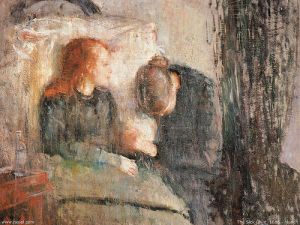 XVI. While sensitivity is a key (not every visit needs to feel like some sort of ‘pre-funeral visit!’), a robust christology bears witness to the Key upon whom all good keys are modelled. It is Jesus Christ who makes himself available in the hospital ward, and in doing so confronts and renews, puts to death and makes alive. The minister and hospital visitor would do well to stay out of the way, not only for the sake of the patient, but also for their own sake. And, as I have it on good authority, also for God’s sake; because God is literally sick to death of tripping over well-meaning messiahs.
XVII. Our witness to Christ includes a number of realties, among which is offering reminders of God’s promise to remain faithful and to provide. The Scriptures recount this promise which lies at the heart of Christian faith (e.g., Gen 26.3; Deut 31.23; Isa 41.9–10; Matt 7.7–8; 28.20, and John 4.10; 14.16–17), and the sacraments too bear tangible witness to these evangelical promises. We may rely on God because God remains faithful. Our witness to Christ is also manifest in the decision to fully embrace – rather than exclude – the sick and dying – and well as their families! – into the life of the Christian community. This ought not be odd, for the Christian community begins with the confession of sickness and dying in the act of baptism. What is out of step with the Christian confession is the acceptance of the practice of building community life around the so-called healthy, clean and ‘righteous’. Mark 2, among other passages, reminds us also of the deep relationship between sickness, healing and the forgiveness of sins, realities which tend to be neglected in much of the contemporary ‘pastoral’ literature. One outstanding exception to this trend can be found in Eduard Thurneysen’s wonderful book A Theology of Pastoral Care.
XVIII. Getting some basic advice from a serious pastor-theologian is always wise, whatever the topic. Dietrich Bonhoeffer’s treatment of the subject at hand appears in his book Seelsorge (German – ‘Pastoral Care’ but translated as ‘Spiritual Care’), at least one section of which is worth citing at length (even if we may wish to challenge Bonhoeffer on some statements):
Sick visits should be regular. Bear in mind that they are there for the sake of the sick person. People never expect others to show up so much as they do when sick. It is best to schedule the visit in advance so the sick person can get presentable. Announced visits are more worthwhile than surprise visits. The pastor mustn’t ignore a scheduled visit. You can’t imagine how much damage you’ll do if you don’t show up. Scheduling regular visits pledges the pastor to be prepared and the sick person to be ready. If possible, the visits should always be scheduled at the same hour and on the same day of the week.
Regular visits are also good for the pastor. He should be present with the sick often. In such a way he will learn that sickness and health go together. This is not abnormal. Sickness and pain are a law of the fallen world. A person who happens to experience fallenness in this special way is an image of the One who bore our sickness and was so afflicted that people hid their faces from him (Isaiah 53). If Jesus came among the sick, that signifies that he bore the law of this world and fulfilled it. “He took our infirmities and bore our diseases” (Matt. 8:17). Jesus saves in that he bears. His salvation has nothing to do with magic, which is able to make people well from a distance. In Jesus’ healings the cross is prefigured. Healing shows that Jesus receives and bears the sick in their weakness, a weakness he will bear on the cross. Only as the crucified One is he the healer.
Among the sick we learn more about the world and come closer to the pangs of Jesus’ cross than we do among the well. Guilt, sin, and decay are more recognizable where everyone participates in the subjection of those who suffer without any particular discernible reason. The same curse rests upon us all. Some, however, experience it more deeply and painfully than all the rest. Such participation helps us recognize the true condition of the world. Our health is endangered in each moment. All sickness is enclosed within our health. The law of this world calls for a cross and not health. It’s not good that the sick are shut up, concentrated in large hospitals to put them far out of sight of the well. At Bethel the sick and the healthy live with one another, sharing as a matter of course daily life and worship: a continual reminder to the sick of wholeness.
Love toward sick members should have a special place in the Christian congregation. Christ comes near to us in the sick. The pastor who neglects the visitation of the sick must ask whether or not he can exercise his office on the whole.
Sick people ask for healing. They cry for release from this body of death into a new and healthy body. They cry for the new world in which “God will wipe away every tear, and there will be no more suffering or crying or pain” (Rev. 21:4). Insofar as this happens, the sick inquire about Christ more than do the well. Christ fulfills this conscious or unconscious expectation through his promise, “I am the Lord, your physician” (Exod. 15:26). Nevertheless the proclamation should not be limited to this one aspect. No proper spiritual care occurs without the offer of the forgiveness of sins. The mandate to proclaim the forgiveness of sins applies here, too. Often concrete sins will come to light. Not only past sins come to light, but also those related to the sickness and those the sickness itself creates. Sickness can make one egocentric and sullen, driven to extreme resistance toward Christ, a resistance which is itself unhealthy. The sickbed then becomes burdened with great guilt. So in spiritual care compassion cannot stand alone; we must also bring the whole truth of sin and grace.
To parishioners who are faithful at worship the pastor might bring the Sunday sermon. “I come because are not able to come.” He will tell the other, “You should know that the church is particularly attentive and pledged to the sick even when they are not able to attend church.” Many people might wonder and silently suspect that someone wants something from them, perhaps is looking to use their condition toward some cheap end. It must be made clear to them that the church comes to the sick without ulterior motives simply to be with them and to help wherever help is desired. Through simple presence we show that God is with the sick and that sickness may be interpreted as a sign of God’s nearness. The presence of the church and the offer of help are never more than pointers to that Help who is God.
There are disagreeable and selfish people. They offer no apologies; after all, they have been torn from their work, they cannot go home, and they fully expect the world to revolve around them. They need to see that their pretensions are groundless; they are, in fact, dependent on the love and friendship of others, and they only do more damage to themselves by such self-seeking behavior. They live in order to receive help. They should be thankful that this is so and learn to be patient when things don’t go as fast as ‘they would like. If they abjure thanksgiving and patience, then they destroy what blessing their illness may hold.
A special problem is presented by the big wards where people are crowded together. There is a lot of bickering in these wards, especially among old women. We might gently remind people that it is undignified to carry on so when we will all soon stand before the judgment seat of Christ. A conversational opening may be to ask how long the person has been ill and, above all, how his or her patience is holding out. One has to extend the right to the sick person to talk about how things are going. Just don’t let the story become too long. Sick folks love to gab and they will go into as great detail as possible about their illness. Better information will be available from the patient’s nurse …
The sick person must not get the impression that, in his condition, he is unnecessary and useless. The pastor can give him such information and tasks that he will be able to see himself on the sickbed as if he were in the midst of the congregation. His chief task will be to intercede for the congregation as a whole and for specific needs, for the pastor and his ministry, for the life and struggle of the church, and also for the other sick people and for a good spirit of community. No one knows that as well as he does. He should know that this ministry, under the circumstances, is more important than all the hurried activities which well people are conducting outside the hospital …
Truth belongs at the sickbed. The pastor should never come with cheap and false comfort that life will soon be all right once more. How is he to know that? On the other hand he shouldn’t say that it will soon be all over. He has no certainty of that either. What the sick need to know in any event is that they are special and uniquely lodged in God’s hand, and that God is the giver of life whether in this world or the next. Vision and heart must always be made opened up to that other world. “Be at peace and let your life rest quietly in God.”
For spiritual care with the sick, it helps if the pastor knows as many Bible verses and hymn stanzas as possible by heart. The memorized Word is more effective and more easily implanted than our own. One might consider creating a booklet for the sick and dying with texts and songs.[13]
XIX. For the sake of convenience, and of good theology, let’s just assume that God got there first.
XX. Much remains unsaid. I’m OK with that.
Notes
[1] Elisabeth Moltmann-Wendel, I Am My Body: A Theology of Embodiment (London: SCM Press, 1974).
[2] Paul Ricœur, Oneself as Another (trans. Kathleen Blamey; Chicago: University of Chicago Press, 1992), 3.
[3] Simon Wilson, When I Was In Hospital You Visited Me (Cambridge: Grove, 2001), 5.
[4] On ministry to out-patients see Herbert Anderson et al., Ministry to Outpatients: a new challenge in pastoral care (Minneapolis: Augsburg, 1991).
[5] For some historical perspectives see Graham Mooney and Jonathan Reinarz, ed., Permeable Walls: historical perspectives on hospital and asylum visiting (Amsterdam/New York: Rodopi, 2009).
[6] Heije Faber, Pastoral Care in the Modern Hospital (trans. Hugo de Waal; London: SCM Press, 1971), vii.
[7] Taken from Elizabeth Barnes, People in Hospital (London: Macmillan and Co., 1961), 97. Cited in Faber, Pastoral Care in the Modern Hospital, vii.
[8] Faber, Pastoral Care in the Modern Hospital, vii–viii.
[9] The West Wing, Season Two, Episode 10, ‘Noël’.
[10] Wilson, When I Was In Hospital You Visited Me, 7.
[11] Charles Causley, ‘Ten Types of Hospital Visitor’ in Collected Poems (ed. Charles Causley; London: Macmillan, 1992), 232–37.
[12] Kenneth Gill, Sick Call (London: SPCK, 1965), 7–12.
[13] Dietrich Bonhoeffer, Spiritual Care (trans. Jay C. Rochelle; Philadelphia: Fortress Press, 1985), 55–9.
 A guest post by Chris Green












 jasongoroncy.com