Author: Jason Goroncy

April Stations

Reading:

Listening:

Watching:

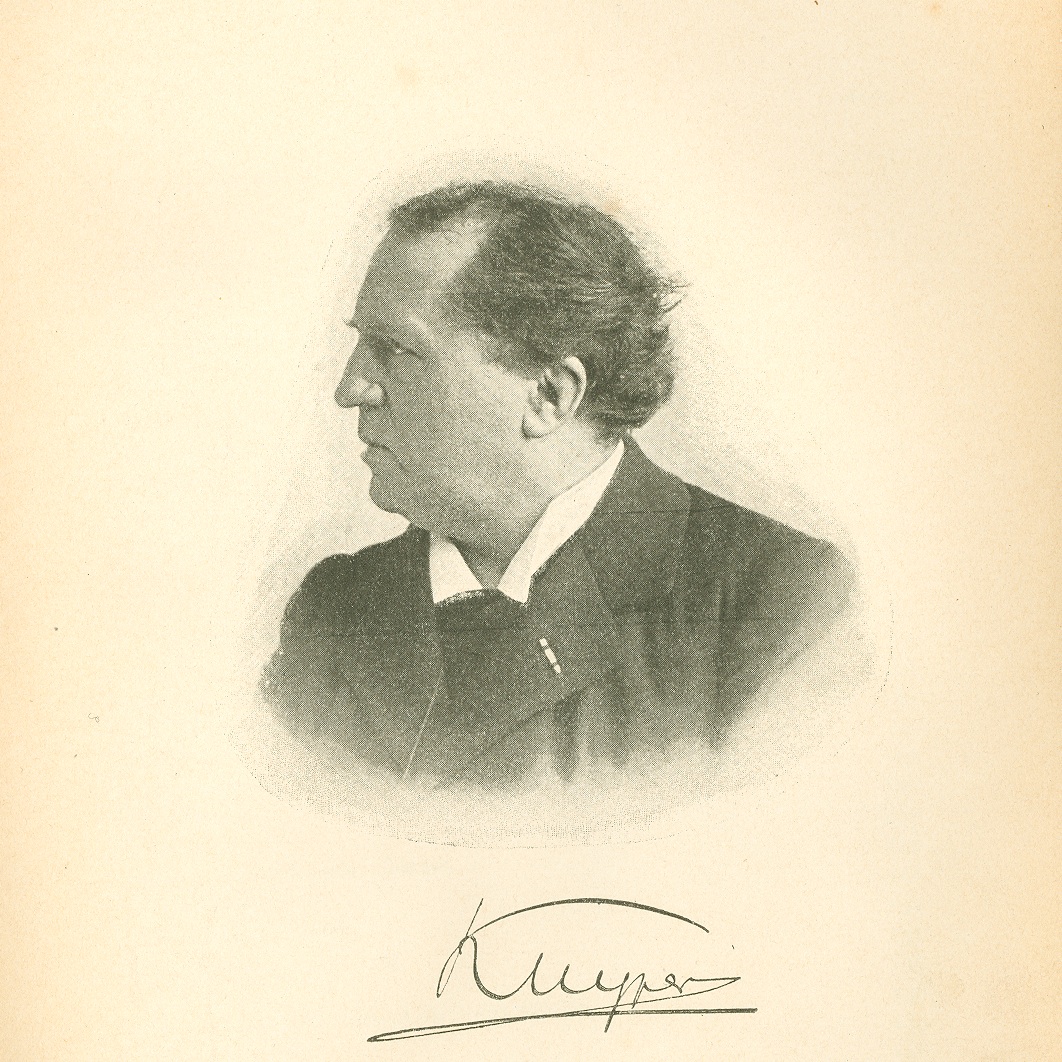
Abraham Kuyper resources

The Princeton Theological Seminary Library and the Historical Documentation Centre for Dutch Protestantism have hooked up to digitalise and to make available most of Abraham Kuyper’s published works as well as his unpublished archives. Both the Abraham Kuyper Bibliography and the Digital Library of Abraham Kuyper represent an important resource to the Church, and any who wish to see a prolific example of naivety birthed by a commitment to natural theology can do little better than dig into a little Kuyper.

Two poems

Two of my favourite places in Dunedin are the aviaries at the Dunedin Botanical Gardens and the Presbyterian Church’s Archives Research Centre. Weird birds seem to dominate both places. Yesterday, I visited the latter, a place from which it seems I rarely depart empty handed. I left with the following two poems. They were amusing enough to share:

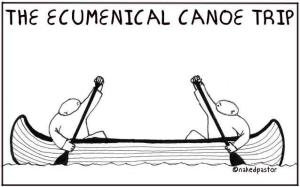
‘The Ecumenicist’, by James Forrest

I caught an Ecumenicist
And kept him in a yard.
I fed him up on sugar-beet
With olive oil and lard.
I kept him effervescent
With the aid of sherbert-fizzers,
And snipped his budding principles
With ecumeniscissors.

In ecumenisentiments
His training was intense;
With ecumeniscience
And ecumenisense;
As he greedily devoured
All the Acts of Convocation
To stimulate the art
Of ecumeniquivocation.

I loved my Ecumenicist
And firmly hoped that he
Would one day ecumenicise
My darling C of E;
But every time I turned, occurred
Another cataclysm –
My Ecumenicist had bred
An ecumeniSCHISM!

Discouraged by experience
I felt it rather vain
An ecumenisysphus
For ever to remain;
My fervant ecumenical
Experiments had failed
And ecumenicynicism
Finally prevailed.

‘Little John Robinson’

Little boy kneels at the foot of the bed,
Droops on his little hands little gold head.
Hush, hush, whisper who dares –
Little John Robinson’s saying his prayers.

“God bless Daddy – I hope that’s right.
Hadn’t we fun with his book tonight?
The words are long, and the theme’s so odd,
But the title’s lovely – Honest to God!

If I open the pages a little bit more
I can see Alec Vidler just round the door.
He’s a beautiful beard, but I doubt if he should …
Oh, God bless Tillich and make him good.

Dietrich Bonhoeffer just writes in red
That the notion of ‘God out there’ is dead.
And John Wren Lewis finds God in all
Though Bultmann doubts if that’s true at all.

They’re so clever, and I’m just me;
And what it’s about I can’t quite see.
I said, ‘Bless Daddy, and Tillich and …’ oh!
While I remember, the Publishers too!”

Little boy kneels at the foot of the bed,
Droops on his little hands little gold head.
Hush, hush, whisper who dares –
Honest to God, he’s just saying his prayers!

(‘Little John Robinson’ appeared in The British Weekly, June, 1963)

With ink and quill: a note on some current projects

Trying to put to bed a number of outstanding writing commitments has meant that the regularity of posts here at PCaL has been somewhat sporadic of late. I make no apology for this. For those who may be interested, here’s what I’ve been working on instead:

  1. A book of sermons (about half of which are previously unpublished) by PT Forsyth. The book, which should be out later this year, is (provisionally) titled ‘Descending on Humanity and Intervening in History’: Notes from the Pulpit Ministry of P.T. Forsyth. It includes a Foreword by Professor David Fergusson and an Introduction by yours truly with the title ‘Preaching sub specie crucis: An Introduction to the Preaching Ministry of P.T. Forsyth’. It will be published by Pickwick Publications (an imprint of Wipf and Stock’s).
  2. Putting the finishing touches on an essay for a volume on Evangelical Calvinism (also to be published by Pickwick) which is being edited by Myk Habets and Bobby Grow. My contribution is titled ‘“Tha mi a’ toirt fainear dur gearan”: J. McLeod Campbell and P.T. Forsyth on the Extent of Christ’s Vicarious Ministry’.
  3. Mastering Indian cooking. No book or TV series on this topic has been planned as yet, but I’m open to offers from publishers and media producers.
  4. Editing a series of conference papers for the volume To Mend the World: A Confluence of Theology and the Arts (also to be published by Pickwick).
  5. Hallowed Be Thy Name: The Sanctification of All in the Soteriology of Peter Taylor Forsyth (formerly known as ‘my PhD thesis’ and which is currently undergoing a long-overdue light edit) will appear in T&T Clark’s Studies in Systematic Theology series … again, hopefully this year. The description reads:

This book fills a noticeable gap in Forsyth studies. It provides readers interested in the thought of Forsyth with a way of reading and critiquing his corpus, and that in a way that takes due account of, and elucidates, the theological, philosophical and historical locale of his thought. Goroncy explores whether the notion of ‘hallowing’ provides a profitable lens through which to read and evaluate Forsyth’s soteriology. He suggests that the hallowing of God’s name is, for Forsyth, the way whereby God both justifies himself and claims creation for divine service. This book proposes that reading Forsyth’s corpus as essentially an exposition of the first petition of the Lord’s Prayer is an invitation to better comprehend not only his soteriology but also, by extension, his broader theological vision and interests.

‘Death and Resurrection’

I am your double man, though first you will
Me one estate: this meadowed flesh my bones
Do comfort in; the blood’s warm brooks that hill
And waterfall me through; my browsing senses
Nostriled for adventure, five unicorns
That rampant in me run; the mind’s huge barns
All attic’d overhead with my pretenses,
All cellared underneath with my unknowns.

And here I landlord, jubilant a while,
To store up meanings in the bins and ricks,
A sundial farmer faithful to my rites
As morning robins: except my brother, sin,
Prides in the yards and warfares at the gates.
And then my countryside is stones and sticks
And straw, and death soon wooden fences in
The ruined body of my land all still.

Yet you recover me from my disgrace.
This little ground I am, this cipher earth
I corner in, this night that densely nights
Me down to stay; you mine-field with the sun,
The fuse as long as love, the burst a birth,
A second world after the blackout’s done:
And out of my debris you timber heights,
And into my despair you hammer grace.

– Arnold Kenseth, ‘Death and Resurrection’, in The Holy Merriment (Chapel Hill: The University of North Carolina Press, 1963), 61.

March stations …

Reading:

Listening:

Watching:

‘The Sickness Unto Death’, by Anne Sexton

God went out of me
as if the sea dried up like sandpaper,
as if the sun became a latrine.
God went out of my fingers.
They became stone.
My body became a side of mutton
and despair roamed the slaughterhouse.

Someone brought me oranges in my despair
but I could not eat a one
for God was in that orange.
I could not touch what did not belong to me.
The priest came,
he said God was even in Hitler.
I did not believe him
for if God were in Hitler
then God would be in me.
I did not hear the bird sounds.
They had left.
I did not see the speechless clouds,
I saw only the little white dish of my faith
breaking in the crater.
I kept saying:
I’ve got to have something to hold on to.
People gave me Bibles, crucifixes,
a yellow daisy,
but I could not touch them,
I who was a house full of bowel movement,
I who was a defaced altar,
I who wanted to crawl toward God
could not move nor eat bread.

So I ate myself,
bite by bite,
and the tears washed me,
wave after cowardly wave,
swallowing canker after canker
and Jesus stood over me looking down
and He laughed to find me gone,
and put His mouth to mine
and gave me His air.

My kindred, my brother, I said
and gave the yellow daisy
to the crazy woman in the next bed.

– Anne Sexton, ‘The Sickness Unto Death’, in The Complete Poems (New York: Mariner Books, 1981), 441–42.

Ethics in the Presence of Christ

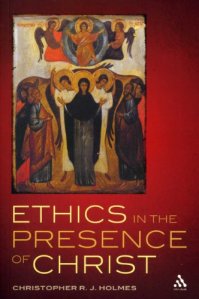
Christopher R.J. Holmes, Ethics in the Presence of Christ (London/New York: T&T Clark, 2012). ISBN: 9780567491732; viii+164pp.

Christian theology is always ethics. To be sure, dogmatics and ethics are not entirely the same thing, but there can be no responsible dogmatics that is not also concerned with ethics, and no responsible ethics that is not equally concerned with dogmatics. Unhinged from one another, both become retarded at best, and tyrants at worst. Put otherwise, ethics is part of the doctrine of God precisely because, as Barth noted, God makes himself responsible for us. So Barth’s decision to speak of ethics as a task of the doctrine of God in CD II/2, a paragraph he introduces thus:

As the doctrine of God’s command, ethics interprets the Law as the form of the Gospel, i.e., as the sanctification which comes to man through the electing God. Because Jesus Christ is the holy God and sanctified man in One, it has its basis in the knowledge of Jesus Christ. Because the God who claims man for Himself makes Himself originally responsible for him, it forms part of the doctrine of God. Its function is to bear primary witness to the grace of God in so far as this is the saving engagement and commitment of man. (§36)

According to Barth, a Christian account of dogmatics and ethics – both evangelical and catholic – begins with a particular person – Jesus Christ – and in his contemporaneous power, truth and love graciously made available to us by the ministry of the Spirit. This too is Chris Holmes’ claim in his delightful and eloquently written essay, Ethics in the Presence of Christ. Slaying the dragon of christological exemplarism (‘Exemplarism in Christian Ethics trades upon principles and a dead Jesus, a Jesus who lives only inasmuch as his example guides. Exemplarism is imprisoned by immanence, the idea that the resources we need for good conduct, for living humanly, are present within the matrix of our own experience, so that Jesus himself is called upon only inasmuch as he corroborates values and attitudes commensurate with our account of what it means to be “ethical”’) as a foundation for Christian and ecclesial existence, Holmes seeks to ‘draw the life of the Christian community into the orbit of the presence and ongoing ministry of Christ, its natural environment, and thus to explore the consequences of his presence for ethics and offer an account of the moral landscape of ethics that is dependent on its environment’.

Convinced that ‘ethics is a function of Christ’s “continually operative” reconciling and revealing intervention’, and that responsible ethics is as participatory as is life, prayer, worship, etc. – i.e., it takes place in the life of the Spirit and from the side of Jesus Christ – Holmes is concerned that we engage in conversations about ethics in light of the contemporary presence and determining ministry of Jesus Christ. He seeks to take with full seriousness the fact that ethics is a function of christology, the human counterpart to Christ’s vicarious obedience and faith. ‘Ethics’, he writes, ‘is simply action evoked by and participant in his saving action and saving obedience. Accordingly, ethics is behavior that recognizes “the pioneer and perfecter” of our faith’. Ethical acts, in other words, are acts aligned to the presence of a particular person, and to what that person – Jesus Christ – is now doing. Accordingly, ethics is not concerned with the good abstractly understood or indeed with any norm or concept apart from a particular living person. And Holmes calls upon Christians to continually turn to the person who speaks through his Word.

Ethics in the Presence of Christ, Holmes outlines in the introductory chapter, is concerned to ask and answer two basic questions: Is this One as narratively attested present? And if so, what is he doing? When ethics becomes attuned to how God’s rule in the world takes shape through the present Christ and how God intends his rule to take shape in us through patient hearing of the Word, it, Holmes insists, ‘becomes an enterprise that begins afresh each day, seeking to do God’s will, recognizing that the doing of God’s will is a matter of being rendered transparent to what God is already doing “to keep human life human in the world’”.

Drawing on the work of Lehmann, Bonhoeffer, TF Torrance, Webster, Hoskyns, Barth, Newbigin, and others, Holmes offers us a theological reading of three texts from John’s Gospel – 5.1–18; 18.1–19.42 and 21 – attending to the themes of the presence of Christ’s power, truth and love respectively. These three chapters form the heart of the book, and are introduced by a fine (though somewhat repetitive) chapter on ethics and presence. The final chapter offers a rich account on why Scripture construes ethical reality.  Holmes’ decision to attend closely to Scripture is premised on the fact that ‘a text on Christology and ethics cannot afford to be exegetically thin, precisely because Christology is a description of the person who acts as narratively depicted, and ethics an account of what the One who acts as Scripturally attested would have of us’. Would that more theologians followed Holmes’ lead here!

In his exposition of Jesus’ healing of the sick man in John 5, Holmes argues that ‘Christ is acting now among us no less powerfully than he did then; he is present among us by the Spirit in accord with the grain of the universe’. He suggests that Jesus’ gracious healing of the sick man is indicative of the fact that Jesus ‘does not will that life go on as normal for this man whom he encounters. The healing of the man is a sign, a sign of ‘the End’, namely the eschatological enfleshment ‘of God’s glory and presence to Israel’. Moreover, Jesus’ healing ministry attests his identity as ‘One in whom God’s life-giving rule is present and effective’. Drawing on E.C. Hoskyns’ claim (in The Fourth Gospel) that ‘In Jesus the world is confronted by the End’, Homes suggests that the end is already present and contemporary to us in Christ: ‘The End – that is, Jesus – is present, moreover, to all times, remaking them in accordance with the will of his Father whom he loves. The hour is no less present to the Jews who sought to kill him because he called “God his own Father, thereby making himself equal to God”, than it is to us (John 5.18). We too live in this hour; we too must hear the voice that is speaking to us and live’. He continues:

This is of course quite difficult for people to appreciate. We are used to and often at home in a world wherein we expect to hear nothing because we already ‘know’ what is real and what can be. But the joy of hearing Jesus is that we realize the extent to which our time is encroached upon by his time. Indeed, Jesus does speak and in so doing he calls ‘into question all the criteria by which – in normal affairs – I [we] judge what is possible, what is reasonable, what is admirable’. As late modern people we find it difficult to believe that the reign of God is present to us and impinging upon us … The gap between the then and there and the here and now is really not so large. In fact, there is not any gap.

Holmes argues that in meeting the power at work in Christ, one encounters God’s knowing and willing – the grain of the universe, to use a phrase popularised by Hauerwas. Power, Holmes insists, is never to be isolated from a determination – namely, that of peace with God himself. It is precisely this determination which is the reality-indication ingredient in the person of Christ. What Scripture testifies to is that this determination is an omnipotent determination which withstands the world’s rebellion. So Holmes:

If the movement in ethics ought always to be from God to humanity, inclusive as it is of the movement of humanity to God, one must take a moment to reflect upon the eternal basis of such a movement. To talk about the eternality of Christ as what grounds his always ‘working’ matters precisely because without such an account we risk talking about the presence of Christ in purely interventionist terms (John 5.17). The power of this One as the presence of God’s power ‘working’ is his immanent life. That is not to take away from the unsubstitutable character of these accounts, but it is to say that we are not beholding in them a reaction. Instead, in the Gospels, we are witnesses to the enactment of an eternal determination: that ‘all things have been created…for him’ (Col. 1.16). It is the Son of God’s eternal determination which is manifest here: the eternal determination of Son and Father to guarantee for the creature their participation as creatures in the blessings of covenant fellowship with themselves. To be sure, the way in which this eternal purpose is realized is shaped by the fact that we have sinned. But our sin and its fruits do not determine God’s will. God’s will – indicative as it is of God’s being – is to humanize. The surety of the reconciliation Jesus is, enacts and reveals is rooted in his person as the eternal Son. An account of the eternality or immanent life of the Son whose ministering presence in Jesus Christ effectively confronts illness is thus necessary if the divine character of the work be granted. Without it, the Gospels can be read only as interventions, not descriptions of the grain of the universe which is the outworking in time of the life of the trinity, specifically the life of the eternal Son.

The implication for ethics is clear:

We do not need by our activity – principally belief – to extend the power at work in Jesus’ ministry into the present or try to make it relevant to our contexts. ‘This is because the question of Christian ethics itself remains malformed unless and until set firmly within a wider acknowledgement that “God has founded the church beyond religion and beyond ethics” by the graciously vicarious fulfillment of the law in the person of the savior.’ Ethics is to be taken up in light of the person of the Son as subjectivized in us through the work of the Spirit. That is, law or command does not describe resources for conduct internal to the self or of the Christian community, a story, or various pressing contingencies or contexts. Rather, ethics understood Christologically is a destabilized ethics. It is destabilized precisely because it is an inherently revelational undertaking. What is given in Christ – the fulfillment of Moses’ law – ‘subjectively takes shape in the mind of the church through the unique enshrining of Christ’s gospel’. Ethics understood theologically is thus a destabilized or ever relativized ethics because it is not a matter of implementing a moral program of sorts, but rather a question of being formed by the One – by the objective Person – who truly fulfills himself in us via his faith. By believing in his fulfillment of his will, we too are made participants in him who claims us for faith. And his life – his faith, what he is doing, his present ministry – is done into us. Most importantly, we do not then live as those in a kind of vacuum of our own making. Instead, our life is formed by Jesus who is present in the Spirit’s power to us, whose present ministry claims us, so that we too might fulfill the law of our being by believing.

‘A biblical person is one who lives within the dialectic of eschatology and ethics, realizing that God’s Judgment [sic] has as much to do with the humour of the Word as it does with wrath’. So penned William Stringfellow in A Simplicity of Faith. Translated otherwise, we might simply say that the person of faith is the person who is living in Jesus Christ, God’s eschaton and ethic incarnate, and reigning in his freedom as he who, in the words of the Book of the Revelation, is walking and speaking ‘in the midst of the lampstands’ (i.e., his people). This is the metaphysic that Holmes seeks to bear witness to in this essay. Clearly, his thesis is grounded on the claim that ‘metaphysics governs ethics’, a thesis strengthened and made all the more stimulating by a sturdy commitment to the doctrine of creatio continua – a corollary of the church’s claim that in Christ ‘all things hold together’ (Col 1.17), and that in the person of the mediator ‘that which constitutes our world and indeed our lives is present in such a way that our descriptions of the way things are must be subject to a “going on”’.

Each of the three chapters engaging with specific texts from John’s Gospel are a highly stimulating read, sermonic in parts, informed by a maturing dogmatic mind, and laden with pastorally-valuable insights.

The final chapter, ‘On why Scripture construes ethical reality’, betrays Holmes’ deep indebtment to Webster’s and Krötke’s work (Holmes’ doctoral dissertation was on Barth, Jüngel, and Krötke), and engages, I think convincingly, with the likes of Hauerwas, O’Donovan and Wannenwetsch, identifying some achilles in their use of Scripture for theological ethics. A couple of passages are simply worth repeating in full:

To begin ethics with Christ is not enough: ethics is to stay with Christ, to seek to be present to Christ.25 I am not interested in only a Christological starting point for ethics: that is, Christology as only a beginning but not also the middle and end point of ethics. Ethics involves our being continually schooled by the prophets and apostles. To not only begin with but to stay with Christ, which is ethics’ task, is to yield to Scripture. By yielding, the church hears and obeys Scripture’s prophetic and apostolic testimony. The church is where ethical agency is nourished, insofar as it is in the church that we are baptized into Christ by the Spirit and nourished by the proclaimed Word and holy table.

Scripture is first and foremost an address that needs to be heard as the discourse of One who unceasingly speaks or shows himself through its pages. Its authority does not lie in its ability to speak to our situations, or arise to the degree to which it resonates with us, its hearers. Biblical commands such as the particular command spoken to Peter – ‘Follow me’ – are not commands that he or we as those addressed in Jesus’ address to Peter need apply. We need, rather, to hear so as to obey. The Bible’s moral authority is inextricably bound up with the present and ministering Christ. Talk of the Bible’s authority – particularly its commands – is derivative of an authoritative presence: namely Christ present as the appointing, calling and commissioning Word, and so the upholding, gathering and sending Word. He in his person is command: Christ is God’s command, what God wills … Faith is a matter of perceiving, then, of acting in agreement with he who is there and at work: the ‘incessant redeemer’. The present tense, the self-giving of the Son in the Spirit, is crucial to acknowledge if the context be properly elucidated. It means that the more important question becomes, I think, ‘What does the “situation” ask of me in light of Christ’s very definite presence and concrete activity in relationship to it?’

There are a number of places where Holmes makes (over?)statements that demand, at the very least, further clarification or explanation. So, for example, Holmes’ claim that the natural post-Fall world is no longer able to function as a ‘theatre of life’ (a claim, prima face, I think, which is undermined by this very book), or that Scripture’s display of what is really going on in the world is ‘especially the case with respect to John’s Gospel’ (a claim that requires some further argument; it certainly betrays the fact that in writing this book Holmes has been living in John’s Gospel). More significant and obvious by their omission are any sustained discussions on prayer, and on the sacraments. These would, I think, have made this a more satisfying book, building on the already-significant exposition of Christ’s immanent reign among and over his people in his prophetic, priestly and royal ministry.

Still, these really are minor quibbles about what is a tremendously-important and well-overdue book. Holmes’ attempt to discern the present reign of the Word is among the best introductions to theological ethics that I have read. I commend it warmly and enthusiastically.

Training for the Christian life

Whenever the body of Christ eats together in Eucharist on Sundays, it does so in the hope that it will have its eyes opened to and participate in what God is up to in the world, not only on Sundays but on Wednesdays too. The claim, made by Stanley Hauerwas and others, that living in a deeper awareness of the story of Jesus and of the Church does, in the freedom and grace of God, ‘do’ something is deserving of a hearing. While there is no magical change of status, and while these graces do not turn the gathered people of God into liturgical automatons nor automatically make them more ethically-consistent or mature, the Church’s gospel-shaped practices are, I suggest, the means by which the Head (i.e., Jesus) immerses his Body (i.e., the Church) in the way of ordinary gospel-posture. Specifically, they are means by which Christ trains us. This is true whether we are talking about something like the Church’s calendar, its fasting, or its weekly praying of the Lord’s Prayer, and it is particularly true when it comes to the Lord’s Supper. Every time we come to the Table, which is where the entire Church’s story is enacted in concentrated form, we are offered training in how to live sacramentally in the world, to unearth its idolatries, and to expose what William Stringfellow calls the ‘transience of death’s power in the world’.

Sacraments of the good news

It is my understanding that the Church sponsors no such thing as ‘sacraments’ in and of themselves. There are only sacraments of the good news, i.e., signs or proclamation activities which direct us – like John the Baptist and the Scriptures themselves – to see and proclaim the truth about Jesus who is the Sacrament of God. To refer to the Church’s sacraments as ‘signs’ is to say something about the way that sacraments work, that they work through what they say, and what they say is communicated in language apposite to us. In other words, the sacraments work as signs because we can read them. It is because we know what it looks and feels like to wash away dirt from our bodies, for example, that the Church can describe baptism in terms of washing away sins (so Acts 22.16; Eph 5.26; Tit 3.5). It is a sign that looks somewhat alike. Beating someone over the head with a hammer, on the other hand, could never become a sacramental sign of forgiveness because that would contradict its normal meaning. It would point in the wrong direction. This point is well made in Timothy Radcliffe’s Why Go to Church?: The Drama of the Eucharist (London/New York: Continuum, 2008), p. 189.

‘The Bright Field’, by RS Thomas

I have seen the sun break through
to illuminate a small field
for a while, and gone my way
and forgotten it. But that was the pearl
of great price, the one field that had
the treasure in it. I realize now
that I must give up all that I have
to possess it. Life is not hurrying
on to a receding future, nor hankering after
an imagined past. It is the turning
aside like Moses to the miracle
of the lit bush, to a brightness
that seemed as transitory as your youth
once, but is the eternity that awaits you.

– RS Thomas, ‘The Bright Field’, in Collected Poems, 1945–1990 (London: Dent, 1993), 302.

February stations …

Reading:

Listening:

Watching:

On Japanese receptions of the thought of PT Forsyth

I posted recently on Hiroshi Ōmiya’s Japanese edition and translation of Justice the True and Only Mercy: Essays on the Life and Theology of Peter Taylor Forsyth (originally edited by Trevor Hart). Now I’ve been informed that Naoya Kawakami’s dissertation on the reception of Forsyth’s thought in Japan has just been published. (You can read about it here and purchase a copy here.) This is an area of growing interest to me, and so it’s a delight to witness this body of literature being made available.

The reviewer as gate-keeper

By and large, I enjoy reading and writing book reviews. And I’ve mentioned before about my chat with a friend about the purpose of book reviews wherein he offered the following description of the reviewer’s task:

To help the writers know they are understood and appreciated without too much attention to their mistakes, to help the readers know whether or not it is for them, to identify one or two critical issues worth discussing along the way, and to ease the conscience of the reviewer about all the free books s/he has acquired through this means, not all of which were ever read.

I still like my friend’s ‘reviewer job description’ and, as a rule, it represents what I hope to do when I’m reviewing a book. During a recent binge with Updike (now there’s a reviewer!), my antennae were re-alerted to my responsibility as a reviewer to engage critically with the text/s under my surveillance, to dwell longer – though not for too long – in those somewhat less salutary spaces (whether they be factual or editorial) within the book’s covers, particularly when the book is otherwise especially praiseworthy, or when the author is a friend. By neglecting such a task, it seems to me that reviewer’s are doing neither the author nor the reader a favour, are abrogating an important responsibility, and are left feeling like the bookseller’s unpaid serf who has sold short the book’s author, publisher (good publishers and editors do care about this kind of thing), readers, and the reviewer’s own academic credibility (not that I hold the latter too tightly anyway).

One of my favourite bloggers, Mary Beard (professor in classics at Cambridge), recently had this to say about reviewing:

If reviewing doesn’t act as a gate-keeper of sorts, the success of a book will come down only to the size of its publicity budget and the enthusiasm of its publishers’ tweets.

Of course, gate-keepers worthy of hire will be those who are cognisant of, and honest about, the limits of their knowledge; but they will endeavour to humbly keep gate, which is, I’m assuming, a somewhat different job to being a tourist guide, or to being an author’s, publisher’s, or bookseller’s hooker. Gate-keepers worthy of hire will certainly be those who, in Stephen Burn‘s words, talk less ‘about themselves, spinning reviews out of their charming memories or using the book under review as little more than a platform to promote themselves and their agendas’. They will also be those who will, and that as best they can, tell the truth like Presbyterians; i.e., decently and in order.

Thanks for stopping by

Since moving this blog from Blogger to WordPress, Per Crucem ad Lucem has received over one million hits. I’m not suggesting that there is any correlation between these two facts. I simply wanted to say ‘Thank you’ for visiting, for commenting, for sharing links, for leaving, and then for stopping by again.

Like most bloggers, I guess, I’ve wondered, from time to time, about packing in the mouse, but then something happens, and the mouse … well, the batteries get changed or re-charged and off we go again. It will not always be so, of course. With probably even less claim to life than grass and flowers, this blog (and its author) will wither and fade (Isa 40.8). Indeed, among its raisons d’être is to bear witness to this hope. But for now, and in the words of Dag Hammarskjöld, ‘For all that has been – thanks. To all that will be – yes’.

Straining to hear what the Spirit is saying to the churches

It’s always encouraging to hear ministers asking questions about what it means to be ‘church’ in a particular time and location. Here’s a clip of the Rev. LeeAnne Watkins, Rector at St. Mary’s (St. Paul, Minnesota), giving voice to some of the challenges that she is facing as she seeks to live out her ordination vows with faith, and to lead the people of God in her neck of the woods with courage:

To be sure, there’s much more conversation that needs to happen here – about the nature of church itself and of the church’s participation in the missio dei, about the task of witness, about the shape of Christian vocation in the world, about the nature of ‘the world’ itself, about the church’s teaching role, about the prophetic role of ministry, about what and who sets the agenda for the church’s and minister’s work, about where the body of Jesus is to be found, about the isolation, support, networking and emotional health of ministers, about why the consumer/attractional model of church is a fizz, &etc. – and it’s not as if LeeAnne is the only one engaged in this important conversation, but she at least articulates how many minister’s feel as they, with others who have an ear to hear, strain to ‘listen to what the Spirit is saying to the churches’ (Rev 2 & 3).

‘Hard Life with Memory’, by Wisława Szymborska

I’m a poor audience for my memory.
She wants me to attend her voice nonstop,
but I fidget, fuss,
listen and don’t,
step out, come back, then leave again.

She wants all my time and attention.
She’s got no problem when I sleep.
The day’s a different matter, which upsets her.

She thrusts old letters, snapshots at me eagerly,
stirs up events both important and un-,
turns my eyes to overlooked views,
peoples them with my dead.

In her stories I’m always younger.
Which is nice, but why always the same story.
Every mirror holds different news for me.

She gets angry when I shrug my shoulders.
And takes revenge by hauling out old errors,
weighty, but easily forgotten.
Looks into my eyes, checks my reaction.
Then comforts me, it could be worse.

She wants me to live only for her and with her.
Ideally in a dark, locked room,
but my plans still feature today’s sun,
clouds in progress, ongoing roads.

At times I get fed up with her.
I suggest a separation. From now to eternity.
Then she smiles at me with pity,
since she knows it would be the end of me too.

[Source: The New York Review of Books; translated from Polish by Clare Cavanagh and Stanislaw Baranczak]