Author: Jason Goroncy

Steve Hely on book reviewers

Most writers, from time to time, elect to set aside a little ink in order to get a few things off their chest. And it’s not uncommon for writers – and here I’m thinking of the likes of Charlotte Brontë, Dorothy Sayers and Kurt Vonnegut, to name just a few – to blow off a little steam about book reviewers (Brontë, for example, referred to them as ‘Astrologers, Chaldeans, and Soothsayers’). But in his very unextraordinary book, How I Became a Famous Novelist, Steve Hely takes the most sustained and pathetic shot at book reviewers that I’ve encountered:

I try not to hate anybody. ‘Hate is a four-letter word,’ like the bumper sticker says. But I hate book reviewers.

Book reviewers are the most despicable, loathsome order of swine that ever rooted about the earth. They are sniveling, revolting creatures who feed their own appetites for bile by gnawing apart other people’s work. They are human garbage. They all deserve to be struck down by awful diseases described in the most obscure dermatology journals.

Book reviewers live in tiny studios that stink of mothballs and rotting paper. Their breath reeks of stale coffee. From time to time they put on too-tight shirts and pants with buckles and shuffle out of their lairs to shove heaping mayonnaise-laden sandwiches into their faces, which are worn in to permanent snarls. Then they go back to their computers and with fat stubby fingers they hammer out ‘reviews.’ Periodically they are halted as they burst into porcine squeals, gleefully rejoicing in their cruelty.

Even when being ‘kindly,’ book reviewers reveal their true nature as condescending jerks. ‘We look forward to hearing more from the author,’ a book reviewer might say. The prissy tones sound like a second-grade piano teacher, offering you a piece of years-old strawberry hard candy and telling you to practice more.

But a bad book review is just disgusting.

Ask yourself: of all the jobs available to literate people, what monster chooses the job of ‘telling people how bad different books are’? What twisted fetishist chooses such a life? (pp. 146–47)

Certainly, it’s difficult to take this vitriol seriously. Perhaps it’s tongue in cheek, or satire. Yes, many reviewers are little more than poorly paid hookers for publishing companies or newspapers. Yes, many reviewers betray little evidence of actually having read the book under consideration, or of knowing its location in and contribution to the wider canon. Yes, many reviewers do appear to be ‘condescending jerks’. But Hely seems to have some seriously unresolved issues here, perhaps the most serious of all is that he appears to be entirely unfamiliar with John Updike who, as far as I am aware, never in all his days shoved a heaping mayonnaise-laden sandwich into his face.

‘They Have Threatened Us With Resurrection’

There is something here within us
Which doesn’t let us sleep,
Which doesn’t let us rest,
Which doesn’t stop pounding
Deep inside,
It is the silent, warm weeping
of Indian women without their husbands,
it is the sad gaze of the children
fixed there beyond memory,
in the very pupil of our eyes
which during sleep,
though closed, keep watch
with each contraction
of the heart,
in every wakening

Now six of them have left us,
And nine in Rabinal,
And two, plus two, plus two,
And ten, a hundred, a thousand.
a whole army
witnesses to our pain,
our fear,
our courage,
our hope!

What keeps us from sleeping
is that they have threatened us with Resurrection!
Because every evening
though weary of killings,
an endless inventory since 1954,
yet we go on loving life
and do not accept their death!

They have threatened us with Resurrection
Because we have felt their inert bodies,
and their souls penetrated ours
doubly fortified,
because in this marathon of Hope,
there are always others to relieve us
who carry the strength
to reach the finish line
which lies beyond death.

They have threatened us with Resurrection
because they will not be able to take away from us
their bodies,
their souls,
their strength,
their spirit,
nor even their death
and least of all their life.
Because they live
today, tomorrow, and always
in the streets baptized with their blood,
in the air that absorbed their cry,
in the jungle that hid their shadows,
in the river that gathered up their laughter,
in the ocean that holds their secrets,
in the craters of the volcanoes,
Pyramids of the New Day,
which swallowed up their ashes.

They have threatened us with Resurrection
because they are more alive than ever before,
because they transform our agonies
and fertilize our struggle,
because they pick us up when we fall,
because they loom like giants
before the crazed gorillas’ fear.

They have threatened us with Resurrection,
because they do not know life (poor things!).

That is the whirlwind
which does not let us sleep,
the reason why sleeping, we keep watch,
and awake, we dream.

No, it’s not the street noises,
nor the shouts from the drunks in the “St. Pauli,”
nor the noise from the fans at the ball park.

It is the internal cyclone of kaleidoscopic struggle
which will heal that wound of the quetzal
fallen in Ixcán,
it is the earthquake soon to come
that will shake the world
and put everything in its place.

No, brother,
it is not the noise in the streets
which does not let us sleep.

Join us in this vigil
and you will know what it is to dream!
Then you will know how marvelous it is
to live threatened with Resurrection!

To dream awake,
to keep watch asleep,
to live while dying,
and to know ourselves already
resurrected!

– Julia Esquivel, ‘They Have Threatened Us With Resurrection’ in Threatened with Resurrection: Prayers and Poems from an Exiled Guatemalan (Elgin: The Brethren Press, 1982), 59–61.

July stations …

Reading:

Listening:

Watching:

Church welcome signs and the divine hospitality

It doesn’t happen very often but every now and then, and usually more then than now, one happens across a church welcome sign that does not reinforce something of what is completely embarrassing about being a church person and which even goes some way towards bearing witness to the divine hospitality itself. This sign from the Our Lady of Lourdes Catholic Community is one such example:

We extend a special welcome to those who are single, married, divorced, gay, filthy rich, dirt poor, y no habla Ingles. We extend a special welcome to those who are crying new-borns, skinny as a rail or could afford to lose a few pounds.

We welcome you if you can sing like Andrea Bocelli or like our pastor who can’t carry a note in a bucket. You’re welcome here if you’re “just browsing,” just woke up or just got out of jail. We don’t care if you’re more Catholic than the Pope, or haven’t been in church since little Joey’s Baptism.

We extend a special welcome to those who are over 60 but not grown up yet, and to teenagers who are growing up too fast. We welcome soccer moms, NASCAR dads, starving artists, tree-huggers, latte-sippers, vegetarians, junk-food eaters. We welcome those who are in recovery or still addicted. We welcome you if you’re having problems or you’re down in the dumps or if you don’t like “organized religion,” we’ve been there too.

If you blew all your offering money at the dog track, you’re welcome here. We offer a special welcome to those who think the earth is flat, work too hard, don’t work, can’t spell, or because grandma is in town and wanted to go to church.

We welcome those who are inked, pierced or both. We offer a special welcome to those who could use a prayer right now, had religion shoved down your throat as a kid or got lost in traffic and wound up here by mistake. We welcome tourists, seekers and doubters, bleeding hearts … and you!

Beatitudes

for Aung San Suu Kyi

Blessed are those who watched
with stormcloud eyes
the ground open to swallow them
while fork-tongue drivers
drove whipcrack highways
on luxury serpents. Blessed
are those run down & flattened
fang-holed & spat on
for good measure of the trade index.
Blessed, those daughters set on high wires
to balance dollar signs, while bored crowds
jeered for another fall in interest rates. Blessed
too those with empty chests, soles ripped
from their shoes, fed to dogs. But most blessed
are those who stole the hound scraps
nailed them to their feet
& kept on marching.

– Paul Mitchell

Rutherford Waddell Conference

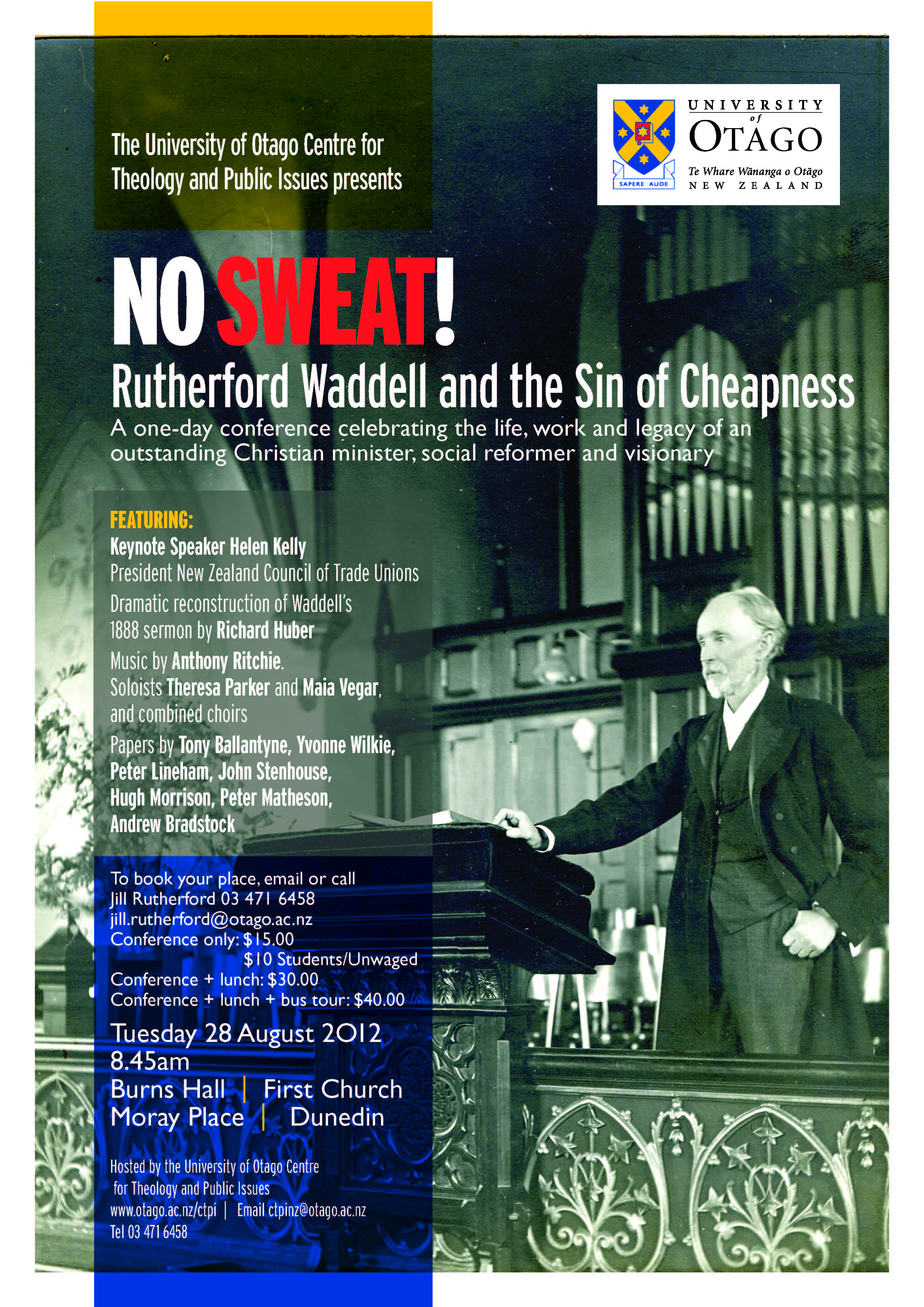
The University of Otago’s Centre for Theology and Public Issues is planning a one-day conference to celebrate the life, work and legacy of the inspirational Christian minister, social reformer and visionary Rutherford Waddell. Here’s the flyer:
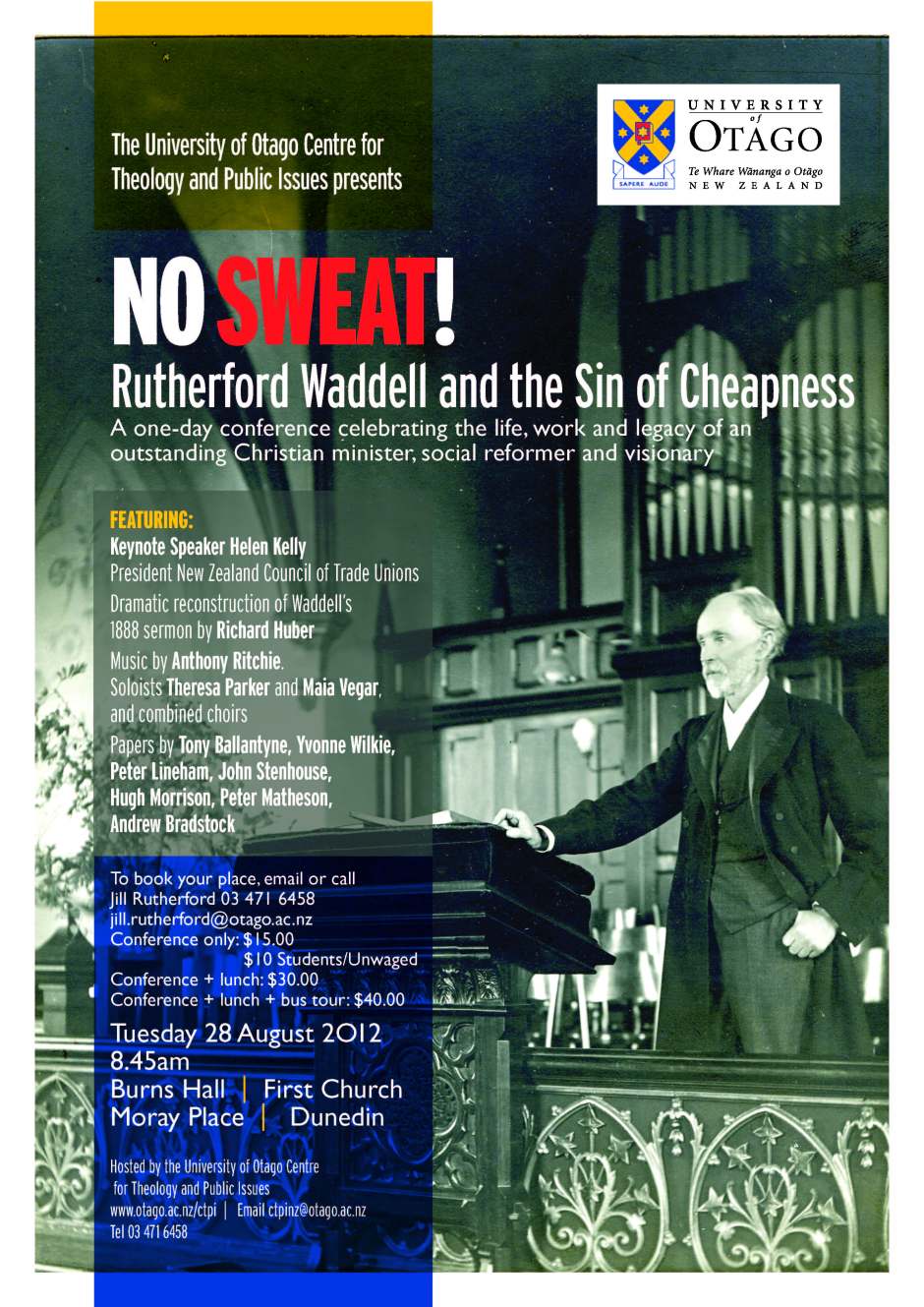
I can still remember my first exposure to Waddell’s writing. It was his delightful collection of essays published as The Fiddles of God and Other Essays. One of those ‘other essays’ was entitled ‘The Lure of the Trout’; this title alone was enough to make me fall in love with the guy. Now it’s true that I’ve fallen in love many times before (and almost as easily out of it again) but I can confess that my affection for him has continued to grow (perhaps I’m still falling) the more I have immersed myself in his exquisite prose – fed as it is by healthy doses of John Ruskin, Emily Brontë, George Eliot and James Lane Allen – and the more I have learnt about his extraordinary ministry right here in my home town of Dunedin. James Gibb once described Waddell as a man who ‘lived under the spell of Christ’. It’s a good description. Suffice it to say that I’m really looking forward to this gig.

For those readers of PCaL unfamiliar with Waddell, here’s the relevant entry, written by Ian Breward, from the Dictionary of New Zealand Biography:

Rutherford Waddell was born in Ballyroney, County Down, Ireland, probably sometime between 1850 and 1852. His father was the Reverend Hugh Waddell, a Presbyterian minister; his mother, Jean Reid, was the sister of Thomas Mayne Reid, a famous writer of adventure stories. Rutherford’s mother died when he was small and he was brought up by an aunt. He was educated at a national school where the teacher was brutal; Waddell regarded the years as wasted. At the age of 14 he became a draper’s apprentice in Banbridge for four years, after which he decided to follow the calling of his father and older brother, Hugh, in the ministry. He graduated MA from Queen’s University in Ireland in October 1875 and also studied at the Presbyterian Theological College, Belfast, from 1874 to 1876. On 27 January 1877, at Dublin, he married Kathleen Maud Ashton Newman. They were to have one daughter, Muriel Alice Newman, who was born on 28 April 1882.

Rejected both for missionary service in Syria and by an Irish congregation, Waddell accepted an invitation to join the ministry of the Canterbury Presbyterian Church Extension Association. He sailed with his young wife to Lyttelton, New Zealand, on the Piako, arriving in May 1877. After a short supply ministry at St Paul’s Church in Christchurch, he was inducted to the charge of Prebbleton and Lincoln on 25 September 1877. Called to the flourishing new charge of St Andrew’s Church in Walker Street (Carroll Street), Dunedin, Waddell was inducted on 18 April 1879 to minister to about 300 members, including many of Dunedin’s leading citizens.

Suspect because of his radical belief that the Christian gospel should be actively interpreted through social justice, Waddell soon won the confidence of the congregation and exercised wide influence through his writing and commitment to civic affairs. In 1888 he was one of the founders of the Dunedin and Suburban Reserves Conservation Society and in 1888 and 1889 an early supporter of technical education. In the parish at the Walker Street mission hall, which opened in 1888, he set up a savings bank, a free library and the first free kindergarten (1889). He also developed a wide range of literary, religious and educational societies, along with a cricket club, gymnasium, and debating and mutual improvement societies. Waddell was deeply committed to overseas missions; the congregation supported three missionaries as well as providing a spiritual home for many students for the ministry.

Waddell was well read. His knowledge of classic and contemporary English literature went with wide reading in theology, economics and sociology, all carefully recorded in notebooks. In his student days he was decisively influenced by reading George Eliot’s Adam Bede. Young and old found his sensitivity to their doubts and questions one of the most attractive features of his ministry. He was deeply compassionate, but was not content just to offer help in his own parish. Reading in politics and social science convinced him that social change was possible, but with this went the conviction that changed laws must be accompanied by changed lives.

Waddell played a leading part in exposing sweated labour in Dunedin (he himself had worked long hours for nothing as a draper’s apprentice in Banbridge). In October 1888 he delivered a sermon at St Andrew’s Church on the ‘sin of cheapness’, arguing that a lust for bargains was forcing prices down to a point where wages fell below subsistence level. In November he took the matter to the Synod of the Presbyterian Church of Otago and Southland and a motion was passed deploring the existence of sweating in New Zealand. The press took up the matter and revealed cases of sweating in Dunedin. His blend of prophetic passion and skilful use of the press and public meetings led in 1890 to a royal commission on sweating on which he served. Its recommendations were an important part of the foundation for the social legislation of the 1890s. Waddell believed that trade unions were an essential part of reform: he became the first president of the Tailoresses’ Union of New Zealand from 11 July 1889. He was also actively involved in temperance reform, the Bible in schools movement and was one of the main supporters of the First Offenders’ Probation Act 1886, a pioneering penal reform.

As well as being a notable minister and social reformer, Waddell was an active journalist and editor of the national Presbyterian weekly, the Christian Outlook (later called the Outlook), from 1894 to 1902. Forced by a breakdown in health to give up that responsibility, he continued to write elegant and thought-provoking columns for the Evening Star under the name ‘Ror’ for 27 years. His other notable achievement was to initiate the deaconess order in the Presbyterian Church of New Zealand. In March 1901 Sister Christabel Duncan, one of the first to graduate from the Presbyterian Deaconess Institute in Melbourne, began her duties among the poor in St Andrew’s parish. Her stipend for the first year was paid by Waddell, but the caution of the deacons was overcome by the end of the year and they became her enthusiastic supporters. In addition, Christabel Duncan was actively involved in the expansion of the Presbyterian Women’s Missionary Union, working as travelling secretary for two years from 1918.

Lightly built and with a slight speech impediment, Waddell became one of the country’s most notable preachers, whose sermons were published in their thousands. He pushed himself to his physical limits and had to take sick leave in 1882, 1886, 1902 and 1913. The last years of his ministry were hampered by severe deafness. He retired in 1919, after a remarkable career. Kathleen Waddell became a chronic invalid and died in Seacliff Mental Hospital on 7 September 1920.

Rutherford Waddell married Christabel Duncan at Melbourne on 3 December 1923. He stayed intellectually vital during his last years; in 1929 he was first president of a fellowship of New Zealand writers. Despite illness he continued to hunt, fish and enjoy golf. He died in Dunedin on 16 April 1932, survived by his wife. Waddell was an important liberalising influence in the Presbyterian church, demonstrating that it was possible to be evangelical and missionary without being rigidly tied to the confessionalism of a strong group in the Synod.

Earl Grey Tea Loaf

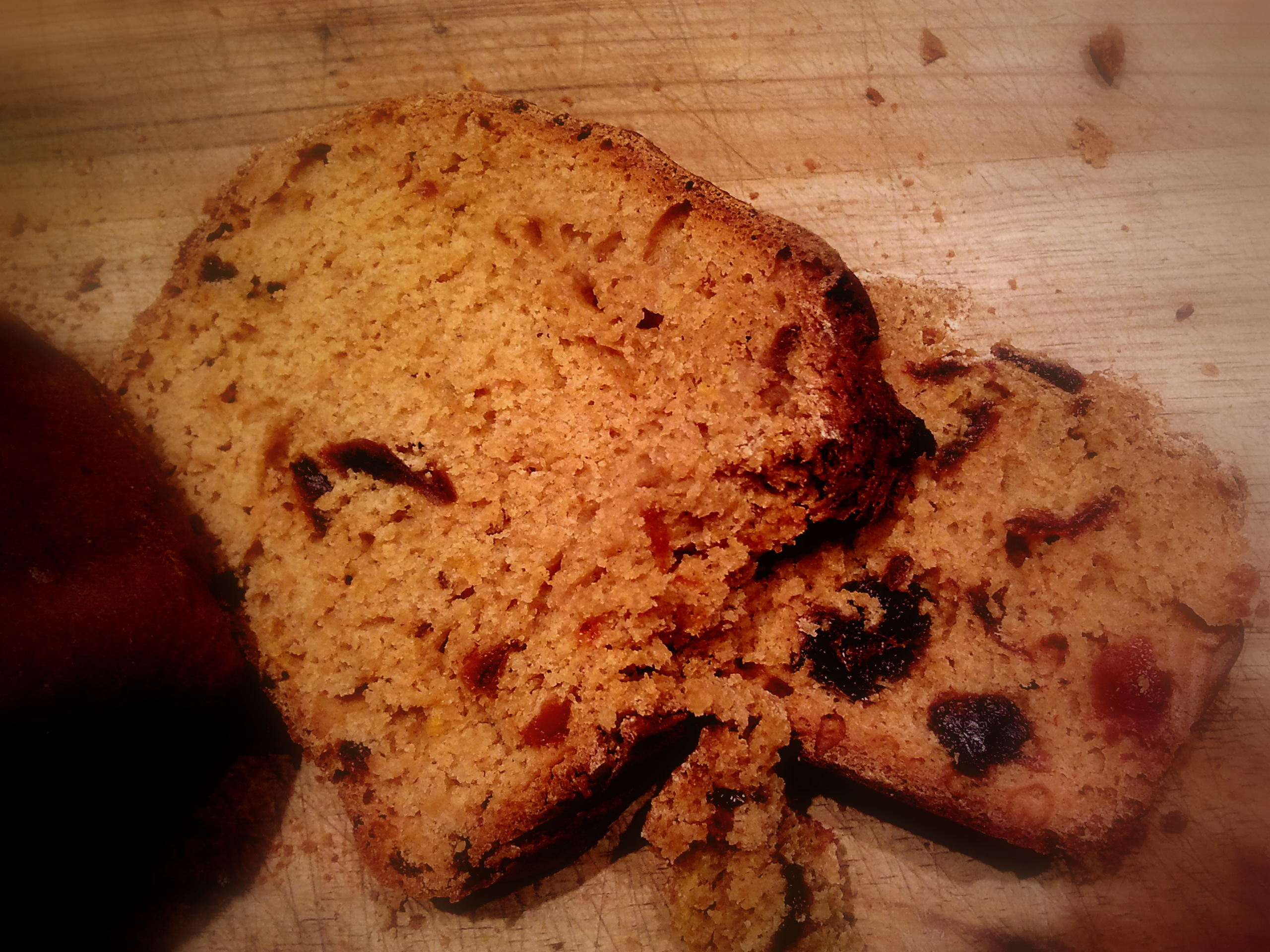
Whether we’re talking creating or eating, I really don’t do desserts. But every now and then a recipe comes along that is both easy peasy to follow, and yields very yummy results. This recipe for Earl Grey Tea Loaf, adapted from that by Jo Seagar, is one example:

Ingredients

  • 1 cup of boiling water
  • 3–4 tea bags of Earl Grey tea (I know, tea bags are a woeful invention – no doubt a conspiracy authored by the coffee industry – but they do work better with this recipe. If really desperate, you can use an inferior leaf such as English Breakfast)
  • 1 cup of raisins (weirdos might think that they can get away with using sultanas)
  • 1 cup of brown sugar
  • 2 cups of self-raising flour (here you could use plain flour plus 2 teaspoons of baking powder)
  • 1 egg
  • 1 orange or lemon zest

Method

1. In a covered bowl, brew the tea in boiling water for 2–3 minutes. Add the raisins and sugar, stir and soak for around 10 minutes (or it can be left until the tea is cold).

2. Preheat the oven to 180˚C. Line a loaf tin with baking paper. Remove the tea bags from your tea mixture. Then add the egg, flour and zest, and gently stir that baby for 2–3 minutes. Pour into the prepared loaf tin and bake for one hour.

3. Gently remove from the tin, cool it down just a bit on a wire rack, slice thickly and serve warm with butter.

Poached Pears in Blackcurrant Juice

Ingredients
1 litre blackcurrant juice (you can also use pear or apple juice)
½ cup of sugar (or less if you prefer)
1 vanilla pod
1 cinnamon stick
Orange zest (1/2 an orange worth with do)
6 pears, peeled and cored

Method
Place the fruit juice into a deep medium size pot, add the sugar (sweetness is up to you) add the vanilla pod and orange zest. Bring to the boil then reduce the temperature to a gentle simmer. Place the pears in the liquid and lid on the pot. Poach gently for 20 minutes or until the pears are tender all the way through.

Remove the pears carefully onto a platter and return the liquid back to heat and boil vigorously until the liquid has reduced to thick syrup. Don’t overcook it or you’ll burn it and stink the house out (like I did the first time)

Serve the pears whole with the fruit syrup poured over with either vanilla ice cream, cream or perhaps crème fraiche.

There were no complaints …

[HT: Otago Farmers Market]

Happy birthday Woody Guthrie

‘Life’s pretty tough . . . you’re lucky if you live through it’.

Today marks the hundredth birthday of one of America’s great human beings – Woody Guthrie (July 14, 1912 – October 3, 1967) – who, in the spirit of the Hebrew prophets and other great secular saints, understood well that it’s damn impossible to tell the truth apart from some form of protest; i.e., apart from being a stone in the shoe every now and then, or what is referred to in French as ‘pissing others off’. I was reminded of this fact recently while reading Poems of Protest: Old & New, a volume edited by Arnold Kenseth, and musician John Mellencamp put it well this week in his own poetic tribute to Guthrie.

Of course, there’s much to admire about Guthrie. Not only was he a poet-musician who inspired (both directly and indirectly) a generation – and subsequent ones too; Guthrie’s famous ‘ripples’ come readily to mind – but he did so precisely by championing (not unlike William Stringfellow) that the integrity that attends truth-telling is to be prized above all those powers that would clamour for a culture’s attention and value bank. So, for example and most famously, denying the copyright nazis and their lawyers who would, albeit mostly in ignorance (I, on better days, like to think), seek to put a culture’s creative processes in chains to be prostituted off to the highest bidder, Guthrie, with the boldness and humour that telling and loving the truth demands, wrote (in the late 1930s) of one of his songs:

This song is Copyrighted in U.S., under Seal of Copyright # 154085, for a period of 28 years, and anybody caught singin’ it without our permission, will be mighty good friends of ours, cause we don’t give a darn. Publish it. Write it. Sing it. Swing to it. Yodel it. We wrote it, that’s all we wanted to do.

The BBC aired a worthwhile documentary on Guthrie in 1988 which is well worth watching; you can do so here. And here’s a clip of Woody singing ‘John Henry’ (with Sonny Terry and Brownie McGhee) from 1946 where he’s doing his darndest to prove that ‘Anyone who uses more than two chords is just showing off’:

And, of course, no post on Guthrie would be complete without a reference to Steve Earle’s fantastic tribute to Guthrie, ‘Christmastime In Washington’:

Happy birthday Woody.

Yanks and Kiwis

In his recent book Fairness and Freedom: A History of Two Open Societies – New Zealand and the United States – which I’m yet to read (a fact which doesn’t always give me reason to pause from offering comment) – David Hackett Fischer observes that whereas public discourse and public policy in America is dominated by the rhetoric of freedom and liberty, here in New Zealand the same are organised around the principles of fairness and social justice. Throwing Australia into this mix would make a fascinating study and, I think, challenge some of Fischer’s conclusions. Still, Fischer’s sounds like an attractive thesis (nicely summarised in this article), and I look forward to checking out the book. (Just as good, however, might be reading a review of the book by American ex-pat Kim Fabricius.)

Mass, Dunedin style

New Zealand Tablet, Volume IV, Issue 169, 23 June 1876, Page 1.

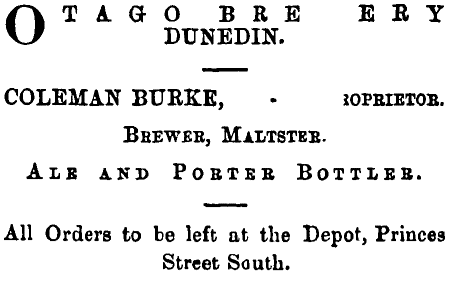
‘The first Mass was celebrated … in the loft of the old bottle store of Burke the brewer. About 20 people were present and they had to ascend a rather rickety ladder and squeeze through a narrow trapdoor to get to the loft. The second Catholic Mass in Dunedin was celebrated in the skittle alley of the Queen’s Arms Hotel, Princes Street South’. – Frank Tod, Pubs Galore: History of Dunedin Hotels 1848–1984, p. 67. [HT: Jennie Coleman]

On helping Tony Abbott to be a Christian

I am so encouraged that Australia’s opposition leader, the honourable Tony Abbott, takes seemingly every opportunity to publicly offer every indication of his sincere intent on being a good Christian. Praise the Lord! Furthermore, it’s great to know that Mr Abbott believes, and that with such costly passion, that ‘Christians’ should be concerned with doing ‘the right thing’. Unfortunately, it appears that Mr Abbot’s got no idea what ‘the right thing’ is; i.e., what is the demand that the gospel lays on him? To be sure, people like Malcolm Fraser and Julian Burnside are doing their darndest to try to educate the poor fella, and I wondered if some accompanying music might help Mr Abbott too. And here I can think of few better than kiwi musician Dave Dobbyn to assist brother Tony to get the ‘Christian’ message (surely he’s not chasing ‘the “Christian” vote’) that he seems so intent on expressing his unyielding fidelity to:

Tonight I am feeling for you
Under the state of a strange land
You have sacrificed much to be here
‘there but for grace…’ as I offer my hand.

Welcome home, I bid you welcome, I bid you welcome
Welcome home from the bottom of my heart.

Out here on the edge
The empire is fading by the day
And the world is so weary in war
Maybe we’ll find that new way.

So welcome home, see I made a space for you now
Welcome home from the bottom of our hearts
Welcome home from the bottom of our hearts.

Keep it coming now – keep it coming now
You’ll find most of us here with our hearts wide open
Keep it coming now – keep on coming now
Keep it coming now – keep on coming now.

There’s a woman with her hands trembling – haere mai
And she sings with a mountain’s memory – haere mai.

There’s a cloud the full length of these isles
Just playing chase with the sun
And it’s black and it’s white and it’s wild
All the colours are one.

So welcome home, I bid you welcome, I bid you welcome
Welcome home from the bottom of our hearts
Welcome home, see I made a space for you now
Welcome home from the bottom of our hearts
From the bottom of our hearts.

[Image: HT to Andrew Beeston, Jono Coates and Jesus]

J. Louis Martyn on life after the invasion

After building a case that Paul’s letter to the Galatians witnesses to the apostles’ basic conviction that ‘the gospel is not about human movement into blessedness (religion); it is about God’s liberating invasion of the cosmos (theology)’, J. Louis Martyn – in a brilliant essay, ‘The Apocalyptic Gospel in Galatians’ (Interpretation 54, no. 3 (2000): 246–66) – proceeds to articulate more fully the shape of that ‘invasion’. Specifically, it means, according to Martyn, a truly crucified cosmos and a genuinely new creation. Commenting on Galatians 6.15, he writes:

Having repeatedly stated that the subject of his letter is the invasive route God has elected in order to make right what has gone wrong, Paul caps his argument by addressing that subject yet again. What do things look like when, having entered the present evil age in Christ, God has begun to set things right? To give the climactic answer to this question, our radical apocalyptic theologian does not refer to an improvement in the human situation. In an unbridled way, Paul speaks rather of nothing less than the dawn of the new creation.

“For me boasting is excluded, except in the cross of our Lord Jesus Christ, by which the cosmos has been crucified to me and I to the cosmos. For neither is circumcision anything nor is uncircumcision anything. What is something is the new creation” (6:14–15; Anchor Bible translation slightly modified).

Our attention is first seized by Paul’s verbs, “is excluded,” “has been crucified,” and “is.” We have in this paragraph a stunning declaration from which the word “should” is altogether absent. Paul speaks about what does and does not exist, not about what should and should not exist. There are two different worlds, the (old) cosmos and the new creation. Second, remembering Paul’s early reference to the present evil age, we also recall that in that reference he celebrated our deliverance from its power. Now, in closing his letter, he speaks of the old world, from which he has been painfully separated—by Christ’s death, by the death of that world, and by his own death to that world. The liberating dawn of the new creation is death? God’s idea of good news includes the crucifixion of God’s Son, of the world, and of human beings?

The crucified cosmos. After announcing the crucifixion of the cosmos, Paul explicates that announcement with an astonishing negation, “neither is circumcision anything nor is uncircumcision anything.” Surprising is the form of this negation (cf. Gal 5:6 and 1 Cor 7:19). In the immediate context, Paul has just referred to the circumcising Teachers (6:12–13). We are prepared, therefore, to find him striking a final blow, directly and simply, against observance of the Law. We expect Paul to say “neither circumcision, nor the food laws, nor the keeping of the sabbath is anything, for gentile observance of the Law reflects the enslaving power of the present evil age!”

He surprises his readers, however, by negating not merely Law observance, but also its opposite, non-Law observance. That to which Paul denies real existence is, in the technical sense of the expression, a pair of opposites, what Aristotle might have called an instance of fanantia, and what I will refer to as an antinomy.

This observation may prove to be of considerable help in our efforts to understand both of Paul’s major apocalyptic expressions in Galatians, “the present evil age” (1:4; in 6:14 the cosmos) and “the new creation” (6:15). For when we note that Paul speaks about a pair of opposites—an antinomy—and that he does so between the making of two cosmic announcements, we may recall how widespread in the ancient world was the thought that the fundamental building blocks of the cosmos are pairs of opposites. A number of the Galatians are almost certain to have been acquainted with this notion, and it is precisely the pattern of thought Paul presupposes in Gal 6:15.

He is making use of it, however, in a very peculiar fashion. He is denying real existence to an antinomy in order to show what it means to say that the old cosmos has suffered its death. He says in effect that the foundation of the cosmos has been subjected to a volcanic explosion that has scattered the pieces into new and confusing patterns. For example, citing an early Christian baptismal tradition, Paul emphatically says that the cosmos, founded as it was on certain pairs of opposites, no longer exists.

For when all of you were baptized into Christ,
you put on Christ as though he were your clothing.
There is neither Jew nor Greek;
there is neither slave nor free;
there is no “male and female”;
for all of you are One in Christ Jesus (3:27–28).

A frightening statement of what is and what is not—again absent the motif of exhortation—this declaration is one in which, as the baptizands are told of their unity in Christ, they also suffer loss of cosmos, as though a fissure had opened up under their feet, hurling them into an abyss.

Potato Soup

Ingredients
2 Tbsp extra virgin olive oil
1.5 kg potatoes, peeled and diced
2 onions, peeled and diced
3 cloves garlic, peeled and sliced
1-2 red chillies, finely chopped
2-3 carrots
1/3 swede
500gr yams, peeled and diced
2 cans rosa tomatoes
2 cans chickpeas
750ml-1lt stock (chicken or vegetable)
handful of freshly chopped herbs (I used oregano & chives)
rock salt & freshly ground pepper, to taste

Method
1. heat oil in pot (cast iron if you have one) and lightly fry onion and garlic until opaque
2. add the rest, make sure that it’s near covered in liquid, and stir
3. cover pot and bring to boil, stirring occasionally
4. slow simmer for 2 hours, stirring occasionally
5. roughly mash
6. simmer for a further 15 mins
7. serve with toasted fresh bread (thick slices) and cold pilsner (optional)
8. share the love

Mustard Roasted Yams

Pre-roasted yams

A few people now have asked me for ‘my’ recipe for mustard roasted yams. It’s a lightly modified version of a recipe by Alison Lambert. Here ’tis:

Ingredients

2 Tbsp cup whole grain mustard
1 Tbsp Dijon mustard
2 Tbsp extra-virgin olive oil
1 Tbsp honey
2 Tbsp apple cider vinegar or fresh lemon juice
3 garlic cloves, minced
1 tsp salt
1kg yams, washed
Freshly cracked pepper
Handful of fresh herbs (oregano, thyme)

Method

  1. Preheat oven to 200C.
  2. Whisk mustard, olive oil, butter, honey, vinegar/lemon juice, garlic, herbs and salt in large bowl to blend.
  3. Add yams; sprinkle generously with freshly ground black pepper and toss to coat. Spread yams in a single layer over a preheated baking tray. Roast yams for 20-30 minutes or until the yams are crusty on the outside and tender inside, turning occasionally.

On living with cats

My love for felis silvestris catus has already been documented. Now, my friend Jim Gordon has both confirmed and challenged that love in two cleverly crafted sentences. He writes:

‘One of the worst mentors for living kenotically is the cat, imperiously indifferent, manipulatively affectionate, instinctively self-interested, morally impervious, purringly contented most times, and furry fury now and again. Such a good balance to help us avoid that anaemic kind of Christian disposition that Thomas Merton called “chronic niceness”‘.

Thanks, Jim, for the invitation to think again, and that not least about how hopelessly cat-like I am. Certainly, reading Philippians 2 will never be the same again.

Busyness

‘Busyness serves as a kind of existential reassurance, a hedge against emptiness; obviously your life cannot possibly be silly or trivial or meaningless if you are so busy, completely booked, in demand every hour of the day. I once knew a woman who interned at a magazine where she wasn’t allowed to take lunch hours out, lest she be urgently needed for some reason. This was an entertainment magazine whose raison d’être was obviated when “menu” buttons appeared on remotes, so it’s hard to see this pretense of indispensability as anything other than a form of institutional self-delusion. More and more people in this country no longer make or do anything tangible; if your job wasn’t performed by a cat or a boa constrictor in a Richard Scarry book I’m not sure I believe it’s necessary. I can’t help but wonder whether all this histrionic exhaustion isn’t a way of covering up the fact that most of what we do doesn’t matter’. – Tim Kreider, ‘The “Busy” Trap’

June stations …

Reading:

Listening:

Watching: