Author: Jason Goroncy

Logos announces the P.T. Forsyth Collection

It’s always wonderfully encouraging to see that PT Forsyth continues to be read. And while all of Forsyth’s major publications are easily and freely accessible in various formats, Logos are planning to make them available in one place in e-book form with their PT Forsyth Collection. Here’s the product description:

The P. T. Forsyth Collection brings together 24 works from this celebrated Scottish theologian and preacher. After studying at the University of Göttingen under the notable theologian Albrecht Ritschl, Forsyth went on to become one of the early twentieth century’s most influential theologians—his ideas are largely thought to have anticipated, and mirrored, the neo-orthodox movement of Karl Barth and Emil Brunner.

The P. T. Forsyth Collection includes Forsyth’s best-known works, including The Cruciality of the Cross, his strong plea for the orthodox doctrine of atonement, and The Justification of God, a moving collection of lectures written at the height of World War I, when many Christians were having trouble reconciling their faith in God with the horrors of war. In This Life and the Next, Forsyth studies the doctrine of immortality and its impact on our current lives. Christ on Parnassus contains lectures on the connection between art and religion. The still-popular Positive Preaching and Modern Mind contains advice to future ministers—advice still relevant for and needed by today’s teachers and preachers.

Also included is the The Holy Father and the Living ChristChristian Perfection, and The Taste of Death and the Life of Grace, which were later reprinted in a single volume titled God the Holy Father, as well as The Principle of Authority in Relation to Certainty, Sanctity and Society, which was later republished as The Church, the Gospel, and Society.

Plus, there are works that examine the doctrine of Christ’s divinity, the connection between economics and the church, the ethics of war and Christianity, and much more. In the Logos Bible Software edition, all Scripture passages in the P. T. Forsyth Collection are tagged to appear on mouseover. For scholarly work or personal Bible study, this makes these resources more powerful and easier to access than ever before. Perform powerful searches by topic or Scripture reference—finding, for example, every mention of “resurrection” or “Mark 9:2.”

Forsyth buffs may also be keen to know that Logos also plan to make available the works of James Denney. Good stuff.

A wee report from the Confoederatio Helvetica

A few weeks ago, I was in Switzerland. I was there for a meeting with the World Communion of Reformed Churches, and to attend a fascinating conference on Churches and the Rule of Law for which I was invited to be a respondent to a paper on ‘The Bible and the State’ by Jim Skillen. It was a wonderful gathering of some very impressive minds, stimulating papers and friendly souls. A number of folk have asked me for a copy of my response. It can be downloaded here. I understand that a final version will, in due course, appear in published form as part of the John Knox Series.

But the trip wasn’t all ‘business’. One – this one at least – simply doesn’t travel half way around the world and not squeeze in some extra-curricular activities! So the itinerary included time in Lausanne (whose cathedral is among the most beautiful I’ve visited anywhere in the world), Neuchâtel, Montreux, Zermatt and the Matterhorn, the Bernese Oberland and the Junfrau (think Queenstown on some serious steroids), Lucerne, Safenwil (a real highlight for me, for obvious reasons), Basel (where I continued the Barth trail), St-Ursanne, Jura & Three-Lakes, and, of course, a significant amount of time in the amazing city of Geneva where I breathed in some more reformed air. Suffice it to say that, coffee and that terrible Calvinus beer excluded, Switzerland is amazing, and I hope to return.

Rules for nurses and other members of the hospital

Every visitor to a modern hospital will encounter a lot of baloney around its wards and halls and lifts. But these rules, taken from the ‘Standing Orders of St. Thomas’ Hospital 1689–1782’, (i) make good sense to me, (ii) prove in themselves that everything that Owen Barfield warned us about in his History in English Words is true, and (iii) should most certainly be reinstated at once as accepted practice throughout the globe’s medical establishments. I mean, seriously, whenever did such evolutionary-advanced societies cease the wise and long-tested practice of allowing dead bodies to be dismembered without the permission of a treasurer? So, for the sake of a better world, behold the wisdom of our forebears:

1. No Person shall be received into the House who is visited, or suspected to be visited, with the Plague, Itch, Scald-Head or other Infectious diseases, and if any such be taken in, then to be discharged as soon as discovered.

2. Patients shall not Swear, not take God’s Name in vain, nor revile, nor miscall one another, nor strike or beat another, nor steal Meat, or Drink, Apparel, or other thing, one from another.

3. Patients shall not abuse themselves by inordinate Drinking, nor incontinent Living, nor talk, nor not Immodestly, upon pain of expulsion; and when they go to or return from the Meals and Beds, they shall crave God’s Blessing and return Thanks to God.

4. No Drink shall be brought in and sold to Patients except by the Physician’s and Surgeon’s License.

5. No Patient with the Foul disease shall go out of his Ward, nor come into the House to fetch anything, nor within Chapel, nor sit upon the seats in the Courtyards, upon pain of Expulsion.

6. None of the Women shall go into the Men’s Wards, nor the Men into the Women’s wards, without License, upon pain of Expulsion.

7. The Sisters shall clean the Wards by Six a.m.

8. Every tenth bed is to be left empty to air and not more than one patient is to be put into each bed.

9. The Sisters shall see that no Card Play or Dicing takes place in the House.

10. If any of the Sisters shall disorder themselves by brawling with one another, or other misdemeanor, she is to be removed her Ward and subsequently discharged the House for ever.

11. Old sheets shall be washed and given the Surgeons for Dressings.

12. No Surgeon shall suffer his Servant to perform any Operation; dilate or cut open Imposthumes, or Sinuous Ulcers, except the Master of such Servant be present, and direct the same.

13. No Dead body shall be opened, Dissected or Dismembered without leave from the Treasurer, or Steward in the Absence of the Treasurer.

14. The Sexton shall keep the Chapel and yards clean and make graves six feet deep, six feet long and three feet wide at eighteen pence each.

Chicken Korma with Coriander Leaves – Dhaniwali Murgh Korma (Kashmir)

Kashmir is actually sheep and goat country and chicken is eaten rarely. This recipe was shown to me by Abdul Ahad Waza who is the premier Kashmir wedding and party caterer. Along with his four sons he cooks in his courtyard and supplies food to the culinary cognoscenti of Kashmir and in the winter does the same in Delhi. This is rather an unusual-flavoured Chicken Korma, mild and fragrant with a thin gravy. Good to eat with rice, roti or even sliced bread. The recipe serves 4.

Ingredients

1kg (organic) chicken
8 green cardamoms
5 garlic cloves
10cm cinnamon stick
10–12 strands of saffron
1/2 teaspoon turmeric powder
2 onions, chopped
1/2 teaspoon ginger powder
3–5 green (or red) chillies, chopped (and deseeded if you prefer)
salt
1 1/2 cups full-fat yoghurt
1/4 cup ghee or extra virgin olive oil
2 cups chicken stock
4 cloves
1/4 teaspoon ground black pepper
2–4 tablespoons chopped coriander leaves

Method

  1. Boil the chicken in 3 cups of water along with 2 of the garlic cloves for 3–4 minutes. Strain and discard water. Leave the chicken to cool, then rinse in lukewarm water. This removes all the odour of the chicken. Cut up the chicken into big bite-sized pieces.
  2. Pound the remaining garlic and soak in 1/2 cup of water to obtain a garlic infusion. Soak the saffron strands in 1/4 cup of water, pressing with the back of a spoon to get an infusion. Purée the onions with the green (or red) chillies. Whisk the yoghurt and set aside.
  3. Heat the ghee or oil in a heavy-based cooking pot and fry the onion purée until golden (about 12–15 minutes). Add the cloves, cardamoms and cinnamon followed by the turmeric powder. Add the chicken, garlic infusion and yoghurt and cover with a lid. Allow to simmer for 7–10 minutes until the juices are absorbed.
  4. Add the ginger powder and salt to taste and sauté for 3–4 minutes until the chicken is lightly browned. Add just enough chicken stock to get the amount of gravy desired (this dish does not need a great deal and you will probably want to then reduce the amount of gravy during the simmer).
  5. Simmer over a gentle heat for 40 minutes, stirring occasionally. When the chicken is tender, sprinkle with the saffron infusion, pepper and fresh coriander leaves. (Alternatively, turn it off after the simmer and then re-heat when required, adding the infusion, pepper and coriander leaves just before you are ready to serve it up).

This recipe is modified from Camellia Panjabi’s version in 50 Great Curries of India.

An essay competition for theology students and young pastors

The World Communion of Reformed Churches is sponsoring an essay competition for theology students and young pastors (up to 35 years of age). The topic is ‘Paradise: an inspirational concept for the financial and economic structures of the global society’.

Essays (written in English, French, Spanish or German) should be received no later than 23 December 2012, and the winner will be awarded the Lombard Prize.

More information is available here.

Towards a Modest and Messy Manifesto for Pastors: a draft

In just over a week, the Knox Centre for Ministry and Leadership will be welcoming a new group of ministry interns. This is often nearly as exciting as it is sad to say goodbye to those ones who are completing their studies with us. In addition to writing some new lectures, I’ve also been thinking about putting together a wee list of items of counsel for new (and old) ministers to consider and discuss. Of course, such a list could be endless, or radically brief. But here are 54 little tidbits that I came up with/stole today:

  1. Remember your baptism. Creep back into the font regularly.
  2. ‘Let nothing be done by force; let everything be done in freedom and love’.[1]
  3. Do not neglect the gift of prayer. Pray especially when you don’t have time to pray, when prayer makes the least sense, and when God’s aliveness seems the least likely version of reality.
  4. Read Scripture devotionally. Immerse your mind, your heart, your wallet, your time and your conscience in Scripture. This means reading the Bible for your sake, and not merely in order to mine passages that can be ‘used’ for some purpose other than hearing the Word of God for yourself. To read devotionally also entails a commitment to letting Scripture read you.
  5. Read Scripture in a scholarly way. Commit yourself to the disciplined study of Scripture, preferably in the original languages. Pastoral ministry is about three things: Exegesis, exegesis and exegesis. ‘Plow [Scripture] like a farmer, furrow after furrow’ (Eduard Thurneysen).
  6. Read newspapers in a scholarly way. Commit yourself to disciplined study of the newspaper. Pastoral ministry is about three things: Exegesis, exegesis and exegesis.
  7. Immerse yourself in the thought and writings of 2–3 significant thinkers for the next 20 years or more. Let them teach you, pastor you, advise you in various pastoral situations. Argue with them heaps, and learn from them.
  8. Always have (at least) one serious theological book on the go. Something like Dostoyevsky’s The Brother’s Karamazov or St Basil’s treatise On the Holy Spirit are worthy options.
  9. Regularly read paragraphs from P.T. Forsyth’s Positive Preaching and the Modern Mind and The Soul of Prayer, from Karl Barth’s The Word of God and the Word of Man, from Alexander Schmemann’s For the Life of the World, and from Athanasius’ On the Incarnation.
  10. Always have (at least) one novel or collection of poetry on the go, and read from it daily. Not only will this increase your chances of avoiding insanity, but it will make you a better theologian, pastor and preacher. Like sore thumbs and monotonous crickets are those untrustworthy and boring souls who don’t read novels and/or poetry.[2]
  11. Whatever the situation, always begin by asking the ‘Who’ question; i.e., ‘Who is Jesus Christ today, here and now?’[3] There may well come a time when you feel that the ‘Why’ and ‘How’ questions matter too, but they can wait their proper turn.
  12. In every situation, recall that humanity has been given one Great High Priest and that such a person is not you. Christian ministry has no justification or power or acceptance except that it be a participation, by the Spirit, in the vicarious humanity of the Son who, as the second (or last) Adam, leads creation and its priests into the worship and joy of the Father and into the service of the Father’s world.[4]
  13. In every situation, remember that every believer – and not just those with dog-collars (or their ‘secular’ equivalents) – receives from God all of the Great High Priest’s benefits and shares in what he is doing now.
  14. Every now and then, read 1 Peter 4 and, more than every now and then, 2 Corinthians.
  15. Learn to trust the people close to you.
  16. Learn to be suspicious of the people close to you.
  17. ‘Many people will want to give you advice. Mostly this says more about them than about you’ (Mary-Jane Konings).
  18. Hang out regularly – and informally – with a more seasoned minister. When you meet, beer and pizza should be the only additional default items.
  19. Hang out regularly – and informally – with peers. When you meet, beer and pizza – or beer and good Indian food – should be the only additional default items.
  20. Hang out regularly – and informally – with those you can mentor. When you meet, beer and pizza – or just beer – should be the only additional default item(s).
  21. Keep a whiteboard marker in the shower for those moments of inspiration.
  22. Despise and avoid romantic visions of Christian community. So Bonhoeffer: ‘God hates visionary dreaming; it makes the dreamer proud and pretentious. The man who fashions a visionary ideal of community demands that it be realized by God, by others, and by himself. He enters the community of Christians with his demands, sets up his own laws, and judges the brethren and God himself accordingly. He stands adamant, a living reproach to all others in the circle of the brethren. He acts as if he is the creator of the Christian community, as if his dream binds men together. When things do not go his way, he calls the effort a failure. When his ideal picture is destroyed, he sees the community going to smash. So he becomes, first an accuser of his brethren, then an accuser of God, and finally the despairing accuser of himself. Because God has already laid the only foundation of our fellowship, because God has bound us together in one body with other Christians in Jesus Christ, long before we entered into common life with them, we enter into that common life not as demanders but as thankful recipients. We thank God for giving us brethren who live by his call, by his forgiveness, and his promise. We do not complain of what God does not give us; we rather thank God for what he does give us daily. And is not what has been given us enough: brothers, who will go on living with us through sin and need under the blessing of his grace? Is the divine gift of Christian fellowship anything less than this, any day, even the most difficult and distressing day? Even when sin and misunderstanding burden the communal life, is not the sinning brother still a brother, with whom I, too, stand under the Word of Christ? Will not his sin be a constant occasion for me to give thanks that both of us may live in the forgiving love of God in Christ Jesus? Thus, the very hour of disillusionment with my brother becomes incomparably salutary, because it so thoroughly teaches me that neither of us can ever live by our own words and deeds, but only by the one Word and Deed which really binds us together – the forgiveness of sins in Jesus Christ. When the morning mists of dreams vanish, then dawns the bright day of Christian fellowship’.[5]
  23. Give thanks often and don’t complain about your church, not even to God: ‘If we do not give thanks daily for the Christian fellowship in which we have been placed, even where there is no great experience, no discoverable riches, but much weakness, small faith, and difficulty; if on the contrary, we only keep complaining to God that everything is so paltry and petty, so far from what we expected, then we hinder God from letting our fellowship grow according to the measure and riches which are there for us all in Jesus Christ. This applies in a special way to the complaints often heard from pastors and zealous members about their congregations. A pastor should not complain about his congregations, certainly never to other people, but also not to God. A congregation has not been entrusted to him in order that he should become its accuser before God and men. When a person becomes alienated from a Christian community in which he has been placed and begins to raise complaints about it, he had better examine himself first to see whether the trouble is not due to his wish dream that should be shattered by God; and if this be the case, let him thank God for leading him into this predicament. But if not, let him nevertheless guard against ever becoming an accuser of the congregation before God. Let him rather accuse himself for his unbelief. Let him pray to God for understanding of his own failure and his particular sin, and pray that he may not wrong his brethren. Let him, in the consciousness of his own guilt, make intercession for his brethren. Let him do what he is committed to do, and thank God … What may appear weak and trifling to us may be great and glorious to God. Just as the Christian should not be constantly feeling his spiritual pulse, so, too, the Christian community has not been given to us by God for us to be constantly taking its temperature’.[6]
  24. ‘Your church is not a reflection of you. It’s success doesn’t make you great; it’s failures don’t make you one. It’s really not about you’ (Carolyn Francis).
  25. Retain a private phone number, and that if for no other reason than that your partner and kids will be grateful.
  26. Remember that God has been calling people do to this impossible stuff for long before you came on the scene, and that you’re dreadfully unlikely to be the last.
  27. Don’t seek honour and don’t give a toss about who is the greatest (see Luke 9.46). As Bonhoeffer put it, ‘The desire for one’s own honor hinders faith. One who seeks his own honor is no longer seeking God and his neighbour … Every cult of personality that emphasizes the distinguished qualities, virtues, and talents of another person … is worldly and has no place in the Christian community; indeed, it poisons the Christian community … The Church does not need brilliant personalities but faithful servants of Jesus … The root of all sin is pride’.[7] Or, as Jesus put it, ‘change and become like little children’ (Matt 18.3).
  28. Fish, or garden, or tramp, or climb trees, or keep bees, or just do something that reminds you that you and this earth belong together, that you are made of dust, and to dust you will return. There is, we are reminded, ‘no clear line between religion and fly fishing. We lived at the junction of great trout rivers in western Montana, and our father was a Presbyterian minister and a fly fisherman who tied his own flies and taught others. He told us about Christ’s disciples being fishermen, and we were left to assume, as my brother and I did, that all first-class fishermen on the Sea of Galilee were fly fishermen and that John, the favorite, was a dry-fly fisherman’.[8]
  29. Learn a musical instrument, or paint, or cook. Human vocation involves undoing the curse of tastelessness and boringness that exists within creation, of adding value to creation itself, and of bearing witness to the wonderful truth that in the end all is music.
  30. Avoid ecclesiocentricity. The end game, after all, is not the church but the new creation. Consequently, those whose entire identity is wrapped up in churchly matters are not only living a lie but are failing to bear witness to the true nature of reality.
  31. Avoid ecclesioisolation: ‘Let him [or her] who cannot be alone beware of community. Let him [or her] who is not in community beware of being alone’.[9]
  32. Cultivate the gifts of friendship. This is a biggie, and its neglect is the cause of much pain in the minister, of much scandal in the church, and of much lying in the world.
  33. Start to seriously worry if you never change your mind about important things.
  34. Anticipate being surprised about God’s location and shape: ‘I can never know beforehand how God’s image should appear in others’.[10]
  35. While we’re speaking of anticipations, if you anticipate wanting something changed at the manse, or in the proposed ‘job description’ (Is there anything more ugly or category-confusing for a minister to have to contend with than one of these awfully-heretical documents?), agree on it early and be done with it.
  36. Because there is an inevitable unfinishedness about the routines of ministry, many ministers find it helpful to ‘pursue a hobby where you can complete projects regularly’ (Mary-Jane Konings).
  37. Minister out of your love life with God. Better still, minister out of God’s love life with you.
  38. Love the people that God has entrusted to your care. Live in solidarity with them, rejoice with them, cry with them and, if called upon, die for them. This includes your own family.
  39. For those with partners, never underestimate the gift that your partner’s eyes (and those of your kids too) are for noticing things within and outwith you that you need to know.
  40. At home, keep a strong-handled basket somewhere handy into which you can throw things during the week that you need to take to church on Sunday, and bring home things (like books that you’ll never read but someone thinks you should) that others give you. When at church, keep this basket on the front pew and make it known that this is what it is for.
  41. Develop ways of learning to speak the local lingo. ‘Laity sometimes complain that their young pastor, in sermons, uses “religious” words like “spiritual practice,” “liberation,” “empowerment,” “intentional community” … that no one understands and no one recalls having heard in Scripture. Such “preacher talk” makes the pastor seem detached, alien, and aloof from the people and hinders leadership’. (William Willimon)
  42. ‘At the same time, prepare yourself to become a teacher of the church’s peculiar speech to a people who may have forgotten how to use it. This may seem contrary to [the previous] suggestion. My friend, Stanley Hauerwas, says that the best preparation for being a pastor today is previously to have taught high school French. The skills required to drill French verbs into the heads of adolescents are the skills that pastors need to teach our people how to speak the gospel. Trouble is, most seminarians are more skilled, upon graduation from school, to be able to describe the world anthropologically than theologically. They have learned to use the language of Marxist analysis or feminist criticism better than the language of Zion. We must be persons who lovingly cultivate and actively use the church’s peculiar speech’. (William Willimon)
  43. ‘Keep telling yourself that the difference in thought between the laity in your first parish and that of your friends back in seminary is not so much the difference between ignorance and intelligence; it’s just different ways of thinking that arise out of life in different worlds. I recommend reading novels (Flannery O’Connor saved me in my first parish by writing true stories that sounded like they were written by one of my parishioners) in order to appreciate the thought and the speech of people who, while having never been initiated into the narrow confines of the world of theological education, are thinking deeply’. (William Willimon)
  44. ‘Remind yourself that while the seminary has an important role to play in the life of the church, it is the seminary that must be accountable to the church, not vice versa. It is my prejudice that, if you have difficulty making the transition from seminary to parish it is probably a criticism of the seminary. The Christian faith is to be studied and critically examined only for the purpose of its embodiment. Christians are those who are to become that which we profess. The purpose of theological discernment is not to devise something that is interesting to say to the modern world but rather to rock the modern world with the church’s demonstration that Jesus Christ is Lord and all other little lordlets are not’. (William Willimon)
  45. ‘Be open to the possibility that the matters that were focused upon in the course of the seminary curriculum, the questions raised and the arguments engaged, might be a distraction from the true, historic mission and purpose of the church and its ministry’. (William Willimon)
  46. ‘On the other hand, be open to the possibility that the church has a tendency to bed down with mediocrity, to accept the mere status quo as the norm, and to let itself off the theological hook too easily. One reason why the church needs theology explored and taught in its seminaries is that theology (at its best) keeps making Christian discipleship as hard as it ought to be. Theology keeps guard over the church’s peculiar speech and the church’s distinctive mission. Something there is within any accommodated, compromised church (and aren’t they all, in one way or another?) that needs to reassure itself, “All that academic, intellectual, theological stuff is bunk and is irrelevant to the way the church really is.” The way the church “really is” is faithless, mistaken, cowardly, and compromised. It’s sad that it is up to seminaries to offer some of the most trenchant and interesting critiques of the church. Criticism of the church ought to be part of the ongoing mission of a faithful church that takes Jesus more seriously and itself a little less so’. (William Willimon)
  47. ‘Your life would be infinitely easier and less complicated if God had called you to be an accountant or a seminary professor. Most of the stuff that you read in seminary will only prepare you really to grow and to develop after you leave seminary. Think of your tough transition into the parish as the beginning, not the end, of your adventure into real growth as a minister. Theology tends to be wasted on the young. It’s only when you run into a complete dead end in the parish, when you are aging and tired and fed up with the people of God (and maybe even God too) that you need to know where to go to have a good conversation with some saint in order to make it through the night. Believe it or not, it’s much easier to begin in the ministry, even considering the tough transition between seminary and the parish, than it is to continue in ministry. A winning smile, a pleasing personality, a winsome way with people, none of these are enough to keep you working with Jesus, preaching the Word, nurturing the flock, looking for the lost. Only God can do that and a major way God does that is through the prayerful, intense reading, study and reflection that you can only begin in three or four years of seminary’. (William Willimon)
  48. ‘Try not to listen to your parishioners when they attempt to use you to weasel out of the claims of Christ. Much of the criticism that you will receive, many of their negative comments about your work, are just their attempt to excuse themselves from discipleship. “When you are older, you will understand,” they told me as a young pastor. “You have still got all that theological stuff in you from seminary. Eventually, you’ll learn,” said older, cynical pastors … God has called you to preach and to live the gospel before them and they will use any means to avoid it. Be suspicious when people encourage you to see the transition from seminary to the parish as mainly a time finally to settle in and make peace with the “real world.” Jesus Christ is our definition of what’s real and there is much that passes for “the way things are” in the average church that makes Jesus want to grab a whip in hand and clean house’. (William Willimon)
  49. ‘The next few years could be among the most important in your ministry, including the years that you spent in seminary, because they are the years in which you will form your habits that will make your ministry. That’s one reason why I think the Lutherans are wise to require an internship year in a parish, before seminary graduation, for their pastors and why I think that a great way to begin is to begin your ministry as someone’s associate in a team ministry in a larger church. In a small, rural church, alone, with total responsibility in your shoulders, in the weekly treadmill of sermons and pastoral care, if you are not careful there is too little time to read and reflect, too little time to prepare your first sermons, so you develop bad habits of flying by the seat of your pants, taking short cuts, and borrowing from others what ought to be developed in the workshop of your own soul. Ministry has a way of coming at you, of jerking you around from here to there, so you need to take charge of your time, prioritize your work, and be sure that you don’t neglect the absolute essentials while you are doing the merely important. If you don’t define your ministry on the basis of your theological commitments, the parish has a way of defining your ministry on the basis of their selfish preoccupations and that is why so many clergy are so harried and tired today. Mind your habits’. (William Willimon)
  50. Speaking of habits, remember that ‘The pulpit is the real arena of the Kingdom of God’ (Karl Barth). In the busy demands that attend parish life, order your priorities accordingly.
  51. Woe to that minister who sub-contracts their pastoral care responsibilities to others and in so doing divorces the cure of souls from the ministry of the Word.
  52. Always strive to represent the local church to the church catholic, and the church catholic to the local church.
  53. Prepare three envelopes:

‘In a certain city there lived a young pastor who was starting her first day at her first solo pastorate. She had met the staff, put all her books on the shelves, and was arranging her desk when a curious thing happened. She opened the desk drawer, and there were three sealed envelopes, numbered one, two, and three, encircled with a rubber band, and with a note attached.

She eagerly unfolded the note, and this is what it said: “Dear Successor. Welcome to the Old Church on the Green. When I arrived here many years ago I found three envelopes in my desk as you just have. They were from my predecessor and his note told me to open each of them in turn whenever I found myself in difficulty in the parish. This was very helpful to me, so I am providing you with three numbered envelopes to open when you need them. Blessings on your ministry. Your Predecessor.”

She didn’t know what to make of this, but soon forgot about the envelopes amidst the whirlwind of starting a new ministry, meeting new people, putting names with faces, in the general excitement and anxiety of the first months. And truth to tell, she had a joyful honeymoon period where she learned to love the congregation and they learned to love her, and everybody was very happy and content.

But in the fullness of time some discontents could be discerned among the faithful. Well-meaning advisors came to her to tell her things they had heard, not that they felt that way, but others did. None of the complaints were major, but they ate at her morale. Some said she had annoying mannerisms in the pulpit, that she was never in the office, that she didn’t do enough pastoral visitation, that she had been seen coming out of a yoga class during the daytime when honest hard-working people are at their jobs.

All these things got her down, and one day she spotted the forgotten envelopes in her desk drawer. She wondered if she should open the first one, and after some struggling and prayer about it, she did so. Inside was a single sheet of paper and on it were the words: “Blame your predecessor.”

She had once taken interim ministry training so she knew how to do this and immediately put the strategy into play. She told her boards and committee that congregations were really dysfunctional family systems and the dysfunction was caused by the former pastor. They all nodded their heads and agreed to be healthier, and they forgot all about their complaints against her, since it is always easier to judge someone that isn’t around. And once again everybody was happy and content.

There came a time, however, when new discontents emerged. The economy went South, pledges were down, fuel cost were up, the endowment which many worshipped had taken a hit, new members were slow to arrive to help pay the bills. She was no longer the new pastor, and there were hints and rumors that a different kind of a leader might fix the problems. She didn’t know what to do. She tried everything she could think of. She went to a centering prayer workshop, she got a Day-Timer, and she attended the Alban Institute conference called “When your Job Sucks.” But none of it seemed to help, so one day, after much struggle and prayer, she opened the second envelope. Once again it was a single sheet of paper and on it were the words: “Reorganize.”

So she convinced her board to create a long-term planning committee, write a new mission statement, and re-write the by-laws. And everybody got very busy, and worked hard together, and there wasn’t enough energy left to complain, and the church thrived for many seasons, and everybody in the congregation felt proud of themselves for having such a well-organized church and such a clever pastor. And, once again, everybody was happy and content.

By this time our pastor was frankly getting a little bored, and not a little burned-out, and wondered just how long she could put out the energy it was taking to keep such a well-organized church going. And her soul was disquited within her.

Once again she tried everything she could think of. She joined a pastor’s support group, she went on a Conference Committee on pastoral excellence, she bought herself a smart-phone and started a blog. But none of it seemed to help, so finally one day in desperation she went to her desk drawer and she opened the third envelope. Once again inside was a single sheet of paper and on it were the words: “Prepare three envelopes.”’[11]

54.  Remember your baptism.

Suggestions will be gratefully received.

To be continued …


[1] Dietrich Bonhoeffer, Life Together (trans. John W. Doberstein; New York: Harper and Row, 1954), 66.

[2] See Michael Jinkins, Letters to New Pastors (Grand Rapids: Wm. B. Eerdmans, 2006), 49–55.

[3] See Dietrich Bonhoeffer, Christology (trans. John Bowden; London: Collins, 1966), 58ff.

[4] See Jason A. Goroncy, ‘”Tha mi a’ toirt fainear dur gearan”: J. McLeod Campbell and P.T. Forsyth on the Extent of Christ’s Vicarious Ministry’ in Evangelical Calvinism: Essays Resourcing the Continuing Reformation of the Church (ed. Myk Habets and Bobby Grow; Princeton Theological Monograph Series. Eugene, OR: Pickwick Publications, 2012), 253–86.

[5] Bonhoeffer, Life Together 27–29.

[6] Ibid. 29–30.

[7] Ibid. 95, 108, 109, 113.

[8] Norman Maclean, A River Runs Through It.

[9] Bonhoeffer, Life Together 78.

[10] Ibid. 93.

October stations …

Reading:

Listening:

‘Tui’

Earlier this week, New Zealand’s finest newspaper, the Otago Daily Times, published one of my recent poems – ‘Tui’. I had hoped to simply be able to provide a link to an online version of the poem but unfortunately none has appeared. Therefore, and particularly for the benefit of those outwith New Zealand who do not have access to the ODT, here ’tis:

The twelfth of
September felt like the
end of all
time. The feared turning
away and vastness of
noiselessness, cup of
bitterness,
undoing of dreaming
and the breaching
open of a wall that
refuses to be
dammed. There can be
now no journey backwards. This
long tide shall stay out. The
bow has been hard bent –

there shall be
no more music.

The nineteenth: we left
the trail, hacked our
way down through
autumn scrub, carrying
the too-small box to the
horizontal slide
of stones that
form the bank by
the River Garry, along
the Pass of Killiecrankie where
we stopped,
to surrender thanks and
to seek goodbye and
to cast our unfinished weight to
the mercy of the current.

[This poem first appeared in the Otago Daily Times, 29 October 2012, p. 9. The beautiful image, ‘Autumn, River Garry at Killiecrankie, Scotland’, is provided by Lindsay Mackinlay, and is used by permission].

Rick Floyd on the lost soul of the procedural church

Some years ago now, my dear friend Rick Floyd shared a wonderful wee parable about pastoral ministry. It was called ‘Prepare Three Envelopes’. He then followed it up with an insightful midrash which bears repeating:

One of the rules I live by is to never explain a joke, but I’m going to break that rule to talk about my recent post: Prepare Three Envelopes: A Parable about Pastoral Ministry.

As several of you have pointed out it is an old joke. John McFadden said he “kicked the slats out of his crib laughing” the first time he heard it. Several of you told me different variations on the one I told, which I think I first heard from Peter Wells, my canny former area minister.

Many of you said it was both funny and painful. Bob Grove-Markwood said, “I laughed, I cried.” Verlee Copeland said she wished “it were funnier for that bell tolls for us all.” It surely resonated with many clergy, which is no accident.

The joke itself was just the frame I used for the picture I wanted to draw. I put the joke in an extended shaggy dog style to accomplish several things. First, I wanted the heroine to be a bit of a cipher and not a fleshed-out character, so that clergy could fill in their own particulars and relate to her situation. I made her a woman pastor so that the parable wouldn’t be seen as strictly autobiographical, although there is more of my own story in it than is entirely comfortable.

I wanted to evoke a certain kind of congregation, what I will call here the procedural church. Now such a congregation doesn’t exist as an ideal type, but I believe most mainline congregations have features of what I will describe.

As I have written elsewhere (“Introduction” to When I Survey the Wondrous Cross) I believe the dominant mode of reflecting on congregational life in our time is not theological (as I believe it should be), but managerial, psychological, and political.

So a managerial congregation will borrow outlooks and methods from the corporate world, and be preoccupied with metrics, goals, objectives, and outcomes largely cast without use of the church’s historic grammar. My reference to the second envelope was a small swat at this approach.

The psychological congregation sees its life in therapeutic terms, and employs the language of health and pathology, of addiction and recovery, and co-dependence. This model loves to talk about boundaries. My little dig at interim ministry comes from my conviction that the family systems model employed by many interim ministers is a blunt tool to deal with complex congregational life, and often scapegoats former pastors, which the Intentional Interim Network dismissingly refers to in their training as BFP’s, Beloved Former Pastors. As a beloved former pastor myself I feel this outlook is disrespectful to dedicated leaders who have given their lives for the church.

The political church sees itself as a change-agent in an unjust and oppressive society, and understands its mission to advance a series of predetermined causes. The bond between congregants is political like-mindedness, and those who don’t “get it” are likely to be driven away without regret. This kind of church, usually liberal in the mainline, fosters a paranoid style, which demonize those who disagree with it. They are always railing against the Religious Right, but actually provide a mirror image of those they fear and distrust, a shadow side Religious Left.

Now I must insert the mandatory self-evident truth that there are genuine insights in all these approaches, and wise leaders should avail themselves of whatever is useful in the culture. Having said that, what is striking to me about the procedural church is the dominance of its perspective over the church’s own grammar.

Congregations can partake of all three of these procedural approaches in various combinations, but what they all share is a procedurally driven church whose agenda takes little account of the church’s own rich heritage of congregational self-understanding derived from scripture and tradition. Ecclesiology, the sub-category of theology that thinks deeply about the church, has a long and deep ecumenical storehouse of insights on how to be the church that are largely ignored or forgotten. Leander Keck, in his fine book, The Church Confident, once compared the contemporary church with folks who inherit a fine old mansion, but choose rather to live in a pup tent in the back yard.

So notice that in Prepare Three Envelopes I never mention God, Jesus Christ, the Holy Spirit, the Trinity, the Scriptures, the sacraments, the creeds, or Christian doctrine. Our heroine does pray, but whether it is Christian prayer is left an open question.

I tried to evoke a kind of flatness in this imaginary congregation. We don’t see our pastor preparing or delivering a sermon, baptizing a baby, presiding at the eucharist, praying by a sickbed, or standing by a grave, even though these activities take up a good deal of any pastor’s time in real life. What we do see her doing is strategizing and attending meetings, the hallmarks of the procedural church.

Now at the end of the parable our heroine is burned-out because she has been driving this frenetic congregational juggernaut out of her own soul, which is now seriously depleted. And if there is one feature common to all three kinds of procedural congregations it is this endless frenetic activity, what P.T. Forsyth once called “The Sin of Bustle.”

The procedural church is functionally atheistic, in that everything depends on us, and nothing depends on God, other than to bless and sanctify the works of our hands.

Morale is bad in the procedural church. Brad Braxton’s sudden and sad departure from Riverside Church has lit up the blogosphere with comments from clergy who feel ill-used by their congregations. There is always plenty of blame to go around in any church kerfuffle, but my perception of many congregations is that their fights and preoccupations about procedure, in Braxton’s case over his salary package, arise because they do not know how to be church.

They know how to manage organizations, they know how to analyze family systems, and they know how to drive a political agenda. But when it comes down to being the church of Christ, to hear his living voice in sermon and text, to eat his sustaining bread, to share his cruciform life, to know that it is his ministry we are called to share and not just be our own voluntary association, not so much! And clergy can blame toxic congregations all they want, but isn’t it the work of the ordained ministry to keep these things before them?

Without sound teaching, faithful preaching, lively and sacramental worship, and enriching group life, the congregation can have all the procedures down and still have lost its soul.

An ‘authentic’ church is a church which sees itself as ‘the bearer of a question’

I spent some time today reflecting on these words from Rowan Williams’ extraordinary essay ‘Women and the Ministry: A Case for Theological Seriousness’. (The essay appears in Feminine in the Church, and is also available here.) [HT: Chris Green for drawing my attention to this essay]:

If we had to choose between a Church tolerably confident of what it has to say and seeking only for effective means of saying it, and a Church constantly engaged in an internal dialogue and critique of itself, an exploration to discover what is central to its being, I should say that it is the latter which is the more authentic – a Church which understands that part of what it is offering to humanity is the possibility of living in such a mode. What the Church ‘has to say’ is never a simple verbal message: it is an invitation to entrust your life to a certain vision of the possibilities of humanity in union with God. And to entrust yourself in this way is to put your thinking and experience, your reactions and your initiatives daily into question, under the judgement of the central creative memory of Jesus Christ, present in his Spirit to his community.

I turned then to Mike Higton’s wonderful book, Difficult Gospel: The Theology of Rowan Williams, wherein he offers a stimulating commentary on these words of Williams’. I thought that it was worth sharing:

If the reality which the Church helps us to explore – the reality which it teaches – is that ‘ceaseless movement towards the Father’, then we need to be cautious about how we express the nature of the Church’s teaching. It is not going to be simply the doling out of well-understood truth – a case of those who have reached and understood the truth handing out that truth to others. Rather the Church will teach by inviting others to join with it in learning, and by pointing them to the sources from which it itself is slowly learning …

Rather than thinking of the Church as the bearer of answers, it might be better to think about the Church as the bearer of a question – the bearer of the question which the Gospel poses; we might say with Williams that the Church is ‘[t]hat which transmits God’s question from generation to generation’. The Church teaches by pointing away from itself to the transforming, upsetting impact of Jesus – pointing not so much to a stable, achieved religious system as to a disruption which can bring all systems of religious practice and knowledge face to face with a reality that cannot be exhausted by any system. The Church’s paradoxical task is to preserve this questioning – to find concrete forms of life, stable practices, and a learnable language that will keep alive the possibility of our hearing this disruption, and which will allow it to be felt deeper and far wider than the circle of its original impact’ (pp. 69–70).

Keith Dyer on healthy New Testament churches

I am grateful for good teachers, and Keith Dyer was certainly one of mine. He taught me about the centrality of apocalyptic in the New Testament, that the Book of the Revelation is one of the most bold and politically-charged pieces of literature ever penned, and that Rudolf Bultmann is one of the good guys. More importantly, he taught me that you didn’t have to switch off your brain in order to read the Bible and to be a Christian, and that following Jesus is inextricably bound up with the concrete life of communities. It was good to read today a recent piece written by Keith, and to hear again through the words his warm voice, his love for Scripture, and his service with the people of God. Here are the closing words from his reflection on healthy New Testament churches:

Healthy churches are transforming churches, not perfect churches. Transforming churches are both being transformed and also transforming the wider community — they breathe in, and they breathe out. They take note of the various models and arrangements for leadership and governance in the New Testament, and learn from the history of the church since then, to embody ways of being and doing that keep them close to the Way of Jesus.

Healthy churches can continue to thrive when differences are expressed passionately by their members. The whole point of the ‘body of Christ’ image (1 Cor 12-14) is that we are one body, but all different, and each and every one gifted differently for the benefit of the whole.

Healthy churches do not decide things based purely on rule by the majority and formal business procedures. Democracy in itself is not a Christian form of governance. It may be the best we have for our Nation and States, but Christian communities are the body of Christ, and 51% of Christ cannot tell 49% of Christ they are wrong. Rather, we Baptists agree to act on the basis of consensus — by overwhelming, if not 100%, majority. That may take time and a lot of praying and talking to achieve, and so sometimes we use the 67% majority as a guide. So be it.

If in the end a small minority is to be overruled by a large majority, the arguments and objections of the minority should be recorded clearly in the record of meeting. It may well be that the words of such prophets provide the foundation for the subsequent reconstruction of the community after the majority have been proved wrong. Thus it was for Jeremiah, that great prophet in the shalom (= health and wholeness) tradition of Israel, and we should always be ready to acknowledge that possibility when we face stubborn resistance within our own community of faith.

It may even be that we part company on an issue, but hopefully in doing so, we can agree that ‘Paul should go to the Gentiles, and Peter to the Jews’, or ‘Barnabas and Mark to Cyprus, and Paul and Silas to Galatia’, and thereby the transforming mission of God to all humanity can benefit regardless.

You can read the rest here.

Chickpea Salad

Ingredients

  • 1 small red onion, peeled and finely sliced
  • 1–2 fresh red chillies, deseeded and finely sliced
  • 2 handfuls of ripe red or yellow tomatoes, roughly chopped
  • 2–3 lemons
  • extra virgin olive oil
  • sea salt and freshly ground black pepper
  • 1 x 400g tin of chickpeas, drained, or around 4 large handfuls of soaked (overnight) and cooked chickpeas
  • Fresh peas, or snow peas
  • a handful of fresh coriander, chopped
  • a handful of fresh green or purple basil, finely ripped
  • 200g feta cheese

Directions

  1. Mix the tomatoes, onion and chillies in a bowl.
  2. Dress with the juice of 2 lemons and about 3 times as much good quality extra virgin olive oil. Season to taste.
  3. Heat the chickpeas in a pan, then add 90 per cent of them to the bowl. Mush up the remaining chickpeas and add these as well – they will give a nice creamy consistency. Allow to marinate for a little while and serve at room temperature.
  4. Just as you’re ready to serve, give the salad a final dress with the fresh coriander, basil and peas. Taste one last time for seasoning – you may want to add more lemon juice at this point. Place on a serving dish and crumble over with the feta.
  5. Enjoy with irresponsible amounts of New Zealand pinot gris!

An introduction to the poetry of Don Walls

The best gifts are those which are entirely unexpected. A few weeks ago now, at a folk club night, a warm-hearted cider-drinking lady named Dorothy introduced me to the work of the Yorkshire poet Don Walls. In fact, the evening opened with a reading of Walls’ delightful poem ‘Fibs’. Struck, I asked Dorothy if I might borrow her copy of Walls’ book, and she was kind enough to oblige. So in between the twang of banjos, friendly conversation with the amazingly-talented Lynn Vare, and downing my pint of Dunedin’s finest pilsner, I spent the night flicking through a small collection of poems gathered loosely around the theme of the garden shed. [You can watch/listen to Walls reading a number of offerings from this collection here.] A number of poems immediately resonated with me – ‘The Lament of the Door Knob’, ‘Doodling’, ‘Chocolate Cake, Fishing and the Germans’ and ‘When I Retire’ among them. But there was one poem in particular that seemed to so fill my mouth with black-dogged words I’ve ached to speak that I felt like Walls had stolen it from me. The poem is entitled ‘Manic Depression’. I thought I’d share it here:

I keep my manic depression in the garden shed.
You never know what mood he’s in.
Sometimes in darkness he lingers for days,
so you grab him by the scruff of the neck and drag him out,
bawl at him, give him little tasks like cutting the grass,
but he slouches round the garden lawn
and so you try another tack:
hold a rose under his nose
or your head on one side at the recital in the hawthorn tree
– blackbird, thrush, but to no avail.
And then, one morning you open the door and he rushes out,
praises daisies, rolls in the grass
and from his head a thousand thoughts all fledging at once,
writes poems all night, paints,
and marvels how yesterday’s tetchy birds sing today like nightingales.
And then the mists, and his mood dies back like greenness in Autumn
and dark winds whirl round the garden shed.

So thank you Dorothy. And thank you Mr Walls.

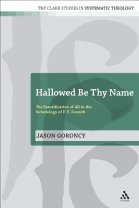
Another update on ‘Hallowed Be Thy Name’

T&T Clark have published another endorsement for my forthcoming book, Hallowed Be Thy Name: The Sanctification of All in the Soteriology of P. T. Forsyth. This time it is from Professor Alan P. F. Sell, who writes:

‘P. T. Forsyth (1848-1921) has been described as a “Barthian before Barth” (not entirely accurate, but a great compliment to Barth). His works enjoyed a revival in the middle years of the twentieth century, and now we are in the midst of a second great awakening inspired by Trevor Hart and others in the mid-1990s. Since then articles and monographs have appeared, and among the best is this book by Dr. Goroncy. He has fastened upon the thus far insufficiently-studied theme of sanctification which pervades Forsyth’s works. His treatment is stimulating, his research is unusually thorough, his style is fluent. The result is an important book which should be read by ministers of religion and church members, as well as by professional toilers in the theological vineyard—especially, perhaps, by any who have somehow momentarily mislaid the gospel’.

I am grateful to Professor Sell for his kind words. All going well, the book should be out in late March next year.

Ruminating on a broad tradition

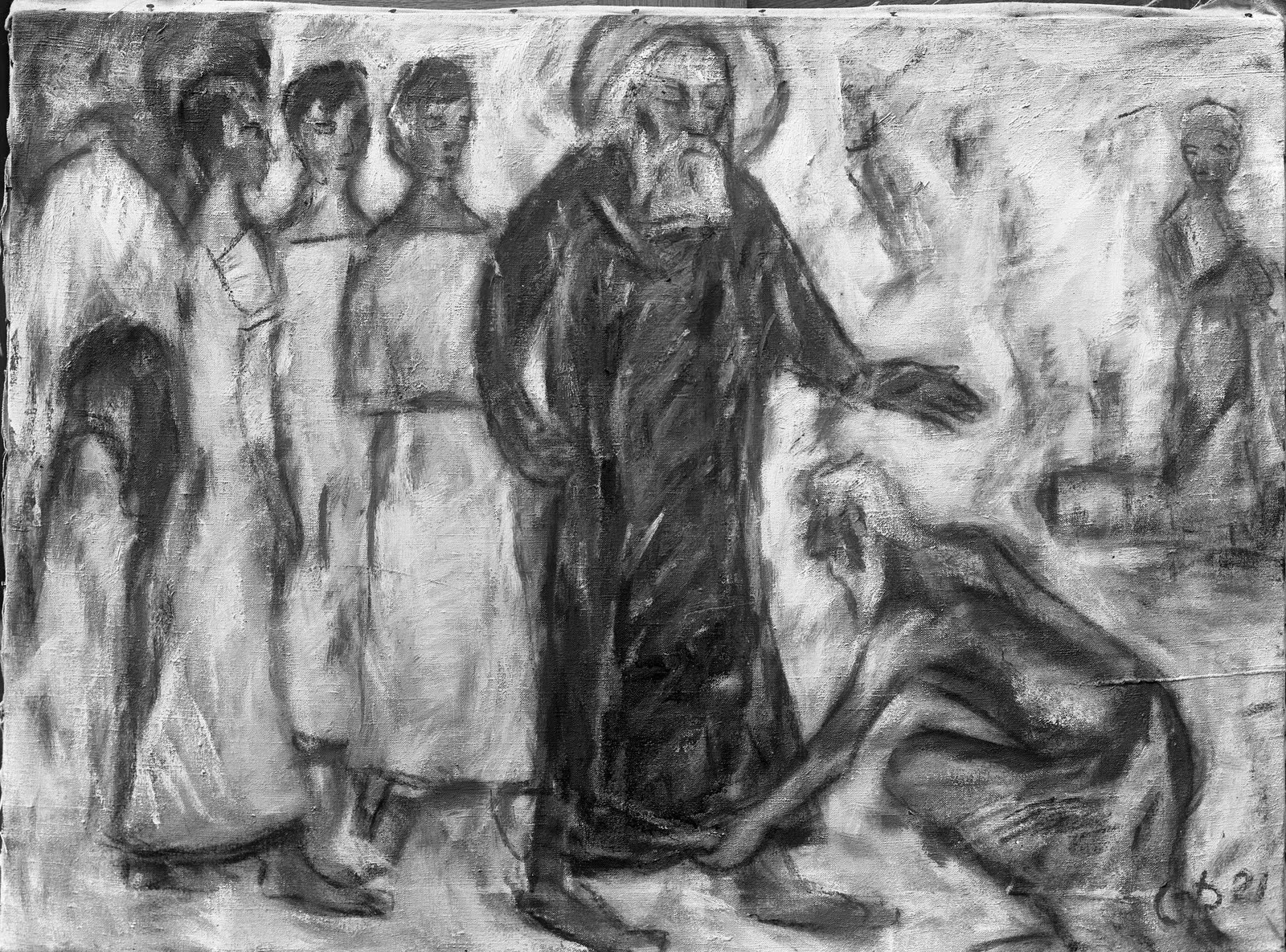
Christian Rohlfs, ‘God seeks out Abraham’, 1921. Staatsgalerie, Stuttgart.

In a recent post, I suggested that both culturally and theologically, the Reformed tradition is – at its best – a broad tradition, captive to neither ethnic nor cultural boundaries, nor to either the left or the right of the theological spectrum. I also noted that the Reformed believe that the politicising of the body of Christ along lines which limit the love and availability of God are a scandal against the Table of the Lord.

I’ve been thinking a bit more this afternoon about this Reformed conviction, and it seems to me that it both represents and gives rise to a number of commitments. I will note just five related matters:

  1. The Church is justified – and kept justified – by the grace of God alone and not by our efforts. All our efforts as both a claimed and proclaiming people ought to be directed towards bearing witness to this truth.
  2. Our unity in Christ, made concrete in the forgiveness of sins, means that all other distinctives are subdominant features of our being together.
  3. No one cultural or theological consortium has a monopoly on the experience or truth of God. This is not only to confess something about the fact that divine revelation is always sheer and surprising gift, but it is also to gesture towards the observation that if our knowledge and love of God (and, conversely, as Calvin noted, our knowledge and love of ourselves) is to deepen, we need to resist moves towards mono-culturalism in all its forms, whether theological, ethnic, sexual, geographic, etc. The Jerusalem Conference (recorded in Acts 15) represents, among other things, precisely such a commitment to mature in the gospel through wrestling and living together with the gospel-culture-ethical rub.
  4. The ‘other’ is not our enemy but represents God’s radical invitation to open-ended life, to dialogue, to prayer, to repentance, to growth, to transformation, to love, and to relationships characterised by mutuality, creativity, openness, trust and presence. Here one recalls the profound work of Jewish philosopher Martin Buber [and, we could add, that of Ricœur, Bonhoeffer, Sartre, and others] and particularly his essay I and Thou wherein he gestures towards the truth that it is not only one’s communion with the ‘other’ that makes human life meaningful, but also that such communion is a necessary counterpart to our communion with One who is always our ‘Other’. To give food to the hungry and drink to the thirsty, to welcome the stranger and clothe the naked, and to take care of the sick and visit the prisoner is, by the work of God, to come face to face with Jesus Christ (Matt 25; cf. Heb 13.2).
  5. To confess ‘I believe in Jesus Christ’ is, therefore, to both resist the temptation to domesticate God and to confess the absolute imperative to remain in fellowship with those with whom we disagree and with those whom we do not yet understand precisely because they too are in fellowship with God. As I wrote earlier, Jesus does not grant us the liberty to choose our friends. Rather, whenever Jesus comes to us he always brings his friends along with him as well … and he helps us to love them.

Some resources on early Presbyterianism

Despite the considerable freedom and trust that many of us teachers enjoy in shaping our courses pretty much how we’d like to, it’s pretty difficult, if not irresponsible, to teach a course on Presbyterianism without at least one lecture on John Knox. To neglect this thundering prophet and consummate politician during such a course would be like trying to teach someone about the history of fishing without ever mentioning Izaak Walton. And, of course, those doing research on Knox have much welcomed the recent studies on the sixteenth-century reformer by Rosalind Marshall and that by Richard Kyle and Dale Johnson. And then there is T. F. Torrance’s noble attempt (in Scottish Theology and elsewhere) to make Knox appear as a Barthian after his own image (an attempt, to be sure, which is nowhere near as pathetic as Eric Metaxas’ remarketing of Dietrich Bonhoeffer in American evangelical drag). But despite these stimulating studies, I confess that I have simply never found preparing lectures on Knox to be particularly interesting. I certainly expect my students to have a working knowledge of one of their major ecclesiastical grandpas, and of the massive events that led up to the birth of their ecclesial identity in 1560, and of the exciting and formative decades thereafter. And it is true that one simply cannot tell this story with an absent Knox, or, equally importantly, with an absent Andrew Melville. (By the way, Melville is himself the subject of a number of recent and much welcomed studies. See, for example, Steven J. Reid’s impressive volume, Humanism and Calvinism: Andrew Melville and the Universities of Scotland, 1560–1625, and the essay by Ernest R. Holloway III, published as Andrew Melville and Humanism in Renaissance Scotland, 1545–1622, both of which I found enormously helpful in filling in some of the gaps in my knowledge of this much underestimated giant of the tradition.)

I recently did some teaching on early Presbyterianism, and was committed – as I increasingly am – to approaching the subject ‘from below’. In my preparation, I draw heavily upon a number of very helpful studies. I want to draw attention to three of those. First, Margo Todd’s The Culture of Protestantism in Early Modern Scotland. There is no question to my mind that Todd’s is an exceptional study, unmatched in its scope and accessibility, and enormously helpful for gaining a sense of the bigger picture, and that with just the right level of detail so that you feel that you’re not being fed propaganda and/or sloppy work. The macro level vista is both the study’s strength and its greatest vulnerability, for while its overview nature superbly introduces us to themes and challenges associated with the subject, the book does not particularly assist readers to appreciate some of the geographically-specific features at play. In other words, it’s a bit like having a fantastic cookbook on Indian food but which makes little distinction between the Punjabi and Udupi palettes.

With Todd in hand, however, two additional studies assisted me to arrive at the subject with greater detail and a more pronounced awareness of the nuances at work. First, there is the remarkably entertaining Stirling Presbytery Records, 1581–1587 edited by, and with an stunning introduction from, the first-class historian James Kirk. Second, is John McCallum’s revised doctoral dissertation published as Reforming the Scottish Parish: The Reformation in Fife, 1560–1640 (in Ashgate’s St Andrews Studies in Reformation History series). Well researched (he draws mainly on largely-neglected kirk session minutes) and accessible writing presented with helpful charts is always going to be a winner when I’m preparing lectures. McCallum does what Todd doesn’t; namely, place the spotlight onto one region, a region (Fife) which is in many ways, as he argues, a reasonable snapshot – because of the diversity of Fife’s presbyteries and parishes – of the reforms and obstacles to reform that were taking place across the country. And McCallum’s focus on the themes of availability and training of ministers, of discipline (and the role of those ‘genuinely parochial institutions’ known as the kirk session) and of worship helped to bring those infant years of Presbyterianism alive for me, and helped – together with Todd’s and Kirk’s work – to fill in some important gaps in what has been a largely ignored period of the church’s life. I can only hope that additional studies exploring other areas of early Presbyterian life might be undertaken.

Some reflections on the 2012 General Assembly of the Presbyterian Church of Aotearoa New Zealand

It was the best of times,
it was the worst of times,
it was the age of wisdom,
it was the age of foolishness,
it was the epoch of belief,
it was the epoch of incredulity,
it was the season of Light,
it was the season of Darkness,
it was the spring of hope,
it was the winter of despair,

we had everything before us, we had nothing before us, we were all going direct to Heaven, we were all going direct the other way— in short, the period was so far like the present period, that some of its noisiest authorities insisted on its being received, for good or for evil, in the superlative degree of comparison only. (Charles Dickens, A Tale of Two Cities)

It was indeed something of a Dickens of a General Assembly, about which I’d thought I’d share a few reflections.

There were a number of genuine springs of hope for which I give thanks:

  1. The powhiri and service of worship at the Church’s national marae at Ohope, hosted by Te Aka Puaho, was very special, overcoming all the challenges of weather, logistics and a crummy sound system. One of the real highlights for me was when Richard Dawson presented the new moderator, Ray Coster, with a copy of the church’s confession of faith, Kupu Whakapono, written in Te Reo Maori, followed by a sung version led by Malcolm Gordon. The Assembly was last held at the marae in 1984 – too long ago – and this Assembly marked, in a number of significant ways, including Wayne Te Kaawa’s rousing speech during the Assembly business time, a maturation in the church’s bicultural journey.
  2. The former moderator, Peter Cheyne, spoke well about the things that have inspired him throughout his moderatorial term: ministry and mission at the grassroots, the caring witness of the people of God in Christchurch, his ongoing concern for a church committed to discipleship and to raising biblical literacy.
  3. The decision to call upon a foreign government (i.e., the New Zealand Government) – and hopefully there are responsibilities here that the church might be able to undertake as well – to establish relocation strategies with the governments of Pacific island nations in danger of disappearing as a result of climate change.
  4. It is always a highlight for me when we welcome international guests and observers. This GA, we welcomed 16 guests from Korea, Burma, Chile, Vanuatu and Tahiti.
  5. The church backed the campaign by Living Wage Aotearoa New Zealand. Margaret Mayman made the point that ‘people and their work have a dignity that makes the labour market substantially different from the purchase of other goods. The price of a person’s labour shouldn’t be determined solely by the market’. This is good news for theologians!
  6. I always have a real sense of pride when ex-students rise to speak. They invariably do so with a neat combination of wisdom and wit, and I reckon that their fresh – and most often younger – voices offer one of the most important contributions to the discussions.
  7. The moderator modelled grace, good humour and appropriate dignity throughout. Well done Ray!
  8. I have mixed feelings about the GA’s decision to grant presbytery status to the Pacific Islands Synod. (Howard Carter expressed my mind well.) Given the decision, however, we might have marked this significant event with more carnivalesque fanfare than we did.

And there were a number of factors which signified that we had indeed entered an ‘epoch of incredulity’ – all-too-familiar territory for the church. Among these were:

  1. No real coffee. I fail to see how anyone can be expected to discern the will of God without real coffee. This is the one great tragedy of the GA!
  2. While I’m on the matter, the vote to support the living wage movement seemed to be radically undermined by the absence of any Fair Trade beverages.
  3. And while I’m on the matter of hypocrisy, the church’s rhetoric of concern regarding climate change seems at odds with our decision to have hundreds of people jump into aeroplanes to attend one of these gatherings and then think little of the environmental cost of such a decision. My minister – peace be upon him – raised a wonderful point about this incongruence. He could have also mentioned something about the number of forests we raped doing our holy business.
  4. Apart from the few extra-ecclesial matters that were discussed, the highest court of the denomination – charged as it is with the solemn and joyous responsibility of listening for and to the divine voice in the world – seems to be much more interested in clanging its own cymbals and blowing its own bassoons. This is not altogether unexpected for it is almost inevitable that anxiety would drive us toward Pelagianism.
  5. The processes of discernment employed by the GA seem to be particularly successful in turning otherwise fine and friendly souls into packs of frightened, blind and deaf wolves. Put otherwise, the church seems to lack the imagination – and/or the theological resources and/or the leadership – required to enter into processes of discernment in ways other than marked by an unholy cannibalism with make a stranger stare (and then walk away) and which perpetuate cycles of abuse from one generation to the next. Like modern day Israel, those who were once victims now employ the very same tactics that they learnt from their abusers, tactics which disempower others to equally ugly effects and cycles which can only be broken by the ministry of mediation and healing given to us in God. Such behaviour served to remind me that the gospel is not a set of doctrines or ideologies, no matter how carefully articulated and well-intentioned – and that with due fidelity to Scripture – but a person; namely, Jesus the Christ. When our ethics, processes, practices, decisions and speech are cut loose from him they roam in the desert of meaning out of step with the grain of the universe, a desert that breeds a kind of unholy desperation out of step with apostolic faith. I know that the Church is the glorious bride of Christ, and the most beautiful creature in creation, but she really can be an ugly and vexatious bitch sometimes.
  6. Much of the debate concerned vexed matters around sexuality and leadership. It is really disappointing – not least because it is most unprotestant! – that both sides insist on grounding their arguments in logic devoid of any kind of christology. Either way you walk, Jesus simply seems to make no difference. For those on the left, the argument seems to be grounded in notions of ‘natural justice’, while those on the right insist on the making their case on the basis of ‘nature’. (I am, of course, aware of St Paul’s words about ‘natural’ and ‘unnatural’ intercourse in Romans 1, but remain entirely unconvinced that Pauline anthropology would sponsor the argument as articulated by traditionalists.) I wonder what might happen were both ‘sides’ to sit at the Lord’s Table together – the most suitable place for debate, and for love making – and begin with a different question; namely, who is Jesus Christ? That said, I am deeply encouraged that some of the ministry interns are trying to do precisely that! I am also deeply encouraged by a number of signs that the hard lines that have characterised our church in the past show real signs of wear and tear. Perhaps a new vision of being church together may result, a vision unenslaved to those modes of modernity which insist on perpetuating irrelevant and outmoded structures of top-heavy leadership – we really don’t need a presbyterian pope! – and where the rhetoric of ‘servanthood’ and ’empowerment’ and ‘local’ continue to characterise where the real action takes place.
  7. Among the many motions upon which the recent GA was invited to discern the mind of God God (quite a bold if not ridiculous thought when you think about it that way) was whether or not an invitation ought to be made to our Church’s Doctrine Core Group to ‘prepare a discussion paper on the theology of marriage within the Presbyterian Church, and explore its implications for public covenants of same-gender relationships’ (Notice of Motion #133). Given the liveliness of this topic in wider NZ society, and a long-standing Presbyterian tradition of seeking the welfare of the city, one may not be surprised to learn that not a few who attended Assembly were profoundly disappointed and somewhat bewildered when this motion received the support of less than half of the voting commissioners. I was also surprised to learn that this significant matter was not even reported on the PCANZ website among the list of items discussed on Saturday. (NB. I am not suggesting that anything sinister or underhanded is going on here, but simply making the observation). There are many things one might deduce from such a decision of our church’s highest court, but I am not interested here in commenting on these. Rather, I wish to offer a few observations about how and why such a move is so foreign to the best instincts of our tradition.

The Reformed faith is, according to John Leith, ‘not a fixed pattern of church life but a developing pattern that has both continuity and diversity’. Being reformed, in other words, is not so much about espousing certain doctrines or sharing a particular interpretation of the Bible but is rather about the fact that one has committed oneself to being involved in a certain kind of project: the project of renewing the faith according to the Word of God. So Michael Jinkins:

The Reformed faith is more an ongoing project than it is a tradition, a denomination, or even a communion, though it has elements of each of these. When we say, ‘We are Reformed,’ we are saying that we are Christians committed to a particular project. The Reformed project is concerned not so much with defining and defending such things as the uniqueness of a Reformed tradition as it is with recovering, in each new generation, Christian faith as God’s calling of humanity to new life in Jesus Christ. Such a mission reflects the commitment of John Calvin ‘to renew the ancient form of the church.’ Whenever the Reformed movement has become preoccupied with itself it has missed the point of its existence. The Reformed project exists to draw our attention to Jesus of Nazareth in whom God is revealed and through whom God redeems creation … This does not mean that there are no distinctive features of what we might call ‘Reformed faith.’ There are particular emphases that have distinguished the Reformed approach to Christian faith from that of other Christians. But these Reformed emphases remain just that: emphases. The most distinctive aspect of the Reformed faith is also its most catholic, or universal: its unflagging commitment to articulate the gospel of Jesus Christ.

The reformed project, in other words, is not about our beliefs, or our righteousness, or our values, or our interests, or our devotion, or our aspirations, or our hopes. The reformed project is about what the Christian faith is about – namely, the God revealed in Jesus Christ. It is about who this God is and what this God is doing in the world. It is about ever calling the church catholic to fulfil our vocation as witness-bearers to this good news. So the reformed minister and theologian Karl Barth understood that in theological study we are ‘always to begin anew at the beginning’. And, for Barth, as for all those engaged in the reformed project, the beginning point is never a concept or a principle. The beginning point is always a name: Jesus Christ. One simply cannot arrive at the right answers until one sets off with the right question. And the ‘quintessential question’ (Bonheoffer) facing our church is not, ‘What can the Reformed tradition do to ensure that it has a future?’ Or, even worse, ‘How can we guarantee the survival of the Presbyterian Church?’ Rather, the right questions are ‘Who is Jesus Christ?’, and ‘What is he up to?’, and ‘What is he calling us to participate in?’ The Lutheran theologian Ernst Käsemann expressed this well when he wrote: ‘Wherever ecclesiology moves into the foreground, however justifiable the reasons may be, Christology will lose its decisive importance, even if it does so by becoming integrated, in some form or other, in the doctrine of the church, instead of remaining the church’s indispensable touchstone’. And Barth too is worth citing here at length:

Theological work is distinguished from other kinds of work by the fact that anyone who desires to do this work cannot proceed by building with complete confidence on the foundation of questions that are already settled, results that are already achieved, or conclusions that are already arrived at. He cannot continue to build today in any way on foundations that were laid yesterday by himself, and he cannot live today in any way on the interest from a capital amassed yesterday. His only possible procedure every day, in fact every hour, is to begin anew at the beginning. And in this respect theological work can be exemplary for all intellectual work. Yesterday’s memories can be comforting and encouraging for such work only if they are identical with the recollection that this work, even yesterday, had to begin at the beginning and, it is to be hoped, actually began there. In theological science, continuation always means ‘beginning once again at the beginning.’ In view of the radical exposure of this science to danger, this is obviously the only possible way. The endangering of theology is strong enough to cut the ground away from under the feet of the theologian time and again and to compel him to look around anew for ground on which he can stand as if he had never stood on such ground before. And above all, the ever-new start is the only possible way because the object of theology is the living God himself in his free grace, Israel’s protector who neither slumbers nor sleeps. It makes no difference whether theological work is done with attention to the witness of Scriptures, with the reassuring connection to the communio sanctorum of all times, and certainly also with a thankful memory of the knowledge previously attained by theology. If God’s goodness is new every morning, it is also every morning a fully undeserved goodness which must give rise to new gratitude and renewed desire for it.

For this reason every act of theological work must have the character of an offering in which everything is placed before the living God. This work will be such an offering in all its dimensions, even if it involves the tiniest problem of exegesis or dogmatics, or the clarification of the most modest fragment of the history of the Church of Jesus Christ, but, above all, if it is the preparation of a sermon, lesson, or Bible study. In this act of offering, every goal that previously was pursued, every knowledge that previously had been won, and, above all, every method that was previously practiced and has supposedly proved its worth, must be thrown into the cauldron once again, delivered up to the living God, and proffered to him as a total sacrifice.

Theological work cannot be done on any level or in any respect other than by freely granting the free God room to dispose at will over everything that men may already have known, produced, and achieved, and over all the religious, moral, intellectual, spiritual, or divine equipage with which men have traveled. In the present continuation of what was won yesterday, the continuity between yesterday and today and between today and tomorrow must be submitted to God’s care, judgment, and disposing. Theology can only be a really free and happy science in a continually new performance of this voluntary offering. If it does not want to succumb to hardening of the arteries, barrenness, and stubborn fatigue, its work should at no step of the way become a routine or be done as if it were the action of an automaton. Because it has to be ever renewed, ever original, ever ready to be judged by God himself and by God alone, theology must be an act of prayer. The work of theology is done when nothing else is accomplished but the humble confession, ‘Not as I will, but as thou willest!’

It ought come as little surprise, therefore, to learn that Barth protested against attempts to found a theological school of thought or a ‘movement’ that might advance his own project. In this Barth was simply being true and consistent with his reformed conviction, for to be committed to the reformed project is not to be committed to being ‘Reformed’ but to being ‘Christian’ (albeit in a reformed kind of way) and to loving the church so much that you direct all your efforts towards her continual hearing of the Word of God rather than assuming that what you heard yesterday is the Word of God for today. The Word of God, in other words, is not an idea or words about an idea, but the dynamic person of God himself who in the freedom of grace makes himself available to us.

Some reformed theologians – Shirley Guthrie Jr., for example – have drawn attention to a double crisis within the tradition – a crisis of identity and of relevance. In some churches so much value is placed on identity – i.e., on adherence to tradition which is then often reduced to a series of propositional truths, etc. – that it often leads to the suppression of imaginative and critical thinking, and to the church becoming both exclusive and judgmental of those who think and live otherwise, and unable to respond creatively and effectively to rapidly changing circumstances. New information or perspectives are discounted in attempts to safeguard doctrine, polity or practice. In the end, it’s often simply about power.

At the other extreme, in a quest for relevance, some churches jettison tradition and historical memory altogether, losing their identity in the process. Abandoning or rendering superficial the resources of history, tradition, liturgy, and theology leaves churches vulnerable to cultural forces that promote idolatry. A church that has lost its memory is in a state akin to senility and prone to repeat the mistakes of the past. Henry Chadwick once made this point powerfully when in the midst of a debate at the Anglican Church’s General Synod (1988) he famously stated that ‘Nothing is sadder than someone who has lost his memory, and the church which has lost its memory is in the same state of senility’. A similar point was made by Simon Schama who, in responding to the lack of historical instruction in Britain’s secondary education, noted that ‘a generation without history is a generation that not only loses a nation’s memory, but loses a sense of what it’s like to be inside a human skin’. And Jinkins also writes:

When memory exits so goes our identity, our grasp on those particular and idiosyncratic recollections that make us who we are, that make us human, that hold us in relationship with one another, that not only make sense of our past but also orient us in the world. When memory fails us we are reduced to confusion. We cannot move forward because we have lost continuity with ourselves and with those who are closest to us. The question is why anyone – and more to the point I want to make – why any church would choose to jettison the memory that makes us who we are. Having loved and lost those who suffered from Alzheimer’s, how could any of us wish for such a fate to befall our church?

Once upon a time, of course, ‘Presbyterians simply looked like Presbyterians. They were clean and well starched. They went to Sunday school and believed in predestination’ (Alston). We may well wish to distance ourselves from such a caricature but there remains much value in our distinctiveness that takes us beyond the straitjacketed stereotypes. Correspondingly, we might think of the habitus, or character, of reformed Christianity in conjunction with its cultural-linguistic identity, a trait George Stroup characterises as ‘family resemblance’. Here, reformed identity is not so much an outdated stereotype, nor a set of theological-ecclesiological propositions, but a family photo album that spans several generations. While no two members of the family are identical, as you become familiar with the family it becomes possible to intuitively pick out a member of the family. [I am very grateful to one of my many amazing ex-students, Rory Grant, for pointing me to this article.]

We might think of such generational family resemblance as an artifact of the narrative history of the tradition – the reformed ‘look’ similar because they have a shared history. However, shared history does not automatically equate to a fixed set of criteria or attributes that define reformed identity. We need to think here of a tradition characterised by both continuity and diversity.

In my teaching, I am keen to assist students to understand and value the characteristics that make the reformed faith distinct. Among these characteristics are (i) a commitment to being a broad church, and (ii) our strong emphasis on education and, relatedly, an expectation of an educated clergy.

Certainly, the reformed tradition is – at its best – a broad tradition, captive to neither the left nor the right of the theological spectrum. The reformed believe that the politicising of the body of Christ along lines which limit the love and availability of God are a scandal against the Table of the Lord. One place we see such happening in our context here in New Zealand is where those associated with more progressive expressions of reformed faith and who dominated our General Assembly and college for over half a century now find themselves on the margins and struggling to find a place in a sea of more conservative expressions of the faith. Regardless of where one sees oneself on the theological spectrum, this situation constitutes an ongoing challenge to our identity historically conceived. Also, as in many other places, increasingly our ministers and congregations come from non-reformed backgrounds. This basic ignorance of reformed identity means a loss of connection with our past, and that leaves us more vulnerable to both repeat its mistakes, and not free to celebrate, learn from and build on its strengths.

Breadth also means taking seriously the cultural, ethnic and social diversity in the Presbyterian family, and a commitment to making the journey together. We are all so much the poorer without each other. Shall the toenail say to the belly-button, ‘I don’t need you’? We as a church are yet to find ways where our full ethnic diversity is both represented and celebrated. There are challenges here, to be sure – translating all the English material into Korean and vice versa, for example – but it’s worth taking up as a priority for the next Assembly, and at presbytery level too. We as a church are all so much the poorer without our breadth.

If what I have witnessed at the past two GAs is any indication of things, the trust barometer of the church is pretty low. And without trust, the divisions shall only widen, and harden. I have also witnessed a people who – on all sides of each debate – care deeply for the church, who love the church and who are invested in its betterment and in the betterment of its witness to God’s love in the world. We must all do better to widen that affection not only for our own patch, or for the church in the abstract, but for the actual people that God has made us family with. This road will require forgiveness, apart from which there will be no future for the PCANZ. The Christian does not carve out his or her own story ex nihilo, or even with the likeminded alone. Jesus does not grant us the liberty to choose our friends. Rather, whenever Jesus comes to us he always brings his friends along with him as well … and he helps us to love them, to stake our very existence on the claim that I simply cannot be me without them, hence the deep existential pain born of the great mistrust between Abel and Cain. Remain unconvinced? Read 1 John! ‘Those who say, “I love God,” and hate their brothers or sisters, are liars; for those who do not love a brother or sister whom they have seen, cannot love God whom they have not seen. The commandment we have from him is this: those who love God must love their brothers and sisters also’. To this end, it is my hope that the PCANZ might learn here from our brothers and sisters across the ditch in the Uniting Church in Australia and embrace the consensus model of discernment at every level of its governance. Enough said.

On the question of education, we might simply note that education was fundamentally important in Grandpa Calvin’s church, and in the early reformed movement more widely. In Geneva, for example, this is evident through the emphases on catechesis and the ‘sermon’, and through the establishment, in 1559, of the Genevan Academy which became the nursery of reformed movements in France, the Netherlands and Scotland. In 1536, at a town meeting, the Genevans also voted to begin what is considered to be the first public-run school. Such a commitment betrays the reformed assessment of all creation thriving as both under the sovereign government of God and as the ‘theatre’ of God’s glory, and sponsors the reformed determination to engage in public theology. The church has always faced the temptation to disengage from the world, to take a turn inwards and focus almost entirely on ‘churchly’ or ‘spiritual’ matters. One response to this turn here in NZ has been to try to carve out a space in university departments for Christian theologians with a proven record and proficiency in the area of public theology to contribute in a constructive way to public discourse around issues facing our nation (e.g., domestic violence, restorative justice, climate change, foreign trade, etc.). These strategic positions sometimes need to be funded from church sources but the positions I have in mind in NZ are already proving to make an important contribution to public discourse, and to model for local churches how they might go about doing the same in their contexts. For example, Chris Marshall serves as Head of School of Art History, Classics and Religious Studies at Victoria University, a position initially fully-funded by a local church in Wellington. Also, the University of Otago has set up the excellent Centre for Theology and Public Issues which is headed up by Andrew Bradstock. One downfall of this model of subcontracting public theology to the university, however, is that it threatens to remove public theology from the life of the church. Does the church need to resurrect its Public Issues Committee, freshly conceived?

The matter of education also finds deep roots in the inclination of the reformed to insist on an educated and theologically-rigorous clergy and church. Historically, one of the real gifts that the reformed have bequeathed to the wider Church and to the discipline of theology has been the rigour with which it has undertaken the indispensable task of talking about God and about God’s work in the world. The twin temptations of abandoning this rigour and/or buying too uncritically into the humanist and enlightenment program with which it has sometimes been associated are real. But it is only to our detriment and – more importantly – to the detriment of the Church’s ongoing witness to Christ that the reformed would neglect this fundamental task. To speak of God in such a way that engages the real questions of our time is not a task for the faint-hearted or the frivolous.

Again, Jinkins:

One of the greatest gifts of the Reformed project is its commitment to the life of the mind in the service of God. From the first, Reformed Christians have sought to advance the best thinking in the face of superficiality, superstition, bad religion, social reactivity, and anxiety. As expressions of confidence that Christian faith and the promotion of knowledge go hand-in-hand, the Reformed project established the first programs of universal education, founding universities, graduate schools, and teaching hospitals as it moved across the world. Today the world’s problems have become extraordinarily complex, and many religious people try to prove their religious devotion by refusing to test their convictions intellectually or by seeking to silence those with whom they disagree. Now more than ever, we as Reformed Christians must foster the curiosity and intellectual openness that have driven us to think deeply, for there is desperate need for faithful people who are bold and unflinching thinkers, people who will use their best knowledge and concerted intellect to engage and mend a broken world.

So we are thinking here about the posture of the reformed to love God (and God’s world) with our mind, as well as with our heart, soul and strength. The reformed are typically those in the body of Christ who worry about what will become of Christian faith – and, indeed, of the world – if Christians fail to ask the tough, deep, critical, sometimes intractable questions about life. They are those who are ‘concerned about what it will mean for our faith if we choose to ignore life’s most profound mysteries and insoluble riddles’, who are ‘concerned about the integrity of the church if we abandon the curiosity that is unafraid to swim at the deep end of the pool, if we jettison a passion for ideas, for knowledge, and for wisdom for their own sake’ and who are equally ‘disturbed about what will become of society if persons of faith retreat from the public sphere, where ideas must fight for their lives among competing interests, where justice is served by vigorous argumentation and intelligent action as much as by high ideals’ (Jinkins). They are those who believe that the greatest heresy the church faces today is not atheism but superficiality, and its attendant ‘cult’. To cite Jinkins, again:

Occasionally I hear editors of church publications or church growth consultants arguing that Christian laypeople just aren’t interested in theology, or that laypeople aren’t interested in the history of their faith or, worse still, that laypeople simply can’t understand complicated ideas. Yet, when I speak in congregations around the country, I regularly encounter crowds of lively, intelligent laypeople hungry to know more about their faith. These are laypeople, incidentally, who in their daily lives run businesses and shape economies, teach, read or even write important books on a variety of serious subjects, argue legal cases before judges and juries, write laws that shape our common life, and cure our diseases of the mind and body. These laypeople are tired of being infantilized at church. They want to understand their faith more deeply.

The comments of the laypeople I meet, people who want to learn more about their faith, are often along the lines of what an elderly woman said … one Sunday after [Tom Long] had preached in one of the many congregations in which he speaks around the country. As he was making his way from the pulpit to the sanctuary exit, the woman stepped forward to greet him. Earlier in the evening, Tom had invited members of the congregation to share with him any messages they’d like him to take back to the future ministers he teaches in seminary. As this woman stepped forward, Tom greeted her with the question, ‘Is there a message you’d like me to take back to the seminary, something you’d like me to tell our students?’

‘Yes, there is,’ she said. ‘Tell them to take us seriously.’

Now, I know that not every person in our churches, or indeed in our society, craves to understand God (or anything else) more deeply. But I would also maintain that at the core of the gospel there is a sacred mandate – we call it the Great Commission – to go into all the world to make disciples, ‘teaching them to obey everything that I have commanded you’ (Matt. 28:20). The word disciple translates a Greek word that means ‘pupil’ or ‘willing learner.’ As church leaders, then, we have this duty, this mission, this commission: to teach, to kindle curiosity, to expand knowledge, to renew minds, to make our people wiser. And there are many, many people only too eager to learn.

The reformed emphasis on the importance of education needs to be tempered, however, with the kind of humility that many reformed emphasise concerning human personhood in general, and about the noetic effects of the Fall in particular. Truth (as the saying goes) is the first casualty of war. But self-criticism is among the first casualties of insecurity, especially those brands of insecurity that transform thinking people into an unthinking herd.

Christian faith, on the other hand, thrives on a spirit that resists taking itself too seriously. As G. K. Chesterton once suggested, angels can fly because they take themselves lightly. Devils, on the other hand, fall under the weight of their own self-regard. Again, Jinkins:

A thinking faith is a self-critical faith. A thinking faith knows its own limits because it is guided by a comprehension of a basic reality: we are human. We are creatures. We are not God. Thinking faith’s recognition of human finitude generates reverence for transcendence and recognition of the limits even of its own claims.

Thinking faith is characterized as much by its humility and reticence as by its pronouncements. Along with its reverence for God and respect for others, it is characterized by a kind of irreverence toward its own certainty. One might regard thinking faith as a faith chastened by knowledge and experience. One would certainly regard thinking faith as a faith that has made its peace with ambiguity, because it cannot and it will not try to justify itself in the presence of God. But it is inevitable, for these very reasons, for a thinking faith to be thought ‘weak’ by some.

It has become commonplace in our culture for Christians to believe they can only prove their faith by claiming to know the mind of God. Yet, pretensions to certainty do not signal a superabundance of faith. They indicate, rather, faith’s vanity and paucity. Religious dogmatism is the child of insecurity.

All this is to say that it strikes me that there is something most foul and most un-reformed at work whenever a member of the reformed family of churches makes a decision to not keep engaging theologically, particularly with the very matters that it has just discerned are ‘fundamental’ to the Christian faith. That the recent GA made precisely such a decision (regarding NOM #133) strikes me as deeply disturbing.

The matters to which NOM #133 are inviting the church to engage are not black and white, but brim with doctrinal, pastoral, ecumenical and ecclesial implications, not least around the question of our relationship with the State. We are a people called to have our agenda set not by the State but by God’s good news announced in Jesus Christ – news which ought to inform and give shape to all our life together and to God’s vision for a society in which human personhood is radically reconstituted after the image of One whose hospitality is most irresponsible, surprising and risky. I consider NOM #133 to be an invitation – perhaps even an invitation by God – to pause and to ask deeper questions about our identity as creatures and as church, and to grow as a result. I am not sure that we as a church together have asked those questions yet in a mode that leaves us satisfied enough to move forward on this divisive issue in a way that gives due fidelity to the gospel and to the hard questions that the gospel raises for us. I can only hope that this desire will not rest, and that ministers and others will seek to bring the essence of NOM #133 to their respective presbyteries (and invite other presbyteries too) with a view to an invitation then being made to the much under-utilised Doctrine Core Group to do some work on this question for us all. The invitation for this important work need not come from the GA though the fruit might well serve that court of our church.

[Image by Diane Gilliam-Weeks. Used with permission]

The great (children’s) bible hunt

Finding a suitable bible for a 6-year-old is proving more difficult than I had anticipated. Thus far, the said child and her father, both of whom love to read, have been very well served by The Jesus Storybook Bible. But they’re now both ready for the long-anticipated Stage Two, and the pickings really do appear to look rather slim and, it should be noted, depressing. At this stage, the responsible parent (no churlish comments here please; though, while we’re on the subject, you may wish to check this out) reckons that the NRSV Children’s Study Bible tops the list. The NIrV Adventure Bible for Early Readers not only sounds like a rare and exhausting disease that young readers would be better to be steered clear of at all costs but its pages are just a little too distracting (and I’m uncomfortable further lining Murdoch’s pockets!), and the ESV Seek and Find Bible has all the creepy hallmarks of a Watchtower magazine. I’d prefer something that doesn’t have the appearance of a glossy Warehouse catalogue [for US readers, think Walmart minus that hunting department so proudly sponsored by the demented Second Amendment], or isn’t filled with extraneous puzzles and ‘Christian’ propaganda, or which doesn’t reduce the words of life to a collection of sanitised McStories, each of which sponsor the impression that the Book is something other than serious stuff.

Suffice it to say that at this stage, I’m open to suggestions …

September stations …

Reading:

Listening:

Watching:

The Moby-Dick Big Read

There’s a beautiful new site dedicated to the massively-worthwhile project of making lie of the claim that Moby Dick is ‘the great unread American novel’. The Moby-Dick Big Read is ‘an online version of Melville’s magisterial tome: each of its 135 chapters read out aloud, by a mixture of the celebrated and the unknown, to be broadcast online in a sequence of 135 downloads, publicly and freely accessible’. It’s only up to chapter 13, so not too late to jump on board, or you can access the book via the iTunes or Podcast feed. There’s never a wrong time to read or to re-read Moby Dick.